Federal government paying to move migrants from Quebec to Ontario

Burden sharing!

The federal government transported almost all of the migrants entering the country through Roxham Road to other provinces over the weekend, said Quebec Minister of Immigration Christine Fréchette on Tuesday, calling the wave of relocations a “new approach” from Ottawa.

Three hundred seventy-two of the 380 migrants who arrived in Quebec by that route on Saturday and Sunday were relocated, largely to Ontario, the minister said in a scrum in Quebec City on Tuesday.

She saluted Ottawa for fulfilling the province’s demand for help with the recent influx of asylum seekers through the irregular border crossing south of Montreal and called on Justin Trudeau’s government to continue.

“We are starting to see results,” said Ms. Fréchette. “We’re very happy with that.”

The federal government has been relocating Roxham Road migrants regularly because of capacity constraints in Quebec since last summer, and would not confirm whether the spike in relocations was a new policy or a blip. Since June, more than 5,300 migrants have been relocated from the province, including some 500 to Windsor, Ont., and roughly 2,700 to Niagara Falls, Ont.

A federal source said this is part of a long-standing initiative, paid for by Ottawa, but did not clarify whether the number of people being relocated outside Quebec have been expanded. The source added that people who do not want to relocate can stay in Quebec.

The Globe and Mail is not naming the source because they were not authorized to speak about the matter.

Ms. Fréchette called on the federal government to maintain the recent heightened rate of removals, repeating her government’s position that Quebec’s “welcoming capacity” has been surpassed. Roughly 60,000 asylum seekers arrived in Quebec last year, double the annual number from before the pandemic, the minister has said.

That has sparked a fierce political debate in the province about how to manage the situation, with the opposition Parti Québécois tabling a motion in the National Assembly recently calling on the government to “close” the border crossing.

Federal opposition parties have also repeatedly called for a review of the Safe Third Country Agreement with the United States, a long-standing pact that requires border agents from each country to turn away asylum seekers from the other if they present themselves at official land border crossings.

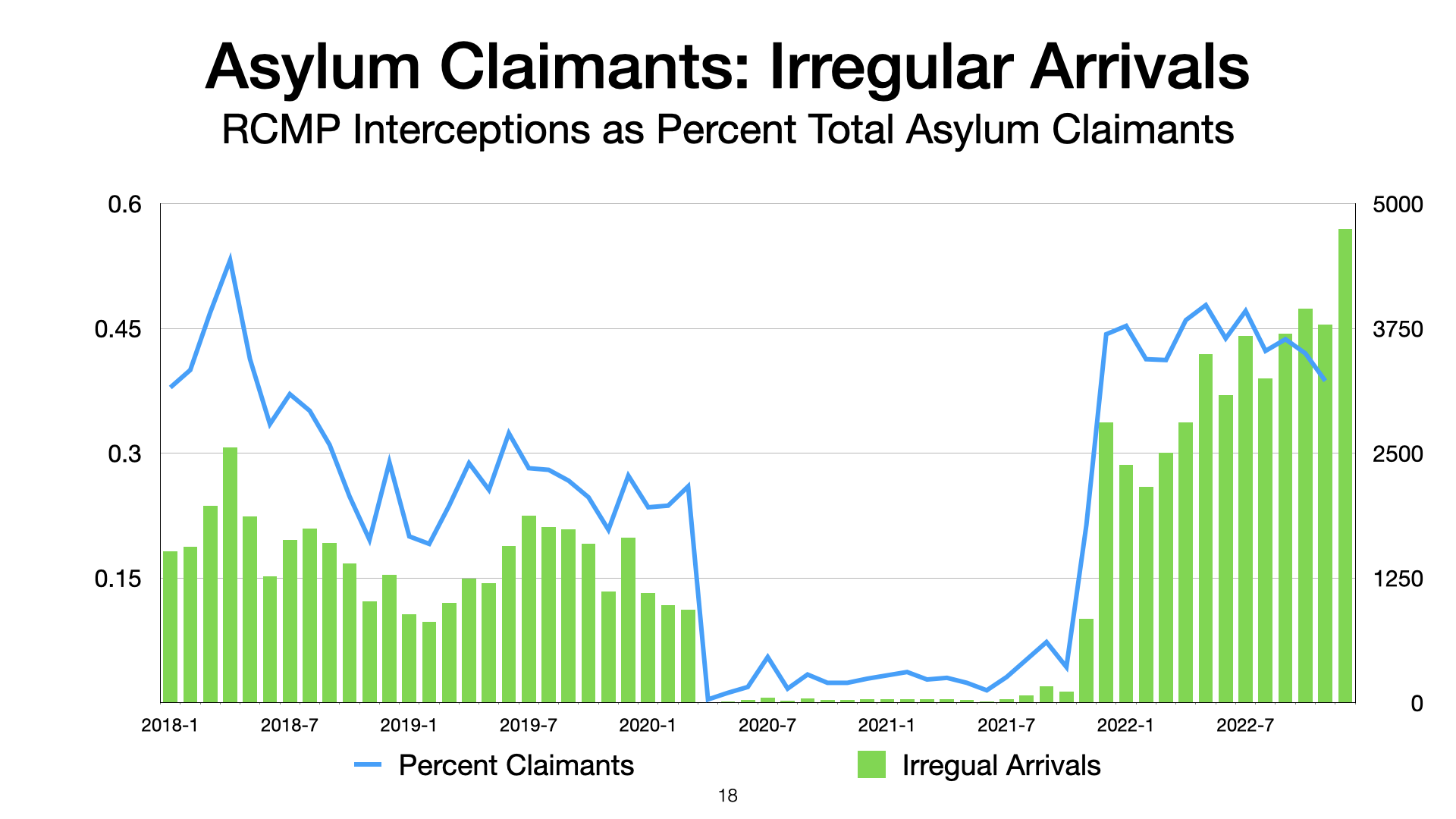
Roxham Road, along the border between New York State and Quebec’s Eastern Townships, has become the primary route for irregular entries into Canada in recent years. The RCMP intercepted 34,478 asylum seekers who did not use official ports of entry to enter Quebec between January and November of 2022, according to Immigration, Refugees and Citizenship Canada data, compared with just 316 in the rest of the country.

On Tuesday, Ms. Fréchette called the weekend’s mass relocations a “first step” that could potentially come to involve other provinces receiving asylum seekers from Roxham Road. She said the federal government recently booked 500 hotel rooms to house migrants in Ontario as a sign of seriousness.

“I don’t have information about what happened on Monday, but we are expecting that this new approach persists,” she said.

In the future, she added, her government is asking that the share of asylum seekers who stay in Quebec be kept around 22 or 23 per cent, in keeping with the province’s demographic weight within Canada.

Roxham Road has become one of the stickiest issues in Quebec politics as Premier François Legault’s nationalist Coalition Avenir Québec government has sought to manage public unease with the increase in irregular migration.

On Tuesday, Mr. Legault met with U.S. ambassador to Canada David Cohen to ask for a speedy renegotiation of the agreement governing asylum seekers between the countries.

“I said to him, ‘I don’t understand why it’s taking this long to settle with the United States.’ What we’re asking is that the Safe Third Country Agreement be applied to all ports of entry, including Roxham.”

Source: Federal government paying to move migrants from Quebec to Ontario

And the article in Le Devoir:

La ministre de l’Immigration, de la Francisation et de l’Intégration, Christine Fréchette, s’est réjouie mardi du fait que presque la totalité des demandeurs d’asile ayant traversé la frontière par le chemin Roxham la fin de semaine dernière ont été envoyés en Ontario.

Parmi les personnes qui ont emprunté cette voie de passage irrégulier samedi et dimanche, seules 8 sur 380 sont restées au Québec, a affirmé Mme Fréchette en mêlée de presse. « On est très contents de ça et on espère que ça va se maintenir dans le temps », a-t-elle dit.

Récemment, « 500 chambres additionnelles » ont été réservées par Ottawa en Ontario afin d’accueillir des demandeurs d’asile, a-t-elle affirmé.

La ministre Fréchette soutient que « la capacité d’accueil du Québec a été dépassée ». « On demande à ce que la proportion des demandeurs d’asile qui restent au Québec équiva[ille] au poids politique du Québec à l’intérieur du Canada, a-t-elle ajouté. Donc on parle de 22 à 23 %. Là, on serait dans des eaux acceptables. »

Christine Fréchette admet toutefois que le dossier sera « réellement réglé » par une renégociation de l’entente entre le Canada et les États-Unis sur les tiers pays sûrs. Le chemin Roxham, situé au sud de Montréal, n’est pas soumis à l’accord, car il s’agit d’une voie de passage irrégulier. Un total de 39 171 demandeurs d’asile y ont été interceptés l’an dernier.

En juillet dernier, Jean Boulet, qui était alors le ministre québécois de l’Immigration, avait salué la décision du gouvernement fédéral de rediriger en Ontario une centaine de demandeurs d’asile entrés de façon irrégulière au Québec.

Le bureau du ministre fédéral de l’Immigration, des Réfugiés et de la Citoyenneté, Sean Fraser, dit s’adapter depuis l’été dernier en fonction de la capacité du Québec et de ses besoins. « On reconnaît qu’au Québec, c’est un gros fardeau », a dit au Devoir Émilie Simard, porte-parole du ministre.

Legault et l’ambassadeur américain

Plus tôt mardi, le premier ministre québécois, François Legault, a dit qu’il continuerait à faire pression sur son homologue canadien, Justin Trudeau, afin qu’il « accélère » les négociations avec les États-Unis concernant l’accord sur les tiers pays sûrs.

Il a d’ailleurs profité de sa rencontre le jour même avec l’ambassadeur américain au Canada, David L. Cohen, pour déplorer le fait que le chemin Roxham n’est pas inclus dans l’entente.

Sur Twitter, M. Cohen s’est réjoui d’avoir pu discuter des « objectifs des États-Unis et du Canada en matière d’énergie propre, de commerce et de nos frontières communes ».

Source: La ministre Fréchette se réjouit du transfert de demandeurs d’asile en Ontario

U.S. border agents give rides to Quebec-bound migrants as side hustle, sources tell Radio-Canada

Hard not to see how this story, and the higher numbers, will not encourage the government to act (not just pretend to act?):

U.S. Customs and Border Protection (CBP) is investigating reports that some of its border patrol agents are driving Quebec-bound asylum seekers to the irregular border crossing on Roxham Road in exchange for money, picking up groups of people in nearby Plattsburgh, N.Y., while off duty.

Sources have told Radio-Canada the practice “has been known for a few months,” adding that several agents are involved, but the exact number is unknown.

The CBP’s Office of Professional Responsibility (OPR) said Friday it “is in receipt of these allegations and is conducting an investigation” but “the commencement of an OPR investigation is not indicative of wrongdoing or the substantiation of alleged misconduct.”

This situation has been reported to Canadian authorities, according to Radio-Canada sources.

Many people looking to cross into Canada use a regular bus line to get to Plattsburgh,which is about 30 minutes away from Roxham Road.

From there, they walk through a wooded passage, enter Canada and seek asylum.

CBSA says it’s ‘aware of situation

When first contacted by Radio-Canada, the Canada Border Services Agency (CBSA) confirmed twice in writing that it was aware of the transportation situation involving U.S. border patrol agents and migrants.

“We are aware of the information you are reporting,” said spokesperson Jacqueline Roby. She added that the CBSA “is in contact with the United States regarding irregular migration issues.”

In another written exchange, the CBSA repeated the same message while instructing Radio-Canada to contact its American counterparts, the CBP.

Source: U.S. border agents give rides to Quebec-bound migrants as side hustle, sources tell Radio-Canada

Nicolas: Claquer la porte 

Always interesting commentaries by Nicolas, and, given the variety of identities many of us have, of “slamming the door shut” rather than understanding and engaging:

Comme je suis liée au milieu universitaire, à la société civile puis au monde médiatique torontois, et du reste du Canada plus largement, depuis près de 13 ans, ma compréhension de notions comme le Québec bashing s’est nuancée au fil des années. On me permettra de partager ici quelques réflexions sur le sujet.

Notons que le concept de Québec bashing n’est pas utilisé ici de manière interchangeable avec la notion de « francophobie », qui regroupe un ensemble d’attitudes touchant directement les francophones qui sont en situation minoritaire, à l’extérieur du Québec. On pourra y revenir dans un autre texte.

Est-ce que « les Anglais nous méprisent et nous haïssent », comme l’avancent certains tribuns et autres fins sociologues peu réputés pour faire dans la dentelle ? La vérité, c’est que, tout comme la société québécoise s’est profondément transformée au cours des dernières décennies, le reste du pays n’est aussi plus ce qu’il était. Tout comme au Québec, donc, il y a ailleurs au Canada un clivage générationnel important entre ceux qui se souviennent des négociations constitutionnelles et des référendums, et ceux qui étaient trop jeunes. J’ai surtout été témoin, parmi les générations plus âgées, de deux attitudes principales.

La première est surtout nourrie par une lassitude : on n’a jamais vraiment compris (ou voulu comprendre) la différence québécoise, et on a l’impression que le Québec, politiquement, est une espèce d’enfant gâté qui utilise son poids politique dans la fédération pour ne pas jouer selon les mêmes règles que tout le monde. On a pu lire souvent, par exemple, que si Justin Trudeau n’a pas critiqué aussi vertement François Legault que Doug Ford pour leurs usages récents de la disposition de dérogation, c’est parce que le Québec fait l’objet d’un traitement de faveur.

La deuxième s’appuie sur une fascination parfois très sincère, parfois quelque peu fétichisée pour le Québec. Parce qu’on a encore un souvenir très vif de la fragilité de la fédération, une certaine élite canadienne exprime sa passion pour « l’unité nationale » par une curiosité particulière pour le Québec et son évolution.

Chez les plus jeunes (et les plus récemment arrivés au Canada), la question se pose autrement. Tant ici qu’ailleurs au pays, la question de « la différence québécoise » au sein du Canada a émergé politiquement pour les millénariaux et la génération qui les suit non pas par le débat sur la souveraineté, mais d’abord à travers toute la saga des accommodements raisonnables, puis par le débat sur la Charte des valeurs, le racisme systémique, les lois 21 et 96, etc.

Il y a une différence fondamentale — j’insiste, fondamentale — entre un jeune de Scarborough ou de Mississauga, immigrant ou enfant d’immigrant, qui n’entend parler politiquement du Québec qu’à travers le refus de sa classe politique de reconnaître le racisme systémique ou de nommer l’islamophobie, et un conservateur de l’Ontario ou du Manitoba rural qui a absorbé, un peu par osmose, les vieilles rengaines orangistes de ses aïeux. J’ai été beaucoup en contact avec l’un, par exemple, lorsque j’étais chargée de cours à l’Université de Toronto, alors que j’ai surtout vu l’autre sévir dans les sections commentaires de certains journaux.

Les deux posent, lorsqu’ils en ont l’occasion, des questions que l’on peut sentir empreintes d’une méconnaissance profonde de la société québécoise dans toute sa complexité et ses nuances. Mais les postures de base et les dynamiques de pouvoir qu’elles sous-tendent ne pourraient être plus diamétralement opposées. Je ne peux pas répondre à mon étudiante qui se préoccupe de l’impact des débats identitaires québécois sur le reste du climat politique canadien — et donc, en fin de compte, sur sa propre sécurité, comme s’il s’agissait de la réincarnation de James Wolfe prêt à revenir brûler nos villages avec son armée.

Cette différence, on est trop peu nombreux à la saisir au Québec. Pour la faire, il faudrait que ceux qui commentent ces questions se sortent eux-mêmes, un tant soit peu, de leur propre lassitude, indifférence, et ignorance du Canada dans toute sa complexité et ses nuances. Depuis le temps que je parcours la 401 dans un sens comme dans l’autre, il y a au moins une chose qui m’apparaît claire : dans ce pays, le sens de la caricature a toujours été parfaitement bilingue.• • • • •

Dans le contexte, on me demande parfois pourquoi je reste dans le dialogue avec le reste du Canada, ou pourquoi je ne claque pas la porte d’un média qui a déjà publié des opinions douteuses sur le Québec dans le passé. Serais-je ainsi complice du Québec bashing ?

La réponse, c’est que je suis une Québécoise francophone de même que je suis une femme, une personne noire et une personne queer. Si je croyais opportun de claquer la porte de toutes les salles de rédaction qui publient des opinions qui viennent heurter mon vécu personnel et familial tant sur le plan de la langue, de la race que du genre, je ne travaillerais plus nulle part, dans aucune langue. Personnellement, je préfère ne pas hiérarchiser les différents aspects de qui je suis, et tente de rester cohérente dans ma manière de réagir à toutes les attaques.

On en comprend que l’impatience, le brûlage de pont et le claquage de porte, donc, sont surtout des réflexes politiques partagés par les personnes socialisées comme majoritaires au sein de leur société. Il faut avoir le luxe, en quelque sorte, de savoir qu’on peut toujours éviter les dialogues difficiles en se repliant vers un monde où les normes sont pensées pour nous. Remarquons enfin que les francophones des autres provinces ont, de manière générale, développé une culture de la résistance politique très différente de celle qui s’affiche souvent au Québec.

Source: Nicolas: Claquer la porte 

ICYMI: Quebec ups funding for asylum groups as New York issues free bus rides to border

Of note:

Quebec is increasing its funding to community groups that help refugee claimants as the province grapples with a sharp increase of people coming through the unofficial border crossing at Roxham Road, south of Montreal.

The announcement came on the same day the mayor of New York revealed that his administration helps provide bus tickets to migrants looking to leave the city, including those travelling north to claim asylum in Canada.

Quebec’s Immigration Minister Christine Fréchette said she was “surprised” by the story and that it highlights the need for Ottawa to solve the problem at Roxham Road, used by tens of thousands of people last year.

She and the Minister of Social Solidarity and Community Action, Chantal Rouleau, announced $3.5-million in funding for dozens of groups helping to provide shelter, food and clothing to newcomers. They were responding to a recent call for help from community organizations.

“Right now, in Quebec, the resources devoted to immigrants and to the most vulnerable people are stretched to the limit,” Ms. Fréchette said. “Obviously the large number of people entering Quebec through Roxham Road is contributing to this overload.”

Roughly 60,000 asylum seekers arrived in Quebec last year, double the annual number from before the pandemic, the minister added, calling it an “unprecedented situation.”

New York Mayor Eric Adams told Fox 5 Monday morning that his administration helps in the “reticketing process” for people who arrive in the city but want to go elsewhere.

He told the news station that the city does not push or force people to leave but some express a desire to move on to other places, including Canada.

His comments come after the New York Post reported that some migrants in New York City are being given free tickets to Plattsburgh, N.Y., from where they travel about half an hour by shuttle or taxi to cross into Quebec at Roxham Road.

An official with Mr. Adams’s office said the city doesn’t treat requests for bus tickets to Plattsburgh any differently than those for other American cities.

In October, 2022, Mr. Adams declared a state of emergency as the number of people in New York City’s overwhelmed homeless shelters soared amid the influx of thousands of migrants from Latin America.

Federal opposition parties in Canada have repeatedly called for a review of the Safe Third Country Agreement with the U.S. – a long-standing pact that requires border agents from each country to turn away asylum seekers from the other if they present themselves at official land border crossings – but anxiety about the situation has been sharpest in Quebec.

The RCMP intercepted 34,478 asylum seekers who did not use official ports of entry to enter Quebec between January and November of 2022, according to Immigration, Refugees and Citizenship Canada data, compared with just 316 in the rest of the country.

The opposition Parti Québécois put forward a motion in the province’s National Assembly last week calling on the government to shut down Roxham Road with police help if necessary.

Source: Quebec ups funding for asylum groups as New York issues free bus rides to border

Les longs délais de traitement des visas nuisent aux universitaires

More concern in Quebec regarding visa delays, particularly with respect to conferences and academics:

Les longs délais de traitement pour obtenir un visa de visiteur au Canada causent de plus en plus de maux de tête à des organisateurs de conférences à Montréal comme à Toronto, qui comptent sur la venue d’experts et de participants de l’étranger. Cette difficulté d’obtenir un visa dans les temps complique la tenue de plusieurs de ces grandes rencontres, allant même jusqu’à les compromettre.

Originaire du Maroc, AbdelazizBlilid collabore avec Stéphane Couture, un professeur du Département de communication de l’Université de Montréal, pour une conférence qui doit se tenir au mois de juin à Montréal. Malgré son souhait d’enfin rencontrer son collègue canadien, qu’il n’a jamais vu en personne, M. Blilid est résigné. Avec un délai officiel de 216 jours sur le site Web d’Immigration, Réfugiés et Citoyenneté Canada (IRCC) pour obtenir un visa de visiteur, le professeur marocain n’a même pas encore pris la peine de déposer une demande.

« Si la situation reste comme telle, je ne demanderai pas de visa, et je manquerai ce deuxième colloque aussi », laisse-t-il tomber, en anticipant qu’il devra y assister à distance. Il commence à être habitué : la dernière fois, un long délai de quatre mois l’avait aussi dissuadé à déposer une demande de visa pour assister à un autre colloque.

L’été dernier, à la suite d’un article rapportant de longs délais de traitement pour les visas de visiteurs, le ministre de l’Immigration Sean Fraser avait réitéré son engagement à diminuer le temps d’attente à la fin de l’année 2022 pour le ramener aux normes de service. Or, comme Le Devoir le révélait mercredi, non seulement les délais n’ont pas baissé six mois après la promesse du ministre, mais ils ont plutôt explosé.

Stéphane Couture a reçu récemment une subvention du fédéral pourorganiser cette conférence, à laquelle40 intervenants et 200 participants sont attendus. Il avait en tête d’inviter des experts du Sénégal, du Maroc et du Cameroun avec qui il collabore. Mais devant les délais qui s’allongent, en particulier pour le Sénégal, où ils sont de 462 jours, il songe à tout reporter. « Une [solution] serait de tenir la conférence dans un autre pays », a dit le professeur.

Pour lui, ces longs délais de traitement nuisent non seulement à ses activités de recherche, mais également à toute son université. « Il y a une attractivité qui n’est pas là. Ce n’est pas très sérieux », soutient-il. « La mission de l’Université de Montréal, c’est d’être l’université francophone la plus influente du monde. Mais si ça prend un an et demi pour avoir la permission de venir visiter Montréal […] alors que mon collègue marocain dit que ça lui prend une semaine pour pouvoir aller en France… »

Les organisateurs de grands événements internationaux y penseront à deux fois avant de choisir Montréal comme ville hôte, craint M. Couture.

Plusieurs embûches

Longs délais de traitement, difficulté d’avoir de l’information concernant l’état d’une demande, acceptation ou refus de dernière minute : pour avoir été responsable de la logistique des participants pour différents congrès internationaux, Laura Sawyer, directrice générale de l’Association internationale de la communication (en anglais, ICA), sait de quoi elle parle.

Mme Sawyer a elle-même dû intervenir auprès des ambassades et des consulats pour aider des participants à obtenir le visa leur permettant d’assister aux divers congrès annuels de son association.

Cette année, le 73e Congrès de l’ICA, qui aura lieu à la fin mai à Toronto, accueillera plus de 4000 participants, dont plus de 3300 viendront de l’extérieur du Canada. Et selon leur nationalité, un grand nombre d’entre eux auront besoin du précieux sésame.

« Nous partageons la frustration des universitaires dans le monde face aux difficultés liées à ces voyages internationaux », a-t-elle affirmé au Devoir. Des difficultés qui se sont exacerbées depuis la pandémie, affirme-t-elle,et qui ont aussi un impact sur la logistique du séjour, dont la réservation des hôtels.

Sans pouvoir juger quatre mois à l’avance de l’ampleur du problème, Laura Sawyer, dont l’association compte plus de 5000 membres répartis dans 80 pays, s’attend encore une fois à devoir personnellement intervenir auprès des autorités migratoires canadiennes.

Les limites de la distance

Pour Mme Sawyer, même si les participants qui n’auront pas obtenu de visa pourront suivre le congrès à distance, il y a une limite à ne jamais pouvoir se rencontrer. « La valeur d’une conférence ne réside pas seulement dans les présentations et les panels, mais aussi dans les conversations de couloir, les événements sociaux, le réseautage », dit-elle. « C’est extrêmement frustrant quand un universitaire renommé, et qui est crucial pour un panel, se retrouve dans l’impossibilité d’entrer dans le pays hôte de la conférence. »

Assister aux conférences en ligne peut être une solution, mais c’est toutefois loin d’être idéal, croit aussi Stéphane Couture.

« Mettez-vous à la place de ces personnes-là. Si la conférence dure quatre jours en décalage horaire via Zoom, ils vont venir à deux ou trois réunions », laisse tomber le professeur. Il aurait aimé que ses collègues venus d’ailleurs restent quelques journées de plus que le colloque pour visiter la ville et tisser des liens. Toute la richesse des rencontres informelles est réduite à néant, déplore-t-il.

Une situation ironique, poursuit-il, quand on considère que la subvention fédérale qu’il a reçue se nomme Connexion, et que le but était « de connecter les gens ». « La dynamique qui permet des connexions va être grandement perdue, croit M. Couture. Les personnes africaines vont structurellement être désavantagées. »

De son côté, l’Université de Montréal indique que les universités canadiennes sont intervenues dans les derniers mois à ce sujet, au même titre que pour les permis d’études des étudiants étrangers.

Source: Les longs délais de traitement des visas nuisent aux universitaires

Liberals resist Tory, Bloc push for Quebec language law to rule federally regulated businesses

Just as Quebec zealously guards against and protests federal incursions into areas of provincial responsibility, so should the federal government with respect to federal jurisdiction. One of the recent rare times it is doing so:
Repeated attempts in committee Tuesday by Conservatives and the Bloc Québécois to incorporate elements of Quebec’s new Charter of the French Language in the modernization of the federal Official Languages Act were met with fierce resistance from federal Liberals.The study of C-13 in the parliamentary committee is still in its early stages, and the Bloc and the Conservatives have made it clear that they are siding with the Quebec government. They want businesses in Quebec, including federally regulated businesses, to comply with the provincial charter, which restricts the right of Quebec anglophones to work and be served in English.

More than once during Tuesday’s meeting, the Bloc and Tories introduced amendments that would lead to Quebec’s new language charter — formerly known as “Bill 96” — to prevail over federal jurisdiction, but they were defeated by the Liberals with the help of the lone NDP MP on the committee.

Source: Liberals resist Tory, Bloc push for Quebec language law to rule federally regulated businesses

Chris Selley: Liberal anti-Islamophobia does not include Quebec

Valid contrast. One does have to question the Liberal’s vetting process and their political understanding of Quebec as this reaction among the Quebec commentariat and politicians was likely:

One of the more astonishing scenes in Canada’s recent political history occurred over the weekend as Prime Minister Justin Trudeau, his Quebec lieutenant and Canadian Heritage Minister Pablo Rodriguez, and Industry Minister François-Philippe Champagne took turns wagging their fingers at Amira Elghawaby. She had been installed only the day before as Canada’s first official representative to combat Islamophobia, on the eve of the anniversary of the 2017 massacre at the Islamic Cultural Centre in Quebec City.

Champagne said he was “worried.” He suggested Elghawaby should take time to reflect upon what she had done. From his fainting couch, Rodriguez declared himself “wounded and shocked as a Quebecer.”

“I certainly don’t agree with her words and I expect her to clarify them,” Trudeau tutted.

Elghawaby’s crime? Elghawaby’s campaigning against Islamophobia actually extends to Quebec.

The controversy began Friday when La Presse unearthed a 2019 op-ed in the Ottawa Citizen, co-written by Elghawaby and fellow Canadian Anti-Hate Network board member Bernie Farber, lamenting the recent passing of Bill 21 — the Quebec legislation, now in force, banning civil servants in certain positions of state authority (notably teachers) from wearing religious garb on the job.

“Unfortunately, the majority of Quebecers appear to be swayed not by the rule of law, but by anti-Muslim sentiment,” Elghawaby and Farber argued. “A poll conducted by Léger Marketing earlier this year found that 88 per cent of Quebecers who held negative views of Islam supported the ban.”

This is not a controversial statement — certainly not by the standards of those who campaigned against Bill 21, as any reasonable appointee to Elghawaby’s new position would have done, Bill 21 being the most Islamophobic thing going in this country.

The pointless 15-year “reasonable accommodations” psychodrama that produced the Bouchard-Taylor Commission, the Parti Québécois’ failed “values charter” and eventually Bill 21 had some Jewish content, particularly around the issue of kosher food at Montreal’s Jewish General Hospital. The Supreme Court’s 2006 decision allowing Sikh students to wear kirpans at school is somewhere in the primordial ooze of this debate.

But no one can honestly deny that the vast majority of the angst was over Islam, and what some of its adherents choose to wear. The notion that the hijab (as opposed to the niqab or burqa) represents a radical, political and evangelical form of Islam is commonly heard in Quebec, and almost never anywhere else in Canada.

The aforementioned 2019 Léger poll found Quebecers’ “net positive” view of Catholics — i.e., positive minus negative – was 66 per cent; of Jews, 55 per cent; of Muslims, 37 per cent. Moving on to personal religious symbols, the net positive view of crucifixes was 59 per cent. The net positive view of kippas was 37 per cent. Of hijabs, 28 per cent. (Keep that in mind the next time someone tells you Bill 21 was a principled extension of the Quiet Revolution. It’s a neat trick, casting off the shackles of the Catholic Church while remaining resolutely pro-crucifix.)

When put on the defensive, Bill 21 supporters will often point out that the idea has support in the Rest of Canada. It’s true to a point: An Abacus Data poll last year found 30 per cent of Canadians outside Quebec liked the idea. But the figure in Quebec was 53 per cent. And rather crucially, Quebec is the only province where any politician in any party has even proposed such a law, never mind followed through on it to popular acclaim.

Elghawaby, an activist and journalist, has committed other rhetorical crimes, especially from the Quebec-nationalist point of view. In 2021, she declared herself nauseated by University of Toronto historian Joseph Heath’s contention that “the largest group of people in this country who were victimized by British colonialism, subjugated and incorporated into confederation by force, are French Canadians.” She has advocated for prayer rooms in public schools, and for including non-Christian holidays on official Canadian calendars. You could hardly pick two better positions to empurple a nationalist with a newspaper column or a seat in a legislature.

“One wonders how this person, with so many prejudices against Quebecers and clearly incapable of understanding the importance of secularism in the historical and social development of Quebec, could help improve the ambient climate and mutual understanding,” professors Nadia El-Mabrouk and François Dugré argued this weekend in La Presse.

She can’t. Almost certainly, no one can. Discussions in this country about Islamophobia, racism, minority rights and everything in that neck of the woods exist in two hermetically sealed chambers: One for Quebec, and one for everyone else. It’s basically impossible to speak to both worlds at once. But if anyone were capable of it, the minimum they would need is to be appointed by a government willing to support her when one world or the other got a bit offended.

As it stands, both the Quebec government and the opposition Conservatives in Ottawa are demanding Elghawaby’s resignation. The Liberals, having denounced her for no good reason, are making it easier, not harder, for them to do so. And they look as ridiculous doing it in Quebec as in the Rest of Canada. Asked Monday by reporters how he responded to the calls for Elghawaby to resign, Trudeau offered up some typically tawdry bafflegab: “She is there to speak for the community, with the community, and build bridges across. Obviously she has thought carefully over many years about the impacts that various pieces of legislation, various political positions, have had on the community. Her job now is to make sure that she’s helping the government and helping everyone.”

Not for the first time with the Trudeau gang, we are left with two simple but baffling questions: What the hell do they think they’re doing? And why haven’t they heard of the internet?

Source: Chris Selley: Liberal anti-Islamophobia does not include Quebec

Lisée: Dire «basta!» à Roxham

More on Roxham. Current federal approach is looking rather lame:

Mettons les choses au clair. Si vous ou moi étions Haïtiens, Cubains, Guatémaltèques, entre plusieurs autres, nous remuerions ciel et terre, vendrions tous nos biens, nous endetterions jusqu’aux yeux pour arriver en territoire états-unien, prendre la route qui mène au chemin Roxham et tenter notre chance d’avoir, pour nous et nos enfants, une vie immensément meilleure au Canada.

Les informations circulent vite dans les milieux de l’immigration des pays du Sud. Il y a six ans ce mois-ci, Justin Trudeau a lancé son gazouillis annonçant « À ceux qui fuient la persécution, la terreur et la guerre, sachez que le Canada vous accueillera ». La version anglaise a récolté pas moins de 600 000 mentions « J’aime ».

Dans un premier temps, paniqué par l’afflux de demandes, Ottawa a annoncé que plus de 90 % de ces demandeurs finiraient par être renvoyés, car ne satisfaisant pas aux critères de l’asile. Plus récemment, un nouveau bilan faisait état de 50 % de refus. On sait cependant que des dizaines de milliers de personnes disparaissent dans la nature et préfèrent vivre sans papiers au Québec et au Canada plutôt que d’être reconduites dans leur pays d’origine. Vous et moi ferions pareil. D’autant qu’Ottawa prévoit régulariser sous peu la situation d’un demi-million d’entre elles.

Voyez, vos (nos) chances de succès sont passées de 10 % à 50 % à potentiellement 100 %. Venir au chemin Roxham, c’est le bon choix.

La société d’accueil doit poser ses conditions au point d’entrée. Elles doivent être précises, compréhensibles, prévisibles. Le contrat social entre nous et les futurs membres de notre société s’incarne là, dans la décision du migrant d’accepter ces conditions. Une fois ce pas franchi, notre attitude doit être d’une totale ouverture.

C’est pourquoi, ministre, j’ai appuyé les milliers de réfugiés du tremblement de terre haïtien qu’Ottawa menaçait d’expulser ; chef du PQ, j’ai dénoncé pendant la campagne de 2018 l’absurde projet de la Coalition avenir Québec (CAQ) de faire reconduire à la frontière les immigrants qui, trois ans après leur arrivée, échoueraient à des tests de valeurs ou de français ; commentateur, j’ai réclamé que tous les réfugiés et demandeurs d’asile ayant soutenu la santé et l’économie québécoises pendant la pandémie, sans exception, se voient accorder un certificat de sélection du Québec, ce que la CAQ a honteusement refusé de faire.

J’ai aussi insisté pour qu’une connaissance du français au point d’entrée soit indispensable pour les immigrants en règle, mais que le niveau de français soit modulé en fonction de l’emploi visé. (Des exemples navrants de rigidité sont bien exposés dans le documentaire Essentiels, sur Télé-Québec.)

Le refus canadien d’agir

Que faire avec Roxham ? On sait exactement quoi, et depuis le début. Ottawa n’avait qu’à utiliser la clause qui suspend notre accord avec les États-Unis pour faire en sorte que tous les demandeurs d’asile se présentent à un poste-frontière régulier. S’il ne souhaitait pas froisser les Américains, il aurait suffi de modifier la loi fédérale sur l’immigration pour appliquer à Roxham les termes de l’entente. Par conséquent, immédiatement, les agents auraient pu y refuser sur-le-champ les demandes d’asile qu’ils jugeaient non fondées, donc la moitié.

On nous annonce que la renégociation de l’entente avec les États-Unis ne sera pas finalisée lors de la venue de Joe Biden en mars et qu’il faudra attendre que le Congrès américain adopte un changement législatif, ce qui est ces jours-ci aussi facile que d’apprendre la nage synchronisée à un essaim de mouches noires.

La nouvelle ministre de l’Immigration du Québec, Christine Fréchette, a dit « basta ! » (un vocable emprunté à l’italien qui veut dire « ça suffit ! »). Oui, mais comment cette injonction se traduira-t-elle dans les faits, lorsque le flot, passé de 16 000 en 2017 à 39 000 l’an dernier, atteindra 50 000 cette année, 60 000 l’an prochain ?

Les options

Je ne connais que deux options aptes à forcer la main d’Ottawa. Certains proposent d’envoyer la Sûreté du Québec. Elle ne pourrait pas bloquer la frontière, qui relève du fédéral, mais la route, de compétence québécoise, derrière les installations fédérales d’accueil. Ce qui signifierait que les agents fédéraux continueraient de recevoir les migrants, mais ne pourraient les faire sortir de leur enclave, forçant Ottawa à renvoyer les candidats vers Lacolle. Je suis opposé à cette hypothèse, angoissante pour les migrants et politiquement intenable, car — visualisez une barricade de policiers québécois bloquant l’accès à des fonctionnaires fédéraux — d’un coût réputationnel énorme.

L’autre solution est de réclamer d’Ottawa qu’il laisse au Québec sa juste part de ces réfugiés, soit 20 %, notre poids démocratique, et qu’il se charge de répartir les autres dans le reste du pays. Sinon, le Québec le fera pour lui. En fait, Ottawa a commencé à opérer ce déplacement l’an dernier, pour environ 10 % des demandeurs. Mais il le fait de façon aléatoire et franchement indélicate, débarquant chez des migrants sans prévenir pour les conduire en Ontario. Je propose que cette démarche soit transparente et prévisible.

Le Québec prendrait en charge dès leur arrivée les francophones et les personnes qui ont de la famille immédiate au Québec, donc ceux pour qui le succès d’intégration est le plus élevé, mais reconduirait quotidiennement les autres à Ottawa ou à un lieu qui nous serait indiqué. Le second contingent en importance est formé de Nigérians, des anglophones, qui trouveront dans le ROC de meilleures conditions d’intégration. S’il existe d’autres options réalistes, je suis tout ouïe.

Une exigence de lucidité

Cette solution ne tarirait pas le flot. Seules les mesures légales fédérales précitées permettraient de le réduire de moitié. Le Québec aurait à vue de nez recueilli l’an dernier 10 000 de ces demandeurs irréguliers, donc quatre fois moins. Ce nombre pourrait doubler en quelques années, mais, au moins, ce serait gérable.

Finalement, il y a la question de savoir si, en cas de suspension de l’entente canado-américaine par Ottawa, les candidats sachant que la moitié d’entre eux seront interdits d’entrée ne franchiront pas la frontière ailleurs. Un certain nombre, oui. Le mal est fait, les passeurs sont installés, ils ont intérêt à ce que ça dure. Cependant, le nombre serait considérablement réduit, car le risque serait beaucoup plus grand.

Je sais que des lecteurs estimeront qu’il ne faut pas évoquer ces hypothèses. Ils ont raison d’estimer que chacun de ces migrants a une histoire, un espoir, une valeur humaine irréductible. Mais puisque les frontières existent, il faut les gérer. Ce qui signifie dire parfois oui, parfois non. Et ces réponses ont, sur chaque migrant, des conséquences pour toute une vie.

La lucidité exige que ces questions soient posées, puisque Justin Trudeau refuse d’agir depuis six ans. J’estime que le Québec doit dire « basta ! » à l’intenable statu quo canadien à Roxham et prendre les moyens pour opérer un vrai changement. J’estime tout aussi essentiel qu’une fois parmi nous, chacune des personnes que nous accueillons obtienne immédiatement ce premier passeport pour la dignité qu’est le droit de travailler — et pour les travailleurs agricoles, qu’ils puissent changer d’employeur à leur gré. Qu’on leur offre ensuite une passerelle rapide vers un statut de résident permanent sans leur faire subir la tartufferie d’examiner leur demande d’asile, d’en refuser la moitié, de les pousser à la clandestinité, puis de les régulariser dans une amnistie.

Bref, soyons fermes et rigoureux au point d’entrée, et mettons tout en oeuvre, ensuite, pour que ceux qui nous choisissent et qu’on a choisis obtiennent le droit, et développent l’envie, de devenir pleinement Québécois.

Source: Dire «basta!» à Roxham

Dutrisac: La vulnérabilité perpétuée par le système (Temporary Foreign Workers and closed work permits)

Of note::

Le nombre d’immigrants temporaires a explosé au Québec, tout comme dans le reste du Canada d’ailleurs. Et parmi eux, des travailleurs étrangers à bas salaire, qu’ils se trouvent dans les entrepôts ou dans les champs, sont à la merci d’employeurs sans scrupule.

Discuter d’un seuil de 50 000 immigrants reçus, le chiffre programmé par le gouvernement Legault, c’est discourir sur un portrait bien partiel de l’immigration au Québec. Comme l’a rapporté Le Devoir récemment, ce seuil est largement dépassé par l’afflux d’immigrants temporaires. Ainsi, le nombre de ressortissants étrangers détenteurs de permis de travail et d’études présents sur le territoire québécois dépassait les 180 000 en 2022. En tout, selon l’Institut de la statistique du Québec, au 1er juillet dernier, on comptait 290 000 résidents non permanents, toutes catégories confondues. Ce nombre a presque doublé en dix ans.

Le gouvernement caquiste n’en a que pour les professionnels et les travailleurs qualifiés, réunis sous le vocable d’immigration économique et commandant les hauts salaires que favorise François Legault. Il en faut, de cette main-d’oeuvre bien formée que recherchent des employeurs aux prises avec des difficultés de recrutement.

Mais on ne saurait occulter le fait que le Québec a aussi besoin de travailleurs sans grandes études, disposés à prendre des emplois dont les Québécois ne veulent pas et à se contenter des bas salaires qui vont avec. Des emplois ingrats, souvent exigeants physiquement, qui représentent pourtant un rouage important de l’économie. On parle de manoeuvres, de manutentionnaires, de préposés à l’entretien, d’ouvriers dans des usines de transformation alimentaire, de travailleurs agricoles.

Depuis 2015, la main-d’oeuvre recrutée par les entreprises québécoises par le truchement du Programme des travailleurs étrangers temporaires (PTET) a plus que triplé pour atteindre les 34 000 personnes.

Quelles que soient leurs compétences, les travailleurs étrangers temporaires, s’ils veulent prolonger leur présence au pays, ce qui, souvent, est aussi le souhait de leur employeur, doivent renouveler leur permis de travail, une démarche souvent angoissante compte tenu de l’incurie administrative des autorités fédérales. Certains de ces immigrants sont ici pour trois ans, cinq ans, dix ans même. C’est la grande hypocrisie du système : de nombreux travailleurs temporaires occupent des postes permanents. Plusieurs souhaitent immigrer au Québec.

Contrairement aux étudiants et aux personnes admissibles au Programme fédéral de mobilité internationale, les travailleurs peu qualifiés recrutés par le PTET ne disposent pas d’un permis de travail ouvert, mais d’un permis « fermé » qui lie leur présence au Québec à un employeur unique. Ils sont placés dans une situation de vulnérabilité qui les expose à des abus et à une exploitation éhontée de la part d’employeurs. Ces travailleurs hésitent à porter plainte de crainte de perdre leur emploi et de se voir forcer de retourner dans leur pays, ce dont on les menace, d’ailleurs.

C’est ce genre de situations que montre l’enquête Essentiels. La face cachée de l’immigration, un documentaire présenté à Télé-Québec, réalisé par Ky Vy Le Duc et signé par la militante Sonia Djelidi et la journaliste du Devoir Sarah R. Champagne. On constate que des travailleurs agricoles ont été forcés de s’échiner dans les champs jusqu’à 17 heures par jour et qu’ils ont passé plusieurs semaines sans prendre une seule journée de congé. Logés sur la ferme, ils doivent s’entasser dans des baraques exiguës et invivables qu’on dit conformes aux normes fédérales. On y voit des travailleuses immigrantes se faire exploiter par une agence de placement sans permis. Ou encore ce travailleur qui est employé depuis dix ans par les serres Savoura et qui n’a vu sa famille, restée au Guatemala, que trois mois et demi pendant la décennie, ne réussissant pas à obtenir un certificat de sélection du Québec.

Contrairement à la Charte canadienne, la Charte québécoise des droits et libertés protège les étrangers. Il faudrait s’en souvenir. Se rappeler aussi que les normes minimales de travail, c’est pour eux aussi. Sur la ferme, Québec peut remédier à la discrimination perpétuée par Ottawa et leur garantir un hébergement digne de ce nom, sujet aux mêmes normes qui régissent l’hébergement fourni par les employeurs aux travailleurs québécois.

Pour que cessent les abus et les mauvais traitements dont les travailleurs étrangers sont l’objet, les permis fermés devraient être abolis et remplacés par des permis ouverts liés à un secteur d’activité et possiblement à une région. Ces changements essentiels dépendent malheureusement de la bonne volonté du gouvernement fédéral. C’est Québec qui devrait se charger des travailleurs étrangers temporaires sur notre territoire, ce que prévoyait l’entente Canada-Québec sur l’immigration. S’assurer du respect de la dignité de tout travailleur en sol québécois, c’est en somme sa responsabilité.

Source: La vulnérabilité perpétuée par le système

How fraud artists are exploiting Canada’s international education boom
Good long but disturbing read, highlighting the complicity of governments and institutions, particularly private colleges, in such exploitation. Tighter eligibility and monitoring of DLI status for private colleges needed:

… For more than a decade, the feds have been pitching the world’s young people on a pie-in-the-sky vision of the Canadian Dream, branding the country as a land of tolerance, opportunity and first-rate education.

In 2012, the federal government declared its intention to double the number of international students to 450,000 within the next decade. The following year, the government committed to an ongoing annual expenditure of $5 million, largely to be spent on advertising and promotion: glossy promotional videos, higher-ed fairs and online marketing. In 2016 it launched the EduCanada website and brand (tagline: “A world of possibilities”), plastered with feel-good messaging about Canada’s cultural diversity and welcoming nature. And in 2019, the government announced nearly $150 million in spending over five years, including $29.5 million for targeted digital advertising alone.

These efforts have paid off enormously. The federal government estimated that in 2018, international students spent $21.6 billion on tuition, accommodation and other expenses—an economic infusion supporting 170,000 domestic jobs and exceeding the impact of major exports like lumber, auto parts and aircraft. At that point, foreign students contributed nearly 40 per cent of tuition revenues at Canadian universities. Those numbers may well be higher now; as of 2022, international student enrolments in Canada surpassed 600,000, far exceeding the government’s 2012 targets.

And well-known public institutions aren’t the only schools benefiting from the boom. As the cohort of students travelling to Canada has swelled, so has the number of small, private-sector colleges emerging to capitalize on them. Many operate out of inauspicious-looking storefronts, strip malls and office parks, where they specialize in short-term programs with clear paths to the workforce: accounting, secretarial studies, IT support, truck driving.

And their numbers are growing fast. In Quebec, those include 48 non-subsidized private colleges in 2022, up from 28 in 2015. (Non-subsidized schools are similar to for-profit career colleges found in other provinces.) The number of study permits issued to international students in the province has more than doubled from 4,900 between 2016 and 2018 to 11,500 between 2019 and 2021.

The international student explosion of the past decade has created fertile ground for shoddy schools and fraud artists. “Money drives these schools, not education,” says immigration lawyer Ho Sung Kim.

Meanwhile, education agents—like the one who recommended M College to Nisha—are funnelling students straight into these schools. According to global education organization ICEF Monitor, as many as half of international applicants to Canadian schools use recruiters. Universities and colleges pay recruiters a commission for each student, typically 10 or 15 per cent of first-year tuition, and sometimes more. (Students themselves generally don’t pay recruiters directly.) Yet the industry remains essentially unregulated, as do recruiters’ relationships with the fast-growing private college sector. According to Montreal immigration lawyer Ho Sung Kim, this is why so many business people are interested in the industry: “Money drives these schools, not education.”

Will Tao, an immigration and refugee lawyer in Vancouver with a special interest in international students, says agents and recruiters often peddle misinformation about the quality of schools. While there are respectable private colleges across Canada, he says, the international student explosion of the past decade has created fertile ground for shoddy schools and exploitative operators.

And when things go awry, students pay the price. In 2015, provincial regulators shut down Fraser Valley Community College, a private college in a strip mall in Surrey, B.C. The government had received dozens of complaints from students about misleading promotions that guaranteed jobs after graduation, plus promises of high-quality facilities the school didn’t have and tuition refunds the college allegedly refused. The government decided the institution could no longer be trusted to comply with regulations and revoked its registration.

In 2020, the Ontario Provincial Police charged owners and employees at the Royal Institute of Science and Management in Markham, Ontario—another storefront career college—with fraud, forgery and other offences. Police allege that the college recruited students to apply for a government funding program to help pay for tuition. The students then simply handed the money to the college and received a diploma without attending any classes.

But little in recent years can match the debacle that Nisha—and hundreds of other students—endured. The story of M College isn’t just about one failed school. It’s about a booming international education machine that’s commodified the hopes and dreams of young people, mostly from the Global South. It’s an industry that has been aggressively stoked by Canadian governments—which have done little to protect students when things go terribly wrong.

***

Caroline Mastantuono is a woman with a knack for both the slow burn and the big swing. In 2004, Mastantuono, then 41, was a support staffer in Montreal’s sprawling Lester B. Pearson School Board, which serves students in grade schools, high schools, adult education centres and adult vocational schools throughout the city. It’s the vocational programs—like auto mechanics, hairdressing and accounting—that are the board’s biggest money-makers, with tuition in some cases topping $18,000.

In 2004, Mastantuono—who did not respond to interview requests sent to her lawyer—received a promotion from the board, putting her in charge of a new international student department. Her mandate was to boost international admissions to those vocational and adult education programs. In 2012, she partnered with a Toronto businessman named Naveen Kolan, who ran a student recruiting company called Edu Edge Inc., which focused on students from India. The partnership soon bore fruit: between 2010 and 2016, the number of international students enrolled in the board jumped from seven to 777, supercharging the department’s revenue from $91,000 to $5.5 million.

“What happened with the students in India is a tragedy. I spoke with one girl who tried to end her life twice in January of 2022,” says Alain Tardif of the law firm McCarthy Tétrault.

Then, in the spring of 2014, Mastantuono’s daughter Christina, who worked on her staff, came to her with a problem: some students were being denied Quebec Acceptance Certificates because they didn’t have enough money to cover tuition. In June, Mastantuono and Kolan allegedly gathered the department’s staff and laid out a creative solution: they would create false receipts of tuition payment. The false receipts were kept secret from students and submitted to the provincial government. Edu Edge then billed the board a recruiter’s fee for 81 forged chits, representing a total of $1.65 million in tuition.

Soon, another alleged scheme came to light. Two staffers in the department began noticing that a numbered company in British Columbia was being credited for recruiting students who the employees knew had applied independently. The pair started digging and found that the company was registered to Kolan’s wife. In total, 25 students were falsely linked to the B.C. firm, which received $119,000 in fees from the school board between 2014 and 2016.

By then, the board’s finance department, as well as its chair and its assistant director, were asking questions. An internal investigation, which concluded in 2016, found that Mastantuono “lacked transparency” in regards to her department’s activities and its financial arrangement with Edu Edge. She and her daughter were both fired, and the minister of education and higher education ordered an audit of the board’s international program. That December, the Quebec government’s anti-corruption squad launched a parallel investigation that found evidence of fraud, fabrications, use of forged documents and abuse of power at the Pearson board. The investigation was code-named “Projet Pandore.”

For the Mastantuonos, this was just a temporary setback. By March of 2017, Caroline had leveraged her knowledge of the international student market to launch a new recruiting firm: Rising Phoenix International, or RPI. She hired her son, Joseph, along with Christina. The new RPI team travelled to China, the Philippines and Mexico on recruitment trips and signed deals with private and public colleges in Quebec, Ontario, B.C. and New Brunswick. In 2018, as president and CEO of RPI, Caroline took part in the Canada-India Business Forum in Mumbaias a member of the Canadian delegation, a trip that included photo ops with Justin Trudeau, Sophie Grégoire Trudeau and celebrity chef Vikram Vij.

By 2020, the Mastantuonos had also taken over operations of three private colleges. There was M College, Nisha’s would-be alma mater, which the family itself founded. It was licensed by Quebec’s Ministry of Education and Higher Education in 2019. The family purchased two other schools: CCSQ, with one campus in the Montreal suburb of Longueuil and another in Sherbrooke. And there was CDE College, also in Sherbrooke. RPI had already served as the schools’ recruiters, drawing the vast majority of students from abroad, almost exclusively from India. There were well over 1,000 students at the colleges, and only six were Canadian. Joseph Mastantuono was named president of all three schools.

***

In January of 2020, Ravneet Kaur Mand stepped off a city bus on Curé-Poirier Boulevard West in Longueuil, on the south shore of the St. Lawrence River, across from Montreal. It was her first day of classes at CCSQ—and immediately, she was confused. The neighbourhood was mostly residential, and the building at the college’s address looked like a plain three-storey walk-up. My apartment building is bigger than this, she thought. Ravneet checked Google Maps on her phone again.

It was no mistake. She made her way inside, which was just as dispiriting. With the exception of a cafeteria in the basement, there was nothing more to the school than bathrooms and a few classrooms with desks, chairs and laptops. Her family was paying $30,000 for her to attend the college’s two-year medical office specialist program, which Ravneet found through a recruiter in her small hometown in Punjab. Once she saw what the college had to offer—an unresponsive administration, mediocre facilities and an educational experience generally unworthy of her steep tuition—she became convinced that her recruiter was financially incentivized to get her to enrol by exaggerating its prestige and the quality of its facilities.

Each year, Quebec’s advisory commission on private education releases a report that evaluates conditions at private colleges across the province. According to its 2020–21 report, only three of the 14 teachers at CCSQ in Longueuil were technically qualified to teach, and turnover was extremely high—the average level of seniority was one year. At CCSQ in Sherbrooke, only one teacher was qualified. Both colleges were warned to stop overcharging for tuition or other services. A provincial inspection at CDE in 2021, meanwhile, revealed that several classrooms were overcrowded. By most accounts, CCSQ’s sister school, M College—the one Nisha virtually attended—wasn’t much better. Located on a busy thoroughfare in the borough of LaSalle in Montreal, it was housed in a nondescript office building nestled among a rotisserie chicken joint, a mattress store and a pair of car dealerships.

Even as students like Ravneet and Nisha were plowing through their underwhelming studies at the RPI schools, the alleged schemes and frauds at the Pearson board were about to come roaring back for the Mastantuonos. After nearly four years of digging, the Projet Pandore investigators concluded their work. In late November of 2020, Caroline and Christina Mastantuono were arrested and charged with fraud. The pair stepped aside from their RPI roles and pleaded not guilty. (Kolan, who’d seemingly vanished, turned himself in two months later. He also faces fraud charges and has pleaded not guilty, and did not respond to a request for comment sent to his lawyer.) That was just the beginning of what would turn out to be a very bad 12 months for the family—though most RPI students were completely unaware of the mounting troubles.

When Caroline and Christina were arrested, RPI was still expecting $10.6 million in financing from TD and the Business Development Bank of Canada to cover the purchases of CDE and CCSQ. After the arrest, the financing was cancelled. Then, during the first two weeks of 2021, the province’s Ministry of Education and Higher Education stopped processing study permit applications from M College and CDE (along with eight other Quebec colleges, unrelated to RPI) while it investigated questionable recruitment practices, among other problems. In retrospect, the family appears to have been aware of a looming financial reckoning: in March of 2021, Caroline Mastantuono gifted a lakefront house she owned in the Laurentians, valued at $750,000, to a family trust—a move that protected it from creditors.

In November of 2021, Caroline came back aboard as RPI president. At the end of that month, students received emails insisting that they had to pay their fees by early December—not January, as they’d previously been told.

Ravneet, who’d already paid her tuition, watched as stressed-out classmates and friends scrambled to secure funds and navigate bank limits on transfers. “I still don’t know how they managed,” she says. The students were perplexed by the colleges’ sudden need for immediate tuition payments.

Things became clear in early January of 2022, when Joseph Mastantuono, president of the colleges, emailed students to inform them that they had filed for creditor protection. (CDE and M College filed the previous day.) He blamed the financial troubles squarely on the pandemic: the cost of delivering new laptops to students abroad, getting the campuses COVID-safe and a drop in enrolment due to travel delays. He said the college would work with a court-appointed monitor, which would oversee the finances. Students close to graduating would continue. Everyone else would be on “extended pause.”

***

After 10 months of studying day and night, sometimes 12 hours straight, Nisha wrapped up her final exam in August of 2021 at home in India. All that was left was to get her study permit, still only approved in principle, and travel to Canada to complete an internship.

Only moments after finishing the exam, an email popped into her inbox from Immigration, Refugees and Citizenship Canada. Her heart sank: her permit had been rejected. The agent who reviewed her application wasn’t satisfied that she’d leave Canada at the end of her stay and didn’t think that the proposed studies—now nearly completed—were consistent with her previous education and qualifications.

Nisha was beyond confused. Neither of these problems were raised in the first stage of the process, when she received her approval in principle. How could the same country that accepted her, and took her money, refuse her almost a year later?

Her first priority was to get a refund from M College, which had previously told students that even in the event of a study permit rejection, they could get their money back, minus administrative fees. Through the summer and fall, the college put her off, citing COVID-related processing delays. When RPI applied for creditor protection, she finally realized that her money was gone for good unless the schools could find a new buyer willing to refund her.

More than 500 other students in India were in a similar situation: their tuition was paid but their study permits or visas had been rejected. About 125 of those had received an approval in principle for their study permit, just like Nisha, and had been studying online for more than a year, with every expectation that their permits would be approved.

Hundreds more were still waiting on their paperwork, or were already studying in Canada, only to find those studies indefinitely paused. All told, approximately 2,000 current or prospective students were affected. Panicked and angry, the RPI students organized protests in Canada and India to raise awareness. They wrote to MPs across the country, especially those with Punjabi backgrounds, like Jagmeet Singh, MP Anju Dhillon from LaSalle, and MP Sukh Dhaliwal from Surrey, B.C.

In February of 2022, they met with the law firm McCarthy Tétrault, which the court had appointed to represent them in the insolvency proceedings. The lawyers’ goal: to ensure affected students got their study permits or visas extended or approved, or received a refund of their fees.

McCarthy Tétrault reached out to the federal government. When no answer came by mid-March, the firm petitioned the Superior Court of Quebec to extend the students’ Quebec Acceptance Certificates and study permits and reconsider student visas for students still in India who had been rejected. The application was dismissed in mid-April; the judge ruled that he couldn’t compel the provincial and federal governments to do what McCarthy Tétrault was asking. Instead, the firm would need to apply to the federal court. According to Alain N. Tardif, a partner at McCarthy Tétrault, that’s a much more complex and expensive undertaking.

To Tardif, Nisha’s case was among the most critical of all. The government had granted her permission to study, only to snatch it away after she’d paid tuition and almost entirely finished her studies. She and her family stood on the precipice of financial catastrophe due to the failure of the RPI schools. According to the McCarthy Tétrault team, the federal and provincial governments were partly responsible for the financial fallout.

“What happened with the students in India is a tragedy,” says Tardif. “I spoke with one girl who tried to end her life twice in January of 2022. Victims of fraud always believe that it’s their fault, but there’s nothing they could have done. The federal government told them to pay those fees in advance. The students keep telling us to get a court order so they can be reimbursed, but what they don’t understand is the money is gone.”

The province’s responsibility—and its culpability—began long before students even paid their fees, adds Tardif. Quebec’s Ministry of Education and Higher Education signs off on which colleges become designated learning institutions, which are approved to enrol international students. The ministry signed off on CCSQ and CDE after the Mastantuonos acquired them—despite a 2020–21 report by Quebec’s advisory commission on private education that flagged financial problems, such as the family’s inability to demonstrate that the colleges had sufficient funds for adequate operations.

But there was another clear red flag the government overlooked, adds Tardif. If one of the permit holders or directors has a judicial record that demonstrates issues that could impede their ability to run an educational institution, he says, the ministry can revoke their permit. That didn’t happen after Caroline and Christina Mastantuono were charged with fraud.

“The first shortcoming is the Quebec government allowing these colleges on that list,” he says. “They had warning that there were issues with the ownership, there were issues with insolvency. Those colleges should not have been on that list.”

***

Today, Ravneet lives with three roommates in Montreal’s Côte-des-Neiges neighbourhood. After struggling to land the internship she needed to complete her program, she found a placement as a technician at a pharmacy. She’s now been approved for a post-graduation work permit, allowing her to stay in Canada for the time being.

Despite everything, she doesn’t have a problem with recruitment agents in general. “Recruiters translate all this English information into Hindi and Punjabi, which is especially helpful for the parents, who often aren’t very educated,” she says. But she does have a problem with agents getting big commissions for pushing certain schools, and students paying the price.

Manitoba is the only province to regulate recruiters. In 2016, it introduced legislation requiring schools to properly train recruiters and review the information they provide to students. It outlines ethical standards for recruiters and requires schools to terminate partnerships with recruiters when those standards are breached. In 2017, the provincial audit on the Mastantuono situation made 15 recommendations to improve the way international student programs conduct business, including accrediting recruiters. No action was taken. Then, last February, the House of Commons Standing Committee on Citizenship and Immigration made a similar recommendation, suggesting that Immigration, Refugees and Citizenship Canada introduce new regulations to govern recruiters, working with provinces, territories and schools to enforce ethical behaviour.

Last June, CDE, CCSQ and M College were transferred to the privately owned Cestar College of Business, Health and Technology. Cestar has operated in Ontario since 2007 without incident, and the acquisition allowed enrolled RPI students, like Ravneet, to finish their studies. Still, the collapse of the schools made many students skittish—about Montreal, about Canada and about private colleges.

Varun Khanna, who’s 32, moved to Canada from India in 2015 to attend a private college. Today, when he’s not busy running the small trucking company he owns, or studying mobile application development at one of Montreal’s public colleges, he volunteers with the Montreal Youth Student Organization. He co-founded the organization in response to the RPI collapse, advocating for South Asian students.

“The headlines in Punjab right now are discouraging people from applying to Canada, because they’re going to be defrauded. That’s very, very bad publicity.”

He says that he’s heard many stories of recruiters telling students they won’t be able to get into a particular well-known college or university and directing them to private institutions instead. Some may be good, but others turn out to be little more than a few floors, or a few rooms in a cheap office building, with underpaid teaching staff. The RPI colleges fit that bill. After the disaster there, he says his organization is recommending students go to public colleges and universities—“just to be safe.”

Caroline and Christina Mastantuono, and Naveen Kolan, are standing trial early this year on charges of fraud stemming from the Pearson school board case, but the outcome will have no bearing on the fate of the RPI students.

Tardif would like the federal government to contribute to a fund for them—it would be the right thing to do, as well as a small step toward rehabilitating Canada’s image abroad. “Our reputation in India is damaged by this,” he says. “The headlines in Punjab right now are discouraging people from applying to Canada because they’re going to be defrauded. That’s very, very bad publicity.”

Nisha wishes someone had given her that kind of warning. “It was my dream to come to Canada, to become something,” she says. “But it would have been better if I’d never applied.” For a while, Nisha just wanted a resolution, in the form of a refund, or entry to Canada. If the school won’t pay us back, then it is the responsibility of the Canadian government to allow us to complete our education, she would tell herself. We’re not criminals; we’re students. Even months after the Superior Court of Quebec dismissed McCarthy Tétrault’s application, she retained some hope.

Now she knows there will be no Canada and no money. Some other Indian students who’d been in similar situations have since managed to gain entry to Canada. Others have found the money to start over again in a new program, at a new school in a new country. There are few people left who truly understand everything she’s gone through.

Nisha’s family doesn’t speak of the financial strain of remortgaging the family home; they want to protect her, and they want her to forget her terrible luck. Their faith in her remains unshakable.

She’s doing her best to turn a profoundly negative experience into something positive—not just for her, but for others. She’s tutoring friends, and friends of friends, in English, on a volunteer basis. At any time, she has 10 or so students between the ages of 18 and 30, across India, taking her classes online, all people who can’t afford the cost of traditional language classes. She wants to help them improve their English and pass their language proficiency exams so they can eventually do what she couldn’t: study abroad and build a new future for themselves.

Source: How fraud artists are exploiting Canada’s international education boom