Of note (and having read both the Usher and Kaufmann pieces, Kaufmann did control for career length and discipline:
…To be fair, there are real criticisms to make of the report. Usher’s point that the MLI press release foregrounds numbers more dramatic than what the full report supports is a legitimate complaint about framing. But it is definitely not evidence of “the worst piece of social science” anyone has ever seen.
What the MLI report is doing is useful: engaging openly with a debate that much of higher education won’t admit is a debate at all. My guess is plenty of academics privately entertain the possibility that equity doesn’t automatically produce excellence, but they don’t publicly say so because it means risking your reputation. As a result, the only people left asking are on the political right, who can then be dismissed, as Usher shows, simply with an accusation of racism, a charge that delegitimizes the question before it’s even considered.
Usher did exactly this to another MLI report four years ago, one I co-authored with Zachary Patterson of Concordia University. That report surveyed ideological conformity and self-censorship in Canadian universities, including whether professors believed diversity should be valued over their discipline’s core intellectual standards.
For asking that question, we too were accused of racism. Usher published a critique alleging assorted methodological problems; when we replied, showing he’d missed the sections addressing every one of them, he simply didn’t respond.
In the case of my report, and again now with MLI’s “The Equity Excellence Trade-Off,” Usher didn’t fact-check the report. He fact-checked the room — and the room agreed with him. Why wouldn’t it, given what we know, on average, about the ideological make-up of the profession?”
Aristotle Foundation continues its critique of Canadian DEI practices without acknowledging the need for government to be more broadly representative of the population it serves. Most recent data highlights increases of visible minorities in particular, reflecting both the EE Act reporting requirements as well as these preferences.
No solid evidence regarding whether quality has suffered or not:
Applicants to some of the most critical jobs in the Canadian federal government, including safety inspectors and intelligence agents, are now being explicitly told that they might be rejected if they don’t fit within an “equity-deserving” identity category.
And in some key federal government departments, 100 per cent of new hires are being screened based on race and identity.
This is all according to a new report by the Aristotle Foundation for Public Policy.
Report authors analyzed 301 government job openings advertised between February and July, 2026. Of those, 42 per cent were subject to “explicit or potential prioritization based on group identity.”
“These postings go beyond signalling an inclusive workplace culture or encouraging applications from particular communities,” it read. “They explicitly disclose that certain groups may or will receive priority consideration in the selection process.” …
According to the Aristotle report, “the expansion of identity-based selection practices risks undermining both the integrity and perceived legitimacy of the federal staffing system.”
The new report is very similar to a 2025 analysis by the Aristotle Foundation that examined hiring practices at Canadian universities.
In that instance, report authors examined 489 university job postings, and found only 12 that didn’t make explicit mention of how identity would be a factor in candidate selection.
“In other words, 98 per cent of academic postings … directly or indirectly discriminated against non-minorities,” it concluded.
While the Government of Canada has tried to encourage the recruitment of women and minority candidates since at least the 1980s, it’s only been within the past 10 years that this has taken the form of mandatory hiring quotas based on race, gender and other “identity” characteristics….
Sensationalist, even if backed up by by available data using the h-index. But there was a need to improve the balance within academia as previous hiring reflected historical patterns and arguably biases, and again arguably going too far in doing so.
That being said, Kaufmann’s point of activist academics in the social sciences has merit:
…The systematic hiring of lower-achieving minorities and women affects the performance of organizations and programs. In order to assess this, we examined the prestigious federal Canada Research Chairs (CRC) program. This is the pinnacle of Canada’s research system, spending $300 million annually on renewable seven-year awards of between $100,000 and $200,000 per year.
Beginning in 2003, and accelerating after 2017, the CRC program implemented an aggressive regime of diversity targets in which institutions that did not meet their quotas for female, minority and Indigenous chairs were threatened with losing their chair allocations. Canada’s Constitution allows for race and sex discrimination, thus CRC openings routinely state that able-bodied straight white males need not apply.
The effects have been dramatic. In 2000, 80 per cent of CRCs were white men. By 2025, just 20 per cent were. Between 2017, when unvarnished EDI was implemented, and 2025, the female share doubled from 30 to 60 per cent while the Black and Indigenous component jumped from two per cent to between 10 and 15 per cent.
We measured the research productivity of Black, Indigenous and female scholars between 2016 and 2025 and discovered that whites and Asians averaged an h-index of 34, Blacks 23 and Indigenous scholars 15. Men averaged 38 to women’s 28. Blacks, First Nations and women are significantly less productive even after controlling for length of career, tier of chair, discipline and year of award. This echoes American results. Moving from a white or Asian chair to a Black or Indigenous chair, or from a male to a female, results in 12 to 15 per cent less research impact.
The effect on the CRC program has been severe. The Canadian government pays chairs to produce research, and — taking into account differences in citing practices by discipline — the h-index is the best unbiased indicator of its impact. Assigning a dollar value to each h-index point, we estimate that EDI hiring costs the CRC program $18 million a year, or six per cent of its budget….
We calculate that money diverted to scholar activism in the social sciences and humanities costs a further six per cent of the CRC budget — and this excludes the tab for administering EDI. This means that around 12 per cent — $36 million of the program’s $300 million annual budget — is wasted on equity and diversity. The EDI “tax” across the Tri-Council agencies’ entire budget of $4.5 billion, not to mention the wider higher education sector, is enormous….
Well, it never is. And yes, the focus should be on the institutional failure, not just the individual. Media organizations and commentators need to be more careful, both those on the left defending and those on the right criticizing:
…Black scholars know how a white scholar’s error tends to remain a story about that individual, while a Black scholar’s error often becomes a collective indictment, used to question Black presence in elite institutions more broadly. For some Black scholars, that generalization is part of a co-ordinated political campaign rooted in the belief that Black people do not belong there. Accountability therefore cannot stop with Mr. Arday. Cambridge must answer for its appointment, oversight and response; media organizations and commentators must answer for how allegations and speculation are framed and amplified; and political actors who extend one case to Black scholars collectively must answer for the wider harm they help produce.
If they fail to do so, there will be lasting damage, because one controversy can easily harden into a presumption about who belongs in the academy.
Malinda S. Smith is a professor of political science at the University of Calgary. Debra Thompson is an associate professor of political science and Canada Research Chair in Racial Inequality in Democratic Societies at McGill University.
Good distinction between census and employer questions:
…All in, one could perhaps be excused for thinking the right way to answer my employer’s question concerning my “pattern of sexual, emotional, and/or romantic attraction to men, women, and/or people of other genders” is not to tick the “I prefer not to answer” box but to opt instead for a respectful “none of your business” write-in.
Are there places where the reservations I’ve suggested don’t come into view?
Yes: the Canadian census, for example, asks some similarly probing questions — but from my perspective, it has a different standing. The information it requests is part of the relationship of citizenship, in which the government has obligations to the citizenry, and the citizenry has reciprocal obligations to the government. Census data can be crucial for governments to effectively discharge their democratic obligations, as well as to materially and legally protect personhood and dignity. And this data is, in the aggregate, also made available to the broader public.
No such symmetry of right and obligation in an original social contract exists between employees and employers. Within the enabling constraints of law, I sell labour to my employer — nothing more, nothing less.
Perhaps we have here a case of competing interests colliding, with no easy reconciliation in sight between protecting the personal sphere and creating a more just working environment. Even still, we owe it to ourselves not to be blind to the casual erosion of the personal sphere.
Paul Abela is an associate professor of philosophy at Acadia University.
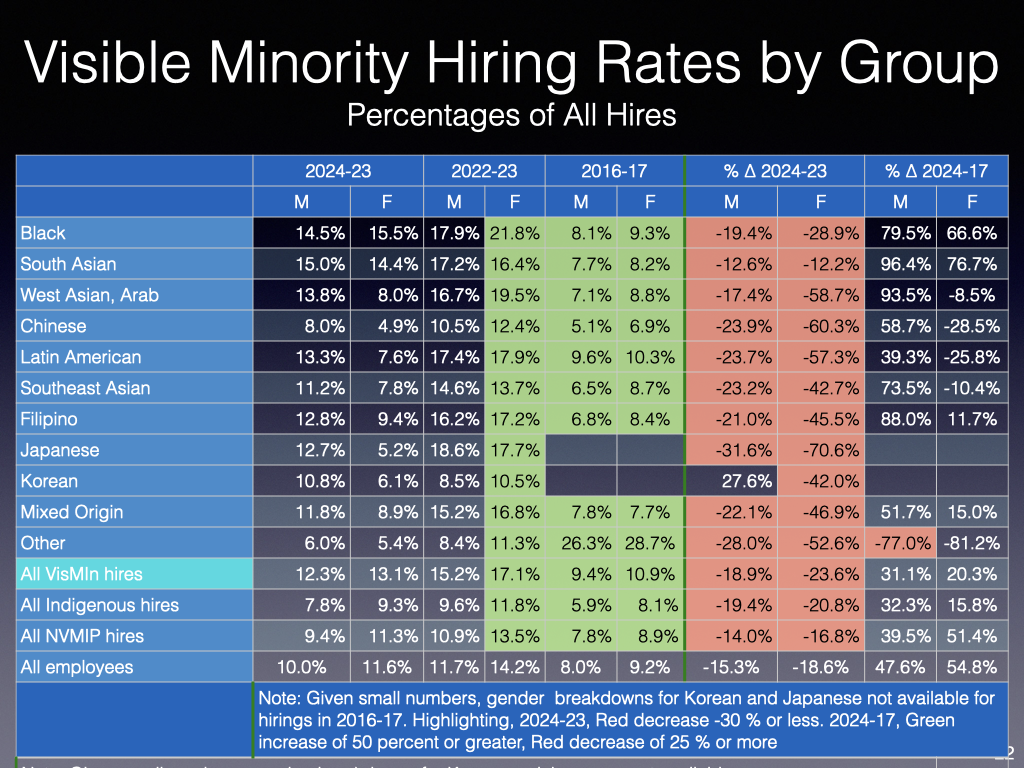
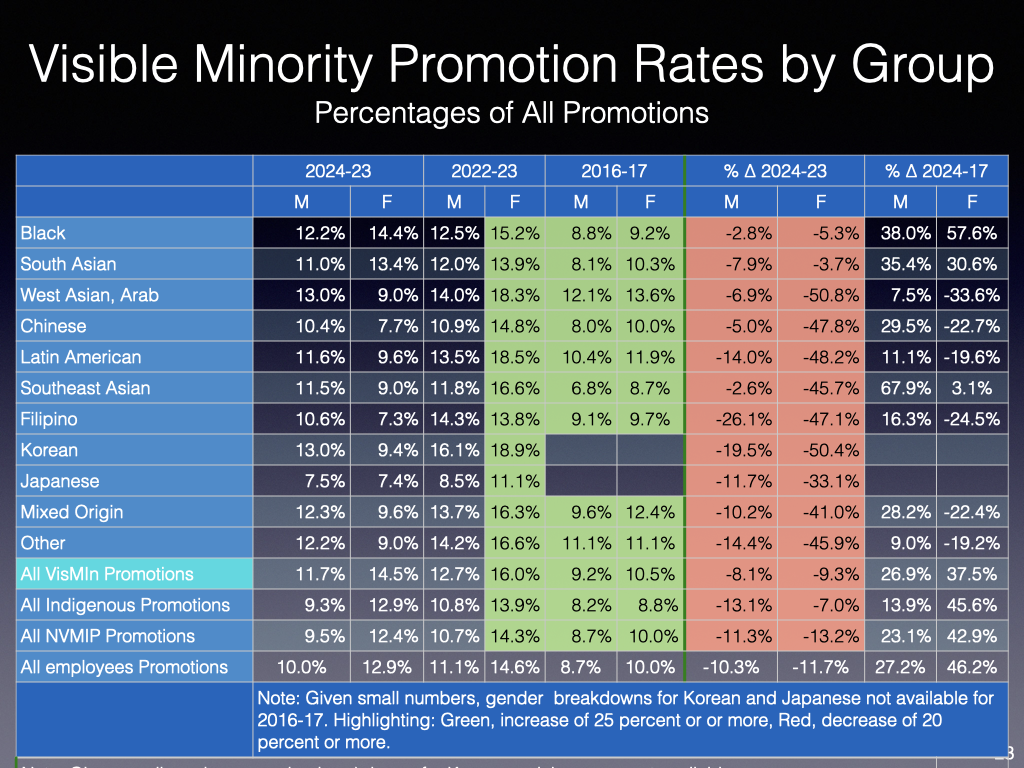
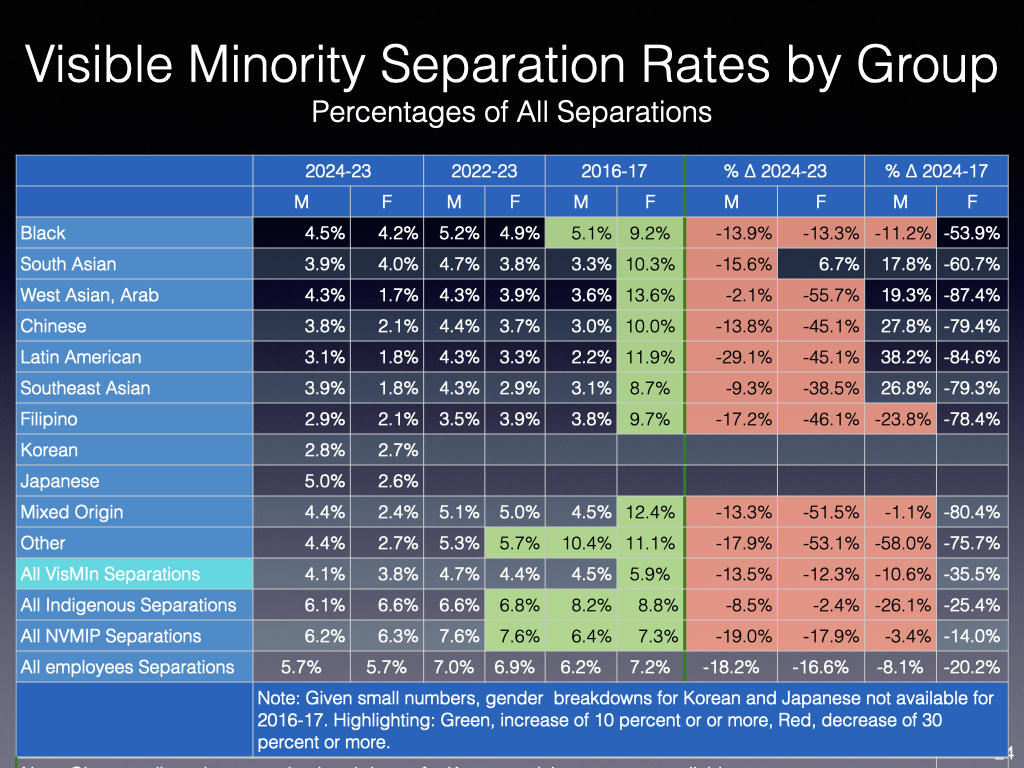
Have forthcoming analysis of the 2024-25 EE desegregated data, representation, hirings, separations, promotions that demonstrates that no negative impact compared to the previous year. So warnings may be overstated and public service may already considering equity impact:
As the public service moves to shed thousands of jobs, unions and a newly formed national coalition say equity gains may be more fragile than they appear, and warn leaving departments to monitor representation creates a “serious gap” in tracking where the cuts fall.
The federal public service entered 2026 looking more representative than it did a decade ago, according to the government’s latest Employment Equity Annual Report. The March report showed racialized workers made up 23.9 per cent of the core public administration in 2024-25, slightly above the 22.7 per cent workforce-availability benchmark. Black employees accounted for 5.1 per cent of the public service, up from 2.8 per cent in 2016-17.
Unions and advocates say the latest report can offer a useful snapshot, but it may not fully capture if employment equity efforts have been damaged. Their concern is less about whether the public service still looks representative on paper than about which workers are most exposed as job cuts deepen.
A newly formed group, the National Employment Equity Council, is calling on the government to require mandatory equity impact assessments before any further staffing decisions. Nicholas Marcus Thompson, its co-chair, warns the government’s current approach means signs of inequities tied to job losses may arrive “too late.”
Andrew Griffith, a former senior federal official who has analyzed Treasury Board employment equity data for years, said the latest data does not support the conclusion that racialized public servants are being disproportionately harmed.
Representation of visible minorities rose slightly in 2024–25, while hiring rates for visible minorities and Indigenous staff remained above their internal representation.
Still, advocates say the TBS response to The Hill Times suggests a worrying approach.
“This doesn’t address the concern,” Thompson said by email.
“It leaves departments to monitor themselves, with no central tracking, under a law the government has acknowledged is outdated. That’s how inequities continue, and by the time we see it, it’s too late.”…
The council’s central demand is implementation of the 2023 Employment Equity Act Task Force report, including formal recognition of Black workers and 2SLGBTQI+ people as distinct designated groups under the law.
For Thompson, one of the most urgent unresolved issues is how Black workers remain folded into the broader visible minorities category. Under that approach, the government can meet aggregate targets while leaving subgroup disparities untouched, he argued.
“When it is lumped in with everyone else, Black people almost always get left behind,” Thompson said.
Due to ongoing cuts, Thompson said Black workers contacting the council have described fear, declining trust in internal systems, and frustration with what they see as a lack of clarity and transparency in how restructuring decisions are being made….
Arguing for purges and inspired by Orban and Trump. Countering one set of excesses by a reverse set of excesses not helpful:
…It can be overcome, but that starts close to home, with provincial governments actively taking back what is rightfully theirs and installing onside allies — not thoughtless centrist donors who fear alienation from their Liberal-voting friends more than they want to win. It takes a careful and concerted effort to take back professional schools, not by defunding them, but by funding academic chairs to break the monoculture, provide role models to onside students, and provide alternative experts to lean on during contentious policy debates. The federal party can’t do much of this, but it can certainly build relationships with onside provinces to make it happen — or hammer them for failing to live up to their responsibility.
It means firing every activist and replacing every Liberal appointee at the top of any public department, every member of a public board, and abolishing those that exist only to prop up Liberal ideology. That means abandoning gender and anti-racism initiatives, something that even Alberta and Ontario struggle to do.
At this point, defund-everything libertarianism is a gambling strategy: it puts all the movement’s eggs into the basket that is the party’s election platform, and takes a crisis in the Liberal party to have any viability at all. In the off-chance it does result in victory, it is incapable of perpetuating itself.
Aimless tax and budget cuts don’t build movements or develop the careers of up-and-comers; they actually impede your future performance by depriving you of the necessary pipeline of manpower required to run complex institutions for years to come. “Just go to the private sector” doesn’t work, by the way, when the major corporations and companies have some kind of Liberal dependency, which is true for all the major consulting firms, law firms, pipeline companies and banks.
The wisdom that institutional control is the easy path to victory was internalized by the Liberals long ago. It’s time Conservatives started thinking the same way. It won’t deliver overnight, but that’s what it’s going to take to build a machine that can win in the absence of a catastrophic Liberal mistake. Anything less is just rolling the dice.
The right should not shy away from doing this when they regain power, which is hopefully a matter of when, not if. A government that refuses to stack the deck with its own people is effectively subsidizing a sort of Viet Cong within the state it supposedly heads. As the Americans learned painfully in the Vietnam War, merely shrinking the size of the Viet Cong with napalm did not eliminate the threat. Familiar or friendly and trusted people can be empowered a great deal within the bounds of the law.
Allies should be rewarded, and parallel institutions should supplant or compete with those that already exist. For example, the Conservative government of Stephen Harper made the mistake of not doing more to support the Sun News Network, which might have blossomed into a true conservative institution in the private sector.
Ironic timing, released at the same time as the Fox ethics scandal:
…Fairness
In 2025, more than three quarters (76%) of employees agreed that the process of selecting a person for a position is done fairly, consistent with 2023 (77%).
Employees who perceived the selection process as unfair were asked to describe how. The main reasons cited were a perception that appointments in their work unit are not transparent, that they are based on “who you know” and that some appointees have benefitted from nepotism or favoritism.
Expanding on the perceptions of fairness in staffing processes, a new question on non-advertised appointments was introduced in 2025. Overall, 71% of employees agreed that non-advertised appointments are done fairly. The main reasons cited by respondents who perceived non-advertised appointments as unfair were that non-advertised appointments depend on who you know (74%) and that they are not transparent (70%).
Statements related to fairness
2023
2025
Process of selecting a person for a position is done fairly
77%
76%
Non-advertised appointments are done fairly
n/a
71%
Reasons
2025
Non-advertised appointments depend on who you know
74%
Non-advertised appointments are not transparent
70%
Non-advertised appointments are not based on merit
48%
Non-advertised appointments are never fair
30%
Non-advertised appointments are not inclusive
28%
Other
12%
Employment equity and equity-seeking groups’ perceptions on fairness
With the exception of women, all employment equity groups expressed less positive perceptions than their respective comparator groups.
Employees identifying as two-spirit and intersex had less positive perceptions of both statements related to fairness compared to all other identities
Employees identifying as another gender had the least positive perceptions of fairness in the staffing process of all groups
Members of visible minorities, Indigenous Peoples and persons with disabilities had less positive perceptions of fairness in the staffing process than their respective comparator groups
Members of religious communities had less positive perceptions of fairness in the staffing process compared with employees who are not members of religious communities
Employees who are separated, divorced or widowed had less positive perceptions of fairness in the staffing process compared with employees who are married, living common-law or single
Employees identifying as asexual and pansexual had less positive perceptions of fairness compared with all other sexual orientations
Understandably mocked for a ridiculously long acronym that throws everything in. Time for plain language rather than this alphabet soup:
NDP MP Leah Gazan is standing by her use of the initialism MMIWG2SLGBTQQIA+ and denouncing those who are mocking her online for using the term.
A clip of the Winnipeg Centre MP saying “the ongoing genocide of MMIWG2SLGBTQQIA+” during a news conference in Ottawa went viral this week and sparked backlash, including insults from Elon Musk and U.S. Republican Sen. Ted Cruz.
“Bigots are bigots,” Gazan told CBC News in response.
“I certainly am really happy that bigots are offended by my positions around equality. What I am concerned about and certainly motivated — continue to be motivated about — is ending systemic racism in this country.”
MMIWG2SLGBTQQIA+ stands for missing and murdered Indigenous women, girls, two-spirit, lesbian, gay, bisexual, transgender, queer, questioning, intersex and asexual+. It’s derived in part from the more commonly used initialisms MMIWG (missing and murdered Indigenous women and girls) and 2SLGBTQ+.
Gazan calls the pushback a distraction from the continued violence facing Indigenous women and girls, two-spirit and gender diverse people, along with federal funding cuts to programming aimed at prevention.
“My concern is the fact that Prime Minister [Mark] Carney has gutted funding to deal with something that was recognized as a Canada-wide emergency in the House of Commons unanimously across party lines,” Gazan said. …
Articles and opinions related to multiculturalism that I found of interest in March:
Racial and Ethnic Disparities
Activisim/Advocacy
Quebec Bill 21
Representation corporate boards and public serice
Disparities
Picard: To address racism in health care, we need to collect data on race
Agree, without data, over reliance on anecdotes:
…It’s important, of course, that data are collected voluntarily and that people’s privacy is respected as it is with all health records.
The public needs to know, too, that the information will not appear on their health card or on medical charts. Rather, it is used in an aggregated fashion to reveal trends and inequalities between racial or ethnic groups, without identifying individuals.
The big barrier to collecting and using race-based data is technical: digital health systems still need to adapt. But we know it’s doable, even on a large scale.
During the pandemic, for example, the Coronavirus Rapid Entry Case and Contact Management System (CORES) included data on race, income and household size. As a result, we learned Black, Indigenous and people of colour in Toronto were over-represented in the tally of COVID-19 cases and deaths. That allowed, among other things, targeted vaccination campaigns.
The data also allowed people who are too often marginalized and ignored to be heard, an important first step in correcting disparities.
Race, culture, language and socio-economic status can all have a profound impact on health, individually and collectively.
Allowing gaps in data collection to persist is bad for our health, and our health system.
StatsCan: Criminal court outcomes of Black accused persons in Canada, 2016/2017 to 2022/2023
Latest useful StatsCan study highlighting disparities
There were 100,450 Black accused persons in adult criminal courts between 2016/2017 and 2022/2023. Black people (6.2%) were overrepresented as accused persons in adult criminal courts over this period, relative to their representation among the adult population of Canada (3.7%).
The proportion of Black accused persons in adult criminal courts has generally increased over time, from 5.7% of all accused in 2016/2017 to 7.1% in 2022/2023.
Between 2016/2017 and 2022/2023, the proportion of Black people in adult criminal courts in Nova Scotia and Ontario was more than two times higher than that of Black people in the total adult population of these provinces. Black people were also overrepresented as accused persons in criminal courts in Quebec, British Columbia, Alberta and New Brunswick compared with their representation in the total adult population.
More than 4 in 10 (42%) cases involving a Black accused person completed in adult criminal courts between 2016/2017 and 2022/2023 resulted in a guilty decision. This was equal to the proportion of cases involving Black accused persons that were withdrawn, dismissed or discharged over this period (42%).
Compared to the rest of the (non-Black) accused population, Black accused persons less often had their case result in a guilty decision and more often had it withdrawn, dismissed or discharged.
Black accused persons most often received a guilty decision for cases where the most serious offence was a Criminal Code traffic offence such as impaired driving (69%) or an administration of justice offence such as breach of probation (49%), and least often for cases where it was a violent offence (33%).
Between 2016/2017 and 2022/2023, just under half of violent crime cases (47%) and property crime cases (46%) involving Black accused persons were withdrawn, dismissed or discharged.
Similar proportions of Black and non-Black accused persons were sentenced to custody upon being found guilty in adult criminal courts (29% versus 27%). Probation was the most common sentence handed down to both Black and non-Black accused persons.
It took nearly two months longer for court cases involving Black accused persons to be completed in adult criminal courts between 2016/2017 and 2022/2023, compared to non-Black accused persons (219 versus 165 days).
CMA: Black Canadians more likely not to fill prescriptions because of financial constraints, study finds
Another insightful study:
Black adults in Canada are more likely not to fill prescriptions because of financial constraints than white adults, according to a new study that highlights disparities in prescription medication coverage as a major barrier to equitable health care.
The study was published in the Canadian Medical Association Journal on Monday. Its authors concluded that the prevalence of cost-related prescription non-adherence – defined as the inability to fill a prescription or delaying, splitting or skipping doses because of financial pressures – was 75 per cent higher among Black adults than white adults.
Coverage for prescription medications was also lower among Black adults, the study showed. In 2022, for example, 72.5 per cent of Black adults were covered compared with 80 per cent of white adults.
One of the study’s authors, Oluwabukola Salami, a Canada Research Chair in Black and racialized peoples’ health at the Cumming School of Medicine at the University of Calgary, said this study is the first of its kind and broadens the understanding of how Black Canadians experience health inequities.
“We know that Black people are more likely to have cardiovascular disease, to have certain types of cancer and to die from any of these conditions. But we always looked at how access to care is a challenge to Black people,” Dr. Salami said.
“This study presents new findings related to medication specifically.”…
Jamie Sarkonak: The crusading judge who helped Liberals build a race-based sentencing regime
Sarkonak appears to be following judges with activist backgrounds as seen in her previous column on Justice Go.
There is a judge on the Ontario Superior Court of Justice whose signature move is letting violent men walk free because of racism. One of the architects of race-based sentencing, his name is Faisal Mirza, and he was appointed to the bench by former prime minister Justin Trudeau in 2022.
Mirza’s flourish of race-based acquittals is not a case of a judge gone rogue: indeed, it’s perfectly on-brand. He was writing about the need for more racial considerations in the Canadian justice system in 2001, before he even became a lawyer. Back then, he argued in the Osgoode Hall Law Journal that mandatory minimum sentences for drug and weapons offences would be racist because of the disproportionate impact they’d have on Black people.
Toronto police, he asserted, were racist because of the arrest statistics they produced: in 1988, Black individuals comprised 51 per cent of drug arrests, 82 per cent of mugging arrests and 55 per cent of purse snatching arrests. This, he said, was evidence of over-targeting. He concluded that more mandatory minimums would exacerbate the effect, because the threat of being convicted on a charge with a guaranteed jail term would disproportionately pressure Black accused persons to make plea deals and forfeit the opportunity to expose racist police at trial.
This became a career pursuit. When the Supreme Court was deciding whether to strike down the mandatory minimum for illegally possessing a loaded firearm in 2014, he argued as an intervener in the case that its disproportionate impact on Black individuals needed to be taken into account. The court ultimately ruled that this mandatory minimum was unconstitutional.
In 2018, Mirza laid the foundation for Ontario’s racial sentencing regime. He was the defence lawyer of Kevin Morris, a Black man who was convicted of various firearms offences. They were lucky to draw the hyper-progressive, destructively lenient Shaun Nakatsuru for a judge. Mirza filed two racial context reports about Morris and Black people as evidence, and the judge emphatically agreed to consider them. He settled on a 15-month sentence to account for the racial factors, even though three years was considered the starting point. On appeal, the Ontario Court of Appeal made racial considerations in sentencing the province-wide rule in 2021….
To his credit, there have been instances where Mirza refrained from applying a racial discount, and from tossing out evidence because of racism, but it doesn’t excuse the other times when he let his biases reign. It’s undeniable that he has a habit of projecting racism in assessing any interaction with the state and undermining public safety with his assumptions. One day, it’s going to end up getting someone hurt — if it hasn’t already.
Dummit: How accommodation hollowed out Canadian nationalism
Not an easy country to govern given differing regional and group interests. Will be interesting to see how the (still) forthcoming revision to the Harper era citizenship study guide provides a cohesive and coherent national perspective:
….Taken as a whole, this legacy of national hesitation makes governing difficult. Is it any wonder that Carney spends so much time abroad signing international agreements? Foreign policy is one of the few areas where a Canadian government can still act as a single whole with relative clarity about the national interest.
But Carney’s real test will come when he finally returns home.
Canada’s genius has always been accommodation. But accommodation, repeated often enough, can gradually hollow out the idea that the country itself even has a single political purpose.
When Carney eventually tries to move forward with projects deemed nationally significant—whether mining developments, high-speed rail, or (God forbid) a new pipeline—he will run directly into Canada’s familiar pattern of internal division.
That’s when we’ll truly find out who is willing to embrace an “Elbows Up” style of nationalism. Until then, we’re left wondering: whose elbows? Defending which nation?
This woman is suing Canada for its ban on adoption under Muslim law
Inevitable that the ban would be challenged. Of course, this predominant affects Muslim families but perhaps a more appropriate challenge would be with respect to Pakistan’s application of kafala:
A Toronto woman is being denied the right to reunite with her adopted children because Ottawa does not recognize adoptions from Pakistan under Islamic rules, a court has heard.
Jameela Qadeer is the maternal aunt of Salman, Umme and Umm; she and her husband raised them as their own in Pakistan after her sister died of a brain hemorrhage in 2012. The Pakistani court has granted them guardianship of the kids and authorization to travel after their biological father, who was absent in their lives, abdicated his responsibility for their care.
An Ahmadiyya Muslim, a sect of Islam deemed heretical in Pakistan, Qadeer fled to Canada in 2017 and was granted asylum. However, her adopted kids have not been allowed to join her. Since 2013, Ottawa has stopped accepting adoption from Pakistan because it says the Islamic rules known as kafala only allow for guardianship of children, but do not sever biological ties as required by Canadian law.
In a fight to reunite the family, Qadeer and her sister’s children, along with two Muslim organizations, have taken the federal government to court, challenging the refusals of permanent residence to the children, and the constitutionality of Canada’s ban on recognizing adoption from Pakistan.
They contend that Canada’s immigration policy has disproportionately affected Muslim families and denied them equality rights under the Charter, even when a guardianship arrangement following traditional kafala is permanent and sanctioned by a foreign court.
“That categorical refusal does not only affect the individual applicants,” Armaan Kassam, lawyer for the National Council of Canadian Muslims told the opening of a three-day Federal Court hearing this week. “It affects Muslim families across Canada who adopt through foreign court-supervised guardianship processes.”
Warda Shazadi Meighen, lawyer for the children, said her clients’ biological father officially abdicated his responsibility in 2013 to Jameela Qadeer. Before leaving for Canada in 2017, Qadeer and her husband were granted judicial guardianship by a Pakistani court under national guardianship laws, giving them exclusive custody. ,,,
Khan: In Quebec, laïcité has become its own kind of religious orthodoxy
Ironic but accurate:
…In the meantime, there is no legal recourse to challenge laws that are clearly discriminatory. Those primarily affected by these bills are veiled Muslim women – whom Quebec ostensibly wants to liberate, while strengthening gender equality. In its oxymoronic quest to impose freedom, then, the government is excluding those very women from the job market and impeding their financial independence. And it’s so 1950s to hear the high priests of laïcité – François Legault, Bernard Drainville – tell women what they can and cannot wear.
Given the situation, it’s time to tell the world about Quebec’s laïcité mission. Canadian embassies, high commissions and consulates should be clear to prospective immigrants (especially from la Francophonie) that their religious freedoms and expression will be curtailed in la belle province. Here at home, the federal government, along with the governments of Ontario, New Brunswick and Manitoba, should help those adversely affected by Quebec’s laws resettle in francophone communities in the rest of Canada, if they wish to leave. They deserve an opportunity to thrive without compromising their faith.
And finally, something must be done about the notwithstanding clause. Governments show no slowdown in its use, while the wider public seems unaware of its fundamental threat to basic freedoms. Perhaps a jarring public education campaign is in order, using the spectre of Donald Trump. After all, his administration has overseen attacks on domestic human rights, circumvented judicial warrants, tried to suspend legal protections to immigrants and denied equality before the law. Little wonder he wants to absorb Canada: The notwithstanding clause would allow him to do all that legally.
Kutty | When parents are shut out of classrooms over what they wear, we have a problem
Absurd and unreasonable:
Two mothers in Quebec were recently told they could no longer volunteer at their children’s elementary school unless they removed their hijabs. For one of them, it meant being shut out of a classroom she had supported for years — not because of anything she did, but because of what she wears.
They are not alone. Across Quebec, people of faith — including Muslim women who wear hijabs, Sikhs who wear turbans, and Jewish Canadians who wear kippahs — are being pushed out of classrooms and public life unless they conceal visible expressions of their identity. In a separate incident, twelve Muslim women reportedly lost their teaching jobs because they refused to remove their hijabs. These are the lived consequences of Quebec’s secularism law, Bill 21, which prohibits many public-sector employees — including teachers, police officers and government lawyers — from wearing visible religious symbols while performing their duties.
The constitutionality of this law is now poised for its most consequential test. Canada’s Supreme Court is now hearing arguments in a landmark case examining whether Bill 21 violates fundamental rights, including freedom of religion and equality under the Canadian Charter of Rights and Freedoms. Quebec has invoked the notwithstanding clause — Section 33 of the Charter — a rarely used constitutional mechanism that allows governments to override certain fundamental rights, including freedom of religion and equality, for renewable five-year periods….
StatsCam: Representation of women on boards of directors and in officer positions, 2023
Useful study with breakdowns:
Statistics Canada is releasing new data on the gender composition of leadership and strategic decision-making roles within publicly traded corporations, privately held corporations and government business enterprises operating across a variety of industries in Canada.
This data helps inform the objective “More company board seats held by women, and more diversity on company boards” and the indicator “Proportion of board members who are women, by type of board” in the Leadership and democratic participation pillar of the Gender Results Framework.
Additional information and other studies and statistics related to gender and enterprises can be found in the Gender, diversity and inclusion statistics hub, the Business performance and ownership statistics portal and in the Representation of women on boards of directors and in officer positions: Visualization tool.
Women hold just under one-quarter of director positions
In 2023, women occupied just under one-quarter (23.2%) of seats on boards of directors, increasing 0.5 percentage points over the proportion of women recorded in 2022 (22.7%).
Just over half of boards (50.3%) did not include any women directors in 2023. In addition, 25.8% of boards had one woman director, while boards with two or more women directors accounted for 23.9% of the total.
Educational services has the highest representation of women directors, followed by the utilities and finance and insurance industries
Educational services had the highest proportion of women directors in 2023, with women holding 35.3% of board seats. This reflects an increase of 4.9 percentage points from 2022.
The utilities industry recorded the second-highest share in 2023, at 34.1%. Corporations in finance and insurance followed, with women representing 28.2% of board members.
The agriculture industry had the lowest proportion of women directors, with women occupying 8.8% of board seats….
Treasury Board not tracking impact of public service job cuts on equity groups
Will be curious to see the respective numbers of hirings, separations and promotions in the forthcoming TBS EE report. Hopefully, TBS will continue to provide the breakdowns by visible minority groups.
Slides from last year’s EE report.
Advocates are raising concerns about how job cuts will affect public servants in equity groups — something the Treasury Board of Canada Secretariat says it’s not tracking.
The federal government has committed to cutting the number of public service jobs by about 40,000 from a 2023-24 peak of 368,000 as it looks to find savings.
Departments and agencies across the public service have started notifying staff of coming job cuts.
Barb Couperus, a spokesperson for the Treasury Board of Canada Secretariat — which oversees government operations — said the office does not collect information centrally on the impact of workforce adjustment on employment equity designated groups.
Equity groups include women, Indigenous people, people with disabilities and members of visible minorities.
Couperus said heads of departments are responsible for managing their workforces.
She said departments will continue to pay “close attention” to maintaining representation and meeting their obligations under the Employment Equity Act.
The act requires federally regulated employers, including the government itself, to take steps to eliminate employment barriers and maintain proportional representation in the workplace for members of equity groups.
During layoff periods, Couperus said, departments can prioritize keeping staff from equity groups if there are gaps in representation.
Nicholas Marcus Thompson, president and CEO of the Black Class Action Secretariat, said he is “disturbed” to learn the Treasury Board isn’t tracking the impacts of job cuts.
“What that suggests is that this is not a priority for this government,” he said.
Over the past five years, the government has hired approximately 5,000 Black workers throughout the entire federal public service, said Thompson. It also has increased the number of Black executives from around 99 in 2020 to more than 220, he said.
“What we’re seeing now is that those gains are being lost as a result of workforce adjustment,” said Thompson, adding his organization has started tracking data on workforce adjustment. “Many folks have reached out to us to find out what their rights are.
“Usually with workforce adjustment, the first to go are folks that were the last to come … So far our data is showing that, despite these equity gains, it’s now turning out to be equity losses.”
Thompson said his organization wants to see the government require equity impact assessments before workforce adjustment decisions are made. It also wants the government to be transparent about the process and publish data on which demographics are being affected.
Rabia Khedr, national director of Disability Without Poverty, said people with disabilities working in the public service will be feeling anxious.
“Generally speaking, a lot of times people with disabilities may be at an entry level position, so that makes them vulnerable,” said Khedr.
The most recent employment equity report for the public service says that as of March 2024, 9.7 per cent of federal executives were people with disabilities, up from 4.6 per cent in March 2019.
Khedr also said she’s unhappy about the lack of central tracking of the impacts of job cuts on equity groups.
“That then leaves it to the individual leadership within departments to make those critical decisions,” she said.
“It really depends on the leadership and their commitment to diversity and inclusion … There’s a risk that equity-denied groups might be more vulnerable in terms of who gets cut and who stays.”