…C’est devenu un objet d’étude en soi, avec la montée en force des médiations interculturelles, ici et ailleurs. La grande université californienne de Berkeley s’est même dotée d’un indice d’inclusivité qui lui permet de mesurer nos progrès, d’identifier les bonnes pratiques comme les mauvaises, celles qui crispent les sociétés et les divisent. Le Canada s’y classe au 15e rang, en sandwich entre l’Allemagne et le Danemark. Tout au sommet, on trouve la Nouvelle-Zélande, le Portugal et les Pays-Bas.
Ses chercheurs observent la constante suivante : l’agitation, les remous et les contre-courants feront toujours partie de la vie en collectivité. Comme il ne sert à rien de s’acharner à vouloir dompter une rivière agitée pour en faire un long fleuve tranquille, il leur apparaît plus utile de jeter des ponts sur son dos afin que tous puissent y faire leur chemin et mettre leurs histoires en commun.
En d’autres mots, l’accord parfait n’adviendra pas et n’a même jamais existé. Il faut définir les valeurs communes qui nous lient et bâtir à partir d’elles, et non contre celles qui nous divisent. Les prochaines années s’annoncent politiquement, économiquement, climatiquement et humainement instables. C’est à ce défi immense mais ô combien prometteur que nous voudrions voir nos partis politiques s’atteler en prévision de la prochaine campagne.
Il est vrai qu’aller vers l’autre est exigeant. Cela vient avec des inconforts, des doutes, des incompréhensions, des appréhensions, voire de l’insécurité. Cet « inconfort interculturel », s’il est bien attesté, n’est heureusement pas éternel, nous enseigne la professeure agrégée de psychologie Marina M. Doucerain. Il a même « tendance à s’estomper à mesure que les gens accumulent les interactions interculturelles ».
Comme c’est en forgeant qu’on devient forgeron, la science nous enseigne ainsi que c’est en multipliant les contacts avec les autres qu’on devient… humains. Voilà une riche leçon pour qui veut passer d’un « imaginaire défensif » à un « imaginaire contributif », pour reprendre l’habile formule du professeur émérite Khadiyatoulah Fall parue récemment dans Le Devoir.
C’est aussi l’occasion de revisiter la pensée du regretté sociologue et philosophe Edgar Morin, pour qui la polarisation restera toujours le symptôme d’une « pensée mutilée » qui réduit le monde à des oppositions binaires. Face à cette fragmentation, il oppose la finesse d’une pensée complexe exigeant de relier les contraires plutôt que de les séparer. « Nous avons trop bien appris à séparer, observe-t-il. Il vaut mieux apprendre à relier. Relier, c’est-à-dire pas seulement établir bout à bout une connexion, mais établir une connexion qui se fasse en boucle. »
Travailler à relier, n’est-ce pas là le début d’une promesse électorale porteuse d’avenir ?
… It has become an object of study in itself, with the rise of intercultural mediations, here and elsewhere. The major California University of Berkeley has even acquired an inclusiveness index that allows it to measure our progress, to identify good and bad practices, those that tense and divide societies. Canada ranks 15th, sandwiched between Germany and Denmark. At the very top, we find New Zealand, Portugal and the Netherlands.
Its researchers observe the following constant: agitation, turmoil and counter-currents will always be part of community life. Since it is useless to insist on wanting to tame a rough river to make it a long quiet river, it seems more useful to them to throw bridges on his back so that everyone can make their way there and share their stories.
In other words, the perfect agreement will not happen and has never even existed. We must define the common values that bond us and build from them, and not against those that divide us. The next few years promise to be politically, economically, climatically and humanly unstable. It is to this immense but very promising challenge that we would like to see our political parties tackle in anticipation of the next campaign.
It is true that going to the other is demanding. This comes with discomfort, doubts, misunderstandings, apprehensions, even insecurity. This “intercultural discomfort”, if it is well attested, is fortunately not eternal, teaches us associate professor of psychology Marina M. Doucerain. It even “tends to fade as people accumulate intercultural interactions”.
As it is by forging that we become a forge, science teaches us that it is by multiplying contacts with others that we become… human. This is a rich lesson for those who want to move from a “defensive imaginary” to a “contributory imaginary”, to use the skillful formula of Professor Emeritus Khadiyatoulah Fall recently published in Le Devoir.
It is also an opportunity to revisit the thought of the late sociologist and philosopher Edgar Morin, for whom polarization will always remain the symptom of a “mutilated thought” that reduces the world to binary oppositions. Faced with this fragmentation, he opposes the finesse of a complex thought demanding to connect the opposites rather than to separate them. “We have learned too well to separate,” he observes. It is better to learn to connect. Link, i.e. not only establish an end-to-end connection, but establish a connection that is made in a loop. ”
Working to connect, isn’t this the beginning of an electoral promise with a future?
…Elle était questionnée par la députée libérale Madwa-Nika Cadet lors de l’étude des crédits budgétaires, un exercice de reddition de comptes qui se tient annuellement à l’Assemblée nationale.
Le projet de loi 94, adopté en octobre dernier, étend notamment l’interdiction du port de signes religieux à l’ensemble du personnel dans les écoles et dans les centres de services scolaires (CSS).
Une clause de droits acquis existe pour tous ceux ayant été embauchés avant le 19 mars 2025.
Mercredi, Mme Cadet a voulu savoir combien d’employés avaient été licenciés en raison de leur refus de se conformer à la nouvelle loi.
« C’est marginal, a répondu la ministre LeBel. À ma connaissance, on est dans les dizaines, même pas les centaines, même pas 100. C’est très minime. […] À ma connaissance, c’est très peu. »
Selon ses explications, la plupart des gens qui ont été contactés étaient sur des listes de rappel.
« La grande majorité de ces gens-là n’avaient pas enseigné dans le réseau de l’éducation depuis plusieurs années. […] Cent cinquante personnes ont été contactées et beaucoup là-dedans n’enseignent même plus.
« Les gens […] qui étaient dans des écoles, qui occupaient un poste dans des écoles (et qui ont quitté), je pense qu’on les compte sur les doigts de la main », a-t-elle insisté.
Le mois dernier, des syndicats avaient pourtant dénoncé la perte de 150 employés, dont des dizaines d’éducatrices en service de garde, des techniciennes en éducation spécialisée (TES) et des préposées aux élèves handicapés.
Ils avaient dit craindre, sur les ondes de Radio-Canada, que ces départs forcés n’accentuent la pénurie de personnel dans les écoles à Montréal.
Le Centre de services scolaire de Montréal (CSSDM) affirmait, lui aussi, que les congédiements allaient avoir un impact dans les écoles.
« La Coalition avenir Québec semble sous-estimer le défi de rétention de personnel touché par les dispositions du projet de loi 94 », a déclaré Mme Cadet, mercredi.
« Si plusieurs employées quittent, il y aura certainement des ruptures de services. Il faudrait tout de même se préparer à cette éventualité pour ne pas nuire aux élèves, alors que le milieu prépare déjà la prochaine rentrée scolaire », a-t-elle ajouté.
Selon les données du gouvernement, plus de 3100 postes (enseignants, personnel de soutien, professionnels) étaient toujours à pourvoir en date de février.
… She was questioned by Liberal MP Madwa-Nika Cadet during the study of budget appropriations, an accounting exercise held annually in the National Assembly.
Bill 94, adopted last October, extends in particular the ban on the wearing of religious signs to all staff in schools and school service centers (CSS).
An acquired rights clause exists for all those who were hired before March 19, 2025.
On Wednesday, Ms. Cadet wanted to know how many employees had been laid off because of their refusal to comply with the new law.
“It’s marginal,” replied Minister LeBel. To my knowledge, we are in the dozens, not even hundreds, not even 100. It’s very minimal. […] To my knowledge, this is very little. ”
According to his [her, translation program mistake] explanations, most of the people who were contacted were on recall lists.
“The vast majority of these people had not taught in the education network for several years. […] One hundred and fifty people have been contacted and many there do not even teach anymore.
“People […] who were in schools, who held a position in schools (and who left), I think we can count them on the fingers of the hand,” she insisted.
Last month, however, unions denounced the loss of 150 employees, including dozens of childcare educators, special education technicians (TES) and disabled student attendants.
They said they feared, on Radio-Canada, that these forced departures would accentuate the shortage of staff in schools in Montreal.
The Centre de services scolaires de Montréal (CSSDM) also said that layoffs would have an impact on schools.
“The Coalition avenir Québec seems to underestimate the challenge of staff retention affected by the provisions of Bill 94,” Cadet said on Wednesday.
“If several employees leave, there will certainly be service breaks. We should still prepare for this eventuality so as not to harm students, while the community is already preparing for the next school year, “she added.
According to government data, more than 3,100 positions (teachers, support staff, professionals) were still to be filled as of February.
C’est ce que je me suis dit en prenant connaissance du tableau explicatif byzantin que le centre de services scolaire de Montréal a présenté cette semaine à son comité de parents qui voulait comprendre comment serait appliquée la loi 94 pour les parents et les élèves.
On se rappellera que cette loi adoptée dans la foulée du scandale de l’école Bedford ne fait pas qu’élargir l’interdiction de porter un signe religieux aux membres du personnel scolaire. Elle s’étend aussi aux parents bénévoles et à toute personne qui fournit régulièrement des services aux élèves.
Dans quels cas un signe religieux est-il autorisé ?
On apprend donc en consultant le tableau explicatif qu’un parent portant un signe religieux, c’est-à-dire en l’occurrence une mère voilée, pourrait préparer un gâteau pour une fête à l’école de ses enfants, mais ne pourrait pas servir elle-même ledit gâteau. Elle pourrait participer à l’organisation d’une sortie scolaire, mais elle ne pourrait pas y accompagner les enfants. Elle pourrait assister à un spectacle de fin d’année comme parent. Mais elle ne pourrait pas donner un coup de main durant le spectacle comme bénévole. Elle pourrait tricoter des mitaines pour la classe le soir, mais pas participer à un atelier de tricot à l’école le jour. Vous suivez la logique ?
La loi suscite son lot d’inquiétudes sur le terrain. Elle semble à bien des égards inapplicable. Comment des directions d’école qui ont déjà leur lot de défis quotidiens vont-elles gérer la chose ? Qui aura l’odieux d’annoncer à une mère enthousiaste et appréciée de tous qu’en raison de son signe religieux, elle peut continuer à être présente à l’école comme mère, mais plus comme bénévole ? …
Mais quel message envoie-t-on aux enfants quand on leur dit que certaines éducatrices, aussi compétentes et professionnelles soient-elles, et certaines mères, aussi impliquées soient-elles, sont désormais infréquentables par leur seule présence auprès des enfants, sans avoir commis aucune faute ? Si infréquentables qu’il faudrait ériger un « cordon sanitaire » entre elles et l’école de peur qu’elles contaminent l’esprit des enfants ?
Je suis désolée, mais le principal message que j’y vois est un message raciste et paternaliste qui a été normalisé ces dernières années. Un message qui tient pour acquis que ces femmes sont incapables de faire leurs propres choix et que l’on devrait donc choisir pour elles. Soumettez-vous à nous ou retournez à la maison, mesdames ! On fait ça pour votre bien, afin de favoriser l’égalité homme-femme… Parce qu’au Québec, c’est comme ça qu’on vit. Vraiment ?
This is what I thought to myself when I read the Byzantine explanatory table that the Montreal school service center presented this week to its parents’ committee who wanted to understand how Bill 94 would be applied to parents and students.
It will be remembered that this law passed in the wake of the Bedford School scandal does not only extend the ban on wearing a religious sign to members of school staff. It also extends to volunteer parents and anyone who regularly provides services to students.
In which cases is a religious sign allowed?
We therefore learn by consulting the explanatory table that a parent wearing a religious sign, that is to say in this case a veiled mother, could prepare a cake for a party at her children’s school, but could not serve said cake herself. She could participate in the organization of a school trip, but she could not accompany the children. She could attend an end-of-year show as a parent. But she couldn’t help out during the show as a volunteer. She could knit mittens for the class in the evening, but not participate in a knitting workshop at school during the day. Do you follow the logic?
The law raises its share of concerns on the ground. It seems in many ways inapplicable. How will school principals who already have their share of daily challenges handle this? Who will have the hate to announce to an enthusiastic and appreciated mother that because of her religious sign, she can continue to be present at school as a mother, but no longer as a volunteer? …
But what message do we send to children when we tell them that some educators, no matter how competent and professional they are, and some mothers, no matter how involved they are, are now infrequent by their sole presence with the children, without having committed any fault? So infrequent that a “sanitary cordon” should be erected between them and the school for fear that they contaminate the minds of children?
I’m sorry, but the main message I see in it is a racist and paternalistic message that has been normalized in recent years. A message that takes for granted that these women are unable to make their own choices and that we should therefore choose for them. Submit to us or return home, ladies! We do this for your good, to promote gender equality… Because in Quebec, that’s how we live. Really?
…Une source policière québécoise me rapporte que les services fédéraux — sauf, de toute évidence, l’Agence du revenu du Canada — sont timides lorsque vient le temps de mener des enquêtes qui pourraient générer un ressac dans les communautés culturelles et religieuses visées. Une accusation d’islamophobie est si vite arrivée. Et il est vrai que, comme la majorité des communautés culturelles, les musulmans canadiens ont voté en masse (65 %) pour le Parti libéral du Canada l’an dernier. Chacun a aussi bien noté que premier ministre Mark Carney s’est présenté, six semaines après les élections, à un événement de l’AMC.
Cela rappelle l’extrême prudence, sinon la pusillanimité, affichée par les libéraux de Justin Trudeau face à l’ingérence de la Chine au Canada, particulièrement dans sa diaspora. Tout cela est paradoxal, car l’action des Frères musulmans et de leurs alliés nuit considérablement aux musulmans modérés qui forment la majorité des fidèles. Un effort conséquent de vigilance et d’action pour neutraliser l’action des extrémistes est au contraire dans l’intérêt général, et dans l’intérêt particulier de la communauté.
“On est en droit de noter que l’action de la GRC la plus intense contre les réseaux fréristes à Montréal s’est déployée lorsque les conservateurs fédéraux étaient au pouvoir à Ottawa, donc avant l’élection de Justin Trudeau en 2015. Il est difficile de croire que ce sont les Frères qui se sont assagis depuis. Auraient-ils jugé que l’effervescence entourant la cause palestinienne dans les campus l’an dernier ne serait pas une bonne occasion de recrutement et de financement ?
Croire que l’évocation d’une présence toxique des Frères dans nos sociétés est une « théorie du complot », comme on l’a entendu la semaine dernière à Ottawa, est plutôt un signe de l’existence chez les libéraux fédéraux de ce qu’on appelle, dans les milieux subversifs, des « idiots utiles ».
… A Quebec police source tells me that the federal services — except, obviously, the Canada Revenue Agency — are shy when it comes to conducting investigations that could generate a hangover in the cultural and religious communities targeted. An accusation of Islamophobia came so quickly. And it is true that, like the majority of cultural communities, Canadian Muslims voted en masse (65%) for the Liberal Party of Canada last year. Everyone also noted that Prime Minister Mark Carney presented himself, six weeks after the elections, at a CMA event.
This is reminiscent of the extreme caution, if not the pusillanimity, displayed by Justin Trudeau’s liberals in the face of China’s interference in Canada, particularly in its diaspora. All this is paradoxical, because the action of the Muslim Brotherhood and their allies considerably harms moderate Muslims who form the majority of the faithful. A consistent effort of vigilance and action to neutralize the action of extremists is on the contrary in the general interest, and in the particular interest of the community.
“It is right to note that the most intense action of the RCMP against the fraternist networks in Montreal was deployed when the federal Conservatives were in power in Ottawa, so before the election of Justin Trudeau in 2015. It is hard to believe that it is the Brothers who have been tasting each other since then. Would they have judged that the excitement surrounding the Palestinian cause on campuses last year would not be a good opportunity for recruitment and funding?
To believe that the evocation of a toxic presence of the Brothers in our societies is a “conspiracy theory”, as we heard last week in Ottawa, is rather a sign of the existence among the federal liberals of what is called, in subversive circles, “useful idiots”.
Articles and opinions related to multiculturalism that I found of interest in March:
Racial and Ethnic Disparities
Activisim/Advocacy
Quebec Bill 21
Representation corporate boards and public serice
Disparities
Picard: To address racism in health care, we need to collect data on race
Agree, without data, over reliance on anecdotes:
…It’s important, of course, that data are collected voluntarily and that people’s privacy is respected as it is with all health records.
The public needs to know, too, that the information will not appear on their health card or on medical charts. Rather, it is used in an aggregated fashion to reveal trends and inequalities between racial or ethnic groups, without identifying individuals.
The big barrier to collecting and using race-based data is technical: digital health systems still need to adapt. But we know it’s doable, even on a large scale.
During the pandemic, for example, the Coronavirus Rapid Entry Case and Contact Management System (CORES) included data on race, income and household size. As a result, we learned Black, Indigenous and people of colour in Toronto were over-represented in the tally of COVID-19 cases and deaths. That allowed, among other things, targeted vaccination campaigns.
The data also allowed people who are too often marginalized and ignored to be heard, an important first step in correcting disparities.
Race, culture, language and socio-economic status can all have a profound impact on health, individually and collectively.
Allowing gaps in data collection to persist is bad for our health, and our health system.
StatsCan: Criminal court outcomes of Black accused persons in Canada, 2016/2017 to 2022/2023
Latest useful StatsCan study highlighting disparities
There were 100,450 Black accused persons in adult criminal courts between 2016/2017 and 2022/2023. Black people (6.2%) were overrepresented as accused persons in adult criminal courts over this period, relative to their representation among the adult population of Canada (3.7%).
The proportion of Black accused persons in adult criminal courts has generally increased over time, from 5.7% of all accused in 2016/2017 to 7.1% in 2022/2023.
Between 2016/2017 and 2022/2023, the proportion of Black people in adult criminal courts in Nova Scotia and Ontario was more than two times higher than that of Black people in the total adult population of these provinces. Black people were also overrepresented as accused persons in criminal courts in Quebec, British Columbia, Alberta and New Brunswick compared with their representation in the total adult population.
More than 4 in 10 (42%) cases involving a Black accused person completed in adult criminal courts between 2016/2017 and 2022/2023 resulted in a guilty decision. This was equal to the proportion of cases involving Black accused persons that were withdrawn, dismissed or discharged over this period (42%).
Compared to the rest of the (non-Black) accused population, Black accused persons less often had their case result in a guilty decision and more often had it withdrawn, dismissed or discharged.
Black accused persons most often received a guilty decision for cases where the most serious offence was a Criminal Code traffic offence such as impaired driving (69%) or an administration of justice offence such as breach of probation (49%), and least often for cases where it was a violent offence (33%).
Between 2016/2017 and 2022/2023, just under half of violent crime cases (47%) and property crime cases (46%) involving Black accused persons were withdrawn, dismissed or discharged.
Similar proportions of Black and non-Black accused persons were sentenced to custody upon being found guilty in adult criminal courts (29% versus 27%). Probation was the most common sentence handed down to both Black and non-Black accused persons.
It took nearly two months longer for court cases involving Black accused persons to be completed in adult criminal courts between 2016/2017 and 2022/2023, compared to non-Black accused persons (219 versus 165 days).
CMA: Black Canadians more likely not to fill prescriptions because of financial constraints, study finds
Another insightful study:
Black adults in Canada are more likely not to fill prescriptions because of financial constraints than white adults, according to a new study that highlights disparities in prescription medication coverage as a major barrier to equitable health care.
The study was published in the Canadian Medical Association Journal on Monday. Its authors concluded that the prevalence of cost-related prescription non-adherence – defined as the inability to fill a prescription or delaying, splitting or skipping doses because of financial pressures – was 75 per cent higher among Black adults than white adults.
Coverage for prescription medications was also lower among Black adults, the study showed. In 2022, for example, 72.5 per cent of Black adults were covered compared with 80 per cent of white adults.
One of the study’s authors, Oluwabukola Salami, a Canada Research Chair in Black and racialized peoples’ health at the Cumming School of Medicine at the University of Calgary, said this study is the first of its kind and broadens the understanding of how Black Canadians experience health inequities.
“We know that Black people are more likely to have cardiovascular disease, to have certain types of cancer and to die from any of these conditions. But we always looked at how access to care is a challenge to Black people,” Dr. Salami said.
“This study presents new findings related to medication specifically.”…
Jamie Sarkonak: The crusading judge who helped Liberals build a race-based sentencing regime
Sarkonak appears to be following judges with activist backgrounds as seen in her previous column on Justice Go.
There is a judge on the Ontario Superior Court of Justice whose signature move is letting violent men walk free because of racism. One of the architects of race-based sentencing, his name is Faisal Mirza, and he was appointed to the bench by former prime minister Justin Trudeau in 2022.
Mirza’s flourish of race-based acquittals is not a case of a judge gone rogue: indeed, it’s perfectly on-brand. He was writing about the need for more racial considerations in the Canadian justice system in 2001, before he even became a lawyer. Back then, he argued in the Osgoode Hall Law Journal that mandatory minimum sentences for drug and weapons offences would be racist because of the disproportionate impact they’d have on Black people.
Toronto police, he asserted, were racist because of the arrest statistics they produced: in 1988, Black individuals comprised 51 per cent of drug arrests, 82 per cent of mugging arrests and 55 per cent of purse snatching arrests. This, he said, was evidence of over-targeting. He concluded that more mandatory minimums would exacerbate the effect, because the threat of being convicted on a charge with a guaranteed jail term would disproportionately pressure Black accused persons to make plea deals and forfeit the opportunity to expose racist police at trial.
This became a career pursuit. When the Supreme Court was deciding whether to strike down the mandatory minimum for illegally possessing a loaded firearm in 2014, he argued as an intervener in the case that its disproportionate impact on Black individuals needed to be taken into account. The court ultimately ruled that this mandatory minimum was unconstitutional.
In 2018, Mirza laid the foundation for Ontario’s racial sentencing regime. He was the defence lawyer of Kevin Morris, a Black man who was convicted of various firearms offences. They were lucky to draw the hyper-progressive, destructively lenient Shaun Nakatsuru for a judge. Mirza filed two racial context reports about Morris and Black people as evidence, and the judge emphatically agreed to consider them. He settled on a 15-month sentence to account for the racial factors, even though three years was considered the starting point. On appeal, the Ontario Court of Appeal made racial considerations in sentencing the province-wide rule in 2021….
To his credit, there have been instances where Mirza refrained from applying a racial discount, and from tossing out evidence because of racism, but it doesn’t excuse the other times when he let his biases reign. It’s undeniable that he has a habit of projecting racism in assessing any interaction with the state and undermining public safety with his assumptions. One day, it’s going to end up getting someone hurt — if it hasn’t already.
Dummit: How accommodation hollowed out Canadian nationalism
Not an easy country to govern given differing regional and group interests. Will be interesting to see how the (still) forthcoming revision to the Harper era citizenship study guide provides a cohesive and coherent national perspective:
….Taken as a whole, this legacy of national hesitation makes governing difficult. Is it any wonder that Carney spends so much time abroad signing international agreements? Foreign policy is one of the few areas where a Canadian government can still act as a single whole with relative clarity about the national interest.
But Carney’s real test will come when he finally returns home.
Canada’s genius has always been accommodation. But accommodation, repeated often enough, can gradually hollow out the idea that the country itself even has a single political purpose.
When Carney eventually tries to move forward with projects deemed nationally significant—whether mining developments, high-speed rail, or (God forbid) a new pipeline—he will run directly into Canada’s familiar pattern of internal division.
That’s when we’ll truly find out who is willing to embrace an “Elbows Up” style of nationalism. Until then, we’re left wondering: whose elbows? Defending which nation?
This woman is suing Canada for its ban on adoption under Muslim law
Inevitable that the ban would be challenged. Of course, this predominant affects Muslim families but perhaps a more appropriate challenge would be with respect to Pakistan’s application of kafala:
A Toronto woman is being denied the right to reunite with her adopted children because Ottawa does not recognize adoptions from Pakistan under Islamic rules, a court has heard.
Jameela Qadeer is the maternal aunt of Salman, Umme and Umm; she and her husband raised them as their own in Pakistan after her sister died of a brain hemorrhage in 2012. The Pakistani court has granted them guardianship of the kids and authorization to travel after their biological father, who was absent in their lives, abdicated his responsibility for their care.
An Ahmadiyya Muslim, a sect of Islam deemed heretical in Pakistan, Qadeer fled to Canada in 2017 and was granted asylum. However, her adopted kids have not been allowed to join her. Since 2013, Ottawa has stopped accepting adoption from Pakistan because it says the Islamic rules known as kafala only allow for guardianship of children, but do not sever biological ties as required by Canadian law.
In a fight to reunite the family, Qadeer and her sister’s children, along with two Muslim organizations, have taken the federal government to court, challenging the refusals of permanent residence to the children, and the constitutionality of Canada’s ban on recognizing adoption from Pakistan.
They contend that Canada’s immigration policy has disproportionately affected Muslim families and denied them equality rights under the Charter, even when a guardianship arrangement following traditional kafala is permanent and sanctioned by a foreign court.
“That categorical refusal does not only affect the individual applicants,” Armaan Kassam, lawyer for the National Council of Canadian Muslims told the opening of a three-day Federal Court hearing this week. “It affects Muslim families across Canada who adopt through foreign court-supervised guardianship processes.”
Warda Shazadi Meighen, lawyer for the children, said her clients’ biological father officially abdicated his responsibility in 2013 to Jameela Qadeer. Before leaving for Canada in 2017, Qadeer and her husband were granted judicial guardianship by a Pakistani court under national guardianship laws, giving them exclusive custody. ,,,
Khan: In Quebec, laïcité has become its own kind of religious orthodoxy
Ironic but accurate:
…In the meantime, there is no legal recourse to challenge laws that are clearly discriminatory. Those primarily affected by these bills are veiled Muslim women – whom Quebec ostensibly wants to liberate, while strengthening gender equality. In its oxymoronic quest to impose freedom, then, the government is excluding those very women from the job market and impeding their financial independence. And it’s so 1950s to hear the high priests of laïcité – François Legault, Bernard Drainville – tell women what they can and cannot wear.
Given the situation, it’s time to tell the world about Quebec’s laïcité mission. Canadian embassies, high commissions and consulates should be clear to prospective immigrants (especially from la Francophonie) that their religious freedoms and expression will be curtailed in la belle province. Here at home, the federal government, along with the governments of Ontario, New Brunswick and Manitoba, should help those adversely affected by Quebec’s laws resettle in francophone communities in the rest of Canada, if they wish to leave. They deserve an opportunity to thrive without compromising their faith.
And finally, something must be done about the notwithstanding clause. Governments show no slowdown in its use, while the wider public seems unaware of its fundamental threat to basic freedoms. Perhaps a jarring public education campaign is in order, using the spectre of Donald Trump. After all, his administration has overseen attacks on domestic human rights, circumvented judicial warrants, tried to suspend legal protections to immigrants and denied equality before the law. Little wonder he wants to absorb Canada: The notwithstanding clause would allow him to do all that legally.
Kutty | When parents are shut out of classrooms over what they wear, we have a problem
Absurd and unreasonable:
Two mothers in Quebec were recently told they could no longer volunteer at their children’s elementary school unless they removed their hijabs. For one of them, it meant being shut out of a classroom she had supported for years — not because of anything she did, but because of what she wears.
They are not alone. Across Quebec, people of faith — including Muslim women who wear hijabs, Sikhs who wear turbans, and Jewish Canadians who wear kippahs — are being pushed out of classrooms and public life unless they conceal visible expressions of their identity. In a separate incident, twelve Muslim women reportedly lost their teaching jobs because they refused to remove their hijabs. These are the lived consequences of Quebec’s secularism law, Bill 21, which prohibits many public-sector employees — including teachers, police officers and government lawyers — from wearing visible religious symbols while performing their duties.
The constitutionality of this law is now poised for its most consequential test. Canada’s Supreme Court is now hearing arguments in a landmark case examining whether Bill 21 violates fundamental rights, including freedom of religion and equality under the Canadian Charter of Rights and Freedoms. Quebec has invoked the notwithstanding clause — Section 33 of the Charter — a rarely used constitutional mechanism that allows governments to override certain fundamental rights, including freedom of religion and equality, for renewable five-year periods….
StatsCam: Representation of women on boards of directors and in officer positions, 2023
Useful study with breakdowns:
Statistics Canada is releasing new data on the gender composition of leadership and strategic decision-making roles within publicly traded corporations, privately held corporations and government business enterprises operating across a variety of industries in Canada.
This data helps inform the objective “More company board seats held by women, and more diversity on company boards” and the indicator “Proportion of board members who are women, by type of board” in the Leadership and democratic participation pillar of the Gender Results Framework.
Additional information and other studies and statistics related to gender and enterprises can be found in the Gender, diversity and inclusion statistics hub, the Business performance and ownership statistics portal and in the Representation of women on boards of directors and in officer positions: Visualization tool.
Women hold just under one-quarter of director positions
In 2023, women occupied just under one-quarter (23.2%) of seats on boards of directors, increasing 0.5 percentage points over the proportion of women recorded in 2022 (22.7%).
Just over half of boards (50.3%) did not include any women directors in 2023. In addition, 25.8% of boards had one woman director, while boards with two or more women directors accounted for 23.9% of the total.
Educational services has the highest representation of women directors, followed by the utilities and finance and insurance industries
Educational services had the highest proportion of women directors in 2023, with women holding 35.3% of board seats. This reflects an increase of 4.9 percentage points from 2022.
The utilities industry recorded the second-highest share in 2023, at 34.1%. Corporations in finance and insurance followed, with women representing 28.2% of board members.
The agriculture industry had the lowest proportion of women directors, with women occupying 8.8% of board seats….
Treasury Board not tracking impact of public service job cuts on equity groups
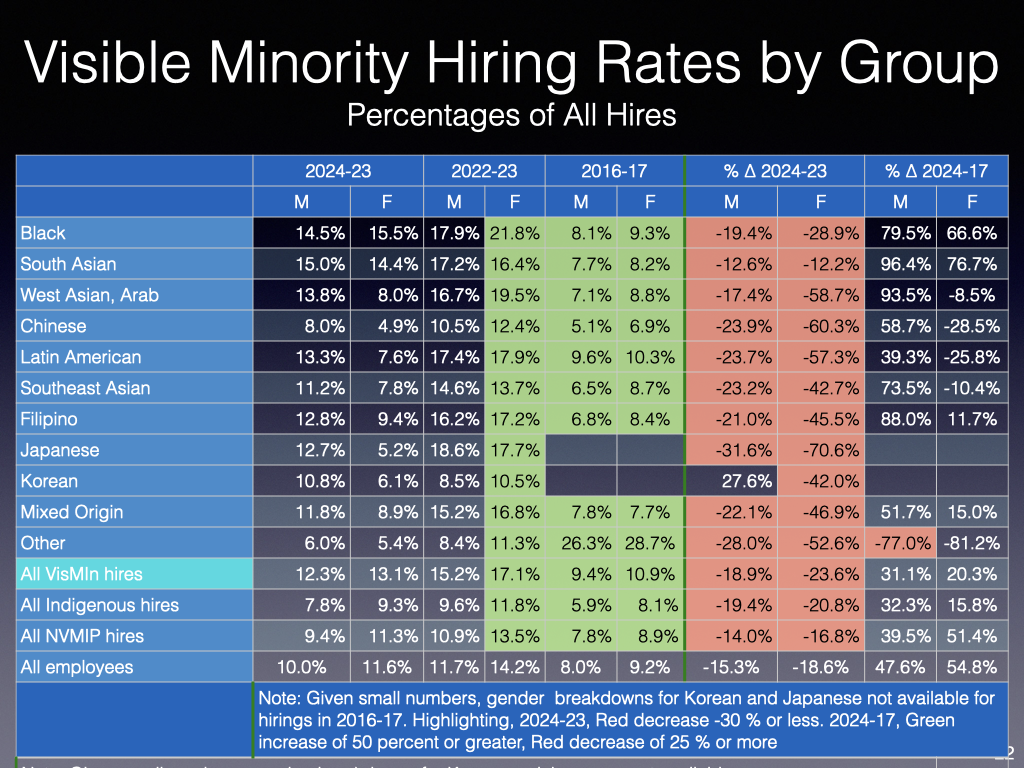
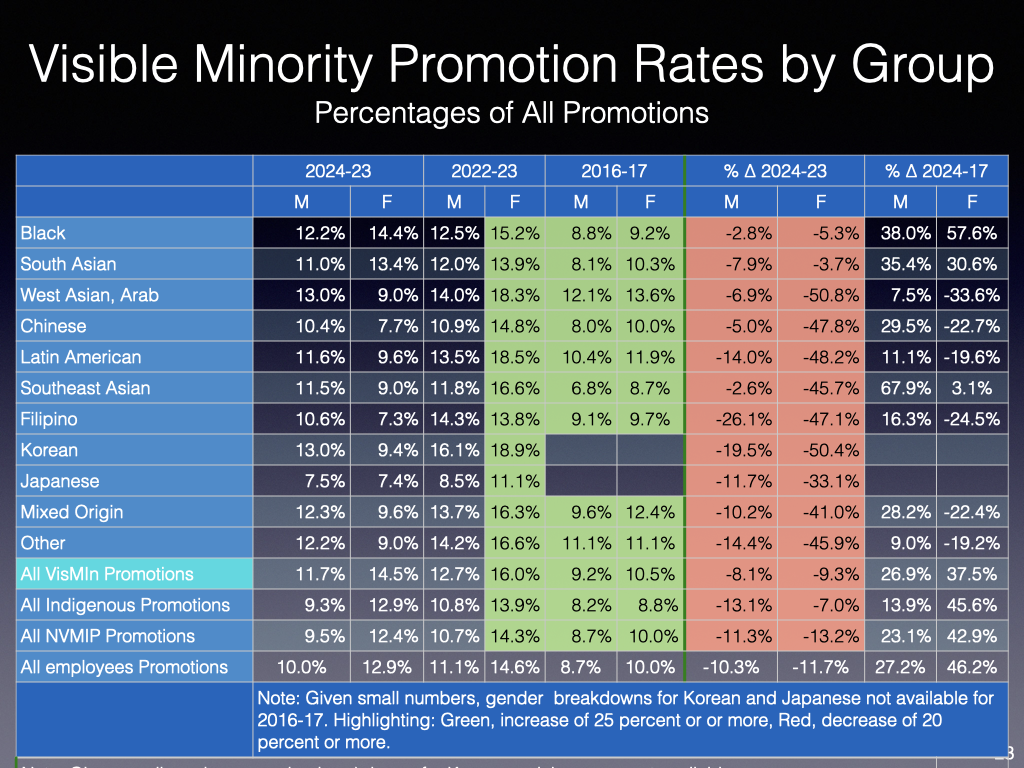
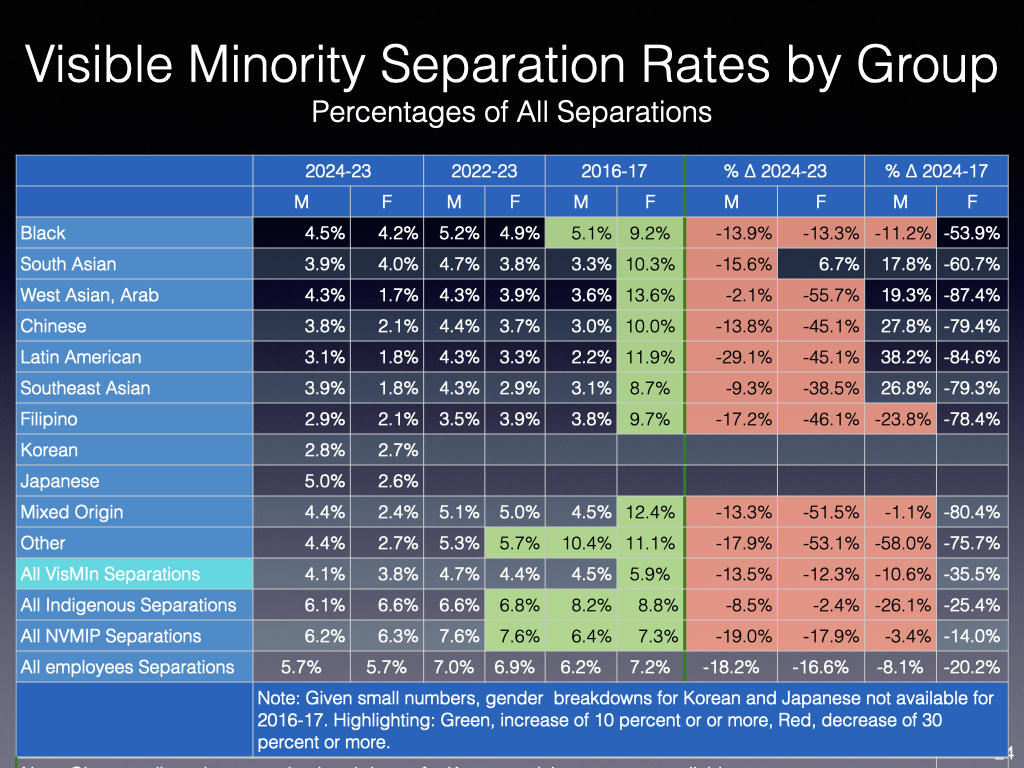
Will be curious to see the respective numbers of hirings, separations and promotions in the forthcoming TBS EE report. Hopefully, TBS will continue to provide the breakdowns by visible minority groups.
Slides from last year’s EE report.
Advocates are raising concerns about how job cuts will affect public servants in equity groups — something the Treasury Board of Canada Secretariat says it’s not tracking.
The federal government has committed to cutting the number of public service jobs by about 40,000 from a 2023-24 peak of 368,000 as it looks to find savings.
Departments and agencies across the public service have started notifying staff of coming job cuts.
Barb Couperus, a spokesperson for the Treasury Board of Canada Secretariat — which oversees government operations — said the office does not collect information centrally on the impact of workforce adjustment on employment equity designated groups.
Equity groups include women, Indigenous people, people with disabilities and members of visible minorities.
Couperus said heads of departments are responsible for managing their workforces.
She said departments will continue to pay “close attention” to maintaining representation and meeting their obligations under the Employment Equity Act.
The act requires federally regulated employers, including the government itself, to take steps to eliminate employment barriers and maintain proportional representation in the workplace for members of equity groups.
During layoff periods, Couperus said, departments can prioritize keeping staff from equity groups if there are gaps in representation.
Nicholas Marcus Thompson, president and CEO of the Black Class Action Secretariat, said he is “disturbed” to learn the Treasury Board isn’t tracking the impacts of job cuts.
“What that suggests is that this is not a priority for this government,” he said.
Over the past five years, the government has hired approximately 5,000 Black workers throughout the entire federal public service, said Thompson. It also has increased the number of Black executives from around 99 in 2020 to more than 220, he said.
“What we’re seeing now is that those gains are being lost as a result of workforce adjustment,” said Thompson, adding his organization has started tracking data on workforce adjustment. “Many folks have reached out to us to find out what their rights are.
“Usually with workforce adjustment, the first to go are folks that were the last to come … So far our data is showing that, despite these equity gains, it’s now turning out to be equity losses.”
Thompson said his organization wants to see the government require equity impact assessments before workforce adjustment decisions are made. It also wants the government to be transparent about the process and publish data on which demographics are being affected.
Rabia Khedr, national director of Disability Without Poverty, said people with disabilities working in the public service will be feeling anxious.
“Generally speaking, a lot of times people with disabilities may be at an entry level position, so that makes them vulnerable,” said Khedr.
The most recent employment equity report for the public service says that as of March 2024, 9.7 per cent of federal executives were people with disabilities, up from 4.6 per cent in March 2019.
Khedr also said she’s unhappy about the lack of central tracking of the impacts of job cuts on equity groups.
“That then leaves it to the individual leadership within departments to make those critical decisions,” she said.
“It really depends on the leadership and their commitment to diversity and inclusion … There’s a risk that equity-denied groups might be more vulnerable in terms of who gets cut and who stays.”
…Demographics is not the only reason Quebec’s influence in Canada is and will be diminishing, unless the province’s politics undergo a substantive change. Quebecers have not voted to separate from Canada in a referendum, but they have separated in some of their attitudes. In the Trump era, belonging to Canada may matter as a shield against the American president’s nonsensical threats. But otherwise, “les Québécois” appear less interested in our nation’s evolution than ever in my lifetime.
Quebec political leaders invest little time in engaging with their counterparts in Ottawa and in provincial capitals, except when specific files require it. The result is that very few politicians across the country have a deep understanding of Quebec’s part in Canada’s diversity. Additionally, recruiting highly qualified French-speaking Quebecers to work in the federal government is a challenge often lamented in Ottawa.
Justin Trudeau appointed a Governor General who does not speak French, a choice that, in earlier decades, would have been criticized not only in Quebec. There is pressure, for instance from the Alberta Premier, to appoint Supreme Court justices who cannot speak one of our country’s two official languages (guess which language it is?). Because of this lack of leadership at the national level, and as a result of French Canada’s relative decline, fewer Canadians value official bilingualism as a plus for our nation. A 2024 Léger poll showed that bilingualism was seen as positive by 70 per cent of Quebecers but only 35 per cent of Canadians outside Quebec. The Prime Minister’s rosy reimagining of Canadian history has no effect on today’s worrisome reality.
The demographic trends at play in Quebec will not only diminish its political weight. Population stagnation and aging threaten the province’s economic growth and fiscal situation. According to the economists at Desjardins, “the sustainability of Quebec’s welfare state model could be challenged.” Quebec’s leaders and population will face serious challenges in the coming years; their contribution to the federation will be the least of their concerns.
Quebecers’ votes played a crucial part in Mark Carney’s election win last year. But such scenarios, where Quebec has a significant impact on the shape of Canada’s federal government, will become fewer and far between. Because of high immigration levels outside Quebec, Canada is changing fast; in 2050, it will comprise close to 49 million people, many of them recent immigrants with no knowledge of French and understandably little attachment to the country’s bilingual status.
Of note, good to see this pushback. But we will see whether the current or future Quebec governments would support a framework that would limit their action:
Dans un mémoire qui a été soumis lundi aux députés chargés d’étudier le projet de loi 9 sur le renforcement de la laïcité, l’ordre professionnel des avocats – dont la mission est la protection du public et la défense de la primauté du droit – note que le gouvernement de François Legault utilise la disposition de dérogation (aussi nommée la clause de souveraineté parlementaire ou clause nonobstant) pour une sixième fois.
“Le contexte mondial est actuellement marqué par une érosion préoccupante de l’état de droit. La réponse la plus robuste à une telle tendance ne doit pas provoquer l’affaiblissement des mécanismes de justification, de contrôle et de reddition de comptes, mais bien les renforcer. Une démocratie solide se reconnaît à l’obligation que se donne une société de respecter les règles qui la fondent.” Le Barreau du Québec
L’ordre professionnel rappelle que la disposition de dérogation était au départ un « compromis politique historique » dans le cadre du rapatriement de la constitution, en 1982. Or, si son utilisation devait être exceptionnelle, elle a été normalisée au cours des dernières années au Québec, notamment en matière de laïcité et de protection du français. Ottawa a déjà annoncé qu’il s’attardera à la question de son utilisation de façon préventive par le gouvernement québécois dans le cadre de la contestation de la loi 21 sur la laïcité qui sera entendue devant la Cour suprême au mois de mars.
« De mécanisme d’exception destiné à répondre à des situations particulières, la disposition de dérogation est devenue un outil de sécurisation politique mobilisé en amont de la contestation judiciaire et au détriment du dialogue constitutionnel », déplore pour sa part le Barreau.
Une loi-cadre « résolument québécoise »
Dans ce contexte, le Barreau du Québec propose au gouvernement d’adopter une loi-cadre pour assurer une « juste utilisation » de la disposition de dérogation. « Une telle solution sera rassembleuse, sécurisante sur le plan juridique, structurante sur le plan institutionnel, et résolument québécoise », estime l’ordre professionnel.
Une telle loi devrait comporter différents éléments pour assurer « le maintien d’un dialogue réel et soutenu entre le législateur et les tribunaux, tout en réaffirmant sans ambiguïté la souveraineté parlementaire du Québec ». Parmi ces éléments, le Barreau estime qu’il faudrait établir des « conditions strictes » à son recours, l’obligation pour le gouvernement d’expliquer les raisons qui justifient son utilisation, de consulter la société civile et de garantir un débat parlementaire sur la question.
Le Barreau suggère également qu’un seuil supérieur à la majorité simple des députés devrait être requis pour utiliser la disposition de dérogation (afin que la démarche soit transpartisane) et qu’un renvoi vers la Cour d’appel (le plus haut tribunal de la province) soit requis pour obtenir un avis sur la question, sans que celui-ci soit de nature à limiter la souveraineté parlementaire….
In a brief that was submitted on Monday to the deputies responsible for studying Bill 9 on the strengthening of secularism, the professional order of lawyers – whose mission is the protection of the public and the defense of the primacy of law – notes that the government of François Legault is using the derogation provision (also called the clause of parliamentary sovereignty or clause notwithstanding) for a sixth time.
“The global context is currently marked by a worrying erosion of the rule of law. The most robust response to such a trend should not cause the mechanisms of justification, control and accountability to weaken, but rather strengthen them. A solid democracy is recognized by the obligation that a society gives itself to respect the rules that base it.” The Quebec Bar
The professional order recalls that the derogation provision was initially a “historic political compromise” in the context of the repatriation of the constitution in 1982. However, if its use were to be exceptional, it has been standardized in recent years in Quebec, especially in terms of secularism and the protection of French. Ottawa has already announced that it will dwell on the issue of its preventive use by the Quebec government in the context of the challenge of Bill 21 on secularism that will be heard before the Supreme Court in March.
“From an exceptional mechanism intended to respond to particular situations, the derogation provision has become a tool for political security mobilized upstream of the judicial challenge and to the detriment of constitutional dialogue,” laments the Bar for its part.
A “resolutely Quebec” framework law
In this context, the Barreau du Québec proposes to the government to adopt a framework law to ensure a “fair use” of the derogation provision. “Such a solution will be unifying, legally secure, institutionally structuring, and resolutely Quebec,” believes the professional order.
Such a law should include different elements to ensure “the maintenance of a real and sustained dialogue between the legislator and the courts, while unambiguously reaffirming the parliamentary sovereignty of Quebec”. Among these elements, the Bar believes that “strict conditions” should be established for its appeal, the obligation for the government to explain the reasons that justify its use, to consult civil society and to guarantee a parliamentary debate on the issue.
The Bar also suggests that a threshold higher than the simple majority of MPs should be required to use the derogation provision (so that the approach is cross-party) and that a referral to the Court of Appeal (the highest court in the province) be required to obtain an opinion on the matter, without this being likely to limit parliamentary sovereignty.
Reminder of the collateral damage related to laïcité:
L’interdiction de porter un signe religieux, imposée au personnel scolaire, risque de faire particulièrement mal aux écoles alternatives du Québec, puisque cette directive s’applique aussi aux bénévoles, a appris Le Devoir. C’est que, dans ces établissements, l’implication des parents dans la classe de leurs enfants est obligatoire.
Le 30 octobre dernier, le gouvernement Legault a fait adopter son projet de loi 94, qui visait à renforcer la laïcité dans le réseau scolaire québécois. Depuis, les élèves doivent fréquenter leur école à visage découvert, tout comme l’essentiel du personnel scolaire. Il est par ailleurs interdit aux employés de porter un signe religieux. Une directive qui s’étend « à toute personne qui fournit régulièrement des services » entre les murs d’une école, peu importe leur nature, ou encore qui fournit « des services aux élèves », même de façon ponctuelle et gratuite.
« Ainsi, pour fournir bénévolement des services dans l’école de son enfant dans l’une ou l’autre des situations qui précèdent, le parent doit respecter l’interdiction de port de signe religieux », confirme le ministère de l’Éducation, dans un courriel au Devoir. Une clause de droits acquis s’applique cependant aux parents qui fournissaient déjà bénévolement des services dans l’école de leur enfant avant le 30 octobre 2025, « sauf si l’entente en vertu de laquelle ces services sont offerts est renouvelée après cette date ». Ils devront alors retirer leur signe religieux ou cesser de s’impliquer dans leur école.
Dans de nombreux établissements, cette décision pourrait complexifier le travail du personnel scolaire, comme des directions d’école, la présence de parents bénévoles pour aider au rangement des livres dans les bibliothèques ou pour accompagner des enseignants lors de sorties scolaires permettant d’alléger, quelque peu, les effets de la pénurie de main-d’œuvre, évoquent plusieurs intervenants au Devoir.
« Discrimination par association »
Cependant, c’est dans les écoles alternatives — dont le nombre, en augmentation, approche la cinquantaine au Québec — que cette interdiction pourrait avoir le plus de répercussions. Car, dans ces établissements, l’implication bénévole des parents d’élèves, directement dans la classe de ces derniers, est obligatoire. Certaines écoles demandent d’ailleurs un nombre d’heures minimales d’implication bénévole aux parents.
Ainsi, si un parent ne peut plus s’impliquer dans une école alternative parce qu’il porte un signe religieux, « son enfant ne peut plus aller à cette école-là », relève le porte-parole du Regroupement des comités de parents autonomes du Québec, Sylvain Martel. « On va arriver à exclure des enfants de leur école en raison des croyances religieuses de leurs parents », déplore M. Martel, qui voit là « une sorte de discrimination par association ».
Une situation que dénonce le porte-parole du Réseau des écoles publiques alternatives du Québec, Pierre Chénier, qui a été mis au fait de cette situation par Le Devoir.
« Je trouve ça vraiment déraisonnable », lance-t-il, déplorant que cette interdiction vise ainsi des parents motivés par leur « bonne volonté » et leur « désir d’aider ». « Vraiment, je n’en reviens pas », poursuit M. Chénier. Selon lui, cette directive menace de « faire disparaître le modèle » unique des écoles alternatives, qui cherche « l’inclusion plutôt que l’exclusion ».
The ban on wearing a religious sign, imposed on school staff, may particularly harm alternative schools in Quebec, since this directive also applies to volunteers, Le Devoir learned. It is because, in these institutions, the involvement of parents in their children’s class is mandatory.
On October 30, the Legault government passed its Bill 94, which aimed to strengthen secularism in the Quebec school network. Since then, students have had to attend their school with their faces uncovered, just like most of the school staff. Employees are also prohibited from wearing a religious sign. A directive that extends “to anyone who regularly provides services” within the walls of a school, regardless of their nature, or who provides “services to students”, even on an ad hoc and free of charge.
“Thus, to voluntarily provide services in his child’s school in any of the above situations, the parent must respect the prohibition of wearing a religious sign,” confirms the Ministry of Education, in an email to Le Devoir. However, an acquired rights clause applies to parents who were already voluntarily providing services in their child’s school before October 30, 2025, “unless the agreement under which these services are offered is renewed after that date”. They will then have to withdraw their religious sign or stop getting involved in their school.
In many schools, this decision could complicate the work of school staff, such as school principals, the presence of volunteer parents to help store books in libraries or to accompany teachers on school outings to lighten somewhat the effects of the labor shortage, say several speakers at Le Devoir.
“Discrimination by association”
However, it is in alternative schools — whose number, increasing, is approaching fifty in Quebec — that this ban could have the most repercussions. Because, in these institutions, the voluntary involvement of parents of students, directly in their classroom, is mandatory. Some schools also require a minimum number of hours of volunteer involvement from parents.
Thus, if a parent can no longer get involved in an alternative school because he wears a religious sign, “his child can no longer go to that school,” says Sylvain Martel, spokesman for the Regroupement des comités de parents autonomes du Québec. “We will be able to exclude children from their school because of the religious beliefs of their parents,” laments Mr. Martel, who sees this as “a kind of discrimination by association”.
A situation denounced by the spokesman for the Réseau des écoles publiques alternatives du Québec, Pierre Chénier, who was made aware of this situation by Le Devoir.
“I find it really unreasonable,” he says, deploring that this ban is aimed at parents motivated by their “good will” and their “desire to help”. “Really, I can’t believe it,” continues Mr. Chenier. According to him, this directive threatens to “make the unique model” disappear from alternative schools, which seeks “inclusion rather than exclusion”.
“Les activités caritatives, comme les guignolées ou les comptoirs alimentaires, pourraient-elles devenir des victimes collatérales du projet de loi du gouvernement Legault « sur le renforcement de la laïcité » ? C’est du moins ce que craignent les évêques catholiques québécois.
Dans un mémoire qui sera présenté mercredi en commission parlementaire, l’Assemblée des évêques catholiques du Québec (AECQ) lève un drapeau rouge : « la définition des “pratiques religieuses” qui est utilisée dans le projet de loi est trop large et doit être précisée, car elle risque de limiter l’action charitable de plusieurs organismes de bienfaisance ».
Déposé en novembre, le projet de loi 9 « sur le renforcement de la laïcité au Québec » prévoit l’interdiction, dans une panoplie d’édifices publics, de toute « pratique religieuse ». L’usage de la voie publique ou d’un parc à des fins de « pratique religieuse collective » est également proscrit, à moins d’obtenir une autorisation exceptionnelle de la municipalité.
“Quand je me réfère à notre expérience ici, à Saint-Jérôme, au centre-ville, la cathédrale a donné plus de 20 000 $ pour des paniers de Noël. Elle a réalisé ça, entre autres, avec une guignolée au coin des rues par les Chevaliers de Colomb », a observé l’évêque de Saint-Jérôme-Mont-Laurier, Raymond Poisson, en entrevue avec Le Devoir en prévision du passage en commission de l’AECQ. « S’il fallait qu’on arrête de faire ça… »
Devant le ministre responsable de la Laïcité, Jean-François Roberge, mercredi, l’AECQ défendra l’idée que, plutôt que la « pratique religieuse », ce soit « l’enseignement religieux et le culte de toute profession religieuse » qui soient interdits dans les édifices publics et dans les rues. Sans quoi, estime Mgr Poisson, cela pourrait sonner la fin des activités caritatives pour plusieurs regroupements.
« Il y a des organismes qui nous offrent des subventions pour nos comptoirs alimentaires et vestimentaires. On en a dans beaucoup, beaucoup de nos églises », a-t-il ajouté. « Pendant la pandémie, ici, on a continué à livrer 200 boîtes de nourriture aux familles et ce sont les employés municipaux qui les livraient. On ne voudrait pas perdre ça. »
“Dans les neuf recommandations contenues dans leur mémoire, les 23 évêques membres de l’AECQ demandent le maintien des locaux de prières dans les universités et cégeps. Ils souhaitent aussi le retrait d’une disposition du projet de loi 9 prévoyant rendre conditionnel le financement public d’écoles religieuses.
« On a une liberté d’expression et c’est reconnu par des chartes. Je pense que l’État, peut-être, déborde de sa juridiction, ou a un peu trop d’ambition », a affirmé Mgr Poisson au téléphone cette semaine.”
Source: “Légiférer sur la laïcité met à risque les guignolées, craignent les évêques du Québec”
“Could charitable activities, such as puppets or food counters, become collateral victims of the Legault government’s bill “on strengthening secularism”? At least that is what Quebec Catholic bishops fear.
In a report that will be presented on Wednesday in the parliamentary committee, the Assembly of Catholic Bishops of Quebec (AECQ) raises a red flag: “the definition of “religious practices” that is used in the bill is too broad and must be clarified, because it risks limiting the charitable action of several charities”.
Tabled in November, Bill 9 “on the strengthening of secularism in Quebec” provides for the prohibition, in a range of public buildings, of any “religious practice”. The use of the public road or a park for the purpose of “collective religious practice” is also prohibited, unless exceptional authorization is obtained from the municipality.
“When I refer to our experience here in Saint-Jérôme, downtown, the cathedral gave more than $20,000 for Christmas baskets. She achieved this, among other things, with a puppet around the corner of the streets by the Knights of Columbus, “observed the bishop of Saint-Jérôme-Mont-Laurier, Raymond Poisson, in an interview with Le Devoir in anticipation of the passage through the AECQ commission. “If we had to stop doing this…”
Before the Minister responsible for Secularism, Jean-François Roberge, on Wednesday, the AECQ will defend the idea that, rather than “religious practice”, it is “religious education and the worship of any religious profession” that are prohibited in public buildings and on the streets. Otherwise, according to Bishop Poisson, this could ring the end of charitable activities for several groups.
“There are organizations that offer us subsidies for our food and clothing counters. We have them in many, many of our churches, “he added. “During the pandemic, here, we continued to deliver 200 boxes of food to families and it was municipal employees who delivered them. We wouldn’t want to lose that. ”
“In the nine recommendations contained in their report, the 23 bishops members of the AECQ ask for the maintenance of prayer rooms in universities and CEGEPs. They also want the withdrawal of a provision of Bill 9 to make the public funding of religious schools conditional.
“We have freedom of expression and it is recognized by charters. I think the State, perhaps, overflows its jurisdiction, or has a little too much ambition, “said Bishop Poisson on the phone this week.”
Ces critiques virulentes proviennent de l’Union des municipalités du Québec (UMQ), qui représente des villes totalisant plus de 85 % de la population québécoise. Ses représentants ont témoigné mardi en commission parlementaire, dans le contexte où le projet de loi 9 est l’une des nombreuses pièces législatives que la Coalition avenir Québec (CAQ) souhaite adopter d’ici au déclenchement des élections.
« En politisant des enjeux ponctuels et en détournant des ressources essentielles, il compromet la capacité des gouvernements de proximité à répondre aux priorités concrètes de la population », déplorent les villes. De plus, « les situations impliquant des enjeux de laïcité sont décrites comme rares, ponctuelles et généralement réglées à l’aide des pouvoirs et outils déjà disponibles en vertu du droit municipal existant », ajoutent-elles.
L’adoption de nouvelles obligations législatives apparaît non seulement injustifiée, mais profondément déconnectée des réalités administratives et opérationnelles municipales. Le projet de loi 9 semble ainsi répondre à des préoccupations marginales, plutôt qu’à des situations concrètes nécessitant une intervention législative additionnelle.
L’Union des municipalités du Québec
Le projet de loi 9 prévoit aussi que les municipalités devront permettre les prières de rue ou dans les parcs pour les groupes qui en font la demande « de façon exceptionnelle », par résolution du conseil municipal, si la pratique religieuse en question « ne compromet pas la sécurité des personnes, est de courte durée, est accessible à tous et n’entrave pas indûment l’accès à toute personne au domaine public ». Les prières individuelles ne sont pas visées.
« Cette orientation est inadaptée à la réalité municipale : les villes disposent déjà des pouvoirs nécessaires pour gérer ces usages de manière efficace, proportionnée et neutre, sans qu’un resserrement législatif uniforme ne soit requis », affirment les municipalités représentées par l’UMQ.
These virulent criticisms come from the Union des municipalités du Québec (UMQ), which represents cities totaling more than 85% of the Quebec population. Its representatives testified on Tuesday in the parliamentary committee, in the context that Bill 9 is one of the many pieces of legislation that the Coalition avenir Québec (CAQ) wishes to adopt between now and the elections are launched.
“It undermines the ability of local governments to respond to the population’s concrete priorities,” the cities lament. In addition, “situations involving secularism issues are described as rare, punctual and generally resolved using the powers and tools already available under existing municipal law,” they add.
The adoption of new legislative obligations appears not only unjustified, but deeply disconnected from municipal administrative and operational realities. Bill 9 thus appears to respond to marginal concerns, rather than concrete situations requiring additional legislative intervention.
The Union of Municipalities of Quebec
Bill 9 also provides that municipalities will have to allow prayers on the street or in parks for groups that request it “exceptionally”, by resolution of the municipal council, if the religious practice in question “does not compromise the safety of people, is short-lived, is accessible to all and does not unduly hinder access to the public domain for anyone”. Individual prayers are not targeted.
“This orientation is inappropriate for municipal reality: cities already have the necessary powers to manage these uses in an effective, proportionate and neutral manner, without uniform legislative tightening being required,” say the municipalities represented by the UMQ.


 Multicultural Meanderings