Pratte: Opinion: Questioning whether French is in decline should not be heresy

A very good example of how to analyze language data in a comprehensive and nuanced manner, using the wide range of language measures in the census and the Rapport sur l’évolution de la situation linguistique au Québec (mother tongue, language most spoken at home, language most spoken at work, language of instruction):

In the wake of a question from MP Emmanuella Lambropoulos that included quotation marks, Minister of Official Languages Mélanie Joly said she was “stunned” and maintained that “we cannot deny at this time that there is a decline in the French language in Montreal and across the country. The statistics show it.”

The decline of French would thus have become an absolute truth, statistical dogma that cannot be contested without risking excommunication — a punishment that was, as a matter of fact, administered to Lambropoulos.

However, the reality is much more complex. In its latest Rapport sur l’évolution de la situation linguistique au Québec, published last year (125 pages of statistics!), the Office québécois de la langue française paints a very nuanced picture of the situation.

Is there a decline? Some data suggest that there is, but several other figures show either stability or progress for francophones, particularly since the francization of immigrant children introduced by Bill 101.

In terms of mother tongue, for example, it is true that the proportion of French speakers slipped from 80.9 per cent to 77 per cent between 1996 and 2016. However, the proportion of anglophones also decreased, from 8.3 per cent to 7.5 per cent. No, the shift from French as a mother tongue has been toward “other” languages, that is, the mother tongues of immigrants. Their children, on the other hand, will go to French school, and French will slowly establish itself from one generation to the next.

Moreover, unlike previous generations, the majority (75 per cent) of recent immigrants who speak a language other than their mother tongue at home adopt French. According to this indicator, within the immigrant population, French is not declining at all, it is on the rise.

Data on language of work and language of instruction provide an equally nuanced picture. For example, on the island of Montreal, the number of children entitled to English-language education under Bill 101 dropped by one-third, from 75,256 to 50,416 students between 1986 and 2015.

Where the problem lies is in the language used in downtown retailers. The survey published by Le Journal de Montréal a few days ago confirms the data collected by the Office, according to which the proportion of stores in downtown Montreal where customers are greeted in French decreased sharply from 2010 to 2017, from 86.2 per cent to 72 per cent for stores in shopping centres, and from 89.5 per cent to 73.6 per cent for stores fronting on the street. These drops occurred in favour of English and of Bonjour-Hi. That said, once past the initial greeting, service in French was available in 96 per cent of cases, a proportion that has not changed since 2010.

We cannot therefore speak of a general decline in French. It all depends on what exactly we’re talking about. The government — and Quebec society in general — must certainly act to ensure that customers are received in stores first and foremost in French. It must be clearly indicated that the main language in Quebec is French.

However, the problems with how customers are greeted in stores do not justify an all-out linguistic offensive, even though such a policy would be popular. We will have to think twice, for example, before imposing Bill 101 on businesses under federal jurisdiction, when there is nothing to indicate that the problem of the “decline” of French is rooted in this sector, which accounts for less than four per cent of the province’s workers. It is surprising, moreover, that the government of Canada has not categorically rejected this blatant intrusion into its jurisdiction.

In short, one cannot speak of a decline of French in Quebec without putting a lot of nuances into it. We can say this while affirming that the situation of French in Quebec will always remain fragile and that, consequently, vigilance is required. However, in order to ensure that policies in this area continue to be well informed, it is absolutely necessary to authorize and encourage debate and questioning, even accompanied by quotation marks.

In short, one cannot speak of a decline of French in Quebec without putting a lot of nuances into it. We can say this while affirming that the situation of French in Quebec will always remain fragile and that, consequently, vigilance is required. However, in order to ensure that policies in this area continue to be well informed, it is absolutely necessary to authorize and encourage debate and questioning, even accompanied by quotation marks.

André Pratte, former journalist and former senator, is a principal at Navigator.
Source: https://montrealgazette.com/opinion/opinion-questioning-whether-french-is-in-decline-should-not-be-heresy

Religious minorities say Quebec’s Christmas gathering plan shows a double standard

Valid critique. I remember when Ontario’s Sunday closing laws (Lord’s Day Act, the Retail Business Holidays Act) were repealed or amended given this discriminatory impact on other religions along with general public pressure in the early 1990s:

Members of religious minority groups in Quebec are decrying the provincial government’s plan to allow Christmas-time gatherings in the midst of the COVID-19 pandemic, calling the move a sign of a double standard.

The condemnations came days after Premier Francois Legault offered Quebecers what he dubbed a “moral contract” through an offer to raise gathering limits over a four-day period starting on Christmas Eve.

“It’s disappointing,” said Yusuf Faqiri, a representative of the National Council of Canadian Muslims. “The Muslim community, the Jewish community, the Sikh community, when we had our respective holidays, we were not able to gather.”

Legault announced the terms of the Christmas repreive on Thursday, saying groups of up to 10 could gather between Dec. 24 and Dec. 27. The short-term move marks a sharp reversal from rules currently in place in much of the province, where all indoor gatherings are banned in regions classified as red zones under the province’s pandemic response plan.

Faqiri said his objections to the move aren’t rooted solely in the pandemic. His organization is one of several that is currently challenging Quebec’s secularism law in court. That law bans some public servants, including teachers, from wearing religious symbols while working, on the grounds that the state must be religiously neutral.

He said it’s “a contradiction” to defend that bill while allowing Christmas gatherings.

“All Quebecers, from all faith groups, from all respective traditions, we’re all proud participants in the society,” he said. “But in order for us to do that, we should all be treated the same and that’s where the fundamental issue lies.”

Rabbi Lisa Grushcow, of Temple Emanu-El-Beth Sholom in Montreal, said Jewish people have been left out.

“But we’ve been left out of something I wouldn’t want to be included in,” she quipped.

Grushcow said she’s worried that the allowance for gatherings will put vulnerable people and teachers at risk.

“I don’t know that the government’s following the science and the medical wisdom,” she said. “That’s the piece that worries me.”

She said she doesn’t want the government to allow people to gather for Hanukkah, noting that her congregation has already made it through more important Jewish holidays in the midst of the pandemic.

“We made it through Passover, we made it through Rosh Hashanah, we made it through Yom Kippur,” she said. “So if anything, I would hope that our experience can show that it’s possible to be creative and still be connected, even while keeping each other safe.”

Grushcow said there is an inconsistency when it comes to the Quebec government’s approach to secularism.

“You’re saying that you can rearrange the whole school calendar and put a society at risk so folks can celebrate Christmas, but you’re not going to let it teacher wear a hijab or a kippah,” she said. “It is a bit of a challenge.”

When asked about people who don’t celebrate Christmas at press conference on Thursday evening, Legault said he believes allowing for gatherings around Christmas is what most Quebecers want.

Other rabbis echoed Grushcow’s concerns.

“While we appreciate the intent of the Quebec government’s decision to accommodate families and allow them to gather for Christmas, it is unfortunate and disturbing that it does not apply to all faith communities,” Rabbi Reuben Poupko, the co-chair of Centre for Israel and Jewish Affairs-Quebec and the rabbi of the Beth Israel Beth Aaron Congregation in Montreal, said in a statement. “The elevating of one faith community over another is inappropriate, and all faith communities should be treated in an equitable manner.”

At a technical briefing on Friday morning, public health officials said they didn’t specifically choose to centre the moral contract around Christmas but selected the dates because they fell in the middle of the winter school break.

Source: https://www.nationalnewswatch.com/2020/11/22/religious-minorities-say-quebecs-christmas-gathering-plan-shows-a-double-standard/#.X7uWei3b23g

La part québécoise de l’immigration continue de diminuer

No surprise. Conscious policy decision with longer-term political impact:

Le Québec n’a peut-être pas accueilli autant d’immigrants qu’il le souhaitait en 2020 à cause de la pandémie, mais il n’en accueillera pas plus l’année prochaine que ce qu’il avait initialement prévu. Du coup, parce qu’Ottawa, lui, entend procéder à un rattrapage, la part québécoise de l’immigration canadienne diminuera encore.

Québec a reconnu fin octobre qu’il recevra cette année entre 30 % et 40 % moins d’immigrants que prévu et qu’il effectuerait un « rattrapage » de 7000 dossiers au cours des deux prochaines années. Plusieurs en ont déduit que ces 7000 personnes s’ajouteraient aux 44 500 à 47 500 personnes que Québec avait planifié d’accueillir en 2021. Ce ne sera pas le cas, a appris Le Devoir.

« Nous maintenons le cap sur les seuils d’immigration. En effet, la cible d’admission pour 2021 demeure la même, soit entre 44 500 et 47 500 immigrants », précise par courriel Flore Bouchon, l’attachée de presse de la ministre québécoise de l’Immigration, Nadine Girault. « L’ajustement des 7000 personnes est pour compenser la baisse des admissions qu’on pourrait avoir. » En d’autres mots, on pense que l’effet de la pandémie pourrait se prolonger en 2021 : garder la même cible constitue donc en soi un « rattrapage » aux yeux de Québec.

Or, le gouvernement fédéral entend vraiment, au cours des trois prochaines années, augmenter le nombre d’immigrants reçus par rapport à ce qu’il avait initialement prévu. Ainsi, il vise 401 000 admissions en 2021 (au lieu de 351 000), 411 000 en 2022 (au lieu de 361 000) et 421 000 en 2023 (les anciennes projections n’allaient pas jusque-là).

Or, le gouvernement fédéral entend vraiment, au cours des trois prochaines années, augmenter le nombre d’immigrants reçus par rapport à ce qu’il avait initialement prévu. Ainsi, il vise 401 000 admissions en 2021 (au lieu de 351 000), 411 000 en 2022 (au lieu de 361 000) et 421 000 en 2023 (les anciennes projections n’allaient pas jusque-là).

Ces hausses feront donc en sorte que Québec recevra une part plus faible qu’avant de nouveaux arrivants au Canada. En 2018, Québec avait reçu 15,9 % du total canadien. Ce taux a chuté à 11,9 % en 2019 et il sera seulement de 11,5 % en 2021 si les cibles des deux gouvernements sont atteintes. Pour l’année 2020 en cours, Ottawa pense être en mesure de respecter sa cible de 341 000 admissions, alors que Québec prévoit d’arriver bien en deçà, dans une fourchette de plus ou moins 25 000 à 30 000 arrivants, ce qui représenterait alors environ 8 % du total canadien.

La baisse de l’apport québécois à l’immigration canadienne se fera surtout sentir dans la catégorie des réfugiés et de la réunification familiale. Le Québec avait accepté 14,4 % de toutes les personnes arrivant au Canada pour rejoindre leur famille en 2018 et 10,6 % en 2019, mais ce taux passera à 9,6 % en 2021. Le déclin est de même amplitude du côté des réfugiés. La part québécoise était de 17,8 % en 2018 et de 13,6 % en 2019, mais ne sera plus que de 12,1 % en 2021.

La baisse de l’apport québécois à l’immigration canadienne se fera surtout sentir dans la catégorie des réfugiés et de la réunification familiale. Le Québec avait accepté 14,4 % de toutes les personnes arrivant au Canada pour rejoindre leur famille en 2018 et 10,6 % en 2019, mais ce taux passera à 9,6 % en 2021. Le déclin est de même amplitude du côté des réfugiés. La part québécoise était de 17,8 % en 2018 et de 13,6 % en 2019, mais ne sera plus que de 12,1 % en 2021.

L’accord entre Ottawa et Québec sur l’immigration commande que Québec accepte plus ou moins 20 % de tous les réfugiés venant au pays. Même si Québec est loin du compte, le gouvernement de Justin Trudeau accepte ses cibles, indique le bureau du ministre fédéral de l’Immigration, Marco Mendicino. « Le plan des niveaux d’immigration du gouvernement du Québec a été intégré au plan des niveaux d’immigration 2021 annoncé par le ministre Mendicino 30 octobre dernier. Nous collaborons avec le Québec afin de nous assurer de leur permettre de recevoir les immigrants nécessaires à la prospérité des entreprises », indique le porte-parole du ministre, Alexander Cohen.

Des craintes

Stephan Reichhold, qui dirige la Table de concertation des organismes au service des personnes réfugiées et immigrantes, trouve « très inquiétante » cette diminution. « Depuis deux ou trois ans, le Québec privilégie beaucoup plus l’immigration temporaire », note-t-il. Ces gens viennent travailler au Québec, mais attendront des années avant que leur statut soit régularisé, faute de place. Cela aura un impact sur leurs droits démocratiques et leur accès aux programmes sociaux ou encore les soins de santé.

Aussi M. Reichhold dit-il à ceux qui seraient tentés de se réjouir de cette diminution des seuils d’immigration que « c’est de la poudre aux yeux ». « Il y a autant de bodiessur le territoire québécois que lorsque les niveaux d’immigration étaient plus élevés. C’est ça que les gens ne comprennent pas. Ils sont déjà parmi nous. Ils vivent parmi nous. Ce sont nos voisins, ils sont là, ils participent, ils travaillent. […] Mais tout ça précarise beaucoup de personnes. »

La hausse des cibles d’immigration d’Ottawa a été généralement bien reçue par le milieu des affaires, qui y voit une solution à la pénurie de main-d’œuvre. Mais la population semble l’accepter avec moins d’enthousiasme. Un sondage Nanos Research Group effectué pour le compte de Bloomberg au début du mois indique que seulement 17 % des répondants pensent que le Canada devrait accueillir plus d’immigrants. 40 % ont dit qu’il faudrait plutôt maintenir les niveaux actuels d’immigration, tandis que 36 % des répondants ont dit qu’il faudrait abaisser les cibles.

Source: https://www.ledevoir.com/politique/canada/589588/immigration-la-part-quebecoise-continue-de-diminuer?utm_source=infolettre-2020-11-12&utm_medium=email&utm_campaign=infolettre-quotidienne

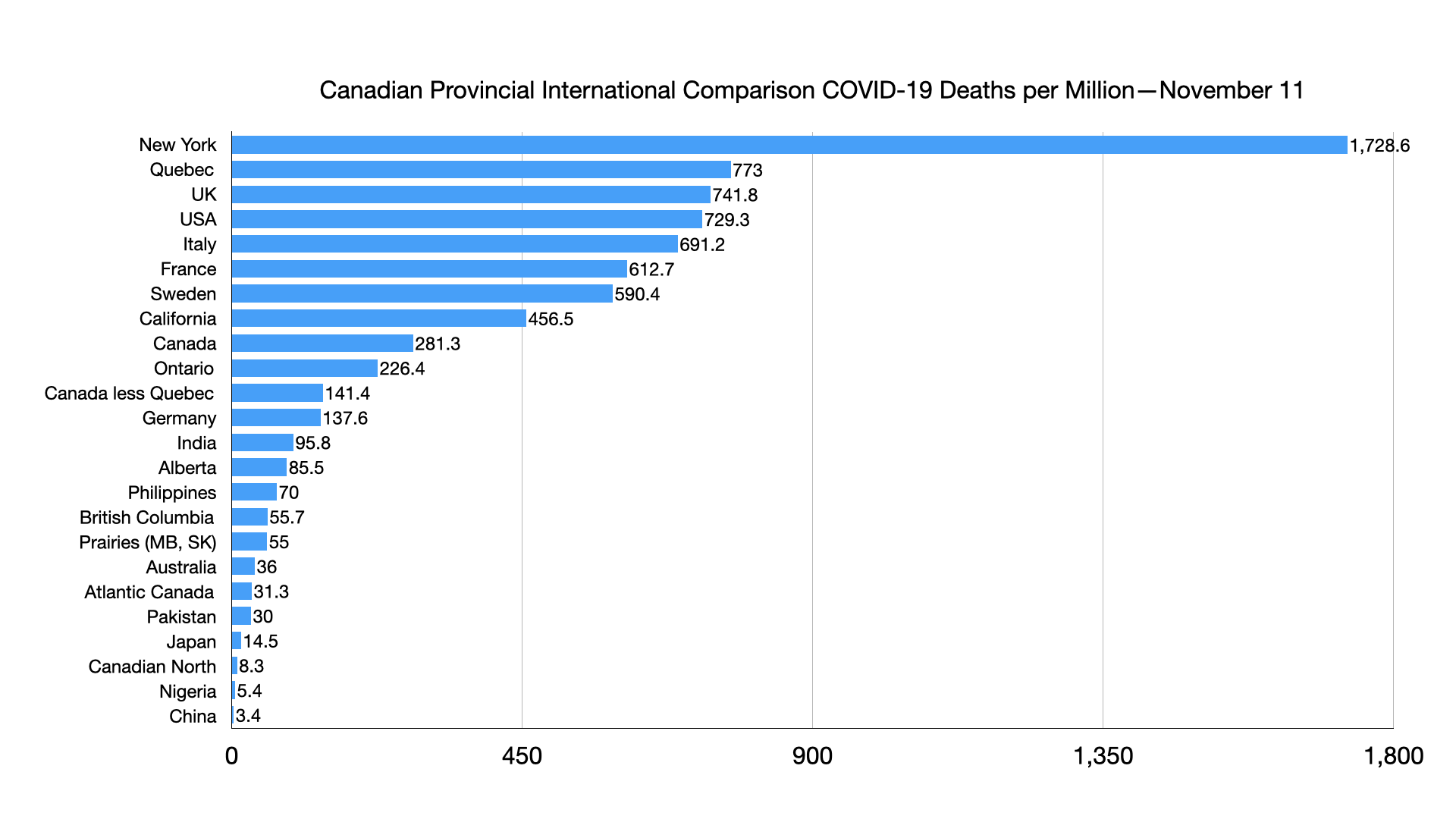
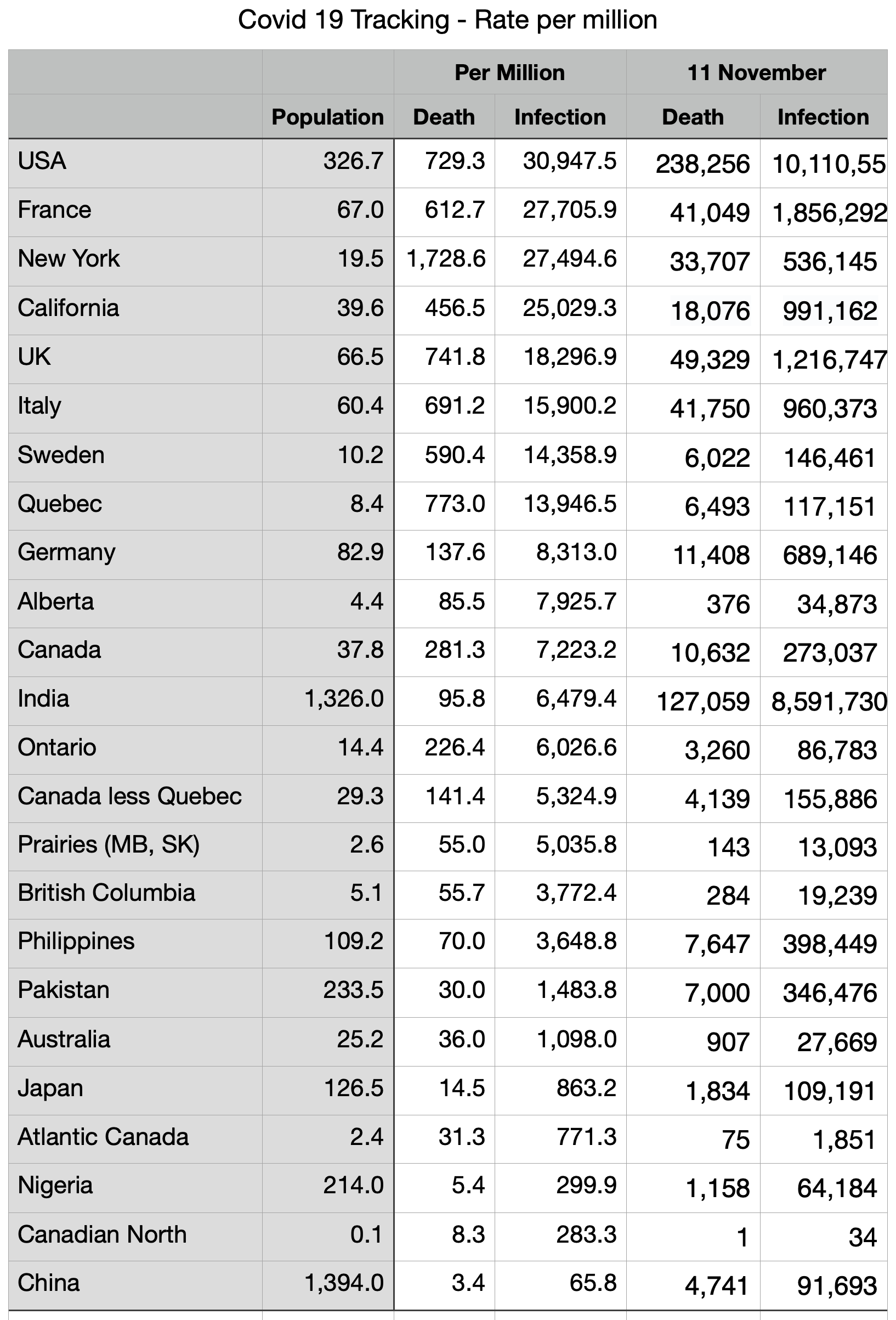
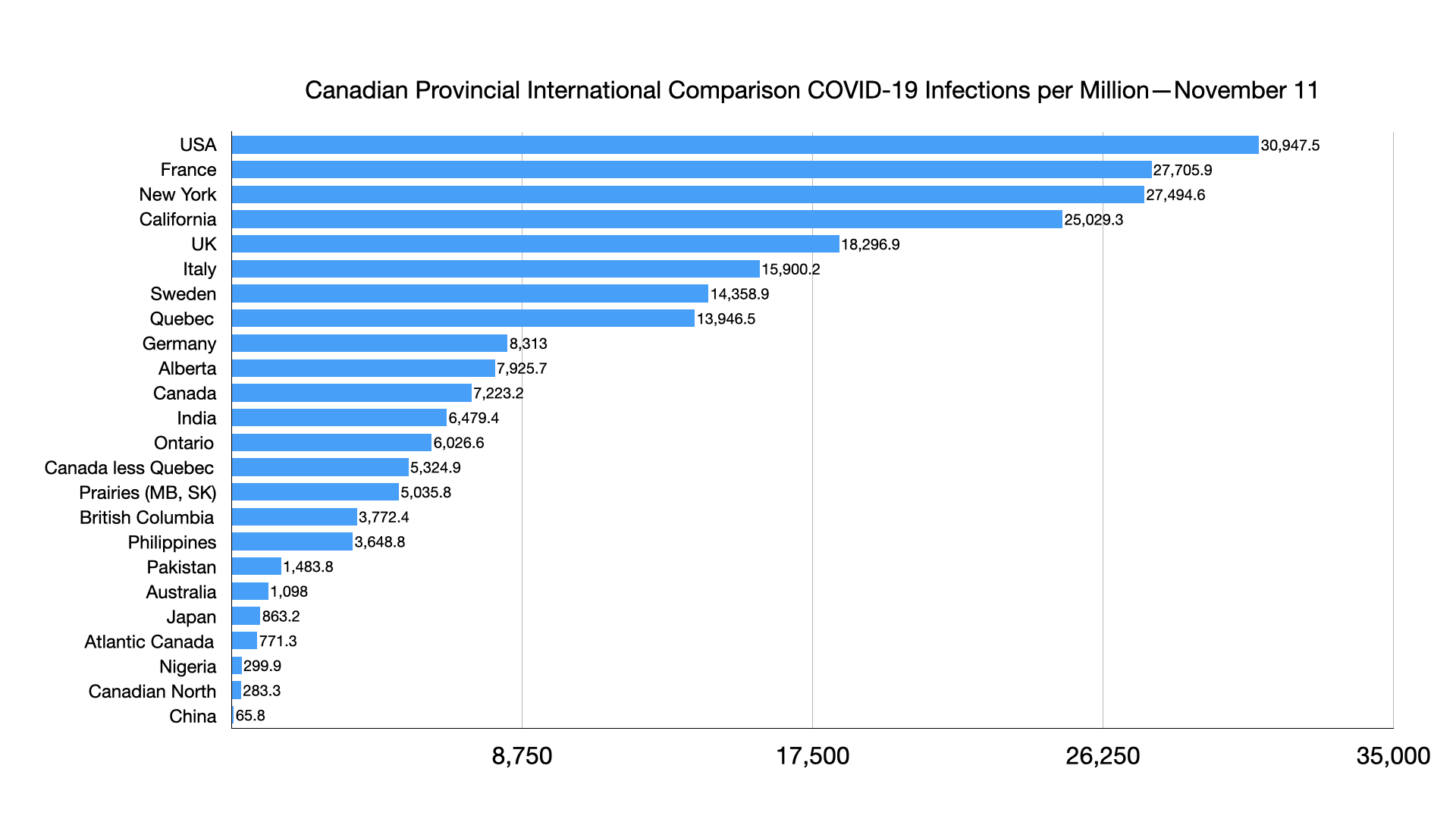
#COVID-19: Comparing provinces with other countries 11 November Update

Main news continues to be with respect to rapid increase in infections in most countries and provinces:
 
Weekly:
 
Infections per million: France ahead of New York, Italy and Sweden ahead of Quebec, British Columbia ahead of Philippines
 
Deaths per millionUK ahead of USA, France ahead of Sweden, Canadian North ahead of Nigeria


Quebec immigration minister skips federal human rights meeting addressing systemic racism (along with Alberta, Saskatchewan)

Sigh:

Quebec’s immigration minister Nadine Girault pulled out of a virtual meeting among provinces about human rights, drawing criticism from federal government officials who say it is because of the province’s refusal to acknowledge systemic racism.

Girault sent a bureaucrat to observe, instead of participate in the meeting, citing scheduling issues. Alberta and Saskatchewan also sent observers, rather than participating.

But Canadian Heritage Minister Steven Guilbeault says he was told by Quebec provincial officials Girault’s absence was because of the meeting’s portion on systemic racism, which Premier François Legault has refused to say exists in Quebec.

Source: Quebec immigration minister skips federal human rights meeting addressing systemic racism

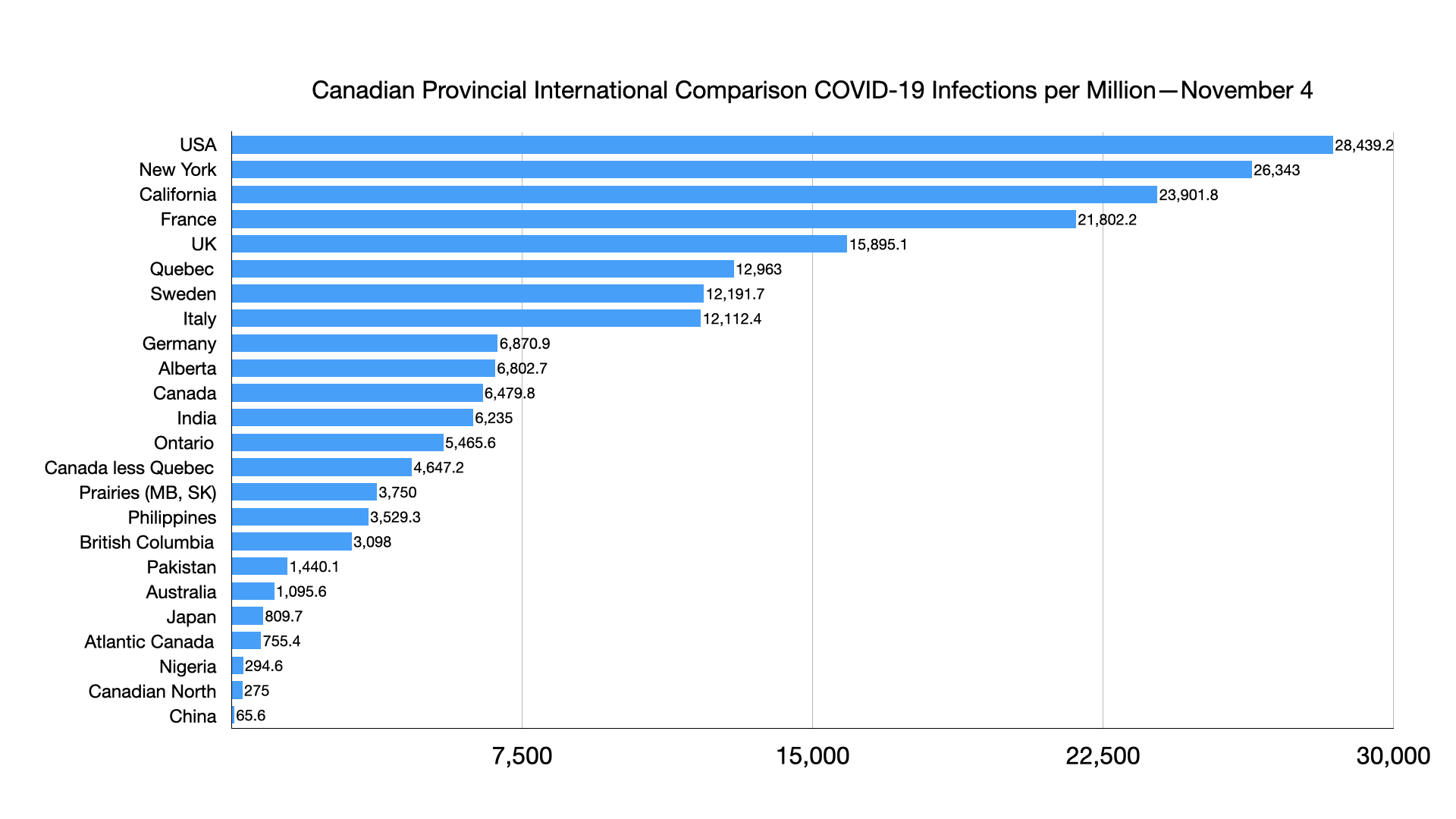
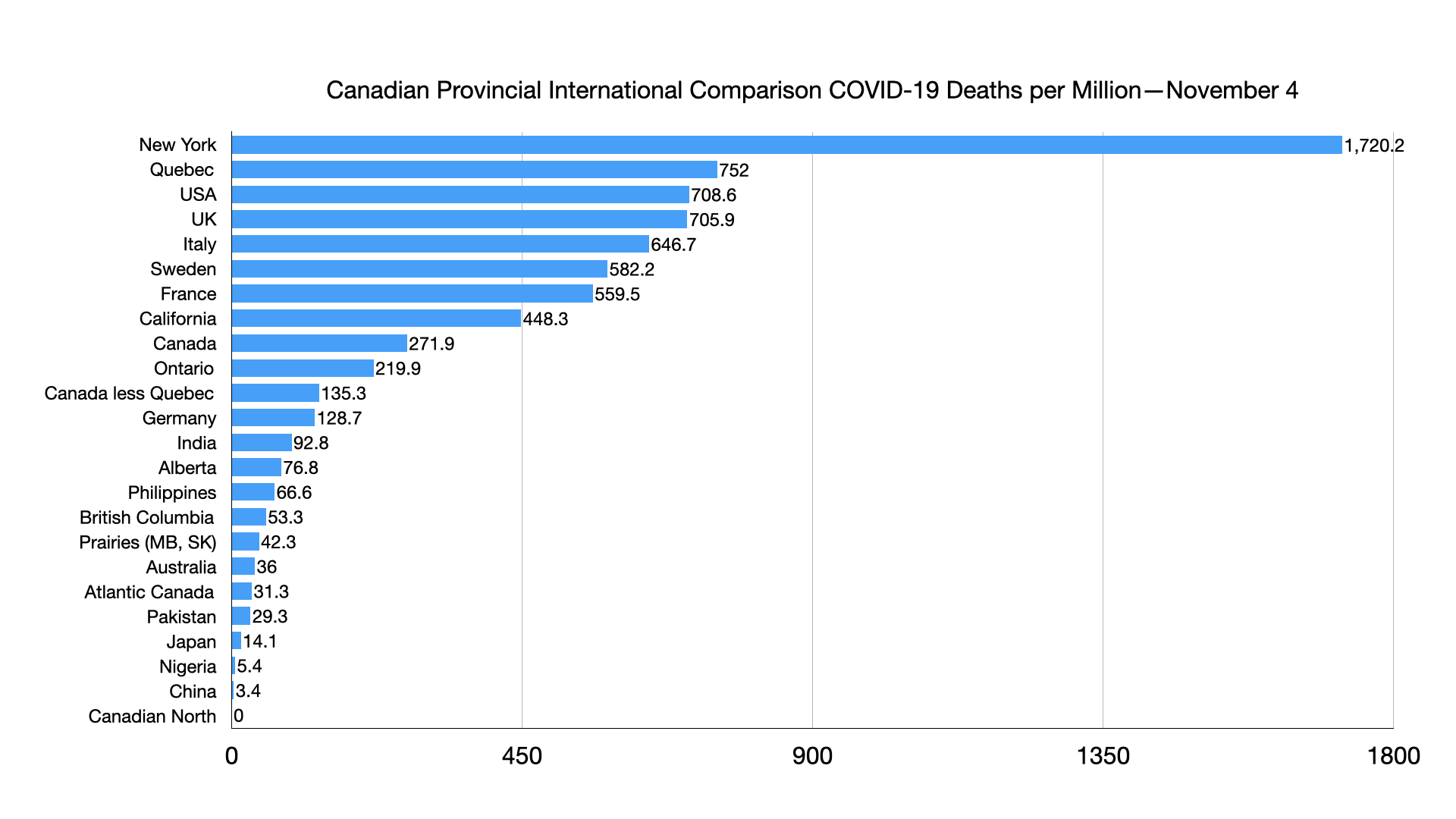
#COVID-19: Comparing provinces with other countries 4 November Update

Main news continues to be with respect to infections and relative increase of COVID cases and deaths in Prairie provinces:
 
Weekly:
 
Infections per million: Germany now ahead of Alberta, Canada, India, Prairies now ahead of Philippines
 
Deaths per million:nPrairies now ahead of Australia


Blanchet seeks to drive values wedge between Quebec and Trudeau government

Virtue signalling during the pandemic, when Quebec has some of the highest per capita infection and death rates worldwide:

Bloc Québécois Leader Yves-François Blanchet is doubling down on efforts to draw a line separating his party’s values from those of the Trudeau Liberals — particularly on the fraught ground of free speech.

Blanchet posted a tweet Sunday suggesting Justin Trudeau’s response to attacks in France that authorities have attributed to Muslim extremists did not go far enough, and highlighted what the Bloc leader called a “disturbing gap” in values that he chalked up to possible “weakness” or “ideology” on the prime minister’s part.

Blanchet said in French that Trudeau is threatening Quebec’s friendship with France. He’s sought to align his province with that country’s “republican and secular” principles, contrasting them with what he called an “Anglo-Saxon multiculturalist doctrine.”

Source: Blanchet seeks to drive values wedge between Quebec and Trudeau government

Québec suspend le parrainage de réfugiés pour les organismes

Of note:

Pour se donner le temps d’enquêter sur de possibles cas de fraudes, le ministère de l’Immigration a décidé de suspendre pendant un an le dépôt de dossiers de parrainage de réfugiés pour les organismes provenant de partout au Québec. Selon ce nouvel arrêté ministériel émis mercredi par la ministre de l’Immigration, Nadine Girault, seuls les groupes de 2 à 5 personnes seront ainsi autorisés à déposer des dossiers de parrainage dans le cadre d’un nouveau mécanisme d’envoi en ligne qui abandonne le système du « premier arrivé, premier servi » au profit d’un tirage au sort.

« Cette décision s’explique par la tenue d’enquêtes pénales et administratives visant des organismes à la suite d’allégations sérieuses qui mettent en cause l’intégrité des actions de certains organismes et la protection des personnes réfugiées », peut-on lire dans un communiqué du ministère. Ces changements surviennent après que le ministre de l’Immigration, de l’Intégration et de la Francisation (MIFI) de l’époque, Simon Jolin-Barrette, a reconnu les ratés du processus en janvier dernier et promis de revoir le mécanisme de réception des demandes.

En colère, plusieurs organismes se plaignent d’avoir été tous mis dans le même panier et d’être ainsi pénalisés pour quelques possibles fraudeurs. « On dit à tout le monde d’arrêter parce qu’il y a des problèmes avec certains joueurs. C’est injuste », a lancé Paul Clarke, d’Action réfugiés Montréal. « L’analogie que je fais, c’est une classe où quelques élèves n’auraient pas fait leurs devoirs, mais on demande à tous les élèves de rester en retenue. » M. Clarke est d’autant plus déçu qu’il a des réfugiés sur sa liste d’attente depuis au moins 5 ans.

« Je suis atterrée », a lancé pour sa part Nayiri Tavlian, de l’organisme Hay Doun, qui poursuit sa mission humanitaire de parrainage depuis près de 15 ans. « Ce programme-là fait la fierté du Québec. Je ne comprends pas qu’on mette la hache de cette manière sous prétexte que certains font des choses irrégulières », a-t-elle dit visiblement en colère. « C’est de la manipulation. »

Rappelons qu’en 2017, le gouvernement libéral d’alors avait suspendu pour 18 mois le programme de parrainage privé, notamment à la suite d’allégations d’irrégularités et de fraudes, où des organismes demandaient d’importantes sommes à des familles de réfugiés, et souvent, sans leur donner l’encadrement nécessaire à leur arrivée.

Nayiri Tavlian soutient que son organisme est un de ceux qui ont toujours collaboré avec le ministère et même dénoncé des choses qui n’allaient pas. Même qu’avec d’autres organismes, Hay Doun réclame depuis deux ans des détails sur cette reddition de compte. « [Le ministère] voulait qu’on fasse des rapports. Alors on a dit “parfait, qu’attendez-vous de nous ? Envoyez-nous des formulaires !” Mais on n’avait pas de réponse. »

Or, ces rapports n’auraient été exigés que très récemment, confirme Paul Clarke, d’Action réfugiés Montréal. « Tout d’un coup, au mois de septembre, les organismes expérimentés comme le nôtre, on a reçu un document [du ministère] qui nous demandait de fournir un rapport financier depuis deux ans et un rapport d’établissement pour voir comment on avait géré l’accompagnement de tous les gens qu’on a accueillis depuis deux ans », a-t-il raconté.

Le directeur de la Table de concertation des organismes au service des personnes réfugiées et immigrantes (TCRI), Stephan Reichhold, craint pour sa part que cette décision du ministère nuise à la réputation des organismes et du programme lui-même. « On est très déçus de la décision. Ça va donner des arguments aux groupes anti-réfugiés qui vont s’emparer de ça et dire qu’en plus de faire venir des réfugiés, les organismes sont des fraudeurs. »

750 dossiers aux « groupes 2 à 5 »

Comme le ministère de l’Immigration maintient la même limite de 750 dossiers pour ce programme, c’est la catégorie des « groupes de 2 à 5 personnes physiques » qui hérite de la totalité des places, ce qui constitue une forte augmentation puisqu’elle était limitée à 100 demandes.

Du 6 avril au 5 mai 2021, ces groupes de particuliers pourront donc déposer une demande de parrainage (maximum deux) par voie électronique, à raison d’une demande par envoi. Le ministère procédera à un tirage au sort parmi les demandes reçues, un mécanisme qui crée un malaise, selon le directeur de la TCRI. « C’est complètement en contradiction avec la mission d’un programme humanitaire qui aide les réfugiés. Le fait qu’on parle de sauver des vies sur la base d’un procédé aléatoire soulève des questions sur le plan éthique », a soutenu M. Reichhold.

Quebec is suspending all private refugee sponsorships by organizations because it says it has serious concerns with the integrity of the program.

The province said today that until November 2021, only groups of two to five people can privately sponsor a refugee.

All larger organizations including church groups and non-profits that have privately sponsored refugees for years are shut out of the program for the next 12 months.

The government published its decision in the Official Gazette and did not give details other than saying it had serious concerns about the integrity of certain practices within the framework of the program.

Quebec’s Immigration Department did not immediately return a request for comment.

Paul Clarke, executive director of Action Refugies Montreal, a non-profit that has sponsored refugees to Quebec since the 1990s, called the government’s decision unfortunate.

Clarke says legitimate organizations such as his have been put under a cloud of suspicion following the suspension. He says it’s unfair to punish his group for the alleged mistakes of others.

“They are using a sledgehammer when they should be using surgical tools,” Clarke said in an interview, in reference to the Immigration Department.

Quebec’s decision to suspend private refugee sponsorships from organizations does not reduce the number of refugees who can apply to immigrate to the province.

Clarke said the government has allowed about 750 applications for the last couple of years and will do so for 2021.

The published public order says the government has “serious concerns about the integrity of certain practices of legal persons within the framework” of the private refugee sponsorship program.

Source: Quebec suspends private refugee sponsorships by organizations for one year

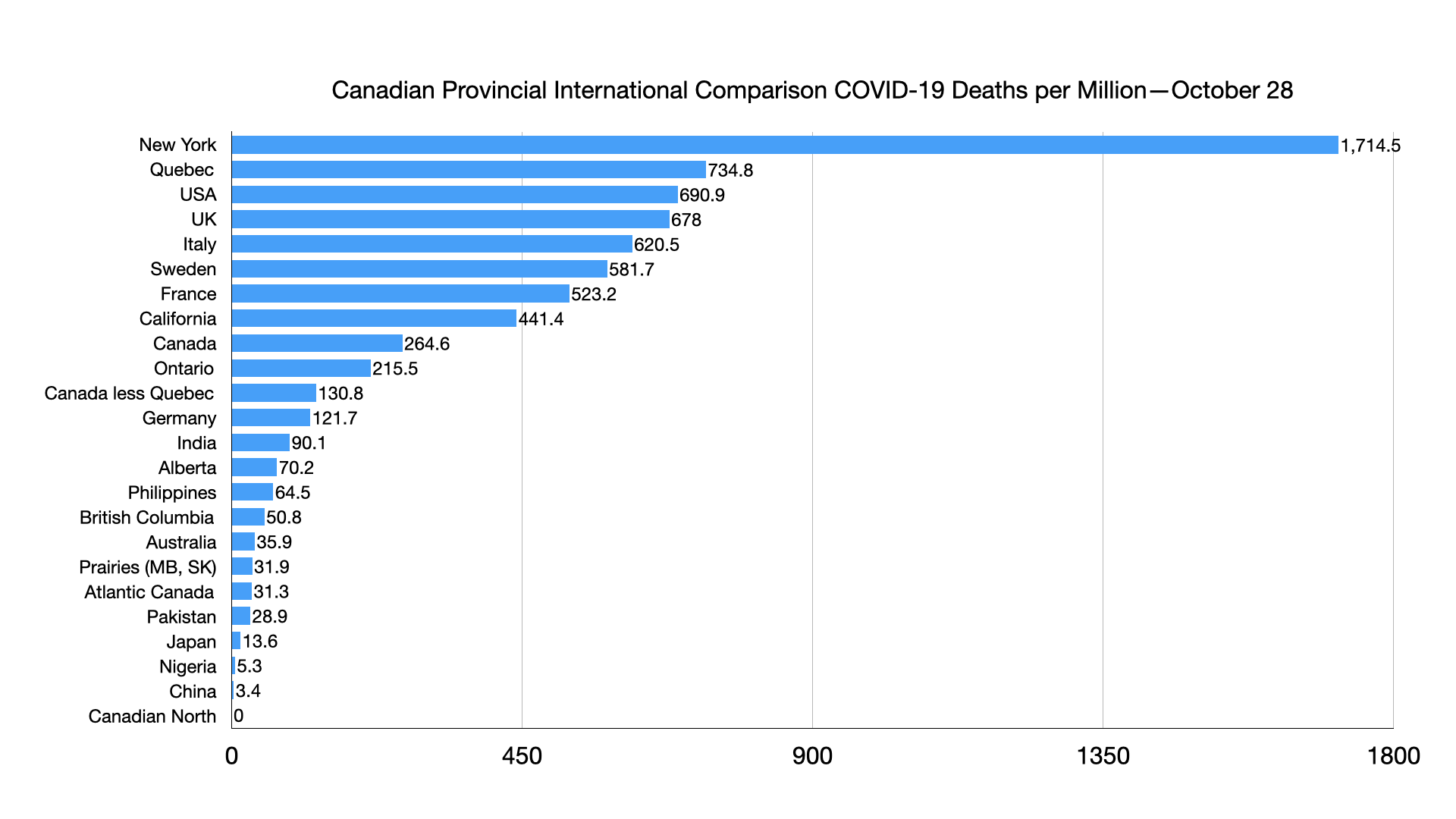
#COVID-19: Comparing provinces with other countries 28 October Update

Main news continues to be with respect to infections:
 
Weekly:
 
Infections per million: UK higher than Quebec, Alberta higher than Canada, Germany higher than Ontario, Prairies higher than British Columbia 
 
Deaths per million: Prairies higher than Atlantic Canada, both higher than Pakistan
 
October 7-28 increase:
 
Infections per million: Prairies (Manitoba, Saskatchewan) join European countries in highest percentage increase
 
Deaths per million: Highest increase in Prairies, particularly Manitoba and Saskatchewan 


Clivage entre Québec et Ottawa à propos du «mot en N»

Of note:

Le clivage entre la classe politique québécoise et celle du reste du Canada se confirme dans l’affaire du « mot en N ». Alors qu’à Québec, tous les partis politiques pensent qu’il devrait encore être possible de prononcer le mot « nègre » dans le cadre d’une discussion académique, à Ottawa, les voix affirmant le contraire se multiplient.

Après le chef du NPD Jagmeet Singh, c’est au tour de la nouvelle chef du Parti vert de soutenir que le mot honni devrait être banni du vocabulaire. Annamie Paul, qui est elle-même Noire, estime que le mot « nègre » ne devrait jamais être utilisé par des personnes blanches. Elle laisse aux personnes noires le choix de l’utiliser ou non entre elles. « J’encourage tout le monde, surtout les personnes qui ne font pas partie de notre communauté, à éviter de l’utiliser, dit-elle en entrevue avec Le Devoir. Ça cause beaucoup de peine. Ce n’est pas nécessaire de l’utiliser, pas même dans un milieu académique. »

Mme Paul reconnaît que la communauté noire n’est pas « monolithique ». Mais elle rappelle que ce mot « n’est pas un mot que la communauté noire a choisi pour elle-même. C’est un mot qui a été imposé sur nous par la société blanche ». « Alors s’il y a des personnes de notre communauté qui ont choisi de se l’approprier, le réclamer comme un mot qu’on utilise entre nous, c’est une chose. Mais c’est tout à fait possible de discuter de ce mot, de son histoire, dans un contexte académique sans l’utiliser. »

Selon Mme Paul, « il y a beaucoup de façons » de parler du mot sans utiliser le mot. Mme Paul a toutefois dit ne pas connaître suffisamment le débat pour se prononcer sur la pertinence de suspendre la professeure de l’Université d’Ottawa qui avait prononcé le mot pendant un cours et qui est à l’origine de toute cette controverse. La professeure Verushka Lieutenant-Duval voulait parler de la réappropriation par des communautés minoritaires de certains mots à l’origine insultants pour elles. Il était question du mot « queer » et elle a dressé un parallèle avec le mot « nigger ».

Le premier ministre Justin Trudeau a lui aussi ajouté son grain de sel au débat. Il a déclaré mercredi que « nous devons tous être conscients de la portée de nos paroles. Nous favorisons le respect des autres et l’écoute des communautés. Notre priorité est toujours de mettre de l’avant des actions concrètes pour combattre le racisme sous toutes ses formes. » La veille, sa vice-première ministre Chrystia Freeland avait déclaré que « le racisme anti-Noir est à la fois odieux et illégal ». Elle n’avait pas dit ouvertement qu’elle jugeait raciste l’usage du mot, mais l’avait laissé entendre en déclarant que « lorsque de telles choses se produisent, nous devons nous rassembler et reconnaître les expériences vécues par nos concitoyens ».

À Québec, tous les leaders des partis représentés à l’Assemblée nationale ont soutenu qu’il devrait encore être possible de prononcer le mot, incluant la cheffe libérale Dominique Anglade qui est Noire elle-même.

Source: Clivage entre Québec et Ottawa à propos du «mot en N»

Good Commentary by Konrad Yakabuski of the Globe:

The people who run Canada’s institutions of higher learning can no longer be trusted to stand up for the very principle for which those institutions exist in the first place. When faced with a choice between defending or silencing open debate on campus, they invariably pick the latter.

This cowering in the face of controversy sets the entirely wrong example for the young minds universities were invented to develop. Yet, university administrators who know better would rather give in to the dictates of cancel culture than face the wrath of those who do not.

Consider the response of University of Ottawa Arts dean Kevin Kee in the face of complaints that an art-history professor had used the N-word during an online seminar to illustrate the concept of subversive resignification, or the process by which an insult is reappropriated by those it is meant to insult. The songs of mainstream Black hip-hop artists provide ample proof of this phenomenon. But apparently this is a topic too hot to handle at the U of O.

“This language was offensive and completely unacceptable in our classrooms and on our campus,” Prof. Kee said in a statement this month after a backlash erupted on social media against art-history professor Verushka Lieutenant-Duval. “Everyone at the University of Ottawa has the right to an environment free of discrimination and harassment, and the right to be treated with dignity and respect.”

The dean’s statement was highly problematic in and of itself. That someone in Prof. Lieutenant-Duval’s class was offended by her use of the N-word is no excuse for its blanket prohibition in an academic setting. The professor obviously did not use it as a slur. She used it to illustrate a form of cultural expression that seeks to gut offensive words of their power to debase by reappropriating them as markers of identity. She also used the word “queer” as an example.

The U of O’s administration was having none of it, however. On Monday, president and vice-chancellor Jacques Frémont, a former head of Quebec’s human-rights commission, weighed in on the matter with this: “Members of dominant groups simply have no legitimacy to decide what constitutes a microaggression.” According to this point of view, a white professor’s right to freedom of expression comes second to the “right to dignity” of minority students.

To put these two concepts on equal footing is a sophism unacceptable from someone in Mr. Frémont’s position. Academic freedom means having the freedom to offend, even if that was most definitely not Prof. Lieutenant-Duval’s intention. Mr. Frémont added insult to injury by saying that Prof. Lieutenant-Duval, who was briefly suspended from teaching this month, “could have chosen not to use the full N-word. Yet she did and is now facing the consequences.”

The consequences? What is that supposed to mean? That she was only asking for online harassment and threats directed at her by daring to treat her students as adults? If those who attacked Prof. Lieutenant-Duval are unwilling to discuss difficult topics, and risk being offended in the process, perhaps a university classroom is the wrong place for them.

The controversy at the U of O, which bills itself as the world’s largest bilingual university, has particularly reverberated in Quebec. Many of the online attacks directed at Prof. Lieutenant-Duval referenced the fact that she is francophone; some used well-worn slurs to do so.

“What also troubles me is seeing the university throw this professor to the wolves of aggressive militants who use violent language against her and [other] francophones. I can’t help but see a certain cowardice on the part of the administration,” Quebec Deputy Premier Geneviève Guilbault wrote in a Facebook post defending Prof. Lieutenant-Duval’s academic freedom.

“It’s as if there is a censorship police,” Premier François Legault added on Tuesday, saying he would take up the matter with his Ontario counterpart, Doug Ford.

Prof. Lieutenant-Duval needs better advocates than these two. Mr. Legault’s government has stubbornly resisted calls to recognize systemic racism in provincial institutions, on the grounds that doing so would be tantamount to labelling Quebec a racist society. His government’s attempt to make a cause célèbre of Prof. Lieutenant-Duval’s case only muddies the water.

Still, francophones also make up most of the nearly three dozen U of O professors who signed a letter defending Prof. Lieutenant-Duval, suggesting many of her anglophone colleagues are too afraid to speak up on her behalf. After all, there would be “consequences.”

Source: https://www.theglobeandmail.com/opinion/article-the-university-of-ottawa-throws-academic-freedom-under-the-bus/