Quebec judge who asked woman to remove hijab apologizes, 5 years later

Of note:

A Quebec court judge, who refused to hear the case of a Montreal woman because she was wearing a hijab, has finally apologized for the incident, more than five years after it happened.

At an online hearing of the Quebec Council of the Magistrature on Tuesday, a lawyer for the council read Judge Eliana Marengo’s apology to Rania El-Alloul.

The council is the body responsible for disciplining judges in the province.

In her statement, Marengo said she acknowledged that she erred in asking El-Alloul to remove her hijab, that she regretted any inconvenience and that she never intended any offence or disrespect.

Marengo addressed the fact that at the time she had compared El-Alloul’s hijab to a hat and sunglasses being worn in the courtroom.

“My reference to hats and sunglasses was simply meant to exemplify how the rules of decorum are generally applied in the courtroom and was most certainly not meant to disrespect either you or your beliefs,” Marengo said.

She concluded by offering El-Alloul her most sincere apologies.

El-Alloul read her own statement in response, saying she accepted Marengo’s apology.

“I remember that day in the courtroom like it was yesterday. I couldn’t imagine that I would be turned away from the justice system because of my hijab, that my rights would be taken away because of my beliefs,” El-Alloul said.

“I hope she understands the pain she caused me, and why it is so important for her to account for her actions. Our justice system is not made for some and not others. No, this is a democracy, where everyone is to be treated equally before the law,” she continued.

“I accept her apology. This is what my faith teaches me.”

‘Not suitably dressed’

The controversy dates back to February 2015 when El-Alloul was in court trying to get back her impounded car.

“In my opinion, you are not suitably dressed,” Marengo told El-Alloul at the time. The judge said the court was a secular space, and no religious symbols should be worn by those before it.

The case was suspended, and El-Alloul eventually got her car back. But the story made headlines around the world.

Dozens of people, including El-Alloul, ultimately filed complaints with the Council of the Magistrature.

El-Alloul’s complaint was dismissed on a technicality, but the council agreed to look into the dozens of other complaints on the matter.

Marengo challenged the authority of the council to examine the complaints. She sought leave to appeal a Quebec Court of Appeal decision that unanimously found she was wrong to bar El-Alloul from her courtroom.

But in 2018, the Supreme Court refused to hear Marengo’s challenge.

Change of heart

The Council of the Magistrature sent a letter earlier this summer to the complainants, informing them of today’s hearing.

“The purpose of this hearing will be to study a settlement proposal from the prosecutors on file, including a letter of apology from Judge Marengo to Mrs. El-Alloul,” the letter said.

The council also told the complainants the apology would be released to the public, in exchange for dropping the disciplinary charges against Marengo.

The settlement was jointly proposed by Marengo’s lawyers and the lawyer handling the complaint for the council.

The panel of judges presiding over the hearing said it would take time to consider today’s arguments before deciding whether to accept the settlement.

Source: Quebec judge who asked woman to remove hijab apologizes, 5 years later

Quebec won’t use COVID-19 notification app for now

Again, surprising given Quebec’s overall poor performance in managing and containing the pandemic. And another kudos to Premier Ford for his plain language messaging “Just do it…”:

Quebec won’t use a smartphone application to notify the public about potential exposure to COVID-19 for now, arguing its testing and contact-tracing capability are sufficient at this stage of the pandemic.

While the province is not closing the door on using an app in the future, Premier François Legault says he would rather use one that was developed in Quebec.

“We would prefer a Quebec company, but I don’t think this is our main argument,” Legault said Tuesday afternoon in Saint-Hyacinthe, Que.

He says there is a lack of broad support for such an app in the province, due to privacy concerns.

“Maybe in six months we will come to another decision,” he said.

The decision puzzled the federal Health Ministry. Thierry Bélair, a spokesperson for Health Minister Patty Hajdu, pointed out that the app offered by the federal government, COVID Alert, does not track a user’s location nor collect any other personally identifiable information.

“It’s also an additional tool we can use as we prepare for a possible increase in cases this fall. So why not make it available now in Quebec?” said Bélair.

COVID Alert, which uses open-source technology built by a volunteer team of engineers at Ottawa-based Shopify, is designed to warn users if they’ve spent at least 15 minutes in the past two weeks within two metres of another user who later tested positive for the coronavirus.

It was launched at the end of July and currently only works in Ontario, where it has been downloaded more than two million times.

Adoption of one app across Canada would be “very helpful” to ensure those who travel between provinces are notified of possible exposure to the virus, Dr. Theresa Tam, Canada’s chief public health officer, said at a Tuesday news conference.”From the federal perspective, we want as many Canadians as possible to be participating,” she said.

Experts in both technology and public health stress that the more people who use the app, the better it will be.

Canada’s Chief Public Health Officer Dr. Theresa Tam says more widespread adoption of the COVID Alert app is one more layer of protection. This comes as Quebec announces it will not sign on to the app for now. 1:03

Éric Caire, Quebec’s minister responsible for digital transformation, said the government is interested in a made-in-Quebec app and is also running tests on the federal app to ensure it is secure.

He said the province has learned from public consultations and legislative hearings that a solid understanding of the technology used in an app makes Quebecers more open to installing it.

“The more that people are told what it does and does not do, the more they will be reassured,” said Caire.COVID Alert relies on Bluetooth technology to detect proximity to other users, instead of GPS data.

The province heard from 16,456 Quebecers in online public consultations about the use of a COVID-19 notification app. Seventy-seven per cent believed such an app would be useful, and 75 per cent said they would install it, the province said in a statement.

But the voices heard at hearings, held by the Institutions Committee in Quebec City, about a possible contract-tracing app were more skeptical.

“Quebec’s legal framework is inadequate in terms of data and personal information protection and access to information, informed consent and the fight against discrimination,” said a report prepared by the committee once those hearings concluded.

Committee members acknowledged that almost all of the 18 experts who testified at the hearings expressed serious reservations about the effectiveness and reliability of the technology.

Dr. David Buckeridge, an epidemiologist at McGill University’s School of Population and Global Health, said the right time to start using such an app would be before the number of daily new cases reaches the crisis levels seen in the spring.”I think the risks, frankly, from this app are relatively quite low, and it was designed in that way,” he said.

“The main issue here is going to be trust and adoption.”

Caire said the province will continue to watch how widely the app is used in Ontario and that Quebec will consider using an app in the event of a second wave.

Ontario Premier Doug Ford said he would ask Legault to reconsider his government’s decision.

“Just do it. It protects everyone,” he said to reporters Tuesday afternoon. “It’s not a big deal.”

Source: Quebec won’t use COVID-19 notification app for now

Bouchard: La souveraineté du Québec, plus nécessaire que jamais

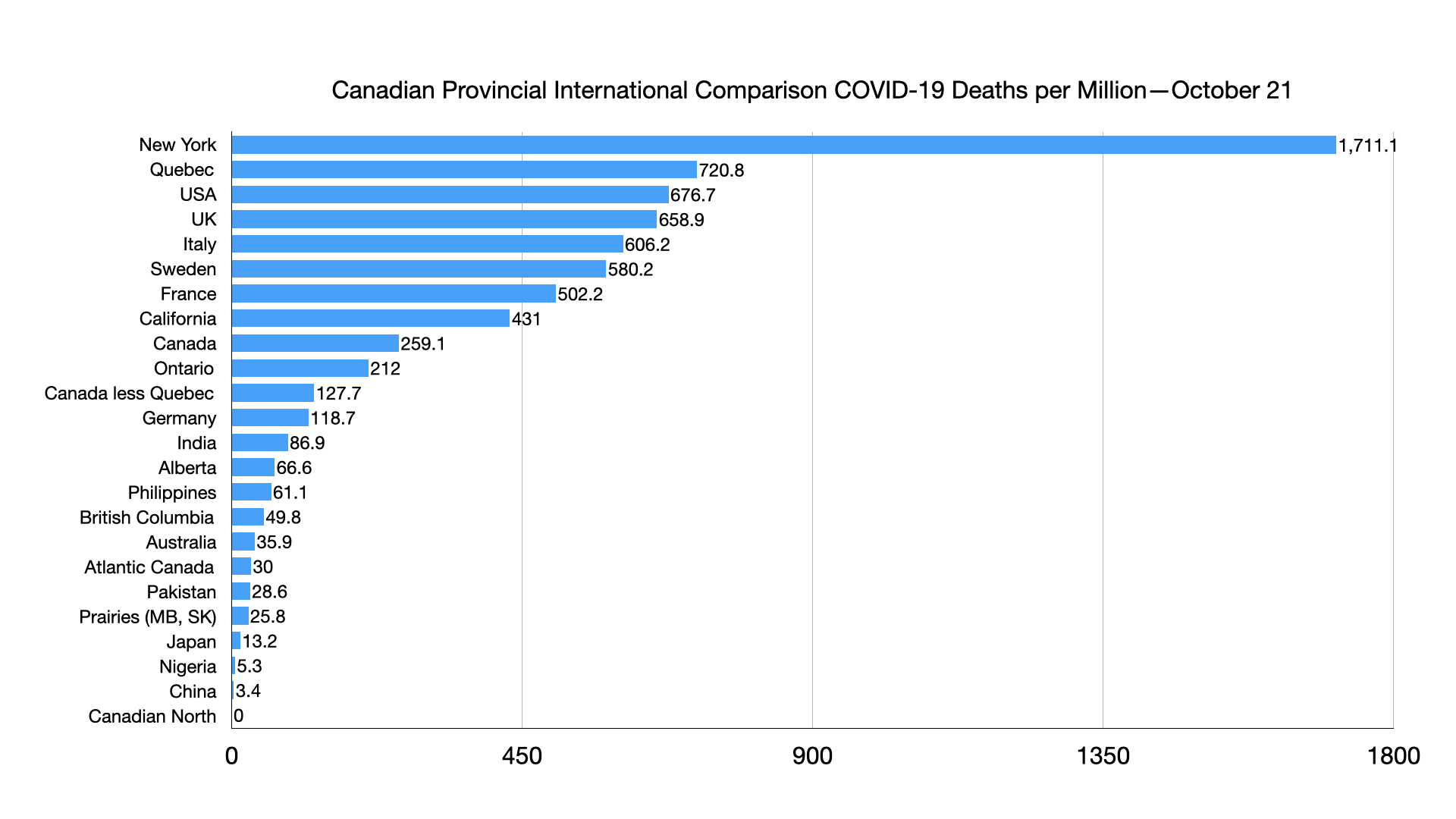
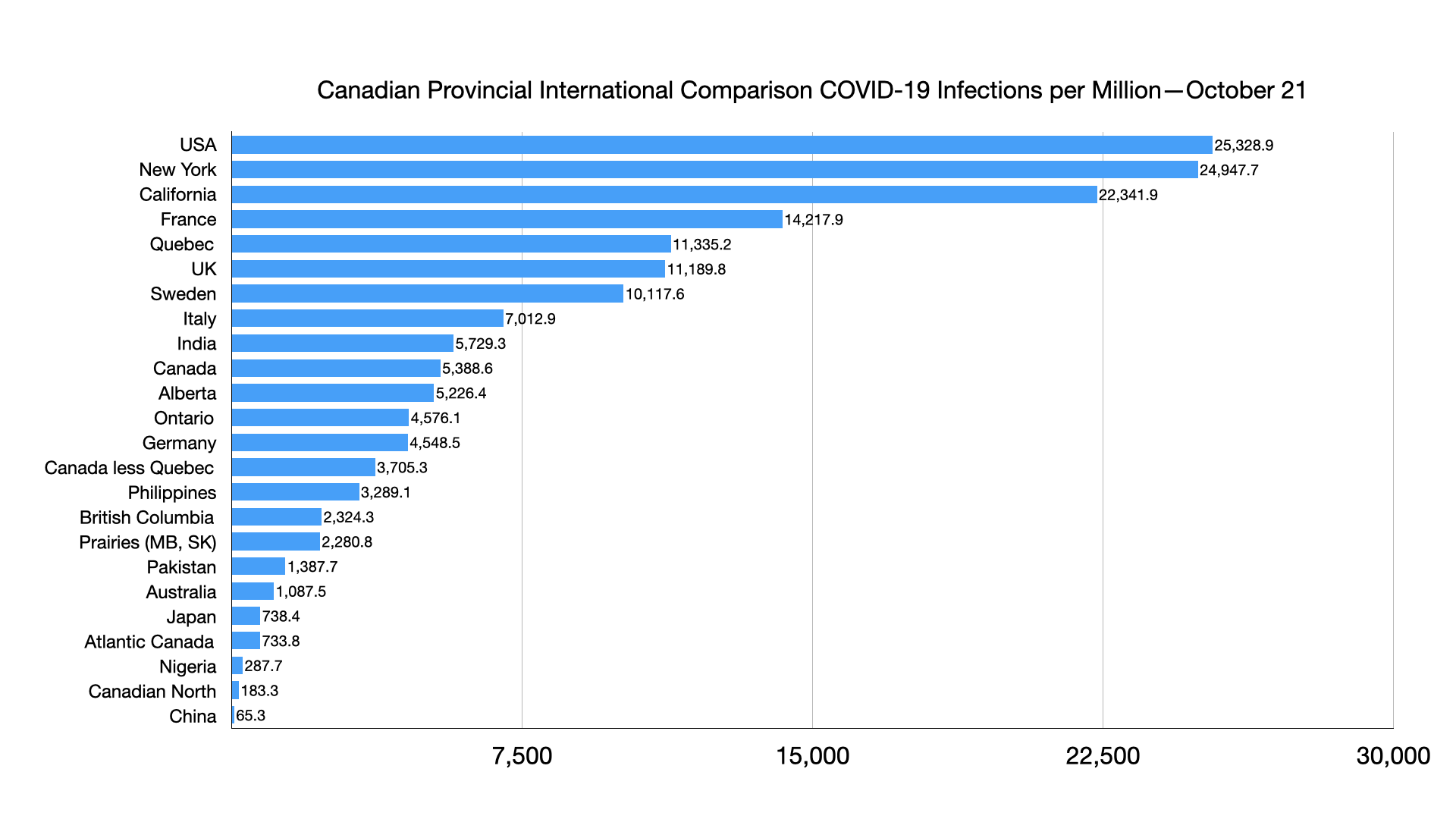
Ironic to cite COVID-19 as a justification for Quebec independence while ignoring that Quebec has the highest number of infections and deaths per million of all Canadian provinces and on par with the most affected European countries.

And of course, both multiculturalism and interculturalism are similar models of civic integration, with more semantic rather than substantive differences:

Du point de vue de notre avenir politique, deux leçons peuvent être tirées de l’actuelle pandémie. Nous avons pu constater que, presque partout, les populations plongées dans l’insécurité se sont tournées vers leur nation pour se protéger. Les instances supranationales, à commencer par l’Union européenne, se sont montrées étonnamment impuissantes à mettre en œuvre des initiatives efficaces pour contrer la pandémie.

Chacun a pu ainsi prendre conscience du recours indispensable que l’État-nation continue de représenter comme rempart dans un contexte de crise. Cette enceinte a montré une grande capacité à susciter une solidarité, montrant ainsi qu’elle est loin d’avoir perdu sa pertinence. Il y a intérêt à la soutenir et à la perpétuer. C’est la première leçon.

La pandémie a aussi révélé la fragilité des réseaux supranationaux. La mondialisation ne s’en trouve pas pour autant condamnée, loin de là, mais elle a accusé d’inquiétantes carences. Il sera prudent de mieux définir nos engagements et nos articulations avec cette sphère qui demeure largement chaotique et imprévisible. On voit l’importance de pouvoir se reposer sur un État doté de tous les pouvoirs essentiels. C’est la deuxième leçon.

Les raisons profondes qui ont toujours motivé le mouvement souverainiste restent d’actualité : le combat pour le français, l’émancipation économique, sociale et culturelle de notre société, le renforcement d’une francophonie nord-américaine et, plus généralement, une plus grande liberté collective pour traiter à notre façon, suivant nos traditions et nos choix, les grands problèmes de l’heure. Ces raisons sont clairement rappelées et mises à jour dans le dernier numéro de la revue Action nationale. La pandémie en fait voir d’autres : renforcer la nation-refuge et procurer à l’État une marge de manœuvre accrue qui lui permet de mieux naviguer à travers les écueils de la sphère planétaire.

Sur l’enjeu identitaire

Tout cela survient au moment où le Parti québécois, occupé à se redéfinir, se donnera bientôt un nouveau chef. J’aimerais, dans ce contexte, soumettre trois réflexions. La première concerne la thématique identitaire, toujours bien vivante au sein de ce parti. Écartons d’abord un malentendu. Il est incontestable qu’une nation a besoin d’une identité comme expression d’une appartenance et source de solidarité. On imagine mal comment, privée de ces ressorts, elle pourrait mobiliser ses citoyens et ses citoyennes autour d’idéaux et de projets communs.

Le danger, c’est lorsque la quête d’une identité glisse vers une auscultation de soi qui l’appauvrit et rétrécit le « nous » de la nation. Un déplacement de ce genre est néfaste pour une société diversifiée. Il tend aussi à diminuer la place d’une dimension essentielle, celle de l’action collective, des grands projets que nous pourrions réaliser tous ensemble comme Québécois. Or, la mémoire de ces réalisations contribue justement à fortifier l’identité.

La population québécoise est de plus en plus diversifiée et le vieux noyau francophone jadis largement majoritaire se contracte progressivement (de 79 % en 1971, sa proportion serait passée à 64 % en 2014). Il est donc nécessaire d’ajuster la définition de la nation et de l’identité à la nouvelle réalité.

Est-ce là succomber au multiculturalisme ? On en est loin. Premièrement, il s’agit simplement de reconnaître les droits de tous les citoyens du Québec, en particulier là où ils sont compromis. Cette règle n’est pas copiée du multiculturalisme, elle fait partie de l’héritage général de toutes les horreurs commises durant la première moitié du XXe siècle en Occident. L’éthique qu’elles ont engendrée invite à respecter la diversité plutôt que de la broyer. Le multiculturalisme canadien en est lui-même une expression parmi bien d’autres, tout comme l’interculturalisme québécois.

Deuxièmement, le modèle canadien en matière de relations interculturelles est très différent de l’approche québécoise. Dans le premier cas, les groupes ethnoculturels se voient accorder une latitude exceptionnelle, si bien que le souci de cimenter ces minorités devient quasiment secondaire.

Au Québec, au contraire, c’est une priorité. Nous sommes une petite nation constamment soucieuse d’intégration, de solidarité, de concertation, de rassemblement — et de survie. Troisièmement, le multiculturalisme canadien reconnaît l’existence de minorités mais nie celle d’une majorité. Comment ce modèle pourrait-il s’appliquer ici ?

Le prochain chef du PQ

Je reviens au Parti québécois. La recherche d’une identité forte, au sens défini plus haut, et la promotion d’une conception vraiment inclusive de la nation ne sont nullement incompatibles. Il suffit de revenir à la tradition instaurée par le parti à ses années glorieuses. La loi 101 en est une parfaite illustration. D’un côté, elle servait les intérêts de la majorité en renforçant le français. De l’autre, elle servait les intérêts des minorités en leur procurant le moyen de mieux s’intégrer à la société et d’y faire leur chemin.

Dans l’intérêt du parti et de celui du Québec, il est éminemment souhaitable qu’il renoue avec cette philosophie qui lui a valu une grande partie de ses succès. Cette tradition est toujours porteuse d’avenir parce qu’elle est étroitement alignée sur le Québec en devenir que les fondateurs avaient remarquablement anticipé.

Concernant la course à la chefferie, ces réflexions invitent à favoriser le candidat qui incarne le mieux à la fois la grande tradition et l’avenir du parti suivant les voies esquissées ici. Parmi les candidatures en lice, celle de Sylvain Gaudreault me semble la plus proche de ce profil.

Source: La souveraineté du Québec, plus nécessaire que jamais

Le PLQ et QS dénoncent un programme de régularisation discriminatoire

Appropriate criticism over the narrowness of the program;

Le Parti libéral du Québec et Québec solidairejugent trop sévères les conditions d’admission au Programme spécial visant à faciliter l’octroi de la résidence permanente aux demandeurs d’asile qui, au plus fort de la crise sanitaire, suaient sang et eau dans les résidences pour personnes âgées assaillies par la COVID-19.

« On circonscrit l’accès à la mesure à un secteur [la santé], et à l’intérieur du secteur, même si tout le monde a eu un risque [de contracter le coronavirus], on circonscrit encore plus… Ça, ça ne serait pas discriminatoire ? » a demandé l’élu libéral Gaétan Barrette en commission parlementaire lundi.

Le Programme spécial des demandeurs d’asile en période de COVID-19 (PSDAPC) s’adresse aux « anges gardiens » qui étaient « sur la ligne de front » à prodiguer des « soins directs à la population pendant la pandémie », a expliqué la ministre de l’Immigration, Nadine Girault. « Ceux qui ont pris le plus de risque », a-t-elle résumé.

Le PLQ et QS se sont tour à tour désolés de voir les autres travailleurs du secteur de la santé — les préposés à l’entretien des résidences pour aînés frappés de plein fouet par le coronavirus, par exemple — laissés en plan par le PSDAPC. Un « vrai, vrai, vrai geste d’humanité » serait de « remercier […] tous les gens qui ont pris un risque ». « Que je sois préposé à l’entretien ménager ou gardien de sécurité, quand le virus je l’attrape, puis que je meure, c’est moi qui suis mort, c’est ma famille qui pâtit. C’est ça un risque », a souligné M. Barrette.

On circonscrit l’accès à la mesure à un secteur [la santé], et à l’intérieur du secteur, même si tout le monde a eu un risque [de contracter le coronavirus], on circonscrit encore plus…

« On a envoyé au combat […] une armée de gens sans arme », a-t-il ajouté, tout en rappelant l’absence d’équipements de protection individuelle en quantité suffisante dans les milieux de vie pour personnes âgées après l’arrivée de la COVID-19 en sol québécois.

L’ex-ministre de la Santé soupçonne le gouvernement caquiste d’avoir « mis un frein » à la volonté du gouvernement fédéral de régulariser les employés du réseau de la santé en situation de précarité afin de respecter les seuils d’immigrationqu’il s’est fixés.

Le député solidaire Andrés Fontecilla a suggéré lundi d’accroître la portée du Programme spécial afin que les préposés à l’entretien, les agents de sécurité, les travailleurs agricoles, les travailleurs d’abattoirs ou d’entrepôts en situation de précarité puissent aussi s’y inscrire.

La ministre de l’Immigration, Nadine Girault, a dit être en paix avec sa décision de permettre seulement aux demandeurs d’asile ayant prodigué des soins directs à des patients — dont des préposées aux bénéficiaires et des aides-infirmières — de s’inscrire au PSDAPC, ce qui leur permettra de s’établir au Québec. « Ce n’était pas un programme discriminatoire. C’était un programme pour remercier les gens qu’on voulait remercier chez les “anges gardiens” qui ont pris soin de nos gens. C’est tout simplement ça », a-t-elle fait valoir.

Puis, elle a cédé, sans avertissement, la parole au nouveau sous-ministre de l’Immigration, Benoit Dagenais. Béant de surprise, le haut fonctionnaire s’est mis à la tâche d’énumérer les 10 orientations de la Planification pluriannuelle de l’immigration 2020-2022 léguée par l’ex-ministre Simon Jolin-Barrette.

Il a par la suite mentionné que le Plan d’immigration du Québec 2021 sera établi à la lumière de la situation économique du Québec, qui a été fragilisée par l’arrivée du coronavirus en sol québécois le printemps dernier. « La crise sanitaire, évidemment, on va la prendre en considération », a souligné M. Dagenais.

De son côté, Mme Girault a indiqué qu’« il n’y aura pas de baisse des seuils d’immigration ».

Lutte contre le racisme

Le PLQ a aussi jeté le doute sur la volonté du gouvernement de lutter contre le racisme au Québec, lundi, après que Mme Girault eut refusé net de nommer les groupes rencontrés jusqu’à aujourd’hui par le Groupe d’action contre le racisme (GACR), dont elle assure la coprésidence.

Le « groupe des sept » élus de la Coalition avenir Québec, qui a été mis sur pied au lendemain de la mort de l’Afro-Américain George Floyd sous le genou d’un policier de Minneapolis, doit présenter une série d’actions visant à faire reculer le racisme au cours de l’automne.

« C’est malheureux et c’est décevant de ne pas avoir l’information », a dit la députée libérale Jennifer Maccarone, tout en invitant le GACR à solliciter sans délai l’avis de la Ligue des Noirs, du Congrès maghrébin au Québec, de la Ligue des droits et libertés…

Source: Le PLQ et QS dénoncent un programme de régularisation discriminatoire

Ralentissement économique: Québec ne réduira pas les seuils d’immigration

Small step in their overall more restrictive immigration policies in ruling out further decreases to their already announced lower levels:

Le gouvernement Legault poursuivra l’augmentation du nombre d’immigrants admis annuellement, malgré la hausse du taux de chômage et le ralentissement économique causé par la COVID-19.

«Il n’y aura pas de baisse des seuils d’immigration dans les cartons pour les prochaines années», a déclaré la ministre de l’Immigration, Nadine Girault, au premier jour de l’étude des crédits à l’Assemblée nationale lundi.

«C’est évident qu’avec la COVID, on a eu moins d’immigrants qui sont rentrés, les frontières étaient fermées, a souligné Mme Girault. Mais ça n’a pas affecté les seuils d’immigration et ça n’affectera pas les seuils d’immigration pour les prochaines années.»

La ministre répondait aux préoccupations du député solidaire Andrés Fontecilla, qui s’inquiétait d’un retour à la baisse, comme ce fut le cas au début du mandat du gouvernement caquiste. Le nombre d’immigrants admis était alors passé de 51 118 à 40 546 et doit maintenant remonter graduellement au seuil original d’ici 2022.

Le 14 avril dernier, le premier ministre François Legault avait évoqué la possibilité d’accepter moins de nouveaux arrivants si la pandémie devait mener à une hausse importante du taux de chômage. «On n’est pas rendus là, mais effectivement, c’est quelque chose qu’on va regarder, avait-il déclaré dans les premières semaines de la pandémie. Je pense qu’il faut tout revoir puis, entre autres, le nombre d’immigrants avec le taux de chômage élevé qu’on va avoir dans les prochains mois. On pourrait effectivement réduire le nombre.» Au mois de juillet, le taux de chômage atteignait 10,7% au Québec.

Mais la ministre Girualt fait valoir que, même si le Québec ne sera plus en situation de plein emploi, «on va avoir quand même des gros manques au niveau de certains secteurs d’emploi».

D’autres «anges gardiens» à risque

Toutefois, c’est l’entente avec Ottawa pour permettre aux demandeurs d’asile du réseau de la santé de régulariser leur statut qui a surtout retenu l’attention du PLQ et de QS durant l’audience de quatre heures. Les deux partis d’opposition reprochent à Québec d’avoir restreint l’accès au programme uniquement à ceux qui ont donné des soins directement aux patients entre le 13 mars et le 14 août, et ce, sur une période d’au moins 120 heures.

«Je suis persuadé que les gens comprennent que ce qu’on fait, c’est parce qu’on voulait s’occuper et prendre soin de nos anges gardiens qui, eux, ont pris soin de nos gens», a martelé la ministre Girault.

Mais le critique libéral Gaétan Barrette fait valoir que le risque est le même de contracter le virus pour tous les employés d’un établissement de santé. «Que je sois préposé à l’entretien ménager ou gardien de sécurité, quand j’attrape le virus et que je meurs, c’est moi qui suis mort et ma famille qui en pâtit», a-t-il souligné.

Source: https://www.journaldequebec.com/2020/08/17/ralentissement-economique-quebec-ne-reduira-pas-les-seuils-dimmigration

Quebec farms facing lost profits and rotting harvests due to migrant worker shortage

A further reminder of our dependence of foreign seasonal agriculture workers:

Nineteen-year-old Florence Lachapelle was among hundreds of Quebecers who tried their hand at planting seeds and harvesting produce this summer, replacing migrant workers who were unable to leave their countries because of the COVID-19 pandemic.

And while Lachapelle spent long days working the fields on Francois D’Aoust’s farm in Havelock, Que., too few other Quebecers took up the call to help the province’s struggling agricultural industry.

Despite a recruiting drive by the provincial government in April, the lack of labour this season has forced farmers to cut production or leave food rotting in the fields.

Unfortunately for Lachapelle, she fell ill with mononucleosis after two months and returned home to Montreal. She said the work was very demanding with so few migrant workers available.

“They’re professionals and we’re simply not,” Lachapelle said in a recent interview.

D’Aoust said he hired a handful of people to work alongside Lachapelle, who were out of work in other sectors such as communications, film and the restaurant industry. But once their opportunities returned, he said, they left for their better-paying jobs.

“Not a lot of people are used to (physical) work all day,” D’Aoust said in a recent interview. “It’s just not the kind of work that we do. It’s rare that people are in shape and can (work) all day in the field.

“People that are farmers, themselves, in their country, surely they are at an advantage.”

D’Aoust and his wife, Melina Plante, have hired the same four Guatemalan seasonal workers year after year. But this year the farmhands were stuck at home at the beginning of Quebec’s farming season due to travel restrictions their country imposed to limit the spread of COVID-19.

He said it takes inexperienced Quebecers up to three times as long to do farm work compared to a migrant worker. That meant he had to pay locals to do less work, eating into his profits.

D’Aoust slashed production at his farm, Les Bontes de la Vallee, by 60 per cent this year because he and his wife figured they would only have migrant workers later in the harvest season.

Two Guatemalan workers eventually made it on D’Aoust and Plante’s farm — but the financial damage to the business was done. “What we hope is to pass through this difficult period without too much loss and start again next year,” he said. “We just want to stay alive.”

For Michel Ricard, who owns 60 hectares of farmland in Saint-Alexis-de-Montcalm, about 60 kilometres north of Montreal, he said he’s going to lose a lot money and food this year because migrant workers from Mexico and Guatemala haven’t been able to arrive.

By the end of August, Ricard said he expects to lose approximately $100,000 dollars worth of cucumbers because he has no one to pick them.

Experienced foreign workers are “essential for the future, for me, and for the majority of growers of vegetables,” he said in a recent interview.

“The people from Guatemala are able to work from 6 a.m. to 6 p.m. It’s not a problem. Sometimes I need to stop them because they want to continue, but sometimes I say ‘that’s enough for today.'”

Local workers haven’t been much help to him, he said. Ricard had his daughter post a message on Facebook to reach out to prospective farmhands, but he said only eight came through for him.

“It was impossible,” Ricard said.

The Union des producteurs agricoles, which represents about 42,000 Quebec farmers, says there are close to 2,000 fewer migrant workers on Quebec farms than usual. Despite the UPA’s efforts to lure Quebec workers through a recruiting drive, just under 1,400 were assigned to Quebec farms this year.

“It didn’t replace, really, the foreign workers,” UPA President Marcel Groleau said in a recent interview. “It helped on some issues … but those workers are not trained and can’t really replace the foreign workers that are trained and have experience on farms.”

Farmers such as D’Aoust and Ricard say migrant farmhands are willing to work longer hours, even for minimal pay.

Groleau said the federal government’s emergency response benefit, which offers up to $2,000 a month to many people who have lost jobs, has encouraged Quebecers to stay away from the gruelling field work.

“When you can get two thousand dollars a month sitting at home,” Groleau said, “it’s not really interesting to go on a farm and work a little bit for minimum wage.”

Source: Quebec farms facing lost profits and rotting harvests due to migrant worker shortage

Judge who told woman to remove hijab offering to apologize in settlement proposal

Hard to see that this apology is genuine or just an effort to avoid discipline given how long Judge Marengo has been fighting this:

A Quebec court judge who refused to hold a hearing for a Montreal woman after the woman refused to remove her hijab now says she’s willing to apologize for the incident, more than five years after it happened.

In February 2015, Judge Eliana Marengo refused to hear the case of Rania El-Alloul.

El-Alloul was in court trying to get her impounded car back.

“In my opinion, you are not suitably dressed,” Marengo told El-Alloul at the time. The judge said the court was a secular space, and no religious symbols should be worn by those before it.

Marengo compared the hijab to a hat and sunglasses, saying she wouldn’t hear a case from someone wearing those, either.

After the incident, dozens of people filed complaints with the Quebec Council of the Magistrature, the body responsible for disciplining judges in the province.

In a letter sent recently to the complainants, the council said it would convene a hearing Sept. 8.

“The purpose of this hearing will be to study a settlement proposal from the prosecutors on file, including a letter of apology from Judge Marengo to Mrs. El-Alloul,” the letter said.

The letter also said the apology would be released to the public, in exchange for the dropping of the disciplinary complaints against Marengo.

Council spokesperson Paul Crépeau told CBC News the settlement is being jointly proposed by Marengo’s lawyers and the lawyer handling the complaint for the council.

Long legal fight

Marengo has been fighting the disciplinary complaint in court for years, at one point challenging the authority of the council to even hear the complaint.

Judge Eliana Marengo’s lawyers are now proposing a compromise where Marengo would write a letter of apology to El-Alloul.(Radio-Canada)

After a request from the legal team assisting El-Alloul, the Quebec Court of Appeal in 2018 issued a judgment reaffirming that the Quebec court dress code does not forbid head scarves if they constitute a sincere religious belief and don’t harm the public interest.

El-Alloul herself filed a formal complaint with the council after the incident, but it was rejected because of a technicality.

However, dozens of other complaints were accepted, and the council convened a special panel of five judges to consider the case.

El-Alloul declined to comment on the latest developments.

Source: Judge who told woman to remove hijab offering to apologize in settlement proposal

Mulcair: Jagmeet Singh calls MP ‘racist’, but has he forgotten about Bill 21?

Valid question:

In 2016, when I first prepared a House of Commons motion condemning islamophobia, we couldn’t get it past a handful of Conservatives who’d denied unanimous consent. We worked hard for all-party agreement, drew a big chalk circle around the stain of Conservative opposition and were able to present the motion again. This time it was accepted and passed unanimously.

Those events in Parliament immediately came to mind when Jagmeet Singh chose to call Bloc House Leader Alain Thérrien a racist. Thérrien had communicated the Bloc’s refusal of unanimous consent for the introduction of Singh’s motion, which called for the recognition of systemic racism within the RCMP. Singh confirmed that he had indeed called Thérrien a racist, but refused to withdraw the word when asked to do so by the Speaker. The Speaker, Anthony Rota, proceeded to expel Singh for refusing to respect his decision.

In subsequent interviews, Singh affirmed that Thérrien had to be a racist because of the subject matter. He also said that he would not apologize for the personal insult, explaining that doing so would be like apologizing for being against systemic racism. As of Jun. 30, Bloc Leader Yves-Francois Blanchet was threatening a robust reaction when the House returns July 8, if Rota maintains the decision of expelling Singh for just one day. Blanchet went so far as to call Singh’s reaction “orchestrated.”

Rota has had to defend his credentials in his home riding of Nipissing—Timiskaming, after a local group called on the MP to demonstrate “stronger anti-racism leadership”. There is now little hope that the grave and urgent issue of systemic racism in the RCMP will ever be the object of the unanimous denunciation of the House of Commons.

In the case of that vote against Islamophobia, it had also been no small feat to get the Bloc Québécois onside. Beginning with my 2007 by-election for the NDP in Outremont, the Bloc rode anti-Muslim sentiment hard. I recall a thoughtful, soul-searching meeting with Alexa McDonough, Ed Broadbent, Jack Layton and our key organizers in the basement of our campaign headquarters where we struggled to find the right words to push back. In that particular by-election, the Bloc was decrying Muslim women’s right to vote with a face covering. We came out four square against the Bloc’s toxic position but personal name-calling wasn’t part of the game plan. We won handily and the Bloc lost two-thirds of it’s vote, finishing third.

In the 2015 general election, of course, the issue came to a head. My support for a woman’s right to wear a niqab at a citizenship ceremony cost us dearly. I remember my campaign director, who’d flown in from Ottawa, imploring me to change my position because it was causing a precipitous drop in Quebec that was playing into our national numbers. Many voters, she said, were just waiting to see whether the NDP or the Liberals, could defeat Harper to make their final choice. She was concerned it could cost us the election. A publication forthcoming in the prestigious Journal of Politics, has confirmed that the NDP got clobbered over the issue of niqabs in Quebec; it was pivotal in deciding the outcome of the election.

In France, even socialist governments have banned certain outward expressions of the Muslim faith. Other religions, such as Sikhism and Judaism have not been spared. Under the guise of separation of church and state, Muslim moms have even been denied the right to accompany their kids on school field trips, because of their headscarves. Outside every school in France is a poster explaining the rules against religious symbols.

Astonishingly, even the European Court of Human Rights has upheld the ban. Public French intellectuals like Michel Houellebecq and Élisabeth Badinter write openly about the threat religious symbols pose to French society.

For those of us who support Canada’s multicultural traditions, such views are an anathema. From our perspective, it’s easy to view them as racist, which I do. In Europe, they are widely shared and accepted as being part of public debate and have gained some currency here amongst those who find fault with multiculturalism.

When Quebec Premier François Legault is asked about systemic racism in Quebec, he too restates the question: “Ah, you’re saying all Quebecers are racist, and I’m saying some Quebecers are racist but that Quebecers are not systematically racist.” It’s a rhetorical trick where politicians repeat the issue in terms that suit their purpose while answering their own question.

Systemic racism doesn’t mean everyone is systematically racist. It means the dice are loaded against some members of our society because of their ethnic, religious or cultural origin. The result of that racism within the system can be proven by looking at results, measuring and comparing outcomes. Legault is too well-informed not to know that, but he also knows his base. Like the crafty populist politician he is, he’s talking to that base bysaying, “I won’t let them call you a racist!”

Legault seems to have in part, at least, won his point. In the aftermath of the dispute between Singh and the Bloc a “premiers’ statement” issued by Justin Trudeau and all of the provincial premiers, on Jun. 26, talks several times of racism and discrimination but never uses the word “systemic”.

I made my first appearance in a parliamentary commission in Quebec City on the subject in the mid-80s and it’s an issue I’ve felt passionately about since. Government reports showed a huge, systemic under-representation of minorities in the Quebec civil service back then. We worked hard to change that. It began by making people understand the problem. The situation has indeed improved considerably, but just this month, the Quebec Human Rights Commission released a study showing that there are fewer than half the number of visible minorities in the Quebec civil service than their proportion of the overall population. Historically, this situation is also a reflection of another old divide: there was much discrimination against French-Canadians in the business sector in the past and good civil service jobs were seen as a way of levelling the economic playing field.

These issues are complex and Jagmeet Singh knows that. He has proven it in the past, notably when confrontedby a voter who told him to remove his turban in order to “look more Canadian”. Singh was almost spiritual in his calm reaction. He knew he was dealing with someone who just didn’t get it and it became a teachable moment. Many people called that man a racist, but Singh never did.

Right now Québec has a law on the books, Bill 21, which openly discriminates against religious minorities, in particular against observant Muslims, Sikhs and Jews. Thus far, no opposition party in Parliament, including the NDP, has dared challenge that law for what it is. They all, including Mr. Singh, say Quebec has a right to adopt it. Trudeau is still refusing to refer the case to the Supreme Court and instead, the victims of Bill 21 who  are being denied the right to teach, become cops or government lawyers, will have to fight for years as the issue slowly wends its way through the courts.

Singh could choose to use all of his credibility and deep personal experience with this issue to persuade Trudeau to finally do the right thing and challenge the discriminatory Bill 21 immediately by referring it without delay to the Supreme Court. That would be helpful.

Source: Jagmeet Singh calls MP ‘racist’, but has he forgotten about Bill 21?

Demonstrators rally against Quebec’s updated immigration reforms

CAQ continues to struggle with immigration issues, most notably with international students and their transition to permanent residency, reinforcing Quebec being a less attractive destination for international students:

Protesters in Montreal and around the province gathered Saturday to denounce upcoming reforms to a Quebec program that fast-tracks immigration for foreign students and temporary workers.

The reforms, announced in late May, mark the Coalition Avenir Québec government’s second attempt to adjust the Quebec Experience Program after it backed down on a first set of changeslast fall.

Those changes were criticized as disorganized and poorly thought out by opposition parties and decried as unfair by students and other members of the public. Simon Jolin-Barrette, the immigration minister at the time, eventually said the reforms had been a mistake.

On Saturday, demonstrators — who marched from Mont-Royal Park to Quebec Premier François Legault’s office in downtown Montreal, as well as others in Quebec City, Sherbrooke, Trois-Rivières and Rouyn-Noranda —  said the new reforms still compromise the future of international students and temporary workers.

“They are totally unjust and unfair to international students like me who just graduated,” said Carla Trigoso, who is from Peru and studied sociology at McGill University. “There are no acquired rights for us. We are terribly, terribly disappointed with the changes in general.”

Quebec Liberal Party MNA Kathleen Weil was one of several opposition members at the demonstration. She said the program, which she introduced as immigration minister in the Charest government, was the envy of many other jurisdictions.

“We created this rapid immigration route because we wanted to retain this talent,” she said of the program, known by its French acronym PEQ. “We compete with the world to attract them. We’re regressing with this reform. We’re not looking at human beings with their full potential.”

Quebec’s new minister of immigration, Nadine Girault, who was appointed to the position on June 22, declined an interview request from Radio-Canada. Her office said it will take some time to properly take over the reform file.

The reforms are nonetheless expected to come into effect soon.

Among other things, the reforms add or increase work experience requirements for applicants. Foreign students, who previously did not need work experience in addition to completing their studies, now do: two years of full-time work for those with a professional diploma and one year for those who complete a university degree or technical diploma.

“Now a diploma in Quebec is not enough to integrate someone,” said Thibault Camara, an organizer with Quebec Is Us Too, one of the groups behind the demonstration.

Trigoso said meeting the work experience conditions would be exceptionally difficult “now that we’re in the middle of an economic crisis and a world pandemic.”

Temporary workers will have to work more to qualify. Until now, one year of work experience was required, but the reforms raise the requirement to the equivalent of three years of full-time work over 48 months.

Camara said his group was also concerned about certain jobs being removed from eligibility altogether.

“All the préposés and all the truck drivers, for example, they aren’t part of the Quebec of tomorrow because of this reform,” he said.

The reforms also impose new requirements around French-language knowledge and increase the processing time for applications from less than a month to six months. Opponents to the reforms want Quebec to maintain the shorter time for applicants who were already in the province.

Source: Demonstrators rally against Quebec’s updated immigration reforms

Quebec stops publishing daily COVID-19 data despite leading country in number of cases UPDATED: Quebec reversal

Update: Quebec announced that it will continue publishing the data on a daily basis following an outcry (Québec recule: les données sur l’évolution de la pandémie seront publiées sur une base quotidienne). Still curious about the rational behind the original decision.

——-

Not sure this strategy will address the “communications” issue as weekly reporting will likely continue to highlight Quebec’s relatively poor performance both domestically and internationally.

Not a great example of transparency and accountability.

Will change my weekly update to accommodate their Thursday release schedule:

Quebec’s Health Ministry says it will only provide weekly reports about COVID-19, rather than providing a daily rundown of the situation.

The province’s public health institute, INSPQ, had also been publishing daily updates, including the number of cases and hospitalizations in Quebec, the number of tests conducted and how many people have died.

The data was also broken down by age and region and showed how many long-term care homes have outbreaks.

The move from daily to weekly updates appears to mean Quebec is providing data less frequently than any other Canadian province, despite leading the country in number of cases. Ontario, which has the second-highest number of cases, continues to provide daily numbers.

As of Thursday, Yukon’s Emergency Measures Organization is providing a public update once per week — but the territory has only 11 confirmed cases.

Prime Minister Justin Trudeau addressed the change in his daily news conference on COVID-19 Thursday, saying it’s up to each province to decide how transparent it needs to be.

He also said that Quebec still has a “significant number of cases” and deaths every day.

“I certainly hope that Premier [François] Legault would continue to be transparent and open with Quebecers and indeed with all Canadians as he has been from the very beginning,” Trudeau said.

The Health Ministry and INSPQ will only publish the data on their respective websites every Thursday, the first of them beginning July 2. The ministry will also be sending out a news release with the figures on that day every week.

The decision was first announced in a news release on Fête nationale, the province’s annual holiday.Dr. Horacio Arruda, the province’s public health director, said Thursday that the decision was made in order to provide the public with “more stable numbers,” as fewer confirmed cases each day will make any day-to-day increase appear more significant than it is.

He said this would also allow the province to provide a more accurate portrait of how the virus is spreading, as reporting delays have often prompted a revision of the daily numbers.

“As soon as there is some important data to share with the population, we will do that.” Arruda said, suggesting that the daily updates could return in the event of a second wave of infections.

The government announcement appeared to take the INSPQ by surprise. A notice on its website Tuesday said it would begin limiting its updates to weekdays only, rather than seven days a week.

But on Thursday, following the Health Ministry’s announcement, it said it too would only provide a weekly update. A spokesperson referred any questions to the Health Ministry.

The number of daily cases and deaths in Quebec has declined in recent weeks.As of Thursday, 55,079 people in Quebec have tested positive for the coronavirus that causes COVID-19. That’s an increase of 142 new cases since Wednesday.

There are 487 people in hospital and 5,448 have died. A total of 520,227 tests have come back negative.

The Quebec government has allowed most businesses to reopen, including restaurants, bars, gyms and shopping malls, with physical-distancing restrictions in place.

Source: Quebec stops publishing daily COVID-19 data despite leading country in number of cases