Tory leader Andrew Scheer promises more autonomy for Quebec on immigration, Coyne comments

As Coyne notes (Andrew Coyne: Shameless bidding war for Quebec votes is only going to get worse), the bidding war begins:

Quebec will be given more autonomy over immigration if the federal Conservatives win October’s election, party leader Andrew Scheer promised Monday. But he wouldn’t say whether he agrees that Quebec alone should determine how many immigrants it receives.

Premier Francois Legault campaigned on a promise to temporarily reduce annual immigration to Quebec, beginning this year. But almost one month into the new year, Prime Minister Justin Trudeau — an advocate of increased immigration to Canada — hasn’t said whether his Liberal government will help Quebec reach its goal.

Trudeau has said he is willing to continue discussions with Legault over his immigration demands, but he stresses his priority is to ensure Quebec has enough workers to fill widespread labour shortages across the province.

Speaking in Montreal at the end of a months-long consultation aimed at courting Quebec voters, Scheer promised “to ensure that Quebec has more autonomy” over immigration.

“Trudeau has had months to do something about (immigration), and what I’m saying is that come October, when I sit down with Mr. Legault, we will actually have actions and not just words, and not just meetings for the sake of meetings,” Scheer told reporters.

Legault says he’s concerned too many immigrants fail to learn French or leave the province soon after arriving. The premier, elected Oct. 1, wants to reduce immigration to address those issues.

Immigration has become a particularly sensitive topic in Quebec since 2017, when an influx of asylum seekers entering the province illegally from the United States began. Last year alone, 18,518 out of 19,419 — or 95 per cent — of RCMP interceptions of migrants crossing between official ports of entry occurred in Quebec.

Scheer said Canadians’ concerns over immigration “stem from the fact this government has completely lost control of the immigration file. We see a situation in Quebec where over 30,000 people have entered Canada illegally and the government — Justin Trudeau — has literally done nothing to stop that.”

Quebec controls roughly 70 per cent of immigrants who settle in the province every year, all in the economic migrant category. The remaining 30 per cent arrive through the family re-unification system or as refugees, two categories controlled by the federal government. Legault has stated he wants to reduce by 20 per cent the number of immigrants in all three categories.

Scheer on Monday declined to say whether he thinks Quebec should control all three categories of immigrants to the province. “I think if you have the right approach … you don’t need to have one party and one level dictating to the other. You work together in collaboration, understanding that Quebec has specific challenges, specific needs.”

Federal Intergovernmental Affairs Minister Dominic LeBlanc said last week he and other federal ministers will soon be meeting with their Quebec counterparts to discuss Legault’s plan to reduce immigration. But LeBlanc said that discussion will have to be “in the context of a broader discussion around labour shortages and … around asylum seekers and the appropriate compensation that the government of Quebec requires.”

The Conservatives sense an opening in the province due to turmoil inside the Bloc Quebecois. The sovereigntist party that once dominated federal politics in the province has been reduced to 10 MPs and last week elected a new leader, Yves-Francois Blanchet, by acclamation.

Last March, Scheer wrote an open letter to Quebecers in La Presse inviting people upset with the “incompetence” of Trudeau and tired of the “existential crises” of the Bloc to come over to his party. An aide said Monday Scheer is taking French lessons, and the Tory leader’s increased ease with the language was noticeable at the news conference.

Aside from promising more autonomy over immigration, Scheer said a Tory government would agree to Legault’s demand that Quebecers file a single tax return to be overseen by the Quebec government.

The Tory leader also promised to “offer incentives” to retirees who want to re-enter the work force, in order to help alleviate labour shortages. And he said a Conservative government would invest in infrastructure to prevent wastewater discharges into the St. Lawrence River and appoint a federal minister from Quebec to oversee economic development in the province.

Later on Monday Scheer was scheduled to attend an event at the campaign office for his candidate, Jasmine Louras, who is vying to replace former NDP leader Tom Mulcair in a Feb. 25 byelection in the Montreal riding of Outremont.
Birth tourism: Système organisé à Vancouver pour le tourisme obstétrique

The third in the Journal de Montréal series:

En quelques années, le tourisme obstétrique est devenu une véritable industrie à Richmond, en banlieue de Vancouver. Une vingtaine de maisons de naissance chinoises sont en activité dans cette ville d’environ 200 000 habitants, dont plus de la moitié sont d’origine asiatique. Dans l’hôpital de la ville, 22 % des bébés sont nés de mères non canadiennes. Aperçu de cette industrie en pleine croissance.

Le recrutement

Plusieurs maisons de naissance sont en contact avec des agences en Chine qui leur trouvent des clients. Elles font aussi de la publicité dans les médias, ici au pays. « Bienvenue dans notre club pour la grossesse, la maternité, la formation postnatale, les visites touristiques et le bonheur d’un bébé citoyen canadien », peut-on lire dans une langue chinoise (traduit avec Google) dans une des publications sur internet dans la rubrique des petites annonces.

Les services « tout inclus »

Les familles qui payent le gros prix pour avoir un « bébé passeport » sont traitées aux petits oignons. Certaines maisons de naissance ressemblent à un véritable « tout inclus ». On offre la collecte à l’aéroport, l’hébergement, la nourriture, le transport aux rendez-vous médicaux, ou encore de l’aide pour remplir les papiers de citoyenneté, explique en entrevue un journaliste basé à Vancouver qui écrit régulièrement sur le sujet, Ian Young.

Levée de boucliers

Cette industrie est très mal perçue par de nombreux citoyens. Le député local, le libéral Joe Peschisolido, a parrainé l’an dernier une pétition visant à reconnaître le problème afin de s’y attaquer de front. « J’ai demandé au gouvernement de dire tout haut que le tourisme obstétrique est mauvais. Et que même si c’est légal, que c’est illégitime. Que c’est un modèle d’affaires qui ne doit pas être toléré et qu’on doit prendre des mesures pour le démanteler pour éventuellement l’éliminer », a-t-il affirmé en entrevue au Journal.

Des soins assurés

Que l’accouchement soit planifié ou que les mères arrivent à l’improviste, l’hôpital de Richmond — ou tout autre hôpital canadien — ne refuserait jamais d’offrir des soins de santé urgents à quiconque « en fonction de sa capacité de payer ou de son lieu de résidence », soutient une porte-parole des autorités de santé publique de Vancouver, Carrie Stefanson.

« Mais nous nous attendons à être indemnisés, que ce soit directement ou par le biais d’une assurance voyage », ajoute-t-elle. La plupart des mères s’inscrivent à l’avance et reçoivent des soins prénataux, précise-t-elle.

La pointe de l’Iceberg ?

L’hôpital de Richmond fait possiblement face à un problème de tourisme obstétrique encore plus important que ce que démontrent ses chiffres officiels, selon le député Peschisolido. Les statistiques sur les mères étrangères sont calculées en fonction de leur résidence de facturation. Or, plusieurs d’entre elles recevraient leur facture directement à la maison de naissance de Richmond.

LES DOUANIERS NE PEUVENT PAS LEUR REFUSER L’ENTRÉE AU PAYS

Les douaniers canadiens ne peuvent pas refuser l’entrée au pays à une femme, même s’ils la soupçonnent de venir au pays uniquement pour accoucher.

« En vertu de la loi, la grossesse n’est pas en soi un motif d’interdiction de territoire », précise une porte-parole de l’Agence des services frontaliers du Canada, Jayden Robertson.

Un couple rencontré par Le Journal dans le cadre de ce reportage sur les « bébés passeport » n’a d’ailleurs pas caché ses intentions lorsqu’il a atterri à l’aéroport de Toronto, en octobre.

« Je leur ai dit de mon plein gré que je venais pour accoucher », admet Hrena Singh, une nouvelle mère de 26 ans venue d’Inde pour offrir la citoyenneté canadienne à son enfant.

Les questions des douaniers à l’arrivée de Hrena et de son conjoint, Aman, se sont limitées à leur situation financière. Ce couple, qui a traversé le Pacifique, a fait appel aux services d’un avocat spécialisé en immigration pour éviter de se mettre dans l’embarras.

La première étape consiste à obtenir un visa de visiteur. Une fois ce document en poche, les douaniers peuvent difficilement leur refuser l’accès.

DES AMÉRICAINES VIENNENT ACCOUCHER ICI

Les familles qui viennent ici pour accoucher dans le but d’obtenir la citoyenneté canadienne pour leur enfant proviennent aussi de pays riches, comme les États-Unis.

Un avocat de Toronto spécialisé en immigration a même constaté une hausse d’intérêt des Américains pour le tourisme obstétrique au Canada depuis l’élection de Donald Trump à la présidence.

Réputation

« Un certain nombre de mes clients viennent des États-Unis à cause de Trump, confirme Alex Davidson. Pour eux, c’est comme un plan B, un peu comme avec le Brexit [le Royaume-Uni a quitté l’Union européenne]. Ces personnes viennent juste au cas où. Ce sont des gens qui ont de l’argent. »

Selon Me Davidson, certains Américains sont attirés par la réputation enviable du Canada à l’international. Le passeport canadien est perçu comme étant « plus utile » par certains de ses clients, explique-t-il.

Les données obtenues par Le Journal concernant l’origine des mères étrangères ne permettent toutefois pas de confirmer cette tendance au Québec. Dans les cinq dernières années, le nombre d’Américaines accouchant dans la province serait plutôt stable.

Préférence

Si plus d’Américaines accouchent ici à cause de Trump, les étrangères sont aussi maintenant plus nombreuses à choisir le Canada au détriment des États-Unis, soutient une accompagnatrice de naissance de Montréal, Rivka Cymbalist.

Les États-Unis demeurent toutefois la Mecque du tourisme obstétrique. Mais un certain déplacement vers le nord s’est opéré en raison de la rhétorique anti-immigration du président, soulignent de nombreux experts.

M. Trump a promis de s’attaquer au phénomène des « bébés passeport » en abolissant la citoyenneté à la naissance.

UN PHÉNOMÈNE QUI EST BIEN MAL DOCUMENTÉ

Le gouvernement Trudeau a récemment lancé une enquête pour mieux connaître l’envergure des « bébés passeport » après avoir minimisé longtemps son importance.

Phénomène en pleine explosion, il s’agit de femmes étrangères qui accouchent au Canada après avoir fait des milliers de kilomètres pour donner naissance ici dans un seul but : offrir la citoyenneté canadienne à son enfant. Le tout soulève des questions éthiques et légales.

« Le gouvernement admet enfin qu’il doit faire une étude, c’est un changement de cap assez significatif », soutient Andrew Griffith, un ex-haut fonctionnaire fédéral qui a publié des données inédites en novembre.

Les travaux de M. Griffith ont démontré que Statistique Canada sous-estime largement le nombre de naissances de mères étrangères au pays. Le gouvernement Trudeau s’entête pourtant à se fier à ces données qui sont contestées par des experts.

4500 accouchements

À titre d’exemple, l’agence dénombrait 313 naissances de mères étrangères dans tout le Canada en 2016. Or, la même année, 378 mères non canadiennes ont accouché uniquement à l’hôpital de Richmond, en Colombie-Britannique, selon les chiffres fournis par le centre hospitalier.

L’étude de M. Griffith, qui n’a pas été contestée par Ottawa, démontre qu’environ 3600 mères étrangères ont donné naissance au Canada l’an dernier, sans compter le Québec. En additionnant les accouchements dans quelques hôpitaux montréalais, on en obtient environ 4500. De ce nombre, environ la moitié serait du tourisme obstétrique.

« Bien que ces statistiques indiquent que ce n’est pas une pratique très répandue, le gouvernement du Canada reconnaît la nécessité de mieux comprendre l’ampleur de cette pratique ainsi que ses répercussions », souligne le ministre de l’Immigration Ahmed Hussen.

Source: Système organisé à Vancouver pour le tourisme obstétrique

The Liberal government wants to pin more medals on bureaucrats

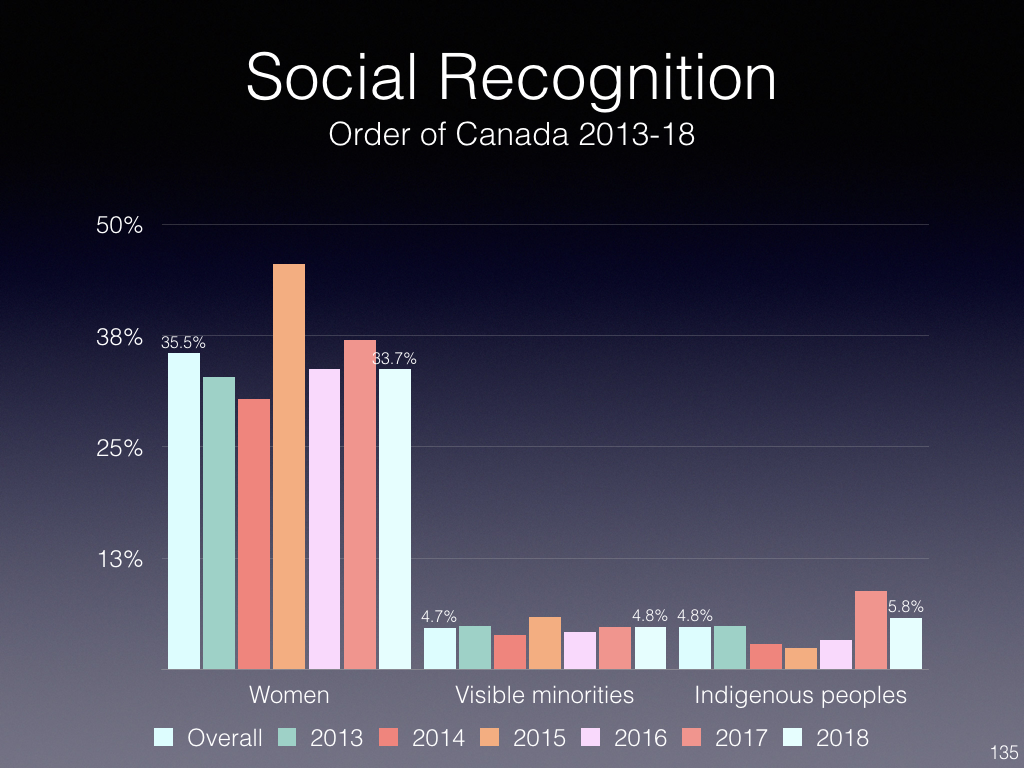
This article does beg the question of whether this is a real issue compared to other under-representation. While the public service initiative is with respect to the wide range of awards under the Governor General, I have looked at Order of Canada recipients.

Under the previous government, there were efforts to improve representation with respect to regional representation (e.g., under-representation in the West, over-representation in Ontario and Quebec) and under-representation of the business community (see my earlier The Order of Canada and diversity).

Recently, it appears that Indigenous representation has increased substantially, and is now greater than their percentage of Canada’s population. Visible minorities, reflecting in large part their relatively newer presence in Canada, but also likely some network effects of not visible minorities, remain under-represented. And women’s representation seems to have plateaued at about one-third with a few exceptions.

And, as the article correctly points out, there are already a considerable number of existing public service awards, both general and department specific:

The Liberal government wants to see more medals pinned on the chests of public servants, and so has established a kind of quota system to make sure they’re nominated more frequently.

Michael Wernick, clerk of the Privy Council and Canada’s top public servant, has pressed all federal departments to submit the names of at least five of their employees each year to the Governor General’s office for various awards.

“We encourage you to task the senior managers responsible for employee recognition within your department to begin nominating at least five public servants per year for Canadian honours,” says a letter co-signed by Wernick and Stephen Wallace, then-secretary to the Governor General.

The fall 2017 missive to deputy ministers, obtained by CBC News under the Access to Information Act, was followed up last year directly by the Governor General’s office to ensure departments were co-operating.

“We look forward to hearing about your department’s strategy to recognize deserving individuals in your department whose achievements, contributions or accomplishments have made a difference or have had a positive impact on your organization,” says an email from Sylvie Barsalou, administrative officer with the Chancellery of Honours.

The Liberal government initiative was triggered by an internal assessment that concluded public servants historically have been “underrepresented” within the Canadian Honours System, which includes a broad range of medals and decorations.

“[W]e are taking steps towards reversing this phenomenon,” says the Wernick-Wallace letter.

Called ‘underrepresented’

A spokesperson for the Governor General cited statistics for the Order of Canada, one of the Government of Canada’s highest honours, to support the claim that public servants are underrepresented.

“Between 1976 and 2018, people whose contributions were considered ‘public service’ made up, on average, 2.4% of annual appointments to the Order of Canada,” Sara Regnier-McKellar said in an email.

“Over this time period, public servants comprised an average of 5.9% of Canada’s employed labour force each year.”

The phrases “public service” and “public servants” in this context, she said, refer to those working in all kinds of governance and government, including Indigenous governments and municipal, provincial and federal governments.

The impact of the new nominating initiative is unclear. Both the Governor General’s office and the Privy Council Office (PCO) say they are not counting nominations submitted by federal departments.

“We do not monitor or track nominations and have no plans to do so,” said PCO spokesperson Stephane Shank.

At least one department – Innovation, Science and Economic Development – formally launched the PCO initiative internally on Aug. 15, 2018, says a briefing note to the deputy minister.

“It is anticipated that most nominations will be submitted for the Meritorious Service Decorations,” says the note, also obtained under the Access to Information Act.

Civilians in silver

Civilian versions of the Meritorious Service Decoration – either a service cross or a medal, both of silver – were introduced in 1991, complementing a military variant. A formal nomination requires the names of three people as references, as well as a full description of the reasons for making the award.

More than 800 civilian service crosses and medals have been awarded since 1991 — about 28 each year.

The Wernick-Wallace letter also says departments might consider nominating their employees for the Order of Canada. Wernick himself sits on the committee that vets such nominations.

There’s no shortage of other awards specifically reserved for federal public servants. The annual Public Service Award of Excellence, for example, recognizes five categories, including “outstanding career.” There were 123 recipients last year (131 in 2017); each one receives a medal.

And new awards are being added each year. The newly created Parliamentary Protective Service, which has provided security on Parliament Hill since June 23, 2015, recently launched an awards program involving gifts such as jewellery, art and show tickets to recognize excellence, long service and retirements.

Canada’s new information commissioner, Caroline Maynard, also created a new award last year for access-to-information officers, selecting two employees (at the Canada Revenue Agency and the Canada Border Services Agency) as the inaugural recipients.

The Canadian Press reported in 2013 that the Treasury Board of Canada was spending an average of more than $100,000 a year on gifts and prizes for public servants in that department.

The Governor General’s office alone is responsible for 13 categories of national awards, and lists a total of 413,526 people in its database of previous and current recipients.

Public service full to bursting with deputy ministers

Alan Freeman on the growth in the number of deputies, picking up on some themes of Donald Savoie:

Here’s a quiz. How many deputy ministers are there in the federal government’s Treasury Board Secretariat?

If you answer “one,” you’ll get a point for logic. After all, as you learned in your first-year university Canadian politics course, a deputy minister is the top public servant in a government department — the boss — whether it’s Transport or Global Affairs or Treasury Board.

But this being Ottawa in 2019, “one” is the wrong answer. How about six? That’s right. The Treasury Board actually has six top officials in the deputy minister (DM) category. Five are full deputies and a sixth is an associate deputy. They’re all appointed by the prime minister to their jobs, and get better salaries and more generous pension benefits than other executives, all for being part of the (once) exclusive club of Ottawa mandarins.

Treasury Board is just one example. Deputies are popping up throughout the federal government like potholes in March. Global Affairs has four, at last count, National Defence three. But it’s Innovation, Science and Economic Development (the old Industry department) that wins the Oscar for best performance in deputy overkill. It’s got four deputies, plus five other DMs, if you include the heads of the five regional development agencies the department supervises. That’s a total of nine.

Of course, the same department has four ministers, including full ministers for science, tourism and small business. A mini-government of its own.

It’s an extraordinary phenomenon that’s the result of political expediency and bureaucratic empire-building. As of today, there are 83 deputies in the federal government: 38 deputy ministers and 45 associate deputy ministers, an increase of 11 positions in the past decade. Since the Trudeau government was elected, nine have been added.

The number of executives in the government has been growing like topsy for years, at twice the growth rate of the public service as a whole. The deputy explosion is just another symptom of a system that’s out of control.

This growth has not just added people, it’s added new layers to the top bureaucracy. Where once there were a group of assistant deputy ministers with specific responsibilities reporting to a deputy at the top of the departmental bureaucratic hierarchy, there are now senior assistant deputy ministers, associate deputy ministers, and even senior associate deputy ministers, all adding to the general confusion.

“It’s huge. It’s cumbersome. They’ve created a whale that can’t swim,” says Donald Savoie, the New Brunswick academic who has studied the federal bureaucracy for decades.

“All of these people have to be relevant, so they create work for themselves. They slow everything down.”

How did we get here? As Savoie notes, the position of associate DM developed a few decades ago. Part of it was classification creep. Then was the desire to reward public servants who may have been very competent, but didn’t have the “gravitas” to make it to the deputy level.

Another reason, according to Savoie, was that promotion to associate DM was seen as a way of getting around wage freezes imposed on senior bureaucrats. If you can’t give a trusted official an annual increase, promote him to a higher-paying job. First it was only the big departments that got an associate DM. Then they spread everywhere. Even a small department like Veterans Affairs now has an associate deputy minister, both appointed by the PM, both with DM salaries.

Politics have also intervened, particularly since the Liberals returned to power. Remember that first Trudeau cabinet, the gender-equal one with 15 men and 15 women? When people found out that five of the women were actually “junior” ministers of state, all hell broke loose and Trudeau was forced to make them all full ministers, with higher salaries. But that also meant they needed a deputy or an associate to help them out with their “portfolio.”

So we have a weird kind of deputy minister, who reports to a minister but doesn’t really have a conventional department to take care of. There’s Guylaine Roy, who became a deputy last summer when Mélanie Joly was demoted from Canadian Heritage and was given the smorgasbord job of Tourism, Official Languages and La Francophonie. The actual public servants (it must be a tiny number) seem to have stayed in their home departments, so it’s hard to know what exactly a deputy is in charge of in those circumstances.

Likewise, a new deputy was appointed for Status of Women when that became a full cabinet position and department again.

And there’s now a deputy minister for public-service accessibility, who was appointed in July when Public Services Minister Carla Qualtrough was given the additional responsibility of improving access for people with disabilities in the federal sector. At the same time, the chief information officer, Alex Benay, was promoted to a DM-level job. Both are part of the Treasury Board gang of six.

Improving accessibility may be a laudable goal, but why is there a need for a full deputy minister? Using the same logic, you could argue that there should be a deputy minister to encourage women in the public sector, or visible minorities or Indigenous people. There’d be no end to it.

And of course, there’s now an associate deputy minister at Public Services and Procurement whose sole responsibility is the Phoenix pay system. That seems a guarantee that the job will be around long after the system is fixed or replaced.

Is there any end in sight? Not really. This week, there was another cabinet shuffle and another newly minted minister, this time for Rural Development. Bernadette Jordan got the job, largely because Trudeau needed an MP from Nova Scotia in the cabinet and there seemed no other place to put her.

By Friday, a new breeze of austerity had clearly blown in from the Privy Council Office, which now says Jordan will be supported by the existing deputy minister at Infrastructure for some of her files, and by the Innovation deputy for the rest. A bit of a respite from the DM tsunami, but you can be sure it won’t be long until another new deputy minister is created.

Source: Public service full to bursting with deputy ministers

Andrew Coyne: Ex-Liberal candidate’s only crime was engaging in ethnic politics — out loud

More piling on with respect to former Liberal candidate Wang (the replacement candidate, Richard Lee, also a Chinese Canadian, has provincial political experience).

Coyne ends this column with the quasi-ideological twist that favouring greater representation of under-represented groups is somehow more undermining of social cohesion than not doing so, and that bias is not a factor in hiring and other practices:

You have to feel for the Liberal Party of Canada, who are surely the real victims in the Karen Wang affair.

The party had innocently selected the B.C. daycare operator to run in next month’s byelection in Burnaby South based solely on her obvious merits as a failed former candidate for the provincial Liberals in 2017, and without the slightest regard to her Chinese ethnicity, in a riding in which, according to the 2016 census, nearly 40 per cent of residents identify as ethnically Chinese.

Imagine their shock when they discovered that she was engaging in ethnic politics.

In a now-infamous post on WeChat, a Chinese-language social media site, Wang boasted of being “the only Chinese candidate” in the byelection, whereas her main opponent — NDP Leader Jagmeet Singh — is “of Indian descent.”

The party was instantly and publicly aghast. Pausing only to dictate an apology to be put out under her name (“I believe in the progress that Justin Trudeau and the Liberal team are making for British Columbians and all Canadians, and I do not wish for any of my comments to be a distraction,” etc etc), party officials issued a statement in which they “accepted her resignation.” Her online comments, the statement noted, “are not aligned with the values of the Liberal Party of Canada.”

Certainly not! How she got the idea that the Liberal Party of Canada was in any way a home for ethnic power-brokers prized for their ability to recruit members and raise funds from certain ethnic groups, or that it would even think of campaigning in ridings with heavy concentrations of voters from a given ethnic group by crude appeals to their ethnic identity — for example by nominating a candidate of the same ethnicity — must remain forever a mystery.

Unless, of course, her real crime was to have said out loud what everybody in politics knows to be the practice, not just of the Liberals but of every party, but prefers not to mention. But the thing having been said, the party had no alternative but to pretend to be appalled, just as the other parties had no alternative but to pretend to be outraged.

There is, after all, a script for these things. Usually it is performed at the expense of the Conservatives, as in the controversy a few years back over a leaked party memo proposing an advertising strategy for “very ethnic” ridings, or another that urged a candidate’s photo include voters of different ethnic backgrounds — as if every party did not do this, every day. Again, the crime was to have said what must be left unsaid, or rather to have been caught doing so.

The only difference in this case is that it involves the Liberals, usually the first to feign such outrage, now forced to yield the stage to the NDP. Thus the NDP’s Nathan Cullen was quoted saying Wang’s post was “the worst kind of politics there is,” while Singh himself observed how “politics that divide along racial lines hurt our communities… I want to focus in on politics that bring people together.”

It takes some effort, hearing such admirable sentiments, to recall NDP officials’ open speculation, after Singh was elected party leader, that this would improve their chances in cities such as Brampton, Ont., or Surrey, B.C., with large numbers of Sikh voters. It doesn’t necessarily follow, of course: voters of all ethnicities display a stubborn tendency to think and vote as individuals, frustrating parties’ efforts to sort them into little boxes. But that doesn’t mean the parties don’t think that way, or act accordingly.

For her part, the lesson Wang drew from the controversy was that she should have limited herself to stressing her own ethnicity, without mentioning Singh’s. “As a Canadian with a Chinese background, normally, obviously, you are trying to gain people’s support from the same cultural background,” she told her post-resignation news conference.

Which at least has the virtue of honesty. The hypocrisy of the universal outrage over Wang’s appeal to tribalism is not just that all the parties do it, as a matter of practical politics, but that much respectable opinion believes it to be right and proper as a matter of principle. Thus, for example, electoral boundaries are supposed to be drawn in conformity with what is delicately called “community of interest,” on the precise understanding to which Wang sought to appeal: that membership in an ethnic or other identity group trumps. At the limit, it emerges in calls for special dedicated ridings — even a separate Parliament — for Indigenous voters.

This is hardly confined to politics: across society, progressive ideology has lately taught us, not to emphasize our common humanity, but the opposite: that people of one group may not — cannot — be represented by those of another; that they are to be judged, not as individuals, but on the basis of their race, gender and so on. The current generation of federal Liberals, in particular, has made hiring quotas the defining principle of their government, to be institutionalized from top to bottom.

It is lovely to hear Liberal ministers proclaim, in response to the Wang affair, that “the value we stand for is representing all Canadians,” just as it is heartening to read an NDP commentator denounce the idea of reducing voters to “a passive, two-dimensional identity to be exploited for someone else’s elevation to the political class.” If only they meant it.

Source: Andrew Coyne: Ex-Liberal candidate’s only crime was engaging in ethnic politics — out loud

Birth Tourism: S’attaquer aux consultants «sans scrupules» d’abord

The second part of the Journal de Montréal series. The most interesting nugget being Conservative immigration critic Michelle Rempel essentially disowning the CPC policy resolution calling for abolishing unqualified birthright citizenship (I may have missed an earlier reference).

As in the first article, some interesting local details:

Le gouvernement fédéral promet de s’attaquer aux consultants illégaux en immigration qui contrôlent une partie de l’industrie du tourisme obstétrique après les avoir laissés prendre racine au pays.

Le Journal rapportait hier qu’environ une femme étrangère accouche chaque jour au Québec après avoir fait des milliers de kilomètres pour donner naissance ici dans un seul but : offrir la citoyenneté canadienne à son enfant.

Le Canada et les États-Unis font partie des rares pays riches où il est encore possible d’obtenir la citoyenneté ainsi. Ce phénomène des « bébés passeport » est en pleine explosion au pays.

Certains des consultants auxquels ces mères étrangères ont recours font partie intégrante du stratagème (surtout localisé à Vancouver) permettant à des femmes — principalement chinoises — de venir accoucher ici en se faisant passer pour de simples touristes.

« Tout nous porte à croire que des consultants en immigration sans scrupules incitent les demandeurs à mentir sur la raison de leur visite au Canada », soutient un porte-parole d’Immigration Canada, Peter Liang.

Maisons de naissance

L’avocat montréalais Hugues Langlais soutient que ceux qui gèrent les maisons de naissance de Richmond, en Colombie-Britannique, pourraient être considérés comme des consultants illégaux en vertu de la loi.

Au Canada, seuls les avocats, les notaires et les consultants en immigration certifiés peuvent prodiguer des conseils en matière d’immigration, comme l’obtention de visas de voyage.

« Si des gens font de la promotion pour des naissances au Canada — comme les maisons de naissance de Richmond — et font des démarches pour solliciter ou renseigner des clients, ils pourraient s’exposer à des poursuites », croit-il.

Immigration Canada dit mener un examen afin de connaître la meilleure façon de serrer la vis aux consultants non autorisés. Or, jusqu’à présent, Ottawa a fait bien peu pour stopper leur progression.

Manque de ressources

C’est que l’agence fédérale responsable de mener ce genre d’enquête admet à mots couverts qu’elle n’a ni les ressources ni le temps de s’occuper de la lutte aux consultants œuvrant dans le domaine du tourisme obstétrique.

L’Agence des services frontaliers du Canada (ASFC), responsable de faire respecter la loi sur l’immigration, se concentre avant tout à assurer la sécurité nationale, et elle s’attaque uniquement aux plus gros délits.

« L’ASFC engage des poursuites pour les cas les plus sérieux de fausses déclarations commises par des consultants en immigration sans scrupules », fait-on valoir.

L’ASFC et Immigration Canada ont d’ailleurs été incapables de fournir des données sur les enquêtes en cours concernant la lutte aux consultants frauduleux.

« Far West »

Parallèlement, Ottawa refuse pour l’instant d’accorder plus de pouvoir à l’ordre professionnel qui régit le travail des consultants en immigration.

« Présentement, c’est le “Far West”, soutient le directeur de l’Association canadienne des conseillers professionnels en immigration (ACCPI), Dory Jade. Ça fait 10 ans qu’on demande une reconnaissance formelle. »

Il croit qu’avec un ordre professionnel comme celui des dentistes ou des ingénieurs, l’ACCPI pourrait mener des enquêtes dans le but de démanteler les maisons de naissance qui pullulent à Vancouver.

JUSQUE DANS LES PETITES ANNONCES

Les facilitateurs du tourisme obstétrique affichent leurs services un peu partout, des petites annonces jusqu’aux réseaux sociaux comme Instagram.

♦ Le Plus International Mother and Child club, situé à Vancouver, offre notamment dans son annonce des services « haut de gamme pour les mères d’outre-mer et leur bébé », précisant que les bébés sont canadiens.

♦ En plus du logement, de l’hébergement, du suivi médical, etc., le Canada Moon Centre B & B propose son aide pour le traitement des certificats de naissance, des passeports canadiens, des documents de voyage et des visas.

♦ Sur internet, le Canada Vancouver Ocean Baby Club écrit : « Bienvenue dans notre club pour la grossesse, la maternité, la formation postnatale, les visites tourististiques et le bonheur d’un bébé citoyen canadien ».

♦ Le Mansion Moon Center précise dans son annonce qu’une infirmière habite la villa qu’elle loue, et qu’on offre le transport depuis l’aéroport et vers les rendez-vous médicaux.

UNE PRATIQUE CHOQUANTE QUI DEVIENDRA UN PROBLÈME

Un important facilitateur du tourisme obstétrique au pays juge la pratique choquante, même si elle est légale, et voudrait la voir cesser.

« Je n’essaie pas de me justifier et de dire que c’est noble ce que je fais, affirme sans détour Alex Davidson en entrevue dans son bureau de Toronto.

« Mais la loi, c’est la loi, ajoute candidement l’avocat spécialisé en droit de l’immigration. Ça ne me concerne pas si ces familles souhaitent venir ici donner naissance pour avoir un passeport pour leur enfant. »

« injuste »

Me Davidson redoute les dérives d’un système qu’il juge « injuste » pour les candidats à l’immigration qui respectent le cours normal du processus. Les « bébés passeport » pourraient même « devenir un problème » pour le Canada, selon lui, s’ils choisissent de s’établir ici et de fréquenter les universités en grand nombre dans quelques années.

L’avocat torontois d’origine américaine et russe déplore que ces personnes aient accès aux systèmes d’éducation et de santé comme tous les autres Canadiens, simplement parce qu’ils sont nés ici.

Mais pour l’instant, la pratique est encore légale et Me Davidson a l’intention de continuer de profiter de ce lucratif marché en offrant ses services aux familles souhaitant entrer au pays en toute légalité avec un visa de voyage.

Il collabore aussi avec six médecins, qui touchent chacun une rémunération pour l’accouchement et le soutien prénatal et postnatal.

« Cadeau pour la vie »

Il y a quelques semaines à peine, il a publié une vidéo sur sa très populaire chaîne YouTube, dans laquelle il invite les familles qui envisagent de s’exiler pour accoucher d’agir avant qu’il ne soit trop tard.

Dans cet extrait, Me Davidson soutient que le Canada pourrait bientôt abolir le droit du sol, car « plusieurs pensent qu’il est injuste de conserver le système actuel », prévient-il.

Comme le président Donald Trump a promis de mettre fin au tourisme obstétrique aux États-Unis, le Canada pourrait bien emboîter le pas, précise-t-il. Mais pour l’instant, aucun parti politique fédéral ne compte aller aussi loin pour contrer le phénomène.

L’avocat qualifie au passage de « cadeau pour la vie » le passeport canadien, qui offre par ailleurs « de nombreux avantages ».

« Il vous reste un an pour vous décider, si vous considérez venir ici pour donner naissance. Il est encore temps d’en profiter », explique-t-il.

Me Davidson s’est fait connaître dans le monde entier grâce à sa chaîne YouTube, dans laquelle il offre des conseils pour immigrer au Canada. Il soutient toutefois que le tourisme obstétrique ne représente qu’une petite fraction de sa clientèle.

LE CANADA DEVRAIT-IL ABOLIR OU PAS LE DROIT DU SOL ?

Le Parti conservateur n’envisage plus d’abolir la citoyenneté à la naissance pour s’attaquer au phénomène des « bébés passeport » comme le souhaite une majorité de ses militants.

« Il y a clairement de l’abus, mais je ne crois pas que ce soit un problème envahissant à l’échelle nationale », croit la députée conservatrice responsable du dossier de l’immigration, Michelle Rempel.

Disant ne pas vouloir « minimiser » le phénomène, Mme Rempel soutient que des analyses plus sérieuses sont nécessaires pour connaître l’ampleur et les causes du problème.

Manchettes

Le tourisme obstétrique au Canada a fait les manchettes au cours des derniers mois après que les militants conservateurs aient voté en faveur, dans une certaine controverse, d’une motion non contraignante visant à abolir le droit du sol.

Un ex-haut fonctionnaire chez Immigration Canada croit que cette solution serait la plus efficace pour mettre fin au tourisme obstétrique. Or, il juge cette mesure trop radicale pour s’attaquer à un problème somme toute secondaire.

Un avis que partagent Mme Rempel, de nombreux experts ainsi que le gouvernement Trudeau.

Les troupes conservatrices ont d’ailleurs déjà tenté d’abolir la citoyenneté à la naissance au Canada. La démarche a été abandonnée puisque la mesure s’avérait trop complexe et coûteuse (entre 20 et 30 millions $).

Il n’en demeure pas moins que d’autres pays, dont la Grande-Bretagne, ont abandonné cette pratique, exigeant qu’un des deux parents réside dans le pays.

Le président Donald Trump a lui aussi promis de resserrer les règles. Mais ce droit est protégé par la constitution américaine, ce qui le rend presque impossible à abolir.

Qu’est-ce que le droit du sol ?

Au Canada, le droit du sol est protégé par une loi datant de 1947. Avant, les Canadiens étaient considérés comme des sujets britanniques.

Le droit du sol a été adopté dans la foulée de la Deuxième Guerre mondiale, durant laquelle beaucoup de Canadiens ont quitté le pays pour aller travailler aux États-Unis.

Le gouvernement canadien voulait donc s’assurer que les personnes qui revenaient au pays après la guerre soient considérées comme Canadiennes, puisque nées sur le territoire, explique l’avocat Hugues Langlais.

Source: SociétéS’attaquer aux consultants «sans scrupules» d’abord2019-01-20 – ArticleIl y a quelques semaines à peine, il a publié une vidéo sur sa très populaire chaîne YouTube, dans laquelle il invite les familles qui envisagent de s’exiler pour accoucher d’agir avant qu’il ne soit trop tard.

Birth Tourism: Un «bébé passeport» par jour au Québec

Interesting in-depth reporting in the Journal de Montréal on the extent of birth tourism in Montreal (the reporter spoke to me a number of times as well as others with some interesting local details) – first part:

Environ une femme étrangère accouche chaque jour au Québec, après avoir fait des milliers de kilomètres pour donner naissance ici dans un seul but : offrir la citoyenneté canadienne à son enfant.

Le principal objectif de ce coûteux séjour au pays est d’obtenir un passeport pour le bébé. La loi fédérale fait en sorte que tous les bébés nés ici obtiennent automatiquement la citoyenneté, et donc un passeport canadien.

Le Canada et les États-Unis font partie des rares pays riches où il est encore possible d’obtenir la citoyenneté ainsi.

Avec ce précieux document, l’enfant pourra :

  • étudier au Canada à peu de frais ;
  • voyager dans le monde plus facilement ;
  • s’établir ici aisément si son pays d’origine connaît des perturbations sociales ;
  • venir se faire soigner ici gratuitement (à condition de venir habiter six mois par année ici pour obtenir la carte soleil).

Explosion

Ce phénomène des « bébés passeport » est en pleine explosion partout au pays, y compris au Québec. Vancouver en est toutefois l’épicentre en raison d’un obscur réseau de facilitateurs bien établis dans la communauté chinoise.

Tout un système de consultants en tourisme obstétrique est d’ailleurs en train de se constituer clandestinement, ce qui inquiète des avocats spécialisés en immigration qui y voient un passe-droit injuste. Le gouvernement canadien promet de faire le ménage dans ce réseau de consultants « sans scrupules » (à lire demain).

Les couples paient de 20 000 $ à 30 000 $ pour venir ici, ce qui comprend les billets d’avion, l’hébergement, quelques milliers de dollars pour les consultants ou avocats et environ 8000 $ pour les frais médicaux.

Mal documenté

Le tourisme obstétrique est mal documenté par les gouvernements. Des établissements publics refusent d’en parler, dont le Centre hospitalier de St. Mary. Les douaniers constatent l’arrivée au pays de mères sur le point d’accoucher, mais ils n’ont aucun moyen légal pour intervenir.

Si certains « consultants » conseillent à leurs clientes de mentir, il y a des couples qui ne cachent pas leurs intentions lorsqu’ils arrivent ici, comme a pu le constater Le Journal. Bien que controversé sur le plan éthique, tout cela est légal.

Personne ne connaît le nombre exact de femmes qui viennent ici pour accoucher. Un calcul inédit produit par Le Journal démontre que plus de 800 mères non résidentes canadiennes ont donné naissance l’an dernier au Québec seulement, essentiellement dans la région de Montréal.

Ces données compilées n’incluent pas le principal lieu d’accouchement francophone au Québec, l’hôpital Sainte-Justine, qui ne dénombre pas ce type de naissance. Tout comme les hôpitaux de la ville de Québec.

Environ 50 % de ces mères étrangères sont venues ici en tant que touristes dans le but d’accoucher, selon l’estimation « très conservatrice » d’un ex-haut fonctionnaire d’Immigration Canada, qui a longuement étudié la question.

L’autre moitié serait composée de mamans qui sont, par exemple, des étudiantes ou des travailleuses étrangères qui ont accouché durant leur séjour ici.

C’est ainsi qu’on évalue qu’environ un « bébé passeport » naît chaque jour au Québec.

Le Centre hospitalier de St. Mary vient au 2e rang de tous les hôpitaux canadiens qui accueillent le plus de naissances de mères étrangères. Dans cet hôpital, près d’un bébé sur 10 est né d’une mère venue d’ailleurs l’an dernier (361). Une hausse significative par rapport à il y a cinq ans (177).

Ces femmes étrangères qui accouchent au Québec sont souvent d’origine chinoise, selon des données obtenues par Le Journal.

Ce phénomène soulève des questions éthiques, remet en question les lois canadiennes sur la citoyenneté et est source de conflits dans les hôpitaux.

« On se demande qui doit prendre la responsabilité de ces femmes », affirme une obstétricienne de Calgary qui a réalisé une rare étude sur le sujet, Fiona Mattatall.

Vancouver, l’épicentre

À Vancouver, le tourisme obstétrique est devenu une véritable industrie. Une vingtaine de maisons de naissance chinoises ont pignon sur rue dans les environs de la métropole britanno-colombienne.

Ces entreprises controversées, dont les tentacules s’étendent jusqu’en Asie, offrent des services clé en main à de riches familles chinoises (à lire demain).

NAISSANCES D’ENFANTS DE MÈRES ÉTRANGÈRES DANS CERTAINS HÔPITAUX DU QUÉBEC

Centre hospitalier de St. Mary

  • 2017-2018 | 361
  • 2013-2014 | 177

Hôpital de LaSalle

  • 2017-2018 | 76
  • 2013-2014 | 91

Hôpital du Lakeshore

  • 2017-2018 | 57
  • 2013-2014 | 28

CUSM

  • 2017-2018 | 123
  • 2013-2014 | 110

CHUM

  • 2017-2018 | 16
  • 2013-2014 | 37

Hôpital général juif

  • 2017-2018 | 72
  • 2013-2014 | 62

Hôpital Maisonneuve

  • 2017-2018 | 63
  • 2013-2014 | 43

Cité de la santé

  • 2017-2018 | 17
  • 2013-2014 | 16

Hôpital du Sacré-Cœur

  • 2017-2018 | 39
  • 2013-2014 | 45

Total : 824 l’an dernier

SOURCES : LES DIFFÉRENTS HÔPITAUX ET CENTRES INTÉGRÉS DE SANTÉ ET DE SERVICES SOCIAUX CONCERNÉS.

DES ENJEUX ÉTHIQUES

Des conséquences sur le système de santé

L’explosion du phénomène des « bébés passeport » entraîne inévitablement des conséquences sur les soins de santé dans les hôpitaux les plus touchés. À l’hôpital de Richmond, en Colombie-Britannique, près de 1 bébé sur 4 est d’origine chinoise. On déplore que des Canadiennes enceintes soient forcées d’accoucher ailleurs parce qu’une femme étrangère se présente en travail à l’hôpital à la dernière minute. « Des infirmières sont inquiètes des abus du système et que des résidentes de Richmond soient rétrogradées », affirme en entrevue le député libéral fédéral de la circonscription, Joe Peschisolido. Le Centre hospitalier de St. Mary, à Montréal, n’est pas à l’abri de ce genre de situation, croit un ancien haut fonctionnaire fédéral ayant longuement étudié la question. « Si la tendance se poursuit, c’est possible et même probable qu’on voie les problèmes de Richmond se produire ailleurs », affirme le chercheur Andrew Griffith.

Des factures non payées

Ils sont l’exception plutôt que la règle, mais certains parents partent sans payer l’hôpital. Les autorités de santé publique de Vancouver poursuivent une femme d’origine chinoise qui a quitté le Canada en laissant derrière elle des factures impayées de 313 000 $ après son accouchement en 2012. L’avocat canadien responsable du dossier soutient qu’il sera très difficile de récupérer les fonds, qui s’élèvent à un million avec les intérêts. À Calgary, une mère américaine a accouché de ses quatre enfants sans s’acquitter de ses factures, qui s’élèvent maintenant à plus de 100 000 $. « Elle n’avait pas d’assurance maladie aux États-Unis. Elle trouvait que c’était beaucoup moins cher de venir se faire soigner ici », explique Fiona Mattatall, une obstétricienne de Calgary. Qu’on paie ou non sa facture, l’enfant obtient la citoyenneté.

Injustice en immigration

Les parents qui offrent la citoyenneté canadienne à leur enfant en accouchant tout simplement ici font enrager les immigrants ayant attendu patiemment pendant des années avant d’obtenir leur passeport à la feuille d’érable. « Pourquoi ne pas suivre les règles qui existent déjà ? Faites les procédures habituelles comme tout le monde », a commenté un utilisateur sur un blogue spécialisé en immigration à une femme étrangère désirant accoucher au Canada. « Tant qu’à être cupide, abandonnez votre enfant au Canada pour qu’il puisse vivre sa vie de Canadien, et vous, rentrez tranquillement chez vous ! » lui a lancé un autre utilisateur.

LA CITOYENNETÉ CANADIENNE EN CADEAU

Aman et Hrena Singh, de l’Inde, ont payé environ 25 000 $ pour venir donner naissance à leur fils à Toronto

Couple d’Indiens bien nanti, Aman et Hrena Singh sont venus au Canada pour donner naissance à leur premier enfant, qui a ainsi la citoyenneté canadienne. Ils ont été pris en photo au bureau de leur avocat, à Toronto, en novembre. Leur fils a vu le jour depuis et a été nommé Alex, en honneur de l’avocat qui les a aidés dans leurs procédures.

Aman et Hrena Singh ne connaissaient rien du Canada avant d’y mettre les pieds en octobre dernier. Cela n’a pas empêché ce couple de venir d’Inde pour donner naissance à un petit garçon qui est maintenant… canadien.

Comme le font chaque année des centaines de familles étrangères, Aman, 37 ans, et Hrena, 26 ans, ont fait des milliers de kilomètres pour donner naissance à leur enfant ici.

Le principal objectif de ce coûteux séjour : obtenir la citoyenneté canadienne pour leur enfant. Le Canada, contrairement à la plupart des pays, attribue la nationalité à toute personne qui naît sur son territoire, sans condition supplémentaire.

Ce couple de l’Inde bien nanti souhaitait d’abord et avant tout offrir à leur petit garçon des soins de santé de classe mondiale et un environnement sécuritaire. Ils ont aussi obtenu pour lui, en prime, la nationalité d’un pays riche.

« Notre but au départ était de venir ici pour 10 ou 15 jours pour explorer le pays. Lorsque nous avons réalisé qu’il était possible d’obtenir la citoyenneté [pour notre bébé], nous n’avons pas hésité », explique Hrena en entrevue depuis le bureau de son avocat torontois quelques semaines avant d’accoucher.

« Je ne voulais pas accoucher en Inde. Je cherchais de bonnes conditions sanitaires, de bons hôpitaux », explique celle qui a donné naissance au début du mois de janvier.

Facture de 25 000 $

Le couple doit rentrer dans son pays à la fin janvier. Ils auront déjà en main, à ce moment-là, le passeport du petit Alex. La famille n’a aucune intention de revenir au pays de sitôt. Propriétaires d’une école primaire privée, Aman et Hrena bénéficient d’une situation économique enviable dans leur pays.

« Nous avons une entreprise prospère en Inde, soutient Aman. Nous ne voyons aucun intérêt à nous établir ici, au Canada. »

La très vaste majorité des familles s’adonnant au tourisme obstétrique font partie de la classe des privilégiés dans leur propre pays, assure l’avocat du couple, Alex Davidson. Ces familles déboursent de 20 000 $ à 30 000 $ pour offrir la nationalité canadienne à leur enfant. Cela inclut les billets d’avion, l’hébergement, les frais d’avocat et d’hôpitaux.

« Ça va nous coûter au total au moins 25 000 $, dit la nouvelle maman. C’est beaucoup plus qu’on pensait! Mais quand on voit la pureté de l’environnement, je pense que c’est raisonnable. »

Le couple a jeté son dévolu sur le Canada parce que ce pays lui semblait plus ouvert et sécuritaire que les États-Unis, seul autre pays riche où le droit du sol est encore en vigueur.

« Nous préférons le Canada à cause du multiculturalisme et parce qu’il est moins densément peuplé », indique Hrena­­­, qui se dit aussi rebutée par les nombreux « attentats terroristes » au sud de la frontière.

Le couple assure que cette démarche vise uniquement à offrir un meilleur avenir à leur enfant. Il n’envisage pas, pour l’instant, de profiter de la citoyenneté canadienne de leur garçon pour l’obtenir eux-mêmes, à leur tour.

Le Canada en a les moyens

Les parents de « bébés passeport » n’obtien­nent pas automatiquement la nationalité canadienne. S’ils souhaitent éviter le processus normal d’immigration, ces familles doivent attendre que leur enfant atteigne l’âge de la majorité, soit 18 ans, pour être admissibles au parrainage.

« Nous ne voulons pas du tout devenir canadiens », lâche Hrena dans un très bon anglais.

Le couple est bien conscient des enjeux éthiques que pose le tourisme obstétrique. Avec le recul, Aman et Hrena n’ont pas l’impression de profiter du système, puisqu’ils déboursent d’importantes sommes pour venir ici.

Ils croient aussi que le Canada a les moyens d’offrir gratuitement sa citoyenneté aux enfants nés ici et juge que cette pratique est une relation d’affaires qui est même bonne pour l’économie du pays.

PRÉSENT, MAIS MOINS BIEN FICELÉ À MONTRÉAL

L’industrie des « bébés passeport » est peut-être moins organisée à Montréal qu’à Vancouver, mais elle a tout de même le vent dans les voiles.

Le Journal a contacté des dizaines d’avocats en immigration et de nombreux spécialistes des soins de santé dans la métropole, dans le cadre de ce reportage. Presque tous ceux avec qui nous avons parlé sont convaincus que la pratique se porte bien à Montréal. Certains ont même déjà travaillé avec cette clientèle.

Il semble toutefois que les maisons de naissance de type tout inclus pour les familles étrangères désirant donner naissance au Canada soient rares, sinon inexistantes au Québec.

« Je ne connais pas de maisons de naissance spécialisées, mais je sais qu’il y a systématiquement dans tous les hôpitaux de Montréal, une bonne portion des femmes qui donnent naissance et qui sont issues de l’étranger », soutient un avocat en immi­gration, Hugues Langlais.

Plusieurs intervenants expliquent que ces familles étrangères viennent donc généralement à Montréal par leurs propres moyens. Elles logent à l’hôtel ou louent un appartement, certaines embauchent une accompagnatrice de naissance ou une sage femme. D’autres encore s’inscrivent à l’unité mère-enfant d’un hôpital. Dans de rares cas, elles arrivent à l’improviste à l’urgence au moment de l’accouchement.

Entrepreneurs

Deux entrepreneurs rencontrés par Le Journal ont tenté d’ouvrir une maison de naissance pour femmes étrangères, sans succès.

Neo Zhang a immigré de Chine en 2012. Constatant la popularité des maisons de naissance en Colombie-Britannique et en Californie, M. Zhang a fait des démarches pour reproduire ce modèle ici.

Son projet n’a toutefois jamais vu le jour ; ses recherches ont démontré que le marché montréalais n’est pas encore mûr pour une telle industrie, en raison de la taille relativement petite de la communauté chinoise, principale source du tourisme obstétrique, croit-il.

La « barrière de la langue » repousse aussi les agences chinoises qui préfèrent développer les marchés britanno-colombiens et ontariens, ajoute M. Zhang.

Yi Hai Yan s’est quant à elle installée à Montréal en 2008. Flairant une bonne affaire, Mme Yi a fait paraître en février 2017 une petite annonce dans un média chinois pancanadien. Elle y vendait des services pour entrer au Canada, remplir des formulaires d’identité pour les bébés, organiser des rendez-vous dans des hôpitaux « sophistiqués » et faire le suivi de l’accouchement.

Son projet est toutefois tombé à l’eau, rapporte-t-elle en chinois dans une entrevue traduite par sa fille de 20 ans. « Je n’avais pas réalisé à quel point c’était compliqué. Je n’ai pas les compétences pour remplir des papiers d’immigration », dit l’accompagnatrice de naissance qui offre des massages et des cours d’allaitement aux nouvelles mamans.

Mme Yi dit que son projet a aussi échoué, car elle ne possède pas de réseau de rabatteurs en Asie.

OMERTA À ST. MARY

Le centre hospitalier de St. Mary, à Montréal, se dit « réputé pour ses soins de haute technologie empreints de compassion ». Mais la transparence, elle, n’est visiblement pas dans ses cordes. Le Journal a tenté d’obtenir une entrevue avec la direction dans le cadre de ce reportage, sans succès. « Nous n’avons malheureusement personne de disponible pour traiter de ce sujet avec vous », nous a-t-on répondu après des demandes répétées. Situé dans le quartier central de Côte-des-Neiges, St. Mary a vu le nombre d’accouchements de non-résidentes bondir dans les cinq dernières années, passant de 177 (4 %) à 361 (9 %).

FACTURE TYPE D’UNE MÈRE ÉTRANGÈRE

Le Centre hospitalier de St. Mary est l’un des hôpi­taux les moins chers où accoucher à Montréal. Voici une facture type pour donner naissance sans la carte soleil

  • Hospitalisation de la mère | 2370 $ / jour
  • Hospitalisation pour le bébé | 2475 $ / jour
  • Médecin | À négocier avec le médecin
  • Anesthésiste | À négocier avec l’anesthésiste
  • Dépôt (cela inclut une nuit d’hébergement pour la mère et l’enfant) | 5045 $

PEU DE CAS À QUÉBEC

Les accouchements de mères étrangères sont si rares dans la région de Québec que le seul hôpital possédant une unité des naissances ne prend même pas la peine de les dénombrer.

« Contrairement à Montréal, ce n’est pas quelque chose qui se passe vraiment souvent chez nous pour qu’on commence à comptabiliser ça. Ce n’est pas un gros enjeu pour l’hôpital », soutient le porte-parole­­­ du CHU de Québec-Université Laval, Bryan Gélinas.

Même son de cloche dans la poignée de cliniques d’obstétrique que nous avons contactées. Le phénomène du tourisme obstétrique existe bel et bien à Québec, nous confirme-t-on, mais dans des proportions réduites.

HÉBERGÉS AVEC AIRBNB

Plusieurs familles font appel à des plateformes de location comme Airbnb en prévision de leur accouchement au Québec. Gérard Laurin, de Gatineau, a hébergé deux femmes originaires d’Afrique subsaharienne en 2013 et 2016. Elles étaient devenues canadiennes durant leurs études à l’Université d’Ottawa, et souhaitaient que leur enfant ait aussi la nationalité.

Source: SociétéUn «bébé passeport» par jour au Québec2019-01-19 – ArticleEnviron 50 % de ces mères étrangères sont venues ici en tant que touristes dans le but d’accoucher, selon l’estimation « très conservatrice » d’un ex-haut fonctionnaire d’Immigration Canada, qui a longuement étudié la question.

Douglas Todd: Jagmeet Singh’s byelection battle in super-diverse Burnaby

More on Burnaby South:

The Shri Guru Ravidass Sabha gurdwara in Burnaby was packed recently for a speech by Jagmeet Singh, the federal New Democratic Party leader.

About 800 people squeezed into the Sikh temple, in the heart of the ethnically super-diverse riding of Burnaby South, where Singh is fighting for the first time win a seat as a federal MP. The Punjabi-language Sach Di Awaaz newspaper ran 12 photos of the event featuring the Ontario-based politician.

At the gurdwara this week, Sikhs said they want Singh to win, hoping he’ll make moves to improve education and the job market. A variety of ethnic Chinese and Caucasians walking in the vicinity of the temple also said they intend to vote for Singh, with one man remarking he hoped it will “shake things up.”

Ethnicity has already been highlighted as a factor in the crucial Burnaby South byelection.

A member of the Burnaby gurdwara holds a copy of the free bi-weekly Sach Di Awaaz newspaper that shows NDP candidate Jagmeet Singh at to speak to hundreds of people.

This week, media reported on the way Liberal candidate Karen Wang said in a WeChat post that, as the only Chinese candidate, she could beat Singh, who she noted is of “Indian descent.” Wang said the post was written by a campaign volunteer, but she took responsibility for it and apologized to Singh. Under pressure from the Liberals for her remark, Wang dropped out of the race, although she hinted Thursday there is a slim chance she’ll run as an independent.

Burnaby is known as one the most diverse cities in Canada, if not the world. An earlier Vancouver Sun study found there’s a 73 per cent chance that two randomly chosen people from Burnaby will be of a different ethnicities. For comparison, the chance is just 34 per cent in Ottawa.

The riding of South Burnaby is almost 40 per cent ethnic Chinese, 30 per cent white, eight per cent South Asian (a category that includes most Sikhs), six per cent Filipino and three per cent Korean.

Given the riding’s eclectic ethnic makeup, the proportion of South Asians and Sikhs within it is not nearly as large as it is in other pockets. The modest Shri Guru Ravidass Sabha gurdwara is the only Sikh temple in South Burnaby, whereas there are many gurdwaras serving the large Sikh populations concentrated in places such as Surrey and the western suburbs of Toronto.

The successful campaign of Singh, a turban-wearing orthodox Sikh, for the 2017 NDP leadership relied significantly on him visiting gurdwaras and drumming up support from Sikhs, who almost all have roots in the Punjab region of India.

Such South Asians were tremendous financial supporters of Singh during the leadership race, which he surprisingly won with 54 per cent of the vote on the first ballot.

Elections Canada data shows Singh collected $603,000 in the year of the NDP leadership convention. More than nine out of 10 of his donors in that year had South Asian names, specifically Punjabi and Sikh (Sikhs often include “Singh” or “Kaur” as one of their names).

Donors to Singh’s leadership campaign — which boasted about signing up a dramatically high number of new NDP members — hailed heavily from the western Toronto suburbs of Brampton and Mississauga, and from Surrey. More than a third of Singh’s 2017 campaign funding came from those three municipalities alone.

The federal Liberals have also long been aware of the political power linked to the related issues of ethnicity and immigration status. They could be major factors in the riding of South Burnaby, since six in 10 residents of the riding are either immigrants or non-permanent residents. That’s triple the national average of two out of 10.

The Trudeau Liberals frequently highlight how they are increasing Canada’s annual immigration levels to 340,000, from 250,000 in 2015 under the Conservatives. And Immigration Minister Ahmed Hussen has recently been goading the Conservatives on Twitter for not being as supportive of family-reunification programs, which are especially important to many extended South Asian families.

At the gurdwara in South Burnaby this week, some visitors supported the Liberals’ moves to increase the number of sponsored spouses, parents, and grandparents permitted into Canada under the family-reunification program. People interviewed at the gurdwara, who did not want their names used, said they had relatives in the Punjab they would like to bring to Canada.

How much is ethnicity, culture, immigration status and religion a factor in Canadian politics? Some people on social media found it controversial in 2018 that Caucasian candidates for city councils in Metro Vancouver appeared to be relatively more successful than candidates from other ethnic groups, leading to the derogatory Twitter hashtag #councilsowhite.

Data have not been made publicly available in Canada, however, on the extent that people of any particular ethno-cultural group vote for candidates of their own ethnicity. Privately, though, Canadian political party strategists often target voters based on which group they belong to. The federal Conservatives, for instance, have over the years won many votes from evangelical Christians.

But since the NDP candidate for Burnaby South won the riding in 2015 with only 500 more votes than the Liberal candidate, Singh will need to work hard to appeal to voters outside his own ethno-cultural-religious group if he is to hold onto the seat for the party he now leads.

Source: Douglas Todd: Jagmeet Singh’s byelection battle in super-diverse Burnaby

Yes, you can buy your way into U.S. citizenship

Not sure how this program is being affected by the Trump administration (85 percent of applications are from China and, like other investment immigration programs, has been dogged by questions of fraud and questionable value):

Yes, you can buy your way into U.S. citizenship The Globe and Mail It’s known as the ‘million dollar

It’s known as the “million dollar green card,” a visa program that gives wealthy people the ability to move to the United States by creating economic opportunities and employment there.

The EB-5 investor visa offers permanent U.S. residency and eventually citizenship when a person invests between US$500,000 and US$1-million in a new commercial enterprise that produces at least 10 full-time jobs.

The program is becoming popular among Canadians with financial means, experts say, from retirees who want to live for extended periods south of the border to families that eventually want their children to be able to study and work there.

But it’s important to understand the program’s rules, costs and timing, they warn, as well as to seek qualified advice about issues such as health care, estate and tax planning as well as payments associated with the Canadian exit and U.S. entry.

“You need to ask questions,” says Joe Kirkwood, a dual Canadian-U.S. citizen who is an immigration attorney and partner at Leibl & Kirkwood, a private law firm in San Diego that specializes in U.S. immigration law. Three-quarters of the firm’s clients are Canadian, he says, and about 10 per cent are getting EB-5 visas, an overall number that is “increasing for sure,” especially as retiring baby boomers often don’t have other ways to become U.S. residents. “You’re buying green card status.”

The U.S. Congress created the EB-5 Immigrant Investor Program in 1990 to help stimulate the country’s economy by attracting new business investment from abroad. It is administered by U.S. Citizenship and Immigration Services, a division of the Department of Homeland Security.

Up to 10,000 EB-5 visas are issued each year. Chinese nationals typically account for three-quarters of them, but Canada consistently ranks among the top 20 source countries. In 2017, according to U.S. State Department statistics, 55 EB-5 visas were issued to Canadian investors and family members.

Applicants can “fly solo,” Mr. Kirkwood says, making a direct investment of US$1-million in an eligible small business that creates at least 10 jobs and then actively managing it. Or they can passively invest US$500,000 in one of about 900 EB-5 regional centres, approved organizations designed to manage EB-5 investor funds and the immigration approval process. These centres finance or buy equity in job-creating capital projects in certain areas, typically smaller communities with high jobless rates.

For the first two years, EB-5 visa holders are granted conditional permanent-resident status in the United States. After 24 months of compliance with the program, they can apply to have the conditions removed. Dependent children under 21 and spouses get the same visa status as the primary EB-5 investor and receive their own green cards. All are eligible for U.S. citizenship five years after initial approval.

EB-5 funds have been used to build office towers, shopping malls, ski resorts, hospitals and film studios.

One of the bigger downsides for participants in the program is that their cash is locked up for perhaps five years, says Terry Ritchie, director of cross-border wealth services for Cardinal Point Capital Management Inc., a firm with offices in Canada and the United States that specializes in wealth management for people in both countries.

Mr. Ritchie says it’s critical for would-be EB-5 investors to look at their tax and estate planning structures, their other investments and the tax implications of leaving Canada.

He cautions that the program comes with a “a nuisance factor because you’re dealing with government.” For example there’s a lot of poking and prodding through your personal information and tax returns. “You’re laying bare your financials,” he says.

The visa applicant must also show evidence that the investment is being made with capital acquired lawfully, for example earnings from employment, private businesses, real estate, stocks and bonds, an inheritance or a gift.

It typically takes 18 to 20 months for applications to be processed, and the filing fee is US$3,675. Plans to update the program and increase the minimum investments required have been reported but not implemented. There have also been warnings that the program might be cancelled altogether.

Mr. Kirkwood suggests that Canadians exhaust other options for U.S. residency, such as family sponsorship or sponsorship by an employer, as it can take a significant amount of time and money to go the EB-5 route. Administrative fees for the EB-5 program can range from $30,000 to $50,000, with legal costs of around $25,000, he says, plus the cost of other professional and financial planning advice.

Entrepreneurs looking to live full-time in the United States, he notes, have other options, such as the E-2 investor visa, which requires a smaller investment in a business – say an outlay of US$150,000 to start a yogurt shop in Florida, for instance – but does not come with a green card and must be renewed periodically.

The principal residence of EB-5 visa holders must be in the United States, Mr. Kirkwood notes. Direct investors are expected to live in the same area as their project, in order to develop and manage the business, while passive investors can live anywhere in the country.

Another motivation for EB-5 investors is attendance at elite universities. For example, it may be easier for the children of EB-5 visa holders to ultimately get into an Ivy League school as a green card holder or dual citizen rather than an international student, and they might qualify for in-state tuition at universities. But Mr. Kirkwood warns that dependent children must be younger than 21 upon the initial program approval to qualify for green cards.

Source: Yes, you can buy your way into U.S. citizenship

USA: New Immigrants Are More Culturally Different than They Used to Be

Some interesting analysis using World Values Survey data. Largely reflects country of origin:

Native-born American concerns about immigration are primarily about how immigration will affect the culture of the country as a whole and, to a lesser extent, how the newcomers will affect the economy.  One’s personal economic situation is not a major factor.  It’s reasonable to assume that the degree of cultural difference between native-born Americans and new immigrants affects the degree of cultural concern.  Thus, Americans would likely be less concerned over immigrants from Canada or Singapore than they would be over immigrants from Egypt or Azerbaijan.

A large team of psychologists recently created an index of the cultural distance of people from numerous countries around the world relative to the United States.  The index is constructed from responses to the World Values Survey as well as linguistic and geographical distances.  Their index includes numerous different psychological facts such as individualism, power distance, masculinity, uncertainty avoidance, long term orientation, indulgence, harmony, mastery, embeddedness, hierarchy, egalitarian, autonomy, tolerance for deviant behavior, norm enforcement, openness, conscientiousness, extraversion, agreeableness, neuroticism, creativity, altruism, and obedience.  These are all explained in more detail in the paper.

Their paper has an index where lower numbers indicate a culture more similar to that of the United States while a higher number indicates a culture more distant from that of the United States.  As some extreme examples, Canada’s cultural distance score is 0.025 and Egypt’s is 0.24.

Using the cultural distance index, I calculated the cultural distance of the stock of immigrants in the United States in 2015 from native-born Americans.  I then compared the cultural distance of the stock to the cultural distance of the flow of immigrants who arrived in 2012-2015.  The immigration figures come from the Annual Social and Economic Supplement of the U.S. Census Bureau.  If the stock of immigrants in 2015 was more culturally similar to native-born Americans than the flow, then the recent flow is more culturally distinct.  If the stock of immigrants in 2015 was more culturally different from native-born Americans than the flow, then the recent flow is less culturally distinct.

Table 1 shows the results.  The immigrant flow in 2012-2015 is more culturally different from native-born Americans than the stock of immigrants was in 2015.  In other words, today’s newest immigrants are more different than those from the relatively recent past.  Relative to the stock, the cultural distinctiveness of the flow in 2012-2015 was greater by about one-fourth of a standard deviation.  In other words, the stock of American immigrants in 2015 was very culturally similar to people from Trinidad and Tobago (0.099) while the flow of new immigrants who arrived from 2012-2015 more similar to Romanians (0.11).

Table 1

Cultural Distance of Immigrants Relative to Native-Born Americans

Cultural Distance
Immigrant Stock 0.10
Immigrant Flow 0.11

Sources: WEIRD Index, ASEC, and author’s calculations.

There are a few problems with my above calculations.  First, those who choose to move here are likely more similar to Americans than those who do not.  There is obviously some difference in cultural values inside of a country as the average person does not choose to emigrate to the United States.  Second, American immigration laws likely select immigrants with similar cultural values through various means such as favoring the family members of Americans and those hired by American firms.  It’s reasonable to assume that foreigners who marry Americans and who are hired by American firms are more culturally similar than the average person from those countries.  Third, the cultural distance index only covers about two-thirds of the immigrant population in the United States.  It is possible that countries not on the list could shift the score significantly in either direction.

New immigrants to the United States are more culturally different than those of the past, but not by much.  This increase in the cultural difference of new immigrants could have had an outsized impact on Trump voters in 2016, but immigration overall is more popular with Americans than it used to be.

Source: New Immigrants Are More Culturally Different than They Used to Be