Asian-centric household goods brands set sights on expansion across Canada

Interesting (we also discovered Muji when travelling):

When discount store Oomomo flung open the doors to its first Toronto location in early December, customers lined up well in advance to scoop up everything from low-cost origami paper and shrimp-flavoured chips to vegetable peelers and toothbrushes.

Oomomo’s president Andy Cheng expects the scene will repeat dozens of times as the Vancouver-based purveyor of Japanese goods expands beyond its current four stores in Canada to open about 30 in the country over the next three years.

“We have customers asking us if we can open as many as possible and make it as huge and giant as possible,” he said of the brand that sells mostly Daiso and Seria products for $2, but prices some up to $15. “We are not trying to take over the market, but we want to focus on bringing Oomomo to every major province and city.”

Oomomo is part of a growing group of Asian-centric retailers selling affordable household goods that are expanding in Canada, quickly conjuring up loyal customer bases with big plans to conquer the market in little time.

Miniso — a Chinese discount brand masquerading as a Japanese company — has the most ambitious goal in mind: 500 stores by the end of 2020. Despite a recent court case threatening to force the Canadian operators into bankruptcy over allegations that they fraudulently transferred registered trademark rights to third-party corporations and disposed of inventory, Miniso has already opened 50 stores in Canada since its December 2017 launch in the country.

Muji, whose stores are more fashion-centric and expensive than Miniso but still marketed as affordable, has more pared down expectations. Vice-president Shogo Okazeri said Muji hopes to grow the eight stores it has opened in B.C. and Ontario to 30 by 2025. Okazeri named Alberta and Quebec as target markets for the expansion.

Experts say such rapid growth in the market is being fuelled by Canada’s diverse population and the increasing demand for both innovations and discounts — a hallmark of items produced in Asia, where labour is much cheaper and access to inexpensive manufacturing materials is greater.

“I picked up a couple of things that I hadn’t seen before at Muji that solved a little problem for me because I hadn’t seen anything quite like it,” said Michael LeBlanc, a senior retail adviser at the Retail Council of Canada.

“Canadians love a good value proposition and (at these stores) the price points are right, the assortment is unique and they offer different solutions.”

The expansion of Asian retailers has been no surprise for LeBlanc because he said the country has really transformed itself into a top shopping destination.

Canada welcomed a record 50 new international retailers in 2017 alone and Toronto outranked several U.S. cities to be named North America’s most popular market for international expansion, according to commercial real estate business CBRE Group Inc.

That excitement around Canada came even as retailers’ cross-border expansion into new markets declined by 2.9 per cent from the year before, CBRE said.

Oomomo’s Cheng was keen on starting his company in Canada instead of Asia because of Canada’s multiculturalism. Half of Canada’s foreign-born population hailed from Asia in 2016, according to Statistics Canada.

“We have a lot of Asian population and also a lot of local, Canadian customers that like to learn about the lifestyle of other cultures and how they do little things around the house,” said Cheng.

It’s an observation he shares with Muji’s Shogo Okazeri, who said Muji quickly discovered Canada has “a growing interest for a simple lifestyle and for products without branding, a trend that is found in traditional Japanese culture.”

He also found multiculturalism was playing a large role in retail.

“We didn’t expect that it would have such an impact, but after expanding in Canada, we realized that many people actually knew MUJI because they discovered it when travelling abroad,” he said in an email to The Canadian Press.

“As a result, we have been receiving requests to open stores in various areas we didn’t necessarily think about at first.”

Oomomo has also been seeing demand to expand to new cities and suspects the market can sustain further growth because of the success enjoyed by companies like Dollarama Inc.

However, Cheng is insistent he doesn’t consider Dollarama a competitor because he said both suit different kinds of customers that will shop at both stores.

“When I need something quick I go into a dollar store, but when I am at a store like Oomomo, I spend an hour at the store just to stop and look around at stuff I haven’t seen before.”

He similarly brushed off concerns about rivals including Miniso and Muji.

“I haven’t talked to anyone who after purchasing something from our store said we are not going to go to the other store,” he said. “We are not in direct competition.”

Source: Asian-centric household goods brands set sights on expansion across Canada

Mexican Asylum Claims Skyrocket Since the Trudeau Government Eliminated Visa for Mexican Nationals

The numbers have increased dramatically although without the IRCC background documents, we do not know whether this extent was predicted or not. But there was a clear trade-off between economic and political considerations and maintaining the visa requirement.

The previous Conservative government faced similar pressures from the EU with respect to the visa requirements then in place for Bulgaria and Romania but were defeated before they had to make a similar decision (EU visa standoff strains allies Canada needs to pass trade deal. The Conservative government did drop the visa requirement for Czech nationals facing this pressure. The Liberal government dropped the visa requirement for Bulgaria and Romania (only Romania figures in the top 25 asylum claimant countries):

After the Trudeau government changed Canada’s visa rules, the number of Mexican refugee claimants in Canada skyrocketed.

2,445 Mexican visitors to Canada failed to leave and instead applied for refugee status in Canada during the first ten months of 2018, according to new data from Immigration Refugee Citizenship Canada (IRCC) .

The number of Mexican asylum claimants to Canada in on track to rise almost 75% above the previous year’s total, or an 840% increase from 2016’s total.

In July 2016, the Trudeau government removed the visitor visa for Mexicans travelling to Canada —  a visa imposed by the Harper government back in 2009 to end a surge of Mexicans claiming refugee status — despite the fact that the visa significantly reduced the number of asylum claims.

In 2016, the number of Mexican asylum seekers jumped to 260 from 111 the previous year, then surged to 1,515 in 2017, and continued to climb dramatically in 2018, rising to 2,445 claims in the first 10 months.

Number of Annual Asylum Claims from Mexican Nationals

2007 2008 2009 2010 2011 2012 2013 2014 2015 2016 2017 2018
7,153 9,454 7,581 1,197 649 321 84 80 111 260 1,515 2,445

Source: Department of Citizenship and Immigration Canada

“Our Government took a pivotal step towards rebuilding and strengthening our relationship with Mexico, which was damaged considerably under the previous government,” said Immigration Minister Ahmed Hussen’s spokesperson Mathieu Genest in an email.

“The visa lift has helped expand trade and business opportunities, increase investment and tourism, and strengthen people-to-people ties that benefit both countries. In 2017 alone, the increase in business travellers and tourists generated more than $600 million in economic benefits for Canada.”

Not everyone shares the Trudeau government’s optimism.

Toronto Immigration lawyer Guidy Mamann pointed out that, “the decision was definitely not consistent with traditional immigration policy.”

“This was completely anticipated by anyone who knows anything about it. It was done for purely political reasons. Mexico is a full participant in NAFTA and didn’t want to feel like the poor cousin of the trio. The cost was anticipated and was undertaken as the ‘cost of doing (international) business,’” said Mamann in an email.

“I would bet that any report by the CBSA (Canadian Border Services Agency) or CIC (the Department of Citizenship and Immigration Canada, now know as Immigration Refugee Citizenship Canada or IRCC) that was requested by the government at that time would have warned of a significant increase in refugees claims,” he said.

Prior to the Harper government’s policy that made it mandatory for Mexicans travelling to Canada to get a travel visa, only a small fraction of the thousands of Mexicans asking for refugee status were deemed by the Immigration and Refugee Board of Canada to be legitimate claimants. In 2008, for instance, Mexico comprised 26% of all asylum claims in Canada.

About 90% of those claims were eventually either rejected or abandoned.

“It would be inappropriate to speculate on asylum claims before the IRB,” said Genest about the low success rate of past Mexican refugee claimants being a concern with the latest spike in claims.

“The IRB is an independent, quasi-judicial tribunal that operates at arms-length from the government to assess and make decisions on all refugee claims. Each case is evaluated on its own merits, and those with a well-founded fear of persecution are permitted to stay and those who are found to not have a legitimate claim are removed.”

Canada’s asylum system costs taxpayers billions of dollars every year.

High-skilled immigration remains popular in anti-immigrant nations

Not much new but reinforces the point that the benefits of higher skilled immigrants are better understood than lower skilled:
Most of those calling for less immigration overall actually support high-skilled immigration, according to an international survey released this week — a counterpoint to the immigration backlash that has upended politics in the U.S. and other countries.

Why it matters: A majority of people who want to cut immigration levels do not necessarily see all immigrants as threats to their job security, but support bringing in foreign workers for highly technical jobs. As fights over asylum, the border and unauthorized immigration rage, the survey is a reminder that the opposition to immigration isn’t across the board.

The big picture: More than half of respondents from 10 of the 12 nations surveyed by the Pew Research Center said they support high-skilled immigration (Israel and Italy were the exceptions). In the U.S., 78% said they supported high-skilled immigrants.

  • But only two countries had immigrant populations where more than half had attained a college degree — Canada and Australia.
  • The U.S. has the highest number of college-educated immigrants, but they only make up around a third of the total U.S. immigrant population.

Between the lines: Immigrants — high-skilled, low-skilled and even unauthorized — play a crucial role in the American labor force beyond high-skilled jobs. The industries that most depend on unauthorized immigrant workers in the U.S., for example, include agriculture, construction and leisure/hospitality, according to an earlier study by Pew.

  • Immigrant workers could be key in maintaining high economic growth as the U.S. population ages and fertility rates drop.
  • “The Pew study shows the public clearly recognizes the great value high-skilled foreigners bring to America, and the critical role they play in our industries and communities nationwide,” Jeff Lande of the Lande Group, which represents India-based IT companies, told Axios.

Source: High-skilled immigration remains popular in anti-immigrant nations

Metro Vancouver voters value issues more than ethnicity

I would be cautious in drawing parallels between municipal and federal/provincial elections. The former tend to under-represent visible minorities and other minority groups whereas federal and political parties tend to recruit candidates from the larger visible minority or ethnic groups, as well as developing policies to attract minority voters (e.g., the Conservatives Chinese head tax historical recognition program when they first formed the government).

And nobody I know is suggesting that groups vote as a block. However, exit polls do suggest that groups have overall political leanings (e.g., Chinese Canadians lean conservative, Canadian Sikhs Liberal or NDP).

So the reality is more complex than presented here.

Byelection campaigns can be extremely complex events.

Voter turnout tends to be lower than in a regular electoral contest, when all the seats in a particular legislative body are at stake. Potential voters are often disengaged and disenchanted, and the lack of deep media coverage leads to citizens not even knowing that they have a chance to exercise their franchise.

In the case of the federal vote that will take place on February 25 in British Columbia’s Burnaby South constituency, the presence of the leader of the federal New Democratic Party (NDP) in the ballot has certainly added some interest. Jagmeet Singh seeks to be the first leader of the main three Canadian federal parties to represent a B.C. riding since Stockwell Day headed the Canadian Alliance.

The Burnaby South byelection was supposed to be an early test of strength for the NDP leader, as well as an indicator of whether the newly created People’s Party would eat into some traditional support for the federal Conservatives.

The race took a wild swing earlier this month, after a poorly worded statement from Liberal candidate Karen Wang was posted to social media platform WeChat and uncovered by the staff at Star Vancouver. In a span of 32 hours, Wang resigned, asked to be reinstated and flirted with a run as an independent. The Liberals have now named former provincial lawmaker Richard T. Lee as their standard bearer.

Wang’s demotion by the Liberal Party has precipitated a much-needed debate on the way political campaigns in Canada operate when it comes to courting so-called “multicultural” voters.  Political consultants charge fortunes pretending to create a magic potion to engage with particular ethnic communities, and messages are crafted to make candidates appear more in touch with voters who immigrated to Canada. This can backfire quickly, as demonstrated in British Columbia by the 2013 “quick wins” scandal.

In elections of all types – municipal, provincial and federal – there is a tendency to make assumptions based on the demographic characteristics of a particular population. These assumptions are usually incorrect.

Just last year, we were treated to illusory media commentary that suggested that being married to a Filipino woman would propel a Vancouver mayoral candidate to victory. The candidate finished in fifth place, as the supposed Filipino constituency that seemed discernible looking at census data never materialized.

In first-past-the-post elections, the futility of this misleading analysis becomes evident. There is more to a community than the origin of its residents. In Richmond, where 53 per cent of residents are of Chinese descent, three Chinese-Canadian candidates garnered 4,794 votes together. Incumbent Mayor Malcolm Brodie was re-elected with 30,452 votes.

The ability of an electoral contender to connect with voters of a particular ethnicity cannot measured by a last name, origin or ability to feature foreign languages in campaign paraphernalia.

A survey I conducted a few weeks before the 2015 federal election showed that voters in Metro Vancouver of East Asian, South Asian and Southeast Asian descent placed “the candidate’s ethnicity” as the least important motivator for their vote. These “multicultural” voters were moved primarily by two issues: the candidate’s position on issues and the political party they represented.

Contrary to what data-less pundits believe, voters of a particular ethnicity do not cast their ballots as a block. In addition, the efforts of politicians to appear inclusive and mindful do not always move the needle. Last year, 69 per cent of British Columbians said that politicians who show up at ethnic festivals and celebrations are merely pandering for votes and are not truly interested in engaging with people from different backgrounds and cultures.

The proportion of voters who are not amused by public servants suddenly showing interest in ethnic celebrations included 76 per cent of residents of South Asian descent, 70 per cent of Europeans and 62 per cent of East Asians – something to ponder the next time politicians don traditional garb for Vaisakhi.

Regardless of the result in Burnaby South, a conversation about treating “multicultural” voters as a commodity has started. It will be interesting to see if political parties learn from Wang’s demise and work harder on policy development and meaningful community outreach, instead of trying to score points with their last names or birthplaces.

The political climate of the country has evolved to a point where candidates do not need to advertise themselves as “the only [insert ethnicity here] in the race.” Let’s hope that situations like the one that led the Liberals to replace their Burnaby South byelection candidate are the exception – and not the norm – in the next federal campaign.

Source: Metro Vancouver voters value issues more than ethnicity

Arton Capital Partners With EnterPH, Enticing More Filipinos To Global Citizenship

Arton keeps expanding its services and trying to spin its services as “shaping a sustainable and responsible environment.” Who writes this kind of puffery? And does anyone actually believes it?:
“With the growing number of Philippine companies entering business in different parts of the world, we are very honored to work with Arton Capital to empower Filipinos with the flexibility and mobility to become global citizens,” said EnterPH President Atty. Rocky Chan.
The partnership between the two bodes well for future clients, who can expect the best of both worlds. Arton Capital brings its international knowledge and experience to the table, while EnterPH possesses a mastery of the local business landscape.Arton Capital was founded by Armand Arton, who also serves as the company’s president. A visionary entrepreneur and philanthropist, Arton has extensive background serving the specialized needs of high net worth investors around the world. Arton is a staunch ambassador of the global citizen movement, seeking to involve global citizens in shaping a sustainable and responsible environment.

© 2018 Arton Capital. This is not a legal document and is provided for information purposes only. Visa-free travel count is provided by the Passport Index. Cost estimates are for a family of 4 (MA+SP+2DEPs 12-17). Arton Capital is not responsible for any content or information illustrated in this document as market conditions are subject to change without prior notice. 2018-02

The Global Citizen Foundation is committed to making a difference by reaching out to children and young people who are in need. They are focusing on education, but also lending a hand and contributing to the next generation of leaders and education policy worldwide.

“We live in the age of global citizens,” said Arton in a TEDx Talks session he gave recently. “As global citizens, the only boundaries we have are the way we see ourselves and the way we see each other.”

Arton Capital takes its leadership position in the global citizenship movement seriously. The company curates the Global Citizen Forum, a platform that brings together visionaries and global leaders.

The company is also a founding member of the Global Investor Immigration Council (GIIC), a group that whose mission is to establish best practices and foster sustainable and responsible industry governance; as well as a co-founder of the Global Citizen Foundation, which aims to contribute to the development of the next generation of leaders and enriching education policies worldwide.

“The place where we were born does not dictate who we are, where we can go, or what we can become. When we limit human mobility, we’re restricting the use of one of the most important growth tools humanity has at its disposal,” said Armand Arton.

Source: Arton Capital Partners With EnterPH, Enticing More Filipinos To Global Citizenship

François Legault veut davantage d’immigrants français

I wonder whether he realizes that some of these may well be of other ethnicities than French (e.g., from Magreb, where issues around laicité could emerge):

Alors qu’il amorçait sa première visite officielle en France, le premier ministre du Québec a déclaré que, même s’il avait l’intention de réduire les quotas d’immigration, il souhaitait attirer encore plus d’immigrants français au Québec. François Legault a fait cette déclaration au Devoir au premier jour de sa visite en France à l’occasion de laquelle il rencontrera lundi le président, Emmanuel Macron, et le premier ministre, Édouard Philippe.

Pour le premier ministre, il est clair que la réduction des quotas d’immigration ne doit pas nuire à l’immigration en provenance de la France. Au contraire, dit-il. « Actuellement, il y a beaucoup trop d’immigrants au Québec qui ne sont pas qualifiés ou qui ne parlent pas français, dit le premier ministre. Donc, des Français, on en prendrait plus. De même que des Européens. »

François Legault rappelle son « inquiétude » de constater que, l’an dernier, 53 % des immigrants accueillis au Québec ne parlaient pas français. Avec l’immigration française, dit-il, il n’y a généralement ni problème de qualification ni problème de langue. C’est aussi pour recruter du personnel qualifié que l’Union des municipalités du Québec participait la semaine dernière au grand Salon du travail et de la mobilité professionnelle à la grande halle de La Villette à Paris.

On l’aura compris, c’est une visite surtout économique qu’entend mener le premier ministre québécois en France, durant laquelle il doit d’ailleurs rencontrer une douzaine de dirigeants de grandes entreprises françaises afin de les convaincre d’accroître leurs investissements au Québec. Le premier ministre est d’ailleurs accompagné du ministre de l’Économie et de l’Innovation, Pierre Fitzgibbon, ainsi que de la ministre des Relations internationales Nadine Girault.

« Ma priorité est économique, dit-il. Je ne veux rien soustraire [dans la relation France-Québec]. Mais je pense qu’on peut en faire plus en économie en augmentant les exportations. […] Je veux aussi augmenter les investissements des entreprises françaises au Québec, même si je comprends que M. Macron veut le contraire. »

François Legault n’hésite pas à qualifier de « ridicule » le chiffre des exportations québécoises en France, qui ne représente que « trois jours sur une année » comparativement aux exportations en direction des États-Unis. Il dit vouloir « doubler » les échanges économiques. « Il est plus que temps que l’on diversifie nos exportations, dit-il. Nos entreprises n’ont pas le réflexe d’exporter en Europe. Il va falloir changer ça. » Le premier ministre entend notamment augmenter le nombre d’agents commerciaux de la Délégation générale du Québec à Paris. Il compte aussi, en réorganisant Investissement Québec, mieux arrimer le travail de cette agence à celui de la Caisse de dépôt et des délégations à l’étranger.

Entre Matignon et l’Élysée, François Legault se rendra au siège de L’Oréal rencontrer son p.-d.g., Jean-Paul Agon. La multinationale des produits de beauté compte déjà 1474 employés au Québec et une usine à Saint-Laurent. Immédiatement après, il s’entretiendra avec le p.-d.g. du groupe agroalimentaire Fleury Michon, Régis Lebrun, qui emploie 350 personnes à Rigaud. Lundi soir, il mangera avec une demi-douzaine de dirigeants d’entreprises inscrites à la Bourse de Paris, dont David Layani, fondateur du groupe Onepoint, spécialiste de la transformation numérique des entreprises, et Jean-Laurent Bonnafé, directeur général de la grande banque BNP-Paribas.

Le volet politique de cette première visite à l’étranger sera pour sa part plus classique. Lundi midi, François Legault aura un repas privé avec le président Emmanuel Macron. Pour le reste, il rencontrera le premier ministre, Édouard Philippe, et les présidents du Sénat, Gérard Larcher, et de l’Assemblée nationale, Richard Ferrand. Il n’y aura ni conférence de presse commune avec le premier ministre français, ni signature d’ententes, ni non plus de rencontre avec les leaders des partis politiques, comme avaient l’habitude de le faire certains de ses prédécesseurs. « C’est déjà beau que, dans le contexte des gilets jaunes, on nous accorde tout ce temps », dit-on dans l’entourage du premier ministre.

Questions and Answers on the Report on Investor Citizenship and Residence Schemes in the European Union

Useful reference material on citizenship and investment immigration schemes:

Questions and Answers on the Report on Investor Citizenship and Residence Schemes in the European Union

1. Investor citizenship (“golden passport”) schemes

What are investor citizenship schemes?

Investor citizenship schemes are often referred to as “citizenships for sale” or “golden passports”.  They allow foreigners to be naturalised as a citizen of a country in return for an investment, provided certain criteria are fulfilled. Bulgaria, Cyprus, and Malta operate such schemes, where investors are required to invest between EUR 800,000 to EUR 2 million.

What is the EU’s competence in the area of nationality law?

It is for each Member State to lay down the conditions for the acquisition and loss of its nationality. However, these schemes are of common EU interest since every person holding the nationality of a Member States is at the same time a citizen of the Union. The European Court of Justice has found that, while it is for every Member State to lay down the conditions for the acquisition and loss of nationality, they have to do so with due regard to Union law. Member States must therefore take into account all rules that form part of the EU legal order, including international law, which requires a “genuine connection” between the State in question and the person that is granted citizenship.

The Commission’s report focusses on the naturalisation schemes that are classified as investor citizenship schemes, which are a new form of naturalisation that systematically grant citizenship based on an investment.

What is the problem with investor citizenship schemes?

Investor citizenship schemes create a range of risks for Member States and for the Union as a whole: in particular, security risks, risks of money laundering and corruption and tax evasion.  Such risks are exacerbated by the cross-border rights associated with citizenship of the Union.

The report found that applicants are often granted citizenship without any physical residence in the Member States concerned and without any genuine link to them.  The report also identifiesconcerns that the security checks applied to applicants for investor citizenship may not be robust enough and that Member States do not consult each other on applicants for investor citizenship, and do not inform each other of rejected applicants.  The report found certain grey areas in the application of anti-money laundering legislation, since agencies operating these schemes do not fall under the EU’s anti-money laundering requirements.

In addition, the transparency surrounding investor citizenship schemes is very limited: it is not always clear who applies for these schemes, who obtains the citizenship (and hence EU citizenship) and how the money raised by such schemes is spent.

How can such schemes pose money laundering risks?

The 4th Anti-Money Laundering Directive requires financial institutions and other entities (“obliged entities”) in the EU to perform customer due diligence checks. The 5th Anti-Money Laundering Directive, which entered into force on 9 July 2018, introduced an amendment requiring enhanced customer due diligence on nationals from third-countries who apply “for residence rights or citizenship in the Member State in exchange of capital transfers, purchase of property or government bonds, or investment in corporate entities in that Member State”.  Member States must transpose the Directive by 10 January 2020 at the latest and the Commission is working with them to ensure correct full and correct transposition.

Member States also have to ensure that the application of the EU rules on anti-money laundering are not circumvented under investor citizenship or residence schemes: Member States should ensure that funds paid by investor citizenship and investor residence applicants are channelled through bodies that qualify as “obliged entities” under the Anti-Money Laundering Directive.

In addition, Member States are encouraged to take into account the potential risks of money laundering linked to investor citizenship and residence schemes in their national risk assessments carried out under the EU anti-money laundering rules and take the necessary mitigating measures.

What has the Commission proposed as next steps regarding investor citizenship schemes?

The Commission will set up a group of experts from Member States that will work to address the specific risks posed by investor citizenship schemes.  It will also address the transparency of investor citizenship schemes and of discretionary naturalisation procedures, which permit acquisition of citizenship based on investment.  The group of experts shall put in place procedures for the exchange of information and statistics on such schemes, including the exchange of information concerning applicants whose applications for citizenship have been turned down in one Member State on grounds of posing a security risk.  Finally, the group should develop by the end of 2019 a common set of security checks for investor citizenship schemes, including risk management processes that take into account security, money laundering, tax evasion and corruption.

Is there a link between investor citizenship and residence schemes?

In some cases, investor residence schemes may facilitate the acquisition of citizenship.  In particular, a residence permit acquired by investment can be used under some Member States’ ordinary naturalisation procedures to provide fast-track access to permanent residence and then citizenship. In countries which have both citizenship and residence investor schemes, the investment required for the residence scheme may be taken into consideration to qualify for the investor citizenship scheme.

In addition, both schemes pose similar risks in terms of security, money laundering and tax evasion.

2. Investor residence (“golden visa”) schemes

What are investor residence schemes?

Investor residence schemes – often referred to as “golden visas” – grant a right of residence on a Member States’ territory to third country nationals on the basis of investment in the country.  They are issued at national level, and therefore do not entitle the permit holder to reside outside the issuing Member State. They do entitle the holder, however, to travel freely within the Schengen zone for a maximum of 90 days in any 180-day period. Currently, 20 Member States run such schemes: Bulgaria, Croatia, Cyprus, Czechia, Estonia, France, Greece, Ireland, Italy, Latvia, Malta, the Netherlands, Poland, Portugal, Slovakia, Spain and the United Kingdom.

What is the EU’s competence as regards investor residence schemes?

Residence permits for foreign investors are not regulated at EU level and remain governed by national law. EU law regulates the entry conditions for specific categories of non-EU nationals (for example students and researchers, seasonal workers and intra-corporate transferees).

What type of investments are required under these schemes? 

Residence investor schemes have very different features, particularly as regards the nature and amount of investment. Investment amounts can range from EUR 13,500 to over EUR 5 million in the form of capital investment, investment in immovable property, investment in government bonds, or donations to an activity contributing to the public good charity or one-time contributions to the national budget. These options are not mutually exclusive, and some Member States allow for different types of investment and their combination.

What are the main risks of investor residence schemes identified by the Commission?

  •     Security risks: In a Schengen area without internal border controls, it is particularly important to ensure that the commonly agreed security checks are fully implemented, for example through centralised information systems such as: the Schengen Information System (SIS); the Visa Information System (VIS); EURODAC and the newly established Entry/Exist system (EES); and the Electronic Travel Information and Authorisation System (ETIAS). Member States must ensure that investor schemes do not undermine and jeopardise these security efforts by allowing them to circumvent these security checks. The Commission’s report has identified both a lack of available information and an important level of discretion in the way Member States approach security checks. For these reasons, the Commission will closely monitor compliance of existing investor residence schemes with EU law to ensure that all obligatory existing border and security checks are systematically and effectively carried out by Member States.
  •     Money laundering: Member States should ensure that funds paid by investor citizenship applicants are assessed according to the EU anti-money laundering rules. This includes enhanced customer due diligence checks on non EU-nationals who apply for residence rights and, as with other higher risk financial transactions or activities, full transparency around the residence schemes to ensure the integrity of funds entering the Union financial system. Member States should also ensure that authorities running investor residence schemes have an obligation to check the origin of funds in investors’ schemes.
  •     Impact on EU law on legal migration: Residence permits obtained by investment but with limited or no required physical presence of the  investor in the Member State in question could have an impact on the application of and rights associated with the EU Long-Term Residence Status. In the absence of an effective monitoring of continuity of residence, investors considered to be residing in a Member State on the basis of a national permit for five years could acquire EU Long Term Resident status and subsequent rights, in particular mobility rights, without fulfilling the actual condition of continuity of residence for five years. This would not be compliant with the Long-Term Residence Directive.
  •     Fast-track to citizenship: Sometimes, a residence permit obtained by investment and without requiring any physical presence may provide fast-track access or a link to permanent residence and then citizenship. In Member States that have both investor citizenship and residence schemes, the investment required for the residence scheme may be taken into consideration to qualify for the investor citizenship scheme.
  •     Tax evasion: There is a risk that the use of investor residence schemes may facilitate abuse as the documentation issued under some of these schemes can make it difficult for financial institutions to correctly identify the legitimate place of tax residence. This is whyMember States should make use of the available tools in the EU framework for administrative cooperation in the context of tax avoidance, in particular for exchange of information.

What has the Commission proposed as next steps regarding investor residence schemes?

The Commission will monitor compliance by Member States with EU law, in particular, with existing EU legal migration and family reunification rules, as well as existing rules regarding the use and implementation of the EU’s migration, border and security information systems.

What are the risks of investor citizenship schemes run by third countries that have a visa-free regime with the EU? How can they be mitigated?

Acquiring the citizenship of a third country, which has visa-free access to the EU for short stays, can permit nationals who require a visa to enter the EU to circumvent the regular Schengen visa procedure and the in-depth assessment of individual migratory and security risks it entails.

However, since April 2017 such risks are mitigated as all travellers, including those that do not require an EU visa, are checked at the EU’s external borders as to whether they fulfil the entry conditions, including by carrying out checks in the Schengen Information System and Member States’ national databases. If there are indications that a traveller could pose a risk to internal security or public policy of any of the Member States, entry could be refused. New information systems such as the European Travel Information and Authorisation System (ETIAS), and the Entry/Exit System (EES) will further contribute to enhancing effective checks of non-EU travellers.

In addition, in March 2017, a revised and strengthened visa suspension mechanism entered into force. It provides for new grounds for the temporary suspension of visa liberalisation, including where the third country in question by its actions – or inaction – is endangering the public policy or internal security of the EU Member States. It applies horizontally to all third countries whose citizens enjoy visa-free access to the Union. The Commission will monitor the impact of investor citizenship schemes implemented by visa-free countries as part of this mechanism.

What will the Commission do to mitigate the risks of investor residence and investor citizenship schemes operated by candidate countries and potential candidates?

In view of the risks inherent in investor citizenship schemes, the Commission will monitor citizenship investor schemes as part of the EU accession process. The countries concerned will be expected to have robust monitoring systems in place, including systems to counter possible security risks such as money laundering, terrorist financing, corruption and infiltration of organised crime linked to any such schemes.

What will the Commission do to mitigate the risks of investor residence and investor citizenship schemes?

The Commission will monitor wider issues of compliance with EU law raised by investor citizenship and residence schemes and it will take necessary action as appropriate. For this reason, Member States need to ensure, in particular, that:

  •          All obligatory border and security checks are systematically carried out;
  •          The requirements of the Long-Term Residence Permit Directive and the Family Reunification Directive are properly complied with;
  •          Funds paid by investor citizenship and residence applicants are assessed according to the EU anti-money laundering rules;
  •          In the context of tax avoidance risks, there are tools available in the EU framework for administrative cooperation, in particular for exchange of information.

The Commission will monitor steps taken by Member States to address issues of transparency and governance in managing these schemes. It will establish a group of experts from Member States to improve the transparency, governance and the security of the schemes. That group will be tasked, in particular, with:

  •      Setting up a system of exchange of information and consultation on the numbers of applications received, countries of origin and on the number of citizenships and residence permits granted/rejected by Member States to individuals based on investments;
  •      Developing a common set of security checks for investor citizenship schemes, including specific risk management processes, by the end of 2019.

Finally, concerning third countries setting up similar schemes, which may have security implications for the EU, the Commission will monitor investor citizenship schemes in candidate countries and potential candidates as part of the EU accession process. It will also monitor the impact of such schemes by EU visa-free countries as part of the visa-suspension mechanism.

What are the risks of tax evasion linked to these schemes?

While the underlying study did not look into tax aspects related to investor citizenship and residence schemes, it seems that very few of the schemes include provisions with the explicit purpose of avoiding or evading tax. That said, a risk of potential aggressive tax planning and evasion can be created when individuals partaking in the schemes are abruptly granted new or additional citizenships which may help to obscure the actual tax residence of the individual, leading to the tax rules in their original country to be circumvented. Schemes in countries which do not tax the income, or tax it at a very low rate, carry a greater risk of account holders hiding evidence of the real state of residence and thereby evading tax. In particular, some EU citizens may deliberately evade taxation in their EU State of residence by acquiring citizenship and declaring themselves tax resident in countries where enforcement of certain requirements is less strict than in others. EU financial institutions may  be less familiar with schemes in place outside the EU in order to evaluate their relevance. Documentation issued under some of these schemes may also make it very difficult for financial institutions to identify correctly the legitimate places of tax residence.

What can be done to limit these tax risks?

EU countries that offer investor citizenship and residence schemes are already subject to strict EU transparency rules that came into force in 2014 and which ensure that all Member States exchange information with each other on the financial accounts held by EU citizens from other countries. These transparency rules have in recent years been significantly extended to include a wealth of other information. Most recently, the rules have been supplemented with new reporting provisions for tax intermediaries (factsheet) who offer advice that could lead to tax evasion or fraud. At the same time, EU level networks of fraud investigators have also been strengthened to enable professionals from all Member States to exchange more information and best practices.

However, there are a number of actions could be taken outside of the EU’s tax transparency framework to minimise the risk of tax evasion when it comes to citizen investorship schemes such as considering the issues they raise for tax purposes in the work being carried out by Member States in the Council to reform the Code of Conduct for business taxation and whether the risks posed merit the inclusion of these issues in the criteria on which the EU’s list of non-cooperative tax jurisdictions is based.

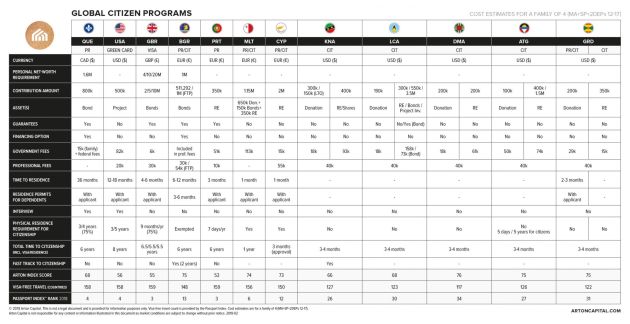
Source: http://europa.eu/rapid/press-release_MEMO-19-527_en.htm

MALCOLM: The latest Liberal fearmongering – Conservatives will ‘militarize the border’?!

Fear-mongering, like virtue signalling, is all too common, whether it be from the right or left. And Malcolm, whose writings are consistent in condemning Liberal actions (and inactions), and arguably fear-mongering herself, rarely addresses some of the inconvenient truths of her critiques.

In this case, if Canada were to declare the whole border official entry points for purposes of the Safe Third Country Agreement, the implication would be that we would need to have more staff at the border to enforce it, not to mention US agreement (unlikely) to take back any person attempting to cross the border.

And should we declare Roxham Road an official point of entry (and if the US would agree), many would simply look for other places to slip across the border?

One could argue that in fact allowing Roxham Road as a loophole makes it easier for the government to know who is arriving and perform the needed security and related checks and go through the IRB process rather than being completely unmanaged:

But While accusing the opposition of fear-mongering about illegal immigration, top Trudeau government officials have stepped up their own fear-mongering campaign against the opposition.

The 2019 federal election may be nine months away, but the campaign has already begun. The latest comes from Trudeau’s immigration minister Ahmed Hussen, who accused the Conservative Party of wanting to “militarize the border.”

Last week, Conservative MP and immigration critic Michelle Rempel held a news conference where she called on the government to study the issue of how Canada screens and vets migrants who illegally cross into Canada. Rempel’s proposal was mild, and well within reason.

Canada is experiencing an unprecedented and ongoing surge in illegal border crossings, which has been accompanied by stories of alleged terrorists and migrants with national security red flags slipping into Canada.

Rempel noted in her news conference that the Conservatives have been asking for a review of Canada’s immigration screening policy since the border crisis escalated in 2017.

Responding to Rempel’s proposal, Hussen dismissed the Tory position on immigration and bizarrely seemed to invent a new position for them.

“I haven’t seen anything from the Conservatives. They don’t have a plan,” said Hussen, before quickly changing his tune. “Do you know what their plan is? To militarize the border and place a CBSA official or RCMP official every 100 metres,” said Hussen.

In the same breath, Hussen claimed both that the Conservatives didn’t have a plan and that their plan includes militarizing the border.

Of course, there is no evidence that the Conservatives — or any sane person for that matter — has ever called for officials to be stationed every hundred meters along the border.

The shared Canada-U.S. border, after all, spans 8,891 kilometres. With border officials ever 100 metres — ten per kilometer — that would mean staffing the border with about 90,000 border stations, and asking our American neighbours to do the same.

If the mainstream media bothered to fact-check Liberal politicians like they do the opposition, Hussen’s wild allegation would surely fail the test.

In reality, the problem is mostly contained to one small section of the border.

In 2018, 19,419 migrants illegally entered Canada in between official ports of entry, 18,518 of them crossed into Quebec. This is in line with the Trudeau government’s claim that 95% of all illegal crossings occur along Roxham Road.

The problem does not span Canada’s nearly 9,000-kilometre border. It’s isolated to a very small location — making it much easier to tackle.

Canada could drastically reduce the flow of illegal migration by taking a simple step: closing the border at Roxham Road and stopping migrants from crossing there. Instead, the Trudeau government has done the opposite.

First, they built a land bridge so migrants wouldn’t have to walk through a ditch.

Second, they permanently stationed RCMP officers at this unofficial crossing point (which is less than five kilometres from the official crossing at Champlain, NY) to register incoming migrants.

Third, they set up makeshift refugee camps so that asylum seekers could start their paperwork and quickly become eligible for government handouts.

Finally, they began shuttling migrants to Montreal or Toronto — their choice — and setting them up in government-funded housing.

Not only has the Liberal government helped to facilitate illegal immigration, they’re normalizing it and thereby encouraging more of it.

Perhaps that is where Minister Hussen is coming from. When you believe in open borders, everything else begins to look like “militarization.”

Source: MALCOLM: The latest Liberal fearmongering – Conservatives will ‘militarize the border’?!

February By-elections: Matching Census Data with Ethnic Media Coverage (1-18 January 2019)

As some of you may be aware, I have been working through census data to develop profiles of all 338 federal ridings that focus on key demographic, economic, social and political indicators.

I have been  working with Canada’s multilingual media monitoring service, MIREMS (www.mirems.com) to test out matching their ethnic media coverage with the census data.

The current by-elections provide an ideal opportunity to test out this approach and to assess how useful this could be for this year’s October 19th general election.

Table 1 contrasts some of the key indicators for the three ridings, two urban and one rural. Burnaby South has the greatest number of immigrants and visible minorities, York Simcoe the least, with Outremont in the middle. None of these ridings have a significant Indigenous population. Outremont has the youngest population with the least number of married or common law relationships and the lowest average household size.

York Simcoe, given its lower number of immigrants, has the highest number of citizens of voting age.

Outremont has the highest number of men and women with university degrees, York Simcoe the lowest. Unemployment rates for men and women are highest in Outremont. Median total annual income is highest for men in York Simcoe and lowest in Outremont; for women, it is also highest in York Simcoe but lowest in Burnaby South. The percentage of low income individuals (Low income measure after tax) is lowest in York Simcoe and highest in Outremont for both men and women.

Burnaby South and Outremont elected NDP MPs in 2015, York Simcoe a Conservative. 

The detailed riding profiles are here: 59003 – Burnaby South, 24054 – Outremont, and 35119 – York Simcoe.

The language most often spoken at home, the indicator that correlates most closely with ethnic media readership, is captured in Table 2. Predominate non-official languages are Mandarin and Cantonese (about 25 percent) whereas Outremont and York Simcoe have few non-official languages most often spoken at home.

Ethnic Media


As one would expect, Chinese and South Asian media dominate in the by-election coverage  given riding demographics, mainly Chinese Canadians, and the highly visible candidacy of NDP leader Jagmeet Singh. The ill-advised remarks of former Liberal candidate Karen Wang, her forced resignation and replacement by Richard Lee have further increased the riding visibility.

As a result, of the 97 media articles monitored 1 to 18 January, one third of ethnic media coverage is in Punjabi, with an additional 8 percent in the South Asian English media. Written Chinese media forms one fifth, with radio and TV in Cantonese forming 8 percent and in Mandarin, three percent.

In terms of candidate specific coverage, NDP leader Singh was covered in about two-thirds of the media, with many articles focussed almost exclusively on his campaign and related challenges (e.g., his inability to answer questions regarding the detention of Canadians in China). His Liberal and Conservative opponents were only mentioned in about 15 percent of media, with of course the controversy over former Liberal candidate Wang’s divisive remarks being mentioned. PPC candidate Tyler Thompson was mentioned by close to six percent.  

There was only one article (reprint really of her website bio) focussed on Outremont, a profile of Liberal candidate Rachel Bendayan in Arabic, with no coverage of the Conservative and NDP candidates (Jasmine Louras and Julia Sanchez respectively). Outremont has a significant Jewish population (11 percent in 2011). Bendayan is Jewish (likely Sephardic given her surname) as appears is Louras. Overall voting preferences of Canadian Jews have shifted from Liberal to Conservative reflecting the previous government’s focus on combatting antisemitism and a more overt pro-Israel policy.

Basic news reporting and reprinting of mainstream media news article form the majority of ethnic media articles. However, close to 40 percent of the Punjabi and South Asian English, and about 13 percent of the Tamil media  media are commentary. Only Punjabi talk shows featured by-election coverage (Burnaby South).

Out of the 16 commentaries analyzed, 12 were in Punjabi, three in South Asian English and one in the Tamil media. For the most part, these were more in the form of neutral analysis than presenting opinions. Only three commentaries expressed opinions. All were negative, two were in the Punjabi media (NDP leader Singh’s ignorance of China’s arrest of Canadians in relation for the extradition case of Huawei executive Meng Wanzhou, former Liberal candidate Wang’s divisive ethnic appeal on social media) and one in the South Asian English media (the same critique of NDP leader Singh).

Next week will likely feature more commentary on ethnic politics given the debate is has provoked among many Canadians, including those in the language groups covered.

See the MIREMS blog for some of the stories being covered: Karen Wang and the ethnic vote: Multilingual media weighs in.

In related election coverage, the Supreme Court of Canada’s striking down the five-year limit for Canadian expatriate voting received coverage, particularly in Cantonese, Chinese and Mandarin media but also with significant coverage in Tamil media.


TD Bank takes down ads targeting South Asians after complaint about word ‘desi’

The complexities and sensitivities in multicultural marketing:

TD Bank has stopped running online advertisements that use the word “desi” to target the South Asian community after at least one person complained about the ads.

Jatin Patel demanded the bank take the ads down after he saw one of them while scrolling through an Indian news app.

“At first, I couldn’t believe my eyes,” Patel said.

“In India, it is used as an offensive term,” he told CBC Toronto, adding that some Indians use the word to describe people as “not very modern” and “from the countryside.”

“Desi” originates from the Sanskrit word “desh,” which means “nation.” It’s commonly used, mostly by young people, to describe people and culture as truly or typically South Asian. It’s even made its way into the titles of many South Asian films.

TD’s ad, which could be seen on both social media platforms and the web, featured videos and pictures with the tagline: “62 per cent of desi Canadians don’t know how much to save for retirement.”

Patel says he gets that TD is attempting to target a specific community, but he believes the wording was “inappropriate and insensitive.”

He immediately contacted the bank to complain about the ad, and TD responded by taking it down the same night.

Patel says he’s hoping for a personal apology, but he also says the damage has been done.

“If you slap someone, and then you say, ‘Sorry,’ what does it mean? The action has already been completed.”

TD Canada says it pulled the ads to show it respects the community.

“Inclusion and diversity are core values at TD, and we continuously make every effort to ensure we respect our customers and colleagues in everything we do,” the bank said in an email statement to CBC Toronto.

Patel is not the only one who thinks the advertisement may have taken the wrong path.

Tushar Unadkat, chief executive of Mukta Advertising in Toronto, said TD’s ad failed because it doesn’t connect with the entire community.

“If someone calls me desi, I’m OK, but I’m very sure that within Canada and within India, as well, there’s a section of people who would use the term to look down upon a different class of people,” he said.

“You’ve got to understand how the community relates to that term locally.”

But Sharifa Khan, chief executive of Balmoral Multicultural Marketing on Toronto, disagrees.

Sharifa Khan, chief executive of Balmoral Multicultural Marketing, thinks ‘desi’ is an acceptable term. ‘It’s certainly not derogatory,’ she says.

“The language has to be 100 per cent authentic for a marketing campaign to be successful,” she said.

“TD has been around long enough to know how to target a multicultural audience.”

Khan says TD likely did its research before crafting the ads.

“Lots of social marketers will use relevant and key words to appeal to their market,” Khan told CBC Toronto.

“And the word ‘desi,’ people within the community will connect with this word all the time,” she added.

“It’s certainly not derogatory.”