HASSAN: Polygamy harms Muslim women and Canada should not tolerate it

More on polygamy following the CBC investigation (A man ‘cannot do that to a woman’: Why polygamy in Canadian Muslim community could be another #MeToo moment):

Will Canadian Muslim women soon have their own #MeToo movement?

A headline for a CBC Fifth Estate online story reads: “A man cannot do that to a woman: why polygamy in Canadian Muslim community could be another #MeToo moment.” The story involved a woman called Zaib, whose last name was withheld for her own safety.

Many of the left-wing activists within #MeToo who point to alleged harassment from years ago now display little interest in the woes of Muslim women marginalized in their own communities. But the soul-destroying practice of polygamy must nonetheless be brought into the open in the hopes that someone of influence cares enough to do something about it.

Zaib said she “went into shock mode” when her husband broke the news that he had taken a second wife.

“I started getting the symptoms of anxiety, depression and crying spells” she told the CBC’s Fifth Estate. Her husband offered the pathetic consolation that he had no intention of abandoning her or their three children and would continue to provide for her.

She was so depressed she had to take time off work. She believes that other Muslim women face similar predicaments, but stay quiet, and that if they also spoke out, something might be done to help eliminate polygamy in Canada. She believes the law should insist that a man can never do such a thing to a woman.

Polygamy is a sensitive topic in Islam, an issue on which the sacred word most clearly conflicts with modernity.

The Islamic provision is to treat all wives with respect and equality and if a husband can’t ensure that, then only take one wife. However, conditions for equality, respect and dignity all become meaningless in an institution that is inherently unjust, disrespects women and creates unfair dominance by males.

The very fact that a man seeks another wife shows disrespect from the outset. It tells her she alone is not good enough for him. Any suggestion that such a system can ever deliver marital equality is clearly absurd.

That is why some scholars of the Quran suggest polygamy is in effect not allowed. Others see such interpretations as convenient modern manipulations of ancient mores and practices. Who can deny the written word of the Quran? Hence the continuation of the practice of polygamy.

Some Muslim men have contracted polygamous unions outside Canada. In 2011, the B.C. Supreme Court ruled that polygamy is unconstitutional and reasonably decided that the damage polygamy does to both women and children is more important than maintaining religious and cultural freedom. An enlightened judgment.

Even Imam Hamid Slimi of Toronto, who by all standards would be considered mainstream Muslim, told CBC that “the way polygamy is practiced today is unfair to women.”

That is progress, but it’s still too conciliatory, because polygamy must never be deemed an acceptable practice. The social circumstances that occasioned the Islamic provision for polygamy in the seventh century have been irrelevant for a millennium.

Canada needs to do more to monitor cases of polygamous unions that occur even here under the immigration guise of “other relationships.”

Remember the Shafia family? The first of the two wives was brought in as an aunt of the children.

Of course, Canadian law cannot stop men from remarrying abroad, but on home soil it must treat such unions as illegal, profoundly hurtful and utterly disrespectful to women.

Canada cannot tolerate this.

Source: HASSAN: Polygamy harms Muslim women and Canada should not tolerate it

Trudeau offers to work with Legault on a temporary reduction in immigration levels

My sympathy for additional funding for asylum seekers is tempered by the fact that the current Canada-Quebec agreement means a further increase despite the drop:

Prime Minister Justin Trudeau demonstrated a new willingness to help Quebec Premier François Legault temporarily reduce immigration to the province by more than 20 per cent, even as Ottawa promotes higher immigration as the key to a stronger economy.

Mr. Trudeau and Mr. Legault discussed immigration issues Thursday during a private meeting in Sherbrooke, Que., where the federal Liberal cabinet is meeting for a three-day retreat.

Ottawa’s readiness to work with Quebec on its lower targets marks a change in tone for Mr. Trudeau, who had criticized the idea last month.

The two governments agreed that senior ministers will meet later this month in Gatineau to work out a plan. The discussions will also aim to reach a deal on compensating Quebec for its costs related to settling refugee claimants who have crossed into the province from the United States between official points of entry.

More than 90 per cent of the thousands of people who have crossed into Canada between official points of entry over the past two years have done so at Roxham Road in southwestern Quebec near Champlain, N.Y.

The Quebec government is seeking $300-million in compensation from Ottawa, but Mr. Legault said Ottawa is only offering to cover $140-million.

Federal Intergovernmental Affairs Minister Dominic LeBlanc, who was in Thursday’s meeting with Mr. Legault, told reporters that reducing immigration at a time when many Quebec businesses are facing severe labour shortages will be a challenge.

“Squaring that circle isn’t going to be easy,” he said. “We recognize that the Quebec government made a commitment in their election to temporarily reduce immigration levels in Quebec. Immigration in Quebec is a shared jurisdiction. It’s not like in my province of New Brunswick. There is a long-standing agreement that we want to respect between Canada and Quebec.”

Under the terms of a 1991 Canada-Quebec deal on immigration, federal funding to help Quebec integrate immigrants will rise even as the province’s total intake of immigrants declines.

The federal government announced in November that it will gradually raise Canada’s national targets for annual immigration to 350,000 in 2021, from 310,000 this year. It is not clear how Quebec’s reductions will affect Ottawa’s national targets.

Mr. Trudeau did not speak with reporters after meeting with Mr. Legault, but the Premier confirmed that further discussions on immigration will take place soon in Gatineau.

“He didn’t say no,” Mr. Legault said following his meeting with the Prime Minister, in reference to his list of demands related to immigration. “He said he was thinking about it. What we want is before bringing the targets back up in the next few years, that we put in place a French test and a values test.”

Federal Liberals are in Quebec this week to build support ahead of the October federal election. Polls suggest the Liberal Party could pick up seats in the province, which could help offset potential losses in other parts of the country.

Several ministers, including Mr. LeBlanc and Infrastructure Minister François-Philippe Champagne, recently toured parts of Quebec to meet with business leaders ahead of the cabinet retreat. They said the clear message is that skills shortages are a major problem.

“Businesses in Drummondville earlier this week told me they’re literally refusing contracts and not accepting sales because they do not have enough employees to properly complete the contract,” said Mr. LeBlanc. “So you can imagine the multiplier effect of that over time, on the economic growth in Quebec, which frankly is something that’s very important for the whole country.”

Mr. Legault said the temporary reduction in immigration – which would apply equally to three categories: economic immigrants, family reunification and refugees – will give Quebec time to ensure that it is bringing in people with the right skills. He also said Quebec wants to ensure its immigrants can speak French and support Quebec values.

Quebec announced in December that it will reduce the number of newcomers to 40,000 in 2019, a 24-per-cent reduction from 2018 levels.

Advocates for immigrants and refugees have called Quebec’s plan cruel. Mr. LeBlanc said last month that Ottawa was “disappointed” by Quebec’s new targets.

Source: Trudeau offers to work with Legault on a temporary reduction in immigration levels

John Ivison: A most convenient misstep for the Liberals in Burnaby South – and other related articles

A good example of ethnic politics going wrong.

First, an interesting political analysis by Ivison:

Occam’s razor, the problem-solving principle dating back to the 13th century friar William of Ockham, states that, other things being equal, simple explanations are generally better than more complex ones.

A medical equivalent, Zebra, guides doctors to reject exotic medical diagnoses in favour of more commonplace explanations.

“When you hear hoofbeats, think of horses, not zebras,” runs the logic.

It’s a good guiding principle for analyzing politics too. It is more often incompetence, rather than scruples, that makes the simplest explanation most likely. The relationships underlying political events are so complex that predicting outcomes from any action is a dubious business.

Yet sometimes, a case comes along where the more complex theory cannot be ruled out.

Take events in the riding of Burnaby South in British Columbia. The Liberals hemmed and hawed about running a candidate in the Feb. 25 byelection there, conscious that if they did so, they might inadvertently win and put paid to the political career of Jagmeet Singh, the federal NDP leader who is seeking a seat in Parliament.

Singh has found the learning curve in federal politics particularly steep, making numerous missteps in the full glare of the national media.

This past weekend, he failed to answer a question on a topic that had been all over the news. He claimed he hadn’t heard the question, but he left the impression that it is only the hard questions that he mis-hears.

Singh remains Justin Trudeau’s preferred opponent in October’s federal election and there was the very real prospect that, if defeated, he might be replaced by someone more seasoned.

The Liberals had the option of not running a candidate in Burnaby South — Elizabeth May’s Green Party decided to respect the old tradition of “leader’s courtesy,” not running against a federal leader trying to win a seat in the House of Commons.

Yet there were local pressures to run a Liberal candidate in the byelection, and it was decided it would be bad form for the ruling party to be so brazen about its preferences.

Step forward Karen Wang, a local daycare operator, who edged biotech scientist Cyrus Eduljee in a contested nomination.

Wang’s candidacy put Singh’s political future very much in doubt, given the seat was won by NDP MP Kennedy Stewart by just 600 votes over his Liberal rival in 2015.

It went unsaid by everyone that a Chinese-Canadian candidate might have extra cachet in a riding where nearly 40 per cent of voters are of Chinese descent.

At least, it went unsaid until Wang said it. Not only did she point out on a Chinese social media platform that she was “the only Chinese candidate,” she identified Singh as being “of Indian descent.”

It was a pretty blatant case of racism from the party that claimed so often in the last election that “a Canadian is a Canadian is a Canadian.”

Since Trudeau’s main line of attack in the next election will be to accuse the Conservatives of fomenting the “politics of division,” it was clear that he would not support a candidate emphasizing differences and playing on intolerance to get elected.

Wang said the “phrasing should have been different” and removed her Chinese language post but it was too late.

Early Wednesday Pacific time, the party issued a statement saying that Wang’s comments “are not aligned with the values of the Liberal Party of Canada” and said it had accepted her resignation. “The Liberal party has a clear commitment to positive politics and support for Canadian diversity and the same is always expected of our candidates,” it said.

Wang issued her own statement, apologizing to Singh, and saying her choice of words about his cultural background “was not well-considered and did not reflect my intent.”

Her resignation has left Singh alone on the left of the political spectrum in Burnaby South, facing Conservative Jay Shin and People’s Party candidate Laura Lynn Tyler Thompson. His victory would seem assured, if the Liberals don’t replace Wang. And yet they seem in no hurry to do so. When asked if there would be another Liberal candidate, Liberal communications director Braeden Caley said: “We’ll have more to discuss on that in due course.”

The most recent opinion poll in Burnaby South by Mainstreet Research suggested the byelection was turning into a two-horse race between Singh, with 39 per cent support, and Wang, with 26 per cent. The Conservatives will be more alarmed by the pollsters’ estimate of People’s Party support, at nine per cent, than the failure of their candidate to win the seat (Shin had the support of 22 per cent of the 740 people polled.)

Even with a margin of error of nearly four per cent, it’s clear that Burnaby South will stay orange if there is no Liberal in the race.

So back to Occam’s razor. Was this just a case of a reckless candidate gambling that if she played dog-whistle politics, it wouldn’t be heard beyond the Chinese community?

Or was the plan all along to throw the fight?

Nine times out of 10, it would be the former but the outcome of this electoral rumpus is extremely convenient for Trudeau. He has polished his own halo as the great unifier who will forge consensus and bridge divides.

And he has all but insured that an NDP leader yet to find his feet on the national stage staggers on to fight the general election.

This may be the rare occasion when the hoofbeats are made by zebras.

Source: John Ivison: A most convenient misstep for the Liberals in Burnaby South

Secondly, revelations by Michelle Rempel, not substantiated but believable, that Wang wanted to run as a Conservative but was rejected:

The Conservative Party of Canada rejected Karen Wang as a potential candidate before her short-lived Liberal Party candidacy in the Burnaby South byelection, according to MP Michelle Rempel.

Rempel said Wang approached her party, wanting to run in the 2019 federal election.

“The Conservative Party of Canada said no to this candidate over a year ago,” she said. “There was a reason for that.”

Rempel would not specify what that reason was.

“My understanding is that there were some discussions with this particular individual and the party decided for reasons regarding her judgment, that became clear today, to not allow her to run for us,” she said.

Rempel made the comments at a press conference in Burnaby Wednesday afternoon. She was joined by Conservative candidate Jay Shin, who is running in the Feb. 25 Burnaby South byelection. The Calgary-based Parliamentarian called the press conference to call on Prime Minister Justin Trudeau to initiate a review of Canada’s immigration screening process.

Rempel’s comments came just hours after Wang dropped out of the race. She came under fire for a WeChat post in which she identified herself as the “only Chinese candidate” in the byelection and pointed out that her opponent, NDP leader Jagmeet Singh, is of Indian heritage. The post was translated from Chinese and reported by StarMetro Vancouver.

“My choice of words wasn’t well-considered and didn’t reflect my intent, and for that, I sincerely apologize to Mr. Singh,” Wang said in a statement. “I have deep respect for him as the leader of his party and for his public service – and I would never want to diminish that in any way.”

Rempel condemned the WeChat post, calling it “racism plain and simple.”

Shin said he was shocked by Wang’s comments.

“I’m offended as a Korean person, as a Korean-Canadian,” he said. “There’s no place for that.”

The NOW has reached out to the Liberal Party and a representative of Wang’s for comment.

Wang ran for the B.C. Liberal Party in the 2017 provincial election, losing to New Democrat Anne Kang. When the NOW asked her earlier this month why she had chosen to run with the federal Liberals after running for a party often aligned with the federal Conservatives, she said she had always been a supporter of the Liberal Party of Canada due to its core values, including diversity, liberty, multiculturalism and national unity.

Source: Conservatives rejected Karen Wang before her short-lived Liberal candidacy, MP says

Third, two different columns in the Toronto Sun, the first by Candice Malcolm, not acknowledging similar practices by the Conservatives, the second by Brian Lilley basically a plague on all their houses with respect to courting ethnic votes:

This is what a postnational multicultural state looks like.

On Wednesday, the Liberal candidate in the Burnaby South by-election resigned after sending a controversial message through the Chinese social media platform WeChat.

In a Chinese-language post, Karen Wang told her supporters to vote for her because she is “the only Chinese candidate” in the race, and to vote against NDP candidate and party leader Jagmeet Singh, noting that he is “of Indian descent.”

This sort of crass appeal based solely on race and identity is off-putting and unwelcome to most Canadians. But it should come as no surprise that race-based ethnic politics takes place across Canada.

And while the Liberal Party can try to back away from Wang’s message, her appeal to identity politics is straight out of the Liberal playbook and echoes the politics and policies promoted by Prime Minister Justin Trudeau.

In late 2015, Trudeau was interviewed by The New York Times magazine about his vision for Canada.

The American publication fawned that “Trudeau’s most radical argument is that Canada is becoming a new kind of state, defined not by its European history but by the multiplicity of its identities from all over the world.”

Forget about our traditions of ordered liberty that date back to the signing of the Magna Carta. And forget about our constitutional monarchy and parliamentary democracy — arguable the most successful form of government in human history — or our commitment to Western liberal ideals.

That type of “European history” is unimportant in Trudeau’s Canada.

Instead, Trudeau said “there is no core identity, no mainstream in Canada… those are the qualities that make us the first postnational state.”

The race-based message from the Liberal candidate mirrors this type of thinking. Wang’s appeal is the inevitable conclusion of Trudeau’s identity politics and his dream of a post-national Canada.

For instance, in her WeChat message, Wang does not call herself “Canadian” or even “Chinese-Canadian.” Instead, she identifies as “Chinese” and calls Singh “Indian.”

Just like Trudeau said, there’s no mainstream, no core identity in Canada. Newcomers don’t have to change anything about themselves when they move to Canada, so why would they bother to adopt a Canadian identity?

Likewise, Trudeau has downplayed the emphasis on language — eliminating the citizenship language test for many newcomers. It’s no surprise, then, to see politicians pandering in different languages to various ethnic communities.

Trudeau’s fixation on identity politics led him to appointing cabinet positions based solely on gender. While 26% of MPs are women, Trudeau promoted 50% to his cabinet.

But why stop at gender? The next logical step is to expand this thinking to other identities, like ethnic background and language groups. Why wouldn’t a postnational Canada have quotas to proportionately represent every ethnic group?

In November, Trudeau said he rejected Canadian nationalism, seemingly conflating it with ethnic nationalism found in Europe and throughout the world.

Canadian nationalism, however, is not based on race or ethnicity, since Canada has always been pluralistic and racially diverse. Instead, our nationalism is defined by patriotism — a love of country and commitment to our heritage and shared values.

Patriotism is the glue that holds our diverse country together, and without it, we devolve into tribalism — divided by bloodlines and ancient feuds from foreign lands.

Trudeau has engineered these changes and created a toxic brew in Canada: lax integration policies juxtaposed with a forced multiculturalism that downplays Canadian values and divisive identity politics that demonizes Canadian heritage and identity.

Source: MALCOLM: Raced-based politics natural outcome of Trudeau’s ‘postnational state’

Karen Wang’s career as a Liberal Party of Canada candidate came to disastrous end on Wednesday as the party dumped her over stupid, and quite frankly racist comments.

It was such a change for a woman whose Twitter profile bragged about being the Team Trudeau candidate in the Burnaby South byelection. The party itself had just the evening before tweeted its support of her.

The official Liberal Party account tweeted “Add Women Change Politics” and called Wang an incredible candidate just hours before this story broke.

Now she’s out, brought down by a crass attempt to use race and tribal politics to win the byelection.

In a posting on Chinese social media platform WeChat, Wang spoke of the size and importance of the Chinese community, then she made the stupid, racist comments.

“If we can increase the voting rate, as the only Chinese candidate in this riding, if I can garner 16,000 votes I will easily win the by-election, control the election race and make history! My opponent in this by-election is the NDP candidate Singh of Indian descent!”

I love the flourish with the exclamation point on Singh’s Indian heritage, she is screaming loud and clear that she means don’t vote for the brown guy.

Well that wouldn’t work for Justin “Diversity is our Strength” Trudeau and after about 15 hours of hand wringing, Wang was fired.

The official line is she resigned, I’m sure her resignation was what I call “voluntold.” Give us your resignation or else.

In her statement, Wang apologized to NDP Leader Jagmeet Singh, kind of.

“My choice of words wasn’t well-considered and didn’t reflect my intent, and for that, I sincerely apologize to Mr. Singh,” Wang said in a statement.

In its own statement the party said Wang’s comments, “are not aligned with the values of the Liberal Party.”

No kidding, they shouldn’t be aligned with anyones values.

Yet in some ways Wang thrust into the open the kind of ethno-politics that all the parties have played for years.

Every party has pandered to ethnic, religious or linguistic communities for votes. They will make sure certain ridings have candidates from a specific group if that group is a large enough voting bloc.

I’ve always found it off-putting and wished the parties would stop.

Voters should be picking candidates to vote for with the best policies for their riding, not the same skin colour or ethnic background.

Parties should pick policies to run on that align with their values and are in the best interests of Canada, not so they can attract certain ethnic voting blocs.

Ms. Wang was in many ways playing the game that has been played too long in Canadian politics, albeit more crassly.

Her statement and apology are weak and she needs to say more.

If this were a white candidate, especially a white male candidate, the fury over these comments about not voting for Singh because he is of Indian descent would be deafening.

Wang cannot be allowed an easy escape, nor can the Liberal Party be let off the hook, simply because she is an Asian woman.

There is the idea that I have heard from anti-racism activists that racism only comes from white people. It’s a foolish claim. Anyone can be racist and Wang’s comments show that.

Saying, “My choice of words wasn’t well-considered” does not gloss over the fact that she told supporters vote for me, I’m Chinese and he’s not.

Wang’s initial reaction to the media stories on this also shows she doesn’t understand why it was wrong, she told the Toronto Star it was just bad communication.

“The phrasing should have been different,” she said.

It wasn’t the phrasing that was the problem Ms. Wang, it was the intent of your post.

This kind of politics has no place in Canada. I’d like to say I hope we never see it again, but that is wishful thinking.

The best we can do is call it out when we see it.

Source: LILLEY: Wang’s resignation shows dangers of playing ethno-politics 

Lastly, some good on the ground reporting on the reaction of the Chinese Canadian community in Burnaby South: ‘It makes us look bad’: Burnaby’s Chinese-Canadian community reacts to Karen Wang’s resignation over WeChat post

Wang’s effort to rescind her resignation was rightly rejected: Ousted candidate’s story takes another strange turn, this time into a parking lot
Lebanese lawmaker fights ‘degrading’ citizenship law against women

Uphill struggle:

Nine months after being voted into the 128-seat Lebanese parliament as one of six female lawmakers, Paula Yacoubian is urging fellow legislators to help change discriminatory laws that are an “injustice” against women.

Yacoubian, 42, won her seat as a civil society candidate in May’s election, and prides herself on being the first woman in Lebanon’s parliament not aligned with any political party in the country’s sectarian political system.

The former journalist turned lawmaker’s biggest battle is gaining nationality rights for thousands of stateless children born to Lebanese women.

In Lebanon, women married to foreigners cannot pass their Lebanese nationality on to their husbands or children.

“There is so much injustice. You have thousands of kids in this country that have no rights – they are Lebanese, they grew up here, they speak only Arabic,” Yacoubian told the Thomson Reuters Foundation from her Beirut office.

“It is not only about women – it is about suffering families … They don’t have a piece of paper that says that you have a nationality – it is degrading.”

Stateless children cannot access public healthcare, have difficulty getting access to education, and when they are old enough, they cannot work without a permit, according to the law.

Additionally, women in some communities can’t inherit or own property regardless of who they marry.Lebanon is far behind other countries in the region, like Tunisia, Morocco and Egypt, that have provided equal citizenship rights to men and women, activists who have worked on the issue said.

MORE PROTECTION FOR WOMEN

Beyond reform, Yacoubian said it is critical for additional laws to be passed in order to protect young women’s health and against forced marriage.

There is no minimum age for marriage in Lebanon. Religious communities can allow girls younger than 15 to marry, according to Human Rights Watch.

Yacoubian supports KAFA, a local campaign group calling on Lebanon to pass a law to make 18 the minimum age for marriage – with no exceptions.

“If there [are] any exceptions to be made it will not have the same impact. The message should be very clear – no marriage under 18,” she said.

Globally, 12 million girls marry before age 18 every year, according to Girls Not Brides, a coalition working to end child marriage.

KAFA said other Arab countries are a step ahead of Lebanon in setting 18 as the minimum marriage age, including Algeria, Egypt, Iraq, Jordan, Libya, Morocco, Oman, Tunisia and the United Arab Emirates.

Protecting women against violence also needs “a lot of work” in a country that passed a long-awaited law in 2014 against domestic violence, Yacoubian said.

But rights groups were outraged that authorities watered it down so much it fell short of criminalising marital rape.

A 2017 national study by ABAAD, a Lebanese women’s rights group, found that one in four women have been raped in Lebanon. Less than a quarter of those sexually assaulted reported it, the survey said.

TIME FOR DISRUPTION

With women in Lebanon gaining only two seats in parliament in May’s election for a total of six, Yacoubian said there needs to be a 33 percent quota to give women fair representation.

“It is their rights first to be represented – to have equal chances. And because this is the real representation of Lebanon … more than half of the country is women. They should be represented in a way that reflects how the society works.”

“I think in the long run it can be disruptive for this patriarchal system that humiliates women.”

Having women in lawmaking postitions will help boost women’s rights in a country where men don’t view women as their equals – something she has experienced herself in the workplace, Yacoubian said.

“I have MPs who treat me as if I am either a flower or something fragile … We don’t have a culture that understands that women are equal to men,” she said.

Many months after May’s election, Lebanese leaders are still at odds over how to parcel out cabinet positions among rival groups as mandated by a political system that shares government positions among Christian and Muslim sects.

Yacoubian called it a “mafia system” that is running the country based off of religion, money and power – dominated by men.

She said she will “keep fighting” for women’s rights and is hopeful legal changes will be made to protect women.

“I hope it will be soon because you will have less suffering, less problems. I am sure that one day this country will see a new horizon, a new light.”

How Taiwanese Think About Immigration

Some interesting research on yet another Asian country facing labour shortages and the need to address immigration needs and concerns:

Concerns about immigration remain a focal point in both American and European politics. The competing demands in Taiwan are familiar to those watching immigration debates elsewhere: the need for workers, especially unskilled workers, for jobs locals cannot or are unwilling to fill versus concerns about the political and social costs of migration. Meanwhile, immigrant workers in Taiwan frequently protest labor conditions.

According to the Ministry of the Interior’s National Immigration Agency, of the over 770,000 foreign residents in Taiwan, more than 90 percent are from Southeast Asia, and predominantly from Indonesia, Vietnam, and the Philippines. In 2017, Taiwanese married more Southeast Asian partners than partners from China. Despite government policies over time to increase ties with Southeast Asian countries as a means to be less economically ties to China, and discussion on immigration policy to encourage Southeast Asian skilled labor immigration to counter Taiwan’s brain-drain, such efforts have not been without controversy. For example, in December 2018 several Taiwanese universities were accused of skirting labor laws by recruiting Southeast Asian students for factory work under the questionable guise of internship programs, although many Indonesian students deny these claims. Another scandal concerned the disappearance of 152 of 153 Vietnamese touriststhat arrived in Kaohsiung, with only 67 located by early January, raising concerns of human trafficking.

Concerns about immigration largely focus on the often interrelated perceived criminal, economic, and cultural threats. For example, considerable research focuses on the ethnicity of immigrants vis-à-vis the citizen population and its impact on perceptions of market competition and negative views more broadly of immigrants (see here, here and here). In terms of individual-level factors, higher education consistently corresponds with more favorable views of immigration, while other scholars have found living abroad and contact with other cultures also positively impacting immigration views. Meanwhile, limited scholarly work addresses both either communities in Taiwan (see examples here and here).

I wanted to unpack whether evaluations of immigration differed in Taiwan based on two factors: immigration in general versus Southeast Asian immigration specifically and whether the focus is on skilled immigration. Considering that academics, political advisers, and marketers have long identified the role of framing and priming in influencing public perceptions, we would expect that relatively small differences in how immigration is presented would influence support, just as previous research on Taiwanese perceptions of free trade agreements, refugees, same sex marriage, diplomatic recognition, and President Donald Trump has shown.

If Taiwanese implicitly or explicitly distinguish between types of immigration, this should be evident when comparing perceptions of similarly worded survey questions. In particular, one would expect that if Taiwanese view Southeast Asian immigration as a criminal, economic, or cultural threat, a focus on Southeast Asian immigration should elicit stronger opposition than when asked about immigration in general. Similarly, if the concern is about unskilled labor and thus competition for jobs, a focus on skilled labor immigration would be expected to generate more positive views on immigration.

To address this, I conducted a web survey in November of 1,000 Taiwanese, surveyed via PollcracyLab at National Chengchi University. Respondents were randomly assigned to respond to one of four versions of a question regarding immigration and asked to evaluate it on a five-point Likert scale (strongly disagree to strongly agree):

Version 1: Taiwan should encourage immigration
Version 2: Taiwan should encourage immigration of skilled workers
Version 3: Taiwan should encourage immigration from Southeast Asian countries
Version 4: Taiwan should encourage immigration of skilled workers from Southeast Asian countries

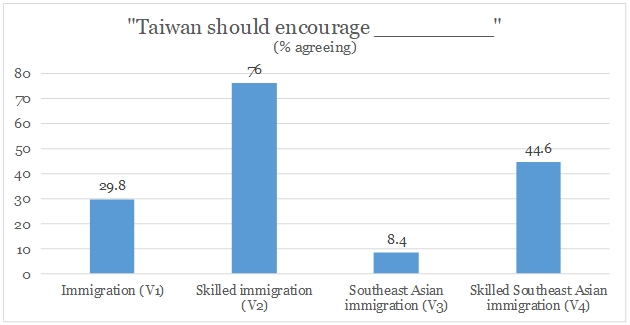
The figure below shows the percentage of Taiwanese surveyed agreeing to each version of the survey. For simplicity, I combined those that agreed and strongly agreed. Here we clearly see that Taiwanese are more supportive of encouraging immigration when framed as skilled immigration, a 46.2 percent increase from the baseline of Version 1. However, support decreases by 21.4 percent from the baseline when simply focusing on Southeast Asian countries. Furthermore, while the version focusing on skilled Southeast Asian immigrants increased support compared to the baseline  by 14.8 percent, this is still far lower (31.4 percent) than support for skilled immigrants in general.

The figure below further makes it clear that Taiwanese are more favorable to skilled labor immigration and less favorable to Southeast Asian immigration. Support increased by 45 percent when skilled labor was mentioned compared to no mention at all, while support for immigration decreased by 26.6 percent when the focus was on Southeast Asian immigration rather than immigration in general.

Additional analyses controlled for a myriad of factors — age, gender, education levels, household income, political ideology, and party identification — with consistent results as those shown above. Overall the results sugest the extent to which Southeast Asian immigration generates a visceral reaction, one that is only partially overcome when the focus is redirected to skilled labor. However, it is unclear how to rectify these biases. With several hundred thousand children of Southeast Asian immigrants already in the Taiwanese elementary school system, ignoring this issue will only create larger identity concerns for Taiwan in the future.

Source: How Taiwanese Think About Immigration

Denmark Is Ramping Up Anti-Immigrant Measures and Rhetoric

Good overview:

On a cold December night, Inger Stojberg stood in an overlit auditorium in Vordingborg, eastern Denmark, and explained why the Danish government had chosen nearby Lindholm Island for its new detention center for rejected asylum seekers. Although she made it clear from the outset that the government would not revoke the proposal (and sure enough, it was approved three days later) one citizen after the next tried to convince her it was a poor decision, drawing on everything from its impact on property values and tourism to what it would mean for locals’ safety. But many in the audience of more than 700 thought something even more important was at stake. “I came tonight because I don’t think this is a decent way to manage these people,” said Marianne Rasmussen, a teacher from the nearby town of Præsto. “It’s not who we Danes are.”

Immigration became a thorny political issue throughout Western Europe in the wake of a record influx of migrants from the Middle East and Africa in 2015, but the split over Lindholm Island suggests the question has taken on unusual dimensions in Denmark. The prosperous Nordic country of 5.8 million stands out among its neighbors for its reluctance to integrate even comparatively small numbers of foreigners. It granted protection to 2,365 people in 2017, compared with Sweden’s nearly 28,000.

Despite a reputation for progressive politics, humanitarianism and a generous welfare state, Denmark has some of the most aggressive anti-immigrant policies in Europe. That has included taking out foreign-newspaper adverts warning potential migrants that they are not welcome, and authorizing police to seize cash and valuables from arriving asylum seekers to offset the cost of their maintenance. By pitting some of Denmark’s long-held values against others, the subject of immigration has not merely divided Denmark, but turned a demographic crisis into an existential one. What, these days, does it mean to be Danish?

Denmark received waves of guest workers from Turkey in the 1960s and ’70s, as well as refugees from the former Yugoslavia in the 1990s, and today immigrants and their descendants make up 8.5% of the population—projected to rise to 13.1% by 2060. Yet to an extent virtually unmatched in Europe, “Danes are quite polarized over immigration,” says Nils Holtug, director of the Centre for Advanced Migration Studies at the University of Copenhagen. “There’s a large part of the population that is welcoming and positive toward immigrants, and another large group that’s worried about them and wants very restrictive policies.”

Many of the country’s recent immigration initiatives seem to operate from the same principle. In the past year, the center-right government has passed a so-called burqa ban, even though fewer than 0.1% of Muslim women in Denmark wear veils, and a law requiring parents in neighborhoods designated as “ghettos” to submit their children to extra schooling in “Danish values.” From January, new citizens are required to shake hands with the official conducting the naturalization ceremony, regardless of their beliefs about physical contact with members of the opposite sex—a law perceived as targeting conservative Muslims.

Danish journalist and historian Adam Holm describes the initiatives as “deliberately hostile.” In other areas, Danish legislators tend to speak in the measured language of jurisprudence. “But the intent here, and people will say it outright, is ‘yes, we are doing this to frighten people away from Denmark.’”

Stojberg, a member of the same Liberal Party as the Prime Minister (and which forms part of the conservative bloc in parliament), has adopted an almost gleeful attitude toward migration restrictions. She celebrated the passage of the 50th anti-immigration law with a cake, posting a photo on social media, and published an editorial in a national newspaper in which she suggested that Muslims bus drivers and hospital workers who fasted during Ramadan might pose a safety risk to Danish society.

Urging Støjberg to go even further is the anti-immigrant Danish People’s Party (DF), which is the second largest party in parliament but does not hold any ministerial positions out of its own choice. The DF proposed the Lindholm Island idea. “We want to reduce the number of all foreigners in Denmark, not just refugees and asylum seekers, but people who come to work or go to school,” says Martin Henriksen, DF’s spokesperson for immigration. “We also want to revoke more of the asylum permits already granted, and send more people home.”

Some see Lindholm Island and other measures as an attempt to appeal to voters ahead of elections in June. “The right-wing government now in power is behind in polls, and so they will want to do something to increase their support,” says Holtug. “And the Social Democrats are tired of losing because of immigration, so their response, increasingly, is to also adopt restrictive policies.”

That’s not the only way right and left are coming closer together. Unlike in the U.S., where anti-immigrant platforms tend to align with conservative opposition to a government-sponsored safety net, the populist DF, like the center-left Social Democrats, seeks to protect generous welfare benefits that include free education through university, universal health care and ample unemployment insurance. “There’s a growing part of the political spectrum that sees a welfare state and a multi-cultural society as directly incompatible, or at least difficult to have side by side,” Holtug says.

The DF’s Henriksen, who believes Trump’s policies on immigration are “too weak,” echoes Holtug’s point. “America is a country founded on migration, but Denmark is not. We’re a small country, and what binds us is a common language, and a common set of traditions and values. If we let in a large number of foreigners with their own cultures, ours will be overwhelmed.”

A degree of plain old xenophobia contributes to this sentiment. But so too does a growing sense, even among more progressive sectors, that the country’s efforts at integration have not worked. “We’ve been very lax in requiring foreigners to learn Danish,” says journalist Holm by way of example. “Ten years ago I would have never uttered those words. But now I say, yes, this is Denmark, so if you want to be part of this society, please learn Danish.”

Yet he is troubled by the harsh measures and rhetoric adopted by his government as well as the sometimes blatant xenophobia that has made its way into public discourse. Recently he published an opinion piece, titled “The Denmark I’ve Always Feared,” in which he lamented the country’s turn away from tolerance and openness. “Enough is enough,” he says of his reasons for writing it. “This is not the Denmark I was brought up to believe in.”

In reality, Denmark already is a multiethnic society, and will become only more so in the future. Younger generations of Danes seem more comfortable with this than their elders. At a Dec. 10 rally in front of Copenhagen’s city hall to protest the Lindholm plan, Selma Solkaer, a 15-year-old student from nearby Roskilde, expressed her dismay that Danes could support it. “It’s shocking, especially when Denmark has always been such a big supporter of human rights,” Solkaer said.

At the rally, Natasha al-Hariri, a legal consultant on immigration, recalled her parents—Palestinians who came to Denmark from Lebanon in 1989—-telling her how welcoming Danes were. “Back then, we took in refugees because we accepted that they needed help,” she said, noting that parts of Danish society now fear eventually being outnumbered by refugees. She finds the upcoming elections especially nerve-racking. “Lindholm Island may just be an electoral tactic so the government can show it’s tough on immigrants,” she says. “But that’s what scares me to death—the idea that that’s what Danish voters want.”

In Vordingborg, Mayor Mikael Smed doubts that’s the case. Less than 5% of the population of Vordingborg, with its broad shopping street and neat houses, is foreign-born—a mix of Turks, Iraqis, and Syrians, among others. But most residents of the town, he says, consider the Lindholm Island plan “madness,” especially because another facility for the same ‘tolerated stay’ population already exists. “ I keep asking but no one in the government can explain to me why we need it.”

Although like other members of the Social Democrat party Smed’s position has evolved so that he now supports limiting the number of asylum-seekers and refugees admitted to Denmark, he also sees plenty of examples of successful integration, from his son’s best friend, whose parents came from Iraq, to a local program that trains foreign-born women to teach new arrivals the ins and outs of Danish society. He also believes that the Danish economy—including the vaunted welfare state—needs an influx of workers if it is to continue to prosper in the future.

But in the end, he justifies his opposition to the Lindholm Island plan with his own appeal to national values. “I recognize the number is important when we have to work on integrating people, and making them as much a part of our society as possible,” Smed says. “But I don’t think that placing people on an island and making the conditions as bad as possible for them is a part of Danish nature.”

Source: Denmark Is Ramping Up Anti-Immigrant Measures and Rhetoric

As Japan Tries Out Immigration, Migrant Workers Complain Of Exploitation

Some interesting, if disturbing, comparative data on trainees and some of the exploitation that some are facing as Japan slowly opens up to “guest workers”:

The wind howls and snow drifts around a house in Koriyama, in northeastern Japan’s Fukushima prefecture. The town is inland from Fukushima’s coastal areas that were devastated by the 2011 earthquake, tsunami and nuclear plant meltdown.

Inside the home, several Vietnamese laborers prepare dinner. The house is a shelter, run by local Catholics, for foreign workers who are experiencing problems in Japan.

One of the workers is surnamed Nguyen. He came to Japan in 2015 as part of a government program for technical trainees. He asked to use only his last name, as he doesn’t want his family in Vietnam to know what he’s been through.

He says he paid the equivalent of about $9,200 to a Vietnamese broker and signed a contract with a private construction company in Koriyama, Japan, to get on-the-job training as a rebar worker.

“I expected to come to a country more developed, clean and civilized than my own,” he recalls. “In my mind, Japan had many good things, and I wanted to learn professional skills to take home.”

Instead, he says he was ordered to do jobs such as removing radiation-contaminated soil from land around the Fukushima nuclear power plant.

“We were deceived,” Nguyen says, referring both to himself, and technical trainees in general.

He would not identify the company by name so as to avoid undermining negotiations he and a workers union are holding with the firm to get compensation.

He says the company issued him gloves and a mask, but not the kind of gear that would protect him against radiation. He did receive a radiation detector to wear, but only before safety inspectors paid a visit. He complained to the company, which ignored him.

Complicating matters, he had borrowed money from a bank and family members in Vietnam to pay the broker who helped him get to Japan.

“I wanted to sue my company, but I didn’t know how,” Nguyen explains. “I didn’t speak Japanese, or understand Japan’s legal system. So all I could do was be patient, and keep working to pay off the debt.”

Technical trainees like Nguyen now account for about 20 percent of the 1.3 million foreign laborers in Japan, according to government data cited by local media.

The Japanese government intends to bring in 345,000 more foreign workers in the next five years, to staff sectors including restaurants, construction, agriculture and nursing. Many will come from nations such as China, Myanmar, Vietnam and the Philippines.

Japan has both the world’s third-largest economy, and fastest-aging population. It also faces an acute labor shortage. Now, it is doing something previously unthinkable: allowing immigration — even as its prime minister denies it.

But advocates for the foreign workers warn that without an overhaul of the technical training program, many of the newcomers could be subjected to the same sort of exploitation Nguyen says he has experienced. Critics equate the training program with “slavery,” and deride it as the creation of labor without a labor force.

Most trainees are paid below minimum wage. They die of work-related causes at twice Japan’s overall rate, according to an analysis of government data by The Japan Times.

The problem of labor brokers using debt to enslave would-be immigrants is an element in human trafficking in many countries around the world.

The Japanese government has promised to crack down on unscrupulous brokers, establish 100 “consultation centers” where trainees can report abuses, increase Japanese language training for enrollees and generally strengthen oversight of the program.

But the U.S. State Department’s Trafficking in Persons report for 2018 says that, so far, Japan has failed to prevent brokers from holding technical trainees in “debt bondage,” and sometimes the authorities arrest trainees who escape from “exploitative conditions,” instead of helping and protecting them.

Many conservative opponents of immigration would prefer that foreign workers don’t stay in Japan after finishing the program.

Speaking before the Diet, Japan’s parliament, in October, Prime Minister Shinzo Abe denied that the country is opening its door to immigration.

“We are not considering adopting a so-called immigration policy,” he insisted. “To cope with the labor shortage, we will expand the current system to accept foreign workers in special fields. We will accept foreign human resources that are skilled and work-ready, but only for a limited time.”

Japan’s parliament, which is controlled by the ruling right-wing Liberal Democratic Party, passed Abe’s plan last month.

Shiro Sasaki, secretary-general of the Zentoitsu Workers Union, which represents some of the foreign workers, rejects Abe’s argument, and adds that Japan’s government is not facing up to the reality of immigration.

“Abe’s definition of an immigrant is someone who lives in Japan long-term, with family,” he says. “But by international standards, the trainees are immigrants. In this sense we can say that Japan is already an immigrant society.”

Sasaki says that opening Japan’s door to immigrants even a tiny crack is better than tricking them into coming.

He says Japan has never experienced mass immigration in modern times, and it has failed to assimilate those few immigrants it has taken in. He sees the whole issue as a test of character for this island nation.

“Japan has never been able to examine itself and define itself in terms of diversity,” he argues. “Now we must live with diversity, and every single Japanese person must think about it.”

Then again, Robert Dujarric, director of the Institute of Contemporary Asian Studies at Temple University in Tokyo, argues that Abe may have no choice but to reform by stealth.

“Immigration is unfortunately not popular even in countries like the U.S. … which historically have been nations that have been built on immigration. So obviously he’s not going to say: ‘Vote for me, I will bring in 10 million foreigners.'”

Many analysts compare the technical training program to Germany’s gastarbeiter or guest worker program of the 1950s-70s. It too took in laborers from poorer neighboring countries — particularly Turkey — but tried to limit workers’ stay in order to prevent immigration. But the cost of hiring and training temporary workers was too high.

Many workers stayed on, paving the way for Germany to see itself as a de facto immigration nation.

Current trainees like Nguyen may be eligible to remain in the country for up to five years on a new class of visas.

But Nguyen says that without decent pay and a chance to learn new skills, he has no interest in staying on.

Source: As Japan Tries Out Immigration, Migrant Workers Complain Of Exploitation

Why We Bear Witness: Speaking Uncomfortable Truths About Immigration

Good series of individual stories behind the numbers:

Of all the questions I get asked every day, the one that crystallizes just how simplistic and uninformed the conversation about immigration is this: “Why can’t you just get legal?”

You ask what you don’t know. When it comes to immigration, most Americans I’ve met across the country—online and offline, from people calling for my deportation to people who want me to stay—don’t know a whole lot. Even journalists who cover the issue struggle to report and frame it outside a largely partisan, pro/anti-immigrant lens, too often using loaded language (“amnesty,” “anchor babies,” “chain migration”) that limits knowledge rather than expands it.

The search for genuine dialogue—the need for complexity and nuance—is manifested to great effect in We Are Witnesses: Becoming an American. With this video series, The Marshall Project has carefully curated a selection of stories that demonstrate the multiple dimensions of what we refer to singularly as “immigration.” The straight-to-camera testimonies don’t fit the typical legal vs. illegal binary that characterizes much of the discourse. The stories they tell are not laden with “talking points” that signal deference to any ideology. They tell truths that challenge and illuminate our understanding of how we got to where we are.

Teofilo Chavez, an undocumented minor from Honduras.

A 14-year-old in Honduras swam across rivers in search of a better life. He learned that when Border Patrol catches a minor, they don’t return them to where they came from—they help them look for their relatives in the United States. “So, I started looking for the Border Patrol,” Teofilo Chavez says. “I basically gave myself to them.”

Born in South Korea, Youngmin Lo arrived in the United States on a student visa. He lost his legal status when he started working to support himself. “You’re not supposed to work on a student visa. Once you lose your status, it’s done,” said Lo, who has been undocumented for 12 years. Asian immigrants—arriving at airports, not at the southern border—constitute a growing undocumented population. An estimated one out of seven Asian immigrants is here illegally.

Alena Sandimirova couldn’t be herself in Russia, where lesbianism is akin to pedophilia. She dreamed of living in the United States and managed to obtain a visa to move here. When the visa expired, she decided to stay illegally before realizing she could apply for asylum. “The heaviest weight fell from my shoulders,” she said, recalling the moment she became an American citizen. “I can breathe, fully.”

Fleeing political persecution, the Villacis-Guerrero family—Juan, Liany, and their twin daughters—left Colombia, where Liany’s family was targeted for being active in politics. Her father was kidnapped and she feared for her daughters’ security. The twins qualified for the Deferred Action and Childhood Arrivals (DACA) program, which provides a two-year temporary reprieve from deportation. But after a routine annual check-in with immigration officers, Juan was detained and then deported. Liany was deported, too. “They built all of this for us,” says one of the twins. “Now, they have to go.”

No matter how many times I am asked, “Why don’t you just get in line?” I can only respond one way: For most of us, there is no line.

I’ve spent my life grappling with the dominant narratives that have defined immigration since arriving in the United States in 1993. Born in the Philippines, I was sent by my mother to live with her parents, both legal immigrants who became naturalized citizens, in Mountain View, California, when I was 12. I discovered that I was “illegal”—that’s what the media called us and still calls us—when I tried to get a driver’s license at age 16. My grandfather explained that he couldn’t find a way to bring me here legally, so he saved up $4,500, a huge sum for a security guard who lived paycheck to paycheck, to pay a smuggler who got me fake papers. Since that realization 21 years ago, I have been living in some kind of purgatory, subjected to rules I didn’t create, my circumstances limited by documents I do not have and laws that many Americans, who had the luck of being born into American citizenship, struggle to articulate. Telling my story—insisting on its specificity to illuminate what is universal—has been a source of liberation.

In that vein, I saw my own story reflected in the stories captured in this video series. The trauma of family separation. The need to create a home for yourself even if you don’t feel at home. The resilience that is a central part of becoming American, whatever “American” may mean to you.

The videos play as a kind of a fugue, playing off each other, composing a melody amidst the dissonance. After watching Lee Wang, a journalist-turned-immigration lawyer, explain how long-time permanent legal residents are dragged into the deportation system, we meet Jose Molina, who has lived in the United States since he was a year old. He’s a legal permanent resident who in the late 1990s was locked up for three years after being convicted of assault. Years later, as his wife, daughter, and son looked on, he was detained and faced deportation. “When ICE came to my door, I just couldn’t believe it,” Molina says. “I’m a permanent resident. I’m not undocumented. They handcuffed me at my home.”

As I watched David Ward, a former Border Patrol agent, talk about how immigration is “continually being exploited by people that just can’t follow the law,” I hoped he would watch the video of Paul Schmidt, a former immigration judge who interpreted the laws, deciding the fate of many immigrants and refugees. “There’s no doubt about the fact that I’ve made mistakes,” says Schmidt, who served from 2003 to 2016. “I probably have sent some people home that I should have allowed to stay, and I probably have allowed some people to stay that maybe weren’t telling me the whole truth, but I couldn’t figure it out.”

Together, this video series accomplishes a task we have largely avoided: having an uncomfortable but truthful conversation about immigration. James Baldwin, who often described himself as a “witness,” said that “nothing can be changed until it is faced.”

Let us face it, together.

Jose Antonio Vargas, the founder of Define American, is the author of “Dear America: Notes of an Undocumented Citizen.” For the release of We Are Witnesses: Becoming An American, The Marshall Project asked Vargas to reflect on how the film series explores the immigrant experience in America, including his own.

Source: Why We Bear Witness: Speaking Uncomfortable Truths About Immigration

USA: A Judge Blocked the Census From Asking About Citizenship. Here’s Why It Matters

One of the better analysis that I have seen:

A federal judge in New York has blocked the Trump Administration from adding a question about citizenship status to the 2020 Census, marking a victory for critics who have said the question is unnecessary and is intended to decrease the number of immigrants and minorities counted in the decennial survey.

The ruling is just the first in a series of cases on the issue, which has significant implications for future elections, political representation at every level and federal funding decisions for the next decade. The Trump Administration is also facing five other lawsuits over the Census question, and the battle is expected to end up at the Supreme Court.

But U.S. District Judge Jesse Furman’s decision on Tuesday was an important moment. The suit’s plaintiffs — a collection of immigrant advocacy groups, states and local officials — argued that the Trump Administration tried to add the citizenship question to intentionally dissuade immigrants from responding to the survey. The U.S. Census, which is conducted every 10 years, has not included a question about citizenship since 1950. More detailed sampling surveys have done so, but those go out to far fewer households.

Furman ruled that the way Commerce Secretary Wilbur Ross added the question was “arbitrary and capricious” and violated administrative procedures.

“He failed to consider several important aspects of the problem; alternately ignored, cherry-picked, or badly misconstrued the evidence in the record before him; acted irrationally both in light of that evidence and his own stated decisional criteria; and failed to justify significant departures from past policies and practices,” Furman wrote in his 227-page decision.

The judge also ruled that Ross’s explanation for the citizenship change — that the Justice Department said it was needed to help enforce the Voting Rights Act — was “pretextual.”

Ross initially offered voting rights enforcement as his official explanation, but documents released as part of the ongoing lawsuits revealed that he began pushing the issue on his own soon after becoming Commerce Secretary.

The Justice Department said it was disappointed in the ruling, while advocacy groups like the ACLU cheered the decision.

“This ruling is a forceful rebuke of the Trump administration’s attempt to weaponize the census for an attack on immigrant communities,” Dale Ho, director of the ACLU’s Voting Rights Project, said in a statement. “The evidence at trial, including from the government’s own witness, exposed how adding a citizenship question would wreck the once-in-a-decade count of the nation’s population. The inevitable result would have been — and the administration’s clear intent was — to strip federal resources and political representation from those needing it most.”

As this was the first ruling in the cases against the citizenship question, evidence that came out during the trial could encourage those pursuing similar lawsuits, said William H. Frey, a demographer and expert on the Census at the Brookings Institution.

“This is good news for people who want to have a Census that represents America,” Frey told TIME. “You want to make sure that all groups are represented and it helps the proper apportionment of Congress, it helps federal spending that is allocated to different groups around the country.”

If immigrants and other minorities avoid responding to the census because of a question about citizenship, experts, including the Census Bureau itself, say it would likely result in a survey that significantly undercounts those populations.

The Census provides crucial data that is used for a wide variety of decisions, including how many representatives each state sends to Congress and how much federal money different areas receive for everything from highway funds to Medicaid. The data can also affect state representation and even the Electoral College, which is based on Congressional delegations.

The private sector often relies on Census numbers as well for decisions about where to open stores or where to base factories and other employment opportunities, Frey notes.

“The Constitution says that we need to count everyone in the United States and I think that as a scientist, as a demographer, as someone who has been doing this for a long time, the research is pretty unequivocal that that’s going to not be done if the citizenship question is on there,” he said.

Source: A Judge Blocked the Census From Asking About Citizenship. Here’s Why It Matters

Did Saudi teen Rahaf Mohammed jump the queue with her speedy resettlement to Canada?

Good overview on the process followed:

Did Rahaf Mohammed Alqunun jump the queue over other refugees when Canada quickly opened its doors to the Saudi teen who was fleeing an allegedly abusive family?

Not according to Canadian immigration officials and the United Nations High Commissioner for Refugees.

While Rahaf’s plea for help on social media got her international headlines and drew the attention of the UNHCR to her plight, the emergency rescue effort was by no means unique — though the warm embrace by a foreign minister at the airport may be.

According to immigration officials, some 200 people are processed under Canada’s Urgent Protection Program each year, with about 50 resettled within the rapid timelines seen in Rahaf’s case. The 18-year-old arrived in Toronto Saturday — accompanied by Foreign Affairs Minister Chrystia Freeland — after a tumultuous week that began with Rahaf escaping from her family during a trip to Kuwait. Rahaf then flew to Bangkok, where she was detained by Thai authorities who prepared to deport her to Saudi Arabia, where she feared for her life.

“Canada has the flexibility to respond quickly to individual emergency situations for a small number of refugees,” said immigration department spokesperson Beatrice Fenelon. “These individuals are resettled on an expedited basis due to their particular circumstances.”

In a news conference in Toronto Tuesday, Rahaf, who has dropped her last name after she learned on social media that her family has disowned her, admitted she was “lucky.”

“I know that there are unlucky women who disappeared after trying to escape or who could not do anything to change their reality,” she told reporters.

People in need of protection cannot apply directly to the special Canadian program and requests must be made by referral organizations, such as the UNHCR.

Since Rahaf’s speedy resettlement to Canada — less than a week after she started a Twitter campaign while barricaded inside her hotel room — she has faced backlash not only from internet trolls criticizing her as a disgrace to her family and Islam but also from refugee supporters accusing her of being a queue jumper.

“A Syrian refugee from a war zone who lost everything is not welcome in the west. But a person from a golden palace in Saudi-Arabia who says ‘I am not a Muslim anymore’ is a hero and very welcome. Can someone explain this to me?” Arnoud van Doorn, a member of The Hague City Council in the Netherlands, asked on Twitter.

In Rahaf’s case, the UNHCR dispatched a team to her hotel room in Bangkok for an emergency resettlement assessment after learning from media reports that the teenager was going to be handed over to her family, who were en route to Thailand and planned to take her back to Saudi Arabia.

Among the 25.4 million refugees worldwide, less than 1 per cent end up being resettled, many of them after years in limbo.

“Emergency resettlement is extremely rare,” noted Jean-Nicolas Beuze, the UNHCR representative to Canada. “Based on agreed-upon criteria, we refer these cases to the 30 countries that offer resettlement programs. There are many situations. It could be for the lack of medical care or the fear of torture if someone is returned to the country of origin.”

At her hotel in Bangkok, Rahaf was given a formal interview where she was asked to provide the details and evidence to substantiate her claims of mental and physical abuse by her family. After she got her UNHCR refugee designation, she underwent a thorough security and criminal check, as well as a medical exam, before being admitted to Canada.

“Rahaf met those criteria and we referred her case to several countries. Canada was the fastest to respond. Rahaf can’t choose her destination. She didn’t jump any queue. It’s a different process with different criteria,” said Beuze. “It’s not a unique case, but it’s only unique because of all the media and social media attention.”

While some critics fear Rahaf’s case may set a precedent and open the floodgates for other Middle Eastern women to claim gender oppression, experts say resettlement is only available to those who make it outside their country of origin.

“The assumption is your country can protect you. You become a refugee because you don’t get the protection and other countries need to step in,” said Janet Dench of the Canadian Council for Refugees. “Due to the notion of sovereignty, you can’t be a refugee in your own country.”

While praising Canada’s quick response to Rahaf’s situation, Dench said government officials must not politicize the refugee resettlement process by only prioritizing cases of those “who have the ears of the Prime Minister or Immigration Minister and are the favourite of the month of the media.”

According to the UNHCR, 1.4 million refugees have been identified for resettlement in 2019, but only 80,000 spots are available, including 11,000 in Canada.

Source: Did Saudi teen Rahaf Mohammed jump the queue with her speedy resettlement to Canada?

Christie Blatchford has a nice column on her strong character and independence, somewhat spoiled by her last editorial comments on grief and trauma counsellors:

She is a psychologically sturdy, resourceful and strong-willed young woman, this Rahaf Mohammed, recent “urgent protection” case freshly arrived in Toronto from Saudi Arabia via Kuwait and Thailand.

“I want to be independent, travel, make my own decisions on education, a career or who and when I should marry,” she said Tuesday at a big press appearance at COSTi Immigrant Services in the city’s west end.

“I had no say in any of this,” Rahaf said. “Today, I can proudly say that I am capable of making all of those decisions.”

She spoke in Arabic, her words translated and read in English by her COSTI settlement worker, Saba Abbas.

But there is no doubt she wrote it, said COSTI executive director Mario Calla with a grin, acknowledging he has seen evidence of the ferocious independent spirit himself.

For instance, he said, inundated with media requests from across the globe, Rahaf was crystal clear that she would do three interviews (with the ABC Australia network, the CBC and Toronto Star) and that was it, because “ ‘I want to get on with my life,’” Calla said.

“We suggested a press conference,” he said and she agreed to write a statement.

“That statement was all her,” Calla said. “She’s been very clear.”

As she said in it, “I understand that everyone here and around the world wishes me well and would like to continue to hear about how I am doing, but I will not be conducting any more media interviews for the time being.

“I ask everyone to respect my wishes.

“I would like to start living a normal private life, just like any other young woman living in Canada. This starts with me getting help in my settlement process and of course, learning English!”

As a government-sponsored refugee, Rahaf is entitled to 12 months of support (worth almost as much as social assistance, Calla said, lest the amount fuel local resentment), and COSTI will help with English classes, getting her settled into temporary accommodation (first with a family, later on her own) and has hired security guards as protection.

In defying her family and leaving behind the repressive guardianship system of Saudi Arabia, which infantilizes women from cradle to grave and makes them dependent on male relatives (father, husband, brother, etc.) for every decision, the 18-year-old has potentially put herself in danger.

Any country brazen enough to arrange to murder one of its own, as Saudi officials have acknowledged doing to journalist Jamal Khashoggi in its consulate in Istanbul on Oct. 2, has a long and lethal reach.

As well, Rahaf has been vilified in the Arab world, with the Kingdom insisting the entire business is a family matter blown out of proportion. Amid all the love she has received on social media, inevitably for this new media world, there comes a backlash, and she also has received some threats. She has left Islam.

And Rahaf’s family has apparently denounced her in a tweet of its own; even discussing this was painful for her in the interviews she did.

“She finds it very difficult,” Calla said after her brief appearance before the cameras. “She does not want to talk about those things.” So she decided, he said, fine, she’d pull the Band-Aid off in one fell swoop: “’I’ll get it out there’” (in the interviews) and be done with it.

She arrived in Canada last Saturday after sneaking out from under her family’s grasp on the last day of their holiday in Kuwait, hopping a plane to Bangkok, and then, with her father and brother apparently enroute to retrieve her, barricading herself in an airport hotel room and launching a desperate Twitter campaign begging for help.

She had the savvy of her age group, to harness social media. It’s new, but refugees have long been innovative. As Calla said, “It’s a complex world. People do everything and anything to try to save themselves.” Some sneak over borders; some jump into little boats and try to cross perilous oceans; a few, and probably soon a few more, use social media.

For all her determination and resourcefulness, she’s also just a teenager. The first order of business, Calla said, after she arrived was to go to the mall.

Rahaf had been expecting to end up in Australia, where she was also welcomed, but the bureaucracy there was slower moving, and on the advice of the UNHCR, she landed in Canada instead, wearing just a little skirt. She needed winter clothes.

“And a phone package,” Calla said, smiling. “We did that on Saturday.”

In her new country, press-gangs of grief counsellors and soothers are brought into high schools and colleges at the first hint of trauma, discomfort, even disrespect. The cultural assumption here is that we are fragile beings. So, Calla was asked if Rahaf is receiving psychological support.

“She is not, right now,” he said. “We do have services at COSTI … We have not seen any signs of distress in that sense.” In the longer term, he said, “for any refugee, the big challenge is the loss — family and friends and a culture that was familiar to them.”

In that sense, one of the country’s newest arrivals is like a delicious throwback to an older and more self-reliant Canada.

Stay tough, darling.

Source: Christie Blatchford: Stow the trauma counsellors, this tough runaway is doing fine on her own