No plans to change refugee target in wake of U.S. travel ban: immigration minister

Calibrated response:

As MPs debate U.S. President Donald Trump’s travel ban in the House of Commons, Canada has already confirmed it will not hike its refugee intake target in the wake of a contentious immigration and travel crackdown in the U.S., says Immigration Minister Ahmed Hussen.

Under pressure by the NDP, human rights groups and refugee lawyers to bring more asylum-seekers to Canada, the minister said Canada’s plan will not change in response to an executive order by Trump that suspends the U.S. refugee program and bars entry to nationals from seven Muslim-majority countries.

“Our immigration levels plan has an allocation that is historically high for refugees,” Hussen said. “We intend to maintain that plan.”

Canada’s 2017 immigration plan is set to accommodate 40,000 refugees.

Hussen also rejected calls to suspend the Safe Third Country Agreement, a pact which considers asylum-seekers safe in both Canada and the U.S.

“All the parameters of that agreement are in place and there is no change at this time,” he said.

MPs held an emergency debate Tuesday evening, which concluded around midnight, on the U.S. immigration and travel directives,.

Noting that the U.S. has now agreed to allow in 872 refugees who were already screened and in transit, and were previously denied entry, Hussen said that’s a sign the situation is evolving fast. He added that Canada will closely monitor developments.

“The responsible thing to do is to maintain contact, to continue to engage and make sure we monitor the situation closely to make sure we provide information to Canadians,” he said.

Ottawa U.S. Embassy Trump protest travel ban Jan 30 2017

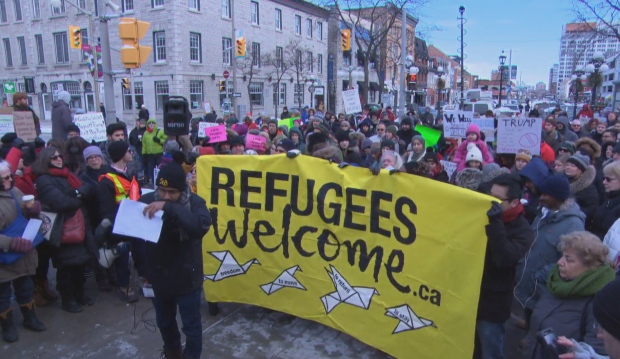
People gathered outside the U.S. Embassy in Ottawa Monday afternoon to protest an executive order signed by President Donald Trump banning citizens of seven Muslim-majority countries from entering the United States. (CBC)

Call for ‘special measures’

NDP immigration critic Jenny Kwan, who requested the emergency debate, held a news conference Tuesday morning urging the government to lift a cap on privately sponsored refugees and to fast-track refugee claims.

The B.C. MP laid out a number of proposed “special measures” ahead of the debate.

“There is no question that this ban promotes hate and intolerance,” she said. “This ban will have a disastrous effect for thousands of innocent travellers and refugees.”

Calling it “absolutely shocking,” Kwan said the Trump travel ban will have a huge negative impact on the economy, as well as cultural and academic development.

…Conservative immigration critic Michelle Rempel used the debate to launch into an examination of whether Canada was effectively managing its own immigration file.

She questioned whether there was adequate funding to help refugees integrate into Canadian society, and whether it was wise to lift the visa restrictions on Mexicans coming to Canada.

“To respond to the immigration policies of other nations, we must first get our own house in order, and then through those actions, show the world what immigration policy best practice looks like,” Rempel said.

Les braises de l’intolérance | Le Devoir

Good analysis by Michel David on how Quebec has yet to come to terms with diversity and the need to avoid identity politics:

Il n’est jamais facile de comprendre les motivations profondes d’un individu qui décide d’assassiner ses semblables, mais on doit certainement s’interroger sur les conditions qui peuvent l’encourager à commettre un acte aussi barbare que le massacre de la mosquée de Québec.

François Legault, que le premier ministre Couillard avait accusé de « souffler sur les braises de l’intolérance », a raison de dire que de telles tragédies ne doivent pas nous faire renoncer à débattre des moyens de combattre l’extrémisme, mais le discours politique qu’on entend au Québec depuis dix ans a pour le moins manqué de nuance. Certes, l’exemple xénophobe de Donald Trump risque d’être contagieux, mais le « code de vie » d’Hérouxville date de janvier 2007 et la boîte de Pandore ne s’est jamais refermée depuis.

Le débat sur la laïcité est tout à fait légitime, mais la crainte de l’extrémisme islamique a eu pour effet de créer une confusion dont l’ensemble de la communauté musulmane est devenue la victime. Une confusion qui a été trop souvent entretenue et exploitée à des fins politiques.
Une triste coïncidence a voulu que le drame de Québec survienne à quelques jours du dixième anniversaire de la création de la commission Bouchard-Taylor, qui visait précisément à empêcher pareils dérapages.
Force est de reconnaître que nous avons collectivement échoué. La « vigoureuse prise de conscience » que la commission voulait provoquer au sein de la société n’a pas eu lieu. La réponse politique n’est pas venue non plus. Depuis la crise des accommodements raisonnables de 2006-2007, aucun gouvernement n’a réussi à légiférer pour donner suite aux recommandations pourtant très modérées de son rapport.
On a sévèrement reproché au gouvernement Marois d’avoir semé la division avec son projet de charte des valeurs. Après la défaite du PQ, ceux qui siégeaient à la table du Conseil des ministres s’en sont désolidarisés les uns après les autres, mais quelqu’un croit-il sérieusement que quelqu’un aurait démissionné si elle avait été adoptée, comme l’a prétendu Jean-François Lisée ?
Il est vrai que le projet de Bernard Drainville ratissait beaucoup trop large, mais la plupart des gens ne prêtent pas une grande attention aux détails d’un projet de loi. C’est surtout le ton du débat et les malheureux amalgames auxquels il peut donner lieu qu’on retient.
Durant les audiences en commission parlementaire, le président du Conseil musulman de Montréal, Salam El Menyawi, avait été moins choqué qu’attristé par le témoignage de la famille Pineault-Caron, de retour d’un voyage au Maroc, où elle avait été horrifiée de voir des hommes « prier à quatre pattes, à terre sur un petit tapis » et qui ne comprenait pas que le maire Coderre laisse « des al-Qaïda, des n’importe quoi » s’installer à Montréal.
« On a besoin d’éduquer la population. C’est triste parce que les gens qui ne connaissent rien à notre religion vont se fier à ces commentaires », avait dit le président. Alors que la commission Bouchard-Taylor proposait la création de programmes qui favoriseraient un rapprochement, le discours politique contribue trop souvent à un éloignement qu’on déplore seulement quand il tourne à la tragédie.
Jean-François Lisée n’est pas un islamophobe, mais il a clairement voulu profiter de l’islamophobie ambiante quand il a associé Alexandre Cloutier à Adil Charkaoui durant la course à la chefferie du PQ. Il n’a pas davantage contribué à alléger le climat en déclarant qu’une burka pouvait cacher un AK-47.
« Tant que plusieurs d’entre eux éprouveront un vif sentiment d’insécurité pour la survie de leur culture, ils seront moins sensibles aux problèmes des immigrants et des minorités ethniques », soulignait la commission Bouchard-Taylor, y voyant l’origine de la crise qui avait entraîné sa création.
Le premier ministre Couillard avait raison d’insister sur l’attention qu’il faut porter au choix des mots, notamment dans le discours politique, mais le devoir de ceux qui gouvernent est aussi de conjurer dans toute la mesure du possible cette insécurité qui tenaille les Québécois.
M. Couillard accuse ses adversaires d’attiser l’intolérance, mais que fait-il lui-même pour les rassurer. Qu’il s’agisse de langue, de laïcité ou d’intégration des immigrants, son gouvernement donne toujours l’impression de chercher à en faire le minimum.
Même dans le projet de loi sur la neutralité religieuse de l’État, on a trouvé le moyen de faire en sorte que la règle voulant que les services publics soient livrés et reçus à visage découvert puisse être contournée. Ce laisser-faire est aussi une façon de souffler sur les braises.
Malgré l’ampleur du drame de dimanche, le Québec a une remarquable tradition de tolérance. En raison de leur histoire et de leur environnement géopolitique, les Québécois sont néanmoins habités par une insécurité culturelle permanente.

Andrew Coyne: The common threads of intolerance behind anti-Muslim atrocities | National Post

One of Andrew Coyne’s stronger columns and message for those playing identity politics – see last two paras:

It began just minutes after the first reports surfaced online. Though the killings had taken place at a Quebec City mosque, though the victims had all been Muslim, nevertheless it was asserted, with all the authority that anonymity confers, that the killers were Muslim. “Police reports” were disseminated claiming they were two Syrian refugees, just admitted the previous week. Fake news sites supplied fake names. The failure of the English-language news networks to go live with the story was attributed, not to a lack of resources or competence, but to their involvement in a cover-up.

This is how we do things now. This is the ritual we have learned, after every such outrage: not to mourn the dead or to draw, after due consideration of the facts, the appropriate lessons, but to lay the blame, in advance of the facts being known — as if it were a kind of race, in which the first to find fault wins. Both sides do it, and while the evidence this time would seem to support the alternate theory, not Islamist but Islamophobe — there are, as we have since learned, one suspect not two, the other arrestee, the one with the Arab name, proving to have been not a shooter but an engineering student who was helping the wounded — those who leapt instantly to that conclusion had no more evidence to support them on the night than their brothers-in-preconception.

In fact, we do not know what the suspect’s motive was, even now. We have rather more basis on which to draw intelligent inferences, but certainty, if ever it is given to us, must await his trial. We have even less grounds to state who or what planted that motive there, though again that has not stopped people from trying. At any rate, it is a fool’s errand. We do not need an atrocity to tell us that something has come unstuck in society of late, and we are on firmer ground, if evidence of that we seek, to look not to a single act on the part of (as I suspect we will find) a particularly disturbed individual, but rather to a more generalized wave of intolerance: to the surge in anti-Muslim hate crimes across Canada in recent months and years, to the increasingly open advocacy of anti-Muslim (and anti-Semitic, and other species of racist) sentiments, online and elsewhere. It is still no more than a small minority taking part, but it is more than it was.

I don’t know what set off Alexandre Bissonnette and neither, if you are honest, do you. But wherever we see large numbers of people acting in the same foul ways, repeating the same foul lines, we are entitled to look for common threads. That does not lessen the individual culpability of each. But people do not act in a moral vacuum. They take their cues from those around them, from what is considered acceptable in the circles in which they move, and the larger the circle in which it is considered acceptable to do and say certain things, the more likely they are to do and say the same. There are such things as cultures, which may wink at things like bribery and tax evasion — and prejudice — or, as one hopes, frown on them.

Once, not long ago, the person who harboured a certain bigotry would have had go to some lengths to find validation in others: a photocopied pamphlet, an anti-Semitic hotline, and such. Now they have merely to go on Twitter, or to visit certain websites. There they discover they are not alone, or even, as it seems, unusual. This is reinforced, in the case of anti-Muslim prejudice, by the tensions aroused after the horrifying Islamist terror attacks across the western world in recent years. The Islamophobe believes that only he is willing to see things as they are, to call things by their proper name, and that those who insist on drawing a distinction between Islamism and Islam, between Muslim terrorists and Muslims, are blinded by political correctness.

This is not in any way to suggest these views should be censored. We would not convict an accused person on a hunch; neither is the supposition, however logical, that open advocacy of prejudicial views might lead to hate crimes sufficient to warrant their suppression — not if we take free speech seriously. There are legitimate fears raised by terrorism, and legitimate debates to be had about how to fight it. Islam must be as open to criticism as any other religion or ideology.
But if we lack enough proof of cause and effect to prosecute, that does not mean we cannot draw reasonable inferences; if we would not restrict others’ speech, that does not mean we should not govern our own. We are all of us engaged every day in the construction of a moral order: by our accumulated individual examples, the words we use, the acts we condone, we can make it one that encourages decency and compassion towards others, or the reverse. This is particularly true of those in positions of leadership, political or other.

I do not think it is fair, then, to lay the murders at the Ste. Foy mosque at the feet of Kellie Leitch or Donald Trump or any other individual besides the murderer. I do think it is fair to ask them, and others, to look inside themselves, to consider what kinds of attitudes they are encouraging, what risks they are taking, and what fire they are playing with.

Quebec media, politicians express regret over Islam rhetoric in wake of mosque attack

Hopefully, a lasting lesson, not just an immediate one:

Across the province, political operators and media stars offered a range of regrets and conciliatory statements for their failure to take into account the weight carried by their constant analysis of the faith, practices and extremist fringes of Islam dating back more than 10 years.

Journal de Montréal columnist Lise Ravary wrote she has come to realize many citizens fail to catch the nuance between extremism and simple religious devotion in her writing as she has argued for a more secular state.

Parti Québécois Leader Jean-François Lisée admitted he has gone too far sometimes. His party long pushed for legislation that would limit religious accommodation in the province and restrict religious symbols and clothing in interactions with the state. Mr. Lisée once warned the burka – a head-to-toe covering some Muslim women wear – is a security risk because it could conceal firearms for a terrorist attacker.

“It wasn’t a good idea to bring that idea into the Quebec debate,” Mr. Lisée told reporters Tuesday. “It’s not easy to be Muslim in the 21st century. We could turn down our language while still debating our values.”

The Bloc Québécois federal party quietly took down an ad from the 2015 election that depicted a niqab – an all-covering black Muslim veil – transforming into a puddle of oil.

As for “radio poubelle” or “trash radio” as critics call it, Quebec City Mayor Régis Labeaume said the province must “reject … those who enrich themselves with hatred.”

One emotional talk radio host in the city admitted Tuesday to an airwave obsession with radical Islam and expressed his shame that his address book was empty when he needed to talk to local Muslim citizens. “I don’t think a week passes that I don’t talk about their religion, about radical Islam. When I wanted to talk to our own [Muslim] people, I figured out we don’t know any. We didn’t have a number,” said Sylvain Bouchard, morning host on FM93. Mr. Bouchard is far from the meanest host on Quebec City airwaves, and several of his competitors angrily denied going too far.

Muslims in Quebec City and across the province were buoyed by large public rallies of support in recent days but they wonder how much the public debate can change.

“Trash radio constantly wants to talk about Islam and it does us immense harm. We are a small community here and huge numbers of people listen to that radio. They see us, they don’t talk to us, they think we’re monsters,” said Yassin Boulnemour, a friend and co-worker of Abdelkrim Hassane, a 41-year-old father of two who was killed in the attack. “If you want to show us your solidarity, stop listening to the radio.”

Majdi Dridi, an organizer with the Quebec arm of the Muslim Association of Canada, said he hopes authorities will take more seriously routine acts of hate and Islamophobia the community encounters. “It’s time now to fine our points of commonality instead of talking about differences and how to accommodate them.”

Not all of the political and media actors are ready to forget about their agenda for limiting the place of Islam in the public sphere. Bernard Drainville, the former PQ member cabinet minister who in 2013 drafted the failed charter of values that would have limited religious dress in the public service among other measures, took to his current TV and radio commenting gigs to say the debate must go on – after a respectful pause.

Source: Quebec media, politicians express regret over Islam rhetoric in wake of mosque attack – The Globe and Mail

Simple truth is Canada’s mass shooters are usually white and Canadian-born: Neil Macdonald

Good reminder by Macdonald:

In fact, in the pantheon of Canadian mass murderers, Mr. Bissonnette is entirely unremarkable. Just about every single one in our modern history has been a Canadian-born, Canadian citizen, and usually white and Christian, meaning extreme vetting of immigrants from places like Yemen and Iraq wouldn’t have done a thing to prevent their predations.

St. Pius X

The first one I covered was the 1975 shooting at St. Pius X High School in Ottawa. The shooter was a student named Robert Poulin. The inquest failed to determine why he bought a shotgun at Giant Tiger, raped and killed his 17-year-old friend, then headed off to school, where he opened fire in hallways and classrooms. Three people died in that case, including the perpetrator. There was no determination of terrorism or any analysis of religious motivation.

That same year, a 16-year-old named Michael Slobodian arrived at Brampton Centennial Secondary School west of Toronto with two rifles in a guitar case. He killed two people, wounded 13, then committed suicide. He left a note explaining he hated school and wanted to kill teachers. Stories from the time made no mention of his religion.

Ecole Polytechnique college

A scene from the shooting at Montreal’s École Polytechnique, perpetrated by Canadian-born Marc Lepine. (Shaney Komulainen/Canadian Press)

Less than a decade later, a white, Christian francophone named Denis Lortie opened fire in the Quebec National Assembly, killing three people and wounding several others. He’s free today, having been released on parole more than 20 years ago. Had he been a Muslim, and a terrorist rather than just a mass killer, one suspects he’d still be behind bars.

In 1989, Montreal-born Marc Lépine headed out into a dreadfully cold December night with a Ruger Mini-14 rifle and a knife, intent on hunting and killing as many women as he could. He eventually left 14 women dead at the École Polytechnique in Montreal before killing himself. Authorities concentrated on his extreme misogyny, but, given that his name was Lepine, did not characterize it as terrorism. (Today, no doubt, much would be made of the fact that his father was an Algerian named Gharbi, even though Lepine took his mother’s name.)

A few years later, Valery Fabrikant, an associate professor at Concordia University in Montreal, decided to settle his grudges with colleagues using three pistols. He killed four people and now resides in a federal penitentiary. Actually, Fabrikant was different in one respect from other mass shooters in Canada: he was an immigrant — from Belarus. He was not Muslim. The killing was not treated as terrorism.

Bad apples vs. terrorists

In 2006, Kimveer Gill entered Dawson College in Montreal with a Glock, a Beretta carbine and a shotgun and cut down 20 people. He wasn’t a very good shot, fortunately, and only one of his victims died. He then killed himself. Police concluded he was mentally ill, and deteriorating fast, when he decided to kill. It was treated as a simple crime, rather than terrorism. Gill had a foreign-sounding name and was from a Sikh family but was born in Canada.

justin-bourque

Justin Bourque was born in Canada and home-schooled in a religious Christian family.

In 2014 in Moncton, a man opened fire on several RCMP officers, killing three of them and wounding two others. Security hawks were ready to cry terrorism, but then it turned out the shooter was named Justin Bourque, was born in Canada, was home-schooled in a religious Christian family, talked a lot about the right to bear arms, and harboured a deep suspicion of government and its agents.

That put an end to any talk of terror. Just another bad apple.

The same year, Calgary experienced its worst mass murder: five people stabbed to death at a house party. The killer, a university student and son of a Calgary police veteran, named Matthew de Grood was not deemed a terrorist. He believed in vampires and werewolves. He was found not criminally responsible by reason of insanity. De Grood was a Canadian citizen.

Parl Shooting Operation 20150525

Bibeau was born in Canada, and therefore a Canadian citizen, but he’d converted to Islam years before the shooting. (RCMP/Handout/Canadian Press)

But then there was the big one. Michael Zehaf Bibeau, a homeless habitual criminal from Quebec, travelled to Ottawa in October 2014, where he shot a soldier dead from behind at the cenotaph before heading up to Parliament Hill, where he was killed by armed security staff.

Bibeau was born in Canada, and therefore a Canadian citizen, but he’d converted to Islam years earlier. The crime shook the nation. Military bases increased their security. The government brought in legislation increasing police powers and curtailing Canadians’ civil liberties.

Terror had finally made its debut here. Canada would never be the same.

And now, Alexandre Bissonnette. The question has to be, what further measures to take? And will Donald Trump begin banning white nationalist Christians from Canada?

Source: Simple truth is Canada’s mass shooters are usually white and Canadian-born: Neil Macdonald – CBC News | Opinion

Trudeau will pay the price if he wavers on Trump: Martin, Hébert, Glavin – The Globe and Mail

Tricky balance for the government to navigate, one that will likely only become more challenging:

Exaggerators, overreactors, alarmists, wolf criers. They make up the ascendant, paranoid right in politics. Canadians, by contrast, show an opposite lean. We’re more inclined to equanimity, seeing things in the round.

It’s one of our finer qualities and it was manifest following Donald Trump’s action against Muslims and refugees, as well as the Quebec murders allegedly perpetrated by a lone-wolf screwball.

Justin Trudeau was out before other world leaders with the message that the excluded were welcome here. Many Conservatives, Jason Kenney included, took issue with the Trump edict as well.

Following the horror in Sainte-Foy, there were no overheated calls from Mr. Trudeau or opposition leaders for a security crackdown on freedoms. Instead, there was this statement by the Prime Minister: “We will not meet violence with more violence. We will meet fear and hatred with love and compassion. Always.”

That, of course, runs directly counter to the Archie Bunkerish proclivities of the new U.S. President and his Visigothic sidekick, Stephen Bannon. Mr. Trump has just come to power and already cross-border relations are rocky. We should get used to it. A long run of bilateral warfare is likely in the offing.

The initial idea, a reasonable one, was to wait before jumping to conclusions about where Mr. Trump was headed. Maybe a lot of his campaign demagoguery was just P.T. Barnum bluster. But it took only a week of announcements – Mexican wall, Muslim wall – to show that he was fully intent on implementing his agenda.

We’re in completely new territory with this U.S. administration. There has never been one like it – and never one so unlike our own. The John Diefenbaker and John Kennedy fissure was based on less. So was the split between Richard Nixon and Pierre Trudeau. The divide today extends to trade, immigration, climate change, social justice, foreign policy and much else. It also extends to temperament, world view and philosophy.

Some say we should bury our differences because relations with Washington are simply too important to let sour. Others say you can suck up to power or you can stand on principle. The Trudeau government would like to find a middle ground. It may be able to work out an accommodation on trade issues. But events are dictating – and likely will continue to dictate – a wide divide.

Global protests greeted Mr. Trump’s actions, with Mr. Trudeau being saluted for his initial statement. Many see Canada as playing a leading role in countering “America First” naiveté.

The country is well-equipped to take on such a challenge. Our unity has rarely, if ever, been stronger than it is today. Regional discontent is at one of its all-time lows. The spirit of positivism that Justin Trudeau has ushered in to contrast the bunker mentality of the Conservative decade has weakened somewhat owing to his recent stumbles.

But to get the measure of how well, comparatively speaking, this country is doing, one need only look at what have been seen as the big controversies stirring in Ottawa. There was the Prime Minister’s Christmas holidaying with the Aga Khan. Horrors. There was his self-admitted slip-up in answering a question in French instead of English. A barn burner, to be sure. There’s been the endless, tedious debate over the issue that most Canadians could not care a fig about. Electoral reform.

Many times in the past our government has had to stake out positions running directly counter to Washington’s. Jean Chrétien’s run-ins with George W. Bush are one example. Pierre Trudeau’s handling of Mr. Nixon constituted another. On neither occasion did we pay too big a price. As for Mr. Trump, he can’t put up walls everywhere. He can’t go about alienating every economic partner.

Mr. Trudeau should make it clear in his coming meeting with him that there will be no relenting on Canada’s contrary beliefs. He and the President are going to have to agree to very much disagree.

If he sells out to Mr. Trump, Canadians will make him pay. And so they should.

Source: Trudeau will pay the price if he wavers on Trump – The Globe and Mail

Chantal Hébert in the Star:

Canada would not even beg to differ in public with Trump’s outlandish assertion that keeping out refugees, visitors and immigrants including green card holders from some Muslim-majority countries was necessary to keep the U.S. safe from attacks.

Given that we share the same continent, it is hard to think of a government leader better placed to offer a rebuttal of that narrative than Canada’s.

But while Trudeau and many others in his government spent the past weekend reaffirming their attachment to Canada’s diversity and their determination to continue to enrich it, they all steered well clear of rebutting the premises of the U.S. ban.

That task fell to non-Liberals such as former Conservative immigration minister Jason Kenney. In a series of tweets on Saturday, he described Trump’s executive order as “a brutal ham-fisted act of demagogic political theatre” and called on Republicans in the American congress to challenge it.

In a statement issued on behalf of all Canadian universities on Sunday and calling for the ban to be ended immediately, their association pointedly noted that this was an issue “that was too important to stay quiet on.”

Asked point blank to address the ban issue in question period on Monday, the prime minister skirted NDP Leader Thomas Mulcair’s question and stuck to touting Canada’s diversity.

The problem with Canada’s tongue-biting approach is that some actions speak louder than others, especially when they are those of a U.S. administration that is using the office of president as a bullhorn to equate Muslims with security threats.

The refusal to engage beyond the very narrow scope of securing Canadian exemptions from measures that have negative planet-wide implications leaves the field wide open to those — starting with the new administration — who are only too eager to distort facts for their own purposes.

Surely Trudeau did not see the White House’s appropriation of the Quebec City tragedy as fodder for its controversial entry ban coming. Chances are this will not be the last time he is blindsided by his U.S. vis-à-vis.

It was always a given that there would be limits to the lengths the Trudeau government could go to in its quest for a transactional relationship with the Trump administration. But few expected those limits to be reached over a matter of little more than a single week. And yet they have.

In wake of mosque shootings, Trudeau silent on Trump’s ban on Muslims: Hébert

And Glavin calls for action on Syrian refugees turned away by Trump:

This is just one small, brave thing that Canadians can do that would be rather more useful than being entertained by their politicians composing tweets about what a nice country Canada is. We could take in at least some of those refugees that Trump has turned away.

Over the Christmas holidays, Hussen’s predecessor, John McCallum, quietly capped the 2017 quota of privately sponsored Syrian refugees at 1,000—this after Canadians privately sponsored nearly 14,000 Syrian refugees in 2016. There are about 25,000 Syrian refugees still in the backlog for resettlement in Canada in 2017. Hussen could lift McCallum’s cap on private refugee sponsorships. This is more or less what the Canadian Council for Refugees proposed on Sunday.

According to the Migration Policy Institute, roughly 18,000 Syrian refugees were resettled in the United States during Barack Obama’s presidency. Canada has taken in more than 40,000 since November 2015. The United States was set to take in 3,566 Syrian refugees during the first three months of this year. According to the State Department’s Bureau of Population, Refugees and Migration, 1,318 Syrian refugees were resettled in the United States between Jan. 1 and last Friday, when the American door slammed shut. That leaves 2,248 innocent Syrian refugees immediately “stranded,” indefinitely, by Trump’s idiocy. We could take them, at a minimum. We could do this.

Either Canadians are the big-hearted and welcoming people our politicians claim we are, or we’re not. Either diversity is our strength, or it is not.

Piety is one thing. Brave policy is quite another.

It’s time for Justin Trudeau to do brave things

Incorrect Fox News tweet on Quebec City mosque attack earns scorn of PMO

Appropriate quick action by PMO. Expect this will not be the last time that these kinds of corrections and messages will be needed and which I suspect will be more effective than general messaging or statements:

The director of communications for the Prime Minister’s Office has written to Fox News, asking it to remove a tweet that she says is “dishonouring” the victims of the Quebec City mosque shooting.

Kate Purchase sent the letter to Bill Shine, co-president of Fox News Channel, asking the organization to remove a tweet that incorrectly reported the suspect in the shooting was of “Moroccan origin.”

Fox News responded by saying it regretted the error and would delete the tweet.

Amid the chaos that characterized the initial hours after the shooting, the incorrect information was also reported by a number of Canadian news organizations, including CBC News.

The Fox tweet only mentioned one possible shooter, while other organizations reported that there were two possible shooters, including one that was of Moroccan origin. Fox ‘s tweet contained text across an image of Prime Minister Justin Trudeau saying “We condemn this terror attack on Muslims.”

While two men were initially arrested, police have only charged 27-year-old Alexandre Bissonnette. The second man, 19-year-old Mohamed Belkhadir, was not involved in the shooting but rather was a witness to the attack that left six dead.

A link contained in the Fox News tweet leads readers to a story about the shooting in which Fox explains that its initial reporting on the incident later proved to be incorrect.

But Purchase wanted that tweet updated to reflect the most recent information.

“Sadly, this misleading information has been left to stand on the Fox News Channel’s Twitter account and continues to circulate online even now,” Purchase wrote.

“These tweets by Fox News dishonour the memory of the six victims and their families by spreading misinformation, playing identity politics, and perpetuating fear and division within our communities.”

Fox News Tweet

A screengrab of the tweet by Fox News, which went out Monday. (@FoxNews/CBC)

Purchase goes on to say that Canada is an “open, welcoming” country and a “nation of millions of immigrants and refugees.”

Moving beyond the tweet, Purchase says that “we need to remain focused on keeping our communities safe and united, instead of trying to build walls and scapegoat communities.

“If we allow individuals and organizations to succeed by scaring people, we do not actually end up any safer. Fear does not make us safer,” she says. “It makes us weaker. Ramping up fear and closing our borders is not a solution. It distracts from the real issues that affect people’s day to day life.

“For all of these reasons, we ask that Fox News either retract or update the tweet to reflect the suspect’s actual identity.”

Late Tuesday, FoxNews.com managing director Refet Kaplan issued a statement saying the organization regretted the error and had made moves to correct it.

“FoxNews.com initially corrected the misreported information with a tweet and an update to the story on Monday,” Kaplan said in the statement. “The earlier tweets have now been deleted. We regret the error.”

Source: Incorrect Fox News tweet on Quebec City mosque attack earns scorn of PMO – Politics – CBC News

Fasten your seatbelt, Peter Thiel, it’s going to be bumpy for Trump in Silicon Valley! – Recode

More strong commentary by Kara Swisher on Silicon Valley finding its spine and its contrarian, Peter Thiel:

So I thought my column this week would be a fun one, focused on the what-the-f&#k article last week in the New Yorker about some deeply narcissistic tech titans — are there any other kind? — who are “prepping” for the apocalypse by hoarding gold, stashing weapons and even buying spreads in remote places to hide.

Aside from commenting on their base inanity and deep selfishness, I even had the best joke to impart that one techie told me:

In the event of doomsday, I have some good news and some bad news. The good news is I have a bunker in New Zealand. The bad news? Peter Thiel is my neighbor.

Ahahaha. Imagining the end times spent with the quirky tech investor — who does, in fact, have one of those Kiwi escape pods — is certainly surreal. But it’s not much more bizarre than Thiel’s response this weekend as he tried mightily to spin an epic fib he told last year about President Donald J. Trump.

It took place in the question-and-answer part of a speech in D.C. that Thiel delivered in late October about his support of Trump, after a reporter asked him about the Muslim ban threat the candidate had clearly made.

As I reported then:

“The media is always taking Trump literally,” says Peter Thiel, while his supporters take him “seriously.” Well, thank goodness Peter Thiel is here to translate words that are said by someone who may be running the most powerful country in the world. He’s just kidding! Sort of! Not really again, but another nice pivot.

Dear Peter Thiel: Words. Matter. A. Lot. Look at me writing them down here on my keyboard.

I was being quite sarcastic then, because at the time I thought that Trump very much meant to do exactly as he said and that Thiel was either very stupid or very disingenuous for pretending otherwise.

Let me state for the record, I do not think Peter Thiel is very stupid.

But a fabulist? Well, let’s fast-forward to this weekend, when Thiel tried to launch another whopper in a pathetic attempt to defend Trump’s appalling executive order to bar the entry of refugees and also travelers from seven Muslim nations into the U.S.

A Thiel spokesman told the Wall Street Journal that “Peter doesn’t support a religious test, and the administration has not imposed one.”

Oh. Peter. Words. Still. Matter. A. Lot.

So please, for the love of Facebook, stop manipulating those words when everyone can see the real-life actions and consequences they have resulted in.

More to the point, every time you open your mouth, you look more and more like you got played by Steve Bannon and his army of hobgoblins to the detriment of tech leaders whom you somehow got to bow and scrape to the new administration.

It was bad enough that you pulled off that frightful kumbaya by trooping the most powerful people in Silicon Valley into Trump Tower for what amounted to a photo op for Trump and managed to get them to do so without uttering a word about key issues at the core of tech, like immigration. I called them “sheeple” at the time for doing that and staying silent, with you as their unlikely shepherd.

Now worse, you have dragged your pals, like tech icon Elon Musk and Uber’s Travis Kalanick, onto the president’s advisory council, with the promise that engagement with Trump will give them the chance to change his mind.

Not so, as it turns out, since they now look like quislings in the wake of the immigration disaster. After asking for suggestions on Twitter this weekend of how to approach Trump later this week on the ban, they are getting pilloried on social media for even being affiliated with the whole sorry mess.

…As for the vast majority of tech leadership and pretty much all of their employees, they are now making a break for the wall-free border with the government’s capricious and ill-conceived crackdown on immigrants and refugees.

The burn started slowly on Friday, with muted opposition largely focused on the impact on their workforces. Only a few strong voices, such as the very brave Reed Hastings of Netflix, made powerful moral statements about the Trump order.

Hastings’s this-shall-not-stand tone was infectious, as it turned out. By the end of the weekend, techies were ratcheting up the volume by the hour with increasingly more emotional, moral-high-ground statements, as well as offers of gobs of money (Google, Lyft, Uber and high-profile techies like Chris Sacca and Tony Faddell), food (DoorDash) and even homes (Airbnb).

Google founder Sergey Brin’s appearance at San Francisco International Airport was a heartening visual of that. While he said he was there as a refugee and not as a rep for the search giant, his presence spoke volumes about the way this was headed.

I knew that would be the case after I tweeted this note below late Friday night and it quickly started to garner a plethora of responses, including from some prominent techies, all of whom wanted in.

That included Laszlo Bock, former head of Google People Ops, who wrote: “former tech leader here, but still 100 percent against excluding people from our nation based on religion, origin, etc.”

It went on like that as opposition to the Trump immigration order has grown and I expect it to do so even more, as those very rich and very powerful and very influential tech companies start to act like they actually have money, power and influence. And, thank goodness, some of the loudest people on earth finally realize they have a very loud voice.

Behind the scenes, where all the real stuff happens, I am told the political arm-twisting has commenced and that there are a number of joint efforts that are under way. We’ll see how effective and long lasting they are, especially since there are many things tech wants from the Trump administration, as I have outlined before.

But given Trump has literally made good on several of his more heinous campaign promises that everyone thought he would not, I think cooperation between tech and Trump is going to be rarer than more opposition.

For example, what of Trump’s hard-line stance in the campaign on encryption or his appointment of very anti-net neutrality FCC chairman Ajit Pai? Neither will be easy to find common ground on.

And just today, Bloomberg is reporting another executive order being drafted focused on work visas that tech companies depend on, which will have a big impact on how critical talent is recruited. According to the report, “companies would have to try to hire American first and if they recruit foreign workers, priority would be given to the most highly paid.”

Well, that’s not going to go over well at Coupa Cafe in Palo Alto. No, no. no. (Fly-on-the-wall dream: I’d love to be in the boardroom at Facebook, where Peter Thiel is a director, to hear him explaining this one away.)

More: I was at a chock-full event in Palo Alto last week, as tech types planned their attack on the defunding of Planned Parenthood and the reinstatement of the global gag rule by Trump and the GOP that restricts foreign aid to those organizations that reference abortions in family planning. It was a move that Facebook COO Sheryl Sandberg spoke out against last week. “We don’t have to guess,” she wrote, noting that the move is a disaster for women globally. “We know what this will do.”

What else? Well, now there are rumors that Trump could sign another executive order aimed at restricting advances in rights made by gays and lesbians, such as allowing people to refuse to do business with them due to religious objections (expect federal legislation here too). And, earlier this week, press secretary Sean Spicer said, “I don’t know,” when asked if Trump would rescind a Barack Obama executive order banning anti-LGBT discrimination by federal contractors.

Given tech leaders have been very vocal in their support of gay issues, which are important to their employees, if Trump does any of this, it should go off like a Roman candle in Silicon Valley.

I’ll be curious what Thiel, who is now famously gay after his speech at the Republican National Convention this summer, will say about it if that comes to pass. I am guessing declaring that “Peter doesn’t support anti-gay orders, and the administration has not imposed one” will not work quite as well the second time around.

And neither will Silicon Valley not taking Trump both seriously and literally anymore. Because these are serious times and we need serious people who will literally be compelled to act and speak out on all this and more. (And if you think I am going to stop nagging you all, you should ask my kids how that goes.)

It’s probably a bummer for many of tech’s leaders that car execs or finance types or Hollywood moguls are not held to this high standard. In fact, the New York Times’ Mike Isaac tweeted about that yesterday.
Donald Trump’s Immigration Order Is Horrifying | Time.com

Hopefully, the Trump administration will learn from this and ensure proper vetting of all future policy decisions.

But I am not hopeful given their tendency to dig in rather than listen (the Holocaust Day press release not mentioning Jewish victims being a case in point):

The malevolence of President Trump’s Executive Order on visas and refugees is mitigated chiefly—and perhaps only—by the astonishing incompetence of its drafting and construction.

NBC is reporting that the document was not reviewed by DHS, the Justice Department, the State Department, or the Department of Defense, and that National Security Council lawyers were prevented from evaluating it. Moreover, the New York Times writes that Customs and Border Protection and U.S. Citizen and Immigration Services, the agencies tasked with carrying out the policy, were only given a briefing call while Trump was actually signing the order itself. Yesterday, the Department of Justice gave a “no comment” when asked whether the Office of Legal Counsel had reviewed Trump’s executive orders—including the order at hand. (OLC normally reviews every executive order.)

This order reads to me, frankly, as though it was not reviewed by competent counsel at all.

CNN offers extraordinary details:

Administration officials weren’t immediately sure which countries’ citizens would be barred from entering the United States. The Department of Homeland Security was left making a legal analysis on the order after Trump signed it. A Border Patrol agent, confronted with arriving refugees, referred questions only to the President himself, according to court filings.

. . .It wasn’t until Friday — the day Trump signed the order banning travel from seven Muslim-majority countries for 90 days and suspending all refugee admission for 120 days — that career homeland security staff were allowed to see the final details of the order, a person with the familiar the matter said.

. . .The policy team at the White House developed the executive order on refugees and visas, and largely avoided the traditional interagency process that would have allowed the Justice Department and homeland security agencies to provide operational guidance, according to numerous officials who spoke to CNN on Saturday.

Homeland Security Secretary John Kelly and Department of Homeland Security leadership saw the final details shortly before the order was finalized, government officials said.

Friday night, DHS arrived at the legal interpretation that the executive order restrictions applying to seven countries — Iran, Iraq, Libya, Somalia, Syria, Sudan and Yemen — did not apply to people who with lawful permanent residence, generally referred to as green card holders.

The White House overruled that guidance overnight, according to officials familiar with the rollout. That order came from the President’s inner circle, led by Stephen Miller and Steve Bannon. Their decision held that, on a case by case basis, DHS could allow green card holders to enter the US.

As I shall explain, in the short term, the incompetence is actually good news for people who believe in visa and refugee policies based on criteria other than—let’s not be coy about this—bigotry and religious discrimination. The President has created a target-rich environment for litigation that will make his policies, I suspect, less effective than they would have been had he subjected his order to vetting one percent as extreme as the vetting to which he proposes to subject refugees from Bashar al-Assad and the bombing raids of Vladimir Putin.

Source: Donald Trump’s Immigration Order Is Horrifying | Time.com

Candice Malcolm in the Sun highlights issues pertaining to dual nationals, of particular concern given her husband’s Iranian ancestry, but finds little fault with the other aspects of the executive order:

There is a lot to unpack in Trump’s EO, and while trying to understand the law and its impact, it’s important to separate the facts from the hysteria.

First, and despite the rhetoric, this is not a Muslim Ban.

The vast majority of the world’s Muslims, including all American Muslims, will not be directly affected by this order.

The EO includes a four-month pause on all refugees, and a three-month ban on all citizens of Iran, Iraq, Syria, Libya, Yemen, Somalia and Sudan. The ban includes all citizens of these seven countries, including Muslims, Christians, Jews, and athiests. The order does not list any religion, nor does it ban people from the world’s most populous Muslim countries.

Second, it is untrue that no nationals of the countries on Trump ban list have perpetrated an act of Islamic terrorism on US soil.

Both the 2016 mall attack in St. Cloud, Minnesota and the attack at Ohio State University were carried out by Somali nationals. The Islamic State claimed responsibility for both attacks.

Senators Jeff Sessions and Ted Cruz released a report highlighting the 580 individuals who have been convicted on terrorism charges in the U.S. since the September 11th 2001 terrorist attacks. Of the 380 foreign-born terrorists, 21 were from Somalia, 20 were from Yemen and 19 were from Iraq.

Curiously, the largest terrorists-producing countries, including Pakistan, Lebanon and the Palestinian territories are not included in the blanket ban. Likewise, the 9/11 hijackers were mostly from Saudi Arabia, another country not included in the ban.

That Trump didn’t include these countries is puzzling, and undermines the national security rationale behind this order.

The most troubling aspect of this order is the blanket ban on nationals from seven countries. The wording is clunky – simply saying the US will “suspend entry” for these nationals.

There is a difference between increased screening and a flat-out ban. This is a ban that will turn away lawful residents at the border.

There have been contradictory reports and messages from different government offices, but it seems that the ban applies to legal residents, green-card holders and even dual citizens travelling with Canadian passports.

There have been reports of green-card holders being handcuffed and detained at U.S. airports. This is reckless and wrong.

Trump immigration EO needs major changes 

The job-creating, anti-extremist Canadian Conservative with a maple leaf tattoo now banned from the U.S. | National Post

National Post profile of the staffer Jason Kenney mentioned in his tweets (dealt with him during my time at CIC/IRCC, sharp guy, pleasant to deal with. Married to Candice Malcolm, another former staffer and current Sun columnist who is also extremely conservative and, IMO, overly partisan in her critiques):

Canadian Kasra Nejatian renounced his Iranian citizenship at 17, got a maple leaf tattoo and has been such an outspoken critic of the Islamic republic that he believes he would be immediately arrested if he ever returned.

He owns a tech company, Kash, with more than a dozen employees in the United States.

He’s also extremely Conservative. He spent years as a staffer for former Tory immigration minister Jason Kenney, who has described him as “one of the most hawkish people I know on national security and integration.”

But according to a bluntly worded executive order from U.S. President Donald Trump, Nejatian’s Iranian birthplace now makes him “detrimental to the interests of the United States.”

“This is virtue-signalling security theatre,” Nejatian told the National Post by phone from San Francisco.

On Friday, Trump issued an executive order that banned U.S. entry to nationals from seven Muslim-majority countries: Iran, Iraq, Syria, Sudan, Libya, Yemen and Somalia, for 90 days.

The suddenness of the ban meant that any nationals from the affected countries who were already airborne at the time of the order were detained upon landing.

The order does not make exceptions for nationals with valid U.S. visas.

Nejatian — who helped form Canada’s own protocol for screening would-be terrorists — said the new order “almost certainly makes the U.S. less safe.”

For one thing, the ban is so blunt that it excludes foreign-born nationals regardless of their loyalty to the United States, he noted.

Source: The job-creating, anti-extremist Canadian Conservative with a maple leaf tattoo now banned from the U.S. | National Post