First Nations School of Toronto ready for brighter future

While I always have mixed thoughts about ethnically (or religiously) based schooling given that it can hamper integration, understand the pressures particularly with First Nations.

It will be important to have some long-term evaluations of this school’s effectiveness, not just in terms of graduation rates (important, where I expect improvement) but 10 years post-graduation in terms of employment and income:

Twenty-five years ago, Shannon Judge was an indigenous student in a Barrie high school where sports teams were named the “Redskins.”

A generation earlier her mother, from Wasauksing First Nation near Parry Sound, wasn’t allowed to speak her first language of Ojibwe at the elementary school she attended on her reserve.

Today, Judge’s two children are finally breaking the cycle at First Nations School of Toronto. Raven, 9, and Rayne, 8, are part of a new era of indigenous education that teaches them through the lens of aboriginal experience and history.

Thanks to their school, both children now speak Ojibwe with their grandmother, which has inspired Judge to take lessons too, provided by volunteers through the school. Morning smudging ceremonies and daily 40-minute language and culture classes with an elder are part of their routine.

“I feel like my kids are getting something from school that’s not only education, but a connection to their history and identity that empowers them and gives them a sense of worthiness,” says Judge.

As of this month, students will have the option of keeping that connection until they graduate from Grade 12, following the school’s long-awaited move from its cramped quarters at Dundas Street Public School.

The Judge family - Shannon and Neal with Raven, 9 and Rayne, 8, - are shown outside the First Nations School of Toronto, which opened in its new location this month.

The move to the spacious building — site of the former Eastern Commerce Collegiate, which closed in 2015 due to falling enrolment — means that beginning in September, First Nations School will introduce a new high school grade each fall. The new Grade 9 class next September will become the first graduates in 2021.

That will make it Ontario’s first publicly-funded school to offer aboriginal education from kindergarten through Grade 12.

“The dynamics have changed,” principal Jonathan Kakegamic said following the Jan. 10 opening on the six-acre property, also home to the Aboriginal Education Centre run by the Toronto District School Board.

The kids, currently in kindergarten through Grade 8 and from all over the city, were beside themselves to see all the space, inside and out. Instead of eating breakfast and lunch in a crowded classroom, they now have a cafeteria, along with their own gym and an auditorium.

“I’m just excited to be here,” says Kakegamic, who moved from Thunder Bay last August to become principal. “It’s an honour to be part of this new era.”

Attendance has already risen to 131 students from 96 in September and the new site will accommodate 600.

Teacher Maliha Mitha reads to her Grade 1 and 2 class at First Nations School of Toronto during the children's first week at the new site.

Kakegamic and others in the community stress that expanding to secondary school is critical to reducing high dropout rates among indigenous students, who often feel lost in a larger system that doesn’t teach their perspective and history.

Source: First Nations School of Toronto ready for brighter future | Toronto Star

Aga Khan’s Global Centre for Pluralism moves in to heritage digs after decade of delays

I remember being involved in the closing of the lease negotiations. Nice to see this being realized:

A think-tank founded by the Aga Khan with $30 million from taxpayers has finally moved into a prime heritage building in Ottawa 10 years after the federal government gave it a 99-year lease.

The Global Centre for Pluralism (GCP) pays the federal government $1 a year to use the building at 330 Sussex Dr., formerly the Canadian War Museum. The agreement also allows the GCP to lease out office space in the building at commercial rates.

And it already has a tenant: the Royal Canadian Mint, a Crown corporation.

The centre’s opening comes after a decade of false starts and missed deadlines.

It also highlights the close relationship successive Canadian governments have sought to foster with the Aga Khan, the hereditary leader of the world’s Ismaili Muslims and a well-known philanthropist.

Prime Minister Justin Trudeau has been forced to defend his recent visitto the Ismaili spiritual leader’s private island in the Bahamas. Trudeau, who through his father has a long personal relationship with the Aga Khan, has said the visit and a similar one in 2014 were personal.

But the Aga Khan and his charitable organizations have a long-standing relationship with the government of Canada, which sees their development work as aligned with Canada’s objectives and has contributed money to their projects for decades.

The Global Centre for Pluralism got its start in 2006, when the government of Stephen Harper gave $30 million to establish an operating fund for the think-tank, which is supposed to spread Canadian values of pluralistic democracy around the world.

Source: Aga Khan’s Global Centre for Pluralism moves in to heritage digs after decade of delays – Politics – CBC News

Trump’s Muslim-targetted immigration ban

The Canadian government continued to play a balancing act between securing Canadian interests (ensuring that Canadian dual nationals would not be affected, later extended to Canadian permanent residents) while, in what may become a pattern, a PM tweet affirming Canadian values with respect to diversity and refugees (PMO says Canadian dual citizens can travel freely to the U.S. despite Trump travel ban ). British PM May was later to obtain a similar exemption for British dual nationals.

But as outrage mounted, the government responded by having IRCC Minister Hussen announce that  Canada will offer temporary residency to people stranded in Canada as a result of the ban.

As Michael den Tandt notes, Donald Trump’s refugee ban pushes Canadian politicians to forge common front:

In closing America’s borders to refugees and banning visitors from seven Muslim-majority nations including U.S.-allied Iraq, President Donald Trump has managed the seemingly impossible; to shove Conservative stalwart Jason Kenney and Liberal Prime Minister Justin Trudeau, long-time foes, into the same tent.

They’re joined there by Saskatchewan conservative premier Brad Wall, Alberta New Democratic premier Rachel Notley, B.C. Liberal premier Christy Clark, Ontario Liberal premier Kathleen Wynne, Toronto conservative mayor John Tory, as well as federal Conservative leadership candidates Deepak Obhrai and Michael Chong — all of whom spoke in support of helping refugees Saturday, in response to Trump’s move, as did Kenney and Trudeau.

Such an unlikely political agglomeration could only occur under extraordinary circumstances, which these are. Just over a week into his presidency, Trump’s series of jarring statements and draconian executive orders have left federal Conservatives divided, federal New Democrats struggling to find a role and Trudeau’s Liberals carefully threading their way through a crisis unlike any in modern memory.

Large and smaller players in the tech industry have been vocal (Tech leaders finally find their voice, opposing Trump’s Muslim ban: ‘So un-American, it pains us all.’) with the best quote from Netflix’s CEO Hastings:

Trump’s actions are hurting Netflix employees around the world, and are so un-American it pains us all. Worse, these actions will make America less safe (through hatred and loss of allies) rather than more safe. A very sad week, and more to come with the lives of over 600,000 Dreamers here in a America under imminent threat. It is time to link arms together to protect American values of freedom and opportunity.

Meanwhile, the Canadian tech industry called for the government to  give temporary residency to those displaced by a U.S. order banning the entry of people from seven Muslim-majority countries (Canadian Executives Urge Govt Action After Trump Muslim Ban …) – done, while others in the industry see the ban as an opportunity:

Canadian technology executives are making plans to capitalize on U.S. President Donald Trump’s immigration orders, using the new president’s crackdown to help their efforts to recruit skilled workers from overseas.

“I think it’s really sad and horrible from a political landscape perspective, but very selfishly it’s an incredible opportunity” said Dennis Pilarinos, a former Microsoft executive whose 22-person software startup in Vancouver, Buddybuild, is in hiring mode. “It’s a chance to welcome incredibly talented engineers who might not have otherwise considered roles in Canada.”

 Trump immigration ban ‘a boon’ for Canadian tech industry, say executives 

Some of the better commentary I have seen to date include that of H.A. Hellyer:

What is there to say about this – except that it is all utterly and wholly outrageous.

There is only one respectable response to this policy from Americans inside the U.S. and leaders outside of the U.S. – unreserved and unqualified condemnation.

But no one should assume that is going to be the automatic retort. On the contrary: Republicans who mocked and denounced Mr. Trump for touting the proposed policy during the presidential election and primaries are now either giving silent consent, or openly supporting their new leader. My own Prime Minister, didn’t take the opportunity, when asked, to say she deplored the policy – instead, Theresa May said that the U.S. was responsible for its own policies.

It would be foolish to say that this policy will radicalize Muslims worldwide – they’re not automatons who will readily flip just because of a stupid and bigoted policy from this U.S. presidency. But make no mistake – this policy does give a huge amount of fodder to Islamic State and the extremist Islamist narrative. They will use and abuse it for years to come.

An irony of ironies: The only people happy with this policy today are right-wing populists in the West, and extremist Islamists worldwide. The free world has just become a lot less free – and certainly not one bit safer.

 Trump’s ‘vetting’ just made the world less free – and less safe

Shaista Aziz (which provoked the greatest number of retweets that I have ever had) calls out British PM May for not saying anything publicly during her meeting with Trump (not known whether she said anything privately):

As a journalist who happens to be a British Muslim woman, I’ve been following the dog whistle politics of the U.S. election campaign and now the car crash Trump presidency in much the same way I followed the Brexit build up and final outcome.

There are many parallels: Mr. Trump’s victory triggered a spike in hate crime across the country, just as Brexit did across the United Kingdom. The incendiary racist language and ‘othering’ of British and American Muslims, the fake facts, fake news and demonizing of immigrants has created an environment where open bigotry is flourishing.

All of this has left many citizens here and across the Atlantic Ocean terrified and worried for the safety and well-being of their loved ones: It feels like our humanity is being questioned and stamped on daily, our value as human beings continues to be down graded by populist politicians and right wing media outlets.

It was behind this backdrop that British Prime Minister Theresa May became the first leader in the world invited to meet Mr. Trump at the White House. All eyes were on Ms. May as she congratulated Mr. Trump on his “stunning” victory and went on to laud the special relationship between both countries. Incidentally, as part of this special relationship, Mr. Trump was seen grabbing Ms. May’s hand as they walked outside the White House.

Last year, Ms. May said she would stand up for the ‘dignity’ of all British citizens when asked about Trump’s Muslim ban proposals. So the meeting was Ms. May’s moment. This was the time to call out Mr. Trump on his Muslim ban and bigotry. She could have said: What you are doing is anti-American. She could have said: President Trump, you are guilty of hate crimes against your people. Religious freedoms, she could have said, are key to any open and free society. And targeting any person on the basis of their religion is hateful and cruel and not a policy welcome in any office.

She could have sent a clear signal to British Muslims and the rest of the population that she is she is serious about tackling Islamophobia and about building a truly cohesive nation.

Instead, her shameful silence toward Mr. Trump and his shameful Muslim ban will only seek to embolden those looking to fuel division and hate.

 Let’s call Trump’s Muslim ban what it really is: A hate crime 

The best article I have seen on who is included and who is excluded is from the Atlantic (What Trump’s Executive Order on Immigration Does—and Doesn’t Do), with the correction that Canadian dual citizens are exempt. This of course keeps on changing as the White House continues to improvise; not only is the ban wrong from moral and policy perspectives, it demonstrates the incompetence of the Trump administration in implementation.

And nice to see Jason Kenney, obviously affected by some of the people he knows affected by the ban, back on the national stage do a 10 tweet takedown of the ban:

1/ Just spoke to a former staffer of mine who was raised in Iran. Immigrated to Canada at 14, he ran as a Conservative for Parliament at 19.

— Jason Kenney (@jkenney) January 29, 2017

2/ He is so Canadian he has a maple leaf tattoo. He despises the Iranian dictatorship & would be thrown in jail if he returned there. He has

— Jason Kenney (@jkenney) January 29, 2017

3/ renounced Iranian citizenship, & is one of the most hawkish people I know on national security & integration. He is running a successful

— Jason Kenney (@jkenney) January 29, 2017

4/ startup in the USA. As a result of yesterday’s Executive Order, he is now barred from entering USA, where he has created dozens of jobs.

— Jason Kenney (@jkenney) January 29, 2017

5/ Yazidi refugees from Daesh’s genocide, US military officers of Iranian origin & countless others join him in being inadmissible to the US

— Jason Kenney (@jkenney) January 29, 2017

6/ Meanwhile, Wahabi militants from Saudi Arabia are unaffected by this EO. This is not about national security. It is a brutal, ham-fisted

— Jason Kenney (@jkenney) January 29, 2017

7/ act of demagogic political theatre. Now we are hopelessly polarized between the false choice of open-border naïveté and xenophobia.

— Jason Kenney (@jkenney) January 29, 2017

8/ The Government of Canada should immediately facilitate temporary residency for bona fide travellers stranded by the EO, e.g. by issuing

— Jason Kenney (@jkenney) January 29, 2017

9/ministerial instructions to visa officers for issuance of Temporary Residence Permits under Sec 25 of Immigration & Refugee Protection Act

— Jason Kenney (@jkenney) January 29, 2017

10/ Republicans in Congress who (rightly) challenged President Obama for making law through EOs should now challenge President Trump’s EO.

— Jason Kenney (@jkenney) January 29, 2017

Lastly, the reaction of the Iranian government, given that the largest group affected are Iranian, with the director of The Salesman, Oscar winning director Asghar Farhadi, announcing that he and those involved in the film will not attend given the ban and related uncertainty:

In a statement released in response to the ban, which temporarily prohibits citizens of seven Muslim countries from entering the U.S., the ministry warned that Trump’s move would only help terrorist groups in their recruiting efforts. “The United States administration’s decision to impose a ban against Muslims’ travel to the US – though for a temporary three-month period – is a flagrant insult to the Muslim world, specially the great Iranian nation; and despite claims about confronting terrorism and protecting security of the American people, it will be recorded in the history as a great gift to extremists and their sponsors,” the statement said. The ban, which includes Iran, “has targeted the Iranian people and is an obvious insult to each and every member of the Iranian nation,” the ministry said.

In Iran, Shock and Bewilderment Over Trump Visa Crackdown – The New York Times

Laying out the impact on people and families (article was written before the weekend chaos):

TEHRAN — Families, businesspeople, athletes and tourists from seven countries in the Middle East and Africa found their travel plans — and even their futures — in a state of suspension on Friday after President Trump signed an executive order temporarily barring thousands from obtaining visas to travel to the United States.

The order is expected to freeze almost all travel to the United States by citizens from the Muslim-majority countries of Iran, Iraq, Libya, Somalia, Sudan, Syria and Yemen for at least 90 days. Three of those countries are considered sponsors of terrorism (Iran, Sudan and Syria), and three are designated countries of concern (Libya, Somalia and Yemen).

Passport-holders from those countries, who have American visas but are outside the United States, will not be permitted to return.

“We only want to admit those who will support our country and love deeply our people,” Mr. Trump said on Friday before signing the order at the Pentagon. “We will never forget the lessons of 9/11, nor the heroes who lost their lives at the Pentagon.”

(The 19 hijackers implicated in the Sept. 11, 2001, terrorist attack came from Egypt, Lebanon, Saudi Arabia and the United Arab Emirates. None of those countries will be subject to what Mr. Trump described as “new vetting measures.”)

During the 90-day period, the Trump administration will assess if the foreign governments on the list are providing enough information about citizens seeking visas to enable the United States to assess whether they pose a terrorism risk. If the governments do not comply, they will be given 60 days to do so; failing that, their citizens will be barred from entering the United States.

Government reaction to the order has been cautious. But there is little doubt that the demand for information will be a challenge for Iran, which sends far more people to the United States each year, around 35,000, than any other country on the list.

While Iran willingly allows its citizens to travel to the United States, it is ideologically opposed to sharing information with Washington. But if it does not, many of its citizens will be cut off from visiting relatives who are among the estimated one million Iranian-Americans living in America.

The visa ban will provide an early indication of where relations between Tehran and the Trump administration are headed, one analyst said.

Photo

The Iranian actress Taraneh Alidoosti in “The Salesman.” She canceled her trip to the Academy Awards on Feb. 26 on news of President Trump’s visa crackdown.CreditHabib Majidi/Cohen Media Group, via Amazon Studios, via Associated Press 

“Trump will regard the Iranian reaction as a test,” said Farshad Ghorbanpour, who is close to the government of President Hassan Rouhani. “If Iran doesn’t comply, they won’t do so either on other issues. We will see in 30 days.”

Another analyst doubted the government would comply with the order.

“We are not obliged to give information about our citizens to the Trump administration,” said Hamidreza Taraghi, considered a hard-liner. “Such a move would be unjustifiable.”

In the United States, Americans of Iranian descent expressed shock and dismay at news of Mr. Trump’s impending policy change, and were particularly concerned about their relatives and friends in Iran.

Trita Parsi, president of the National Iranian American Council, a Washington-based advocacy group, said many Iranian citizens with valid green cards and American visas were distraught. Those outside the United States are fretting they will not be allowed in, and those already in the country fear they will not be able to leave, even temporarily, because they will be barred from returning.

“There is a sense of bewilderment, as well as a sense of injustice,” over why Iran was even included on the list of targeted countries, Mr. Parsi said. No Iranian has been accused of an attack on the American homeland. By contrast, he said, the Sept. 11 attackers included citizens from countries which are not on the list — and “the United States has produced more ISIS fighters than Iran has.”

Iran’s most popular actress, Taraneh Alidoosti, announced on Twitterthat she was canceling her trip to the Academy Awards ceremony in Los Angeles on Feb. 26, after reports that Mr. Trump was about to sign the sweeping executive order.

Ms. Alidoosti plays a leading role in ‘‘The Salesman,’’ directed by the acclaimed Iranian director Asghar Farhadi and nominated for best foreign film. She almost certainly could have obtained a visa as a ‘‘culturally unique artist,’’ but said she no longer felt like making the trip.

“This is not about me or the Academy Awards, it’s about having a discussion about this decision,” Ms. Alidoosti said. “This is such a bizarre ban, it is uprooting people’s lives in ways not imaginable.”

In 2015, according to the Department of Homeland Security, a total of 35,266 nonimmigrant visas were granted to Iranians to enter the United States, compared with 21,381 for Iraq; 16,010 for Syria; 5,549 for Yemen; 4,792 for Sudan; 2,879 for Libya and 359 for Somalia.

GRAPHIC

How Trump’s Executive Order Will Affect the U.S. Refugee Program

The order cuts the number of refugees to the U.S. in half and bars those from Syria.

 OPEN GRAPHIC 

As there is no American embassy or consulate in Iran, Iranians must travel to Ankara, Turkey, Dushanbe in Tajikistan or to Dubai, in the United Arab Emirates, to apply for a visa. The State Department says that more than 40 percent of all applications are rejected. There are numerous agencies in Iran and other countries that mediate and assist Iranians seeking appointments.

Atlantic premiers, federal ministers announce new immigration initiative

A useful pilot continues to the next step:

Atlantic Canadian companies that want to hire international students and skilled workers will soon get government help.

 Atlantic Canadian premiers and several federal ministers announced a key step in an immigration pilot project, at the conclusion of their second meeting on the Atlantic Growth Strategy initiative Friday.

Federal Immigration Minister Ahmed Hussen said the provinces will now start designating employers that want to hire skilled immigrants.

Immigrants arriving in the region will have a job offer and an individualized settlement plan for them and their families.

“The idea behind this is to leverage the unique position of employers to help immigrants and their families better integrate into their new communities in Atlantic Canada and to remain here for the long-term so they can help grow the region’s economy,” Hussen said after Friday’s meeting in Wolfville, N.S.

Under the plan – part of the new Atlantic Immigration Pilot announced last July – the government will accept up to 2,000 immigrant applications this year, with increased numbers in following years depending on performance.

The pilot project is aimed at ensuring newcomers stay in the region instead of joining the stream of outmigration to other parts of the country.

Nova Scotia Premier Stephen McNeil said his province recognizes the need to capitalize on the 20,000 young people who choose his province for post-secondary education.

“About seven to eight thousand of them are from other countries,” said McNeil. “We’re aggressively going to work with our universities to grow that number even more and provide them an avenue to stay inside of our province to grow jobs and create opportunities.”

Source: Atlantic premiers, federal ministers announce new immigration initiative – Macleans.ca

Peter Thiel’s New Zealand citizenship: Billionaires get citizenship abroad so they can run from the problems they create — Quartz

Thiel’s safety hatch citizenship, assessed by Atossa Araxia Abrahamian, the author of The Cosmopolites (another take on the themes of Chrystia Freeland’s book, Plutocrats):

We don’t know the exact details of Thiel’s naturalization yet, but it’s hard to imagine that his exorbitant wealth didn’t help. New Zealand offers residence permits to rich investors—the hacker Kim Dotcom, who’s facing extradition to the United States, bought his way there by investing millions of dollars—and grants citizenship in special circumstances to people who don’t meet the five-year residence requirements.

In these discretionary cases, New Zealand’s immigration minister has to personally approve the petition and deem it “in the public interest because of exceptional circumstances of a humanitarian or other nature.” (Thiel does not appear to have won any prizes for his humanitarian efforts.)

Thiel’s opinions will affect some 300 million Americans, most of whom who do not have a backup passport—or indeed, even the funds for a plane ticket abroad.  More and more countries are adopting special citizenship laws to let in extraordinarily rich or talented people, whether it’s athletes, experts, or entrepreneurs. As I note in my book, The Cosmopolites, for your average billionaire, having a Plan B country has become practically de rigueur. Citizenship-by-investment is estimated to be a $2 billion a year business. A half-dozen countries, from tiny specks in the Caribbean like Antigua to EU member states like Malta, openly sell their passport to wealthy individuals so long as they are not known criminals. Even the US effectively sells green cards through its EB-5 investor program.

It’s one thing for a wealthy private citizen to buy herself options to make traveling, living, and working abroad easier. Hypocrisy among Trump’s inner circle—and indeed, in all contemporary American politics—is hardly breaking news. And the irony of a Trump confidante revealing himself to be a rootless globalist is admittedly delectable. It’s also not all that surprising: Trump’s pick for trade secretary, Robert Lighthizer, has attended the Davos World Economic Forum 15 times.

The fact that Thiel can easily run away from the very rules and regulations he’ll be helping Trump shape, however, is not funny in the least. Thiel is in a position of immense power as Trump’s advisor. His opinions will affect some 300 million Americans, most of whom who do not have a backup passport—or indeed, even the funds for a plane ticket abroad. The ease with which Thiel can opt out of American society speaks to the very concerns that conservatives themselves have voiced about the denationalized “Davos man” for decades. When Samuel Huntington worried in 2004 that America’s elites were “seceding,” he could have easily been talking about Thiel—or any number of Trump’s cabinet appointees, for that matter.

 It is the current system of passports and nations and states, along with moralistic attitudes about patriotism, that enables the rich to opt out. On the surface, there seem to be immense contradictions between the nationalist, populist, protectionist rhetoric that Trump spouts and the acquisitive globalism of a Peter Thiel type. But these twin ideologies coalesce in a mutually supportive way. Trump said in a December speech that there is no world currency, no world flag, and no world passport. That’s true. But the continued primacy of the nation-state is precisely why the practice of “sovereignty hacking” or “jurisdiction shopping,” as exemplified by citizenship-by-investment programs and offshore tax registries, has become so prevalent among those who can afford it. Picking and choosing residencies, citizenships, and tax regimes helps the wealthy exist as though the world had no borders at all, which means they can throw their support behind nationalist policies that will close off options to everyone else. It is the current system of passports and nations and states, along with moralistic attitudes about patriotism, that enables the rich to opt out.

Thiel knows this world very, very well. In fact, Thiel apparently found the concept of hacking sovereignty so compelling that in 2008, he gave his personal and financial support to the Seasteading Institute, a nonprofit organization based in San Francisco that promotes the creation of artificial floating nations in international waters. The political philosophy behind seasteading can be summed up as follows:

  1. Governments are bad

  2. Governments have a monopoly on sovereignty

  3. Governments would be less bad if they had to compete on the open market with each other for capital, companies, citizens, and ideas

  4. No one can compete with governments because governments control the world’s land

  5. The only spaces that aren’t controlled by existing governments are in international waters

  6. Creating lots of new countries in international waters will increase competition and make all governments better

Source: Peter Thiel’s New Zealand citizenship: Billionaires get citizenship abroad so they can run from the problems they create — Quartz

The politics of 2036, when Canada is as brown as it is white: Ibbitson

Good column by John Ibbitson on the political implications of the 2036 projections on Canada’s demographics (and a much more likely prediction than his earlier one in his book The Big Shift, although he still sticks to the Jason Kenney line that immigrants are inherently more conservative, which the 2015 election indicated was overly simplistic, given the diversity among immigrant groups and the wide margins the Liberals enjoyed in 33 visible majority ridings):

…The transformation of Canada is already far advanced, and continuing. By 2036, the agency predicts, as many as 30 per cent of all residents will not have been born in Canada. Another 20 per cent of the population will be native-born, but with at least one immigrant parent. Since the vast majority of immigrants come from Asian or Pacific nations, within 20 years Canada will likely be as brown as it is white.

Some old-stock Canadians, as Stephen Harper called them, will resent this. No one asked them, they will say, whether they wanted the European, Christian country they grew up in to be transformed into something so cosmopolitan. They lament the loss of traditional values and social solidarity. Some of them look with envy to the United States, where Donald Trump surfed nativist resentments all the way to the White House.

But a Canadian Donald Trump – at least one who wins a general election – is unlikely. There is no future courting the angry white vote. There just aren’t enough angry white voters.

Some Conservative leadership candidates are flirting with nativism nonetheless, because the Conservative Party membership is older and whiter than the general population. But, in fact, Conservatives should welcome immigrants. The Philippines, India and China accounted for 40 per cent of new arrivals in 2015. They are economically and socially more conservative than many of the native-born; many of them voted for Mr. Harper in 2011, and they are a natural constituency for the Conservative Party.

Justin Trudeau, however, won suburban ridings with large immigrant populations across the country in 2015. Politically, keeping those voters loyal is his first and most important task. Winning them back should be the first and most important task of the next Conservative leader.

The massive demographic shifts under way in Canada speak to both growth and decline across the country. In 2036, StatsCan predicts immigrants will make up at most 10 per cent of the population in New Brunswick and Nova Scotia. About a third of Montreal’s population could be immigrant, but in the rest of the province they will be hard to find. In Ontario and British Columbia, about a third of the population will be foreign-born, and Alberta should be near 30 per cent.

In terms of both population and politics, Canada will be a country of large, growing, young, diverse cites, with everything in between older and whiter and continuing to decline.

Quebec will struggle to make its voice heard: those whose mother tongue is French will decline from 21 per cent of the population today to 18 per cent in 2036. The number speaking English as a native language will also go down, but up to 30 per cent of Canadians will have a mother tongue that is neither English nor French.

Canada is losing its old-time religion. Ninety per cent of Canadians identified as Christians in 1970. Today, it’s two-thirds, and will be just over one half by 2036. Christianity is not being displaced by other religions – only 7 per cent, at most, will identify as Muslim by 2036 – but by no religion at all. A quarter of all Canadians today identify with no faith, and that number could reach a third by 2036.

The fact that this country has deliberately transformed the makeup of its population in a way no other country has managed, or even attempted, speaks to the tolerant, diverse society in which we live. Multiculturalism works and Canada is proof.

If you’re grinding your teeth at this, if you long for the Canada that was, it’s easy to understand your frustration. That Canada has gone away. By 2036 it will be barely a memory.

Source: The politics of 2036, when Canada is as brown as it is white – The Globe and Mail

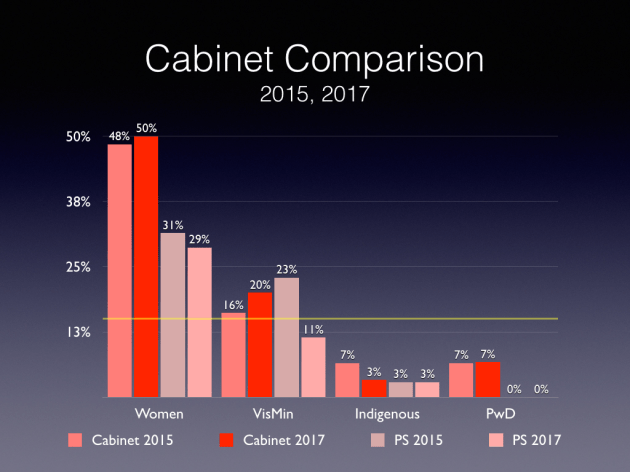
Parliamentary secretary changes: fewer visible minorities

election-2015-and-beyond-implementation-diversity-and-inclusion-025

With the announcement Thursday of the changes to parliamentary secretaries, there has been a slight decline in the number of women and a halving of the number of visible minorities.

This largely reflects the number of visible minority parliamentary secretaries who were dropped (Anju Dhillon, Emmanuel Dubourg and Greg Fergus) and that none of the new parliamentary secretaries are visible minority.

The PMO press release indicates 34 parliamentary secretaries but the actual ‘parliamentary secretaries tab’ has 35: the number I have used for this analysis.

Is Kellie Leitch for real? When the Tory insider pushes her Trump-light message, who’s listening?

Good long read by Richard Warnica on Kellie Leitch’s leadership strategy, and the degree to which there is a ‘market’ for her use of identity politics, both within the party and the country more generally. Her campaign is a bit of a litmus test of Canadian resilience to xenophobia and anti-immigration messages:

Her appeal, then, is to a narrower slice of the Trump constituency, one engaged more by identity issues and immigration than economics and jobs. The question for Leitch is whether there are enough of those voters to carry her to victory in the Conservative race, let alone in a general election.

Pollsters and analysts from all three major parties are generally skeptical, though few rule out the idea entirely. Many see her values campaign more as a tactical attempt to stand out in the early going of the race than a genuine expression of belief. “She’s running against the mainstream, which helps her get headlines and raise money in the short term,” said Brad Lavigne, a longtime senior NDP campaign official. “But the bet is the short-term exposure that she’s getting now will come to haunt her if she were to win, because there is not a significant audience for this among general election voters.”

That’s not to say there is no constituency at all for that message in Canada. Compared to Europeans and Americans, Canadians are still relatively open to things like foreign investment, immigration and multiculturalism, according to pollster Frank Graves, the president of Ekos Research. But that support is not as strong as it once was, and it’s been going down for years. “A lot of people think Canada doesn’t have the same forces that produced Trump or Brexit,” Graves said. “It absolutely does. They’re a little bit muted, but they’re here.”

That audience is also disproportionately concentrated among Conservative supporters, the people Leitch needs to capture the leadership. Graves polled Canadians on support for Trump in November. A significant majority of Liberal, NDP, Green and Bloc supporters disapproved of the job he was doing as president-elect. But a majority of Conservative supporters — 57 per cent — approved. So when the Leitch team flicks at Trump’s themes or parrots his campaign, they aren’t necessarily poisoning the well, at least not the one they need to drink from right now.

Tim Powers, a longtime Conservative strategist and outspoken Leitch critic, believes at the very least she could use the Trump message to sell memberships. “I probably have responded as strongly as I have because I believe that they have the potential to win by playing off fears and discontent and misunderstandings,” he said. “I think I’m not alone in that. There is still a good portion of Canadian society that harbours an older, traditional version of the country. And some of that traditional version is good and some of it is not so good.”

There are also those in other parties who will admit, quietly, that Canadians of all stripes are not nearly as allergic to nationalist anti-immigrant messages as some would like to pretend. One senior Liberal said the party’s own internal polling shows that Canadians on the whole don’t love immigration, and that even on the refugee issue that captivated and helped turn the last election in the Liberals’ favour, the polling was pretty mixed.

Lietaer believes Leitch may find particularly fertile ground for her message in Quebec, where debates over cultural values, immigration and assimilation have raged for years. The Conservative Party actually won more votes and more seats in Quebec in 2015 than it did in 2011. Many attribute that marginal bump, concentrated in the Quebec City region, to the prominence of the debate over the niqab in the campaign.

“A student of mine told me, a few months later, that he had been working as an election worker and he said that the words at the end of the campaign were “niqab, niqab, niqab,” said Louis Massicotte, a political scientist at Laval University. “The general feeling here was that it was a good idea for the Conservative candidates to raise this issue.”

All of that said, the general consensus among the dozen or so strategists, pollsters and party insiders interviewed for this story, was that while Leitch may find an initial, vocal audience for her anti-Canadian values and anti-elite message, her potential for long-term growth is probably limited. “I don’t see what the second ballot strategy is here, because it’s such a polarizing issue,” said Lietaer.

Indeed, several strategists suggested Leitch’s best hope is to win on the first ballot, an exceedingly difficult task in a race with 14 candidates, a preferential ballot and an arcane system of dividing points between all of Canada’s 338 ridings. For Leitch, that job will be made even harder by the fact that, according to multiple Conservative sources, her campaign strategy has offended wide swaths of the party.

“Among the rank and file of the party, and frankly anybody I talk to in the party, anybody I know in the party, everybody is really, really right pissed off at her for doing this,” said Yaroslav Baran, who ran communications for Stephen Harper’s 2004 Conservative leadership campaign. Officially neutral at the time of his remarks, Baran announced his support for Michael Chong, one of Leitch’s rivals, this past week.

Source: Is Kellie Leitch for real? When the Tory insider pushes her Trump-light message, who’s listening? | National Post

As Popularity Of Citizenship-By-Investment Grows, Tighter Vetting By Some Countries Should Be Recognized | The Daily Caller

More on citizenship-by-investment programs, by Lanny Davis, who consults with countries to ensure appropriate due diligence in reviewing applications. Ironic that he also cites Dominica as a good example the same day that this other story came out where the process failed (Dominica says ‘due diligence followed’ before granting citizenship to arrested Iranian national):

Recent U.S. media reports, however, have focused on these “bad apples” or atypical anecdotal stories of abuses.  These reports fail to report the examples of nations who have raised, not lowered, their standards of vetting and oversight, so that Americans can gain the advantage of a passport that doesn’t put a potential “death” target on their backs when they seek to travel on business or for family vacation reasons.

For example, take the government of St. Kitts and Nevis (SKN), twin islands in the Caribbean 1,200 miles southeast of Miami. In the SKN citizenship-by-investment program’s infancy, a handful of wrongdoers obtained St. Kitts and Nevis passports. Rather than ignore their shortcomings to remain competitive in the contest of attracting potential investors, government leaders acknowledged the deficiencies and overhauled their program. I should know—I was hired to conduct an independent review of the country’s revamped program.

On December 4, 2015, I was retained by Prime Minister, the Honorable Timothy Harris, Head of the Government of the Federation of Saint Kitts and Nevis. We were asked to conduct an independent review of the increased efforts of the St. Kits and Nevis Government to enhance and strengthen its vetting and background checking procedures under its CBI.

With a staff that has nearly doubled in size, led by Mr. Les Kahn, an internationally respected former consultant to IPSA International, the unit has added many additional layers of vetting. Each layer requires a written report to explain why a specific recommendation was made, and that report stays in the file as it moves upstream. In addition to conducting internal investigations, unit officials collaborate at length with international partners (including the U.S. government) through established law enforcement channels. Under Mr. Khan’s leadership, the Unit has willingly revoked previously issued problematic passports. St. Kitts and Nevis now operates one of the most stringent CBIs in the world. In addition to conducting internal investigations, Unit officials collaborate at length with international partners (including the U.S. government) before deciding to issue the passport.

Another example is the nation of Dominica, another beautiful island nation in the Caribbean, Prime Minister, Dr. the Honorable Roosevelt Skerrit, with whom I have met twice and who is a most impressive leader of his small island, has been steadfast in his commitment to a rigorous vetting process that involves criminal, character and ethics checks by international law enforcement agencies for all citizenship applicants. For PM Skerrit, having a legitimate and transparent CBI is about more than reputation—it has massive implications for his small nation’s economy. In 2016, the CBI accounted for 39.2% of the country’s total revenue. These resources are critical to rebuild the country and its economy in the wake of tropical storm Erika.

No matter a country’s size and stature, in an age of terrorism and increased need in the global economy for Americans to travel without fear, the citizenship-by-investment programs of small democracies that need such investments ought to be available with appropriate high-level vetting standards.   International media should take the time to investigate and differentiate between those nations who are” selling” passports without regard to the “bad actors” buying them vs. those governments who have put a high level of regulation and oversight into place and continue to raise their standards before issuing passports, knowing they will depress revenues from such bad actors.

Source: As Popularity Of Citizenship-By-Investment Grows, Tighter Vetting By Some Countries Should Be Recognized | The Daily Caller