Our Trump moment might not be so white: Saunders

Doug Saunders reminds us of Rob Ford, that his base was largely the non-white suburban poor and the importance of addressing barriers that produce marginalization:

Canada’s most dramatic recent triumph of Trump-style politics occurred in Toronto, where nearly half the city’s voters (and Toronto has more voters than most provinces do) cast a ballot for a wealthy, unpredictable, populist, anti-immigration, anti-elite, racist-mouthed guy named Rob Ford in 2010, and a third voted for his movement in 2014. Many note the similarities between the late mayor and the current President. Others point out the big difference: Ford voters weren’t generally, or even mainly, white.

An analysis by University of Toronto geographer Zach Taylor found that the Torontonians who voted for Mr. Ford overwhelmingly lived in inner-suburban wards whose populations were mainly racial and ethnic minorities, mainly lacking university education and mainly getting by on family incomes of less than $100,000 a year. Those voters are what the journalist Naheed Mustafa, in an analysis of their backgrounds, called “the non-white suburban poor,” whom Mr. Ford pitted against an unseen, well-paid downtown elite (and sometimes against newer immigrants) – “Despite his personal wealth, he gave the impression that he spoke the language of the marginalized.” Sound familiar?

Since the eighties, new Canadians and their families have tended to live in the low-cost, poorly transit-connected high-rise suburbs; they are more likely to be excluded from the housing boom and the secure new-economy jobs that have buoyed Canada; they are generally not white. Mr. Ford spoke their specific language of outsider resentment; he stoked the anger felt by many marginal Caribbean, African, South Asian and East Asian Canadians, and worked their Evangelical and Pentecostal churches. He knew their sense of exclusion could be turned into angry intolerance and he gave his voters a mythic “them” to be angry about. And it worked.

Likewise, the 2011 federal election was the first in which most ethnic and religious minorities voted Conservative. The Harper Tories certainly weren’t a populist far-right party, but they didn’t attract these new voters by moving leftward.

This doesn’t mean minorities in Canada have turned to the far right – they haven’t, any more than anyone else has. It does mean that anger and exclusion and paranoia in Canada, and even racial intolerance and xenophobia in Canada, are just as likely to entrap minority Canadians. The places where I most often hear overtly pro-Trump opinions are on Toronto’s black-music radio station or in the suburban flea markets: His outsider message works there.

Canada has traditionally avoided extremism by offering hope: If you start on the bottom rung, you can make it higher. But the second and third rungs are no longer so secure. If they fail, we could wind up electing the world’s most diverse form of self-destructive intolerance.

Source: Our Trump moment might not be so white – The Globe and Mail

Refugee claims at Canada-U.S. border have doubled over past 2 years

Will likely be an ongoing challenge under the Trump administration:

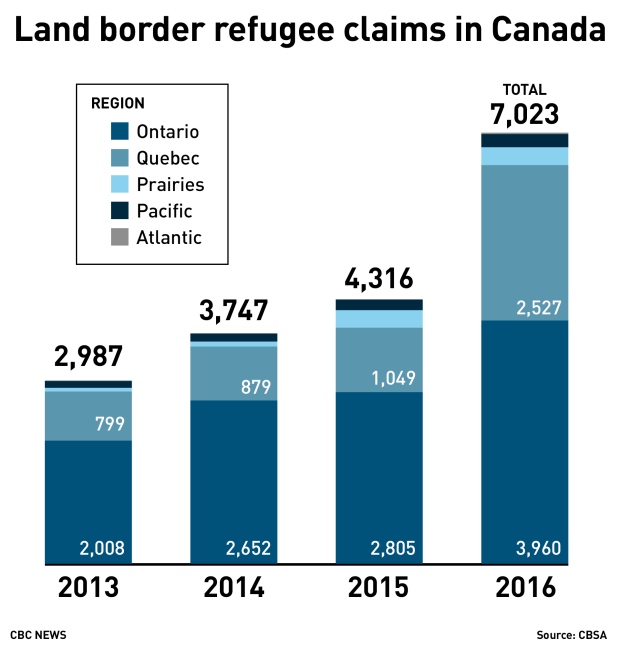
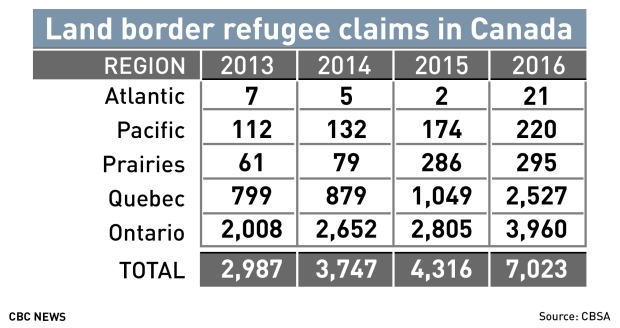
The number of refugee claims made at the border has more than doubled over the past two years, surging to 7,023 in 2016, according to the Canada Border Services Agency.

By comparison, 4,316 people sought refugee status in Canada at land border crossings in 2015 and another 3,747 did in 2014.

But the spike isn’t unusual and represents a return to the volume of refugees Canada has previously received, said Janet Dench, executive director of the Canadian Council of Refugees.

land border refugee claims

“The numbers may look high, but that is because the range you are looking at is one where Canada has been receiving unusually low numbers of claimants,” Dench said in an email interview, noting that there were more than 8,000 land border claims made annually from 1999 to 2004.

“So in the longer perspective, 7,000 is not a very large number,” Dench explained.

Canada changed the way it receives refugees in 2004 with the introduction of the Safe Third Country Agreement with the United States. The agreement says that people seeking protection must make their claim in the first country they arrive in. Canada must accordingly send asylum seekers trying to cross at the border back to the U.S.

21.3 million refugees around the world

In 2016, the largest group of people making refugee claims at border crossings in Canada came from Colombia, followed by Syria, Eritrea, Iraq and Burundi. There were 21.3 million refugees around the globe in 2015, according to the United Nations.

Lorne Waldman, a Toronto-based lawyer who specializes in immigration and refugee law, attributes the recent rise to geopolitical instability. For example, there was a dramatic rise in Turkish refugee claims in Canada following the coup in Turkey.

“The numbers tell stories and the stories are really related to what’s happening politically,” he said, noting that Canada observed a rise in Pakistani refugee seekers that arrived via the U.S. following the Sept. 11 attacks.

land border claims

Waldman said the election of U.S. President Donald Trump, who campaigned on a promise to crack down on immigration and recently tried to enact a controversial travel ban restricting travel from seven Muslim majority countries, likely contributed to the bump.

“As the situation deteriorates in the U.S., the likelihood that we’re going to see more people crossing is very high,” he said.

But, Waldman noted that there has long been a perception among asylum seekers — even before Trump took office — that the U.S. is not sympathetic to refugee claims.

Source: Refugee claims at Canada-U.S. border have doubled over past 2 years – Canada – CBC News

Trump Copies the Worst Mistake of FDR – Scott McGaugh, The Daily Beast

Another example of those who forget history …:

Fear and vengeance have again gripped our nation. It’s not the first time that Americans have acted in a most un-American manner when we have been attacked or feel threatened. Throughout our history, we have branded entire ethnic groups as vague-but-dangerous threats. American communities have been forcibly unrooted without due process. Immigrants from China to the Middle East have been banned from our shore, in a passion first captured by Cicero when he wrote, “In times of war, the laws fall silent.”

February 19 marks the 75th anniversary of President Franklin Roosevelt’s Executive Order 9066 that ordered the removal of more than 100,000 Japanese Americans from the West Coast in 1942, solely because of their ethnicity. There was no due process. No formal charges. Families were given only a few weeks’ notice to sell their businesses, homes, personal belongings, and even family heirlooms. “Japantowns” from San Diego to Seattle were gutted within a few months.

In this century, the 9/11 attack and jihadist-inspired domestic violence have spawned speculative calls for databases of Muslim Americans and mosque closures. Now President Donald Trump has tried to chaotically banish wide swaths of ethnic immigrants, for fear of unknown enemy combatants who may be among them. Out of fear of the invisible few, President Roosevelt authorized the equivalent 75 years ago this month, in what now is considered one of the darkest chapters of American history. President Trump has stopped short of condemning internment camps, despite national apologies by Presidents Reagan and Bush.

Shamefully, Trump is continuing an American tradition of retribution and vengeance against ethnic groups. When Native Americans were viewed as a threat to white settlement and expansion, tens of thousands were forcibly moved onto more than 300 reservations. Indeed, Cicero proved prescient when our Japanese-American neighbors were sent to internment camps about 65 years later in some of the same desolate regions that had been forced upon Native Americans.

It would serve President Trump and his allies well to reflect on Americans’ treatment of their Japanese-American neighbors in World War II. It was euphemistically called “relocation” and “evacuation” at the time. But the reality was far different. It was hysterical payback. Most victims endured nearly two years in a prison-camp environment of barracks where families lived in a single room. They were surrounded by barbed wire and guarded by armed soldiers, weapons turned inward.

Were they truly the American enemies that some feared—just as President Trump views large swaths of Muslims today?

In 1943, President Roosevelt authorized the segregated Japanese-American 442nd Regimental Combat Team. He asked the sons of those incarcerated and others to volunteer for an army commanded by white officers and to possibly die for their country in Europe and the Pacific. Remarkably, 10,000 volunteers from Hawaii stepped forward. Together with about 1,300 volunteers from the internment camps and draftees, army recruiters were overwhelmed by the response.

The 442nd suffered horrendous casualties on near-suicide missions as it compiled a remarkable war record. Ultimately the 442nd became the most-decorated unit of its size in World War II. One of its battalions, the 100th from Hawaii, brutally earned the moniker “Purple Heart Battalion.” The 442nd ultimately earned more than 18,000 awards for valor, more than one for every man. (Yet Japanese-American soldiers were denied Medals of Honor until President Clinton issued 21 in 2000. Only seven were alive to receive them personally.)

They returned home after the war and some suffered continuing hatred from their neighbors. Yet they endured and rebuilt their lives as parents, teachers, merchants, church leaders, and mechanics. Even though their families had been treated as a faceless, homogenous, and undefined internal threat against America, for the most part Japanese Americans suffered silently as they rose above America’s fear and vengeance.

Today their legacy sounds a cautionary note against partisan political talk of Muslim-American databases, muddled policy statements about Muslim Americans abroad, Muslim immigrant banishment, and the dangers of American mosques.

Today’s sweeping characterizations of Muslim Americans and Middle Eastern immigrants are a dangerous echo of America’s World War II treatment of Japanese Americans, as articulated by Oregon Governor Walter Pierce: “Their [Japanese American] ideals, their racial characteristics, social customs, and their way of life are such that they cannot be assimilated into American communities. They will always remain a people apart, a cause of friction and resentment, and a possible peril to our national safety.”

His statement sounds eerily familiar today. It is a sentiment that continues to sully the American spirit. Fear and vengeance must be stifled if thoughtful and constructive decisions are to be made that intelligently protect America’s national security.

Source: Trump Copies the Worst Mistake of FDR – The Daily Beast

John Ivison: Langevin was a man of his time, not a monster, so don’t take his name off an Ottawa building

While I understand the pressures for renaming, I much prefer keeping the original names but with historical plaques that capture both sides of the legacies of historical figures. There are risks in erasing or forgetting history:

To damn Langevin is not only to judge him with the benefit of 135 years of hindsight but also to ignore the political leadership he showed during his nearly 30 years as a cabinet minister. He was not a monster — he was a man of his time.

Brian Lee Crowley, managing director of the Macdonald Laurier Institute think-tank, was not referring to Langevin in his remarks at a “Canada at 150” dinner Thursday, but he may as well have been.

“It is easy to criticize the past and the decisions made there. But it is a conceit of each and every generation that they alone are free from poor judgments and intellectual shortcomings. Looking solely at our past efforts is not the right standards by which to measure Canada and its great achievements,” he said.

Crowley referred to a recent Angus Reid poll that suggested less than half of 18-24 year olds feel a sense of pride and achievement in this country.

Since Canada’s prominent historical figures are increasingly portrayed as a parcel of racists, homophobes and militarists, is it any wonder?

This country is addressing many of the wrongs that have been wrought and has committed not to repeat them. But that does not require we repudiate our past by renaming every bridge, road and building that bears the name of someone whose actions we now deem ill-advised and unacceptable.

As the American poet and civil rights activist Maya Angelou, said: “History, despite its wrenching pain, cannot be unlived. But, if faced with courage, it need not be lived again.”

Source: John Ivison: Langevin was a man of his time, not a monster, so don’t take his name off an Ottawa building | National Post

Ahmed Hussen: The rise and rise of Canada’s immigration minister

Good long profile of IRCC Minister Hussen in Macleans (Hussen is well respected by many Conservatives who while in government engaged with the Canadian Somali Congress – whether this respect will continue as he implements Liberal policies remains to be seen):

Still, Hussen was not exactly a high-profile MP, and when he was tapped to take over the immigration file from veteran John McCallum—who subsequently resigned his seat and was named ambassador to China—the reaction was largely, “Who?” Hussen says he had no sense this was coming, but he was “very, very honoured and really touched” that the Prime Minister handed him this file. “I’ll be frank: it’s a big job, and he didn’t start as a parliamentary secretary, so he didn’t have the opportunity to get seasoned on the brief,” says Chan, who remained friends with Hussen after both left McGuinty’s office. “But I’ve never doubted his intelligence. So for me, his only major challenge is the cut-and-thrust, and the speed with which things will transpire in his life.”

Chan exudes a warm, fatherly sort of pride toward his colleague, despite being only nine years older. Hussen has three sons aged seven, three and five months; Chan’s three sons are just about a decade older, and he’s warned Hussen of how hectic it will be juggling everything now. Chan echoes others who know Hussen, in remarking on how he manages to be quietly commanding. “I think the challenge sometimes is in the heat of the bright lights, some people might take that (soft-spokenness) as a form of weakness. I would never take that as a view, that he won’t see through the issues or that he’s going to act in a capricious way, or that there’s a soft underbelly to him,” Chan says.”There isn’t.”

In fact, the PMO saw Hussen’s “preternatural calm” as a major asset in this portfolio, the senior government official says. The Liberal government—not unlike vast swaths of the U.S. government apparatus, apparently—didn’t know exactly what the Trump administration had planned, but it was clear from the campaign that immigration would be a hot file. Hussen was also seen as an ideal fit because he had, quite literally, been there. “We wanted to make sure there was someone in the control room who really understood what it was like to be on the shop floor,” the official says.

Hussen is almost comically understated about his dramatic public introduction to the job, conceding only that it was a “very interesting” weekend. “I’ve always learned most when I’m placed quickly in a situation where I have to deal with something,” he says. “It was a very steep learning curve to get right into it, but I have a very good staff and supportive department officials.”

When asked about his seeming reluctance to respond to issues like the U.S. travel ban from a personal perspective, Hussen returns to a familiar line in spelling out the various pieces of his identity and history. “I’m very happy and proud of my Somali heritage, but I also make it a point to emphasize that I’m a Canadian citizen, and I’m a Canadian,” he says. “This is where I have spent more of my life, this is home for me and this is the society I have grown to cherish.”

For Hussen, it’s about being proud of his roots, but recognizing that he is a citizen of one country now: Canada.

Source: Ahmed Hussen: The rise and rise of Canada’s immigration minister

Andrew Coyne: Free speech needs to be guided by judgment and conscience, not rules

Another thoughtful column by Coyne:

It is common among some clear-thinkers to reject any allegation of speech suppression — a speaker being shouted down on campus, a boycott of an offending corporation, a Nazi getting punched — unless it involves the explicit use of the coercive power of the state. Anything else is merely the “consequences” of speech, for which one should accept “responsibility.” Suck it up, snowflake.

In a sense, of course they’re right. The obligations of the state are of a different order than private individuals or groups, because of its unique powers of coercion, and because coercion — the power, not merely to punish speech, but to actively prevent speech — is of a different order than mere disapproval, say, or shunning.

But the difference is not so absolute as all that. It is more of degree than kind. As private individuals, we may not be under the same obligations and constraints as the state, but that does not mean we are under none. We have still the obligations of judgment, of conscience, and of respect — for the spirit of free speech, if you will, rather than the legal letter.

At one extreme it is easy to see this. If a mob were to burn down the local newspaper and hang its editor, it is of no use to say, well, it wasn’t the government that did it, so no chilling of speech is involved. One should not have to factor in, among the “consequences” to be expected of speech, the chance that one might be murdered — or punched, for that matter.

Short of actual law-breaking, things get trickier. There is no violence in shouting down a speaker, you may say; neither is a university, as a private organization, obliged to provide a platform for opinions of which it, or a section of the university community, disapproves. No, indeed. But free speech exists, as a legal guarantee, in part because of the foundation of social values in which it is embedded.

The spirit of free speech, that is, is as important: the notion that none of us is in absolute possession of the truth; that the route to truth is through the exchange and conflict of ideas; that the rights we each enjoy are guaranteed only so far as they do not intrude upon another’s; and that, in particular, we do not have a right not to be offended, or to be spared any encounter with disagreeable words, images or ideas. If we do not live by these principles ourselves, we will shortly find neither will our creation, the state.

So far so good. But what of the more benign ways of expressing collective disapproval: boycotts, online campaigns, or Parliamentary motions? Are these mere consequences of speech, or constraints upon it?


Answer: It depends. Anyone who has been the subject of a Twitter mobbing can attest it can be deeply unpleasant, and quite intimidating, even without overt threats of violence. The harm to reputation, for example, of having one’s name broadly associated with sexism, racism — or “Quebec-bashing” — can be a significant deterrent to speaking freely.

Taboos, shunning and other mechanisms of social disapproval, in other words, can raise the “price” of speech to intolerable levels. On the other hand, some things are taboo for a reason. We should not feel censorious for shunning or denouncing someone who expresses hateful or noxious opinions.

Neither should we hesitate to call them what they are. A good many of the participants in the present debate seem to think their freedom to say the most virulently and prejudicially anti-Muslim things should also protect them from being accused of prejudice against Muslims — or Islamophobia — in return. Well, no. That is simply logical, as is the denunciation in the motion before Parliament.

Where do we draw the line, then? Again, it depends. It requires all of us to use our judgment. People should not be labelled bigots or hate-mongers merely for offering an unconventional view on a controversial topic. A reasoned critique of Islam’s teachings on women is not to be treated the same as, say, a blanket claim that Muslims, as a group, are “unintegrateable.” But neither should actual bigotry be excused as merely being “un-PC.”

There are no simple rules to guide us. There are only mutual obligations: not to give offence needlessly, but also not to take offence lightly; not to round up a mob every time someone’s views offend us, but neither to be intimidated by the mob when it is necessary to offend.

Source: Andrew Coyne: Free speech needs to be guided by judgment and conscience, not rules | National Post

The Tories approach a point of no return and other commentary on M-103

Terry Glavin’s usual trenchant commentary:

During the debate on the motion in the House, Khalid said she defines Islamophobia as “the irrational hate of Muslims that leads to discrimination.” That’s perfectly fine, too, but what makes no sense was Khalid’s statement that she refused Conservative MP (and party leadership hopeful) Erin O’Toole’s offer to help win unanimous consent for her motion by tightening it up, because that would have meant “watering it down.”

In a parallel topsy-turviness, Joly has objected to David Anderson’s alternative motion, which replicates Khalid’s motion except for the ambiguous term Islamophobia, because it’s a “weakened and watered down version.”

It’s true to say, as Scott Reid does, that seemingly benign injunctions against “Islamophobia” have been put to the squalid purpose of placing the Muslim religion and the practices of authoritarian Islamic regimes off limits to criticism. But it’s also fair to say that “anti-Muslim bigotry” doesn’t sufficiently capture the full-throated paranoid lunacy animating the nutcase wing of the Conservative support base these days.

“Racism” doesn’t quite cover it. “Hatred” doesn’t quite get at it. Whatever term you like, it’s more than merely ironic that those who make the most hysterical claims about clandestine Islamic conspiracies at the centre of Justin Trudeau’s government are also the ones shouting the loudest that an irrational fear of Islam isn’t even a thing.

It’s not as though the Liberals are blameless in all this. They could have welcomed O’Toole’s efforts at reaching out to find a compromise, but they didn’t. And the Liberals do seem quite content to have the Conservatives squirming and chafing against the appearance that the reason they object to the term Islamophobia is that they themselves are Islamophobic, whatever that might mean. It is not as though it bothers the Liberals that the Conservatives are stuck with the crazy talk coming from several of the leadership candidates these days.

Trudeau may have given away more than he intended last week when he was confronted at a community meeting in Iqaluit about why he reneged on his electoral reform promises. Raising the spectre of proportional representation opening the door to “fringe” parties, Trudeau asked, rhetorically: “Do you think that Kellie Leitch should have her own party?”

Clearly, Trudeau doesn’t want that. For starters, it would mean decent Conservatives couldn’t be tarred so easily with the indecencies committed by the party’s fringe factions. It would mean bigot-baiting the Conservative Party would be that much harder to do. In the meantime, it’s up to the Conservatives to get themselves sorted, and after the sordid events of the past few days, their options are limited:

Isolate, quarantine, amputate or purge.

Source: The Tories approach a point of no return – Macleans.ca

Campbell Clark in the Globe:

It’s one thing for MPs to say they oppose the motion. But it’s another to accept the bogus reasoning.

One is the slippery-slope argument. Mr. Levant is telling Canadians that once a Commons committee starts studying the vague notion of Islamophobia and what to do about it, they’re going to propose laws that make it illegal to criticize Islam, and restrict free speech.

The obvious weakness in that is that Motion M-103 doesn’t even ask the committee to propose laws, nor could it force them – let alone the kind that stifle free speech. If they ever did, MPs could vote against it then. And it still could not violate constitutional guarantees on free speech.

If Conservative objections really were about a vague term, some deal-making would be in order. There are arguments that in some countries the term has been used to refer to any criticism of Islam.

Of course, this motion calls for MPs to study it, so they could define it.

But Liberals were unwilling to compromise when the Conservatives asked them to change “Islamophobia” to “hatred for Muslims.”

But it’s not about the word. Ironically, it’s about fear.

All this began when Montreal-area MP Frank Baylis started a petition last year to assert that all Muslims should not be equated with a few extremists. NDP Leader Tom Mulcair later asked for unanimous consent for a motion condemning Islamophobia – and got it on his second attempt on Oct. 26.

Conservative House Leader Candice Bergen responded to Mr. Mulcair’s motion with her own, condemning religious discrimination.

Both were adopted. The word Islamophobia was fine for Conservatives then, before they got scared.

Source:  Conservative MPs are afraid of Motion 103, and things it can’t do 

The contrary view, and the conflation of Islamophobia/anti-Muslim hate with free speech concerns, comes from Farzana Hassan in the Sun, who appears not to have understood what the motion covers and what it does not:

When we challenge a certain Islamic practice, we are careful to exclude the moderate majority and focus our attention on a small segment of the Muslim community. Yet some claim that even such discussion conflates the radicals with the moderates.

If Khalid believes such discussions include all Muslims, she is unwittingly admitting that all Muslims are indeed like the fundamentalists.

Khalid is mistaken if she believes any rational discussion on Islamic practice castigates all Muslims. She must understand that any well-intentioned and constructive discussion on a religious practice or ideology is a fundamental right of every Canadian.

There is no phobia of Islam in Canada. There is genuine resentment toward orthodox Islam. But it has little to do with the usual public discourse.

Some practices, whether we discuss them in public or not, are commonly known to be associated with orthodox Islam, such as polygamy, wife battery and ostracism of religious minorities.

It is up to moderate Muslims to distance themselves from these outrages as much as possible. So far no robust public challenge to such practices has emerged from moderate segments of the community.

Without such a grassroots challenge any social observer, professional or amateur, can form any opinion on orthodox Islam, whether positive or negative.

We know some Muslims are working to institute gender equality, and others are partners with the government in fighting terror. However, these efforts need to become the norm rather than the exception. Once this takes place, the world will automatically begin to see Muslims in positive light.

Prime Minister Justin Trudeau has talked about finding the right balance between protecting a religious minority and also protecting our Charter rights.

The answer to his dilemma is simple: Do not put the slightest dent in our right to free speech.

To balance this, the prime minister can take more measures to protect the security of all minorities with tighter law enforcement and stricter punishments for alleged offenders like Alexandre Bissonnette.

Source: I’m a liberal Muslim and I reject M-103

Lastly, an article on Iqra Khalid’s reading out the hateful emails and tweets she has received, providing proof of the validity of M-103 and its specific reference:

The Liberal MP who tabled an anti-Islamophobia motion says she has been inundated with hate mail and death threats.

Mississauga, Ont. MP Iqra Khalid told the House of Commons today she received more than 50,000 emails in response to M-103, many of them with overt discrimination or direct threats.

“I have asked my staff to lock the office behind me as I now fear for their safety,” she said. “I have asked them not to answer all phone calls so they don’t hear the threats, insults and unbelievable amount of hate shouted at them and myself.”

She described a “chilling” video posted on YouTube that called her a terrorist sympathizer and disgusting human being.

“‘I’m not going to help them shoot you, I’m going to be there to film you on the ground crying. Yeah, I’ll be there writing my story with a big fat smile on my face. Ha ha ha. The Member got shot by a Canadian patriot,'” she read, quoting from the video.

And that, she said, was just tip of the iceberg. Here are some other messages she received and read in the House:

  • “Kill her and be done with it. I agree she is here to kill us. She is sick and she needs to be deported.”
  • “We will burn down your mosques, draper head Muslim.”
  • “Why did Canadians let her in? Ship her back.”
  • “Why don’t you get out of my country? You’re a disgusting piece of trash and you are definitely not wanted here by the majority of actual Canadians.”

Khalid said she has also received many messages of support.

Source: ‘Kill her and be done with it’: MP behind anti-Islamophobia motion reads out hate mail
Georgetown professor under fire by conservatives for lecture about slavery and Islam – The Washington Post

Challenge for academics in terms of how their nuances and subtleties get lost in public debate, and how the present can cloud our understanding of the past (understanding doesn’t equal acceptance):

Brown’s lecture was from the first of several papers he said he is writing on the question of Islam and slavery that are aimed at giving the Muslim community tools to bridge the gap between “elements of Islamic traditions and modern values” at a time when the Islamic State has “slammed the issue of slavery on the table in the 21st century.” In a phone interview, he said was trying to “help frame this problem by discussing the values of consent and autonomy that are prominent today, but they weren’t always.”

Brown denied that he had condoned slavery and non-consensual sex and said that his critics, some of them from the “alt-right,” are misquoting him. “I don’t know how they could say that I did,” he said. Scholars are at risk, he said, if “some de-contextualized quote of theirs is taken out and prompts a feeding frenzy that calls for them to be fired.”

A number of stories from conservative magazines and websites wrote scathing stories about the lecture, saying that he was condoning slavery and non-consensual sex. For example, the American Conservative wrote a piece with this headline: “Georgetown Prof Defends Islamic Slavery.” American Thinker had a story with this headline: “Georgetown professor defends Islamic slavery and ‘non-consensual’ sex.” The Daily Banter wrote: “Islamic Studies Professor On Whether Rape and Slavery Are Wrong: It Depends” and “An Islamic Studies professor at Georgetown has taken academic obscurantism and cultural relativism to new heights.”

Source: Georgetown professor under fire by conservatives for lecture about slavery and Islam – The Washington Post

Port de signes religieux: Taylor plombe un compromis possible, déplore Bouchard 

Always interesting to listen to both Taylor and Bouchard, both when they agree and when not. But the focus on the concrete mentioned at the end of this article indicates a strong convergence of views:

Le Québec a raté une occasion unique de mettre derrière lui le débat sur le port de signes religieux. En désavouant la solution mise de l’avant dans son propre rapport, Charles Taylor a coupé les ailes au consensus qui se dessinait entre les partis politiques, déplore Gérard Bouchard qui, avec M. Taylor, avait coprésidé la commission sur les accommodements reliés aux différences culturelles.

Avec la prise de position étonnante du philosophe Taylor, «le Québec risque d’être une autre fois enfoncé dans l’âcre querelle qui le divise depuis une quinzaine d’années », observe M. Bouchard dans une lettre publiée demain dans la section Débats de La Presse+. «Pour ma part, j’endosse toujours cette proposition», tranche M. Bouchard.

M. Taylor soutient intervenir pour contribuer à la réconciliation des opinions sur cette question délicate. Or, estime M. Bouchard, cette intervention aura « contribué à mettre en échec [la réconciliation] qui émergeait entre les partis politiques et qui a été rendue possible parce que d’importants éléments de consensus étaient présents dans la population ».

En désavouant cet élément de son rapport de 2008, M. Taylor risque de provoquer «l’échec du projet de consensus, dénonce son collègue Bouchard. Les jeux sont à nouveau ouverts. Il est probable que le PQ et la CAQ voudront maintenant reprendre leurs billes». Avec cette occasion ratée, prédit-il, «le débat sur les signes religieux est relancé au moins jusqu’aux prochaines élections, et peut-être au-delà».

Le sociologue du Saguenay était injoignable depuis que son partenaire Taylor avait, dans une lettre à La Presse, annoncé qu’il n’appuyait plus la recommandation formulée dans leur rapport en 2008. Il avait eu vent que son collègue s’apprêtait à rendre publique sa volte-face.

Les deux intellectuels proposaient alors d’interdire le port de signes religieux visibles aux représentants de l’État exerçant un pouvoir de coercition sur les autres citoyens. Ainsi les juges, les procureurs de la Couronne de même que les policiers et les gardiens de prison n’auraient pu afficher leur confession en portant une croix, une kippa ou un voile, par exemple. Pour Gérard Bouchard, cette formule «s’était progressivement posée, aux yeux de nombreux Québécois, comme l’assise à partir de laquelle on pourrait ériger un consensus. Cet horizon est maintenant compromis».

M. Taylor jugeait que, depuis la publication du rapport, le contexte avait changé et que le débat soulevé par cette question avait entraîné des gestes malheureux à l’endroit de la communauté musulmane. Ce revirement avait comblé d’aise le premier ministre Couillard qui, rapidement, revint à sa position – totale liberté pour le port de signes religieux à la condition que les services publics soient donnés et reçus à visage découvert.

Au passage, M. Bouchard écorche la position de Philippe Couillard qui, opposé à la «discrimination vestimentaire», prône l’absolue liberté quant au port de signes religieux.

Or, le projet de loi 62 proscrit le niqab, le voile qui couvre le visage, «une contradiction flagrante» dans la position du gouvernement, observe M. Bouchard. M. Couillard a déjà fait valoir que des questions d’identification, de sécurité, commandaient que les services soient offerts et reçus à visage découvert.

L’interdiction du rapport Bouchard-Taylor, limitée à quelques «agents exerçant une fonction tout à fait exceptionnelle», «se défendait bien sur le plan juridique», estime le sociologue, rappelant que des juristes avaient été consultés avant la publication du rapport en 2008. «Nous sommes loin d’une attaque directe contre les musulmans ou du projet de charte des valeurs, comme on l’a prétendu» dit-il.

Les «dissensions persistantes sur les signes religieux» vont rester. Il convient maintenant «d’oeuvrer énergiquement » à d’autres tâches, la lutte contre la discrimination, la destruction des stéréotypes, et « vider enfin le panier de crabes des accommodements [qui posent toujours un gros problème pour les deux tiers des Québécois]». Le gouvernement Couillard semble se montrer plus actif dans cette direction, se réjouit en conclusion Gérard Bouchard.

Source: Port de signes religieux: Taylor plombe un compromis possible, déplore Bouchard | Denis Lessard | National

Senate Hearings on C-6: Witnesses February 15-16

The Senate’ Social Affairs, Science and Technology (SOCI) committee started hearings this week on Bill C-6 repeal and other changes to the previous government’s C-24 legislation that made citizenship “harder to get and easier to lose”

Witnesses reflected a balance of views on the proposed changes with few surprises compared to the House Citizenship and Immigration Committee hearings last year, or for that matter, much of the discussion around C-24 in 2014.

The changed composition of the Senate compared to the 2014 C-24 review (more non-affiliated senators, Trudeau appointments) was reflected in the selection of witnesses and questions.

As expected, discussion focussed on the main elements of C-6:

Revocation (terror or treason): Witnesses from the CBA, Quebec Bar, Audrey Macklin, and Craig Forcese all supported repeal of this provision, Reis Paghtakan opposed its repeal but only for terrorist convictions in Canada, and CIJA and Julie Taub opposed its repeal in all cases. Questioning by Senators included the legal and constitutional aspects of revocation, whether or not this acted as a deterrent, and the possible impact this could have with respect to war crimes.   There was a useful discussion on the difference between revocation for misrepresentation and for crimes of terror or treason; the former pertaining to crimes committed before being granted citizenship, where misrepresentation was the issue, and crimes committed after being granted citizenship, where the issue was whether the criminal system was sufficient to handle such cases or a supplementary punishment through revocation was warranted. Needless to say, the issue of differential treatment for dual nationals and Charter rights was raised repeatedly. Forcese and Macklin noted the negative impact such differential treatment had with respect to integration and countering violent extremism.

Revocation (misrepresentation): While not part of C-6, the absence of procedural protections – paper process, no right to a hearing, no right to an appeal – was raised repeatedly with virtually all witnesses indicating this remained an issue. Most favoured a return to the previous system of appeals to the Federal Court. Taub, however, emphasized how easy it was to commit residency fraud and misrepresentation, the need for smart Permanent Resident cards to track entry and exit, but did not comment on the need or not for protections. CIJA acknowledged the need for some procedural protections but wanted to ensure that these did result in endless appeals as happened in the Oberlander case.

Language and knowledge assessment: All agreed language was important to integration. No witnesses disagreed with the proposed removal of language and knowledge testing for 14-17 year olds. Metro Toronto Chinese & Southeast Asian Legal Clinic (MTCSALC) noted time, money and educational challenges for their low-income and refugee clientele, the need for expanded language training and related supports such as child care and income support and greater flexibility to waive requirements on humanitarian and compassionate grounds. The cost of language assessment was also mentioned. CBA noted that writing the knowledge test in english or french imposed a double requirement and they would have been happy with keeping the testing requirement for 55-64 year olds but with the flexibility to do the test with an interpreter.

The most interesting recommendation was from Paghtakan, where he continues to advocate for scrapping language assessment as is a pre-requisite for economic class immigrants for permanent residency status. Duplication meant more expense to the government and more costs to immigrants. Most family class immigrants are parents and grandparents who would thus be exempt given the proposed change in age requirements while refugees could wait until they attain 55.

Chair noted earlier work by committee that showed 55-64 year olds formed about one-third of the active workforce.

Residency: Taub questioned the change in residency from four out of six years to three out of five, arguing that it was more generous than other countries and that this and other measures would increase the number of citizens of convenience. Paghtakan, while he had supported the four of six requirement of C-24, had no issue with the change to three of five given the maintenance of physical presence. The strength of Taub’s intervention on residency-related questions prompted Senator Petitclerc why all Taub’s points were so negative without mentioning the positive benefits of citizens contributing abroad. Taub cited citizens who install their family and return to the Gulf or Hong Kong where they can make more money and not pay Canadian income tax.

Intent to reside: Only Taub supported maintaining the intent to reside provision given its symbolic importance. The other lawyers testifying noted that situations can change following applying for citizenship and the consequent risk of misrepresentation cases and thus supported its repeal.

Pre-Permanent Residency time partial credit: Again, only Taub opposed restoring this pre-C-24 provision for Temporary Foreign Workers and international students, stating that this facilitated citizens of convenience.

Other issues

Oath: Paghtakan endorsed the TRC recommendation to amend the citizenship oath by adding the words “including Treaties with Indigenous Peoples” to assist new Canadians appreciate and understand this aspect of Canadian history and society.

Parental passing citizenship to children with no genetic link (in vitro): Quebec Bar raised gap in current legislation which based parental status on the genetic link (save for adoptions) rather than the relationship as in case of in vitro children.

Religious accommodation language testing: CIJA noted that many language testing centres only provided this service on Saturday (Sabbath), with extensive delays in accommodation.

Smart permanent resident card (chip or magnetic strip): Taub argued strongly that the PR card should be a smart card like any gym card that would allow tracking of entry and exit and make it easier for applicants to prove they met the residency requirements without having to search through documentation. (Comment: sounds good in theory but not a simple change, compounded by government challenges in managing complex IT projects as seen with Phoenix and Shared Services Canada.)

Fees: MTCSALC noted that the increase in citizenship processing fees from $100 to $530 made it prohibitive for many low income and refugee immigrants. The recent CBC article on the impact of citizenship fees on the number of applications was cited by Senator Eggleton. Taub argued that reduction was not just related to the increase of fees, that other factors — change in residency requirements, language testing — were also factors. She supported full cost recovery but with subsidies for low-income applicants.