Don’t be deaf to the threat of dog whistle politics: Collenette

Good piece by Penny Collenette, former senior PMO staffer under Jean Chrétien:

So what can we do to stop the spread of this inflammatory and destructive force? How do we halt the powerful right wing of Trump’s America from spilling over our borders with their vicious messages? There are a number of ways.

Canadian politicians who use coded messages of race-baiting or values testing should be “named and shamed” by political opponents. Already this is thankfully happening in the Conservative leadership race.

Strategists and pollsters who practise this type of dangerous communication must think twice before posing questions designed to whip up prejudice. Clients and investors may equally become concerned about provocative behaviour.

Civil society and individuals are watch dogs for truth and fairness. Don’t allow friends or colleagues to discriminate against others or to disseminate hateful information. Whether a message is in a tweet, during a conversation, or on Facebook, point out errors or bias.

Main stream media and social media equally have responsibility to verify facts and to report without bias.

And never forget the power of words. Quebec Premier Philippe Couillard noted that “Words can hurt. Words can be knives slashing at people’s consciousness.” But words can also heal and soothe, especially when they are spoken with great sensitivity by a member of the community, which has just been devastated.

“What the Daesch is doing in the name of Islam is an affront to Islam, decency and humanity. What took place in Quebec was criminal and horrible. But the response of Canadians with love and solidarity represents Canada at its best and offers us pride and hope,” said Mohammed Azhar Ali Khan, a former journalist and Order of Canada recipient.

Let’s not let our communities and ourselves down. Let’s support each other with understanding and strength.

And while we are it, let’s throw those dog whistles in the garbage.

Source: Don’t be deaf to the threat of dog whistle politics: Collenette | Toronto Star

Des musulmans demandent une meilleure intégration sur le marché de l’emploi

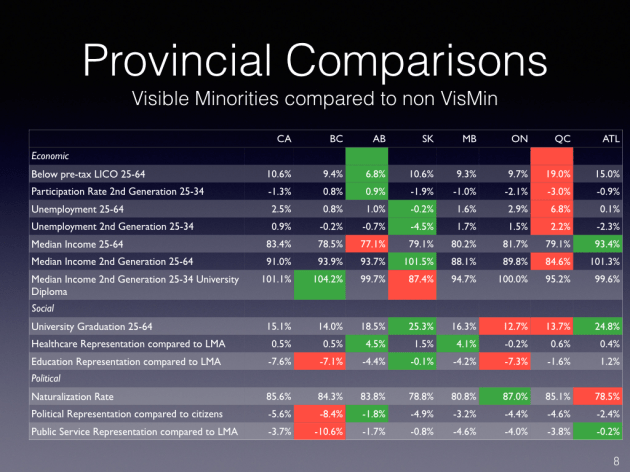
Multiculturalism - Implementing Diversity and Inclusion - Dec 2016.008.pngQuebec has the poorest economic outcomes for visible minorities:

Plus tôt cette semaine, le vice-président du Centre culturel islamique de Québec, Mohamed Labidi, a évoqué les efforts vains d’une des victimes de l’attentat, Azzaddine Soufiane, à trouver un emploi à son arrivée dans la province. Celui qui a tenté d’arrêter le tireur, au moment de la fusillade, avait donc décidé d’ouvrir un magasin, avait dit M. Labidi aux journalistes.

« Allez aux présentoirs de chauffeurs de taxi et vous verrez des post-doctorants et des personnes détenant des maîtrises puisque nous ne trouvons pas d’emplois ici », avait-il lancé.

Un programmeur informatique de formation qui est arrivé d’Algérie en 2011, Bachreir Ikhlef, était au départ « plein d’énergie » quand il est arrivé dans sa province d’accueil, a raconté le chauffeur de taxi de 37 ans alors qu’il attendait son prochain passager à quelques kilomètres de la Place d’Youville.

Un conseiller en orientation lui avait suggéré d’obtenir un diplôme au Québec afin d’agrémenter son curriculum vitae.

« Nous étions 25 à avoir commencé le programme, a dit celui qui avait alors opté pour un certificat en programmation. Et à la fin, seulement 12 d’entre nous l’ont fini. »

« Ni moi ni un type venant de la Tunisie n’avons pu obtenir un stage. Aucun d’entre nous n’a trouvé un travail dans notre domaine », a ajouté M. Ikhlef.

Selon l’Institut de recherche et d’informations socio-économiques (IRIS) — un groupe de réflexion connu pour ses positions plutôt portées à gauche du spectre politique —, 43 % des immigrants étaient surqualifiés, en 2016, pour l’emploi qu’ils occupaient.

« Mêmes démons »

Jeudi, lors de la cérémonie funéraire qui se tenait à Montréal, le premier ministre Philippe Couillard a souligné que la société québécoise « a les mêmes démons auxquels d’autres font face », mentionnant notamment la xénophobie, l’exclusion et le racisme.

Il a appelé les employeurs à engager des personnes en se basant sur leurs compétences et non leur nom de famille, demandant tout haut pourquoi le taux de chômage était plus élevé parmi les immigrants.

Le chauffeur de taxi Taoufik Essekkouri — arrivé du Maroc en 2010 — espère de son côté que ces mots mèneront à des actions concrètes, faisant valoir en entrevue que la surqualification des nouveaux arrivants par rapport à leur emploi est un problème connu depuis longtemps, mais qui tarde à être résolu.

Source: Des musulmans demandent une meilleure intégration sur le marché de l’emploi | Le Devoir

Lady Gaga’s Super Gay Super Bowl Halftime Show Came When We Needed It Most – The Daily Beast

While the overall view appears to be that Lady Gaga played it safe, her goals were less so:

It was actually rather inspiring to listen to Lady Gaga talk about the goals she had for the performance at a press conference last week.

“Music is one of the most powerful things the world has to offer. No matter what race, religion, nationality, sexual orientation, or gender that you are, it has the power to unite us, so this performance is for everyone. I want to, more than anything, create a moment that everybody who’s watching will never forget—not for me, but for themselves,” she said.

This whole political statement debate? “The only statements I’ll be making during the halftime show are the ones that I have been consistently making throughout my career,” she said. “I believe in a passion for inclusion, I believe in the spirit of equality, and [I believe] the spirit of this country is one of love and compassion and kindness, so my performance will uphold those philosophies.”

It’s one thing to hear that, and another to watch it unfold over the course of 13 minutes on TV, fatigued from another week of horrifying headlines and cultural frustration that’s long passed its boiling point. Who knew how much we’d need Lady Gaga right now?

“Essentially, that kid that couldn’t get a seat at the cool kids table and that kid who was kicked out of the house because his mom and dad didn’t accept him for who he was? That kid is going to have the stage for 13 minutes,” she said. “And I’m excited to give it to them.”

And we needed to receive it.

Source: Lady Gaga’s Super Gay Super Bowl Halftime Show Came When We Needed It Most – The Daily Beast

CBC did a nice round-up of the messages of the ads, largely explicitly or subtly in favour of diversity and inclusion:

It’s rare that you want to watch the commercials. Normally you want to change channels, go get a snack or fast forward through them — except during the Super Bowl.

For Americans, commercials have long been part of the attraction. And this year — finally — Canadians got to take part in the fun, thanks to a CRTC decision.

Every year, more than 30 advertisers spend roughly $5 million US and aim to create the most memorable 30 to 90 seconds by stuffing commercials with celebrities, slapstick humour, cute animals or children.

This year’s crop of ads filled all the categories, but several nodded to the political climate since Donald Trump became president.

The messages

Shortly before kickoff, Coca-Cola’s replayed an ad originally from 2014, which featured America the Beautiful sung in eight different languages. The commercial seems to be a reaction to increased racial tensions in the U.S. New or not, this commercial struck a nice tone.

The most obviously political ad was from 84 Lumber, which had an earlier version rejected for being too controversial. The commercial features the journey of a woman and her daughter travelling through Mexico. The ad directs viewers online to see the conclusion.

At the end of the six-minute piece, you see the characters arrive at a towering wall and appearing defeated until they discover a gate in the wall. The ad ends with the words, “The will to succeed is always welcome here.”

The commercial is clearly in opposition to Trump’s plan to build a border wall between the U.S. and Mexico.

 The hits, misses and messages of the Super Bowl commercials

Dix ans après Bouchard-Taylor, tant reste à faire

Good summary by journalists Stéphane Baillargeon, Robert Dutrisac
and Lisa-Marie Gervais:

Québec annonçait il y a dix ans la formation de la commission Bouchard-Taylor. Les deux présidents livrent leur bilan et Le Devoir constate les retards et les échecs dans l’application de plusieurs recommandations centrales.

La « réalité alternative » a la cote par les nouveaux temps trumpiens qui courent, mais les faits sont têtus. Les faits disent, par exemple, que l’organisme Ensemble pour le respect de la diversité, qui fait la promotion du respect des différences, ne reçoit à peu près plus rien de l’État québécois.

Deux ministères (Éducation et Affaires autochtones) fournissent maintenant 4 % des quelque 630 000 $ du budget annuel de fonctionnement. Le ministère de l’Immigration, de la Diversité et de l’Inclusion du Québec (le MIDI) fournit par contre 30 000 $ par année pour deux ans pour un projet de lutte contre la radicalisation.

Nous sommes contents d’avoir du soutien pour les petits projets, mais notre mission n’est pas appuyée

« Nous avons subi une baisse énorme », résume Marie-Ève Paiement, qui assume l’intérim à la direction de l’organisme montréalais, qui, en 20 ans, a donné plus de 10 000 ateliers, visité 965 écoles, rencontré près de 340 000 jeunes du Québec et du Canada. « La recommandation qui nous concerne dans le rapport de la commission Bouchard-Taylor n’a malheureusement pas été appliquée, dit-elle. Nous sommes contents d’avoir du soutien pour les petits projets, mais notre mission n’est pas appuyée. »

En 2004, la Fondation pour la tolérance (l’ancien nom d’Ensemble pour la diversité) tirait le tiers de ses revenus des subventions au fonctionnement. C’était avant la commission Bouchard-Taylor et avant que son rapport de 2008 recommande précisément d’augmenter le soutien financier à ce genre d’organisme et à la Fondation en particulier.

Un autre exemple ? La commission recommandait aussi « d’accorder une attention particulière à la Capitale-Nationale de façon à en faire un deuxième pôle métropolitain d’accueil des nouveaux venus ». Vérification faite, le MIDI a annulé le fonds d’aide à la régionalisation des immigrants il y a trois ans.

« Le Québec est la seule province au Canada où la population immigrante s’installe presque exclusivement dans sa métropole, dit Jean-Luc Gélinas, du Service d’orientation et d’intégration des immigrants au travail (SOIT) de Québec. Les professionnels immigrés ne vont pas là où sont les emplois : ils se dirigent presque tous vers Montréal, où ils ne sont pas assurés de trouver du travail en fonction de leurs compétences et de leur formation. »

Le document déposé en 2008 listait 37 recommandations. Dès novembre 2009, un an après le dépôt du rapport, des porte-parole gouvernementaux affirmaient que 80 % des recommandations avaient fait l’objet d’un suivi.

Jusqu’au départ du premier ministre Jean Charest en 2012, le directeur général de la Table de concertation des organismes au service des personnes réfugiées et immigrantes (TCRI), Stephan Reichhold, produisait un « Bulletin de performance » pour suivre l’application des recommandations. Il évaluait en 2010 que 6 % des stratégies proposées étaient concrétisées. « Je ne penserais pas que ç’a ait beaucoup changé », dit-il au Devoir.

Dans un article publié en 2014 dans le livre L’interculturel au Québec (PUL), le sociologue François Rocher, de l’Université d’Ottawa, estimait pour sa part qu’environ le tiers (37 %) des recommandations avaient été mises en oeuvre. La note positive n’était accordée qu’à 7 des 24 plans jugés prioritaires.

Bref, les bilans ne semblent pas très favorables, et les deux présidents eux-mêmes trouvent aussi, dans les entrevues accordées au Devoir, que les choses traînent.

Le professeur Gérard Bouchard fait directement référence à ce bilan très mitigé. Charles Taylor souligne que deux secteurs concrets font particulièrement défaut, celui de la reconnaissance des compétences et des diplômes et celui de l’intégration comme telle.

Les vérifications effectuées par Le Devoir au sujet d’une dizaine de recommandations décrites comme prioritaires il y a dix ans pointent aussi vers du laxisme, des lacunes, voire des régressions.

Interculturalisme et laïcité. La commission demandait que le modèle de l’interculturalisme soit inscrit dans une loi. Ce modèle diffère du multiculturalisme en ce sens qu’il met l’accent sur la diversité, mais autour d’un noyau francophone. Les commissaires proposaient également l’adoption d’un livre blanc afin de lancer une vaste consultation sur la laïcité dite ouverte.

Dix ans plus tard, il n’y a pas de loi sur l’interculturalisme, pas plus que de livre blanc. Nous en sommes à la quatrième mouture de projets de loi qui ont voulu circonscrire la laïcité — les libéraux préfèrent la notion plus canadian de neutralité religieuse de l’État — et les accommodements religieux. Toutes ces tentatives furent vaines sauf, évidemment, le projet de loi 62, dont on a retardé l’étude en commission parlementaire en raison du climat actuel teinté par l’attentat.

Intégration des immigrants. Le souhait était d’intensifier « la reconnaissance des compétences et des diplômes acquis à l’étranger ». Yann Hairaud, directeur général de la Clef pour l’intégration au travail des immigrants de Montréal (CITIM), juge qu’« il n’y a pas eu de suite à cette recommandation » malgré quelques efforts notables, dont la mise en place d’un mécanisme de traitement des plaintes des décisions prises par les ordres professionnels. Ce problème concerne environ un immigrant au Québec sur dix, soit plus ou moins 4500 personnes par année.

Le Québec compte 46 ordres qui réglementent la profession de plus de 385 000 membres. Une dizaine d’entre elles (dont les médecins, les ingénieurs ou les infirmières) totalisent 80 % des demandes de reconnaissance, avec des taux d’acceptation très variables. Les obstacles viennent par exemple des coûts imposés pour les examens, de la difficulté de trouver des formations d’appoint ou des stages.

Inégalités et discriminations. Les commissaires ont conclu que l’État devrait porter une attention particulière à la lutte contre les crimes haineux et a exigé plus de ressources et de moyens pour les organismes de lutte contre la discrimination, notamment à la Commission des droits de la personne et des droits de la jeunesse. Or, si le budget annuel est resté stable (environ 15 millions de dollars), 33 postes ont été abolis, passant de 161 à 128 (équivalents à temps complet) au cours des dix dernières années. Un service-conseil en matière d’accommodements raisonnables a été mis en place en 2008 pour aider les décideurs.

Pratiques d’harmonisation. Une attention particulière devait être portée à la déjudiciarisation du traitement des demandes d’accommodement ou de la formation des enseignants. Ces formations, qui datent d’avant la commission, sont toujours aussi nombreuses

« Peut-être que, dans les commissions scolaires en région, où l’immigration est plus récente, il y a plus de besoins », dit Marie McAndrew, professeure à la Faculté des sciences de l’éducation à l’Université de Montréal et spécialiste des questions de multiethnicité. « Mais dans les grosses commissions scolaires, à Montréal, […] c’est clair que l’expertise est là. »
Source: Dix ans après Bouchard-Taylor, tant reste à faire | Le Devoir

CCDI Study shows law firm senior leadership still largely white and male

Interesting study by the Canadian Centre for Diversity and Inclusion.

In general, I find a three-year time series too short to show much change given the nature of promotion and equivalent processes (a minimum of five years is better, ten is more reliable).

However, it is nevertheless informative in terms of its breakdown by seniority  and a good initiative:

Despite much talk over the last decade around boosting diversity and inclusion in law firms, women and racialized lawyers continue to be under-represented in the Canadian legal profession with Caucasian men continuing to far outnumber those two groups in senior leadership roles, according to a study from the Canadian Centre for Diversity and Inclusion.

Level Chan says a lack of women and racialized lawyers at the top of law firms is a matter of retention and advancement. He says there continues to be “over-representation” at the associate and entry-level areas of the firms but they don’t tend to stay.

In fact, the study shows Caucasian men who responded to the survey have the greatest odds of being an equity partner, and they are seven times more likely than racialized women to be an equity partner.

The study, “Diversity by the Numbers: The Legal Profession,” conducted by the CCDI in partnership with the Canadian Bar Association, shows the representation of minority groups in the legal profession has not changed substantially over the last three years that the CCDI has been collecting data. In 2014 and 2015, 73.99 per cent and 76.88 per cent of senior leader respondents were men. In 2016, 75.34 per cent of senior leader respondents to the survey were men and 90.78 per cent of senior leaders were Caucasian.

In 2014 and 2015, 89.28 per cent and 88.91 per cent of senior leader respondents were Caucasian respondents, respectively. Another statistic of note is that 81.9 per cent of senior leaders are equity partners.

“Results from 2014, 2015 and 2016 do not show a shift towards a more diverse and inclusive workforce, particularly in partner and leadership roles,” the report states.

The study, sponsored by Borden Ladner Gervais LLP, Cassels Brock & Blackwell LLP, Dentons Canada LLP, McCarthy Tétrault LLP and Miller Thomson LLP, shows women and racialized respondents are under-represented in equity partner and senior leader roles and over-represented as associates and articling or summer students.

Authors of the report say factors contributing to the perpetuation of these numbers include “inflexible working conditions, rigid firm culture, high client expectations and overall economics of the profession.”

While some might point to a tough economy since 2008, Deanna Matzanke, director, measurement and analytics at the CCDI, says the economy is a “significant red herring” and what the report shows is “a compelling validation” that the current law firm model makes it difficult for women and minorities to rise to equity partner positions.

“ . . . the process of billable hours, the emphasis placed on client relationships, and the hierarchal ‘Old Boys Club’ network in law firms do not support or foster a diverse and inclusive environment.”

The report goes on to say that women find themselves in a difficult position when faced with trying to balance family needs with law firm demands. Also, “ . . . lawyers from minority groups do not have the same social and cultural capital to network and find mentors who relate to them, because the pool is very small.”

That means many leave the law firm culture for more flexible and accommodating environments elsewhere, such as in-house roles or solo practice.

Matzanke, a lawyer herself, says the results of the study are disappointing and show that diversity and inclusion are not being successfully implemented in the legal profession, despite the fact the pool of potential lawyers in law school has increased in diversity and at the associate level at law firms shows fairly high diversity.

The majority of racialized respondents in the legal profession are Asian, while all other groups show very small representation.

A total of 11 firms from nine provinces and one territory participated in the 2016 survey. Firms were invited to participate directly by CCDI via the Law Firm Diversity and Inclusion Network, and the Canadian Bar Association sent a letter to all members.

“There’s nothing surprising here really,” says Level Chan, a partner with Stewart McKelvey LLP in Halifax and the CBA’s representative on the CCDI’s advisory committee.

“As to why we’re not moving the needle much, I think it’s a matter of retention and advancement, and as you see particularly with women, there continues to be over-representation at the associate and entry level areas of the firms, but we’re not keeping them. I think that in turn is translating to having fewer people available for senior roles and as equity partners. That is the ongoing issue we’ve had in the legal profession.”

Source: Study shows law firm senior leadership still largely white and male

Link to the study:Diversity by the Numbers: The Legal Profession

We need to understand what ‘Islamophobia’ really means : Glavin

Good piece by Terry Glavin:

Getting it wrong can do great harm, because the slipperiness of language occurs in tandem with the slovenliness of ideas. The Southern Poverty Law Center, for instance, recently sustained a nasty self-inflicted wound to its reputation in this way. Long a turn-to organization for research on political extremism, the SPLC published a list of what it described as 15 “anti-Muslim extremists ” that included the unambiguously bigoted American hothead Pamela Geller and the notorious paranoid Frank Gaffney along with the impeccably credentialed Maajid Nawaz, a high-profile reformist Muslim. Nawaz works with the Quilliam Foundation, a British anti-extremism think tank named after the founder of Britain’s first mosque.

The imprecision of the term Islamophobia is almost invariably bound up in dead-end arguments that allow both “counter-jihad” activists and jihadists alike to conflate Islam, the religion as it is practiced by the overwhelming majority of Muslims, with Islamism, the totalitarian ideology that has produced several virulent strains, including the ghastly fanaticism of Daesh, otherwise known as Islamic State.

…The conflation of Islam with Islamism allows anti-Muslim bigotry to flourish. Bigots and lunatics routinely conflate passages from the Quran with the faith of innocently devout Muslims. It’s easy work to find all sorts of bloodcurdling passages in the Quran that can be lifted and rigged to slander Muslims of all kinds. Like these: “When you meet the unbelievers, smite their necks. . . Oh believers, take not Jews and Christians as friends. . . Oh believers, fight the unbelievers who are near to you; and let them find in you a harshness.”

Taking that to mean that Muslims are just waiting for the chance to embark upon rampages of neck-smiting and wickedness is to surrender to racism and dementia. Even more unpleasant, this one’s about Jews: “I shall give you my sincere advice: First to set fire to their synagogues or schools and to bury and cover with dirt whatever will not burn, so that no man will ever again see a stone or cinder of them. . . Second, I advise that their houses also be razed and destroyed.”

That one’s from a lurid 16th Century tract composed by the prophet of Protestantism, Martin Luther. Shall we all start freaking out about Lutherans now?

The “left” has happily entertained its own hysterical conspiracy theories: the United Nations reconstruction of Afghanistan was really an American imperialist war for oil (Afghanistan, alas, is rich mainly in sand) is one. “Al Qaeda was created by the CIA” is another. Sometimes, the idiocies of the “left” and “the” right are indistinguishable or interchangeable, even in the arguments about President’s Trump’s vulgar excesses.

Who said this? “If they want to build a wall that’s up to them. If they want to throw out illegal immigrants or keep out Muslims that’s up to them. It’s their business.” It could have been the execrable Trump-admiring Brexit rabblerouser Nigel Farage. But it was the disgraced British MP and “anti-war” loudmouth George Galloway, who not long ago was a frequent celebrity guest on fashionable CBC chat shows and a darling of Toronto Star columnists.

During Tuesday’s emergency House of Commons debates on how Canada should respond to Trump’s anti-Muslim executive order, the wisest counsel came not from NDP leader Thomas Mulcair, who did a splendid job attempting to wrest something useful from the government benches, nor from rookie Immigration, Refugees and Citizenship Minister Ahmed Hussen, who had nothing to offer in response.

It came from Conservative immigration critic Michelle Rempel, who is not what you would call a popular person at the Conservative Party’s fringe, where shouting about Muslims is the loudest.

“It is facile for us to believe that there are not others on this planet who disagree with our way of life. There are those who hold views so extreme that they kill in the name of their God. They rape in the name of their God. They subjugate and bring terror in the name of their God. No religion and no nation is immune to this,” Rempel told the House.

“Yet there are those who seek to bring light and beauty to the world. They seek to bring peace, prosperity, and tolerance. Every religion and every nation has these people. They are Muslim and they are Christian. They are Sikh and they are Hindu.”

By closing our arms around the grieving widows and the children and the loved ones of those six martyrs in Sainte-Foy this week, we Canadians might just have allowed some light and beauty to emerge from this horrible thing. Yet there remains an unspeakable hatred of Muslims, and hysteria about Muslims, abroad in the land.

We need to get this right. We owe it to the dead, and we owe it to the living, to face this scourge with decency, with compassion and with honesty, to muster what is right and good about Canada to the cause of seeing to it that those six men did not die in vain.

Source: We need to understand what ‘Islamophobia’ really means – Macleans.ca

Trump Pushes Dark View of Islam to Center of U.S. Policy-Making – The New York Times

Yet another test for the institutional checks and balances:

It was at a campaign rally in August that President Trump most fully unveiled the dark vision of an America under siege by “radical Islam” that is now radically reshaping the policies of the United States.

On a stage lined with American flags in Youngstown, Ohio, Mr. Trump, who months before had called for a “total and complete shutdown” of Muslim immigration, argued that the United States faced a threat on par with the greatest evils of the 20th century. The Islamic State was brutalizing the Middle East, and Muslim immigrants in the West were killing innocents at nightclubs, offices and churches, he said. Extreme measures were needed.

“The hateful ideology of radical Islam,” he told supporters, must not be “allowed to reside or spread within our own communities.”

Mr. Trump was echoing a strain of anti-Islamic theorizing familiar to anyone who has been immersed in security and counterterrorism debates over the last 20 years. He has embraced a deeply suspicious view of Islam that several of his aides have promoted, notably retired Lt. Gen. Michael T. Flynn, now his national security adviser, and Stephen K. Bannon, the president’s top strategist.

This worldview borrows from the “clash of civilizations” thesis of the political scientist Samuel P. Huntington, and combines straightforward warnings about extremist violence with broad-brush critiques of Islam. It sometimes conflates terrorist groups like Al Qaeda and the Islamic State with largely nonviolent groups such as the Muslim Brotherhood and its offshoots and, at times, with the 1.7 billion Muslims around the world. In its more extreme forms, this view promotes conspiracies about government infiltration and the danger that Shariah, the legal code of Islam, may take over in the United States.

Those espousing such views present Islam as an inherently hostile ideology whose adherents are enemies of Christianity and Judaism and seek to conquer nonbelievers either by violence or through a sort of stealthy brainwashing.

The executive order on immigration that Mr. Trump signed on Friday might be viewed as the first major victory for this geopolitical school. And a second action, which would designate the Muslim Brotherhood, the Islamist political movement in the Middle East, as a terrorist organization, is now under discussion at the White House, administration officials say.

Beyond the restrictions the order imposed on refugees and visitors from seven predominantly Muslim countries, it declared that the United States should keep out those with “hostile attitudes toward it and its founding principles” and “those who would place violent ideologies over American law,” clearly a reference to Shariah.

Rejected by most serious scholars of religion and shunned by Presidents George W. Bush and Barack Obama, this dark view of Islam has nonetheless flourished on the fringes of the American right since before the Sept. 11, 2001, terrorist attacks. With Mr. Trump’s election, it has now moved to the center of American decision-making on security and law, alarming many Muslims.

Quebec’s Response to Hate: More Tolerance – The New York Times

NYT editorial notes the contrast between Canada and the US (but no reason to be smug):

No society is immune to acts of terrorism, especially by a lone wolf driven by deep hatreds. The United States has known many mass shootings; Norway had the mass murderer Anders Behring Breivik; in France last July, a man drove a truck into a crowd in Nice, killing dozens; the list could go on and on. When they strike, the measure of a wounded society is how it responds.

On Sunday, Quebec City was struck when, officials say, a 27-year-old student named Alexandre Bissonnette, known to be a right-wing extremist, walked into a mosque, began shooting and killed six people. The shock across Canada was immediate and tangible: Tolerance is a proud theme in Canadian identity — the country has taken in nearly 40,000 Syrian refugees since late 2015 when Prime Minister Justin Trudeau took office. Now Canadians were wondering how this could have happened, and what it means — a question made more acute by their widespread revulsion at President Trump’s actions to block Muslims from the United States.

The response of Quebec’s premier, Philippe Couillard, is worth noting. “Every society has to deal with demons,” he said. “Our society is not perfect. None is. These demons are named xenophobia, racism, exclusion. They are present here. We need to recognize that and act together to show the direction we want our society to evolve.”

That was what Canadians sought to do. Thousands gathered at memorial services across the country, including Mr. Trudeau on Monday. Speaking earlier to Parliament, he addressed the more than one million Muslim Canadians: “Thirty-six million hearts are breaking with yours,” he said, referring to the population of Canada. “Know that we value you.”

In sad contrast, the reaction from Mr. Trump’s White House was to use the shootings to justify its anti-immigrant policies. The attack was a “terrible reminder,” said the White House press secretary, Sean Spicer, of why America’s actions must be “proactive, rather than reactive.” The logic, or illogic, seemed to be that if Muslims had been kept out of Canada, they would not have been killed.

Canada is not perfect; it, too, has its demons, as Mr. Couillard said. But the response of a democratic society must be to reaffirm its fundamental faith in freedom, including the freedom to practice one’s faith and cultural traditions. In Quebec, the demons took a terrible toll, but the country’s commitment to inclusion was, if anything, strengthened.

Lise Ravary: It took a massacre in a mosque, but Quebecers now see the darkest side of their identity crisis

It should not have taken this incident or this long for commentators like Ravary to become more mindful and self-aware, but better late than never.

But yet she still uses the language “at war” rather than strongly opposed, unacceptable or other words.

Words matter:

The killing and maiming of Muslim men in prayer in Québec City Sunday night raises many questions. Some of those questions are extremely uncomfortable for Quebecers.

Over time, we will find out more about the motives of the alleged killer, Alexandre Bissonnette, but such tragedies do not occur in a vacuum. Knowing why it happened is as important as finding out why the first deadly terrorist attack against Muslims by a non-Muslim in the West happened in Quebec.

My gut reaction to the news was “That’s not us!” I tweeted it. Replies from other commenters came fast and furious. “Oh yes, it is. Quebec is a racist society. Islamophobia and anti-Semitism are rampant.”

It’s sad that many Canadians genuinely believe this; I won’t even begin to try and change their minds here. Uniquely racist Quebec is an alternative fact. Even so, in the aftermath of this tragedy, not asking what role, if any, Quebec society played a role in this tragedy would be doing Quebecers a great disservice.

It may be too soon to start laying the cultural blame for this crime but already, politicians such as Parti Québécois leader Jean-François Lisée, have admitted that they may have gone too far in their criticism of Muslims in Quebec. Premier Couillard is asking for a change of tone. He’s right.

As a conservative columnist at war with religious extremism and political Islam in particular, I will keep myself in check. When denouncing Islamism, I always insist that my comments do not apply to Muslims as a people or to Islam as a faith.

I realized last Sunday that many readers don’t see the difference, some because they can’t. Others because they won’t. Media must take this into consideration. Some are blinded by racism and other by fear. Not so much fear of Muslims the quintessential fear that Quebecers have of disappearing as a nation.

Source: Lise Ravary: It took a massacre in a mosque, but Quebecers now see the darkest side of their identity crisis | National Post

To fight hate, we must become soldiers of inclusion: Khan

Another good piece by Sheema Khan:

As many have noted, the massacre took place in an atmosphere of increasing Islamophobia. While the individual who allegedly perpetrated these crimes is solely responsible for his actions, it is time to reflect on where we as a society stand in relation to public discourse about Muslims.

Currently, “Otherizing” Muslims has not only become the norm, but a political platform to win votes. We saw it in the previous federal election. The current Parti Québécois Leader, Jean-François Lisée, championed the toxic Quebec values charter and plays the Muslim identity card. In July, he criticized a colleague for wishing Quebec Muslims a happy Eid. What message does this send?

Enthusiastic supporters of Kelly Leitch embrace her defence of “Canadian values” – a phrase that resonates with their deep mistrust of Muslims in Canada. The actions of political leaders sets the tone. Xenophobic overtures, whether overt or covert, give licence to people to spew their prejudices in the open. Attitudes once considered shameful are normalized, to the detriment of social harmony.

We have a choice. Do we allow the “Otherizing” to continue unchallenged or stand up to bigotry? Do we allow politicians to play upon fears or do we hold them accountable?

This is a very difficult time for Muslims. The unthinkable has happened, resulting in intense feelings of vulnerability. A sanctuary of refuge has been violated. Their co-religionists have been murdered in cold blood for their simple profession of faith. Many have thought “that could have been me” and are wondering what to tell their children, and how to keep them safe.

Schools and community sports organizations can help to address anxiety with messages of inclusion. My daughter’s school tweeted the following reassuring words on Monday morning: “To Muslim members of our community, our deepest condolences. Please know our thoughts are with you and we love you. Staff are here for you.” This really helped to assuage many of our worries.

In addition, law-enforcement agencies across the country are providing enhanced protection to Islamic centres and mosques. These institutions should also apply for the federal government’s Communities At Risk program, which is aimed at helping institutions vulnerable to hate-motivated attacks improve their security.

What about questions of identity, going forward? Perhaps Muslims can take a cue from Linda Sarsour, one of the organizers of the recent Women’s March, and declare themselves “unapologetically Muslim, unapologetically Canadian.” We should continue to worship in humility, relying on our faith for strength. Let’s continue to practise the universal virtues of community, generosity and charity. Now is not the time to disengage, nor turn inward with fear.

In fact, Canadians and Quebeckers have opened their hearts to Muslims across this country, letting them know that they are loved and supported. Our elected leaders have set the tone toward healing. These profound acts of kindness help repair the social fabric that extremists desperately seek to rupture. Their goal is to sow hatred, division and fear. We must not let them succeed. Instead, let us become soldiers of inclusion, armed with compassion, ready to confront xenophobia in all its forms. Apathy is not an option.

In his beautiful Quebec anthem Mon pays, Gilles Vigneault wrote “A tous les hommes de la terre, ma maison c’est votre maison.” This theme – that our vast country is home to those who arrive on its shores – is also found in aboriginal tradition. Our hearts, like the land, are wide enough to embrace all those who seek to call Canada “home.” How unapologetically Canadian.

Source: To fight hate, we must become soldiers of inclusion – The Globe and Mail