Online criteria for Afghan refugee program changes, applies only to those who’ve fled

While one can understand the rationale given the difficulties in leaving Afghanistan under the Taliban, arguably the need is greatest for those stuck in the country. Will likely provoke controversy among the many who have already been working to raise the issues and help them leave:

The Canadian government has quietly changed the criteria on its website for a special program for vulnerable Afghan refugees so that only those who have already managed to escape to other countries are eligible.

The online criteria for the “special humanitarian program” used to include Afghans “who are in Afghanistan or outside of Afghanistan,” but it was changed this month to apply only to those “outside of Afghanistan.”

The program is one of two set up to help bring 40,000 Afghan refugees to Canada and is intended for vulnerable groups including women leaders, persecuted religious or ethnic minorities, LGBTQ people and journalists.

The online criteria for the other program, which is aimed at interpreters and others who helped Canada during its military mission as well as embassy staff, still allows those inside Afghanistan to apply.

When the government first announced the special humanitarian program in August, it said it would apply to those outside Afghanistan, but it ultimately included those stuck inside the war-torn country in its online criteria.

Canada was the first country worldwide to  launch a special pathway to Canada for women, girls, LGBTQ and targeted minorities in Afghanistan.

Groups working with Afghans trying to flee the country said the change to the program’s eligibility criteria on Canada’s official website would sow confusion and desperation among Afghans hoping to come to Canada.

It could drive Afghans to resort to people smugglers to get outside the country in order to qualify, they warned.

Alex Cohen, a spokesman for Immigration Minister Marco Mendicino, said Canada was “the first country in the world to announce a humanitarian program for Afghan refugees, which will see some 40,000 refugees start new lives in this country.”

The humanitarian initiative, he said, requires refugees to have left their country of origin to be consistent with the 1951 UN Convention on Refugees.

He said the government is “adapting our programs to the evolving situation in Afghanistan, and have added a provision to enable two new partner organisations to refer exceptional cases of individuals who are inside Afghanistan.”

“We regularly review IRCC’s public communications to ensure they reflect our policies and provide the best possible information to applicants, and update them accordingly,” he said. “The edit to our website was a communications change, not reflective of a policy shift.”

Stephen Watt of Northern Lights Canada, a refugee organization, said the government’s plan to bring 40,000 Afghans to Canada has been wrapped in secrecy ever since it was announced.

“There is still no clear way to apply to the program, or to discover who it is accepting or how it is operating,” he said. “This is a life and death question for many of the people we are talking to within Afghanistan.

“Our government needs to come clean about its plans for these very vulnerable people who it promised to help in the heat of the election, and provide a clear path for providing that help. This isn’t a time for empty promises and secret processes.”

Canada ended its airlift mission from Kabul near the end of August as the U.S. was completing its own withdrawal from the country. Thousands of people with permission to travel to Canada were left behind — including Canadian citizens.

Since the Taliban seized control, it has been increasingly difficult to get people out.

Wendy Noury Long, director of the Afghan Interpreters Association, said she feared that government’s change to its criteria, made in mid October, would drive desperate Afghans to go to extreme lengths to get out of the country so they qualify.

“People will be thinking how do I get out? Do I contact human smugglers? Countries are actively deporting people back to Afghanistan,” she said.

“This is a policy change. This is the explanation of whether you qualify. You are taking a huge risk to try to get out to another country and you might find yourself deported back to Afghanistan.”

The humanitarian program Canada set up to help Afghans at risk has strict eligibility criteria. To qualify, Afghans must also be a woman leader, a human rights advocate, a member of a persecuted religious or ethic minority, in the LGBTQ community, or a journalist or someone who has helped Canadian journalists. As of mid October, they must be located outside Afghanistan.

Those who fit these criteria need to register for refugee status through existing refugee programs, with the United Nations Refugee Agency or the government where they live, and wait to be referred. They can also be identified as eligible by a private sponsor.

Around 3,700 Canadians and Afghan refugees, including former interpreters, were airlifted out by Canada before the end of August.

Approximately 1,700 interpreters and other Afghans with papers to come to Canada are currently in safehouses in Kabul. Some safehouses, being run by an NGO and funded by veterans and private donations, face closure within weeks because of lack of funding.

Source: Online criteria for Afghan refugee program changes, applies only to those who’ve fled

Australian voters rethinking immigration in wake of extended border closures, poll suggests

Interesting shifts:

Australia’s prolonged international border closure appears to have lowered the political temperature around immigration, with the number of voters believing levels are too high dropping from 56% in January 2019, and 64% the year before that, to 37% in the latest Guardian Essential survey.

While the pandemic has shifted the dynamics of the debate, the latest poll of 1,781 respondents suggests immigration remains a divisive issue. Migration is back on the political agenda because both the federal and state governments have flagged a rethink of the size and mix of Australia’s migration program once the border reopens.

In the latest Guardian Essential survey, more than half of respondents (52%) say migration levels are either too low or about right, while 37% say too high, and 11% are undecided. Just over half the sample (51%) agrees that immigration is vital for Australia’s business and economy (20% are opposed that view).

But 63% of respondents also believe that increasing immigration levels would add more pressure on the housing system and infrastructure (only 11% disagreed).

While half the Guardian Essential sample (50%) thinks boosting immigration will help businesses recover from the economic shock of the pandemic by giving them the skilled labour they need (22% disagree) – a majority of respondents are evidently not convinced that immigration helps Australia deal with skills shortages as the population ages (only 49% agree with that proposition and 22% disagreed).

Source: Australian voters rethinking immigration in wake of extended border closures, poll suggests

Douglas Todd: What do Indigenous voices say about immigration?

Some interesting voices. A more comprehensive survey would be of interest:

As a First Nations leader, what would you think of Canada’s immigration policy?

“It’s a bit late to ask that question,” answers Tsawwassen First Nations Chief Ken Baird, with a wry smile.

Indeed, Canada’s Indigenous people have never really been asked how they feel about immigration policy, despite experiencing wave after wave of newcomers.

A small number of First Nations leaders over the years, however, have said they want more influence in shaping immigration. There came a point more than a decade ago when the Assembly of First Nations resolved to “freeze all immigration coming into Canada until the federal government addresses, commits, and delivers resources to improve housing conditions, education, health and employment in First Nations communities.”

But not much came of the Assembly’s demand. Immigration policy in Canada continues to be made mostly behind closed doors, particularly in the Prime Minister’s Office.

First Nations are often said to be in a double-bind when it comes to the issue of large-scale immigration, which has shaped Canada more than most nations.

“Regarding immigration, Aboriginal peoples are caught between a rock and a hard place,” academics Bonita Lawrence, a member of the Mi’kmaq Nation, and Enaskhi Dua have said. Either Indigenous people become implicated in anti-immigration rhetoric, they said, “or they support struggles of people of colour that fail to take seriously the reality of ongoing colonization.”

Outstanding questions are many: How does increasing Indigenous self-determination fit with immigration? And how does it connect to official multiculturalism, which supports the thriving of all of Canada’s subcultures? Should an umbrella organization for the country’s 1.6 million Indigenous people help set immigration levels, as Quebec does?

While the Tsawwassen First Nation’s elected chief says Indigenous people, like others, have a wide range of views about immigration, he is personally mostly sanguine about it.

“I’m all for people who want to come here and work hard and build themselves a life and have good family values. And 99 per cent of immigrants do. And I think that’s pretty admirable,” Baird said.

While Baird is among the First Nations leaders who don’t intend to push on immigration issues, University of B.C. sociologist Rima Wilkes and colleagues have made public presentations in which they ask questions about immigration and Indigenous peoples. Their questions are designed to urge Ottawa to take First Nations perspectives more seriously.

“What does it mean to settle people on someone else’s land?” Wilkes asks in a presentation. “Why is there ‘consultation’ (with First Nations) on natural resources such as mining, oil and gas and timber, but not on the human resources such as immigration policy? What about real decision-making?”

Veteran B.C. Indigenous leader Bill Wilson, who helped found the First Nations Summit, has said he is open to most forms of immigration, particularly for refugees.

When asked about immigration, the member of northern Vancouver Island’s Kwak’wala-speaking peoples, who is also father of former Liberal cabinet minister Jody Wilson-Raybould, told a story about the late Vancouver Sun aboriginal affairs reporter Ron Rose, with whom he became close friends.

“It may have very well been Ron Rose asking me the same question (in the 1980s): ‘What do I think about immigration and the people coming in?’” said the blunt-talking hereditary chief. “I said to him, ‘Well, at least the colour is getting better. He and I laughed. And he said, ‘You’re an a–hole.’ And then we moved on.”

The citizenship exam that is required of all new immigrants, Wilson believes, should include more on Indigenous history in Canada.

“I don’t have any problem with people coming to this country. But what I object to is they’re not required to understand the history,” he said. “Hopefully they could start to embrace some of the laws we are finally resorting to as a country in terms of (Indigenous peoples’) relationship to the land and the water and the sea resources.”

The First Nations lawyer believes a portion of new immigrants, the majority of whom are now non-white, “are basically oblivious to Indigenous issues” at the same time they are becoming more influential. “WASPS are obviously becoming a minority and losing a great deal of their power.”

Baird, who worked as a fisher and water-system specialist before becoming chief of the self-governing Tsawwassen First Nation, believes the coming together of Indigenous people with early settlers and immigrants has “turned us all into minorities in a way. And that’s a good thing.”

Although some wonder whether Canada’s official multiculturalism policy ignores the special status of First Nations, Baird said, “I don’t see a problem with it. At the end of the day, we all want to be treated equal and have the same rights and prosperous lives. And your colour and blood and race and religion shouldn’t matter. That’s part of being in a free country.”

Wilson values bringing in more refugees, but he questions the country’s immigrant-investor programs, both national and provincial, which have urged wealthy foreign nationals to gain Canadian passports by promising to divert money into the economy.

Wilson strongly opposed such “selective citizenship,” saying “money-backed immigration is not sincere and it’s not necessary.” But “accepting refugees makes sense,” he said, because their inclusion “is based on need.”

Although Wilson generally agrees First Nations should get more say in immigration policy, especially over their own traditional territories, he is not sure how that would work.

“How do you implement that? We have a multiplicity of tribes. There are 27 separate tribes in the province of B.C. alone.”

When it comes to questions of Canada’s Indigenous peoples and immigration, the conversation is only beginning.

Source: Douglas Todd: What do Indigenous voices say about immigration?

Ibbitson: No one considers Canada’s immigration record to be a big deal, and that’s remarkable

Correct, even if more discussion about the advisability of such an expansionist approach is needed.

But is is striking that the latest Focus Canada survey by the Environics Institute shows remarkable stability in Canadian generally positive attitudes regarding immigration despite a difficult pandemic year:

With a little more than two months to go, Canada is comfortably on track to meet its goal of welcoming 401,000 new permanent residents this year, despite closed borders and other pandemic restrictions.

That Canada is on the cusp of achieving such a goal in such times is remarkable. Even more remarkable is that no one seems to consider this a big deal.

“We’re in the home stretch,” Immigration Minister Marco Mendicino told me. “Our goal of landing 401,000 new permanent residents in 2021 is well within sight.”

And the Liberal government remains committed to setting immigration records every year, with 411,000 new arrivals slated for 2022 and 421,000 in 2023. Canada is now taking in well in excess of 1 per cent of its population of 38.5 million annually.

The Immigration department has been meeting these targets by converting temporary workers, graduated international students and asylum claimants already in Canada to permanent residents. Those measures, however, are winding down. Visa offices are open once again around the world and fully vaccinated travellers are allowed to enter Canada.

The COVID-19 pandemic revealed hard truths. One is that some of Canada’s most essential workers aren’t in high tech or trades; they’re supermarket workers and truck drivers and others who keep the wheels turning. Immigration policy must recognize their importance.

Another is that immigration will account even more for labour-force growth after the pandemic than it has in the past. Canada’s total fertility rate in 2016 was 1.6, short of the 2.1 children per woman needed to keep a population stable. Today it’s down to 1.4.

Don Kerr, a specialist of demography at King’s College at the University of Western Ontario, shared with me data on fertility rates by census metropolitan area, based on Statistics Canada’s 2020 birth data. Many major cities have fertility rates below the national average.

Vancouver’s fertility is 1.09, comparable to the ultra-low fertility rates of Pacific countries such as Japan and South Korea, while Victoria has fallen to a remarkable low of 0.95. Edmonton (1.41), Calgary (1.33) and Montreal (1.41) are at or close to the national average, but Toronto is only at 1.21, and Halifax is at 1.1.

“Canadian women are delaying their first birth further and further, having fewer children and opting for childlessness to a greater extent than ever before,” Prof. Kerr observed. Thirty-two out of 33 census metropolitan areas saw a decline in fertility over the past decade, even prior to the pandemic.

“Canada’s natural increase is at an unprecedented low,” said Prof. Kerr. “If the smaller cohorts to follow the millennials continue with this very low fertility, we can expect even fewer births.”

If so, then immigration is the only route to filling labour shortages and sustaining the economy. The good news is that new polling data provided to The Globe and Mail by the Environics Institute and Century Initiative show that attitudes toward immigration remain positive and stable.

Sixty-five per cent of those polled disagreed with the statement: “Immigration levels are too high.” Only 29 per cent agreed. Flipped around, 57 per cent agreed that “Canada needs more immigrants to increase its population” (37 per cent disagreed) and 80 per cent agreed/16 per cent disagreed that “the economic impact of immigration is positive.”

(The survey was based on landline and cellphone interviews with 2,000 Canadians from Sept. 7-23, and has a posted margin of error of 2.2 percentage points, 19 times out of 20.)

In the recent federal election, every major national party supported an open immigration policy. Maxime Bernier’s People’s Party, which would ratchet the numbers down, received 5 per cent of the vote, but even that modest level of support was probably based mainly on the party’s opposition to vaccine mandates.

Far from opposing immigration, provinces such as Ontario are asking Ottawa to increase the numbers they can bring in under the provincial nominee program.

Mr. Mendicino may or may not remain as Immigration Minister after a new cabinet is sworn in Oct. 26. His and other departments struggled to extricate Canadians and those who had served Canada when the Taliban swept to power in Afghanistan in August.

But overall the country’s immigration performance on this minister’s watch has been impressive. And Canadians should congratulate themselves on remaining an open and welcoming society, even as so many others have closed their doors.

Source: https://www.theglobeandmail.com/politics/article-no-one-considers-canadas-immigration-record-to-be-a-big-deal-and-thats/

USA: Criminal Illegal Immigration Rates Fall Along the Border

Of note:

Customs and Border Protection (CBP) just announced that they have encountered 1,431,179 people out of 1,960,519 total enforcement actions in FY2021 along the borders of the United States. When it comes to immigration enforcement, the two components of CBP are the Office of Field Operations and the Border Patrol. Relative to the 478,648 individuals encountered by CBP in FY2020, the number of individuals encountered is up by a factor of three in FY2021. Although the number of individuals encounters by CBP rose enormously in FY2021, the rate of criminals among them dropped to new lows.

CBP defines criminal noncitizens (they used to be called criminal aliens) as individuals who are not U.S. citizens and who have been convicted of crimes here or abroad if the conviction is for conduct which is also a crime in the United States. The CBP data also include noncitizens and U.S. citizens who are arrested as a result of being wanted by other law enforcement agencies. So as to not exclude any criminal illegal immigrants through unintentional omission, this blog post counts all apprehensions of criminals by CBP as noncitizen illegal immigrants. This results in an overcount of illegal immigrant criminals, but it’s better to make errors that overcount illegal immigrant criminality rather than errors that undercount it. In 2016, about 6.4 percent of all illegal immigrant individuals encountered by CBP were criminals. In FY2021, only about 1.9 percent of illegal immigrants apprehended by CBP were criminals (Figure 1).

The absolute number of criminal illegal immigrants encountered by CBP also fell from FY2016 to FY2021, but not in every year. In FY2016, CBP encountered 38,758 criminals out of approximately 607,761 individuals encountered. In FY 2021, CBP encountered 28,213 criminals out of 1,431,179 total illegal immigrants encountered. During that time, the number of illegal immigrants encountered by CBP increased by 236 percent and the number of criminals encountered fell by over 27 percent. In some of the intervening years, the absolute number of criminal illegal immigrants rose, but it generally trended downward.

It’s remarkable that such a vast increase in the number of illegal immigrants apprehended in FY2021 included a lower percentage of criminals than earlier years. Perhaps the supply of criminal illegal immigrants seeking to enter the United States is relatively inelastic and massive changes in the number of individuals seeking to enter unlawfully or ask for asylum are non‐​criminals. In other words, reforms in U.S. immigrant policy that could attract more illegal immigrants or changes in foreign conditions that prompt mass migration do not seem to much affect the flow of criminals.

Many Americans want to keep the border closed, increase harsh border security methods, or restrict asylum because they fear that those encountered are criminals. Based on data supplied by CBP, the criminal illegal immigrant proportion of all encounters along the border are lower in FY2021 than in previous years despite the large increase in the number of encounters. Illegal immigration is a serious problem that imposes high costs on Americans and migrants, but it does not pose a serious criminal threat.

Source: Criminal Illegal Immigration Rates Fall Along the Border

Doug Ford is completely wrong in his suggestion that immigrants are aiming to laze around

Good analysis of the labour market and recent immigrants (traditionally who have lagged earlier periods of immigration):

Ontario Premier Doug Ford is not just wrong in suggesting that prospective immigrants to his province are aiming to laze around on the dole.

He’s exactly wrong. The Premier’s statements are completely at odds with an unprecedented shift in the labour market, in which the most recently arrived workers with landed-immigrant status have seen the biggest gains in employment rates, now nearly 10 percentage points higher than prepandemic levels. And that trend is more pronounced in Ontario than for Canada as a whole.

Speaking at an infrastructure-funding press conference in Windsor on Monday, Mr. Ford expressed his concern about a shortage of workers, adding that he would press the federal government to boost immigration levels.

But he went on to add a caveat. “You come here like every other new Canadian has come here, you work your tail off. If you think you’re coming to collect the dole and sit around, not gonna happen,” he said. “Go somewhere else. You want to work, come here.”

Mr. Ford’s concerns are misplaced. Immigrants must have permanent residency status before becoming eligible for payments under Ontario’s social assistance program.

Among workers aged 15 or older, the employment rate for those who have had landed-immigrant status for five years or fewer rebounded to prepandemic levels last October, far faster than any other category of citizenship status. As of September, 2021, the seasonally unadjusted employment rate for this group had risen to 71.8 per cent.

That represents a remarkable surge of nearly 10 percentage points. University of Waterloo economics professor Mikal Skuterud said employment rates usually do not change so rapidly; a long-term change of a single percentage point would normally be significant. ”This is massive,” he said.

What’s more, the gains by the most recent landed immigrants have resulted in that group leap-frogging Canadian-born workers. Before the pandemic, the employment rate for Canadian-born workers aged 15 and older, at 62.5 per cent, ran just ahead of that of workers with five years or less of landed-immigrant status, at 62.2 per cent.

That 0.3 percentage point gap has now reversed, and grown, with the employment rate for workers with five years or less of landed-immigrant status more than 10 percentage points higher than that of Canadian-born workers.

The same trend is evident among workers aged 15 or older who have held landed-immigrant status between five and 10 years. The employment rate for that group rebounded past prepandemic levels last month. Participation rates rose as well, and the absolute number of unemployed workers in this group has fallen markedly since the pandemic began.

Across Canada, the same pattern holds true, although the effect is not quite as pronounced.

Mr. Ford’s comments fly in the face of those data. The Premier’s office did not directly answer a question on what the basis is for Mr. Ford’s concern that new immigrants might choose not to work. Instead, spokesperson Ivana Yelich wrote in an e-mail that “… our province is open to anyone and everyone who wants to work hard, support their family and contribute to their community.”

Ottawa’s policy choices on immigration have played a role as well. Prof. Skuterud says that immigration reforms in the early 2000s introduced a points system that placed much greater emphasis on employability. The result was that immigrants in the past 20 years have been better placed to compete in the job market relative to earlier cohorts.

Prof. Skuterud said the trends that have emerged during the pandemic are the reverse of the experience in previous recessions, when immigrant workers had the first and worst job losses, and the slowest recovery.

He points out that Ottawa dramatically curtailed immigration last year as part of the overall effort to limit border crossings. The number of new permanent residents fell by nearly half in 2020 compared with 2019. That decline has somewhat reversed this year, with the number of new permanent residents admitted between January and August equal to four-fifths of the total admitted during the same nine-month period in 2019.

Prof. Skuterud says the rebound in immigration threatens to stall the gains in employment rates that newer permanent residents have been making, and perhaps even reverse them. Beyond the sheer increase in immigration numbers, the federal government has also sharply reduced the minimum amount of points needed to qualify for landed-immigrant status as Ottawa seeks to boost the inflow of immigrants.

Together, those two factors threaten to create a new generation of immigrants that are less able to find employment easily. Even a tight labour market, Prof. Skuterud said, won’t be enough to keep some landed immigrants from floundering.

Source: https://www.theglobeandmail.com/business/article-doug-ford-is-completely-wrong-in-his-suggestion-that-immigrants-are/

Refugee, undocumented health-care workers demand access to permanent resident program

Of note given unsubscribed slots in the permanent resident pathway program for the healthcare stream:

Refugees and undocumented health-care workers are demanding they be allowed to apply for a government program that would grant them permanent status in Canada.

The temporary resident to permanent resident pathway program was announced in April as a way to keep skilled essential workers in the country, with a focus on retaining 20,000 hospital and long-term care workers.

While the government has already received the maximum number of applications for recent university graduates and other essential workers, there have been few applicants accepted to the health-care stream.

The program is set to close on Nov. 5 and has so far accepted only 5,421 applications.

The Migrant Workers Alliance for Change says that’s because refugees and undocumented people are barred from applying and many health-care occupations are excluded.

“I felt humiliated when the eligibility requirement excluded me,” said Fasanya Kolade, a Nigerian refugee and developmental support worker in Newfoundland and Labrador.

Kolade works primarily with seniors and adults with physical, developmental and intellectual disabilities, and said he pulled 65-hour weeks throughout the pandemic to care for his patients.

Despite meeting most of the criteria, he could not apply.

“The only criteria that excluded me was just that I am a refugee claimant,” he said in an online press conference Wednesday.

The program is only open to workers with temporary status in Canada, so even undocumented people with work permits cannot apply.

The program also requires applicants to meet language requirements, and have recent experience in an approved health-care occupation.

Those requirements can also limit eligibility for people who don’t have time to take the proper language tests, the Migrant Workers Alliance said.

The federal government launched a similar pathway program specifically for health-care workers with pending or failed refugee claims late last year, which closed to applications on Aug. 31.

Now with nearly 15,000 spots for temporary residents set to expire in just two weeks, the alliance is calling for the criteria to be expanded.

“Changing these rules, ensuring access for migrants, refugee claimants, undocumented people without economic, occupational restrictions and language restrictions is a no-brainer,” said Syed Hussan, executive director of Migrant Workers Alliance for Change.

“Otherwise these spots will just evaporate.”

Several people have applied, hoping the criteria would be amended, but have been denied.

“When I first heard of the health worker pathway I knew God had finally heard, not only my cries, but also other people in my situation,” said Jane, a Ugandan refugee and personal support worker in Hamilton, Ont. Her full name has been protected because of her lack of immigration status.

She fled her country after leaving an abusive and homophobic relationship and was disowned by her family when they learned she was a lesbian.

She applied for the pathway program with the help of a lawyer and waited, hoping the criteria would be expanded to include people with failed refugee claims, but she was denied.

There are many people with similar stories said Florence, a Ugandan asylum seeker who works in a Toronto residential home for young adults with complex developmental and physical disabilities. Her full name has also been protected.

She was denied because she had filed an asylum claim in the United States.

“Our hands are tied up. I cannot get a steady permit to pursue my dreams,” Florence said Wednesday. “I know there are very many of us like me who need papers.”

Immigration, Refugees and Citizenship Canada did not immediately respond to a request for comment.

Source: Refugee, undocumented health-care workers demand access to permanent resident program

These ‘first of their kind’ Ontario changes could get more skilled immigrants working in their actual fields of expertise

Good initiative that may break some of the logjam. Will see over time the impact. More significant that Premier Ford’s unfortunate remarks on immigrants and the political and activist pile-on:

The Ontario government is unveiling a new plan to help get immigrants working in the fields where they have expertise.

Legislative changes to be introduced Thursday would force some professional regulators to drop Canadian work-experience requirements from their licensing criteria — and to speed up processing times.

If passed, the changes would address what newcomers often cite as two key barriers to acquiring their professional designations in Ontario.

Labour Minister Monte McNaughton, whose ministry also oversees training, skills development and immigration, called the changes “unprecedented and the first of their kind in Canada.”

“They’re just long overdue,” McNaughton said. “My goal is to ensure that we’re creating a clear path for new Canadians to fully apply their skills and remove barriers so immigrants can find meaningful work.”

The proposed amendments to the Fair Access to Regulated Professions and Compulsory Trades Act would cover 37 non-health-related professions and trades.

The affected fields would range from architecture to teaching, social work, plumbing, electricians’ work, auto-body repair and hairstyling.

The changes, if passed, would give the minister and the fairness commissioner the powers to order financial penalties for regulators found to have breached the law. 

At present, licensing time in some professions takes as long as 18 months, and both the ministry and the fairness commissioner’s office will gather baseline data to inform and establish reasonable timelines in consultation with oversight ministries, regulators and communities.

For decades, many immigrants who were selected for their education achievements and work experience have complained about being unemployed or underemployed because their foreign credentials are devalued in Canada.

Those who have training and background in a regulated profession also complain they lack the coveted Canadian experience to meet licensing requirements and that the process is too lengthy and costly.

When asked about the timing of this announcement, following another earlier this week to regulate temporary worker agencies and recruiters, McNaughton denied it was part of a Conservative strategy to galvanize immigrant votes in next year’s provincial election.

“The pro-worker reforms we’re unveiling … it’s all about rebalancing the scales. Coming out of this pandemic, the scales were tilted toward a lot of big corporations that make billions of dollars run by billionaires,” he said.

“We are on the side of workers and just ensuring that they’re getting better paychecks and better protections.”

Premier Doug Ford has been at the centre of controversy since Monday, when he said Ontario is desperate for people to move here — as long as they want to work.

“You come here like every other new Canadian has come here, you work your tail off,” he said. “If you think you’re coming to collect the dole and sit around? Not going to happen, go somewhere else.”

The comments have drawn fire from many who say the premier was playing to racist stereotypes about new Canadians.

According to McNaughton, currently only 25 per cent of all immigrants are actually employed in their field of study, while 293,000 jobs are waiting to be filled in the province, which could see its GDP increase by $20 billion, if the skill gap is addressed.

“That’s unacceptable,” he told the Star in an interview Wednesday. “It’s important that we ensure that everyone’s talent is being used and we unleash their talent to its full capacity.”

The proposed changes to eliminate the Canadian experience licensing requirement do have exemption provisions if regulators can demonstrate that it is necessary for public health and safety. The expectation, however, would be that they find alternative methods to minimize barriers. The Ontario fairness commissioner’s office would review exemption requests and make recommendations to the minister, who would have the final say.

The government also plans to align and streamline language-testing requirements for immigration and licensing purposes, for instance, by asking regulators to accept the same tests as proof of language proficiency or embed it as part of their respective technical exams.

“We’re eliminating the unfair Canadian work experience requirements, reducing burdens including duplicative language training and ensuring that licensing applications are processed faster,” McNaughton said.

“Last year alone, about 17,500 internationally trained individuals applied to receive their licence to practise from our regulator. We want to increase that number in a big, big way.”

The expectation is for the Canadian work experience requirement to be struck down within two years.

The changes could potentially extend to the regulated health sector in the future, which is far more complex due to health and safety concerns.

“We continue to work with health (authorities). That is a priority for me,” McNaughton noted. “But this is going to apply across the board apart from health, at least at this point.”

Source: https://www.thestar.com/news/canada/2021/10/21/these-first-of-their-kind-ontario-changes-could-get-more-skilled-immigrants-working-in-their-actual-fields-of-expertise.html

Lawyers say they should be excluded from money laundering policies in B.C.

Really? “Better call Saul:”

Two groups representing lawyers say their profession should be excluded from any government regulations aimed at fighting money laundering in British Columbia in order to protect the confidentiality of the lawyer-client relationship.

Kevin Westell made joint closing submissions at a public inquiry into money laundering on behalf of the B.C. chapter of the Canadian Bar Association and the Criminal Defence Advocacy Society.

The bar association representing 7,000 lawyers in the province is also concerned about suggestions that there is a high risk of money laundering inherent in the work of lawyers, Westell told the inquiry as it wrapped up on Tuesday.

The province announced the launch of the hearings in 2019 after three reports outlined a money laundering crisis fuelled by billions of dollars being funnelled through the gambling, real estate, horse racing and luxury car sectors as well as the illegal drug trade.

The inquiry heard from 198 witnesses since hearings began in May 2020.

Westell told inquiry commissioner Austin Cullen that his ultimate recommendations could significantly affect how lawyers do their jobs and the extent to which members of the public will continue to feel confident that their dealings with lawyers would remain strictly confidential.

The Canadian Bar Association maintains that the proper approach to dealing with concerns about money laundering in the legal profession must be through ongoing self-regulation to ensure that lawyers aren’t forced into a situation where they’re spying on their clients, he said.

The groups’ concerns about potential infringement of confidentiality as part of solicitor-client privilege as well as the independence of lawyers stem from findings in one of two government-commissioned reports on “dirty money” authored by Peter German, a lawyer and former RCMP deputy commissioner.

German said in the second report that lawyers in B.C. are at high risk of being targeted by money launderers, not only because they are exempt from financial reporting, unlike notaries, but due to the risks that are part of dealing with real estate transactions.

“Lawyers are the ‘black hole’ of real estate and of money movement generally. With no visibility by law enforcement on what enters and leaves a lawyer’s trust account, many investigations are stymied,” German wrote in the March 2019 report.

He also said the “no cash rule” governing the acceptance by lawyers of no more than $7,500 is limited in its effect because it does not prevent someone from giving tens or hundreds of thousands of dollars in cash to a lawyer for bail money, or for fees and expenses.

However, Westell said German offered no suggestions on how third-party reporting of cash and suspicious transactions should be handled.

“An external reporting requirement for lawyers would inevitably breach solicitor-client confidentiality. Cash and suspicious transaction reporting would require documentation and disclosure of the source of funds to a party outside (the Law Society of B.C.),” he said.

Criminal defence lawyers are particularly concerned that the government and police may take increasingly invasive anti-money laundering measures that could be unproven in their effectiveness and “unfairly trample on the rights of British Columbians,” Westell said.

However, lawyer Toby Rauch-Davis, who represents a coalition that includes the group Transparency International Canada, told Cullen that lawyers, bankers and accountants should be included in any policies in order to allow for public scrutiny of how the advice of those professionals could be sought by criminal enterprises involved in money laundering.

“A finding that accountants and other professionals pose no money-laundering risk is akin to the kind of wilful blindness that led us to these proceedings,” he said.

“Given the fact that there can be no public scrutiny of the solicitor-client relationship, there’s an enhanced public interest in having complete transparency on the measures that the law society takes to ensure lawyers are not facilitating money laundering.”

The commission’s terms of reference say Cullen’s final report is due Dec. 15.

Source: Lawyers say they should be excluded from money laundering policies in B.C.

#COVID-19: Comparing provinces with other countries 20 October Update, UK rising infection rates

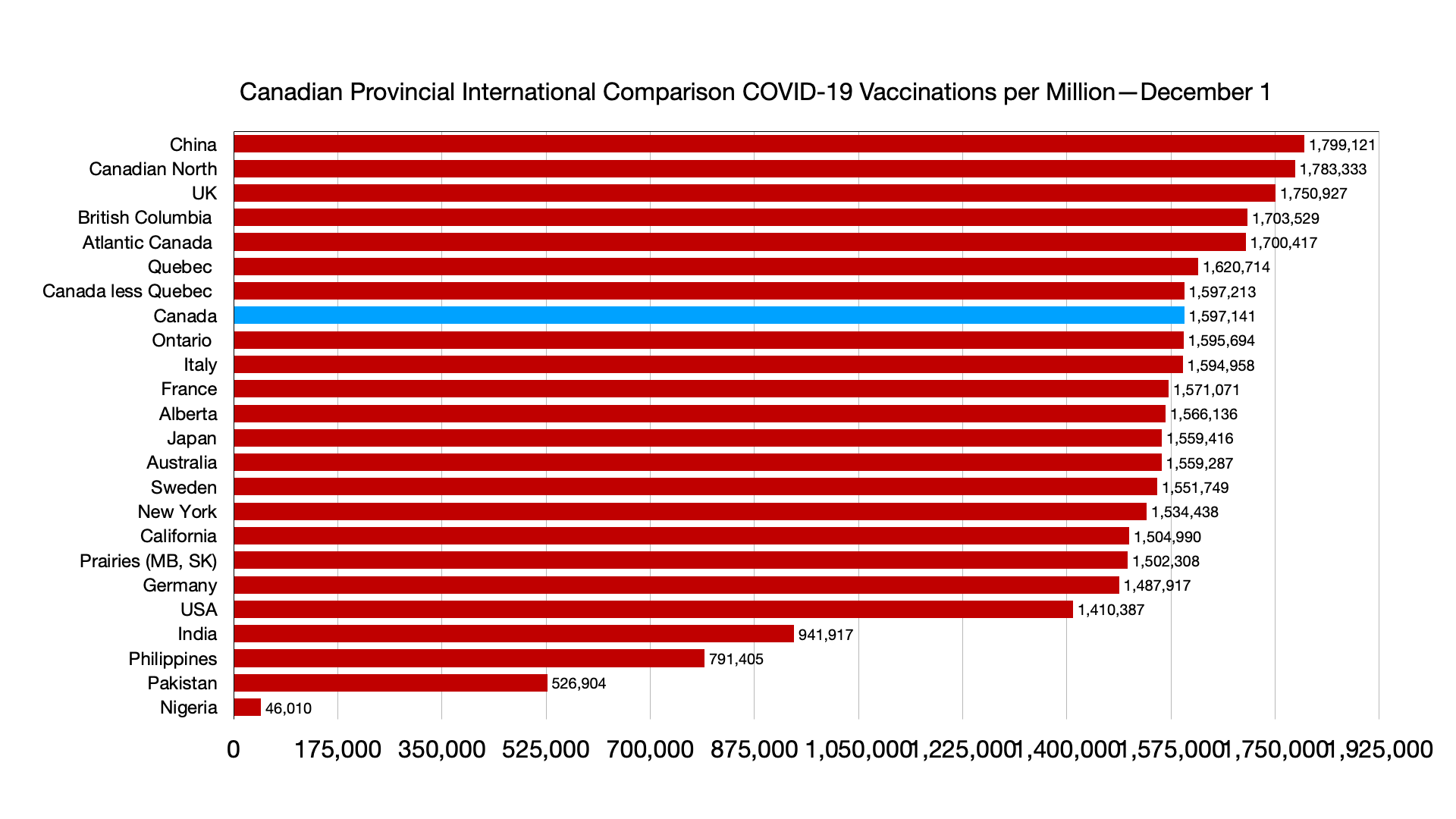
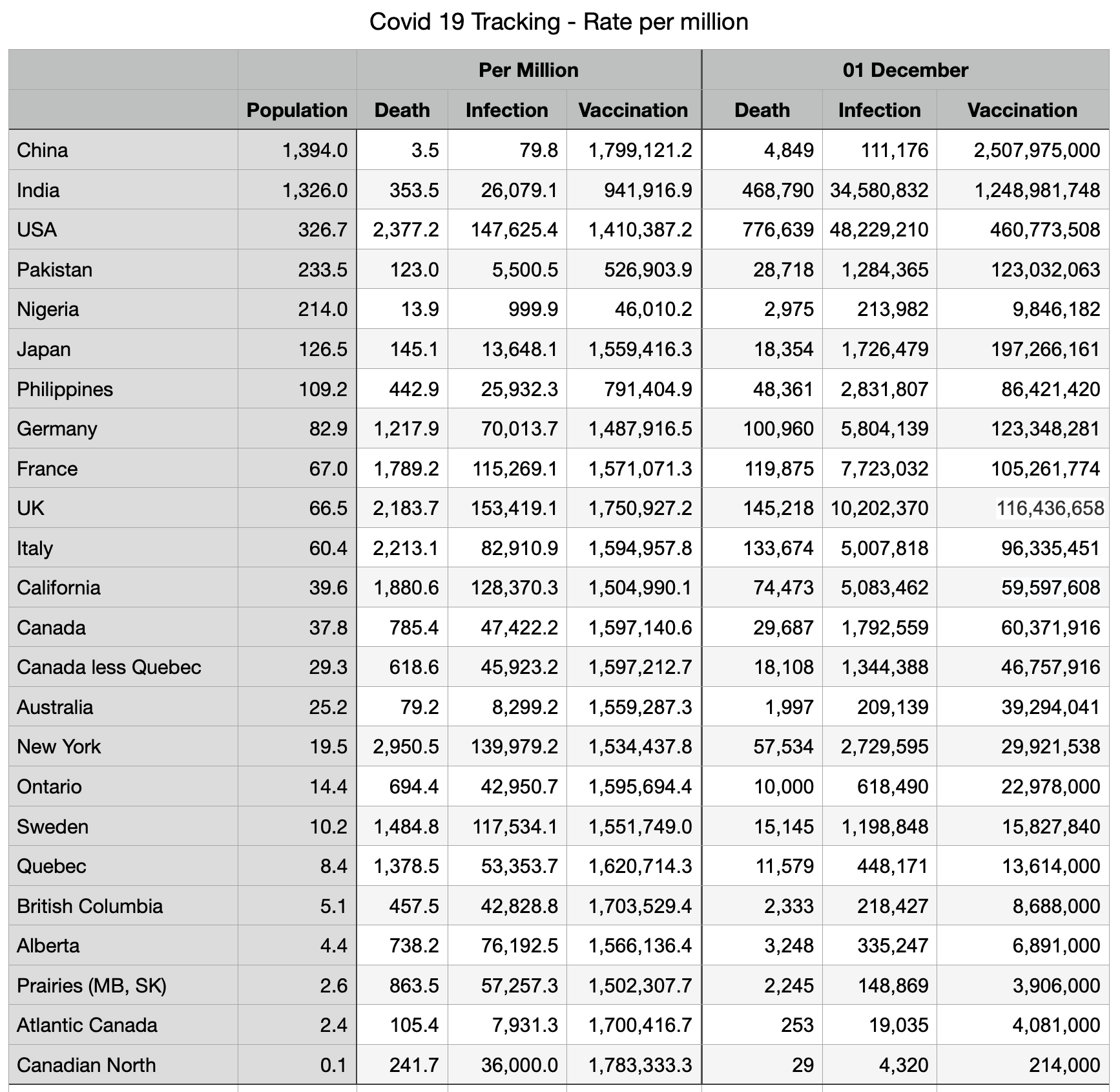
The latest charts, compiled 20 October. Canadians fully vaccinated 73.7 percent, higher than USA 57.6 percent and the UK 67.1 percent). But all countries have essentially plateaued, making it highly unlikely that they will reach targets 80 percent or higher.

Vaccinations: Atlantic Canada ahead of China, Canadian North ahead of Ontario, Alberta ahead of UK, California ahead of Germany.  China fully vaccinated 75 percent (unchanged), India 20.6 percent.

Trendline Charts:

Infections: The chart shows the number of infections in Alberta starting to level off unlike the Prairies or British Columbia.

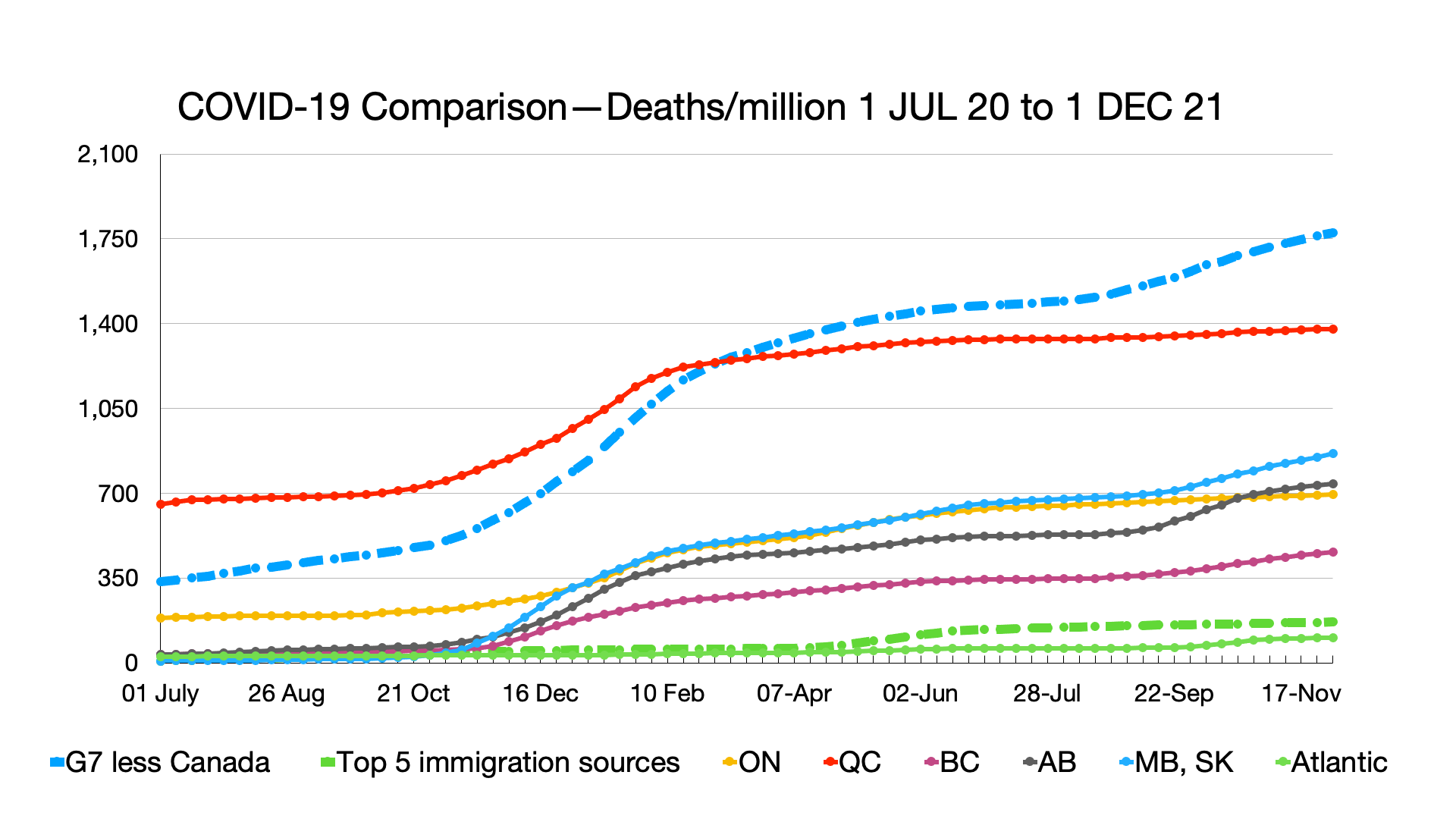
Deaths: Alberta deaths, along with the Prairies albeit to a lesser extent, continue to climb.

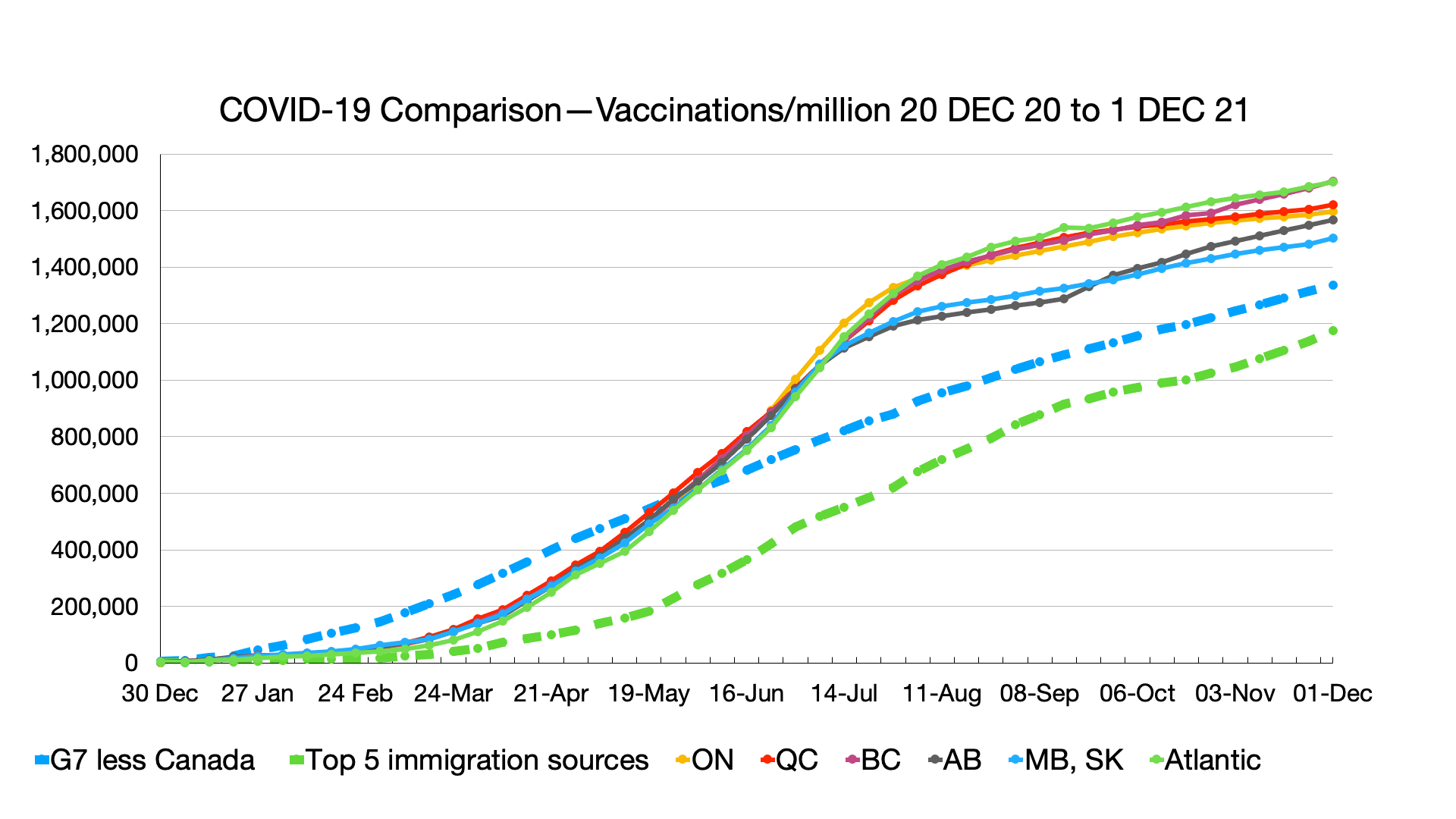
Vaccinations: Alberta vaccinations continue to surpass the Prairies. Immigration source country vaccination rates tapering off.

Weekly

Infections: Canadian North ahead of India, Australia ahead of Pakistan.

Deaths per million: No relative change.

Meanwhile, the “UK faces calls for ‘Plan B’ with virus cases high and rising:”

Life has returned to normal for millions in Britain since coronavirus restrictions were lifted over the summer. But while the rules have vanished, the virus hasn’t.

Many scientists are now calling on the government to reimpose social restrictions and speed up booster vaccinations as coronavirus infection rates, already Europe’s highest, rise still further.

The U.K. recorded 43,738 new COVID-19 cases on Tuesday, slightly down from the 49,156 reported Monday, which was the largest number since mid-July. New infections have averaged more than 44,000 a day over the past week, a 16% increase on the week before.

Last week, the Office for National Statistics estimated that one in 60 people in England had the virus, one of the highest levels seen in Britain during the pandemic.

In July, Prime Minister Boris Johnson’s government lifted all the legal restrictions that had been imposed more than a year earlier to slow the spread of the virus, including face coverings indoors and social distancing rules. Nightclubs and other crowded venues were allowed to open at full capacity, and people were no longer advised to work from home if they could.

Some modelers feared a big spike in cases after the opening-up. That didn’t occur, but infections remained high, and recently have begun to increase — especially among children, who largely remain unvaccinated.

Also rising are hospitalizations and deaths, which have averaged 130 a day over the past week, with 223 reported Tuesday alone. That is far lower than when cases were last this high, before much of the population was vaccinated, but still too high, critics of the government say. Britain has recorded more than 138,000 coronavirus deaths, the highest total in Europe after Russia.

Against that backdrop, some feel Britons have been too quick to return to pre-pandemic behavior. Masks and social distancing have all but vanished in most settings in England, including schools, though Scotland and other parts of the U.K. remain a bit more strict. Even in shops, where masks are recommended, and on the London transit network, where they are mandatory, adherence is patchy.

A plan to require proof of vaccination to attend nightclubs, concerts and other mass events in England was dropped by the Conservative government amid opposition from lawmakers, though Scotland introduced a vaccine pass program this month.

Some scientists say a bigger factor is waning immunity. Britain’s vaccination program got off to a quick start, with shots given to the elderly and vulnerable beginning in December 2020, and so far almost 80% of eligible people have received two doses. The early start means millions of people have been vaccinated for more than six months, and studies have suggested vaccines’ protection gradually wanes over time.

Millions of people in Britain are being offered booster shots, but critics say the program is moving too slowly, at about 180,000 doses a day. More than half of the people eligible for a booster dose haven’t yet received one.

The U.K. also waited longer than the U.S. and many European nations to vaccinate children ages 12-15, and only about 15% in that age group in England have had a shot since they became eligible last month.

“It’s critical we accelerate the booster program,” said epidemiologist Neil Ferguson, a member of the government’s Scientific Advisory Group for Emergencies.

Ferguson said one factor influencing the U.K.’s high case numbers was that it has relied heavily on the AstraZeneca vaccine, “and, while that protects very well against very severe outcomes of COVID, it protects slightly less well than Pfizer against infection and transmission, particularly in the face of the delta variant.”

He also noted that “most Western European countries have kept in place more control measures, vaccine mandates, mask-wearing mandates, and tend to have lower case numbers and certainly not case numbers which are going up as fast as we’ve got.”

“But at the end of the day this is a policy decision for government to make,” he told the BBC.

Scientists in the U.K. are also keeping an eye on a new subvariant of the dominant delta strain of the virus. The mutation, known as AY4.2, accounts for a small but growing number of cases in Britain.

Francois Balloux, director of the University College London Genetics Institute, said the subvariant might be slightly more transmissible and was being “closely monitored.” But he said evidence suggested “it hasn’t been driving the recent increase in case numbers in the U.K.”

A report by lawmakers released last week concluded that the British government waited too long to impose a lockdown in the early days of the pandemic, missing a chance to contain the disease and leading to thousands of unnecessary deaths. Critics say it is repeating that mistake.

Last month, the prime minister said the country might need to move to a “Plan B” — reintroducing measures such as mandatory masks and bringing in vaccine passes — if cases rose so high in the fall and winter that the health system came under “unsustainable” strain.

For now, the government says it won’t change course, but will try to boost vaccination rates, with a new ad campaign and an increased number of sites outside of schools where kids can receive their shots.

Johnson’s spokesman, Max Blain, said “we always knew the next few months would be challenging.” But he said the government was trying to protect “both lives and livelihoods.”

“Clearly we are keeping a very close eye on rising case rates,” Blain said. “The most important message for the public to understand is the vital importance of the booster program.

But, he added: “There are no plans to move to Plan B.”

Source: UK faces calls for ‘Plan B’ with virus cases high and rising