Trudeau pushing softer approach to temporary visas, less focus on risk of overstaying

Would be nice if we actually had published data on the number of visa overstays to inform policy and monitor extent of issue (USA reports on overstays). Some progress in recognizing impact of immigration on housing…:

Prime Minister Justin Trudeau says he’s pushing Canada’s immigration system to soften its approach to processing visa applications and put less focus on the risk of visitors overstaying their short-term visas.

“We’re also trying to do a better job around temporary visas,” Trudeau said Friday.

“The system — I’ll be honest — is still based around, ‘Prove to me that you won’t stay if you come,’ right?” he said, arguing that it is easier for applicants to “convince” immigration officials to grant them visas if they have “a good job and a home and a house and a good status back home.”

On the other hand, people who are strongly motivated to be in Canada for family reasons could be seen by officials as more likely to overstay, he suggested: “If your mom talks about how much she loves you and just wants to be there (in Canada), and you’re there all alone, that’s scary.”

Trudeau made the remarks Friday during an hour-long meeting with about 25 Algonquin College nursing students in Ottawa. Many of them told him they are international students, and a handful mentioned visa issues.

During a question-and-answer session, one international student recounted being hospitalized for seven months and feeling isolated. She told the prime minister her mother had tried twice to get a visa to come visit her, but both applications were rejected.

Trudeau responded that it is vital for Canadians to have faith in the integrity of their immigration system. But he also suggested that he had asked Immigration, Refugees and Citizenship Canada to take a less defensive posture when issuing visas.

“We have to stop saying ‘Well, it would be a bad people, a bad thing, if these people were to choose to stay,'” Trudeau said. “Our immigration minister, Sean Fraser, is working very, very hard on trying to shift the way we look at immigration and make sure that we’re bringing people in.”

The prime minister told the student that the Immigration Department made the wrong call in deciding not to admit her mother.

“It would seem unfair to Canadians and to all sorts of people if there was a back door. These are all the things we’re trying to balance,” Trudeau said. “But I absolutely hear you. Your mom should have been able to come and see you.”

Trudeau added that the federal immigration system is challenged by Canada’s need to fill labour gaps and by numerous crises abroad that are causing people to flee their homes.

Trudeau also said Ottawa has to do a better job helping immigrants thrive. Otherwise, he said, Canadians’ warm feelings toward immigration could chill.

“An anti-immigration party would have a hard time succeeding in Canada, because so many Canadians understand how important that is,” Trudeau said. “We need to protect the fact that Canadians are pro-immigration.”

For example, he said there must be enough housing stock for newcomer families to establish themselves without breeding resentment among the Canadian-born population. But he suggested immigration could also help solve that problem.

“There’s a labour shortage in the construction industry and building houses. So as we bring in more people who can build houses, we will solve some of the housing shortage,” said Trudeau.

“There are solutions in this. Part of it is shifting the attitudes. Part of it is also just improving our ability to process (applications) using proper digital means and computer means.”

Fraser’s office confirmed that work is underway to look at how Ottawa issues visas for relatives of people already in Canada.

“Reuniting families is a pillar of Canada’s immigration system,” the minister’s spokeswoman, Bahoz Dara Aziz, said in a statement. “We continue to be guided by principles of fairness and compassion, and work to explore all avenues possible in bringing people together with their loved ones.”

Canada’s visa denials and processing delays have made global headlines in the past year, with citizens of developing countries finding themselves unable to attend global conferences hosted in Canadian cities.

This week, the International Studies Association went public with its struggles to get visas for hundreds of people set to attend a Montreal conference next month.

Despite presenting plane tickets, income data and evidence of funding they received to attend the conference, many attendees, including panelists, have been denied on the grounds that they can’t demonstrate a likelihood of returning home when the event is over.

The issues follow an uproar last year over the denial of visas for multiple African delegates to the International AIDS Conference, also held in Montreal, which had some accusing Canada of racism.

Data updated Tuesday show that visa applications take an average of 217 days to process for people based in Britain. It’s 212 days for people in France.

While citizens of those countries don’t need visitor visas to come to Canada, academics from many developing countries who are based in Paris or London do need a visa to attend a conference Canada.

The Immigration Department did not respond to the concerns until after The Canadian Press published an article Wednesday.

“IRCC works collaboratively with organizers of international events taking place in Canada to help co-ordinate processing of temporary resident visa applications for delegates or participants to Canada,” spokesman Jeffrey MacDonald said in an email.

“We are committed to the fair and non-discriminatory application of immigration procedures. We take this responsibility seriously, and officers are trained to assess applications equally against the same criteria.”

The department said the complexity and accuracy of information in a visa application can influence how quickly IRCC processes it, in addition to the staffing and resources of offices that handle the requests.

But the department also noted that the processing times it posts online are often not “reflective of reality.”

That’s because the estimate is based on how long it took officials to process 80 per cent of applications in the previous six to eight weeks. Those include long-backlogged cases.

“Processing times can be skewed by outliers, in particular applications from our older inventory that were previously on hold for a long period of time and are now being processed,” MacDonald wrote.

“Once this backlog of applications is cleared, we will start to see processing times more reflective of reality.”

Source: Trudeau pushing softer approach to temporary visas, less focus on risk of overstaying
U.S. border agents give rides to Quebec-bound migrants as side hustle, sources tell Radio-Canada

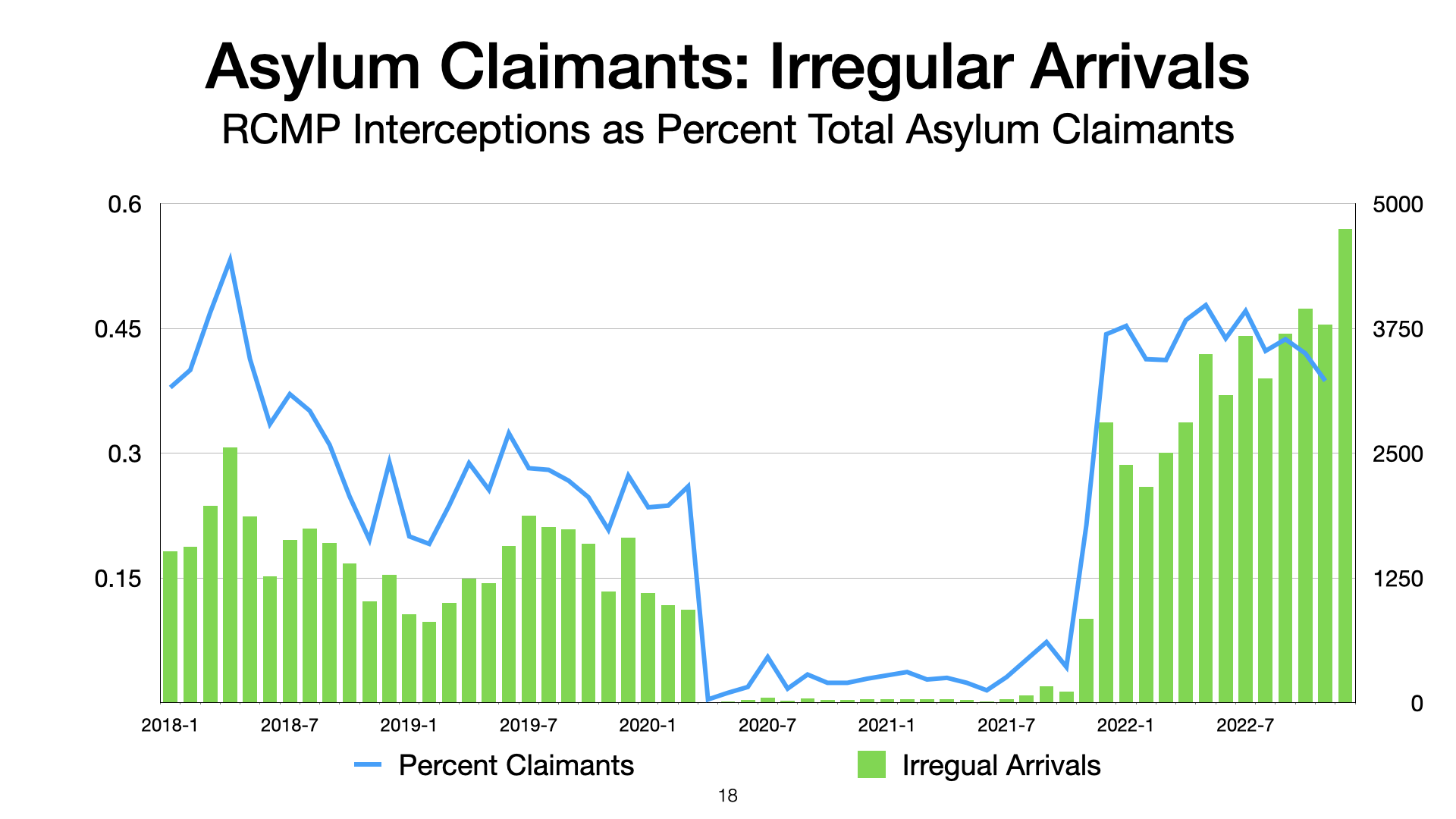
Hard not to see how this story, and the higher numbers, will not encourage the government to act (not just pretend to act?):

U.S. Customs and Border Protection (CBP) is investigating reports that some of its border patrol agents are driving Quebec-bound asylum seekers to the irregular border crossing on Roxham Road in exchange for money, picking up groups of people in nearby Plattsburgh, N.Y., while off duty.

Sources have told Radio-Canada the practice “has been known for a few months,” adding that several agents are involved, but the exact number is unknown.

The CBP’s Office of Professional Responsibility (OPR) said Friday it “is in receipt of these allegations and is conducting an investigation” but “the commencement of an OPR investigation is not indicative of wrongdoing or the substantiation of alleged misconduct.”

This situation has been reported to Canadian authorities, according to Radio-Canada sources.

Many people looking to cross into Canada use a regular bus line to get to Plattsburgh,which is about 30 minutes away from Roxham Road.

From there, they walk through a wooded passage, enter Canada and seek asylum.

CBSA says it’s ‘aware of situation

When first contacted by Radio-Canada, the Canada Border Services Agency (CBSA) confirmed twice in writing that it was aware of the transportation situation involving U.S. border patrol agents and migrants.

“We are aware of the information you are reporting,” said spokesperson Jacqueline Roby. She added that the CBSA “is in contact with the United States regarding irregular migration issues.”

In another written exchange, the CBSA repeated the same message while instructing Radio-Canada to contact its American counterparts, the CBP.

Source: U.S. border agents give rides to Quebec-bound migrants as side hustle, sources tell Radio-Canada

Wernick: The never-ending question of contracting in the public service

Interesting how some former clerks remain silent in retirement and others like Wernnick, play a useful public role in sharing their reflections over the unsolved (and perhaps unsolvable) systemic issues of government and governing:

Over the last few months, we have seen a rising tide of interest in the use of contracted services by the federal government. The latest episode seems to have crystallized around the use of consulting firms, notably McKinsey & Company. It has triggered another round of partisan squabbling at a parliamentary committee and the pack of journalists who cover politics are piling on, unsure of what narrative is the most important.

It is not clear what “theory of the case,” if any, is driving the current flap. At its simplest, the Opposition and the media are drilling wells hoping for a political gusher. Can they find something untoward in the contracting process? Can they find something troubling in the relationship with a particular supplier? Can you show poor value for money? If they can’t find proof of anything untoward, a stream of insinuation can still generate political rewards.

The more interesting angles to this are about whether the use of outside contractors is a sign of weakening capacity by the public service, at least the federal version, or augurs of a dangerous dependency. That is far from clear as a diagnostic and, once again, the point would be what tangible actions anyone is prepared to take to do something about it. For me, the issue is not whether to use outside suppliers of services, but how to use them to best effect.

There is nothing new about governments at every level acquiring services from outside suppliers, and no iron rule to lean on as to whether work is best done by public servants or contractors. It is a matter of judgment, informed by business choices around cost, timeliness and quality, and by ideological preferences about the role of the state.

There are three ways to get a flow of work done: by permanent public servants; by temporary public servants (term appointments, casuals, seasonal workers, students); or by outside contractors. The first two fall under “staffing” policies and processes, while the third falls under “procurement and contracting.” All three generate costs for the government. These days, Ottawa spends roughly $50 billion on its public service and $15 billion on contracted services. Is that mix the right one? If you want to dampen or cut government spending, which should be cut more deeply?

Permanent public servants are expensive, carrying a premium beyond their salaries in terms of benefits and future pension costs. They are difficult to move around and almost impossible to terminate for poor performance. They are entangled in a complex web of collective agreements and human resource mechanisms. They do however bring experience, expertise, loyalty, engagement and an orientation to the public interest, as opposed to short-term profit. The smart business choice is often to build up and develop sustainable capacity within a public service entity.

But the truth – uncomfortable for some – is that sometimes it makes more sense to go to an outside supplier where a pool of expertise resides. Just as the private sector does, it often makes sense for governments to outsource services, whether they are ongoing or related to a specific project with finite time frames. A large consideration is matching supply to demand.

The federal government is actually more than 300 distinct entities, most of them small, working on a vast array of tasks and projects. It would make little sense for each of them to build up permanent staff and cost structures to deal with the episodic need for some kinds of work. That is why there is a range of internal service providers such as Public Services and Procurement Canada, Shared Services Canada and the Translation Bureau. It is also why bringing in outside firms often makes sense.

It is commonplace and relatively uncontroversial now for governments to contract building maintenance and security, to retain external auditors and to hire legal counsel with specific skills. The federal government contracts translators and interpreters for specific events or tasks. It contracts communications firms to develop and place advertising, and to conduct market research to find out what users and citizens are thinking. I can recall a period of controversy about using temporary help agencies for administrative work.

As governments have moved more and more of their transactional and information services to the web and phone apps – while chasing rising expectations for speed, accuracy, cybersecurity and personalization – they have turned to firms that work with large private sector clients around the world that are wrestling with similar challenges. At their best, these firms help upgrade both the hardware and software of government technology, and train public servants to work with whatever is the emerging toolkit.

The pressure to continuously improve externally facing services and the internal services that support them make it sensible to retain firms that have worked with other governments and with private sector firms on queue management, customer relationship interfaces, customization of offerings, and protection of privacy and security. It is simply not true that public servants could keep up all by themselves. Nor is it true that all the people with the skills and knowledge needed by governments want to become public servants. Nor is it true that private firms always do good work – as we saw with the Phoenix pay system and with some apps, such as ArriveCAN – or do it at less cost.

What seems to be troubling some observers is the use of “management consultants,” which is a very elastic term. At their best, firms can offer an outside perspective on business processes, internal governance, organizational maturity, costing, risk management and other management issues. They can draw on international networks and expertise gained from working with a range of clients. For the public sector, they can be a useful antidote to inertia and the culture of “but that is the way we have always done things.”

The private sector uses external advisers extensively. I worked with several ministers who were highly sceptical of public service advice and insisted on running the issue by an outside firm with a big reputation before taking a decision. During spending reviews, ministers reflexively turn to outside advisers because they assume, with some justification, that the public service won’t be willing to challenge itself or consider new approaches.

The current McKinsey episode has surfaced concerns that advisory firms are starting to play a bigger role in decisions about policy – the “what” government chooses to do, as opposed to “how” it does it. It has also raised concerns that the public sector can become too dependent on outside firms with a profit motive and an interest in generating future work and billings. These are valid topics for scrutiny. Public service unions make valid arguments about the potential exploitation of gig workers with little job security or benefits at these outside firms. But there are valid arguments for using outside suppliers that can’t be dismissed as mindless privatization.

The boundaries between insourcing and outsourcing have always generated controversy. Can we use these brief periods of attention to do something about it beyond scoring short-term points?

The politicians and pundits who now argue for less use of external advisers should commit themselves in action or argument to a doubling of the resources allocated to training public servants and to a much expanded program for interchange of permanent staff between the public service, and the private and not-for-profit sectors. They should also endorse greatly expanding the resources used to acquire outside perspective and fresh ideas from the supply chain of think tanks and academic centres.

To be an intelligent buyer getting value for money for taxpayers and citizens, the public service must always invest in its leadership cadre, in its capacity in vendor management, in project management, and in its processes to onboard and internalize the skills and knowledge that working with outside advisors can provide. It should be possible to create a positive feedback loop and learning cycle that makes the public service better.

Source: The never-ending question of contracting in the public service

Nicolas: Claquer la porte 

Always interesting commentaries by Nicolas, and, given the variety of identities many of us have, of “slamming the door shut” rather than understanding and engaging:

Comme je suis liée au milieu universitaire, à la société civile puis au monde médiatique torontois, et du reste du Canada plus largement, depuis près de 13 ans, ma compréhension de notions comme le Québec bashing s’est nuancée au fil des années. On me permettra de partager ici quelques réflexions sur le sujet.

Notons que le concept de Québec bashing n’est pas utilisé ici de manière interchangeable avec la notion de « francophobie », qui regroupe un ensemble d’attitudes touchant directement les francophones qui sont en situation minoritaire, à l’extérieur du Québec. On pourra y revenir dans un autre texte.

Est-ce que « les Anglais nous méprisent et nous haïssent », comme l’avancent certains tribuns et autres fins sociologues peu réputés pour faire dans la dentelle ? La vérité, c’est que, tout comme la société québécoise s’est profondément transformée au cours des dernières décennies, le reste du pays n’est aussi plus ce qu’il était. Tout comme au Québec, donc, il y a ailleurs au Canada un clivage générationnel important entre ceux qui se souviennent des négociations constitutionnelles et des référendums, et ceux qui étaient trop jeunes. J’ai surtout été témoin, parmi les générations plus âgées, de deux attitudes principales.

La première est surtout nourrie par une lassitude : on n’a jamais vraiment compris (ou voulu comprendre) la différence québécoise, et on a l’impression que le Québec, politiquement, est une espèce d’enfant gâté qui utilise son poids politique dans la fédération pour ne pas jouer selon les mêmes règles que tout le monde. On a pu lire souvent, par exemple, que si Justin Trudeau n’a pas critiqué aussi vertement François Legault que Doug Ford pour leurs usages récents de la disposition de dérogation, c’est parce que le Québec fait l’objet d’un traitement de faveur.

La deuxième s’appuie sur une fascination parfois très sincère, parfois quelque peu fétichisée pour le Québec. Parce qu’on a encore un souvenir très vif de la fragilité de la fédération, une certaine élite canadienne exprime sa passion pour « l’unité nationale » par une curiosité particulière pour le Québec et son évolution.

Chez les plus jeunes (et les plus récemment arrivés au Canada), la question se pose autrement. Tant ici qu’ailleurs au pays, la question de « la différence québécoise » au sein du Canada a émergé politiquement pour les millénariaux et la génération qui les suit non pas par le débat sur la souveraineté, mais d’abord à travers toute la saga des accommodements raisonnables, puis par le débat sur la Charte des valeurs, le racisme systémique, les lois 21 et 96, etc.

Il y a une différence fondamentale — j’insiste, fondamentale — entre un jeune de Scarborough ou de Mississauga, immigrant ou enfant d’immigrant, qui n’entend parler politiquement du Québec qu’à travers le refus de sa classe politique de reconnaître le racisme systémique ou de nommer l’islamophobie, et un conservateur de l’Ontario ou du Manitoba rural qui a absorbé, un peu par osmose, les vieilles rengaines orangistes de ses aïeux. J’ai été beaucoup en contact avec l’un, par exemple, lorsque j’étais chargée de cours à l’Université de Toronto, alors que j’ai surtout vu l’autre sévir dans les sections commentaires de certains journaux.

Les deux posent, lorsqu’ils en ont l’occasion, des questions que l’on peut sentir empreintes d’une méconnaissance profonde de la société québécoise dans toute sa complexité et ses nuances. Mais les postures de base et les dynamiques de pouvoir qu’elles sous-tendent ne pourraient être plus diamétralement opposées. Je ne peux pas répondre à mon étudiante qui se préoccupe de l’impact des débats identitaires québécois sur le reste du climat politique canadien — et donc, en fin de compte, sur sa propre sécurité, comme s’il s’agissait de la réincarnation de James Wolfe prêt à revenir brûler nos villages avec son armée.

Cette différence, on est trop peu nombreux à la saisir au Québec. Pour la faire, il faudrait que ceux qui commentent ces questions se sortent eux-mêmes, un tant soit peu, de leur propre lassitude, indifférence, et ignorance du Canada dans toute sa complexité et ses nuances. Depuis le temps que je parcours la 401 dans un sens comme dans l’autre, il y a au moins une chose qui m’apparaît claire : dans ce pays, le sens de la caricature a toujours été parfaitement bilingue.• • • • •

Dans le contexte, on me demande parfois pourquoi je reste dans le dialogue avec le reste du Canada, ou pourquoi je ne claque pas la porte d’un média qui a déjà publié des opinions douteuses sur le Québec dans le passé. Serais-je ainsi complice du Québec bashing ?

La réponse, c’est que je suis une Québécoise francophone de même que je suis une femme, une personne noire et une personne queer. Si je croyais opportun de claquer la porte de toutes les salles de rédaction qui publient des opinions qui viennent heurter mon vécu personnel et familial tant sur le plan de la langue, de la race que du genre, je ne travaillerais plus nulle part, dans aucune langue. Personnellement, je préfère ne pas hiérarchiser les différents aspects de qui je suis, et tente de rester cohérente dans ma manière de réagir à toutes les attaques.

On en comprend que l’impatience, le brûlage de pont et le claquage de porte, donc, sont surtout des réflexes politiques partagés par les personnes socialisées comme majoritaires au sein de leur société. Il faut avoir le luxe, en quelque sorte, de savoir qu’on peut toujours éviter les dialogues difficiles en se repliant vers un monde où les normes sont pensées pour nous. Remarquons enfin que les francophones des autres provinces ont, de manière générale, développé une culture de la résistance politique très différente de celle qui s’affiche souvent au Québec.

Source: Nicolas: Claquer la porte 

Khan: How a Quebec current affairs show offered a model for how to talk about Islamophobia

Good example:

It has been a bruising two weeks, to say the least, in Quebec. Here, there has been strong reaction to the Justin Trudeau government’s appointment of Amira Elghawaby as Canada’s Special Representative on Combatting Islamophobia, with a mandate of providing outside advice and guidance to the federal government.

But Ms. Elghawaby’s previous writings pertaining to Quebec set off a firestorm in the province. In a 2019 opinion piece, she and co-author Bernie Farber cited a poll in saying that “the majority of Quebeckers appear to be swayed not by the rule of law, but by anti-Muslim sentiment” in their support for Bill 21, which restricts certain public-sector employees from wearing religious symbols while on the job.

Now, this has unleashed calls for her resignation from four provincial and two federal political parties, in spite of her sincere apology for the hurt caused by her words; some have even called for the abolition of the position itself. In response to these accusations of Quebec-bashing and contempt for the people of Quebec, there have been counter-accusations of Islamophobia for the treatment of Ms. Elghawaby, as well as for Bill 21. It’s as if the two solitudes have been shouting at each other, which has only tragically entrenched them in their positions.

So it was bold for Radio-Canada to enter the fray with a televised debate around these very issues, on the popular current affairs show Tout le monde en parle, hosted by the brilliant Guy A. Lepage. The guests were Maxime Pedneaud-Jobin, the former mayor of Gatineau, Que., and Boufeldja Benabdallah, a co-founder and spokesman of the Islamic Cultural Centre of Quebec, where six Muslim worshippers were murdered in 2017.

But while the two men differed on a number of issues, they did so respectfully, with nuance, humour and a heartfelt appeal for mutual understanding.

Mr. Pedneaud-Jobin, who is now a columnist for La Presse, had penned a piece on the suffering of the Quebec people under the yoke of the Catholic Church. His great-grandmother died at the age of 34, following her 13th pregnancy, of which eight had come to term; his grandmother gave birth to 11 children, after which her priest had blessed her for “doing her part.” These were the days when the Church controlled much of the state and the lives of Quebeckers, and according to Mr. Pedneaud-Jobin, the harms it perpetrated far outweighed the good. A friend of mine likens that era to present-day Iran. This is why a generation of Quebeckers is averse to religion – especially any foray into government.

For Mr. Pednault-Jobin, Bill 21 is a compromise, in that it is not an outright ban on all government employees. He also explained that in Quebec, collective rights are more prominent than in the rest of North America, where individual rights hold sway. One may not agree, but this was useful – and necessary – in understanding why people support the law.

For his part, Mr. Benabdallah eloquently shared his appreciation for the Quebec people, the vast majority of whom have extended kindness to the Muslim community since the 2017 murders. He said he was “devastated” by Ms. Elghawaby’s comments – they didn’t reflect his own experience – but as a man of peace, he believes she should be given the opportunity to prove herself, since she has apologized. As for the laïcité, Mr. Benabdallah agreed that religion should have no influence on government affairs, but he took issue with Bill 21. If it was as benign as its supporters claim, he said, there would have been no need for the province to use the notwithstanding clause to shield it from both the Canadian and Quebec Charters.

On the question of the representative job itself, Mr. Pednault-Jobin drew from his mayoral experience, arguing that money spent on local, on-the-ground programs would be far more effective than funding a federal post. He also preferred a position that would combat all forms of discrimination. As a counterpoint, Mr. Benabdallah pointed out that 11 Muslim Canadians have been murdered in three separate attacks over a four-year period, and that anti-Muslim sentiment has not stopped, making the specificity necessary. But he did also agree with the need for an office to combat antisemitism.

And so it went: a palette of ideas, offered up for reflection with much wisdom and from cooler heads. This juxtaposition of opposing views, served in a humane manner to enhance understanding and respect, should be a model for discussion of other contentious issues. In this way, there is an opportunity for a gradual rapprochement amidst colliding histories within our human family. We don’t need to shout past each other; we need to listen.

Sheema Khan is the author of Of Hockey and Hijab: Reflections of a Canadian Muslim Woman.

Source: How a Quebec current affairs show offered a model for how to talk about Islamophobia

Ndiaye: Voici pourquoi il est difficile – et peu souhaitable – de « fermer » le chemin Roxham

We will see what the SCC rules. But not convinced that the shutting or Roxham Road would have a minimal impact on numbers. The reason why over 95% choose Roxham is because of its convenience, relatively low risk and accessibility. Some are likely to weigh the risks accordingly and thus results in fewer irregular arrivals:

« Fermer » le chemin Roxham a été invoqué à maintes reprises ces dernières semaines, tant par des chroniqueurs que des élus, créant même un imbroglio entre la ministre québécoise de l’Immigration, Christine Fréchette, et son propre gouvernement caquiste. En 2022, un record de 50 000 demandeurs d’asile sont passés par le désormais célèbre chemin, qui relie la Montérégie et l’État de New York.

Ces demandeurs d’asile évitent les postes-frontières officiels entre le Canada et les États-Unis en raison de l’entente sur les tiers pays sûrs, signée en 2002 et entrée en vigueur en 2004. En vertu de cette entente, « les personnes qui entrent au Canada à un point d’entrée terrestre ne sont toujours pas admissibles à présenter une demande de statut de réfugié, et seront renvoyées aux États-Unis à moins qu’elles ne satisfassent à l’une des exceptions prévues dans l’Entente ».

Il y a en effet peu de chances qu’un demandeur d’asile puisse invoquer des persécutions aux États-Unis, un pays considéré comme « sûr ». De fait, sur les 62 113 demandes encore en instance devant la CISR en septembre 2022, seulement 274 considéraient les États-Unis comme pays de persécution.

La question qui se pose est la suivante : est-ce que l’entente sur les tiers pays sûrs pourrait être appliquée tout au long des 8 891 km qui nous séparent des États-Unis, afin de limiter le passage de ces demandeurs d’asile empruntant le chemin Roxham et d’autres chemins alternatifs ?

Du point de vue opérationnel, la réponse est non. Pas plus que le Québec ne peut fermer le chemin Roxham, car c’est le gouvernement fédéral qui a la compétence pour gérer les frontières canadiennes.

Par ailleurs, le Canada est soumis à des obligations résultant de la Charte canadienne des droits et libertés : il ne peut renvoyer les demandeurs d’asile vers un pays où il existe un risque de torture. En vertu du droit international, le Canada a aussi ratifié la Convention relative au statut des réfugiés et la convention contre la torture, qui implique ce principe de non-refoulement à toute personne risquant la torture, des traitements inhumains ou dégradants.

Professeure de droit des migrations à l’UQÀM, je suis directrice de l’Observatoire sur les migrations internationales, les réfugiés, les apatrides et l’asile (OMIRAS). Je propose ici un survol de ce que disent les lois internationales sur l’accueil de réfugiés.

Devant la Cour suprême

La saga judiciaire pour invalider l’entente sur les tiers pays sûrs a débuté en 2007 devant la Cour fédérale, ensuite devant la Cour d’appel fédérale, et s’est finalisée en 2009 par un rejet de la Cour suprême.

Depuis 2020, avec l’arrivée de dizaines de milliers de demandeurs arrivant des États-Unis par des points d’entrée non officiels, une nouvelle demande a été introduite par Amnistie internationale, le Conseil canadien des Églises, le Conseil canadien pour les réfugiés et des demandeurs d’asile afin de faire invalider l’entente. À la suite de plusieurs aller-retour devant la justice, une demande d’autorisation d’appel a été introduite. Le 16 décembre 2022, la Cour suprême a accepté de recevoir la cause et de réviser l’entente. Il faudra donc attendre la décision de la plus haute juridiction canadienne sur la validité ou non de l’entente

Un droit garanti en droit international

Le Canada accueille un nombre infime des demandeurs d’asile dans le monde. Le HCR les estime à plus de 4,9 millions. À eux s’ajoutent les 25 millions de réfugiés et plusieurs autres millions de déplacés internes. La plupart vivent dans les pays limitrophes de leur pays d’origine, comme la Jordanie, la Turquie ou le Liban, au Moyen-Orient, la Colombie, en Amérique du Sud, ou l’Ouganda et le Kenya, en Afrique (continent qui accueille le plus grand nombre de réfugiés).

Ultimement, le Canada est obligé de laisser les gens disant fuir des persécutions présenter leurs demandes d’asile, un droit garanti par l’ONU. Toutes ces demandes d’asile doivent être jugées recevables avant d’être transmises à la Section de protection des réfugiés, compétente pour examiner les demandes de protection internationale au Canada. Si les demandes remplissent les critères, les personnes seront reconnues comme des réfugiées au Canada.

Migrants irréguliers et demandeurs d’asile

Il y a présentement un amalgame entre migrations irrégulières et accueil des demandeurs d’asile. Pour ces derniers, l’entente sur les tiers pays sûrs leur permet d’arriver au Canada à travers le chemin Roxham (à leurs risques et périls). L’invalidation de l’entente permettrait aux personnes disant fuir des persécutions de présenter leur demande d’asile en toute sécurité au Canada, quel que soit leur lieu d’arrivée. Notons que des organisations de défense des migrants, dont Amnistie internationale, relatent des pratiques qui enfreignent les droits humains des demandeurs d’asile aux États-Unis.

Pour les migrations irrégulières, le Canada dispose d’un Programme d’aide mondiale aux migrants irréguliers (PAMMI) et des dispositions législatives pour éradiquer l’immigration irrégulière. Le Québec devra continuer la collaboration avec le gouvernement fédéral afin de lutter efficacement contre les migrations irrégulières notamment en ciblant les causes réelles de ces déplacements (inégalités économiques, changements climatiques, conflits et violences dans le monde).

D’autres chemins ouvriront

Le chemin Roxham présente des enjeux complexes. Mais il faut le situer dans son contexte mondial, avec la présence de plus de 100 millions de personnes en exil dans le monde.

Devant l’afflux de plus en plus de réfugiés, plus de 68 % des Québécois souhaitent la fermeture du chemin Roxham. Les pressions sur le système se font grandissantes. Il en coûte 20 millions de plus par mois à Québec en prestation d’aide sociale, notamment en raison du fait que le Québec accueille 64 % de ces demandes d’asile au Canada et que le Canada tarde à délivrer des permis de travail.

Malgré cela, il n’est pas pertinent de fermer le chemin Roxham, car d’autres points d’entrée le remplaceront, exposant les demandeurs d’asile à davantage de risques et de dangers. L’exemple de l’Union européenne est révélateur : dès qu’une route se ferme, d’autres encore plus dangereuses s’ouvrent et le nombre de personnes décédées ou disparues grimpent. À cela s’ajoutent les multiples violations des droits humains dont font l’objet ces millions d’hommes, de femmes et d’enfants fuyant les guerres et les persécutions.

Source: Voici pourquoi il est difficile – et peu souhaitable – de « fermer » le chemin Roxham

ICYMI – Hébert: Justin Trudeau’s anti-Islamophobia disaster reveals a government dangerously out of touch with voters

Of note, searing yet valid:

By appointing Amira Elghawaby as his lead representative on the Islamophobia file, Prime Minister Justin Trudeau has thrown the equivalent of a political grenade into his Quebec trenches.

The damage to his party and to the cause she is tasked with advancing could be consequential.

Here is an early assessment.

At week’s end, Elghawaby’s appointment had been disavowed by most of the leading figures of Quebec’s political class.

The ranks of those who believe Trudeau should reconsider his choice extend well beyond the fans of Quebec’s controversial law on securalism and its attending ban on religious vestments in selected public service workplaces.

Take former NDP leader Thomas Mulcair. Throughout his tenure, he had been a top Quebec anti-Islamophobia advocate.

His uncompromising defence of religious and minority rights has come at some political cost. In the 2015 election, his denunciation of the Conservatives’ so-called niqab ban took a toll on NDP fortunes in Quebec. 

In his Montreal Gazette column this week, Mulcair argued Elghawaby, a former Star columnist, was the wrong person for the job. That is also the position of the provincial Liberals, the party with the most diverse base. (Mulcair then stated in a subsequent column he was willing to accept her apology at face value. The Quebec Liberals did not.) 

No one in Quebec seriously expected Trudeau to appoint a special representative on anti-Islamophobia who was a supporter of Bill 21. But, by the same token, few expected the prime minister to appoint someone who had burned her bridges with Quebecers on her way to this new role.

A lot of the media commentary this week has focused on Elghawaby’s misrepresentation of a poll to shore up her assertion that most supporters of Bill 21 are Islamophobic.

But chances are her apology for an ill-thought-out column would have found more takers if it had not been part of a larger pattern.

The latter suggests either an abysmal ignorance of Quebec history or a blatant indifference to Canada’s less-than-glorious past treatment of its francophone minority.

In a since-deleted tweet, Elghawaby wrote that assertions to the effect French-Canadians had been oppressed and seriously discriminated against under the British rule made her want “to throw up.”

Coming from someone who lives in Ontario — a province that once outlawed any teaching in the French language — that’s a rich comment.

Should she develop an appetite for facts, Trudeau’s representative may want to acquaint herself with the findings of the Royal Commission on Bilingualism and Biculturalism. Alternatively, she might want to read up on the deportation of Canada’s Acadian community.

But whether she does or not, it will likely be too little, too late.

Given her baggage, it will be hard for Elghawaby to be much of an asset to Quebec’s anti-Islamophobia forces.

Moving on to Trudeau. He and his Liberals have just been on the receiving end of the biggest Quebec backlash of his tenure as prime minister. 

By all available indications, the prime minister was only aware of some of Elghawaby’s musings about Quebec prior to her appointment. He may not have been briefed about the vomit tweet.

What is certain is that, notwithstanding any after-the-fact apology, anyone who had cavalierly dismissed the historical grievances of Canada’s Indigenous Peoples would not have been appointed to a federal bridge-building role. 

It sometimes seems the due diligence approach of this Prime Minister’s Office to the vetting of high-profile appointments is to dismiss potentially inconvenient facts rather than dig into them.

On that score, the most glaring example remains Julie Payette’s elevation to the role of governor-general. 

In this case, the tendency seems to have been compounded by a serious PMO disconnect from Quebec.

If there is someone on Trudeau’s staff with a solid Quebec antenna and the influence to draw attention to red flags, he or she must have taken January off.

And if such a person does not currently exist, prudence would have required turning instead to his Quebec ministers for advance feedback on the planned appointment.

Judging by the stunned reaction of the prime minister’s Quebec lieutenant, Pablo Rodriguez, that did not happen.

This latest mess comes on a week when an Abacus poll found the Conservative party with a solid lead on the Liberals in national voting intentions. 

For months, all polls have shown that, among the larger provinces, Quebec was most responsible for keeping Trudeau’s party competitive with the Conservatives. The Liberals can only hope that won’t change as a result of this week’s events.

In the larger picture, the Abacus poll found that 75 per cent of Canadians do not believe the current government is focused enough on the top-of-mind cost-of-living crisis. The numbers on health care were not much better for the government.

Against that background, a Liberal week spent on the defensive on the divisive front of identity politics can only drive home the opposition’s message that on the issues that matter most to voters these days, Trudeau’s government is missing in action.

Source: Hébert: Justin Trudeau’s anti-Islamophobia disaster reveals a government dangerously out of touch with voters

McWhorter: Police Brutality Is Not Always About Race

A reminder:

The brutal killing of Tyre Nichols by Memphis cops horrified and infuriated many Americans, not least because it was another in what has been an endless litany of Black men and boys killed by police officers in America: George Floyd, Eric Garner, Philando Castile, Tamir Rice, Michael Brown and literally thousands of names less well known. There is one confounding detail in Nichols’s death, however. The five policemen who mercilessly beat the life out of him were all Black.

Thus, to understand the full tragedy of Tyre Nichols, it is important to ask hard questions about the culture and behavior of police officers — including grappling with the fact that whatever role race played in Nichols’s death, it was more complicated than the racist-white-cop-kills-Black-man framework into which we typically sort such horrific episodes. One possibility that needs further exploration is the role that poverty plays in determining the victims of police killings — a characteristic that overlaps with but is obviously distinct from race.

Much of the conversation about police violence in recent years has been through a lens of systemic racism, white cops and antiracism reform goals. But a man (or a woman) who is killed by a police officer merits our attention and response, regardless of the race of either victim or killer. There has long been a theory afoot that hiring more Black cops would result in fewer shootings of Black civilians. But there is little evidence that this intuitive solution has any meaningful effect. (It’s worth noting here that there is substantially more readily available data regarding the race of victims of police violence than that of the perpetrators.)

More than one study has suggested that the difference in likelihood between white and Black cops killing Black people is much smaller than one might suppose. Expert observers on the subject regularly concur, and it is a commonplace in Black community discussions that one cannot necessarily expect any particular clemency from Black officers in tough situations. The Memphis Police Department is 58 percent Black and has a Black police chief; that did not prevent the horrific acts of violence perpetrated on Nichols.

As Duane Loynes Sr., an assistant professor of urban and Africana studies at Rhodes College in Memphis, told The Los Angeles Times’s Jaweed Kaleem, “Here’s a dirty little secret: Studies indicate that Black officers are just as brutal and at times even more brutal against Black bodies as their white counterparts.”

The point is not that we don’t have a grievous problem but rather that the problem is not exclusively racist white cops. It’s cops, period. (An important note: When it comes to nonlethal mistreatment, as opposed to police shootings, studies demonstrate the existence of outright racial bias. This is very much a problem but a very different problem from police killings.)

The way we are trained to view the situation is understandable but outdated. As recently as the 1970s and 1980s, cops killed people — Black and white alike — at much higher rates in major cities than they do now, as the criminologist Peter Moskos has shown. I grew up in the Philadelphia of that era, where Mayor Frank Rizzo openly condoned cops’ brutality against Black people. By morbid coincidence, I saw the gruesome videotaped beating of Nichols shortly after I rewatched Melvin Van Peebles’s pioneering 1971 film “Sweet Sweetback’s Baadasssss Song.” In the movie, Van Peebles plays a Black man on the run from racist white cops whose shameless, bloodletting brutality roughly corresponded to what some Black people of the period actually experienced. A lot of time has passed since then, but the way we discuss police brutality against Black people today can sometimes make it sound as if there is no difference between the situation Van Peebles depicted — of marauding, openly racist cops — and the one we face today.

Yet white Americans are also killed by police officers in appalling numbers — many more, overall, than Black Americans, owing to the fact that the latter make up only about 14 percent of the U.S. population. In 2022, The Washington Post’s database on cop killings documented that of 755 victims whose race was known, 225 were Black and 389 were white.

Because casual and sometimes lethal violence against Black people by cops is part of our shameful and still recent national narrative, names like those of the victims I cited earlier sometimes become national news stories. But the media rarely even covers police killings of white people, which don’t fit so neatly into that existing narrative.

So we largely missed the story that in 2015 in Paradise, Calif., a white officer, Patrick Feaster, shot a white man, Andrew Thomas, as he was getting out of the S.U.V. he had crashed during a pursuit, even as Thomas’s wife lay gravely injured on the ground at the scene. The parallel with what happened to Nichols is ghastly, as is that between Floyd’s murder and what happened in 2016 to Tony Timpa, a white man in Dallas. Although Timpa had requested police officers’ help because he was off his medication, he was killed when they pinned him to the ground as he called out desperately. It was recorded on the officers’ body cams. Members of Timpa’s family have contacted me wondering why the media had so little interest in what happened to him; last year, the officer who had pinned him was promoted.

A common response here is to note that nevertheless, police officers kill unarmed Black people at more than three times the rate they kill unarmed white people and that this disproportionate rate of Black killings demonstrates that racism affects whether cops kill. But this assumption seems oversimplified. One reason is that poverty also helps determine whether — and in what way, with what results — one encounters the cops.

The police are called to, as well as directed to, poorer neighborhoods more often than to middle-class or affluent ones. Poverty can nudge a person into criminal activities — including intrinsically violent ones, such as the illegal drug trade — that are far more likely to lead to dangerous encounters with cops. It is also not an accident that so many of these gruesome killings by cops happen when someone flees after being stopped because he already has an outstanding warrant. Such warrants are frequently outstanding as a result of poverty.

And in a striking parallel, unarmed Black people are not only more than three times as likely as white people to be killed by a cop but also more than twice as likely to be poor. In 2021 the poverty rate for white Americans was 8.1 percent, while for Black Americans, it was 19.5 percent.

We could propose that the match between these statistics bears no relevance to the issue of police violence and racism and dismiss them as a coincidence. But this would be willfully resistant to examining the significance of patterns in a way that no one would even venture in drawing parallels between, for example, poverty rates and obesity.

Police killings of unarmed or unthreatening American citizens are a national disgrace and one that requires action. But action requires comprehension, and the simplest explanation — “racist white cops kill Black people” — is clearly often not the correct one.

Source: Police Brutality Is Not Always About Race

Dutrisac: Visas et immigration: y a-t-il un ministre responsable?

Bonne question? Malheureusement, trop d’exemples:

À la fin août de 2022, le ministre fédéral de l’Immigration, Sean Fraser, donnait l’assurance que les inacceptables délais pour la délivrance d’un visa de visiteur au Canada seraient considérablement réduits à compter d’octobre de la même année.

Le ministre faisait valoir que son ministère, Immigration, Réfugiés et Citoyenneté Canada (IRCC), embaucherait 1250 nouveaux fonctionnaires afin de régler « d’ici la fin de l’année » les importants arriérés dans la production de visas et de documents relatifs à des demandes d’immigration.

Or, comme l’a rapporté Le Devoir la semaine dernière, les délais pour obtenir un visa n’ont pas diminué ; bien au contraire, ils ont explosé. Entre l’engagement du ministre Fraser et janvier 2023, les délais, tels qu’ils ont été rendus publics par IRCC, se sont allongés pour 179 des 195 pays dont les citoyens doivent se munir d’un visa pour entrer au Canada. Et l’attente est franchement surréaliste. Quelques exemples : un an et demi pour la Tanzanie, au lieu de 64 jours l’été dernier, quelque 500 jours pour le Honduras ou le Nicaragua, alors que l’attente oscillait autour de 80 jours. Rappelons que le délai normal pour la délivrance d’un visa de visiteur par IRCC est de 14 jours.

Les explications du ministère ne sont pas des plus limpides : les fonctionnaires traitent des arriérés qui existent depuis longtemps. Une part de ces phénoménaux arriérés a été constituée pendant la pandémie. Le délai par pays, tel qu’il est affiché sur le site du ministère, dépend du temps qu’il a fallu pour traiter 80 % des demandes dans un intervalle de deux à quatre mois. IRCC a prévenu Le Devoir que ses chiffres « peuvent être faussés par des valeurs aberrantes ». Pas étonnant que des avocats qui assistent des étrangers dans leur démarche se plaignent du manque de fiabilité du tableau colligé par le ministère. Quelles que soient les justifications d’Ottawa, ces délais, tout en reposant sur des données douteuses, sont inadmissibles.

Selon le cabinet du ministre, bien que les chiffres se détériorent, les choses s’améliorent ; la capacité de traitement d’IRCC est passée de 180 000 demandes de visas par mois avant la pandémie à 260 000 en novembre dernier.

Sean Fraser est à la tête d’un ministère dysfonctionnel. À l’heure actuelle, il y a plus de 2 millions de demandes de tout ordre en attente au ministère, que ce soit pour des permis de travail, l’octroi de la résidence permanente, des décisions relatives aux demandeurs d’asile et à leur statut de réfugié, les demandes de visas, etc.

Selon une note de service interne d’IRCC, datée du début de décembre, dont le Globe and Mail a obtenu copie, le ministère est prêt à prendre des mesures draconiennes pour se sortir de ce magma kafkaïen où croupissent plus de 700 000 demandes de visas. Selon une des options envisagées, des exigences d’admissibilité tomberaient : le demandeur n’aurait plus à convaincre un agent d’immigration qu’il retournera dans son pays après son séjour (occuper un emploi, posséder une propriété ou des actifs financiers et avoir de la famille dans son pays d’origine) ni à en fournir des preuves. Seule la vérification relative à la sécurité et à l’absence de casier judiciaire demeurerait. Pour se sortir la tête de l’eau, le ministère est prêt à renoncer à assumer ses responsabilités. C’est tout un aveu d’incurie.

Cette négligence n’est pas sans conséquences. On peut penser aux pertes économiques que subit l’industrie touristique. Mais là n’est pas le plus important. Des milliers d’immigrants ne peuvent pas recevoir la visite de leurs proches restés dans leur pays d’origine. Ou s’ils y arrivent, c’est après des mois et des mois de retard et d’incertitude. Pour un pays qui se veut un modèle d’accueil pour ses immigrants, ce laxisme administratif envoie un mauvais message et nuit à sa réputation sur la scène internationale.

Les échanges culturels sont perturbés, tout comme les rencontres internationales qui se déroulent au Québec. Les conférences et colloques universitaires, qui comptent sur la présence de sommités en provenance de l’étranger, en pâtissent. Comme l’a rapporté Le Devoir, une conférence, organisée par l’Université de Montréal et, de surcroît, subventionnée par le gouvernement fédéral, pourrait être reportée parce que des chercheurs invités ne peuvent obtenir leur visa en temps utile. L’organisateur désespère de voir débarquer à Montréal des experts du Sénégal, du Maroc et du Cameroun. Pour un citoyen sénégalais, le temps d’attente est de 462 jours, confirme IRCC. La situation affecte non seulement les activités de recherche, mais aussi le rayonnement international de l’Université de Montréal, qui se veut l’université francophone la plus influente au monde.

Il existe un principe nommé responsabilité ministérielle : un ministre doit répondre de ses actions (ou de son inaction), mais aussi de celles de ses fonctionnaires. C’est un principe qu’on aurait avantage à se rappeler à Ottawa.

Source: Visas et immigration: y a-t-il un ministre responsable?

Mahboubi, Skuterud – The Unintended Consequences of Category-Based Immigrant Selection

Valid critique:

From: Parisa Mahboubi and Mikal Skuterud

To: Sean Fraser, Minister of Immigration, Refugees and Citizenship Canada

Date:  February 6, 2023

Re: The Unintended Consequences of Category-Based Immigrant Selection

Immigration, Refugees, and Citizenship Canada (IRCC) recently held consultations on plans aimed at giving the department more flexibility in how it prioritizes economic-class applicants for permanent residency.

The new rules will, in effect, free the immigration minister to bypass the existing system for selecting candidates, known as the Comprehensive Ranking System (CRS), to target applicants with particular “attributes” such as work experience in a particular occupation.

This may alleviate some labour shortages, but we see significant unintended consequences.

Leveraging immigration to boost average living standards in the population requires selecting immigrants whose Canadian earnings exceed average earnings in the pre-existing population, thereby pulling up average incomes and per capita GDP.

The CRS aims to achieve this by ranking and cream-skimming economic class candidates who have the highest expected Canadian earnings. This is estimated using data on the earnings of previous cohorts of immigrants who arrived with similar human capital characteristics. Of particular importance in the CRS calculation are education, age, language abilities, and Canadian work experience.    

Recent analysis using Statistics Canada survey and census data, as well as our own examination of immigrants’ income tax records (see Figure below,) provides encouraging evidence that the CRS has contributed to rising earnings for newcomers since its launch in January 2015.  

By prioritizing applicants’ occupations, IRCC hopes it can be more responsive to employer needs, as well as address Canada’s chronic labour shortages.

But accurately identifying labour market requirements and being sufficiently responsive is difficult, if not impossible. Tight labour markets can quickly become slack. By the time targeted immigrants arrive, their skills may no longer align with employer needs, thereby exacerbating long-standing mismatch issues between immigrant skills and job openings. For this reason, the CRS does not use specific occupational information in its calculation.

The raison d’être of the Temporary Foreign Worker Program, which allows Canadian businesses to employ guest workers on limited-term contracts, is to meet temporary labour-market shortages. The objective of our permanent immigration system, on the other hand, should be to drive new employment growth in high-productivity sectors that are intensive in their use of skills and new technologies.

Unfortunately, we increasingly have a system where our temporary and permanent immigration systems are focused on the same objective – satisfying employers’ current labour needs. The risk is that the overall immigration system fails to do anything well.

An important advantage of the CRS is its transparency. Candidates can determine their own scores using a simple online tool and IRCC reports cutoff scores in their bi-weekly draws allowing unsuccessful candidates to identify what’s needed to be selected. The category-based selection system that IRCC is proposing compromises this transparency by leaving screening criteria to the whims of the minister of the day. This risks increasing applicant confusion and frustration and increases the need for immigration consultants and lawyers to help applicants navigate the system. At worst, it drives applicants with the best outside options to other countries.

Allowing the ministers to determine which candidate attributes are prioritized also risks politicizing the process. Research shows that while temporary worker inflows in Canada are responsive to the intensity of corporate lobbying, the same has not been true for permanent immigration. One explanation is that ‘point systems’ like the CRS remove immigrant selection decision making from the political realm in the same way that the Bank of Canada’s inflation mandate keeps its interest rate decisions from being politicized. Look for that to change.  

In our view, prioritizing candidates’ occupational work experience in immigrant selection makes most sense in sectors where the competitive market mechanism to address labour shortages does not exist, such where wages are set by collective agreements or government regulation.

In these settings, labour shortages are less likely to induce the wage adjustments necessary to encourage job switching and training and education investments within the existing population. Chronic shortages of nurses and other healthcare workers are an important example.

Nonetheless, we question if it makes sense to prioritize applicants for permanent residency whose foreign work experience is in an occupation where credential recognition in Canada is problematic. It doesn’t really matter if credential recognition problems reflect genuine skill and competence issues, or the self-interested behaviour of professional associations. Either way, we are prioritizing applicants who will contribute relatively little to Canadian economic growth, thereby compromising the key objective of our economic immigration system.

In our view, IRCC’s planned reform of how it selects economic-class immigrants is just one step in a series of pandemic-era policies compromising the prioritization of skilled immigrants. The CRS has come to be seen by IRCC as a constraint rather than an effective quality-control mechanism. In prioritizing employers’ short-term labour needs, IRCC is being forced to lower the average CRS score of selected immigrants and, in turn, average expected earnings. The hard reality is that Canada’s newcomers continue to experience labour market challenges that are longstanding and exceptional. The risk is that the last decade’s significant gains will be undone.

Parisa Mahboubi is a senior policy analyst at the C.D. Howe Institute and Mikal Skuterud is professor of economics at the University of Waterloo. 

Source: Mahboubi, Skuterud – The Unintended Consequences of Category-Based Immigrant Selection