Differences of Opinion: How Canadian and US business leaders think about gender diversity

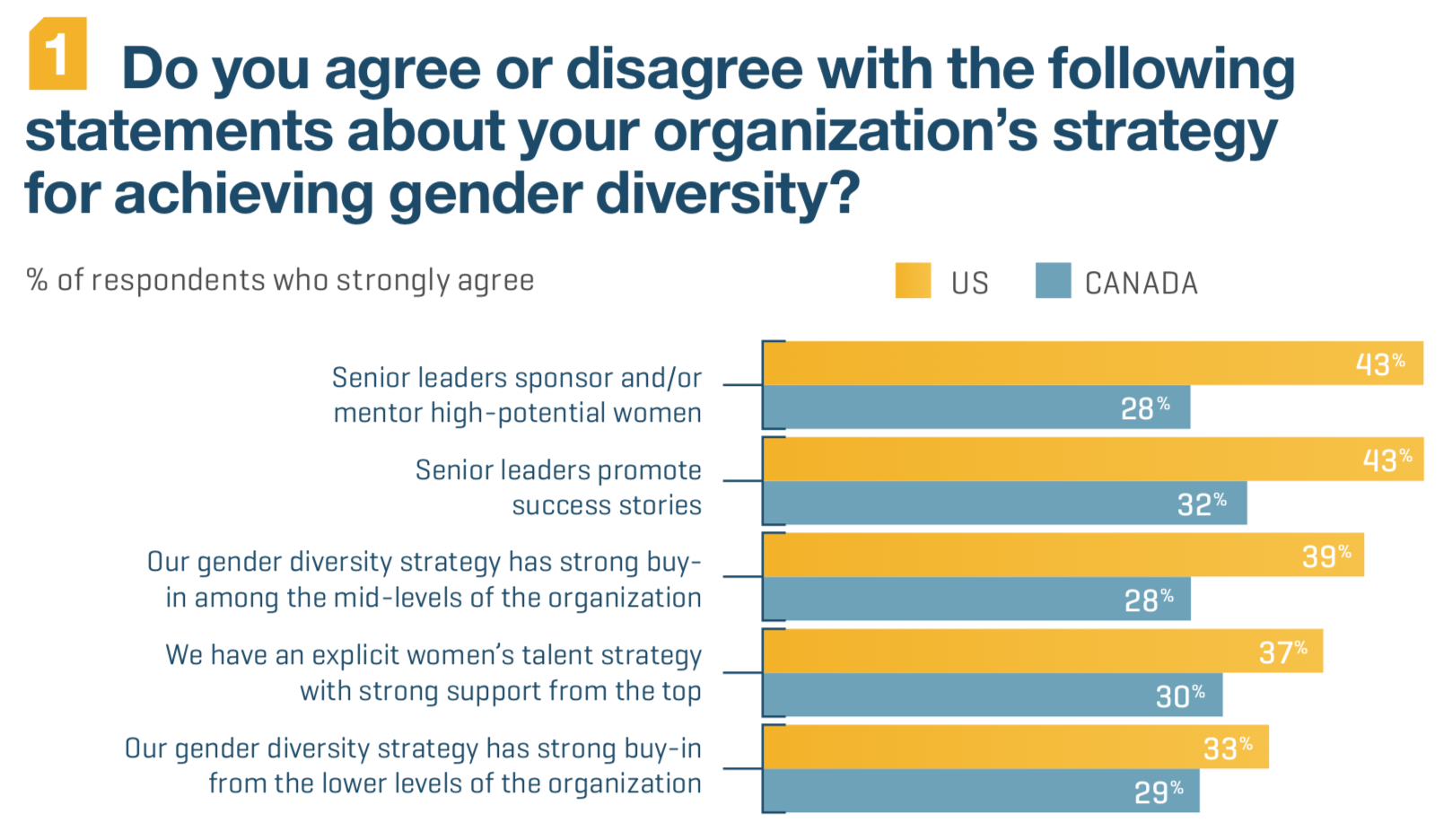
RBC continues to do interesting research and reports on diversity issues. This Canada-United States comparison being the most recent example (and it challenges Canadian smugness about our diversity policies in the corporate sector). These two charts are particularly revealing, report recommendations follow:

1. Be aware that diversity mandates can backfire.

Surprisingly, mandatory diversity training can often have the opposite effect, increasing bias rather than eliminating it. Research over several decades has shown that corporate leaders and managers are less motivated to increase diversity if they are forced to do so. In one study, Harvard Business Review researchers who analyzed data from hundreds of US firms found that “companies get better results when they ease up on the control tactics.”

Similarly, national policies that promote gender parity, diversity, and gay rights may be viewed as controlling or policing people’s personal opinions and actions. Equal opportunity or pro-diversity legislation may make organizations “check the boxes” to advertise their compliance with the requirements, but may also make them less likely to make practical efforts to reduce gender or other types of discrimination. Rather, engaging leaders and managers to become advocates for change is more effective. Voluntary training to raise awareness, along with mentoring and coaching efforts, participation in task forces or councils, or leadership of affinity groups, works best.

2. Try more innovative solutions.

The most appropriate measures vary across industries and firms, and a decision not to adopt any specific approach cannot be interpreted as a failure. Still, our study shows that companies in both the US and Canada are using only a subset of all the potential strategies. Canadian companies tend to take fewer risks and are less likely to try innovative solutions than their US counterparts. Solutions that have been adopted less frequently in Canada than in the US may provide ideas for further action by Canadian firms. They include:

  • Job auctions or trial hiring (37% vs 43%)
  • On-the-job development activities that provide opportunities to generate business impacts (38% vs 44%)
  • Support for working parents (34% vs 43%)
  • Flex time (48% vs 52%), part-time (31% vs 35%) and childcare subsidies (27% vs 31%)
  • Assessing performance relative to gender diversity targets (37% vs 44%)

3. Build a strong business case for women in senior management.

“Fundamentally, having a workforce and a senior management team that represents the clients and communities an organization serves is both an asset and a competitive advantage,” says Jennifer Tory, Chief Administrative Officer at RBC. “Diversity of gender, thought, and background creates inclusive teams that generate better ideas and solutions. Inclusive teams are strong teams, and strong teams make better business decisions.”

4. Invest in retraining and reintegrating women into the workplace.

One of the biggest challenges in both the US and Canada is the issue of parental leave and how it affects women’s careers. The two countries differ markedly with respect to national policies. In the US, women who take maternity leave do not receive guaranteed payments from the federal government. The Family and Medical Leave Act protects their job for up to 12 weeks; some individual companies and states may offer more generous policies or a short-term disability policy that pays women during their leave of absence. By contrast, Canada is far more generous; its mandated 12-month parental leave is expected to stretch to 18 months in 2018.

In a way, that could “create unintended consequences” for women’s advancement in Canada, says the University of Toronto’s Dart. She notes that although both parents can share the leave, men are often reluctant to take time off. “In many Scandinavian countries paternity and maternity leave are mandatory. Both men and women leave the workplace for a time when they have children, so there is less of an opportunity for gender bias. It has to be mandatory. You have to make it an equal playing field.”

In Canada and other countries where equal parental leave is not mandated, being away from the job for so long could be detrimental to women’s careers, she adds. “Women step out, often because of family pressure, and find it very difficult if they want to come back later on. They have lost their professional networks and they don’t know if their skills are up-to-date. Many companies don’t actively work on bringing women back to work; it is easier to advance the women who have stuck it out.”

5. Make a concerted effort to change societal perceptions.

Here’s where male role models, influencers, pressure groups, and governments play a big part. “With regard to progressing in their career, women are working really hard, but they need networks and sponsorship much earlier in their career,” says Jennifer Reynolds, CEO of the Toronto Financial Services Alliance (TFSA), a public-private partnership that supports the financial services industry. “We need to actively challenge senior management on that, and we have to have men in this dialogue.”

Dart advocates going even further. “There is a very large gap in the middle part of the pipeline,” she says. “There’s always more commitment that we need to see in senior leaders. We need more CEOs and board chairs to advance their support of women. But this battle is not lost at the corporate front. This battle is lost at the home front. The expectations of women, the roles they are supposed to play, are different in different cultures. That’s where we need to start: changing role expectations.”

Source: Download Here
Big Oil Has A Diversity Problem : NPR

Good profile of US oil patch and diversity. Assume similar in Canada but I welcome Canadian oil patch reader comment and insight:

Oil industry leaders say they want be more welcoming to women and minorities. Both groups are underrepresented across much of the oil industry, compared with the U.S. workforce as a whole.

One example is the category “oil and gas extraction,” where Bureau of Labor Statistics numbers show only 20.2 percent of workers are women, compared with 46.8 percent in the overall workforce. African-Americans make up only 6.2 percent in the same category, compared with 11.9 percent overall.

At oil companies, “for both women and for African-Americans, they tend to be among the worst performing in terms of both pay gaps and employment representation,” says sociologist Don Tomaskovic-Devey. He directs the Center for Employment Equity at the University of Massachusetts, Amherst and wrote a report about these federal labor statistics.

Tomaskovic-Devey says some firms probably do a better job than others. He says it’s difficult to know because those numbers aren’t available. “The key thing to understand is when diversity is a managerial priority, it happens,” he says.

The great crew change

A few people at the top of the oil business do want to make diversity a priority. One reason is something the industry calls “The Great Crew Change.” After the oil bust in the 1980s, a lot of companies stopped hiring. That has left the industry with an aging workforce that includes many who are headed toward retirement.

Winkel co-authored a 2016 American Petroleum Institute research report detailing how many women and minorities work in the oil and gas business now and how that could change in the future. It projects the industry needs to attract 1.9 million new workers by 2035 to make up for retirements and growth in the oil business.

“We know from the Census Bureau that we will be a majority-minority country by 2044 … Those changing demographics demand that we pay more attention to diversity than, perhaps, we have in the past,” says Winkel.

You can see evidence of the industry’s desire to at least appear as if it’s changing in advertisements for big oil companies. One from ExxonMobil shows a string of mostly women and minority workers wearing hard hats and holding signs that tout the benefits of the industry.

This ExxonMobil advertisement features a string of female and minority workers that are much more diverse than the oil industry’s actual workforce.
ExxonMobil YouTube
Chevron’s Twitter posts highlight the company’s commitment to diversity in its suppliers.

The company has made diversity and inclusion one of the core principles highlighted in its mission statement called “The Chevron Way.”

“Staffing our workforce for the future is a priority and we actually start focusing on our talent pipeline with kids as young as 5 years old,” says Rhonda Morris, vice president of human resources at Chevron.

Big oil companies like Chevron and ExxonMobil spend millions promoting science and math to children around the world — in part hoping that it will lead to a more diverse workforce. At colleges, those companies recruit women and minorities and then offer them mentors. And for existing employees, there are programs such as unconscious bias training.

Ray Dempsey, the chief diversity officer at BP America, says this is good for business. “There’s data that you can find from many, many sources that talk about how much difference a more diverse and a more inclusive workforce can make on your fundamental business outcomes.”

Dempsey says executives already embrace diversity. The focus these days is on middle managers where the hiring and firing happens.

But he says there are other things about the oil industry that are difficult to change, like where the oil or gas is located. Dempsey says it’s often in remote places, “versus the urban centers where minorities — communities of color — tend to be and, frankly, where people from those communities tend to want to live and to work.”

Dempsey says the industry needs to do more to make rural places welcoming to women and minorities.

via Big Oil Has A Diversity Problem : NPR

Canada stays civil amidst the polarization of American media: John Ibbitson

Good piece by Ibbitson:

CNN has a new commercial that features a picture of an apple. “Some people might try to tell you it’s a banana,” says the narrator. They might even scream that it’s a banana. “They might put BANANA in all caps. … But it’s not. This is an apple.”

The ad was, of course, immediately attacked by right-wing columnists. “Trump Derangement Syndrome has struck CNN and is taking a terrible toll,” wrote Thomas Lifson at American Thinker.

The American media have become so deeply polarized that each side has now lost any ability to listen to the other. Each accuses the other of committing fake news – stories based on false facts that are intended to deceive. But the deeper problem resides in columns and editorials and blogs and tweets that take implacable stands, distorting facts and belittling opponents, ignoring or disrespecting other points of view.

On Thursday, on the RealClearPolitics aggregator website, you could find headlines such as “The Bone Spur Bozo in the White House,” and “Does the Dems Dossier Trick Count as Treason?”

So why aren’t Canadians screaming at each other the way the Americans are?

One answer is that “we don’t have Donald Trump as prime minister,” observes Janni Aragon, who teaches political science at the University of Victoria. The President personifies the anger embedded within American discourse. But Prof. Aragon adds that the differences in media reflect differences in the political cultures of the two countries.

America, she says, is a land divided. In Canada, “divisiveness is not as strong.”

There isn’t a single political leader in Canada whose platform mirrors the nativist, anti-immigrant, authoritarian strains that we see in President Trump and his supporters. Nor, with a few minor, on-the-fringe exceptions (We’re talking about you, The Rebel), do Canadian media cater to racist phobias.

Why not? There could be several reasons.

Since the first Loyalist settlers arrived in the late 1700s, Canadian political culture has been tinged with what has been called a “tory touch,” an upper-class British tradition that stresses collective obligations over individual liberties. This sense of noblesse oblige underlies many of the value assumptions of the mainstream media.

Our small and scattered population also contributes, says Kirk Lapointe, who held a variety of positions in Canadian media (he was once my boss), and who teaches journalism at the University of British Columbia. There are so many Americans, he points out, that fringe publications can profitably publish, giving extremists a voice. But Canadian publications must cater to more moderate views in order to win a large enough audience to make a profit.

Mr. Lapointe hosts a Vancouver radio talk show. In his experience, extremists don’t attract listeners. “I see a fair amount of revulsion when someone like that tries to grab the microphone,” he said in an interview.

Canada’s large immigrant population is also a steadying influence. With four in 10 Canadians either an immigrant or the son or daughter of an immigrant, nativist voices have little hope of dominating the print, broadcast or digital conversation.

Pollster Michael Adams has published a book, Could It Happen Here? that compares Canadian and American political and social values in the age of Trudeau and Trump. To cite just one powerful statistic: According to one poll, 50 per cent of Americans believe that “the father of the family must be the master in his own house.” In Canada, the figure is 23 per cent.

To explain these differences, Mr. Adams refers to a chronic streak of paranoia that has long run through American politics, and Horatio Alger-like belief that anyone can make it to the top – so if you don’t, the system must be conspiring against you. He also cited the baleful influence of evangelical religion, gerrymandered Congressional districts and increasing income insecurity.

“In this paranoid atmosphere, people feel entitled not only to their own opinions but also to their own facts,” he believes. “And now, in the age of the internet, each is his own publisher and editor locked inside an ideological bubble with fellow travellers.”

This paranoid polarization infects the right more than the left in American politics. There is no progressive equivalent to Rush Limbaugh or Breitbart News. But the left is not immune to intolerance.

At the University of California Los Angeles (UCLA) last week, a small group of protesters self-identifying as antifascists interrupted a forum on, of all things, how best to challenge hate speech. “No Trump, no KKK, no Fascist U.S.A.” they yelled, shutting down a question-and-answer session that resumed later in another room.

The discourse in Canadian politics and journalism is far from perfect. Indigenous Canadians, especially, do not see their values and priorities reflected in either Canada’s political culture or its media. Newsrooms are far less diverse than the communities they cover.

And Prof. Aragon warns of the tendency of American cultural influences to “trickle up” across the border. Polarized American media risk polarizing Canadian media through the sheer power of proximity.

Nonetheless, as President Trump sends out one angry tweet after another, Canadians retain deeper wells of moderation and goodwill than their American cousins.

In this country, just about everyone seems to agree that an apple is not a banana.

Source: Canada stays civil amidst the polarization of American media – The Globe and Mail

Political typology: Race and discrimination, opinions about immigrants and Islam | Pew Research Center

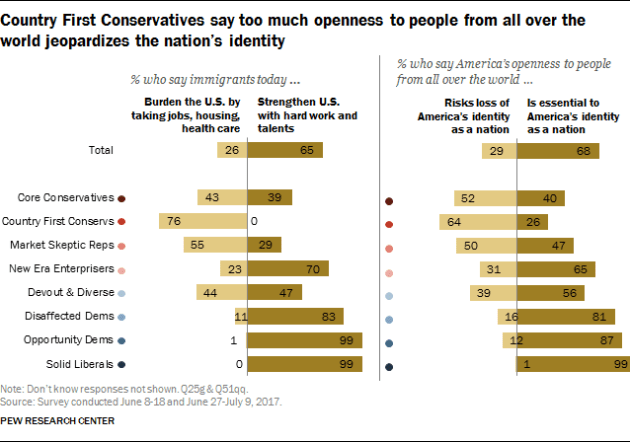
As always, Pew’s findings, broken down by political leaning, are of interest and highlight just how divided the United States is on these issues:

Views of immigrants and nation’s ‘openness’

When it comes to attitudes about immigration, Democratic-leaning groups hold almost universally positive attitudes toward immigrants and support the idea of America being open to people from all over the world. Virtually all Solid Liberals say that immigrants strengthen the society and that openness is “essential” to America’s identity as a nation (99% each).

The only group on the political left that holds ambivalent views of immigrants is Devout and Diverse, a group that is racially and ethnically diverse and also has the lowest family incomes and levels of educational attainment of any typology group.

The Republican-leaning groups are sharply divided in views of immigrants and the nation’s openness to people from around the world. About three-quarters of Country First Conservatives (76%) say immigrants are a burden on the country – the largest share of any typology group. Country First Conservatives also are most likely to say that the U.S. risks losing its identity as a nation if it is too open to people from around the world (64% say this).

Compared with Country First Conservatives, Core Conservatives and Market Skeptic Republicans have more divided views of immigrants and whether too much openness risks the nation’s identity. New Era Enterprisers have the most positive views among Republican-leaning groups: 70% view immigrants as a strength and 65% say America’s openness is “essential to who we are as a nation.”

Islam and violence

A large majority of Core Conservatives (79%) say Islam is more likely than other religions to encourage violence among its followers.

And roughly the same percentage of Solid Liberals (83%) say Islam does not encourage violence more than other religions.

The views of other typology groups divide along partisan lines, with one exception. As with views of immigration, Devout and Diverse differ from other Democratic-leaning groups in their views of Islam and violence.

Devout and Diverse are divided – 47% say Islam is more likely to encourage violence, 44% say it is not – while sizable majorities in other Democratic groups say Islam does not encourage violence more than other religions.

How Immigration Foiled Hillary – The New York Times

This is a really good long read and analysis of the tensions in rural America over immigration and related issues.

While the Canadian electoral system (ridings) makes lop-sided margins in cities and rural ridings less significant, it nevertheless is a reminder of the need to find ways to alleviate the concerns and apprehensions of rural voters:

Democrats point to a thousand reasons that Hillary Clinton lost the presidential election. Here is another.

In political circles, it’s common knowledge that in four key states President Trump unexpectedly carried counties that Democratic presidential campaign strategists had failed to recognize as crucial terrain — sparsely populated areas of Wisconsin, Michigan, Ohio and Pennsylvania.

In “What I Got Wrong About the Election,” for example, published right after Clinton lost, David Plouffe, who had managed the Obama campaign in 2008, wrote that

Trump’s margins in rural and exurban counties were off the charts. For example, in Madison County, an exurban area outside Columbus, Ohio, Mr. Romney’s margin over Mr. Obama was 20.4 percentage points; Mr. Trump’s margin over Mrs. Clinton was 39.8.

Plouffe added that this “happened in thousands of counties throughout the country, and it added up quickly.”

What Democrats missed was the profound political impact recent immigration trends were having on the more rural parts of the once homogeneous Midwest — that the region had unexpectedly become a flash point in the nation’s partisan immigration wars.

In a Brookings essay published last month, John C. Austin, director of the Michigan Economic Center, a local think tank, writes that the region is experiencing a “steady stream of immigrants from Mexico, Central America, Asia, Africa, and the Middle East.”

As a result, Austin continues,

Immigration has become an unambiguous factor in this racially charged Midwestern landscape. While immigrant-rich states like Arizona, California, and Florida are often at the center of immigration policy discussions, the political debate about the role of immigrants burns hottest in the heartland.

Austin went on, in an email, to provide more detail about the power of immigration to move white voters into the Trump column:

The “rural” voters here are some farmers, but more likely, as in the hinterlands outside Flint, Monroe, Toledo, Erie, or Janesville, Wisconsin, they are mostly white, working class blue collar workers or retirees, many, sadly, who fled their small cities to escape blacks. They are anxious about the economic prospects for their future, their aging communities (the kids have fled), making folks mad. And now all these immigrants come and are changing the society!! Just as Macomb County, where working class white voters fled Detroit in advance of blacks, now sees nearby communities like Hamtramck becoming (in their view) a Bangladeshi bazaar — and they don’t like that. And they are easily fanned to blame those folks.

In February 2017, Stanley Greenberg, a Democratic pollster and strategist, conducted four postelection focus groups with white voters who had cast ballots for Trump in Macomb County, Michigan, an area he has been studying since 1985. The participants were not Republicans. They were whites without college degrees who identified themselves as independents, as Democratic-leaning independents, or as Democrats who voted for Obama in 2008, 2012 or both.

“Immigration is a powerful issue for these Trump voters, representing a demand that citizens come before noncitizens, Americans before foreigners, and that we take care of home first before abroad,” Greenberg wrote in his report for The Roosevelt Institute:

They believe that we have “opened up our borders, they pretty much made it a free for all” which means fewer jobs and greater demands on government services and more concerns about safety.

Greenberg’s report is replete with revealing quotes from the focus groups:

I went and finally signed up for Medicaid, and I’m standing in the damn welfare office, and I’m looking around at all of these people that can’t even say hello to me in English. But they’re all there with appointments for their workers, which means they have the health care, they have the food stamps…. If you can come from somewhere else, why can’t we all get it?

And:

My grandson’s school, I went to as a child, there are hardly any — I’ll just say American families there now. It’s mostly Middle Eastern and people all standing outside waiting for their kid, to pick them up at the end of the day, and nobody’s speaking English. Everyone’s speaking other languages, which, there’s nothing wrong with other languages.

And:

You know what, like where I’m working, at Kroger, how many Spanish people I wait on. The universal language — I don’t care, if you smile — hello, I don’t care what country you’re from, but some of these people, they act like they can’t do that, even. It’s like, “You know what? You’re in America.” Get with either — you can learn to say hello, goodbye, thank you, in our language. This is America.

Three developments are taking place in the rust belt simultaneously.

First, as recently as 2000, many of the key Midwestern counties that moved from blue to red in 2016 had very few minority residents. Since then, their immigrant populations began to increase at a rapid rate well above the national average. Second, at the same time that immigrants are moving in, younger native-born residents are leaving in droves to seek employment elsewhere, while the remaining white population is aging and is often hostile to change. It is the perfect formula for cultural conflict, and Trump proved to be the perfect candidate to exploit it. Finally, these changes are taking place in a region that Austin points out is home to “15 of the nation’s 25 major metro areas with the sharpest black-white segregation,” making it even more unreceptive to nonwhites than other sections of the country.

One way to understand what has been taking place recently in the Midwest is through the use of a measure called the diversity index. This index ranks geographic areas — states, counties and ZIP codes — on a scale from 0 to 100. The higher the number, the more likely that two people chosen at random will be different by race and origin. Put another way, a higher number means more diversity, a lower number, less diversity. (The diversity index for states and counties can be found here.)

Arrayed on a diversity index, Michigan with an index of 42, Wisconsin at 35, Ohio at 36, and Pennsylvania at 41, all rank in the bottom twenty — i.e., the least diverse — of the fifty states. The diversity index for the entire country is substantially higher at 63. Examples of states with very high diversity indexes include California at 79; Nevada at 73; Texas at 70; and New York at 70.

A rapid rate of growth in the percentage of immigrants in communities that have in the past experienced little diversity is particularly explosive.

Benjamin J. Newman, a political scientist at the University of California-Riverside, described this phenomenon in a 2013 paper:

Growth in local Hispanic populations triggers threat and opposition to immigration among whites residing in contexts with few initial Hispanics, but reduces threat and opposition to immigration among whites residing in contexts with large pre-existing Hispanic populations.

In other words, communities that are close to 100 percent white will react intensely to a modest increase in foreign-born residents, while highly diverse communities will shrug it off.

…In a prescient 2010 paper, “Politicized Places: Explaining Where and When Immigrants Provoke Local Opposition,” Daniel Hopkins, a professor of political science at the University of Pennsylvania, described the crucial interaction of the rate of change in the level of immigration with the politicization of the immigration issue by national figures:

When faced with a sudden, destabilizing change in local demographics, and when salient national rhetoric politicizes that demographic change, people’s views turn anti-immigrant.

In an email, Hopkins elaborated on his thesis: “sudden influxes of immigrants generate hostility, likely because they destabilize long-time residents’ sense of their communities’ identity.”

Looking back on the 2016 election and the importance of the immigration issue, what stands out is the failure of the Clinton campaign to address the immigration concerns of the Obama-to-Trump voters who played such a key role in the outcome. Campaign strategists may not have been aware of the intensity with which these voters viewed the issue, or they may have decided that given their target voters, the Democratic Party was not at liberty to moderate its unwavering pro-immigration stance.

The immigration stance of the Clinton campaign contrasted with Obama’s record. While Obama called for immigrants who were brought into this country as children to be allowed to stay, he stressed policies calling for the deportation of criminals and in fact deported more people than George W. Bush or Bill Clinton.

The campaign’s public stance on Immigration Reform declared:

Hillary has been committed to the immigrant rights community throughout her career. As president, she will work to fix our broken immigration system and stay true to our fundamental American values: that we are a nation of immigrants, and we treat those who come to our country with dignity and respect — and that we embrace immigrants, not denigrate them.

Eight of the nine policies described in Clinton’s statement are pro-immigration, and the ninth refers only peripherally to enforcement:

Enforce immigration laws humanely. Immigration enforcement must be humane, targeted, and effective. Hillary will focus resources on detaining and deporting those individuals who pose a violent threat to public safety, and ensure refugees who seek asylum in the U.S. have a fair chance to tell their stories.

The Clinton campaign has come under some fire from fellow Democrats on immigration. In a June American Prospect essay, Stanley Greenberg wrote:

The Democrats have moved from seeking to manage and champion the nation’s growing immigrant diversity to seeming to champion immigrant rights over American citizens’. Instinctively and not surprisingly, the Democrats embraced the liberal values of America’s dynamic and best-educated metropolitan areas, seeming not to respect the values or economic stress of older voters in small-town and rural America.

The contest for the 2020 Democratic presidential nomination will test whether and how the explicitly liberal stance adopted by Clinton might evolve. This is a moral and political challenge for left-liberal parties throughout the Western Hemisphere. On one hand, there has been the prospect of “an emerging Democratic majority.” In the United States, Obama won the White House twice relying on just such a majority.

An issue that first came to the fore 52 years ago after passage of the 1965 Immigration and Nationality Act has yet to be resolved. The task for Democrats is how to come up with a non-xenophobic, non-racist answer to this problem.

Still, Trump’s 2016 victory — as well as Brexit, Marine Le Pen’s episodic successes (33.9 percent of the French presidential vote last May), and the emergence of the anti-immigrant AfD in Germany last month as the third largest party in the Bundestag — all demonstrate that backlash politics continue to gain ground and remain a powerful force.

Trump Administration To Drop Refugee Cap To 45,000, Lowest In Years : NPR

A smaller percentage than others. USA already had far fewer refugees than others in 2016:

EU USA Canada Australia
2016 Population

510,100,000

323,100,000

36,290,000

24,130,000

Refugees resettled or granted asylum

720,000

84,994

58,910

17,955

Per capita percent

0.14%

0.03%

0.16%

0.07%

The Trump administration plans to cap the number of refugees the U.S. will accept next year at 45,000. That is a dramatic drop from the level set by the Obama administration and would be the lowest number in years.

The White House formally announced its plans in a report to congressional leaders Wednesday, as required by law.

The number of refugees the U.S. admits has fluctuated over time. But this cap is the lowest that any White House has sought since the president began setting the ceiling on refugee admissions in 1980.

Refugee resettlement agencies are disappointed with the 45,000 cap, which they say falls far short of what is necessary to meet growing humanitarian needs around the world. They had recommended a limit of at least 75,000.

Last year, the Obama administration set the cap at 110,000. Only about half that number have been admitted, after the Trump administration put the entire refugee resettlement program on hold under its travel ban executive orders.

“Churches and communities, employers and mayors, are heartsick at the administration’s callous and tragic decision to deny welcome to refugees most in need,” said Linda Hartke, the president and CEO of Lutheran Immigration and Refugee Service, one of largest resettlement agencies in the country.

The debate over refugees is often framed as a clash between humanitarian goals and national security.

But Trump administration also argues that the U.S. spends millions of dollars a year to screen and resettle refugees and to help them once they arrive.

“For the cost of resettling one refugee in the U.S., we can assist more than 10 in their home region,” President Trump said in a speech to the United Nations earlier this month.

Once they arrive, refugees qualify for many social services, including health care, food stamps and cash assistance. Many of those costs fall on state and local governments, and some states are pushing back.

Earlier this year, Tennessee took the federal government to court over refugee resettlement.

“The bottom line is the federal government is coercing the state of Tennessee to spend Tennessee taxpayers monies in ways that some individual Tennesseans disagree with,” Republican state Sen. John Stevens told member station WPLN in March.

But many mayors across the country see refugees as an economic boon for their cities.

“These people are paying taxes. They’re buying houses. They’re going into our schools,” said Stephanie Miner, the mayor of Syracuse, N.Y.

Miner, a Democrat, says refugees are helping revitalize the city’s north side, which was home to Italian and German immigrants before them.

Source: Trump Administration To Drop Refugee Cap To 45,000, Lowest In Years : NPR

Who Put The ‘Hispanic’ In Hispanic Heritage Month? : NPR

Interesting history and example of how political level, civil organizations and officials responded to needed change:

And then by 1980, the term Hispanic shows up for the first time on a census form. How did that happen?

One wouldn’t necessarily think of [President Richard] Nixon as a champion of Latino rights or Latino identity. But he was open to hearing Latino concerns, in part because he grew up in Southern California, in a context where he knew Mexican-Americans existed. And they were different. Their lives were different; their experiences were different from whites. In 1972, he created the first comprehensive ‘Hispanic vote’ political campaigns at the presidential level that the country had ever seen. Nixon had what he called “amigo buses” that roamed around the Southwest but also the Northeast and into Florida. Those that roamed on the East Coast played salsa and cumbia and those that roamed in the Southwest played mariachi. This was before the Democratic Party did anything close to this. And the Nixon administration also pressured the Census Bureau to create an advisory board comprised of the Mexicans and the Puerto Ricans, who were incredibly loud, and also some Cuban sympathizers that had been big contributors to Nixon. One of the biggest points of debate is: What would this group be called on the census?

How did they choose the term ‘Hispanic’?

Some of the advisory members said, “Hey, why not use ‘brown’? We don’t fit into these white, black, Asian categories. That’s not us.” Now, if you’re a demographer, if you’re a statistician, that seems like an incredible nightmare. You know, brown can mean Filipinos. Brown can be Native Americans. Brown can be South Asian Indians. This was a complete non-starter.

They went down the list. Latin American. One of the problems is that Latinos were seen as foreigners, invaders and not inherently American. And one of the jobs of the advisory board was to really show that Latinos were an American minority group, like African-Americans — a minority that stretched from coast to coast and that were patriotic, that fought in wars, that contributed to American history, that built American cities. So when a term like Latin American was used, right away, it seemed to strike discord because it was seen as too foreign.

Hispanic was never a term that everybody loved, but it was a term that got a lot of support from within Latinos in the Nixon and, later, the Ford administration.

And, then, how did they make it stick?

The Census director called all the Latino advocacy groups that were being set up in Washington, D.C. — the National Council of La Raza; the Mexican American Legal Defense and Education Fund, and said: “HELP.” NCLR set up town halls in places like Miami, New York, Los Angeles, Chicago, showing people the new census form and telling them, “Look, we’re Hispanic. This is us. This is our chance. This is our category!” The second phone the Census director picked up was to Spanish-language media. At that time, the company that would later go on to be called Univision was growing rapidly. They ran documentaries, commercials, even a day-long telethon, where different performers from across Latin America came out. Each of them held out the census form and says, “Hey, remember to fill out the census. We’re Hispanic on the 1980 census. This is important for us.”

How did we get from arguing for totally separate identities like Mexican, Puerto Rican and Cuban, to me calling myself a Latina?

Because it takes on a life of its own! Once the category was made, everything from political groups to civic organizations to every other media group that would emerge, would draw on census data. As soon as the census numbers came out, Latino lobby groups could then run the numbers and say, ‘Look, this is what Latino poverty looks like; this is what Latino educational attainment looks like.’

They could go up to the Department of Education, for example, and say, “Latinos are the second-largest minority group. And yet, our educational attainment pales to that of whites. Send money to our schools.”

The same exact thing happened in the market. As soon as the numbers came out, Univision releases the first Hispanic marketing manual, in which they take figures like income, and they call it “Hispanic buying power.” And they take the census report and make pitches to McDonald’s and Kellogg’s and everybody else. And they start to slowly grow.

During the 1980s, Latino political organizations started to demand that not only should we have a Hispanic category in the census, but we damn well should have it on birth certificates. Michigan, Georgia, Louisiana — they still categorize Latinos as whites. And there was a large political push among these groups, with even Spanish-language media writing to them and saying, ‘Look, put us down as Latinos. We’re not white. We’re distinct. We’re different.’

Trump has started a brain drain back to India

Positive impact for Canada:

So many [foreign hi-tech] workers have been frustrated that attorney Brent Renison sought class-action status for a lawsuit filed last year in U.S. District Court in Portland. He argued, in part, that the H-1B lottery was arbitrary and capricious. The suit asked the court to order the government to process visa petitions in the order they are filed and compel the government to establish a waitlist like the one used for green card petitions. The government prevailed.

“Some people are moving out of the country, taking valuable skills with them,” Renison says. “Some people are choosing not to come. If this persists, were going to lose a lot of the foreign students we educate.”

The system was barely functioning as it was. Applications for work visas already were so clogged in the federal bureaucracy that in recent years even Ivy League graduates couldn’t be certain of receiving one. Getting a work visa hasn’t guaranteed stability, as Sahay, the data architect, knows.

Employers can sponsor immigrants’ green cards, or permanent visas, but the approvals process is backlogged. The federal government places caps for green cards on each country each year. Indians seeking permanent residency say it’s routine for them to linger in line for a decade or more. Up to 2 million Indian workers here and abroad may be waiting in a green card backlogthat could take a decade or more to clear if there are no changes to the system, says David Bier, an immigration policy analyst at the Cato Institute think tank.

Those concerns may add to the shortage of highly skilled technology workers in the United States, just as Canada or Singapore vie for those same people.

Every other startup company, says Vish Mishra, an investor with Clearstone Venture Partners, a venture capital firm in Silicon Valley, has operations based overseas or recruits workers in India, Eastern Europe, Canada or Israel.

“You’re not going to have, all of a sudden, 200,000 [American] people filling the gap that exists. What are businesses going to do? Businesses have to import talent,” he says.

Canada has become more attractive just since the U.S. presidential election. The country granted temporary work visas to 1,960 Indian nationals in all of 2015, and 2,120 total in the fourth quarter of 2016 and first quarter of this year.

In November, Canada announced that as of June, the country would speed the processing of standard visas and work permits to two weeks for highly skilled talent working for companies doing business in Canada. The move, the government says, will help companies grow and fuel job growth for Canadians.

Meanwhile, in the United States, tech workers and engineers are bound to established companies that filed paperwork for them years back. Almost everyone in the Indian tech community knows a weekend entrepreneur who desperately wants to start his or her own company but can’t quit work because they would be visa-less. Meanwhile, friends and family in India beg them to come home and bring their ideas to India’s own booming silicon valleys.

Rishi Bhilawadikar, a user-experience designer in the Bay area, says that tenuous life lived by so many educated Indian workers — in America, but not really of America — spurred him to shoot a feature film.

In For Here or To Go, made over the course of more than seven years, the characters weigh whether America has lost its promise for young, mobile Indians. The idea bubbled up, Bhilawadikar says, after he read research that showed how certain laws keep some immigrants from fulfilling their potential, driving many back home or to countries with more welcoming policies, such as Canada and Chile.

Source: Trump has started a brain drain back to India

Whites Have Huge Wealth Edge Over Blacks (but Don’t Know It) – The New York Times

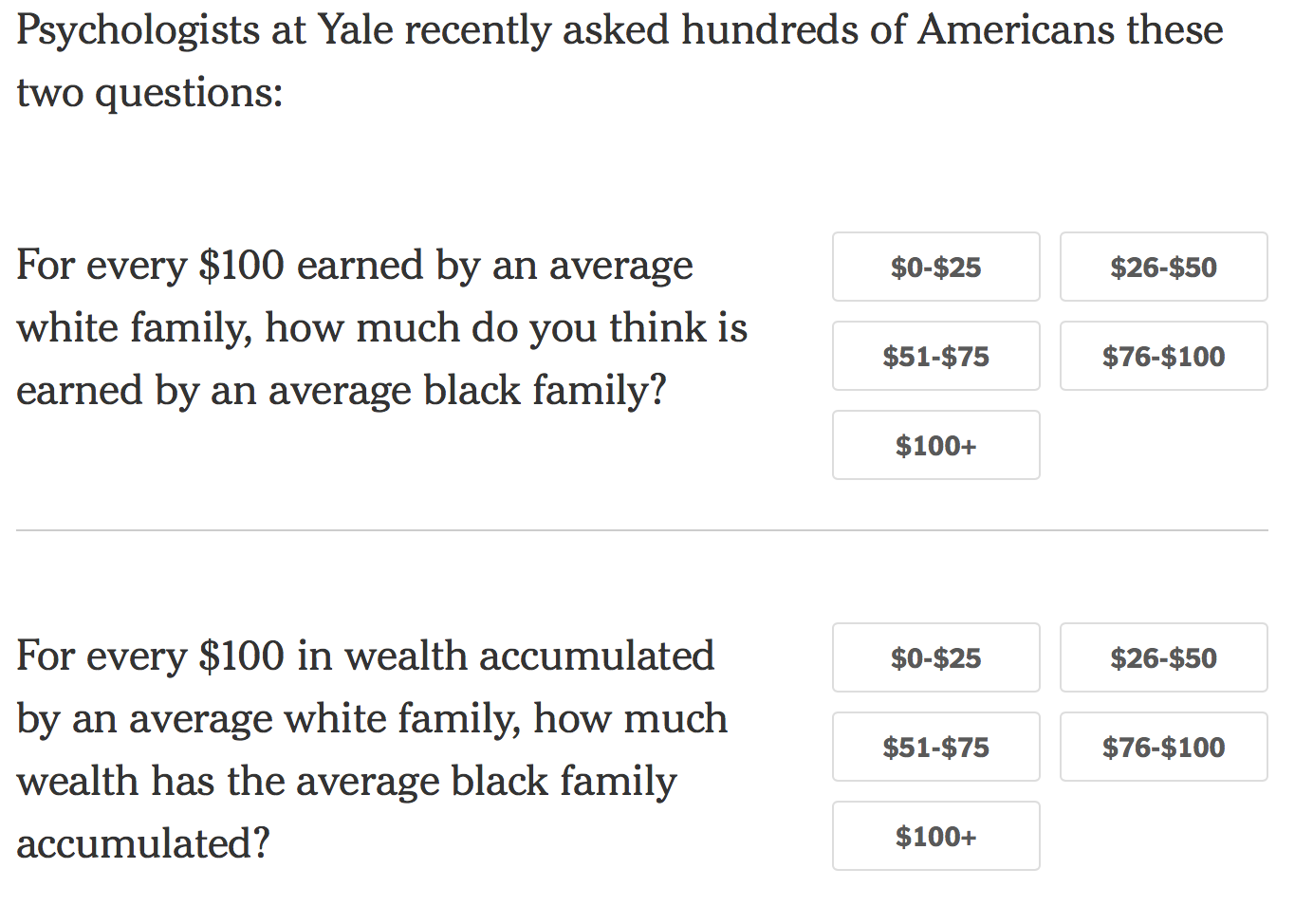
The Yale researchers suspected that many people would not get the answers right.

“I’m a person who studies inequality, who should really know how inequality looks,” said one of the psychologists, Michael Kraus, who researches the behaviors and beliefs that help perpetuate inequality. “And I look at the black-white gap, and I’m shocked at the magnitude.”

Black families in America earn just $57.30 for every $100 in income earned by white families, according to the Census Bureau’s Current Population Survey. For every $100 in white family wealth, black families hold just $5.04.

If Mr. Kraus, of all people, is taken aback by these numbers, what are the odds that most Americans have a good understanding of them? The answer, he and his colleagues fear, has broad implications for how we understand our society and what we’re willing to do to make it fairer.

Americans, and higher-income whites in particular, vastly overestimate progress toward economic equality between blacks and whites, the psychologists reported Monday in the Proceedings of the National Academy of Sciences. Americans believe that blacks and whites are more equal today than they truly are on measures of income, wealth, wages and health benefits. And they believe more historical progress has occurred than is the case, suggesting “a profound misperception of and unfounded optimism” regarding racial equality.

“It seems that we’ve convinced ourselves – and by ‘we’ I mean Americans writ large – that racial discrimination is a thing of the past,” said Jennifer Richeson, who was another of the study’s authors, along with Julian Rucker, a doctoral student. “We’ve literally overcome it, so to speak, despite blatant evidence to the contrary.”

To understand how people have perceived that progress, the researchers asked blacks and whites of varying income levels to estimate answers to the questions above in both recent years and historically. They also asked about how much black workers with a high school diploma but no college degree earn relative to whites of the same education level, and how the earnings of blacks and whites with a four-year college degree compare.

The present-day results, aggregated across several surveys used in the study, are compared here with actual government data:

The researchers suspect that the answer in part has to do with how little exposure Americans have to people who are unlike them. Given how economically and racially segregated the country remains, many Americans, and especially wealthy whites, have little direct knowledge of what life looks like for families in other demographic groups.

But the pattern this study identifies isn’t simply about lack of access to accurate information. As Mr. Kraus points out, popular videos and charts regularly circulate on social media highlighting the startling levels of inequality in America. And yet, many people who click on them forget about the severity of inequality just long enough to be surprised by it again in the future.

“Despite this information being out there, we don’t really take it in,” Mr. Kraus said. This happens “in a way that suggests that maybe we’re motivated to forget it, or motivated to distort it in our own minds.”

He and Ms. Richeson suspect that we also overgeneralize from other markers of racial progress: the election of a black president, the passage of civil rights laws, the sea change in public opinion around issues like segregation. If society has progressed in these ways, we assume there’s been great economic progress, too.

We’re inclined, as well, to believe that society is fairer than it really is. The reality that it’s not — that even college-educated black workers earn about 20 percent less than college-educated white ones, for example — is uncomfortable for both blacks who’ve been harmed by that unfairness and whites who’ve benefited from it.

“It’s very difficult to consider the possibility that some of what we’ve achieved or gained is due to forces that aren’t our own individual hard work,” Ms. Richeson said. “That’s hard to grapple with, especially in American society. We really believe in egalitarianism and meritocracy.”

These findings suggest that the motivation to see the world as fair may be even stronger in this context than stereotypes white Americans hold, for instance, equating blacks with poverty.

The researchers found in some additional surveys that whites answer these questions more accurately when they’re first asked to consider an America where discrimination persists. If we want people to have a better understanding of racial inequality, this implies that the solution isn’t simply to parrot these statistics more widely. It’s to get Americans thinking more about the forces that underlie them, like continued discrimination in hiring, or disparities in mortgage lending.

It’s a myth that racial progress is inevitable, Ms. Richeson said. “But it’s also dangerous insofar as it keeps us blind to considerable inequality in our nation that’s quite foundational,” she said. “Of course we can’t address it if we’re not even willing to acknowledge it.”

And if we’re not willing to acknowledge it, she adds, that has direct consequences for whether Americans are willing to support affirmative action policies, or continued enforcement of the Voting Rights Act, or renewed efforts at school desegregation.

Research Shows Spanish Speakers Take Longer To Learn English. Why? : NPR

Likely a mix of all three explanations:

A recent study out of Philadelphia tracked kindergartners who were learning English and found that four years later there were major discrepancies between which groups of students had mastered the language.

Students whose home language was Spanish were considerably less likely to reach proficiency than any other subgroup. And, on the extreme end, Spanish speakers were almost half as likely as Chinese speakers to cross the proficiency threshold.

The study, conducted by the Philadelphia Education Research Consortium, just looked at English learners who entered the district as kindergartners in 2008 and their progress through the end of third grade.

But this phenomenon isn’t specific to Philadelphia. “I have never seen any study that has looked at this question and not found this trend,” says Ilana Umansky, who studies English acquisition at the University of Oregon.

Earlier this year, the National Academies of Sciences, Engineering, and Medicine published a 415-page report on English learners. The report cited 12 studies — dating back to 2004 — that found this gap between Spanish-speaking English learners and other groups.

But to date, no research has been able to determine why.

So, we emailed or spoke with about two dozen researchers, teachers, and students to hear how they would explain this trend. Predictably, there’s no consensus, but here are three basic theories.

Spanish saturation

There are nearly 150,000 Spanish speakers in Philadelphia, according to the American Community Survey. The numbers are even greater in New York City, where Jose Garcia arrived in 2012, at 11 years old, after emigrating from the Dominican Republic.

Garcia moved to the heavily Hispanic Washington Heights neighborhood in upper Manhattan. At home, he spoke Spanish. In school, classmates spoke Spanish. When he watched television, he often tuned into Spanish-language news.

“So it wasn’t like a big challenge for me,” Garcia says.

Eventually, Garcia moved to Philadelphia and weaned himself off Spanish media by watching American movies like The Fast and the Furious. But he considers his early months in New York wasted time, compounded by the fact that many of his friends didn’t seem all that interested in learning English.

“They didn’t wanna learn it as fast because they didn’t need to use it,” he says. “They were speaking Spanish already. So they had a way to communicate with each other.”

But Nelson Flores, a professor at the University of Pennsylvania’s Graduate School of Education, grew up in an area of Philadelphia with a lot of Spanish speakers, too, and he says that’s not always the case. In fact, he doesn’t think the Spanish-language achievement gap has much to do with language at all.

Family income and segregation

Flores contests the notion that Spanish speakers aren’t learning English — at least in the way we typically understand language acquisition.

“We’re not talking about the ability to communicate in English,” Flores says. “We’re talking about the ability to do grade-level content in English.”

Flores believes a lot of the students who score below proficient in English can speak and comprehend the language with ease. Many of them, he says, can speak English better than Spanish.

So why aren’t they testing well? Flores believes it’s because Latino students are disproportionately living in isolated, high-poverty neighborhoods and learning in isolated, high-poverty schools.

High-poverty schools, Flores points out, tend to receive fewer resources and less-experienced teachers. Plus, these schools have to deal with the compound effect of having so many students who experience trauma, transience and other disadvantages.

It could be true that Spanish-speaking English learners in Philadelphia are generally poorer than, say, Vietnamese-speaking students, but it’s unlikely family income totally accounts for the achievement gap.

It’s no surprise that researchers studying this trend in the past have used income-based controls — such as whether a child qualifies for free or reduced lunch. Those researchers have still found Spanish speakers lagging.

Family background

If you look only at family income, you might assume many immigrant groups come from relatively similar socioeconomic backgrounds.

“Immigrants often look low-income because they’re in transition,” says Patricia Gandara, a UCLA professor who has studied this trend in California. “They may have been physicians in their home country, but now they’re having to work as a cook.”

Many of the proxies we use to measure poverty or disadvantage trace back to how much money a family makes. But in the case of immigrant groups, that may mask some crucial differences.

A 2009 analysis led by Hunter College professor Donald Hernandez found, for instance, large discrepancies in the relative education levels of many immigrant groups. Adult immigrants from East Asia and the Middle East were among the most likely to have a high school or college degree. Adult immigrants from Mexico and Central America were among the least likely to have made it to high school.

Researchers Jennifer Lee and Min Zhou came to similar conclusions when they compared Mexican and Chinese immigrants. They found that, relative to their parents, the children of Mexican immigrants progressed further educationally from one generation to the next. But the children of Chinese immigrants progressed further overall, in large part because their parents started many steps ahead.

The logic here is pretty simple: Parents who attended college are better able to help their children with homework or connect them to resources.

Tip of the iceberg

These were just three theories we heard when we asked about the language acquisition gap, not all of them.

For instance, many people pointed to societal biases against Hispanic students, arguing that teachers and administrators have lower expectations of them than Asian students because of deeply ingrained stereotypes.

Right now, it’s hard to isolate the cause of this gulf between Philadelphia’s Spanish-language English learners and everyone else. It’s possible — maybe likely — that all of these theories have some shade of truth to them.