This US program inspired a comparable preference in Canada for citizenship applicants who had enrolled in the military in C-24:
Mohammed Anwar enlisted in April 2016 in the United States military through a program that promised him a fast track to citizenship. His ship date for basic training, expected within six months, was postponed twice. “It was common knowledge that there were delays because of new security checks,” said the 27-year-old Pakistani national, who lives in Jersey City.
Each month he donned a uniform and, as required, attended drill training with his Army Reserve unit in Connecticut.
Last week, Mr. Anwar got a call from his recruiter informing him that his enlistment had been terminated. “I was shocked, confused and angry that the United States government didn’t keep up with its commitment to me,” said Mr. Anwar, who was to work as a nurse.
The reason behind the decision to cut Mr. Anwar from the military remains unclear to him.
In the last week, recruiters have rescinded contracts for an unknown number of foreign nationals who had signed up for Military Accessions Vital to the National Interest, or Mavni, a program introduced in 2009 to attract immigrants with certain language and other skills that are in short supply into the armed forces.
More than 4,000 Mavni recruits have been in limbo since late last year, when the Department of Defense began introducing additional vetting. The protracted process has indefinitely delayed basic training for many enlistees, making it more difficult for recruiters to meet their targets. Recruiting stations are flooded with calls from many concerned that their lawful presence in the country could lapse while they await clearance.
“Emotionally, I can’t move forward with my life,” said Mr. Zhu, 27, who has master’s degrees in engineering from Columbia University and the University of Wyoming. “I am sure my contract is on the verge of being rescinded,” he added, because enlistees must report to training within two years of signing a contract.
Paul Haverstick, a Pentagon spokesman, confirmed that the Army must discharge recruits who have not shipped to initial military training within two years.
“Unfortunately, some Mavni recruits have been unable to complete the increased security screening required by the Department of Defense to ship to training within two years of enlistment,” he said, adding that the Army is still seeking ways to help those who have been affected.
“The Mavnis have become a huge problem for the recruiting command because they can’t ship out to their training until they complete mandated background checks,” said Margaret Stock, a retired lieutenant colonel in the Army Reserve who helped create the program. “If they can’t ship out, they aren’t doing the Army any good.”
Ankit Gajurel, a Nepalese mechanical engineer who enlisted in the Army Reserve in May 2016, recently had his training date postponed for the second time. But several of his references had been contacted by security officials, and he had been told by his recruiter that his “counterintelligence interview,” one of the last steps in the vetting process, would be scheduled for November.
Yet another example where Trump is forcing corporations to take a stand:
The chief executives of Apple, Amazon, Facebook and Google joined roughly 300 business leaders urging President Donald Trump late Thursday to continue protecting children brought illegally to the United States from being deported.
Since 2012, the U.S. government has allowed those children — young adults now known as Dreamers — to continue living in the country as long as they obtain and renew work permits under a program called Deferred Action for Childhood Arrivals, or DACA.
But Trump on Friday is expected to eliminate that legal shield entirely. Months after promising to approach the issue with “great heart,” the president reportedly is expected to order the government to cease granting work permits for undocumented young adults to stay. Meanwhile, the roughly 800,000 currently registered in DACA would not be allowed to obtain additional work authorizations once their current approvals expire.
The move would fulfill one of Trump’s most controversial promises from the 2016 presidential campaign — yet it already is prompting a wide array of businesses to issue a collective rebuke of the White House.
“Dreamers are vital to the future of our companies and our economy. With them, we grow and create jobs,” wrote the corporate executives in a joint letter. “They are part of why we will continue to have a global competitive advantage.”
The missive was organized by FWD.us, the immigration reform group backed by Facebook CEO Mark Zuckerberg. Other signers include the leaders of Airbnb, LinkedIn, Lyft and Netflix, as well as Laurene Powell Jobs, the founder of the Emerson Collective, and some executives outside of the tech industry, like Mary Barra, the CEO of General Motors.
In a post on his own Facebook, meanwhile, Zuckerberg himself stressed: “We need a government that protects Dreamers.”
“Today I join business leaders across the country in calling on our president to keep the DACA program in place and protect Dreamers from fear of deportation,” he continued. “We’re also calling on Congress to finally pass the Dream Act or another permanent, legislative solution that Dreamers deserve.”
Broadly, Trump’s expected announcement may only worsen his already strained relationship with corporate America. In August, a number of high-profile executives opted to stop advising him on economic issues because of his comments on a different matter: The neo-Nazi violence in Charlottesville, Va.
In Silicon Valley, though, the move toward ending DACA adds to a special, longer-running strain between tech titans and the Trump administration. Immigration is an issue of immense personal and professional importance to the tech industry, which employs a number of foreign workers and long has sought to hire more. Other tech engineers have families abroad, and some of the region’s founders and executives themselves are immigrants who have tried, unsuccessfully, to sway Trump in recent months.
Earlier Thursday, Microsoft estimated that 27 of its workers — from engineers to sales associates — would be affected by the change to DACA. The company’s chief executive, Satya Nadella, even tried to issue an early plea to the White House: “We care deeply about the DREAMers who work at Microsoft and fully support them,” he said. “We will always stand for diversity and economic opportunity for everyone.”
Uber, meanwhile, similarly came to the defense of the Dreamers, noting in a statement that their “contributions make America more competitive and they deserve the opportunity to work, study, and pursue the American dream.” The defense of DACA comes days after Uber appointed a new chief executive, Dara Khosrowshahi, who himself is an immigrant from Iran — and a fierce critic of Trump’s approach to those issues.
Trump’s expected announcement comes partly in response to 10 state attorneys general, which threatened to take the administration to court over DACA if it did not eliminate the program by Sept. 5. Going forward, though, Congress can still codify the program into law, but lawmakers long have struggled in that aim.
“The 800,000 people, and dreamers like them, they deserve a permanent legislative solution,” stressed Todd Schulte, the leader of FWD.us, in an interview late Thursday. He said lawmakers had a choice — pass a law or risk become “a nation that says we’re going to see hundreds of thousands of people pushed out of the workforce.”
Initially, Trump himself appeared to waver on the issue, a fierce opponent of DACA during the campaign who later said, as president, he would approach the Dreamers with “great heart.”
Ahead of the decision, tech executives had been some of the more vocal, aggressive lobbyists on behalf of preserving DACA. In June, for example, Apple CEO Tim Cook specifically urged Trump to show compassion for the Dreamers. The private comments came at a reception to conclude the first day of Trump’s “tech week,” a five-day focus on ways to modernize the government with the industry’s help.
Usual interesting survey results from Pew, along with some comparisons with Christianity and Judaism in America:
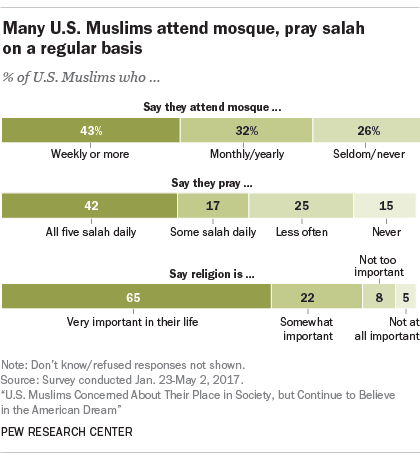
For American Muslims, being highly religious does not necessarily translate into acceptance of traditional notions of Islam. While many U.S. Muslims say they attend mosque and pray regularly, sizable shares also say that there is more than one way to interpret their religion and that traditional understandings of Islam need to be reinterpreted to address the issues of today.
By some conventional measures, U.S. Muslims are as religious as – or more religious than – many Americans who belong to other faith groups. Four-in-ten (43%) Muslim Americans say they attend mosque at least once a week, including 18% who say they attend more than once a week, according to a 2017 Pew Research Center survey. An additional 32% say they attend once or twice a month, or a few times a year. These attendance levels are comparable to those of U.S. Christians, 47% of whom say they attend services weekly or more, and greater than the 14% of American Jews who say the same.
A majority also say that they pray at least some or all of the salah, or ritual prayers required of Muslims five times per day. Among all U.S. Muslims, fully 42% say they pray all five salah daily, while 17% pray at least some of the salah every day. A quarter say they pray less often, and just 15% say they never pray.
And nearly two-thirds of U.S. Muslims (65%) say that religion is very important in their lives, similar to the share of U.S. Christians who say the same (68%), and higher than the share of U.S. Jews who say this (31%). An additional 22% of Muslims say that religion is somewhat important in their lives, while fewer say that religion is not too or not at all important to them.
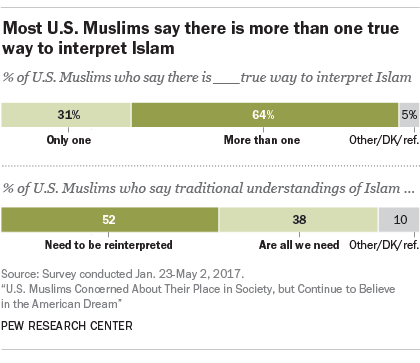
At the same time, American Muslims openly acknowledge that there is room for multiple interpretations of the teachings of Islam. A majority (64%) say there is more than one true way to interpret the faith’s teachings, while just half as many (31%) say there is only one true way to interpret Islam. And it’s not just less-religious Muslims who express this sentiment: While 72% of Muslims who say religion is somewhat (or less) important in their life say they are open to multiple interpretations, a majority (59%) of those who say religion is very important in their life also say there is more than one true way to interpret the faith. Among U.S. Christians, there is a similar balance: 60% say there is more than one true way to interpret the teachings of their religion, while 34% say there is just one true way.
About half (52%) of all U.S. Muslim adults also say that traditional understandings of Islam must be reinterpreted to reflect contemporary issues, while 38% maintain that traditional understandings of Islam are all that are needed to address today’s issues. On this question there is more of a difference of opinion among Muslims when it comes to how important religion is in their lives. Those who say religion is very important in their lives are evenly divided (43% say traditional understandings should be reinterpreted vs. 46% who say traditional understandings are all that is needed), while about seven-in-ten (71%) of those who say religion is less important express the view that Islamic teachings need to be reinterpreted.
Not much new but good overview and reminder to NYTimes readers that we too have our dark side:
Breitbart News, the online news site often associated with the alt-right, has grown so powerful that when its former editor, Stephen K. Bannon, lost his White House job last week, it was widely assumed that Breitbart’s influence would only grow.
As this was happening, across the border in Canada, another right-wing media organization known as Rebel Media, which is often compared to Breitbart News, was imploding so severely it was seen as potentially auguring the implosion of Canadian right-wing populism itself.
The shift in Canada reveal something important about one of the biggest stories of the last year, events initially described as a “global populist wave.” Though the wave was later qualified down to just right-wing populism and just in Western countries, it increasingly looks even narrower than that.
The decline of Rebel Media, contrasted with the success of Breitbart, exemplifies something we’ve been saying for a while. The “populist wave” is actually quite specific to individual countries. And, most important, in each Western country where it appears, right-wing populism enjoys support among only about 15 to 25 percent of the population. (Those numbers are based vaguely on a 2016 study by the political scientists Ronald Inglehart and Pippa Norris.)
Whether that fractional support becomes an isolated fringe or a major political power comes down not to anything as fuzzy as culture or values, but to nuts-and-bolts political institutions.
It’s worth running through the sordid details of Rebel Media’s bad week. Faith Goldy, a correspondent, praised Charlottesville’s white nationalist marchers in a live video from the scene. Her video referenced “white racial consciousness” and the “JQ,” shorthand for the “Jewish question.”
A national backlash eventually led the site’s founder, Ezra Levant, to fire Ms. Goldy. But something had changed, maybe for good, with Rebel Media’s place in Canadian politics.
Conservative politicians openly denounced the organization. Andrew Scheer, the leader of the Conservative party, said he wouldn’t give Rebel Media any more interviews until it changed its “editorial direction.”
High-profile staffers and contributors quit. One, Caolan Robertson, released a video accusing Rebel Media of exploiting its supporters for donations it didn’t need. Mr. Robertson also accused Mr. Levant of offering him money to keep quiet. (Mr. Levant has accused Mr. Robertson of attempted blackmail.)
But Canadian journalists see broader forces at work. Jonathan Kay, in an article for The Walrus, wrote that Rebel Media failed in its mission to become the American Fox News or Breitbart because, in Canada, “structural barriers make the creation of this kind of conservative ecosystem impossible.”
Americans generally understand that politics work a bit differently in Canada, but wrongly assume Canadians are simply predisposed to be more liberal. In fact, those “structural barriers” against right-wing populism are more technical, and less particular to Canada, than you might think.
Amanda explained those structural barriers in an in-depth article this summer. The short version: Canadian politicians and civil society groups spent two generations engineering their political system to be highly tolerant of diversity and highly intolerant of something called ethnic outbidding.
Stephen Saideman, a political scientist and friend of the column, has defined ethnic outbidding as “when politicians compete for the support of a particular ethnic group, leading to ever greater demands to protect that group at the expense of others.”
This process can turn politics into a zero-sum competition between ethnic groups who come to see one another as threats. Right-wing populism, in the West, can often function as a kind of ethnic outbidding for white people.
If you want to know how Canada did this and why so many other diverse countries have failed, read Amanda’s story. Of course, we’re not denying that racism and right-wing populist politicians exist in Canada. Rob Ford became Toronto’s mayor after running on a populist platform. But, compared to the rest of the West, the country stands out for its resistance to populism. (And even Mr. Ford cultivated a multi-ethnic voter base.)
That resistance happens through institutions, and you see them working, for example, in Mr. Scheer’s disavowal of Rebel Media. Before any liberal readers rush to award Mr. Scheer a medal of courage, you should know that he was acting within his immediate political interests.
Political norms in Canada are unusually intolerant of overt white nationalism, which has strong and increasingly open support in the United States and much of Europe. The country’s electoral and legislative systems make it very difficult for a party to win power without heavy support from racial minorities.
And Rebel Media’s power, even before this week, was waning. This spring, when some politicians embraced Rebel Media, seeking to reproduce populists’ successes elsewhere, those candidates instead found defeat.
This summer, when reporting for Amanda’s story, we visited a Rebel Media conference in Toronto. Though we had only stopped by for the day, it was clear that this was a movement on the decline.
In a long and thoughtful article on Rebel Media, Richard Warnica of The National Post wrote that Mr. Levant, intentionally or not, is “forcing people to pick a side.”“
Nothing The Rebel did this week, as Conservatives and contributors edged away, was substantially different from what it had done two months ago, or six months ago or last year,” Mr. Warnica added.
What changed is Canada’s conservative establishment, which rejected Rebel Media. That is a marked difference from the conservative establishment in Britain, which embraced populism, or the conservative establishments in the United States and France, which tried to reject populism but instead were overcome by it.
The story of Rebel Media is of course a story of personalities and what unfolded between them. But it is also, like just about every major news story from the last year, a story about institutions.
Second, nationalist populism isn’t a political philosophy or a real governing framework. It’s a con targeting the furious and the febrile, a Facebook click scam disguised as a movement. It’s nothing more than grunting, economically ignorant revanchism against a catalog of imaginary, opera-buffa villains. It requires a constantly expanding catalog of people to blame for an economy that changed more due to technology than a sinister cabal of brown people from faraway lands.
Overall, not terribly surprising except for the dramatic shift among Republicans over the past two years:
The recent violence in Charlottesville, Va., amplified an ongoing struggle in America about who experiences discrimination and to what extent. Many of the white nationalists who rallied in Charlottesville, for example, feel that white people are discriminated against as much as, or more than, minority groups.
Questioning others’ experience of discrimination isn’t limited to fringe protest groups. Perceptions of discrimination vary heavily across the U.S. population as a whole, as a June study from the Public Religion Research Institute showed. And those differences tend to fall along partisan lines.
The survey found that a plurality of Americans — 42 percent — perceive “a lot of discrimination” against three groups: black people, immigrants, and gay and lesbian people. But the partisan gap is large: Sixty-one percent of Democrats believed this of all three groups, compared to 19 percent of Republicans.
PRRI broke down the numbers by state. When the states’ perceptions of discrimination are lined up against states’ votes for Trump in 2016, it shows a clear negative correlation — places where there was bigger perception of discrimination had a lower likelihood of voting for Trump. Reliably liberal California and reliably conservative Wyoming reside at opposite ends of the spectrum.
It’s a relatively strong correlation, with an r value of -0.69 (that’s a statistical measure that tells the strength of correlation on a scale of -1 to 1 — a measure closer to 1 or -1 means a strong linear relationship, while a measure closer to zero means a weak linear relationship).
And while states that tend to perceive less of this discrimination also tend to be whiter (85 percent-white Wyoming, for example), and white people also tend to perceive less discrimination against blacks and immigrants than other racial groups do, the white share of a state’s population does not correlate to the discrimination data as well as support for Trump does. The r-value between those two series is around -0.44.
The data don’t say anything about the direction of correlation (standard journalist disclaimer: “correlation is not causation”), but it’s easy to see how this relationship might exist. Trump, after all, made opposing political correctness one of his (literal) rallying cries. Wherever 2016 voters’ attitudes about discrimination came from — whether stirred up by Trump or brought on by outside forces (or both) — he certainly took advantage of these feelings.
That said, it’s hard to separate Trump from Republicanism in general on this; a similarly strong correlation exists between this discrimination measure and a state’s share of Republican voters.
To Robert Jones, the founder and CEO of PRRI, it makes sense for perception of discrimination to be a partisan issue.
“I think that goes to a broader worldview thing of, it fits with a conservative bootstrap theory,” he said, ” ‘If you fail there’s no one to blame but yourself.’ ”
But one PRRI datapoint suggests that something shifted among Republicans between 2015 and 2017. Just two years ago, 46 percent of Republicans believed there was “a lot” of discrimination against blacks. As of this year, that figure was 32 percent. Among independents, however, that figure held steady between those two years (it went from 59 percent in 2015 to 58 in 2017), as it held relatively steady for Democrats (going from 80 to 77 percent).
And it’s not just PRRI’s data. A study on the 2016 presidential election found a “relatively strong indication that racism and sexism were more important in 2016 than they had been in previous elections.” The effects were particularly strong on the Republican side, with the impact of racism and sexism (as defined by the researchers) much stronger in 2016 voters’ choices than in 2012 or 2008, according to the survey by the University of Massachusetts, Amherst, and MacWilliams Sanders Communication.
Most Americans are worried about Islamic extremism, and most Muslim Americans share these concerns.
About eight-in-ten U.S. Muslims (82%) say they are either very (66%) or somewhat concerned (16%) about extremism committed in the name of Islam around the world, about the same as the share of the general public that feels this way (83%), according to a new Pew Research Center survey. Only about one-in-six U.S. Muslims (17%) and Americans overall (15%) say they are “not too” or “not at all” concerned about extremism carried out in the name of Islam worldwide. Among both groups, concern about extremism is up 10 percentage points since the Center’s last survey of U.S. Muslims in 2011.
Muslim American women are particularly worried about global extremism in the name of Islam. Nearly nine-in-ten U.S. Muslim women (89%) say they are at least somewhat concerned about it, up 16 points since 2011. A smaller share of U.S. Muslim men (75%) say they feel this way.
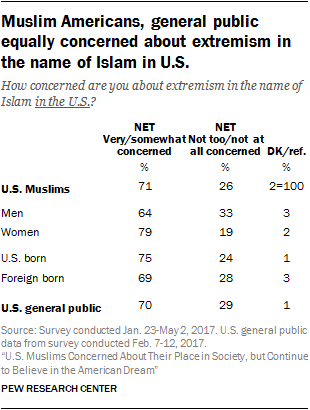
While U.S. Muslims are slightly less worried about Islamic extremism in the United States than around the world, their concern about domestic extremism is still high. About seven-in-ten American Muslims (71%) say they are at least somewhat concerned about extremism in the name of Islam occurring in the U.S. As with global extremism, the level of concern among Muslim Americans about extremism in the U.S. is very similar to the general public’s (70%).
Despite their concerns about Islamic extremism, only 17% of Muslim Americans say there is a great deal (6%) or fair amount (11%) of support for extremism among U.S. Muslims. Most say there is not much support for extremism (30%) or none at all (43%) among the U.S. Muslim community. This contrasts with the views of Americans in general. Compared with Muslims, twice as many people in the general public (35%) say there is at least “a fair amount” of support for extremism among Muslims who live in the U.S.
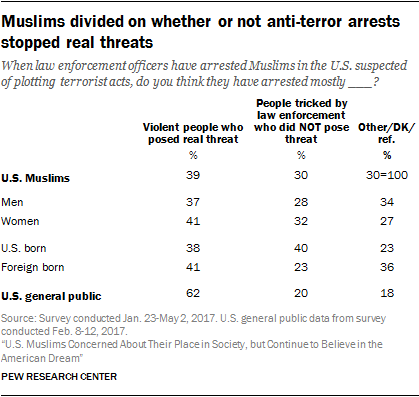
Muslim Americans also differ from the general public in their views on undercover sting operations and other police efforts to disrupt terrorist plots. Four-in-ten U.S. Muslims (39%) say that when law enforcement officers have arrested Muslims on suspicion of plotting terrorist acts, they have mostly arrested “violent people who posed a real threat.” But 30% say such arrests have mostly involved “people who were tricked by law enforcement and did not pose a real threat,” while an additional 30% say they are not sure or express no opinion.
The general public is less divided on this question: 62% of U.S. adults say anti-terror arrests have mostly stopped real threats, while only 20% say authorities mostly have entrapped people who did not pose a real threat.
Both Muslims and the general public also were asked if there are circumstances under which targeting and killing civilians can be justified in order to further a political, social or religious cause. Roughly eight-in-ten U.S. Muslims (84%) say such tactics can rarely (8%) or never (76%) be justified. The share of Muslims who say such tactics can often or sometimes be justified (12%) is similar to the share saying this among the general public (14%). And Muslims are more likely than the public as a whole to say that targeting civilians for political, social or religious causes can never be justified.
Interesting account of some of the history of ethnic studies, the political debates and the evidence of how it encourages more engagement among minority students:
In Jr Arimboanga’s ninth-grade classroom, students learn about critical consciousness: how to read the word, but also the world. It’s a concept popularized by a Brazilian educational theorist named Paulo Freire in his book, Pedagogy of the Oppressed.
The class is ethnic studies. It’s part of an effort by San Francisco educators like Arimboanga to teach courses centered on the perspectives of historically marginalized groups. Just last year, California passed a law mandating a model ethnic studies curriculum.
Sometimes called multicultural education or culturally responsive teaching (though there are subtle differences among the three), ethnic studies has been expanding on the west coast and in pockets across the country. San Francisco’s curriculum is “designed to give high school students an introduction to the experiences of ethnic communities that are rarely represented in textbooks,” according to the school district’s website.
Teachers of ethnic studies argue that these courses give students a pathway to break the cycles of poverty, violence, and incarceration that so many communities of color face.
“Ethnic studies works,” says Artnelson Concordia, a veteran teacher who is helping to develop the San Francisco curriculum. He wants students to see that “all of their experiences can be connected to larger issues.”
“So by the end of the school year, they’re seeing themselves as makers of history,” Concordia says.
Movements and Counter-Movements
Ethnic studies has “gained momentum, frankly, with the election of Donald Trump,” says Ravi Perry, president of the National Association for Ethnic Studies. This summer, Oregon set a timetable for the adoption of K-12 ethnic studies standards. Efforts to introduce statewide legislation are also ongoing in Kansas and starting this year, Indiana high schools will be required to offer ethnic and racial studies as an elective course. States with large indigenous populations — like Montana and Alaska — have already written standards for culturally responsive teaching.
“We have an obligation to ensure their heritage is aptly reflected in how we talk about America,” Perry says. “This is not about promoting an individual agenda. It’s about understanding the importance of community solidarity.”
Other movements are concentrated at the district level. Seattle has passed a resolution, based on recommendations from the NAACP. Students in Providence, R.I., have successfully lobbied for a pilot of the ethnic studies curriculum. Albuquerque, N.M., has launched ethnic studies courses in all of its high schools.
Though the start of the ethnic studies movement can be traced to the early 1900s, it really kicked off in the 1960s at colleges and universities. In the past decade, the growth has accelerated in K-12 schools, partly in response to an Arizona law that banned the curriculum.
There, Republican lawmakers were specifically targeting a Mexican-American studies program at Tucson High School — where minority enrollment is 88 percent. The Republicans who wrote the legislation, Tom Horne and John Huppenthal, claimed the classes were stoking racial tensions and “radicalizing students.” They pointed to the course materials — among them, Freire’s Pedagogy of the Oppressed and Rodolfo Acuña’s Occupied America — as well as the class decor, which included a poster of Che Guevara.
In 2010, Horne and Huppenthal passed HB 2281, prohibiting classes and materials that “promote the overthrow of the U.S. government,” “resentment toward a race or class or people,” or “ethnic solidarity.” (This happened soon after the passage of SB 1070, which gave local police the authority to question a person’s citizenship.)
There were other ethnic studies courses in Tucson that were not touched by the bill, Huppenthal says. He mentions African-American studies, for one. But the teachers of Mexican-American studies classes at Tucson High, Huppenthal says, were “indoctrinating students.”
“They were doing a very simplistic application of Karl Marx’s dictum: All of history is the struggle between the ‘oppressor’ and the ‘oppressed,’ ” Huppenthal says. “And they were going to identify whites as oppressors and Hispanics as the oppressed.”
Myths and Truths
“One of the things you would hear was that our classes were hateful. That we were teaching resentment,” says Curtis Acosta, who piloted one of the Mexican-American studies classes that sparked the controversy in Arizona. “That’s exactly the antithesis of what you would see.”
Acosta taught for 18 years in Tucson Unified School District. On a typical day in his Chicano literature class, Acosta says, you’d find students sitting at tables “doing really controversial things like reading and writing well.”
Each morning, his class would begin with an affirmation, a Mayan precept called In Lak Ech, which translates to “You are another me.” Students would recite in Spanish and English part of the poem by Luís Valdez:
Tú eres mi otro yo. You are my other me. Si te hago daño a ti, If I do harm to you, Me hago daño a mi mismo. I do harm to myself. Si te amo y respeto, If I love and respect you, Me amo y respeto yo. I love and respect myself.
“Students were sharing and taking risks and that didn’t happen by accident,” Acosta says. “It was real intentional.”
Alexei Marquez can attest to that. She was in Acosta’s class the first year it was offered. Up until then, she had been a dutiful, if disengaged, student. “I learned from an early age to play the game as it was,” Marquez says.
When she took Acosta’s class, it was the first time she’d connected to literature on a personal level. She fell in love with The Devil’s Highway by Luís Alberto Urrea. “I can’t even tell you what I read in AP English,” Marquez says.
“The research says, plainly, that this stuff works,” explains Christine Sleeter, a California State University professor and ethnic studies expert. In 2010, the National Education Association asked her to review the academic and social impact of ethnic studies.
A few things happen when students take courses that connect with their lived experience, Sleeter says. Engagement increases, as do literacy skills, overall achievement and attitudes toward learning.
“As students of color proceed through the school system, research finds that the overwhelming dominance of Euro-American perspectives leads many such students to disengage from academic learning,” Sleeter writes in the NEA report. “Ethnic studies curricula exist in part because students of color have demanded an education that is relevant, meaningful, and affirming of their identities.”
Something else happens in these classes: students develop “a sense of agency,” Sleeter writes. So they aren’t just learning about history, they’re engaging with it and shaping it — reading the word and the world.
A Stanford study finds similar outcomes — particularly for high school students at risk of dropping out. Taking a course which examines “the roles of race, nationality and culture on identity and experience” improved not only academic performance, but also attendance.
“Kids react when the curriculum isn’t speaking to their experiences or to the things that really matter to them,” Sleeter says. “They just get bored and they either intellectually drop out or physically drop out.”
Interesting analysis of identity politics in action:
Nationality, race and ethnicity are a large part of identity for most people. Factors like this matter more for some people than others — and for some groups more than others — but a sense of group awareness or membership exists in varying degrees across all segments of American society.
Often it’s easy to see the signifiers of such group identity, in distinctive music, food or clothing, for example. But sometimes when symbols or language are co-opted, it is harder to spot. In 2015, Donald J. Trump’s “make America great again” and “build a wall” started out as simple but powerful slogans. As time went on, they became more infused with a specific meaning that symbolized the concerns and preferences of a substantial set of white Americans.
Mr. Trump’s appeals were a form of group politics or identity politics, and he continues to focus on threats to white identity as president.
Some Trump critics find his focus on whites as a group outrageous or counterproductive. But survey data suggest that many white Americans do feel threatened, and that they think there are policies that discriminate against them and should be changed.
Two examples of the president’s efforts and the underlying support for his positions illustrate these trends.
On Wednesday, he offered his support for a bill that would cut legal immigration to the United States in half, saying “this legislation demonstrates our compassion for struggling American families who deserve an immigration system that puts their needs first and that puts America first.” To achieve its goal, the plan would limit entry for some family members of American citizens and permanent residents.
In explaining how limiting the entry of relatives would put the needs of American families first, a White House policy adviser, Stephen Miller, said it was “common sense” that immigration was costing Americans jobs. He then suggested that the family members who would be denied entry under the proposal were largely low-skill workers who were taking jobs away from struggling Americans.
The claim about who, if anyone, suffers from the immigration of low-skilled workers is nuanced. Debate on the question is active. If people come to America because they have a relative living here, it does not mean by definition that they are low-skilled workers. Despite the difficulty of nailing down the effects of low-skilled immigration on American families, public opinion on the topic — at least for a particular set of Americans — may reflect the “common sense” Mr. Miller described.
In January 2016, the American National Election Study asked 875 white Americans this question: How likely is it that many whites are unable to find a job because employers are hiring minorities instead? On average, 28 percent of the white population thought it was extremely or very likely that white people could not find work because of minorities seeking those same jobs. Roughly half the white population thought it was at least moderately or slightly likely. Only 21 percent thought this was not at all likely.
Differences emerge across party lines, even among whites. Close to 20 percent of Democrats thought it was extremely likely that the prospects for white job-seekers would be threatened by the presence of minority workers, while 34 percent of Republicans (and 30 percent of independents) felt this way.
Among white Republicans and independents, an even greater divide becomes clear: White voters who preferred Mr. Trump to one of the other candidates in the Republican field were nearly twice as likely to anticipate white job loss to nonwhite workers (48 percent compared with 24 percent).
The survey also asked white people how important it was for whites to work together to change laws that are unfair to whites. On average, 38 percent said it was extremely or very important. Only a quarter thought it was not important at all — a category that presumably also encompasses people who thought no such laws existed.
These trends also help to frame President Trump’s other recent announcement that the Justice Department would be investigating college admissions procedures that might discriminate against white applicants.
The difference between white Democrats and Republicans on the importance of uniting as a group against discriminatory laws is only five percentage points, with Republicans believing it was more important than Democrats and independents.
The divide, however, among Republicans who preferred Mr. Trump in the primaries and those who chose someone else is overwhelming. Nearly 60 percent of Mr. Trump’s primary supporters thought organizing to change laws that are unfair to white people was extremely or very important. Only 15 percent thought it was not important at all to do so. Supporters of other G.O.P. candidates, on average, were about half as concerned.
The data show that race is less important to white Americans’ sense of self than to nonwhites — more white people say being white is not at all important to their identity relative to the numbers who say so in other groups. But Mr. Trump’s continued efforts to remind white Americans of their group status may increase the number of white people who think of themselves through a racial lens. It is one of the ways that his campaign and presidency may reshape public opinion and politics.
He is capitalizing both on an existing sense of threat among white voters and the opportunity to shape the way whites — because of their group membership — think of themselves.
A reminder to those critical from the right of the Liberal government’s approach of the alternative critique from the left, suggesting that the Liberals remain in the centre:
Prime Minister Justin Trudeau and Immigration Minister Ahmed Hussen sound a lot like former Conservative Immigration Minister Jason Kenney these days when it comes to immigration. Last Friday the Prime Minister said, “Protecting Canadians’ confidence in the integrity of our system allows us to continue to be open, and that’s exactly what I plan to continue to do.” Over the weekend, both the Prime Minister and the Immigration Minister counselled Haitians thinking about crossing the U.S. border into Canada to stay where they are and make their refugee claim in the United States. Many of Mr. Kenney’s public comments about changes to the immigration system introduced under his watch were also peppered with references to the need to maintain the integrity of, and public confidence in, the immigration system.
Maintaining the “integrity of the immigration system” is in part the shared code language for how our governments (Conservative or Liberal) think about asylum seekers. Canada may love refugees like Syrians who are selected and screened abroad before they set foot in the country, but the same cannot be said about asylum seekers who wash up on our shores in boats, or who walk across our border with the U.S.
Canada’s approach to asylum seekers pokes holes in the image of the country as inherently welcoming to immigrants and refugees. The fear and panic Canadians expressed about the arrival of 174 Sikhs off the coast of Nova Scotia in 1987, the arrival of “ghost ships” from Fujian, China in 1999, and 492 Tamils aboard the MV Sun Sea in 2010, bear little resemblance to Mr. Trudeau’s tweet in January where he told the world that, “To those fleeing persecution, terror and war, Canadians will welcome you.” Indeed, a 2015 Environics poll found that nearly half of Canadians believe that refugees coming to Canada do not have a legitimate claim.
Though the policy climate in the United States toward immigrants and refugees is changing for the worse, I am not optimistic that the Liberals will do much to make it easier for Haitians and others to make a refugee claim in Canada.
The immigration department is obsessed – and this is not too strong a word – with preventing the arrival in Canada of “jumpers” (their shorthand for “queue jumpers.”) One of the responsibilities of a visa officer is to try to predict whether a person who applies for a visitor visa will make an asylum claim after they arrive. If they think a person might “jump,” they can refuse to issue a visa. Even though making an asylum claim in Canada is not illegal, Canadian authorities dislike it when individuals use the visitor visa system to get to Canada to make a refugee claim.
Nor am I optimistic that the Liberals will rescind the Safe Third Country Agreement. Doing so would be a slap in the face to American authorities because it would send a very clear message that Canada does not have confidence that U.S. authorities can deal fairly with asylum claims. Some might say that with the current chaos in the White House, the U.S. will not notice, but at a time when there are heightened tensions about immigration in that country, you bet they will. I also doubt whether the Liberals are going to want to muddy the waters as we renegotiate NAFTA.
Nor is the government likely to close the “loophole” in the Safe Third Country Agreement that allows individuals to make an asylum claim if they cross into Canada outside of an official port of entry. To do so would involve an unprecedented militarization of the Canadian border and most Canadians are not ready to see the spectacle of the RCMP or CBSA officials physically preventing asylum seekers from crossing into Canada. We would look a lot like Hungary and its approach to preventing the arrival of asylum seekers.
The government of Canada has benefited more from the Safe Third Country Agreement than the United States. The two countries entered into the agreement for different reasons. For the U.S., it was part of a post-9/11 effort to enhance security. For Canada, it was an effort to stop asylum seekers from entering from the United States. One study found that before the Safe Third Country Agreement was put into effect, between 8,000 and 13,000 refugee claimants entered Canada annually from the United States. During the same period (1995-2001), only about 200 refugee claimants entered the United States from Canada.
The sad reality is that Canada’s welcoming approach to immigrants and refugees comes at the expense of asylum seekers.