Poll: Discrimination Against Women Is Common Across Races, Ethnicities, Identities : NPR

Another in the series of NPR polls on discrimination, with the usual richness of data including the “intersectionality” between race and gender:

Discrimination in the form of sexual harassment has been in the headlines for weeks now, but new poll results being released by NPR show that other forms of discrimination against women are also pervasive in American society. The poll is a collaboration with the Robert Wood Johnson Foundation and the Harvard T.H. Chan School of Public Health.

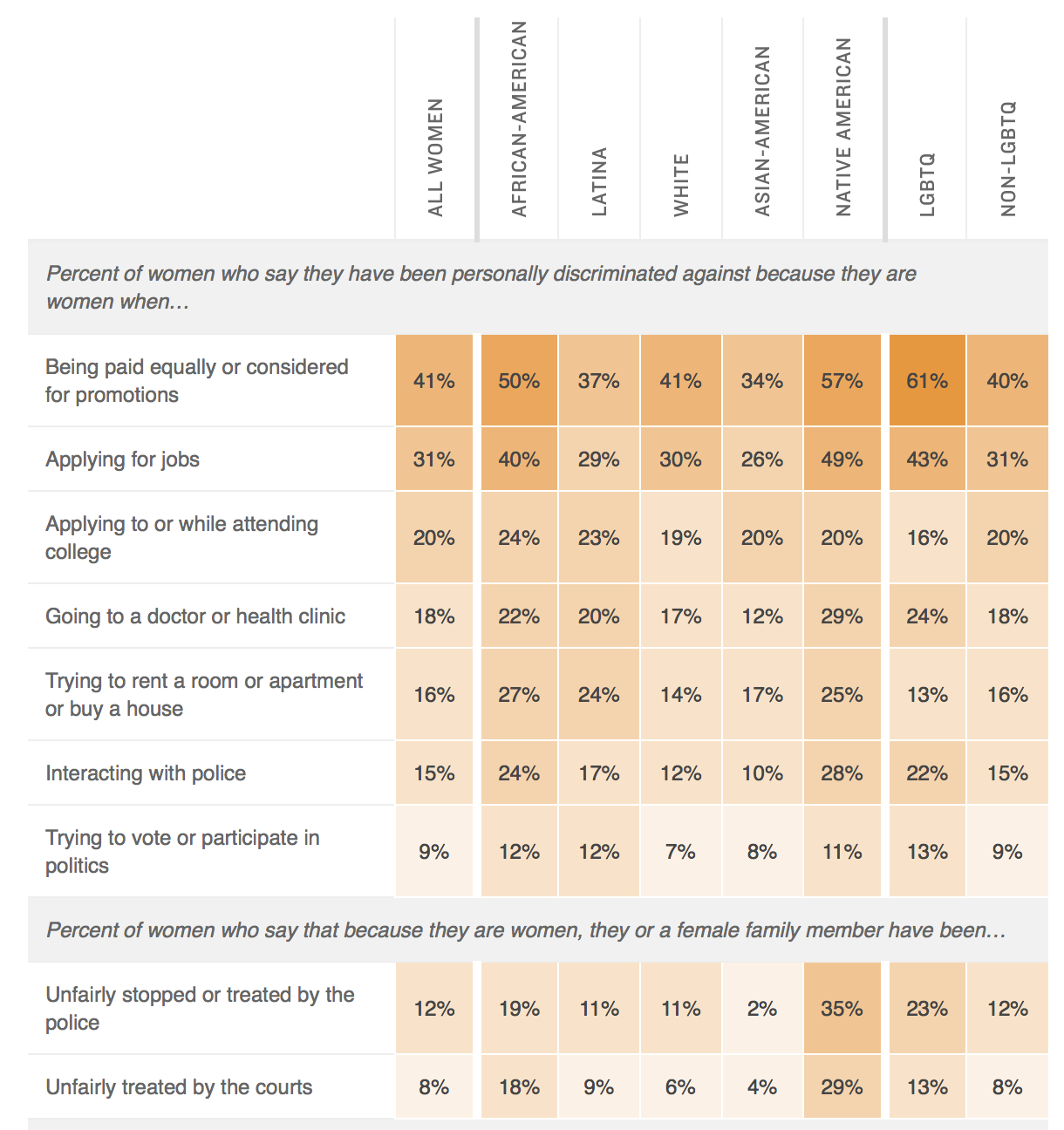
For example, a majority (56 percent) of women believe that where they live, women are paid less than men for equal work. And roughly a third (31 percent) say they’ve been discriminated against when applying for jobs because they are women.

Overall, 68 percent of women believe that there is discrimination against women in America today.

The chart below shows that the experience of gender discrimination is not monolithic — women in each racial, ethnic and identity group have particular problems in employment, education, housing and interactions with law enforcement, the courts and government. Several groups of women also avoid seeking health care out of concern they will face discrimination.

On nearly every measure, Native American women had the highest levels of discrimination based on gender. In our series, “You, Me and Them: Experiencing Discrimination in America,” we have highlighted several of these situations, including unfair treatment by the courts in majority-Native areas.

NPR will livestream an expert panel discussion on Native American issues at noon ET on Tuesday.

One of the patterns that emerged from the poll and our subsequent reporting is a gulf between high- and low-income areas when it comes to experiences of discrimination. This gap is also apparent in the gender data crunched by our Harvard team. The graph below illustrates the stark differences based on income when it comes to several everyday experiences people have in their own neighborhoods.

A snapshot in time

Our poll — which was fielded from late January to early April — before this fall’s intense news coverage of sexual harassment — also captures what women were feeling and experiencing before the recent scandals.

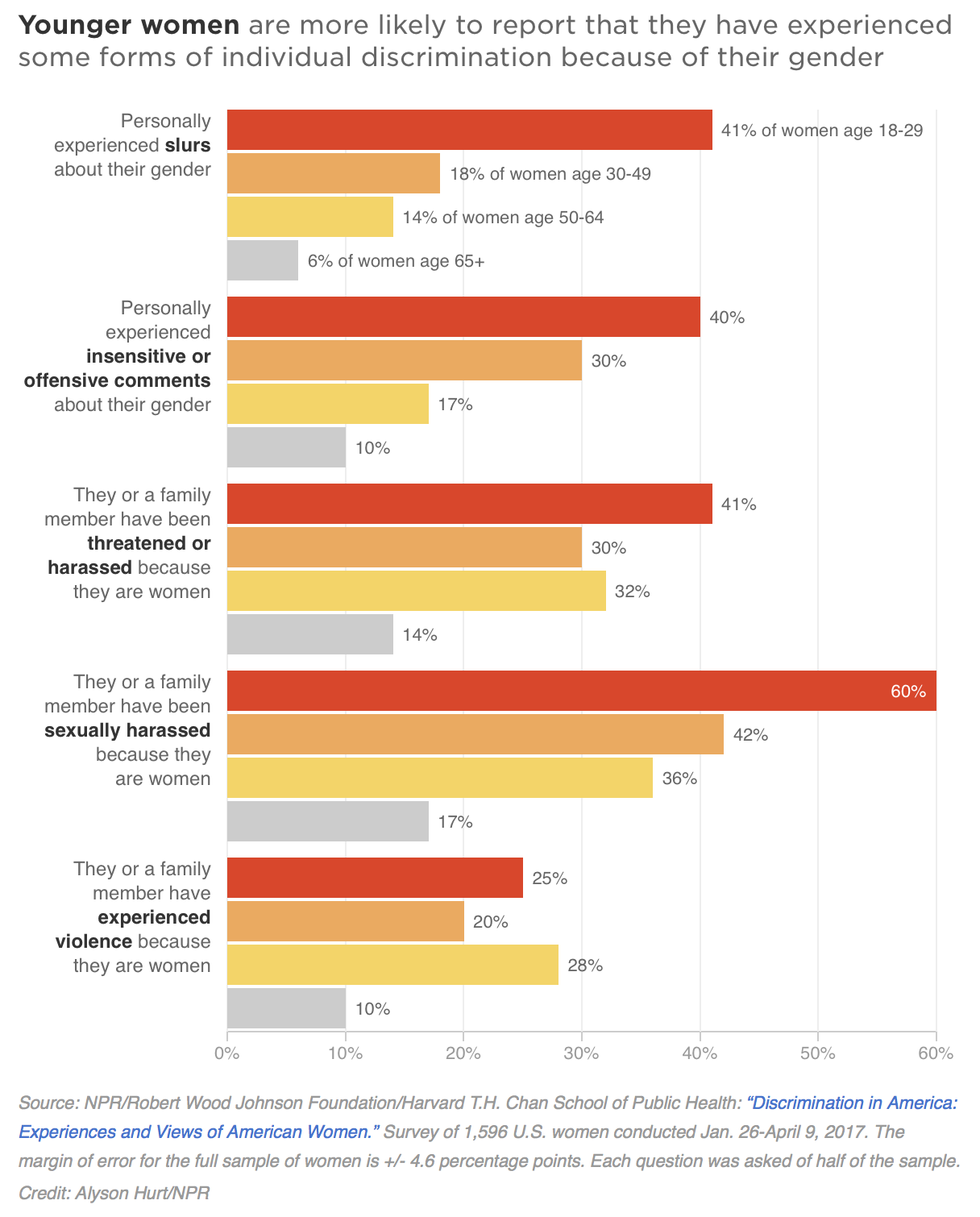
We found that 37 percent women overall reported they or a female family member had been sexually harassed because they are women at some point in their lives. But there was a wide range of responses based on age, with 60 percent of those 18 to 29 years old saying they or a female family member had been sexually harassed because they are women, versus 17 percent of women 65 and over.

“Our survey highlights the extraordinary level of personal experiences of harassment facing women today, as reflected in the news,” says Robert Blendon, co-director of the poll and professor of health policy and political analysis at the Harvard Chan School. “These national conversations may have affected how people viewed or responded to their own experiences in our survey, or their willingness to disclose these experiences.”

Indeed, a poll released last week by Quinnipiac University, asking specifically about sexual assault, suggests women may be more comfortable reporting such experiences now that more women are coming forward and revealing past abuse. (Our poll differs from Quinnipiac in that we asked a broader question: “Do you believe that you or someone in your family who is also a female has experience sexual harassment because you or they are female?”)

The survey from NPR, the Robert Wood Johnson Foundation and the Harvard Chan School was conducted from Jan. 26 to April 9, 2017 among a nationally representative probability-based telephone (cell and landline) sample of 1,596 women. The margin of error for total female respondents is 4.6 percentage points at the 95 percent confidence interval. Complete methodological information is in the full poll report.

via Poll: Discrimination Against Women Is Common Across Races, Ethnicities, Identities : NPR

US expat groups vow to continue fight to end citizenship-based tax regime, repeal FATCA

Despite the efforts, too small an interest group, and not domestically-based, to effect change to date:

After the US Senate voted early on Saturday morning to approve a version of a major tax reform bill that failed to include certain fiercely-fought-for changes that would have benefited expatriate Americans, spokespeople for some of the organisations that lobbied on behalf of these changes said they didn’t regard the battle as over – and that in any event, the fight would go on.

They also stressed that much had been achieved in terms of educating Americans at home and abroad to the issues, and organising and building groups that will continue to work for a change. Said Marylouise Serrato, executive director of the American Citizens Abroad, one of the organisations at the centre of the campaign: “Thanks to everyone’s efforts, the awareness and interest in the topic of residency-based/territorial taxation for Americans overseas is the highest its ever been.”

As reported,  the ACA, along with such other organisations as the Republicans Overseas, the Democrats Abroad, Americans for Tax Reform, the Heritage Foundation and a number of American chambers of commerce have fought hard for months to convince US lawmakers to do away with the current US system of citizenship-based taxation.

Some of these and others, including the Campaign to Repeal FATCA, and certain members of Congress such as Republican Senator Rand Paul of Kentucky, have been campaigning for the US to get rid of the Foreign Account Tax Compliance Act, which has made life difficult for expatriate Americans since it was signed into law by president Obama in 2010.

Saturday’s Senate vote saw 51 Republican lawmakers vote to approve the Senate version of the so-called Tax Cuts and Jobs Act, and 49 senators – all Democrats – voting against it.  Neither a proposal to replace the current citizenship-based tax regime nor one that would have called for the repeal  of FATCA was included in the version that was passed, even though, as reported, such key lawmakers as the Republican head of the House Ways and Means committee, Kevin Brady, had publicly indicated that Washington officials were taking “seriously” the call for a shift away from the citizenship-based income tax system.

via US expat groups vow to continue fight to end citizenship-based tax regime, repeal FATCA

USA: 2020 Census May Ask White People To Get Specific About Their Ethnicity | 90.1 FM WABE

Canada has collected ethnic origin/ancestry data for over 30 years:

“White” has been a constant of the U.S. census.

Other racial categories for the national headcount have come and gone over the centuries. But “white” has stuck ever since U.S. Marshals went door-to-door by horseback for the first census in 1790, tallying up the numbers of “free white males” and “free white females,” plus “all other free persons” and “slaves.”

Census takers determined who counted as “white” or any other race. That changed in 1960, when U.S. residents were first allowed to self-report their race. Since then, just answering “white” has been enough to respond to the race question.

But the upcoming census in 2020 may ask those who identify as white to explore their family tree to share their ethnic background as well. Anyone who checks off the “white” box could also mark boxes for groups such as “German,” “Irish” and “Polish” or write in another option.

That change depends partly on whether the White House approves proposals to modify how the federal government collects race and ethnicity data. They originated when President Obama was still in office, and now it’s up to the Trump administration to approve or reject them. If approved, the Census Bureau may move forward with this new way of asking people of all races about their identities on the 2020 questionnaire.

Friday is the deadline for the White House’s Office of Management and Budget, which sets standards for this kind of data for all federal agencies, to announce its decisions on the proposals. Any policy changes would come at a time of heightened awareness of white nationalist calls against multiculturalism and growing partisan divides over issues about race in the U.S.

Research by the Census Bureau suggests the proposals could produce a more accurate count in 2020. In a report released in February, the bureau’s researchers write that the suggested changes are responding to a public “call for more detailed, disaggregated data for our diverse American experiences as German, Mexican, Korean, Jamaican, and myriad other identities.”

‘It could change the discussion’

Asking white people about their ethnic background is not a new concept for the census. Recent census forms, including the questionnaire used in 2010, have asked all recipients about their ethnicity specifically in terms of “Hispanic, Latino, or Spanish origin.” A question about a person’s ancestry or ethnic origin was first included in the 1980 Census and remained on some forms as recently as 2000. Past forms have asked for a person’s place of birth, the countries where the person’s mother and father were born and languages spoken other than English.

via 2020 Census May Ask White People To Get Specific About Their Ethnicity | 90.1 FM WABE

The French Origins of “You Will Not Replace Us” | The New Yorker

Good long read:

The Château de Plieux, a fortified castle on a hilltop in the Gascony region of southwestern France, overlooks rolling fields speckled with copses and farmhouses. A tricolor flag snaps above the worn beige stone. The northwest tower, which was built in the fourteenth century, offers an ideal position from which to survey invading hordes. Inside the château’s cavernous second-story study, at a desk heavy with books, the seventy-one-year-old owner of the property, Renaud Camus, sits at an iMac and tweets dire warnings about Europe’s demographic doom.

On the sweltering June afternoon that I visited the castle, Camus—no relation to Albert—wore a tan summer suit and a tie. Several painted self-portraits hung in the study, multiplying his blue-eyed gaze. Camus has spent most of his career as a critic, novelist, diarist, and travel essayist. The only one of his hundred or so books to be translated into English, “Tricks” (1979), announces itself as “a sexual odyssey—man-to-man,” and includes a foreword by Roland Barthes. The book describes polyglot assignations from Milan to the Bronx. Allen Ginsberg said of it, “Camus’s world is completely that of a new urban homosexual; at ease in half a dozen countries.”

In recent years, though, Camus’s name has been associated less with erotica than with a single poignant phrase, le grand remplacement. In 2012, he made this the title of an alarmist book. Native “white” Europeans, he argues, are being reverse-colonized by black and brown immigrants, who are flooding the Continent in what amounts to an extinction-level event. “The great replacement is very simple,” he has said. “You have one people, and in the space of a generation you have a different people.” The specific identity of the replacement population, he suggests, is of less importance than the act of replacement itself. “Individuals, yes, can join a people, integrate with it, assimilate to it,” he writes in the book. “But peoples, civilizations, religions—and especially when these religions are themselves civilizations, types of society, almost States—cannot and cannot even want to . . . blend into other peoples, other civilizations.”

Camus believes that all Western countries are faced with varying degrees of “ethnic and civilizational substitution.” He points to the increasing prevalence of Spanish, and other foreign languages, in the United States as evidence of the same phenomenon. Although his arguments are scarcely available in translation, they have been picked up by right-wing and white-nationalist circles throughout the English-speaking world. In July, Lauren Southern, the Canadian alt-right Internet personality, posted, on YouTube, a video titled “The Great Replacement”; it has received more than a quarter of a million views. On great-replacement.com, a Web site maintained anonymously, the introductory text declares, “The same term can be applied to many other European peoples both in Europe and abroad . . . where the same policy of mass immigration of non-European people poses a demographic threat. Of all the different races of people on this planet, only the European races are facing the possibility of extinction in a relatively near future.” The site announces its mission as “spreading awareness” of Camus’s term, which, the site’s author concludes, is more palatable than a similar concept, “white genocide.” (A search for that phrase on YouTube yields more than fifty thousand videos.)

“I don’t have any genetic conception of races,” Camus told me. “I don’t use the word ‘superior.’ ” He insisted that he would feel equally sad if Japanese culture or “African culture” were to disappear because of immigration. On Twitter, he has quipped, “The only race I hate is the one knocking on the door.”

…Such revolutionary right-wing talk has now migrated to America. In 2013, Steve Bannon, while he was turning Breitbart into the far right’s dominant media outlet, described himself as “a Leninist.” The reference didn’t seem like something a Republican voter would say, but it made sense to his intended audience: Bannon was signalling that the alt-right movement was prepared to hijack, or even raze, the state in pursuit of nationalist ends. (Bannon declined my request for an interview.) Richard Spencer told me, “I would say that the alt-right in the United States is radically un-conservative.” Whereas the American conservative movement celebrates “the eternal value of freedom and capitalism and the Constitution,” Spencer said, he and his followers were “willing to use socialism in order to protect our identity.” He added, “Many of the countries that lived under Soviet hegemony are actually far better off, in terms of having a protected identity, than Western Europe or the United States.”

Spencer said that “clearly racialist” writers such as Benoist and Faye were “central influences” on his own thinking as an identitarian. He first discovered the work of Nouvelle Droite figures in the pages of Telos, an American journal of political theory. Most identitarians have a less scholarly bent. In 2002, a right-wing French insurrectionary, Maxime Brunerie, shot at President Jacques Chirac as he rode down the Champs-Élysées; the political group that Brunerie was affiliated with, Unité Radicale, became known as part of the identitairemovement. In 2004, a group known as the Bloc Identitaire became notorious for distributing soup containing pork to the homeless, in order to exclude Muslims and Jews. It was the sort of puerile joke now associated with alt-right pranksters in America such as Milo Yiannopoulos.

…The United States is not Western Europe. Not only is America full of immigrants; they are seen as part of what makes America American. Unlike France, the United States has only ever been a nation in the legal sense, even if immigration was long restricted to Europeans, and even if the Founding Fathers organized their country along the bloody basis of what we now tend to understand as white supremacy. The fact remains that, unless you are Native American, it is ludicrous for a resident of the United States to talk about “blood and soil.” And yet the country has nonetheless arrived at a moment when once unmentionable ideas have gone mainstream, and the most important political division is no longer between left and right but between globalist and nationalist.

“The so-called New Right never claimed to change the world,” Alain de Benoist wrote to me. Its goal, he said, “was, rather, to contribute to the intellectual debate, to make known certain themes of reflection and thought.” On that count, it has proved a smashing success. Glucksmann summed up the Nouvelle Droite’s thinking as follows: “Let’s just win the cultural war, and then a leader will come out of it.” The belief that a multicultural society is tantamount to an anti-white society has crept out of French salons and all the way into the Oval Office. The apotheosis of right-wing Gramscism is Donald Trump.

On August 11th, the Unite the Right procession marched through the campus of the University of Virginia. White-supremacist protesters mashed together Nazi and Confederate iconography while chanting variations of Renaud Camus’s grand remplacement credo: “You will not replace us”; “Jews will not replace us.” Few, if any, of these khaki-clad young men had likely heard of Guillaume Faye, Renaud Camus, or Alain de Benoist. They didn’t know that their rhetoric had been imported from France, like some dusty wine. But they didn’t need to. All they had to do was pick up the tiki torches and light them. ♦ 

via The French Origins of “You Will Not Replace Us” | The New Yorker

For LGBTQ People Of Color, Discrimination Compounds : NPR

More on challenges among visible minority LGBTQ, both internal and external:

Nancy Haque’s parents understood discrimination — after moving to the U.S. from Bangladesh, they endured threats, even glass under the tires of the family car. But Haque says the discrimination she faces as a queer woman is different.

“As the child of immigrant parents, it’s not like I had to come out as being South Asian,” Haque laughs. “But I think that we didn’t talk about discrimination.”

She talks about it now. Haque is co-director of Basic Rights Oregon, an LGBTQ advocacy group based in Portland. She is committed to bringing civil rights issues to the forefront of LGBTQ organizing.

In 2017, Haque says, “if you’re an LGBTQ organization that hasn’t taken on racial justice as a key part of who you are and what you do, then you’re irrelevant.” That is because the discrimination that LGBTQ people of color experience and the resources they have to combat it are compounded by their intersecting identities.

According to a new poll by NPR, the Robert Wood Johnson Foundation and the Harvard T.H. Chan School of Public Health, LGBTQ people of color are more than twice as likely as their white counterparts to say they’ve been discriminated against because they are LGBTQ in applying for jobs and interacting with police.

The National Black Justice Coalition focuses on the intersection of racial justice and LGBTQ rights. Isaiah Wilson, the coalition’s director of external affairs, says LGBTQ people of color are “the most impacted communities” when it comes to discrimination, “be it trans military service, be it access to health care, or if you look at employment.”

And according to demographic data collected by the Williams Institute, black LGBTQ people are more likely to live where other black folks live — many of them in the South, says Wilson, “where we don’t have state and local protections to be out.”

Wilson says given this compounded discrimination, LGBTQ people of color need support. But they don’t always get it — because the LGBTQ movement at large has had different priorities. Namely, organizing around the fight for marriage equality that culminated with the Supreme Court’s 2015 ruling that legalized same-sex marriage nationwide.

“When you’re continuing as a community to face discrimination, harassment, even violence,” Wilson explains, “marriage is a luxury. Surviving, being able to participate in community, being able to provide for our families — if I can’t do that, who’s thinking about a marriage certificate?”

And while communities of color come together around the discrimination and harassment they face, they may not always see LGBTQ issues as part of the same struggle.

In the Latino community, for example, “the perception … is that it’s always been a conservative community,” says Ingrid Duran, founder of Familia Es Familia, a group that aims to increase LGBTQ acceptance among Latinos.

And, she adds, “that conservative element comes along with religious beliefs” — primarily those of the Catholic Church, which regards homosexuality as a sin.

But Duran says that is changing. The U.S. Latino population is very young, and young people are increasingly moving away from organized religion — and the Catholic Church itself is changing. And, Duran says, the Latino community is changing on queer issues, especially when there has been outreach and education from groups like Familia es Familia, because of the cultural priority on family.

“Nine times out of 10, a grandparent or a parent is going to accept their child. Because it is their family,” Duran says. “And they still hold the same values that they held five minutes before they came out to you.”

via For LGBTQ People Of Color, Discrimination Compounds : NPR

Poll: Majority of LGBTQ Americans Report Harassment, Violence Based On Identity : NPR

Not too surprising:Poll__Majority_of_LGBTQ_Americans_Report_Harassment__Violence_Based_On_Identity___NPR

More than half of lesbian, gay, bisexual, transgender and queer Americans say they have experienced violence, threats or harassment because of their sexuality or gender identity, according to new poll results being released Tuesday by NPR, the Robert Wood Johnson Foundation and the Harvard T.H. Chan School of Public Health.

“There are very few nationally representative polls of LGBTQ people, and even fewer that ask about LGBTQ people’s personal experiences of discrimination,” says Logan Casey, deputy director of the survey and research associate in public opinion at the Harvard Chan School. “This report confirms the extraordinarily high levels of violence and harassment in LGBTQ people’s lives.”

Majorities also say they have personally experienced slurs or insensitive or offensive comments or negative assumptions about their sexual orientation. And 34 percent say they or an LGBTQ friend or family member has been verbally harassed in the bathroom when entering or while using a bathroom — or has been told or asked if they were using the wrong bathroom.

The poll, conducted earlier this year, looked not only at violence and harassment but also at a wide range of discrimination experiences. We asked about discrimination in employment, education, in their interactions with police and the courts and in their everyday lives in their own neighborhoods. We’re breaking out the results by race, ethnicity and identity. You can find what we’ve released so far on our series page “You, Me and Them: Experiencing Discrimination in America.”

via Poll: Majority of LGBTQ Americans Report Harassment, Violence Based On Identity : NPR

In An Era Of Colorlines, Are East Asians ‘Brown’? : NPR

Interesting discussion on “yellow” vs “brown” identities:

It’s time for another Ask Code Switch. This week, we’re getting into the gray area between yellow and brown.

Amy Tran, from Minneapolis, asks:

Can light-skinned Asians (East Asian) call themselves “brown”? I am East Asian, and have a friend who is South Asian. She is much darker than me, and told me that because of my skin color, I cannot identify as brown. I acknowledge that even though I am not technically brown, I do face similar challenges that people under the “brown” umbrella face – gentrification, unfair labor conditions, xenophobia, not to mention micro-aggressions and stereotypes, etc. – and that to exclude me from this “group” is excluding all light-skinned Asians from the oppression we face. What’s your take?

Hi Amy,

I think there are actually two different questions — both very important — that we have to parse out here. One of them is about skin color, and the other is about political identity. And in the conversation about who gets to claim the term “brown,” those are very different things.

So, to begin with, let’s get one thing straight — the colors that people use to differentiate people of different races have never really been about skin color. Black, white, brown, yellow, red? Those terms bear little resemblance to the actual spectrum of coloring found in humans, not to mention they create false distinctions between groups of people who have always overlapped.

And, of course, there are plenty of East Asians who have very brown skin, just as there are tons of South Asians who have very light skin. This cuts across racial groups. Some black people have skin the color of a chestnut, and others have skin the color of pink sand. In the U.S., Latinos with all different coloring refer to themselves as brown.

The racial categories we use today were largely the brainchild of eighteenth and nineteenth century European “racialist anthropologists,” who used things like skull measurements and hair texture to divide people into racial groups. For years, many of these anthropologists referred to four races: red, yellow, black and white. Then in 1795, Johann Blumenbach, a German naturalist, wrote about a fifth brown race (the “Malays”,) consisting of Southeast Asians and Pacific Islanders.

All that is to say, the way someone identifies racially has never been strictly about physical appearance and always about drawing (arbitrary) lines between groups of people.

So, the idea that you shouldn’t refer to yourself as brown because of your literal skin color, I think, is a bit misguided.

Having said that, Amy, there is a pretty compelling reason not to call yourself brown.

As you’ve rightly pointed out, identifying as “brown” (or black, or white, or yellow) is a political statement. To you, and many others, being brown is about a set of shared experiences, that include things like being subjected to discrimination and stereotyping.

But there’s some important history here, and it goes back to the Yellow Power Movement of the 1960s and ’70s. The Yellow Power Movement was instrumental in fighting for the civil rights of Asian-Americans. But not all Asian-Americans felt represented by the movement. And that’s where the East Asian/”Brown Asian” divide comes in.

The brown Asian movement was a response to the fact that “brown Asians are still really forgotten and marginalized within the Asian American umbrella, to this day,” says E.J.R. David. He’s a professor at the University of Alaska, Anchorage who studies the mental health consequences of colonialism. He also wrote Brown Skin, White Minds, a book about the psychological experiences of Filipino Americans.

David says that when people in the United States talk about Asian-Americans, they’re almost always referring to people of Chinese, Japanese, or Korean descent. But today, those groups only make up about half of all Asian-Americans. And those East Asians, David says, have different educational outcomes, income levels, immigration histories, health outcomes, access to resources and refugee status than brown Asians. (Brown Asians include Filipinos and South Asians, David has written.)

So while there certainly may be similarities between the experiences of East Asians and other Asian Americans, David says that the term brown Asians is meant to differentiate people who have felt invisible. It makes sense, he says, that some people might be offended if the term is taken on by someone of East Asian descent.

“To me, there are terms that only, because of the history of it, and because of the current reality of our situation, I think are best reserved for some people to be able to use, especially if they’re using it for their own empowerment, and for their own group’s empowerment,” David says. And for those people who are not part of it, he adds, “We cannot appropriate that if it’s not ours.”

via In An Era Of Colorlines, Are East Asians ‘Brown’? : Code Switch : NPR

Donald Trump Has Nominated 480 People So Far in His Presidency. 80% of Them Are Men.

Says it all:

And if there is one trend that has defined this current president’s staffing decisions, it has been his proclivity to turn to men when filling out key posts.

Since he assumed office, Donald Trump has sent 480 nominations to the U.S. Senate for positions in the judicial branch and executive branches. Of those, The Daily Beast found, 387 were men—constituting just over 80 of all of Trump’s nominees.

The trend goes across government, though it is truly accentuated in certain fields. For example, Trump has nominated 282 men for high-ranking cabinet positions compared to 77 women. He has nominated 55 men for tax, armed forces, veterans claims, district, appellate, and supreme court judgeships compared to 13 women. And he has nominated 50 men to U.S. attorney posts compared to just three women.

Numerous executive branch departments have not had a single woman nominated to their ranks. Though some of them have only a handle of confirmable positions, others like the  Department of Agriculture and the Department of Energy have had seven nominees respectively to date. All of those nominees were men.

via Donald Trump Has Nominated 480 People So Far in His Presidency. 80% of Them Are Men.

Hate Crimes Up In 2016, FBI Statistics Show : NPR

Relatively low numbers compared to the population, reflecting major data collection gaps:

The Anti-Defamation League, for example, noted that nearly 90 cities with populations of more than 100,000 either reported zero hate crimes or did not report data for 2016.

“There’s a dangerous disconnect between the rising problem of hate crimes and the lack of credible data being reported,” said ADL CEO Jonathan A. Greenblatt. He called for an “all-hands-on-deck” approach to get better nation-wide figures on the problem.

Sim Singh, the national advocacy manager of the Sikh Coalition, agreed. He noted that the FBI statistics count seven anti-Sikh hate crimes in 2016, which he said “represents the tip of the iceberg.”

“If law-enforcement agencies fail to document the true extent of hate crimes against our communities,” Singh said, “our nation will have a hard time mobilizing the political will and resources necessary to prevent and combat the problem.”

The only way to fix the data problem, he added, is for law enforcement to adopt mandatory hate crime reporting.

Still, the FBI data provides an overview of hate crimes across the country.

There were 7,509 victims of single-bias hate crime incidents, according to the reported numbers for 2016. A victim can be a person, a business, a government entity or a religious organization.

Nearly 59 percent of the victims were targeted because of their race. A further 21.1 percent were targeted because of religion, and 16.7 percent because of sexual-orientation.

Of the race-related incidents, more than half were anti-black, while some 20 percent were anti-white. More than half of the religious-related crimes, the statistics show, were anti-Jewish, while a quarter were anti-Muslim.

In cases where law enforcement was able to identify the perpetrator, 46.3 percent were white and 26.1 percent were black.

via Hate Crimes Up In 2016, FBI Statistics Show : NPR

U.S. Congress split over whether criticizing Israel constitutes antiSemitism – Haaretz.com

Expect we would have similar divisions if there were hearings on an antisemitism definition, and how it applies to criticism of Israel and Israeli policies:

A U.S. House of Representatives committee heard tough exchanges between proponents and opponents of a bill that would codify a definition of anti-Semitism that incorporates a controversial component addressing attacks on Israel.

The nine witnesses appearing Tuesday at a meeting of the House Judiciary Committee were split: Five among those said the proposed addition to federal anti-discrimination statutes is a necessary means of stemming anti-Semitism on campuses, and four who argued it infringes on speech freedoms. The law if enacted would apply to Title VI of the 1964 Civil Rights Act, which addresses institutions — including universities — that receive federal funding.

The witnesses at times directly addressed one another, violating congressional protocol. Barbs were exchanged, with each side questioning the bona fides of the other in defining anti-Semitism. In a bizarre twist, the coauthors of the language that the bill would codify argued opposing viewpoints.

Lawmakers — who also bickered at times — marveled at the Jewish family food fight they were witnessing.

“It’s like throwing a ball and having a scrum and seeing who wins,” Rep. Doug Collins, R-Ga., said.

At issue is the Anti-Semitism Awareness Act — a version also is under consideration in the Senate — which would codify the State Department’s definition of the phenomenon, which is used by diplomats to identify the problem and report on it.

Top officials of the Anti-Defamation League, the American Jewish Committee, the Simon Wiesenthal Center and Christians United for Israel advocated for the proposed statute, as did Paul Clement, a former U.S. Solicitor General. Opposing were two Jewish studies professors, the director of PEN America –  a speech freedom umbrella, and the head of an outfit that combats anti-Semitism.

Representing the American Jewish Committee, which backs the bill, was Rabbi Andy Baker, the AJC’s director of International Jewish Affairs. Ken Stern, who in 2004 when both he and Baker were employed by AJC  drafted the language in question,  now directs the Justus & Karin Rosenberg Foundation, which combats anti-Semitism. Stern opposes codifying the language into law, although he still endorses the language for its intended use, as a means for diplomats to identify anti-Semitism.

The language, in its current State Department formulation, includes a section that defines as anti-Semitism language that “demonizes” Israel. It breaks down the term “demonizes” as: “Using the symbols and images associated with classic anti-Semitism to characterize Israel or Israelis, drawing comparisons of contemporary Israeli policy to that of the Nazis, blaming Israel for all inter-religious or political tensions.”

In his testimony, Stern said that the tough standards he would apply in assessing whether a speech at the United Nations by Iran’s president was anti-Semitic should not devolve onto college freshmen. He said it would be especially cruel to young Jews still testing their boundaries within the community.

“Whether or not you can be an 18-year-old anti-Zionist and within the (Jewish) community is not a debate Congress should decide,” he said.
Proponents said that the bill would not inhibit speech because the definition would only be applied when assessing whether a Title VI-banned act — violence or a bid to shut off speech — was anti-Semitic, and not to anti-Semitic speech in and of itself.

“It wouldn’t raise First Amendment problems, it would only be triggered by harassment,” said Clement.

That, Stern said, was “disingenuous” — a federal statute would naturally inhibit speech. “When you prioritize a certain definition it has the weight of having Congress behind it,” he said.

Barry Trachtenberg, a Jewish studies professor at Wake Forest University in North Carolina, seemed to accuse proponents of the legislation of bad faith. “They are part of a persistent campaign to thwart scholarship, debate, and activism critical of Israel,” he said.

The Simon Wiesenthal Center’s Rabbi Abraham Cooper and the ADL’s Jonathan Greenblatt fired shots at Trachtenberg, and at Pamela Nadell, the president of the Association for Jewish Studies, saying that academics were not in the trenches. Cooper chided the committee for inviting them. “It’s like inviting people from the Flat Earth Society to a hearing about NASA,” he said. Greenblatt mocked them as being ensconced in an ivory tower.

Cooper seemed visibly uncomfortable, crowded next to Trachtenberg at the witness table, who kept staring at him. Cooper kept emphasizing that the Jewish leadership in its entirety backed the bill, seeming to sideline Stern’s organizational affiliation. At one point Cooper’s insistence that the entire Jewish community backed the bill drew a correction from Rep. Jerry Nadler, D-N.Y., who produced a letter from J Street U, the liberal Middle Eastern lobby’s campus affiliate, opposing the bill.

via U.S. Congress split over whether criticizing Israel constitutes anti-Semitism – U.S. News – Haaretz.com