Appointment of Mi’kmaq, black women to Nova Scotia courts ‘a huge step’

As the federal government increases the diversity of its judicial appointments (Justice minister announces 24 new judges in effort to end national shortage), interesting to see watch provincial announcements and the degree to which they are reported on:

Nova Scotia has appointed the first Mi’kmaq woman and the third black woman to the provincial and family courts, in what the province’s Premier calls a “huge step forward” for ethnic diversity on the bench.

Legal aid lawyer Catherine Benton becomes only the third aboriginal judge in Nova Scotia, while Ronda van der Hoek, a public prosecutor, joins two

other black women – Corinne Sparks and Jean Whalen – among the 73 full-time judges in the province.

Premier Stephen McNeil said in an interview the two new judges will provide added perspectives from the black and indigenous population in a court system that needs to reflect the makeup of the general population.

“I believe this is a huge step forward. They have had distinguished careers in making sure minority voices are being heard, that Mi’kmaq rights are being protected, and their cultures will be reflected in the decisions they make,” he said.

Justice Benton is well known within legal circles as an advocate for racial and ethnic diversity in the courts, having pushed from the earliest days of her career for a stronger role for indigenous lawyers in the court system.

She worked as a researcher with the Union of Nova Scotia Indians and the Mi’kmaq Grand Council before getting her law degree from Dalhousie in 1993.

In 1994, Justice Benton told the aboriginal publication Windspeaker she had made a series of fruitless job applications to firms around Atlantic Canada, with some partners telling her they felt her knowledge of aboriginal law wouldn’t be an asset.

“I think it’s important to establish an aboriginal justice network,” she told the publication.

Naiomi Metallic, a teacher specialized in indigenous law at Dalhousie’s Schulich law school, says the appointments are being greeted with delight among advocates for greater indigenous and black representation in the legal system.

“I’m elated … We’ve been saying in the media there needs to be more diverse appointments and it appears that hasn’t fallen on deaf ears,” she said.

Justice van der Hoek, from Windsor, has practised law for 19 years and also worked with Nova Scotia Legal Aid in Windsor and Halifax after graduating from Dalhousie Law School.

She is the third black judge in the province’s lower and superior courts.

Justice Van der Hoek and Justice Benton also bring the family and provincial courts a step closer to gender parity, with a total of 15 full-time female judges, compared to 20 full-time, male judges.

Source: Appointment of Mi’kmaq, black women to Nova Scotia courts ‘a huge step’ – The Globe and Mail

Trump administration backs off immigration pledge – Macleans.ca

Some small signs of a more reasoned approach to immigration:

President Donald Trump will focus immigration enforcement efforts first on criminal immigrants in the country illegally, his administration said on Monday, offering hope to more than three-quarters of a million young immigrants protected from deportation under the Obama administration.

Those protected from deportation under former President Barack Obama’s Deferred Action for Childhood Arrivals program have been worried that Trump would follow through on a campaign pledge to immediately end the “illegal amnesty.”

While White House spokesman Sean Spicer, at his first press briefing, did not explicitly rule out action on the program known as DACA, his comments suggest that Trump’s initial policies will be similar to Obama’s. Spicer noted Trump has said his focus would be on immigrants in the country illegally who have a criminal record or pose a threat.

“That’s where the priority’s going to be, and then we’re going to continue to work through the entire number of folks that are here illegally,” he said.

He added that those immigrants who have overstayed visas will also be among the administration’s enforcement priorities.

Spicer’s comments echo what Trump said in an interview shortly after the election, when he told CBS’ “60 Minutes” that the focus would on “probably 2 million, it could be even 3 million” criminals living in the country illegally. They also suggest continuity with Obama, who also focused on immigrants with criminal records.

Obama created the DACA program in 2012. The program allows young immigrants who were brought to the country as children to apply for a two-year reprieve from deportation and a work permit. The protection and work permit can be renewed.

Information about the program and applications documents remained available online from U.S. Citizen and Immigration Services, the Homeland Security agency that manages DACA.

Immigration advocates bracing for elimination of the program are pushing members of Congress to protect the young immigrants after failing to do so in the past. The immigrants, often referred to as Dreamers, are seen as the most sympathetic group among the estimated 11 million immigrants living in the United States illegally.

Source: Trump administration backs off immigration pledge – Macleans.ca

U.S. Supreme Court won’t hear ‘Sister Wives’ polygamy appeal

Reality tv meets the justice system, but on a technicality:

The U.S. Supreme Court said Monday it won’t hear an appeal from the family on TV’s “Sister Wives” challenging Utah’s law banning polygamy.

The decision ends the family’s long legal fight to overturn a seldom used and unique provision of Utah’s law that the Browns and other polygamous families contend has a chilling effect by sending law-abiding plural families into hiding because of fear of prosecution.

The provision bars married people from living with a second purported “spiritual spouse” even if the man is legally married to just one woman, making it stricter than anti-bigamy laws in other states.

The reality TLC cable channel TV show follows the lives of Kody Brown, his four wives and all their children. When it debuted in 2010, it was considered ground-breaking by offering viewers a glimpse into how a plural family navigates the unique complexities of the arrangement.

Utah prosecutors say they generally leave polygamists alone but that they need the ban to pursue polygamists for other crimes such as underage marriage and sexual assault. Only 10 people were charged with violating the law between 2001 and 2011, prosecutors say.

The Utah Attorney General’s Office declined comment on the Supreme Court’s denial of the case, which the justices issued without comment.

The saga between the Browns and Utah officials began in September 2010 when the first episode aired of the TLC show, “Sister Wives.” A county prosecutor opened an investigation, leading the Browns to leave their longtime of Lehi, Utah, in 2011, to settle in Las Vegas where they still live today.

That same year, the Browns filed a lawsuit calling the opening of the investigation government abuse. The case was closed without filing any charges.

In 2013, the Browns scored a key legal victory when a federal judge in Utah ruled the law violated polygamists’ right to privacy and religious freedom.

But an appeals court in Denver decided last year that the Browns could not sue because they were not charged under the Utah law. It did not consider the constitutional issues. That ruling will now stand.

The Brown’s attorney, Jonathan Turley, said in a statement posted on his blog that he and the family are disappointed but not surprised because the high court is on a pace to hear less than 1 per cent of the 7,500 appeals it is likely to receive this term.

Turley emphasized that an appeals court ruling was not made based on the merits of the Browns’ assertion that Utah’s law violates their rights of speech and religion.

“Our victory in Salt Lake City will remain as a cautionary decision for legislators who wish to marginalize or sanction this community in the future,” Turley said. “It has been a long road for all of us and it is not the end of the road. Plural and unconventional families will continue to strive for equal status and treatment under the law.”

Kody Brown is legally married to Robyn Brown, but says he is “spiritually married” to three other women. They live together in a plural relationship and belong to a religious group that believes in polygamy as a core religious practice. Their show continues to air on TLC.

Source: U.S. Supreme Court won’t hear ‘Sister Wives’ polygamy appeal – Macleans.ca

Should we ‘ban’ Salafism? – Gurski

Good piece by Phil Gurski:

Truth be told, I am no fan of most Salafis (full disclosure: I am not Muslim so my views count for little). I happen to find them arrogant, intolerant and distrustful of Muslims who are not like them (this means most Muslims—look at the figure presented above: of an estimated 4.3 million Muslims in Germany, 10,000— i.e. less than one per cent—are Salafi). In the same way I have little time for fundamentalists of any religion, including my own. But, I don’t tell them how to pray and how to worship—that is not my job. Is the German government now the arbiter of Islam in Germany? Does it really want that job?

This is fraught with problems. Is anyone associated with the German government qualified to determine who is a Salafist and who isn’t? What about divisions within Salafism? Most reputable scholars recognize at least three divisions with only the third—the Salafi jihadis—as a group that must be opposed because they believe in the use of violence to get their way. If Germany cracks down on “Salafists,” whether or not they espouse violence, should it not also ban other fundamentalist groups (Jews, Christians, Hindus…)? If not, why not?

At the end of the day the people best placed to deal with Salafism, if we agree that it is a “problem,” are not those in government, but the communities where it has taken hold. They are the ones most affected by it and they are the ones criticized by those with more intolerant views. They have a vested interest in challenging this issue, not the state. If certain preachers advocate violence, then ban them.

Furthermore, and this is really important, just as there is not a direct correlation/causation between Islam and terrorism, nor is there one on every occasion between Salafi Islam and terrorism. Saying there is is disingenuous. Let’s not make the serious problem of terrorism bigger than it already is. The “escalator” model of terrorism (i.e. that there are concrete steps always present along the pathway to violent extremism) is a poor one and has never been shown to apply universally. This lack of certainty describes the relationship between Salafism and terrorism.

Canada’s 15th prime minister, Pierre Elliott Trudeau, famously said that the “state has no business in the bedrooms of the nation.” Nor does it have a place in the mosques, pews, synagogues, temples or gurdwaras. If any of these places serve as hub or venue for conspiracy to commit a terrorist act, then that is a different story and the State does have both a right and a duty to get involved. Otherwise, it is wiser to stay out of that domain.

Source: Should we ‘ban’ Salafism? – The Hill Times – The Hill Times

To Secular Bangladeshis, Textbook Changes Are a Harbinger – The New York Times

Not encouraging:

Bangladesh’s Education Ministry was preparing to print the 2017 editions of its standard Bengali textbooks when a group of conservative Islamic religious scholars demanded the removal of 17 poems and stories they deemed “atheistic.”

By the time the books were distributed to schools on Jan. 1, the 17 poems and stories were gone, with no explanation from the government. Other changes had crept in, too: First graders studying the alphabet were taught that “o” stands for “orna,” a scarf worn by devout Muslim girls starting at puberty, not for “ol,” a type of yam; and a sixth-grade travelogue describing a visit to the Hindu-dominated north of India was replaced by one about the Nile in Egypt.

The changes were barely noticeable to the general public, but they alarmed some Bangladesh intellectuals, who saw them as the government’s accommodating a larger shift toward radical Islam.

Bangladesh has struggled to contain extremist violence in recent years, as Islamist militants have targeted secular writers and intellectuals. But equally significant, over the long term, are changes taking place in the general population: The number of women wearing the hijab has gradually risen, as has the number of students enrolled in madrasas, or Islamic schools.

That religious organizations now have a hand in editing textbooks, a prerogative they sought for years, suggests that their influence is growing, even with the Awami League party, which is avowedly secular, in power.

It is a shift that, increasingly, worries the United States. Bangladesh broke away from Pakistan in 1971, and in the decades that followed, it defined itself as adamantly secular and democratic.

For years, this ideology seemed to serve as an insulating force. Transnational jihadist networks that flourished in Afghanistan and Pakistan found little purchase in Bangladesh, despite its dense, poor Muslim population and porous borders.

But over the last several years, as extremist attacks on atheist bloggers and intellectuals became commonplace, secular thought was also fast receding from Bangladesh’s public spaces.

Islamist organizations, analysts say, are so skilled at mobilizing that it has become harder for the government to ignore their demands, especially with a general election coming in 2019.

Hefazat-e-Islam, a vast Islamic organization based in Dhaka, the capital, first called for changes to the textbooks during huge rallies in 2013.

“We went to the higher-ups in the government,” Mufti Fayez Ullah, the group’s joint secretary general, said. “The government realized, ‘Yes, the Muslims should not learn this.’ So they amended it. I want to add that all the political parties, they consider their popularity among the people.”

C-6: My brief to the Senate on the declining naturalization rate

For those interested, my full brief to the Senate’s Social Affairs, Science and Technology (SOCI) that will be reviewing Bill C-6 changes to the Citizenship Act can be found here: C-6 Senate Hearings: Expected Impact on the Naturalization Rate.

The summary is below:

  • Bill C-6 appropriately maintains and strengthens the existing integrity and business process measures introduced in the 2014 major rewrite of the Citizenship Act (C-24).
  • Beyond the specific changes proposed in Bill C-6, there is a broader issue of fewer immigrants applying for citizenship, primarily a result of the steep increase in the processing fee (from $100 to $530 in 2014-15).
  • Five non-legislative recommendations are proposed to ensure that all immigrants have a more equitable opportunity to become citizens. One legislative recommendation is proposed to ensure a clear and transparent process for future citizenship fee changes:
  • Non-Legistlative
  1. Reduce the current citizenship processing fee of $530 to $300, abolish the right of citizenship fee of $100, with consideration for a partial waiver for refugees and low income immigrants;
  2. Review the impact of the additional cost of language competency pre-assessment (about $200) and develop lower-cost alternatives;
  3. Ensure that any revisions to the citizenship study guide, Discover Canada, and related materials are written in plain language as close to the level required (CLB-4), and preferably focus-group tested;
  4. Consider dedicated citizenship preparation classes targeted towards those groups that appear to be having difficulty passing the test; and,
  5. Set a meaningful naturalization benchmark rate that 75 percent of immigrants will take up citizenship within a six- to eight-year period.
  • Legislative
  1. Repeal the exemption to the User Fees Act with respect to the setting of citizenship fees to ensure full public review and consultation for future changes.

Judicial Advisory Committees: Clear signal of increased diversity

English media slower to pick this up than Le Devoir.

By way of context, Rosemary Cairns Way in her Deliberate Disregard: Judicial Appointments under the Harper Government, analysed the diversity of the Committees as of May 2014. 12 of the 17 committees were chaired by men, with 70 percent of filled positions held by men (her analysis did not include visible minorities or Indigenous peoples).

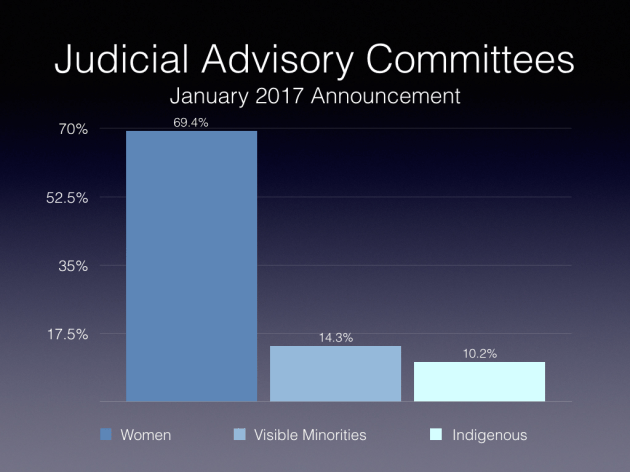
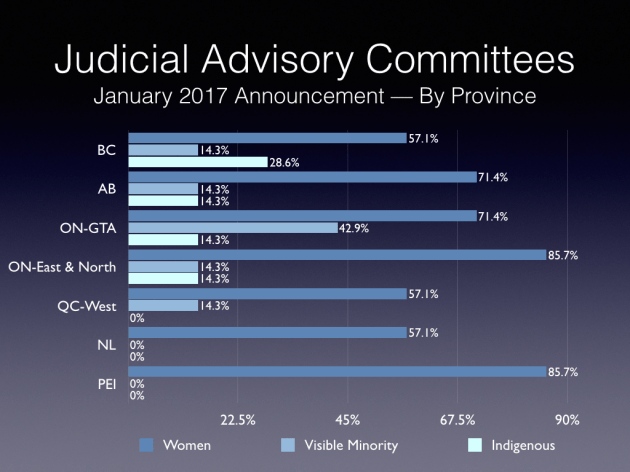
The Government, in a significant implementation of the government’s diversity and inclusion agenda, has essentially flipped this around as the following charts demonstrate for seven of the appointment committees.

election-2015-and-beyond-implementation-diversity-and-inclusion-083

election-2015-and-beyond-implementation-diversity-and-inclusion-084

The regional variations generally overweight all groups in relation to the local demographics with some exceptions (e.g., Ontario GTA representation of visible minorities). Three of the seven committees are headed by women.

Overtime, and in line with the 2016 judicial appointments, this should further increase diversity on the bench:

With the number of judicial vacancies reaching near-record levels, the Liberal government has revived a dormant appointment process, and signalled that it intends to change the face of the judiciary.

It named the members of seven newly constituted screening committees for the federal bench last week. Each of the committees has a majority of women.

The announcement of the judicial advisory committees comes as full-time vacancies are at 57 across the country, and as courts are struggling to meet Supreme Court deadlines for timely justice. In the fall, murder charges in Alberta and Ontario were thrown out for unreasonable delay. All judicial advisory committees from Ontario to Newfoundland and Labrador have been without any members at all since at least last April. And the government removed the members of all other committees in October.

The government announcement still leaves 10 of the 17 committees across Canada without members. A spokeswoman for Justice Minister Jody Wilson-Raybould said the government named the committees in areas with high numbers of judicial vacancies.

The federal government asked members of the public, including non-lawyers, to apply for three federally appointed spots on each committee back in mid-October, allowing one month to do so. The Liberals were critical of the appointment process under the Conservatives for what they called its lack of openness and a lack of diversity in appointments. While the government devised a new system, it appointed just 39 judges (some of them promotions, or the naming of regional judges) in the 16 months since the Liberals took office. Chief Justice Neil Wittmann of the Alberta Court of Queen’s Bench said publicly his court had grown desperate.

Rob Nicholson, the Conservatives’ justice critic, is critical of delays in the appointment process. “I still don’t understand why it has taken them so long to make the judicial appointments that it is their responsibility to make,” he said in an interview. It is important to make timely appointments “because when there’s an absence of judges, cases will get thrown out. That does not help the credibility of the justice system.” He said he is “fine” with the majority of members being women.

The Justice Minister did not respond to questions about when the committees would begin recommending candidates, and when the government would make its first appointments from those recommendations. The committees do not pick judges, but they create the pool of approved candidates from which the federal government makes its choices.

Some legal observers consider the federal government’s authority to appoint judges a major yet underappreciated exercise of its power. Former prime minister Stephen Harper changed the process soon after taking office to give Ottawa’s appointees on the committees a voting majority: he added a police representative, and took away the vote from judges who sat on committees. He also removed the “highly qualified” category, to leave the government more leeway to choose. Under the Conservatives, 30 per cent of applicants for the federal judiciary, which includes the Federal Court, Tax Court and superior courts in the provinces, were women, and 30 per cent of appointees were women. Little more than a handful of new judges were visible minorities, though in its decade in office the Conservatives did promote several minorities from lower courts to higher ones.

The Liberals have now undone all the Conservative changes. The police representative is gone. The legal community (the Canadian Bar Association, the law society, the provincial Attorney-General and a Chief Justice) appoints four of the seven members, and the federal government advertised for candidates for the remaining three positions from the general public. While the names of members on previous committees were public, the government now publishes capsule biographies on each. Several have a background in social causes, such as Bruce Rivers of Toronto, executive director of Covenant House, which serves homeless youth, and Jelle Jeen Van Ens of Beaver County, Alta, a social worker.

In all, 34 of the 49 members named so far to the committees are women. On two of the new committees, there is just one man out of seven members, and on two others, just two men. That contrasts sharply with the committees during the Conservative years; most committees had a majority of men, and some committees (Saskatchewan’s and the one for Ontario West and South) had no women members at all.

There are also several visible-minority members on the seven committees announced last week, including an African-Canadian former deputy police chief from Toronto, and two members of First Nations from British Columbia.

In a news release, Ms. Wilson-Raybould said the committee members will receive training in the importance of judicial diversity from Supreme Court Chief Justice Beverley McLachlin. An accompanying fact sheet explains that they will watch her give a speech on videotape. It’s a shortened version of one she gave in Scotland in 2012: “The first attitude that the judge must cultivate is introspectiveness. A judge must be willing to take moral stock of herself. … In a diverse society introspection is essential to ensuring that the phenomenon of difference confronting the judge does not skew the decision-making process.”

Of the 39 judges appointed by the Liberals since they took office in November, 2015, 24 are women.

Source: Petite révolution judiciaire à Ottawa | Le Devoir, New advisory committees could change the face of Canada’s judiciary

Douglas Todd: Canada needs strong dose of ‘cultural curiosity | Vancouver Sun

Interesting conversation between Douglas Todd and Ara Norenzayan, a UBC social psychologist and the need to understand difference better rather than assuming no difference. Their discussion turns more challenging when it comes to considering what differences are acceptable and what is not:

We started our conversation with Norenzayan describing three of the benefits social psychologists and anthropologists have discovered about diversity.

“Diversity concentrates talent,” Norenzayan said. Cities, universities and businesses can advance when talented people gather together from diverse cultures.

In addition “diverse groups are more creative at problem solving,” Norenzayan said. Laboratory experiments show groups of varied people can imagine many novel uses for an object that a more homogeneous group sees in a limited way.

Thirdly, people in diverse contexts can learn the skill of interacting without polarizing. Norenzayan cited summer camps in which young Jews and Palestinians become friends, the prime route to cross-cultural understanding.

But there are potential downsides to diversity, which should not be denied.

The most obvious is that diversity can lead to self-segregation.

I have written about the startling degree to which ethnic Chinese, South Asians, Caucasians and others are forming ethnic enclaves in Metro Vancouver, a region that demographers call “hyper-diverse” since 45 per cent of the population is foreign born.

“People are less likely to get to know their neighbours if they live in diverse neighbourhoods. Contact diminishes,” Norenzayan said.

It’s happening at UBC, which is a predominantly ethnic Asian campus. “Asian students and non-Asian students self-segregate.”

Diversity “can unravel very fast”

….Canada is not on the verge of becoming like divided Lebanon. But that strife-torn country is a chilling example of how diversity can suddenly turn to polarization.

“People used to think of Lebanon as a model of a society that was very diverse,” Norenzayan said. Muslims, Christians, Lebanese, Palestinians and others tended to get along.

“But, in 1975, it unravelled very fast. So I don’t have any illusions.”

Although few can explain why Lebanon boiled over, Norenzayan said it “doesn’t take much to poison the well.” Certain events in Lebanon incited groups that once tolerated each other to turn to identity politics, inducing “a spiral of negativity” that continues to this day.

Even though most countries of the world don’t accept any immigrants, some that do, like the U.S., Britain, France and the Netherlands, have in recent years experienced a rapid rise of immigration-skeptical nativism.

Despite decades of official multiculturalism, Norenzayan worries many Canadians still think that being honest about cultural differences is the same as stereotyping. And the last thing any Canadian wants to be called is racist or xenophobic, however unfairly.

“The first thing to do is tell people difference is OK. It’s not prejudice to recognize people have different beliefs,” Norenzayan said.

Social psychologists, for instance, have found through experiments that most people in the West value independence, choice and self-realization.

But in Chinese and Korean cultures, research shows group cohesion and obedience are tied into morality.

“My Chinese students are extremely respectful of authority,” Norenzayan said. When he asks Chinese students to call him “Ara,” he says most “just can’t do it. They think it’s immoral. They believe deference to authority is a moral value.”

Another Asian value that Westerners don’t get, said Norenzayan, is purity.

While Hindu temple priests expect visitors to take their shoes off before entering as an act of purity, he said many Westerners think it’s just etiquette. But purity codes have powerful consequences throughout Asia.

“Cultural curiosity” recognizes differences

The more we explore diversity, the more we may find some cultural differences morally disturbing, depending on whether we’re liberal, conservative or in-between.

Even though we should avoid a rush to judgment, Norenzayan said a diverse society like Canada “has to make some choices” about how far to go in accepting some cultural differences.

I asked Norenzayan what he thought about Toronto Muslim Zunera Ishaq’s successful fight in 2015 to wear a face-covering niqab during her citizenship ceremony.

“I personally don’t agree with niqabs, but I don’t think there should be a law that bans them,” he said. “There are lot of things I don’t like that other people do. Where do you stop? If (polls show most of) the Canadian population doesn’t like something, do we ban it?”

When I responded that European courts appear to be making reasonable decisions to ban women wearing niqabs while working with young people in daycare centres or public schools, Norenzayan added he believed RCMP officers should likely not be permitted to wear niqabs.

He also felt strongly about polygamy. His former UBC colleague, Joe Heinrich, discovered that polygamist societies tend to be “more violent and more gender unequal.”

If Canada were to legalize polygamy, Norenzayan said, it would make the country “a magnet for polygamous immigrants,” which he thinks would be harmful.

Compared to many countries, Canadian multiculturalism is maintaining a certain calm. We’re often ranked as one of the world’s most “tolerant” nations.

“But we don’t really know why,” Norenzayan said. He emphasized we need to figure it out.

We speculated the country’s relative peace and good order could have something to do with our protected borders and general Canadian “civility,” which has long historical roots.

We also agreed Canadians’ overall acceptance of diversity flows from a highly selective migration policy. Most countries don’t allow any immigration, but those that do constantly adjust intake criteria, and levels, in search of the sweet spot that encourages integration.

Since Norenzayan has experienced how easily a hyper-diverse region can descend to tribalism, he feels more urgency than most about enhancing Canada’s relative harmony,

Instead of being “culture blind” and pretending no differences exist, Norenzayan says society needs to offer more Canadians a chance to experience positive contact across cultures.

I couldn’t agree more when he suggests the attitude necessary to make that happen is the genuine practise of cultural curiosity.
Source: Douglas Todd: Canada needs strong dose of ‘cultural curiosity | Vancouver Sun

For the next four years, remember: Art doesn’t belong to the left: Brendon Ambrosino

An amusing if ultimately silly article.

Yes, of course, Ambrosino is right that we should all try to see and understand the perspective of others.

But that does not necessarily mean accepting their views, particularly when they are anti-democratic, misogynistic, racist or bigoted, as many of Trump and his followers have been, with no post-election pivot to a more inclusive tone. So it’s not just about art ‘belonging’ to Democrats, it is about civic values and respect belonging to us all:

As the election proved, entertainment and media elites who live on the coasts are severely out of ideological step with the rest of the nation. Some small-town folks from the middle of the country enjoy Broadway shows as much as New Yorkers – and they open their wallets when Broadway shows and the Rockettes tour through their largely white, blue-collar towns. Best, then, not to alienate them by sending the message that performing arts are against Trump supporters. Especially because, if some of these people really are as backward as we’re told, wouldn’t you want them to be in the front row of, say, Hamilton, so they can experience the beauty of diversity in action? Trump supporters could learn a lot from a theatre; no need to make them feel unwelcome there.

There are rumours that Mr. Trump might cut arts funding, which would be a terrible decision. But think about the way his mind works: If professional artists are sending the message that art belongs to Democrats, then why would his administration keep funneling money there? Same thing with Mr. Trump going to see Broadway plays or concerts: Why would he do that if he thought he was showing up only to be lectured? This is the new leader of our country – and various arts communities would do well to let him know he is welcome to enjoy their art.

If you’re angry with Mr. Trump’s supporters, go to a quiet room, close your eyes, and try to imagine three logical reasons why they might be happy with a Trump presidency. If you can’t come up with these reasons easily, then that’s a failure of imagination on your part. (There are plenty of these sorts of unimaginative people on social media.) That suggests to me that our country is in desperate need of a renewed artistic vision, one that transcends petty political infighting.

I believe Dostoevsky was right when he said that beauty will save the world. Best, then, not to keep it under a political bushel for the next four years.

Source: For the next four years, remember: Art doesn’t belong to the left – The Globe and Mail

Can Trudeau keep resisting calls to be the anti-Trump? Radwanski

Listening to President Trump’s inaugural speech, reinforces the Adam Radwanski’s commentary on one aspect of the challenges facing the government with respect to the Trump administration:

On the eve of Donald Trump’s inauguration as his country’s 45th president, Justin’s Trudeau’s office was flagging a speech about Canada-U.S. relations that the Prime Minister made when he was the third-party leader back in June, 2015.

Delivered to the Liberal-affiliated Canada 2020 think-tank shortly before the campaign that would bring Mr. Trudeau to power, the address criticized Conservative prime minister Stephen Harper for letting ideology get in the way of our country’s relationship with its most important trading partner. If his party were to be elected, Mr. Trudeau pledged, there would be no “hectoring” of whoever was in charge of the U.S. government; he would build on a proud history of setting aside differences in favour of pursuing shared interests.

So far, Mr. Trudeau seems to be making good on that commitment, even with an incoming president he could not possibly have considered as a potential partner back then. He generally has refrained from public criticism of the White House’s new occupant, despite presumable personal distaste for him; meanwhile, Mr. Trudeau’s officials and advisers have diligently worked to forge ties with those of Mr. Trump and sell them on the importance of a relationship scarcely on their radar.

But as speculation about Mr. Trump’s presidency gives way to hard reality, we will find out the extent to which Mr. Trudeau is willing and able to stay focused on Canada’s economic self-interest – and how much he can tune out voices telling him he should aim for something nobler.

Some of those voices will come from within his own government: Some members of Mr. Trudeau’s caucus, deeply uncomfortable playing nice with right-wing populists, would certainly prefer he strike a contrast with Mr. Trump.

Others will come from Canadian media and the opposition. Even before Mr. Trump was elected in November, commentators wanted Mr. Trudeau to upbraid him publicly. Those can be expected to ramp up again soon, and if he declines to criticize the new president strongly for going against Canadian interests on trade policy or to stand up to him on human rights, Mr. Trudeau will be accused of weakness – not least by the New Democrats, who are seeking Liberal vulnerabilities among voters who are opposed to Mr. Trump.

And prominent voices in other countries see him as one of liberal internationalism’s few great hopes as a wave of populism sweeps across an increasingly destabilized Western world.

“I think this is the time for Canada to be loud, very loud, and that’s not always the case,” was how Ian Bremmer – who heads the global consulting firm Eurasia Group, and is a prominent foreign-policy commentator south of the border – put it in a recent interview in his New York office. Mr. Bremmer, who is friends with Foreign Affairs Minister Chrystia Freeland, said this may be an opportune time for a “Canada doctrine” – echoing a view that Mr. Trump’s presidency could help compel Mr. Trudeau to take an outsized role in defending and shaping international institutions.

As seductive as such calls could be for a Prime Minister who unabashedly enjoys the international stage, Mr. Trudeau has thus far rejected them in favour of pragmatism – buying the argument from David MacNaughton, the ambassador to Washington, that Canada’s interests (particularly on trade policy) can best be served by acting as a friend to Mr. Trump at a time he will need one. As evidenced by his cancellation of his visit to this week’s World Economic Forum in Davos, Switzerland, where last year he was the toast of the town, Mr. Trudeau is clearly aware he risks giving rise to a populist backlash in Canada if he pays too much attention to international elites at the expense of practical concerns back home.

But it was relatively easy for Mr. Trudeau, going along to get along, when Mr. Trump’s words did not have real consequences – when Barack Obama was still in the White House and the United States retained its traditional role with NATO and other international bodies, respected Muslims’ and other minorities’ civil liberties (relatively), pursued a climate-change strategy, did not seek out trade wars, was suspicious of Vladimir Putin, and was otherwise recognizable.

If a lot of that changes, Mr. Trudeau will have to turn a blind eye – and live with accusations of complicity – if he wants to make good on that 2015 speech.

Or most of that speech anyway. Toward its end, he spoke enthusiastically of also working more closely with Mexico as part of a continental strategy. His government followed through on his promise to lift visa requirements that Mr. Harper imposed on Mexicans. But it plainly has little intention of otherwise aligning more closely with NAFTA’s southernmost partner when that country is firmly in Mr. Trump’s sights.

The Prime Minister’s aim, one of his advisers said on Thursday, is for Canada to lead by example on matters such as diplomacy and human rights without ramming its views down its neighbour’s throat. But even that has its limits.

Source: Can Trudeau keep resisting calls to be the anti-Trump? – The Globe and Mail