Is Trump’s refugee crackdown threat pushing asylum seekers into Canada?

is_trumps_refugee_crackdown_threat_pushing_asylum_seekers_into_canada____toronto_starNumbers still relatively small but significant increase:

Under the Safe Third Country Agreement, only those asylum seekers who have family already living in Canada or those who have already been refused refugee status in the United States will be considered for asylum if they show up at Canadian land border posts.

But those who cross illegally are exploiting a loophole in the law — the conditions of the Safe Third Country Agreement do not apply to people who are already in Canada when they make a claim for asylum.

The Canada Border Service Agency will not reveal how many asylum seekers are crossing into Canada illegally. But overall, there has been a sharp rise in the number of people seeking asylum in recent months.

In 2016, there were 2,529 asylum claims made at Quebec’s land border crossings, according to statistics from the agency. That figure averages out to 211 claimants each month.

But the numbers started to climb dramatically this fall. There were 289 refugee claimants in October, 369 in November and 591 in December.

Montreal immigration lawyer Éric Taillefer said his caseload of refugee claimants began to increase noticeably in December.

“Before I had one from time to time and now in December and early January there have been many,” he said, adding that most of his clients are from coming from Eritrea, Iraq and Libya.

“These are people who have fears of returning to their country of origin,” said Handfield.

Most of his clients are people who were already living in the United States, but others obtain tourist visas to travel to the U.S. and use that as the entry point for their trek to Canada. Despite American fears about border security since the Sept. 11 terrorist attacks, Handfield said it remains easier to obtain the necessary permissions to enter the U.S. than those required to enter Canada.

Source: Is Trump’s refugee crackdown threat pushing asylum seekers into Canada? | Toronto Star

Storm of reaction to news Syrian refugee charged with sex assaults

Good commentary by David Tait of Carleton University on how the media should and should not report on cases like this:

Reports that a man accused of sexual assaults on six Edmonton teenage girls was a Syrian refugee have ignited a firestorm of reaction, from anti-immigration diatribes to criticism about how the media dealt with the story.

Groups that work with refugees in the city have been inundated with calls and texts over the past 24 hours, some from people calling for an end to the refugee program and others from refugees themselves apologizing on behalf of their community.

Erick Ambtman, executive director of the Edmonton Mennonite Centre for Newcomers, said his organization received a message on Twitter from a white supremacist group that included a picture of a Syrian refugee, asking the centre to confirm whether the photo was the same man accused of the crimes.

“It may be just to scare us or to unnerve people,” Ambtman said.

“But around my office that’s what’s happening. People are starting to get really nervous, and the [English] language students are starting to get really nervous.

“And the Syrian students are apologizing for somebody who they don’t even know, because he’s got the same country of origin as they do.

“It’s really spiralling into a really ugly place.”

Soleiman Hajj Soleiman, 39, was arrested Saturday and charged with six counts of sexual assault and six counts of sexual interference after six teenage girls, all younger than 16, told police they were inappropriately touched while swimming at the West Edmonton Mall water park.

…When the media reports stories like this one, decisions about what information is relevant have to be made on a case-by-case basis and sometimes on a day-by-day basis, said David Tait, a professor at Ottawa’s Carleton University who has taught ethics courses at the journalism school.

“Journalists have to sort of go and look at a situation not from the standpoint of, ‘Is there public appetite for this information? Do people want to know it?’ But, ‘Is that detail relevant at this stage to this story?’

“And that’s a very difficult thing to determine as a journalist, because you also have to be careful that you’re not making your judgment for some sort of social engineering purpose.

“To say, ‘Oh I don’t want to make these sorts of people look bad’ or ‘I don’t want to make these sorts of people look good.’ You shouldn’t make your journalistic judgments based on how you want people to think about something, because that’s not the journalistic mission.”

‘Our job is to report what’s going on’

Tait said in this case, while reporting immediately after the arrest was made public, he would have questioned whether details about the accused’s background were relevant.

“My question would be, would we have run additional background details about this person if they were a gay man? A gun owner? If they were Jewish? If they were a fundamentalist Christian? If they were a recent arrival from the United States? If they were any number of other identifiers?”

It’s the responsibility of journalists to try to determine what the public needs to know to understand the story. Once the public has the information, people will make their own choices about what’s relevant to them, he said.

Some will seize on information that confirms their own views about the world and overlook other aspects of the story.

“Our job is to report what’s going on out there in the world,” he said.

The story about the water park allegation, Tait said, “is a classic example of where people these days are rushing to grab details, to use individual facts as weapons instead of looking at those details and saying, ‘How does this fit into my developing understanding of the world?'”

Ambtman said Soleiman came to Canada in January 2016 with his wife and six children, aged one to 13 years. The family was assisted by the Mennonite Centre.

Some commenters are exploiting the fact that a Syrian refugee has been charged with a crime, he said.

“They’re exploiting what’s happened to these girls to say something about immigration, and it’s just a really ugly thing to do. It’s been pretty awful to bear witness to.”

It will be up to the justice system to determine the facts of the case and, if a crime has been committed, punish the person responsible, he said.

“To make this about immigration is just absurd. What has happened is there has been a sexual assault at West Edmonton Mall and six girls are going to be traumatized likely for the rest of their lives because of a crime that somebody perpetrated on them. To me, that’s the concern.

Michelle Rempel demands more from politics—on both the left and right

Impressive and thoughtful speech delivered at a McGill Institute for the Study of Canada event regarding immigration and Canadian exceptionalism:

During the 2015 campaign, I thought all political parties, my party included, acted shamefully on the issue of immigration, because we used the Syrian refugee crisis as a political wedge in a political campaign, and that was wrong. The response to the Syrian refugee crisis became a campaign issue of one-upmanship on numbers, rather than talking about people as human beings. “Who’s going to bring in more?” When the question should have been: “How do we do it in a way that achieves social license in the country in an expeditious way that shows compassion and addresses the situation, and how do we support the integration of people when we come to Canada, such that we build social license for more refugees in the future, and ensure that refugees that come to Canada have a better experience here than where they came from?” That is not a politically sexy conversation, because it’s easier to say, “I’m going to bring in 25,000 and you’re going to bring 15, ergo you’re racist and I’m more awesome.” Not helpful. Also not helpful is to frame the issue of gender isolation in new Canadian women in the term of a tip line.

And what happened out of all that? Where we are today is we had a parliamentary study that looked at the response to the Syrian refugee initiative, and we had Syrian refugees come in front of a parliamentary committee and said: “I’m in a hotel room that’s infected by bed bugs, and my wife can’t go out and learn English because she’s got five kids. How are we going to have any hope to do anything well here?”

It’s not an adequate response to say, “It’s a nation-building project and the provinces are responsible for it,” when I have a school board come to parliamentary committee and say, “We’ve absorbed in our one city the equivalent of a full elementary school of refugees this year, they have needs that we need to address and need to be compassionate to because they’ve been in a war zone for years and their education has been disrupted, and we received no new funding for it. So in a political campaign for any political stripe to say it’s fully costed when there is no plan … not helpful. Not exceptional.

The thought that populist rhetoric can’t happen in Canada is shocking. The reality is that there has been a narrative that has arisen where you have groups of people who feel that their voices aren’t being heard, and it’s easy through 140 characters and short visual soundbites and memes to say it’s someone else’s fault. And in Canada, that’s still here. But the reality is there’s no “them” and “us” anymore. That’s not how the globe operates. We are so interconnected, be it through trade, or simply the reality of understanding our humanity through Twitter, through YouTube. You can see the destruction in Aleppo. To have that narrative be used in political discourse is disgusting and wrong, and oversimplified.

We all have to demand better. Demanding better for someone who’s a centrist like myself has been a very unpopular position. Because it means there’s no real home for me as a politician on some days. But it’s where we all need to be. There’s many other examples of how Canada in public policy has sort of politicized the system—they might not be as firecracker or high-profile as the barbaric cultural practices tip line. It’s things like lifting a visa requirement on a country without a formal review for some unquantified economic benefit. It’s policy around immigration that is politically motivated that is unquantifed and unsubstantiated—and both parties are guilty of this—that diminishes the public confidence that immigration is a good thing, and we are unexceptional in that, especially in Parliament.

Why should we all be listening to these sorts of things with an open mind? It’s because if we don’t do that, I’m really deeply concerned as a legislator about the peace of humanity right now, and that’s not hyperbole. When I see nationalist parties rise and gain seats in European Parliament, we should be very concerned. When I see the level of nationalist rhetoric that is acceptable among people that are pretty educated and smart people, that’s cause for concern. When I see protectionism and the thickening of borders as a populist public policy response in a globalized economy, we should all be concerned.

The way forward is to ensure we have a public policy dialogue that is not alt-right or far-left. It has to be in the middle and we have to focus not on values, but on programming and outcomes that enable what we vision exceptionalism to be. Things like: where is the smart conversation around the burqa? Where’s that safe space? I don’t wear one—women who wear one, where’s their voice on this? And why don’t we talk about the fact there are equally as many other religious groups who use dress as a control for women? So rather than judging them and shaming them, how do we reach out to them, and give them hope? The fact that we can’t even talk about that—I find as a politician, for me as a camera, even saying that is a risk. I’ve done something terribly egregious, by bringing up both sides of that argument. But if we can’t have this argument, how can we ever reduce issues like Islamophobia? The fact that we can’t have a discussion because we’re so polarized is why we need to acknowledge that we’re not exceptional.

You, as the thought leaders on this? It can’t be 140 characters “You’re a racist; you’re a socialist. You’re conservative; you’re Liberal. Your party sucked; your party sucked.” Come on. If we are truly exceptional, we have to show the world we’re better than that. And I’ll be honest with you, after 18 months of banging my head in both my own party and in the House of Commons against the Liberals, you’ve got to help me out too.

Where we are as a country, for us to be having a conference on how exceptional we are and how much better we are than the United States and we’re welcome to refugees is such a disservice to the fact that we’ve got a long way to go.

For all of you, from the bottom of my heart: let’s try to be smarter about this. And let’s demand better from our leaders.

Source: Michelle Rempel demands more from politics—on both the left and right

A week of kindness, then identity politics as usual in Quebec

Good piece by Yves Boisvert – how quickly old patterns reassert themselves:

In the aftermath of the Quebec City mosque killings, one would think the political debate around secularism and identity would be kinder and more reasonable. Quebec Premier Philippe Couillard was widely congratulated for his dignified behaviour, his call for unity, and for refusing to point fingers at political opponents or media who irresponsibly played identity politics over the past few years.

Parti Québécois leader Jean-François Lisée appeared with Mr. Couillard and admitted some wrongs. Yes, he went too far last fall when he said a provincial debate was needed on the wearing of burkas in Quebec, suggesting you could hide an assault rifle under clothing of that sort. He already had admitted in the past that the infamous so-called “Quebec Charter of Values” promoted by his government had “poisoned” the debate on secularism in Quebec.

It would, however, take a full-time job to track the fast-evolving thinking of Mr. Lisée on the matter. After losing power, he repudiated the bill banning religious signs for public servants. Just a few months before, as a minister in the PQ government, Mr. Lisée wrote an op-ed in The New York Times pretending Quebec was having a “Jefferson moment,” in its pursuit of secularism.

But politics, like gravity, adheres to inescapable laws. After a week of political kindness and introspection, Mr. Couillard tried to put the other parties on the defensive, by “reaching out” to them for quick approval of Bill 62, “an Act to foster adherence to State religious neutrality.” The small bill, an 18-section piece of legislation, states that members of public bodies have to exercise their functions “with face uncovered.” This would also apply to citizens seeking public services. An accommodation can be made except for identification or security matters.

The bill also offers a vague framework for religious accommodations, be it for employees or school children. It should respect gender equality and other basic principles.

The bill does not go far enough for the main opposition parties, who pretend the legislation should settle once and for all every case of religious accommodation that comes up in the future. The perception that Quebec is under pressure for an incredible number of demands from religious minorities (read: Muslims) is persistent. But, a Commission of inquiry by two prominent intellectuals, Gérard Bouchard and Charles Taylor, concluded in 2008 that no such crisis exists. But the PQ, since its identity shift, has worked hard to cultivate the myth.

Not as hard, though, as François Legault, the nationalist-but-not-sovereigntist leader of the Coalition Avenir Québec. If we are to believe Mr. Legault, religious compromise risks diluting Quebec’s identity, which is why Mr. Legault last summer was so concerned about the province’s so-called burkini problem.

Still, Mr. Legault offered to drop his demand that a ban on religious signs for teachers be included in the bill. He asks, as the PQ, that the Bouchard-Taylor recommendations be included, namely a ban on religious signs for officers of the law – judges, police officers, prison guards, prosecutors.

“Let’s legislate on what we agree on,” Mr. Couillard said, not willing to strip any theoretical (for now) law officer of their rights to please the opposition.

Meanwhile, left-wing Québec solidaire accuses the Premier of “systemic racism” because only 2 per cent of job appointments by the Executive Council are visible minorities.

And, the shock-media commentators are back on track, playing down the very idea that Islamophobia exists in Quebec.

The worst case of hate crime against Muslims in the country’s history has yet to inspire a more profound and painful conversation.

Source: A week of kindness, then identity politics as usual in Quebec – The Globe and Mail

Liberal MP’s anti-Islamophobia motion set for debate next week

Hate Crimes Comparison.004

Statistics Canada Annual Police Reported Hate Crimes

Canada already has hate speech laws (unlike south of the border) and tracks police reported hate crimes (although StatsCan stopped writing its analysis of the data).

While I favour tracking, analyzing and messaging that covers all forms of racism, prejudice and discrimination, community specific messaging can be part of raising awareness, addressing concerns and reassuring communities. The previous government paid particular attention to antisemitism given the concerns of Canadian Jews.

My reading of the motion is that it has an appropriate focus on data collection and analysis, places Islamophobia within the broader context of racism and discrimination. with the resulting policy recommendations to be developed within that context by Canadian Heritage:

Members of Parliament will debate a motion to condemn Islamophobia and track incidents of hate crime against Muslims in the House of Commons next week.

Motion 103 was tabled by Mississauga, Ont., Liberal backbencher Iqra Khalid last fall, but will be discussed in the  aftermath of last month’s mass shooting at a Quebec City mosque. It calls on government to “condemn Islamophobia and all forms of systemic racism and religious discrimination.”

The text of the motion also asks the government to:

  • Recognize the need to quell the increasing public climate of hate and fear.
  • Request the heritage committee study how the government could develop a government-wide approach to reducing or eliminating systemic racism and religious discrimination, including Islamophobia.
  • Collect data to contextualize hate crime reports and to conduct needs assessments for impacted communities and present findings within 240 calendar days.

The motion, scheduled for one hour of debate on Wednesday, has generated a backlash online, with petitions garnering thousands of signatures opposing the motion.

Some critics have mischaracterized M-103 as a “bill” or a “law” rather than an non-binding motion.

Some have warned that Canada is moving towards criminalizing Islamophobia or even to the implementation of Islamic law, called Shariah, in Canada.

Khalid declined requests for an interview from CBC News.

When she tabled the motion on Dec. 5, 2016, she described her experience as a “young, brown, Muslim, Canadian woman.”

“When I moved to Canada in the 1990s, a young girl trying to make this nation my home, some kids in school would yell as they pushed me, ‘Go home, you Muslim’ — but I was home. I am among thousands of Muslims who have been victimized because of hate and fear,” she said.

“I am a proud Canadian among hundreds and thousands of others who will not tolerate hate based on religion or skin colour. I rise today with my fellow Canadians to reject and condemn Islamophobia.”

E-petition condemning Islamophobia

On the same day Khalid tabled her motion, an e-petition with nearly 70,000 signatures was tabled that called on the House of Commons to join the signatories in recognizing that “extremist individuals do not represent the religion of Islam, and in condemning all forms of Islamophobia.”

Barbara Kay, a columnist for the National Post and contributor to The Rebel Media, worries about the potential impact on freedom of expression and special protections for a single religious group.

“There are a lot of countries in Europe where criticism of Islam, even if not entrenched in law as a hate crime, are being interpreted by police and law enforcement, social workers — the whole spectrum of the state apparatus. They have been internalized by those within the public service as wrong, and if not criminal then absolutely morally wrong, and therefore Muslims are a group that must be protected from this very offensive speech,” she said in an interview with CBC.

Kay said anti-hate speech laws have traditionally targeted human beings, not ideas. She questioned the need to single out Islamophobia, and argued there are more hate crimes against Jews than Muslims in Canada.

Hate crimes in Canada

According to Statistics Canada, in 2013 there were 326 police-reported hate crimes motivated by hatred of a religion or religious group, about 28 per cent of all hate crimes.

Those targeting Jewish populations were the most frequently reported, accounting for 56 per cent of religious hate crimes in 2013, according to the most recent data available. There were 181 hate-motivated crimes targeting the Jewish religion reported by police in 2013, compared to 65 crimes motivated by hatred against the Muslim religion.

In her report and a video for The Rebel website, Kay said blasphemy laws conceived according to Shariah law could creep into Canada.

She said that could have a chilling effect on free speech and ultimately mean some of her columns could be deemed Islamophobic and subject to penalties.

“I’m worried. All Canadians should be worried,” she wrote.

Push for broader discussion

B.C. Conservative MP Dianne Watts said she supports the motion but wants a broader discussion about how to end any act of hate or discrimination based on race or religion.

“We just look at what happened at the mosque in Quebec and it’s such a horrible thing to have happen in Canada because that’s not who we are, that’s not what we’re about and we have to do everything we possibly can as legislators and as a community to make sure it doesn’t happen again,” she said.

Source: Liberal MP’s anti-Islamophobia motion set for debate next week – Politics – CBC News

Motion text: Motion M-103

A potentially historic number of people are giving up their U.S. citizenship – The Washington Post

More on the increasing number of American expats renouncing citizenship for tax reasons (FATCA), not Trump. Again, while the increase is dramatic, still small in relation to the number of expatriates (State department estimates between three and eight million):

It can be difficult to become a U.S. citizen. A lot of people put a large amount of time, effort and money into the process of gaining an American passport or, failing that, the right to permanent residency.

But to some people, U.S. citizenship can apparently be a burden. And it’s a burden that people seem to be shaking off in increasing numbers. This week, the Treasury Department released its quarterly list of individuals who had chosen to “expatriate” — i.e., renounced their U.S. citizenship or gave up their rights to permanent residence.

The list is notable for a couple of reasons. First off, Britain’s Foreign Secretary Boris Johnson is on it. This means that Johnson, a dual-national who was born in New York City, has finally renounced his citizenship (as he had long promised he would). Secondly — and far more importantly in the grand scheme of things — the list shows that Johnson is just one of a total 5,411 individuals to expatriate in 2016.

The number of people giving up their U.S. citizenship may in fact be higher. Ryan Dunn, a lawyer with Andrew Mitchel LLC, explained via email that his firm has suspicions that the lists released by Treasury are incomplete. However, this would not change the trend. America is seeing what is likely a historically high level of expatriation. And it seems only likely to rise further.

“Given that we’ve seen year-over-year increases in expatriation since 2012, we speculate that the trend will continue,” Dunn explained.

But why would anyone renounce their citizenship to the United States? Dunn said that in his firm’s experience, it wasn’t usually political. “We have not been contacted by anyone saying that they wanted to give up their citizenship because Trump won the election,” he said. Instead the motivation was simpler: money.

The United States is one of the only countries in the world that requires its citizens and permanent residents to file taxes even when they live abroad. Eritrea is the only other country to have a similar policy. This unusual policy a relic of the Civil War and the Revenue Act of 1862, which called for the taxing of U.S. citizens abroad — in part to punish men who fled the country to avoid joining the Union army.

This is no new policy — Americans abroad have always been covered by federal tax laws. However, things changed in 2010, when the Foreign Account Tax Compliance Act (FATCA) was enacted. This law essentially requires foreign financial institutions to check whether an account holder is a U.S. citizen or permanent resident. In some cases, Dunn said, they would ask for proof that the account holder is not a U.S. citizen.

The end result here is that whereas in the past a U.S. citizen abroad might be able to get away with not filing their U.S. taxes, that has become vastly less likely under these new circumstances. In some cases, this can be extremely costly: Johnson was known to have racked up a large U.S. tax bill for the sale of his home in London, even though he had not lived in Britain since he was a small child.

But even for those without Johnson’s wealth, it can be tricky. “FATCA is a dirty word to Americans abroad,” Peter Spiro, a Temple University law professor and the author of “At Home in Two Countries: The Past and Future of Dual Citizenship,” explained. “Think lots of extra forms that have to be filed even by citizens who aren’t wealthy by any standard. Americans abroad used to be able to do their taxes just like Americans at home. Now they have to hire expensive accountants.”

Giving up your citizenship isn’t necessarily cheap either. It can take a long time to get an appointment in some places, and the processing fee is around $2,350. More important, Dunn said, was the “exit tax” that some high-earning or high-net-worth individuals have to pay — and also some people who forget to file their forms correctly too. But evidently, for some people it’s worth it. (Green-card holders have a simpler and cheaper process.)

Source: A potentially historic number of people are giving up their U.S. citizenship – The Washington Post

Shouldn’t Israel Care About Anti-Semitism? – The New York Times

This piece by Shmuel Rosner worth noting post-Trump International Holocaust Remembrance Day deliberately not mentioning Jewish victims:

Occasionally, there is even a temptation for Israel to benefit from anti-Semitism. In recent years, rather than focus on the need to fight anti-Semitism in France, Israel called on French Jews to come live in Israel.

Of course, when Israel encounters a clear-cut case of Holocaust denial, or of persecution of Jews, it does not shy away from making its voice heard. Two years ago, the Israeli foreign minister warned European far-right parties that they must shun neo-Nazis and described Hungary’s Jobbik and Greece’s Golden Dawn as “illegitimate.”

But most of the time, Israel attempts to delicately balance its wish to delegitimize anti-Semitism and its need to maintain foreign relations that advance its causes. Sometimes this means using attacks on Jews to attract Jewish immigration to Israel. Sometimes this means turning a blind eye to anti-Semitism in exchange for political support. Sometimes this means ignoring the trivialization of Jewish deaths in the Holocaust.

This is as unavoidable as it is troubling, even painful. Israel is a state with interests and priorities among which censuring anti-Semitism is one, but not the only one.

David Ben-Gurion, Israel’s founding father, understood this when he agreed to accept reparations from Germany, less than a decade after the Holocaust. Mr. Ben-Gurion’s opponents had a strong moral case against accepting money from the country that had just orchestrated the murder of millions of Jews, but the prime minister thought that his duty as the man in charge of building and defending a new state trumped such considerations. Then, as now, Israel sometimes agreed to help other countries and parties whitewash their images. It’s often a trade: We, Israel, will get what we need in the form of money or arms or political support. You will get the right to showcase Israel as proof that you aren’t an anti-Semite.

This could become much more uncomfortable when the country in question is the United States and when the person accused of tolerating anti-Semitism is the American president. Israel depends on the United States more than it does on any other country for aid, security and diplomatic support. And the American Jewish community is the other main pillar of world Jewry, alongside Israel. More than 80 percent of Jews live and thrive either in Israel or in the United States. This makes the United States the place in which official anti-Semitism cannot be overlooked — and the place where it must be overlooked.

That could result in an irreparable split between Jews. The statement on International Holocaust Remembrance Day — provoking Jewish outcry in the United States, while provoking nothing from Israel — just proved it.

Ottawa looks at user-fee hikes for potential new revenue

While it is appropriate that the government is reviewing the User Fees Act to streamline the process (and increase revenues), there is a risk in providing departments with too much flexibility and too limited public consultations.

A clear case in point is with respect to citizenship fees, set at $100 in 1995.

The previous government obtained an exemption from the Act in Budget 2013 omnibus legislation which allowed it to avoid lengthy consultations and increase the fees to $300 in February 2014 along side Bill C-24’s revamping of the Citizenship Act. The government then did a further increase to $530 January 2015, with the change buried during the Christmas holidays.

This further increase was never mentioned during the Commons and Senate hearings on C-24, highlighting again the risk to public accountability.

There is also the broader risk that the current government may only look at fees from a cost recovery or private interest perspective, and not take into account that some fees reflect a mix of private and public interest.

I have argued elsewhere that citizenship fees have such a mix (see The impact of citizenship fees on naturalization – Policy Options, C-6 Senate Hearings: Expected Impact on the Naturalization Rate) given the shared interest in encouraging political as well as economic and social integration.

Passports, also part of IRCC, are IMO more of private than public interest, where full cost recovery makes sense. Passport fees are subject to the Act and in testimony, departmental witnesses indicated that it took about two years to obtain approval:

The Liberal government is eyeing the user fees Canadians pay for federal services as a new source of revenue.

Since 2004, fees for everything from fishing licences to campsites have generally fallen farther behind the cost of providing those services. That’s the year the User Fees Act was passed, compelling departments to justify to Parliament any proposed fee increases or new fees.

The requirements under the law have been so onerous, however, that they effectively discouraged departments from applying for increases even as costs rose. The result is that taxpayers are stuck with higher bills for private benefits enjoyed by individuals and corporations.

The federal Treasury Board wants to fix the law to smooth the way for more fee increases, putting the fee-cost arithmetic back into balance — and snaring fresh revenues that could be worth millions of dollars.

The wide-ranging initiative, called the Modernizing of the Management of User Fees, is outlined in an internal document CBC News obtained under the Access to Information Act.

“While fees have not increased over time, costs have,” says the heavily censored Aug. 8 memo for Scott Brison, the Treasury Board president. (Numerous sections of the document, available below, have been whited out.)

“This resulted in an increase in the rate of taxpayer subsidies for government services that benefit private interests,” it says.

The freezing effect of the 2004 User Fees Act was dramatic, says the memo. Prior to the legislation, there were an average of 10 proposals each year to increase fees. After 2004, that dropped to 2.4 proposals annually.

Increased paperwork

Changes brought about by the legislation added “significant time and effort” in paperwork for fee increases or new fees, which discouraged applications. Departments have also since been wary of a provision that requires them to cut fees whenever they fail to meet performance standards, says the document.

As a result, 84 per cent of existing user fees have not been revised in nearly 13 years, and now cover a diminishing fraction of the cost of providing the services.

The memo cites the example of the Canadian Food Inspection Agency, which in 2004–2005 collected $54,999 in user fees for services that cost government $694,641 — or only about eight per cent of the bill.

Nine years later, at $55,988 in fees versus $877,306 in costs, the ratio had worsened to 6.4 per cent.

Other departments, including Health Canada and Industry Canada, have been more successful in keeping the fee-to-cost ratio in balance.

The released sections of the memo do not contain an estimate of potential new revenues.

A spokesman for Treasury Board declined to provide details or timing for the initiative.

‘Strengthening the accountability’

“While the matter of modernizing user fees is still under consideration, we remain committed to strengthening the accountability, oversight, and transparency of user fees,” Alain Belle-Isle said in an email.

Sheila Fraser, then-auditor general of Canada, found in 2008 that there were about 220 federal fees reported publicly, worth about $1.9 billion to the federal treasury. Fees are charged on a wide range of services, including passports, licences for manufacturing drugs, marine navigation, citizenship, and national park entry.

Fraser’s report, which made headlines that spring, criticized the government for overcharging Canadians for consular fees that were attached to passport application fees.

‘Inappropriately subsidizing’

Less noticed was her warning that the government “may be recovering less than an appropriate amount from fee payers, or, depending on the fee, taxpayers may be inappropriately subsidizing a private benefit …”

Source: Ottawa looks at user-fee hikes for potential new revenue – Politics – CBC News

Americans View Islam Less Negatively Than They Did A Year Ago | The Huffington Post

Not sure the extent to which this is positive (fewer negative views) or negative (greater political polarization) but ironic given the words of the Trump campaign and the words and actions of the Trump administration:

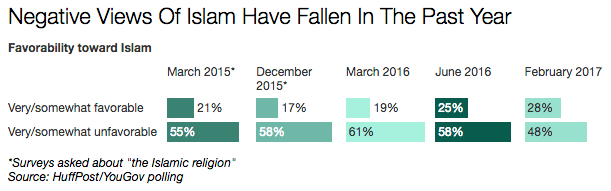
Americans’ view of Islam are, by and large, hostile. But negative opinions of the religion have dropped significantly during the past year, a new HuffPost/YouGov poll finds, despite ― or perhaps in response to ― the anti-Islam rhetoric often espousedby President Donald Trump and his advisers.

Last March, Americans were 42 points more likely to view the religion negatively than they were to view it positively. That gap dropped to 33 points by June, and to 20 points in the most recent survey, the lowest it’s been since HuffPost/YouGov surveys first asked the question nearly two years ago.

HUFFINGTON POST

At least one other pollster has noticed a similar shift. Shibley Telhami, the director of the University of Maryland Critical Issues Poll, wrote in The Washington Post earlier this year about having seen attitudes toward “Muslim people” growing progressively more favorable between November 2015 and October 2016 ― even after Trump’s anti-Muslim rhetoric and the terrorist attacks in San Bernardino, California, and Orlando, Florida.

He attributed some of the change to polarization, noting that the biggest driver was evolving opinions among Democrats, and, to a lesser extent, independents.

“As on almost all issues, partisan divisions intensified during a highly divisive election year,” he wrote. “The more one side emphasized the issue — as happened with Trump on Islam and Muslims — the more the other side took the opposite position. … Trump the president should have more sway. But he is starting at place where partisanship is not diminishing, and where his presidential rhetoric mirrors his words as a partisan candidate.”

Breaking down the two most recent HuffPost/YouGov surveys along party lines yields similar results, suggesting that the Trump administration’s rhetoric has actually galvanized Democrats, and some independents, into greater support of Islam.

HUFFINGTON POST

In June 2016, Democrats, Republicans and independents all held net negative views of Islam, although the gap was most pronounced among Republicans. Since then, Democrats’ opinions of the religion have improved significantly ― favorable opinions have risen by 11 points, while unfavorable opinions have fallen by 13 points.

ICYMI – Hans Rosling: A truth-teller in an age of ‘alternative facts’ – Macleans.ca

Good profile of Rosling, who was so creative and insightful in his presentation of data. Particularly important to note in the context about “alternative facts” and fake news:

… Rosling joined the Karolinska Institute in Stockholm, where he discovered his students, and even his colleagues, had crude and misinformed ideas about poverty. To them, and most policy makers in the western world, the “third world” was one uniform mess of war and starving orphans. They did not understand the vastly different experiences of a family living in a Brazilian favela and one living in the Nigerian jungle, nor did they realize how rapidly these countries and economies were evolving. Without this knowledge, how could people make informed decisions about diseases, aid, or economics? “Scientists want to do good, but the problem is that they don’t understand the world,” he said.

Working with his son, he developed software that explained data through easily understood graphics. He launched the Gapminder site, which allowed people to explore and play with data that was otherwise hidden in the archives of the OECD, the World Bank and the United Nations. And Rosling began giving increasingly popular public lectures. His TED Talks and online videos went viral, as he explained global population growth using plastic boxes, or the relationship between child mortality and carbon dioxide emissions with Lego bricks.

https://embed.ted.com/talks/hans_rosling_shows_the_best_stats_you_ve_ever_seen

Rosling had a natural charm and a ready sense of humour that grabbed your attention and kept it, even if he was talking about the most esoteric elements of statistical science. His message—that the world is getting better but we need to understand the data if we want to help those being left behind—resonated not just with the public, but among philanthropists and government leaders.

From Davos, to the White House, to the offices of the World Bank, Rosling could be found tirelessly preaching the gospel of facts, data, and truth. For generations, aid and charity decisions were taken for reasons of vanity, simplicity or self-interest. Billionaires gave money in ways that would grant them the most publicity. Bureaucrats channelled aid dollars to projects that were the easiest to administer. And western governments built dams in Africa solely to help their own construction companies. The real impact of aid on poverty was rarely considered and almost never measured. Rosling helped change that, by explaining to donors that ignorance is the first battle that must be fought in the war against extreme poverty.

This idea, as obvious as it seems in hindsight, was new. And it mattered. Governments listened. Donors became converts to Rosling’s religion of evidence-based policy. He was not its only apostle, but he was among its most well-known, and the only one with millions of views on Youtube.

Ironically, Rosling had a much more critical assessment of his own influence on the world. He called himself an “edutainer”, and in a 2013 interview he bemoaned the fact that the average Swede still overestimated the birth rate in Bangladesh: “they still think it’s four to five.”

“I have no impact on knowledge,” he said. “I have only had impact on fame, and doing funny things, and so on.”

The deputy prime minister of Sweden, Isabella Lövin, disagreed. After Rosling’s death was announced, she wrote: “He challenged the whole world’s view of development with his amazing teaching skills. He managed to show everyone that things are moving forward … I think the whole world will miss his vision and his way of standing up for the facts—unfortunately it feels like they are necessary more than ever at the moment.”

A few hours after the announcement of Rosling’s death, Betsy DeVos, a Republican donor who believes the American school system should be reformed to “advance God’s Kingdom” was confirmed as Donald Trump’s Secretary of Education.

Source: Hans Rosling: A truth-teller in an age of ‘alternative facts’ – Macleans.ca