Tire Review – Embracing Diversity

I never thought I would see a tire magazine talking about diversity but makes sense, given the need for differentiated marketing strategies:

“Being diverse opens you up to a whole world of customers, which at the end of the day means more sales,” says Corey Miller, president of Halifax, Nova Scotia-based Miller Tirecraft. “There’s no point in limiting yourself to just 75% of the market; you may as well try to reach 100% of it. There’s a business case to support that it’s more profitable. I truly believe when you’re open and inclusive, the logical result is that you attract more customers.”

Community Tire, based in Phoenix, has undertaken two highly successful marketing campaigns, first one for the LGBT community and subsequently one targeting women.

While both groups actually have much in common from a customer standpoint, CEO Howard Fleischmann Sr. says, “The difference between marketing to the female community and the gay community is if you do a good job with women and they trust you, they’re going to come back. If you do that for someone in the gay community, they’re going to come back but they’re going to bring six of their friends. It’s a very good group of customers to have.”

“Women are loyal customers,” agrees Tania Flynn Warminski, vice president of Hermitage, Pa.-based Flynn’s Tire & Auto Service. “Once they find a professional who they know is knowledgeable, honest and values their business, they will not only be loyal to that business, but they will tell all of their friends about it.”

Tire Review – Embracing Diversity.

Why I am not outraged by the anti-immigration flyer | CanIndia NEWS

A different and provocative take on the Brampton anti-immigration flyer from within the Indo-Canadian community. I think the issue with the flyer was as much over the overall tone and intent of the flyer, as much as the targeting of one specific community:

I spoke with Liberal nominee and Brampton resident Navdeep Bains about the issue and his view was refreshingly balanced, he wasn’t outraged and believed it was important to keep a dialogue going with people with racist views and address their fears rather than shutting them up. When Navdeep was in high school, South Asians were a true minority, his school had a healthy mix of kids representing the Canadian mosaic. One consequence of having neighborhoods with a high density of South Asians means that some of its school have just a handful of Caucasians and a smattering of non-South Asian kids. So while we pay lip service to multiculturalism, our exposure to Caucasians who’ve lived here several generations as well as other Canadians is virtually non-existent.

Perhaps we should introspect and debate the flyer

Rather than expressing outrage and anger against this flyer, there should be reasonable debate about the sensitive issue this flyer has raised. Politicians and community leaders should be out there discussing the fallout of White Flight. Whites fleeing Brampton should be given exit interviews to figure this why they are moving out. Should Brampton have mixed housing, smaller homes for other races who eschew joint families? Do non-South Asians feel unwelcome in Brampton? Are we inconsiderate neighbors? Uncouth even?

Why I am not outraged by the anti-immigration flyer | CanIndia NEWS.

Multiculturalism: Good for the Bottomline and Your Gateway to Global Markets 

Tips on multicultural marketing:

Juliette Mayers the Executive Director for Multicultural Marketing for Blue Cross Blue Shield of Massachusetts shares seven success factors for those desiring to target multicultural consumers:

Do your Homework: Research whether formal or informal is critical to guiding your multicultural marketing program. The research data will inform you on the purchasing habits, lifestyle, and product and service preferences of multicultural consumers. Consult data to help tailor your marketing and advertising campaigns to fit your customers’ needs.

Get Buy-In: Launching a multicultural marketing program must be based on the fact that it makes good, practical business sense. To succeed, it must have the commitment both in human and financial resources and acceptance at all levels of the corporation, beginning at the office of the CEO.

Self Evaluate: It is important to evaluate your services and products to determine if they reflect the cultural sensibilities of consumers you are targeting.

Evaluate Competitors and Industry: Research your competitors and industry’s approach vis-à-vis multicultural consumers and evaluate and review best practices. Ask are there ways we can improve on what’s already being done in the marketplace industry? Then differentiate your brand strategy.

Engage Consumers Through Partnership: Engage in “socially responsible” corporate philanthropy and co-branding marketing programs and sponsorships that are important to multicultural consumers. Positive perception and word-of-mouth advertising are vital to fostering a positive relationship with culturally diverse consumers.

Identify Support Expertise: Outside help can be useful. Find a top quality multicultural/trans-cultural marketing communications firm to assist you. Such expertise can collaborate with your in-house marketing staff and/or advertising agency to ensure your marketing strategies are “on target,”as well as avert any crises that may result from unforeseen issues and perceptions that may arise.

Multiculturalism: Good for the Bottomline and Your Gateway to Global Markets | Colette A.M.Phillips.

Vote à visage couvert: un amendement du Bloc battu

BQ tries to play identity politics on C-23 (Elections Act), perhaps not learning from some of the lessons of the recent QC provincial election. But interesting that this marks the formal acceptance by the Conservative government, after the high-profile berating of Elections Canada for allowing the niqab in 2008 by the Prime Minister:

Ce résultat a « déçu » le député bloquiste, lui qui espérait l’appui des députés conservateurs à sa proposition. Il rappelle que le gouvernement Harper a présenté deux projets de loi pour interdire le vote voilé, deux initiatives qui sont mortes au feuilleton.

« Ils semblent avoir décidé que c’était payant politiquement en 2007 et en 2011, a indiqué M. Bellavance. (…) Ils doivent penser qu’ils n’en ont plus besoin. »

Il reproche au gouvernement conservateur de ne pas tenir compte du fort consensus qui existe au Québec contre le vote voilé.

Vote à visage couvert: un amendement du Bloc battu | Martin Croteau | Politique canadienne.

No real increase in Ukraine anti-Semitism, OSCE Rep

Of note:

Rabbi Andrew Baker, who is the Personal Representative of the Chairperson-in-Office on Combating Anti-Semitism at the Organization for Security and Co-operation in Europe, or OSCE, made the statement Tuesday after visiting Ukraine this week.

“There have been several incidents in the last few months including violent attacks which are rare in Ukraine,” Baker told JTA in an email. “By all accounts hate crime incidents in Ukraine are under reported. But apart from these recent events, which many believe were not ‘home grown,’ there does not appear to be any real increase over recent years.”

No real increase in Ukraine anti-Semitism, researcher says | The Times of Israel.

Les fameux avis juridiques sur la Charte restent introuvables

I am not sure what is more objectionable and irresponsible: making apparently false statements about legal opinions or not asking for legal opinions. In either case, another mark against the Marois government:

Dès la première conférence de presse à ce sujet, en septembre 2013, La Presse lui avait demandé si ce projet était soutenu par de tels avis pour expliquer quelles étaient les chances de succès en cour, si la Charte de la laïcité pouvait traverser le test des chartes canadienne et québécoise des droits. M. Drainville avait alors répliqué: «Nous avons la conviction que ce projet-là est constitutionnel. On a des avis qui vont dans ce sens. Mais comme vous le savez, ces avis constitutionnels sont toujours confidentiels, l’ont toujours été et vont le rester.»

L’ex-ministre de la Justice, Bertrand St-Arnaud, avait toujours refusé de confirmer l’existence d’avis juridiques de son ministère sur le projet de loi 60. Mais en campagne électorale, clairement embarrassée, Mme Marois avait laissé entendre qu’elle en avait plusieurs et qu’ils étaient même contradictoires. «Nous avons eu des avis juridiques. Certains nous disent que cette charte pourrait tenir la route. Mais cependant, je tiens à ce point à cette charte que s’il faut aller vers une dérogation, nous le ferons», avait-elle dit, soutenant même que des avis «disent qu’il y a des risques». Peu après, le ministre St-Arnaud avait encore refusé de confirmer que son ministère disposait de tels avis.

Les fameux avis juridiques sur la Charte restent introuvables | DENIS LESSARD | Politique québécoise.

Le PQ n’avait pas d’avis juridique

Ethnic Origin, Age and Religious Views (US)

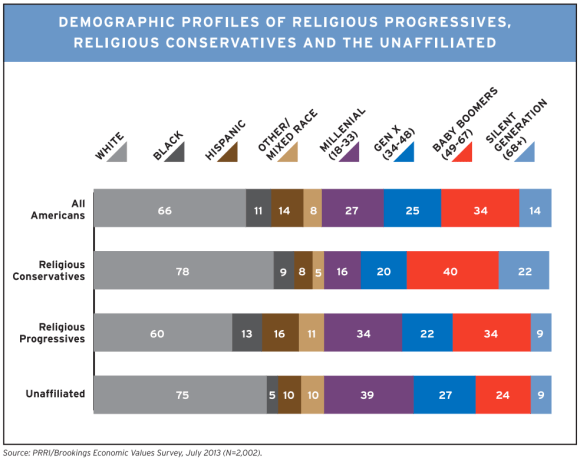
Interesting analysis by Emma Green cross-referencing ethnic origin, age, and religious views in the US:

Blacks, hispanics, and people of mixed race are all more likely to be religious progressives than conservatives; these groups are also among the fastest-growing demographics in the United States. Similarly, Millennials are more than twice as likely to be religious progressives than religious conservatives; in fact, people older than 50 make up more than 60 percent of those who are considered to be religious conservatives. Although it’s impossible to talk to an 18-year-old about her views on culture and predict what she’ll think in two decades, these demographic trends suggest that the religious right is about to start shrinking.

But the question of influence is a little fuzzier. Although more than a third of Millennials are considered religious progressives, roughly 40 percent don’t have any faith at all: A growing number of young people don’t identify with a particular religion. That, along with the fact that an overwhelming majority of religious progressives don’t see religion as “the most important thing in their life,” suggests that faith is losing its overall influence over how people think about social and cultural issues.

Chart Of The Day « The Dish.

A Tool That Maps Out Cultural Differences – Harvard Business Review


Comparing_Management_Cultures_-_Harvard_Business_Review

Interesting approach to understanding cross-cultural differences from a management perspective. Canada does not figure but the graphs are interesting. Risk of stereotyping, of course, but it may help people reflect on their styles and the impact on others:

Erin Meyer, an American (from Minnesota) in Paris who coaches executives in managing cross-cultural career moves and teaches at INSEAD in Fontainebleau, has a theory about these malentendus. The problem, she argues, is that most people tend to emphasize just one or two, at most three, dimensions of cultural difference when it comes to parsing and predicting foreigners’ behavior.

But cultures differ along many more than three dimensions, so the more dimensions you consider, the less likely you are to trip up on a cultural paradox — you’ll be able to tell that incoming French manager to tone down critiques of his American subordinates before he upsets them.

The trouble, of course, is that it’s cognitively difficult for us to keep more than three dimensions of comparison in our head at once. What’s more, we tend to lose sight of the fact that relative, not absolute differences, are what matters. Most cultures would find the Brazilians to be very relaxed about punctuality, for instance, but Brazilians themselves tend to struggle to adapt to Indians’ even more casual notions of time.

A Tool That Maps Out Cultural Differences – David Champion – Harvard Business Review.

Companies see diversity pay off

An example of diversity leadership in legal practice, Denton’s Canada (highlighting their Calgary office):

“From a cultural perspective, we’ve had zero pushback from senior leadership on embracing (diversity and inclusion) programs,” says Ghitters. “Diversity isn’t a fad. We’re in it for the long term.”

Having been recognized recently as one of Canada’s Best Diversity Employers by Mediacorp Canada Inc., Ghitters said diversity has to be built into the culture of a company with buy-in from the top down.

In the past six to eight months, the company has done everything from host several events supporting the LGBT community, had inspirational speakers, and ongoing support from the firm’s regional diversity committees for its array of programs.

It’s all part of an effort to instil a sense of support for diversity in every aspect of the company’s operations.

It appears to be working. “Any good workplace culture has some fun to it and this is a good way to celebrate diversity,” said Jordan Deering, partner and co-lead of the diversity committee in Calgary with Ghitters.

They use the simple method of reflecting the naturally diverse nature of the clients they serve and the cities they operate in across Canada.

“It also assists us in approaching legal issues from different perspectives and ways of thinking,” says Deering. “It helps us look at things from all angles.”

Companies see diversity pay off.

Why Race Has Been the Real Story of Obama’s Presidency All Along

Lengthy but interesting article by Jonathan Chait on the enduring legacy of slavery, and how it plays into the political and ideological divides in the US. Worth reading:

And the truth is almost too brutal to be acknowledged. A few months ago, three University of Rochester political scientists—Avidit Acharya, Matthew Blackwell, and Maya Sen—published an astonishing study. They discovered that a strong link exists between the proportion of slaves residing in a southern county in 1860 and the racial conservatism (and voting habits) of its white residents today. The more slave-intensive a southern county was 150 years ago, the more conservative and Republican its contemporary white residents. The authors tested their findings against every plausible control factor—for instance, whether the results could be explained simply by population density—but the correlation held. Higher levels of slave ownership in 1860 made white Southerners more opposed to affirmative action, score higher on the anti-black-affect scale, and more hostile to Democrats.

The authors suggest that the economic shock of emancipation, which suddenly raised wages among the black labor pool, caused whites in the most slave-intensive counties to “promote local anti-black sentiment by encouraging violence towards blacks, racist norms and cultural beliefs,” which “produced racially hostile attitudes that have been passed down from parents to children.” The scale of the effect they found is staggering. Whites from southern areas with very low rates of slave ownership exhibit attitudes similar to whites in the North—an enormous difference, given that Obama won only 27 percent of the white vote in the South in 2012, as opposed to 46 percent of the white vote outside the South.

The Rochester study should, among other things, settle a very old and deep argument about the roots of America’s unique hostility to the welfare state. Few industrialized economies provide as stingy aid to the poor as the United States; in none of them is the principle of universal health insurance even contested by a major conservative party. Conservatives have long celebrated America’s unique strand of anti-statism as the product of our religiosity, or the tradition of English liberty, or the searing experience of the tea tax. But the factor that stands above all the rest is slavery….

And yet—as vital as this revelation may be for understanding conservatism, it still should not be used to dismiss the beliefs of individual conservatives. Individual arguments need and deserve to be assessed on their own terms, not as the visible tip of a submerged agenda; ideas can’t be defined solely by their past associations and uses.

Liberals experience the limits of historically determined analysis in other realms, like when the conversation changes to anti-Semitism. Here is an equally charged argument in which conservatives dwell on the deep, pernicious power of anti-Semitism hiding its ugly face beneath the veneer of legitimate criticism of Israel. When, during his confirmation hearings last year for Defense secretary, Chuck Hagel came under attack for having once said “the Jewish lobby intimidates a lot of people up here,” conservatives were outraged. (The Wall Street Journal columnist Bret Stephens: “The word ‘intimidates’ ascribes to the so-called Jewish lobby powers that are at once vast, invisible and malevolent.”) Liberals were outraged by the outrage: The blog Think Progress assembled a list of writers denouncing the accusations as a “neocon smear.” The liberal understanding of anti-­Semitism is an inversion of conservative thinking about race. Liberals recognize the existence of the malady and genuinely abhor it; they also understand it as mostly a distant, theoretical problem, and one defined primarily as a personal animosity rather than something that bleeds into politics. Their interest in the topic consists almost entirely of indignation against its use as slander to circumscribe the policy debate.

Why Race Has Been the Real Story of Obama’s Presidency All Along — New York Magazine.