ICYMI: Turning up the war rhetoric isn’t the same as confronting the threats – The Globe and Mail

Sensible commentary by Campbell Clark in the Globe:

But the big issue is clearly trying to prevent young Canadians, many of them apparently ordinary-joe young suburbanite men, from becoming radicals. And because that’s hard, governments talk less about it.

Talk of war on a massive scale won’t dissuade radicalization. Quite the opposite. One of the motivators for violent radicalization, according to experts, is that it makes marginalized, alienated young men feel important, even feared. ISIS even uses videos with themes from video games like Call of Duty to recruit foreign fighters. A potential recruit would probably be drawn, not deterred, by the idea that this is war on a massive scale. It might be better to employ ridicule.

It is true, as Mr. Harper said last week, that there are threats. But the unpleasant fact is that turning up the war rhetoric isn’t the same as confronting them.

Turning up the war rhetoric isn’t the same as confronting the threats – The Globe and Mail.

Turns out the French government can’t take a joke either

Leonid Bershidsky on the French government’s overkill in arresting Dieudonne and others for hate speech:

Like the other 53 people arrested for hate speech in France since the Paris terror attack, Dieudonne did not wield a gun — he just typed words on a keyboard. If all those cartoons of pencils versus Kalashnikovs that proliferated after the Charlie Hebdo killings are worth anything at all, these people must be freed.

Words do not kill, and it’s always the reader’s or listener’s choice whom to listen to. Charlie Hebdo is not a publication for radical Islamists, Christian fundamentalists or the far right. I bought Charlie Hebdo when I lived in France, but I am not a Dieudonne fan, for obvious reasons. Freedom, however, is about recognizing that, while some wouldn’t touch Charlie Hebdo with a barge pole, they might flock to Dieudonne’s sold-out shows.

Today, Charlie Hebdo sold out its extraordinary 3 million print run in a matter of hours. (Two million additional copies will be printed.) As we stock up on the magazine with a cartoon of the prophet Mohammed on the cover, it would be a good idea to listen to Luz, the artist who drew that cartoon. Here’s what he said in a recent interview:

“The symbolic actions of today are what Charlie has always worked against, to destroy symbols, remove taboos, flatten fantasies. It’s great that people support us but that’s contrary to what Charlie cartoons are about. The unanimity is useful to Hollande when he wants to unite the nation. It is useful to Marine Le Pen when she calls for the death penalty. Everybody can do whatever they want with symbolism in a broad sense.”

Instead of using the Charlie Hebdo attack as a pretext for a crackdown on the freedom of expression, the French government should set an example to others by repealing hate speech laws and concentrating on preventing the truly deadly attacks — those that use bullets. There are far more dangerous people around than anti-Semitic comedians.

Turns out the French government can’t take a joke either

And Andrew Sullivan makes similar points:

…. particularly religion, which should be open to the most merciless attacks and denunciations and mockery precisely because of the grandeur of its claims and the power of its social authority. A true believer is relieved to see the all-too human institutions of church or mosque or synagogue ridiculed, precisely because those institutions are prone to corruption on a vast scale. And faith should easily survive mockery. Jesus himself encouraged his followers not to be dismayed when they are maligned or disparaged because of their faith. It is not something Christians should avenge; it is something that at times Christians should even seek. But even a spiritual figure like Jesus was ignored for millennia once Christianity got worldly power. When Muhammed himself authorizes a hit on someone who insulted him and Allah, the journey is going to be considerably longer.

France Cracks Down On Free Speech

France Has A History Of Anti-Semitism And Islamophobia | FiveThirtyEight

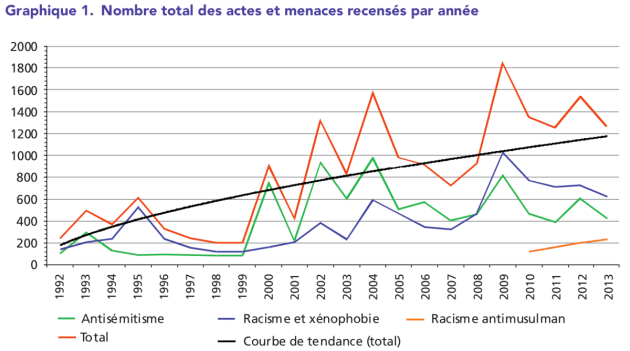
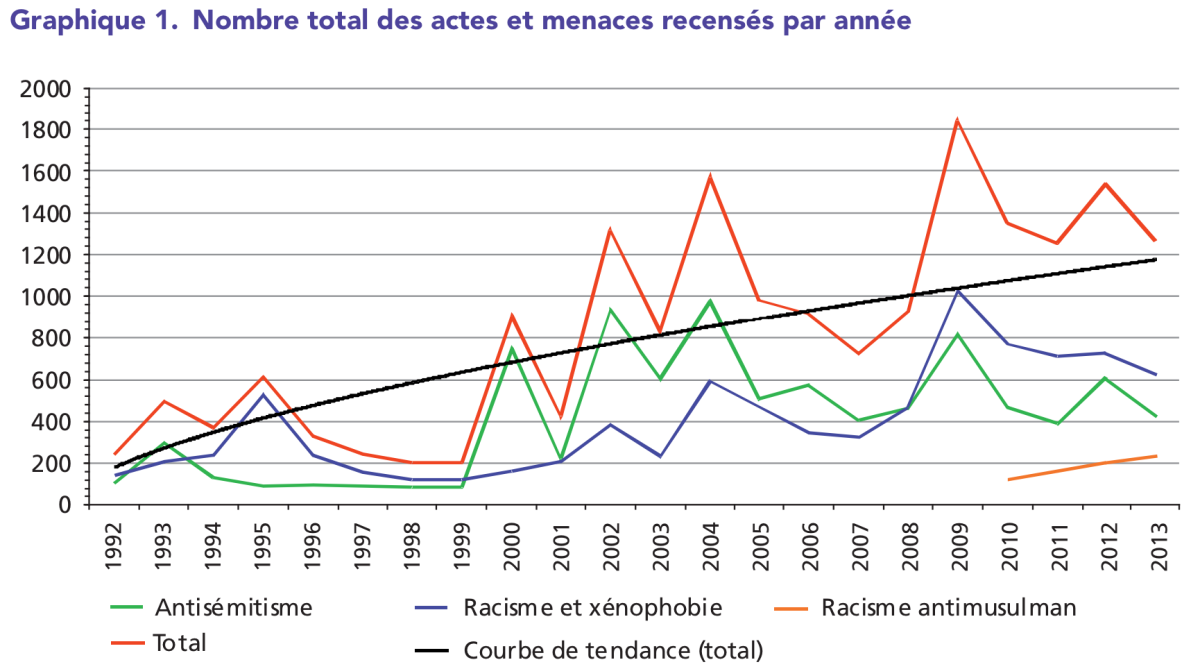
Hate crimes FranceBeyond the anecdotes, hate crime data (chart above) and public polling:

Public opinion surveys might offer some further insight into how Islamophobia is changing in France. In the spring of 2008, Pew surveyed 754 adults in the country about their views on various religious groups. Thirty-eight percent of respondents said they had a “somewhat” or “very” unfavorable opinion of Muslims. That figure was slightly higher than in previous years — in 2006, 35 percent said they had an unfavorable opinion of Muslims in 2005, and in 2004 it was 34 percent.

In 2014, Pew commissioned a new survey, this time posing a question to 1,003 French adults with a slightly different wording. Rather than asking about attitudes toward religious groups in general, the survey asked specifically about attitudes towards religious groups living in France. This time, 27 percent of respondents expressed a somewhat or very unfavorable opinion of French Muslims.

Three-quarters of French respondents believe Islam is an “intolerant” religion, incompatible with the values of French society, according to a January 2013 poll by the French newspaper Le Monde and the market research company Ipsos.

Anti-semitism in France

Rabbis in France have described the country’s Jewish population as “tormented with worry” after Friday’s attack on a French supermarket. On Monday, 5,000 police officers had been sent to Jewish schools and religious sites amid security concerns in addition to 10,000 troops deployed across the country.

The nonprofit Service de Protection de la Communauté Juive (the Jewish Community Security Service, SPCJ) publishes an annual summary of anti-semitic attacks reported to the organization and to police precincts in France. Its latest figures show that in 2013 there were 105 anti-semitics acts and 318 anti-semitic threats. Taken together, the number of threats and acts in 2013 was lower than in 2012 (when there were 614 total incidents) but higher than in 2011 (389).

Pew’s 2014 survey also asked about respondents’ attitudes toward French Jews, with 10 percent of respondents expressing an unfavorable opinion.

In September 2014, Fondapol, a French think tank, posed a range of questions that might reveal anti-semitic attitudes to 1,005 French people age 16 and over. The choice of wording in the survey is interesting. One question asked “when you learn that someone you know is Jewish, what reaction do you have,” to which 91 percent of respondents said “nothing in particular,” 3 percent said “I like them” and 3 percent said “I don’t like them” (the rest refused to answer). However, 21 percent of respondents said they would prefer to avoid having a Jewish president, 14 percent a Jewish mayor, 8 percent a Jewish doctor and 6 percent a Jewish neighbor.

France Has A History Of Anti-Semitism And Islamophobia | FiveThirtyEight.
Islamophobia Is Not a Myth – The Atlantic

The US debate on Islamophobia with Connor Friedersdorf of the Atlantic countering Brendan O’Neil’s piece in the National Review, “Islamophobia is a Myth” with evidence:

Says O’Neill, “According to federal crime stats, in 2009 there were 107 anti-Muslim hate crimes; in 2010, there were 160. In a country of 330 million people, this is exceptionally low.” But in 2000, there were 28 such incidents. What’s wrong with inveighing against anti-Muslim bigotry that’s responsible for 100 or so “extra” hate-crimes, or noting that the numbers were much worse immediately after 9/11… and worrying a spike could happen again? Calling for tolerance of a minority group at a moment of plausible peril is costless, prudent and humane, not objectionable. And if relative tolerance then prevails, that’s a success, not an occasion to complain that elites weren’t trusting enough in the masses.

There’s a non-trivial chance that efforts to stigmatize an anti-Muslim backlash are partly responsible for the fact that there haven’t been more hate crimes in the United States and that the post-9/11 spike has decreased, albeit not back to pre-9/11 levels.

That’s certainly the intention of liberals, as well as many conservatives who followed President Bush’s lead. The chance of success strikes me as a good reason to continue the campaign of stigma, even if the sensibilities of some conservatives are offended, as if suffering is a zero-sum game, or zealously guarding against Islamophobia somehow undermines the fight against terrorism. Insofar as mainstream Muslims are instrumental in informing on radicalized co-religionists who turn to violence, efforts to reach out in support of them are investments in counterterrorism in addition to being consistent with basic justice.

“Islamophobia is a code word for mainstream European elites’ fear of their own populations,” O’Neil writes, “of their native hordes, whom they imagine to be unenlightened, prejudiced, easily led by the tabloid media, and given to outbursts of spite and violence.” As it happens, human beings, in Europe and everywhere else, are often prejudiced, easily led by the media, and given to spite and violence. It is lovely to think that a violent faction on the European right will never again succeed in perpetrating horrific abuses against immigrants or ethnic minorities. To stigmatize those working to prevent such a future is a waste of stigma.

Islamophobia Is Not a Myth – The Atlantic.

La Loi sur la laïcité encore au programme de Couillard | Le Devoir

Couillard maintaining the focus on fundamentalism, not the headgear of public servants:

« On va légiférer. Mais, encore une fois, c’est faire un amalgame qui m’apparaît non seulement risqué, mais inapproprié. Clairement, la relation entre le code vestimentaire et les événements terroristes a été montrée en France comme étant inexistante. On confond deux enjeux », a-t-il d’abord lancé.

« C’est ce genre d’amalgame qu’il faut absolument éviter. Comme on l’avait dit à l’époque, on se trompe de cible. La cible, c’est le fanatisme, c’est le terrorisme, c’est la radicalisation », a-t-il ajouté.

Il a tout de même insisté sur l’importance d’exprimer clairement la neutralité de l’État au Québec. « Ce qui est important, c’est d’assurer la neutralité des institutions de l’État. On a dit qu’on le ferait et on le fera. Également, d’adopter des mesures, par exemple, qui vont, sur le plan du Code civil entre autres, lutter contre l’intégrisme ou les manifestations de l’intégrisme au Québec », a dit M. Couillard.

La Loi sur la laïcité encore au programme de Couillard | Le Devoir.

Jason Kenney rejects crackdown on religious satire

Good strong defence of freedom of speech (see earlier post Satirical religious cartoons should be illegal, says Ottawa imam and reactions):

In the past week, however, some Islamic communities have asked that depictions and satirizations of Mohammed, considered a prophet by Muslims, and whose image is sacred and not to be shown, be pursued by legal means.

Kenney showed no interest in those pleas.

“Freedom of expression means anything,” he said. “It means the right to publish controversial or even sometimes offensive speech.

“It doesn’t mean we have to like it, and it doesn’t mean we have to endorse it, but we have to tolerate it,” Kenney went on. “That’s the price of freedom.”

Jason Kenney rejects crackdown on religious satire | Canada | News | Toronto Sun.

Islam’s Problem With Blasphemy

Good piece by Mustafa Akyol in the NY Times:

Before all that politically motivated expansion and toughening of Shariah, though, the Quran told early Muslims, who routinely faced the mockery of their faith by pagans: “God has told you in the Book that when you hear God’s revelations disbelieved in and mocked at, do not sit with them until they enter into some other discourse; surely then you would be like them.”

Just “do not sit with them” — that is the response the Quran suggests for mockery. Not violence. Not even censorship.

Wise Muslim religious leaders from the entire world would do Islam a great favor if they preached and reiterated such a nonviolent and non-oppressive stance in the face of insults against Islam. That sort of instruction could also help their more intolerant coreligionists understand that rage is a sign of nothing but immaturity. The power of any faith comes not from its coercion of critics and dissenters. It comes from the moral integrity and the intellectual strength of its believers.

Islam’s Problem With Blasphemy – NYTimes.com.

Why I’m Through With Apologies From Racists | TIME

Good commentary by Morgan Jerkins in Time:

So how do we remedy this situation? I know for certain that the reason why these white public figures make these insensitive remarks is because they are not aware. They are not aware that what they do and say hurts minorities. The easiest way to be aware of one’s differences vis-a-vis another’s is to be in the midst of them.

They need to surround themselves with more minorities, and not just the ones who cook their food, watch their children, and scrub their kitchen floors. More minorities need to be in the boardroom being heard and taken into consideration for their priceless cultural value to the company. Such a contribution is crucial in this generation, and it all starts with the hiring process. A white person with some high school education can get hired quicker than a black college graduate. If that discrepancy does not unsettle you just a little bit, then you may be also part of the problem.

We need these people in power to be aware. A boardroom should succeed in bringing in a diversity of talents and a diversity of people. One black or Asian person does not equal diversity. The hiring process needs to be changed. We as minorities cannot only be good enough for you to take our money, but not good enough to hire. We see the statistics and hear from unemployed people of color all the time. Minorities are applying but you are not taking them. Then, others wonder why CEOs and public figures alike make racist faux pas. I can guarantee you it’s because no minority was in their corners in order to tell them that they were making a big mistake.

In essence, we as the public need to hold these people accountable. Think pieces and hashtags are great catalysts for conversation, but their impact gets stunted if the people who need these lessons most do not read any of them.

I’ve heard the saying that the best place to hit a rich, privileged person where it hurts is in his or her pockets. But now, that’s not enough anymore. Let’s hurt their revenue and also reveal how dangerous their rhetoric is. If that means sending them books on critical race theory, inviting them on talk shows alongside scholars with minority interviewers, and having powerful people of color to bolster support, so be it.

We cannot allow these cycles to go on because all they do is reinforce a hierarchy. In the end, the minorities are the ones who still feel the sting when the story is old news. We may eventually move on from the topic, but that’s because another racist juggernaut is outed then the emotional wound deepens. Regardless, we never forget. Do not let them forget either.

Why I’m Through With Apologies From Racists | TIME.

Radicalization of prisoners discussed at Canadian roundtable

Interesting to see whether the CSC will revisit the earlier decision to cancel the chaplain program in 2013 (Is Canada doing enough to ‘de-radicalize’ convicted terrorists?):

Don Head, commissioner of the Correctional Service of Canada (CSC), got approval from Public Safety Minister Steven Blaney to fly in participants from other parts of Canada and from the United States, the United Kingdom, New Zealand, Israel, France, Spain and the Netherlands at a cost of about $63,000, according to a briefing note obtained by CBC News through Access to Information.

“Violent extremist or radicalized offender populations may pose a threat to the safety and security of institutions and communities, necessitating an examination of evidence-based assessments, interventions and management practices for this group of offenders,” the document reads.

CSC confirmed the three-day event took place Dec. 2-4, bringing together international experts who discussed ways to manage extremist offenders.

Amedy Coulibaly, seen in an undated video posted online Sunday by militants, shot a policewoman and four hostages at a kosher grocery in Paris before he was killed by police on Friday. Coulibaly is said to have been radicalized in prison, where he met one of the Kouachi brothers responsible for last week’s Charlie Hebdo killings. (Associated Press)

The issue of radicalization behind bars is on the global radar after revelations that two gunmen involved in last week’s attacks in France are believed to have been radicalized in prison.

French authorities are struggling to contain the threat from what is now considered fertile ground for extremism.

….Rioux said CSC’s initiatives to prevent radicalization include comprehensive intake and screening procedures and training for front-line staff on security threat group identification.

Radicalization of prisoners discussed at Canadian roundtable – Politics – CBC News.

Face of the Day – Charlie Hebdo’s Cover

o-charlie-cover-5701