More state power, not free speech, the likeliest we-are-Charlie result – Neil MacDonald

Extensive commentary by Neil MacDonald of the CBC who unfortunately nails it in his somewhat lengthy piece on the aftermath of the Paris killings:

Western governments are, however, quite interested in enforcement and security, and that, not more speech, is the order of the day once again.

With unintended irony, and a very short memory, French Prime Minister Manuel Valls declared over the weekend that France is now locked in a “war on terror.”

That’s exactly the term George W. Bush used after 9/11. It presaged an unprecedented expansion of the surveillance state and the powers of America’s security apparatus.

Civil liberties were tossed aside. Other countries’ laws, even those of U.S. allies, became irrelevant.

And the frightened American population cheered.

The French, among others, mocked the slogan relentlessly, especially once it became apparent that the U.S. invasion of Iraq, carried out as part of this war on terror, was based on a false pretext.

Eventually, Bush’s own Pentagon quietly dropped the slogan. And when the Democrats took the White House, they repudiated it.

But it’s clearly back on. U.S. Attorney General Eric Holder agreed with the French prime minister. America, he said, is at war, too.

Next month, Washington is convening an international summit to discuss new measures.

Canada is preparing new legislation to expand the powers of its security agencies.

The French, and the Americans, and no doubt the Canadians, are considering how better to monitor and obliterate incitement on the internet.

Or, more precisely, what security officials consider incitement. It’s a term that can be interpreted rather broadly, and no doubt will be.

Clearly, the ultimate answer to the Charlie Hebdo massacre will not be freer speech. It will be a mostly secret intensification of police power, with attendant shrinkage of individual freedoms.

And we will all be told not to worry: If you aren’t doing anything wrong, you have nothing to worry about.

At least one French demonstrator seemed to recognize some of this over the weekend. The sign he hoisted read: “Je marche, mais je suis conscient de la confusion et de l’hypocrisie de la situation.”

I march, but I am aware of the confusion and hypocrisy of the situation.

More state power, not free speech, the likeliest we-are-Charlie result – World – CBC News.

No “Clash of Civilizations” – Commentary Magazine

From a surprising source, Commentary Magazine:

Surveys indicate that the broad majority of Muslims around the world are not in the violent, jihadist camp. A Pew poll in 2013, for example, found that across 11 Muslim countries, 67 percent of those surveyed said they are somewhat or very concerned about Islamic extremism and 57 percent said they had an unfavorable view of al-Qaeda while 51 percent had an unfavorable view of the Taliban. Moreover, “about three-quarters or more in Pakistan (89%), Indonesia (81%), Nigeria (78%) and Tunisia (77%), say suicide bombings or other acts of violence that target civilians are never justified.” Indeed the only place where a majority of Muslims justified suicide bombings was in the Palestinian territories.

It seems safe, then, to say that most Muslims around the world are moderate. But there is a substantial minority of extremists which, in absolute numbers, pose a serious threat, given the fact that there are an estimated 1.2 billion Muslims in the world. While those extremists pose a substantial threat to the West, they present an even bigger threat to fellow Muslims. The vast majority of victims of Islamist terrorist organization such as the Taliban, ISIS, al-Qaeda, and Hezbollah have been fellow Muslims. Such organizations, after all, are principally bent on dominating their own societies, thus by definition oppressing and killing fellow Muslims; they generally attack the West only as an auxiliary line of operations. One of the truly disturbing aspects of modern-day Islamist movements is the ease with which they declare their Muslim enemies to be “takfir” (i.e. apostates) and therefore liable to be killed.

What is going on, then, is not a war between civilizations but a war within Islamic civilization pitting an armed, militant minority against a peaceful but easily cowed majority. Any talk of waging “war on Islam” is thus deeply misguided and harmful. What we in the West need to do is to help moderate Muslims wage war on the radicals. Sound impossible? Far from it. Just look at how successfully (if brutally) Muslim states such as Morocco, Egypt, Tunisia, and Algeria have fought to repress Islamist movements–or how courageously so many Iraqi and Afghan security officers have fought against Islamist extremists. (They would fight even more effectively if their own organizations were less corrupt and more effective.)

The “us-vs.-them” narrative only distracts from what needs to be done while playing into the terrorists’ hands–that is after all, precisely the narrative they seek to promulgate to rally Muslims to their side.

No “Clash of Civilizations” – Commentary Magazine Commentary Magazine.

Charte de la laïcité: «une clause grand-père» prévaudra |Drainville

Quebec Public Administration

From 2011 National Household Survey

This will hardly help integration in Quebec. The above chart shows just how limited the number of visible minorities are among federal employees in Quebec and particularly in the Quebec provincial and municipal governments (a similar pattern is found in Quebec’s education system, particularly elementary and secondary schools and CEGEPs):

«Il faut avancer, a résumé M. Drainville en entrevue. On ne peut pas s’empêcher d’avancer parce qu’il y a des actes de terrorisme qui sont posés chez nous ou ailleurs dans le monde. Quand on fait cela, ils gagnent. On ne doit pas se faire dicter nos débats et nos choix démocratiques par les extrémistes.»

Quelques jours avant la pause des Fêtes, M. Drainville a promis de dévoiler au début 2015 une version plus «souple», plus «consensuelle» de la Charte de la laïcité qu’il a défendue l’an dernier. Il a fait valoir que, si le gouvernement péquiste minoritaire avait pu mener son projet de loi à terme, il aurait dû en venir à un compromis avec la Coalition avenir Québec.

Selon nos informations, la nouvelle charte prévoira que l’interdiction de porter des signes religieux, la mesure phare de la première version, ne s’appliquera qu’aux futurs employés de l’État. Aucun employé actuel ne serait obligé de s’y conformer.

Charte de la laïcité: «une clause grand-père» prévaudra | MARTIN CROTEAU ET DENIS LESSARD | Politique québécoise.

The far right spreads its wings over Europe

Good survey of the rise of intolerance and right-wing anti-immigration parties by Jonathan Manthorpe and his plea for perspective:

There’s no doubt at all that public fears of Islamist violence have been stoked by government alerts and alarmism — a trend that started before the 9-11 attacks. More recently, western governments — including our own — have seized on the psychopathic Islamic State group in Syria and Iraq, warning that Muslim citizens recruited into IS will return with terrorist skills and cause havoc at home.

As with the Charlie Hebdo attack, the “lone wolf” killings of two Canadian soldiers in Quebec City and Ottawa in October have been held up as evidence of the threat of radicalized Muslims living in the West. What’s missing from these panic-fueled statements is anything like perspective.

Remember, just two Canadian misogynists — Robert Pickton and Marc Lepine — together accounted for the deaths of 63 people. And on any bad day, Canada’s warring drug gangs in greater Vancouver and Toronto notch up death tolls far outstripping anything Islamic terrorists can come up with. And most mass killings of Mounties in recent years — four at Mayerthorpe in 2005 and three in Moncton last June — have been perpetrated by mentally unstable Canadians with hunting rifles.

The far right spreads its wings over Europe (paywall)

And Gwynne Dyer on the situation in Germany:

Germany is taking in more immigrants than ever before: some 600,000 this year. That’s not an intolerable number for a country of 82 million, but it does mean that if current trends persist, the number of foreign-born residents will almost double to 15 million in just 10 years. That will take some getting used to—and there’s another thing. A high proportion of the new arrivals in Germany are Muslim refugees.

Two-thirds of those 600,000 newcomers in 2014 were people from other countries of the European Union where work is scarce or living standards are lower. They have the legal right to come under EU rules, and there’s really nothing Germany can do about it. Besides, few of the EU immigrants are Muslims.

The other 200,000, however, are almost all refugees who are seeking asylum in Germany. The number has almost doubled in the past year, and will certainly grow even larger this year. And the great majority of the asylum-seekers are Muslims.

This is not a Muslim plot to colonize Europe. It’s just that a large majority of the refugees in the world are Muslims. At least three-quarters of the world’s larger wars are civil wars in Muslim countries like Syria (by far the biggest source of new refugees), Iraq, Yemen, Somalia, Afghanistan and Libya.

Asylum-seekers: The limits of tolerance in Europe

And a more encouraging story from Germany, that of Professor Mouhanad Khorchide:

In his lecture, the long conversation and a telephone call after the shootings on Wednesday at the office of the satirical newspaper Charlie Hebdo in Paris, Mr. Khorchide was calm and optimistic, delivering insight with a Viennese lilt in his German.

He expressed fear that extremists on both sides would try to use the attack for their own ends. “The Muslim extremists will say, ‘Oh, look how strong and mighty we are,’ ” he said, “while those who fear Islam will say, ‘See, that is what Islam is, and what we were warning about all along.’ ”

He said he expected more attacks, but also more questioning from Muslims. “Such events force us to discuss openly about theological positions,” he said. “It is too simple to say, ‘No, no, that has nothing to do with Islam.’ These people,” he added of jihadists, “are referring to the Quran, and we must confront these passages in the Quran.”

His students, he said, were angry after the Paris shootings. In part, they were upset with Muslim extremists seeking to please what they consider a false idol. But they were also resentful that now “they must justify themselves: ‘We are peaceful,’ ” he said. “And this constant justifying and defending oneself is annoying.”

Europe’s populist current “whips up fears where no fears exist,” Mr. Khorchide said. “For instance, the Islamization of Europe: Demographic data shows that this is a fantasy.”

Furthermore, he noted, Muslim children born in Europe now tend to adopt its ways, the tiny minority who go off to fight in Iraq and Syria notwithstanding.

Teaching Islam’s ‘Forgotten’ Side as Germany Changes

Lastly, from the Netherlands, not surprising to see a spike in support for Geert Wilders.

But interesting that the Dutch PM declined to use the word “war” in favour of  a more nuanced expression, yet one that also communicates resolve:

Wilders, known for his inflammatory rhetoric, said after the Paris bloodshed that the West was “at war” with Islam, drawing a rebuke from Dutch Prime Minister Mark Rutte on Sunday.

If elections were held now, his party would be the single largest in the Netherlands, with 31 seats in the 150-member parliament, more than twice as many as it won in the last elections, according to a Sunday poll.

The governing Liberal and Labour parties, damaged by persistent sluggish growth, would have just 28 seats between them, compared to the 79 they held after the 2012 elections.

The Freedom Party was polling 30 seats just prior to the Jan. 7-9 Paris attacks, in which 17 people including journalists and policemen were killed by three Islamist gunmen who were later shot dead by French special forces.

Wilders this week called in an interview for measures against Islam: “If we don’t do anything, it will happen here,” he was quoted by the newspaper Het Parool as saying.

But speaking to Dutch public television shortly before leaving to attend a peace rally in Paris, the Dutch prime minister distanced himself from Wilders’s comments.

“I would never use the word ‘war,'” he said. “We are in a struggle with extremists who are using a belief as an excuse for attacks.”

More than 80 percent of respondents to the De Hond poll said people who left the Netherlands to wage jihad (holy war) in Syria should lose their Dutch citizenship and those returning from fighting in Syria or Iraq should face lengthy jail terms.

Paris attacks boost support for Dutch anti-Islam populist Wilders | Reuters.

Drawing the prophet: Islam’s hidden history of Muhammad images

Interesting article on the history of devotional Islamic art that depicts the prophet Muhammad. Again, a sad forgetting of some of the rich traditions within Islam:

To many Muslims, any image of the prophet Muhammad is sacrilegious, but the ban has not always been absolute and there is a small but rich tradition of devotional Islamic art going back more than seven centuries that does depict God’s messenger.

It began with exquisite miniatures from the 13th century, scholars say. Commissioned from Muslim artists by the rich and powerful of their day, they show almost every episode of Muhammad’s life as recounted in the Qur’an and other texts, from birth to death and ascension into heaven.

Intended as private aids to devotion and prayer, these detailed scenes were made for both Sunni and Shia worshippers, and surviving examples can be found in dozens of major museum and library collections.

They also laid the foundations for a popular, if minority, tradition of devotional and inspirational images that still exists today, from icons cherished in homes to a five-storey government-commissioned mural in the heart of Tehran and even to revolutionary street art in Cairo – although the prophet’s face is obscured in both those public drawings.

In the wake of the murder of cartoonists at French magazine Charlie Hebdo, many Muslims and non-Muslims have argued that Islam has always banned any representation of the prophet, in part because of strong warnings in the Qu’ran and other religious texts against idolatry or anything that could be seen as a pathway towards idolatry.

This position is rarely challenged, perhaps because the existence of images of Muhammad is little known and almost never discussed outside communities that create, study or buy them. But their obscurity frustrates experts who see them as a rich part of Islam’s artistic heritage and resent the misconception that the only depictions of the prophet are mocking or racist creations by non-believers. “It’s really important for audiences that have never seen the pietistic images of Muhammad to make a radical distinction between the mystical and beautiful images that have been produced over the last 1,000 years by Muslims and for Muslims, and the offensive and sometimes pornographic images [currently in the news],” said Omid Safi, director of the Islamic Studies Centre at Duke University in North Carolina.

Drawing the prophet: Islam’s hidden history of Muhammad images | World news | The Observer.

France’s political elite never champions virtues of a multicultural nation | Elise Vincent

Good piece by Elise Vincent of Le Monde on the problems with France’s approach to diversity and integration:

The problem with the approach of both Sarkozy and Hollande is that it reveals a defensive attitude, never a proactive one. So when the government begins to accept meatless menus in canteens or creates Muslim areas in cemeteries, the impression given to the French public is still that of an “abdication” faced with the claims of Muslim “lobbies”. It doesn’t, as it could, suggest an approach that’s chosen and is beneficial to the French Muslim minority and so, in turn, to the whole of French society.

Similarly, constantly brandishing the idea of a republic “one and indivisible” – as the saying goes – France judges that it is defending itself against Anglo-Saxon “multiculturalism”.

In truth, on the ground, things are very similar. De facto community organisations exist in France, as in the UK. But there’s one key difference: by acting as it does, France prevents the emergence of moderate “community leaders”. Those who manage to emerge in public debate are those who shout the loudest: the radicals.

While failing to review its “model”, France is ignorant of the extent of its mixed relationships and the children born to them. How, without accurate ethnic statistics, can we address properly this grassroots transformation of France? How to measure properly the failures of integration or the success of many immigrants, whether Muslim or not?

The way of speaking of “living together” in France is often too negative, obsessed by the most extreme behaviour, or, alternatively, it is too celebratory, as if it were absolutely necessary to embellish reality to better fight the rise of the Front National. The analyses are often coarse, unnecessarily judgmental. The always subtle, complicated reality of identity and life on the ground is regularly overlooked. All these small shifts in what and how people feel have much more to do with everyday tensions than blind terrorism.

Physicists know that the smell of a dangerous gas is detectable in the air long before becoming harmful and ends in an explosion. There are still two years before the next presidential elections. Two years to prevent French voters massively supporting the Front National, as predicted by many polls. Stopping this leak will not necessarily protect France from terrorism, but it will at least guard against another cataclysm.

France’s political elite never champions virtues of a multicultural nation | Elise Vincent | Comment is free | The Observer.

Satirical religious cartoons should be illegal, says Ottawa imam and reactions

From one of the preferred interlocutors of the Government in the Canadian Muslim community:

Imtiaz Ahmed, an imam with the Ahmadiyya Muslim Community, said it should be against the law to publish cartoons that depict religious figures in a derogatory way.

“Of course we defend freedom of speech, but it has to be balanced. There has to be a limit. There has to be a code of conduct,” Ahmed said.

“We believe that any kind of vulgar expression about any sacred person of any religion does not constitute the freedom of speech in any way at all.”

Ahmed said there should be limits placed on freedom of speech to prevent the publication of offensive material. He says that seems to be the case for events such as the Holocaust. Members of the public denounce those who say the Holocaust never happened.

“We don’t want the Jewish community to be hurt by these sentiments,” Ahmed says.

And yes, of course there are limits; the debate is more about what those limits should and should not be, and what is considered offensive and to whom. A blanket “ban” on religious satire is what he seems to be what he is suggesting.

Satirical religious cartoons should be illegal, says Ottawa imam | Ottawa Citizen.

And the reply by the Association of Canadian Editorial Cartoonists:

“I think it should be up to the cartoonist and their editor as to whether a cartoon has crossed the line and become too distasteful,” said Wes Tyrell, association president and the feature editorial cartoonist for Yahoo! Canada.

“A cartoonist should absolutely be prepared to criticize what they see as poor behaviour by any human on the planet, whether a politician or religious figure. I find the whole concept of ‘you can’t touch them’ as pretty sad.”

… Ahmed’s views on censorship were met Friday with a storm of protest on the Citizen’s website. “I’m Catholic and I saw the humour in Monty Python’s Life of Brian: I didn’t pick up a gun after that,” wrote public health inspector Bruce Kemball, who noted that Canada already has laws against hate speech.

Other religious leaders contacted by the Citizen also weighed in on the issue.

Rabbi Reuven Bulka said it’s too unwieldy to try to define what’s unacceptable as it relates to satire and religion.

“We abhor hateful speech, we abhor speech that’s demeaning of anyone,” he said. “But in the end, the only way you’re going to have an effective counter to this kind of garbage is by people not buying these papers or not subscribing to them. If there’s no market, it won’t happen.”

Cartoonists insist they should be able to satirize anyone

Paris policeman’s brother: ‘Islam is a religion of love. My brother was killed by terrorists, by false Muslims’

From the brother of the slain police officer, Ahmed Merabet:

“My brother was Muslim and he was killed by two terrorists, by two false Muslims,” he said. “Islam is a religion of peace and love. As far as my brother’s death is concerned it was a waste. He was very proud of the name Ahmed Merabet, proud to represent the police and of defending the values of the Republic – liberty, equality, fraternity.”

Malek reminded France that the country faced a battle against extremism, not against its Muslim citizens. “I address myself now to all the racists, Islamophobes and antisemites. One must not confuse extremists with Muslims. Mad people have neither colour or religion,” he said.

“I want to make another point: don’t tar everybody with the same brush, don’t burn mosques – or synagogues. You are attacking people. It won’t bring our dead back and it won’t appease the families.”

Paris policeman’s brother: ‘Islam is a religion of love. My brother was killed by terrorists, by false Muslims’ | World news | The Observer.

Charlie Hebdo harsher with Christianity than Islam

Martin Patriquin on Charlie Hebdo:

My point here isn’t only that Charlie Hebdo is an equal opportunity offender of religions, a fact repeatedly borne out in the magazine’s archives. It’s also this: over the years, Charlie Hebdo has been far harsher with Christianity than it has with Islam. Catholic organizations have sued the magazine 13 times, and only once by Muslim groups. That the magazine was both firebombed (in 2011) and its staff attacked and killed (2015) by apparent adherents of Islam only speaks to Charlie Hebdo’s central point: it’s not the religion that’s the problem—though there’s that too—but its  most extreme adherents. “French Muslims are sick of Islamism,” read the first cover sell in one issue.

French society might well be anti-Islam. Muslims, who make up 12 per cent of the country’s population, account for about 60 per cent of its prison population. Many of Paris’s infamous banlieues are petri dishes of relative poverty and exclusion. French politicians, eager to curry to the public’s favour, have been far too quick in appealing to its baser fears; Nicolas Sarkozy’s outright burqua ban is but one example of this.

But Charlie Hebdo is hardly a reflection of this hate. In fact, when it wasn’t pillorying him for being an image-obsessed, pro-American patsy, Charlie Hebdo was at its best when it pointed out in brilliant and profane Technicolor how Sarkozy was guilty of scapegoating Muslims and the Roma for the sake of an election. Here is one example.

There’s a sad irony for you: far from being anti-Islam, Charlie Hebdo was perhaps the loudest defender of those who practice it.

Charlie Hebdo harsher with Christianity than Islam.

And in the same vein, on Arun with a View, commentary on the content of Charlie Hebdo by someone who has read it on and off over the years:

… The fact is, CH is on the left, targets all religions—but not their believers—in equal measure, and aims its main fire at politicians, and particularly the right (and, above all, the Front National). CH comes out once a week, i.e. 52 times a year. A handful of its issues—less than a dozen—over the past decade have had cover cartoons mocking radical Islamism (not Islam or Muslims). A drop in the bucket in terms of what CH has published. And most of these cartoons have been pretty good actually. Witty and on target.

A few in the inside pages—which could only be seen if one purchased the issue, as CH puts almost nothing on its website—were in poor taste (and the cover cartoon from last October on the girls kidnapped by Boko Haram—which was situated in the context of the then French debate on family allowances—was definitely in very poor taste), but, taken as a whole, could in no way be taken as denigrating to Muslims qua Muslims. And then there’s the actual content of CH’s columns and articles, which absolutely no CH detractor mentions (as they have most certainly never read any). I will defy anyone to find any of these—published at any point over the years—that could in any way be considered racist or Islamophobic.

On Charlie Hebdo, bigotry, and racism

The ideologies of Canadian economists, according to Twitter – Macleans.ca

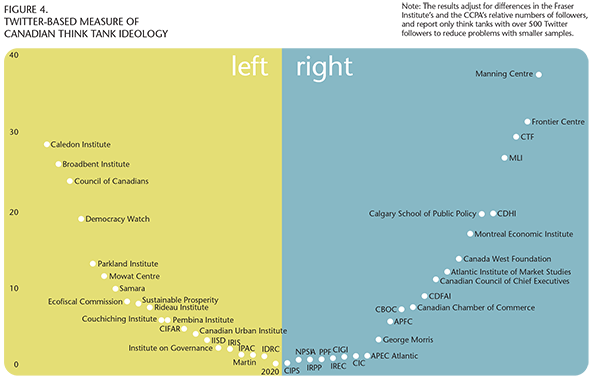
Think tanksInteresting analysis of Twitter use and followers to indicate ideological leanings by Stephen Tapp:

Four additional results are worth highlighting. First, there are indeed many Canadian think tanks: these results include 44. Having such a crowded playing field may explain much of the general public’s confusion about which think tank fits in where ideologically.

Second, according to my ideology measure, Canadian think tanks seem to be about evenly split on the left-right continuum: there are 21 think tanks to the left of centre and 23 to the right.

Third, the smile isn’t exactly symmetric. In this sample, and with this measure, the average “right-wing” think tank appears to be a bit more “ideological” than the average “left-wing” think tank. That said, the difference is not that large and may simply reflect what Halberstam and Knight found in the US: that conservatives are actually more tightly connected on social media than liberals.

Fourth, my preliminary analysis did not suggest any systematic relationship between ideology and Twitter followers. In other words, it does not appear that more extreme ideologies on their own are associated with a larger Twitter following.

… That said, we should always be careful when reducing a complex issue to a single number along a single dimension. The concept of ideology is inevitably problematic. Moreover, think tank ideologies are not uniform within a given organization and they change over time. Finally, of course, readers should not use these results to prejudge, discredit or approve of research by any of these organizations without a thorough reading of that research. I emphasize that these simple results are preliminary and just a first step; much more work is needed to better understand these complex issues.

The ideologies of Canadian economists, according to Twitter – Macleans.ca.