Jamie Sarkonak: Carney’s budget is more subtle on wokeness, but the agenda is still strong

Noting the change but discounting the extent:

Tuesday’s budget wasn’t like those of the high Trudeau years, encrusted with identity politics at every turn. But the spirit of the old regime lives on under Prime Minister Mark Carney, who has opted for a deficit of $78.3 billion along with the continuation of social justice programs and diversity mandates.

This year, one-time “investments” are numerous. The federal anti-racism secretariat — the entity that spurred a government-wide clampdown on forced diversity and hiring quotas in Ottawa in 2021, in response to the Black Lives Matter movement — is getting $2 million in 2025-26, and nothing else after that. The Canadian Heritage program for DEI in sport is getting $8 million in 2025-26, and, again, nothing afterwards.

Even better, the Liberals are spending $28 million over the next two years on Canadian Heritage’s Digital Citizen Initiative, which has been around for years now. It could arguably be called a propaganda program, as it essentially involves funding government-aligned influencers to dispel “disinformation” and researchers to track “anti-Liberal” media, among other things. This budget claims that the funding tap will shut off in 2027 … but we’ll see about that.

The National Film Board, which restricts non-Indigenous individuals from using archive footage for commercial purposes, is getting a $4 million bonus next year. Federal museums, which have been slammed with diversity mandates in the Liberal era, will get $12 million.

Identity-based business funding is back, as well. The federal women’s entrepreneurship program is supposed to get $39 million next year, with nothing to come after. Black entrepreneurs, meanwhile, were told in September that they were getting another $189 million over the next five years for race-based business funding (this wasn’t written into the budget documents, however).

How many of these programs will actually end in a year or two, it’s hard to say. It’s easy for the government change its mind next budget season — better, even, because doing this helps keep the projected deficit lower….

Perhaps most disappointing of all is the continued existence of Women and Gender Equality Canada, which will be getting $500 million over the years 2026 to 2030. The department exists to funnel government money to Liberal-aligned social justice organizations and create new crises relating to menstruation, among other things, and really doesn’t have a point in an age where gender equality has largely been achieved.

Regardless of any spending cuts, the core philosophy of the Liberal government has remained the same since 2015: spend on the mosaic model of culture; prioritize supports on the basis of identity and privilege. Under Carney, it’s no different.

Source: Jamie Sarkonak: Carney’s budget is more subtle on wokeness, but the agenda is still strong

Jamie Sarkonak: Liberal diversity mandates must end if we’re to solve the judge shortage

Not sure if there is real evidence for the assertion “focus on diversity necessarily comes at the expense of excellence” and citing one example rather than a broader sample does not cut it. The shortages assertion may or may not be true, as the government has a record in many areas of not meeting targets and levels:

…This tends to involve standard-bending because the pool of bench-eligible senior lawyers is going to be more white and more male than the country as a whole. The senior tiers of any profession reflect the demographics of students in professional schools 40 years ago, not today. While excellent candidates can be found from all walks of life, the Liberal focus on diversity necessarily comes at the expense of excellence. And because the Liberals are obsessed with maintaining an acceptable ratio of white male to “diverse” appointees, we can infer that they’d rather leave some seats empty until a correct number of diverse judges can be put forward at the same time. Shortages ensue….

Source: Jamie Sarkonak: Liberal diversity mandates must end if we’re to solve the judge shortage

CBC hired 84 percent racialized, Indigenous, or disabled while having job vacancies for top talent: Internal report

Telling that the commentary only mentions the overall diversity numbers for context at the bottom of the article, highlighting the representation gaps that CBC like other organizations are trying to address:

The CBC far exceeded its “equity representation” target in the last fiscal year, with 84.1 percent of new hires being “Indigenous Peoples, persons with disabilities, and racialized people,” according to the public broadcaster’s new corporate report. In the “reflecting contemporary Canada” subsection, the report shows the CBC had aimed for 65 percent of new hires to fall within the three groups, but surpassed it by 19 percentage points.

Some employment lawyers believe the CBC’s fixation on race and disabilities in its hiring process is limiting the broadcaster from accurately reflecting the Canadian population, and could fall into hiring discrimination.

“Moving away from merit-based hiring is a disaster no matter what the makeup of your organization is,” said Puneet Tiwari, a Toronto-based employment lawyer. “If an employer wants a more diverse workplace, it should be an equal opportunity employer, but still hire based on merit. As an Indo-Canadian whose grandparents came here in the 60s, I’ve seen more representation across all media outlets.”

CBC hiring doesn’t appear to reflect the overall ethnic demographics of the country. Canada’s most recent census data from 2021 showed that approximately 4.9 percent of Canadians were Indigenous, 26.5 were visible minorities (with 67.4 percent being white), and 27 percent had disabilities. The country’s demographics and population has dramatically changed in the last four years through immigration, however, increasing from 38.1 million in 2021 to 41.7 million in 2025.

…Out of CBC’s total workforce as of June 2025, employees self-identifying as Indigenous were 2.1 percent, 11.3 percent were persons with disabilities, and 20.7 were visible minorities….

Source: CBC hired 84 percent racialized, Indigenous, or disabled while having job vacancies for top talent: Internal report

McWhorter: Those flubs of Mamdani’s name aren’t necessarily what they sound like

Always interesting:

…I once heard two colleagues grumbling about the ways that people mispronounced their names. One of those colleagues was Italian; the other was a Black Muslim. They took it as an unquestionable sign of disrespect. I thought they could have eased up a little, given that they themselves surely had occasion to screw up unfamiliar names. It’s quite difficult not to.

If Mamdani is elected mayor, mispronunciations of his name will diminish, and soon sound very dated. Repetition and practice will assure that his name gets more respect than Kosciuszko’s. But in the here and now, it’s worth not leaping to conclusions about why someone might jumble the sounds. Between the human mouth, the power of habit and the vagaries of spelling, “Zor-han Mandami” is an inevitable first step toward, as Mamdani put it, getting it right.

Source: Those flubs of Mamdani’s name aren’t necessarily what they sound like

Most Canadian workers support equity efforts despite some backlash: report

Of note. Not clear from the article if any significant variations by types and sectors of employment:

A majority of Canadian workers say they view equity, diversity and inclusion favourably, according to a new report, even in the face of some backlash. 

The report from the Future Skills Centre and researchers at the Diversity Institute at Toronto Metropolitan University found that 54 per cent of Canadian workers view EDI favourably, while 27 per cent were neutral, and 16 per cent viewed it negatively. The survey was conducted by Environics Institute.

Workplace EDI initiatives in Canada and the U.S. have faced “intensifying scrutiny and backlash” amid policy shifts in the U.S., which have had spillover effects in Canada, the report said.

“Most Canadians do not view it (EDI) as a matter of political correctness or wokeness. They view it as an important foundation of Canadian values and culture,” said Wendy Cukier, one of the report’s authors and a professor of entrepreneurship and innovation at Toronto Metropolitan University.

“Increasingly, we’re seeing evidence that most businesses and non-profits and government organizations recognize that it’s fundamental to their success, particularly in times of disruptions.”  

In January, U.S. President Donald Trump signed an executive order putting a stop to diversity, equity and inclusion programs across the U.S. government.

Some companies have scaled back equity-related efforts as well, the report said, highlighting moves by Meta, Amazon and Target in the U.S. In Canada, the authors highlighted changes Shopify Inc. made by disbanding its dedicated diversity team and law firm McCarthy Tétrault pausing a specialized hiring program for Black and Indigenous law students. …

Source: Most Canadian workers support equity efforts despite some backlash: report

StatsCan Study: Portrait of the Arab populations in Canada

Another useful demographic portrait from StatsCan:

The Arab populations in Canada are growing

Arab populations in Canada more than tripled from 2001 to 2021 because of immigration and the growth of the Canadian-born Arab population. In 2021, Arab populations reached 795,665 people and made up 2.2% of the total population of Canada. According to the latest demographic projections, Arab populations in Canada could number 1.4 million to 1.9 million people by 2041, constituting 3.1% to 3.6% of the population of Canada.

Arabs in Canada have many different places of birth, with Canada being the most common

Based on 2021 data, about 3 in 10 Arabs were born in Canada (30.3%). The next most common places of birth included Lebanon (10.3%), Syria (10.0%), Iraq (7.0%) and the Arabian Peninsula (6.8%) in Southwest Asia and Morocco (9.4%), Egypt (7.4%) and Algeria (6.4%) in Northern Africa. The proportion of Arabs in Canada who were born in Lebanon declined from 1 in 5 in 2001 to 1 in 10 in 2021, as immigration from other places of birth increased. The peak of Arab immigration from Lebanon was in the late 1980s and early 1990s. 

Just over half of Arabs who immigrated to Canada from 1980 to 2021 are economic immigrants

In 2021, just over half (51.3%) of Arabs in Canada who had immigrated from 1980 to 2021 were economic immigrants (selected for their ability to contribute to Canada’s economy), while close to 2 in 10 (18.4%) were sponsored by family members and 3 in 10 (29.5%) were refugees. More than 70% of Arab immigrants born in Egypt, Algeria or Morocco were economic immigrants. Most Arab immigrants born in Lebanon were either economic immigrants (52.1%) or sponsored by family members (32.2%). Refugees made up the majority of Arab immigrants born in Syria (78.3%) or Iraq (67.6%)….

Source: Study: Portrait of the Arab populations in Canada

Globe editorial: The rights of Quebeckers aren’t a political plaything

Indeed:

…In Canada, the human rights protected by the Charter are tempered by the first clause of the 1982 Constitution, but “only to such reasonable limits prescribed by law as can be demonstrably justified in a free and democratic society.”

The notwithstanding clause is likewise an attempt to balance the power of the courts with that of elected officials.

But as a legal constitution, it starts from the premise that individual rights are paramount and are embedded in law. Quebec’s proposed bill is a political constitution that starts from the opposite premise: that the majority needs protection from a minority of others who might not share its language and beliefs, and that these protections should be embedded in the quicksand of political necessity.

To make that happen, the proposed constitution gives vast powers to the Quebec National Assembly and the politicians in it and then shields itself from judicial oversight. The rights of Quebeckers would thus be subject to the whims of elected officials who answer only to the needs of their electoral fortunes.

Quebeckers clearly want their government to defend their language and culture. But universal human rights of equality and liberty are not some confection of English Canada. Quebeckers should demand that Mr. Legault scrap a law that would turn their fundamental freedoms into the playthings of politicians. 

Source: The rights of Quebeckers aren’t a political plaything

New hate-crime bill must confront the enforcement gap

As in most areas, implementation and enforcement are important in themselves as well as for government credibility. Some of these suggestions are more realistic than others. Linguistic expertise may be less important given ongoing improvements in translation software for some languages:

…To have real impact, Ottawa’s new hate-crime bill must establish, fund and train specialized prosecution units, specifically on sections 318–320 of the Criminal Code and on digital evidence so that prosecutors are less inclined to vacillate when faced with complex hate-crime files.

For instance, developing linguistic expertise so investigators can examine hate content in minority languages would greatly help in properly translating, transcribing and admitting key evidence in court. Protection under the law should not be weakened by the legal system’s linguistic blind spots.

Finally, the upcoming reforms must guarantee support for victims and witnesses all the way through prosecution to verdict — not just during the initial complaint stage. Otherwise, communities that face repeated targeting cannot be expected to engage with enforcement efforts.

Such fundamental steps are what transform recognition of hate crime into deterrence.

The case of the Montreal man being found not criminally responsible after a Jewish man was attacked reinforces that communities will accept humane outcomes if they also see consistent deterrence. Right now, they don’t.

Unless enforcement is prioritized, the new bill could amount to a replay of ambition without results.

Beyond any doubt, Canada has become proficient at counting hate. Lawmakers now have the chance to prove we can also punish it. Victims have shown courage by reporting; it is time for Parliament to show equal valour by closing the enforcement gap.

Daniel Robson is an independent Canadian journalist specializing in extremismterrorism and crime, focusing on national and community security, and the legal, institutional and policy dimensions of public safety. X: @DanielRobs77090

Source: New hate-crime bill must confront the enforcement gap

Canada cannot sell gender equality abroad without practising it at home

Always surprised that these kinds of analysis and commentary fail to look at the intersectionality between gender, visible minorities and Indigenous peoples.

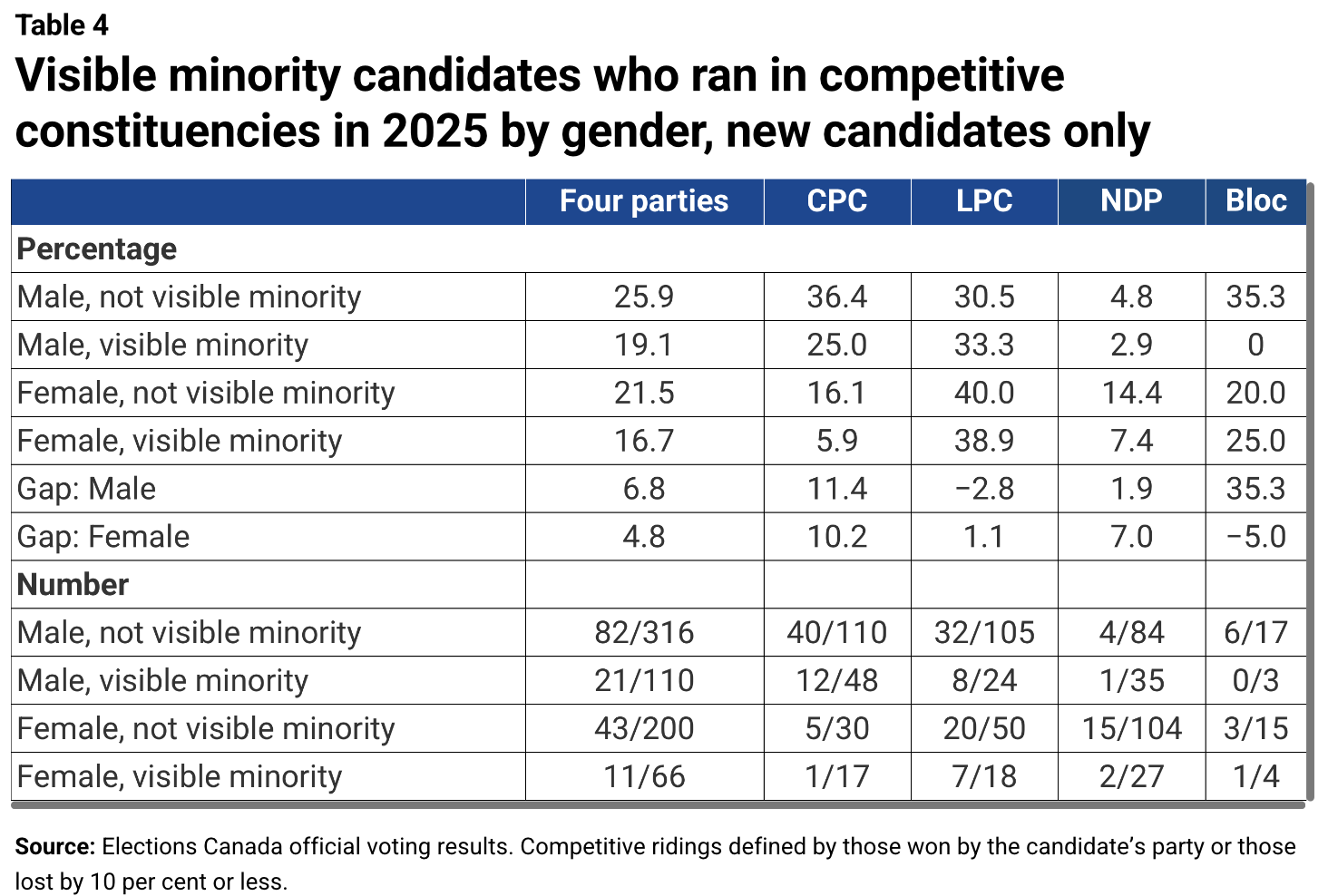
Here’s what the intersectionality between women and visible candidates:

However, Liberal women MPs form 45 percent of all visible minority MPs whereas for the Conservatives, it is only 11 percent:

….The idea is not new to Canada. In 2016, then-MP Kennedy Stewart introduced a private member’s bill that would have financially penalized parties that did not approach gender parity among their general election candidates. In 2019, the House of Commons Standing Committee on the Status of Women received evidence that quotas should be adopted to increase the number of women candidates.

A 2023 poll even showed that 50 per cent of Canadians would support gender quotas for federal elections.

Left to their own devices, parties cannot get the job done. Women comprised a dismal 22 per cent of Conservative candidates in the 2025 federal elections, but blame does not fall on Conservatives alone. Compared to 2021, the proportion of women candidates dropped in every party, save the NDP: by 11 percentage points for the Conservatives but also by eight percentage points for the Liberals and the Bloc.

Without quotas to make the parties perform better, Canada’s federal elections are failing voters’ expectations for what legitimate political institutions look like.

Public opinion speaks clearly. People do not mind gender quotas; what they really do not like is seeing men dominate politics. Canada has fallen behind other countries not just because it elects fewer women, but because it lacks any policy commitment to do better. The country cannot sell gender equality abroad without first practising it at home.

Jennifer M. Piscopo is professor of gender and politics at Royal Holloway University of London and a contributing researcher to Informed Perspectives’ Balance the Power Initiative.

Source: Canada cannot sell gender equality abroad without practising it at home

Islamic preacher barred from entering Canada for speaking tour, months after being banned from U.K.

Seems like the right call. Question about a religious exemption for hate speech as proposed by the Bloc much more thorny as one looks at the potential impact across many religions and sects:

…Mr. Blanchet said his party plans to table an amendment to the government’s Combatting Hate bill to stop religion from being used as a defence for hate speech. 

The proposed change to the Criminal Code would abolish a defence allowing a person who incites hatred to escape prosecution if their words are based on religious beliefs or a religious text.

Canadian Identity Minister Steven Guilbeault replied that the Liberals shared the Bloc’s aim to combat hatred and would welcome amendments to the bill.

“We will hear from experts, subject-matter experts, and are willing to work with the Bloc Québécois, with all parties in this House to ensure that hate speech is not in Canada,” he replied. 

Jeremy Bellefeuille, spokesperson for Justice Minister Sean Fraser, said in a text message that the minister “is open to hearing expert testimony in committee.”…

Source: Islamic preacher barred from entering Canada for speaking tour, months after being banned from U.K.