Reasonable recommendations for more education and awareness:
…MAC has long contended that an audit of its activities by the revenue agency’s Review and Analysis Division was fundamentally tainted by systemic bias and Islamophobia.
During court proceedings over the agency’s audit, federal lawyers said preliminary audit findings identified “several serious issues’’ concerning the association’s non-compliance with its charitable registration obligations.
These allegedly included involvement in foreign political activities, buying considerable real estate, providing support to an organization listed as a terrorist entity and issuing improper donation receipts.
Gallant’s report says scrutiny for support of extremism places charities “in the unenviable position of making decisions about what actors, or actions, the administrator of charities law might think are linked to terrorism.”
“Despite the distinctive ambitions of the administrative agency — the effort to police terrorist abuse — in the case of the MAC audit that effort proved seriously deficient.”
Gallant said the agency drew heavily on MAC’s links and ties with others in its analysis.
“Considerable dispute exists over the implications and effectiveness of such ‘links,’ or associational, methods,” she wrote. “It risks capturing innocent activity through associational connections, risks ‘over-inclusion’ and can fail to accurately discern between suspicious activity and authentic legitimate activity.”
Leaders of Muslim charities, volunteers and employees exist within their religious communities, the report adds. “Any anointing of the notion that associations — connections — indicates terrorist abuse risks overidentification and the attraction of ‘guilt’ by association,” it says.
The revenue agency could play a bigger role in educating charities about the possible risks of involvement with certain groups or people, Gallant said in an interview.
“I think that if the charities directorate was a little more forthcoming in educating, specifically — don’t interact, don’t be doing things here, we’re suspicious about these things — then charities can make a choice, right?” she said….
…If I can be barred from volunteering at my own children’s school, what guarantees do I have that tomorrow my profession won’t be questioned too? When I see women whose dreams of becoming teachers, lawyers, or educators have been shut down by legislation, I have to ask: Where does this end?
Let me be clear: Secularism is an important value for us in Quebec, and I support it. We do not send our children to public school to receive religious instruction. But preventing mothers from volunteering attheir children’s schools – that is not secularism; it is outright exclusion. Creating this fear that children might be threatened by a mother simply practisingher religion is both illogical and harmful – and it sows division instead of fostering cohesion.
Aisha Khan is an occupational therapist based in Quebec
Articles and opinions related to multiculturalism that I found of interest in March:
Racial and Ethnic Disparities
Activisim/Advocacy
Quebec Bill 21
Representation corporate boards and public serice
Disparities
Picard: To address racism in health care, we need to collect data on race
Agree, without data, over reliance on anecdotes:
…It’s important, of course, that data are collected voluntarily and that people’s privacy is respected as it is with all health records.
The public needs to know, too, that the information will not appear on their health card or on medical charts. Rather, it is used in an aggregated fashion to reveal trends and inequalities between racial or ethnic groups, without identifying individuals.
The big barrier to collecting and using race-based data is technical: digital health systems still need to adapt. But we know it’s doable, even on a large scale.
During the pandemic, for example, the Coronavirus Rapid Entry Case and Contact Management System (CORES) included data on race, income and household size. As a result, we learned Black, Indigenous and people of colour in Toronto were over-represented in the tally of COVID-19 cases and deaths. That allowed, among other things, targeted vaccination campaigns.
The data also allowed people who are too often marginalized and ignored to be heard, an important first step in correcting disparities.
Race, culture, language and socio-economic status can all have a profound impact on health, individually and collectively.
Allowing gaps in data collection to persist is bad for our health, and our health system.
StatsCan: Criminal court outcomes of Black accused persons in Canada, 2016/2017 to 2022/2023
Latest useful StatsCan study highlighting disparities
There were 100,450 Black accused persons in adult criminal courts between 2016/2017 and 2022/2023. Black people (6.2%) were overrepresented as accused persons in adult criminal courts over this period, relative to their representation among the adult population of Canada (3.7%).
The proportion of Black accused persons in adult criminal courts has generally increased over time, from 5.7% of all accused in 2016/2017 to 7.1% in 2022/2023.
Between 2016/2017 and 2022/2023, the proportion of Black people in adult criminal courts in Nova Scotia and Ontario was more than two times higher than that of Black people in the total adult population of these provinces. Black people were also overrepresented as accused persons in criminal courts in Quebec, British Columbia, Alberta and New Brunswick compared with their representation in the total adult population.
More than 4 in 10 (42%) cases involving a Black accused person completed in adult criminal courts between 2016/2017 and 2022/2023 resulted in a guilty decision. This was equal to the proportion of cases involving Black accused persons that were withdrawn, dismissed or discharged over this period (42%).
Compared to the rest of the (non-Black) accused population, Black accused persons less often had their case result in a guilty decision and more often had it withdrawn, dismissed or discharged.
Black accused persons most often received a guilty decision for cases where the most serious offence was a Criminal Code traffic offence such as impaired driving (69%) or an administration of justice offence such as breach of probation (49%), and least often for cases where it was a violent offence (33%).
Between 2016/2017 and 2022/2023, just under half of violent crime cases (47%) and property crime cases (46%) involving Black accused persons were withdrawn, dismissed or discharged.
Similar proportions of Black and non-Black accused persons were sentenced to custody upon being found guilty in adult criminal courts (29% versus 27%). Probation was the most common sentence handed down to both Black and non-Black accused persons.
It took nearly two months longer for court cases involving Black accused persons to be completed in adult criminal courts between 2016/2017 and 2022/2023, compared to non-Black accused persons (219 versus 165 days).
CMA: Black Canadians more likely not to fill prescriptions because of financial constraints, study finds
Another insightful study:
Black adults in Canada are more likely not to fill prescriptions because of financial constraints than white adults, according to a new study that highlights disparities in prescription medication coverage as a major barrier to equitable health care.
The study was published in the Canadian Medical Association Journal on Monday. Its authors concluded that the prevalence of cost-related prescription non-adherence – defined as the inability to fill a prescription or delaying, splitting or skipping doses because of financial pressures – was 75 per cent higher among Black adults than white adults.
Coverage for prescription medications was also lower among Black adults, the study showed. In 2022, for example, 72.5 per cent of Black adults were covered compared with 80 per cent of white adults.
One of the study’s authors, Oluwabukola Salami, a Canada Research Chair in Black and racialized peoples’ health at the Cumming School of Medicine at the University of Calgary, said this study is the first of its kind and broadens the understanding of how Black Canadians experience health inequities.
“We know that Black people are more likely to have cardiovascular disease, to have certain types of cancer and to die from any of these conditions. But we always looked at how access to care is a challenge to Black people,” Dr. Salami said.
“This study presents new findings related to medication specifically.”…
Jamie Sarkonak: The crusading judge who helped Liberals build a race-based sentencing regime
Sarkonak appears to be following judges with activist backgrounds as seen in her previous column on Justice Go.
There is a judge on the Ontario Superior Court of Justice whose signature move is letting violent men walk free because of racism. One of the architects of race-based sentencing, his name is Faisal Mirza, and he was appointed to the bench by former prime minister Justin Trudeau in 2022.
Mirza’s flourish of race-based acquittals is not a case of a judge gone rogue: indeed, it’s perfectly on-brand. He was writing about the need for more racial considerations in the Canadian justice system in 2001, before he even became a lawyer. Back then, he argued in the Osgoode Hall Law Journal that mandatory minimum sentences for drug and weapons offences would be racist because of the disproportionate impact they’d have on Black people.
Toronto police, he asserted, were racist because of the arrest statistics they produced: in 1988, Black individuals comprised 51 per cent of drug arrests, 82 per cent of mugging arrests and 55 per cent of purse snatching arrests. This, he said, was evidence of over-targeting. He concluded that more mandatory minimums would exacerbate the effect, because the threat of being convicted on a charge with a guaranteed jail term would disproportionately pressure Black accused persons to make plea deals and forfeit the opportunity to expose racist police at trial.
This became a career pursuit. When the Supreme Court was deciding whether to strike down the mandatory minimum for illegally possessing a loaded firearm in 2014, he argued as an intervener in the case that its disproportionate impact on Black individuals needed to be taken into account. The court ultimately ruled that this mandatory minimum was unconstitutional.
In 2018, Mirza laid the foundation for Ontario’s racial sentencing regime. He was the defence lawyer of Kevin Morris, a Black man who was convicted of various firearms offences. They were lucky to draw the hyper-progressive, destructively lenient Shaun Nakatsuru for a judge. Mirza filed two racial context reports about Morris and Black people as evidence, and the judge emphatically agreed to consider them. He settled on a 15-month sentence to account for the racial factors, even though three years was considered the starting point. On appeal, the Ontario Court of Appeal made racial considerations in sentencing the province-wide rule in 2021….
To his credit, there have been instances where Mirza refrained from applying a racial discount, and from tossing out evidence because of racism, but it doesn’t excuse the other times when he let his biases reign. It’s undeniable that he has a habit of projecting racism in assessing any interaction with the state and undermining public safety with his assumptions. One day, it’s going to end up getting someone hurt — if it hasn’t already.
Dummit: How accommodation hollowed out Canadian nationalism
Not an easy country to govern given differing regional and group interests. Will be interesting to see how the (still) forthcoming revision to the Harper era citizenship study guide provides a cohesive and coherent national perspective:
….Taken as a whole, this legacy of national hesitation makes governing difficult. Is it any wonder that Carney spends so much time abroad signing international agreements? Foreign policy is one of the few areas where a Canadian government can still act as a single whole with relative clarity about the national interest.
But Carney’s real test will come when he finally returns home.
Canada’s genius has always been accommodation. But accommodation, repeated often enough, can gradually hollow out the idea that the country itself even has a single political purpose.
When Carney eventually tries to move forward with projects deemed nationally significant—whether mining developments, high-speed rail, or (God forbid) a new pipeline—he will run directly into Canada’s familiar pattern of internal division.
That’s when we’ll truly find out who is willing to embrace an “Elbows Up” style of nationalism. Until then, we’re left wondering: whose elbows? Defending which nation?
This woman is suing Canada for its ban on adoption under Muslim law
Inevitable that the ban would be challenged. Of course, this predominant affects Muslim families but perhaps a more appropriate challenge would be with respect to Pakistan’s application of kafala:
A Toronto woman is being denied the right to reunite with her adopted children because Ottawa does not recognize adoptions from Pakistan under Islamic rules, a court has heard.
Jameela Qadeer is the maternal aunt of Salman, Umme and Umm; she and her husband raised them as their own in Pakistan after her sister died of a brain hemorrhage in 2012. The Pakistani court has granted them guardianship of the kids and authorization to travel after their biological father, who was absent in their lives, abdicated his responsibility for their care.
An Ahmadiyya Muslim, a sect of Islam deemed heretical in Pakistan, Qadeer fled to Canada in 2017 and was granted asylum. However, her adopted kids have not been allowed to join her. Since 2013, Ottawa has stopped accepting adoption from Pakistan because it says the Islamic rules known as kafala only allow for guardianship of children, but do not sever biological ties as required by Canadian law.
In a fight to reunite the family, Qadeer and her sister’s children, along with two Muslim organizations, have taken the federal government to court, challenging the refusals of permanent residence to the children, and the constitutionality of Canada’s ban on recognizing adoption from Pakistan.
They contend that Canada’s immigration policy has disproportionately affected Muslim families and denied them equality rights under the Charter, even when a guardianship arrangement following traditional kafala is permanent and sanctioned by a foreign court.
“That categorical refusal does not only affect the individual applicants,” Armaan Kassam, lawyer for the National Council of Canadian Muslims told the opening of a three-day Federal Court hearing this week. “It affects Muslim families across Canada who adopt through foreign court-supervised guardianship processes.”
Warda Shazadi Meighen, lawyer for the children, said her clients’ biological father officially abdicated his responsibility in 2013 to Jameela Qadeer. Before leaving for Canada in 2017, Qadeer and her husband were granted judicial guardianship by a Pakistani court under national guardianship laws, giving them exclusive custody. ,,,
Khan: In Quebec, laïcité has become its own kind of religious orthodoxy
Ironic but accurate:
…In the meantime, there is no legal recourse to challenge laws that are clearly discriminatory. Those primarily affected by these bills are veiled Muslim women – whom Quebec ostensibly wants to liberate, while strengthening gender equality. In its oxymoronic quest to impose freedom, then, the government is excluding those very women from the job market and impeding their financial independence. And it’s so 1950s to hear the high priests of laïcité – François Legault, Bernard Drainville – tell women what they can and cannot wear.
Given the situation, it’s time to tell the world about Quebec’s laïcité mission. Canadian embassies, high commissions and consulates should be clear to prospective immigrants (especially from la Francophonie) that their religious freedoms and expression will be curtailed in la belle province. Here at home, the federal government, along with the governments of Ontario, New Brunswick and Manitoba, should help those adversely affected by Quebec’s laws resettle in francophone communities in the rest of Canada, if they wish to leave. They deserve an opportunity to thrive without compromising their faith.
And finally, something must be done about the notwithstanding clause. Governments show no slowdown in its use, while the wider public seems unaware of its fundamental threat to basic freedoms. Perhaps a jarring public education campaign is in order, using the spectre of Donald Trump. After all, his administration has overseen attacks on domestic human rights, circumvented judicial warrants, tried to suspend legal protections to immigrants and denied equality before the law. Little wonder he wants to absorb Canada: The notwithstanding clause would allow him to do all that legally.
Kutty | When parents are shut out of classrooms over what they wear, we have a problem
Absurd and unreasonable:
Two mothers in Quebec were recently told they could no longer volunteer at their children’s elementary school unless they removed their hijabs. For one of them, it meant being shut out of a classroom she had supported for years — not because of anything she did, but because of what she wears.
They are not alone. Across Quebec, people of faith — including Muslim women who wear hijabs, Sikhs who wear turbans, and Jewish Canadians who wear kippahs — are being pushed out of classrooms and public life unless they conceal visible expressions of their identity. In a separate incident, twelve Muslim women reportedly lost their teaching jobs because they refused to remove their hijabs. These are the lived consequences of Quebec’s secularism law, Bill 21, which prohibits many public-sector employees — including teachers, police officers and government lawyers — from wearing visible religious symbols while performing their duties.
The constitutionality of this law is now poised for its most consequential test. Canada’s Supreme Court is now hearing arguments in a landmark case examining whether Bill 21 violates fundamental rights, including freedom of religion and equality under the Canadian Charter of Rights and Freedoms. Quebec has invoked the notwithstanding clause — Section 33 of the Charter — a rarely used constitutional mechanism that allows governments to override certain fundamental rights, including freedom of religion and equality, for renewable five-year periods….
StatsCam: Representation of women on boards of directors and in officer positions, 2023
Useful study with breakdowns:
Statistics Canada is releasing new data on the gender composition of leadership and strategic decision-making roles within publicly traded corporations, privately held corporations and government business enterprises operating across a variety of industries in Canada.
This data helps inform the objective “More company board seats held by women, and more diversity on company boards” and the indicator “Proportion of board members who are women, by type of board” in the Leadership and democratic participation pillar of the Gender Results Framework.
Additional information and other studies and statistics related to gender and enterprises can be found in the Gender, diversity and inclusion statistics hub, the Business performance and ownership statistics portal and in the Representation of women on boards of directors and in officer positions: Visualization tool.
Women hold just under one-quarter of director positions
In 2023, women occupied just under one-quarter (23.2%) of seats on boards of directors, increasing 0.5 percentage points over the proportion of women recorded in 2022 (22.7%).
Just over half of boards (50.3%) did not include any women directors in 2023. In addition, 25.8% of boards had one woman director, while boards with two or more women directors accounted for 23.9% of the total.
Educational services has the highest representation of women directors, followed by the utilities and finance and insurance industries
Educational services had the highest proportion of women directors in 2023, with women holding 35.3% of board seats. This reflects an increase of 4.9 percentage points from 2022.
The utilities industry recorded the second-highest share in 2023, at 34.1%. Corporations in finance and insurance followed, with women representing 28.2% of board members.
The agriculture industry had the lowest proportion of women directors, with women occupying 8.8% of board seats….
Treasury Board not tracking impact of public service job cuts on equity groups
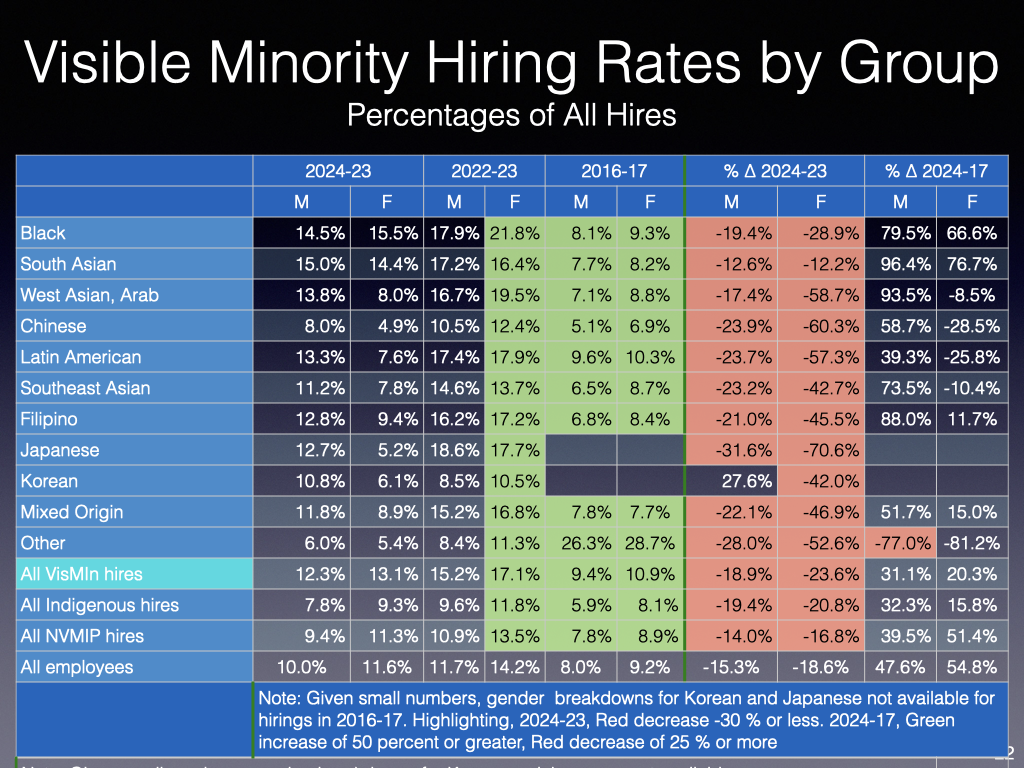
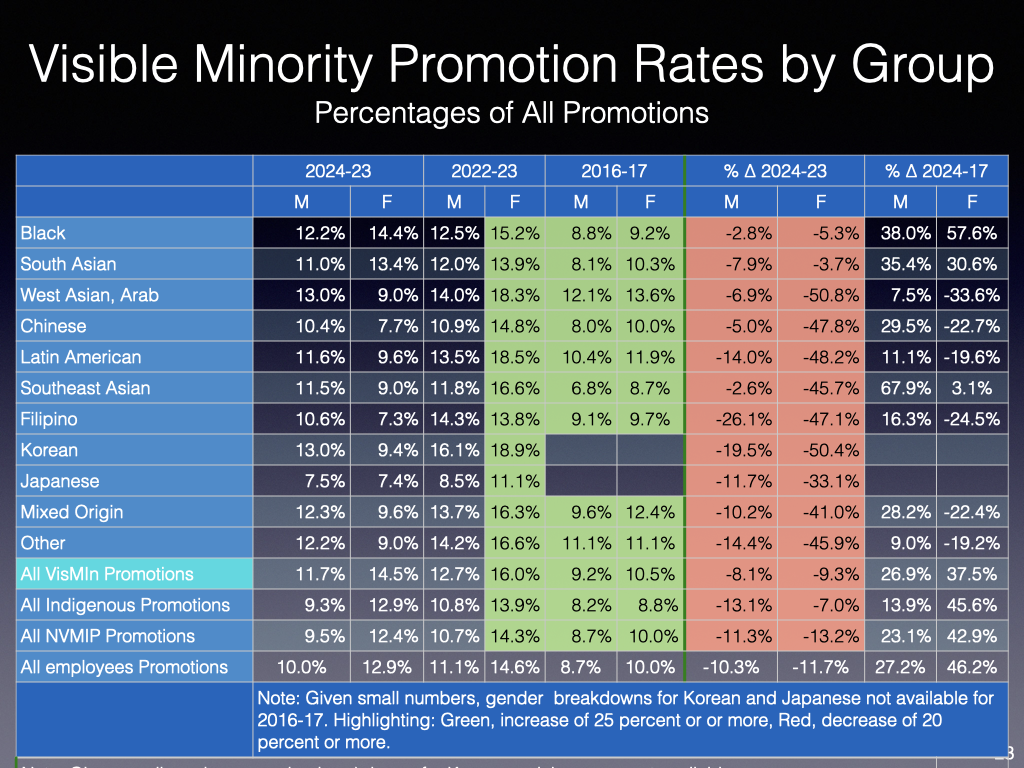
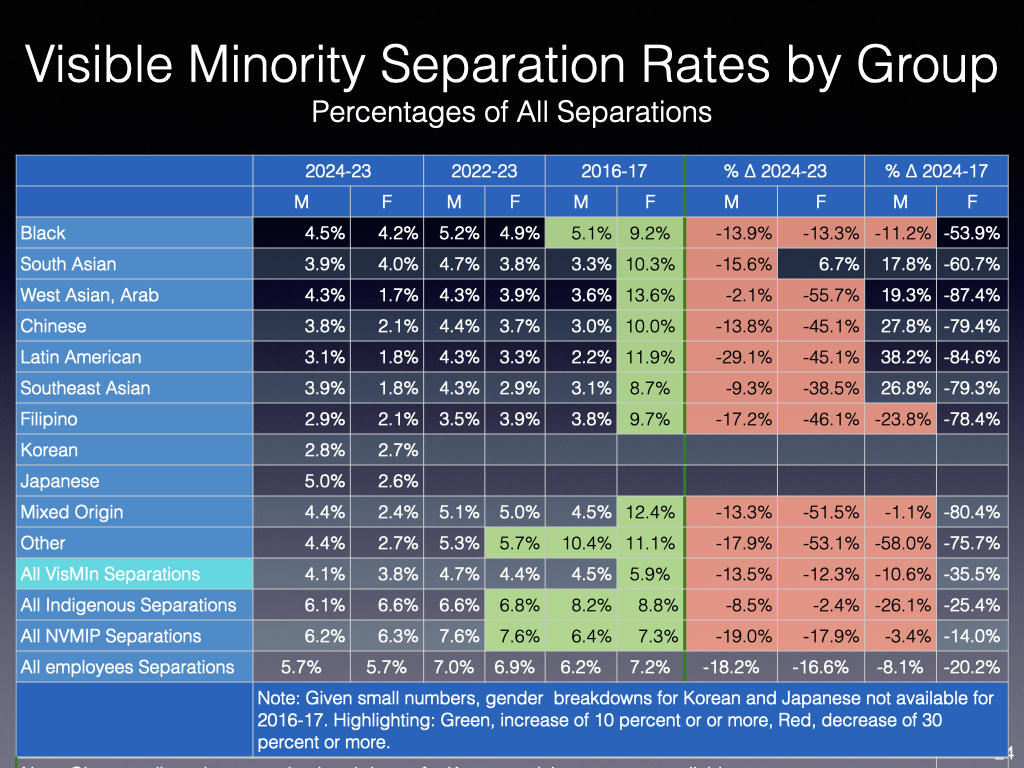
Will be curious to see the respective numbers of hirings, separations and promotions in the forthcoming TBS EE report. Hopefully, TBS will continue to provide the breakdowns by visible minority groups.
Slides from last year’s EE report.
Advocates are raising concerns about how job cuts will affect public servants in equity groups — something the Treasury Board of Canada Secretariat says it’s not tracking.
The federal government has committed to cutting the number of public service jobs by about 40,000 from a 2023-24 peak of 368,000 as it looks to find savings.
Departments and agencies across the public service have started notifying staff of coming job cuts.
Barb Couperus, a spokesperson for the Treasury Board of Canada Secretariat — which oversees government operations — said the office does not collect information centrally on the impact of workforce adjustment on employment equity designated groups.
Equity groups include women, Indigenous people, people with disabilities and members of visible minorities.
Couperus said heads of departments are responsible for managing their workforces.
She said departments will continue to pay “close attention” to maintaining representation and meeting their obligations under the Employment Equity Act.
The act requires federally regulated employers, including the government itself, to take steps to eliminate employment barriers and maintain proportional representation in the workplace for members of equity groups.
During layoff periods, Couperus said, departments can prioritize keeping staff from equity groups if there are gaps in representation.
Nicholas Marcus Thompson, president and CEO of the Black Class Action Secretariat, said he is “disturbed” to learn the Treasury Board isn’t tracking the impacts of job cuts.
“What that suggests is that this is not a priority for this government,” he said.
Over the past five years, the government has hired approximately 5,000 Black workers throughout the entire federal public service, said Thompson. It also has increased the number of Black executives from around 99 in 2020 to more than 220, he said.
“What we’re seeing now is that those gains are being lost as a result of workforce adjustment,” said Thompson, adding his organization has started tracking data on workforce adjustment. “Many folks have reached out to us to find out what their rights are.
“Usually with workforce adjustment, the first to go are folks that were the last to come … So far our data is showing that, despite these equity gains, it’s now turning out to be equity losses.”
Thompson said his organization wants to see the government require equity impact assessments before workforce adjustment decisions are made. It also wants the government to be transparent about the process and publish data on which demographics are being affected.
Rabia Khedr, national director of Disability Without Poverty, said people with disabilities working in the public service will be feeling anxious.
“Generally speaking, a lot of times people with disabilities may be at an entry level position, so that makes them vulnerable,” said Khedr.
The most recent employment equity report for the public service says that as of March 2024, 9.7 per cent of federal executives were people with disabilities, up from 4.6 per cent in March 2019.
Khedr also said she’s unhappy about the lack of central tracking of the impacts of job cuts on equity groups.
“That then leaves it to the individual leadership within departments to make those critical decisions,” she said.
“It really depends on the leadership and their commitment to diversity and inclusion … There’s a risk that equity-denied groups might be more vulnerable in terms of who gets cut and who stays.”
While I largely disagree with the recommendations, good to have this data analysis on the impact of these preferences:
…Key findings include:
• In nine of 14 schools, the non-racial-minority, or non-Black, non-Indigenous applicant group had the lowest acceptance rates. Even among the five remaining schools where the “Discretionary” and “Black” applicant racial groups had the lowest acceptance rates, those rates were much higher than if the applicants from these two groups had been required to compete against all applicants, regardless of race.
• Thirteen schools (with two exceptions for LSAT-specific analysis) admitted fewer non-racial-minority or non-Black, non-Indigenous applicants than would have been the case had they selected applicants according to their top-ranked academic performance.
• Further analysis showed that 216 applicants or 10 per cent were admitted with lower grades out of 2,150 medical and law school first-year students who were all from designated racial minority applicant groups. A similar admission pattern was also observed for LSAT/MCAT scores, with 132 racial minority applicants admitted with lower scores, or 6.1 per cent of the total number of admitted students. This analysis indicates that race-based admission policies result in the admission of academically weaker students.
• In every school that provided admissions data, the non-racial-minority or non[1]Black, non-Indigenous applicant groups experienced the highest number of rejections despite higher academic scores than the admitted applicant from other racial groups with the lowest academic score from their group.
• Most medical schools and many law schools refused to release their race-based application and admission data at all. This lack of transparency raises serious concerns about accountability in publicly funded institutions.
The implications are troubling. Institutional racism potentially erodes fairness and undermines public confidence in our standards for medical and legal education. Such racism is also remarkably resistant to scrutiny – operating behind policies that limit access to basic admissions data.
These findings give some specificity to broader concerns about DEI in Canadian universities and colleges, where critics have raised alarms about the growth of DEI bureaucracies, opaque hiring policies, and admission practices that prioritize group identity over merit.
Canada also stands out internationally. University officials in Denmark, Finland, Norway, Sweden, and the Netherlands reported that race is not considered in admissions decisions for medical or law schools.
Policy recommendations to address the racial segregation and discrimination identified in this report include:
• Provincial governments should prohibit the use of race as an admissions criterion in medical and law schools.
• To restore academic rigour, these schools should rely exclusively on objective measures such as the MCAT, LSAT, and required prerequisite coursework. Provinces should consider suspending funding to medical and law schools that continue to factor race into admissions decisions.
• In addition, provinces that continue to consider race in medical and law school admissions should be required to publicly release race-based application and admission data using consistent, transparent measures of discrimination, preferably measures similar to the measures used in this study. Without this disclosure, governments cannot effectively oversee or correct the disturbing trend of racial discrimination that threatens the overall academic strength of our medical and law students.
Recent public debates in Canada, including high-profile campus protests, faculty resignations over DEI mandates, and legislative scrutiny of “equity hires,” reflect growing concern that universities are straying from their core missions under the banner of DEI. Rather than sorting applicants by racial category, universities should focus on ensuring that all prospective students, regardless of race, have the academic preparation needed to compete fairly. This includes access to tutoring, frequent testing, and meaningful academic feedback well before the application stage….
Interesting research and wonder whether any of those involved had a sense of how their work would be used or was it more a case of wilful blindness and complicity:
Bookbinders and restorers in the 1930s and ’40s used their craft to help the Nazi regime create a database that was used to persecute and kill Jews and others who were deemed racially impure, a British researcher has found.
Key to building this database were church, civil and synagogue records, which were often hundreds of years old and damaged beyond legibility when the Nazis came to power in 1933.
By tasking professionals with cleaning up these documents, which held information about millions of people, the Nazis gained access to generations’ worth of material — which they used to target specific population groups, the new research shows.
The findings are the result of more than two decades of work by Morwenna Blewett, an expert in conservation history.
She was working as a conservation fellow at the Worcester Art Museum in Massachusetts in 2004 when a question came to her: What had happened to the art restorers who did not flee Nazi Germany during World War II?
She pondered the question while sorting through an old filing cabinet in the museum’s basement — where, as she recalled in a book published this month, “Art Restoration Under the Nazi Regime: Revelation and Concealment,” the “warm, dark air smelt faintly of cigarettes, coffee and engine oil.”
Soon, she had expanded on her query: “How did the Nazi regime intend to use conservation and restoration to achieve its aims?”
The answer, she discovered, was that paper restorers and bookbinders in Nazi Germany had helped the regime track down people’s Jewish ancestry by conserving and cleaning up old records from churches, as well as from synagogues and civil registers.
Dr. Blewett said that, by publishing her book, she hoped to shed light on this part of the Holocaust, which she called “one of the longest and most insidious of all National Socialism’s projects to exploit the field of conservation and restoration.”…
« Il y a effectivement 4 démissions et 8 ruptures du lien d’emploi associé au projet de loi 94. Les organismes publics comme les centres de services scolaires sont tenus d’appliquer celle-ci », a indiqué Mélanie Poirier, porte-parole du CSSMI, dans un courriel adressé à La Presse. Nos autres questions sont restées sans réponse.
Selon Annie Charland, présidente du Secteur soutien scolaire de la FEESP-CSN, toutes les personnes qui ont ainsi perdu leur emploi étaient des surveillantes ou des éducatrices en milieu scolaire. Toutes ont refusé de ne plus porter leur voile.
« Pour ces femmes, c’est une énorme déception », souligne Annie Charland, en entrevue avec La Presse.
Elles ont étudié là-dedans et on leur enlève la dignité de pouvoir gagner leurs vies.
Selon des documents transmis par la CSN à La Presse, le CSSMI a envoyé fin janvier une note à tous les membres de son personnel rappelant les nouvelles obligations légales encadrant le port de signes religieux, à la suite de l’adoption du projet de loi 94, le 30 octobre dernier….
“There are indeed 4 resignations and 8 terminations of the employment relationship associated with Bill 94. Public bodies such as school service centers are required to apply it, “said Mélanie Poirier, spokeswoman for the CSSMI, in an email sent to La Presse. Our other questions remained unanswered.
According to Annie Charland, President of the School Support Sector of the FEESP-CSN, all the people who lost their jobs as a result were school supervisors or educators. All refused to no longer wear their veil.
“For these women, this is a huge disappointment,” says Annie Charland, in an interview with La Presse.
They studied there and they are deprived of the dignity of being able to earn their living.
According to documents sent by the CSN to La Presse, the CSSMI sent a note at the end of January to all members of its staff recalling the new legal obligations governing the wearing of religious signs, following the adoption of Bill 94, on October 30th….
…But Mr. Roberge said police are reluctant to act when people use prayer as a form of protest, for fear of being seen as infringing on their Charter rights. “The guidelines are not clear enough in situations involving religious demonstrations,” he told the committee. The minister declined an interview request.
The scope of the new legislation is wide-ranging. In addition to tackling public prayer, it would extend the province’s workplace ban on religious symbols to anyone working in daycares, colleges, universities and private schools. Quebec’s original secularism law, which is now being challenged at the Supreme Court of Canada, banned religious symbols for some public-sector employees, including elementary and high school teachers, police officers and judges.
The new bill would also prohibit prayer and other religious practices in public institutions, effectively banning prayer rooms at Quebec colleges and universities.
Critics say the legislation is a thinly veiled attempt to exploit anti-Muslim sentiment for political gain. In a brief presented to the committee, the National Council of Canadian Muslims said Quebec Muslims “feel less and less that they belong” in the province.
Bishop Poisson said there’s no reason to treat religious demonstrations any differently from other public events. “We must be careful not to build a society where the laws prohibit everything except what is permitted,” he said.
“I want to live in a country where everything is permitted except what is prohibited. There’s a big difference.”
…Former Islamic State fighters from multiple countries, their wives and children have been detained in camps since the militant group lost control of its territory in Syria in 2019. Though defeated, the group still has sleeper cells that carry out deadly attacks in both Syria and Iraq.
Australian governments have repatriated Australian women and children from Syrian detention camps on two occasions. Other Australians have also returned without government assistance.
Australia’s Prime Minister Anthony Albanese on Wednesday reiterated his position announced a day earlier that his government would not help repatriate the latest group.
“These are people who chose to go overseas to align themselves with an ideology which is the caliphate, which is a brutal, reactionary ideology and that seeks to undermine and destroy our way of life,” Albanese told reporters.
He was referring to the militants’ capture of wide swaths of land more than a decade ago that stretched across Syria and Iraq, territory where IS established its so-called caliphate. Jihadis from foreign countries traveled to Syria at the time to join the IS. Over the years, they had families and raised children there.
“We are doing nothing to repatriate or to assist these people. I think it’s unfortunate that children are caught up in this, that’s not their decision, but it’s the decision of their parents or their mother,” Albanese added.
Not sure how practical or implementable it is, and existing prevention programs have a mixed record, but focus on behaviours, rather than beliefs is appropriate:
….A practical National Polarization Metrics model
Canada does not need a new bureaucracy. It needs a light-touch doctrine that makes prevention routine. A “National Polarization Metrics” model would use behavioural indicators that are measurable and non-partisan, focusing on coercive targeting and intimidation rather than beliefs: repeated harassment aimed at identifiable groups; doxxing and coordinated pile-ons; credible threats; and violence-normalizing signalling that changes what peers believe is acceptable.
That doctrine should assign accountable ownership. Every campus and school board needs an escalation lead with a clear mandate to consistently log incidents, coordinate support and safety planning, quickly preserve evidence, and trigger referrals when thresholds are met.
Far from weakening civil liberties, this reduces arbitrary decision-making and makes outcomes less dependent on institutional mood.
It also requires routable handoffs. Educational settings should have a consistent pathway for when matters stay at the level of documentation and support, when they require municipal policing involvement, and when patterns suggest coordination or mobilization indicators that justify a threat-assessment channel. Canada’s National Strategy on Countering Radicalization to Violence frames early intervention as a national priority, but it leaves Canada without a single escalation ladder that is understood—end-to-end—across education systems, municipal police, and federal threat assessment.
Finally, evidence preservation must become doctrine. A standardized 24-72-hour capture-and-preserve practice—time-stamped collection, secure storage, minimal access logging, and a consistent referral format—would strengthen downstream deterrence without criminalizing student life….
Prevention must become doctrine, not late reaction
A pluralist society can withstand disagreement. What it cannot withstand is normalized intimidation combined with institutional paralysis—especially when digital ecosystems accelerate conflict faster than administrators, police, or courts can react. If Canada wants to confront its fault lines before they deepen, it must stop treating youth extremism as cultural weather and start treating it as a measurable pathway.
That means building the missing bridge: shared indicators, accountable ownership, rapid evidence preservation, and standardized handoffs. Not to stigmatize communities, and not to criminalize student life—but to ensure coercion and violence-normalizing signalling do not become the price of campus politics, or the prelude to community harm.
Daniel Robson is a Canadian independent journalist specializing in digital extremism, national security, and counterterrorism.