Why promoting multiculturalism could increase support for the EU

Interesting study and linkage (may be more correlation than causation):

Many political parties combine pro-EU policies with critical stances toward immigration and multiculturalism. But are these two approaches contradictory? Drawing on a new study covering France and Germany, Natalia Bogado, Evelyn Bytzek and Melanie C. Steffens highlight that discourses emphasising the threat of cultural diversity can increase Euroscepticism among voters, while discourses promoting multiculturalism are associated with an increase in support for the EU.

Since the 1990s, the Leitkultur debate – ironically spearheaded by later Wilkommenskulturchampion, German Chancellor Angela Merkel – has been at the heart of discourses about immigration and asylum in Germany. In a nutshell, the debate is a body of discourses (more or less extreme) grounded on the notion that without a German guiding culture that everyone equally adopts (i.e. a culture into which everyone has been equally assimilated), German society would fall apart.

In other words, social cohesion and peace can only exist in conditions of complete cultural assimilation. Multiculturalism is thus disparaged as an unsustainable ideology that leads to a lack of social unity, violence, criminality, and even terrorism by those who have allegedly failed to adopt the cardinal tenets of the German culture. Accordingly, Merkel famously declared multiculturalism dead in 2010, and the notion that cultural diversity poses a serious threat to peaceful coexistence in Germany was a constant in her political rhetoric throughout her 16 years in power.

Beyond Germany and the Leitkultur, assimilation has dominated public debates about immigration and asylum in many European countries. In France, assimilationist discourses have been the leitmotif of the far-right populist Rassemblement National and the lifeline that secured electoral success for many centre-right candidates – famously, Nicolas Sarkozy, but others as well. Similarly, Brexit followed a campaign where immigration and the threat it allegedly poses to the British cultural identity were highly salient. Armed with a wide array of nationalist and assimilationist slogans, the UK Independence Party and the anti-EU factions of the Conservative Party were able to turn fears over national-identity loss and immigration into anti-EU votes.

Evidence from France and Germany

Brexit offered anecdotal evidence of the negative impact of assimilationist discourses that present immigration, asylum, and cultural diversity as a threat to the nation on support for the EU. In a new study covering Germany and France, we provide scientific evidence to support these assumptions.

Specifically, we found that reading electoral pledges (taken from the 2019 European Parliament election) such as “We must regulate immigration to preserve Europe’s cultural integrity” or “We must protect our European way of life and our Christian values under threat by unconditional migration,” decreased support for EU integration, identification with the EU and – particularly concerning in light of Brexit ­– increased intentions to vote to leave the EU.

Thus, our study evidenced that something as (apparently) innocent as expressing concern about cultural diversity threatening the integrity of national cultures and customs can fuel Euroscepticism and intentions to leave the Union. Conversely, reassuring voters of the benefits of multiculturalism and cultural diversity increased support for the EU.

Reading electoral pledges that emphasised the importance of promoting multiculturalism and respecting cultural diversity improved EU attitudes and reduced intentions to vote to leave the EU. Electoral pledges such as “We celebrate cultural diversity and want to make Europe a safe place for all” and “We are determined to defend the right of asylum and of migrants to live in Europe without having to abandon their cultural identities” had a positive impact on support for the EU, identification with the EU, and intentions to remain in the Union.

The way forward

In a context where Euroscepticism continues to grow, our research helps us to understand how politicians’ assimilationist messages can promote Euroscepticism. These findings have important implications for political and media discourse. Assimilation discourses are not exclusive to the populist far-right: many pro-EU centre-right parties have also emphasised the threat of cultural diversity in their immigration discourses.

German Chancellor Angela Merkel – who advanced a strong pro-refugee agenda, welcoming hundreds of thousands of Syrian refugees and urging other EU countries to do the same – framed immigration and asylum almost exclusively in assimilation terms. In light of our findings, it is hardly surprising that during Merkel’s tenure, Germany saw the electoral rise of the Eurosceptic Alternative for Germany and the rise of radicalised groups like Pegida and others. Beyond Germany, our study highlights why, despite many politicians’ efforts to promote a pro-EU agenda, the persistence of assimilation discourses means that Euroscepticism will continue to grow among Europeans.

Furthermore, the echoes of Brexit still threaten the continuity of the Union, as exposure to information emphasising the United Kingdom’s sovereignty gains following its exit from the Union increases Euroscepticism and willingness to leave the EU. As such, the importance of adopting multicultural discourses when framing immigration and asylum for the future of the EU cannot be understated.

Additionally, our study offers further hope: in addition to promoting the benefits of multiculturalism, fostering an emotional connection to the EU can also protect the Union from the impact of assimilationist discourses. Unfortunately, data from the 2018 European Social Survey is not reassuring, as EU attachment remains moderate to low among Europeans. However, research has offered some avenues to promote EU attachment.

Recently, studies have found that policies like EU Cohesion Policy and the adoption of the euroincreased emotional attachment to the EU. Future research should continue to explore ways to achieve this longstanding goal of increasing Europeans’ attachment to the Union. At the moment, the Russian invasion of Ukraine represents a watershed moment for the EU to display its political, financial, and cultural leadership in the region and thus strengthen European citizens’ emotional attachment to the Union.

Source: Why promoting multiculturalism could increase support for the EU

USA: A more equitable distribution of the positive fiscal benefits of immigration

Interesting suggested approach to compensate states for the associated costs. Unlikely to change the politics, however. Quebec has a case with respect to Roxham Road arrivals but given the lop-sided nature of the Quebec grant, hard to have much sympathy:

The economic benefits of immigration are well documented. Immigrants boost economic activity, promote innovation, and improve the productivity of native-born workers. Increases in immigration raise both tax revenues and fiscal costs. The mix of revenue types and benefits provided across the federal, state, and local levels mean that tax revenues increase the most at the federal level and costs increase the most at the subnational level. The result is a net fiscal benefit to expanded immigration at the federal level and a net fiscal cost at the state and local levels for the average immigrant.

THE CHALLENGE

Immigrants have a direct positive fiscal impact to the extent that they pay taxes and an indirect one if the increase in economic activity they create generates government revenue. The federal government provides a relatively small share of the public services that immigrants receive while accruing much of the revenue. The fiscal costs to immigration are disproportionately paid for by state and local governments, largely owing to the top two state and local expenditure categories: education and health care. Children of immigrants have access to public schools regardless of their own or their parents’ immigration statuses, and schools are mainly financed at the state and local levels. In addition, health-care benefits for immigrants are partially financed by states or localities.

THE PATH FORWARD

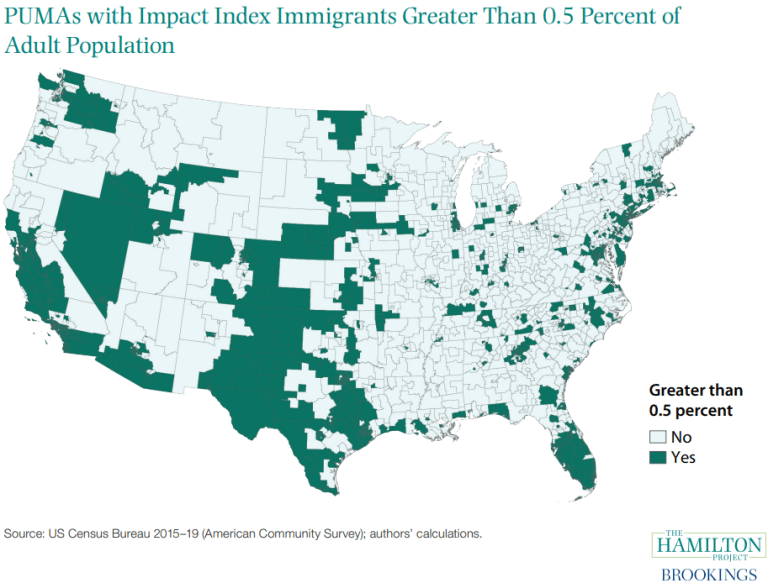
To ensure that the local communities affected by federal immigration policy receive more of immigration’s fiscal benefits, the authors propose to redistribute some of the fiscal gains of immigration to defray the immediate net fiscal costs that arise from welcoming newly arrived, less-educated immigrants. This proposal creates a method for determining the communities that qualify for funds, the Immigration Impact Index, and justifies an evidence-based dollar value per immigrant ($2,500) to be remitted to Immigration Impact Index communities by the federal government. These funds would visibly and transparently flow through education- and health-based federal funding channels: namely Impact Aid (education) and Federally Qualified Health Centers (health).

Figure showing PUMAs with Impact Immigration Immigrants Greater than 0.5% of Population

Source: A more equitable distribution of the positive fiscal benefits of immigration

IRCC Settlement Services Statistics 2018-2022 to date

I recently received settlement service data from IRCC (open data tables date from 2019). Some highlights below.

Starting with the monthly data by service type, the effect of COVID can clearly be seen with levels having largely caught up with the pre-pandemic period, albeit during higher immigration levels.

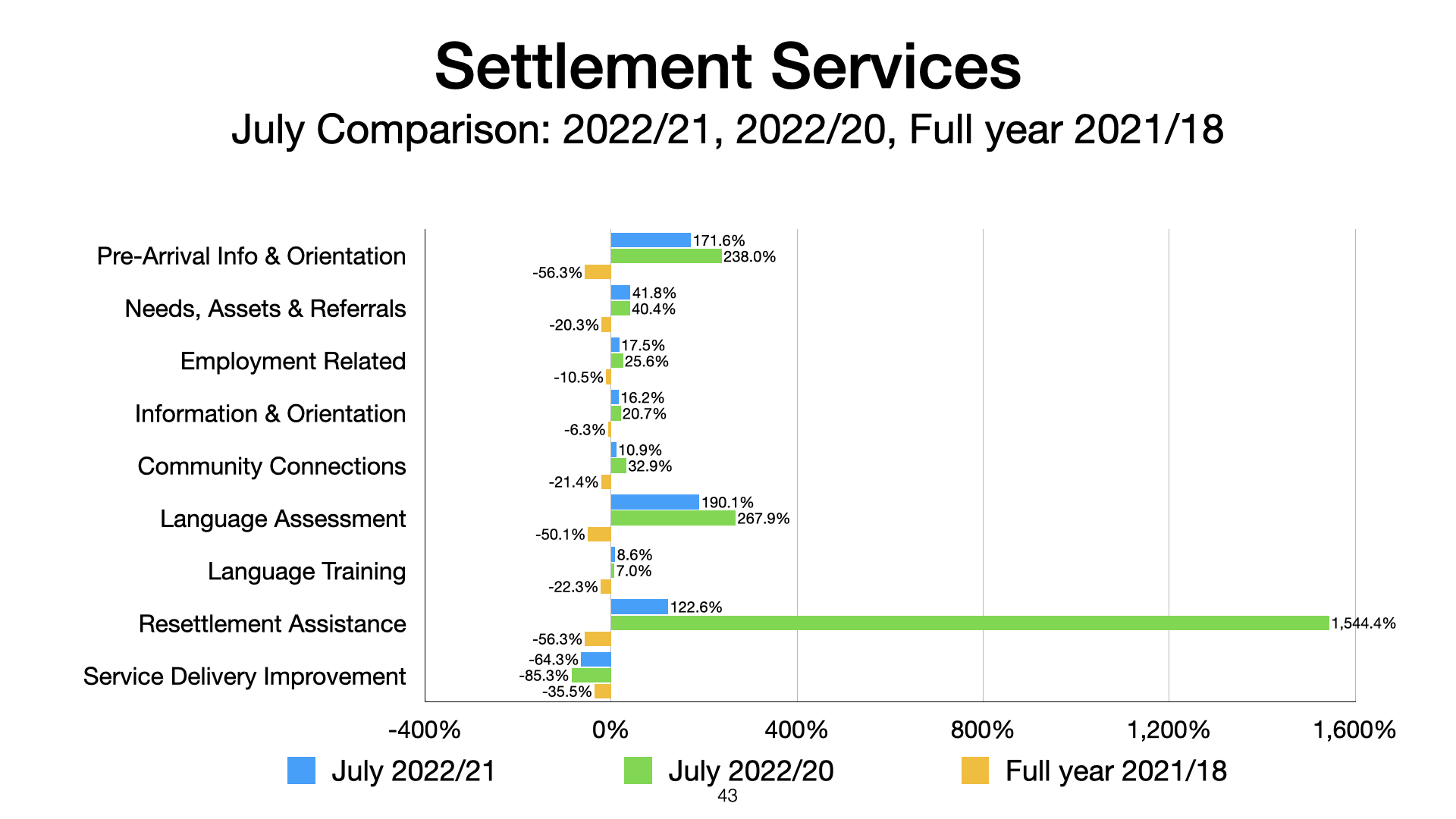
The second chart compares the current July 2022 period with July 2021 and July 2020 periods, along with full-year 2021 with full year 2018, highlighting the increase on a monthly basis and the overall decrease compared to pre-pandemic levels.

Again, given that immigration has increased significantly since 2018, this understates the decline from 2018.

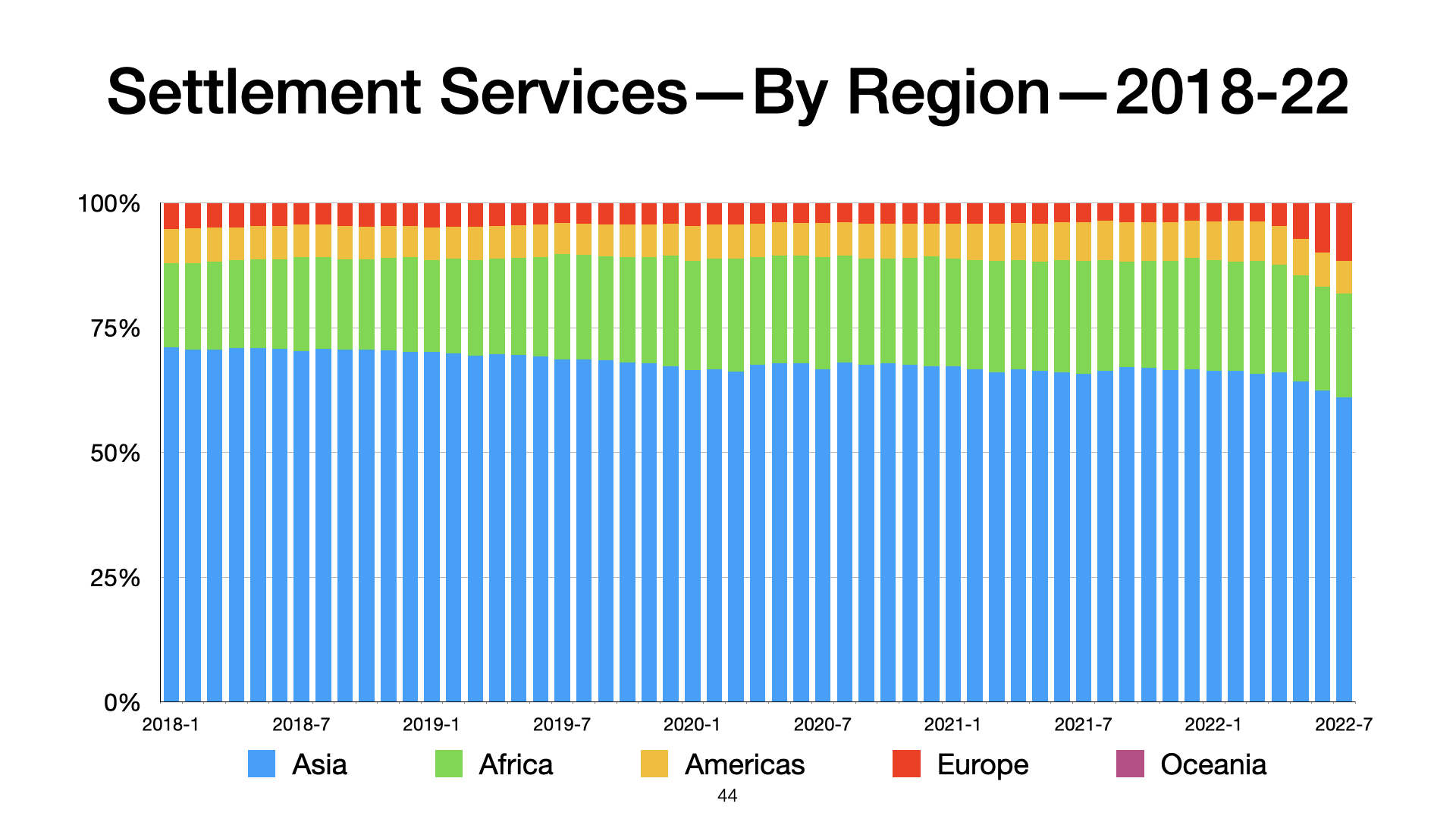
While the regional breakdown has generally been fairly stable, the recent increase in the share of European-origin users of settlement services reflects increased Ukrainian users while the decline in Asia reflects declines from Syria, China, India and Afghanistan.

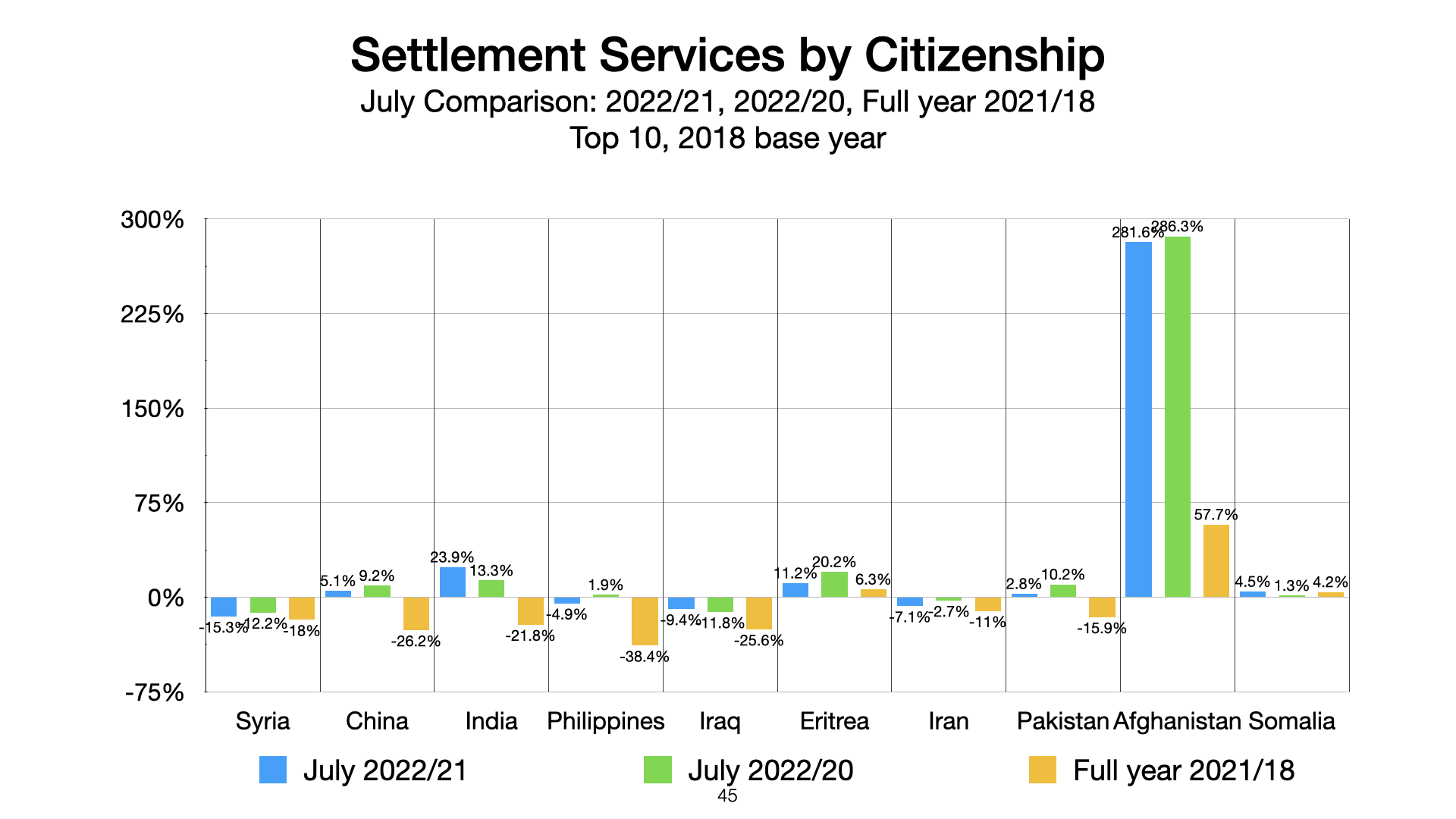
Of the top 10 countries, Afghan users have increased the most following the Taliban takeover and consequent refugees. Ukrainian users, not shown, increased about 10 fold following the Russian war and consequent migration flows.

The last chart compares users by province with Alberta showing the greatest monthly increases and Atlantic Canada the only region showing an increase compared to 2018.

Canadian banks look to newcomers as key source of client growth

Not really a new trend:

Canada is banking on newcomers to help keep the economy humming along, while banks themselves are eying the hundreds of thousands of people coming to the country every year as a key source of client growth.

Those efforts have been growing along with the number of newcomers, including more efforts to secure people as customers before they even arrive in Canada.

“We’re seeing it as a big focus across all categories of banks, not just the big banks,” said Abhishek Sinha, banking transformation leader at EY Canada.

“Whether you talk to the Big Five or you talk to the next tier after that, or even the credit union segment, newcomers and penetrating that market segment is super important.”

The efforts come as Canada has been welcoming record numbers of newcomers, with an aim to bring in 432,000 permanent residents this year, rising to 451,000 by 2024, while the first half of the 2010s saw the average number of newcomers sit around 260,000.

The segment, which the federal government says accounts for almost all of Canada’s labour force growth and roughly three quarters of population growth, has pushed banks to create partnerships like one recently announced between RBC and ICICI Bank, India’s largest.

“With immigration levels expected to rise to record levels, we’ve announced a collaboration agreement with ICICI Bank Canada,” said RBC chief executive Dave McKay on an analyst call in August.

Some student visa classes require students to put down cash deposits, and the program allows those to seamlessly be transferred to an RBC account in Canada. The program is starting with students but RBC wants to later expand the pipeline of account transfers to a wider field.

“As part of our agreement, ICICI Bank Canada will refer all newcomer clients to RBC over time, making it easier for them to open a bank account upon arrival,” said McKay.

The program, only the second initiative in another country for RBC after it launched a program with a separate focus on China a few years back, taps into an increasingly large source of newcomers, said Amit Brahme, head of the newcomer and cultural client segment at RBC, in an interview.

“We know that the international students segment is one of the fastest growing segments within different visa classes. So we’re really excited about the fact that we are going to be tapping into a growing segment.”

Overall, the number of international students coming to Canada more than tripled in the decade leading up to 2019, reaching 638,000. The pandemic then led to a dip in numbers with 2021 drawing about 622,000.

And while many students will only be in Canada temporarily, a growing number return as potential long-term clients. Statistics Canada says about three in 10 international students become landed immigrants within 10 years of arrival.

Other banks have also been ramping up their efforts, such as Simplii Financial last year rolling out a digital identity verification program that allows clients to open accounts before they even land in the country. Some efforts to secure clients before they come to Canada however, such as Scotiabank’s partnerships in China, go back more than a decade.

The rise of fintechs has also opened new avenues to solve old challenges for newcomers, such as using more global data and international bank partnerships to solve the challenge of credit histories, said Sinha.

“We’ve seen a few fintechs come up who are creating credit models which are based on a more holistic history of the individual than just their history in Canada, and that’s starting to get more mainstream traction.”

Efforts once people arrive in Canada also continue to evolve. Banks, such as CIBC at Toronto Pearson International, have established themselves at airports to be a first point of contact, while banks have also worked to expand and adapt their product offerings, including credit cards without a need for credit history, which is a key stumbling block for many.

At VanCity, the credit union’s efforts have included supporting financial literary courses to help both immigrants and refugees, while it also looks to help newcomers on the business side, said Gurpreet Jhaj, vice president of marketing.

“We support them with micro-financing. And we provide that with financing at favorable terms. And we look really beyond just credit history. We consider what their ambition, character determination and things like that.”

It also provides loans for newcomers to help them write exams to allow their foreign credentials to be recognized, a key barrier for many, and has also been working with the B.C. government to support arriving displaced Ukrainians.

Refugees, such as people fleeing the war in Ukraine, are set to make up about 77,000 of the wider permanent residency goals for this year, so it’s an important segment for banks while for those arriving a bank account is absolutely critical to getting established, said Effat Ghassemi, executive director of the Newcomer Centre of Peel.

“It’s like oxygen, they have to have a bank account.”

She said banks have helped out by bringing teams to the hotels where refugees are staying to help set them up with the accounts necessary to get government aid.

The biggest barrier really for newcomers is trust, said Ghassemi.

“Put yourself in their shoes, you know, they’re new, they came from war. They don’t trust anybody. They don’t trust government or banking.”

Banks are working to build up the trust factor in part by becoming general resources for clients. RBC has created hubs near cultural centres and on campuses where newcomers can get answers to all sorts of questions beyond banking such as getting a drivers’ licence or daycare, along with apps as general resources to get settled, as it works to differentiate itself in a tough market said Brahme at RBC.

“The space is extremely competitive, because newcomers are the source of new clients to majority of the organizations.”

Source: Canadian banks look to newcomers as key source of client growth

Rioux: Quel «dérapage»? [on Premier Legault’s comments on social cohesion]

Le Devoir’s European correspondent Christian Rioux comparing EU social cohesion concerns with those of Premier Legault.

While recognizing the differences between Canada’s (and Quebec’s) immigration selection systems and integration programs and those of EU countries, he nevertheless reverts to the same social cohesion concerns without examining the effects of Quebec political discourse and legislation that have contributed to social exclusion, not social cohesion:

« Couvrez ce sein que je ne saurais voir », disait le Tartuffe. Convenons que ses héritiers modernes ont des formules moins élégantes que celles de Molière. Ces temps-ci, ils préfèrent parler de « dérapage ». Mais l’effet est le même. Il consiste à écarter du débat tout propos un peu dérangeant dès lors qu’il aborde une question litigieuse. L’étiquette vaut à elle seule condamnation.

Ainsi en va-t-il des récents propos de François Legault sur l’immigration. Pourtant, qu’y a-t-il de plus banal que d’affirmer comme l’a fait le premier ministre la semaine dernière qu’une forte immigration peut nuire à la « cohésion nationale » ?

On comprend que dans un pays « post-national » comme le Canada, où l’immigration a été sacralisée, ces propos créent la polémique. Mais, vu d’Europe, où le débat est ancien et plus nourri, il est évident que l’immigration massive pose partout et toujours un défi à la cohésion nationale.

Cela se vérifie à des degrés divers dans la plupart des pays européens. En France, sous l’effet d’une immigration incontrôlée et très largement issue du monde arabo-musulman, on a assisté depuis de nombreuses années à un véritable morcellement du pays. Dans toutes les grandes villes sont apparues des banlieues islamisées autrement appelées ghettos. Pas besoin de s’appeler Marine Le Pen pour le constater. Interrogé par des collègues du Monde en 2014, le président François Hollande lui-même n’avait pas hésité à le reconnaître. « Je pense qu’il y a trop d’arrivées, d’immigration qui ne devrait pas être là », disait-il. Et celui-ci de conclure : « Comment peut-on éviter la partition ? Car c’est quand même ça qui est en train de se produire : la partition. » (Un président ne devrait pas dire ça…, Gérard Davet et Fabrice Lhomme, Stock).

Certains diront évidemment qu’en France, ce n’est pas pareil. Soit. Tournons donc nos yeux vers un pays plus à notre échelle.

Avec ses 10 millions d’habitants, son économie de pointe, son climat boréal, son amour du consensus et son parti pris en faveur de l’égalité hommes-femmes, la Suède partage plusieurs points communs avec le Québec.

Il n’y a pas longtemps, dans ce petit paradis nordique, celui qui s’inquiétait de l’immigration massive était accusé de « déraper », quand il n’était pas traité de raciste. Les Suédois regardaient de haut des pays comme la France et le Danemark, soupçonnés de xénophobie. Jusqu’à ce que la réalité les rattrape. La flambée des émeutes ethniques, comme en France, et l’irruption de la violence dans les banlieues ont vite fait de les ramener sur terre. Aujourd’hui, de la social-démocratie à la droite populiste, les trois grands partis estiment qu’il en va justement de la « cohésion nationale ». C’est pourquoi ce pays, qui a toujours été particulièrement généreux à l’égard des réfugiés, a radicalement resserré ses critères d’admission et a multiplié les mesures d’intégration. L’élection sur le fil d’une majorité de droite, finalement confirmée mercredi, ne fera que conforter cette orientation.

Les belles âmes ont beau détourner le regard, en Suède comme en France, il est devenu évident qu’un lien existe (même s’il n’explique pas tout) entre l’immigration incontrôlée et la croissance d’une certaine criminalité. Les événements récents du printemps au Stade de France, où des centaines de supporters britanniques se sont fait détrousser à la pointe du couteau par des dizaines de délinquants, ont forcé le ministre de l’Intérieur à reconnaître ce dont les habitants de la Seine-Saint-Denis se doutaient depuis belle lurette.

La Suède aussi a connu une explosion de la petite criminalité et des règlements de compte entre gangs. Elle a notamment enregistré une croissance des morts par balle parmi les plus fortes en Europe. Aujourd’hui, même la gauche sociale-démocrate l’admet. Et elle s’est résolue à augmenter les effectifs policiers. Contrairement à la France, cette prise de conscience fait aujourd’hui un certain consensus dans la classe politique.

Cela n’a rien à voir avec la peur de l’Autre. Comme nombre de Français, les Suédois ont dû se rendre à l’évidence et cesser d’envisager l’immigration comme une simple question morale. Les peuples ont le droit de réglementer l’immigration sans se faire traiter à chaque fois de raciste par une gauche morale et une droite libérale qui en ont fait leur Saint-Graal.

Bien sûr, l’immigration n’est pas la même en France, en Suède et au Québec. À cause de son histoire et de sa position en Europe, la France connaît une forte immigration illégale et de regroupement familial. Naïvement et par générosité, la Suède a ouvert toutes grandes ses portes aux réfugiés et elle n’a jamais contrôlé son immigration économique. Le Québec, où l’équilibre linguistique est plus que précaire, subit des quotas d’immigration parmi les plus élevés au monde et une immigration temporaire hors de contrôle.

Il n’empêche que, malgré ces différences réelles, les mêmes causes produisent partout les mêmes effets. Ce n’est souvent qu’une question de temps.

Lentement, depuis une décennie, tous les tabous de la mondialisation se sont effrités. Ceux qui ont vécu les années 1980 se souviennent de l’enthousiasme et de la naïveté qui accompagnaient cette nouvelle phase d’expansion du capital. Nous n’en sommes plus là. L’immigration de masse demeure le dernier mythe encore vivace de cette époque.

Source: Quel «dérapage»?

‘People look at you and they feel hope’: New CEO to lead Calgary Catholic Immigration Society

Passing of the torch. Always enjoyed my (limited) encounters with Fariborz:
After leading one of the country’s largest immigration organizations for 28 years, Fariborz Birjandian is stepping into an advisory role to welcome the next CEO of the Calgary Catholic Immigration Society.
Like Birjandian, the incoming CEO, Gordana Radan, was a refugee to Canada who started working with CCIS shortly after arriving in Calgary and experiencing the organization’s services firsthand. Radan came to Canada as a refugee from the former Yugoslavia in 1995. Her first home in Calgary was at CCIS’ Margaret Chisholm Resettlement Centre.

Source: ‘People look at you and they feel hope’: New CEO to lead Calgary Catholic Immigration Society

How VR and AI could revolutionize language training for newcomers

Innovative:

Adla Hitou is shamelessly showcasing her stellar work experience as she tries to convince the interviewer to hire her.

The Syrian newcomer answers every question that’s tossed her way.

“Give me that $3-trillion job,” she says, before bursting into laughter.

The assertive and fun-loving Hitou undertaking this mock job interview in virtual reality seems like an entirely different person from the timid mother of two who normally only whispers to others in her real-world classroom.

“I don’t feel nervous speaking in English in the virtual world because I just disappear. When I talk, I’m not afraid to make mistakes anymore. I just feel more confident,” says the 51-year-old Mississaugan, a former pharmacist who resettled in Canada in 2018 via Lebanon.

Alexander called the project’s use of VR in language learning “groundbreaking,” adding the technology appears to help participants overcome the self-consciousness in communicating in their second language.

“At this point, VR is a great equalizer. When students are using VR, they seem to feel this freedom to want to be able to speak. I think part of it is, when they’re in the VR world of it, they’re less concerned about themselves and about making mistakes, where they are actually being represented by a cartoon character.”

On this sweltering Saturday, instructor Anthony Faulkner and volunteers prepared the four female and three male adult learners on how to tackle questions at a job interview.

At first glance, there’s nothing atypical about the drill, a part of the English as a Second Language curriculum to help adult immigrants learn the language for their successful integration in their adopted country.

They talked about how to make a formal introduction of themselves, highlight their accomplishments and think on their feet when faced with the unexpected.

Sitting in a circle in the lab, Hitou — in a soft and gentle voice — told classmates in the physical world about her training as a pharmacist, her work experience as a project manager with the World Health Organization’s food and vaccination programs in Syria, and the civil war that forced her exile.

“I’m good at communication. I can take your ideas, relate the information and make a good presentation,” she said, adding personal details: “I love volunteering and do handcraft. I’ve made crochets and sold them at bazaars to raise money for charities. I am a bad seller but I have a kind heart.”

After the in-class session, with help of a team of volunteers, the participants were invited to put on their headsets, lift the hand-held controllers and enter Faulkner’s virtual office resembling an executive suite — wood panelling, rows of bookshelves and a bronze chandelier.

In an instant, Hitou, in her white hijab and blue one-piece dress, transformed into an avatar in the virtual world, revealing her long silver hair and sporting a black business suit.

“How do you deal with failures and mistakes?” asked Faulkner, standing in the middle of the classroom and moving his hand-held controllers in the air to make his avatar do a “hands-open, palms-up” gesture.

Caught by the surprise question, Hitou, behind her headset and facing a whiteboard in the physical world, confidently replied: “We are all humans. We have to learn from our mistakes and understand why we made the mistakes and failed. I do not give up.”

“This is so much more fun than learning English from books and notes in the traditional classroom,” she said later. “Now, I remember every word and thing that I see and learn in the virtual world when I go back to the real world.”

The virtual job interview is just one of many thematic VR experiences covered over the eight-week course by the research team that developed the customized scenarios with help from ENGAGE, a virtual platform that simulates the way people interact in the physical world for multi-user events, collaboration, training and education. One scene includes a dinner party at a virtual highrise loft; another involves the planning of a Canadian road trip where each newcomer is assigned to research a part of the country before going to the different booths in a virtual conference hall to make a presentation to their peers about these places and activities.

Instead of just viewing some Canadian landmarks on television as peers in a regular class might, the VR participants can take virtual tours of Niagara Falls, Toronto’s Eaton Centre and St. Lawrence Market through the VR 360 videos on YouTube VR.

Oakville’s Manar Mustafa, a computer engineer who fled war in Syria and came here in 2016, said she attended a regular English program at a newcomer settlement service agency but nothing can compare to VR learning.

“This is a perfect experience. I never used VR but everything feels so real in the VR world. I have not visited the Niagara Falls but now I have. It was right in front of me in the classroom and I didn’t even get wet,” the 36-year-old mother of four said with a chuckle.

“Initially, I felt dizzy (with motion sickness), but now I really love it. I feel very comfortable with it.” 

Her classmate, Afghan journalist Abdul Mujib Ebrahimi, who only arrived in Canada last November, said he hopes to quickly translate what he has learned from the virtual world to the real world.

“The VR experience pushes you in a real situation. You are a character and you use your imagination to communicate with others. If I don’t know a word or how to say something, I just explain it in a different way for people to understand me,” said the 27-year-old from Badakhshan. 

“I’m still trying to learn English and work with English, but I am more confident when I talk to real people.” 

Alexander cautions that it’s too early to determine the effectiveness of VR in language learning.

“We have to be careful of the novelty effect of VR. Our students are enjoying the experience maybe because they’re trying VR for the first time and they can tell their friends and family about it,” he explained.

The VR class this summer is part of a series of projects that also include participants in traditional classrooms and artificial-intelligence-assisted learning in front of a computer. The AI session will be launched in winter.

There are about 80 newcomers waiting to get in the program, according to Marwa Khobieh, executive director of the Syrian Canadian Foundation, which has been running a joint English tutoring program for newcomers with volunteers from U of T since 2017.

She concedes that VR language learning is expensive, with the required infrastructure and equipment in its infancy, but if it succeeds, there’s a huge potential to use it to accelerate the learning and ultimately the integration of new immigrants.

“If we’re able to help newcomers learn and improve their language skills in two years instead of four, it’s worth the investment,” noted Khobieh. “Technology is our future and this can change the future of language training for newcomers.”
Source: How VR and AI could revolutionize language training for newcomers

Debating difference and diversity: combining multiculturalist and interculturalist approaches to integration

Much of these debates and discussions are more semantics than substantive, as the devil is in the details regarding the specific practices and policies of integration, social cohesion, multiculturalism and interculturalism:

In the UK, as elsewhere in Western Europe, issues of integration and social cohesion in relation to ethno-cultural minorities are never far from the headlines or policy concerns in one form or another. In the last year, events such as the Black Lives Matters protests, COVID-19, the Euros, and the upcoming Queen’s Platinum Jubilee, have all prompted reflection on integration. In 2019 the government published a new indicators of integration framework and the term has again been the central concern of a recent report by a prominent think tank, which notes that integration is ‘one of the slipperiest concepts in the political lexicon’.

One of the central issues to thinking about integration is what is to be done about ethno-cultural difference? Is it a problem to be overcome, a barrier to integration? Is it something positive, to be embraced and celebrated? Should it be overlooked in favour of what we all, as individuals, have in common, or should it be the ground we build a more equitable sense of belonging from?

The term integration can be not just slippery but the site of antagonistic and at times heated debate. These two properties of antagonism and slipperiness are well exemplified in debates between two alternative camps on how to manage and think about integration and ethno-cultural diversity: multiculturalism and interculturalism. Whereas the former emphasises respect for difference and hyphenated identities, the latter emphasises contact, mixing and what is shared or common against difference.

The two have frequently butted heads in academic debates, with multiculturalism under fire from interculturalists as in need of replacement, something reflected in political and policy discourse. For instance, the government’s 2018 Integrated Communities Strategy stated that ‘multiculturalism has too often encouraged communities to live separate lives – reinforcing distinct cultural identities to the detriment of efforts to draw attention to what we have in common – and is defunct’. Multiculturalists have responded by pointing out how these arguments misrepresent or caricature multiculturalism.   

In a new research project, PLURISPACE, we ask if this antagonism must necessarily be the case. We’ve found that integration as it exists in government policy as well as policy advocacy from civil society organisations more often combines these two opponents in various ways, and this is where the slipperiness comes in. Peeling back from political rhetoric and academic theory debates, what might we learn from the slipperiness?

While policies that are consistent with an intercultural position have become central, through increased emphasis on contact and mixing, as well in discourse around fundamental British values, the term itself is found nowhere in policy documents or parliamentary debates themselves (unlike, for example, in Spain or at the EU level). Moreover, these interculturalism gains have not been to the detriment of multicultural policies, which have also shown an increase over the last few decades. This begins to point to types of complementarity between different approaches, which forms the focus of the PLURISPACE project. But what different forms does such complementarity take in practice?

From an analysis of documents produced by prominent civil society organisations, supplemented by interviews, we can point to three main types of complementary form in which multiculturalism and interculturalism are combined in the UK, reflected in alternative emphases on the idea of integration. The first two represent what we might call a principled multiculturalism, complemented or qualified by interculturalism to different extents.

The first variation is broadly multiculturalist in emphasis. It wants to preserve the importance of difference between ethnic, cultural, and faith communities whilst developing a sense of multicultural nationhood that can include these differences. Integration is thought about as relations between communities and across difference, but which adds to this the need for contact and mixing between people of different ethnicities and faiths and a simultaneous emphasis on what is held in common if it is to be successful. Here, integration is very much a ‘two-way street’.

The second variation represents a more equal mixing of multiculturalism and interculturalism. It is more cautious of stronger statements about group rights but with a significant feature; its underlying premises can be said to be more multiculturalist than interculturalist. That is, underpinning interculturalist features is a stronger sense of the need to recognise and respect difference as a fundamental way in which equality is thought about. As one report puts it: ‘If integration is not about everybody, it is not integration‘. Interculturalist emphases from this position are important, but bound to fail if not substantively underpinned by thicker multiculturalist sensibilities and policies when it comes to identifying and addressing discrimination and positive recognition.

Across these two positions features of interculturalism are seen as extremely important but also as inadequate and ineffective if not underpinned by more substantive approaches to equality consistent with multiculturalism.

A third position is one we might call critical interculturalism. This adopts a broadly interculturalist stance, but is qualified in significant ways (and ways that some interculturalists would reject) by multicultural emphases. It emphasises contact and mixing, and is oriented foremost around individual rights and the centrality of ascribing to fundamental British values, and of minority integration into these values. It stresses general laws and policies that apply to everybody, rather than differentiated policies and stronger forms of group recognition. Yet, different expressions of this broad position also emphasise the national level as significant in setting the tone for equality and integration; some emphasise that group targeted policies might be necessary in order to address patterns of discrimination and disparities in policy areas such as employment, education and so on, even if they are not necessarily ideally desirable and one day might not be necessary. We might see this as a kind of stop gap multiculturalism.

Overall, these different forms of complementarity are suggestive of the important contestations and differences there are when it comes to questions of what integration should mean and look like. But what they also show is that out of the shadows of academic debates and political rhetoric, syntheses and hybrids are occurring on the ground, and this has lessons for theory and politics alike. It also shows that behind the rhetoric, multiculturalism is not only alive but a multicultural sensibility is a significant feature of how we should think about equality and belonging.

Thomas Sealy (@SealyThomas) is Lecturer in Ethnicity and Race in the School of Sociology, Politics and International Studies at the University of Bristol.

Source: Debating difference and diversity: combining multiculturalist and interculturalist approaches to integration

Greg Abbott Backs Immigrant School Policy That Helped Turn California Blue

Of note, political virtue signalling for the right, with risks of possible backlash. Proposal is intrinsically deplorable:

In 2001, then-Governor Rick Perry, a Republican, signed what was known as the Texas DREAM Act, providing in-state tuition rates to young undocumented students as long as they were state residents for three years, graduated from a Texas high school, and promised to apply for permanent residency.

Two decades later, immigration politics in Texas have been completely transformed. Governor Greg Abbott is now calling for the Supreme Courtto strike down the 1982 Plyler v. Doe ruling that forces states to pay for the education of undocumented children.

Speaking on a conservative radio show, Abbott said Texas already sued the federal government long ago over having to incur the costs of the education program.

“And the Supreme Court ruled against us on the issue,” Abbott said. “I think we will resurrect that case and challenge this issue again, because the expenses are extraordinary and the times are different than when Plyler v. Doe was issued many decades ago.”

In light of the report that the Supreme Court is set to strike down Roe v. Wade and reverse long-enshrined federal abortion protections, Democrats and activists privately worry that efforts like Abbott’s are not the fantasy they would have seemed just six months ago, but could actually become reality in the near future.

But they argue Abbott’s gambit could backfire, as a similar campaign did after the passage of California’s infamous Proposition 187 in 1994 signed by then-Governor Pete Wilson, a Republican, which denied public services to undocumented immigrants, including public education.

After all, “Prop 187,” which only survived five years, had unintended consequences. Not only did it fail in discouraging immigrants from seeking services, it also helped to create a mobilized Latino electorate that proved to be a major factor in turning California blue.

Mike Madrid, a longtime Republican strategist, worked in California GOP politics and considers Wilson a friend. But he says the fallout from Prop 187 could serve as a warning for Texas Republicans.

“The legacy of 187 was to create a generational voting bloc of Latinos against the Republican Party that would not normally happen,” Madrid said, adding that California was then experiencing the rightward shift Texas is experiencing now. “That changed substantially because of these attacks on the community. Once attacked, Latinos rally.”

In California, the Latino share of the electorate nearly doubled at the time and support for Republicans crumbled, a far cry from the 1980s, when Ronald Reagan garnered 48% of the Hispanic vote. When Bob Dole ran in 1996, he received a paltry 6% of the Latino vote.

Julissa Arce, an activist and author of the new book “You Sound Like a White Girl: The Case for Rejecting Assimilation,” told Newsweek she was once an undocumented student in Texas when she lived in the state from age 11 to 21.

“Thank God no one was questioning how I got there,” she said. But fear was always present. “I never wanted to go talk to my counselor, afraid they might look at my documents.”

Abbott’s rhetoric creates an environment of fear, Arce said, particularly in a state where nearly 53% of public school students are Hispanic.

The end of the state educating undocumented kids would likely include echoes of the chaos of Prop 187, with school administrators having to ask children about the immigration status of their parents, and parents who have both undocumented and U.S.-citizen children pulling their kids from school.

Abbott has tacked to the right during his reelection campaign in an effort to energize his primary voters, often around issues concerning immigration and education. He sent buses of migrants to Washington DC, a message to the Biden administration to deal with a problem he feels it has made worse.

Last week, Abbott slammed the Biden administration for providing baby formula to immigrants in holding facilities, “as American parents scramble amid a nationwide shortage of the product.”

John Wittman, Abbott’s former communications director, told Newsweekthe Texas governor widely publicized moves are an effort to draw attention to the federal government’s shortcomings.

“I think the governor’s point is the federal government continues to fail in its responsibility of dealing with immigration, and Congress has failed for decades, so as a result states have had to deal with the fiscal responsibility of the issue,” he said. “The border and illegal immigration is something Texas has picked up the tab on.”

Arce called Abbott’s announcements “anti-immigrant sentiment and rhetoric” for a reelection campaign, but acknowledged “it feels different because he could really turn this into action as we’ve seen with Roe v. Wade, and this relitigation of things we thought had been settled.”

Source: Greg Abbott Backs Immigrant School Policy That Helped Turn California Blue

Institute for Canadian Citizenship makes Canoo [Cultural Access Pass] available to Permanent Residents

Significant move, expanding access to Canoo to Permanent Residents during their first 5 years in Canada, not just new citizens within one year of becoming a citizen.

From their announcement:

Thanks to generous donors large and small, 2 million Permanent Residents will now have free VIP access to our country’s best culture and nature attractions from the get-go. There is no better way to prove to immigrants that Canada values and respects them – to make them feel truly and completely at home. 

We also added spectacular new benefits to Canoo, including big discounts with Air Canada, film festival memberships, sports tickets, concerts, shows, classes, kid-friendly activities, volunteering, and so much more. 

Canoo is now a one-stop-shop for becoming Canadian, not just in your passport, but in your heart.