Settlement services need to improve their online offerings for tech-savvy newcomers

Interestingly, the number of those from outside Canada accessing IRCC’s “Find immigrant services near you” is comparatively small: about 10,000 per month in 2021, a small decline from pre-pandemic 13,000 per month in 2019.

Given the diversity among immigrants, clearly more segmentation of services, more digital for the digital savvy and more high touch in person for those less so.

Will see what Ryerson’s Virtual Bridge comes up with in terms of recommendations:

Welcoming and including newcomers is increasingly becoming an important part of creating vibrant cities. 

Settlement agencies don’t just deliver services to newcomers. They also identify the best possible channels to reach them and provide them with the necessary information to make settlement in Canada a seamless process. 

But a 2021 study found that although newcomers were using the internet for many things, few were using it to look for settlement services. There’s still a gap when it comes to helping newcomers with better targeted online services. 

The federal government is investing in pre-arrival settlement service delivery so that newcomers are prepared for life in Canada. 

There are currently 147 active settlement program initiativesbeing funded by Immigration, Refugees and Citizenship Canada. These projects are valued at over $250 million, with a goal of finding new ways of delivering services to newcomers. 

About 45 per cent of these funds went towards 17 pre-arrival settlement service initiatives that virtually prepare newcomers for life in Canada. The initiatives provide employment-related services, orientation services, needs assessment and referral services. 

Pre-arrival initiatives have seen success in digital learningcounselling and community-building, including tackling xenophobia and misinformationskills training and starting an online business.

The initiative taken by Immigration, Refugees and Citizenship Canada and local governments are in step with the embrace of digital technologies and the internet among newcomer communities and the demand for more pre-arrival information.

But more must be done to increase awareness among newcomers about the services provided by settlement agencies. 

This is an area of focus for the project Virtual Bridge, which aims to provide research and tools for settlement service agencies to improve their online communications and service delivery. Given the technological aptitude of so many newcomers to Canada, online outreach and services are critical to ensuring their successful resettlement.

Canadian municipalities like TorontoLondonWinnipeg and Halton Region open their doors to a large number of newcomers.

These communities recognize the importance of digital initiatives like welcome portals, pre-arrival services, web/mobile phone applications and online newcomer guides in creating a welcoming environment. The mobility restrictions imposed by the COVID-19 pandemic has heightened the need for these online services and has even spurred digital adoption among migrants themselves.

Settlement agencies, however, still have work to do to ensure they’re offering enough online services to newcomers, including using online channels to communicate with them before they arrive in Canada.

Digital divide

Make no mistake — some newcomers may be excluded because of pre-existing inequalities in access to internet services or devices in their home countries. Demographics will determine whether they have access to digital services. 

Those include age (young people use the internet more often than older generations), gender, location (including whether they come from places in their home country with poor internet service or expensive or absent broadband services), household wealth, education levels and migration status (some refugees and asylum-seekers depend on internet service and social media platforms to navigate the journey between home and host country). 

This is known as the digital divide. For host countries like Canada, unequal access to digital services means another layer of inequality that must also be addressed by settlement services. Failure to do so could further exacerbate what’s known as digital poverty.

Newcomers who do go online must be skilled enough to navigate various platforms, persistent misinformation and hate speech on social media. 

This requires them to obtain vital and accurate information. They can and do. Refugee youth from the Middle East and East Africa, for example, use various platforms like Facebook, WhatsApp, Instagram, Snapchat and Viber before and after coming to Canada to communicate and get information. 

Similar examples are found among immigrants from Bangladeshrefugees from Syria and the Tamil diaspora.

A 2018 report found that newcomers who used pre-arrival settlement services were more informed about where to go to find more information after they arrive, they knew how to get their professional credentials evaluated and they had an overall better understanding of Canadian workplace culture.

They also actively looked for work, while some enrolled in further education to upgrade their skills.

New tech transformation

Before coming to Canada, migrants often have limited sources of information about life here, relying mostly on their social networks. 

Technology allows potential newcomers — with the assistance of friends and family on social media — to make informed migration decisions and improve their search for job market information.

Even before the pandemic, 67 per cent of newcomers to Canada were using social media, similar to Canadian-born usage rates (68 per cent)

Newcomers were mainly using it to learn English, get local news, learn about the Canadian cultureconnect with family and friends, find job market information and for further education opportunities.

Nonetheless there can be some negative impacts on newcomer integration due to social media, meaning there’s a role for newcomer settlement service agencies to build greater trust into virtual spaces.

Some platforms can potentially inhibit integration if they limit interactions with local citizens. Chinese immigrants using WeChat, for example, interact a lot more with other Chinese immigrants and much less with Canadian-born citizens. This can delay how newcomers learn about Canadian social practices. 

Social media can also create privacy and security challenges for newcomers that leave them vulnerable to fraud, identity theft and misinformation. 

Searching for settlement services

Settlement agencies don’t just deliver services to newcomers. They also identify the best possible channels to reach them and provide them with the necessary information to make settlement in Canada a seamless process. 

But a 2021 study found that although newcomers were using the internet for many things, few were using it to look for settlement services. There’s still a gap when it comes to helping newcomers with better targeted online services. 

The federal government is investing in pre-arrival settlement service delivery so that newcomers are prepared for life in Canada. 

There are currently 147 active settlement program initiativesbeing funded by Immigration, Refugees and Citizenship Canada. These projects are valued at over $250 million, with a goal of finding new ways of delivering services to newcomers. 

About 45 per cent of these funds went towards 17 pre-arrival settlement service initiatives that virtually prepare newcomers for life in Canada. The initiatives provide employment-related services, orientation services, needs assessment and referral services. 

Pre-arrival initiatives have seen success in digital learningcounselling and community-building, including tackling xenophobia and misinformationskills training and starting an online business.

The initiative taken by Immigration, Refugees and Citizenship Canada and local governments are in step with the embrace of digital technologies and the internet among newcomer communities and the demand for more pre-arrival information.

But more must be done to increase awareness among newcomers about the services provided by settlement agencies. 

This is an area of focus for the project Virtual Bridge, which aims to provide research and tools for settlement service agencies to improve their online communications and service delivery. Given the technological aptitude of so many newcomers to Canada, online outreach and services are critical to ensuring their successful resettlement.

Source: Settlement services need to improve their online offerings for tech-savvy newcomers

New research finds that preference for remaining is key to successful immigration: Turkish immigration in Germany study

Of interest:

New research finds that policies granting permanent residency to immigrants conditional on acquiring host country skills—like language—are most likely to generate higher fiscal contributions to the host country through income taxes. In fact, immigrants with a preference for remaining in the host country develop social contacts and other specific skills that allow them to find better paid jobs and stay for a longer time.

As immigration worldwide increases, host countries are faced with crucial policy decisions aimed at maximizing immigrants’ economic contributions. Designing the right policies requires understanding exactly how immigrants make their decision to migrate and return to their country of origin. Bocconi University, Milan, professors Jérôme Adda and Joseph-Simon Goerlach, with co-author Christian Dustmann (University College London), in a forthcoming article in The Review of Economic Studies, develop and estimate a that provides key insights into the decision-making process of immigrants. They find that immigrants’ expectations for the length of their stay and their location preferences can explain their decisions to invest in career improving skills, their acceptance of lower-paying jobs compared to natives, and how they respond to immigration policies on the duration and possibility of permanent residence.

While previous research focused only on productivity differences between immigrants to explain their career profiles, the authors argue that location preferences could be crucial in determining how much immigrants invest in acquiring skills that consequently impact their career profiles. For instance, an who prefers the host country and intends to stay permanently may invest more in learning the local language, familiarizing themselves with the local labor market, and developing social contacts and other host country-specific skills. Alternatively, a migrant with a location for their original country may not invest in these skills as they are likely undervalued back there. The authors model this preference and estimate the impact of location preferences and planned migration duration using data from surveys of Turkish immigrants in Germany over three decades, starting from 1961.

Indeed they find that immigrants who remain are higher-skilled due to their conscious investment in host-country skills. Their model is also able to explain why immigrants may be more willing to accept low-paid jobs compared to natives. They argue that immigrants from countries that have a lower price level and who want to return home would face higher effective wages since their wage allows them to consume more at home over their lifetime. Knowing this may encourage temporary migrants to accept lower-paid jobs.

The authors also use their model to compare three different types of prevalent today that grant permanent residency after 5 years either conditional on:

  1. An earning threshold (like the UK);
  2. Acquiring host-specific skills such as language (like in some countries of the EU);
  3. Granted randomly with 30% probability.

The authors find that scheme 1 selects for high productivity migrants and scheme 2 for those with a high preference for the host country.

Assuming a population of 25-year-olds migrating to Germany in 1970 as an example to estimate on, the earning threshold rule would generate an annual per capita increase in tax payments by €782 compared to if the policy wasn’t there. The host-specific skills rule would generate an average annual tax gain of €789 and fewer tax losses due to fewer individuals leaving the host country. The random lottery instead leads to a decrease in average annual taxes by €633 since the expected returns to investing in host country skills are reduced due to the scheme’s reliance on random chance. Furthermore, schemes 1 and 3, due to the barriers they pose to seeking permanent residency, reduce total immigration by about 26% whereas the host-specific skills rule does so by around 3%.

Thus, the authors show how these schemes could have differential impacts when one accounts for not only immigrants’ productivities but also their location preference / expected duration of stay. As the recent Ukrainian refugee crisis shows, such considerations are crucial for both the host countries’ goals as well as the lives and decisions of the arriving immigrants and their integration and acceptance in societies.

Source: New research finds that preference for remaining is key to successful immigration

Canada to offer language training, employment assistance to Ukrainians fleeing war

Significant change, one that continues to blur the previous lines between temporary residents, previously not able to access settlement services, and Permanent Residents who were, as well as highlighting the preferential treatment of Ukrainian nationals compared to others fleeing from their country.

Reality, both policy (the distinction between temporary and permanent has become increasingly arbitrary given that most new Permanent Residents are not former temporary residents) and political (the size and influence of Ukrainian Canadians), results in a major change.

The government will help Ukrainians arriving in Canada find a job and learn to speak English or French, Immigration Minister Sean Fraser said Monday.

Applications opened March 17 for a program to allow an unlimited number of Ukrainians fleeing war in their home country to come to Canada for up to three years while they decide whether they want to apply for permanent residency.

Those who are approved can work or study in Canada during their stay.

The Immigration Department says nearly 60,000 Ukrainians and their family members have applied for the program so far.

“We’re expanding the federal settlement program to offer key services such as language training, orientation, employment assistance and other supports for Ukrainians as they settle into their new communities,” Fraser said as part of a series of Tweets Monday.

More details are expected Tuesday.

The department estimated it would take about two weeks to process each application, so Ukrainians could begin to arrive under the new program as early as this weekend.

Russia’s invasion of Ukraine sparked a mass exodus of mainly women and children who fled the violence that erupted one month ago.

The UN refugee agency estimates 3.8 million people have fled Ukraine since Feb. 24.

The temporary program for people who have left Ukraine is unlike the regular process for refugees, which includes help to find housing and community orientation.

Fraser’s department is working on more ways to help settle the potentially thousands of Ukrainians who could come to Canada over the next several weeks.

“We’ll continue to support Ukrainians, before and after they arrive in Canada,” the minister tweeted.

Beginning Friday, help will be available at certain airports to welcome Ukrainians, with assistance and arrival information in their language.

The Ukrainian Congress has called on the government to provide the new arrivals with financial support for food and shelter during a three-month transitional period.

On Monday the government announced a special grant program for graduate students and post-doctoral researchers affected by the invasion.

“We are establishing this measure as another way of demonstrating our support for Ukraine, to help Ukrainian researchers and students working in Canada to continue their important work,” Health Minister Jean-Yves Duclos said in a statement.

“It will also help protect the future growth of the Ukrainian scientific community.”

The program will provide grants of up to $45,000 for Ukrainians who wish to continue their studies and research in Canada, as well as Ukrainians in Canada who can’t return home because of the war.

Source: Canada to offer language training, employment assistance to Ukrainians fleeing war

German integration chief plans to ‘advertise’ to migrants with citizenship revamp

Of note:

Germany’s integration chief has said she wants to advertise the country to migrants and smooth their path to citizenship, as the country looks to plug expected gaps in the workforce.

Reem Alabali-Radovan said Germany was “in competition with other countries”, such as Canada, to attract migrants with the prospect of a good life and a path to German nationality.

Concerns over worker shortages are fuelled by an ageing population in Europe’s biggest economy, with the number of working-age people projected to decline by 150,000 a year.

Germany has historically been wary of dual citizenship, with some people forced to choose only one passport when they turn 18. But the three parties which formed a coalition last month have promised to loosen these rules.

“Germany has to present itself as a modern country of immigration that offers new prospects,” Ms Alabali-Radovan, who is Secretary for Migration, Refugees and Integration in Chancellor Olaf Scholz’s office, told the newspaper Tagesspiegel.

She said she wanted to support ministers in “advertising Germany” to potential workers.

“I see it as my task to work towards making people here want to stay here,” she said. “There’s much more to that than a work contract – we also need language courses, housing, schools and a chance to be part of society.”

Berlin’s tone contrasts with that of Britain, where Conservative ministers tout stricter migration rules as an accomplishment of Brexit, and France, where right-wing candidates are taking hard lines before April’s presidential election.

The arrival of hundreds of thousands of refugees in Germany after the 2015 migration crisis similarly led to a backlash on the right.

But the centre-left government that took power last month has promised to shorten the period for naturalisation to five years, instead of eight, and simplify the process of obtaining nationality.

Some migrants may be exempted from language requirements if they cannot afford lessons, while the threshold will be lowered for descendants of the mainly Turkish “guest worker” generation of the 1960s and 1970s.

Ms Alabali-Radovan said existing laws meant workers such as carers and tradespeople were facing the threat of deportation because they had only a temporary status in Germany.

“We have a shortage of skilled workers – we need them, we don’t want to deport them,” she said.

The head of Germany’s labour agency last year said the country would need 400,000 immigrants a year to fill its workforce.

Germany has separately promised to take in thousands of vulnerable Afghans, after refugees described fears and bureaucratic delays in the weeks after the Taliban took power.

Ms Alabali-Radovan, 31, is the child of Iraqi parents who left their home country after opposing former president Saddam Hussein’s regime.

Born in Moscow in the last days of the Soviet Union, she moved to Germany in 1996 and settled in the east of the country.

Source: German integration chief plans to ‘advertise’ to migrants with citizenship revamp

Syrian refugees who now call Canada home look to help Afghan newcomers

Nice:

The living room at Zoheir and Nadia Darrouba’s home is a hive of activity in the late afternoon – their older children, just back from school, are taking turns carrying around their baby brother as their parents look on.

It’s a simple scene but one that makes Zoheir Darrouba feel at home in the mid-size Ontario city the Syrian refugee family of eight has now put down roots in.

“We have settled here. We cannot live outside Peterborough,” he says. “It’s a good and quiet city. There are not problems here … People are helpful and nice.”

The family is among nearly 46,000 Syrian refugees who were resettled in Canada under a program introduced by the Liberal government in 2015. The first flight carrying Syrian refugees landed in Toronto on Dec. 10, 2015, exactly six years ago.

The Darroubas, who made their way to Canada under the resettlement program in November 2016, used to live in Idlib, in northwest Syria, one of the first regions where local uprisings escalated into widespread violence. The family lived for a period of time in Lebanon before finding themselves settling in Peterborough.

Now, as they consider themselves firmly established locals, the family is looking to help Afghan refugees who’ve started arriving in the city following the Taliban’s takeover of Kabul earlier this year, although the pandemic has made that effort a bit more complicated.

“There are several (Afghan) families here … They are in quarantine, unlike before,” said Darrouba, who wants to offer support because he knows first-hand how hard starting over in a new country can be.

“When we came here, we didn’t know anyone here. If someone showed up to visit us, we would feel it’s great support.”

Darrouba currently works as a driver delivering COVID-19 PCR test samples for local pharmacies in Peterborough to a lab in east Toronto.

The family’s five older children, ranging in age from eight to 16, are all doing well at school, their father says, while their mother is staying home to care for her two-month-old.

Nadia Darrouba says she’s content with her Canadian home.

“In my first days in Canada, I used to look at the snow from the window and cry thinking when the winter will be over,” she recalled. “We are very comfortable now. My children grow up here. They don’t know Syria.”

Two of her daughters, who are blind, say they’re well-supported at school and feel set up for success.

“If I compare where I was and where I’m now, it’s a huge achievement … I used to speak English but it wasn’t so good. Now my English is a lot better … My grades are very good,” said Aya Darrouba.

The 16-year-old, like her father, said she feels drawn to helping Afghan refugees who are now beginning a new chapter, just as her family did.

She volunteers with a local settlement agency that’s helping Afghan refugees and, since the pandemic has made it challenging to meet in person, recently helped it make a video offering advice to the newcomers.

“I just tried to make them feel at home,” she said of the video. “I told them your first days in Canada will be difficult but you will get used to the country.”

The federal government has committed to resettling 40,000 Afghan refugees, with 3,625 now in Canada, including about 80 in Peterborough, according to government data.

Marwa Khobie, executive director at the Syrian Canadian Foundation, said Syrian refugees are well placed to help the Afghan refugees who started arriving in Canada in the last few months.

Her organization, which is based in Mississauga, Ont., launched a campaign this week to raise money for Afghan newcomers and connect them with 100 Syrian refugees.

“Now that Afghan refugees have arrived, it was kind of a way to refresh our memories and remember what we went through five years ago,” she said.

“Many Syrian newcomers were actually asking and telling us: ‘How can we support Afghan refugees? What can we do? How can we meet them?'”

Her organization has partnered with four other groups that are supporting Afghan refugees to provide opportunities for now-settled Syrian refugees to help the newcomers in the Greater Toronto Area, she said.

Khobie said the campaign, called From Syria to Afghanistan, will also have a positive impact on Syrian refugees.

Sharing their success stories, remembering what they went through – this is a way to empower Syrian newcomers and Afghan refugees at the same time,” she said.

“For Afghan refugees, we want them to feel welcomed here in Canada, a sense of belonging, knowing that they’re not alone in the community, and everybody is willing to support in every way possible.”

Source: Syrian refugees who now call Canada home look to help Afghan newcomers

Canada’s health and settlement systems are failing newcomers. It’s time for a new system of care

More theoretical than practical given the fragmentation within and between sectors an the jurisdictional issues:

Last year, the federal government announced its intention to welcome over 1.2 million immigrants to Canada by the end of 2023. The truth is, however, that our care systems are not ready to adequately support those newcomers upon arrival — and here’s why.

Right now, Canada’s health care system and settlement services have operated in silos and are funded by different levels of government. This is creating large gaps in services, with newcomers falling right through them. The fact is many newcomers come to Canada in better health than the rest of the population. Yet, their health and wellness tend to rapidly decline during and after settlement. Some reasons for this could be due to not having secure housing, access to health care, and/or enough to eat. 

So, what is a solution to these problems? Two words: Integrated care.

Integrated care connects newcomers with a seamless suite of co-ordinated and holistic health and settlement services, including mental health care, employment services and access to food security. Existing integrated care programs offered by health agencies and community organizations, like WoodGreen Community Services’ Inter-Professional Care Program, offer solid proof that integrated care can improve systems of care for newcomers, predominantly in two ways. 

Firstly, integrated care can improve the efficiency, cost-effectiveness and sustainability of care systems by breaking down silos between health, settlement and other services. 

As a people-centred approach, integrated care organizes services around the needs and perspectives of newcomers. This improves continuity of care and allows newcomers to gain timely access to the services they need through any door, without the burden of system navigation. Integrated care also reduces the risk for duplication of work and may minimize high-cost services, such as hospital admissions, by diverting clients away from the emergency room and encouraging a shift to preventative care.

The second main (and particularly timely) benefit of integrated care is that it helps service providers feel less burned out.

Burnout is prevalent among care professionals, a factor which has been proven time and again throughout the course of this pandemic, and which is often linked to reduced patient satisfaction and health outcomes. Statistics Canada reported that, in early 2021, the health-care sector saw one of the largest annual increase in job vacancies compared to other sectors, with a particular increase in job postings for nurses.

By building and co-ordinating relationships and support between providers, integrated care has been found to combat burnout and improve job satisfaction and well-being.

To be clear, integrated care in Canada is not a new thing. The challenge is that an integrated approach to health care and settlement services is not being implemented at a scale that can successfully settle Canada’s incoming and recently settled migrants.

Policy-makers, in collaboration with settlement providers, community agencies, health-care organizations, and other stakeholders, can help to address this issue by:

  • Improving access to stable resources for settlement service providers and physicians to effectively implement integrated care;
  • Offering newcomers of all statuses access to services, including individuals with insecure legal status and people who have been in Canada for years; and
  • Requiring race-based and sociodemographic data collection to ensure organizations have the information they need to track health equity outcomes and evaluate program performance, among other recommendations.

If Canada hopes to achieve a successful and resilient COVID-19 recovery (where newcomers can contribute to the economy while maintaining their own socio-economic well-being), we must commit to better integrating our health and settlement care systems to ensure that newcomers don’t just come here to live — but to thrive.

Source: https://www.thestar.com/opinion/contributors/2021/12/03/canadas-health-and-settlement-systems-are-failing-newcomers-its-time-for-a-new-system-of-care.html?source=newsletter&utm_content=a02&utm_source=ts_nl&utm_medium=email&utm_email=A02AB30AB014E9AB29974E92EB3BFDCD&utm_campaign=top_90291

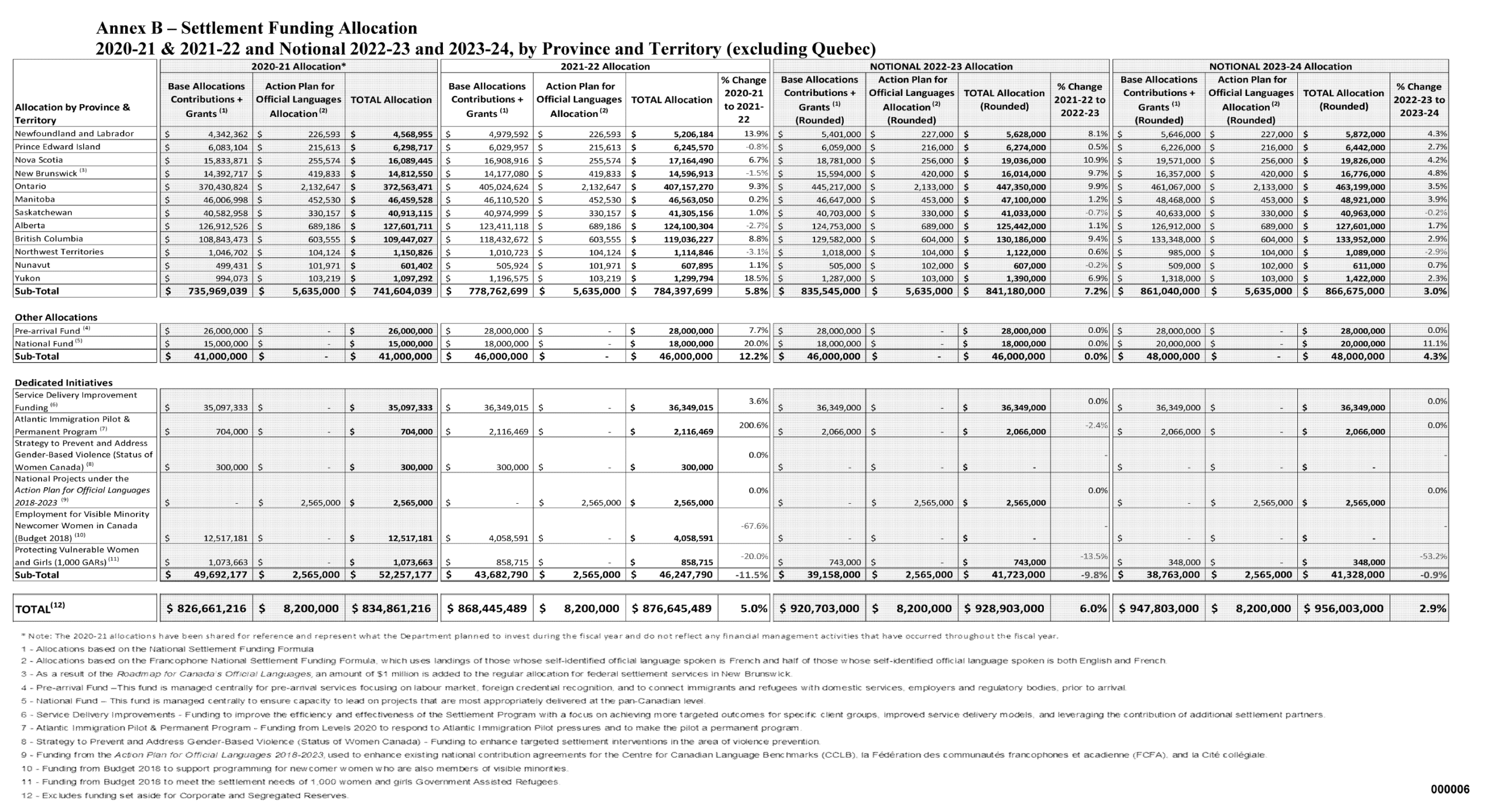
IRCC’s immigrant settlement funding by province/territory for 2021-22

Not much new but useful to have this overview, which again highlights the disproportionate share allocated to Quebec:

…IRCC settlement funding by province and territory

The memo shows that Mendicino approved the following 2021-22 allocation by province and territory (except Quebec). Note that all figures are rounded and also include spending projections obtained from IRCC’s publicly available 2021-2022 departmental plan:

  • Ontario: $407.2 million
  • Alberta: $124.1 million
  • British Columbia: $119 million
  • Manitoba: $46.6 million
  • Saskatchewan: $41.3 million
  • Nova Scotia: $17.2 million
  • New Brunswick: $14.6 million
  • Prince Edward Island: $6.2 million
  • Newfoundland and Labrador: $5.2 million
  • Yukon: $1.3 million
  • Northwest Territories: $1.1 million
  • Nunavut: $608,000
  • Sub total: $784.4 million
  • Other allocations: $46 million
  • Dedicated IRCC Initiatives: $46.2 million
  • Quebec (Not included in the memo): $650.3 million via the separate annual grant it receives from IRCC
  • Resettlement services (Not included in the memo): $145.7 million
  • Grand total (Not included in the memo): $1,672.6 billion

Sources: IRCC memo and IRCC’s Departmental Plan 2021-22.

Screenshot 1: Settlement Funding Allocation (Click on image to enlarge):

ircc settlement funding allocation 2021-2022
Source: IRCC

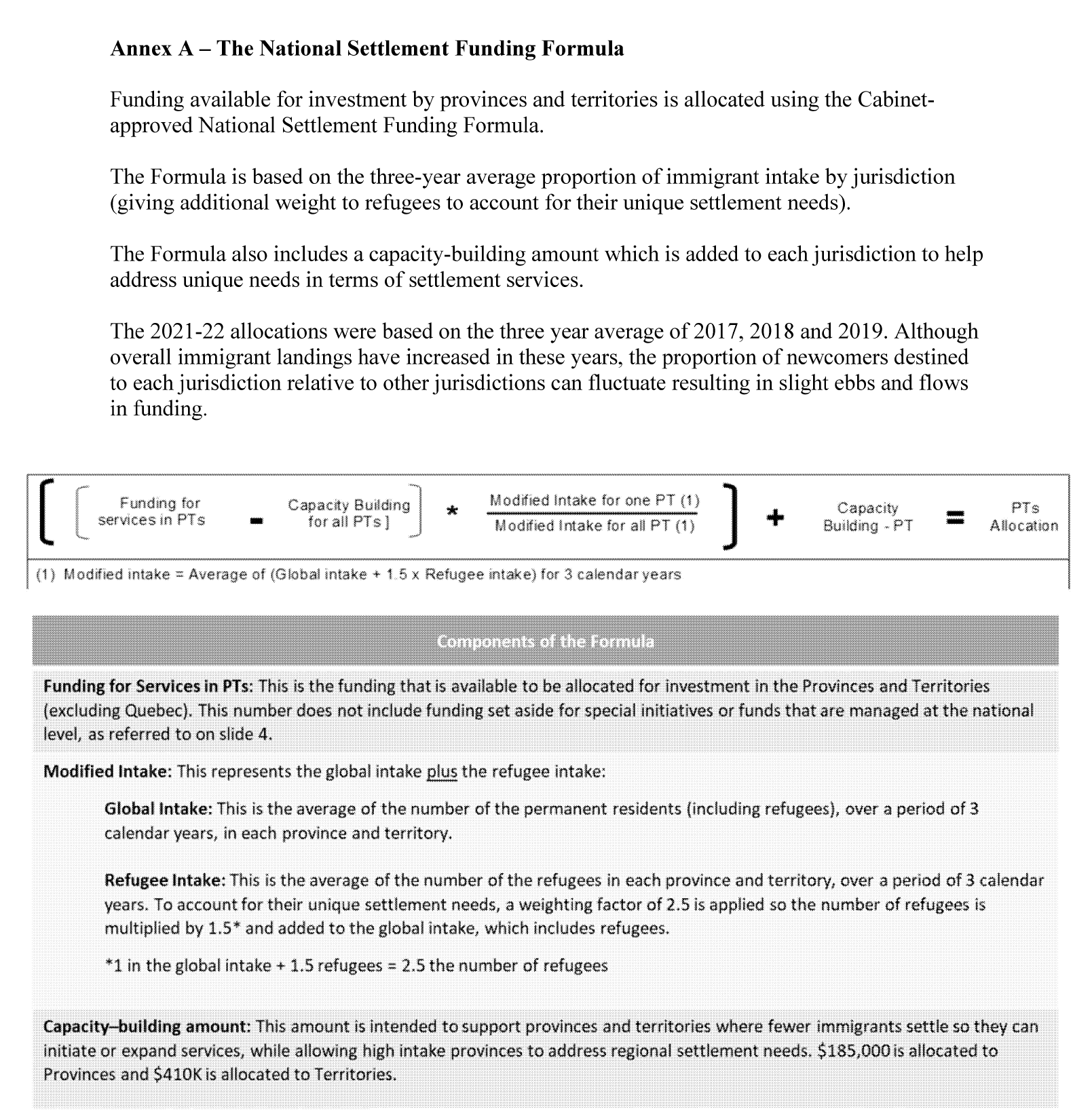
IRCC’s settlement funding formula

One possible reason IRCC has stopped sharing this information publicly is due to the controversy it garners among provinces, territories, and the service provider organizations. These stakeholders are in constant negotiations with IRCC on identifying the most appropriate funding levels for their respective jurisdictions. IRCC acknowledges the controversial nature of this process in the memo.

The memo outlines that the allocation of funding by province and territory is based on a federal Cabinet approved National Settlement Funding Formula. The formula allocates funding for each jurisdiction based on the three-year average proportion of immigrant landings by jurisdiction. It also gives additional weight to refugees to account for their unique settlement needs (refugees tend to require more settlement services than economic and family class immigrants). Quebec is not subject to this formula since its grant is calculated based on the formula outlined in the Canada-Quebec Accord relating to Immigration and Temporary Admission of Aliens signed in 1991. Due to Quebec’s special status as Canada’s only French-speaking province, it has more authority than any other jurisdiction to select immigrants. It also receives more IRCC settlement funding than any jurisdiction and has more flexibility to use the funding.

Screenshot 2: The National Settlement Funding Formula (Click on image to enlarge):

ircc settlement funding formula

Source: IRCC.

Settlement funding per capita

As indicated in Screenshot 2, IRCC determined the 2021-22 allocations based on immigrant landings in each province and territory in 2017, 2018, and 2019. This results in the following settlement funding amounts per capita:

  • Nunavut: $16,432
  • Quebec: $13,541
  • Northwest Territories: $4,622
  • Yukon: $4,194
  • Newfoundland and Labrador: $3,428
  • New Brunswick: $3,072
  • Ontario: $3,033
  • Alberta: $2,913
  • Manitoba: $2,862
  • Nova Scotia: $2,857
  • Saskatchewan: $2,691
  • Prince Edward Island: $2,684
  • British Columbia: $2,671

Sources: IRCC; Author’s calculations. The methodology is: Allocations for each province and territory divided by annual average of each province/territory’s immigrant intake between 2017-2019.

IRCC’s memo states that smaller jurisdictions receive capacity building funding to allow them to increase the scale of their services. This may explain why jurisdictions with low newcomer intakes including Nunavut, the Northwest Territories, Yukon, Newfoundland and Labrador, and New Brunswick are at the top of the list. Ontario gets more than the provinces west of it due to it having the highest refugee intake in the country.

Quebec leads all provinces due to the generous settlement formula identified in the Canada-Quebec Accord. Among its provisions, the formula dictates the grant amount can only increase over time.

What does this all mean?

IRCC goes to great lengths to help immigrants succeed. This is demonstrated by its settlement program accounting for nearly half of the department’s annual $3.6 billion budget. Canada is the largest funder of immigrant settlement services in the world.

At the same time, IRCC has the difficult task of identifying how to distribute its settlement funding across the country in a manner that takes into consideration the needs of each jurisdiction. This results in an imperfect process that is subject to intense scrutiny and debate among Canada’s governments, settlement provider organizations, researchers, and the media.

Quebec enjoys the most funding in absolute terms as well as the second most per capita even though its provincial government was elected in 2018 on a mandate to reduce immigration. The province’s settlement funding formula was agreed to in 1991 based on the expectation that Quebec’s immigration levels would increase over time to help compensate for its aging population and low birth rate. However the election of the Coalition Avenir Quebec (CAQ) party in 2018 highlighted a flaw in the formula, as Quebec has since seen its annual grant from IRCC continue to rise as its newcomer intake declined by 22 per cent in 2019 compared to 2018.

Conversely, Alberta, New Brunswick, Prince Edward Island (PEI) and the Northwest Territories have each seen their settlement allocations decline this federal fiscal year due to recent declines in their newcomer arrivals. Decreasing allocations to jurisdictions when their newcomer levels decline may seem fair, but it also creates operational challenges. Namely, lower IRCC funding to a province or territory could come at a time when that jurisdiction sees an increase in their newcomers (and hence, strains their ability to deliver settlement supports to newcomers). In addition, decreased funding means that service provider organizations may need to scale back their operations which sometimes entails laying off staff.

IRCC recognizes such challenges, which is why the memo notes that IRCC will make a one-time transfer to their Western Canada operations to top-up the funding provided to Alberta. The purpose of the top up is to ensure that Alberta can continue to provide high quality settlement supports to its newcomers.

Finally, IRCC recognizes that further investments will be needed to support future newcomers. The memo states the department anticipates more settlement funding to become available as it looks to welcome more newcomers through its Immigration Levels Plan. The 2021-2023 levels plan is the most ambitious in Canadian history as it seeks to welcome over 400,000 new immigrants per year. Since its founding in 1867, Canada has welcomed 400,000 immigrants in a year just once, in 1913. As such, the memo indicates an expectation the allocation for all provinces and territories (excluding Quebec) will increase by another $100 million for the 2023-24 federal fiscal year. This suggests the department’s total settlement spending will reach some $2 billion annually within the next few years.

Source: IRCC’s immigrant settlement funding by province/territory for 2021-22

Racism and the need for a national integration commission

My latest, complements my earlier Increasing immigration to boost population? Not so fast.

Protests by communities affected by prejudice, discrimination and racism appear to be on the rise, as evidenced by the Black Lives Matter, and the Indigenous-led Cancel Canada Day and Land Back advocacy movements. These are in response to deaths by Black people and Indigenous youth in police custody, and anti-Muslim, anti-Asian and anti-Semitic hate incidents and crimes in both Canada and the United States.

At the same time, there has been greater understanding amongst most Canadians regarding systemic issues and broader support of individuals and groups most affected. But government and societal responses have been largely reactive, involving symbolic measures such as summits, funding and communications initiatives.

The 2021 summits on Islamophobia in response to the London killings and on antisemitism, following increased tensions between Israel and Palestine, are examples that did little to reduce hate incidents. The most current evaluations of the multiculturalism program by Immigration, Refugees and Citizenship Canada and Canadian Heritage (2017) highlight the limited evidence as to the effectiveness of government programming.

Why aren’t current approaches working? These types of targeted initiatives generally preach to the converted, and thus have limited reach and impact. They often understate the diverse experience within communities, and how racism intersects with gender, religion, sexual orientation, ethnic ancestry, mixed identities and class. The problems are complex and multi-faceted, and there are no easy or quick solutions. Summits, conferences and even parliamentary hearings are designed for the short-term, and do not commit the time and resources for in-depth examination and discussion of fundamental issues.

While these approaches respond to the community and political needs, a deeper examination of the common issues across all groups and a more integrated approach is needed.

Racism is a concern in Canada, present and future, given the rapidly increasing Indigenous and immigrant-origin population. An in-depth and independent examination of the issues, challenges and possible solutions is needed, and there must be broad consultations and engagement with all affected groups.

What would be some of the requirements for such an enquiry?

The overall approach should be akin to the Royal Commission on Bilingualism and Biculturalism, held between 1963 and 1969. At that time immigrants formed about 16 per cent of the population, compared with 21.9 per cent in 2016.

Canada has changed dramatically since 1963, and an enquiry would have to address the impact of today’s increased and more varied diversity. Immigrant source countries have shifted away from Europe, which was the source of 61.6 per cent of recent immigrants in 1971, compared with 11.6 per cent in 2016. Christian affiliation declined from 78 per cent of immigrants who arrived prior to 1971 to 47.5 per cent of those who arrived between 2006 and 2011. One-third of those arriving between 2001 and 2011 identified as Muslim, Hindu, Sikh or Buddhist. LGBTTQ issues were not discussed in the 1960s, and the major gap in employment equity legislation and reports is an indication of this silence, even though these groups have become more visible and accepted. And more Canadians have complex, mixed identities, reflecting this increased diversity within and between different groups.

Essential aspects of an enquiry

While it should be established by the government, the enquiry’s deliberations and recommendations should also be independent and nonpartisan.

It needs to have a broad mandate that includes research, independent studies and public consultations on barriers to inclusion. We have more than enough research and data by sociologists, political scientists and economists regarding the socio-economic, education and health disparities of different groups.

However, more interdisciplinary research and analysis by social psychologists, neuroscientists and policy-makers is needed on how bias and prejudice form, which groups are most vulnerable and why, and the most effective ways to counter prejudice, discrimination and hate.

It would need to have an adequate budget and resources to fulfill its mandate, comparable to other major commissions.

It would have to adopt a broad intersectional lens, not looking at individual groups in isolation but at the inter-relationships among gender, religion, sexual orientation, ethnic ancestry, mixed identities and class. It would have to look at minorities and majorities within each group and the degrees of inclusion and exclusion within and between them.

The consultations would have to be designed to go beyond the normal advocacy groups, and include more diverse and marginal voices to help break down the silos and identify commonalities. It is important to recognize that Canadians are affected by immigration and diversity in different ways, depending in part on their socio-economic status, workplace and education. And while this is not without risk, the consultations need to include individuals and groups that have some discomfort with increased diversity or have been negatively affected by immigration.

The enquiry must look not just at bias, discrimination and racism between the “mainstream” majority and minority groups, but also at that between visible, religious and gender minority groups. In other words, it must break away from the simplistic dichotomy that has mostly characterized the current diversity and inclusion discourse, which does not adequately reflect Canada’s present and projected diversity.

Practical solutions and approaches should be the focus; ones that can be implemented by governments and organizations over time; and where progress can be tracked, measured and reported. The tracking of the progress of the Truth and Reconciliation Commission Calls to Action could provide a model.

Canadians, long-established and newcomers alike, are increasingly coming to terms with our legacies of injustice against Indigenous peoples, as well as against racialized, religious, LGBTTQ, and other minorities. Despite considerable progress in removing legislative and other barriers to inclusion, the effects of these legacies linger in ongoing inequalities and inequities.

While many Canadians are reaching out and supporting communities that experience hate, the increase in hate crimes and incidents against individuals and groups indicates we cannot be complacent.

Reducing the influence of the more extreme groups that undermine social inclusion and cohesion would be a key aim. Developing practical recommendations to do this would be an important first step.

As we saw with Quebec’s Bouchard-Taylor Commission, there is a risk that a broad enquiry will provide space for those with more xenophobic views. However, not allowing any space for those with immigration and diversity concerns would mean missing those who need to be reached.

Canada depends on immigration to address an aging population, and it also needs to provide better opportunities for younger Indigenous populations, so a comprehensive national enquiry is needed to ensure that we have the evidence-based knowledge to reduce bias, prejudice and discrimination so all Canadians, whatever their origin, ancestry or religion, can fully participate and contribute.

Source: https://policyoptions.irpp.org/magazines/august-2021/racism-and-the-need-for-a-national-integration-commission/

It’s a system meant to help newcomers to Canada learn English. But critics say it prioritizes testing — at students’ expense

Hard balance to strike between the need for accountability through testing of progress and pedagogy:

After having his education stalled by war, Fahed Diab was thrilled to have a chance to return to school in Canada. But before he could apply to college, the Syrian refugee needed to enrol in adult English classes.

In those classes, the then 21-year-old worked to learn a foreign language from scratch while, more importantly, rebuilding his self-confidence and mingling with other newcomer students like him who were also trying to learn the history, values and cultures of their adopted homeland.

“I wanted to be able to communicate with people and learn how to ask for help, go to a doctor and book an appointment,” said Diab, who resettled in Canada with his family via Lebanon in 2015 under a refugee sponsorship.

“I went to classes and met friends in similar situations as me. I enjoyed interacting with people from different backgrounds and learning about this country. My self-confidence was getting better.”

However, when changes were made to the federal immigration department-funded Language Instruction for Newcomers (LINC) while he was about halfway into his one-year program, Diab, now studying engineering at Lakehead University, said he lost his drive as a result of the frequent in-class assessments required to prove the students’ progress.

“We had two or three tests a week, sometimes for writing and reading, or listening and speaking. We must pass all these tests to move up to the next level,” said the now 27-year-old Hamilton man.

“All the tests distracted me from the learning. I was obsessed with passing the tests rather than learning the language and culture.”

After about a year enrolled in the immigrant English classes, Diab quit and moved to an academic credit program for adults at a school board to finish his Canadian high school diploma as a bridge to the language requirement for post-secondary education.

He could’ve met college admission English requirement if he’d reached LINC level 7, which requires the learner to be able to communicate “comfortably and reasonably fluently” in most common daily situations.

Based on the Canadian Language Benchmarks, LINC goes from level 1 for low beginners to level 8 for high intermediate learners. While most Canadian colleges require minimum scores in standard language tests such as IELTS and TOEFL, they also accept adult immigrant students who have completed at least level 7 in LINC.

Adult immigrant students do drop out of English classes once their language proficiency reaches the level they need to navigate their day-to-day life; for many, it’s just a means to obtain the certificate to meet the bar of the language requirement for citizenship applications. Immigration data shows as many as half of all students discontinue after completing one level.

However, students and instructors say the portfolio-based language assessment or PBLA introduced in 2013 is taking the fun — and class time — out of learning for students such as Diab.

The language assessment system, which has been rolled out incrementally since then, is meant to provide a standardized tool to measure the program’s impact on participants’ language learning and track their progress at each English benchmark.

According to its practice guidelines, PBLA is a “comprehensive, systematic and collaborative approach to language assessment” based on the use of real world language tasks throughout the teaching and learning cycle.

Teachers and participants together are supposed to set learning goals, build a body of work to showcase the student’s language proficiency over the span of a school term and use it to make plans to advance the learner’s journey.

According to the immigration department’s most recent review of its language program, 87,140 or 16 per cent of adult newcomers admitted between 2015 and 2017 enrolled in formal language training. Women accounted for 62 per cent of the enrolment and three quarters of the students were between the ages of 25 and 54.

Students surveyed told researchers they were in classes to improve English for daily life (78 per cent), to help get a job (67 per cent), to better communicate at work (61 per cent), to learn about Canada (58 per cent) and to meet people (53 per cent).

About two-thirds said PBLA was helpful in encouraging them to learn more, that in-class assessments were useful in showing they are learning (64 per cent), and that the frequency of tests was just about right (67 per cent).

Instructors who did not find the assessment approach helpful complained the process took too much preparation (88 per cent) or classroom time (80 per cent), and that learners might not be comfortable with or understand the goal-setting (76 per cent).

“The PBLA may be useful ‘as a learning tool,’ but ‘not as an assessment tool,’” said the 75-page report, released in May. “PBLA is time consuming, and that training for PBLA is in high demand.”

Kelly Morrissey, who has taught English to immigrants and refugees in Toronto since 2010, says the tool looks good on paper but is so labour intensive when applied to a class of 20-plus adult students that it turns into sheer test-oriented learning and assessment rubrics.

PBLA requires students to collect what’s called artifacts — evidence of success in applying vocabulary, grammar and pronunciation in group activities — throughout the term. They need 32 artifacts in writing, reading, listening and speaking based on the instructor’s assessment to move up each ladder. There are eight LINC levels in total.

“Language needs a lot of repetition in different contexts. You need to give the brain as many ways to acquire the language skills as possible. You need to bring in all the senses,” said Morrissey.

“Language is one of the humanities. It’s not like a hard science. You can’t treat language students like laboratory rats.”

Morrissey tailors her curriculum to what her students’ needs are and those needs vary from cohort to cohort.

For a lesson about grocery shopping, she would go to a local store to take pictures of aisle signs, bring empty food packaging to the class and turn the classroom into a supermarket to allow students to do role-playing and learn English in that setting. Sometimes, that would also include a field trip to a store.

While the task-based learning approach that many instructors have already been doing is fantastic, says Morrissey, the paper work involved in PBLA has cut into the time students spend on those activities.

And it doesn’t help that instructors have to develop their own course content outside of the class based on rough PBLA guides. Those hours are unpaid.

“PBLA focuses on test, test, test, test. I had refugees from war-torn areas in my literacy class, experiencing post-traumatic stress disorder. I wanted more than anything to protect them from stress of these tests,” said Morrissey. “I think it’s unethical to be asked to do that to them.”

Ethiopian newcomer Ibsa Abdurzak, who was sponsored to come to Canada by a community group in 2017, spent six months in the language program in 2018 before quitting. While the assessment helps students get a sense of their English levels, he said he became hung up with making the grades.

“The best way to learn a language is through practice. But there’s too much assessment and it was too tedious for students,” said the 28-year-old, who had a degree in education back home and now studies business accounting at Mohawk College.

“We don’t like to be judged. It makes people nervous and stressed. It did take away the time to practise English.”

Yuliya Desyatova, a University of Toronto doctoral student, focuses her research on PBLA in adult language training in Canada. She says learners, often self-conscious and afraid to fail, could benefit more from engaging in activities than being assessed.

“They need the opportunity to interact in the language in a social environment. Many of my students are isolated at home. They don’t have interaction (in English) beyond classroom hours. They have so much responsibility,” said Desyatova, herself a LINC instructor since 2006.

“When this opportunity to interact with classmates and teachers is replaced by you filling out paper after paper after paper in the hope to pass, the interaction is pushed aside.”

While the assessment is supposed to offer a “better and reliable measurement” to gauge a learner’s progress, Desyatova says it’s still an inconsistent instrument because each teacher applies the standards differently, with some more heavy-handed than others — an issue the immigration department’s review recognized.

“A simple solution is to remove the mandatory nature of PBLA and let teachers decide how much and how frequently tests need to be done,” she said. “We don’t need to test our students 32 times to see this student is not learning anything more from my class and needs to move to the next.”

Settlement Assistance and Family Support Services, an immigrant agency in Toronto, provides adult language training to some 400 newcomers a year at three locations from literacy to level 7.

Its executive director Sudip Minhas said PBLA allows students to be the centre of the learning and give them ownership of the process, though she admits that the concept of evaluation scares people.

“The intent of PBLA is to take that anxiety out of testing. If I’m given the ownership of my own learning, the assessment is not about pointing out whether I fail or pass, but rather if this route didn’t help (my learning), can I take a different route?” said Minhas.

“But for all our instructors as well as administrators, we have not been able to translate that into practice because we’ve been conditioned by years of certain structured exams and of assessing people by failing or passing them.”

Although PBLA has been implemented for some years now, she says it takes time for instructors and learners to recondition their thinking about the assessment and apply it correctly.

The big setback was that the teachers were not given enough training and support at the onset, she’s glad to see the immigration department’s review recognizes that instructors can “benefit from many supports” and recommends more adaptable PBLA materials, limiting the amount of unpaid work and extra training.
Source: It’s a system meant to help newcomers to Canada learn English. But critics say it prioritizes testing — at students’ expense

IRCC Evaluation of Language Training Services

Of interest, particularly the differences between settlement service language training clients and non-clients, the greater effectiveness of employment-focussed language training and the overall impact of the socio-demographic profile of clients and non-clients:

This report presents the findings of the evaluation of Immigration, Refugee and Citizenship Canada’s (IRCC) Language Training Services. The evaluation was conducted to provide an in- depth assessment of this major program and considered issues of program effectiveness, covering the period from 2015 to 2018.

The Evaluation of the Settlement Program (2018) highlighted the need to further assess the different success factors and approaches to language learning. While language training is helping newcomers improve their language ability, progression was shown to vary by skill (i.e., reading, writing, listening and speaking), as well as client characteristics, which pointed to the need for a greater understanding of progression across skills. As such, the evaluation recommended an in- depth examination and thorough analysis to provide fulsome outcomes results and specific recommendations for improvements to the Department with the aim of improving language training effectiveness.

The language learning services have been evaluated, focusing on two key areas. The main focus was to better understand language skills improvement – what works for whom and under what conditions, with a view to determining the specific characteristics that influence language skills improvement. The secondary area of focus was to examine whether the language learning framework is adapted to address newcomers’ needs.

Summary of conclusions and recommendations

Based on the evidence analyzed, it was found that language learning services are designed to be flexible and effective in meeting the diverse needs of newcomers and to support their progression. The findings also show that language progression for newcomers is mostly positive, but there are differences between clients and non-clients with respect to likelihood of progression. While clients were seen to progress at the same pace as non-clients when assessed in the short term, using an objective measure, clients appeared to progress more than their non- client counterparts when assessed on a longer timeframe using a subjective measure. It was also found that some components of language training are associated with a greater likelihood of newcomers improving their language skills, such as full-time language training and multi-level classes, while others lowered chances of progression, such as continuous intake classes.

Furthermore, when assessing other settlement outcomes, the evidence indicated that:

  •   clients of general formal language training use official languages less frequently than non- clients, while formal language training focused on employment were using it significantly more than non-clients.
  •   clients of formal language training, and clients who took both formal and informal language training, are more likely to report an increase in the frequency of use of official languages.Although not a direct objective of language training, employability remains a primary concern for clients. The evaluation carefully analyzed this theme and assessed the impact of language training on various labour market outcomes. Clients of general language training used English or French at work less frequently and were less comfortable using official languages than non-clients, however taking language training focused on employment contributed to making these gaps smaller. Also, clients often had poorer labour market outcomes than non-clients on the short to medium term. The analysis showed that a large part of the difference in employment outcomes between clients and non-clients could be attributed to socio-demographic profiles of individuals (e.g., education, age, gender, year of admission). This suggests that taking language training is not necessarily a cause of poorer labour market outcomes, but rather that clients and non-clients may have different characteristics that explain their outcomes on the labour market. Furthermore, the evaluation found that employment outcomes of clients do not vary greatly based on how language training is delivered, language training focused on employment generally had a positive impact on employment outcomes, and taking language training during core hours was associated with less favourable results.

While the client progression and their labour market outcomes show mixed results, it should be noted that language learning services correspond to the diversity in clients’ need and IRCC- funded language learning services are designed in a manner to be conducive to language improvement for newcomers.

In response to the findings from the evaluation, this report has grouped the recommendations into two main themes. First, the evaluation proposes three recommendations around the topic of outcomes measurement. Second, the evaluation recommends improvements to the program to foster success. To this end, the evaluation proposes seven additional recommendations to further support clients, instructors and program stakeholders.

Source: https://www.canada.ca/content/dam/ircc/documents/pdf/english/corporate/reports-statistics/evaluations/E4-2018_LanguageTrain_Eng.pdf