Harvard Research: Why Immigrants Are More Likely to Become Entrepreneurs

Of interest:

If you’re lucky enough to have received a Covid-19 vaccination, you probably have an immigrant entrepreneur to thank. Not only are Pfizer, BioNTech, and Moderna pioneers in the field of mRNA-based vaccine research; they were all founded or cofounded by immigrants.*

The entrepreneurs who started those companies are prominent examples of a larger trend. A 2012 study found that immigrants were more likely to start businesses than members of the native population in most of the 69 countries surveyed. In the United States, where 13.7% of the population is foreign-born, immigrants represent 20.2% of the self-employed workforce and 25% of startup founders. And according to a 2018 study by the National Foundation for American Policy, immigrants founded or cofounded 55% of the United States’ billion-dollar companies — so-called unicorns.

Yet we have a limited understanding of why so many immigrants take the risk of starting a company. Previous research has attributed the phenomenon to host-country effects, such as labor market discrimination, selective immigration policies, and the availability of specific opportunities within ethnic groups in areas with high overall immigration.

In my recent research, I explored a more hidden driver of immigrant entrepreneurship: personality-based self-selection. The decisions to emigrate voluntarily and to start a company are both associated with high levels of risk. Entrepreneurs of all types face the threat of business failure. As a study of startups in several OECD countries showed, just above 60% survive past their third birthday, and only 40% make it past their seventh one. Immigrants, too encounter significant additional risks, from unemployment or underemployment to xenophobia and psychological trauma.

My hypothesis was that people with a high tolerance for risk would be more likely than others to perceive both voluntary emigration and entrepreneurship as viable paths. So I expected that immigrants would be more likely than others to start businesses precisely because of their appetite for risk, which helped them go abroad in the first place. I tested the hypothesis through a longitudinal study of engineering and business students at two Austrian universities. In 2007 I surveyed 1,300 students about their risk-taking preferences and their intentions and concrete plans to start a business and move abroad for work. Twelve years later I collected a second wave of data from 360 of them, via two professional social media platforms, to learn about their careers since the first survey was conducted.

The results confirmed my hypothesis: Students with a high willingness to take risks were significantly more likely than others to plan to emigrate and start a business, and by 2019 those plans had become reality. More than a quarter of the former students had moved abroad, and many had become entrepreneurs. While 19% of the non-emigrants in the sample had started one or more companies, 29% of those who had emigrated and still lived abroad had done so. Among those who had emigrated but subsequently returned to Austria, the figure was even higher: 43% had started a business in the 12 years covered by the study.

Statistical analyses confirmed that a high willingness to take risks contributed greatly to the results, even after controlling for age, gender, entrepreneurship experience, and other variables. Additional findings suggested that self-selection effects might extend to other personality traits that have been associated with success as entrepreneurs and in the labor market. The data showed that individuals with a high achievement motivation (a tendency to set and accomplish challenging goals) were significantly more likely than others to emigrate and to plan on becoming entrepreneurs at some point in the course of their lives.

These findings have direct implications for investors and policymakers. In recent years some venture capitalists, such as Unshackled Venturesand OneWay Ventures, have set up funds that work exclusively with ventures founded or cofounded by immigrant entrepreneurs. Along with startup support, they provide services tailored to the needs of foreign-born founders, including visa and legal advice. Their investment rationale is simple, and it’s very much supported by my study’s results. As OneWay Ventures argues, owing to self-selection, “immigrant founders have a competitive advantage when it comes to building impactful, global reaching ventures.”

From a policy perspective, the findings suggest that the entrepreneurial potential of immigrants extends beyond the small group of late-stage international entrepreneurs who are usually the target of entrepreneurship visa programs and investment promotion agencies. Public policy should also support nascent entrepreneurs among immigrants by providing funding, training, access to work spaces, and help navigating the administrative processes associated with starting a business as an immigrant.

In countries with net emigration, self-selection can pose challenges; entrepreneurial talent can become part of the overall “brain drain.” Although countries of origin benefit from emigrants’ entrepreneurial activities through trade and remittances, they experience fewer job-creation and economic-spillover effects than host countries do. Still, there’s a silver lining to my findings: As noted, emigrants who returned to their countries of origin were the most entrepreneurial group in the study’s sample, most likely because of the experience and opportunity-recognition capabilities they gained abroad and the advantage of operating in a familiar environment upon their return. Successful public programs in China, Senegal, Mexico, and the Philippines show that countries of origin can make use of the high potential of this group through targeted entrepreneurship support.

The social impacts of such policies can be significant. Entrepreneurship can provide immigrants and return immigrants with opportunities for upward mobility and integration. What’s more, it contributes to job creation and innovation in the society at large. It might even lead to the development of a new type of vaccine against a global pandemic.

Source: Research: Why Immigrants Are More Likely to Become Entrepreneurs

USA: Public Opinion Shifts in a Pro-Immigration Direction

Of note. Dysfunctional US political system does not translate shift into political action:

Since 1965, Gallup has been polling Americans about whether they want immigration levels to decrease, increase, or remain the same. Last year, the percentage of Americans who want to increase immigration rose above the percentage who want to decrease it for the first time. In 2021, that shift held with more respondents again supporting increasing immigration than decreasing it (Figure 1). The support for increasing legal immigration may have narrowed in 2021 to 33 percent from 35 percent in 2020, but the changes are so small that they are likely statistically insignificant.

Consistent with the general rise in support for increasing immigration, a large majority of Americans still believe that immigration is a good thing for the United States (Figure 2). Just like in Figure 1, the percentage saying it’s a good thing has declined by 2 percentage points but that is a small shift a statistically insignificant shift. Although this is consistent with pro‐​immigration policy views, it also includes those who like the current level of immigration.

However, an even more important shift has continued in U.S. opinion about immigration. Since 2001, Gallup has asked this question: “(Asked of those dissatisfied with level of immigration into U.S.) Would you like to see the level of immigration in this country increased, decreased or remain about the same?” Respondents who are dissatisfied with the level of immigration are increasingly likely to be dissatisfied because they think that there is too little immigration. I wrote about this last year but the trend has grown in 2021 (Figure 3). In 2020, 26 percent of respondents were dissatisfied with the level of immigration and they wanted to decrease immigration. By 2021, that percentage had fallen to 19 percent. The percent of those who were dissatisfied and wanted an increase stayed about the same and the percent of those satisfied climbed slightly.

That’s a tectonic shift. From 2001–2016, an average of 63 percent of respondents were dissatisfied with the level of immigration. Only about 5 percent of respondents were dissatisfied and wanted to increase immigration levels and a whopping 44 percent of the dissatisfied wanted to decrease them (Figure 3). This began to change shortly after President Trump took office. From 2017–2020, an average of about 11 percent of respondents wanted to increase immigration levels while 28 percent were dissatisfied and wanted to decrease them. By the end of the Trump administration, there was still quite a gap among those dissatisfied with immigration, but it had narrowed.

We’re clearly seeing a shift in public opinion where those who dislike the current system are beginning to dislike it because it’s too restrictive. To the extent that we can believe surveys that measure opinions unexpressed through concrete actions like voting, this is a big shift. So far, virtually all of the political energy and enthusiasm has been for immigration restriction. Anti‐​immigration voters cared a lot more about this issue than pro‐​immigration voters. Now, the decline in the percent of respondents who are dissatisfied and who want less immigration is beginning to look like the collapse in anti‐​immigration sentiment that began in the mid‐​1990s (Figure 1).

One doubt I had about this change in behavior last year was that this increased pro‐​immigration opinion was just a reaction to President Trump and that it would fade out after he left office. In other words, I was worried that this was just an ephemeral liberal reaction of President Trump rather than a real and sustained change in opinion. But since the 2021 survey results show that only 19 percent of respondents are dissatisfied and want less immigration, a number 7 percentage points below the previous response in 2020, that is an indication that the pro‐​immigration sentiment of the American public is continuing to increase in the Biden administration. That improvement is especially surprising considering the rise in apprehensions along the border.

This appears to be a positive and sustainable change in American public opinion.

Source: Public Opinion Shifts in a Pro-Immigration Direction | Cato at …https://www.cato.org › blog › public-opinion-shifts-pro…

Former BC DM Wright: Rhetoric vs. Results: Shaping Policy to Benefit Canada’s Middle Class – Immigration excerpt questioning approach

Interesting and relevant paper on rebalancing policy priorities. Excerpt on immigration of note:

Some nuance on immigration policy, please (it’s GDP per capita, stupid!)

There is a growing push from opinion leaders and decision makers to

significantly raise the level of immigration.[19] The current federal government has raised the target for annual immigration levels and seems on a path to raise it further down the road.

Let me state upfront that I am in favour of maintaining immigration at significant levels. Over the past 60 years Canada has evolved into a wonderful multiethnic, multicultural nation. That doesn’t mean it doesn’t have issues with tolerance and inequitable socioeconomic outcomes. But the general view of the

population is that immigration continues to be positive for Canada.[20] Furthermore, Canada has a moral obligation to do its share of ameliorating the suffering of the millions of refugees created from regional wars, civil wars, ethnic cleansing and failed states.

Given the emphasis in this paper on the essential need for tightness in the labour market, however, it is important to consider whether higher immigration levels will be helpful or harmful in re-establishing a rising standard of living.

The rationale for the need to increase immigration levels weaves together four elements:

  1. To offset the challenges of the aging baby-boomer bulge in the population pyramid;
  2. To keep GDP growing by increasing the labour supply and the demand for goodsand services;
  3. To realize greater economies of scale; and
  4. To supply employers with the workers they cannot find.

The first of these sounds reasonable on the face of it. But there is much less

there than one might suppose. The age structure of immigrants is not that different from the existing population in Canada. On average it is somewhat younger, but not dramatically so. This is because, in addition to prime working age adults and their children, the immigration mix also includes family class parents and grandparents. This has led at least one analyst to joke that the only way immigration could be a solution to the population pyramid problem is if Canada only accepted 15-year-old orphans as immigrants.

A recent analysis[21] shows that “changes in immigration levels have impacts on the margin only: no increase within the realm of practicality can prevent population aging. Other policies to ease the demographic transition, notably encouraging people to work longer are at least as powerful.” The authors calculate that Canada would need to raise immigration levels to 1.4 million a year to even out the population pyramid. In 2019, 341,000 — a record level — arrived in Canada.

The second is more than a little specious, hence the somewhat rude subtitle for this sub-section. Almost daily news items quote somebody of influence saying the only way to increase the rate of growth of GDP is to increase immigration. Some interests will benefit from increasing immigration levels — employers who would prefer a buyers’ labour market to a sellers’ labour market, the real estate industry, financial institutions that provide mortgages and people who already own their homes. But the critical metric is not GDP; it is GDP per capita and how it is distributed.

Source: https://ppforum.ca/publications/don-wright-middle-class/?output=pdf

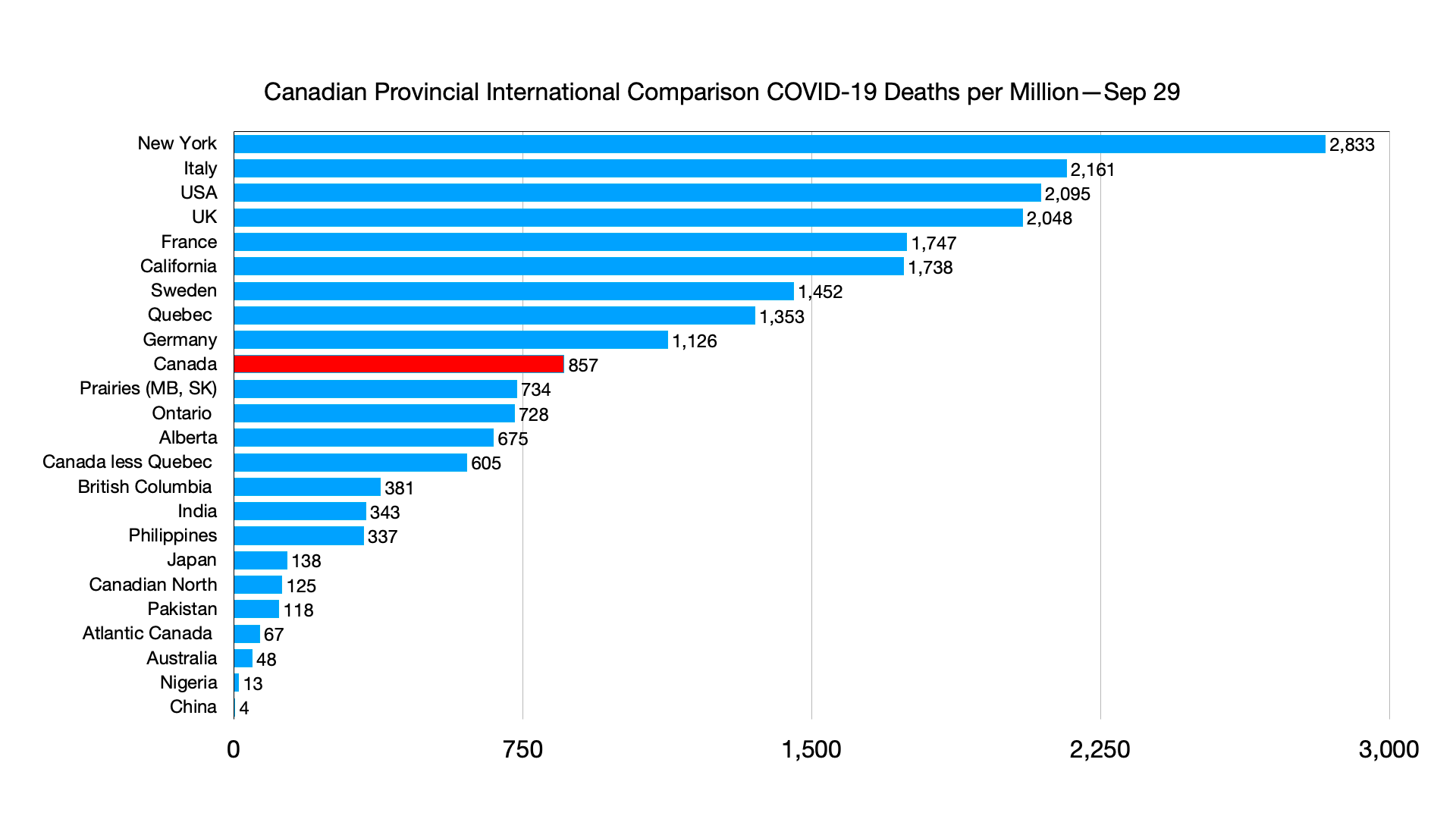
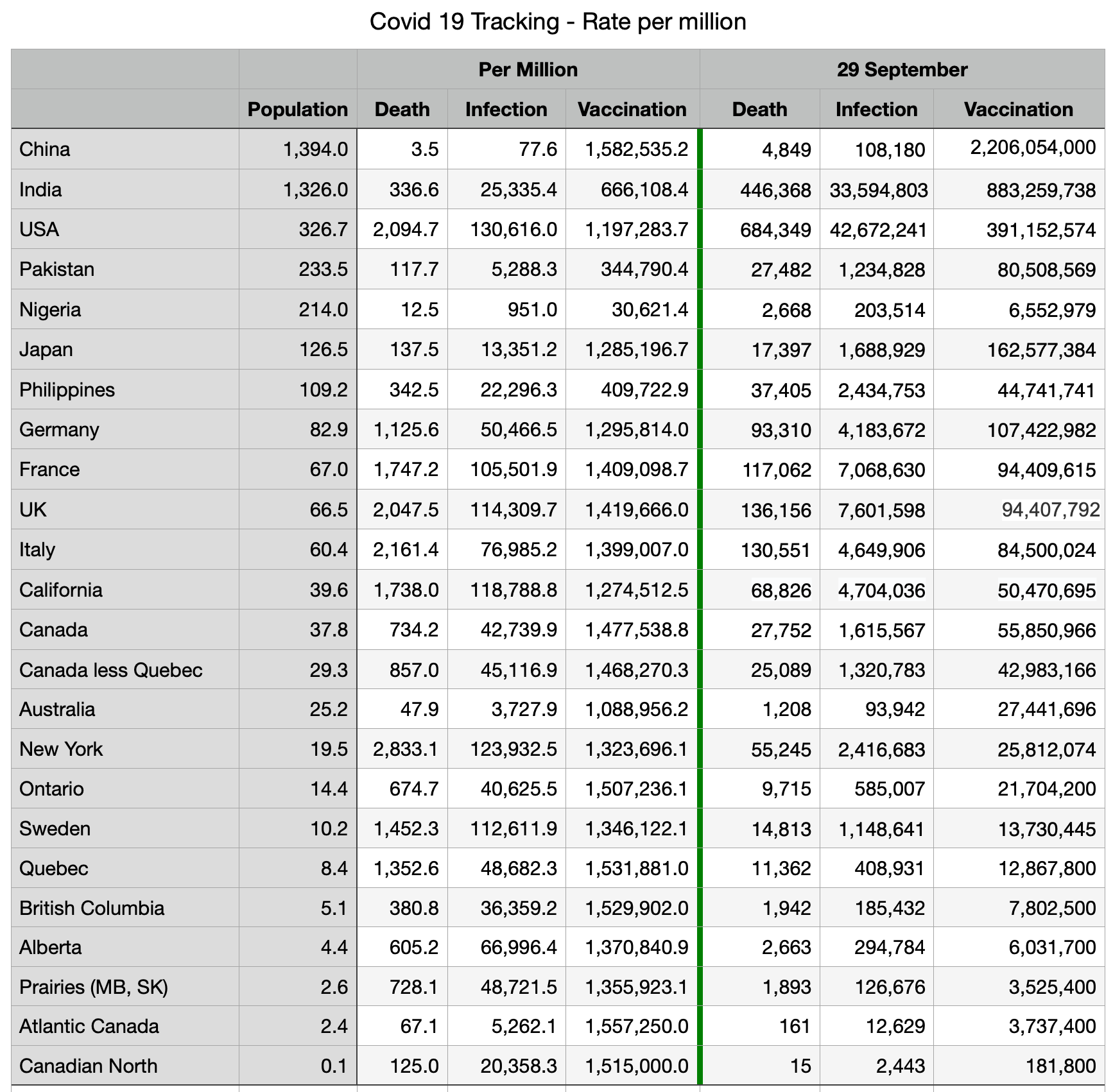
#COVID-19: Comparing provinces with other countries 4 August Update, China’s Delta variant

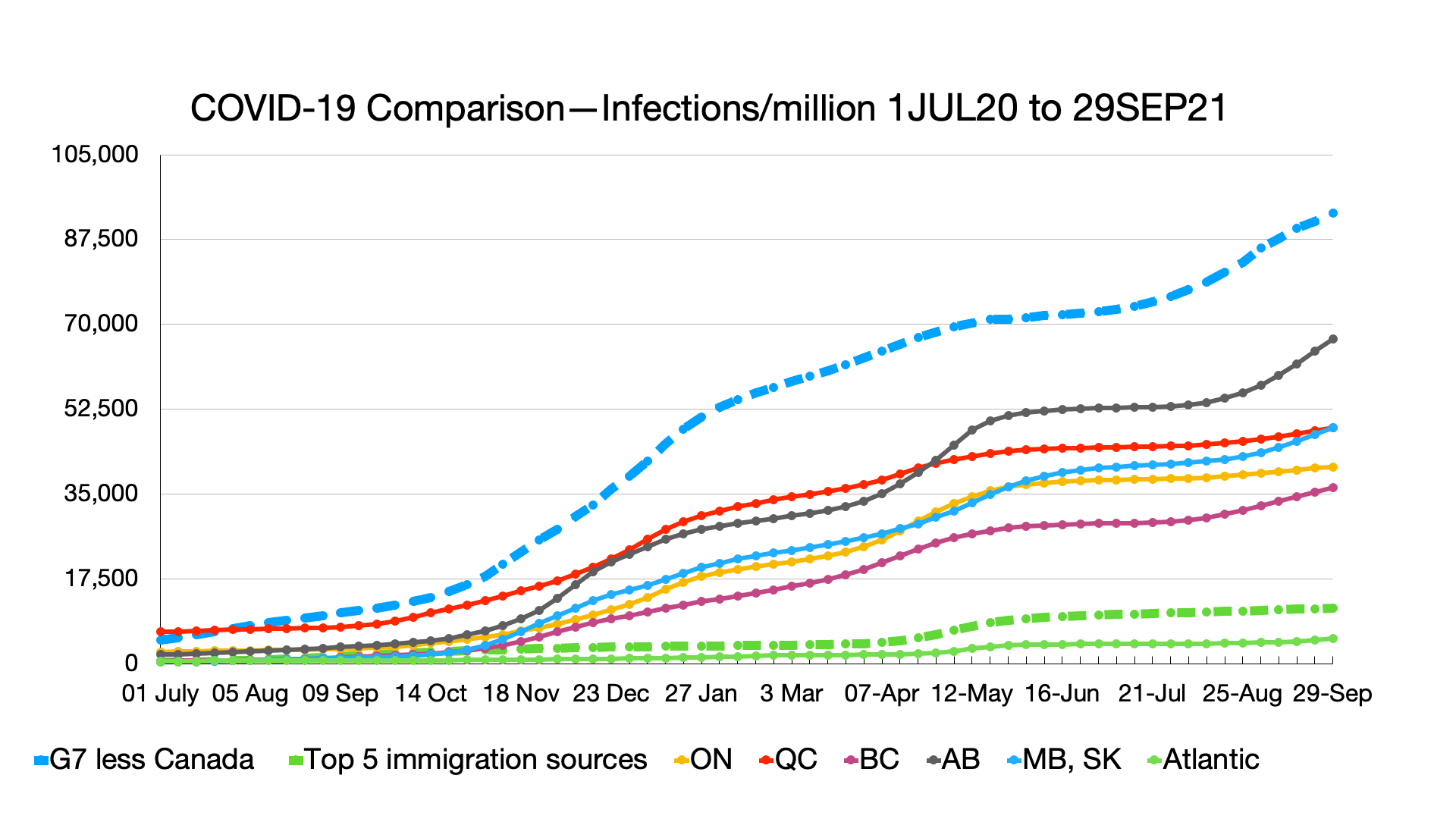
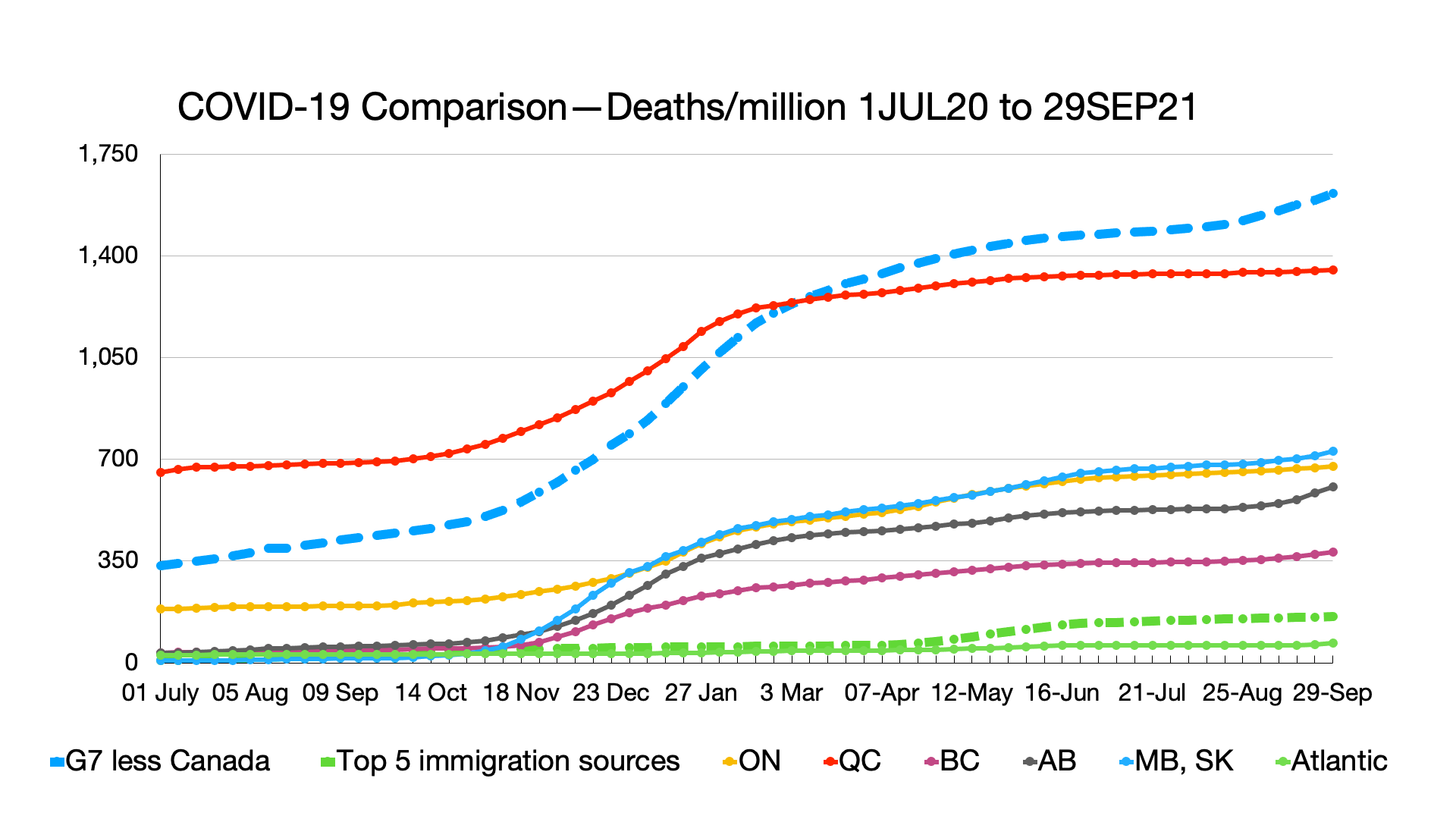
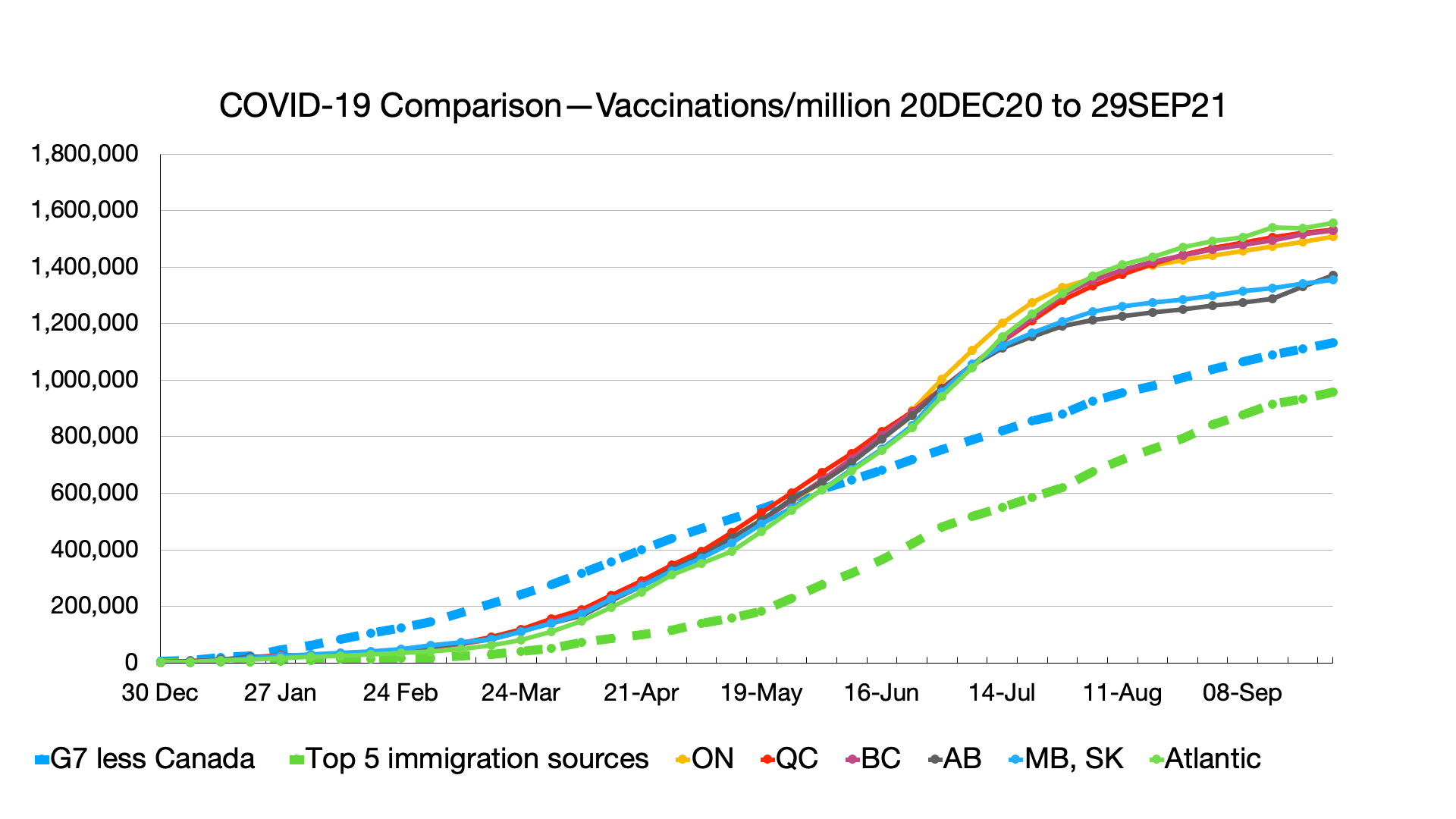
The latest charts, compiled 4 July as overall rates in Canada remain relatively stable but with slight increases due to the variant. Canadians fully vaccinated now 59.8 percent, higher than USA 50.3 percent and the UK 57.2 percent).

Vaccinations: All Canadian provinces ahead of USA and EU countries, all but Prairies ahead of UK.

Trendline charts

Infections: No significant change but slight uptick in G7 less Canada more apparent given increased infections in UK and USA. The outbreak of the Delta variant in China and consequent lockdowns is covered in the article following the charts.

Deaths: No significant change.

Vaccinations: Ongoing steady gap between Canadian provinces and G7, immigration source country increase continues to be driven by China (fully vaccinated 16 percent) and India (fully vaccinated 7.6 percent).

Weekly

Infections: No relative change.

Deaths per million: No significant change.

China now grappling with the Delta variant with Wuhan under lockdown:

China’s spiraling Delta variant outbreak has reached Wuhan, the original epicenter of the pandemic, prompting citywide coronavirus testing as authorities scramble to contain the city’s first reported local infections in more than a year.China is grappling with its worst outbreak in months, with more than 300 cases detected in more than two dozen cities across the country. The country now has 144 medium- and high-risk areas, the most since the initial outbreak in early 2020, the National Health Commission said Wednesday.The speed and scale of the spread has spurred mass domestic travel restrictions, with all inter-city coach, taxi and online car hailing services suspended in medium- and high-risk areas. Chinese immigration authorities have also vowed to “strictly restrict non-urgent, unnecessary cross-border travel,” including tightening the issuing of passports for Chinese citizens.

On Monday, seven infections were reported among migrant workers in Wuhan, the central Chinese city where the coronavirus was first detected in December 2019. As of Wednesday, a total of 20 local infections have been reported, including 8 asymptomatic cases, according to the Hubei provincial health commission.

The city of 11 million people was placed under the world’s first and arguably strictest coronavirus lockdown in January 2020, during the height of its devastating initial outbreak. The paralyzing 76-day lockdown came at a huge personal cost to residents, but eventually succeeded in taming the virus. Wuhan had not reported any locally transmitted cases since May last year.

Despite the initial mishandling, the Chinese government has heralded Wuhan as a success story in its fight against the pandemic. In August 2020, as much of the world grappled with Covid-19, Wuhan made international headlines when it held an electronic music festival in an open air water park, with thousands of people partying without any masks or social distancing measures in sight. 

Some fear the return of a stringent lockdown. Videos and photos shared on social media Monday show empty shelves and long lines at supermarkets, as residents rushed to stock up daily supplies.”Seeing Wuhan people panic buying at supermarkets makes me feel sad. Only those who have experienced it understand how terrible it is, (we) dread a return to the days of staying at home and not knowing where the next meal is,” said a Wuhan resident on Chinese microblogging site Weibo.During Wuhan’s initial lockdown, millions of residents were ordered to stay in their homes, relying on officials and volunteers for daily necessities — often at a higher price.As of Wednesday, no citywide lockdown has been announced for Wuhan, although residential compounds linked to detected cases have been placed under targeted lockdowns.

Spiraling outbreak

The ongoing outbreak first started in Nanjing, Jiangsu province in eastern China, where nine airport cleaners were found to be infected on July 20 during a routine test. Chinese authorities have linked the cluster to a flight from Russia, which arrived at the Nanjing Lukou International Airport on July 10. 

“It is believed that the cleaners did not strictly follow anti-epidemic guidelines after cleaning Flight CA910 and contracted the virus as a result. The infection further spread to other colleagues, who are also responsible for cleaning and transporting garbage on both international and domestic flights,” reported state news agency Xinhua.

Since then, the cluster has spread to at least 26 cities, including the tourist hot spot Zhangjiajie and the capital Beijing. In just two weeks, China has reported more than 480 locally transmitted confirmed cases, according to a CNN tally of the National Health Commission’s daily reports. Not all infections have so far been directly linked to the cluster in Nanjing.

On Monday, 63 local infections, including 50 asymptomatic cases, were reported in Zhengzhou, the provincial capital of Henan province which was ravaged by deadly floods last month. Most cases are linked to an outbreak at a hospital, where janitors, medical staff and patients are among those infected. The city launched citywide testing Sunday.

The fast spreading Delta variant has posed a major challenge to China’s hardline zero Covid strategy, which relies on mass testing, targeted lockdowns, extensive contact tracing and strict quarantine measures to quickly suppress local flare-ups.

China responded by doubling down on its containment approach, adopting stringent measures on a scale not seen in months. Several cities have been placed under effective lockdowns, ordering residents to stay in their homes and canceling flights and trains. The country has also imposed massive nationwide travel restrictions. All provincial authorities have urged citizens not to travel to medium and high-risk areas or leave the provinces where they live unless it is strictly necessary. 

The Chinese government is particularly concerned about the spread of the virus to Beijing, which is set to hold the Winter Olympics in February next year. The city has reported a handful of cases since last week — its first coronavirus resurgence in months. 

Beijing authorities have banned people from medium- or high-risk areas from entering, suspending flights, trains and buses from Covid-hit places. Since Tuesday, 23 railway stations have halted ticket sales for train rides heading to the capital, Xinhua reported.

Chinese authorities are also tightening restrictions on cross-border travel. China is still largely closed off from the outside world, and those who are allowed to enter are subject to lengthy hotel quarantine. At a press conference Wednesday, an official with the National Immigration Administration said authorities would stop issuing travel documents, such as passports, for Chinese citizens who want to leave China for “non-urgent, unnecessary” reasons. Individuals who need to travel overseas for study, work or business purposes would still be issued travel documents upon approval, he added. 

Mahjong parlors

China reported 71 locally transmitted confirmed cases On Wednesday, with nearly half of them coming from Jiangsu province, according to the National Health Commission. The city of Yangzhou, neighboring Nanjing, has become the latest hotspot, reporting 32 local infections.Authorities have blamed the outbreak in Yangzhou on a 70-year-old Nanjing resident, who traveled to Yangzhou on July 21 despite her residence in Nanjing had been placed under a lockdown, according to a statement from the Yangzhou police.The elderly woman, who stayed in Yangzhou with her sister, did not inform local officials of her travel history as required, and repeatedly visited crowded places including restaurants, markets and mahjong parlors, the statement said.The woman sought treatment at a hospital on July 27 after she started coughing and developed a fever, and tested positive for coronavirus a day later. She has been criminally detained by police and is under investigation for suspected obstruction of the prevention and control of infectious diseases, according to the statement.

Mahjong parlors, popular with older people, have played a central role in the spread of Covid in Yangzhou, according to authorities. On Wednesday, Jiangsu officials said at a press conferencethat 64% of Yangzhou’s 94 confirmed cases as of Tuesday were linked to Mahjong parlors, and 68% of confirmed cases are above 60 years old. Both Yangzhou and Nanjing have conducted several rounds of citywide testing, and suspended all domestic flights, long-distance buses, taxis and online car hailing services from arriving and departing.

Source: https://www.google.com/url?sa=t&rct=j&q=&esrc=s&source=web&cd=&cad=rja&uact=8&ved=2ahUKEwia6cWm95fyAhVNMlkFHVudBGgQFnoECAkQAw&url=https%3A%2F%2Fwww.cnn.com%2F2021%2F08%2F04%2Fchina%2Fchina-delta-outbreaks-intl-hnk%2Findex.html&usg=AOvVaw3PoVYncfFvnc5YrT6b2bw5

Immigration Can Offset US Population Decline | Cato at Liberty Blog

Cato Institute’s reply to the CIS post highlighting the limits of immigration in addressing an aging population ( Immigration and the Aging Society ). Not convinced. And like all immigration debates, the question is one of balance and understanding the limits of immigration in addressing ongoing policy and demographic issues:

The U.S. population is growing slowly and the average age of Americans is increasing as a result. Although the United States is not as old as other countries and likely to age better, the future looks demographically grim. Some social scientists and commentators think that boosting immigration can help delay or reverse those trends. Steven Camarota, director of research at the Center for Immigration Studies, makes a series of silly argumentsagainst the notion that immigration can slow the aging of the U.S. population. Camarota’s points below are in quotes and my responses follow.

In reality, a significant body of research shows that the impact of immigration on population aging is small. While immigration can certainly make our population larger, it does not make us dramatically younger.

Camarota might be correct that the current and historically low rate of immigration to the United States doesn’t much lower the average age of the population, but that does not mean that immigration could not lower the average age if it were expanded. He merely shows that current U.S. immigration policy, which is very restrictive and much closer to his ideal level than mine, cannot much affect the average age. We shouldn’t expect a restrictive immigration system that allows in, at least prior to the immigration restrictions adopted by President Trump and partly maintained by President Biden (so far), a number of immigrants roughly equal to 0.3 percent of the population annually to have a big effect on the average age of the population. In 2018, 32 OECD countries had higher immigration flows as a percent of their populations and only five had lower flows, relative to the United States. Camarota’s point does not rebut the argument that expanded immigration would lower the average age and expand U.S. population.

But demographers have known for a long time that, absent truly gargantuan and ever‐​increasing rates of immigration, it isn’t actually possible for immigrants to undo or dramatically slow the overall aging of society. As Oxford demographer David Coleman observes, ‘it is already well known that [immigration] can only prevent population ageing at unprecedented, unsustainable and increasing levels of inflow.’

Do demographers know that? I looked up the source of the quote by David Coleman, former British MP and member of the Galton Institute. Camarota clipped a portion of a longer quote that makes a slightly different point. Coleman’s full quote is: “Although immigration can prevent population decline, it is already well known that it can only prevent population ageing at unprecedented, unsustainable and increasing levels of inflow, which would generate rapid population growth and eventually displace the original population from its majority position [Camarota’s quote italicized].”

Coleman agrees that immigration can prevent population decline. He identifies two problems with more immigration: It would “generate rapid population growth and eventually displace the original population from its majority position.” Rapid population growth is one of the many goals of those of us who favor liberalized immigration, so I have no argument with Coleman there. We simply disagree as I believe that population growth is positive and he thinks it’s negative. When it comes to “displace the original population from its majority position,” Coleman means that immigrants and their descendants would eventually become the majority of the population in the United Kingdom at a high level of immigration.

There’s no good reason for Camarota to find that shocking as it has happened at least once in U.S. history. As sociologist Charles Hirschman pointed out, the population of the United States today would only be about 100 million if immigration had stopped in 1800. Since the current population is about 330 million, that means most Americans are immigrants or the descendants of post‐​1800 immigrants. That doesn’t mean that boosted immigration would be “unprecedented” or “unsustainable.” It sounds like a return to immigration normality for Americans.

There are four broad reasons why the demography doesn’t support the political credo. First, not all immigrants arrive young — in fact, a growing share are arriving at or near retirement age. Second, immigrants age just like everyone else, adding to the elderly population over time. Third, immigrant fertility rates tend to converge with those of the native born. Fourth, to the extent that immigrants do have higher fertility rates than the native born, their children add to the dependent population — those too young or old to work.

Camarota’s first point is a curious criticism of the current restrictive immigration system. If this is his concern, why not just increase legal immigration opportunities for younger immigrants? Camarota’s second point somewhat answers that criticism – because “immigrants age just like everyone else, adding to the elderly population over time.” After all, newborn babies age too and will one day retire, which is a particularly poor argument against having children or increasing immigration.

Camarota’s third point is that immigrants assimilate. While a surprising admission from Camarota given his research, immigrants and their children still increase the population, and it takes time for immigrant fertility to approach that of natives – which he admits in his next point. Camarota’s fourth point is that immigrants have higher fertility rates that produce children who are also dependents.

To sum up, Camarota thinks that our current immigration system doesn’t help reduce the ratio of dependents to workers, immigrants age like everybody else, immigrant fertility shrinks too rapidly, and immigrant fertility doesn’t shrink fast enough.

The Census Bureau also estimates that, in 2060, 59% of the population will be of working age. Again, this is based on the assumption that net migration will amount to an average of 1.1 million each year. Under a zero‐​immigration scenario, just under 57% of the population would be of working age. In other words, while immigration is projected to add 75 million people to the American population by 2060, it will only increase the working‐​age share of the population by about two percentage points. Even if annual net immigration were expanded by 50% above what the Census Bureau projects, so that it averaged about 1.65 million a year, it would still only increase the working‐​age share of the population by three percentage points.

In other words, Camarota writes that the U.S. can increase immigration by 50 percent and have a working‐​age share of the population in 2060 similar to what it would otherwise be in 2027 or, on the extreme other side, 2060 America will look like Japan will in 2032. The percentage point spread is small, but the social, economic, and fiscal impacts are larger than they appear. Japan’s looming population collapse is terrifying and a few percentage points difference caused by expanded legal immigration can delay it for decades or longer. Even better, expanding legal immigration is a lot cheaper than birth subsidies.

You can read the rest of Camarota’s piece as it merely expands upon his points, offers some politically correct suggestions for reforming entitlement programs, and adds more figures. Nowhere does Camarota contest the obvious counterargument that immigration’s currently small effects on America’s age distribution result from very restrictive immigration policies.

The U.S. fiscal imbalance is a serious problem created by a poorly designed entitlement system. Declining U.S. fertility exacerbated the problem of the fiscal imbalance in a way that a well‐​designed system would not face. In addition to that, a growing population is correlated with increasing prosperity over the long term. More people mean more ideas, workers, consumers, investors, as well as potential friends, neighbors, and family members.

The worldwide and American increase in economic output from expanded legal immigration would be large and much of it could be captured to resolve the fiscal imbalance – at least for a few more generations. According to some estimates, massively expanded immigration would place the United States in an unassailable economic position. Allowing Americans and immigrants to interact as they see fit would also be a more ethical policy. In short, there are many reasons to support expanding legal immigration, and reversing expected US population decline is one of them, despite what Neo‐​Malthusians say.

Source: Immigration Can Offset US Population Decline | Cato at Liberty Blog

Immigration: Canada expands non-Canadians’ rights to information and privacy requests

Given the lengthy ATIP processes, particularly for policy-related requests, not sure the degree to which this change will results in material benefits:

Earlier this month, Canada announced a major change to its rules for access to information and privacy (ATIP) in the Canada Gazette.

The change is simple, but the impacts are profound. The Canadian government is going to allow anyone to make an ATIP request under the Privacy Act. This new policy will bring Canada into line with global standards on ATIP. It will also vastly expand the rights of non-Canadians.

Laws such as the Privacy Act allow people to make ATIP requests to the federal government. Immigration, Refugees, and Citizenship Canada (IRCC) is a federal agency, so it is subject to the Privacy Act.

Currently, there are limitations on who can make an ATIP request through the Privacy Act. One of the items limits the right of access to two groups:

  • Canadian citizens and permanent residents, inside or outside of Canada; and
  • any entity (person or business) inside Canada, whether a citizen or not.

This limitation means that non-Canadians who are outside of Canada cannot make requests under the Privacy Act. There is a way to get around this rule. An ineligible person can get someone who is eligible to make a request on their behalf. However, this process can be expensive and time-consuming.

Having the ability to make an ATIP request to IRCC can be very helpful. For example, an ATIP request can allow a person to access their Global Case Management System (GCMS) notes. These are the detailed records of a person’s immigration case. They will explain IRCC staff’s thinking and decision-making. They can help a person understand why IRCC has decided the way it has. This knowledge, in turn, can also help the person challenge the IRCC decision. For example, the person could show the officer ignored or mis-interpreted something.

IRCC is a popular target for ATIP requests. In fact, there are more ATIP requests for IRCC than there are for any other federal government department combined.

Because this change is so important, IRCC expects it will need time to make sure it goes smoothly. For example, IRCC will have to change forms and processes. It will also likely have to deal with a much greater number of requests. For this reason, the government is delaying when the new rule takes effect. Per the Canada Gazette, the Canadian government changed the Extension Order on July 14, 2021. However, the Gazette also noted that the change takes effect on its first anniversary. This means that on July 14, 2022, the new rule will come into force.

The new rule is a major step forward for non-Canadians. There is a delay in effect. This delay, itself, is because the change is so large and important.

Source: Immigration: Canada expands non-Canadians’ rights to information and privacy requests

Canada faces a staggering immigration backlog. With the border reopening and applicants anxious to get here, how should Ottawa prioritize?

Good overview of the backlog and related issues that IRCC will have to address:

Thanks to COVID-19, Linda Shaji and Canada have had what you might call a bad romance.

After a lengthy vetting process, the 29-year-old from India was approved for permanent residence here on March 20, 2020 — two days after this country’s border was closed.

Now, 16 months later, her Canadian immigration visa has expired and Shaji is still home at her parents’ house, waiting to be admitted into this country.

The worst part is, after all this time, she’s still in the dark — met with automated email responses and told by Canada on its immigration website: “To wait for us to tell you what happens next. You don’t need to contact us again.”

“Ghosting us when we ask questions. Denying anything is wrong. Saying we are too needy when we question the long silence,” Shaji paused, “if this is a relationship, these are some serious red flags.”

The pandemic has wrecked havoc on the entire immigration system, with backlogs for every program — from family reunification to different economic immigration streams — that are only growing.

Now, as the border begins to reopen, the federal government is faced with long lines of disgruntled applicants, all looking to be the first to come in and start new lives in this country, while the bureaucracy struggles to digitalize an outdated case management and processing system.


Since March 18, 2020, when Canada closed its border in the face of the emerging pandemic, the immigration system has ground to a halt. The federal immigration department found itself scrambling to secure laptops for stay-at-home staff and to transition its processing online.

As of July 6, the backlog of permanent residence applications had skyrocketed by 70 per cent to 375,137 since February 2020, with the number of applications for temporary residence currently sitting at 702,660 cases.

The backlog of citizenship applications has also ballooned: it’s reached 369,677 people from 208,069 over the same period. These numbers do not include the applications that have been received at the mailroom of immigration offices but which have yet to be entered into the system.

Amid border lockdowns here and around the world, Canadian officials prioritized foreign nationals whose travels were deemed essential, such as migrant farm workers and health workers. They also responded to the plight of international students, who had paid a fortune to study in Canada and were in immigration limbo.

Wanting to keep the country’s immigration pipeline flowing, but not knowing how long travel restrictions would be in place, officials turned to the huge pool of migrant workers already in Canada to offer some of them permanent residency.

Immigration Minister Marco Mendicino has, meanwhile, been criticized by applicants left, right and centre who have had their lives, careers and dreams put on hold, some facing prolonged separation from spouses and parents or grandparents who are being kept out of the country.

“The growth of the inventory or what is described as backlogs is very much a function of the pandemic. There (was), quite literally, in the case of new permanent residents, no place for them to come to as a result of the travel restrictions,” Mendicino said.

“We hear you. We see you. Each and every one of your cases matters to me and to our department and to our government.”

While Mendicino has boasted about the quick adaptation of the immigration system to the pandemic, often citing the virtual citizenship test and oath-taking ceremony as examples, he has yet to make public a detailed plan or priorities for when the border reopens.

Recently, Canada’s reopening effort reached a new milestone, with the federal government set to welcome fully vaccinated U.S. citizens and green card holders at the land border for non-essential travel beginning on Aug. 9 without having to quarantine, and from other countries beginning Sept. 7.

What Mendicino needs to do immediately, experts and advocates say, is bring in the migrants who have already been vetted and approved for permanent residence but kept outside of Canada.

“All of the backlogs have now been exacerbated. The government has to provide some clear pathways and criteria for prioritization,” said independent Sen. Ratna Omidvar, a strong voice on migration, diversity and inclusion in the Senate.

“It should do everything it can to process those people who’ve already been processed. They should be a priority. They’ve put their lives on hold because we’ve selected them. They need to come to Canada. They need to put roots down.”


Shaji quit her job at an artificial intelligence development firm last July, when she got her visa after the visa office in India reopened. But Canada’s door was closed to immigrants even if they had valid visas because it was deemed non-essential travel.

“There is still no set timeline for anyone. It means further agony of waiting,” said Shaji, who has yet to hear from the federal government on what she needs to do regarding her expired documents in order to get here.

“Immigration surely matters to Canada, but do immigrants matter?”

In late June, Ottawa started opening the border to immigrants who have valid permanent residence visas to enter Canada, but the ones with expired documents were told more information would be forthcoming and not to contact officials.

For travellers like Shaji from India, Canada’s top immigrant-source country, getting here is another logistical challenge.

Ottawa has just extended its ban on all flights from India to Aug. 21, meaning even Canadian citizens can’t travel back. The ban was introduced in April due to the unruly surge of COVID-19 cases and deaths in the country.

The pandemic has exposed many shortcomings of the immigration process, said MP Jenny Kwan, the NDP’s immigration critic, and officials must cut unnecessary red tape and bureaucracy in these unprecedented times.

One of the things they could do, she said, is to automatically renew immigration applicants’ expired documents.

Requiring people to scramble to update outdated documents during a pandemic may buy Ottawa time, she noted, but it won’t solve the crisis and is going to further agonize immigration applicants.

“To this day, it is a mystery to me why the government has insisted on contacting each individual with an expired or expiring permanent resident visa to see if they still wanted to come to Canada, instead of just automatically renewing it,” Kwan said.

“Why did they do that? Why did they spend all those resources doing that instead of putting it into processing applications? They need to adopt an approach that’s not so rigid.”


Taraneh Gojgini sponsored her parents, Kaykavoos and Sima Gojgini, both American citizens, to join her in Vancouver from Long Island, N.Y., in 2018. The couple were issued their confirmation of permanent residence in September 2019 and had booked a flight to move here in April 2020. Due to COVID-19, the border was closed and their flight cancelled.

They didn’t hear anything from immigration officials for 10 months until this February, when they were asked if they were still interested in moving to Canada. The couple confirmed their desire to come here but wanted to delay the trip until the summer after most Canadians were expected to have been vaccinated.

Last April, after their visas expired, they were asked again if they were ready to come and told to send in their passports and photos for a new visa. In June, another email came asking them a third time if they planned to come to Canada. This time, they were also told to do a new medical exam.

“My parents are past the point of worry. They are so upset and anxious that there is no calming down their concern at this point,” said Gojgini, who moved to Vancouver in 2011 after marrying her husband, Behzad Pourkarimi. “They have become disillusioned with Canada.”

Kwan said reuniting families, whether spouses or parents, should be a priority for the immigration department, even if it means letting applicants abroad come here first on temporary visas and have their permanent residence applications processed within Canada so families won’t be kept apart even longer.


Suhani Chandrashekar, an engineer, came to Canada from India on a work permit in 2018 and went back to marry Naveen Nagarajappa, a close family friend, in December 2019. She returned to Canada and entered her profile into the skilled immigration pool for permanent residence.

In March 2020, just before COVID was declared a global pandemic, she received an invitation to submit her application under the Canadian Experience Class. Her case has since been stalled.

“Staying away from each other for so long is putting unnecessary strain on our marriage. We are also planning to start a family. But the uncertainty is not helping our cause here,” said the 29-year-old Toronto woman, who also has a pending application to have her husband join her here on a temporary work permit.

“Even after more than a year and a half of marriage, we are not able to see each other.”

Vancouver immigration lawyer Steven Meurrens said many of the permanent residence applications in the backlogs are actually near “finalization,” just pending approvals and admission.

Application backlogs in economic immigration, such as Canadian Experience Class or federal skilled workers, should be quick to clear, he contends, because they are processed online based on points allotted to applicants’ age, education, language test result and related work experience — and only require straightforward document reviews.

The paper-based family class applications, however, will be a problem because these are harder to process remotely and involve more discretionary decision-making by individual officers, and will take longer to finalize.

“The government has shown that where they’re willing to allocate resources and put the effort toward processing files, they can achieve it,” Meurrens said. “If they want, they can clear out this backlog easily.”

To him, the biggest question for Ottawa is whether it has the will to greatly exceed the annual immigration targets that they’d set — 401,000 in 2021; 411,000 in 2022; and 421,000 in 2023 — while simultaneously clearing backlogs and processing new applications that keep coming in.

“Are they prepared to explain to Canadians why immigration levels are going to go up because we’re processing this backlog while maintaining existing plans?” Meurrens asked. “If they don’t do that, they will have more application backlog delays.”

One of the blessings of the pandemic, he said, is that it gave Ottawa the opportunity to transition a large number of migrants on temporary status in Canada, such as precarious low-skilled workers who otherwise wouldn’t qualify for immigration, to become permanent residents.

“COVID has reduced that gap between the number of people who work here and the number of people who can immigrate,” said Meurrens. “Otherwise, we risk developing this permanent foreign worker class in Canada.”

Earlier this year, Ottawa introduced a one-time special program to grant permanent residence to 90,000 international graduates and essential migrant workers already in Canada in part to meet its 2021 immigration targets and in part to recognize migrant workers’ contributions to Canada during the pandemic.

Sen. Omidvar said the pandemic has shown Canadians that our economy not only needs highly educated STEM scientists and engineers but also immigrants who deliver essential services such as in agriculture and health care during the crisis.

A 21st-century immigration system needs to recognize those “essential skills” in the labour market that go beyond minimum language requirements and how many university degrees an immigration applicant has, she said.

“Let’s get away from this dichotomy and this unfortunate language of low skills and high skills. It doesn’t suit us anymore in this new era,” Omidvar said. “We need to view the labour market a little bit more broadly than we have done in the past. Coming out of this crisis, that’s the new horizon we need to grasp.”


For front-line immigration officers, many of whom are still working from home, having the proper digitizing infrastructure is key post-COVID-19, said Crystal Warner, national executive vice-president of the 27,000-member Canada Employment and Immigration Union.

During the pandemic, immigration staff were not equipped to work from home and some had to take turns going into the office, which only allowed a 20 per cent capacity at one point. Programs were de-prioritized and then reprioritized, and her members — 78 per cent women — weren’t given proper training and support, she said.

“There is a lack of a centralized digitization process. Staff are scanning mailed applications on desktop scanners at their desks in the office. It’s not an effective strategy. Progress is being made, but it is slow,” she said.

Warner said some of the systems are still not upgraded appropriately and crash all the time. Just recently, after a meeting where staff were told that significant investments were being made into the bandwidth and server space, the whole system crashed for the day, nationwide.

“This is ongoing,” she said. “On the one hand, they are digitizing like crazy and on the other hand, the hardware and system upgrades are not keeping pace.”

It’s an issue the federal government is hoping to address with an $800-million investment to modernize the immigration system in its 2021 budget, said the immigration minister.

“That’s the really exciting work that lies ahead of us, which is going to, I think, catapult us into an entirely transformed immigration system,” Mendicino said. “Our system needs to be transformed, needs to be modernized, so that it can accommodate the great demands that are placed on it.”


While the current immigration case management system certainly needs an upgrade, critics said Mendicino must first figure out the vaccination requirement for travellers — both permanent and temporary residents — who don’t meet current border exemptions.

Whether to let someone into the country should be based on vaccination status rather than just about which immigrant group Ottawa wants to prioritize, said Ravi Jain, past president of the Canadian Bar Association’s immigration division.

“If people are fully vaccinated, I think we’ve got to start opening up,” he said, adding that processing immigration applications abroad depends very much on how well other countries manage the pandemic and their lockdown conditions, which hinders Ottawa’s priorities.

Ottawa, Jain noted, needs to figure out a vaccine passport that’s easy to enforce and can complement ArriveCan, the government app for travellers to provide travel info before and after entry to Canada, as well as which vaccines should be recognized based on science.

For fairness, he said, officials do need to allow prospective immigrants who have been waiting the longest to come first and start a new life here, as well as fast-tracking investors and businesspeople who can create employment in Canada for its economic recovery.

“I don’t want to say that you prioritize this and that particular group, and everyone else is waiting,” said Jain.

“There’s nothing preventing the government from moving forward on all fronts and on all these issues. What’s been preventing them, frankly, has been the border. That’s been the real sticking point.”

For overseas immigration applicant Maninderjit Singh, it’s simply heartbreaking to see those applying for permanent residence from abroad being shut out from the process.

The lawyer from Punjab, India, entered the federal skilled worker pool in January with 467 points, but the government has not had one single draw for the program.

And time is running out because a candidate loses points with increased age, five points per year as the system targets those in prime working age. Singh’s score has already come down by five points to 462 after he turned 32 recently.

“Thousands of federal skilled worker applicants are getting prejudiced with each passing day. Our life is now at a stand still,” he said. “With reduced score and thousands of new applications adding into the pool, the chances are getting bleak for me to get invited to Canada.”

Source: Canada faces a staggering immigration backlog. With the border reopening and applicants anxious to get here, how should Ottawa prioritize?

Canada’s international students are becoming less diverse. Here’s why Ottawa says that’s a problem

Of note (so much for the 2019 strategy!):

More and more foreign students are coming from the same countries, concentrating in particular school programs and provinces, and that could spell trouble for Canada’s international education sector, says a new study.

Based on immigration and post-secondary student information data between 2000 and 2019, Statistics Canada examined the countries from which international students come, and how those students’ level of study and province of study have evolved over the years.

Over nearly two decades, the number of first-time study permit holders almost quadrupled to 250,020, with the most notable jump coming post-2015 with the annual growth rates ranging between 12.5 per cent and 27 per cent.

The share of the international student population from the top 10 countries has grown from 67.9 to 74.9 per cent, with those from India skyrocketing to a whopping 34.4 per cent of the pie from just 2.7 per cent 20 years ago.

Increasingly, international students are drawn to shorter, cheaper college programs with business, management and public administration becoming the dominant fields of study.

While international enrolment increased in all provinces, Ontario consistently attracted the largest share of foreign students, with its percentage up steeply to 48.9 per cent in the 2015-19 cohort from just 37.4 per cent in the 2000-04 cohort.

“Despite its growth, the international student population has become less diverse in many ways over the past two decades,” said the study released this week.

And those trends go against Ottawa’s International Education Strategy, unveiled in 2019, which cited the “need for diversification” in the flow of international students to Canada as well as their fields as well as levels and location of study.

“Attracting students from a wider diversity of countries, as well as to a greater variety of regions and schools, would foster sustainable growth of Canada’s international education sector and distribute the benefits more equitably across the country,” said the strategic plan.

“The new strategy contributes to these goals by increasing the diversity of inbound student populations, skill sets and programs, and by fostering people-to-people ties and international networks.”

Like diversifying investments to reduce risk, attracting students from different countries can also minimize the impact on international enrolment if there is a particular regional economic downturn — the kind that might make students from a certain area halt their studies.

According to the study, the growth of international education in the past five years has much to do with new regulations in 2014 that set up a designated learning institution regime to stamp out “nongenuine and poor quality” schools as well as automatically allowing the students to work off-campus for up to 20 hours per week.

Over the years, Ottawa has also made a strong push to favour those with Canadian education credentials and work experience as potential permanent residents, turning international students into a pipeline for permanent immigration.

At the program level, the Statistics Canada study said, the shares of international students in elementary through secondary schools have declined, but it was made up for by increases in the shares intending to study at the college and master’s degree levels.

In 2019, the share of first-time study permit holders at the elementary school level was five per cent, a drop from the 10 per cent in 2000. The corresponding share also declined at the secondary level from 18 per cent in 2000 to 11 per cent in 2019.

In contrast, those in college programs grew from 27 per cent to 41 per cent as their peers studying at the master’s degree level doubled from five per cent to 10 per cent. The share of international students at the doctoral degree level was steady, at two per cent.

Among the 2015-19 cohort, there were 324,000 international students in college programs, compared to 246,000 in universities over the same period.

Over the past five years, India (34.4 per cent) has replaced China (16.5 per cent) as the top source country for international students, followed by South Korea (4.7 per cent), France (4.5 per cent), Brazil (3.3 per cent), Vietnam (2.7 per cent), Japan (2.6 per cent), the United States (2.6 per cent), Mexico (2.1 per cent) and Nigeria (1.9 per cent).

Of those in college programs, Indian students made up 66.8 per cent of the international student population. Those from India also accounted for 21.3 per cent of that population in universities.

Ontario was the main beneficiary in the competition for international students, with its share up from 37.4 per cent in 2000 to 48.9 per cent in 2019, while B.C. saw the biggest drop from 31.1 per cent to 22.7 per cent over the two decades. Alberta’s and Quebec’s shares both dropped slightly as well.

At both the college and university levels, the most common field of study for international students was business, management and public administration, although growth in the field being more prominent at colleges, up from 37 per cent to 41 per cent in the last decade, at the expense of international enrolment in architecture, engineering and related technologies, and of visual and performing arts, and communications technologies.

The share of international students in math, computer and information sciences was up notably in colleges while universities saw a bigger gain in international students studying physical and life sciences and technologies.

“Looking forward, trends in the sociodemographic characteristics of international students have the potential to influence the sustainable growth of Canada’s international education,” the Statistics Canada study concluded.

“Increased concentration of international students by source country, level of education, province of study and field of study may have a downstream impact on the potential pool of candidates for permanent immigration and the Canadian labour force.”

Source: Canada’s international students are becoming less diverse. Here’s why Ottawa says that’s a problem

Americans Remain Divided on Preferred Immigration Levels

Latest Gallup poll. Overall trends toward more support for immigration along with notable partisan divided along with demographic details:

Americans divide almost evenly on whether immigration to the U.S. should be increased (33%), decreased (31%) or kept at its present level (35%). These preferences are similar to last year’s readings but reflect greater support for increased immigration since the early 2000s, reaching a high of 34% in 2020. At the same time, there has been a decline in recent years in the percentage of Americans who want immigration decreased, with last year’s 28% the lowest in the trend.

Line graph. Americans’ preferences for immigration levels. Thirty-five percent of U.S. adults want immigration kept at its present level, while 33% want it increased and 31% decreased.

For much of Gallup’s trend dating back to 1965, the plurality (if not the majority) of Americans wanted immigration decreased. Three surveys conducted between 1993 and 1995 found more than six in 10 wanting immigration reduced. After 9/11, 58% held this view, and as recently as 2009, 50% did.

Meanwhile, relatively few Americans called for increased immigration, with the percentage holding that view not surpassing 20% until 2012. Since then, it has not gone below that level and has been the preferred option for one in three Americans each of the past two years.

The current results are based on a June 1-July 5 Gallup survey that included oversamples of Black and Hispanic adults to allow for more precise estimates of those subgroups. The overall sample was weighted so all racial and ethnic groups are represented in their proper proportions of the U.S. population.

These findings come at a time when the U.S. is struggling to control crossings at its southern border, with many of those migrants coming from Central American countries. June saw the largest number of attempted border crossings in more than two decades. At the same time, many U.S. businesses are currently having difficulty filling open job positions. In the longer term, the U.S. has an increasingly aging population that may not be able to fill the number of jobs needed in the future.

Gallup’s latest update finds 9% of Americans naming immigration as the most important problem facing the country. Only the government and race relations are mentioned more frequently.

Hispanic Americans More Likely to Favor Increased Immigration

Forty-two percent of Hispanic adults want immigration levels increased, compared with 32% of non-Hispanic Black and 30% of non-Hispanic White adults.

Overall, White Americans divide equally in their preference for immigration, while Black Americans slightly prefer keeping immigration levels the same.

Preferences for U.S. Immigration Levels, by Racial/Ethnic Group
In your view, should immigration be kept at its present level, increased or decreased?
Increased Present level Decreased
% % %
U.S. adults 33 35 31
Hispanic adults 42 33 25
Non-Hispanic White adults 30 33 35
Non-Hispanic Black adults 32 41 26
GALLUP, JUNE 1-JULY 5, 2021

Since Gallup began tracking racial/ethnic groups’ immigration attitudes in 2001, each has shown a greater preference for increased immigration, especially White Americans. That year, 10% of White Americans, 24% of Black Americans and 33% of Hispanic Americans favored increased immigration levels.

The racial/ethnic group differences, however, are not as great as those for party identification and education. Fifty-seven percent of Republicans, compared with 12% of Democrats, want to see immigration reduced. In contrast, half of Democrats and 10% of Republicans want it increased.

Additionally, half of Americans with a postgraduate education think immigration should be increased, double the percentage among those with a high school education or less.

Preferences for U.S. Immigration Levels, by Party Identification and Education
In your view, should immigration be kept at its present level, increased or decreased?
Increased Present level Decreased
% % %
Party identification
Democrats 50 37 12
Independents 34 36 29
Republicans 10 31 57
Educational attainment
Postgraduate 50 23 27
College graduate only 37 39 24
Some college 31 34 31
High school or less 25 38 35
GALLUP, JUNE 1-JULY 5, 2021

Most Americans Continue to View Immigration Positively

Though Americans are divided on how immigration levels should change, they widely agree that immigration is “a good thing” for the country today. Three in four U.S. adults hold this view, while 21% disagree and say it is “a bad thing.”

At least seven in 10 Americans have viewed immigration positively since 2015, and majorities have consistently done so since Gallup first asked the question in 2001. At its lowest, 52% said immigration was a good thing in Gallup’s first post-9/11 reading in 2002.

Line graph. Belief that immigration is a good thing for the country today. Currently 75% of U.S. adults say it is a good thing and 21% bad thing. Majorities have consistently said it was a good thing, ranging from 52% to 77%.

Majorities of all key subgroups think immigration is good for the country today, with little difference by racial/ethnic group. However, significant gaps by party identification and education exist, as Republicans are less likely than Democrats and independents to view immigration positively, and fewer college nongraduates than college graduates say it is a good thing.

Views of Immigration as a Good or Bad Thing for the U.S. Today, by Subgroup
Good thing Bad thing
% %
Race/Ethnicity
Hispanic adults 80 16
Non-Hispanic White adults 73 23
Non-Hispanic Black adults 74 23
Party identification
Democrats 84 13
Independents 79 17
Republicans 57 39
Educational attainment
Postgraduate 85 13
College graduate only 85 11
Some college 72 24
High school or less 68 29
GALLUP, JUNE 1-JULY 5, 2021

Over the past decade, all major subgroups, with the exception of Republicans, have become significantly more inclined to see immigration as a good thing for the U.S. In 2011, 53% of Republicans viewed immigration positively, compared with 57% today. By contrast, the increases were 16 percentage points among independents (from 63% to 79%) and 23 points among Democrats (from 61% to 84%).

Bottom Line

Immigration remains a challenging issue, and Congress has not been able to agree on legislation to address the matter in a comprehensive way. Over the past decade, Americans’ views have shifted, with more favoring increased immigration.

This year has seen a dramatic increase in attempted border crossings, and the Biden administration struggled this spring to house thousands of unaccompanied minor children entering the U.S. at its border with Mexico. President Joe Biden and his advisers have told migrants not to leave their home countries. Amid all this, Americans’ views on immigration have held steady compared with what they were last year when Donald Trump, who took a much stricter stance against immigration, was in office.

Although there is general agreement among Americans that immigration is good for the country, their even division on whether immigration levels should be changed may be frustrating efforts to pass legislation. Moreover, Republicans and Democrats disagree about the proper level of immigration, as well as about the urgency of the problem, further hampering U.S. political leaders’ ability to find solutions to the issue.

Source: Americans Remain Divided on Preferred Immigration Levels

Political Storm Swirls Around Britain’s Refugee Surge

Of note:

Some held their hands aloft in celebration; others simply slumped to the ground in the 24°C heat, exhausted from the ordeal they’d just endured.

That was the scene on the south coast of England this week, when at least 430 migrants — including infants too young to walk — made landfall. They had braved the 20-mile crossing from either France or Belgium, navigating the world’s busiest shipping lane aboard flimsy inflatable boats.

Meanwhile, 70 miles away in Westminster, the fate of those who’ll arrive in the months and years ahead was being aired, as UK lawmakers debated the government’s planned reform of refugee policy.

Undocumented migration is a convulsive political issue in post-Brexit Britain. Departure from Europe was sold as a chance to buttress the country’s creaking borders — yet, since the start of the year, some 8,000 people have reached British soil with the help of boat-borne smugglers. Monday’s surge represented the highest number of arrivals on record, with 2020’s total of 8,417 likely to be topped in the coming weeks.

Addressing this is the job of UK Home Secretary Priti Patel, a divisive politician who’s pinned her reputation on stemming the flow of refugees.

She is the brains behind the ‘Nationality and Borders Bill’ — legislation that will make it a criminal offence to enter the country without permission, with a penalty of up to four years in prison. It also raises the prospect of a new overseas detention scheme, in which asylum-seekers could be sent to a “safe third country” while their claims are considered. Thus far, no third-party nation has agreed to participate.

It would be a firm but fair system, Patel says, designed to deter vulnerable people from placing their lives in the hands of unscrupulous traffickers. Instead of crossing to the UK, asylum applications should be made wherever in Europe refugees first find themselves, the government argues.

It’s a legally dubious position. Though, under European law, migrants should have their claims processed in the jurisdiction of their arrival, the 1951 UN Refugee Convention makes clear that asylum-seekers must face no legal discrimination, and suggests that their unlawful entry to a country shouldn’t result in prosecution.

And there’s another, more human consideration that critics say must be accounted for: that no amount of securitisation will deter needy people enticed by the UK’s reputation for defending human rights, offering legal protection to those in direst need, upholding the rule of law, and celebrating — not condemning — multiculturalism .

That is why migrants have always been drawn to British shores, often in far, far greater numbers than those seen today. (Arrivals topped 100,000 per year in the early 2000s).

The difference now, partly thanks to COVID-19 shutting rail and road migration routes, is that their arrival is a more visible, maritime spectacle. Headlines are hard for politicians, but photos of foreigners wading ashore is a whole different level. Coupled with a bureaucratic meltdown at the Home Office — the number of asylum-seekers awaiting a decision has doubled since 2014 — it’s little surprise the British government is coming down hard.

The truth, however, is that the UK’s refugee situation is far less onerous than it is for its nearest neighbours. Britain ranks 17th out of 28 European countries in terms of asylum applications, with around a third of those confronting authorities in France and Germany.

Such stats obscure the human story. That every one is a person, often vulnerable and fleeing persecution or poverty, willing to risk it all for a better, brighter future.

Source: Political Storm Swirls Around Britain’s Refugee Surge