ICYMI John Ibbitson: Immigration isn’t an election issue and that’s something to celebrate

Agree. Part of the reason is that no party can win a majority or likely even a plurality given the large number of ridings where immigrants and visible minorities form a significant portion of the electorate.

One downside of immigration not being part of election discussions and debates is that there are issues that need to be discussed and debated but are not given fears of being labelled racist or xenophobic.

For example, questioning the Liberal government’s fixation on meeting higher targets during a pandemic, or its overall increase in immigration targets to address an aging population, doesn’t occur given fears that would likely be used by the Liberals to paint the Conservatives as anti-immigration. Hence the Conservative platform is silent on immigration levels:

There are plenty of issues being fought over in this election campaign, from the economy to vaccines to Afghanistan. But immigration in this country is not an issue, for which we should rejoice.

New census data revealed that the white population in the United States shrank by 8.6 per cent between 2010 and 2020. This may be the result of a declining fertility rate, or of an increase in the number of Americans who declare they are multiracial, or both. Whatever the reason, America becomes more racially diverse each year.

While many white Americans are fine with this, others resent the decline of white dominance. Replacement theory – an obnoxious, racist rant that maintains immigrants who vote Democratic are being imported to replace white Republicans – is coming out of the shadows.

“The Democratic Party is trying to replace the current electorate – the voters now casting ballots – with new people, more obedient voters from the Third World.” Fox News host Tucker Carlson said back in April.

Stephen Miller, who was a key adviser to former president Donald Trump, warned on Tuesday against allowing Afghan refugees who are fleeing the Taliban into the United States. “Resettling in America is not about solving a humanitarian crisis,” he told Laura Ingraham. “It’s about accomplishing an ideological objective – to change America.”

Europe is also torn. “2015 mustn’t be repeated,” German politicians declared this week, including major figures in the Christian Democratic Union, the party of departing Chancellor Angela Merkel. Hundreds of thousands of refugees from Syria and elsewhere flooded Europe that year. There are strong anti-immigration parties in almost every European parliament.

But in Canada, Justin Trudeau has promised to let in at least 20,000 Afghan refugees if his Liberal party is re-elected on Sept. 20. Conservative Leader Erin O’Toole promised to do the same if his party forms government.

Even more important, neither the Conservatives nor the New Democrats are protesting against the Liberals’ decision to welcome more than 400,000 new permanent residents this year. They’re doing this mostly by converting the status of graduated students and temporary workers already in the country, to compensate for borders closed by the pandemic.

And while anti-immigration sentiment is poisoning the democratic well in the United States and Europe, polls show that, for most Canadians, immigration is a non-issue.

Canada’s wide-open immigration policy is deeply entrenched. In 1960, when John Diefenbaker was the Progressive Conservative prime minister, his immigration minister, Ellen Fairclough, proposed that Canada set an annual immigration intake of 1 per cent of its population. Cabinet rejected that proposal, but ultimately accepted her plan to eliminate racial discrimination when selecting immigrants.

Liberal prime minister Lester Pearson’s government came up with the race-blind points system for selecting immigrants. Liberal prime minister Pierre Trudeau declared that Canada was a multicultural society. Progressive Conservative prime minister Brian Mulroney opened the floodgates by setting a target of 250,000 immigrants a year. Liberal prime ministers Jean Chrétien and Paul Martin, and Conservative prime minister Stephen Harper, embraced that target.

By making more than 400,000 people permanent residents this year, Canada will finally meet, and exceed, the intake proposed more than half a century ago by Ms. Fairclough.

We are alone in this. Britain, Australia and New Zealand are cutting back on immigration, while in the United States – where many immigrants are undocumented Latinos – Democrats and Republicans have been at war over the issue for decades.

Canada brings in, per capita, more immigrants than any other country for mostly selfish reasons. Immigrants are often better educated than native-born Canadians. They compensate for labour shortages, start businesses and pay taxes that support the health care and pension needs of an aging Canadian society.

We are far, far from perfect. Racism, especially toward Black Canadians and Indigenous peoples, is part of our past and present. Horror at the realization that hundreds, probably thousands, of First Nations children lie buried in unmarked graves at residential schools muted Canada Day celebrations this year.

But the fact remains that a fifth of all Canadians were not born in Canada, that we are arguably the most diverse society on Earth. That no major political party has a problem with this is something to celebrate.

Source: https://www.theglobeandmail.com/politics/article-immigration-isnt-an-election-issue-and-thats-something-to-celebrate/

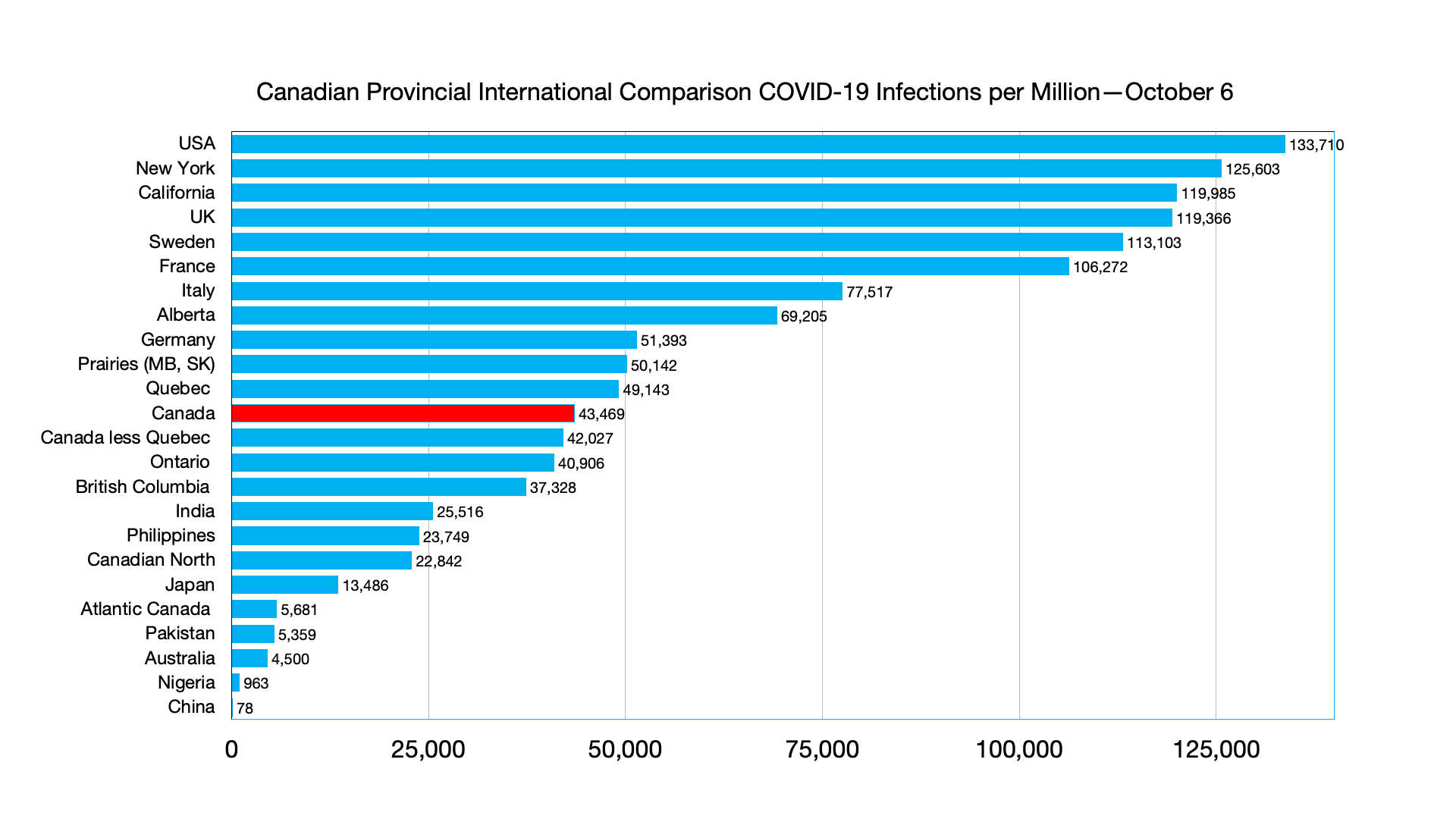
#COVID-19: Comparing provinces with other countries 25 August Update

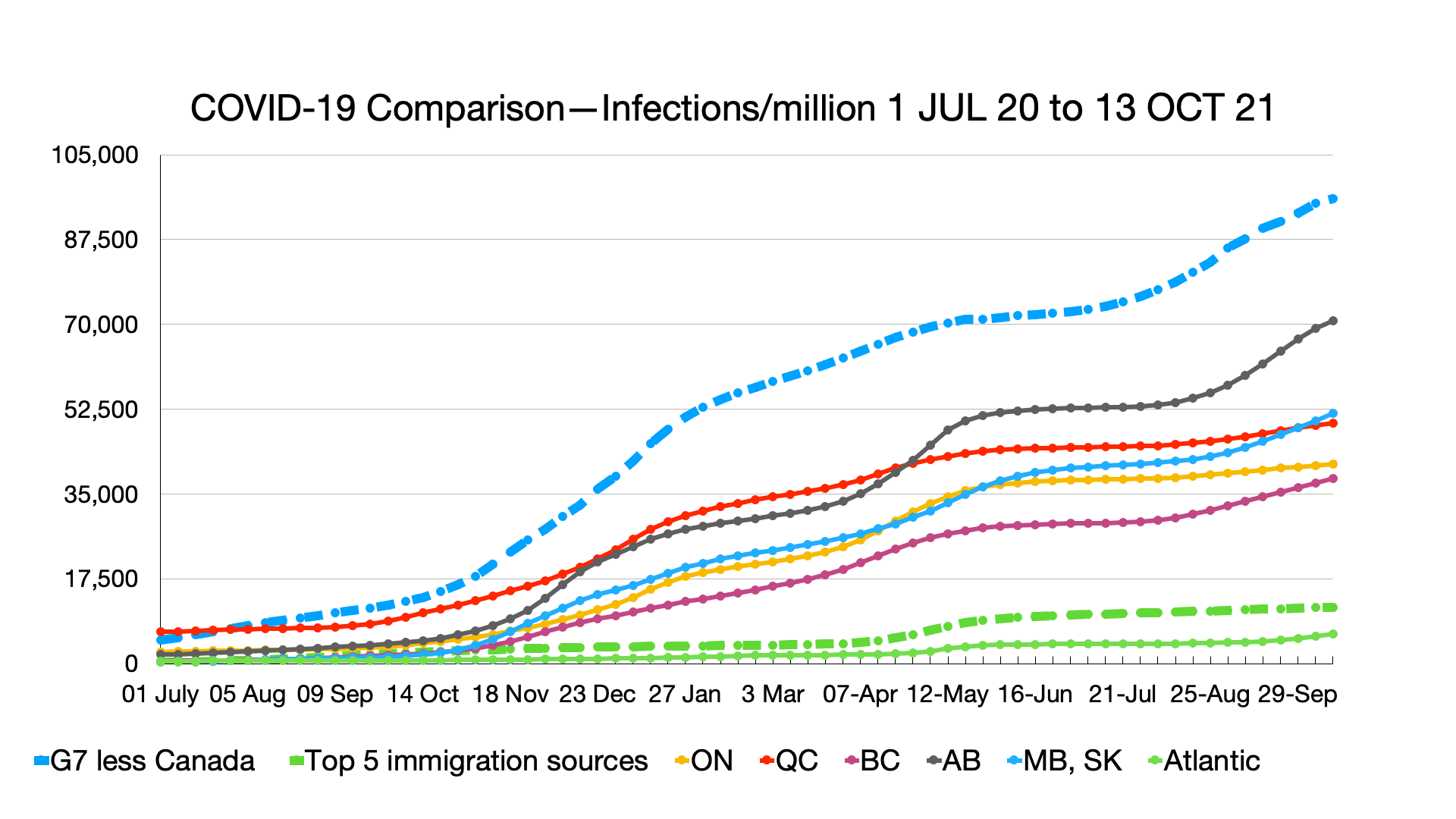
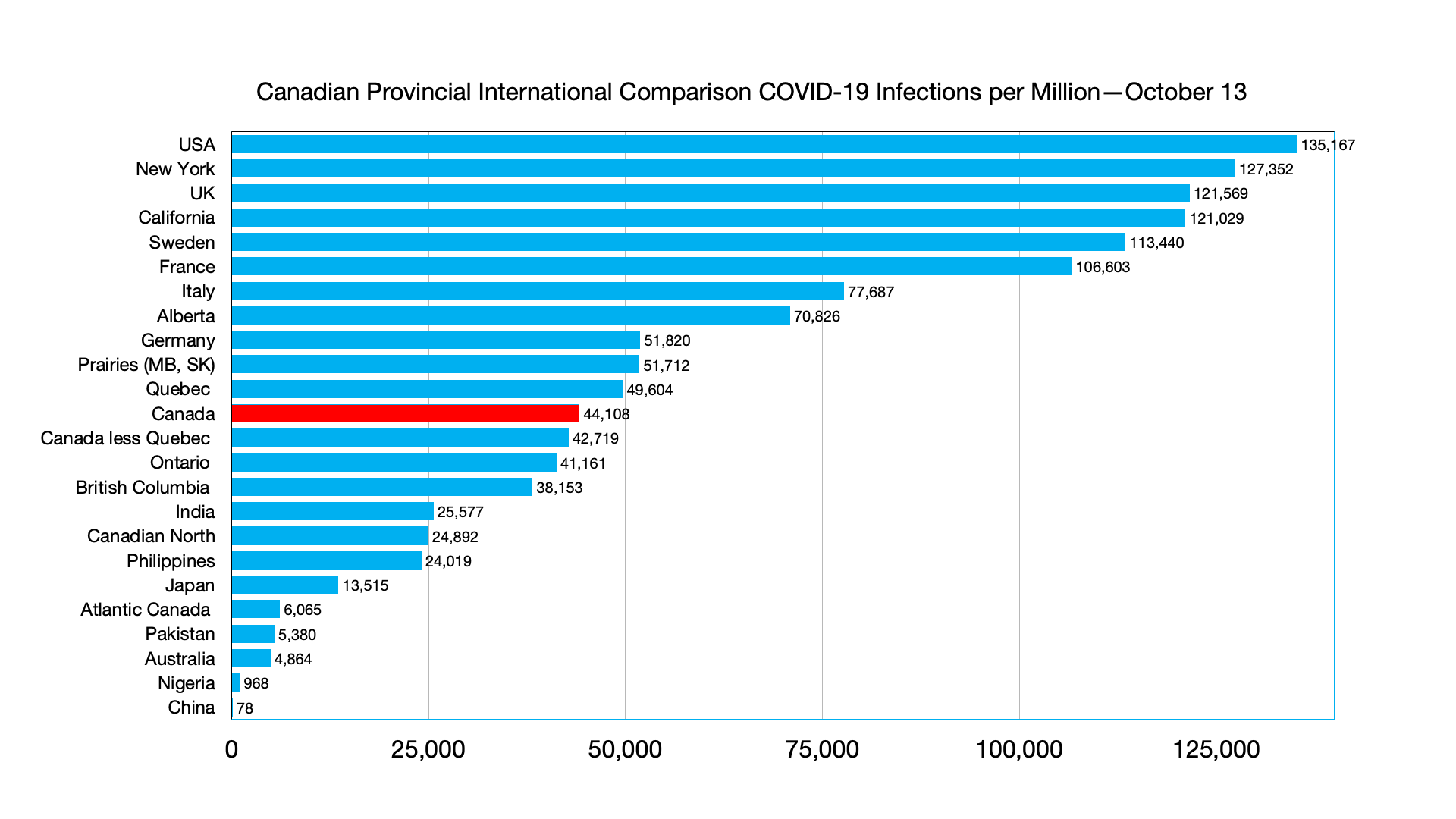
The latest charts, compiled 25 July as overall rates in Canada remain relatively stable but with slight increases due to the variant. Canadians fully vaccinated now 66.4 percent, higher than USA 52.2 percent and the UK 62.8 percent).

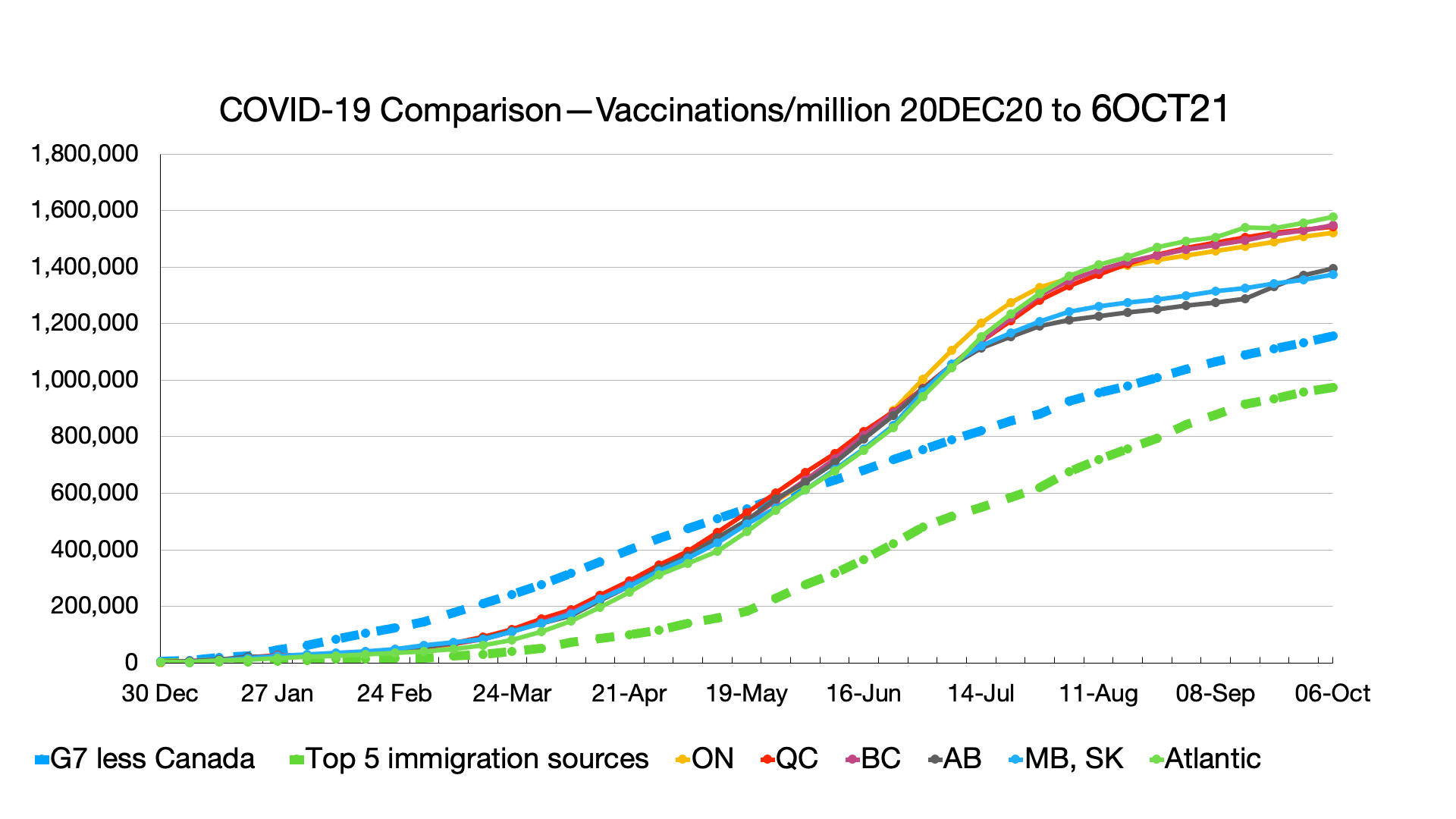
Vaccinations: China ahead of Canada and only slightly behind in fully vaccinated, 55.6 percent, if numbers are accurate.

Trendline charts

Infections: Same ongoing trend: More pronounced uptick in G7 less Canada (driven largely by USA). While all provinces showing increased infections, greater upticks in Alberta, British Columbia.

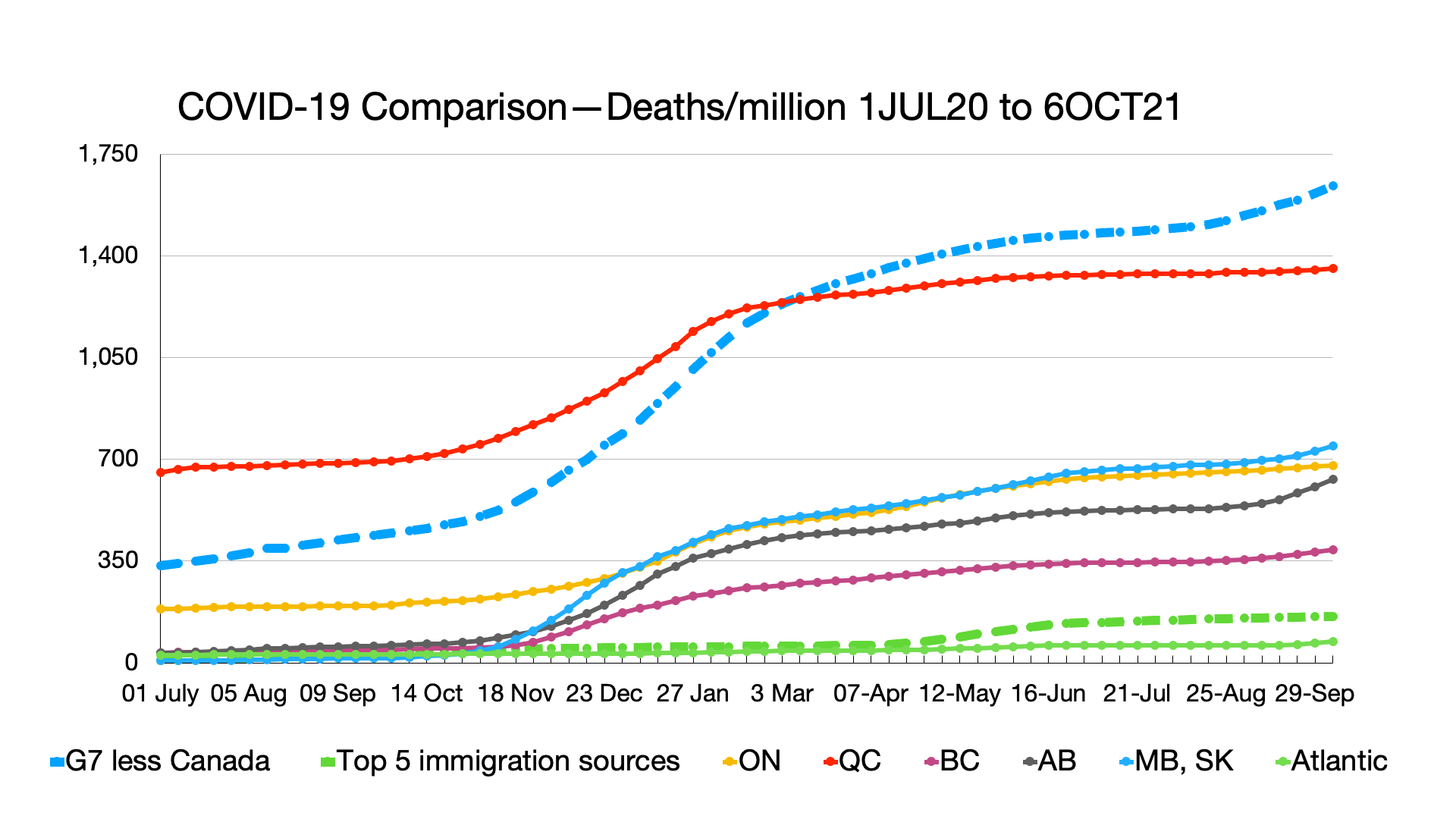
Deaths: No significant change.

Vaccinations: Ongoing steady gap between Alberta and Prairies with lower vaccination rates than elsewhere in Canada, with more pronounced flattening.

Weekly

Infections: No relative change.

Deaths per million: No significant change.

#COVID-19: Comparing provinces with other countries 18 August Update

The latest charts, compiled 18 July as overall rates in Canada remain relatively stable but with slight increases due to the variant. Canadians fully vaccinated now 64.8 percent, higher than USA 51.5 percent and the UK 61.1 percent).

Vaccinations: All Canadian provinces ahead of USA and EU countries, China ahead of UK, Alberta and Prairies.

Trendline charts

Infections: Same trends as last week: More pronounced uptick in G7 less Canada (driven largely by USA). While all provinces showing increased infections, greater upticks in Alberta, British Columbia.

Deaths: No significant change.

Vaccinations: Ongoing steady gap between Canadian provinces and G7, immigration source country increase continues to be driven by China (fully vaccinated 55.6 percent, very steep rise since last week) and India (fully vaccinated 9 percent). Flattening of Canadian vaccination rates as reported elsewhere.

Weekly

Infections: No relative change.

Deaths per million: No significant change.

Why the argument that immigration is the sole cause of soaring home prices is flawed

A contrary view to the role that large scale immigration plays a role in high housing prices. While the pandemic provides reasons for questioning the arguments, longer-term trends and analysis shows that it does in our largest cities. 
And citing long-term GDP per capita growth is misleading, as this growth was largely before 2008, with the past years characterized by fluctuations with no significant increase: 

A recent commentary suggested that the demand for new housing directly results from the net increase in population, which is mainly driven by immigration. According to Statistics Canada, “international migration has accounted for more than three-quarters of the total population growth since 2016, reaching 85.7 per cent in 2019.”

One can argue that if immigration is the reason behind population growth, which determines the demand for shelter, perhaps Canada should reconsider the number of immigrants it admits each year to ease the pressure on housing and infrastructure.

Source: Why the argument that immigration is the sole cause of soaring home prices is flawed

CPC Platform: Immigration-related plans and some missing parts

Will be preparing a comparative table when the platforms of other parties are out. While Conservatives have five priority themes: jobs, accountability, mental health, strategic stockpile of vaccines and PPE, and economy, the platform contains a myriad of commitments across most areas.

The immigration section is also detailed, covering the following themes: “addressing administrative backlogs, fixing a broken visitor visa system, innovation efficiency and cultural sensitivity, strengthening credential recognition, family reunification, super visas, pathways to permanence, advancing Canada’s interests, reforming Canada’s broken refugee system, and securing our border.”

Striking what is missing: no reference to citizenship and multiculturalism, racism reference pertain to Diefenbaker), no substantive references to diversity and inclusion, no reference to employment equity, no reference to antisemitism or Islamophobia, discrimination references limited to the CAF and (again) to Diefenbaker. Anti-Asian hate including in section “Standing up to China’s aggression.”

The other initial observation is the platform is silent on the question of levels, likely given that any suggestion of reduced levels would provide the other parties an opportunity to paint the CPC as anti-immigrant (unfairly, IMO).

Source: https://www.conservative.ca/plan/

Paul Well’s take:

Increasingly I think detailed campaign platform documents are terrible for governance.

They shackle entire governments, struggling with the unimaginable realities of life three years from now, to the best guesses a few campaign strategists were able to make last month. They crowd out the civil service’s policy-development function, because the first thing a new PM’s transition team says to the Privy Council Clerk who greets them is, “Shush. Do all of this.” They discourage agility amid changing circumstances because everyone’s busy ticking off stale boxes so they can run for re-election on “promise made, promise kept.” They practically guarantee fiscal trouble because who’d ever campaign on an appropriately pessimistic outlook for the economy?

Fie on the whole mess. The best way to run for high office would be to say, “You know me. Meet my team. Do we seem solid? Count on us to handle whatever comes our way.”

Of course I’m outvoted. Constantly. Whatever their worth as blueprints for government, thick platforms often work a charm in campaigns, especially if the goal is to rebut widespread worry that the leader in question is a lightweight or a nutbar. Modern campaign credibility-building was invented by Jean Chrétien’s Liberals in 1992 with Creating Opportunity: The Liberal Plan for Canada, instantly dubbed the Red Book. It transformed Chrétien from a yesterday’s man without a clue to a big thinker with an eye for detail. “It’s in there. Read it,” he’d say. Ontario’s provincial Conservatives under Mike Harris won power back in 1995, after a decade of Liberal and NDP governments, with the Common Sense Revolution pamphlet. And Justin Trudeau did a lot in 2015 to parry perceptions that he was a lightweight with Real Change: A New Plan For a Strong Middle Class (.pdf here). And even though each of those documents would have occasion to cause grief for its authors, they all worked, so they’ve spawned a hundred more or less successful imitators over the years.

This year the emerging novelty is a preference for early platform launches, a repudiation of the notion that you should dribble out your announcements for weeks on end, maintaining suspense and keeping campaign reporters from getting bored. Jagmeet Singh’s NDP went for a big bang last week with the release of the party’s entire platform, Ready For Better. And on Monday Erin O’Toole did the same, releasing the entire platform (Canada’s Recovery Plan) on the campaign’s first full day. Well, all of it except the costing: since it’s up to the Parliamentary Budget Office to check costing claims, and they couldn’t do that in a timely fashion because of the snap election, the costing will come later, Conservative campaign strategists told reporters on Monday. Meanwhile, apparently everything O’Toole is promising is free! I kid.

The problem O’Toole seeks to address is that, to borrow the language I used a few paragraphs ago, lots of people worry he’s a lightweight and a nutbar. A lightweight because a lot of his public pronouncements until now have been comically low on detail—Justin Trudeau got NAFTA wrong, we need a plan, the debate is over, whatever random combination of fridge magnets you want to assemble. A nutbar because he campaigned as a “True Blue” and then discovered his party doesn’t believe the Earth is round, or some such.

Canada’s Recovery Plan (rejected title: Erin O’Toole’s Hail Mary Pass) is an attempt to answer every question anyone will ever have about O’Toole and his party. Surely a doomed attempt—it’s always easy to come up with more questions, this week often featuring the words “nasal swabs”—but ambitious in the trying nonetheless. It starts out a little pre-school (Actual quote from the first page of text: “What is Canada’s Recovery Plan? It’s a plan. A very detailed plan.” Gee thanks, Einstein). But before it’s done it sprawls across nearly twice as many pages as Trudeau’s 2015 platform. The word “detail” and its derivatives appears 54 times, often in chapter titles that read like so much grim found poetry: “A Detailed Plan to Lift Up Working Canadians/ A Detailed Plan to Support Working Families/ A Detailed Plan to Lower Prices/ A Detailed Plan to Tackle Home Prices,” and on and frickin’ on.

Another word frequently spotted in the thing is “support,” also a favourite of the Trudeau government, especially since COVID-19. In Trudeauspeak, “support” means “give money to,” and I suspect O’Toole swiped it to convey the impression this year’s Conservatives are more spendy than previous generations. “Support” and its derivatives appear 190 times in the CPC platform, including a record 23 appearances over the four pages from 108-111. What’s the beneficiary of this four-page burst of support? I was surprised to discover it’s the rest of the world, for it’s in his platform’s foreign-policy section that O’Toole feels most, um, uplifting.

Among the very many things he wants to support: “Taiwan’s participation in multilateral fora”; “a climate-conscious, clean alternative to the Belt and Road Initiative;” “regional security” across “Pakistan, Bangladesh, Nepal, Sri Lanka and beyond;” “Israel’s existence as a sovereign democratic Jewish state” and “the aspirations of the Palestinian people and a two-state solution leading to a Palestinian state;” and “East Africa with data and infrastructure development.”

So the gauntlet is thrown. If you don’t vote Conservative this year, I guess you just don’t want a digital East Africa. It’ll be interesting to see whether this brick dominates O’Toole’s campaign or whether, having dropped it, he never mentions it again. I’ve seen both happen in various campaigns. It’s a drag that the Parliamentary Budget Officer hasn’t checked the Conservatives’ math, though they swear they’ll fix that in future editions, once the PBO reports. It’s close to a sure thing that amid all these words, there’ll be something to upset Conservatives’ opponents and probably also some supporters. Whatever happens next, at least, O’Toole can tell himself he left everything on the field, and indeed that he put it out there early.

Source: https://www.macleans.ca/politics/ottawa/erin-otoole-fills-in-blanks/

COVID-19 Immigration Effects: June 2021

Regular monthly update of impact of COVID on the suite of immigration programs: Permanent Residents, Temporary Residents, Asylum Seekers, International Students, Settlement Services, Citizenship and Visitor Visas. 

The major change is with respect to Permanent Resident Admissions, which have more than doubled from 17,085 in May to 36,625 in June for all three classes. Compared to June 2019, however, only the Economic class increased. (Minister Mendicino just revealed that July admissions are close to 40,000, indicating government was well on its way to meeting this year’s questionable target of 401,000 new Permanent Residents). 

Close to three-quarters of new Permanent Residents were former Temporary Residents transitioning. 

Temporary Residents (International Mobility Program) were up significantly while Temporary Foreign Worker Program was stable. 

Study permit applications and permits also increased, both on a year-over-year basis as well as compared to 2019. 

While the number of new citizens has increased compared to May, compared to 2019 the numbers are down by over half.

#COVID-19: Comparing provinces with other countries 11 August Update

The latest charts, compiled 11 July as overall rates in Canada remain relatively stable but with slight increases due to the variant. Canadians fully vaccinated now 62.7 percent, higher than USA 50.8 percent and the UK 59.4 percent).

Vaccinations: All Canadian provinces ahead of USA and EU countries, UK and China now ahead of Alberta and Prairies.

Trendline charts

Infections: More pronounced uptick in G7 less Canada (driven largely by USA). While all provinces showing increased infections, greater upticks in Alberta, British Columbia.

Deaths: No significant change.

Vaccinations: Ongoing steady gap between Canadian provinces and G7, immigration source country increase continues to be driven by China (fully vaccinated still at 16 percent) and India (fully vaccinated 8.5 percent). Flattening of Canadian vaccination rates as reported elsewhere.

Weekly

Infections: No relative change.

Deaths per million: No significant change.

It’s a system meant to help newcomers to Canada learn English. But critics say it prioritizes testing — at students’ expense

Hard balance to strike between the need for accountability through testing of progress and pedagogy:

After having his education stalled by war, Fahed Diab was thrilled to have a chance to return to school in Canada. But before he could apply to college, the Syrian refugee needed to enrol in adult English classes.

In those classes, the then 21-year-old worked to learn a foreign language from scratch while, more importantly, rebuilding his self-confidence and mingling with other newcomer students like him who were also trying to learn the history, values and cultures of their adopted homeland.

“I wanted to be able to communicate with people and learn how to ask for help, go to a doctor and book an appointment,” said Diab, who resettled in Canada with his family via Lebanon in 2015 under a refugee sponsorship.

“I went to classes and met friends in similar situations as me. I enjoyed interacting with people from different backgrounds and learning about this country. My self-confidence was getting better.”

However, when changes were made to the federal immigration department-funded Language Instruction for Newcomers (LINC) while he was about halfway into his one-year program, Diab, now studying engineering at Lakehead University, said he lost his drive as a result of the frequent in-class assessments required to prove the students’ progress.

“We had two or three tests a week, sometimes for writing and reading, or listening and speaking. We must pass all these tests to move up to the next level,” said the now 27-year-old Hamilton man.

“All the tests distracted me from the learning. I was obsessed with passing the tests rather than learning the language and culture.”

After about a year enrolled in the immigrant English classes, Diab quit and moved to an academic credit program for adults at a school board to finish his Canadian high school diploma as a bridge to the language requirement for post-secondary education.

He could’ve met college admission English requirement if he’d reached LINC level 7, which requires the learner to be able to communicate “comfortably and reasonably fluently” in most common daily situations.

Based on the Canadian Language Benchmarks, LINC goes from level 1 for low beginners to level 8 for high intermediate learners. While most Canadian colleges require minimum scores in standard language tests such as IELTS and TOEFL, they also accept adult immigrant students who have completed at least level 7 in LINC.

Adult immigrant students do drop out of English classes once their language proficiency reaches the level they need to navigate their day-to-day life; for many, it’s just a means to obtain the certificate to meet the bar of the language requirement for citizenship applications. Immigration data shows as many as half of all students discontinue after completing one level.

However, students and instructors say the portfolio-based language assessment or PBLA introduced in 2013 is taking the fun — and class time — out of learning for students such as Diab.

The language assessment system, which has been rolled out incrementally since then, is meant to provide a standardized tool to measure the program’s impact on participants’ language learning and track their progress at each English benchmark.

According to its practice guidelines, PBLA is a “comprehensive, systematic and collaborative approach to language assessment” based on the use of real world language tasks throughout the teaching and learning cycle.

Teachers and participants together are supposed to set learning goals, build a body of work to showcase the student’s language proficiency over the span of a school term and use it to make plans to advance the learner’s journey.

According to the immigration department’s most recent review of its language program, 87,140 or 16 per cent of adult newcomers admitted between 2015 and 2017 enrolled in formal language training. Women accounted for 62 per cent of the enrolment and three quarters of the students were between the ages of 25 and 54.

Students surveyed told researchers they were in classes to improve English for daily life (78 per cent), to help get a job (67 per cent), to better communicate at work (61 per cent), to learn about Canada (58 per cent) and to meet people (53 per cent).

About two-thirds said PBLA was helpful in encouraging them to learn more, that in-class assessments were useful in showing they are learning (64 per cent), and that the frequency of tests was just about right (67 per cent).

Instructors who did not find the assessment approach helpful complained the process took too much preparation (88 per cent) or classroom time (80 per cent), and that learners might not be comfortable with or understand the goal-setting (76 per cent).

“The PBLA may be useful ‘as a learning tool,’ but ‘not as an assessment tool,’” said the 75-page report, released in May. “PBLA is time consuming, and that training for PBLA is in high demand.”

Kelly Morrissey, who has taught English to immigrants and refugees in Toronto since 2010, says the tool looks good on paper but is so labour intensive when applied to a class of 20-plus adult students that it turns into sheer test-oriented learning and assessment rubrics.

PBLA requires students to collect what’s called artifacts — evidence of success in applying vocabulary, grammar and pronunciation in group activities — throughout the term. They need 32 artifacts in writing, reading, listening and speaking based on the instructor’s assessment to move up each ladder. There are eight LINC levels in total.

“Language needs a lot of repetition in different contexts. You need to give the brain as many ways to acquire the language skills as possible. You need to bring in all the senses,” said Morrissey.

“Language is one of the humanities. It’s not like a hard science. You can’t treat language students like laboratory rats.”

Morrissey tailors her curriculum to what her students’ needs are and those needs vary from cohort to cohort.

For a lesson about grocery shopping, she would go to a local store to take pictures of aisle signs, bring empty food packaging to the class and turn the classroom into a supermarket to allow students to do role-playing and learn English in that setting. Sometimes, that would also include a field trip to a store.

While the task-based learning approach that many instructors have already been doing is fantastic, says Morrissey, the paper work involved in PBLA has cut into the time students spend on those activities.

And it doesn’t help that instructors have to develop their own course content outside of the class based on rough PBLA guides. Those hours are unpaid.

“PBLA focuses on test, test, test, test. I had refugees from war-torn areas in my literacy class, experiencing post-traumatic stress disorder. I wanted more than anything to protect them from stress of these tests,” said Morrissey. “I think it’s unethical to be asked to do that to them.”

Ethiopian newcomer Ibsa Abdurzak, who was sponsored to come to Canada by a community group in 2017, spent six months in the language program in 2018 before quitting. While the assessment helps students get a sense of their English levels, he said he became hung up with making the grades.

“The best way to learn a language is through practice. But there’s too much assessment and it was too tedious for students,” said the 28-year-old, who had a degree in education back home and now studies business accounting at Mohawk College.

“We don’t like to be judged. It makes people nervous and stressed. It did take away the time to practise English.”

Yuliya Desyatova, a University of Toronto doctoral student, focuses her research on PBLA in adult language training in Canada. She says learners, often self-conscious and afraid to fail, could benefit more from engaging in activities than being assessed.

“They need the opportunity to interact in the language in a social environment. Many of my students are isolated at home. They don’t have interaction (in English) beyond classroom hours. They have so much responsibility,” said Desyatova, herself a LINC instructor since 2006.

“When this opportunity to interact with classmates and teachers is replaced by you filling out paper after paper after paper in the hope to pass, the interaction is pushed aside.”

While the assessment is supposed to offer a “better and reliable measurement” to gauge a learner’s progress, Desyatova says it’s still an inconsistent instrument because each teacher applies the standards differently, with some more heavy-handed than others — an issue the immigration department’s review recognized.

“A simple solution is to remove the mandatory nature of PBLA and let teachers decide how much and how frequently tests need to be done,” she said. “We don’t need to test our students 32 times to see this student is not learning anything more from my class and needs to move to the next.”

Settlement Assistance and Family Support Services, an immigrant agency in Toronto, provides adult language training to some 400 newcomers a year at three locations from literacy to level 7.

Its executive director Sudip Minhas said PBLA allows students to be the centre of the learning and give them ownership of the process, though she admits that the concept of evaluation scares people.

“The intent of PBLA is to take that anxiety out of testing. If I’m given the ownership of my own learning, the assessment is not about pointing out whether I fail or pass, but rather if this route didn’t help (my learning), can I take a different route?” said Minhas.

“But for all our instructors as well as administrators, we have not been able to translate that into practice because we’ve been conditioned by years of certain structured exams and of assessing people by failing or passing them.”

Although PBLA has been implemented for some years now, she says it takes time for instructors and learners to recondition their thinking about the assessment and apply it correctly.

The big setback was that the teachers were not given enough training and support at the onset, she’s glad to see the immigration department’s review recognizes that instructors can “benefit from many supports” and recommends more adaptable PBLA materials, limiting the amount of unpaid work and extra training.

Source: It’s a system meant to help newcomers to Canada learn English. But critics say it prioritizes testing — at students’ expense

The U.S. Attracts Fewer International Students, Loses Billions In Revenue. Here’s Why

Of note:

The Biden administration is hoping to attract tens of thousands of international students who stayed away from U.S. campuses during the pandemic. Foreign enrollment plummeted by 20% last year costing nearly $10 billion dollars in lost revenue. Though some students are starting to return, recovery might not be so easy. Even before the pandemic, international students were already turning away from the U.S.

In the 2018-2019 school year, foreign enrollment peaked at 1.1 million students and it’s been declining ever since as countries like Australia, Canada and the U.K gain more foreign students.

That’s a challenge for American colleges. But it also could be a blow to U.S. competitiveness. ​​​​Foreign students often go on to build their lives in the United States, filling our faculty offices, our laboratories, our boardrooms. One in five entrepreneurs who founded start-ups in the United States is an immigrant — and three-quarters of them first came to America as students.

International students are more likely than Americans to pay full freight. At public universities, the out-of-state tuition they pay has helped make up for a drop in state funding, especially after the Great Recession.

“They [colleges] need the tuition. They need full four-year out of state tuition payers,” says Robert Daly who directs the Kissinger Institute on China and the United States at the Wilson Center. Daly argues that colleges have become too reliant on students from one country: China. “They’ve become addicted to this money.”

Higher education is one the America’s largest service exports

When the pandemic sliced away a huge chunk of foreign students, the new administration took note. Higher education is one the nation’s largest service exports — bigger than agriculture exports like corn and soybeans.

Unlike the Trump administration’s hostility to foreigners, the Biden administration recently called it a “foreign policy imperative” that the U.S. remain the top study destination for international students. It’s putting students first in line for interviews and visa processing at U.S. consulates around the world.

But for many foreign students, the U.S. just isn’t as dominant. Emily Dobson calls it the “geoswerve.” Dobson, a college counselor in Brazil, has seen more diversity in where her students apply to colleges over the past few years. She says they’re finding options not just in traditional destinations like Australia and the U.K. but in Qatar, Japan, and the Czech Republic. “We’re not seeing the future we used to see here,” she says of the United States. “Still love you. A few of you are on our list. But you know, we’re going to go to other schools.”

“The American Dream idea,” she says, “is being questioned more.”

Dobson’s students are looking for more affordable options than the U.S. and for places where they can earn a degree in just three years. Safety is also a big concern — America’s gun violence scares many families.

New hesitancy by foreign student spells big trouble for U.S. colleges and economy

And 70% of international students on American campuses are from Asia. The recent rise in anti-Asian hate crimes have made some of them reconsider their futures in the U.S. Early in the pandemic, Lily Cao, a Chinese student at Mount Holyoke College, was confronted in a grocery store by a woman accusing her of spreading the coronavirus. “COVID has really been the trigger point where I felt like, Oh, I might get discriminated against,” Cao says. She plans to return to China to build her career in public health.

This new hesitancy spells big trouble for colleges — and for the larger U.S. economy, which is propelled by immigrant entrepreneurs, many of whom came here as college students. Competitor countries, such as Australia and Canada, make it easy for international graduates to stay and work and give them priority above other applicants for permanent residency. Britain last year introduced a global talent visa that fast-tracks people in in-demand fields for immigration. Universities in those countries frequently promote the ability to work after graduation when they recruit international students.

U.S. colleges are trying to regain their competitive edge and the pandemic may offer something of a blueprint. After more than a year of remote learning, both professors and students are more comfortable with online education. More hybrid and online programs could shorten the amount of time students would need to be in the U.S. And colleges hope a new commitment by the Biden administration to welcome international students can reignite the American Dream for students from abroad.

Source: The U.S. Attracts Fewer International Students, Loses Billions In Revenue. Here’s Why

How do we improve our immigration system post-pandemic?

More general than useful, more promotional than substantive:

After the slowdown in immigration during COVID-19, the Canadian government has announced it intends to ramp up immigration targets, especially in the permanent resident category, for the next few years. 

How do we make sure that we “build back better” in terms of our immigration policy? 

In attempting to find answers to this question, WINS undertook a survey in February to March of 2021 called Showcasing Immigrant Voices to understand the experience of immigrants in Canada. 

Among our respondents, a quarter had a bachelor’s degree and close to two-thirds a master’s degree or higher. Close to three-quarters reported that their first position in Canada was entry level, whereas before immigration, under a fifth had entry level jobs. 

Close to a half found their job search far more difficult than expected. More than a quarter were still job searching after 12 months or more after moving to Canada. A “lack of Canadian work experience” was commonly cited as a major hurdle, with a third also reporting what they believed to be “discrimination in the hiring process.” 

This data, coupled with data from secondary sources that we collected for our survey report, showed that the challenges immigrants face have not changed in over a decade. All this compelled us to ask: why has nothing changed? Isn’t it time it did? This led us to reflect on how we can help to bring about change.

The sad truth is that the survey results merely confirm what we have heard from many immigrants we talk to every day and something that the Ontario government realizes as well. 

A recent provincial news release noted that more than 170,000 internationally trained immigrants in the province are working in jobs that do not match their level of qualification. This does not include those who are underemployed or dropped out of the labour force. The release also noted that the Ontario Bridge Training Program is providing $14 million over three years to help 2,698 internationally trained professionals access the labour market.

Such announcements raise an obvious question: Does spending $5,000 per spot for re-education of a very small minority of underemployed internationally trained immigrants make sense? The present government approach has continued for a long time but the problem remains. 

We believe there is a better strategy.

We recommend that Canadian stakeholders collaborate on bringing about a paradigm shift toward integrating immigrants into the Canadian workforce. The main players in this shift need to be governments, employers and Canadians at large.

Governments should shift funds toward employment-focused programs that help those already here get jobs that match their skills. As noted by the Conference Board of Canada, we need to deal with long-standing barriers to economic integration, especially now that we have seen how these barriers impeded immigrants during COVID-19, and this has been a major barrier. 

Stricter regulations are also needed around discrimination based on Canadian experience. Meanwhile, more attention has to be given to revamping the federal skilled occupation list to match the reality of the current labour market. 

Employers have a role to play as well. They must refine a set of best practices for HR professionals and provide training to shift their focus from immigrants’ supposed “lack” to the positive contributions that immigrants, with their transferable skills, can make. Through a realization of just how much Canadian experience serves as a systematic barrier, employers can improve the prospects of immigrant talent already here in Canada.

Finally, all Canadians must understand the challenges that immigrants face. That means reflecting on what kind of society is produced when a portion of its members are constantly devalued and their capabilities undermined by existing programs and prejudices. Immigrants’ patriotism and sense of belonging can be fully realized only when they feel fully valued members of Canadian society.

Dr. Hitu Sood is a diversity and HR consultant and the founder and executive director of Winning Inclusive Solutions (WINS), a not-for-profit based in Toronto. Mark Lovewell is the chair of the board of WINS. Veronica Seeto is the vice-chair of the board of WINS.

Source: https://www.thestar.com/opinion/contributors/2021/08/04/how-do-we-improve-our-immigration-system-post-pandemic.html