Immigration and the Aging Society

The same characteristics apply to Canada in terms of the limited impact of immigration on addressing an aging demographic. However, given Canada’s prioritizing skilled immigration, the fiscal drain arguments don’t apply (previous studies by Grubel that argued thus were flawed):

The idea that immigration is the solution to the aging of American society has become an article of faith among those arguing for ever-higher levels of new arrivals. They assert that, in societies such as the United States, where fertility rates are low relative to historic patterns, the native population will not supply enough workers to maintain a robust economy and pay for government services, particularly retirement programs. If native-born Americans aren’t going to have enough children to balance the longer-lived elderly population, the argument goes, then our only option is to increase immigration levels.

It’s not a crazy argument; it just happens to be incorrect. In reality, a significant body of research shows that the impact of immigration on population aging is small. While immigration can certainly make our population larger, it does not make us dramatically younger.

And yet, commentators have been making such arguments for years. The late Washington Post columnist Charles Krauthammer asserted in 1998 that America has been “saved by immigrants” from the kind of aging taking place in other first-world countries. Former Florida governor Jeb Bush famously said that America needed higher levels of immigration to “rebuild the demographic pyramid.” At the data-journalism site FiveThirtyEight, Ben Casselman has argued that immigration is the “only thing” preventing the country from facing a “demographic cliff.”

The release of the 2020 census showing the U.S. population grew by only 22.7 million since 2010, coupled with preliminary data indicating a sharp drop in fertility during the Covid-19 pandemic, have prompted a new round of articles asserting that immigration is the solution to population aging. The title of a recent Vox piece by Nicole Narea summed up this view: “The Census Shows the US Needs to Increase Immigration — By a Lot.” Similarly, George Mason University’s Justin Gest has called for doubling immigration to make the United States “younger, more productive and richer.”

But demographers have known for a long time that, absent truly gargantuan and ever-increasing rates of immigration, it isn’t actually possible for immigrants to undo or dramatically slow the overall aging of society. As Oxford demographer David Coleman observes, “it is already well known that [immigration] can only prevent population ageing at unprecedented, unsustainable and increasing levels of inflow.”

Those who argue that immigration is the key to dealing with an aging society are right about one thing: Both the share of the population that is of working age (16 to 64) and the ratio of workers to retirees are declining as Americans live longer and have fewer children. It is also true that, primarily due to post-1965 immigration, immigrants and first-generation Americans represent a growing share of the U.S. population and workforce. But this does not mean that immigration can dramatically slow or halt the aging of American society to nearly the degree that many seem to believe.

There are four broad reasons why the demography doesn’t support the political credo. First, not all immigrants arrive young — in fact, a growing share are arriving at or near retirement age. Second, immigrants age just like everyone else, adding to the elderly population over time. Third, immigrant fertility rates tend to converge with those of the native born. Fourth, to the extent that immigrants do have higher fertility rates than the native born, their children add to the dependent population — those too young or old to work. All of this means that immigration has only a modest impact on the working-age share of the population and the ratio of workers to retirees.

Immigration and Population

Studying the impact of immigration on population aging is nothing new for demographers. In a 1992 article in Demography — the top journal in the field — economist Carl Schmertmann explained that mathematically, “[c]onstant inflows of immigrants, even at relatively young ages, do not necessarily rejuvenate low-fertility populations. In fact, immigration may even contribute to population aging.” In 1994, Thomas Espenshade, the former chairman of Princeton’s sociology department and director of its graduate program in population studies, concluded the same. “Immigration,” he observed, “is a clumsy and unrealistic policy alternative to offset a shortage of domestic labor or to correct a perceived imbalance in the pensioner/worker ratio in the United States.” Likewise, as part of its population projections in 2000, the U.S. Census Bureau stated that immigration is a “highly inefficient” means for increasing the working-age share in the long run.

More recent studies only confirm these conclusions. A paper I co-authored for the 2012 annual meeting of the Population Association of America, for instance, shows that future levels of immigration have a modest impact on population aging. A 2019 version of that paper, which is based on the most recent Census Bureau population projections, demonstrates the point yet again.

According to those projections, the total U.S. population will reach 404 million in 2060. This figure assumes current trends in net migration — the difference between the number of people arriving and those leaving — will continue, at an average rate of about 1.1 million each year. To determine the effect this level of immigration will have on the U.S. population, we can compare the bureau’s 2060 projection to the projected population under a scenario where net migration is zero (which is unlikely in the extreme, of course, but useful for our analysis). In this scenario, the U.S. population would decline slightly, to 329 million. The 75-million difference between the two figures represents the impact that immigration will have on the total population over the next 39 years.

The Census Bureau also estimates that, in 2060, 59 percent of the population will be of working age. Again, this is based on the assumption that net migration will amount to an average of 1.1 million each year. Under a zero-immigration scenario, just under 57 percent of the population would be of working age. In other words, while immigration is projected to add 75 million people to the American population by 2060, it will only increase the working-age share of the population by about two percentage points. Even if annual net immigration were expanded by 50 percent above what the Census Bureau projects, so that it averaged about 1.65 million a year, it would still only increase the working-age share of the population by three percentage points.

Part of the reason immigration has such a small effect on the working-age share of the population is that while it certainly adds new workers, it also adds to the number of retirees over time, as well as to the number of children. To be sure, these children eventually grow up and become workers. But by the time this happens, many of their immigrant parents will have reached retirement age. These two developments tend to cancel each other out over time. As a result, immigration does not have much of an impact on the share of the population that is of working age in the long run.

This fact is key to understanding why immigration has such a modest impact on overall population aging. Looking at the average age of immigrants over time, as opposed to projecting into the future, shows how this works. In 2000, the average age of all immigrants — not just new arrivals — was 39.2 years. By 2019, it was 46 — a seven-year increase. Over the same period, the average age of native-born Americans increased only slightly, from 35.4 years to 38 years. Part of the reason for the disparity is that all children born to immigrants are considered natives, so they add only to the native-born population. Nonetheless, the relatively high and increasing average age of all immigrants is a good reminder that they grow old like everyone else, even if they do arrive when relatively young.

Most people recognize why a larger senior population increases government expenditures, but fewer acknowledge that a larger population of children does so as well. Government spending on children makes up a sizeable portion of federal, state, and local budgets: The United States spent $726 billion on public schools during the 2017-2018 school year alone. Federal and state governments also spend more than $1 trillion per year on means-tested programs, a large share of which goes to families with children. Indeed all societies, including ours, devote enormous resources to providing for children, and for good reason. But a larger population of children means the state must spend more to provide for them.

Even if we were to exclude children from the analysis and focus solely on the ratio of working-age people to retirees (those 65 and over), the impact of immigration would still be modest. Under the Census Bureau’s current projections, there will be 2.5 working-age people per retiree in 2060. If the projected immigration rate were cut in half, there would be 2.3 workers per retiree. Commenting on our findings at a panel discussion, American Enterprise Institute scholar Nicholas Eberstadt summarized the upshot succinctly: “[I]mmigration cannot possibly over the long run maintain a youthful population structure.”

Of course, as Espenshade and Coleman suggest, it is theoretically possible to use immigration to preserve the current working-age share of the population, as well as the ratio of workers to retirees. But doing so would require levels of immigration that have no precedent in American history. Our analysis shows that, to roughly maintain the working-age share of the population, immigration rates would have to increase five-fold over what the bureau currently foresees. This would create a total population of 706 million in 2060 — more than double the current population. Under such a scenario, by 2060, most U.S. residents would be post-2019 immigrants or their offspring. This level of immigration would be transformative in the extreme; few aspects of society would remain untouched by adding so quickly and so dramatically to the U.S. population.

Immigration and Aging

Population projections provide a reasonable picture of what is likely to happen demographically in the future, but they also rely on assumptions about trends that are always changing. As a result, the newest Census Bureau projections do not fully reflect the significant increase in the age at which immigrants are now coming to America.

Although newcomers were slightly younger in 2019 than they were in 2018, the average age of new immigrants, including illegal immigrants, is still much higher than it was in the past — increasing from 26 in 2000 to 31 in 2019. Perhaps even more surprising, the share of newly arrived immigrants who are 55 and older more than doubled, from 5 percent in 2000 to 11 percent in 2019. This means that one in nine new immigrants is arriving old enough to move directly into a retirement community.

Why are immigrants arriving at older ages? One reason is that, as the United Nations has reported, fertility is declining and life expectancy is increasing worldwide. Rapidly aging populations in countries that send immigrants to the United States almost certainly translate into immigrants arriving at older ages, at least to some extent.

Even more importantly, U.S. citizens can sponsor their parents for permanent residence without numerical limits. Parents typically immigrate to the United States after age 50, meaning they tend to be at or near retirement age as soon as they arrive. As the number of naturalized citizens living in the United States has nearly doubled since 2000, it should come as no surprise that the number of immigrants arriving each year in the parents category has increased in turn.

It is fair to criticize this category of permanent immigration — at least for a society facing an entitlement-funding crisis, such as ours. But it would be politically difficult to end the program. Press accounts in recent years indicate that the Trump administration considered offering parents a continually renewable temporary visa instead of permanent residence, but no such policy was formally proposed. The Biden administration is unlikely to advance such an idea. And in any case, the approach would still have meant the arrival of perhaps 150,000 or more parents each year, who would have added to overall population aging.

The understandable desire of many immigrants to bring their parents to the United States means that any immigration reform that emerges from Congress will almost certainly allow a substantial number of older immigrants to enter the country on both permanent and long-term temporary visas. Once these individuals arrive, it is hard to imagine the government refusing to provide some level of assistance for them — after all, many elderly immigrants who did not work long enough to qualify for Social Security or Medicare often end up receiving Supplemental Security Income and Medicaid. Like our devotion to providing for children, our commitment to assisting the elderly is not without merit. But we should also be cognizant of how immigration policy affects our ability to make good on this commitment as our society ages.

Immigration and Fertility

A key reason for the aging of America’s population is the declining fertility rate among the native born. Many commentators assume that immigration can help reverse this trend, as they believe immigrant women tend to have many more children than do American-born women.

Yet as mentioned above, declining fertility rates are a near-universal trend. Several of the top countries that contribute to America’s immigrant population — including Cuba, Vietnam, China, and South Korea — have fertility rates near as low as, or even lower than, that of the United States. More importantly, immigrants living in the United States are increasingly reflecting these trends: Despite a 9 percent increase in the total number of immigrant women of childbearing age between 2008 and 2019, there were 158,000 fewer births to immigrant women in 2019 than there were in 2008.

As the graph below indicates, the total fertility rate (TFR) — the number of children a woman is expected to have in her lifetime — for immigrant women has fallen steadily. In 2008, immigrant women had a TFR of 2.75. By 2019, the rate had fallen to 2.02. A TFR of 2.1 is widely considered necessary to maintain the existing population. Thus, for what is almost certainly the first time in American history, the immigrant fertility rate was below replacement level.

As the graph above indicates, the TFR for native-born women also declined over the same period. But it did so by roughly half as much as it has among immigrants. To be sure, the overall immigrant TFR of 2.02 is still higher than the 1.69 TFR of natives. But the presence of immigrants only pulls up the overall TFR in the United States to 1.76 — an increase of just 4 percent.

The steep decline in immigrant fertility has not received much media coverage, even while the fall-off in births nationwide has received a good deal of press. In fact, many people remain unaware that it has occurred. The Census Bureau is aware of the development, but again, the trends it relies on are always changing, and it takes time to incorporate changes of this kind into its population projections. As a result, the bureau’s most recent projections do not fully capture this trend, instead assuming a 2019 TFR for immigrants of 2.5 — well above the actual rate of 2.02. Because immigrant fertility is much lower than projected, the small, positive impact of immigration on population aging shown in the bureau’s projections is even smaller. What’s more, although the fertility numbers for 2020 are preliminary, we do know that fertility was down significantly in the country during the pandemic. There is no reason to believe immigrants bucked this trend.

Among native-born Americans, Hispanics have seen the steepest drop in fertility in recent years. American-born Hispanic women had a TFR of just 1.77 in 2019. The TFR was 1.42 for American-born Asian women that same year — both well below replacement level. The rate for native-born whites and blacks was 1.69 and 1.68, respectively. In short, among native-born whites, blacks, and Hispanics, there is now no meaningful difference in fertility rates, while the native-born Asian fertility rate is a good deal lower than the rest. Thus, in a very real sense, immigrants and their children are assimilating to American norms when it comes to family size. This means immigration is no game changer when it comes to the nation’s birth rate.

Intriguingly, some research indicates that immigration may actually lower the fertility rate of the native born, most likely by driving up housing costs, which discourages couples from starting or expanding their families. Kelvin Seah of the National University of Singapore has found that the Mariel Boatlift to Miami — during which about 125,000 Cuban immigrants arrived in the city during a five-month period in 1980 — caused a significant decline in native fertility. In an analysis completed this year, Karen Zeigler and I show that in large metropolitan areas, a higher share of immigrants in the population correlates with lower fertility among the native born, even after controlling for each city’s demographic characteristics. If this finding is confirmed, it could erase, and perhaps even reverse, the small positive impact of immigration on the nation’s overall fertility.

The Fiscal Picture

One of the central concerns about population aging is the ability of an older society to pay for government. With immigration, the hope is that young immigrants will help pay for entitlement programs. Of course, this depends on their actual tax payments relative to the fiscal costs they create. While many immigrants are young, are highly skilled, and have high incomes, immigrants on average have less education and lower incomes than do native-born Americans. This makes it difficult for them to generate the kind of fiscal surplus that would be necessary to help them pay for entitlement programs.

In 2017, the National Academies of Sciences, Engineering, and Medicine (NASEM) estimated the current net fiscal impact of all immigrants and their dependents using eight budgetary scenarios. In all eight of these scenarios, immigrants and their dependents were found to be a net fiscal drain, paying less in total taxes than the costs they created. Though they were found to be a surplus in four of the scenarios at the federal level, their fiscal drain at the state level offset the federal surplus.

Even if immigrants were able to shift the ratio of workers to retirees dramatically, it would not help fill public coffers if they are a net fiscal drain on government funds before they reach retirement age. The best evidence indicates that this is in fact the case, at least at present. One might think this fiscal drain is due to the immigrant population consisting of mostly newcomers who are still trying to find their way in America, but this is not so. In 2017, the average immigrant had lived in the United States for 21 years.

NASEM also ran long-term fiscal projections (out 75 years) for immigrants and their descendants, which showed a fiscal deficit in four of the scenarios and a surplus in the four others. Projections of this kind are quite speculative, involving not just predicting births, deaths, and migration in the way that population projections do, but also predictions about future tax rates, spending, economic growth, and the progress of immigrants over several generations. The upshot of the fiscal analysis is that the current situation is clearly negative, while the long-term impact is uncertain.

To be clear, immigrants are not a fiscal drain because they are lazy or because they came to America for welfare. In fact, working-age immigrants are slightly more likely to hold a job than are working-age natives. This is especially true of the least-educated immigrants, who are much more likely to work than are the least-educated natives. The main reason for the current fiscal drain is straightforward: Immigrants are less educated on average than are native-born Americans, and as a result, they have lower average incomes, lower average tax payments, and a higher use of means-tested programs than natives do.

One way to change the fiscal picture, at least for future immigrants, would be to move away from the current system, which admits people primarily because they have a family member here, and toward a system that selects more highly educated immigrants who are likely to earn high incomes. But given political realities, it’s hard to imagine that the admission of family members will not remain a significant component of U.S. immigration policy.

The bottom line is that it’s simply not reasonable to expect a family-based immigration system to create an inflow of highly educated, high-income immigrants who are likely to help solve our fiscal problems, no matter what it does to the age structure. This is especially true because, as a society, we have been unwilling to tax ourselves enough to pay for government — hence our enormous federal debt, even before the pandemic, and heavy borrowing at the state and local levels. As a result, the average American, whether immigrant or native born, is in fiscal deficit. Our unwillingness to pay for the programs we desire is, of course, not the fault of immigrants. But given current circumstances, admitting higher numbers of immigrants, even if they were average taxpayers, would worsen our fiscal situation.

Beyond Projections

Population projections, with their inherent uncertainty about future trends, are not the only way to think about the impact of immigration on the nation’s age structure; it’s also possible to estimate the impact of immigration based on what has happened in the recent past. The Census Bureau collects detailed data on immigrants (including most illegal immigrants) in the American Community Survey and the Current Population Survey, making such retrospective analysis relatively straightforward. Since this method frees analysts from having to make any of the assumptions that would otherwise be necessary for developing a population projection, it is useful to our purposes here.

Zeigler and I have taken Census Bureau data from 2017 and found that, since 1990, immigrants — including the original immigrants, their children, and their grandchildren — have added 43 million people to the country. This total exceeds the combined population of 22 states and represents one in eight U.S. residents. Looking at this large and relatively young population offers a good test of the argument that immigration can solve the problem of an aging society.

Our analysis shows that these post-1990 immigrants and their progeny increased the overall working-age population percentage from 63.9 percent of Americans to 64.4 percent. The impact is small because, as already discussed, immigration added to both the number of workers and the number of people too young or too old to work. Even if the number of post-1990 immigrants and their offspring had been double the actual number, the working-age share would have increased to 64.8 percent — just 0.9 percentage points higher than if there had been no immigration at all.

As for the ratio of working-age people to those of retirement age, post-1990 immigrants raised it from 3.7 workers per retiree in 1990 to 4.1 potential workers per retiree in 2017. While not a trivial impact, this increase was still quite modest. The post-1990 immigrants did add a significant number of workers, but they also added over 2 million people aged 65 and older, as well as 2.7 million people nearing retirement (ages 55 to 64).

The overall conclusion from this retrospective analysis is that immigration had little effect on the working-age share of the population and a larger, but still modest, impact on the ratio of workers to retirees. This largely confirms the projection-based conclusions discussed above.

Alternative Strategies

If immigration is unlikely to dramatically transform the age demographics of our society, how can low-fertility, high-life-expectancy countries like the United States deal with population aging?

The most obvious solution is to raise the retirement age. One of the main reasons for the entitlement crisis as it relates to providing for the elderly is the increase in life expectancy. Pushing back the age of retirement — or at least the age when people can receive publicly funded old-age entitlements — would align policy with demographic reality.

The retirement age is not set in stone, as even today, programs like 401(k) accounts, private pensions, and government pensions can all be accessed at different ages. At present, the retirement age for full Social Security benefits is set to rise from 66 to 67 by 2027, while Medicare eligibility remains fixed at 65. Meanwhile, remaining in the workforce has become more common among the elderly, particularly among the so-called “young old” — those ages 65 to 69. In 2000, about a quarter of the people in this age group worked. By 2019, the portion had increased to one-third.

People who reach age 66 today can expect to live substantially longer than their counterparts in the 1930s did, when Social Security was created. If the retirement age for Social Security were increased to 70, it would still allow the average recipient to receive benefits for longer than retirees did in the 1930s while nearly preserving the working-age share of the population through 2060. As Eberstadt put it during the panel mentioned above, “raising the age of retirement has a bigger bang” when it comes to the share of the population who are workers than does immigration.

Our retrospective analysis confirms this conclusion. Raising the retirement age by just one year in 2017, assuming no post-1990 immigration, would have increased the ratio of workers to retirees by as much as the 43 million post-1990 immigrants and their offspring did. Increasing the retirement age by two years would have improved the worker-to-retiree ratio in 2017 more than did all 43 million post-1990 immigrants and their descendants combined.

Besides raising the retirement age, another effective option for addressing population aging is to increase the number of Americans in the labor force. By historical standards, the number and share of working-age people outside the labor force was quite high in 2020, even before the pandemic hit. At the start of 2020, about 71 percent of working-age non-institutionalized people — those not incarcerated or in long-term care facilities — were employed; the rest were either unemployed and looking for work or had left the labor force entirely. By then, labor-force participation rates across every major demographic subgroup had been declining among people without a bachelor’s degree for decades.

In our population projections, we found that if we assume the working age remains at 16 to 64, but the share of those working were raised to 75 percent from the pre-pandemic level of 71 percent, it would increase the worker share of the population by as much as would adding 75 million people to the population through immigration over the next four decades.

Returning discouraged workers to the labor force may not be easy given all the social problems many, especially the least educated among us, face. That said, as recently as 2000, 74 percent of working-age people were employed. Moving a larger share of working-age Americans back into the labor force is thus hardly unimaginable. Doing so would directly improve the ratio of workers to retirees and, as non-work is associated with significant social ills, would have some desirable non-economic effects on society to boot.

What Immigration Can’t Do

Every analytical approach to the question of aging demonstrates that, unless the level of immigration is truly enormous and ever-increasing, it will not solve or even significantly alleviate the challenges associated with an aging population.

The reason behind this truth is simple: Immigrants are human beings, not just the idealized workers or child-bearers that some commentators imagine. As humans, they immigrate at all ages, grow old over time, and are choosing to have smaller families. As a result, they add to the population across the age distribution and do not fundamentally change the nation’s age structure.

One can advocate for immigration for any number of reasons, including the fact that immigrants themselves benefit greatly by coming here. But it is simply dishonest, and therefore irresponsible, to claim that immigration will address the fiscal and other challenges of an aging society that maintains an enormous welfare state for the elderly.

Given this reality, we will need to think about other means of addressing our fiscal troubles, including changing the structure of our entitlement programs and coaxing more native-born Americans into the workforce. If we are serious about addressing the challenges associated with an aging society, we cannot depend on immigrants to save us.

Source: Immigration and the Aging Society

Hayden Taylor: For some, the definition of ‘settler’ is as difficult to pin down as reconciliation

Interesting reflections on the term “settler:”

In a lot of my writing, I frequently use the term “settler” in referring to those comprising the dominant society of Canada. In another time and age, they might be referred to as white people – i.e. the colour-challenged, or people of pallor. But in these more politically correct times, we in the Indigenous community prefer “settler.” It sounds more neutral and historically relevant.

However, some disagree with that title. Not long ago, I received an e-mail from a gentleman named Mike who objects to the term. After several paragraphs on how his Irish family were abused by the English and ended up celebrating St. Patrick’s Day in Canada, he adds, “When writers, almost always Indigenous, use the term ‘settler’ to describe people like me, I can’t help picking up a tone of, what is it? Bitterness, anger, maybe even submerged hatred. At a minimum, what I sense is passive aggression.”

He finishes his complaint off by asking me, specifically, “that you please not refer to people as ‘settlers’ unless they really were ‘settlers.’ ”

I mentioned this to some friends and they called it settler fragility.

Let’s deconstruct the argument. Technically, who are these settlers of which we speak? That has been an intense topic of discussion in recent times. For some, its definition is as difficult to pin down as reconciliation. Some would argue it’s anybody whose ancestors were not a part of this land since Time Immemorial. Similarly, others might further define settlers as all the non-Indigenous peoples living in Canada who form the society we live in today, politically, economically and culturally. Basically, if your ancestors came here, and you are enjoying and revelling in the end product of turning Turtle Island into Canada, you are a settler. So enjoy your latté and non-fat Greek yogurt.

Numerous settlers I have talked with accept and acknowledge that. Many have told me “guilty as charged,” “I’m a settler. It is not an insult, it’s a fact” or “where do I sign up for Settlers Anonymous?” Instead of a 12-step plan, their charter includes the 94 recommendations from the Truth and Reconciliation Commission.

But let’s face it, not every person walking the streets and roads of Canada can claim the divine right of terra nullius. If you were brought here, either by physical force (i.e. that all-expense-paid boat trip from Africa) or through intense economic coercion (i.e. come for the railway-building and stay for the racism), you might have a get-out-of-jail-free card.

Still, is it a nasty, critical moniker? It appears it can be. One person on Twitter reported they got a five-day ban on Facebook for calling somebody a settler. When you think about it, “settler” seems to be one of the least offensive terms that could be used. Others that have been suggested during a brief and highly unscientific poll I did online (from mostly settlers responding) include colonizer, occupier, original boat people, squatters, second-generation settlers, beneficiaries of genocidal Canadian Indigenous policies, colonial invader, Euro invaders, economic refugees, and my personal favourite, the Second Nation people, as opposed to First Nations. Actually, no, this is my favourite suggestion: the year-round multi-generational campers. It’s kind of a mouthful, but you get the picture.

Additionally, it would make a hell of a good name for a sports team. I hear a few out there are looking for a new one.

And I don’t think Mike is alone, although I am puzzled why he wants me, and it seems just me, to stop using the term. Everybody else is okay, I guess. I’m getting used to responses like this. Several weeks ago, I wrote an article about how many First Nations people find themselves sympathetic to the Palestinian cause. It was just a report on conversations I had with many Indigenous people and listing the reasons I had been told.

The response to the article, some positive but mostly negative, was surprising. I had e-mails from quite a few people telling me that I should tell those same Indigenous friends how wrong they are. Several different people, possibly settlers, sent detailed lists breaking down why Indigenous people should stay clear of the Palestinian perspective.

To the settlers of the world – Mike, this includes you – I know many of you may disagree with the argument I have posted, and may find it a little … unsettlering. If you don’t agree, just remember, I earn most of my salary from making things up.

Additionally, we could spend the next pandemic playing the “what if …” game: i.e. “what if my ancestors fled in religious terror and found themselves in Canada because they weren’t allowed into … let’s say Monaco?” As of yet, I can’t answer those. But I am currently putting together a detailed chart that should be able to answer all those questions.

Source: https://www.theglobeandmail.com/arts/article-for-some-the-definition-of-settler-is-as-difficult-to-pin-down-as/

Liberals promise to boost number of parents and grandparents sponsored to Canada

Targeting key voting groups and ridings:

In an election-style campaign stop in B.C., Immigration Minister Marco Mendicino said Ottawa is going to triple the number of parents and grandparents Canadians can sponsor to Canada in 2021 to 30,000.

Flanked by two Liberal colleagues in Surrey, where South Asians make up almost 60 per cent of the population, the Ontario MP made an in-person appearance at a community centre to praise the importance of family reunification, a big issue for newcomer communities.

Mendicino was quick to remind the audience how the Liberals have raised the annual quota of the parents and grandparents program — which allows Canadians and permanent residents to sponsor their parents to the country — since it took over from the Conservative government in 2015, when the intake was capped at 5,000 a year.

“We are going to welcome under it to a record level of 30,000. Let’s not gloss over that fact, in 2015, when we took reigns over from the last Conservative government, they were at just 5,000. We are now at six times that rate under this program,” he said.

“And worse, they put a two-year pause on the parent and grandparent program when there wasn’t even a pandemic.

“So my message to the community is: continue to see the parent and grandparent program as an opportunity to reunite with your loved ones, to reunite with your families. This is a government that believes in you, believes in family reunification, and we will deliver on these commitments.”

Due to the COVID-19 pandemic, the federal government scaled back its 2020 intake under the program to 10,000, half the level in the previous year. Now, with speculation that an election call is coming, the Liberals are promising to reverse that.

“Every immigrant that I go to, this is what I’m hearing, ‘Parents and grandparents play a major role in the success of new immigrants,’” said Sukh Dhaliwal, MP for Surrey—Newton, citing other immigrant-friendly policies his party has rolled out since coming into power.

Through a random draw, the immigration department will select 30,000 applicants from a pool of potential sponsors who have already submitted “an expression of interest” to sponsor their parents and grandparents from abroad to be permanent residents in Canada.

Selected individuals will be invited to submit the full applications over two weeks, starting the week of Sept. 20, through a new digital platform created to “speed up and simplify” the process.

Citing the financial challenges faced by Canadians during the pandemic, Mendicino said sponsors’ income requirement for the 2020 tax year will be reduced. For instance, to bring in two people, a sponsor only needed to make $32,270 last year, down from $41,007 in 2019.

Incomes from regular employment insurance benefits and temporary COVID-19 benefits such as the Canada Emergency Response Benefit will be counted toward their 2020 income.

Source: Liberals promise to boost number of parents and grandparents sponsored to Canada

#COVID-19: Comparing provinces with other countries 21 July Update, India unreported cases

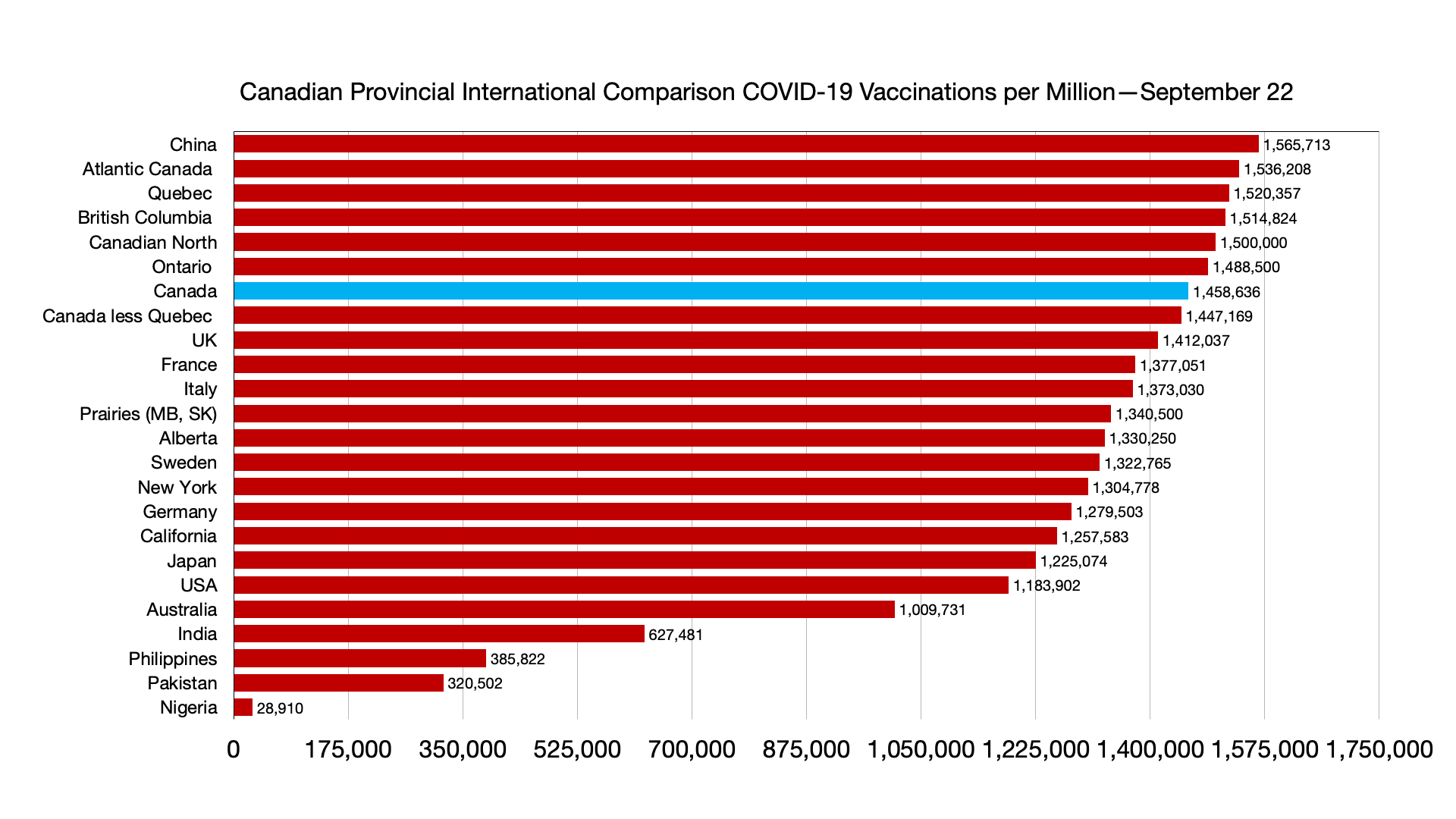
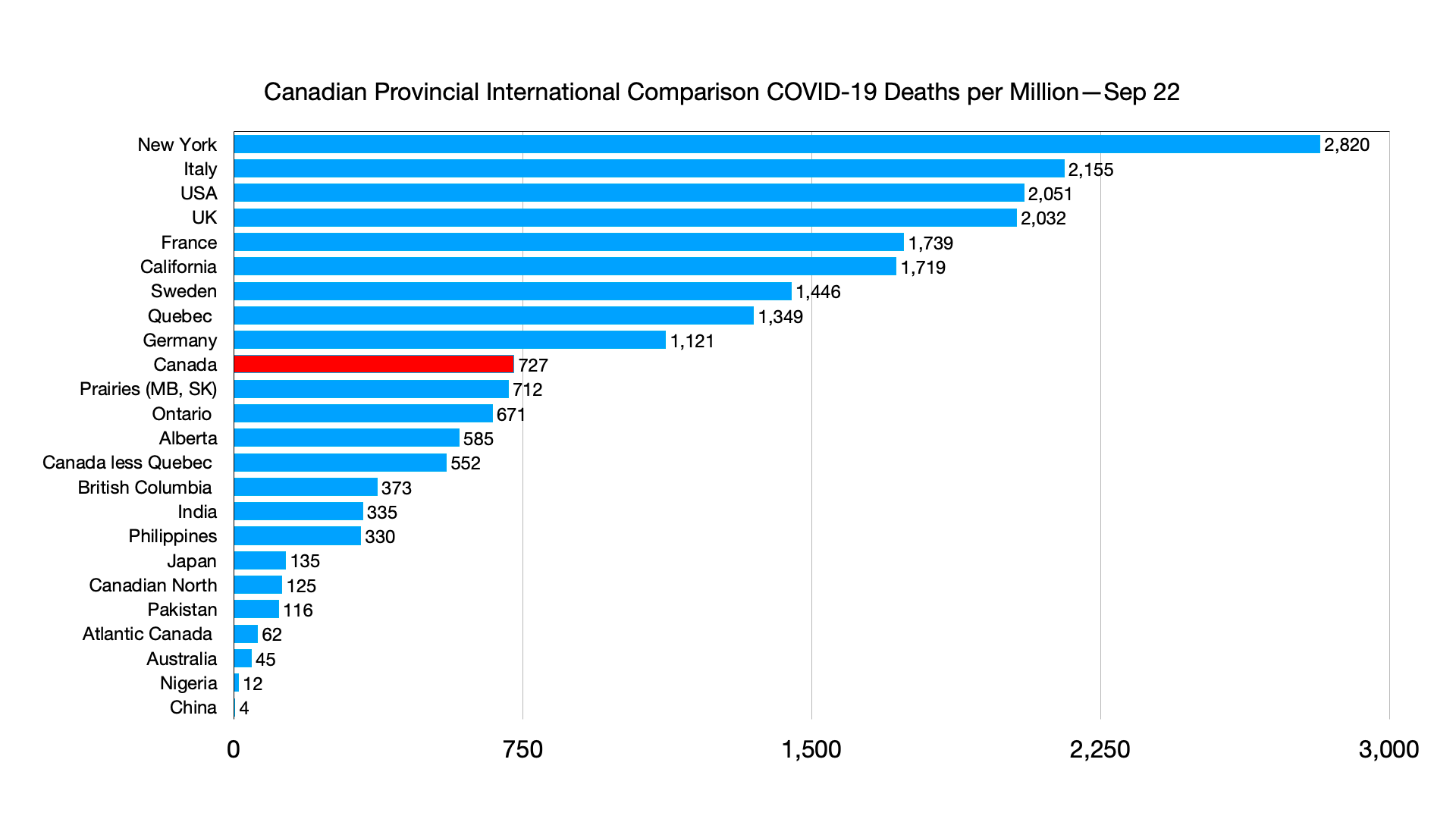
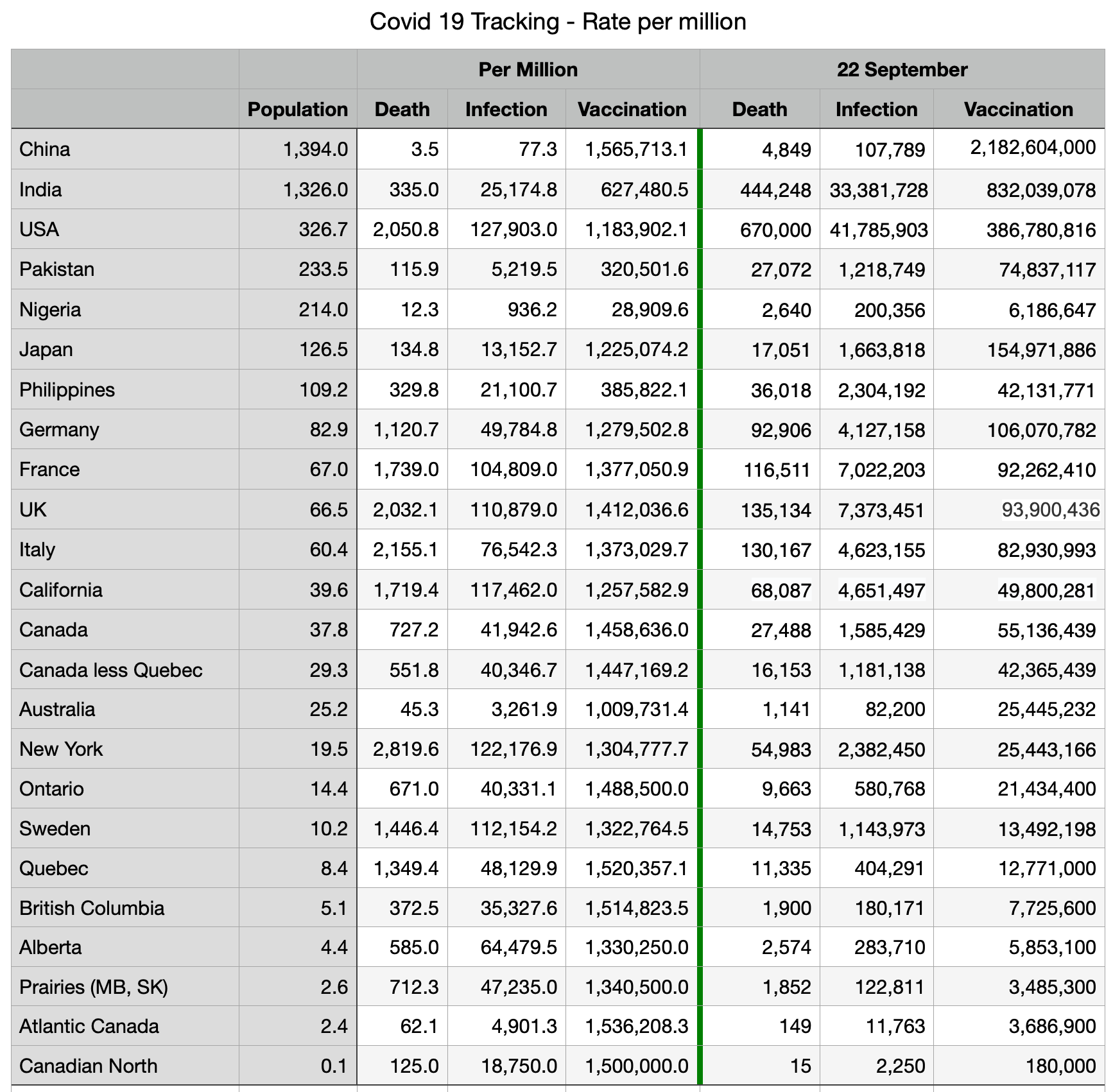
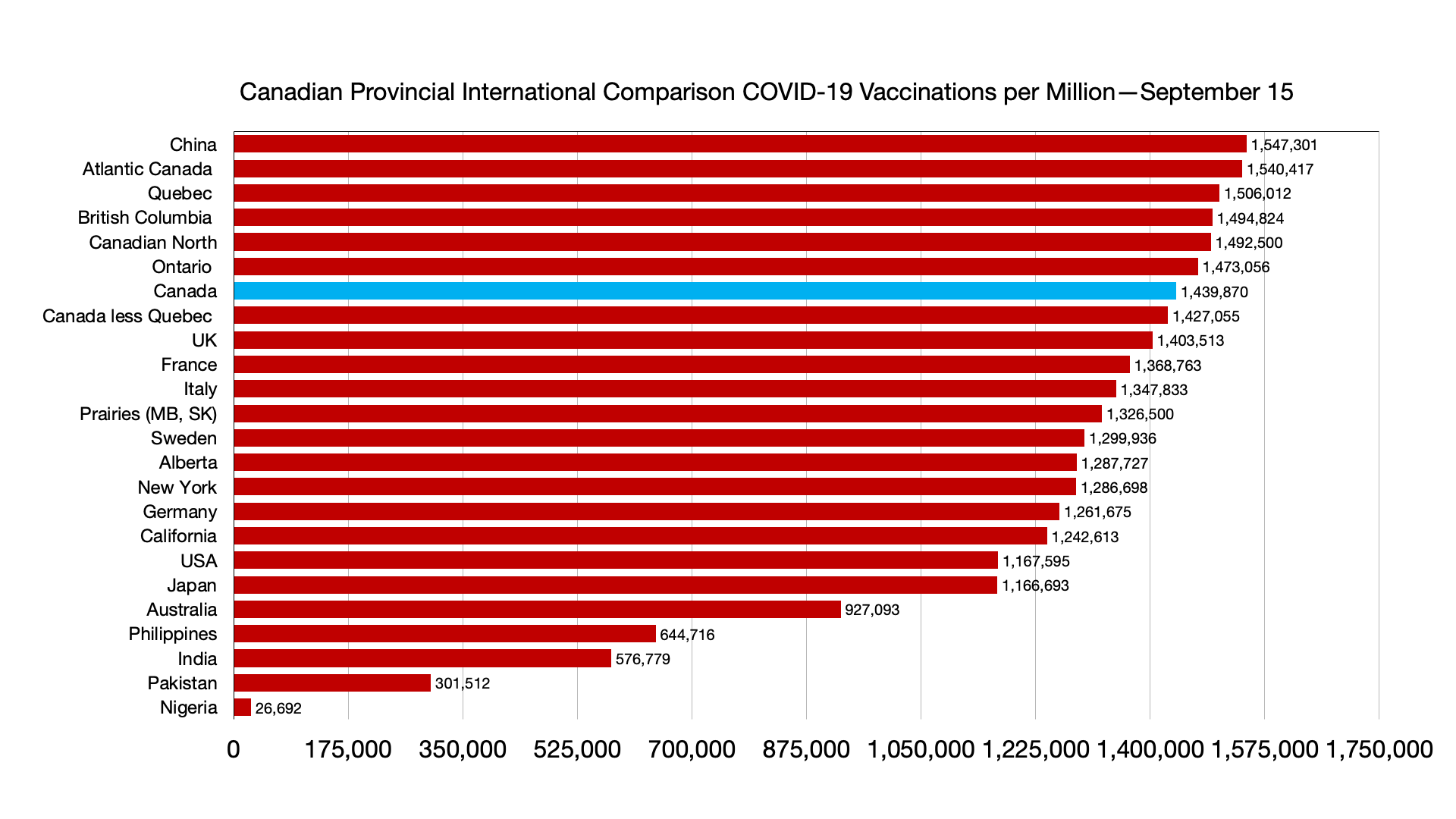
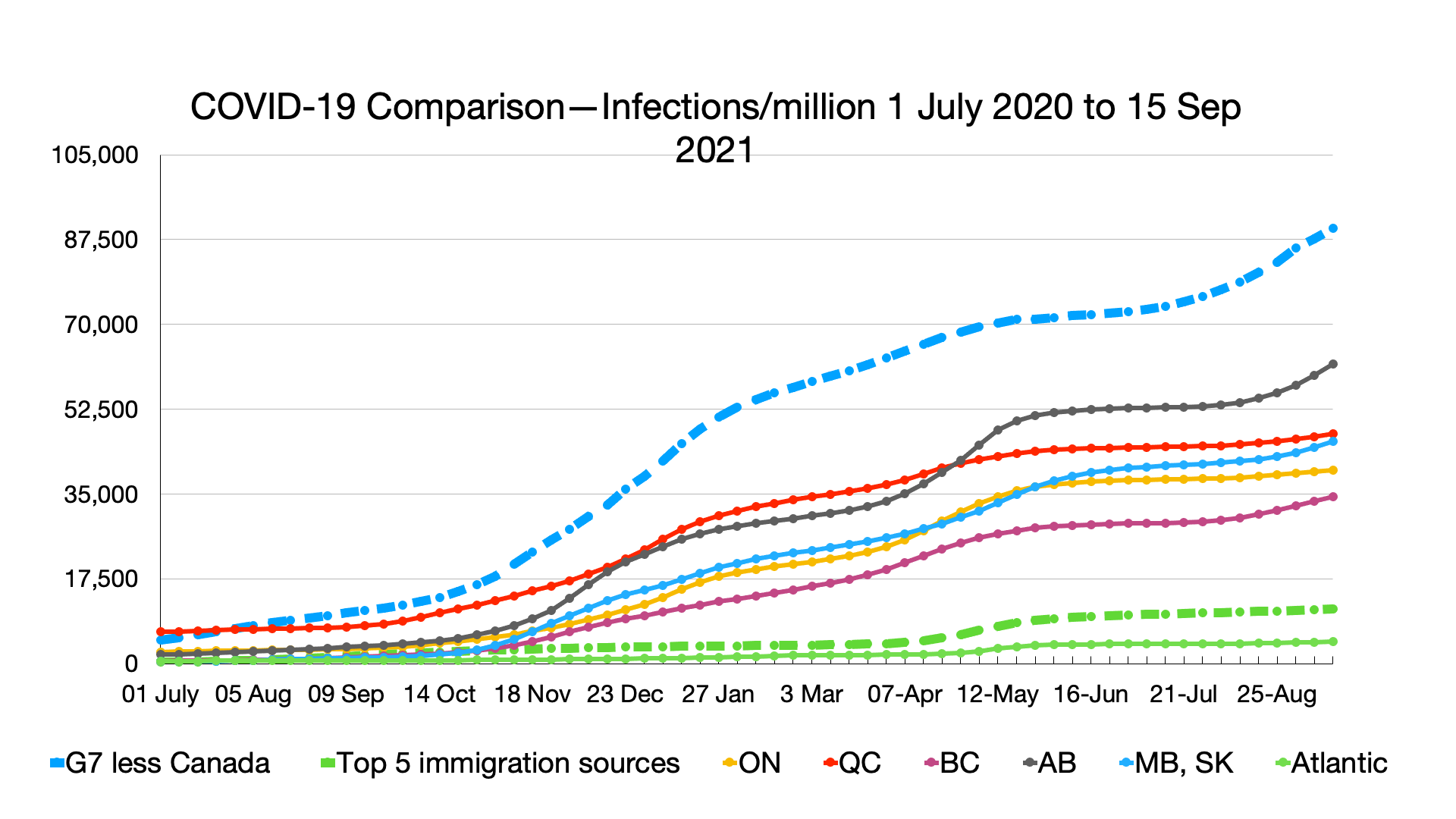
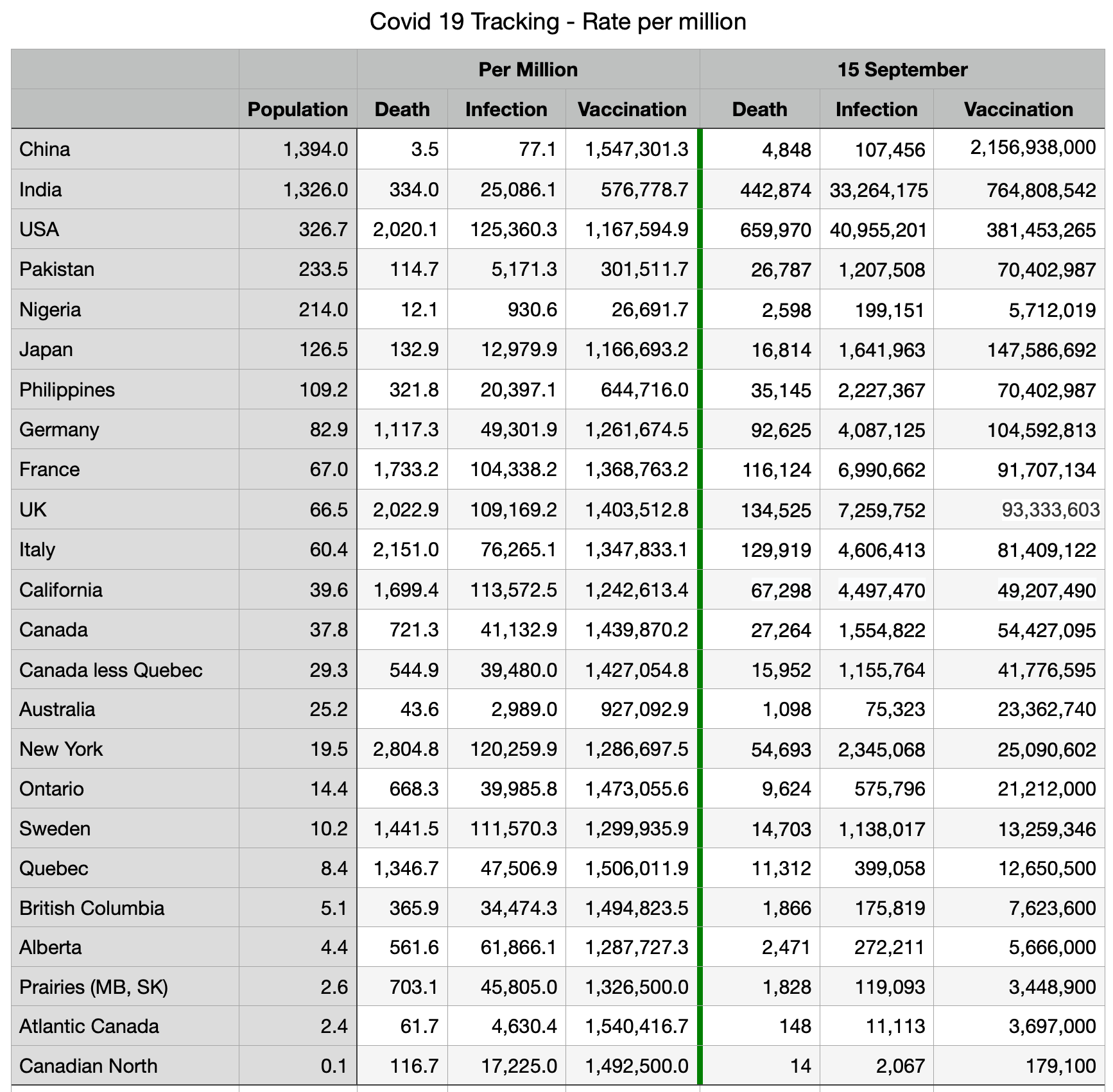
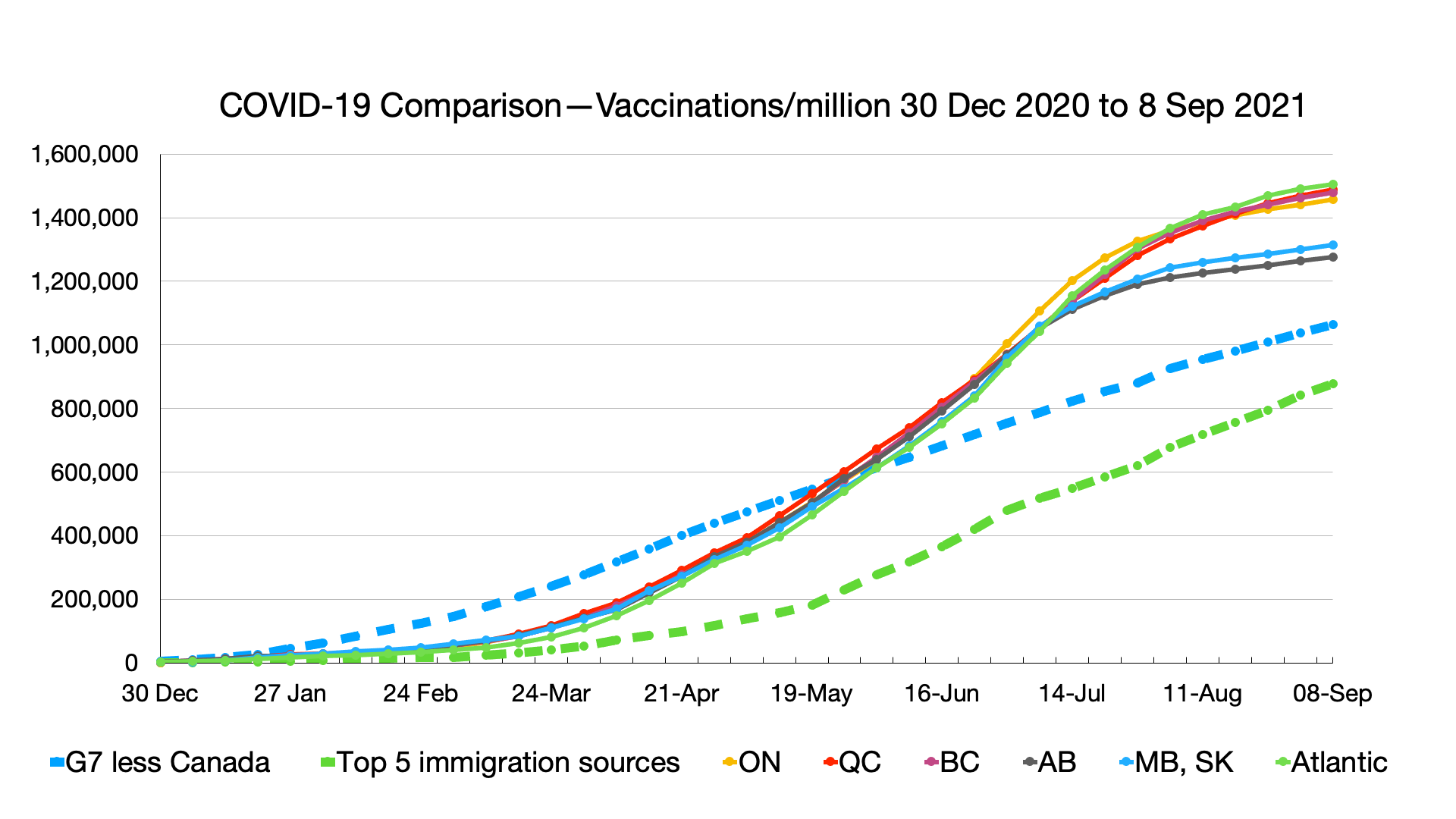
The latest charts, compiled 21 July as overall rates in Canada continue to decline along with increased vaccinations (Canadians fully vaccinated 51.7 percent, higher than USA 49.2 percent and and just behind UK 54.2 percent).

Vaccinations: All Canadian provinces ahead of USA and EU countries.

Trendline charts

Infections: No significant change but slight uptick in G7 less Canada given increased infections in UK and USA.

Deaths: No significant change.

Vaccinations: Captured above, with steady gap between Canadian provinces and G7.

Weekly

Infections: No relative change.

Deaths per million: No significant change.

Interesting and relevant analysis of India’s under-counting of COVID-19 cases:

India’s excess deaths during the pandemic could be a staggering 10 times the official COVID-19 toll, likely making it modern India’s worst human tragedy, according to the most comprehensive research yet on the ravages of the virus in the south Asian country.

Most experts believe India’s official toll of more than 414,000 dead is a vast undercount, but the government has dismissed those concerns as exaggerated and misleading.

The report released Tuesday estimated excess deaths — the gap between those recorded and those that would have been expected — to be between 3 million to 4.7 million between January 2020 and June 2021. It said an accurate figure may “prove elusive” but the true death toll “is likely to be an order of magnitude greater than the official count.”

The report, published by Arvind Subramanian, the Indian government’s former chief economic adviser, and two other researchers at the Center for Global Development and Harvard University, said the count could have missed deaths occurring in overwhelmed hospitals or while health care was delayed or disrupted, especially during the devastating peak surge earlier this year.

“True deaths are likely to be in the several millions not hundreds of thousands, making this arguably India’s worst human tragedy since Partition and independence,” the report said.

The Partition of the British-ruled Indian subcontinent into independent India and Pakistan in 1947 led to the killing of up to 1 million people as gangs of Hindus and Muslims slaughtered each other.

The report on India’s virus toll used three calculation methods: data from the civil registration system that records births and deaths across seven states, blood tests showing the prevalence of the virus in India alongside global COVID-19 fatality rates, and an economic survey of nearly 900,000 people done thrice a year.

Researchers cautioned that each method had weaknesses, such as the economic survey omitting the causes of death. 

Instead, researchers looked at deaths from all causes and compared that data to mortality in previous years — a method widely considered an accurate metric. 

Researchers also cautioned that virus prevalence and COVID-19 deaths in the seven states they studied may not translate to all of India, since the virus could have spread worse in urban versus rural states and since health care quality varies greatly around India. 

And while other nations are believed to have undercounted deaths in the pandemic, India is believed to have a greater gap due to it having the world’s second highest population of 1.4 billion and its situation is complicated because not all deaths were recorded even before the pandemic. 

Dr. Jacob John, who studies viruses at the Christian Medical College at Vellore in southern India, reviewed the report for The Associated Press and said it underscores the devastating impact COVID-19 had on the country’s under-prepared health system. 

“This analysis reiterates the observations of other fearless investigative journalists that have highlighted the massive undercounting of deaths,” Jacob said.

The report also estimated that nearly 2 million Indians died during the first surge in infections last year and said not “grasping the scale of the tragedy in real time” may have “bred collective complacency that led to the horrors” of the surge earlier this year.

Over the last few months, some Indian states have increased their COVID-19 death toll after finding thousands of previously unreported cases, raising concerns that many more fatalities were not officially recorded.

Several Indian journalists have also published higher numbers from some states using government data. Scientists say this new information is helping them better understand how COVID-19 spread in India.

Murad Banaji, who studies mathematics at Middlesex University and has been looking at India’s COVID-19 mortality figures, said the recent data has confirmed some of the suspicions about undercounting. Banaji said the new data also shows the virus wasn’t restricted to urban centers, as contemporary reports had indicated, but that India’s villages were also badly impacted.

“A question we should ask is if some of those deaths were avoidable,” he said.

Source: https://apnews.com/article/business-science-health-india-pandemics-334c326d86efa73a0631bf7cb6e3f92e?utm_source=Sailthru&utm_medium=email&utm_campaign=MorningWire_July20&utm_term=Morning%20Wire%20Subscribers

As Canada eases COVID-19 border restrictions, advocates say refugees’ travel is ‘essential’

Covid-19 immigration effects - Key Slides - May 2021 Draft.017On the good news side, the IRB backlog declined dramatically, with new claims falling by 68% and the backlog by 30%.

The progressive reduction in travel restrictions and requirements should allow for a more normal flow, with less concern for the irregular arrivals at non-official border posts given the Biden Administration’s approach:

Thanks to COVID-19 outbreaks in jails, immigration detainee Apollinaire Nduwimana was released from a U.S. prison in late April last year, after being held among convicted criminals for almost three years.

The asylum seeker from Burundi tried to head north for protection at Roxham Road in Quebec last October. But he didn’t know Canada had closed the border to refugees.

He was immediately intercepted, sent back to America and detained at the Clinton jail in Pennsylvania. He was threatened with deportation to his homeland despite assurances from Ottawa to let him return once COVID travel restrictions were lifted.

As of July, Nduwimana was one of 450 asylum seekers “directed back” to the U.S. since March 21, 2020, when Ottawa closed the border to non-essential travels. Although there have been exemptions, seeking asylum isn’t one of them.

With Ottawa slowly easing its travel restrictions, and border rules with the U.S. up for renewal on Wednesday, advocates say the federal government’s first order of business should be reopening the door to asylum seekers and sponsored refugees, the most vulnerable migrant group during the pandemic.

“Refugee travel is essential, we know that no one chooses to be a refugee,” said Maureen Silcoff, president of the Canadian Association of Refugee Lawyers. “Refugees can in fact enter and quarantine. So that really should have been the starting point.”

According to the latest UN Refugee Agency report, 1.5 million fewer people fled their homelands in 2020 than forecast, but the world’s displaced population still edged to a record 82.4 million by the end of last year, up from 79.5 million in 2019.

That’s because, it said, asylum seekers were unable to cross borders, with 164 countries imposing travel bans, and 99 states, including Canada, making no exception for people seeking asylum.

In total, only 34,400 refugees were resettled to third countries in 2020, down 69 per cent from 107,800 the year before. Today, 1.4 million refugees are awaiting resettlement.

Amid the chaos, the Immigration and Refugee Board of Canada is the rare beneficiary of the border closure.

Last year, the number of new claims fell 68 per cent to 18,500, from 58,378 in 2019. These were mostly from those within Canada who entered legally and later decided to seek asylum, or who came to the border before the lockdown or belonged to one of the exemption groups.

The slowdown allowed the board to reduce its backlog, which fell 30 per cent to 65,000 by the end of June, from 91,300 in March 2020, as refugee judges moved hearings online and adapted to new health protocols in offices.

Nduwimana first arrived in the U.S. for asylum in 2017 but was detained until his release in April 2020.

Thanks to interventions of advocates on either side of the border, he is one of nine asylum seekers who have been issued a “national interest exemption letter” to return to Canada on a later date after he was turned back at the border.

But it’s not without hassles because there are no bilateral policies to ensure these “direct-back” asylum seekers will be released from detention or spared from deportation to come back to the border.

“I am not a criminal but I was detained with people convicted of murder and rape,” said Nduwimana, 41, who fled political persecution in Burundi, an East African country where human rights violations are such that Canada suspends all removals to that country.

“Canada has the obligation to protect asylum seekers. Instead they sent me back to a country that’s not safe for refugees,” added the former church pastor and university language instructor, who almost got deported in January before a U.S. court intervened.

Upon his release in March from another jail in upstate New York, he entered Canada at Fort Erie and had his 14-day mandatory quarantine at a Niagara hotel. He is now awaiting his proceedings.

Silcoff said Nduwimana’s case shows refugee travel can coexist with public health measures and the current refugee ban can be lifted.

Despite public fear that Canada would see another surge of asylum seekers once the border reopens, Silcoff believed that’s unlikely under the new White House administration. Since Joe Biden became president in January, Washington has reversed many Trump-era anti-migrant, anti-refugee policies.

Temporary protected status has been granted to migrants currently in the U.S. from major refugee source countries such as Haiti, Venezuela and Yemen. In June, the U.S. restored the possibility of asylum protections for women fleeing domestic violence in other countries as well as for families targeted by violent gangs.

“It’s a different climate,” said Silcoff. “It’s hard to know what the future would bring but we know that Canada is able to handle fluctuations in numbers of asylum seekers.”

During the pandemic, Ottawa has also rolled out several measures that involved asylum seekers and failed refugees in Canada, such as releasing immigration detainees with less serious immigration violations and suspending deportations at the peak of the pandemic.

Another positive during this global public health crisis is the special program that grants permanent residence to asylum seekers who work in health care and essential jobs during the pandemic, said Janet Dench of the Canadian Council for Refugees.

“So there have been some good parts,” she said.

In June, the immigration department also announced plans to expedite the processing of permanent residence applications of people who have been granted asylum in Canada, with a new target of 45,000, up from 23,500.

That commitment will help someone like Mohammed Jadallah, who fled to Canada for asylum from Gaza via the U.S. in 2018 and has since been separated from his wife and five children.

When war erupted between Hamas militants in Gaza and Israel earlier this year, with bombs raining down on his homeland, the 41-year-old Toronto man could only console his family helplessly from afar, on a computer screen.

Although he was granted protected status in Canada in October and immediately applied for permanent residence, the process was set to take an average of 39 months.

“There was an airstrike in our neighbourhood in Rimal. The building that’s just 200 metres from ours was flattened,” said Jadallah, a rebar detailer, whose family struggles with food and fuel shortages.

“As a parent, you try to protect your children. It’s so hard when you can’t do nothing for them.”

Until he receives his permanent residence, Samaa, 37, and their children — Nidal, 15; Asil, 12; Mustafa; 9, Ali, 8; and Yusuf, 5 — cannot join him in Canada.

Dench said that speaks to the need to do away the bureaucracy that requires accepted refugees to go through all the hoops to apply for permanent residence.

“It will cost us less if we give them permanent residence more quickly because then it makes it easier for them to upgrade their skills and to reunite with their family and to contribute more fully,” she said. “If you’ve been vetted and accepted as a refugee, you should be automatically a permanent resident.”

During the pandemic, the resettlement of overseas refugees in Canada has also come to a halt due to border closures and the reduced processing capacity by the International Organization for Migration, the UN and local Canadian visa posts — except for the most vulnerable who require emergency resettlement.

As of the end of October, only 2,879 resettled refugees landed in Canada since March 18, 2020, including 1,603 sponsored by community groups, 1,262 by the federal government, and 14 through a joint public and private sponsorships. Another 40 arrived under the “urgent protection” program.

In 2021, Ottawa has set a target to bring in 36,000 sponsored refugees, but only 1,630 had arrived by the end of April, according to a report by Reuters. Last year, the target was 31,700 but only 9,200 made it, leaving 22,500 spots unfilled.

Critics ask: Will Immigration Minister Marco Mendicino allow the unused spots to carry over in coming years when international travel is back to normal?

“It’s 65,000 who are in the queue essentially, who are waiting to travel,” said Brian Dyck, national migration and resettlement program co-ordinator of the Mennonite Central Committee Canada. “And that queue has never been longer than now. Their applications are going in but there are none that are going out.”

Those who managed to come during the pandemic, he said, had their proof of permanent residence in hand on or before March 18, 2020.

While the task to bring in a huge number of sponsored refugees in a short time appears daunting, Dyck said that’s doable, as shown in how Canada and Canadians successfully brought in 25,000 Syrian refugees in a matter of months in 2015 and early 2016.

“I think that the government has learned how to use a variety of networks to process sponsorship applications in different ways,” he noted..

And there’s been no shortage of public support during the pandemic, said Dyck, whose office has continued to receive a lot of inquiries from people looking to sponsor refugees even without promoting the idea.

Torontonian Marika Elek and her sponsorship group, Beach Cares, submitted a private sponsorship application in January to bring a Syrian family of five to Canada from Lebanon.

“I remember what happened in 2015 and 2016 when there was a real surge of refugees coming in, and people managed to handle that,” said Elek, whose family was sponsored here by the Canadian government in 1957 from Hungary when she was a girl.

During the pandemic, she and some 350 sponsors got together online and officially launched The Private Refugee Sponsor Network to “connect, learn and share” information and provide free training to help each other problem-solve in anticipation of the border reopening.

“We have people who are ready to welcome them.”

Source: As Canada eases COVID-19 border restrictions, advocates say refugees’ travel is ‘essential’

Canada rejected humanitarian bids to stay in the country at a much higher level during the pandemic. Critics want to know why

Would be interesting to know the reasons for the increased rejections and how IRCC was able to process more bids when every other program declined:

Despite the processing of immigration applications being scaled back during the pandemic, Canada dramatically increased the number of bids it rejected from those seeking to stay in this country on humanitarian and compassionate grounds.

Unlike other immigration programs, Immigration, Refugees and Citizenship Canada actually finalized more applications under the so-called H&C category in the last year than in 2019.

In 2020, officials processed 8,735 H&C applications, 900 more than the year before COVID-19 was declared a global health crisis, prompting border closures and travel restrictions, and stalling immigration operations.

However, last year’s refusal rate reached a five-year high of 57 per cent, up from 35 per cent in 2019. In the first quarter of 2021, 70 per cent of the H&C applications were refused.

In general, prospective migrants must apply for permanent residence from outside Canada but those already inside the country and out of status as overstayed visitors and workers or failed refugees can ask for special permission to acquire permanent status if they can provide proof of establishment in Canada or undue hardship upon removal from the country.

“With these historic rejection rates, the federal government is condemning those migrants already here, and working in the most precarious situations to further insecurity and deportation,” Syed Hussan of the Migrant Rights Network told a news conference Tuesday.

“By doubling rejections, Prime Minister Justin Trudeau is doubling the potential for exploitation.”

With the myriad programs to bring in temporary residents such as international students and migrant workers, Hussan said migrants can easily fall through the cracks and become undocumented and the H&C is the only way for them to access permanent status in Canada.

During the pandemic, the immigration department has focused on transitioning temporary residents in Canada into permanent residents. In May, it opened new immigration pathways to 90,000 international graduates and essential workers, but undocumented migrants were ineligible.

“We need comprehensive not piecemeal change, that is to ensure full and permanent immigration status for all migrants, including undocumented people in the country,” said Hussan, who estimated there are half a million of non-status migrants in Canada.

“To avoid facing the same crisis in the future, ensure that all residents that arrive in the future do so with permanent resident status.”

Hussan said it’s not known what has led to the skyrocketing refusals against H&C applicants because there have been no policy changes as to how these applications are processed.

“The Liberal government must provide answers to why there is such a significant jump in H&C refusals and take immediate action to rectify this,” said NDP immigration critic Jenny Kwan, who obtained the data.

Applicants from the Philippines and India were the most overrepresented groups under the humanitarian program, with refusal rates hovering at 72 per cent and 75 per cent respectively.

“It’s long past time that Canada returns to an immigration system that honours the contributions of all workers with a full range of diverse skills and occupations with landed status on arrival,” Kwan said. “A regularized immigration stream for migrant workers is the only way to ensure workers’ rights are respected.”

Queen Gabriel was among those whose humanitarian application was refused last year. The 39-year-old Trinidadian woman arrived in Canada on a visitor visa in 2013 and has worked as a personal support worker even though she is without status in Canada.

She said precarious immigration status puts migrants like her at risk to exploitation at work places. She said she was made to work 400 hours a month for more than two years and the employer refused to pay overtime and vacation. She couldn’t even travel for her father’s funeral or bury her brother, who died last year.

Ottawa introduced a time-limited “Guardian Angel” immigration program in December to eligible asylum seekers who work in Canadian health care. However, Gabriel did not qualify because she’s never made an asylum claim here.

Three years ago, she needed to be admitted to a hospital emergency department for a gynecological surgery and the medical bill was more than $8,000. She still owes the doctor $5,000.

“There’s no living without status in Canada. There’s only existing dead end jobs for survival,” she told the Tuesday news conference. “Landed status to all is necessary, especially when the immigration process is slowly choking the life out of us.”

The Migrant Rights Network is calling on the federal government to implement a “regularization” program to grant permanent status to all temporary residents currently in Canada.

“It is not a gift or a privilege,” Hussan said. “It is the only existing mechanism for migrants to access the same rights as other residents of the country.”

Source: Canada rejected humanitarian bids to stay in the country at a much higher level during the pandemic. Critics want to know why

‘We Can’t Take Immigrants for Granted’: Minister

Bit of an odd comment by the minister – “ranking immigrants one against the other” – given that the old point system and current Express Entry application process do just that. Or maybe he was simply trying to communicate an increased focus on lower-skilled essential workers.

But perhaps the massive draw earlier this year with minimal comprehensive ranking score of 75 suggests that the government’s objective in meeting this year’s target of 400,000 makes previous merit assessment approaches less important:

Minister Marco Mendicino has emphasized the need to modernize Canada’s immigration system so that future public health crises don’t threaten the economy the way COVID-19 has, though he was scant on details about how to achieve it.

Speaking at an online event on Friday organized by First Policy Response, Mendicino said bringing immigrants into the country is critical for the Canadian economy, while also recognizing the “contributions (of immigrants) that we took for granted before the pandemic.”

“We believe that we are an open country, an inclusive country, but our system needs to be transformed, needs to be modernized, so that it can accommodate the great demands that are placed on it,” he said.

Mendicino believes the $1 billion slated in the 2021 budget to “modernize and transform” the immigration system will lead “not only to better service…but to faster outcomes” for people trying to immigrate into the country. As he sees it, it is part of a “shift in the paradigm in the way we talk about immigration,” which should include getting rid of discriminatory practices like “ranking immigrants one against the other” – namely those considered low-skill versus those with higher qualifications.

“I think the pandemic has allowed us to really understand that each and every newcomer has something to contribute to our economy, to our communities and to our country,” the Minister said.

The government has taken some steps during the pandemic to continue some level of immigration. These have included writing new laws and policies to authorize entry based on “the needs of the economy;” the digitization of permanent residence and citizenship application processes; and the extension of permanent residence to immigrants already working in the country but lacking status through programs like the Essential Workers Pathway and the Guardian Angel programs, the latter of which allowed “asylum seekers to stay in Canada thanks to their contributions in hospitals and long-term care homes,” Mendicino said.

“We prioritized the needs of the economy. Immigration will create jobs, further opportunities and strengthen our long-term prosperity.”

But other than “investing in hiring additional people, introducing new technologies and putting in place policy flexibility,” there were few, if any, details on what will be done going forward to ensure immigrants don’t fall into precarious employment. Raju Mohandoss, one of the four panelists and the director of newcomer programs and services at WoodGreen Community Services, a settlement organization in Toronto, referred to these employments as “survival jobs.”

“When newcomers come – even qualified ones – they get into survival jobs that sustain them during a period when they are putting other things together and trying to access other services to integrate,” he said after the Minister had finished speaking and left. “But all these survival jobs are in the hospitality, retail, or manufacturing sectors…all of which are completely wiped out because of the pandemic situation.”

To his credit, before leaving, Mendicino had mentioned the importance of “making sure we protect (migrant workers’) rights” and “ensure that their workplaces are safe and healthy,” but he again failed to specify how this would be done.

He also made no mention of the precarious nature of most of those so-called “survival jobs.” And while he recognized that speaking of immigration must include a discussion on how to “attract people not only for the purposes of adding to our economy…but to protect that promise of Canada” as a welcoming, safe country, he gave no details on what will happen to people whose permanent residence applications are stuck in limbo or in a backlog, other than “keep the faith” and “we hear you.”

The four-member panel that followed Mendicino’s presentation, which consisted of immigration experts from various fields, failed to find the Minister’s announcement as much more than a self-congratulatory moment.

Rupa Banerjee is the Canada Research Chair and Associate Professor at the Ted Rogers School of Management at Ryerson. She said that while she agreed with Mendicino that “a lot of news early in the pandemic really [was] quicker” than what is expected from governments, little work has been done to help newcomers integrate into society.

Mendicino “talked about selection and modernization,” she said, “but, at the end of the day, those do not exist in a vacuum…Newcomers face challenges once they arrive in Canada, and those challenges need to be integrated into the selection system as well.”

What is needed immediately in order to help newcomers, added Mohandoss, are dollars. While the $1 billion investment is “good to hear,” Mohandoss stressed that “no new dollars” have been made available for settlement agencies, which are crucial in helping newcomers find, understand and access available resources. According to him, there hasn’t been any investment in the settlement agencies sector for “more than a decade and a half.”

“We have these targets – that’s great – but what happens to (newcomers) when they’re here?” he said. “Unless we’re improving settlement services, these people are going to continue to struggle being here…So, dollar investments in digitizing and innovating stops short of investing in settlement services.”

Much of the rest of the conversation between the panelists involved discussing what they saw as Canada’s “two-tier immigration system,” referring to the premium the government puts on the Canadian Experience Class versus so-called “low-skill” immigrants. The result, said Shamira Madhany, World Education Services’ managing director, is that Canada ends up “with a lot of people who come to Canada through the two-tiered system but don’t grow our economy” as their experience abroad is discounted and thus often goes underutilized, forcing them onto precarious so-called survival jobs.

“Even with pathways to permanent residence, people still struggle greatly after transition,” added Banerjee.

Madhany suggested a three-pronged approach to help boost the economy by properly utilizing newcomers’ experiences and skills as they integrate without having to sacrifice their safety: a national strategy to enhance immigration and labour market integration; policies that are intentionally passed with those who are “impacted greatly” in mind, such as racialized women and people relegated to low-wage labour; and developing innovative tools and approaches to recognize and assess skills and experience gained abroad.

“We need to think about being intentional about leveraging the skills people bring,” she said. “This isn’t just about bringing people in and taking any job…but using people’s deep experience.”

Source: https://ca.news.yahoo.com/t-immigrants-granted-minister-185607613.html

#COVID19 Immigration Effects – May 2021

Updated data across all immigration programs. Given the travel restrictions and shutdowns spring 2021, some of the monthly percentage increases are exceedingly high, with comparisons to May 2019 more meaningful. 

Some of the highlights: 

  • 2021 Permanent Resident numbers to date remain below 2019 levels, 109,615 Jan-May 2021 compared to 125,850. To meet 2021 target of 401,000, over 40,000 new PRs per month needed over the next 7 months. Given the various measures taken to date, a stretch but not impossible. 
  • The decline in Permanent Resident admissions partially reflects decline in TR to PR transitions, perhaps suggesting limited existing “inventory,” with PR applications also down 
  • Temporary Residents relatively less affected with numbers fairly stable 
  • Slight decline in study permit applications and study permits 
  • Asylum claimants stable at low levels 
  • Citizenship slight recovery in numbers but still much lower than pre-pandemic 
  • Visitor visas remain largely shut down. 

Le dossier de l’immigration au Québec va mal

Apart from the administrative issues (a natural result of distinct jurisdictional responsibilities that should be addressed administratively), the main argument is for transferring responsibility for temporary migration to Quebec. Given the Quebec government’s overall approach to immigration, hard to see that this would result in improved administration or outcomes.

And complaining that Quebec does not receive integration funds for temporary workers is cheeky, given the overly generous financial support for integration under the Quebec-Canada accord (https://vancouversun.com/business/douglas-todd-quebec-to-get-10-times-more-than-b-c-and-ontario-to-settle-immigrants):

Le 6 juillet dernier, Robert Dutrisac note que « [la] superposition des administrations canadiennes et québécoises [en matière d’immigration] cause des lourdeurs inacceptables dont il faudra bien se débarrasser ».

Il a raison d’expliquer pourquoi cela prend plus de temps pour obtenir la résidence permanente au Québec. En effet, une personne sélectionnée au Québec reçoit un Certificat de sélection du Québec (CSQ) et ensuite fait une demande de résidence permanente au fédéral. Après avoir fait les vérifications de santé et de sécurité, le fédéral est tenu d’accorder la résidence permanente selon l’Accord Canada-Québec sur l’immigration signé en 1991. Quelqu’un qui se destine à ailleurs au Canada n’a pas à passer par l’étape du CSQ.

Le Devoir a offert ces derniers mois plusieurs exemples montrant que le dossier de l’immigration au Québec va mal et combien chevauchement gouvernemental s’ajoute souvent au problème.

Des personnes sélectionnées par le Québec en attente de leur résidence permanente ne réussissent pas à faire renouveler leur permis de séjour temporaire ; des demandeurs d’asile qui contribuent à notre société attendent pour savoir si leur demande de résidence permanente sera approuvée ; sans parler des étudiantes et étudiants étrangers séduits à s’inscrire à des collèges privés avec une promesse de résidence permanente au Canada ou des travailleurs agricoles qui subissent des conditions de travail inacceptables au Québec, liés à leur employeur par un permis de travail temporaire fermé.

Les solutions proposées vont dans tous les sens. Les employeurs réclament une hausse de seuils d’immigration pour pourvoir à la pénurie de main-d’œuvre. Un parti politique réclame une baisse des seuils d’immigration pour protéger notre langue et notre culture. Un autre semble vouloir offrir la résidence permanente essentiellement à tout le monde qui veut s’installer au Québec. Le gouvernement parle de négociations qui traînent avec le fédéral pour accélérer la régularisation des personnes sélectionnées et pour plus de contrôle sur le programme des travailleurs étrangers temporaires.

Pendant ce temps, plus de 80 millions de personnes ont été déplacées sur la planète en 2020 à cause des conflits. Combien de milliers d’autres pour des raisons de catastrophes naturelles ? On ne connaît pas encore l’effet à long terme de la pandémie sur la migration économique ou pour les études.

L’immigration temporaire a pris le dessus

L’Accord Canada-Québec signé il y a 30 ans ne suffit plus à la tâche. Le gouvernement du Québec d’alors cherchait à déterminer les volumes d’arrivées et à appliquer une grille de sélection spécifique aux besoins démographiques, socio-économiques et linguistiques du Québec. Il voulait également plein contrôle des services d’intégration socioéconomiques et linguistiques. Presque tout dans l’Accord concerne l’immigration permanente. Même la compensation du fédéral prévue pour les services d’intégration ne touche que les personnes avec un statut de résidence permanente.

Aujourd’hui, c’est l’immigration temporaire qui a pris le dessus, sans planification des volumes. En 2019, l’année où le gouvernement du Québec a baissé le nombre d’admissions de 20 % pour l’établir à 40 000, il y avait près de 160 000 personnes avec un permis temporaire au Québec au 31 décembre, excluant les personnes ayant fait une demande d’asile.

L’immigration temporaire inclut les personnes de l’étranger qui étudient ou travaillent ici, avec des permis fermés ou ouverts qui comprennent leurs conjointes et conjoints et les travailleuses et travailleurs agricoles. Un grand nombre veulent rester et ils y sont même encouragés.

Ces personnes restent souvent au Québec pendant quelques années avant de faire leur demande de résidence permanente. Pendant ce temps, les seules exigences linguistiques qui s’appliquent sont celles des établissements d’enseignement supérieur ou des employeurs. Ils peuvent envoyer leurs enfants à des écoles publiques anglaises. En dépit des grands nombres, la pénurie de main-d’œuvre perdure.

C’est le gouvernement fédéral qui décide les conditions des permis de séjour temporaire et qui traite les dossiers de demande d’asile. Dans le budget fédéral de février dernier, un financement de 49,5 millions de dollars sur trois ans a été annoncé pour appuyer les organismes communautaires qui offrent des programmes et des services d’orientation aux travailleurs migrants. Puisque ces services ne visent pas les résidents permanents, ils ne seront pas couverts par l’Accord Canada-Québec. Le Québec n’aura donc plus le plein contrôle sur le message aux personnes arrivant sur le territoire, ni sur la langue de ce message.

Monsieur Robert Dutrisac affirme avec raison que « le Québec doit, pour des raisons évidentes, garder le contrôle de son immigration ». Malheureusement, il est presque trop tard. Ce ne sont pas les petits pansements ici et là dans les processus qui suffiront à remédier à la situation.

Est-ce que le Québec saurait faire bon usage d’un réel contrôle de son système d’immigration et d’intégration ? Est-ce possible un Accord modernisé ? Il est plus que temps de trouver les réponses à ces questions.

Ancienne directrice de la planification et de la reddition de comptes, ministère de l’Immigration, de la Francisation et de l’Intégration

Source: https://www.ledevoir.com/opinion/idees/617817/quebec-le-dossier-de-l-immigration-va-mal?utm_source=infolettre-2021-07-14&utm_medium=email&utm_campaign=infolettre-quotidienne

#COVID-19: Comparing provinces with other countries 14 July Update

The latest charts, compiled 14 July as overall rates in Canada continue to decline along with increased vaccinations (Canadians fully vaccinated 45.6 percent, higher than EU countries, just slightly behind USA 48.6 percent and UK 52.4 percent).

Vaccinations: All Canadian provinces ahead of USA and EU countries.

Trendline charts

Infections: No significant change

Deaths: No significant change.

Vaccinations: Captured above, with increasing gap between Canadian provinces and G7.

Weekly

Infections: No relative change.

Deaths per million: No significant change.