Immigration and natives’ exposure to COVID-related risks in the EU | VOX, CEPR Policy Portal

Interesting assessment that immigrant workers in EU countries helped non-migrants avoid COVID-related risks given that immigrant workers filled the more difficult and dangerous jobs and that native workers were more able to shift to jobs that could be filled from home:

In recent years, immigration policy has been at the forefront of political debates in high-income destination countries. The UK completed its withdrawal from the EU on 31 January 2020, due in part to the desire to have more control over its immigration policies and to limit migrant flows. Intense political debates and polarisation on immigration helped fuel the rise of right-wing parties in Europe and political controversies over the border wall and the Dream Act in the US.

Despite these high-profile examples of the popular and political backlash against immigration, the academic literature provides evidence that immigrant workers often fill difficult and dangerous jobs that locals are not willing to undertake (Orrenius and Zavodny 2009 and 2013, Sparber and Zavodny 2020).

The recent COVID-19 shock exerted unforeseen and sudden pressures on labour markets across the world. While the negative effects of the pandemic were widespread, some categories of workers were hit much harder than others due to their occupations (Adams-Prassl et al. 2020a and 2020b, Dingel and Neiman 2020, Garrote-Sanchez et al. 2020, Gottlieb et al. 2021). Migrant workers, in particular, have been more exposed to the negative impacts of COVID-19 (Basso et al. 2020, Borjas and Casidi 2020, Fasani and Mazza 2020 and 2021). Another strand of the migration literature shows that in response to immigration, native workers reallocate to different occupations in which they have a comparative advantage (Peri and Sparber 2009).

Against this backdrop, a question of interest is whether immigration contributed to reducing locals’ exposure to the COVID-19 pandemic. In a recent paper (Bossavie et al. 2020), we explore how the prevalence of immigration in a labour market affects different types of workers’ exposure to COVID-19 related risks. We provide evidence that not only were immigrant workers more exposed to the economic and health-related shocks of the pandemic; they also served as a protective shield for native workers. By selecting into higher-risk occupations prior to the pandemic, immigrants enabled native workers to move into jobs that could be undertaken from the safety of their homes or with lower face-to-face interaction with customers and co-workers during the pandemic.

To assess the exposure of immigrant and native workers to the economic and health risks posed by the pandemic, we construct various measures of vulnerability. We look at three main dimensions of occupational vulnerability in the context of COVID-19: whether an occupation can be carried out from home, whether it has been categorised as essential by governments in the context of COVID-19, and whether it is exposed to COVID-19 health risks. In general, lower-skilled occupations such as machine operators, waiters, and day laborers tend to be less amenable to work from home than professional and managerial occupations. Essential jobs are concentrated in key sectors such as healthcare or agriculture. The higher health risks are found in essential occupations that require intensive face-to-face interactions such as doctors, personal care workers, or bus drivers.

We focus on destination countries in Western Europe, including the 15 countries that were the initial members of the EU (prior to the 2004 enlargement), Norway, and Switzerland. This region is the destination for an estimated 60 million of some 272 million immigrants worldwide. The analysis is based on a harmonised labour force dataset (EU Labor Force Survey) that contains detailed information on personal characteristics (such as age, education, occupation, and sector) of native workers and labour migrants in hundreds of local labour markets in subregions within European countries.1 The distribution of occupations by type of exposure to COVID-19 and by migrant status in the EU is reported in Figure 1.

Figure 1 Relative size of telework, essential, and non-face-to-face jobs in the EU

Source: Own calculation based on EU-LFS 2018 data, following EC directive (2020) and Fasani and Mazza (2020).

We first find that immigrants are generally employed in occupations that are more vulnerable to COVID-19-related risks (Fasani and Mazza 2021 report similar findings). Our estimates show that only 27% of employed migrants in the EU15 have a job amenable to telework, compared to 41% of native workers (Figure 2). On the other hand, migrants are slightly more likely to be in essential occupations. Combining those two categorisations of job vulnerabilities, migrants are more than 10% less likely than natives to hold jobs that are shielded from negative income shocks associated with the COVID-19 pandemic. Furthermore, migrants are also more likely to have jobs that are exposed to health risks, though we report significant heterogeneity in exposure among immigrant groups. The higher vulnerability of migrants is common across skill levels but varies depending on country of origin, with Eastern European migrants being the most exposed to income risks while migrants from Western Europe or North America have a similar risk profile to natives. Recent Eurostat statistics show that the higher vulnerability of migrants to the COVID-19 shock in Western Europe resulted in higher employment losses in 2020 (4% drop vis-à-vis 2019, compared to 0.8% fall for natives during the same period).

Figure 2 Share of workers by region of origin and risk type

Source: Own calculation based on EU-LFS 2018 data, following EC directive (2020) and Fasani and Mazza (2020).

We then examine whether the presence of immigrants in local labour markets has a causal impact on the vulnerability of native workers in the same geographic areas. Our empirical analysis is motivated by a general equilibrium model of comparative advantages in task performance between immigrant and native workers (Peri and Sparber 2009). In the model, native workers reallocate to other occupations in response to an influx of immigrant workers. In the empirical analysis, we use an instrumental variable approach to account for the non-random location choices of migrant responses to local job opportunities, which is based on past migration presence in the same region. Because of information, networks, and preferences, there is a strong positive association between current and past immigrant presence across European regions, as immigrants tend to move to the same locations where previous immigrants from the same country already live.

We find that native-born workers in those European subregions with a higher share of immigrants are significantly less likely to be exposed to various dimensions of occupational vulnerability associated with COVID-19. This association is especially strong when looking at the likelihood of being employed in teleworkable occupations (Figure 3), and the results get stronger once the endogeneity of immigrants’ location choices is taken into account. Immigration thus had a causal impact in reducing the exposure of native workers to some labour markets risks associated with the COVID-19 pandemic.

Figure 3 The relationship between share of immigrants in the working-age population and share of natives employed in jobs amenable to work from home in European regions

Source: Authors’ calculations using the EU Labor Force Survey 2018.
Note: The sample includes NUTS-2 regions from the EU-15 as well as Switzerland and Norway.

We also find heterogeneous effects depending on the characteristics of native workers. The effects of immigration on job safety are stronger for highly (i.e. tertiary) educated native workers, who benefit from the presence of both high-skilled and low-skilled migrants. By contrast, the effects are smaller and statistically insignificant for less (i.e. non-tertiary) educated native workers. We also assess whether these compositional effects on employment of certain types of native workers are accompanied by overall changes in total employment and wages. We find no evidence of wage or employment impacts among native workers, suggesting that the increase in job safety among native workers is driven purely by their reallocation from vulnerable jobs to safer jobs.

In short, we find that immigration to Western Europe reduced the economic exposure of natives to COVID-19 related labour market shocks by pushing them towards occupations that are more amenable to work from home. Our paper thus provides another example of immigrant workers in effect ‘protecting’ native workers by taking on the riskiest jobs during the pandemic.

Source: Immigration and natives’ exposure to COVID-related risks in the EU | VOX, CEPR Policy Portal

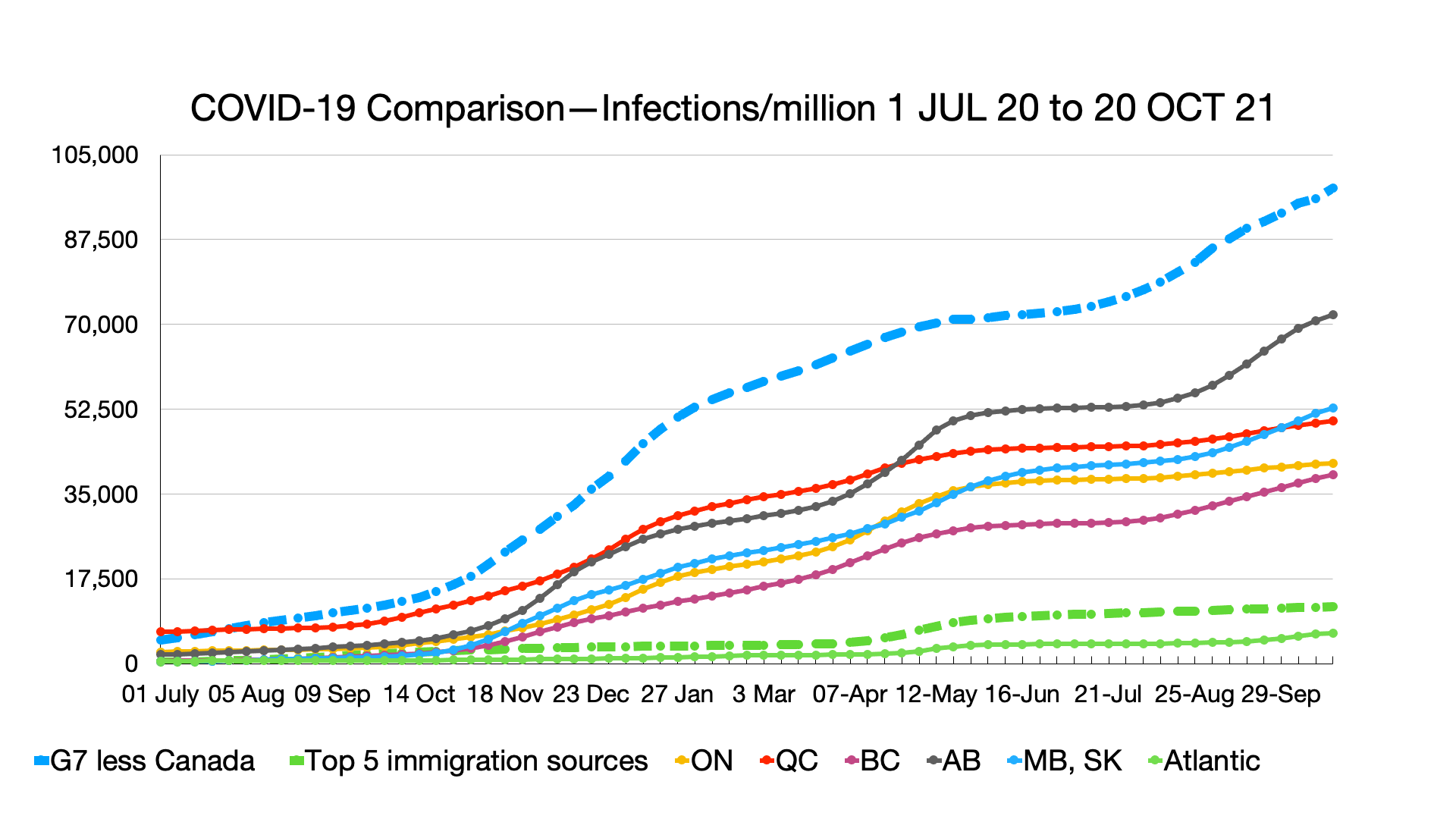
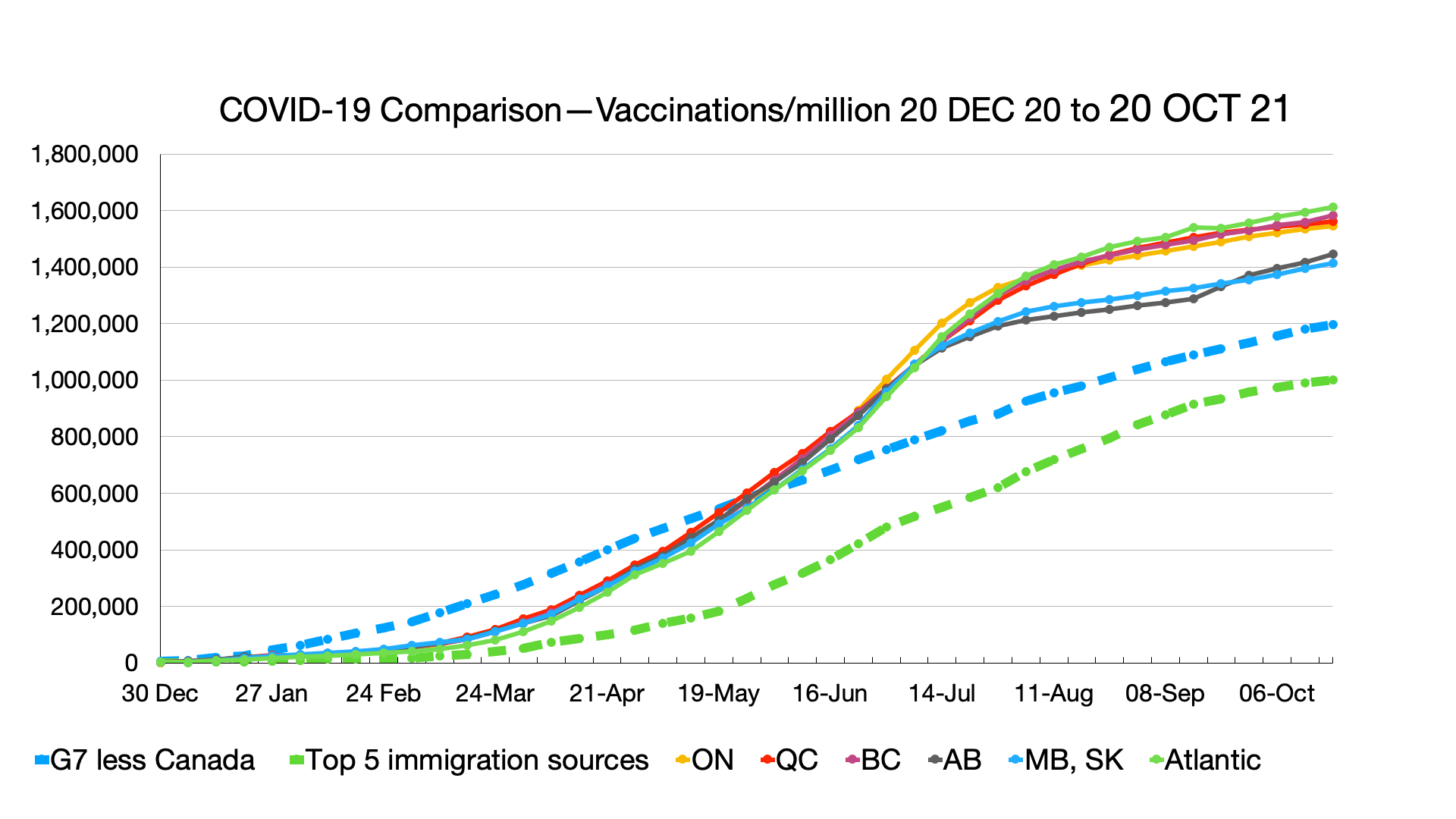
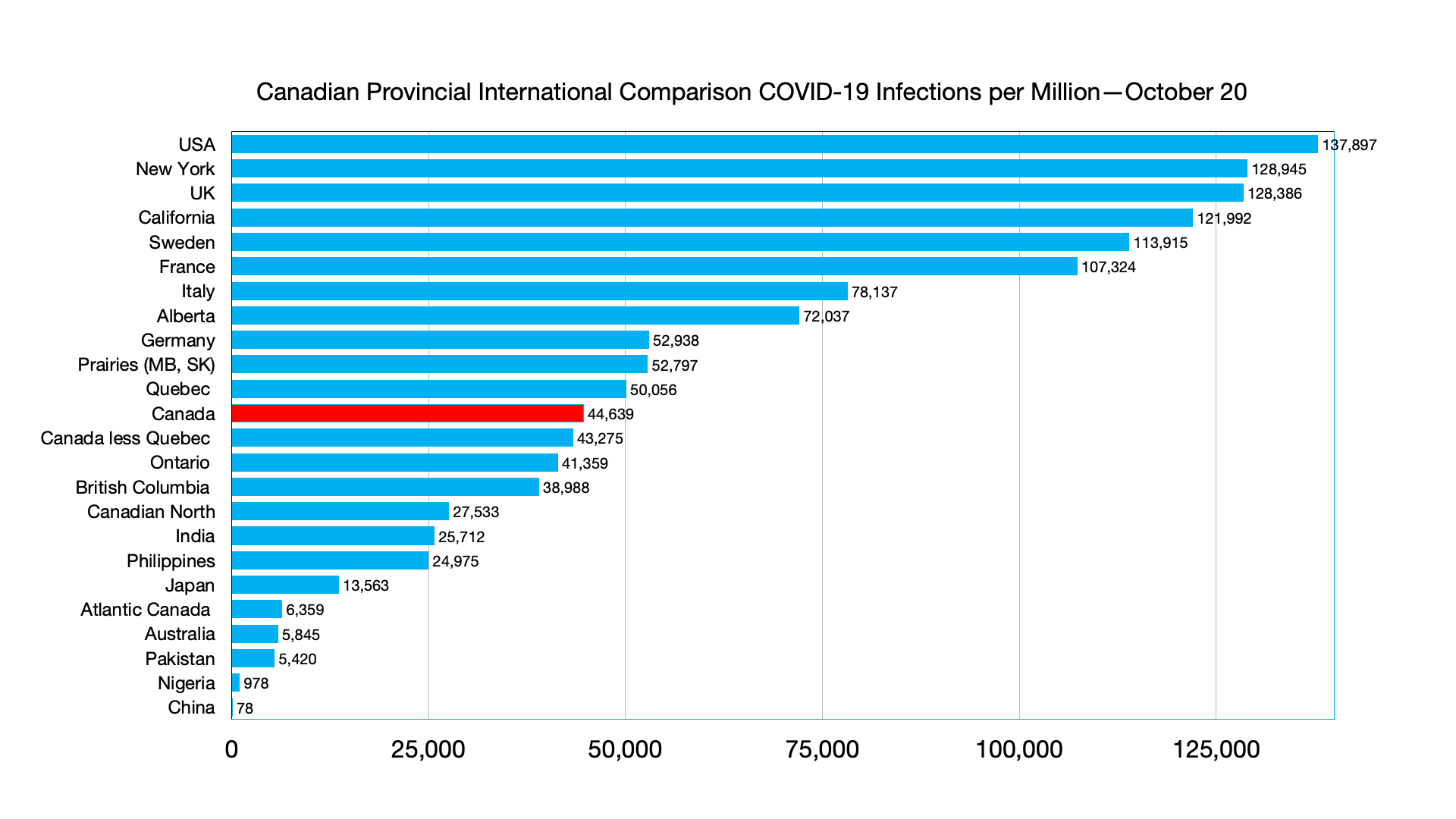
#COVID-19: Comparing provinces with other countries 1 September Update

The latest charts, compiled 1 Septe mberas overall rates in Canada increase slightly due to the variant. Canadians fully vaccinated 67.6 percent, higher than USA 53 percent and the UK 64 percent), although all three countries appear to be reaching a wall with respect to vaccination.

Vaccinations: China second after Atlantic Canada, Quebec ahead of Canadian North, France ahead of Prairies, and Germany ahead of Sweden. Chinese fully vaccinated, 63.3 percent, if numbers are accurate.

Trendline charts

Infections: Same ongoing trend: More pronounced uptick in G7 less Canada (driven largely by USA). While all provinces showing increased infections, greater upticks in Alberta, British Columbia.

Deaths: No significant change.

Vaccinations: Ongoing steady gap between Alberta and Prairies with lower vaccination rates than elsewhere in Canada. More rapid increase of immigration sources countries driven by China and to a lesser extent, India.

Weekly

Infections: No relative change except UK slightly ahead of France.

Deaths per million: No significant change.

Will hate crimes make Canada a less attractive destination for immigrants?

Not convinced. Unlikely that among the various factors that influence destinations of immigrants that this will dominate the others. More important, even as a factor, this will be in relation to other countries, most of which have higher degrees of polarization on immigration and diversity issues:

Since the start of the pandemic, there has been a reported intensification in racially motivated hate crimes against immigrants from East and Southeast Asia in many Western countries, including Canada. But do such xenophobic crimes affect migration to the countries in which they take place?

To answer this question, we first need to understand that, to many immigrants, the decision to migrate depends on a set of factors; some that push them to leave their home country, while others pull them to the host country.

The fact is that Canada has not always been a welcoming country – rather it has a well-documented history of racial discrimination against immigrants. In fact, most Asian immigrants in Canada are aware of racism, both covert and overt. With the popularization of information and communication technology, it is imaginable that many seeking to move to the country have been prepared by their families and friends already in Canada for discrimination, particularly in the job market, which is notorious for its systemic discrimination against professional credentials, work experience, language, culture and race of ethno-racial minority immigrants.

Of the top ten countries of birth of recent immigrants to Canada, seven are in Asia

Yet given these challenges, why do tens of thousands of immigrants from East and Southeast Asian countries still decide to immigrate to Canada every year?

Before 1967, when Canada introduced its points-based immigration system, immigrants to Canada were overwhelmingly from Europe. The point system welcomed young, educated and skilled immigrants, andshifted the major sources of immigrants to Canada from Europe to Asia. According to the 2016 census, among the top ten countries of birth of recent immigrants, seven are in Asia, namely the Philippines, India, China, Iran, Pakistan, Syria and South Korea. With a long history of migration to Canada, immigrants from these countries have also established a strong transnational social network that facilitates the migration of fellow friends and families and their settlement and integration in Canada.

A better future

Seeking a better economic future is believed to be a key force behind transnational migration, particularly from the Global South to the Global North. Political instability and oppression are other major factors driving people voluntarily and involuntarily to leave their countries, such as the case of Syria and Iran. Recently, the military suppression of democracy movements in Myanmar, the civil unrest in Thailand, China’s military pressure on Taiwan and the imposition of National Security Law on Hong Kong have caused many people to consider leaving their home countries.

Immigrants to Canada have long cited seeking better futures for their families as the number one reason why they decided to emigrate. Some were even willing to trade off economic loss for political stability. One example is the 380,000 Hong Kong immigrants who travelled to Canada in the 1980s and 1990s, amid the uncertainties surrounding the transfer of sovereignty of Hong Kong from Britain to China.

For many immigrants, Canada and other Western countries are attractive not only because of better economic opportunities but because of political stability, safety, lifestyle, education, as well as social and health protection, to name just a few reasons.

Canada has repeatedly claimed to be a global defender of human rights. Recently, the Canadian government apologized and compensated for racially motivated wrongdoings in the past, such as the head tax on Chinese immigrants and the internment of Japanese-Canadians. Hate crimes against Asians and any other ethno-racial groups simply jeopardize Canada’s global reputation and moral credibility.

Related story

PA-53949819.jpg
Canada’s immigration planning is increasingly divorced from the real impacts of COVID-19 – and undervalues ‘essential workers’

Meanwhile, as a country that relies on immigrants to replace the shrinking domestic supply of talents to our labour market, Canada is competing for high-skilled talents in demand globally. If it is to become an appealing destination, we must create a welcoming and inclusive environment for immigrants in Canada. Racism will certainly weaken this, and also make it more difficult to retain immigrants, particularly those who are highly skilled, and can choose to leave. In 2006, there were already 2.8 million Canadians living abroad, many of whom had originally been immigrants to Canada, including 300,000 who returned to, and still reside in, Hong Kong.

The intensification of anti-Asian hate crimes since the start of the pandemic may not reduce the number of immigrants who choose to move to Canada or to other Western democracies. But a socially unwelcoming society will have difficulties competing for and retaining global talents.

To make Canada a welcoming place, where immigrants can secure a better future for their families and contribute to society, all levels of government and the general public need to step up to combat all forms of racism against all minorities.

Source: Will hate crimes make Canada a less attractive destination for immigrants?

Canada accepted 7,300 more immigration applications due to technical bug

Shouldn’t have happened but good that IRCC accepted the invitations (of course, in current context of government target of 400,000 new Permanent Residents, doesn’t hurt):

A bug in the Canadian immigration system led to the government accepting an additional 7,307 immigration applications, surpassing the imposed limit.

This comprised files from international graduate stream applicants aspiring to change their temporary visa status to permanent residency.

Glitch led system to accept 7,307 applications over the limit

Canadian immigration law typically sets an annual limit for the number of immigration applications that can be accepted in a year under each route.

For example, eligible international graduates in Canada can apply to adjust their temporary residency status to permanent residence (PR) via an online application.

For 2021, the international graduate stream had an upper cap of 40,000 applications. However, a bug in the online system led to the acceptance of thousands of excess applications over the limit.

cic upper limit on applications
CIC upper limit on PR applications under each route

BleepingComputer reached out to Immigration, Refugees and Citizenship Canada to learn more:

“Due to a technical issue, IRCC received applications above the limit for the international graduate stream of the temporary pathway to permanent residence,” Philippe Couvrette, a government spokesperson told BleepingComputer.

The bug also caused the system to treat multiple applications as a single one:

“In some cases where two or more applications were submitted simultaneously, the electronic application system counted them as a single application.”

“As a result, the electronic application system accepted approximately 7,300 applications above the 40,000 limit for this stream,” continued Couvrette.

Minister enacts temporary policy to accept excess applications

Shelby Thevenot, editor of CIC News who first reported on the technical glitch shared additional insights with BleepingComputer.

In an internal memo shared with BleepingComputer, the government department requested Immigration Minister Marco Mendicino to allow for the excess applications to be processed as normal.

Without ministerial approval, as the current law dictates, applications accepted in excess due to the glitch would normally have been returned to the applicants, along with the fees.

The minister approved the policy on June 28th this year, allowing for the 7,307 extra applications above of the annual limit to be considered.

The move saved the applicants from unnecessary penalties and inconvenience caused by no fault of their own.

“IRCC is processing the applications received above the limit to ensure the 7,300 applicants are not penalized due to a system error. IRCC also made changes to the system to make sure this no longer happens,” Couvrette further told BleepingComputer.

The government agency said it is committed to delivering quality client service across its global network by making their programs and services more efficient, clear and consistent.

As more people come to Canada and application volumes continue to rise, IRCC must keep improving its operations and provide timely and efficient service to attract more immigrants and visitors and remain globally competitive, says the department.

“IRCC has been moving towards a more integrated, modernized and centralized working environment in order to help speed up application processing globally.”

“We move applications around our global network to ensure they are processed as efficiently as possible, which means applications may not be processed at or decided upon by decision makers at the office closest to where a client lives, or where an application is submitted,” concluded IRCC in their email to BleepingComputer.

IRCC is expected to enact a separate public policy for processing applications from persons requiring accommodation, details of which are to be announced.

Temporary residents and international students wanting to assess their eligibility towards one or more immigration streams can check out the online eligibility tool.

Source: Canada accepted 7,300 more immigration applications due to technical bug

Losing steam, Polish government plays immigration card

Sad but not unexpected:

As it loses steam in the polls, Poland’s right-wing populist government is playing the anti-immigration card that helped it win in 2015, hoping to take back the political initiative, analysts said.

Thousands of migrants — most of them from the Middle East — have crossed from Belarus into eastern EU states, including Poland, in recent months.

The EU suspects the influx is engineered by the Belarusian regime in retaliation against increasingly stringent EU sanctions, with Poland the Baltic states calling it a “hybrid attack”.

Political attention in Poland in recent weeks has focused on a group of around 30 migrants camped out on the border between Poland and Belarus.

Poland is refusing to let in the migrants, said to be Afghans by a charity trying to help them, or give them aid without the consent of Belarus.

“It cannot be ruled out that there will be early elections next year… and it is by no means certain that the Law and Justice (PiS) party will win a majority or manage to piece together a coalition,” said Agata Szczesniak, a political analyst for the news portal OKO.press.

The government lost its formal parliamentary majority earlier this month after the departure of a junior coalition partner.

A recent poll by Kantar also found that PiS had fallen by three points in the polls and is now neck-and-neck with the main opposition grouping, Civic Platform, at 26 percent.

“To go back up in the polls, PiS is trying to replay what happened in 2015 but even more so. It is focusing public emotion around the image and rhetoric of a war” against migrants, Szczesniak said.

During Europe’s migration crisis of 2015, PiS leader Jaroslaw Kaczynski scored electoral points in parliamentary elections that year with his anti-immigration rhetoric, including warnings about the diseases and “all sorts of parasites” that the migrants might bring with them.

– ‘Holy Polish territory’ –

The government has remained intransigent over the migrants on the border even after multiple appeals from the UN refugee agency, the Council of Europe and the European Court of Human Rights.

Prime Minister Mateusz Morawiecki has said he is protecting “holy Polish territory”.

Dressed in military-style wear, he has visited the border to announce the building of a fence.

Culture Minister Piotr Glinski has promised to “defend Poland against migrants” and Defence Minister Mariusz Blaszczak has sent 2,000 soldiers to the border.

“What is happening at the border is political gold” for the government, said former EU chief Donald Tusk, now head of Civic Platform.

Adam Szostkiewicz, a political commentator for the weekly Polityka, said the government was “building its election campaign around this”.

But analysts pointed out that public feeling around the issue has changed in recent years.

Many Poles sympathise with Afghans and are growing used to higher levels of immigration in the country, particularly of Ukrainians and Belarusians.

“At the time, around 70 percent of Poles said they were opposed to letting in refugees. Today, it is 55 percent,” said Szczesniak.

– Confusion –

The government may also be sending a mixed message.

In recent days, it has also evacuated almost 1,000 Afghans who worked for Poland’s military contingent.

“On the one hand, the PiS is helping Afghans and on the other it is rejecting them. This creates confusion,” said Szczesniak.

Szostkiewicz said the fact that the crisis could be orchestrated by Minsk “does not justify the lack of basic empathy… and Poles can see that”.

The situation of the group blocked at the border has also prompted pleas from Poland’s Catholic Church, which is traditionally close to the current government.

Poland’s leading Catholic clergyman, Archbishop Wojciech Polak, has appealed for political leaders “to be guided above all by the spirit of hospitality, respect for new arrivals and goodwill”.

Source: Losing steam, Polish government plays immigration card

Sen Omidvar: Canada needs to improve its immigration channels for essential migrant workers

Of note. But perhaps more fundamentally, we need a more thorough and comprehensive review of our medium and longer-term labour market needs, rather than just responding to current issues:

Canada is in dire need of more essential workers. Besides the ongoing pandemic, our population is aging rapidly. Each day, we have more elderly who need care and fewer workers to meet our employers’ needs. To address these issues, we need a proper migration channel allowing new essential workers at a variety of skill levels to come to Canada and help fill critical jobs. Such a streamlined pathway could be the first step toward making our system easier for both workers and employers. We need to move beyond the current scheme made up of a patchwork of pilots and hard-to-navigate programs. Our growing labour shortages and care needs create an imperative to begin building a comprehensive migration system supported by a collaborative effort by rights-respecting labour mobility actors.

In May, the government opened a one-time pathway to permanent residency for thousands of foreign-born individuals who already work in Canada in “essential” occupations. This program is one of many small steps that legislators have recently taken to address the effects of the ongoing pandemic. However, to truly address the labour shortage crisis, we need to not only offer permanent residency to those already in the country, but also to offer migration channels that will allow more newessential workers to enter.

The pandemic has especially highlighted the extent to which we depend on foreign-born caregivers, child-care workers and workers in the food supply chain. The waitlist for a personal support aide in Ottawa had nearly 3,000 names at the end of last year, and the number of job openings in health care and social assistance hit a record high after jumping nearly 57 per cent.

At the same time, Canadian farmers have reported that the lack of workers in agriculture has already led to production delays. Even pre-pandemic numbers point to a crucial workforce scarcity, with estimates that the country will be short about 200,000 new health-care aides and 123,000 farm workers by the end of this decade. Distressingly, this growing labour force scarcity is not tied just to certain sectors. The overall labour market trends suggest that in the next decade our businesses will be short by two million workers across many industries.

To address the deepening labour shortage, lawmakers decided that more than 400,000 foreign-born individuals – primarily those who are already in Canada – will become eligible for permanent residency in 2021. This will be only the sixth timesince 1867 that we have accepted more than 300,000 permanent residents. The federal government has already taken other meaningful steps toward this goal. Before announcing the one-time pathway to permanent residency for certain foreign-born essential workers, it lowered the threshold for immigrants applying for residency through the point-based system to a historic low.

Although these policies represent important efforts to boost permanent migration, they alone will not solve the labour scarcity issue. Neither one of them establishes sustainable pathways that allow new essential workers currently abroad to come work in Canada and settle here permanently, should they wish to do so.

Current regular mobility pathways exclude most essential workers, such as home caregivers, cashiers and food-processing workers because of education-based criteria that typically require formal certification or a degree. Despite the proven enduring need for essential workers with a variety of skills – not only doctors and registered nurses – the country has yet to introduce ways to accommodate these workers, who may have lower education levels but who are just as important.

Besides offering permanent residency to those who are already here, we need migration channels to bring more essential workers to Canada. Specifically, the government should create a large-scale stable labour mobility program to bring new international talent and essential workers. Such a step must go hand-in- hand with heightened efforts to strengthen protections against abuse in worker recruitment, as well as operational support for migrants who meet the admission criteria but lack the networks and information necessary to get good jobs.

Even if eligible for the program, foreign-born workers still face many operational barriers, from identifying suitable jobs with reliable employers to the processing of official documents both outside and inside Canada. These barriers can slow down or even prevent their arrival. A collaborative effort could create a new “ecosystem” within the labour mobility space to assist workers in navigating existing programs and overcoming these barriers, with an eye toward labour rights. Such efforts would vastly improve employer and worker experiences with labour mobility, leading to a better and more effective migration system.

Our current system is fragmented and hard to understand. The federal government’s attempts to open new ways to address specific migration issues and labour scarcity have led to a patchwork of more than 100 programs and pilots at the federal as well as provincial level. This is extremely difficult for foreign workers and Canadian employers to understand and navigate.

The caregiver sector is a great example of this dissonance. In 2019, the government introduced two new pilots for foreign-born caregivers – a sector with a long and complicated history of migration programs. These new pilots followed two previous five-year caregiver pilots as well as the original program under the Temporary Foreign Worker Program (TFWP), all of which are currently closed.

However, even though the government no longer accepts new applications for these old programs, it still continues to process certain claims submitted for the two previous pilots and to renew existing work permits for TFWP caregivers. As a result, foreign-born caregivers can work in Canada through six separate programs, depending on their current situation. That is just at the federal level. Earlier this year, Quebec launched an additional pilot at the provincial level to accept up to 550 individuals to work as orderlies.

On top of that, the federal caregiver pilots – the only ones accepting new applications – are capped at 5,500 workers, far fewer than the nearly 12,000 new permits that TWFP caregivers received in 2014 before the program began to wind down. Similar to caregivers, workers and employers in other essential industries such as food processing, transportation, construction and manufacturing experience equally confusing and small-scale mobility pathways, if they exist at all.

The federal government’s efforts to provide permanent residency to workers with a variety of skills are certainly laudable. Yet these new policies alone are unlikely to secure enough new workers to address the country’s current and future labour demand. Simply put, there are two issues that must be addressed: our current system is complicated and hard to navigate for both employers and workers; and it doesn’t let enough new foreign-born essential workers at a variety of skill levels enter the country.

Creation of a streamlined program is just the first step. We also need to make labour migration simpler and fairer for workers and employers. This is why alongside a new essential workers pathway, we need to begin building a new ecosystem of labour mobility actors, which would lay the groundwork for a quality “labour mobility industry.” A quality labour mobility industry would bring together actors within the migration space, who respect and promote the rights of workers by ensuring nondiscriminatory and humane treatment and by engaging in other ethical practices such as not requiring recruitment fees and providing lawful wages and working hours. The array of ethical actors would include recruiters, financial intermediaries, remittance providers, transportation providers, travel agents, migration lawyers, consultants and others.

Together, these actors would provide a variety of quality services to facilitate worker mobility under supervision and in accordance with our labour standards and rights, as well as existing bilateral and multilateral agreements. In other words, an industry of co-ordinated ethical actors would streamline the migration process, making it easier, faster and safer to navigate. Importantly, organized co-operation among good actors could also help eliminate at least some of the bad outcomes often seen in existing systems that frequently result in migrant indebtedness, fraud regarding job terms and quality, worker abuse, and irregularity. This would build both worker and employer trust in the system, and hopefully encourage more “good” migration to help fill our essential worker shortages.

The global pandemic and its aftermath have revealed the invaluable role of essential workers. Now we have an excellent opportunity to develop a coherent mobility pathway for additional essential workers. The latest policy efforts suggest that the political will may be there. This new pathway could lay the foundation for a more-equitable immigration system, underpinned by a quality mobility industry that supports safe and legal migration pathways, while ensuring positive outcomes for workers of all skillsets. It’s time for Canada to once again take the lead on labour mobility by setting an example of good practice, so other countries seeking to modernize their immigration schemes can follow.

Source: https://policyoptions.irpp.org/magazines/august-2021/canada-needs-to-improve-its-immigration-channels-for-essential-migrant-workers/

Legault lays out Quebec’s demands, criticizes ‘centralist’ Liberal and NDP campaigns

Of note, the call for Quebec to have responsibility for family class immigration:

Quebec Premier François Legault weighed into the federal election campaign on Thursday, making health care and immigration his priorities and criticizing the Liberal and NDP platforms as out of step with nationalists in the province…

Immigration excerpt

Mr. Legault said health care and immigration reform are the two “crucial” issues on a list of requests he laid out in a letter to all federal parties. He said he’s calling on federal leaders to support giving Quebec control over the family reunification category of immigration so it can impose language requirements.

“We need to remember that Quebec is an island of francophones in a sea of anglophones in North America. It’s math. If new immigrants don’t integrate, don’t learn French, well then, it’s the future of the French language, the future of our nation, that is at stake,” he said.

Quebec is a key battleground for all federal parties as it accounts for nearly a quarter of the 338 seats in the House of Commons. Quebec voters have also been the source of dramatic swings in party support in recent federal campaigns, adding a sense of unpredictability to how the province may vote on Sept. 20.

The Liberals won 35 of the province’s 78 seats in 2019, followed by 32 seats for the Bloc Québécois, 10 for the Conservatives and one for the NDP. Several candidates won by the slimmest of margins, including Liberal cabinet ministers Jean-Yves Duclos in a Quebec City area riding and Diane Lebouthillier in Gaspésie—Les Îles-de-la-Madeleine.

….

Source: https://www.theglobeandmail.com/politics/article-legault-lays-out-quebecs-demands-criticizes-centralist-liberal-and-ndp/?utm_medium=email&utm_source=Morning%20Update&utm_content=2021-8-27_6&utm_term=Morning%20Update:%20Canada%20ends%20Kabul%20rescue%20flights,%20texts%20those%20left%20behind%20to%20stay%20indoors&utm_campaign=newsletter&cu_id=%2BTx9qGuxCF9REU6kNldjGJtpVUGIVB3Y

Alboim and Cohl: Ordinary Canadians can help Afghans settle successfully in our communities

Useful recommendations and call for support:

The planes are arriving. They are bringing to Canada people who fear retribution, oppression or death from the Taliban, now firmly in control of Afghanistan. These arrivals are part of the federal government’s commitment to resettle vulnerable Afghan nationals. Officials estimate this will include 6,000 people from within Afghanistan and 15,000 who have managed to flee the country. With minimal opportunities for people to make it safely to the Kabul airport, let alone get on a plane, and with borders to neighbouring countries closed, Canada may be hard pressed to reach these numbers quickly. The reality is that many Afghans are trapped in their landlocked country, unable to escape by land, sea or air.

The immediate priority must be to get vulnerable people out of Afghanistan, whether they are at risk for having helped the Canadian government or for their human rights advocacy. Women leaders are particularly vulnerable and urgently need help to exit the country. But this cannot be our sole focus. We must also create systems to help Afghan refugees to settle successfully in our communities. In this regard, there is much to learn from previous crises where Canada welcomed large numbers of refugees.

Although every refugee movement requires tailored solutions to address unique circumstances, Canada’s success with Indochinese refugees from Vietnam, Laos and Cambodia (after the fall of Saigon in 1975) and Syrian refugees (after the civil war began in 2011) is particularly instructive. An overarching lesson from these two movements is that the involvement of ordinary Canadians – in addition to governments, the private sector, and civil society organizations – can have a huge and positive impact.

One way that members of the public and civil society organizations make a difference is by being vocal about their support for a strong government response. In 2015, public outrage and concern helped to make Syrian refugees a federal election issue, garnering strong commitments from all political parties. An initial target of resettling 1,300 Syrian refugees, set by the Conservative government in 2013, became 25,000 after the Liberals came to power two years later.

Iconic photos of capsized boats and a young child who didn’t survive the journey were factors in galvanizing Canadian support in the past. Heart-wrenching images emerging from the Kabul airport could potentially have a similar effect. Canadians may feel especially motivated to help the two categories the federal government has prioritized: people who helped the Government of Canada, and those who fought for human rights and democracy, principles highly valued in Canada. These individuals and their extended families are clearly in grave danger.

While many potential refugees remain trapped in Afghanistan, those who fled to other countries before the Taliban took control are eligible for private sponsorship. The people being airlifted directly from Kabul and arriving in Canada as government assisted refugees could also benefit from being matched with groups interested in private sponsorship. This would give those refugees the benefit of the personal relationships, networks and cross-cultural connections that privately sponsored refugees typically enjoy.

For such approaches to work, authorization for sponsorship agreement holders to help Afghan refugees will need to be above and beyond any existing caps. And the lists of persons and families at risk being compiled by veterans, human rights groups, Afghan organizations, and family members in Canada should be consolidated to assist in the matching process. Private sponsorship would also be enhanced by creating a community organization modelled after Operation Lifeline and Lifeline Syria, which formed during the Indochinese and Syrian crises respectively to train sponsors and match them to refugees. Now is the time to create Lifeline Afghanistan with the leadership of Canadian Afghan organizations, like the Afghan Women’s Organization, working closely with other civil society organizations.

Another lesson from previous refugee movements is that Canada’s commitment must be long-term. The dangers abroad do not stop once Canada has reached its initial target for refugees, and the need for reunification with extended family members can take many years to resolve. Canada is still accepting Syrian refugees, although considerable frustration exists due to lengthy processing lags now that this movement is no longer a top priority.

Canada has responded to refugee crises before and we can do it again. We have the infrastructure on the ground, a robust settlement sector, an engaged Afghan community, and above all a Canadian public with a history of coming forward to do their part. We are in the middle of another federal election. It is time to speak up.

Naomi Alboim is the senior policy fellow at the Canada Excellence Research Chair in Migration and Integration at Ryerson University and was actively involved in the Indochinese and Syrian refugee movements. Karen Cohl is a consultant specializing in access to justice and immigration policy issues.

Source: https://www.theglobeandmail.com/opinion/article-ordinary-canadians-can-help-afghans-settle-successfully-in-our/

Little-Known Federal Software Can Trigger Revocation of Citizenship – The Intercept

Good long read. As AI and automation continue to become more important to manage immigration and other programs, the importance of getting the algorithms and the like becomes more important.

Use of AI in Canada’s visitor visa program provides an example of a measured approach that improves efficiency with appropriate checks.

But as we know from any number of studies, there are consistency and fairness issues with human decision makers as well:

SOFTWARE USED BY the Department of Homeland Security to scan the records of millions of immigrants can automatically flag naturalized Americans to potentially have their citizenship revoked based on secret criteria, according to documents reviewed by The Intercept.

The software, known as ATLAS, takes information from immigrants’ case files and runs it through various federal databases. ATLAS looks for indicators that someone is dangerous or dishonest and is ostensibly designed to detect fraud among people who come into contact with the U.S. immigration system. But advocates for immigrants believe that the real purpose of the computer program is to create a pretext to strip people of citizenship. Whatever the motivation, ATLAS’s intended outcome is ultimately deportation, judging from the documents, which originate within DHS and were obtained by the Open Society Justice Initiative and Muslim Advocates through Freedom of Information Act lawsuits.

ATLAS helps DHS investigate immigrants’ personal relationships and backgrounds, examining biometric information like fingerprints and, in certain circumstances, considering an immigrant’s race, ethnicity, and national origin. It draws information from a variety of unknown sources, plus two that have been criticized as being poorly managed: the FBI’s Terrorist Screening Database, also known as the terrorist watchlist, and the National Crime Information Center. Powered by servers at tech giant Amazon, the system in 2019 alone conducted 16.5 million screenings and flagged more than 120,000 cases of potential fraud or threats to national security and public safety.

Ultimately, humans at DHS are involved in determining how to handle immigrants flagged by ATLAS. But the software threatens to amplify the harm caused by bureaucratic mistakes within the immigration system, mistakes that already drive many denaturalization and deportation cases. “ATLAS should be considered as suspect until it is shown not to generate unfair, arbitrary, and discriminatory results,” said Laura Bingham, a lawyer with the Open Society Justice Initiative. “From what we are able to scrutinize in terms of the end results — like the disparate impact of denaturalization based on national origin — there is ample reason to consider ATLAS a threat to naturalized citizens.”

“From what we are able to scrutinize in terms of the end results … there is ample reason to consider ATLAS a threat to naturalized citizens.”

Some critics believe it’s no accident that ATLAS could go after individual immigrants for flimsy reasons. “The whole point of ATLAS is to screen and investigate so that the government can deny applications or refer for criminal or civil or immigration enforcement,” said Muslim Advocates’ Deborah Choi. “The purpose of the secret rules and predictive analytics and algorithms are to find things to investigate.”

The Department of Homeland Security refuses to disclose to the public how exactly ATLAS works or what rules it uses to determine when an immigrant should be flagged to potentially have their citizenship revoked. This secrecy makes it nearly impossible to tell whether ATLAS is targeting immigrants baselessly or not. The Open Society Justice Initiative this week filed a new FOIA request with DHS and its United States Citizenship and Immigration Services, or USCIS, division seeking details on how the algorithm functions.

The revelations about ATLAS come as policymakers await a review of denaturalization policies that the Biden administration began in February to “ensure that these authorities are not used excessively or inappropriately,” as the White House put it at the time. President Joe Biden came to office promising a more “humane” approach to immigration than former President Donald Trump, who stripped dozens of naturalized Americans of their citizenship. A deadline related to the review came and went in May. Months later, the administration has yet to publish the review or speak publicly about the matter.

ATLAS originates within USCIS, a DHS division with responsibility for granting citizenship and other immigration benefits. USCIS has called the software its “primary background screening system,” but ATLAS appears to be a feature of a larger computer program that helps manage case information on every person in the immigration system: USCIS’s Fraud Detection and National Security Data System, or FDNS-DS. A 2020 DHS assessment of ATLAS’s privacy implications, one of the few public sources of information about ATLAS, shows that when an individual’s information is run through the software — a virtual certainty for any immigrant — ATLAS autonomously scours the databases, including some that contain classified materials.

ATLAS appears to scrutinize not just individual immigrants but also their wider social networks. A 2016 privacy assessment of FDNS-DS said that ATLAS “visually displays linkages or relationships among individuals to assist in identifying non-obvious relationships… with a potential nexus to criminal or terrorist activities.”

Amazon Web Services, the cloud computing division of the large online retailer, was hosting the ATLAS system as of 2020. That arrangement is one of many instances in which Amazon has sold its services to a controversial Homeland Security initiative targeting immigrants. Amazon has faced protests both from the general public and its own employees demanding that the company cease any further anti-immigrant work; the company did not return a request for comment.

USCIS spokesperson Matthew Bourke declined to answer any questions about ATLAS.

Tracking Millions of Immigrants With Potentially Catastrophic Consequences

It’s unknown how many individuals have been denaturalized via ATLAS. But a 2019 USCIS press release gave some sense of the program’s scale, noting that the program that year processed more than 16 million “screenings” and generated 124,000 “automated potential fraud, public safety and national security detections requiring further analysis and manual review by USCIS officers.”

Immigrants come into contact with ATLAS, according to the 2020 privacy assessment, when one “presents him or herself” to the USCIS for some reason, of which there are many; when “new derogatory information is associated with the individual in one or more U.S. Government systems”; or, according to the 2016 privacy document, whenever “FDNS performs an administrative investigation.” This apparently can happen even after an immigration-related decision has been made: Among the FOIA documents shared with The Intercept is a USCIS memo noting that ATLAS is used to detect “fraud patterns in immigration benefit filings … either pre- or post-adjudication,” suggesting that an immigrant could be subjected to algorithmic scrutiny indefinitely after their filing is approved.

Once the system is triggered, ATLAS eventually decides whether to flag the immigrant in question, but it’s unclear exactly how it arrives at that decision. How ATLAS reasons — that is, its decision-making “algorithm” — is secret. And although DHS documents list a handful of data types ATLAS can potentially search, they do not indicate what sorts of personal information ATLAS will churn through to reach its decision.

The 2020 privacy document states vaguely that “ATLAS contains a rules engine that applies pattern-based algorithms to look for indicators of fraud, public safety, and national security concerns,” a process described as “predictive.” It gives little information about these rules but does state that it is permissible to use ATLAS to target immigrants by race and ethnicity in “exceptional instances,” a term left glaringly undefined. The document claims that USCIS protects immigrants from discrimination by “limiting the consideration of an individual’s simple connection to a particular country, by birth or citizenship, as a screening criterion, unless such consideration is based on an assessment of intelligence and risk and in which alternatives do not meet security needs.” Caveats aside, the point is clear: ATLAS could be used to target certain ethnic groups or nationalities in “exceptional circumstances” or should DHS deem it a “security need.” Appealing to murky notions of “national security” and “fraud” is a long-standing tactic of the post-9/11 homeland security apparatus, and one that has historically permitted the state to justify efforts to harass or target marginalized communities in the U.S. under the auspices of public safety.

If ATLAS produces a negative review, the next steps can lead to denaturalization, and a 2019 flowchart included in the FOIA documents provided to The Intercept illustrates how: When ATLAS finds something derogatory according to its secret list of rules, the software sends out a “System Generated Notification,” which is then “triaged” and forwarded directly to FDNS-DS if potentially “actionable.” From there, FDNS determines whether the notification constitutes a “possible criminal denaturalization referral,” and, if so, will “refer to ICE for criminal denaturalization action.” All told, going from an ATLAS notification to criminal denaturalization proceedings takes only four steps on the flowchart.

FOIA-flowchart-1

An internal USCIS document shows an ATLAS scan as the first step in identifying cases for denaturalization.

Document: FOIA

A USCIS spreadsheet summarizing the System Generated Notifications created in 2020, also obtained via FOIA litigation, cites 12 different categories of ATLAS alert. Though the meaning of these codes is unclear, the spreadsheet references notifications relating to “DACA,” presumably the Deferred Action for Childhood Arrivals policy that protects some undocumented immigrants from deportation; “DOD,” possibly referring to the Department of Defense; and two different “NS,” or national security, categories whose full names were redacted. Most of the notifications created in 2020 were in the “multiple identities” category, which refers to immigrants deliberately using false aliases.

Legal scholars and technologists have widely criticized attempts to use software to predict national security threats, arguing that terrorism is so statistically rare as to be impossible to foresee by drawing “patterns” from a person’s biography. “Because the rules or factors underlying ATLAS’s screening functionality are unknown, there is no way to assess whether ATLAS is disproportionately flagging certain communities,” Choi of Muslim Advocates told The Intercept. “In fact, the Privacy Impact Assessment for ATLAS states that under certain circumstances, an individual’s country of birth or citizenship could be a screening criterion. As was the case in Operation Janus” — a DHS program that involved a review of past naturalization cases of people from “special interest countries” — “any rule based on country of origin is likely to target individuals from Muslim-majority countries.”

The 2020 privacy document does little to dispel worries that ATLAS is making potentially life-ruining decisions on the basis of bad data. The document states that ATLAS’s output is subject to manual review by the agents who use it; it also notes that the accuracy of ATLAS’s input is taken as a given: “USCIS presumes the information submitted is accurate. … ATLAS relies on the accuracy of the information as it is collected from the immigration requestor and from the other government source systems. As such, the accuracy of the information in ATLAS is equivalent to the accuracy of the source information at the point in time when it is collected by ATLAS.” The document further notes that “ATLAS does not employ any mechanisms that allow individuals to amend erroneous information” and suggests that individuals directly contact the offices maintaining the various databases ATLAS uses if they wish to correct an error. The notion that someone struggling to navigate the U.S. immigration system would have the wherewithal to personally negotiate a correction of the FBI Terrorist Screening Database, or have an opportunity to learn of such an error to begin with, is questionable.

An Opportunity To Stop the Denaturalization Wave

The U.S. government’s use of denaturalization has varied widely over the last century. In the early to mid-1900s, the federal government pursued denaturalization for political, racist, and sexist reasons, even going after U.S.-born citizens. That changed after a 1967 U.S. Supreme Court decision vastly narrowed the potential uses of denaturalization. For nearly five decades afterward, the government brought denaturalization cases only sparingly, usually against accused war criminals and Nazis — up until the Trump presidency.

In September 2017, the Department of Justice announced its intent to denaturalize three men it accused of lying about their immigration histories on their applications for citizenship. It was a loud proclamation of a new front in the Trump administration’s war on immigrants that would lead to nearly double the number of denaturalization cases filed during two years as compared to the number of cases filed from 2004 to 2016, according to a New York Times Magazine investigation.

The infrastructure that helped the Trump Justice Department identify its first targets for denaturalization was years in the making. Under Operation Janus — an initiative that began at the end of George W. Bush’s presidency and continued under former President Barack Obama — the Department of Homeland Security began to digitize fingerprint data for about 315,000 people whose information was missing from a central database, ultimately identifying 1,029 people who had been naturalized after receiving final orders of deportation under another identity. According to a 2016 report from the DHS Office of Inspector General, U.S. Immigration and Customs Enforcement had begun the process of investigating some of those cases to decide whether the individuals should be denaturalized.

“But the Obama administration proceeded with caution, instructing officials only to denaturalize those who appeared to pose a danger to the United States,” writes law professor Amanda Frost in her recent book, “You Are Not American: Citizenship Stripping from Dred Scott to the Dreamers.” “After the Trump administration took over, however, the program grew exponentially.”

In early 2018, the Justice Department wrote in a press release that USCIS “has stated its intention to refer approximately an additional 1,600 for prosecution,” and later that year, USCIS announced the creation of a new office focused on denaturalization. (Asked about the status of that office, Bourke, the USCIS spokesperson, said that once the administration’s review of denaturalization policies is complete, “USCIS staffing will be adjusted accordingly to meet the needs of the agency.”) Ahead of the 2019 and 2020 fiscal years, the Department of Homeland Security asked for $207.6 million to fund, among other things, investigations into hundreds of additional leads under Operation Janus, as well as a review of another 700,000 immigrant files under Operation Second Look, a related program. In early 2020, the Justice Department created a new office to investigate “terrorists, war criminals, sex offenders, and other fraudsters who illegally obtained naturalization” for denaturalization.

ATLAS is a direct descendent of these efforts to simultaneously digitize huge swaths of paper fingerprint records and sift through them en masse in order to find damning inconsistencies. One of the FOIA-produced documents shared with The Intercept, the USCIS memo on that office’s fingerprint digitization strategy, notes that ATLAS “will help to ensure USCIS is aware of cases with multiple identity fraud patterns so that officers can address this potentially derogatory information prior to final adjudication of immigration benefits.”

Several of the documents obtained under FOIA suggest that deportation is the end goal of these recent efforts: A heavily redacted, undated USCIS presentationlists “Removal Proceedings (if Amenable)” as the final step in a denaturalization case, while a flow chart on the “Historical Fingerprint Enrollment Denaturalization Workflow” shows the second-to-last step as “Immigration Removal Proceedings Occur,” followed by a decision by an immigration judge. A 2018 USCIS memo states that a key consideration in settlement agreements is to determine if deportation “is a priority or if denaturalization is sufficient,” noting that deportation “would generally be within the enforcement priorities, where the subject is denaturalized with an admission or finding of fraud.” A 2009 ICE memonotes that in cases in which the Justice Department declines to criminally prosecute someone suspected of “identity and benefit fraud,” that person “must, if legally possible, be administratively arrested and placed in removal proceedings. Several of the subjects have been granted citizenship through naturalization. These cases should be given priority.” Additionally, a USCIS spreadsheetlisting settlement proposals for 10 denaturalization cases in 2018 and 2019 (all of which were rejected) shows that all of the offers included some sort of protection from deportation — either explicitly or through an agreement to maintain permanent resident status.

Denaturalization experts say that putting an immigrant’s paper trail through the algorithmic wringer can lead to automated punitive measures based not on that immigrant’s past conduct but the government’s own incompetence. Experts have long pointed out that using matches against shoddily maintained fingerprints, many collected on notecards decades ago, as evidence of deliberate “fraud” or malfeasance is likely to ensnare and punish innocent people.

According to Choi, in some cases “denaturalization is sought on the basis of the mistakes of others, such as bad attorneys and translators, or even the government’s failures in record-keeping or the failures of the immigration system.” Bureaucratic blundering can easily be construed as a sign of fraud on an immigrant’s part, especially if decades have passed since filling out the paperwork in question. If ATLAS finds that your name doesn’t match a name associated with your historical fingerprint record, you could be fast-tracked for denaturalization without ever realizing that there was an inconsistency in your paperwork, potentially through no fault of your own. “Many denaturalization cases are based on the government’s allegations of fraud, but the government has never substantiated its sweeping justification of fraud prevention to warrant the irreparable harm to American families and society that is caused by denaturalization,” Choi added.

The Justice Department’s denaturalization prosecutions appeared to slow in 2020, when the coronavirus pandemic caused massive delays throughout the judicial system, according to a document obtained by the Open Society Justice Initiative. Another USCIS document obtained by the group, however, shows that there were thousands of cases in the pipeline: As of April 2020, the agency had produced 2,628 “affidavits of good cause,” which are a procedural requirement for initiating civil denaturalization cases, and had assigned 1,265 cases to the USCIS Office of Chief Counsel. Of those, 745 cases were pending with the OCC and 502 had been referred to the Justice Department’s Office of Immigration Litigation. Asked about the current number of cases it is currently investigating or has referred to the Justice Department for prosecution, USCIS referred questions to the Justice Department. Justice Department spokesperson Danielle Blevins declined to comment on the department’s denaturalization caseload.

Under Biden’s February executive order, the departments of State, Justice, and Homeland Security were due to submit a report to the president in early May. The State Department confirmed to The Intercept that it had completed its portion of the review and directed questions about if and when the report would be made public to the White House. Bourke of USCIS told The Intercept that the agency is working with DHS and the Justice Department on the review and that it would “potentially make adjustments following that assessment.” The White House did not respond to questions about the report.

Advocates, meanwhile, have been pushing the administration to dismantle the denaturalization-focused infrastructure built by Trump and to restore the previous status quo of very limited pursuits of denaturalization. In May, Muslim Advocates was the lead signatory among 48 advocacy groups that detailed these demands in a letter to USCIS. The groups recommend that the agency halt its use of ATLAS until completing a “disparate impact review” and publicly release information on the rules ATLAS uses to flag people, demographic information about the people flagged by the system, and the number of screenings and flags, as well as their outcomes.

Sameera Hafiz, policy director at the Immigrant Legal Resource Center, who has been involved in advocacy efforts related to denaturalization for several years, said she wants to see the administration do even more. “Our expectation is that the Biden administration will establish a clear process to immediately restore citizenship to all the individuals stripped of their citizenship during the Trump years and commit to dropping the pending denaturalization cases initiated by Trump,” she said. “Unfortunately, Biden’s immigration enforcement tactics continue to instill fear in our communities — this is one important step the administration must take to begin addressing the harms of the Trump years.”

Source: Little-Known Federal Software Can Trigger Revocation of Citizenship – The Intercept

The Worldwide Effort to Bar Chinese Immigration

Review of The Gold Rushes and Global Politics:

In his classic treatise on American pauperdom, “How the Other Half Lives” (1890), Jacob A. Riis, a Danish carpenter turned journalist and photographer, opines, “The Chinese are in no sense a desirable element of the population,” and “they serve no useful purpose here.” Ascribing his own failure in penetrating the inner soul of New York’s Chinatown to proverbial Oriental inscrutability, Riis asserts that each Chinese in America, unlike European immigrants, is “a homeless stranger among us.”

In hindsight, these racist statements from a progressive social reformer may sound shocking, but as Mae Ngai shows in her meticulously researched book, “The Chinese Question: The Gold Rushes and Global Politics,” views like Riis’s actually represented the prevailing sentiment toward Chinese, not just in the United States but throughout the Anglophone world in the 19th century. Tracking the migration of Chinese to California, Australia and South Africa, Ngai, a professor of history at Columbia University, locates the beginnings of Chinese communities in those far-flung gold-producing regions, where they faced marginalization, violence and exclusion from self-described “white men’s countries.”

The so-called Chinese Question (at the time thorny social issues were called questions: the Negro Question, the Jewish Question, the Woman Question and so on) boiled down to this: Are the Chinese a racial threat to white, Anglo-American countries, and should Chinese be barred from them?

Excavating rich deposits of the past, Ngai has certainly made striking discoveries. She ties the Chinese Question to a pivotal period in the 19th century that saw the ascendence of British and American financial power spurred by gold production, colonial dispossession and capitalist exploitation. Born out of an alchemy of race and money, the history of the Chinese communities in the West, Ngai cogently argues, were not extraneous to the emergent global capitalist economy but an integral part of it.

However, making the Chinese Question central to global politics and economics is not the most noteworthy accomplishment of Ngai’s important book. From John Bigler riding the issue of Chinese exclusion successfully to the first California governor’s office in 1852 to the role that the Chinese Question played in the landmark 1906 victory by the Liberal Party in Britain, not to mention modern politicians who routinely bash China as a vote-getting ploy, Ngai’s narrative recounts events that sound all too familiar today. The Chinese became mere pawns in a cynical political game.

Ngai not only shows that anticoolieism was foundational to Western identities of nation and empire, she also demonstrates the many ways that the Chinese communities were themselves agents of change, not slavish coolies or passive victims of abuse and discrimination. Facing violence, harassment and institutionalized inequality, they looked within their own communities — forming huiguans (associations) and tongs (secret societies) when denied justice in a courtroom, building networks to the homeland when marginalized by mainstream society, seeking alternative means of influencing local politics when denied citizenship and the right to vote. Woven into these poignant and stirring stories of communal building are Ngai’s colorful profiles of little-known individuals like Yuan Sheng, Lowe Kong Meng and Xie Zixiu — “representative men” who rose to wealth and power from their humble origins in the mining camps. She describes as well accused murderers and petty criminals who tried to defend themselves in pidgin English but did not stand “a Chinaman’s chance.”

To be sure, the narrative pace is somewhat uneven and Ngai is not always successful in keeping a balance between her dry data and her storytelling. Still, her book is a deep historical study, and a timely re-examination of the persistent Chinese Question in America and elsewhere.

Source: https://www.nytimes.com/2021/08/24/books/review/the-chinese-question-mae-ngai.html