Saunders: The pandemic exposed Canada’s inefficient immigration system. It needs to be scrapped and rebuilt

Good commentary:

For a surgeon who had been risking his life in pandemic-hit Canadian hospitals performing organ transplants, the April 14 invitation was a welcome gift. Despite his highly sought-after, life-saving skills and the risks he was taking to do his job, he’d so far had no pathway to becoming Canadian.

Then Marco Mendicino, the immigration minister at the time, announcedthat Canada would give permanent residency, and thus eventually citizenship, to 90,000 immigrants, refugees and foreign students currently living here on temporary visas and mostly doing in-person jobs deemed “essential.”

It was one part of a broad goal, announced earlier this year, to meet an ambitious target of 401,000 new Canadians in 2021, despite then-closed borders, mainly by drawing on the huge number of people already living and working here.

It sounds good – but the pandemic months have taught us that Canada does not have the immigration system to deliver it.

Almost immediately after that announcement, those invitations collided with a bureaucracy – including a Byzantine and outdated set of federal and provincial immigration rules – that all but prevented those worthy goals from becoming realities.

The transplant doctor soon noticed. He had been slowly accumulating points under Canada’s main immigration system, known as Express Entry, which grants points for things such as education and language fluency and requires full-time work experience in Canada. (Surgeons are classified as self-employed, so have a harder time earning those points.)

While the invitation was a gift, the rules all but prevented him from accepting it. His application – which had to be begun afresh, with no relationship to the existing paper trail of his Express Entry application – had to be personally submitted at a specific time on a weekday. This hours-long procedure on a newly created and deeply dysfunctional and crash-prone web portal was nearly impossible for a working surgeon. For some reason it forbade lawyers and immigration agents from helping, and reportedly barred applicants from working during the application process, which could drag on for months.

The long-standing rules also required him to submit the results of a fluency test in English or French. His language skills weren’t in doubt – you can’t be a high-level surgeon without them – but the testing centres had weeks-long delays, and the minister’s invitation had an hours-long application window.

Many people filed applications without the language test, hoping it could be added informally later. Months later, they found their claims were rejected without any communication from the department, and the whole system had to start again. It was an ordeal for a privileged surgeon; for the nurses and home-care workers for whom the program was intended, it was far worse.

“In 25 years of practice I have never seen the client service as poor as it is now,” says Barbara Jo Caruso, the surgeon’s immigration lawyer. “I think there is a fundamental disconnect right now. … The department needs to change the way front-line workers work, so they can be facilitative and solve problems by making a call. Otherwise they’re wasting enormous amounts of human resources doing the same things over and over.”

The major problem, says Andrew Griffith, a former director-general of Canada’s immigration department, is “not understanding the service needs of the target population.”

In essence, Ottawa is trying to force a growth-oriented policy through a haphazard, enormously complex and often uncommunicative set of provincial and federal bureaucracies that were constructed over the last five decades to restrict immigration and control numbers, and to administer a range of often contradictory immigration programs.

The result has been chaotic. Even though experienced front-line health workers ought to be the most desirable new Canadians, Ottawa was not able to come close to its target of 20,000 of them – after the deadline passed this summer, only 7,155 had reportedly been able to get their names on the list. Tens of thousands more simply could not manage to apply.

Other invitations suffered the opposite problem: The target of 40,000 student-visa holders who’ve completed their degrees was met in fewer than two days. Then a computer failure reportedly caused thousands more to be let into the system in a mess of false messaging and panicked confusion, so Ottawa had to give another 7,300 applicants admission.

Despite its high annual immigration targets (which will continue to rise), Canada has become notorious for its inability to turn people into immigrants and citizens without years of unnecessary delay and reams of procedures that can’t be navigated without a lawyer – even if you’re a nanny earning less than minimum wage. Ottawa currently says it has 1.8 million immigration applications stuck in the queue, many lost on the desks of an understaffed and overburdened public service.

A new Immigration Minister, Sean Fraser, was appointed by Prime Minister Justin Trudeau a few weeks ago. He ought to have one job: to scrap and rebuild the entire system, reducing the off-putting hodgepodge of outdated programs and procedures with a single, understandable and sensible immigration pathway for all applicants that actually serves the country’s needs. If nothing else, the pandemic months have taught us that we need to start afresh.

Source: Opinion: The pandemic exposed Canada’s inefficient immigration system. It needs to be scrapped and rebuilt

Canada’s immigration minister says he wants to look into ‘issue’ of discrimination and bias within department 

Immigration is essentially discriminatory in terms of who we select. The challenge is to ensure that the criteria are as objective and neutral as possible with respect to country of origin:

Canada’s immigration minister says he wants to look into the “issue” of discrimination and unconscious bias within the department tasked with triaging and approving immigration requests to Canada.

“Over the past couple of weeks, I’ve become aware of this issue, and it’s something that I personally want to look into,” Immigration Minister Sean Fraser told reporters Wednesday as he entered a Liberal caucus meeting.

“There’s no secret that over the course of Canada’s history, unconscious bias and systemic racism have been a shameful part of Canada’s history over different aspects of the government’s operations. One of the things that we want to do is make sure that … this kind of unconscious bias doesn’t discriminate against people who come from a particular part of the world.”

Fraser was responding to questions on a recent report in Montreal newspaper Le Devoir that Immigration, Refugees and Citizenship Canada (IRCC) is increasingly refusing foreign student applications from francophone African countries to Quebec, whereas English-speaking applicants are increasingly approved.

Immigration lawyers quoted in the report stated that IRCC recently refused applications from nearly 100 per cent of students from Maghreb and Western African countries applying to study in Quebec.

Fraser says he’s certain that the department was not consciously discriminating against those countries, but he still wants to look into it to make sure no other factors than those set out in immigration legislation are being considered when assessing requests.

“I certainly don’t think that there’s been a decision actively to pick one country over another. I think there’s certain factors that IRCC officials assess when they’re trying to admit more newcomers to Canada,” Fraser said.

“But it would be silly if I were to stand here and say that in a department of 11,000 people, if you look at the different operations of IRCC, to say that there is no discrimination,” he added.

He also promised to look at ways to bring more, not less, French-speaking students into Canada.

“International students are one of the groups that successfully integrate more and more so than just about any other group of newcomers,” Fraser said. “That’s a good thing, not just for the newcomer to Canada, but for our economy as well.”

Reporters then asked the newly-minted minister if it was ironic that there would be issues of discrimination and conscious or unconscious bias in the department tasked with handling foreign immigration.

“I think there’s a big distinction between what should be and what is,” the minister responded. “I think we need to constantly be looking to make sure that the public has faith in the system.”

In a follow-up statement, Fraser’s press secretary noted that the minister intended to continue the work already launched by IRCC to “eradicate racism” within the department, including creating a task force dedicated to the task “full-time,” mandatory unconscious bias training for employees and executives and appointing an “anti-racism representative” within each sector of the department.

Earlier this year, IRCC published a report based on focus groups of its employees that revealed that there were multiple and repeated reports of racist incidents within the workplace.

“Experiences of racism at IRCC include microaggressions, biases in hiring and promotion as well as biases in the delivery of IRCCs programs, policies and client service,” reads a summary of the findings, which were first reported by CBC last month.

“In addition, employees paint a picture of an organization fraught with challenges at the level of workplace culture” and a “history of racism going unchecked.”

For example, the report notes that an IRCC team leader was said to have “loudly” declared that colonialism was “good” and that “if ‘the natives’ wanted the land they should have just stood up.

In another case, non-racialized employees and supervisors were notoriously known to refer to parts of the department employing a higher number of racialized employees as “the ghetto.”

Participants also noted “widespread” internal references to certain African nations as “the dirty 30.”

Source: https://nationalpost.com/news/politics/canadas-immigration-minister-says-he-wants-to-look-into-issue-of-potential-discrimination-and-bias-within-department

Germany to open up more to migrants under new coalition

Significant changes:

Germany’s incoming government plansto improve asylum seekers’ rights, facilitate immigration for skilled workers, and simplify the process of acquiring German nationality.

Immigration was a defining issue of Germany’s 2017 election campaign after Chancellor Angela Merkel’s decision to open the door to hundreds of thousands of Syrian refugees in 2015.

Although it was not one of the main issues in this year’s election, it has moved up the political agenda again as thousands of migrants have tried to enter the European Union via Belarus in recent weeks.

A coalition deal agreed by the Social Democrats, Greens and Free Democrats (FDP) said the new government planned to make Germany a more appealing destination for migrants, while making life easier for asylum seekers who are willing to integrate

The alliance also agreed to introduce a law to make multiple citizenship possible. Becoming a German citizen generally requires a person to give up any other passports, though there are exemptions, including for citizens of other EU countries.

“As a rule, naturalization should be possible after five years, with special integration achievements after three years,” the document said. That compares to eight years and six years respectively at the moment

‘GUEST WORKERS’

The new law will grant children born in Germany to foreign parents German citizenship if one of the parents has been legally residing in Germany for five years.

The law targets Germany’s ‘guest-worker’ generation of migrants, who came from southern Europe and Turkey in the 1960s and 1970s and contributed to the postwar “economic miracle”.

Some could not be naturalized even after living in Germany for decades due to language requirements or because they did not want to give up their original citizenship.

The wording of a controversial naturalization prerequisite of “living according to German life style” will be replaced with clearer criteria in the new law.

Keen to tackle a shortage of skilled workers that has held back economic recovery, Germany’s new government will improve access to study and apprenticeship for foreigners. Visa processing will also be simplified.

Asylum seekers with temporary status will be able to obtain more secure residency and bring in their families after four to six years if they integrate well.

Guenter Burkhardt, managing director of PRO ASYL refugee rights group, welcomed the deal but said more was needed to improve asylum seekers’ rights.

“Deportations to war and crisis areas are not clearly excluded,” he said.

Source: Germany to open up more to migrants under new coalition

Yakabuski: Amid Quebec labour crunch, Legault spurns business demands for more immigrants

A natural experiment: as the rest of Canada increases immigration, Quebec adapts a more restrictive approach.

Will be interesting to contrast Quebec economic outcomes with those of the other provinces, particularly with respect to productivity and income, over the coming years:

Generations of Quebeckers were once forced to leave home for work, fleeing to Ontario or New England for a job, as their native province grappled with a chronic unemployment problem.

Until the turn of the century, Quebec’s jobless rate consistently exceeded the Canadian average by several percentage points. The spread with Ontario stood at as much as five points in the 1980s and never shrank below three points before 2000.

That was then. A falling birth rate, a fast-aging population and lower immigration levels than in the rest of Canada have since combined to make Quebec’s labour market the country’s second tightest after British Columbia.

Quebec’s unemployment rate stood at 5.6 per cent in October, compared with 7 per cent in Ontario and 6.7 per cent nationally. At 3.8 per cent, the unemployment rate in Quebec City was the lowest of any census metropolitan area in the country.

Premier François Legault considers this a nice problem to have.

“You have to admit it’s good news for [Quebec’s] 4.5 million workers because it puts upward pressure – and we’ve seen it for the past three years – on salaries,” the Premier said last week. “I’d rather have a lack of workers than a lack of jobs.”

Quebec businesses do not see it that way, however. They describe an acute labour shortage – there are currently more than 220,000 job vacancies in the province – as the biggest obstacle to economic growth. The province’s manufacturers have foregone $18-billion in revenues in the past two years because they could not find enough workers to fill orders. Many businesses are closing for lack of employees.

Last week, five of Quebec’s main business groups joined with the Union des municipalités du Québec to demand Mr. Legault’s Coalition Avenir Québec government boost immigration levels to prevent the current labour shortage from getting even worse. In addition to working with the federal government to accelerate the application process for temporary foreign workers, the groups want the province to permanently boost the number of permanent residents it accepts each year and do more to get newcomers to settle outside the greater Montreal area to more remote regions where the worker shortage has reached crisis levels.

Karl Blackburn, the head of the province’s main employers’ group, le Conseil du patronat du Québec (CPQ), called the province’s labour shortage “an economic catastrophe,” and called on Finance Minister Eric Girard to introduce new measures to address the labour crunch in next week’s fall economic statement.

Mr. Legault, who was elected in 2018 on a signature promise to temporarily cut immigration levels, continues to push back against such demands. The Premier emphasized automation, job training and digitization last week while outlining his government’s strategy for easing the labour shortage and boosting productivity.

Mr. Legault has made closing the wealth gap between his province and Ontario – Quebec’s per-capita gross domestic product remains about 13 per cent lower – his government’s top economic priority. As a result, he has insisted that bringing in more immigrants, who typically start off making less than the average full-time salary of $56,000, would only make this task harder.

“Immigration might be part of the solution, but we have to realize that, at 50,000 [immigrants] a year, we have reached our capacity for integration,” Mr. Legault said. “If we want the next generations to continue speaking French, there is a limit to the number of immigrants we can accept.”

Under a decades-old agreement with Ottawa, Quebec establishes its own immigration targets and selects economic immigrants. The federal government is responsible for choosing newcomers who come to the province as refugees or under the family reunification program.

Mr. Legault’s government recently announced it would seek to bring in 70,000 immigrants in 2022. But the one-time boost would only to make up for a shortfall of newcomers experienced in 2020 and this year because of the pandemic. Despite the one-shot increase, Quebec will continue to receive far fewer immigrants relative to its population than Ontario, B.C. and Alberta.

To keep pace with the rest of the country, Quebec, which accounts for 22.5 per cent of the Canadian population, would need to increase the number of immigrants it accepts to 90,000 starting this year and increase the level annually after that.

In 2019, Quebec accepted only 40,565 immigrants, or 11.9 per cent of the 341,180 permanent residents admitted to Canada that year. Its share is set to rise temporarily to 17 per cent next year, but will fall below 12 per cent again starting in 2023 as Ottawa increases the national immigration target to 421,000.

Beyond the current labour crunch, the CAQ’s immigration policy will leave the province even less well equipped to face the budgetary pressures caused by an increasingly aging population. At 19.7 per cent, the proportion of Quebeckers over the age of 65 exceeded the national average of 18 per cent in 2020. Quebec also has fewer residents under the age of 20 than the rest of Canada, while the size of its working-aged population has been shrinking.

Mr. Legault, who is up for re-election in 2022, continues to portray immigration as a threat to Quebec’s distinct culture. But his policies are damaging his province’s economic prospects and reducing its political influence within Canada. How can that be good for Quebec’s cultural survival?

Source: https://www.theglobeandmail.com/business/commentary/article-amid-quebec-labour-crunch-legault-spurns-business-demands-for-more/

Human rights hearing on allegations of racial profiling of migrant workers caught in mass DNA sweep begins

Of interest:

The Human Rights Tribunal of Ontario will hear Monday from migrant workers who allege they were racially targeted by the Ontario Provincial Police (OPP) as part of a DNA sweep in connection to a 2013 sexual assault investigation.

The 54 applicants argue that the indiscriminate manner in which the DNA sweep was conducted violated their rights under Ontario’s Human Rights Code.

The OPP swabbed 96 Black and brown migrant farm workers from mostly Caribbean countries working on at least five farms in Elgin County, in southwestern Ontario, in 2013 as officers searched for a suspect in a sexual assault.

But human rights lawyer Shane Martínez, who is representing the migrant workers pro bono, says most workers who were swabbed did not fit the physical description of the suspect except for the colour of their skin.

“Workers were West Indian, workers were black from Jamaica, workers with long dreadlocks, ones who were bald — one worker had gold teeth,” Martínez said. “They were as diverse a group as you could potentially imagine.”

“When they tried to provide explanations as to [where they were] and they provided alibis, the police completely disregarded those and wanted nothing more than to collect their DNA because of how they looked.”

The suspect, meanwhile, was described as between 5-10 and six feet tall, black, with no facial hair and a low voice that might have a Jamaican accent.

The sexual assault survivor told police her attacker was muscular and possibly in his mid-to-late 20s. She said she was confident the perpetrator was a migrant worker and believed she’d seen him near her home in rural southwestern Ontario.

‘I didn’t want to risk my livelihood’

Dwayne Henry recalls being asked to provide a DNA swab eight years ago.

Hailing from Jamaica, Henry says while he was nervous, he initially felt assured when the police approached him.

“We were scared, but knowing this was Canada, this was the first world, I thought I was doing something keeping with the law,” said Henry. “We know what police can do back in our country.”

Henry, who now lives in Stratford, Ont., said he was with his girlfriend at the time of the assault and had dreadlocks that did not match the suspect’s description. But he says that made no difference in the investigation.

Now that he’s a permanent resident, Henry says he could clearly see that both his employer and the police pressured him to comply.

“I think at that time they were taking advantage of us just because we were migrant workers,” said Henry. “We were scared that we were going to be sent back home. This is the place [where we are the] breadwinner for our family, you know?”

Henry says the investigation continues to follow him and his reputation, even back in his home country. That’s why he became part of the human rights claim.

“To this day, it still has a dent in my life.”

Samples didn’t match DNA from scene

Police would later tell an independent review into what happened in 2013 that due to the seasonal agricultural worker program, they felt they had to act fast to find the perpetrator before he left the country.

On Nov. 30, 2013, Henry Cooper, a migrant farm worker from Trinidad and Tobago was arrested after suspicions around his unwillingness to provide a DNA swab and conversations with his employer led to the OPP surveilling him in hopes of getting a discarded sample of his DNA.

He eventually pleaded guilty to sexual assault with a weapon, forcible confinement and uttering death threats and was sentenced to seven years in prison.

In 2016, the Office of the Independent Police Review Director (OIPRD) released its report based on a complaint put forth by Justicia for Migrant Workers, a volunteer-run collective that advocates for the rights of migrant workers.

At least 11 other stakeholders made submissions to be considered during the review, including the Canadian Civil Liberties Association and the Ontario Human Rights Commission.

The report found that while the investigation failed to “recognize the particular vulnerabilities of the migrant worker community targeted by the DNA canvass,” it was not motivated by racial prejudice.

It also questioned whether the “consents obtained were truly informed and voluntary.”

In his report, Gerry McNeilly, the police review director at the time, recommended the OPP adopt a policy on canvassing for DNA that could also be used by other police services.

When asked if the OPP had implemented this recommendation — and the report’s six others, which included training for officers on DNA canvassing and communication surrounding the collection and destruction of DNA — OPP spokesperson Bill Dickson said it “reviewed [the report’s] contents and continues to address the recommendations that were made in the OIPRD review.”

When pressed about what that meant, he replied as follows: “Any further comment would be inappropriate in order to preserve the integrity of the Human Rights Tribunal of Ontario hearing.”

Martínez says despite acknowledgement of the OPP’s shortcomings, the independent police review did not match the standards of a human rights tribunal in determining racial discrimination — which is one of the reasons the workers moved ahead with their claim.

All of the officers interviewed by the independent police review director said they had told the migrant workers that their decision to participate in the DNA swabbing was voluntary — and that the decision would be kept confidential from their employers so as not to affect their job security.

But the report found the officers failed to do that.

After learning that a few workers had refused to do the DNA test, the main employer “made the decision that none of these men would be invited back to work for our company in the future unless they consented to take [the] test,” the report found.

Case delayed for years

The application to the Human Rights Tribunal of Ontario was filed in 2015.

While the COVID-19 pandemic created some delay in getting to a hearing, Martínez alleges the OPP also tried to have the case quashed.

Martínez says the OPP tried to have the application dismissed because it was filed two years after the DNA swab instead of within the typical one-year deadline.

But he said a pre-tribunal hearing found that the filing delay was “sustained in good faith” and it noted that the applicants are part of a vulnerable population.

A class-action lawsuit on behalf of anyone whose DNA was taken by the OPP in relation to these types of investigations has also been certified.

The lawsuit alleges the Centre of Forensic Sciences has retained DNA profiles in a database, even though the material gathered did not match that of the suspect in the criminal investigation.

Although the 2016 independent police review states that all of the migrant workers’ samples were destroyed in 2014, a spokesperson for Justicia for Migrant Workers says the workers don’t have faith the samples and their profiles are gone — and were never made aware their DNA profiles would be entered into a database.

“These are widespread issues of privacy, of privacy infringement, of racial injustice that I think all of us in the community need to be concerned [about],” said Chris Ramsaroop. This is a systemic practice and policing that’s flawed.”

Fighting for recognition

According to Justicia for Migrant Workers, the case is the first human rights hearing of its kind in Canada to examine allegations of systemic racial profiling and discrimination by the police of migrant farm workers.

“Many of the workers wanted to just basically put this incident past them, and there were other workers who were still fearful of repatriation,” Ramsaroop said. “But the fact that we had 54 of the 96 workers take part in this I think is phenomenal. This speaks to the level of outrage that exists within this community.”

Henry says he’s fighting for recognition, compensation and justice so that other people don’t have to go through something similar.

“We are taking a stand to protect the rights of migrant workers who are coming,” Henry said. “I’m doing this not just because of us; I’m doing this for other migrant workers also.”

Source: Human rights hearing on allegations of racial profiling of migrant workers caught in mass DNA sweep begins

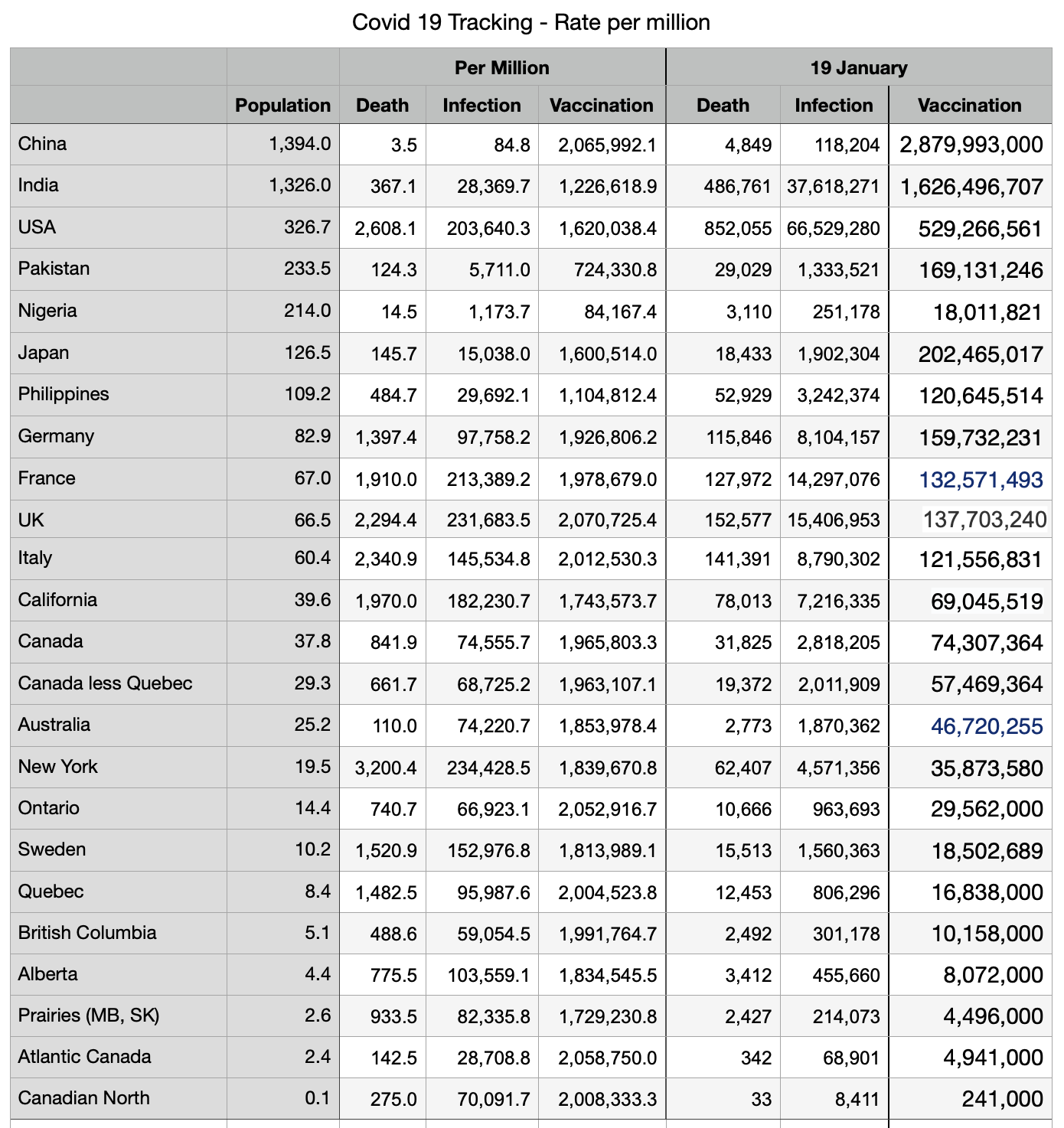
#COVID-19: Comparing provinces with other countries 24 November Update

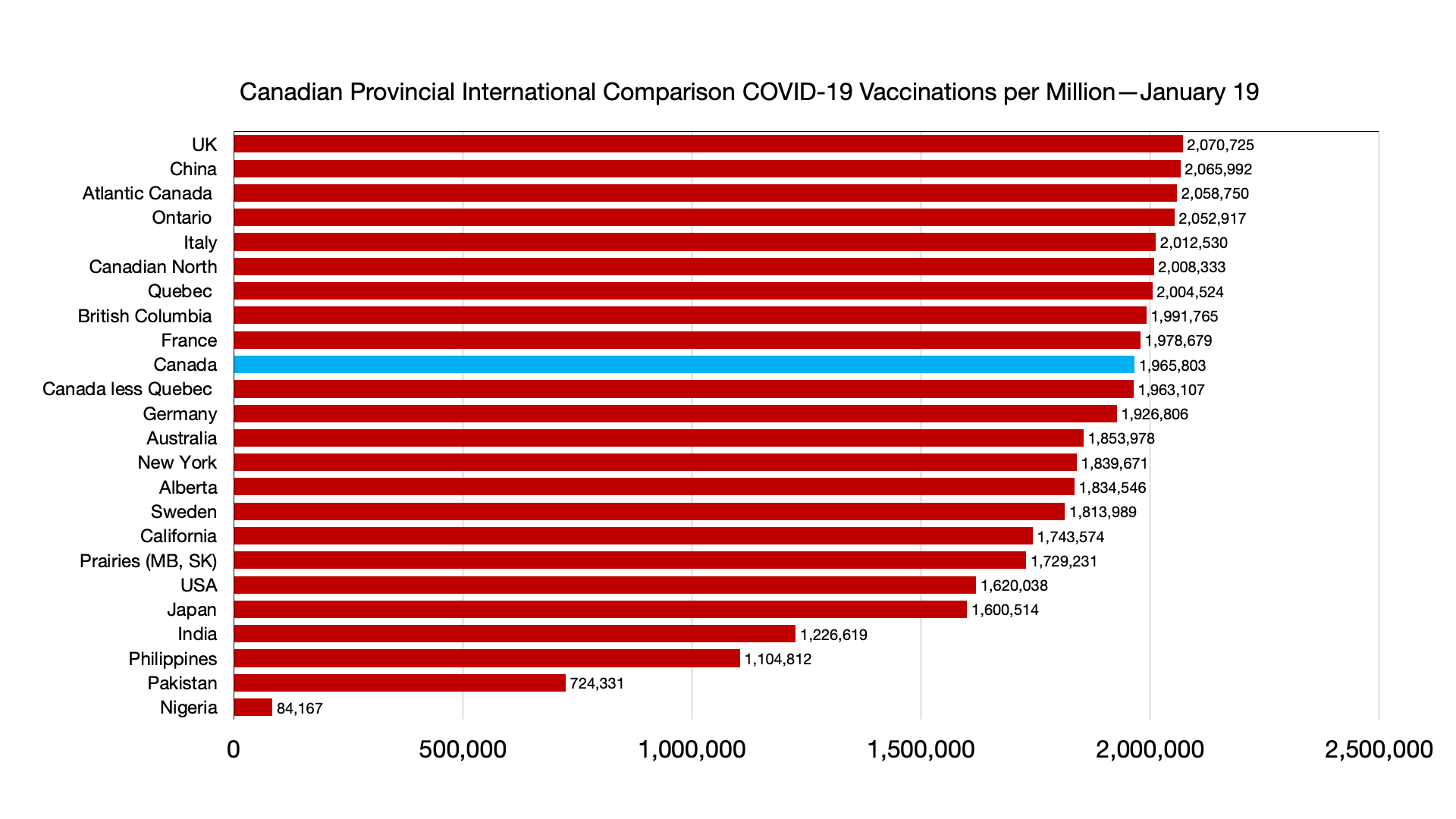
The latest charts, compiled 24 November. Canadians fully vaccinated 76.9 percent, compared to Japan 76.6 percent, UK 69.1 percent and USA 59.7 percent.

Vaccinations: Minor shifts: UK ahead of Atlantic Canada, Italy ahead of Japan, Prairies ahead of New York. China fully vaccinated 77 percent, India 30.1 percent, Philippines 40 percent.

Trendline Charts:

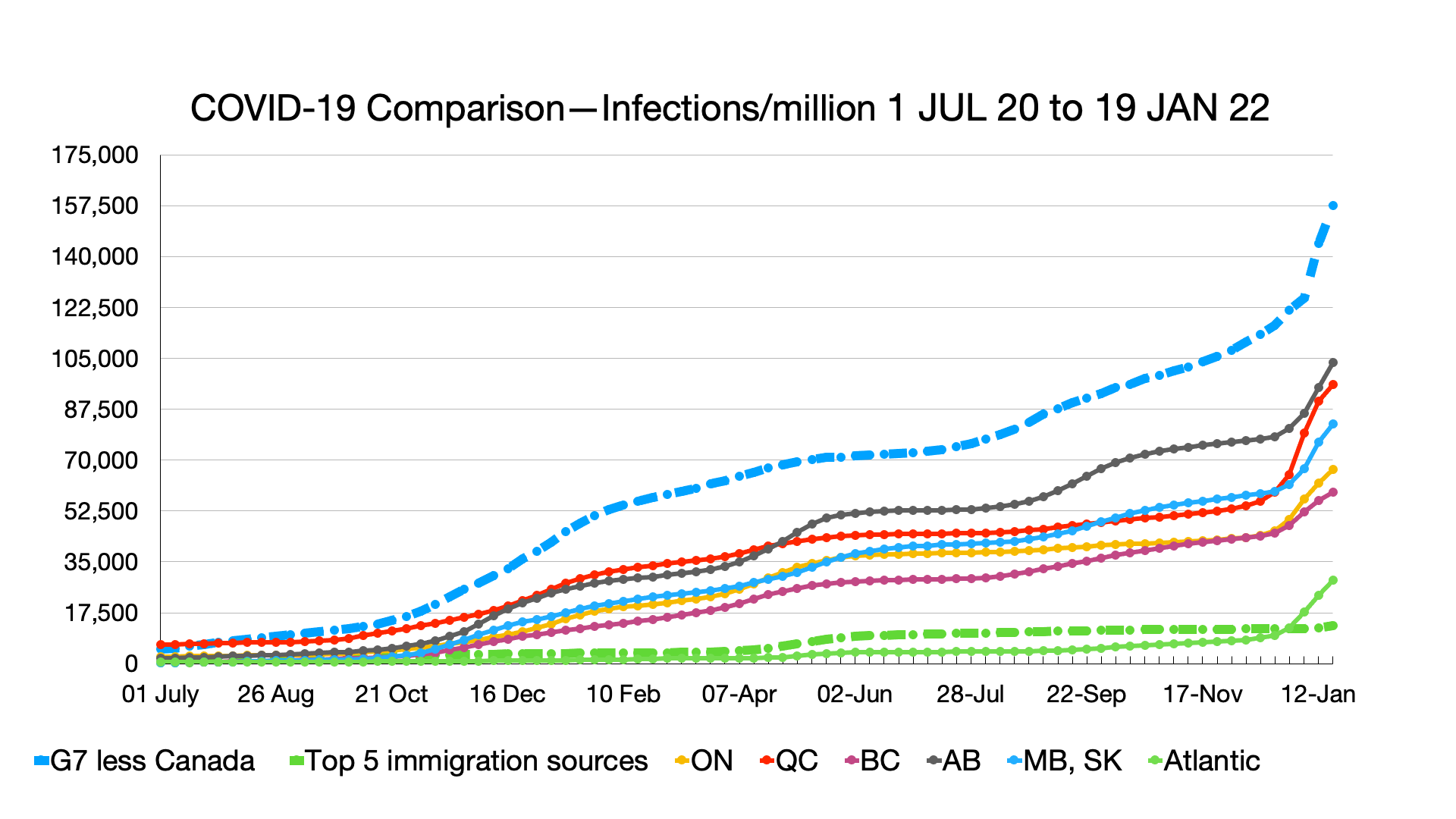
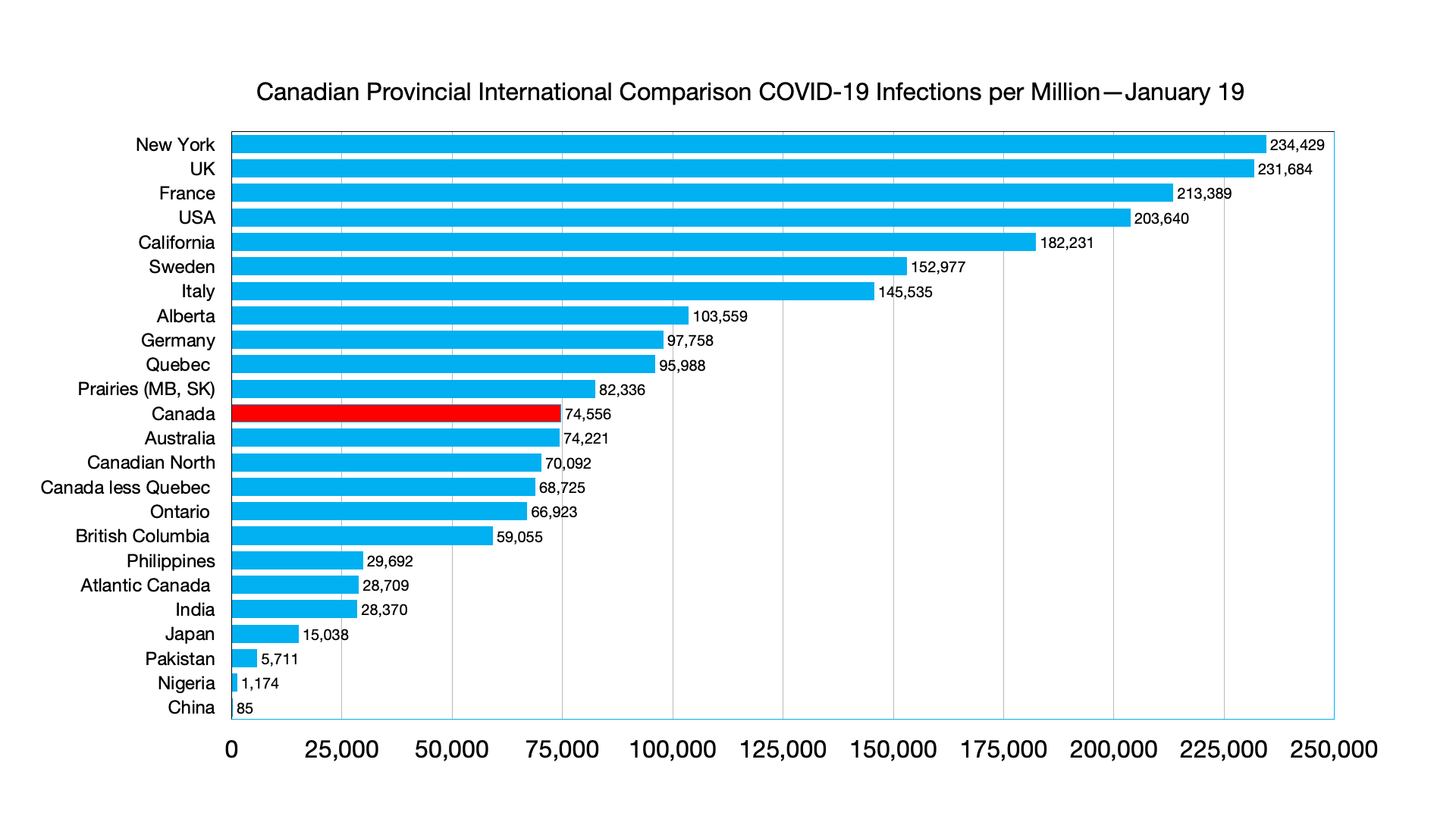
Infections: Recent trends of increased infections in Europe more apparent. Canadian provincial trends showing minimal change from last week, with some levelling off in West.

Deaths: G7 less Canada (driven mainly by USA) continue to increase, West still increasing but at relatively stable rate.

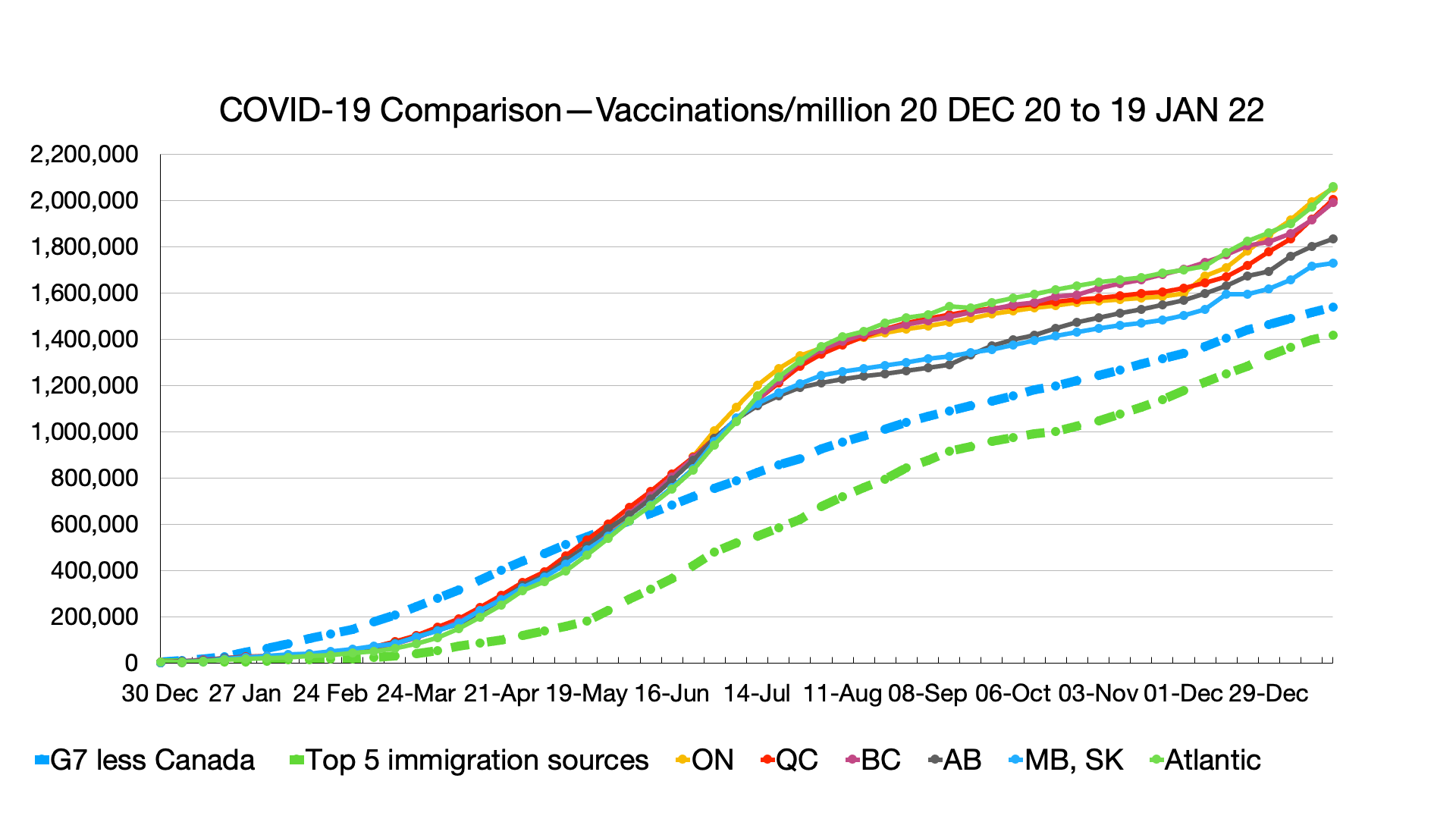
Vaccinations: Ongoing convergence among provinces and G7 less Canada and narrowing gap with immigration source countries given China, India and Philippines.

Weekly

Infections: No relative change.

Deaths: No relative change

À quoi peut-on s’attendre au chemin Roxham? 

Quebec advocate perspective. Will be interesting to see how fast and how far numbers climb:

Entre 2017 et 2019, 95 % des personnes ayant présenté une demande d’asile à la frontière terrestre canadienne l’ont fait au Québec, et pratiquement toutes au chemin Roxham, où l’on ne trouve aucun poste frontalier officiel. Près de 18 mois après l’avoir interdit en raison de la pandémie, le gouvernement fédéral permet, depuis dimanche dernier, aux personnes qui traversent la frontière entre les postes frontaliers de déposer une demande d’asile. À quoi peut-on s’attendre à la suite de cette réouverture ?

Pour répondre à cette question, il faut retourner aux années prépandémie. La transformation du chemin Roxham en point névralgique de cette frontière n’est pas une coïncidence : elle découle de plusieurs décennies de politiques migratoires qui visent à empêcher l’arrivée spontanée de demandeurs d’asile. Répondant à une anxiété liée au fonctionnement du système fédéral d’asile dans les années 1990, ces politiques ont pris une tournure antiterroriste à la suite des attentats du 11 septembre 2001. Cette année-là, le Canada et les États-Unis se sont mis d’accord sur la Déclaration pour une frontière intelligente, dont fait partie l’Entente sur les tiers pays sûrs (ETPS). Mise en place en 2004, l’ETPS permet de renvoyer la majorité des demandeurs d’asile qui se présentent à la frontière canado-américaine vers les États-Unis.

Cette entente est à l’origine de ce que l’on a appelé la « crise migratoire » du chemin Roxham. En effet, parmi les exceptions qu’elle prévoit, l’ETPS ne s’applique pas aux personnes qui traversent la frontière à un endroit autre qu’un point d’entrée. En raison de sa situation géographique et à la faveur de la conjoncture politique, le chemin Roxham s’est imposé en tant que principal point d’entrée non officiel au Canada. Si les premières arrivées se sont déroulées de manière chaotique, les autorités ont par la suite mis en place certains dispositifs permettant d’accueillir ces personnes de façon ordonnée. Néanmoins, cet arrangement temporaire a permis aux autorités canadiennes d’exercer une surveillance sur les arrivées irrégulières, de garder un certain contrôle sur ces personnes et, ultimement, d’examiner leurs demandes de façon à respecter les droits des demandeurs d’asile ainsi que la législation canadienne.

Durant les premières semaines de la pandémie, le Canada a presque entièrement fermé sa frontière terrestre aux demandeurs d’asile. Alors que le gouvernement a par la suite rétabli les quelques exceptions à l’ETPS, les personnes se présentant entre les points d’entrée officiels ne pouvaient toujours pas déposer leur demande, étant renvoyées aux États-Unis dans l’attente du moment où les autorités leur permettraient de venir le faire. Bien que l’Agence des services frontaliers du Canada ait commencé à contacter ces personnes en août dernier, cette fermeture fait en sorte que de nouveaux chemins plus reculés sont maintenant empruntés. Du côté américain, des organismes d’aide aux réfugiés déplorent les conditions difficiles dans lesquelles se retrouvent les personnes qui attendent de pouvoir déposer leur demande.

La levée de cette exception annoncée dimanche aura des conséquences au chemin Roxham et ailleurs le long de la frontière terrestre. Il s’agit d’un bon moment pour considérer l’abrogation de l’ETPS et ainsi permettre aux demandeurs d’asile de se présenter directement aux postes frontaliers. Sinon, les images de 2017 risquent de revenir à la une de nos journaux : des familles entières qui se présentent de façon irrégulière au chemin Roxham, leurs valises à la main, puisque cela constitue leur unique option pour demander le statut de réfugié au Canada. Ou, pire encore, des demandeurs d’asile qui, comme ce fut le cas en 2017, périssent dans les régions rurales enneigées des Prairies à la recherche d’un passage entre deux postes frontaliers. Ce jeu du chat et de la souris entre les autorités et les demandeurs d’asile ne sert finalement personne.

Source: https://www.ledevoir.com/opinion/idees/649125/demandeurs-d-asile-a-quoi-peut-on-s-attendre-au-chemin-roxham?utm_source=infolettre-2021-11-23&utm_medium=email&utm_campaign=infolettre-quotidienne

Skilled immigrant women already faced obstacles finding employment. The pandemic made it worse

Of note. Law may be one of the harder regulated professions for internationally-trained professionals, both men and women:

Tolu Adeyemi had been working as a corporate and commercial lawyer in her hometown of Lagos, Nigeria for four years when she immigrated to Calgary in late 2019.

Her sister and brother already lived in Canada and she knew there would be a transition period to get her law qualifications recognized in Alberta. While waiting for her transcript to be sent from Nigeria and for the National Committee on Accreditation (NCA) to evaluate her qualifications, Ms. Adeyemi found work in sales at a beauty supply store to tide her over. Then the COVID-19 pandemic hit. She was laid off in June 2020 and picked up work as a delivery driver with Amazon and SkipTheDishes.

At the beginning of 2021, Ms. Adeyemi caught COVID-19 and reached a low point.

“It sort of made me reevaluate,” she says. “My father was like, ‘This is not what you came to Canada to do, to work different survival jobs.’”

By this point, the NCA determined that Ms. Adeyemi would need to complete five examinations and a year of articling to qualify to become a lawyer in Alberta. She has written three of the five exams and plans to finish the last two by the end of 2021. Meanwhile, she has been applying to legal assistant jobs, over a hundred by her estimate, to no avail.

“People usually say it’s because I don’t have Canadian experience, or they would say something about [not] being the right fit,” Ms. Adeyemi says.

She also participated in a three-month career services program for foreign-trained professionals at the Calgary Immigrant Women’s Association (CIWA) to learn digital skills, cross-cultural communication and career counselling, followed by a three-month practicum at an employment and business law firm in Calgary.

“We had IT professionals, HR professionals, accountants from different countries,” says Ms. Adeyemi of her fellow program participants. “Even if they had 10 years of experience, they had serious trouble breaking into the job market.”

‘Gendered effect’ of the pandemic

Despite halting immigration last year due to COVID-19, the Liberal government is on track to meet its goal of bringing in 401,000 new permanent residents in 2021. But skilled immigrant women continue to face increased barriers in finding employment, and the pandemic has only made it more difficult.

Luciara Nardon, a professor of international business at Carleton University’s Sprott School of Business in Ottawa, published a paper in June 2021 showing how skilled immigrant women had their career trajectories delayed, interrupted or reversed during the pandemic. These roadblocks were due to layoffs, fewer job opportunities and increased domestic burden during lockdowns.

“The pandemic was particularly difficult for women in general because kids [were] at home,” Dr. Nardon says. “It’s a very gendered effect that way.”

Jenny Krabbe, manager of the employment services department at CIWA, has seen married immigrant women having to set aside their own goals to prioritize their spouse’s career, even prior to the pandemic.

“In many cases, the male [in the relationship] has the better education in the country they came from and the reason they could get into Canada under our point system was that he qualified,” Ms. Krabbe says. “She may be a professional in her own right, but now she has to figure out her way forward.”

Confidence is another factor that Ms. Krabbe says hinders skilled immigrant women in their career progression in Canada. Training in career services programs, like the one that Ms. Adeyemi participated in at CIWA, can help build that confidence, she says.

Networking helps build confidence too, and is what leads most skilled immigrant women to find meaningful work in their fields, notes Dr. Nardon. But the pandemic has limited these opportunities.

“If you already know somebody, you can meet on Zoom instead of meeting in person,” she says. “But if you don’t know them, that becomes very difficult.”

A necessary culture change

Support programs like those at CIWA provide a great opportunity for immigrant women to network, says Dr. Nardon, but she hopes to see more government initiatives to support the employment journeys of skilled immigrant women. In particular, she highlights the need for programs with longer, more flexible eligibility terms.

“Sometimes women take a longer time to integrate because the men’s career will have priority and the women stay home taking care of the kids,” she says. “By the time the woman is ready to enter the workforce, then services are no longer available because they lost eligibility.” Childcare support can also help relieve some of the domestic burdens that immigrant women face, allowing them to spend more time building their careers.

But the onus isn’t solely on the government. Dr. Nardon also calls for a “culture change” in societal attitudes towards immigrant women, especially from employers and hiring managers.

“There may be assumptions that [immigrant women] didn’t get the right experience or the right training, so they are not as capable as somebody else,” she says. As employers head into the “great resignation,” (Statistics Canada reported 731,900 job vacancies in the second quarter of 2021, which is nearly 26 per cent more vacancies than in the same quarter two years earlier), Dr. Nardon encourages companies to consider how skilled immigrant women can benefit their businesses, as opposed to searching for candidates to fulfil a particular set of needs.

“Look at the talent that immigrants bring and have a more open mind instead of trying to fit them into boxes,” she says. “Some employers are thinking of different ways of recruiting. They’re not picking specific characteristics, but instead they’re saying, ‘We need talent.’ They’re creating jobs around the talent that is available.”

Dr. Nardon adds that all Canadians can play a part by making connections among skilled immigrants in their communities or industries.

“Professionals can give time for mentoring, for sharing knowledge and sharing networks,” Ms. Nardon explains. “This is not one person’s job. The whole society has to work together.”

Source: https://www.theglobeandmail.com/business/article-skilled-immigrant-women-already-faced-obstacles-finding-employment-the/

Quebec: Les francophones discriminés [international students]

More commentary.

Checked Quebec numbers: CEGEP international student enrolment up more than 5 times (de 2 899 en 2009-2010 à 16 505 en 2019-2020) compared to university enrolment that only doubled during the same period (de 24 504 en 2009-2010 à 48 406 en 2019-2020). http://www.education.gouv.qc.ca/colleges/enseignants-et-personnel-de-college/references/enseignement-superieur/portrait-statistique-des-etudiants-internationaux-a-lenseignement-superieur/

But the relative shift from French to English CEGEPs is notable, irrespective of any discrimination issues:

Le Québec bataille pour sa place d’État francophone fier depuis des lustres au sein d’un Canada qui n’en a généralement que faire, soupirant d’ennui entre deux réformettes de façade. À divers niveaux, tous les gouvernements du Québec se sont préoccupés des combats à livrer pour résister aux assauts bien vigoureux de l’anglais, entre autres dans le champ de l’éducation. Le gouvernement de François Legaultveut d’ailleurs donner plus de mordant à la loi 101, car la fronde anglophone n’a jamais été aussi vive.

Pendant que sur le front politique le discours est à la défense du fait français, le terrain regorge d’incohérences qui ne commandent que de l’indignation. Comment en effet concilier ces deux données ? L’explosion spectaculaire du nombre d’étudiants internationaux dans les collèges du Québec — en hausse de 369 % en dix ans — a surtout profité aux établissements d’enseignement de langue anglaise. Mais en moins de deux ans, Immigration, Réfugiés et Citoyenneté Canada (IRCC) a refusé 35 642 candidats originaires des principaux pays francophones du Maghreb et de l’Afrique de l’Ouest qui voulaient venir étudier au Québec.

Une première analyse brute des données dévoilées la semaine dernière par la journaliste du DevoirSarah R. Champagne donne à penser que le « système », dans son gigantisme et son indolence bureaucratique, effectue de la discrimination à l’entrée. Ouvrir les vannes à des étudiants anglophones venus de l’Inde et les accueillir à pleines portes dans des établissements privés non subventionnés de Montréal ? Que oui ! Mais accepter des candidats inscrits à des études supérieures en provenance du Maghreb et de l’Afrique de l’Ouest, deux zones francophones ? Que nenni !

Les taux de refus pour ces deux bassins de locuteurs pourtant très francophones « frôlent les 100 % », dénoncent des avocats en immigration, qui ne s’expliquent pas le quasi-automatisme dans le rejet de candidatures pourtant bien défendues — dossier financier très solide, entre autres critères observés par les ministères de l’Immigration. Un nouveau système de tri automatique des candidatures en vigueur depuis 2018 serait-il en partie la cause de ces refus en bloc ? Personne ne peut le certifier, mais cela pourrait par exemple expliquer que, sur la base de revenus moyens par habitant très peu élevés dans certains pays d’Afrique, des dossiers de grande qualité présentés par des individus soient écartés avant même d’être analysés. Cette question mérite d’être creusée.

Plus on cherche à comprendre cette grande absurdité, plus on s’enfonce dans les contradictions. Celle-ci par exemple : un couple congolais au dossier financier plus que bien ficelé a reçu sa réponse de refus en l’espace d’une semaine en provenance des autorités canadiennes — déjà de quoi faire sourciller quand on sait que la question des délais interminables dans le traitement des dossiers d’immigration constitue le principal problème dénoncé par Québec. L’argument qu’on leur a donné ? L’agent d’immigration n’a pas été convaincu qu’ils quitteraient le Canada après leurs études. Quitteraient, oui. Pourtant, les politiques officielles et l’énergie déployée tant par le gouvernement du Québec que par celui du Canada vont dans le sens complètement contraire : celui de travailler au maintien des étudiants étrangers en sol québécois après la fin de leurs études. Que comprendre de ce cirque ?

Pour les mêmes pays d’origine, le Québec voit ses taux de refus plus élevés qu’ailleurs au Canada, ce qui s’expliquerait en partie par une méconnaissance des agents d’immigration du système collégial québécois, certains dossiers étant refusés sur la base d’une mauvaise liaison entre la demande d’étude et le cheminement scolaire du candidat. C’est à n’y rien comprendre : les cégeps existent depuis 1967 au Québec.

Le Québec, qui perd ici pied et contrôle sur une immigration potentielle de qualité en son propre sein, aurait raison de vociférer et de revendiquer la pleine maîtrise sur les flux d’entrée en ses frontières. Mais il devra aussi pratiquer un sérieux auto-examen. S’il n’a rien à voir avec le refus de candidatures francophones en provenance de pays du Maghreb et de l’Afrique de l’Ouest, c’est quand même dans sa propre cour que s’est jouée l’augmentation faramineuse d’étudiants étrangers anglophones — parfois même inscrits dans des cégeps francophones.

Dans une étude publiée par l’Institut de recherche en économie contemporaine, Éric N. Duhaime brosse un portrait statistique sans équivoque : alors que le recrutement d’étudiants étrangers au collégial s’était toujours historiquement tourné vers des bassins francophones, la tendance s’est inversée depuis 2017 environ. En 2019, « plus de la moitié des étudiants internationaux du réseau collégial provenaient de l’Inde (7687), dépassant les effectifs de la France (4072) ». Marché lucratif, détournement de mission pour le réseau de l’éducation et… impact significatif sur la langue d’usage dans les rues de Montréal, qu’on le veuille ou non.

Source: https://www.ledevoir.com/opinion/editoriaux/649134/etudiants-etrangers-les-francophones-discrimines?utm_source=infolettre-2021-11-23&utm_medium=email&utm_campaign=infolettre-quotidienne

Chilean Election Unlikely to Halt New Barriers to Immigration

Of note, given the surge from Haiti and Venezuela:

Chile’s last presidential election in 2017 appeared to be an endorsement for more of the same with the Presidency alternating between former centre-left coalition leader, Michelle Bachelet, and right-wing incumbent Sebastian Piñera for the second time since 2006. But with only 46% of Chileans voting in the first round, there was a clear disinterest in the political process which has since transformed into discontent.

In October 2019 public anger reached its pinnacle when mass protests broke out in Santiago, sparked by increases to public transport costs, and spread countrywide in a challenge to Chile’s long-standing inequality. After 29 deaths and an estimated U$D 3.5 billion worth of damage to infrastructure, reforms were made, and a fresh focus was placed on replacing the 1980 constitution introduced under Pinochet’s military dictatorship.

Even against the backdrop of heightened anti-government protests and the Covid-19 pandemic, immigration has remained a key issue in the run up to the election.

Migration in Chile

Historically Chile’s migrant population has been more European and smaller than that of its South American neighbours. However, numbers of people entering Chile from elsewhere in Latin America have grown swiftly in the last decade, tripling in the last three years to 1.5 million, with arrivals stemming from humanitarian crises in Haiti (ca. 180,000) and Venezuela (ca 460,000).

Whilst under Bachelet (2014-2018), the now UN Human Rights Commissioner, immigration laws required no visa and only a formal employment contract to obtain temporary residency, under Piñera restrictions have tightened markedly.

In 2018 Piñera introduced the Humanitarian Returns policy whereby migrants could be returned free of charge to their country of origin on the proviso that they would not return for another nine years. 1,800 people were deported in 2020 with some deportation flights staged for media consumption.

New Law

A new Migration Law will also come into effect in mid-2022 requiring migrants to provide additional documentation to qualify for a one-year consular visa. These visas are often expensive, hard to acquire and in some cases expire after three months. They will also only be available to those who arrived in Chile before 18 March 2020, when the government closed the country’s land borders during the pandemic. The Law will make consular visas compulsory, prohibit adjustments from a tourist permit to temporary residence, and make it harder to move from temporary to permanent status once in the country. Furthermore, only those who have resided in Chile for at least 24 months will be able to receive state-funded social security.

Whilst limited, the government does have a programme that commits it to supporting work done by individual municipalities in the areas of migrant integration and intercultural exchange. At a national level, the Escuela Somos Todos, supports students into school regardless of their migration status. The Compromiso Migrante has also been created to incentivise private companies and unions to take a non-discriminatory and inclusive approach to hiring and management, by connecting awardees with support from agencies like the International Labour Office (ILO) and International Organisation for Migration (IOM). However, this initiative is somewhat undermined by employers needing to pay for employees and family members’ return travel once a contract has ended. This has resulted in migrants working informally, often on lower wages that undercut those of local people already struggling with the cost of living, stirring xenophobic sentiment in the process.

Polarising candidates

Jose Antonio Kast, a staunch defender of the Pinochet constitution, has capitalised on recent anti-migrant protests along Chile’s northern borders to become the presidential frontrunner. In the town of Iquique, thousands of locals gathered to protest against the presence of migrants after a year-old Venezuelan settler camp was cleared by police. Protests culminated with the burning of the settlers’ belongings on a bonfire. Kast has since proposed Chile’s withdrawal from the UN Human Rights Council, digging ditches at the borders with its northern neighbours and the creation of a body within the investigative police force to “actively seek out [and deport] illegal migrants”.

By contrast, his 35-year-old opponent, the left-wing Frente Amplio party leader, Gabriel Boric, who up until recently led the polls, had spoken of no expulsions, and access to visas and housing for migrants. However, following Kast’s rise he has rowed back on commitments to provide access to housing noting an over 500,000 shortfall in national housing provision, and has highlighted the need to work on a regional basis to establish a quota system to share the burden. Chile is the third biggest recipient of the over 5 million person exodus from Venezuela, after Colombia and Peru.

 So what next?

With the government having given the army a border enforcement role, in the short-term they have maintained that they will continue with “evictions of all public spaces” as well as “the expulsion plan” of undocumented migrants.

No matter who wins the election, the stringent provisions under the new Migration Law will likely contribute to an increase in the number of migrants living in irregular status.

Boric remains the favourite to win in the event of a second round of voting, but in the face of growing anti-migrant sentiment he appears to be ceding ground on his open border policy.

Even if he does maintain his commitment, the process of making Chile both ready and welcoming to immigrants (with an average of 200 arriving a day) will not be straightforward. The Piñera administration struggled to govern without a majority in both houses and the polarised nature of Chilean politics means that Boric would likely struggle to implement his liberal agenda without one.

In the last year there has been an 80% increase in Haitian migrants leaving the country, such has been the cold welcome many have received. Whilst an inclusive new constitution may be approved next year it will be the policies and investment that follow that determine whether Chile can make full use of the potential of immigrants and work with regional partners to reach a sustainable solution.

If Kast wins, in spite of the same governability challenges, it seems likely he would seek to build on the ew law–and in so doing–deprioritising regional collaboration, minimising integration support and introducing physical borders, forcing migrants into more difficult journeys in the process. Since January 2021, at least six immigrants have died after crossing the Andes and entering the Atacama Desert.

The new Migration Law requires the government to revise its national immigration policy at least every four years. This could lead to politically motivated changes creating instability for current and future immigrants, as well as for Chilean society as a whole.

Source: Chilean Election Unlikely to Halt New Barriers to Immigration