Soaring backlogs, disgruntled applicants — Canada’s immigration system has been upended by COVID-19. This is the man in charge of fixing it

Some initial messaging from the new minister of immigration. No major change from his predecessor, as expected:

Sean Fraser says he knew what he was getting into when he was tapped to be Canada’s next immigration minister.

“Things are at such a strained point as a result of COVID-19 that I see an opportunity to make an extraordinary difference coming from this particular starting point,” the Nova Scotia MP says.

“There are no shortage of challenges ahead of me.”

Few other federal services have seen so much disruption as the immigration system during the pandemic, with the operation grinding to a halt and staff working remotely with antiquated infrastructure and travel restricted for newcomers abroad due to border closures.

It’s laid bare the many existing problems with immigration operations, from out-of-date technologies that still relied on paper applications and processing, to administrative red tape built up over the years and a lack of resources to meet the insatiable demand for immigration to this country.

In his first major media interview since inheriting the job on Oct. 26. from Marco Mendicino, now the public safety minister, Fraser, a rising star within the Trudeau government, highlighted some of the priorities that call for his immediate attention.

As countries worldwide are all trying to reopen their economies at the same time and competing for the same pool of workers, he said Canada must stay competitive in the global search of talent.

Streamlining the system and digitalizing the application process will be crucial to boosting the processing capacity of the immigration system and improving user experience, he added.

“We have to make a decision of whether we’re going to increase the overall levels to accommodate the intense demand that we’re seeing from people who want to come to Canada,” Fraser said.

“If there’s going to be 400,000 people that are able to come to Canada in a given year and we have 700,000 applicants, it doesn’t take a PhD in mathematics to understand that that’s going to lead to a further buildup of the backlog. So we do have to take strategic decisions about how many people our communities can accommodate successfully.”

As of July 31, according to the immigration department, more than 561,700 people were in the queue for permanent residence and 748,381 had a pending temporary residence application as students, workers or visitors while the backlog for citizenship stood at 376,458 people.

Fraser says he doesn’t have a target timeline for how long it will take to eliminate the backlog, but there are numerous initiatives already in place toward that goal — and other changes will also be made.

“I don’t want to communicate to you today that in a short period of time, all of these problems will be fixed. They weren’t made overnight and they won’t be fixed overnight,” he said.

“I want to accelerate the work that’s going to help clear some of these backlogs. It’s going to make the process less painful for families that are trying to pursue a new life or reunite with their loved ones or find a job to contribute to our economy.”

Fraser said the digitalization of citizenship applications has already taken place and in the months ahead, there will be “serious reforms” on applications for spousal reunification.

There could also be legislative changes in order to remove what Fraser calls the system’s “choke points” as new policies are being developed.

For example, he said it just doesn’t make sense to deny entry of a foreign national with a pending family reunification application to be with their spouse or children in Canada because of their intent to stay in the country permanently. The provision in the law has set many families apart while their applications are in process, sometimes for years.

“It’s easy to get bogged down in a conversation about the number of cases and the inventory. But in my role, you will not succeed if you don’t realize that every one of these cases or numbers in the inventory represents a human being,” Fraser said.

“This will take longer than most people would like, longer than I would like. But if you want to change a system as large as Canada’s immigration regime, to do it right and to succeed, you have to put the time in.”

Born in Antigonish and raised in Merigomish, a small community in Nova’s Scotia’s Pictou County, Fraser is one of the rare immigration ministers from rural Canada.

Like many young people from small remote communities, he — and his five sisters — had to leave for larger urban centres for education and job opportunities. With an undergraduate degree in science from St. Francis Xavier University, the 37-year-old went on to study law at Dalhousie University and at Leiden University in the Netherlands before working at a large law firm in Calgary.

Many communities have struggled with an aging population and out-migration of young people, and immigration is a crucial part of the solution, he said.

“When you have more people around the world coming up, coming into your community, opening businesses, opening restaurants, creating a more dynamic place to live, you see more Canadians flocking to those communities to have that kind of dynamic culture and life experience as well,” said Fraser.

Fraser said the bulk of most of his days since his appointment as the immigration minister has evolved around the Afghan refugee resettlement. The Liberal government has made a commitment to bring in 40,000 Afghan newcomers and so far only 3,500 have made it to Canada.

“Canadians are right to be frustrated about what’s going on in Afghanistan,” he said. “The reality on the ground right now is that we don’t have access the way we did in Syria, and that’s the equation that a lot of Canadians I think are trying to make.”

The government’s strategy is to work with partners in Pakistan, the United Arab Emirates and the United States — all struggling to resettle the Afghan refugees — to bring the Afghans to a permanent home. “Our commitment does not waver,” he said.

Although he was honoured by Maclean’s magazine as the “Best Orator” and a finalist for “Rising Star” in the last government, Fraser said he’s just a guy who cares deeply about people.

“I very much want to ensure that Canada treats people with a sense of dignity, respect and fairness.”

Source: Soaring backlogs, disgruntled applicants — Canada’s immigration system has been upended by COVID-19. This is the man in charge of fixing it

Ottawa refuse de plus en plus de francophones, surtout venus d’Afrique

Similar perceptions and data as seen elsewhere in Canada.

While the disparities in rejection rates raise legitimate questions, disparities themselves do not necessarily mean non-objectivity or bias, just the need to take a closer look to assess or re-assess criteria:

Alors que le nombre d’étudiants étrangers anglophones augmente au Québec, les taux de refus pour des pays africains ne cessent de grimper, et certains dossiers « impeccables » sont refusés. Des candidats répondant pourtant aux critères sont ainsi empêchés de poursuivre leurs études ici, déplorent-ils.

Leurs avocats en immigration dénoncent ces taux « qui frôlent le 100 % » pour certains pays du Maghreb et de l’Afrique de l’Ouest, deux bassins de locuteurs du français. « Il arrive fréquemment qu’un candidat aux études démontre une capacité financière de 100 000 $ pour la durée de son programme, qu’il a son acceptation de l’université, mais il est quand même refusé », note l’avocate québécoise Krishna Gagné.

Le taux de refus global est aussi beaucoup plus élevé au Québec que dans le reste du pays, selon les données fournies au Devoir par Immigration, Réfugiés et Citoyenneté Canada (IRCC). La différence est attribuable entre autres aux principaux bassins de recrutement pour la province, par rapport au reste du Canada.

En moins de deux ans, entre janvier 2020 et septembre 2021, Ottawa a ainsi refusé 35 642 candidats des principaux pays francophones du Maghreb et de l’Afrique de l’Ouest qui voulaient venir au Québec. Pendant ce temps, le nombre d’étudiants en provenance de l’Inde — qui se destinent majoritairement à des cours en anglais — a atteint des sommets, notamment dans le réseau collégial québécois.

Parmi les témoignages recueillis, figure celui du couple Dorothée et Mboungou, originaire de République du Congo. Ils racontent avoir présenté des preuves de leur argent disponible dans des comptes en euros et en monnaie locale. Appartements en location qu’ils possèdent, maison, voiture, entreprise, parcelles de terre ; ils ont également fait évaluer tous leurs biens, en plus de devoir voyager trois fois dans le pays voisin pour faire prendre leurs empreintes digitales par un centre autorisé par le Canada.

« Nous ne sommes pas des nécessiteux au Congo, il ne faut pas croire que tous les Africains sont d’une pauvreté extrême », résume la mère de famille qui travaille pour la multinationale Total depuis 14 ans. Ils ont demandé d’utiliser uniquement leur prénom, de crainte de nuire à une future demande de permis d’études.

« À partir du moment où on a déposé tous les papiers, il s’est passé à peine une semaine avant le refus, comme si la réponse était déjà toute faite », note Dorothée. « Est-ce que c’est une discrimination ? On s’attendait à une étude objective de notre dossier », ajoute-t-elle.

Des raisons contradictoires

Leur dossier était pourtant « impeccable », insiste leur avocate québécoise, Krishna Gagné, mais Ottawa les a refusés. Le principal motif invoqué ? L’agent d’immigration n’était pas convaincu qu’ils quitteraient le Canada à la fin de la période d’études, comme le veut le règlement sur l’immigration.

Ce motif semble « entièrement contradictoire » pour Me Gagné. En effet, les politiques d’immigration tant provinciales que fédérales encouragent de plus en plus les étudiants étrangers à rechercher un statut permanent après l’obtention de leur diplôme.

Ottawa a ouvert cette année de nouvelles voies d’accès à la résidence permanente pour les étudiants étrangers diplômés d’une institution d’enseignement canadienne, soit 40 000 places attitrées. Lors de l’annonce en avril, le ministre de l’Immigration d’alors, Marco Mendicino, disait vouloir permettre « à ceux qui ont un statut temporaire de planifier leur avenir au Canada ». « Nous voulons que vous restiez », avait-il déclaré.

Québec est aussi très actif en matière d’opération de séduction à l’étranger. Seulement en 2021, le gouvernement a conclu des ententes de près de six millions de dollars avec diverses organisations pour « l’attraction et la rétention » d’étudiants étrangers.

« Il existe nombre d’incitatifs pour que les gens restent après leurs études, donc cette raison [évoquée par les agents d’IRCC] contrevient au discours politique et à ces efforts. On dénonce cet aspect », souligne aussi Francis Brown, directeur des affaires internationales de la Fédération des cégeps.

Le couple congolais n’avait pour sa part pas l’intention de rester. Le père de famille espérait qu’un diplôme canadien donne un élan international à sa carrière et à son entreprise : « Il voulait tout simplement sortir un peu du cadre national, même si sa boîte fonctionne très bien », a confié au Devoir son épouse.

« Seulement avec l’argent qu’on a dépensé pour les démarches, on aurait pu payer toute une scolarité en France », soupire la femme. Mboungou a d’ailleurs déjà décroché une maîtrise en France en 2020 à l’Université Lumière Lyon avec des démarches de permis d’études « beaucoup plus simples ».

Le Québec pénalisé ?

« On ne fait pas le poids face à d’autres systèmes d’immigration », fait valoir M. Brown. Il rappelle notamment que les récents délais de traitement des permis d’études se sont encore allongés cette année, ce qui a été déploré par le gouvernement de François Legault dans une lettre transmise au fédéral.

Le Québec est pénalisé par rapport au reste du Canada en raison de ses bassins de recrutement francophones en Afrique. L’Algérie, le Sénégal et le Cameroun figurent par exemple parmi les six premiers pays d’origine des étudiants étrangers au Québec et ont connu des taux de refus de plus de 80 % en 2020 et en 2021. Le Maroc figure au 4e rang en importance sur le plan du nombre d’étudiants, mais son taux de refus est moins élevé en moyenne que ceux des autres pays africains.

D’autres ressortissants à destination du Québec se font rejeter par Ottawa à hauteur de 80 à 90 %, comme ceux de la Guinée, du Bénin, du Togo et de la République démocratique du Congo.

Dans les autres provinces, l’Inde représente une grande partie du bassin d’étudiants étrangers, mais son taux de refus est beaucoup moins élevé que pour ces pays africains francophones. Il n’a été que de 30 % pour les neuf premiers mois de 2021, soit nettement sous celui des pays d’origine pour le Québec.

Qui plus est, le taux de refus des candidats d’un même pays d’origine est parfois plus élevé au Québec que dans le reste du Canada. En 2020, les demandes de la Côte d’Ivoire ont par exemple été refusées à 75 % au Québec et à 68 % dans le reste du Canada.

Ce fossé s’explique en partie par une « méconnaissance de la place du réseau collégial dans le système d’enseignement supérieur » par IRCC, selon la Fédération des cégeps. Plusieurs étudiants se font ainsi refuser un permis d’études dans un cégep « parce que l’agent considère que la demande ne concorde pas avec le parcours, sur la base du cheminement scolaire », dit Francis Brown.

Une personne avec l’équivalent d’un baccalauréat universitaire par exemple serait considérée comme trop « avancée » par un agent d’immigration pour faire une technique dans un cégep. Les étudiants africains s’inscrivent pourtant dans des programmes « avec un taux de placement très élevé », insiste Nathalie Houde, conseillère en recrutement à l’international pour le Cégep de Jonquière. C’est le cas dans des filières industrielles, par exemple, où les demandes d’admission de la part des Québécois sont en baisse, mais qui connaissent pourtant de graves pénuries de main-d’œuvre.

En août dernier, cinq étudiants acceptés par ce cégep avec des bourses d’excellence se sont vu refuser l’accès au Canada, relate-t-elle. « C’était une situation absurde et excessivement difficile », poursuit-elle. La bourse, octroyée par Québec, couvrait les frais de scolarité plus élevés pour les étrangers ainsi que des frais de subsistance. Quatre d’entre eux ont finalement pu arriver à temps pour la session d’automne.

Le taux de refus a en outre augmenté depuis 2017, ce qui indique que la situation empire au lieu de s’améliorer, note Me Krishna Gagné et d’autres membres de l’Association québécoise des avocats et avocates en droit de l’immigration (AQAADI). Le fossé entre les refus au Québec et au Canada s’est aussi accru globalement, selon les données d’IRCC.

Source: https://www.ledevoir.com/societe/education/648552/etudiants-etrangers-ottawa-refuse-de-plus-en-plus-de-francophones-surtout-venus-d-afrique?utm_source=infolettre-2021-11-19&utm_medium=email&utm_campaign=infolettre-quotidienne

September immigration impact of #COVID19

Latest monthly update:

Canada has a backlog of nearly 1.8 million immigration applications

Striking. One of the disadvantages of IRCC’s shift to monthly stats was the elimination of regular reports on backlogs, and in the case of citizenship, application data. So having this information fills a needed gap in understanding IRCC’s operational challenges.

For citizenship, highest previous backlog was 323,000 in 2012, impact of Discover Canada study guide and related knowledge test, along with cutbacks in citizenship processing capacity in a government-wide program review exercise:

IRCC’s backlog stands at almost 1.8 million immigration applications.

CIC News has received data from Immigration, Refugees and Citizenship Canada (IRCC) showing the following number of applications in IRCC’s inventory as of October 27, 2021 (figures are rounded):

  • 548,000 permanent residence applications (economicfamily, refugee, and humanitarian class applicants)
  • 776,000 temporary residence applications (applications for study permitswork permits, temporary resident visas, and visitor extensions)
  • 468,000 Canadian citizenship applications (as of October 26)
  • 1,792,000 total applications in inventory

IRCC’s figures indicate their backlog has grown by nearly 350,000 applications since July.

In August, a report by Nicholas Keung of the Toronto Star showed that the backlog as of July 6, 2021 stood at about:

  • 375,000 permanent residence applications 
  • 703,000 temporary residence applications 
  • 370,000 Canadian citizenship applications. The Star reported that this figure did not include Canadian citizenship applications sitting in IRCC’s mailrooms that have yet to be processed.
  • 1,448,000 total applications in inventory

In an email to CIC News, an IRCC spokesperson explained “Ongoing international travel restrictions, border restrictions, limited operational capacity overseas and the inability on the part of clients to obtain documentation due to the effects of COVID-19 have created barriers within the processing continuum. This hinders IRCC’s ability to finalize applications, creating delays that are outside IRCC’s control.”

At the same time, the spokesperson acknowledged the challenges that applicants are facing, noting “Despite our efforts, we know that some applicants have experienced considerable wait times with the processing of their applications, and we continue to work as hard as possible to reduce processing times. We thank them for their patience and understanding at this moment, and we look forward to welcoming them to Canada.”

IRCC also shared data on the number of applications it has processed during the pandemic:

  • 337,000 permanent residence applications processed between January and September 2021. It processed some 214,000 applications in 2020.
  • 1,500,000 temporary residence applications processed between January and September 2021. This compares to nearly 1,700,000 applications in 2020.
  • 134,000 Canadian citizenship applications processed between January and September 2021. This compares to about 80,000 applications processed in 2020.

Source: https://www.cicnews.com/2021/11/canada-has-a-backlog-of-nearly-1-8-million-immigration-applications-1119651.html#gs.gbfl8c

Japan looking to allow more foreigners to stay indefinitely in a major immigration policy shift

Of note:

In a major shift for a country long closed to immigrants, Japan is looking to allow foreigners in certain blue-collar jobs to stay indefinitely starting as early as the 2022 fiscal year, a justice ministry official said on Thursday.

Under a law that took effect in 2019, a category of “specified skilled workers” in 14 sectors such as farming, construction and sanitation have been allowed to stay for up to five years, but without their family members.

The government had been looking to ease those restrictions, which had been cited by companies as among reasons that they were hesitant to hire such help.

If the revision takes effect, such workers — many from Vietnam and China — would be allowed to renew their visas indefinitely and bring their families with them, as the other category of more skilled foreigners are allowed to do now.

Immigration has long been taboo in Japan as many prize ethnic homogeneity, but pressure has mounted to open up its borders due to an acute labor shortage given its dwindling and ageing population.

“As the shrinking population becomes a more serious problem and if Japan wants to be seen as a good option for overseas workers, it needs to communicate that it has the proper structure in place to welcome them,” Toshihiro Menju, managing director of think tank Japan Center for International Exchange, told Reuters.

The 2019 law was meant to attract some 345,000 “specified skilled workers” over five years, but the intake has hovered at around 3,000 per month before the Covid-19 pandemic sealed the borders, according to government data.

As of late 2020, Japan housed 1.72 million foreign workers, out of a total population of 125.8 million and just 2.5% of its working population.

Source: Japan looking to allow more foreigners to stay indefinitely in a major immigration policy shift

‘Half-baked’ Bill 27 won’t protect migrant workers from exploitative recruiters, say advocates

Valid criticism of low level fines and other issues related to recruiting agencies:

Ontario’s proposed changes to employment law would not protect vulnerable migrant workers from unscrupulous recruiters and employers, and need more teeth to work for the workers, say advocates.

Professional recruiters play a key role in the transnational recruitment of migrant workers for employment in Ontario’s agricultural sector, fisheries, food supply, transportation, tourism, as well as in-home personal care and support services.

Last month, Labour Minister Monte McNaughton introduced Bill 27. The omnibus legislation includes policy changes meant to remove barriers for immigrants to get licensed in a regulated profession; require temporary help agencies to be licensed; and compel businesses to let delivery drivers use their washrooms, among other things.

Dubbed the Working for Workers Act, the bill, currently under review by a provincial standing committee, would also require recruiters to be licensed in a public registry and be responsible for repaying workers any illegal fees charged here or abroad.

The consequence of non-compliance for the recruiter would be the revocation of their licence and a possible fine under $300 for a first offence, critics point out.

Although employers would be required to use licensed recruiters, they would only face a fine of $250 for using someone who’s not registered.

Advocates for migrants have been calling for the licensing of recruiters and recruitment agencies since 2008, but said the enforcement tools in the proposed legislation are inadequate because the fines for infractions are way too low to be deterrents.

Recruiters, agencies and consultants use the promise of jobs that don’t exist and work conditions that don’t exist to lure workers to come to Canada,” said Syed Hussan, executive director of the Migrant Workers’ Alliance for Change. “Once they’re here, they’re so indebted they’re unable to protect themselves and defend themselves.

“This has been a well-documented issue. Now, the rest of the country has moved forward. Ontario has frankly not created any effective legislation to protect migrant workers from exploitative recruiters. As the bill stands, this will simply be window dressing, half-baked.”

According to Hussan, six provinces — Alberta, Quebec, British Columbia, Saskatchewan, Manitoba and Nova Scotia — have already adopted mandatory licensing programs, requiring a security deposit between $5,000 and $25,000 from recruiters; most also have a registry for employers who hire migrant workers. Fines for employers for using an unlicensed recruiter can go up to $50,000 in Manitoba. A registry would enable proactive inspections.

Deena Ladd of the Workers’ Action Centre said Ontario must follow the other jurisdictions to hold employers equally responsible to make sure they use recruiters that do not charge illegal fees.

“This would not compel an employer to use a licensed recruiter if all you are required is a $250 fine,” she said. “It’s really the employers who use the recruitment agencies in the first place that drive this whole business model. It is their demand for migrant workers that creates a supply chain.

“We need to make sure employers are jointly and severally liable so they’re responsible when they use these recruitment agencies.”

Advocates are asking for a minimum fine of $15,000 against employers who fail to use a licensed agency, as well as a security bond of no less than $25,000 against licensed recruiters.

Ladd said a mandatory registry of employers who hire migrant workers is crucial.

“In our experience, we see employers who violate employment standards and continue to hire workers, only to repeat the violations, such as unpaid hours of work, overtime and illegal deductions,” said Ladd.

“Mandatory employer registration would enable the Ministry of Labour to conduct effective, targeted, proactive inspections as it will have all the information they need to do so.”

Also under this bill, Hussan said the onus is on the migrant workers to prove they have paid a recruitment fee or have been exploited. But recruiters have become so savvy that they now leave little paper trail.

“We need to reverse the onus so that workers don’t have to prove that they are being charged illegal fees, but employers and recruiters must prove that the charging doesn’t happen,” he said.

Source: ‘Half-baked’ Bill 27 won’t protect migrant workers from exploitative recruiters, say advocates

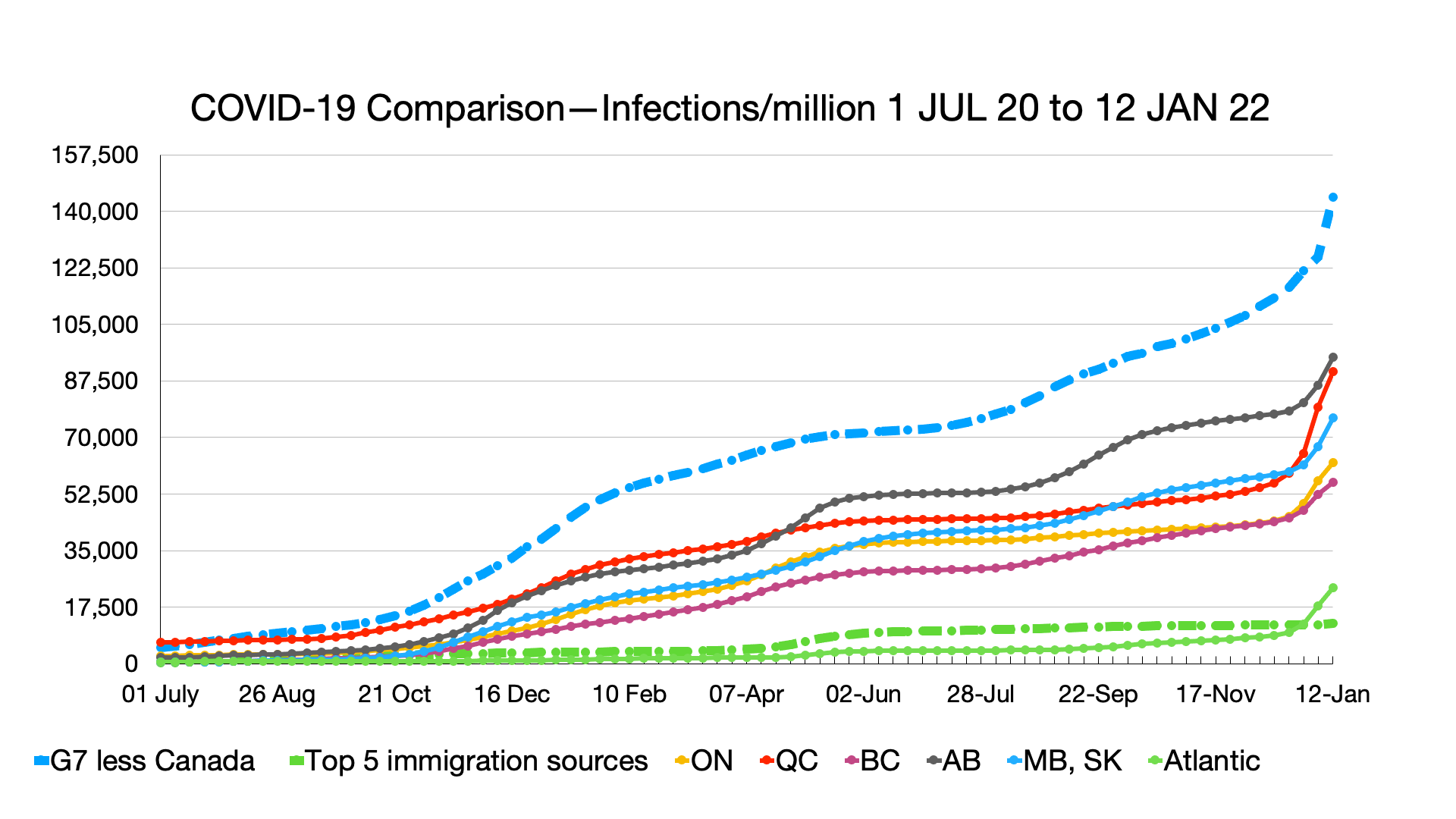
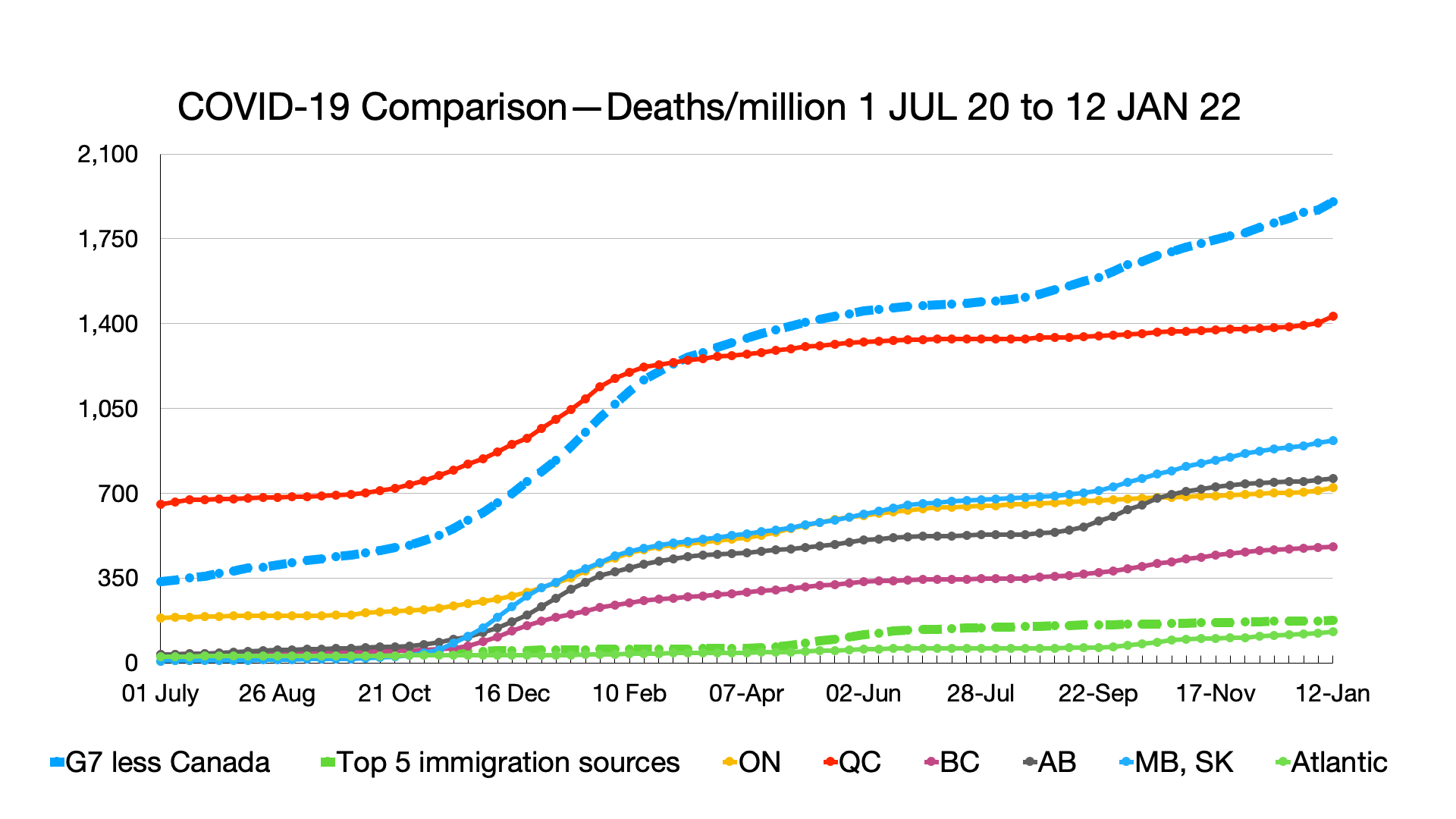
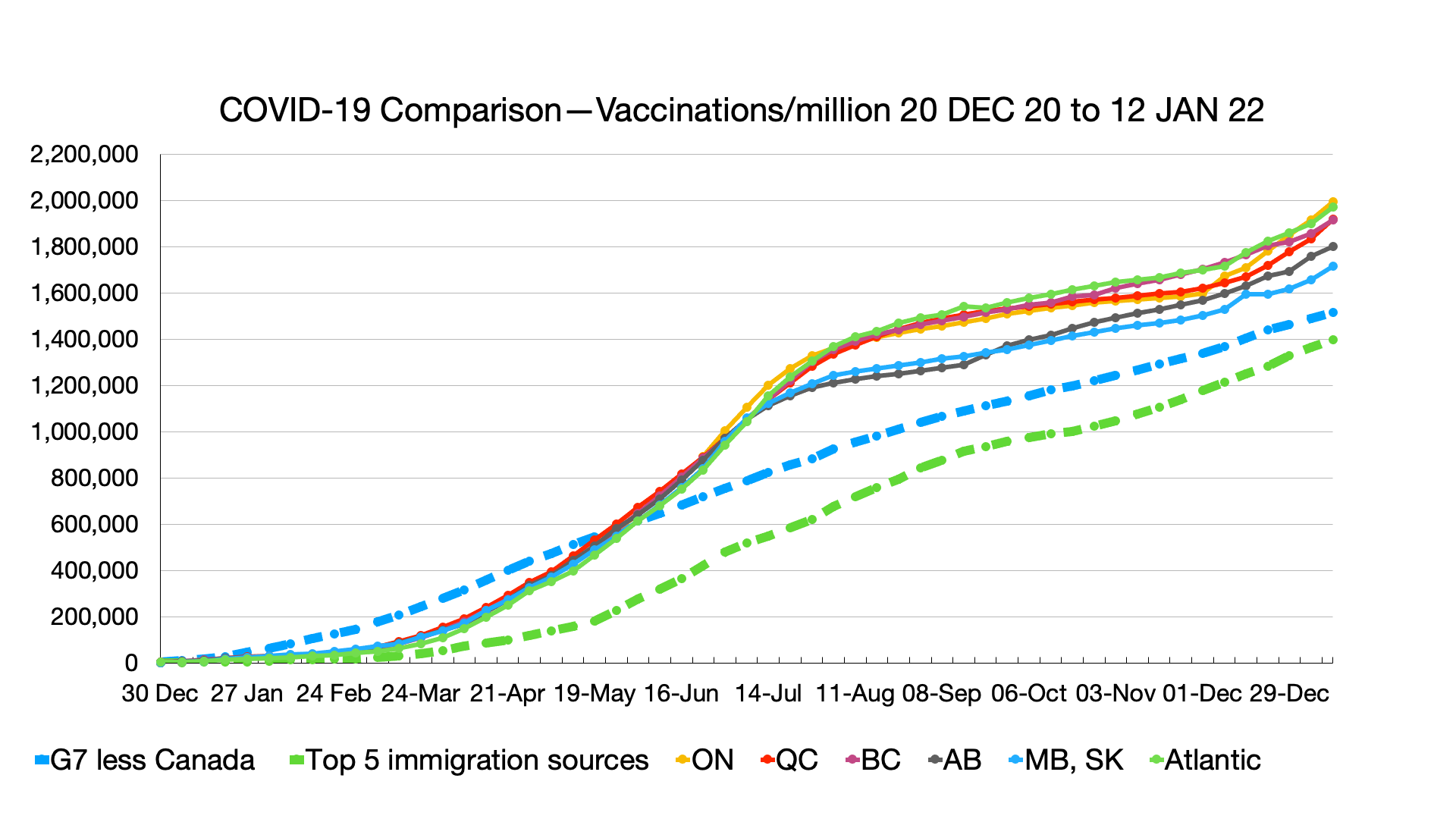
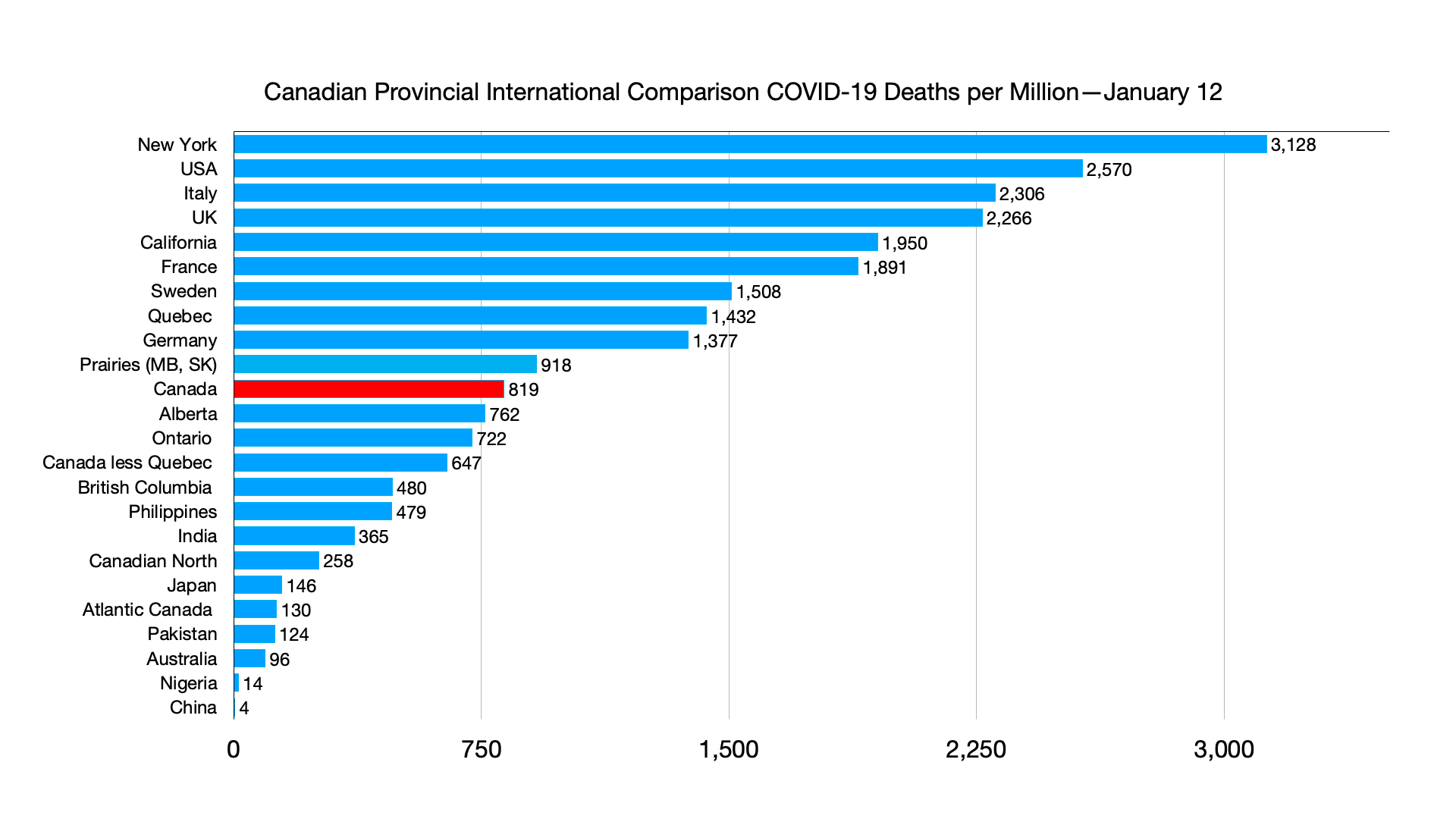
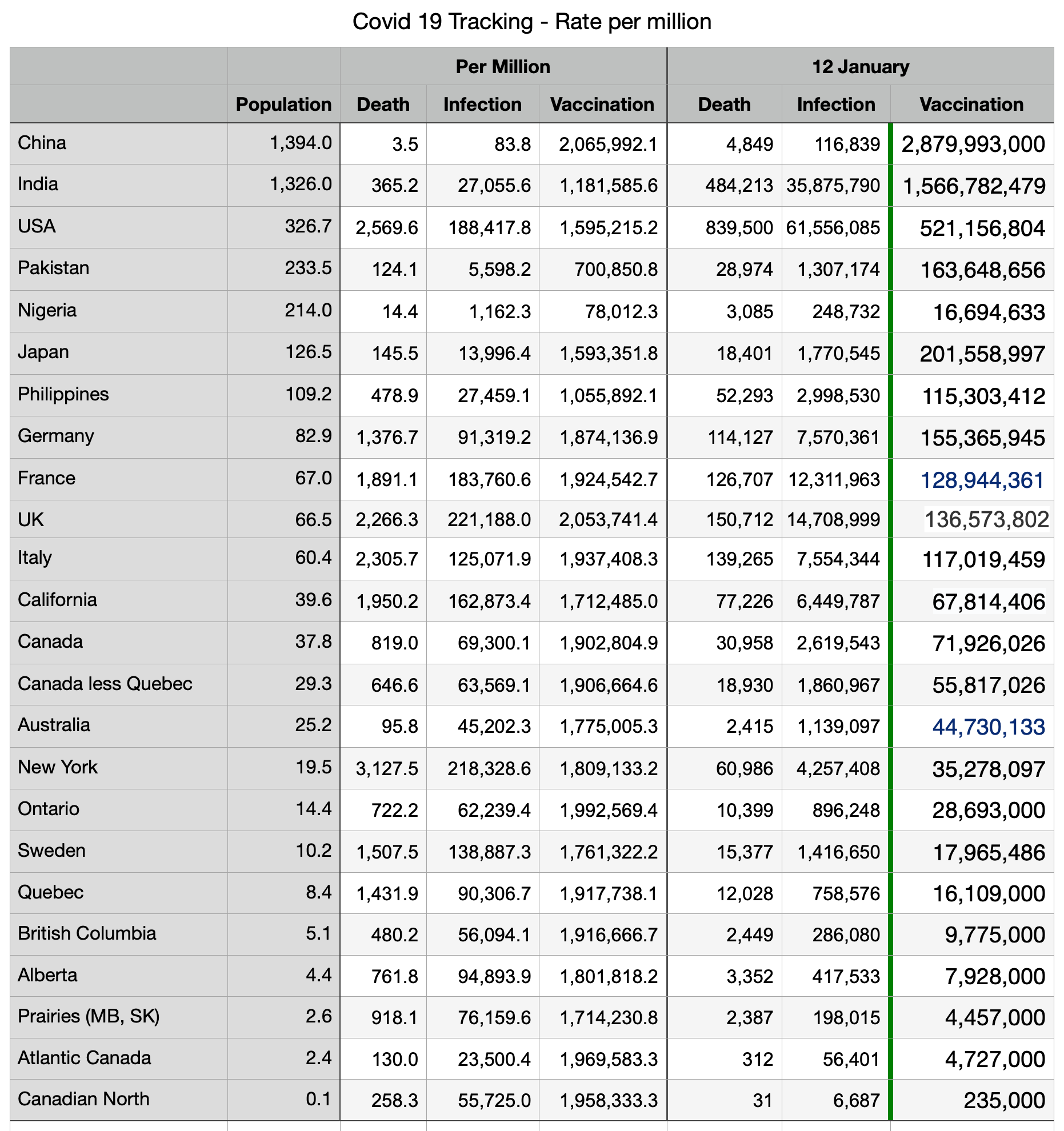
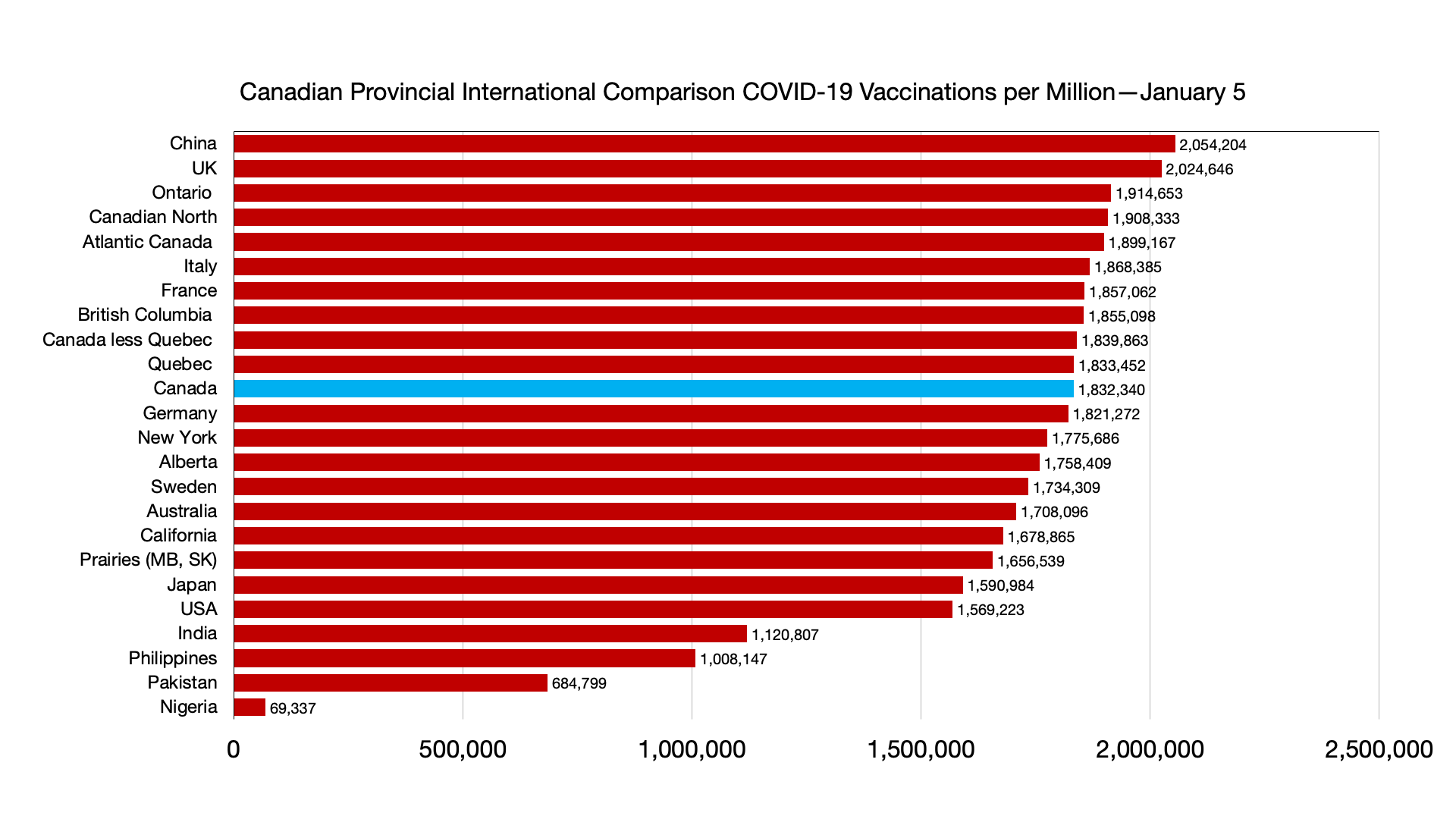
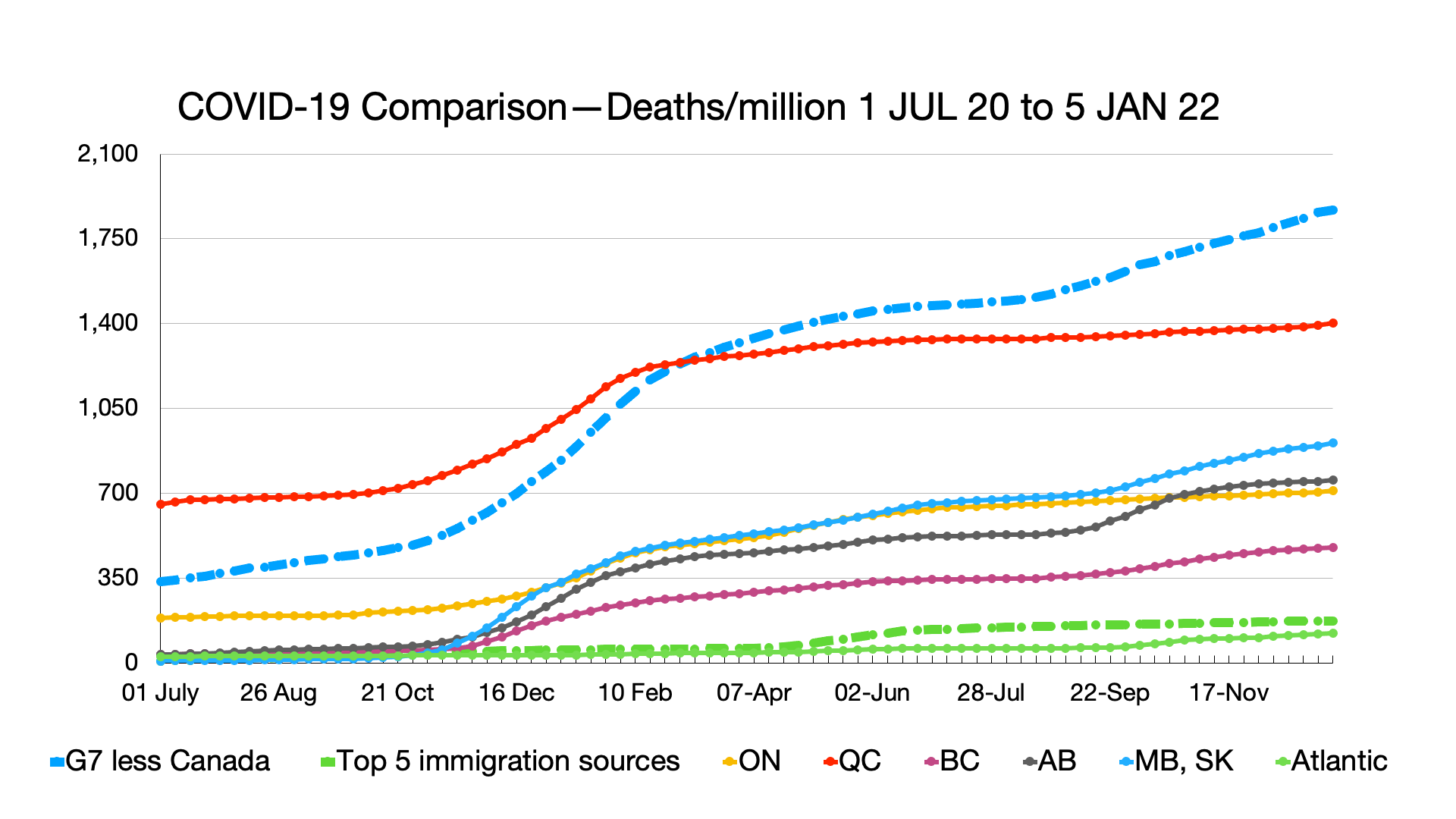
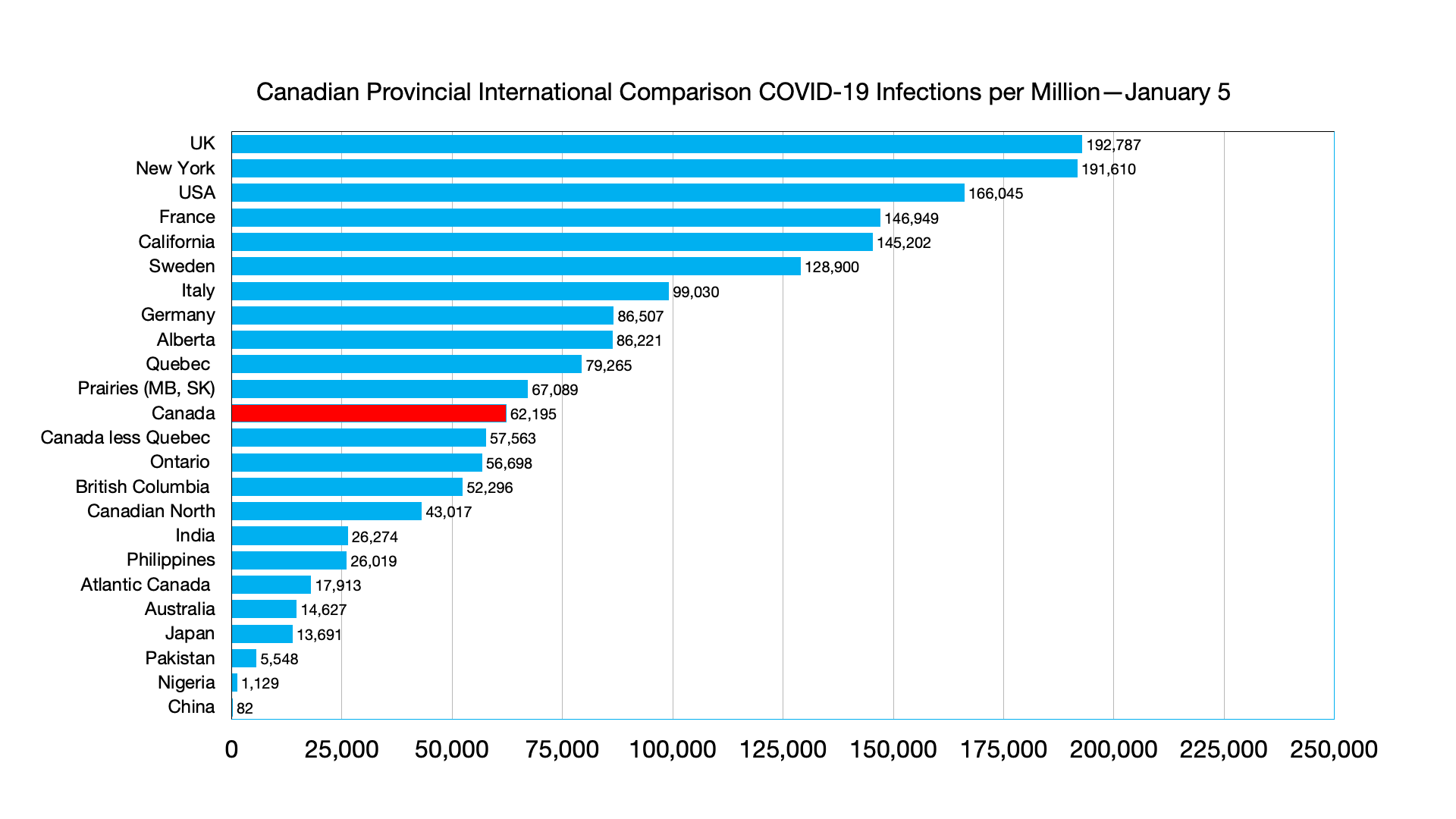
#COVID-19: Comparing provinces with other countries 17 November Update

The latest charts, compiled 17 November. Canadians fully vaccinated 76.4 percent, compared to Japan 75.8 percent, UK 68.9 percent and USA 59.4 percent.

Vaccinations: Canadian North ahead of Atlantic Canada, UK and British Columbia, Sweden and New York ahead of Prairies. China fully vaccinated 76.8 percent, India 27.6 percent, Philippines 36.5 percent.

Trendline Charts:

Infections: Recent trends of increased infections in Europe becoming more apparent. Canadian provincial trends showing minimal change from last week.

Deaths: Albert, Prairie and British Columbia deaths climb at slower à rate to G7 less Canada (driven mainly by USA).

Vaccinations: Ongoing convergence among provinces and G7 less Canada and narrowing gap with immigration source countries.

Weekly

Infections: UK ahead of USA with no other relative change.

Deaths: No relative change

And an interesting article on cognitive bias and vaccine hesitancy:

The World Health Organization recognized vaccine hesitancy as a growing challenge in 2011, and identified it as a new priority topic. This was mostly because of the return of vaccine-preventable diseases like measles in Europe and the United States

Ten years later, in 2021, we see that vaccine hesitancy has become an even more significant challenge despite all the efforts. The COVID-19 pandemic has brought it to a peak, and all efforts to manage the pandemic depend on the people’s willingness to take the vaccination. However, the numbers are not very promising as some percentage of populations in every country are reluctant to vaccinate.

Vaccine hesitancy means “delay in acceptance or refusal of vaccines despite availability of vaccination services.” Vaccine-hesitant people cite distrust in vaccine safety and concerns over vaccine adverse eventsas the most common reasons for reluctance to get vaccinated. 

Vaccines are used in healthy people to prevent a disease that might harm them in the future. However, as they are healthy at the time of vaccination, they may worry about the vaccine’s safety.

Our team of business analytics and artificial intelligence researchers at Concordia University, along with a professor of epidemiology at McGill University, has published a paper in the BMC Public Health journal that investigated this critical concern from two perspectives. 

First, we addressed vaccine safety concerns by analyzing data from vaccine adverse events systems. These are vaccine surveillance systems where adverse events following immunization are reported, monitored and stored in a database. Canada’s system is called the Canadian Adverse Events Following Immunization Surveillance System (CAEFISS).

Second, we focused on cognitive science and highlighted the critical role of cognitive biases in people’s vaccination decision-making that might lead to vaccine hesitancy.

Data-driven evidence to address vaccine safety

A solution to mitigate distrust in vaccines safety is to provide evidence-based meaningful information about vaccine safety and adverse events. We followed this path and analyzed all the adverse events reported to the U.S. Vaccine Adverse Event Reporting System (VAERS).

We analyzed almost 294,000 reports over eight years from 2011 to 2018. It equals roughly 115 reports per million people, covering 87 vaccine types. The most frequently reported vaccines were those for chickenpox, influenza, pneumococcal bacteria and human pappilomavirus (HPV).

Each VAERS report (representing one incident) involved an average of three adverse events, the most common being rashes, fever, swelling, pain and headaches. Only 5.5 per cent of the reports were marked as serious, resulting in hospitalization, disability, threats to life or death. The top adverse events in this group also include fever, pain, vomiting, headaches and shortness of breath. 

We also analyzed the vaccine adverse events reported to Canada Vigilance. Our findings were consistent with those from the VAERS.

We have provided our results in an interactive dashboard. Health-care professionals and others involved in vaccine communication can use this dashboard to provide evidence-based information to the public. Research suggests that summarized data is the best format for communicating vaccine safety information, so using this dashboard in vaccination communication can help mitigate vaccine hesitancy and safety concerns, and increase trust in vaccines.

The role of cognitive biases in vaccine hesitanc

In the second part of our study, after addressing concerns about vaccine adverse events, we examined the role of cognitive biases on vaccine hesitancy. We identified cognitive biases that might affect vaccine communication and decision-making. 

As mentioned earlier, vaccines are administrated to healthy people. When people are making decisions about vaccination, they might feel some degrees of risk, ambiguity and uncertainty about the results, which can instigate cognitive biases in the decision-making process. Such cognitive biases might nudge people toward vaccine hesitancy.

For example, contrary to the positive effect of providing people with summarized vaccine safety information that increases vaccine trust, detailed vaccine adverse event reports will decrease trust because of two cognitive biases. 

First, when vaccine hesitant people read a detailed report about a vaccine adverse event, it gives them the chance to see what they want to see. It is an example of confirmation bias, which is the tendency to recall and interpret information that confirms our existing beliefs

Second, a detailed adverse event report will also increase the event’s vividness, making it easier to recall the next time there is a decision to be made about taking a vaccine. That is the effect of availability bias, the tendency to attribute more weight to factors that are easier to recall.

We identified 15 cognitive biases in the vaccine decision-making process and categorized them into three groups:

  • Cognitive biases triggered by processing vaccine-related information include availability bias, as in the above example, as well as framing effect, base rate neglect, availability bias, anchoring effect and authority bias.
  • Cognitive biases triggered in vaccination decision-makinginclude omission bias, which is when the results of not taking an action are viewed as less damaging than the results of taking action, even when this is not the case. Others include ambiguity aversion, optimism bias, present bias and protected values. 
  • Cognitive biases triggered by prior beliefs regarding vaccination include confirmation bias such as the one in the example, as well as belief bias, shared information bias and false consensus effect.

The full list of cognitive biases affecting vaccination decision-making and their examples is available here. Public health officials and practitioners can use this list and customize their plans, interventions and other forms of vaccine communication to decrease vaccine hesitancy. 

You also can check the list and see if these biases have influenced your own vaccination decisions.

Source: https://theconversationcanada.cmail19.com/t/r-l-trtukldd-kyldjlthkt-b/

Share of World Population Allowed to Immigrate Legally to U.S. 85% Below Its Peak

Canada’s peak year for immigration in relation to its population was 1913, when over 400,000 arrived, or 5.2 percent of our total population of 7,632,000. In world population terms, that would be 22 per 100,000; today’s 400,000 is about 5 per 100,000. So not sure how meaningful this argument is but fun to work the numbers:

In fiscal year 2021, the share of the world population that the U.S. government permitted to immigrate legally to the United States was about 85 percent below its peak year of 1907 when 74 in 100,000 people became legal permanent residents of the United States. By 2021, that number had fallen to about 11 in 100,000—slightly lower than the 13 in 100,000 in 2019 or 16 in 100,000 in 2016.

Unlike those with various temporary statuses or no status, legal permanent residents are the only non‑U.S. citizens who may naturalize to become U.S. citizens. Measuring legal immigration as a share of the world’s population contextualizes potential immigrants’ actual opportunity to immigrate to the United States better than the absolute number of immigrants. No year has seen more than a fraction of a percent of the world’s population become U.S. legal permanent residents, but the share has declined, even as the desire to immigrate has increased.

Figure 1 shows the number of new legal permanent residents to the United States as a share of the non‑U.S. world population from 1840 to 2021. The lines after 1952 reflect the fact that some immigrants could adjust to legal permanent residence while already the United States. The share of “new arrivals” who enter from abroad as permanent residents fell even more dramatically from its high—nearly 95 percent below its peak in 1907.

During the era of mostly free immigration prior to 1925, legal immigration fluctuated wildly based on world events and the U.S. economy. But after visas were capped, an unnatural consistency developed at a low level. The one anomaly is in the period of 1989 to 1991 when the immigrants legalized by the 1986 amnesty adjusted to legal permanent residence. This experience was a small window into the demand that would exist if the United States had retained free immigration.

Table 1 ranks the years based on the share of the world population immigrating to the United States. Out of the 182 years, fiscal year 2021 ranks 122nd in terms of total new legal permanent residents as a share of the world population and 167th in terms of newly arriving legal permanent residents from abroad—which means only 15 years saw fewer new arrivals as a share of the world population than 2021.

If the United States had retained the same level of new legal permanent residents as a percentage of the world population as it saw during 1900 to 1924—the 25 years before the borders were closed—from 1925 to 2021, 160 million immigrants would have received permanent residence, compared to the 51 million who did. The level of legal immigration for 2000 to 2021 would be about 2.7 times the rate it actually was, permitting about 62 million immigrants as opposed to 22 million.

It’s reasonable to suppose that the actual rate would be higher than this, had the United States maintained its earlier policies. It certainly looks like the trend before World War I was upward from peak to peak. Transportation has also decreased significantly in price as well. The upshot is that the United States has extremely closed borders relative to what a reasonable person would expect under an even relatively open immigration system. This fact also explains why the country is experiencing so much more illegal immigration than in the past. When legal immigration is closed off, illegal immigration becomes most people’s only option.

Source: Share of World Population Allowed to Immigrate Legally to U.S. 85% Below Its Peak

Climate migration is already happening — Canada must lead in developing a coherent response

Silent on the impact of increased immigration to Canada on Canada’s climate footprint and how to mitigate it. And would these new classes be part of current and future expected immigration levels or supplemental? Would this approach risk the overall consensus in favour of immigration in Canada?:

Representatives from much of the world gathered in Glasgow to discuss how to respond to the existential impacts of climate change. COP26 brought with it a heightened sense of urgency and the destructive effects of climate change can no longer be ignored, even for the most stubborn amongst us. 

But the consequences of climate change will hit some people harder and many will be forcibly displaced from their homes. Climate migration is projected to create the largest amount of displacement we have seen in modern history. An estimated 216 million people in six regions across the globe will be displaced due to climate change by the year 2050. 

In 2020 alone, over 30 million people were internally displaced by natural disasters. By the end of the century, the homelands of 280 million people could be permanently submerged due to rising sea levels.

Some of the displaced will inevitably find their way to Canada. The need is urgent for Canada to put forward a comprehensive law and policy framework for climate migrants.

We must be better prepared for the inevitable. We must also meet our international law obligations and create meaningful pathways for displaced individuals to find safety within our borders. Canada must lead in developing a coherent response on climate migration.

As the echoes grow louder at COP26 for proactive action on the resettlement of climate migrants and refugees, the Canadian Association of Refugee Lawyers has released a new 2021 Report on Climate Migrants to offer a number of policy and legal options for the Canadian government to consider.

Despite the inevitability of climate migration and the known scale of the impending issue facing Canada, there is no comprehensive plan or framework in Canada to address the issue of climate migrants, aside from the brief 2010 background federal report entitled “Climate Change and Forced Migration.” 

However, much has changed since 2010. We know more about the severity of the climate risks faced by millions across the world and we know more about the timing of the impending issues we face as a country. Indeed, the issues posed by climate change and climate migration provide an opportunity by Canada for global leadership on a pressing issue while the numbers of actual climate migrants are presumably low. Canada should act now so that it is able to thoughtfully design and test evidence-based, proactive policy and law.

There are a host of policy and legal options available to Canada in order to address climate migration proactively:

First, Canada can broaden categories for protection by granting “protected person status” to climate migrants, exempting them from the requirement of demonstrating personalized risk given the often generalized nature of climate induced displacement.

Second, Canada can create a public policy class under its humanitarian and compassionate program for persons facing climate disasters. We did this in the aftermath of the 2010 Haitian earthquake, and we can test this in the case of climate migrants.

Third, we can expand private refugee sponsorship categories to include a class of individuals who have been displaced by climate change.

Fourth, we can ensure that individuals are not deported from Canada where they do not have a home to return to due to climate induced displacement. The reality is that Canada has options in law and policy, but we must begin doing the work now — and quickly.

Climate migration is inevitable, and its scale is growing by the day. Canada must get ahead of the matter before it is too late.

Source: https://www.thestar.com/opinion/contributors/2021/11/15/climate-migration-is-already-happening-canada-must-lead-in-developing-a-coherent-response.html

Canada is refusing more study permits. Is new AI technology to blame?

Given the high volumes (which immigration lawyers and consultants benefit from), expanded use of technology and templates inevitable and necessary, although thorough review and safeguards necessary.

Alternate narrative, given reporting on abuse and exploitation of international students and the program itself (The reality of life in Canada for international students), perhaps a system generating more refusals has merit:

Soheil Moghadam applied twice for a study permit for a postgraduate program in Canada, only to be refused with an explanation that read like a templated answer.

The immigration officer was “not satisfied that you will leave Canada at the end of your stay,” he was told.

After a third failed attempt, Moghadam, who already has a master’s degree in electronics engineering from Iran, challenged the refusal in court and the case was settled. He’s now studying energy management at the New York Institute of Technology in Vancouver.

His Canadian lawyer, Zeynab Ziaie, said that in the past couple of years, she has noticed a growing number of study permit refusals like Moghadam’s. The internal notes made by officers reveal only generic analyses based on cookie-cutter language and often have nothing to do with the particular evidence presented by the applicant.

“We’re seeing a lot of people that previously would have been accepted or have really what we consider as complete files with lots of evidence of financial support, lots of ties to their home country. These kinds of files are just being refused,” said Ziaie, who added that she has seen more than 100 of these refusals in her practice in the past two years.

It’s a Microsoft Excel-based system called Chinook. 

Its existence came to light during a court case involving Abigail Ocran, a woman from Ghana who was refused a study permit by the Immigration Department.

Government lawyers in that case filed an affidavit by Andie Daponte, director of international-network optimization and modernization, who detailed the working and application of Chinook.

That affidavit has created a buzz among those practising immigration law, who see the new system — the department’s transition to artificial intelligence — as a potential threat to quality decision making, and its arrival as the harbinger of more troubling AI technology that could transform how immigration decisions are made in this country.

All eyes are now on the pending decision of the Ocran case to see if and how the court will weigh in on the use of Chinook. 


Chinook was implemented in March 2018 to help the Immigration Department handle an exponential growth in cases within its existing, and antiquated, Global Case Management System (GCMS).

Between 2011 and 2019, before everything slowed down during the pandemic, the number of visitor visa applications skyrocketed by 109 per cent, with the caseload of applications for overseas work permits and study permits up by 147 per cent and 222 per cent, respectively.

In 2019 alone, Daponte said in his affidavit, Canada received almost 2.2 million applications from prospective visitors, in addition to 366,000 from people looking to work here and 431,500 from would-be international students.

Meanwhile, the department’s 17-year-old GCMS system, which requires officers to open multiple screens to download different information pertaining to an application, has not caught up. Each time decision-makers move from screen to screen they must wait for the system to load, causing significant delays in processing, especially in countries with limited network bandwidth.

Chinook was developed in-house and implemented “to enhance efficiency and consistency, and to reduce processing times,” Daponte said.

As a result, he said, migration offices have generally seen an increase of between five per cent and 35 per cent in the number of applications they have been able to process.

Here’s how Chinook works: an applicant’s information is extracted from the old system and populated in a spreadsheet, with each cell on the same row filled with data from that one applicant — such as name, age, purpose of visit, date of receipt of the application and previous travel history.

Each spreadsheet contains content from multiple applicants and is assigned to an officer to enable them to use “batch processes.”

After the assessment of an application is done, the officer will click on the decision column to prompt a pop-up window to record the decision, along with a notes generator if they’re giving reasons in the case of a refusal.

(An officer can refuse or approve an application, and sometimes hold it for further information.)

When done, decision-makers click a button labelled “Action List,” which organizes data for ease of transfer into the old system. It presents the decision, reasons for refusal if applicable, and any “risk indicators” or “local word flags” for each application.

The spreadsheets are deleted daily after the data transfer for privacy concerns.

While working on the spreadsheet, said Daponte, decision-makers continue to have access to paper applications or electronic documents and GCMS if needed.

“Chinook was built to save decision-makers time in querying GCMS for application information and to allow for the review of multiple applications,” Daponte noted.

However, critics are concerned that the way the system is set up may be guiding the officers toward certain conclusions, giving them the option of not reviewing all the material presented in each case, and that it effectively shields much of the decision making from real scrutiny.

According to Daponte’s court affidavit, the notes generator presents standard language that immigration officers may select, review and modify to fit the circumstances of an application in preparing reasons for refusal. The function is there to “assist them in the creation of reasons.”

Ziaie believes that explains the templated reasons for refusals she’s been seeing.

“These officers are looking at a spreadsheet of potentially 100 different applicants. And those names don’t mean anything to the officers. You could mix up rows. You could easily make errors,” said the Toronto lawyer.

“There’s no way to go back and check that because these decisions end up with very similar notes that are generated right when they’re refused. So my concern is about accountability. Every time we have a decision, it has to make sense. We don’t know if they make mistakes.”

That’s why she and other lawyers worry the surge of study permit refusals is linked to the implementation of Chinook. 

In fact, that question was put to Daponte during the cross-examination in the Ocran case by the Ghanaian student’s lawyer, Edos Omorotionmwan.

Immigration data obtained by Omorotionmwan showed the refusal rate of student permit applications had gone from 31 per cent in 2016 to 34 per cent in 2018, the year Chinook was launched. The trend continued in 2019 to 40 per cent and reached 53 per cent last year.

“Is there a system within the Chinook software requiring some oversight function where there is some other person to review what a visa officer has come up with before that decision is handed over to the applicants?” asked Omorotionmwan.

“Within Chinook, no,” replied Daponte, who also said there’s no mechanism within this platform to track if an officer has reviewed all the support documents and information pertaining to an applicant’s file in the GCMS data.


“This idea of using portals and technology to speed up the way things are done is the reality of the future,” said Vancouver-based immigration lawyer Will Tao, who has tracked the uses of Chinook and blogged about it.

“My concern as an advocate is: who did this reality negatively impact and what systems does it continue to uphold?”

Tao said the way the row of personal information is selected and set out in the Chinook spreadsheet “disincentivizes” officers to go into the actual application materials and support documents out of convenience.

“And then the officers are supposed to use those notes generators to justify their reasoning and not go into some of the details that you would like to see to reflect that they actually reviewed the facts of the case. The biggest problem I have is that this system has had very limited oversight,” he said.

“It makes it easier to refuse because you don’t have to look at all the facts. You don’t have to go through a deep, thoughtful analysis. You have a refusal notes generator that you can apply without having read the detailed study plans and financial documents.”

He points to Chinook’s built-in function that flags “risk factors” — such as an applicant’s occupation and intended employer’s information — for inconsistency in an application, as well as “local flag words” to triage and ensure priority processing of time-sensitive applications to attend a wedding or a funeral.

Those very same flag words used in the spreadsheet can also be misused to mark a particular group of applicants based on their personal profiles and pick them out for refusals, said Tao.

In 2019, in a case involving the revocation of citizenship to the Canadian-born sons of two Russian spies, the Supreme Court of Canada made a landmark ruling that helps guide judges to review the decisions of immigration officials.

In the unanimous judgment, Canada’s highest court ruled it would be “unacceptable for an administrative decision maker to provide an affected party formal reasons that fail to justify its decision, but nevertheless expect that its decision would be upheld on the basis of internal records that were not available to that party.”

Tao said he’s closely watching how the Ocran decision is going to shed light on the application of Chinook in the wake of that Supreme Court of Canada ruling over the reasonableness standard.

“Obviously, a lot of these applications have critical points that they get refused on and with the reasons being template and standard, it’s hard for reviewers to understand how that came to be,” he said.

In a response to the Star’s inquiry about the concerns raised about Chinook, the Immigration Department said the tool is simply to streamline the administrative steps that would otherwise be required in the processing of applications to improve efficiency.

“Decision makers are required to review all applications and render their decisions based on the information presented before them,” said spokesperson Nancy Caron.

“Chinook does not fundamentally change the way applications are processed, and it is always the officer that gives the rational for the decisions and not the Chinook tool.”

For immigration lawyer Mario Bellissimo, Chinook is another step in the Immigration Department’s move toward digitalization and modernization.

Ottawa has been using machine learning technology since 2018 to triage temporary resident visa applications from China and India, using a “set of rules derived from thousands of past officer decisions” then deployed by the technology to classify applications into high, medium and low complexity.

Cases identified as low complexity and low risk automatically receive positive eligibility decisions, allowing officers to review these files exclusively on the basis of admissibility. This enables officers to spend more time scrutinizing the more complex files.

Chinook, said Bellissimo, has gone beyond the triage. He contends it facilitates the decision-making process by officers.

The use of templated responses from the notes generator makes the refusal reasons “devoid of meaning,” he noted.

“Eventually, do you see age discriminators put into place for study permits when anyone over the age of 30 is all automatically streamed to a different tier because they are less likely bona fide students? This is the type of stuff we need to know,” Bellissimo explained.

“When they’re just pulling standard refusal reasons and just slapping it in, then those decisions become more difficult to understand and more difficult to challenge. Who made the decision? Was technology used? And that becomes a problem.”

He said immigration officials need to be accountable and transparent to applicants about the use of these technologies before they are rolled out, not after they become an issue.

Petra Molnar, a Canadian expert specializing in migration and technology, said automated decision-making and artificial intelligence tools are difficult to scrutinize because they are often very opaque, including how they are developed and deployed and what review mechanisms, if any, exist once they are in use.

“Decisions in the immigration and refugee context have lifelong and life-altering ramifications. People have the right to know what types of tools are being used against them and how they work, so that we can meaningfully challenge these types of systems.”

Ziaie, the lawyer, said she understands the tremendous pressure on front-line immigration officers, but if charging a higher application fee — a study permit application now costs $150 — can help improve the service and quality of decisions, then that should be implemented.

“They should allocate a fair amount of that revenue toward trying to hire more people, train their officers better and give them more time to review the files so they actually do get a better success rate,” she said. “By that, I mean fewer files going to Federal Court.”

As a study permit applicant, Moghadam said it’s frustrating not to understand how an immigration officer reaches a refusal decision because so much is at stake for the applicant.

It took him two extra years to finally obtain his study permit and pursue an education in Canada, let alone the additional application fees and hefty legal costs.

“Your life is put on hold and your future is uncertain,” said the 39-year-old, who had a decade of work experience in engineering for both Iranian and international companies.

“There’s the time, the costs, the stress and the anxiety.”

Source: https://www.thestar.com/news/canada/2021/11/15/canada-is-refusing-more-study-permits-is-new-ai-technology-to-blame.html