Funny op-ed that reads more as Semotiuk’s brief for a client than broader policy arguments. And not convinced of the overall economic benefits claimed for the program but understand the frustration of applicants caught by operational changes during the pandemic:
Marcos Bertola is a U.S. EB-5 Regional Center foreign immigrant investor whose green card is in limbo because the Regional Center program shut down while his application was in process. He is one of over 30,000 such committed investors whose I-526 immigration petitions are stuck. At least $15 billion in capital investment and almost 500,000 American jobs are caught up in this logjam according to IIUSA, Invest in the USA.
Better Understanding Needed
“I believe the lack of sympathy from Congress towards what investors are going through with the lapse of the Regional Center program is due at large to people not realizing who they are,” said Bertola. He added, “Investors are seen as millionaires who can afford to wait another year so that the delay won´t affect their lives. But in our case, and that of many EB-5 investors we know of, we are just middle-class families investing our savings in the American economy to give a better education for our children and because we believe in the excellence of the American institutions to such a degree that we want to be part of it.”
Bertola describes how the process started for his family, “The decision to immigrate to the US started when my daughter was finishing high school and decided to become a nurse. Researching on how she could study in the US we learned that EB-5 seemed an opportunity for us to be with her as a family. My wife who is a researcher graduated with a Master´s Degree at one of the most prestigious universities in Latin America was thrilled with the idea of being able become a doctor in the US.”
Bertola filed his EB-5 investor petition in 2016, when adjudication times were expected to be around 14 months. It took three years for it to be approved, yet he was glad and expected things to run faster after that. The next step in their immigration journey was to get approval from the National Visa Center to get their immigrant interviews at the U.S. Consulate abroad. He and his wife even bought a house in the US in 2019 in Orlando, Florida expecting everything would work out. That house has been empty ever since, creating a financial burden of paying for two households, with property taxes, insurance, HOA, etc., in addition to their expenses overseas.
Consulates Closing Didn’t Help
Bertola indicates, “Our documents were filed at the National Visa Center on March 2020, but due to the pandemic, Consulates worldwide closed that month. When they resumed immigration interviews one year later, there was a 4-tier priority to determine which immigration petitions should be interviewed first and EB5 cases were last on the list.”
The Bertola oddessy continued, “Our interview was finally scheduled, with the assistance of a Florida Senator´s office, for July 30th, 2021 after the sunset of the Regional Center Program. A week after the interview, we got an email from the Consulate saying that everything was good on our end, and they were waiting for the reboot of the program to issue our visas. We were in the incredible situation of having all steps of our petition approved, including the Consulate interview, but unable to get our visas due to the lapse. Our passports are still with the Consulate since then.”
Psychological Toll
This wait has also put an immense psychological burden on his children. “My daughter who was on her 3rd year as a nursing student has just decided she can no longer wait to go. My wife could be graduated in the biomedical field and working in healthcare in the U.S. by now if not for this reauthorization lapse. Our lives have been put on hold for many years in the expectation of moving to the U.S., but every time a deadline seems close, a disappointment comes and uncertainty grows,” Bertola says. He adds, “Those years of professional development and achievements are being robbed from us, especially my children who are starting their careers. Our personal belongings are in a warehouse for more than a year, ready to be shipped, and we spend our time searching the internet for news about the reauthorization which never comes.”
No Sense Of Urgency
The way Bertola sees it, “There is no sense of urgency in Congress towards the reauthorization, and investors are being used as hostages in the negotiations.” A grandfathering bill, such as FIFPA (Foreign Investors Fairness Protection Act) could easily solve this problem, but according to Bertola it lacks political awareness. “It´s a damaging situation for the reputation of the program and could bring as consequence the loss of millions of dollars and thousands of jobs if the investors start to sue to get their investment back. Nobody wins, but we investors are the weakest link,” says Bertola.
“Right now, our best hope is to have our voices and personal stories heard. I have a dream of moving to America as a legal immigrant and to become an American citizen in the future, but that dream is being denied for thousands of investors who did nothing wrong but were caught in the political turmoil of these past years,” concludes Bertola.
Grandfathering Legislation Needed
Dealing with this problem, Kurt Reuss a securities broker and founder of EB5 Marketplace, recently wrote, “Existing EB-5 regional center investors are stuck in limbo right now as their applications remain frozen due to the lapse of the Regional Center Program. The U.S. government has an obligation to live up to its end of the bargain: adjudication of the petitions of investors who invested and filed in good faith. To do otherwise, would be just plain wrong and would negatively impact our immigration reputation.”
According to Reuss, who advocates an end to the Regional Center program in favor of the EB-5 direct investment option, “Simple grandfathering legislation can protect those investors who filed their petition when the program was authorized. Take care of past regional center investors who acted in good faith and end the program with that.”
Whether or not the Regional Center program is renewed, it is clear that it is time to help the foreign investors caught in the fray.
It is in Canada’s policy interests to resume Express Entry invitations to FSWP and CEC candidates in short order.
Upon its launch in 2015, Express Entry sought to invite the highest scoring candidates to apply for permanent residence. Its dynamic nature sought to end backlogs since IRCC only needs to process the applications of those it invited rather than processing every application it receives. Unfortunately, IRCC has departed from inviting the highest scoring candidates and backlogs have grown due to it shifting its resources to prioritizing permanent residence applications submitted within Canada as well as the processing of Afghan refugee applications.
Back in 2015, IRCC argued that using the Comprehensive Ranking System (CRS)to score and rank candidates was the best way to identify new immigrants most likely to successfully integrate into Canada’s economy. The CRS was informed by many decades of Statistics Canada research and hence is meant to be a scientific way of selecting the Canadians of tomorrow. Thus, it is in Canada’s best interests to use the CRS as the main determinant for Express Entry invitations. One may even argue a stronger case can be made to stick with the CRS now, during an economically turbulent period, since Statistics Canada research also shows immigrants who land during a recession have weaker economic outcomes throughout their careers in Canada than those who land during stronger economic times.
An argument to stick to the CRS can also be made on grounds of fairness. Between 2015 and the end of 2020, IRCC had been overwhelmingly issuing Express Entry invitations based on CRS score but departed from this approach in January 2021 without warning. Many candidates entered the Express Entry pool after taking steps to maximize their CRS score or have taken steps since entering the pool to improve their CRS score. Such efforts have gone for naught through no fault of their own due to IRCC shifting the goalposts on them with no advanced notice (IRCC remains quiet on its Express Entry plans for 2022).
The growth in the Express Entry backlog was avoidable since IRCC made the deliberate choice to expedite CEC application processing while holding off on processing FSWP and other applications. In the second half of 2021 it was processing about 14,000 CEC applications per month and just 600 FSWP applications monthly.
The backlog of FSWP and other applications of skilled workers abroad is proving costly since it is resulting in weaker population, labour force and economic growth. Canada’s population growth is the weakest since 1915/16 and the country is currently grappling with the highest job vacancy rate on record with nearly 1 million jobs currently unfilled. Crucial industries across the Canadian economy from health care, to transportation, to agri-food, and many others are in dire need of more workers. It goes without saying then, it is in Canada’s economic interests for IRCC to get the application processing of skilled workers abroad back on track so they can soon arrive to alleviate the labour shortages that are slowing the country’s economic recovery.
Finally, the pause in CEC draws since September is also concerning from both economic and fairness perspectives. CEC candidates tend to work for Canadian employers and are able to remain with them indefinitely after getting permanent residence via Express Entry. Many CEC candidates risk losing their legal status due to the absence of Express Entry invitations which may force them to leave the country. This would result in less economic activity in Canada and contribute to additional labour shortages and pressure for Canadian employers. From a fairness point of view, it would not be right to also shift the goalposts on such individuals with no advanced notice, and ask them to leave the country, after they have spent years contributing to Canada’s economy and society.
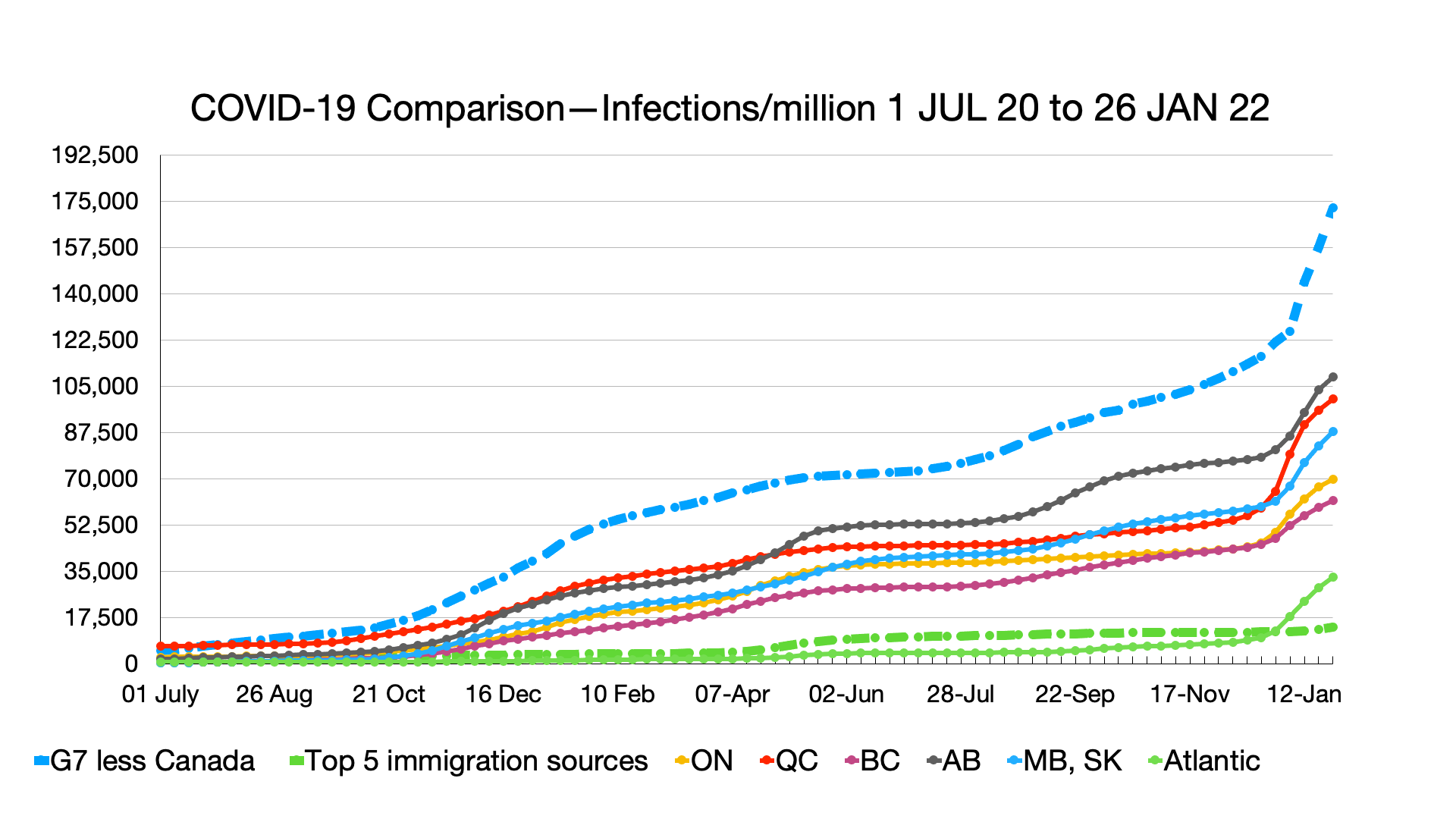
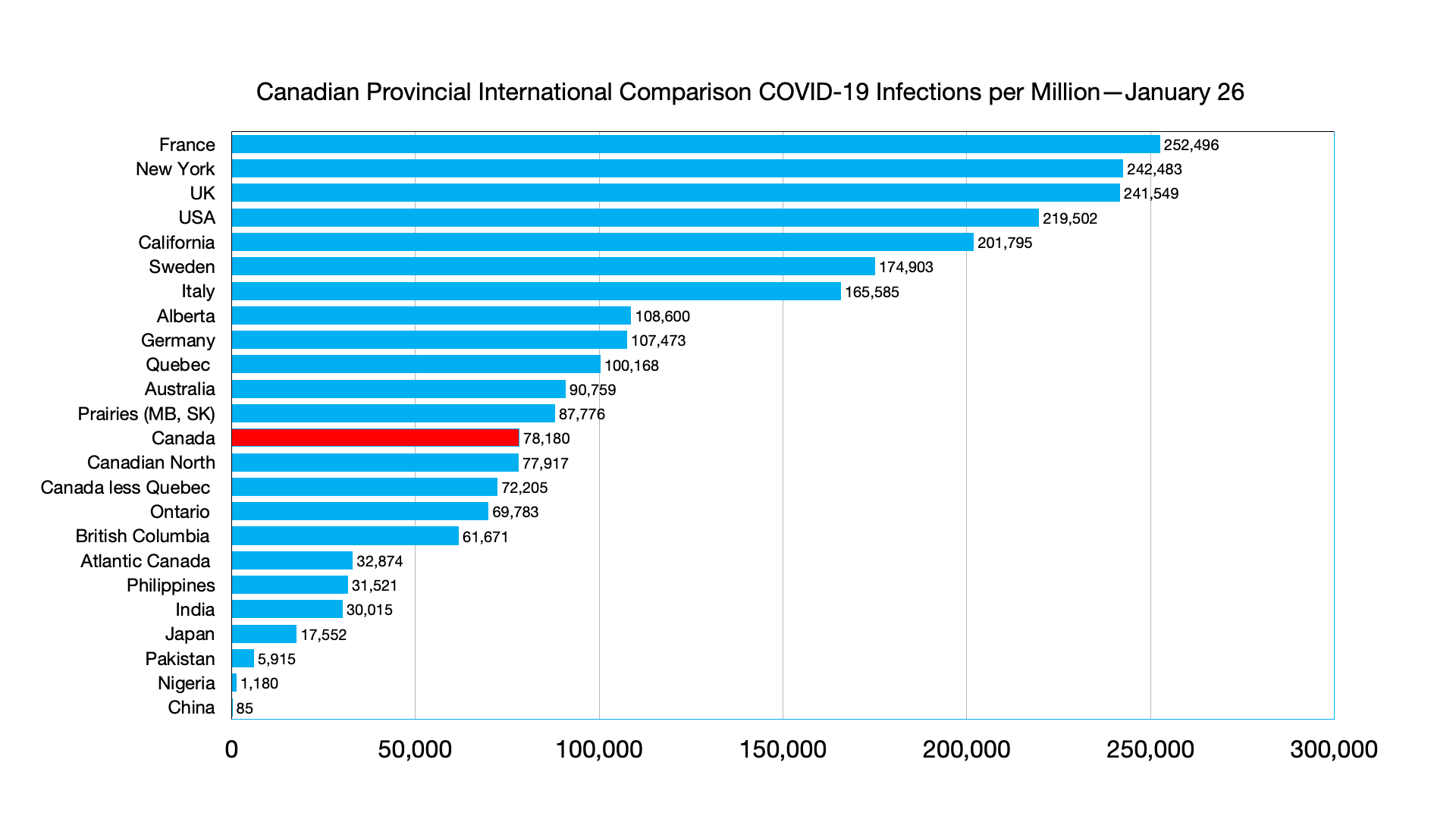
Steep rise of infections remains the main story, along with resulting increases in hospitalizations and ICUs.
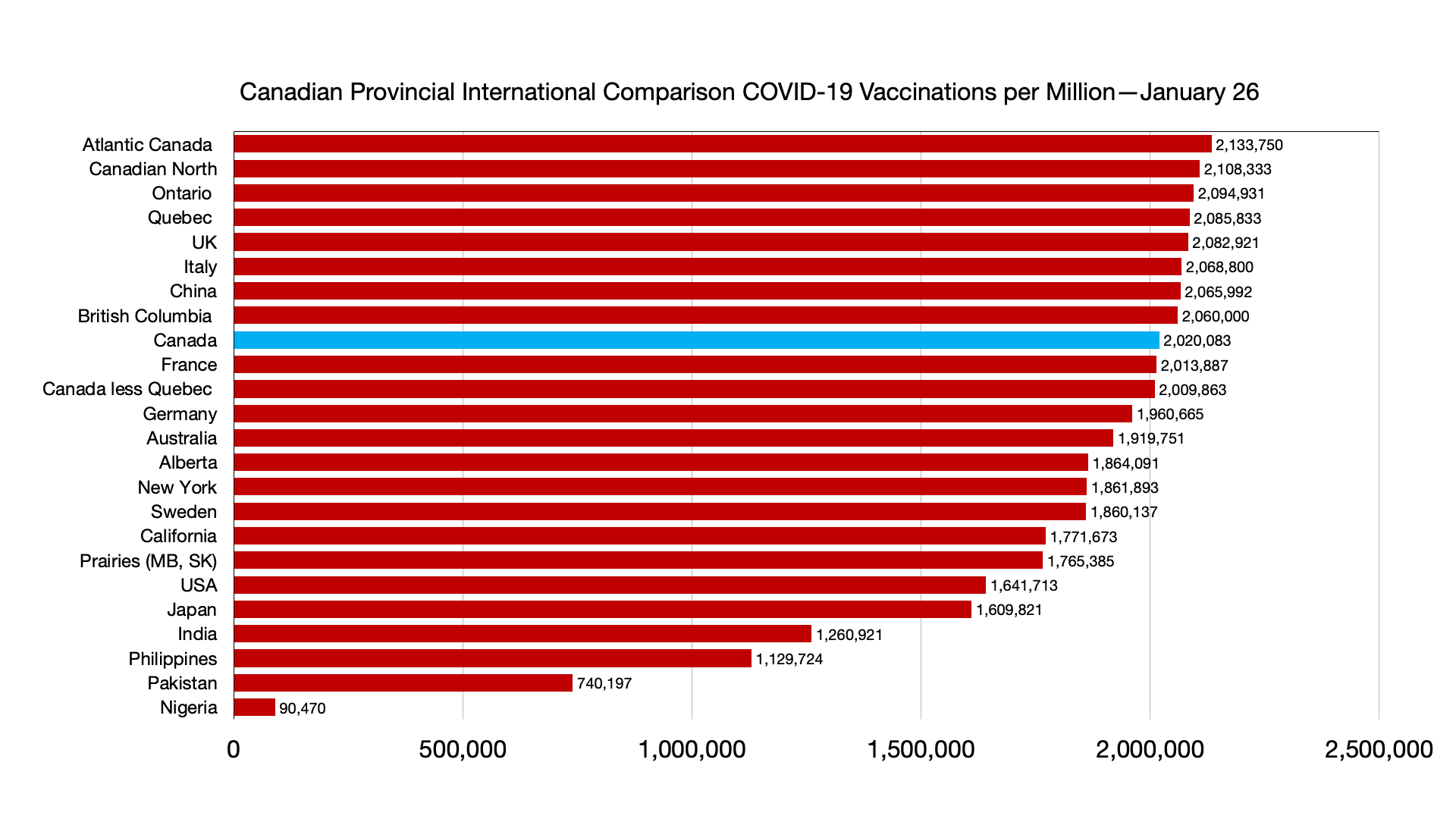
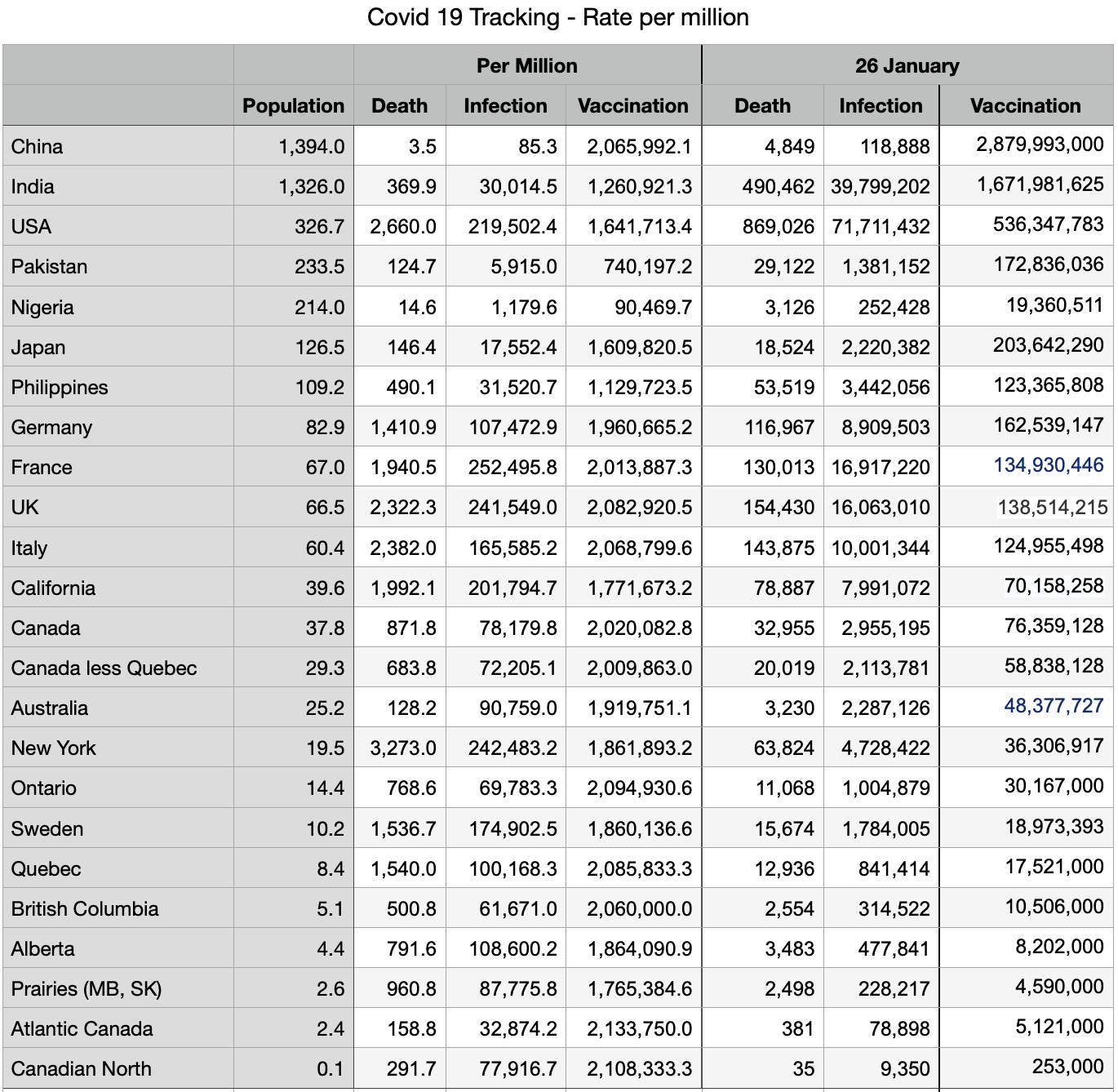
Vaccinations: Some minor shifts but general convergence among provinces and countries. Canadians fully vaccinated 79.5 percent, compared to Japan 78.9 percent, UK 72.2 percent and USA 64.2 percent.
Immigration source countries are also converging: China fully vaccinated 87.6 percent, India 50.4 percent, Nigeria 2.6 percent (the outlier), Pakistan 37 percent, Philippines 53 percent.
Trendline Charts:
Infections: Effects of Omicron seen in steep curve in all G7 countries and provinces. No such effect in immigration source countries.
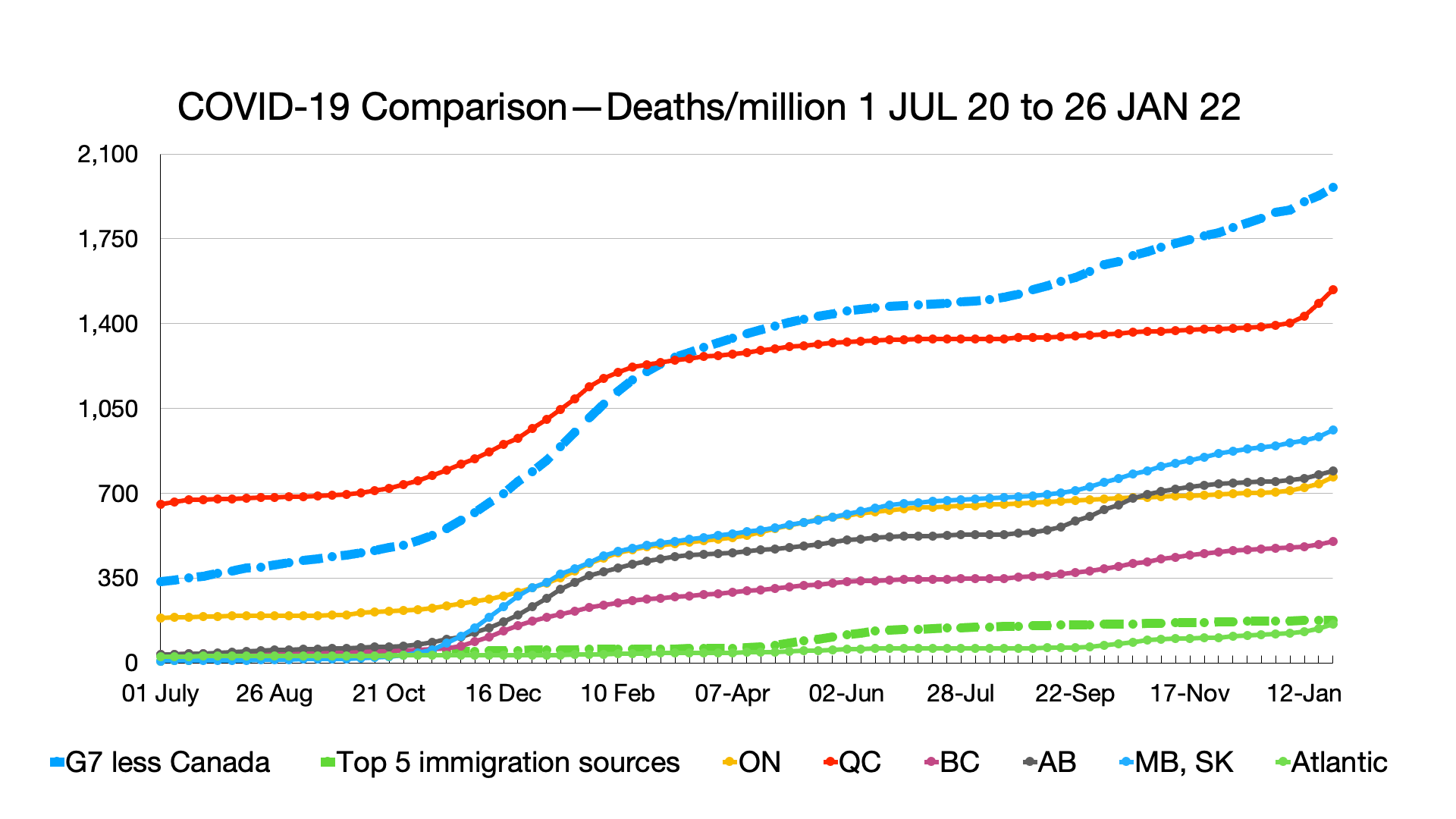
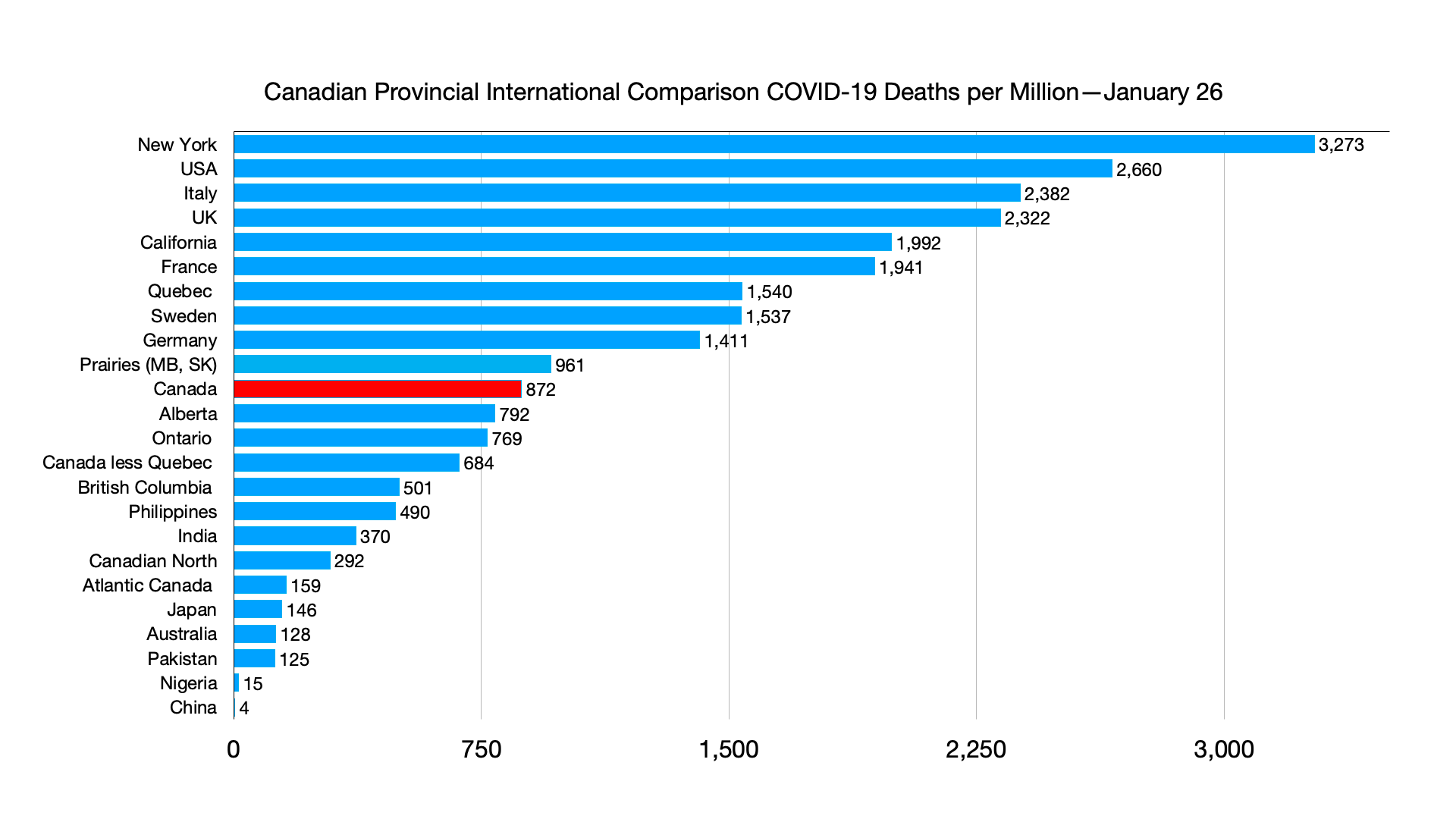
Deaths: No relative changes but Quebec uptick highly visible.
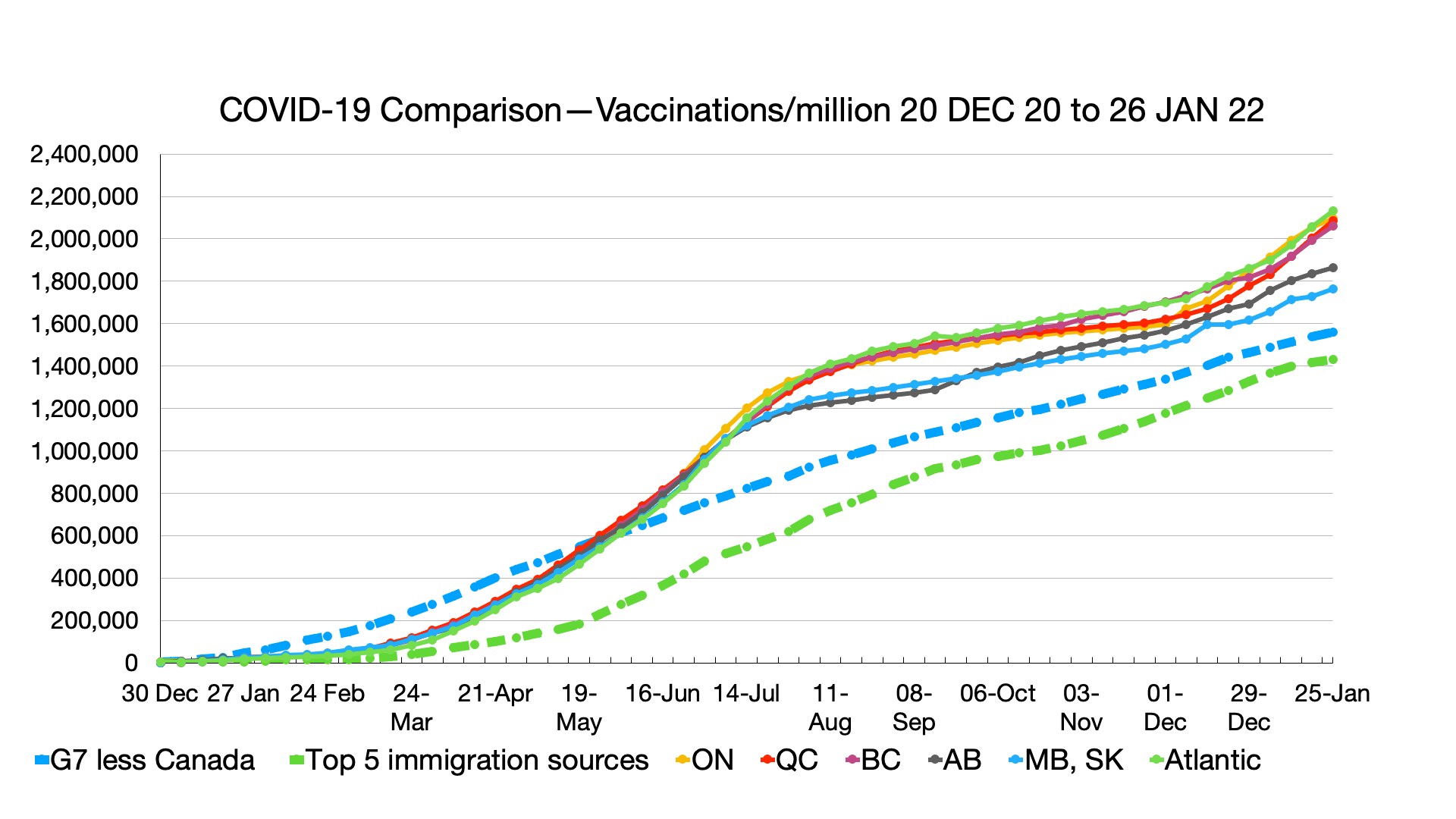
Vaccinations: Ongoing convergence among most provinces. Gap between G7 less Canada continues to grow despite overall convergence, with narrowing gap with immigration source countries save for Nigeria.
Weekly
Infections: France ahead of New York and UK, Australia ahead of Prairies, Atlantic Canada ahead of Philippines.
Deaths: Quebec ahead of Sweden, Atlantic Canada ahead of Japan, Australia ahead of Pakistan.
In a recent article in Foreign Policy, Parag Khanna of globalization experts FutureMap predicted that the Great Lockdown will be followed by the Great Migration, as the best and brightest move to exploit opportunities and fill labour shortages.
It would seem an inopportune time for the government of Canada to stop accepting applications from highly skilled workers from overseas. Yet that is exactly what the Liberals have done.
As my colleague Ryan Tumilty reported on Saturday, the high-skilled worker stream is backlogged, so despite nationwide labour shortages, the government is pausing new invitations because the department can’t process them.
The reason why Immigration, Refugees and Citizenship Canada is so backed up are entirely political.
For a variety of reasons, not least of which is that more immigration means more economic growth, the Liberals have committed to bringing in more than 400,000 permanent residents a year for the next three years.
Canada’s growth rate has been tepid in recent years, even with high levels of immigration. Absent the new arrivals, we’d be going backwards, as is clear from real GDP per capita data (in 2015, it was $51,158 per person; in 2020, it was $50,510, in constant 2012 dollars).
High levels of immigration are integral to the Liberal economic plan.
Yet those targets looked untenable during the pandemic, as international travel was suspended. Ottawa worked around the problem by granting permanent residency to thousands of temporary residents who were already employed or studying in Canada – the so-called Canada Experience Class.
The subsequent torrent of applications from students and temporary workers in Canada, coupled with the commitment to double the number of refugees coming from Afghanistan to 40,000, has resulted in bureaucratic resources becoming swamped. IRCC now has around 1.8 million applicants in a queue which is growing by about 20,000 every couple of months.
Part of the solution, according to an internal memo, is to cut the 110,500 skilled workers in the government’s target for next year by about half. The government says that there are still 76,000 skilled workers in the queue, so 2022 numbers won’t be affected. “The pause is temporary,” said a spokesperson for new immigration minister, Sean Fraser, who added that the government provided $85 million in new money to increase processing capacity.
But with around half of all businesses claiming to be experiencing labour shortages, the government has decided to meet its numerical targets, rather than focus where the needs are most pressing.
This is political meddling at its most mendacious. The government was able to boast about breaking the all-time immigration record in 2021, yet a quarter of those people were already here.
On refugees, no-one disagrees that Canada owes a duty of care to many people in Afghanistan but doubling the number of refugees from 20,000 to 40,000 will take two years to honour.
Andrew Griffith, a former director general at IRCC and author of a book on citizenship and immigration policy, said that the political choice to meet numerical targets, by allowing temporary residents to become permanent residents, meant that all other classes of immigrants became a lower priority. “It was a trade-off and, personally, I’m not convinced it was the right trade-off to make,” he said.
Griffith said the department would have warned the minister about the consequences of “bringing in the bodies” on the capacity constraints of other immigration streams. That advice appears to have been ignored.
The Liberals have so far stuck within the bounds that have traditionally governed Canada’s immigration policy, and which have ensured it has support in virtually all parties.
Immigration programs that are fair and economically-driven will continue to have widespread public support. People appreciate that we need new taxpayers to spread the burden of paying for an aging population.
In 2021, 58 percent of new immigrants were drawn from economic class programs; 26 percent from family class; and 16 percent from refugee and humanitarian class.
But the 2023 numbers may look quite different, if the number of high-skilled workers drops off dramatically and the number of refugees rises.
It has been a hallmark of this government that it has not been very effective at implementing policies, often because it is too focused on communications, and not enough on making things happen after they’ve been announced. This reflects a prime minister, who, in the words of one of his own senior members of staff, it “much more about: ‘what’s new?’”.
“He’s good at getting people super-excited, setting bold visions. But it creates real challenges in execution,” the staffer said.
This is a classic example. The “1 percent of population” immigration target probably got the inner circle “super-excited”, as, no doubt, did the 40,000 Afghan refugee promise.
But it may well be that there are consequences to those decisions which will see Canada miss out on tens of thousands of the globe’s most able engineers, heavy duty mechanics, plumbers, computer programmers, carpenters and database analysts.
And, slightly different take, from Matthew Claxton:
What with COVID-19, and winter storms bearing down, and two days left until Christmas, it’s fair to say that few of us were paying attention to Canadian immigration policy on Dec. 23.
Which is a shame, because an announcement from the Department of Immigration, Refugees, and Citizenship showed that we’ve had a quiet revolution in how Canada accepts new permanent residents.
The government announced that 2021 was a record year for the arrival of new permanent residents – in total, 401,000 people had “landed” as permanent residents. Permanent residency is a major step towards Canadian citizenship, and it’s a massive driver of our population growth.
But in that announcement was a confirmation of something that Immigration has mentioned a few times in passing during the pandemic.
More than half of the folks who officially “landed” as permanent residents were already here.
“As we continue to struggle with the pandemic, we made the most of the talent already within our borders,” the announcement said. “The majority of these new permanent residents were already in Canada on temporary status.”
Yep. We increased our population of permanent residents by moving a bunch of people from one column in a government ledger to the other!
A significant number of permanent residents have always come from the ranks of temporary residents. In 2019, 74,586 of the 341,180 new permanent residents were already here on temporary status. But that’s just 21 per cent of the total number of new permanent residents, not more than 50 per cent!
In 2020, massive disruptions in travel due to the pandemic caused immigration rates to plummet just as the federal Liberal pledge to ramp up immigration levels was supposed to be coming into effect.
In the first year of the pandemic Canada admitted just 184,500 new permanent residents barely more than half the number from the year before.
I don’t actually have any particular objection to this change as policy. Making it easier to transition from being a temporary resident to a permanent one seems only just and fair, to me. If you’re good enough to work here or go to school here, surely you’re good enough to stay.
But the federal government didn’t make this change because they wanted to change the mix of people coming to Canada and becoming permanent residents. It wasn’t based on the idea that allowing increasing temporary residents to become permanent would be good for them, or good for Canada’s economy or culture.
It was done to hit an arbitrary number. The government had pledged to bring in more than 400,000 new permanent residents. Never mind how many were already here, some of them for years.
It doesn’t speak well that the government would see people, most of whom are future Canadian citizens, as mere numbers, a target that needed to be hit to meet an arbitrary goal.
Highest level ever since 2017. Will likely become political issue again:
Whenever a bus arrives at the Greyhound station in Plattsburgh, New York, a small band of taxi drivers waits to drive passengers on a half-hour trip to a snowy, dead-end dirt road.
There, at the border with Canada, refugees pile out of taxis or vans several times a day, and Royal Canadian Mounted Police officers warn that they will be arrested for illegal entry if they cross, which they do. Most are soon released to pursue asylum, living and working freely while awaiting a decision.
“We have the hopes of everyone — be successful and have a change of life,” Alejandro Cortez, a 25-year-old Colombian man, said as he exited a taxi last week at the end of Roxham Road in Champlain, New York. The town of about 6,000 is directly across the border from Saint-Bernard-de-Lacolle, Quebec.
Cortez joins a renewed stream of migrants seeking refuge in Canada after a 20-month ban on asylum requests designed to prevent the spread of COVID-19. Families are once again lugging suitcases and carrying children across a remote, snow-covered ditch to the border.
Canada’s decision to lift the ban on Nov. 21 stands in marked contrast to the approach in the United States, where the Centers for Disease Control and Prevention has extended indefinitely a similar restriction on the border with Mexico that will enter its third year in March.
On Wednesday, a Justice Department attorney vigorously defended the ban against sharp questioning from federal appeals court judges about the scientific basis for such a far-reaching move against asylum.
The U.S. expelled migrants nearly 1.5 million times from March 2020 through November under what is known as Title 42 authority, named for a 1944 public health law that the Trump and Biden administrations have used to deny migrants a chance to seek asylum on grounds that it will curb the spread of the coronavirus. That accounts for about two of three arrests or expulsions at the border, most involving single adults and some families. Unaccompanied children have been exempt under President Joe Biden.
Fully vaccinated travelers have been able to enter the U.S. and Canada since November, but Canada went a step farther by reinstating a path to asylum.
Cortez arrived in the United States on a tourist visa five months ago. He said he couldn’t go back to Colombia because of violence and the disappearance of thousands of young men.
“All of that hurts a lot,” he said. “We have to run from our country.”
Asylum-seekers on the Canadian border began appearing at Roxham Road around the time Trump became president. How it became the favored place to cross into Canada isn’t clear, but the migrants are taking advantage of a quirk in a 2002 agreement between the U.S. and Canada that says people seeking asylum must apply in the first country they arrive in.
Migrants who go to an official crossing — like the one where Interstate 87 ends just east of Roxham Road — are returned to the United States and told to apply there. But those who arrive in Canada at a location other than a port of entry, like Roxham Road, are allowed to stay and request protection.
Nearly 60,000 people sought asylum after illegally crossing the border into Canada from February 2017 through September, many at Roxham Road, about 30 miles (50 kilometers) south of Montreal, Canadian government statistics show.
Of those, more than 45,000 claims have been finalized, with almost 24,300 approved, or almost 54%. Another 17,000 claims were rejected while over 14,000 are still pending. Other claims were abandoned or withdrawn.
In December, the number of asylum-seekers at the border in Quebec jumped to nearly 2,800. That’s up from 832 in November and 96 in October, according to the statistics.
Canada lifted the asylum ban with little fanfare or public backlash, perhaps because the numbers are small compared with people crossing into the U.S. from Mexico.
Under the ban, people from Mexico, Guatemala, Honduras and El Salvador, are bounced back to Mexico before being afforded rights under U.S. and international law to seek asylum. People from other countries are flown home without a chance at asylum.
Scientific arguments for Title 42 have met with skepticism from the start.
The Associated Press reported in 2020 that Vice President Mike Pence called CDC Director Dr. Robert Redfield in March of that year and told him to use the agency’s special legal authority to slash the number of asylum-seekers allowed into the country.
Pence made the request after a top agency doctor who oversees such orders refused to comply with the directive, saying there was no valid public health reason to issue it.
Dr. Anne Schuchat, the second-highest CDC official when she departed in May, told a congressional panel last year that “the bulk of the evidence at that time did not support this policy proposal.”
On Wednesday, Justice Department attorney Sharon Swingle insisted the ban is based on scientific expertise and prevents disease at crowded Border Patrol holding facilities. Facing persistent questioning from judges on a three-member panel in Washington, she acknowledged there were no affidavits in court records to explain the order’s scientific foundation.
Within hours of the November change by the Canadian government, immigrants started arriving in large numbers at Roxham Road, said Janet McFetridge, of Plattsburg Cares, a group that provides hats, mittens and scarves to people crossing the border in the dead of winter. She said people are eager to cross while they can.
“There definitely is a fear that it’s going to close suddenly,” she said while waiting on Roxham Road for the next group of migrants.
A Canadian officer said in French to a woman and her traveling companion, who was carrying a baby, that it was illegal to enter Canada there.
“If you cross here, you will be arrested,” he said.
“Yes, it’s not a problem. It’s not a problem,” the woman said as her companion started to pull a suitcase across the border.
There are few nurses in the Zambian capital with the skills and experience of Alex Mulumba, who works in the operating room at a critical care hospital. But he has recently learned, through a barrage of social media posts and LinkedIn solicitations, that many faraway places are eager for his expertise, too — and will pay him far more than the $415 per month (including an $8 health risk bonus) he earns now.
Mr. Mulumba, 31, is considering those options, particularly Canada, where friends of his have immigrated and quickly found work. “You have to build something with your life,” he said.
Canada is among numerous wealthy nations, including the United States and United Kingdom, that are aggressively recruitingmedical workers from the developing world to replenish a health care work force drastically depleted by the Covid-19 pandemic. The urgency and strong pull from high-income nations — including countries like Germany and Finland, which had not previously recruited health workers from abroad — has upended migration patterns and raised new questions about the ethics of recruitment from countries with weak health systems during a pandemic.
“We have absolutely seen an increase in international migration,” said Howard Catton, the chief executive of the International Council of Nurses. But, he added, “The high, high risk is that you are recruiting nurses from countries that can least afford to lose their nurses.”
About 1,000 nurses are arriving in the United States each month from African nations, the Philippines and the Caribbean, said Sinead Carbery, president of O’Grady Peyton International, an international recruiting firm. While the United States has long drawn nurses from abroad, she said demand from American health care facilities is the highest she’s seen in three decades. There are an estimated 10,000 foreign nurses with U.S. job offers on waiting lists for interviews at American embassies around the world for the required visas.
Since the middle of 2020, the number of international nurses registering to practice in the United Kingdom has swelled, “pointing toward this year being the highest in the last 30 years in terms of numbers,” said James Buchan, a senior fellow with the Health Foundation, a British charity, who advises the World Health Organization and national governments on health worker mobility.
“There are 15 nurses in my unit and half have an application in process to work abroad,” said Mike Noveda, a senior neonatal nurse in the Philippines who has been temporarily reassigned to run Covid wards in a major hospital in Manila. “In six months, they will have left.”
As the pandemic enters its third year and infections from the Omicron variant surge around the world, the shortage of health workers is a growing concern just about everywhere. As many as 180,000 have died of Covid, according to the W.H.O. Others have burned out or quit in frustration over factors such as a lack of personal protective equipment. About 20 percent in the United States have left their jobs during the pandemic. The W.H.O. has recorded strikes and other labor action by health workers in more than 80 countries in the past year — the amount that would normally be seen in a decade. In both developing countries and wealthy ones, the depletion of the health work force has come at a cost to patient care.
European and North American countries have created dedicated immigration fast-tracks for health care workers, and have expedited processes to recognize foreign qualifications.
The British government introduced a “health and care visa”program in 2020, which targets and fast tracks foreign health care workers to fill staffing vacancies. The program includes benefits such as reduced visa costs and quicker processing.
Canada has eased language requirements for residency and has expedited the process of recognizing the qualifications of foreign-trained nurses. Japan is offering a pathway to residency for temporary aged-care workers. Germany is allowing foreign-trained doctors to move directly into assistant physician positions.
In 2010, the member states of the W.H.O. adopted a Global Code of Practice on the International Recruitment of Health Personnel, driven in part by an exodus of nurses and doctors from nations in sub-Saharan Africa ravaged by AIDS. African governments expressed frustration that their universities were producing doctors and nurses educated with public funds who were being lured away to the United States and Britain as soon as they were fully trained, for salaries their home countries could never hope to match.
The code recognizes the right of individuals to migrate but calls for wealthy nations to recruit through bilateral agreements, with the involvement of the health ministry in the country of origin.
In exchange for an organized recruitment of health workers, the destination country should supply support for health care initiatives designated by the source country. Destination countries are also supposed to offer “learn and return” in which health workers with new skills return home after a period of time.
But Mr. Catton, of the international nurses organization, said that was not the current pattern. “For nurses who are recruited, there is no intention for them to go back, often quite the opposite: They want to establish themselves in another country and bring their families to join them,” he said.
Zambia has an excess of nurses, on paper — thousands of graduates of nursing schools are unemployed, although a new government has pledged to hire 11,200 health workers this year. But it is veteran nurses such as Lillian Mwape, the director of nursing at the hospital where Mr. Mulumba works, who are most sought by recruiters.
“People are leaving constantly,” said Ms. Mwape, whose inbox is flooded with emails from recruiters letting her know how quickly she can get a visa to the United States.
The net effect, she said, “is that we are handicapped.”
“It is the most-skilled nurses that we lose and you can’t replace them,” Ms. Mwape said. “Now in the I.C.U. we might have four or five trained critical-care nurses, where we should have 20. The rest are general nurses, and they can’t handle the burden of Covid.”
Dr. Brian Sampa, a general practitioner in Lusaka, recently began the language testing that is the first step to emigrate to the United Kingdom. He is the head of a doctor’s union and vividly aware of how valuable physicians are in Zambia. There are fewer than 2,000 doctors working in the public sector — on which the vast majority of people are reliant — and 5,000 doctors in the entire country, he said. That works out to one doctor per 12,000 people; the W.H.O. recommends a minimum of one per 1,000.
Twenty Zambian doctors have died of Covid. In Dr. Sampa’s last job, he was the sole doctor in a district with 80,000 people, and he often spent close to 24 hours at a time in the operating theater doing emergency surgeries, he said.
The pandemic has left him dispirited about Zambia’s health system. He described days treating critically ill Covid patients when he searched a whole hospital to find only a single C-clamp needed to run oxygenation equipment. He earns slightly less than $1000 a month.
“Obviously, there are more pros to leaving than staying,” Dr. Sampa said. “So for those of us who are staying, it is just because there are things holding us, but not because we are comfortable where we are.”
The migration of health care workers — often from low-income nations to high-income ones — was growing well before the pandemic; it had increased 60 percent in the decade to 2016, said Dr. Giorgio Cometto, an expert on health work force issues who works with the W.H.O.
The Philippines and India have deliberately overproduced nurses for years with the intention of sending them abroad to earn and send remittances; nurses from these two countries make up almost the entire work force of some Persian Gulf States. But now the Philippines is reporting shortages domestically. Mr. Noveda, the nurse in Manila, said his colleagues, exhausted by pandemic demands that have required frequent 24-hour shifts, were applying to leave in record numbers.
Yet movement across borders has been more complicated during the pandemic, and immigration processes have slowed significantly, leaving many workers, and prospective employers, in limbo.
While some countries are sincere about bilateral agreements, that isn’t the only level at which recruitment happens. “What we hear time and time again is that recruitment agencies pitch up in-country and talk directly to the nurses offering very attractive packages,” Mr. Catton said.
The United Kingdom has a “red list” of countries with fragile health systems from which it won’t recruit for its National Health Service. But some health workers get around that by entering Britain first with a placement through an agency that staffs private nursing homes, for example. Then, once they are established in Britain, they move over to the N.H.S., which pays better.
Michael Clemens, an expert on international migration from developing countries at the Center for Global Development in Washington, said the growing alarm about outflows of health workers from developing countries risks ignoring the rights of individuals.
“Offering someone a life-changing career opportunity for themselves, something that can make a huge difference to their kids, is not an ethical crime,” he said. “It is an action with complex consequences.”
The United Kingdom went into the pandemic with one in 10 nurse jobs vacant. Mr. Catton said it some countries are making overseas recruitment a core part of their staffing strategies, and not just using it as a pandemic stopgap. If that’s the plan, he said, then recruiting countries must more assiduously monitor the impact on the source country and calculate the cost being borne by the country that trains those nurses.
Alex Mulumba, the Zambian operating room nurse, says that if he goes to Canada, he won’t stay permanently, just five or six years to save up some money. He won’t bring his family with him, because he wants to keep his ties to home.
“This is my country, and I have to try to do something about it,” he said.
Overly harsh on IRCC staff and under-estimating the issues and processes involved but valid critique of the pace of bringing them to Canada in a more timely manner. Risks feeding the “over-promise, under-deliver” government narrative:
I suspect being a senior immigration official is only marginally less boring than being a night watchman, and that might sour their view of the world. Nonetheless, on three continents over several decades it has been my experience that those who control the visa stamps are all conditioned to find a way to say “No,” or “Later,” or “We’ll get back to you” — and then don’t. Ours are no different.
A young relative of mine was denied entry into Canada, after an especially obnoxious senior Canadian immigration official declared to her mother that they were not convinced that this was a “sincere adoption” — the staggering assumption being, I suppose, that the new mother would sell her beloved infant on arriving in Canada. Serious political pressure was required to reverse the insulting judgment. Plenty of Canadians have similarly awful stories to tell.
This is the reality that too many terrified Afghan refugees are facing today. The Taliban threaten their lives and their families constantly; Canadian NGOs desperately struggle to find paths out for them; and our senior immigration officials are unresponsive or unreachable. This too will require serious political pressure to fix, from the prime minister.
The parallel with Syria is quite plain. There, our immigration officials also tried their usual delaying devices until two very determined ministers, supported by PM Justin Trudeau, said, “Enough! Get this done.” Thousands of Syrians were quickly welcomed to Canada. Though the Syrians were fleeing a war zone, the risks the Afghans face are far more specific, urgent and life-threatening.
A favourite blocage used today is, of course, national security. As in “Yes Minister,” a Canadian Sir Humphrey might ooze, “Well, minister, that would be very courageous, questioning the advice of our national security advisers. Highly politically risky, but courageous, ma’am!” I was not aware that we have had a rash of terrorist attacks in the six years since thousands of Syrians built new lives for their families here.
We had little previous knowledge of many of the Syrians we admitted then. But many of the Afghans desperate to be rescued from tyranny now are men and women who put their lives at risk assisting Canadian soldiers, diplomats, journalists and NGOs. Hundreds of Canadians know these Afghan families personally.
It is especially embarrassing that we promised safe havens to 40,000 Afghans and have admitted fewer than 7,000. The United States, who have not outranked us in our welcome for immigrants and refugees for many, many years, have admitted over 10 times as many.
At this rate of foot-dragging — fewer than 50 refugees per day — we will be approaching the end of 2023 before we have kept our promise. By then, many of these desperate families will have been tortured and killed. Are we really willing to risk the humiliation and international opprobrium of having their blood on our hands?
The government has a very clear policy path forward before it — a plan that has been internally vetted, and endorsed by the many Canadian veterans’ organizations and other NGOs struggling to keep the faith. The policy framework describes in some detail how to remove, or avoid, the several bizarre policy roadblocks that have been placed in refugees’ way.
When cabinet next meets, let us hope that Trudeau turns to his colleagues and says, as he did in 2015 on Syria only days after being elected, “Get this done!” What an uncontestable political triumph it would be.
And what a huge morale booster for Canadians, as we plod our way through this increasingly brutal winter and the frustrations of a virus we must still fight daily. Imagine the sight of exhausted but ecstatic Afghans, falling into the arms of their waiting families, friends and Canadian sponsors, overseen at airports by the prime minister and other leaders. Imagine as well, how proud we would be to have once again shown leadership on refugees to the world.
Money quote: “These reductions are due to admissions space required to accommodate the TR2PR [Temporary to Permanent Resident] stream and the resettlement of Afghan nationals to Canada.”
The former was a policy choice in order to meet the government’s fixation on meeting its target of 401,000; the latter reflected lack of foresight, common to many countries, and thus the need to deal with the crisis:
Canada’s immigration system for high-skilled workers is severely backlogged and even amidst a labour shortage, the government is pausing new invitations because the department simply can’t process them quickly enough, according to a briefing document.
Immigration lawyer Steven Meurrens obtained the document through access to information and provided it to the National Post. In the memo, department officials outline that “an estimated 76,000” applicants are in the inventory for federal high-skilled worker applications, which is more than what the government needs to meet targets all the way out to 2023.
The same memo says the express entry pool, which includes skilled workers, skilled trades and people with experience living in Canada, has more than 207,000 people in it.
Canada’s immigration plan has a variety of different classes, including skilled workers, provincial nominees, family reunification and refugees. The government has continued to process applicants nominated by the provinces, but other economic immigrants have been stalled since last fall.
People applying through the high skilled worker and trades program submit a variety of documents including a language test and then wait for an invitation to finish their application before it is processed.
With travel bans in place, high-skilled worker applications from overseas have been on pause since September 2021. Last year, the government still managed to hit its record-high immigration targets, but did so mostly by inviting people already in Canada on temporary permits or as students to become permanent residents through a new temporary resident to permanent resident program (TR2PR).
The government’s current immigration plan forecasts bringing in 110,500 skilled workers next year, but the department says in a memo that could have to be cut by as much as half, because the department has so much other work.
“These reductions are due to admissions space required to accommodate the TR2PR stream and the resettlement of Afghan nationals to Canada,” reads the memo.
The Liberals initially pledged to bring 20,000 Afghans to Canada, but during the fall campaign doubled the pledge to 40,000. As of the most recent update 7,000 of them have arrived in Canada.
A new departmental immigration plan will be tabled in Parliament when the House of Commons resumes in February.
The department aims for a six-month processing time for federal skilled workers (FSW), but in the memo they warned that could rise dramatically.
“Processing times are currently at 20.4 months (over three times higher than the service standard) and are expected to continue to grow as older inventory is processed. The FSW processing time is expected to rise to 36 months throughout 2022.”
Immigration Minister Sean Fraser was not available for an interview, but Rémi Larivière, a spokeswoman for the department, said the government will still bring in highly skilled workers, because so many are already in the queue.
“The already existing robust inventory of skilled candidates to process means that there won’t be a reduction in 2022 of the number of new skilled permanent residents arriving in Canada to work and settle,” she said in an email. “This pause is temporary; invitations to apply under the FHS streams will resume once the processing inventory is reduced enough to create space for new intake.”
Larivière said the fall fiscal update included measures to help reduce the backlog.
“The Government of Canada has proposed to provide $85 million in 2022-23 so it can process more permanent and temporary resident applications and reduce processing times in key areas affected by the pandemic.”
Conservative MP Jasraj Singh Hallan, the party’s immigration critic, said the delays are unacceptable.
“The massive backlog the Liberal government has created at Immigration, Refugees and Citizenship Canada is not only hurting hard-working newcomers, families, immigrants and business owners, it also threatens billions of dollars of much-needed economic growth in Canada,” he said in a statement.
He said employers need workers and the government has to act quickly.
“Immigrants and Canadian employers cannot wait three years to have Federal Skilled Worker applications processed. It’s time for the Liberals to announce a precise date for when the pause on processing federal skilled worker invitations will come to an end.”
A Business Development Bank of Canada study from last fall found 55 per cent of Canadian businesses were dealing with labour shortages. They found that number was as high as 80 per cent in hospitality type businesses.
Potential immigrants to Canada are scored based on their level of education, language proficiency and other measures under the government’s Comprehensive Ranking System. The memo outlines that with the current state of applications someone would need a score over 500.
Betsy Kane, an Ottawa Immigration lawyer, said that is a very high score.
“What that’s going to mean is basically a young couple with very high education for both applicant and the person concerned, potentially only with executive-type job offers,” she said. “What it’s telling you is that only basically power couples are going to be who’s going to benefit from the 500-plus scores.”
Kane said with this backlog there are also going to be a lot of people on work or study permits who will need extensions because their application hasn’t been processed.
The federal Liberals have set targets to bring in more than 400,000 immigrants a year. Kane said they need more than lofty goals.
”The department has the capacity to do it. It just needs tools.”
She said that should include getting people back into the office to process applications, many of which come in on paper.
“This department is an essential service just like Canada Revenue Agency and just like the Canada Border Services Agency,” she said. “These guys should be back in the office.”
Sergio Karas, a Toronto immigration lawyer, said the department also has to start focusing more on what Canada’s employers need.
“I don’t think it’s a matter of adding personnel. I think it’s a matter of realigning priorities, and reassigning personnel to process the type of applications that the Canadian economy requires,” he said. “Employers are desperate for skilled trades for people who are highly skilled typically in the construction industry.”
Although a European study, likely more broadly applicable to Canada and other countries, something that advocates of current and higher levels of immigration to Canada understate or ignore:
Up to a third of job roles in Europe could be made redundant by automation over the next 20 years as companies battle to increase productivity and fill skills gaps created by an ageing population, according to Forrester.
The tech analyst’s latest Future of Jobs Forecast estimates that as many as 12 million jobs could be lost to automation across Europe by 2040, primarily impacting workers in industries such as retail, food services, and leisure and hospitality.
Mid-skill labour jobs that consist of simple, routine tasks are most at risk from automation, the report said.These roles make up 38% of the workforce in Germany, 34% of the workforce in France, and 31% of the workforce in the UK.
In total, 49 million jobs in ‘Europe-5’ (France, Germany, Italy, Spain, and the UK) could potentially be automated, according to Forrester. This jeopardizes casual work, such as zero-hour contracts in the UK, and low-paid, part-time jobs where workers hold “little bargaining power”.
A combination of pressures is prompting businesses to ramp up their investments in automation, particularly in countries where industry, construction and agriculture are big business.
While small and medium enterprises (SMEs) with up to 50 workers capture two-thirds of European employment, their productivity lags that of larger corporations, according to Forrester. In manufacturing, for example, ‘microenterprises’ are 40% less productive than large companies.
A five-year study of robot adoption at French manufacturing firms found that robots lowered production overheads by reducing labor costs by between 4% and 6%.
Business leaders also see automation technology as a means of filling the gaps created by Europe’s ageing population, which Forrester describes as “a demographic time bomb.” By 2050, Europe will have 30 million fewer people of working age than in 2020, the analyst said.
Productivity lost to the pandemic is seeing organizations look to machine processes to recoup efficiency, while industries that were already using automation to grow their revenues have invested even more heavily in the technology to increase service delivery and mitigate pandemic restrictions.
“Lost productivity due to COVID-19 is forcing companies globally to automate manual processes and improve remote work,” said Michael O’Grady, principal forecast analyst at Forrester.
“European organisations are also in a particularly strong position to embrace automation because of Europe’s declining working-age population and the high number of routine, low-skilled jobs that can be easily automated.”
While many low-skilled and routine roles face being replaced by machine processes, nine million new jobs are forecast to be created in Europe by 2040 in emerging sectors like green energy and smart cities, Forrester said.
This means that, all told, only three million jobs will truly be ‘lost’ to automation by 2040 – the caveat being that people who lose jobs may not find new ones.
Business leaders outside of Europe are also exploring the role of automation in bridging skills shortages and speeding up processes in the enterprise.
Polling of 500 C-suite executives and senior management personnel by automation platform UIPath found that 78% were likely to increase their investment in automation tools to help them address labor shortages. Business leaders are turning to automation because they are struggling to find new talent (74%).
At the same time, 85% of survey respondents said incorporating automation and automation training into their organization would help them attract new talent and hold onto existing staff. Meanwhile, leaders said automation was already helping them to save time (71%), improve productivity (63%) and save money (59%).
Academic forecasts of jobs that could be lost to automation vary wildly. The European Parliament’s 2021 ‘Digital automation and the future of work’ report found that estimates varied from as little as 9% to almost half (47%).
“Machine-learning experts often drive this uncertainty,” said Forrester.
“They imagine future computer capabilities without understanding enterprise technology adoption constraints and the cultural barriers within an organization that resist change.”
Of note given likely impact on relative attractiveness of Canada compared to USA but degree not known:
Although Donald Trump said he favored “merit-based” immigration, his policy team never seemed to find high-skilled foreign nationals it wanted to let work in the United States. In contrast, the Biden administration has proposed new policies that take the opposite approach.
Announced January 21, 2022, the new Biden policies can be divided into four general areas. Each holds the potential for making America more welcoming for talented foreign-born individuals at a time when human capital and innovation have never been more valuable to a nation.
Improved National Interest Waivers For Employment-Based Immigrants: As reported earlier in an article previewing immigration in 2022, new guidance for “National Interest Waivers” in the employment-based second preference could be a significant improvement for many immigrants. “The USCIS [U.S. Citizenship and Immigration Services] policy update clarifies how the national interest waiver can be used for persons with advanced degrees in STEM [science, technology, engineering and math] fields and entrepreneurs, as well as the significance of letters from governmental and quasi-governmental entities,” according to a Biden administration fact sheet describing the new policies. “This update will promote efficient and effective benefit processing as USCIS reviews requests for national interest waivers.”
The new guidance could expand the use of national interest waivers for immigrant entrepreneurs and potentially for a broader range of highly skilled individuals with expertise in science, engineering and other fields. The narrow interpretation in current USCIS guidance has frustrated immigrants since using such waivers allows foreign nationals to “self-petition.” That means (per USCIS) “they do not need an employer to sponsor them.” National interest waivers can also be a relief from the Department of Labor’s lengthy labor certification process.
Updating O-1A Visas: “O-1A [are for] individuals with an extraordinary ability in the sciences, education, business, or athletics (not including the arts, motion pictures or television industry),” according to USCIS. However, in the past, USCIS has adopted a narrow view of who is eligible for the visas. A Biden administration official said on background the new policy is expected to expand significantly the eligibility for O-1A visas in STEM fields. (See here for the USCIS policy manual update on O-1A visas.)
“In this update, the Department of Homeland Security (DHS) is clarifying how it determines eligibility for immigrants of extraordinary abilities, such as Ph.D. holders, in the science, technology, engineering, or math (STEM) fields,” according to the fact sheet. “The new update provides examples of evidence that may satisfy the O-1A evidentiary criteria and discusses considerations that are relevant to evaluating such evidence, with a focus on the highly technical nature of STEM fields and the complexity of the evidence often submitted.”
Dan Berger of Curran, Berger & Kludt thinks the new O-1A guidance will be helpful. “O-1 visas had become more difficult to obtain,” he said in an interview. “New guidance is helpful to clarify how the statutory criteria apply to STEM fields and the modern world. Many of the criteria were written before the internet age.”
Expanding Eligibility For STEM OPT: As discussed here, the Biden administration has expanded eligibility for STEM Optional Practical Training (OPT), which allows international students to gain practical experience for 12 months and an additional 24 months in a STEM field. Many international students would not come to America without OPT and the ability to work in their field, including the potential later to obtain H-1B status and an employment-based green card.
In a Federal Register notice (January 21, 2022), the Department of Homeland Security (DHS) announced, “The Secretary of Homeland Security is amending the DHS STEM Designated Degree Program List [for OPT] by adding 22 qualifying fields of study.” The fields include Cloud Computing, Anthrozoology, Climate Science, Mathematical Economics, Business Analytics, Data Visualization, Financial Analytics and others. (More details are available in the Federal Register notice.)
Expanded Programs For J-1 Exchange Visitors: The Biden administration has also proposed two expansions in the use of J-1 visas that may represent new routes to America for individuals in STEM fields. “The U.S. Department of State’s Bureau of Educational and Cultural Affairs (ECA) is announcing an ‘Early Career STEM Research Initiative,’ to facilitate non-immigrant BridgeUSA exchange visitors coming to the United States to engage in STEM research through research, training or educational exchange visitor programs with host organizations, including businesses,” according to the administration’s fact sheet. “ECA is also announcing new guidance that will facilitate additional academic training for undergraduate and graduate students in STEM fields on the J-1 visa for periods of up to 36 months.”
Without reviewing text on the new J-1 policies, Lynden Melmed, a partner at Berry Appleman & Leiden and former chief counsel for USCIS, said the changes could be quite positive. He also views the other policy proposals favorably.
“Immigration is often about fitting square pegs into round holes, and that won’t ever change,” he said in an interview. “But over the years, the policy guidance and procedures have become so inflexible that we risk losing employees who are working in developing fields critical to national security. The guidance on O-1 visas and foreign students restores some sanity to the process.”
“Expanding the number of STEM fields is long overdue and very welcome,” he said. “DHS took a careful approach when it first issued the STEM list. Today’s announcement is key because it signals the government will try to keep up with the rapidly changing academic environment.”
Statistics on international students help illustrate why the Biden approach aimed at attracting international students makes more sense than the Trump administration’s restrictive policies. “At U.S. universities, foreign nationals account for 82% of the full-time graduate students in petroleum engineering, 74% in electrical engineering, 72% in computer and information sciences, 71% in industrial and manufacturing engineering, 70% in statistics” and over 50% in many other fields, according to a National Foundation for American Policy analysis. “At many U.S. universities, the data show it would be difficult to maintain important graduate programs without international students.”
The State Department and U.S. Citizenship and Immigration Services still need to improve processing, and Congress must enact many immigration reforms. Notable reforms would include increasing the number of employment-based green cards and H-1B visas and eliminating the per-country limit for employer-sponsored immigrants.
It is easy to forget the Trump administration’s generally hostile policies toward foreign-born scientists and engineers. In 2020, Donald Trump blocked the entry to the United States of employment-based immigrants and H-1B visa holders via proclamations, and it took unfavorable court rulings on H-1B visas for USCIS finally to end four years of restrictive immigration policies against employers. Should the same policy team return to the White House in 2025, the goal on foreign talent likely won’t be to shut the barn door tighter but to dismantle the barn and close down the farm.
The Biden administration sees international education and innovation much differently from its predecessor, and the context from which these new policies have been proposed is clear. America is viewed as losing ground to China and other countries in the battle for talent. The latest proposals show the U.S. government is now attempting to join this battle and encourage talented foreign-born scientists and engineers to become part of the U.S. economy and the nation.