France’s ‘beautiful notion’ of secularism is not a model for Quebec – The Globe and Mail

Jack Jedwab of the Association of Canadian Studies on the empirical evidence on France’s secular model. Confirms other analysis, news reports, and general knowledge:

Unfortunately for Ms. Marois and Mr. Moscovici, the evidence on the French model points to a very different conclusion. Surveys conducted in June, 2012, by Eurobarometer (the polling arm of the European Commission) put France on top of the list amongst the 27 countries of the European Union as regards the extent to which its own population feel there is discrimination in society based on religion or beliefs. Two in three French citizens surveyed see such discrimination as widespread compared with half of the U.K. population. As regards discrimination outside the workplace on the basis of religion or beliefs France (55 per cent) records the highest percentage in the EU of people feeling it is widespread. France doesn’t do much better around the perception of ethnic discrimination outside the workplace with yet another EU record 76 per cent seeing it as widespread.

France’s ‘beautiful notion’ of secularism is not a model for Quebec – The Globe and Mail.

Quebec Muslims facing more abuse since charter proposal and other Charter-related articles

Not surprising, that Quebec Muslims are reporting more abuse following the proposed Charter. Playing identity politics invites that. It will be interesting to see if these anecdotes of increased abuse show up in the official Stats Canada Police-reported hate crime in Canada, 2011 (there is always a time lag), as police-reporting is a higher threshold and allows more consistency among groups.

Quebec Muslims facing more abuse since charter proposal, women’s groups say – The Globe and Mail.

Femmes voilées: «augmentation dramatique» des agressions

And signals from the Quebec government that no exceptions to the proposed Charter will be allowed, whether for Montreal, universities or the health sector:

Charte: Québec songe à abolir le droit de retrait

Some interesting commentary today, starting with Humera Jabir, a law student at McGill, noting her own history of considering the hijab as a political symbol as much as a demonstration of her faith, and in the end stopped wearing the hijab, given that her spiritual grounding was not strong enough:

Quebec is wrong to treat the hijab as a political tool

Michelle Gagnon of CBC notes some of the paradoxes of the proposed Charter with respect to Catholicism  (of which there are many). A good illustration of yet another government being driven by the politics of the anecdote, rather than sound evidence, and I pity the public servants that had to provide “fearless advice” as the government proceeded down this path. Would love to see the briefing notes!

Is Quebec more Catholic than it likes to think?

How Marois made a prophet out of Pierre Trudeau and other Charter articles

A round-up of Charter-related articles, starting with Paul Adams reminding us of the blind end of ethnic and identity politics:

…. progressives are reluctant to give Stephen Harper credit for much of anything. But one bit of data in a recent Ipsos Reid poll has startling implications: the Conservatives are in a comfortable first place among foreign-born Canadians.

I defy you to find another developed country where a conservative party — and one with a populist past to boot — can claim such an achievement.

Whether it was moral insight or political advantage that led Harper to turn his back on the Reform Party’s red streak of xenophobia doesn’t really matter. He made a choice that was immensely important to that young woman in the supermarket, whether we wish to acknowledge it or not.

Marois and Drainville have made a different choice. And they’ve made a prophet of Pierre Trudeau, the man who predicted Quebec’s political nationalism would lead inevitably to an ethnic dead end.

How Marois made a prophet out of Pierre Trudeau | iPolitics.

And good commentary from Emmett Macfarlane of University of Waterloo, noting that judges also have an ideology and biases, similar to the arguments I make in Policy Arrogance or Innocent Bias: Resetting Citizenship and Multiculturalism with respect to public servants:

It is a myth Ms. L’Heureux-Dubé herself helped propagate when she was interviewed before the House of Commons standing committee on justice in 2004, which was examining reform to the Supreme Court appointments process. Asked about the role ideology might play in judging, L’Heureux-Dubé stated: “We talk about ideology, but very few of us [judges] have any. You may not perceive that, but we look at a case by first reading and knowing the facts and then reading the briefs, and then we make up our minds.”

A generous interpretation of these comments would not take them as literal – everyone has an ideology, it is what allows us to make sense of the world around us – but rather as a suggestion that judges can simply separate themselves from ideology and apply the law (as a thing somehow autonomous from politics) in an objective fashion. But would anyone seriously believe that if Ms. L’Heureux-Dubé were on the Court today she would refrain from upholding the Quebec Values Charter as constitutional?

It sometimes appears that judges would like to have their constitutional cake and eat it too. By supporting the notion that courts can reach the “correct” answer on where broad constitutional phrases like “freedom of expression” begin and end – often settling controversies about which reasonable people might reasonably disagree – by somehow detaching themselves from their political ideology, we are presented with a caricature of judges as infallible oracles.

 Secular Charter case shows Supreme Court judges can be ideological – and wrong

And some general updates on the debates and discussion in Quebec, starting with hospitals wanting a general exception:

Charte des valeurs: les hôpitaux veulent une exemption

Lysiane Gagnon noting how the proposed Charter has created a feminist rift between radical and liberal feminists:

In Quebec, a feminist rift over secularism

Gerry Weiner, former multiculturalism minister during the Mulroney government who negotiated the Japanese Canadian redress agreement and led the development of the Canadian Multiculturalism Act, is harshly critical of the proposed Charter:

“In the name of separation of church and state, the charter presents the government with a way to abandon the previous policy of tolerance and respect for minority communities that has been an integral part of Quebec for many decades.

“Instead the charter proposes a policy of uniformity, a policy of enforced assimilation, and a contempt for minority values—vilifying them as outsiders and not a part of the real Quebec,” he told his audience who during WW II were vilified and interned in war camps as being dangerous outsiders, where not a shred of intelligence justified such an action.

He noted that he is worried that this is a policy that will divide the province, “that it could strip away decades of building a caring society, of returning us to the Quebec of my youth filled with hate, discrimination, and indifference.  It had taken many decades to become what we are today, with a wonderful quality of life.”

Weiner says Quebec charter to break up Canada

PQ asked to release public input on values charter

As always, governments are less transparent about public input than desired, maintaining the power of the summary or synthesis to shape the debate.

PQ asked to release public input on values charter – Need to know – Macleans.ca.

Consultation sur la Charte – Drainville dévoilera une synthèse des opinions

And a good opinion piece by Diane Lamoureux, of Université de Laval, arguing against the approach of the proposed Charter from both a rights and values perspective:

Le premier est celui de l’égalité des citoyennes et citoyens. Celle-ci est assurée, entre autres, par la neutralité religieuse de l’État, mais aussi par l’ouverture des emplois et des charges publics à toutes et à tous, sans distinction autre que le fait de posséder les qualifications professionnelles nécessaires à l’exercice d’un emploi. Faire porter uniquement aux personnes qui travaillent dans l’appareil d’État (défini de manière très extensive puisqu’il inclut les CPE privés subventionnés) le poids de la neutralité religieuse de l’État représente un fardeau indu pour l’ensemble des citoyennes et citoyens, pas seulement pour ceux et celles qui arborent des signes religieux visibles. Dans les sociétés contemporaines, l’égalité implique également l’inclusion et non l’isolement de certaines ou certains dans des ghettos religieux ou «communautaires».

Le deuxième est celui de la liberté. C’est un grand acquis des sociétés modernes que la façon dont les gens se vêtent ne soit pas fixée par la législation. N’oublions pas qu’il n’y a pas si longtemps, on interdisait aux femmes le pantalon. Certaines et certains peuvent être choqués par la façon dont d’autres s’habillent, mais il ne devrait pas relever de l’État de dicter la tenue vestimentaire à adopter. Seules quelques fonctions requièrent un uniforme et le port de celui-ci devrait se limiter au temps de travail. La liberté ne donne aucun droit à opprimer les minorités et le degré de liberté d’une société se mesure à la liberté dont jouissent ceux et celles qui diffèrent de l’opinion majoritaire.

Le troisième principe est celui de la solidarité. Nous ne sommes pas une communauté, nous sommes une société, traversée par une multiplicité d’intérêts et de sujets d’accord et de désaccord. Faire société implique des modes de civilité, un respect mutuel et une volonté d’inclusion. Dans un territoire où l’apport de l’immigration est si important, ce n’est pas tant le passé que nous partageons que l’avenir que nous pouvons construire ensemble. C’est en se côtoyant et non en s’excluant que nous pourrons déterminer ensemble cet avenir.

La Charte ou le triomphe de l’ersatz

And a reminder, from Norman Paradis, in Le Devoir, that all religions, have their fundamentalist streams, which tend to focus on family law, personal status, sexual and reproductive rights, with a disproportionate impact on women:

La montée des fondamentalismes, enjeu oublié du présent débat

‘Wear hijabs in and out of class’: Pupils at state Islam school become the first to be forced to cover up with Muslim headscarf | Mail Online

The debate in the UK on state schools with dress codes, in and out of school. Lacking in the article is a comparison with other faith-based state schools, and their dress codes (e.g., Catholic, Jewish, Sikh etc), and how they are applied.

Quebec, ironically, also provides state financing to faith-based schools, despite it ongoing focus on secularism.

A reminder that providing financing can reinforce parallel communities and reduce opportunities for integration.

‘Wear hijabs in and out of class’: Pupils at state Islam school become the first to be forced to cover up with Muslim headscarf | Mail Online.

Québec écarte le Comité sur les affaires religieuses

More evidence on how governments can marginalize views or organizations that they do not agree with. Removal of some of the checks and balances helpful to a democratic society, even if they complicate things for government.

Québec écarte le Comité sur les affaires religieuses | TOMMY CHOUINARD | Politique québécoise.

Charte des valeurs québécoises – Le CSF a peut-être perdu toute crédibilité pour s’exprimer

And lastly, and surprisingly at least to me, a former Supreme Court Justice appears to be coming down in favour of the Charter:

Ex-Supreme Court judge expected to back Quebec values charter

Quebec minister in hot seat over charter of values – Montreal – CBC News

Missed this debate between the Minister in charge of selling the Charter, and the philosopher and academic, Gérard Bouchard, who actually has thought considerably about these issues during his long career and his work on the Bouchard-Taylor commission. Quote:

“We took a meticulous look at the practice of accommodations and concluded it was going well,” he said. “You launched yourself into this operation in ignorance of the reality.”

Bouchard repeatedly asked Drainville what studies the government had done to determine that there was a need to restrict its employees’ religious freedoms.

Drainville replied that he had heard from “representatives of teachers, school boards, people working in the health sector” and other employers who didn’t know how to deal with their workers’ requests for religious accommodations and who implored the province to bring in limits.

Quebec minister in hot seat over charter of values – Montreal – CBC News.

In other words, anecdote, not evidence.

And naturally enough, the “battle” of the demonstrations starts (smaller than the one the previous week protesting the Charter):

Manifestation en faveur de la Charte des valeurs à Montréal

And a nuanced analysis of what makes Muslim Canadians wear the hijab, noting the wide variety of practices and beliefs within the community, and that wearing a hijab does not mean that it has been forced by male relatives. Quote:

D’une génération à l’autre, l’islam est souvent vécu de façon différente. « Certaines femmes [plus âgées] ont porté le voile par tradition. Les jeunes sont beaucoup plus dans une recherche spirituelle. On s’approprie la religion et on en fait quelque chose d’individuel. »

Port du voile – Les motifs derrière les apparences

Values Charter: Sovereignists, Amnesty Intl, France

Quiet day. Reflecting the divisions among the sovereignists, those in favour of the Charter are planning their strategy, and aim a cheap shot at Gérard Bouchard:

Des souverainistes pro-Charte se rassemblent à Montréal | Hugo Pilon-Larose | Politique québécoise.

Meanwhile, back to reality with Amnesty International’s public position noting that the proposed Charter limits the fundamental rights of freedom of expression and freedom of religion:

Amnesty International slams Quebec charter for limiting ‘fundamental rights’

And lastly, a good analysis in the Globe about France’s experience with its laicisme approach, including the latest Charter of Secularism at school. The original decision to ban the veil at government schools was subject of considerable discussion and reflection; and was grounded in fears that there was a fair amount of compulsion for teenage girls to wear the hijab (not voluntary). But as these measures are imposed, people opt-out of the government schools, undermining the policy objective of inclusion.

How the French promotion of secularism offers a cautionary lesson for Quebec 

Reaction to Quebec’s values charter

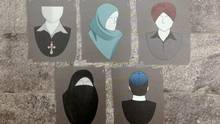
Charte symbolsSo the draft Charte is out with few surprises. Lots of reaction. Starting with what’s in and what’s out:

Would

Bar public sector employees — including everyone from civil servants to teachers, provincial court judges, daycare workers, police, health-care personnel, municipal employees and university staff — from wearing a hijab, turban, kippa, large visible crucifix or other “ostentatious” religious symbols while on the job.

Allow five-year opt-outs from the ban for certain organizations, but not daycare workers or elementary school teachers.

Require that those receiving or providing government services uncover their faces.

Exempt elected members of the Quebec legislature from the regulations.

Amend Quebec’s human rights legislation, the Charter of Human Rights and Freedoms, to specify limits on when someone can stake a claim for religious accommodation.

Wouldn’t

Remove religious symbols and elements considered “emblematic of Quebec’s cultural heritage.” That includes: the crucifixes in the Quebec legislature and atop Mount Royal in Montreal, the thousands of religiously based geographic names (e.g. Saint-Louis-du-Ha! Ha!) and the names of schools and hospitals.

Ban public sector employees from wearing small religious symbols like a ring with a Star of David, earrings with the Muslim crescent or a necklace with a small crucifix.

Eliminate subsidies to religious private schools. The Quebec government currently funds about 60 per cent of the budgets of most of the province’s private schools, including parochial ones.

Ban opening prayers at municipal council meetings, which was recommended by the 2008 Bouchard-Taylor Commission report into cultural accommodation. The Quebec Court of Appeal ruled in May that such prayers do not necessarily violate Quebec’s current human rights legislation.

Eliminate property tax exemptions for churches, mosques, synagogues and other religious buildings.

In other words, some of the deeper aspects of multiculturalism, deeper than the rest of Canada, and arguably less integrative like subsidies for religious schools, would remain, while imposing restrictions on public service employees. And will we have a ‘sartorial’ police measuring the size of ‘discrete’ or small religious symbols?

5 things Quebec’s values charter would do, and 5 it wouldn’t – Montreal – CBC News.

Quebec reveals religious symbols to be banned from public sector

Five key consequences of Quebec’s planned Charter of Values

Reaction in Quebec to the proposal is mixed. While Minister Drainville continues to say with a straight face that the Charte aims at harmony, others disagree, particularly in Montreal, where most of the communities live and work together:

Une Charte au nom de l’harmonie, selon Drainville

Signes religieux: la Charte se bute à un écueil

Mairie de Montréal : unanimité contre la charte des valeurs

Signes religieux – Québec fait fausse route, dit la Fédération des femmes

Charte des valeurs québécoises – Réactions mitigées sur la scène politique provinciale

«C’est une Charte contre les femmes»

Federal politicians have pronounced strongly against the proposed Charte. Particularly striking – and courageous given Quebec politics – that both federal leaders from Quebec, Justin Trudeau of the Liberals, and Tom Mulcair, Leader of the Official Opposition and NDP, have been unequivocal in their defence of human rights and freedoms, as has been Minister for Multiculturalism and Economic and Social Development Jason Kenney, speaking on behalf of the government, although as some have noted, he was less expansive than usual.

Given the Ottawa-Quebec dynamics, and the desire by the PQ to play politique identitaire, this may fit into their game plan to create a wedge issue. But irresponsible politics at best.

How Kenney, Mulcair and Trudeau took on Quebec’s charter of values

Tories gear up for constitutional fight as parties unite against PQ’s charter

Le prix de ses principes

NDP Leader Tom Mulcair denounces Quebec’s proposed charter of values

Some other reaction and analysis in English Canada:

De-valued promises in Quebec

Controversial Quebec charter exemptions based on idea that some religious symbols have become purely secular

Charter of Values hints that Quebec having second thoughts over mad dash for immigrants

And an opinion piece in Le Devoir in favour of laicité:

La laïcité, enfin!

And unfortunately behind Le Devoir’s firewall, an opinion piece by Gérard Bouchard, one of the co-authors of the Bouchard-Taylor report, and one of the more thoughtful thinkers on multiculturalism and interculturalisme around. Interview below:

Le sociologue Gérard Bouchard, professeur à l’Université du Québec à Chicoutimi, a codirigé avec le philosophe Charles Taylor de l’Université McGill la Commission de consultation sur les pratiques d’accommodements reliées aux différences culturelles, en 2007-2008. Il juge sévèrement la proposition du gouvernement défendue par le ministre Bernard Drainville pour « répondre au pluralisme religieux dans un état moderne ».

Si le ministre Drainville vous appelait pour vous demander conseil, lequel lui donneriez-vous ?

Je lui dirais que la façon de poser les termes du débat indispose les libertés fondamentales et risque de produire une fracture sociale. C’est donc une mauvaise façon et nous allons nous faire mal. La sagesse consisterait présentement à couper le projet de réforme en deux. Une partie concerne les accommodements et une autre concerne les signes religieux. Sur les signes religieux, visiblement, le Québec n’est pas prêt à se diriger vers un consensus. À mon avis, cette partie du débat sera un échec. Les Québécois seront très, très divisés. Par contre, sur les accommodements, il y a toutes les chances de réaliser un très large consensus parmi l’ensemble des Québécois, la minorité, comme la majorité. Là, à mon avis, il y aurait la possibilité d’en arriver à une loi.

Et tout irait pour le mieux, tout simplement ?

Non. J’ai une autre inquiétude. En parlant des accommodements, le ministre a amplifié toutes les mauvaises perceptions à propos des accommodements. Il a répandu l’idée que les accommodements portaient atteinte régulièrement à l’égalité hommes-femmes. Ce n’est pas vrai. Aucune étude ne soutient ça. Il a aussi répété qu’il y avait une accumulation d’accommodements déraisonnables consentis récemment. Pas de preuve encore. Pas d’études. Rien pour soutenir ça.

Quel autre élément de la proposition vous semble négatif ?

Au cœur de l’affaire, il y a la volonté de s’en prendre à un droit fondamental qui concerne la liberté de manifester sa religion en public, incluant au travail, dans les postes de l’État ou les institutions parapubliques. C’est reconnu comme un droit fondamental par les deux Chartes, canadienne et québécoise, partout en Occident et par l’ONU. Il est permis de supprimer un droit fondamental. Mais il faut alors s’appuyer sur un motif supérieur. Le meilleur exemple au Québec, c’est la loi 101. Elle restreint ou supprime des droits, par exemple en limitant le droit de choisir l’école de ses enfants. Mais il y avait un motif légitime que même la Cour suprême du Canada a reconnu. Je ne trouve pas de motif équivalent dans le cas présent. Il n’y a pas de proportionnalité entre le droit restreint et les motifs évoqués.

Pourquoi est-ce si grave d’interdire des signes religieux aux fonctionnaires ?

Dire que tous les employés de l’État et des organismes parapublics — et ça fait beaucoup — devraient s’abstenir de porter un signe religieux ne tient pas compte de la réalité profonde de certaines croyances. Pour certains croyants, le signe religieux n’est pas dissociable du credo. En se défaisant du signe, le croyant trahit sa foi. C’est pourquoi jamais un sikh ne va retirer son turban au travail. Voilà pourquoi les sociétés doivent trouver des accommodements, dans la mesure où ça ne nuit à personne, sans nuire au travail.

Qu’auriez-vous souhaité alors ?

Charles Taylor et moi, dans notre rapport, nous recommandions l’adoption d’un régime de laïcité au Québec. Il fallait énoncer les grands principes et les justifier. Il fallait énoncer des règles générales de conduite à l’usage des décideurs des institutions. Ce qui a été dévoilé ne fait pas ce travail, ne décrit pas le régime de laïcité qui dirait les rapports entre les religions et les convictions profondes, qui ne sont d’ailleurs pas toutes religieuses, dans notre société. Le gouvernement a tout de suite sauté à des conclusions qui conduisent à la suppression d’un droit fondamental.

Que pensez-vous du droit de retrait de certaines institutions, pour une période allant jusqu’à cinq ans, inclus dans la proposition ?

C’est une affaire difficile à comprendre. Ce droit de retrait se trouve à défaire ce que le projet est censé faire. Premièrement, le problème juridique de fond reste. Deuxièmement, il va en découler une fragmentation juridique du Québec, d’une municipalité à l’autre, d’une université à l’autre. Une jeune étudiante portant le foulard pourra fréquenter tel cégep, mais pas tel autre. C’est assez surprenant. En général, quand l’État statue sur un droit, il le fait pour l’ensemble de la société. Il paraît très étrange de donner aux citoyens la liberté de respecter la loi et des dispositions de la Charte. Troisièmement, cette option donne à la majorité la possibilité de disposer des droits des minorités. On ne peut pas confier la gestion des droits fondamentaux aux humeurs de la majorité. Imaginez où en serait le droit des homosexuels si on fonctionnait comme ça.

​Gérard Bouchard: «Nous allons nous faire mal»

And lastly, some questions for those in favour of the Charte and laicité absolue:

  1. Is this driven by ideology or unconscious prejudice against people with religious beliefs?
  2. Do you assume greater competence among public servants without religious symbols than those with?
  3. Do you view the wearing of a cross as purely secular or not?
  4. When being treated at a hospital, taking a child to day care or school, or getting on a bus, what assumptions do you make regarding someone wearing a cross, kippa, turban, hijab or other symbol?
  5. Is the issue competence or appearance? Comfort or discomfort?

As someone who has been in and out of hospital for more time than I would like to remember, and has been treated with a variety of doctors and nurses, some with religious symbols, some without, competence trumps appearance and I have not been disappointed. Yesterday, it was a nurse wearing a hijab that did my regular blood work; and it was one of the more painless pokes in recent memory.
Charte des valeurs québécoises – Round-up

On the morning the draft Charte will be revealed, the usual round-up of articles. While it appears the main direction has not changed – banning religious signs in all government-funded workplaces, implementation periods and renewal derogations will be allowed. Another layer of bureaucracy, another way to keep the politique identitaire a public issue, and another way for Quebec to avoid coming to terms with diversity, interculturalisme, and expressions of faith. And sad that the government is not going back to the more nuanced and moderate laïcité ouverte of the Bouchard-Taylor Commission.

However, delaying implementation of a bad law does not make it good.

Charte des valeurs québécoises – À peine connue, déjà contestée | Le Devoir.

Le mieux et le bien

Parti Québécois to unveil secular charter Tuesday

And a naive article on the implications for Charter challenges:

Vers des exceptions à la Charte des valeurs

And divisions among the membership of one of the teacher’s unions, the Fédération autonome de l’enseignement (FAE), not surprising but illustrative of Québec public opinion:

Laïcité – La position de la FAE décriée

An opinion piece by Lucia Ferretti, largely favourable to the proposed approach, and noting how embedded religion is in society, whether the schooling system in Québec (government-financed faith-based schools unlike Ontario, NGOs). He neglects the human rights element of freedom of religion, which includes, of course, Catholics in Québec, whether secularized or traditional, whether progressive or traditional (like other religions):

Charte des valeurs québécoises – Séparation oui, neutralité, non

And a good piece by Bruce Anderson on how motives, and how they are perceived, can help a policy initiative sink or swim:

 Bruce Anderson: For Marois’s charter, voters will judge the motives 

And some good profiles in the Globe from a range of Québécois:

Five Quebeckers weigh in on the proposed secular charter

Sheema Khan reinforces her ongoing message:

Institutions should reflect local best practices, where discourse, debate and inclusion of stakeholders set the tone. Currently, most Muslim institutions are replicas of their foreign counterparts, with a top-down approach in which the voices of women and youth are often absent.

We need intelligent, dispassionate discussions of how Western principles, such as gender equality, freedom of conscience, freedom of expression and critical inquiry, meld with overarching Islamic principles.

Civic engagement will also be paramount for future integration, as Muslims participate in wider policy issues, such as the environment, energy security, aboriginal self-assertion and, yes, Quebec identity.

In classical Islamic thought, the overriding principle of the faith was understood to be mercy. It was manifest by the intent to do good to others, to bring benefit to the wider society and to prevent harm. It is a principle worth resurrecting as Muslims establish roots here.

Reconciling Muslim practices with Western principles