Du racisme dans le secteur privé, selon la Commission des droits de la personne

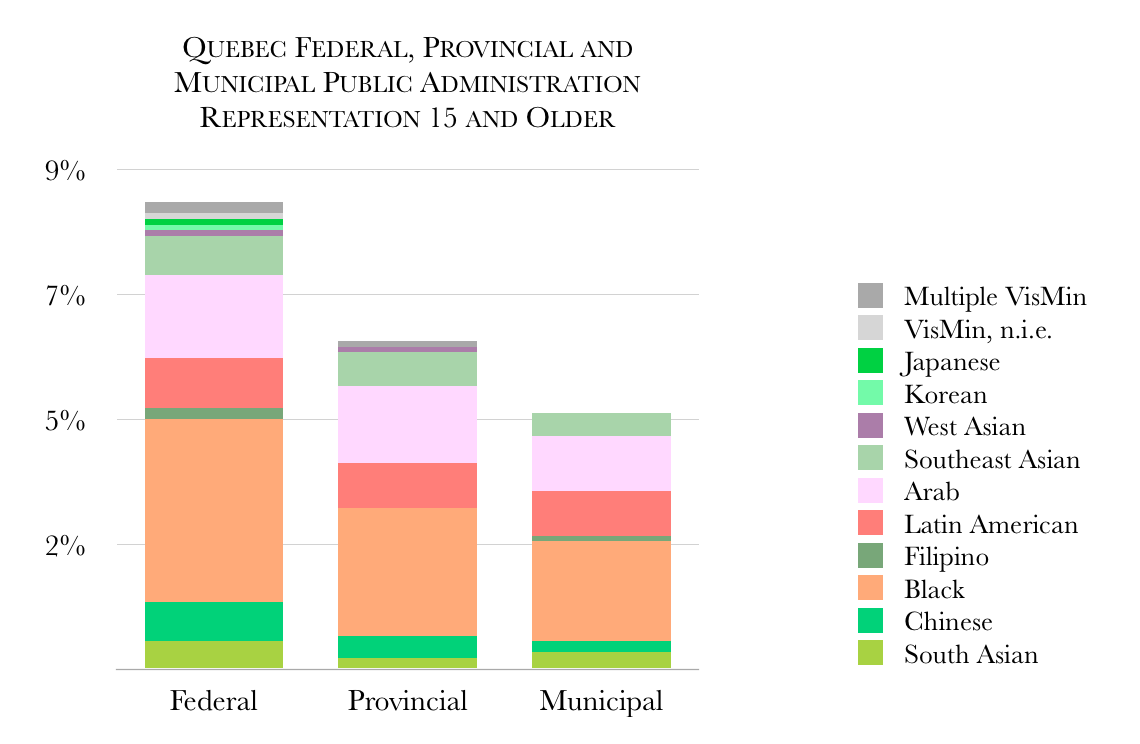
Quebec Government EEOngoing issue in Quebec with visible minorities having higher unemployment rates, greater prevalence of low-income, and lower median incomes than non-visible minorities, often greater than differences elsewhere in Canada.

L’État devrait donc les forcer juridiquement à adopter un mécanisme visant à contrer toute forme de racisme et de discrimination au moment de recruter des employés, plaide l’organisme dans son mémoire présenté mercredi dans le cadre de la consultation publique menée par le gouvernement sur la future politique d’immigration du Québec.

Le gouvernement devrait commencer par donner l’exemple et accorder un statut particulier aux membres des «minorités racisées» (qu’on pense aux Noirs et aux Asiatiques) lorsqu’il y a embauche dans la fonction publique, a fait valoir le président de l’organisme de défense des droits, Jacques Frémont.

Car les nouveaux arrivants issus des minorités visibles sont systématiquement sous-représentés «dans toutes les catégories d’emploi de la fonction publique», déplore la commission dans son document étoffé, assorti de 23 recommandations remises à la ministre de l’Immigration, Kathleen Weil.

Ces personnes, trop souvent victimes de discrimination à l’embauche pour des motifs n’ayant rien à voir avec leurs diplômes ou leurs compétences, devraient donc faire partie d’«un groupe cible distinct et spécifique» aux yeux du gouvernement à titre d’employeur, recommande la commission, qui revendique de plus l’adoption d’une politique globale de lutte contre le racisme et la discrimination.

And as shown in the above chart, relatively low public sector hiring rates for visible minorities.

Du racisme dans le secteur privé, selon la Commission des droits de la personne | Jocelyne Richer | National.

Quebec reopens its identity can of worms – Gagnon

Appropriately cutting commentary by Lysiane Gagnon:

What’s the link between an Islamist terrorist and a daycare worker who wears the hijab? Any sensible person would find the question utterly silly, but not Quebec’s radical secularists – and they’re at it again.

Here they are, shamelessly exploiting the terrorist attacks in Paris that left 12 dead three weeks ago, calling for a ban on religious symbols – as if such a ban was some sort of guarantee against potential terrorist attacks. (If it were, France wouldn’t have been targeted so often by home-grown terrorists, since it has the most stringent secular policies by far in the Western world.)

The blood of the Paris victims wasn’t even dry when Quebec’s radical secularists, led by the Parti Québécois opposition, began campaigning for some sort of revival of the secular charter that died when former premier Pauline Marois’s government was defeated after months of divisive and emotional debate.

The PQ, knowing full well that Premier Philippe Couillard is uncomfortable with identity politics, is pushing the government to pass legislation his Liberals promised, unwisely, before the election. The legislation, a much milder version of the PQ charter, would forbid public-sector employees to cover their faces (a non-existent problem) and set rules for “reasonable accommodations” between institutions and religious customers or employees (a problem that’s already been solved by local administrations).

Quebec reopens its identity can of worms – The Globe and Mail.

And Don Macpherson of the Gazette, on some of the internal PQ politics following Jean-François Lisée’s decision to pull out of the leadership race:

On sovereignty, Lisée said, the PQ had to “look the situation in the face.” It had to win the support of young people, who have “turned their backs on us,” and minorities, which “do not recognize themselves in us.” It had to accept the possibility that even with hard work, it might not win a mandate in the 2018 general election to hold a referendum.

The party had to “re-examine the contours of our project,” with a referendum process negotiated with the rest of Canada and “real independence,” with a Quebec currency as well as a Quebec citizenship. It had to end its “ambiguity on its identity” and show clearly that it is left-of-centre, environmentalist and humanist. It could no longer be against climate change and for developing shale oil.

And while the PQ continued to fight against the decline of French and for secularism, it had to have “a more open attitude” toward the English-speaking community and “a more active one” on the integration of immigrants.

But, Lisée said, there was no point in his going on; the election in May had already been decided, and Pierre Karl Péladeau had won. Lisée spoke with resignation and a trace of bitterness about the PQ wanting to “live its Pierre Karl Péladeau moment right to the end.” It was as if the PQ was infatuated with his rival for its affections, a passion against which Lisée was helpless and hopeless.

Don Macpherson: The PQ is determined to have its PK Peladeau moment

Quebec preparing major reform to immigration policy

Quebec_Unemployment_Rate

National Household Survey 2011

Imitation is the highest form of flattery, with Quebec Minister Weil wanting to appropriate the Canadian model linked more closely to employer needs.

As indicated in the chart above, visible minority unemployment rates are significantly higher than non-visible minorities in Quebec:

Ms. Weil told The Canadian Press she was ready to launch a “big reform” of relations between new immigrants and Quebec society at-large by the end of the year, a process that will include the revision of Quebec’s immigration law.

Everything will be on the table: the number of immigrants welcomed annually, the selection process and favoured countries of origin, the importance of knowing French before arriving, French language courses, the recognition of training undertaken abroad, regionalization, and the sharing of common values.

The minister said she wanted a wide-reaching debate on the issues, and was “very open to everything that will be proposed.”

Fifty stakeholders are expected to participate in public consultation hearings over the next few weeks on the future of immigration to Quebec. The province’s current policy has been in place for 25 years.

A later consultation will also be held on two specific aspects of immigration: the number of immigrants Quebec wants to welcome every year and their countries of origin.

The emphasis, however, will be placed on the economy and balancing between the recruitment of new immigrants and workforce needs. Finding candidates that can fill empty jobs will be key, and on that point, Quebec is being inspired by Ottawa.

Last year, the federal government reformed its selection process for new immigrants. With the focus now primarily on filling jobs, every candidate for immigration to Canada must produce a “declaration of interest” showcasing his or her ability to meet employers’ needs.

Weil said she wanted to appropriate that model. “ What I want to arrive at, is an immigration system based on the Canadian model,” she said.

Quebec preparing major reform to immigration policy – The Globe and Mail.

Débat sur la laïcité: Charles Taylor redoute de nouvelles divisions sociales

As always, sensible commentary by Charles Taylor:

«Puisqu’il y a des gens qui veulent surfer là-dessus pour faire avancer leur projet de laïcité, là, c’est dangereux parce que se sont deux questions complètement différentes. Si on commence le débat en pointant du doigt une partie de la population comme étant des terroristes en puissance, on ne pourra jamais régler ce problème, le problème de diversité», a déclaré M. Taylor.

Selon le professeur émérite, laïcité et lutte au terrorisme sont deux choses différentes et tracer un lien entre les deux thèmes risque de mener le Québec tout droit vers de nouveaux déchirements.

«Ce serait une erreur monumentale de mélanger les questions de terrorisme et les questions du vivre-ensemble dans la diversité dans une société comme la nôtre. Du moment où on fait un amalgame comme ça, on est tout droit sur le chemin de la division sociale. Si les gens croient que le moment est propice à cause des événements de Paris, ils ont grandement tort», a-t-il dit.

Sans détour, M. Taylor a exprimé sa méfiance envers le député péquiste et candidat à la direction du Parti québécois Bernard Drainville, revenu à la charge il y a une semaine avec une nouvelle mouture – moins restrictive – de son projet de charte des valeurs.

Le philosophe estime que le député de Marie-Victorin est «un mauvais porteur de ballon» dans ce dossier à cause de son passé marqué par la confusion entre la diversité religieuse et l’intégrisme.

Durant le débat sur la première version de la charte en 2013-2014, M. Drainville, alors ministre responsable, «a constamment fait l’amalgame», a soutenu M. Taylor.

«Il entretenait un contexte flou d’intégrisme religieux qui voulait dire à la fois se pencher sur la violence et interdire les signes ostentatoires. Quelqu’un qui croit que les gens qui portent des signes ostentatoires sont des terroristes en puissance ignore tout de la vie religieuse très diverse de notre pays, de notre société. Il agite des slogans très dangereux», a-t-il soulevé.

Le professeur est d’avis que les Français ont fait preuve de plus de sagesse à la suite de l’attentat perpétré contre l’hebdomadaire satirique en rejetant les amalgames et en prenant soin de ne pas montrer du doigt leurs concitoyens de confession musulmane.

Bien au contraire, «ils se sont tous dits: on est tous ensemble, toutes les religions, ne faisons pas d’amalgame, ne blâmons pas les musulmans pour ce qui s’est passé», a-t-il relaté.

Débat sur la laïcité: Charles Taylor redoute de nouvelles divisions sociales | Martin Ouellet | National.

Couillard est insensible en matière de laïcité, dit Legault

The Quebec debates start again:

Le premier ministre Philippe Couillard ne doit pas utiliser les récents attentats terroristes de Paris pour repousser le débat sur la neutralité religieuse de l’État, a déclaré mardi le chef de la Coalition avenir Québec, François Legault.

Selon M. Legault, il est plus que temps de régler la question de la laïcité dans les institutions publiques en imposant des balises.

«Philippe Couillard n’a pas raison d’attendre, c’est inacceptable qu’on attende, on a déjà trop attendu dans le dossier de la laïcité au Québec, a-t-il dit. On doit agir, on doit mettre en place des balises dans une charte, dans une loi, on doit mettre ce dossier derrière nous.»

M. Legault reconnaît que la lutte à l’intégrisme est une question distincte de la laïcité, mais il juge que M. Couillard fait fausse route en repoussant le débat parce qu’il veut éviter d’amalgamer les deux sujets.

«J’ai beaucoup de difficulté à suivre Philippe Couillard, a-t-il dit. Philippe Couillard est vraiment insensible à tous les dossiers qui touchent l’identité québécoise. C’est une insensibilité qu’il montre depuis qu’il est élu.»

Couillard est insensible en matière de laïcité, dit Legault | Alexandre Robillard | Politique québécoise.

From the Government side, a focus on identifying best practices to counter radicalization:

On cherchera surtout à détecter ceux qui flirtent avec les organisations fondamentalistes.

Le but poursuivi sera de «nous protéger collectivement, protéger les familles qui sont à risque avec un enfant qui se radicalise, et protéger le public», a fait valoir Mme Weil.

Pour mener à bien sa tâche, Mme Weil est entourée des ministres de l’Éducation, Yves Bolduc, de la Protection de la jeunesse, Lucie Charlebois, de la Sécurité publique, Lise Thériault, de la Famille, Francine Charbonneau, et de l’Emploi, François Blais.

Les organismes communautaires et religieux, notamment musulmans, sans compter bien sûr les corps policiers (municipaux, Sûreté du Québec et Gendarmerie royale du Canada), seront mis à contribution pour soutenir l’action gouvernementale.

Québec dit vouloir s’inspirer des meilleures pratiques mondiales en ce domaine et présenter des mesures concrètes «pour détecter, contrer la radicalisation» de certains jeunes.

Le bouquet de mesures sera réuni dans un plan d’action interministériel et intersectoriel.

Le travail de déblayage du dossier a déjà été fait par les fonctionnaires. Vendredi, une première réunion ministérielle devrait permettre de préciser le cadre de travail et l’échéancier.

Le plan d’action devrait être rendu public «dans l’année» en cours, a promis la ministre Weil, en s’engageant à ce que le processus ne s’étire pas pendant «trois ans, disons, pas deux ans».

«On ressent tous qu’il ne faut pas fermer les yeux, qu’il faut y travailler. Il ne faut pas rester passif par rapport à ce phénomène-là», a-t-elle dit, un phénomène «pas très bien compris».

Intégrisme religieux: Québec s’engage à intervenir

Ex-student of ultra-orthodox Jewish school system in Quebec wants compensation for poor education

Interesting, and not particularly surprising, when a fundamentalist philosophy prevails:

Yonanan Lowen can read and write in Aramaic, the 3,000-year-old language that likely served as the mother tongue of Jesus Christ.

But despite being raised and schooled for most of his life in the cloistered Hassidic Jewish community of Boisbriand, north of Montreal, the 37-year-old cannot read or write in French, stumbles through English texts and is confounded by the most basic tasks asked of grade-school students.

Lowen’s years of frustration have led him to denounce Quebec’s education ministry, a local school board, the province’s director of youth protection and his two former schools, with demands for $1.25 million in compensation by Dec. 15. Through their collective actions, or failures to act, he argues, he has been deprived of his right to an education under Quebec’s charter of rights and the province’s education law.

“I feel like a child of six years old, alone in the world, who doesn’t have parents, who doesn’t have somebody to take care of him. A child is helpless. He can do nothing by himself and this is how I feel,” Lowen said in an interview, adding he is prepared to launch legal action if necessary.

Despite all of Quebec’s existential debates about laïcité, Quebec provides funding to faith and community based private schools.

Ex-student of ultra-orthodox Jewish school system in Quebec wants compensation for poor education | Toronto Star.

Leaving anti-Semitism and unemployment behind, French Jews make Montreal home | Haaretz

Interesting:

Although up-to-date data on French Jewish immigration does not exist, Monique Lapointe, director of Agence Ometz, Montreal’s primary Jewish social services and resettlement organization, told JTA she has noticed a significant increase in newcomers, especially over the past year. Inquiries, Lapointe said, have poured in through Ometz’s email system and Facebook page — including from French Jews currently living in Israel.

“I wouldn’t say it’s a huge number of [immigrants],” Lapointe said. “But it’s a trend. We’ll be anticipating more.”

Lapointe described the average immigrant as single, between the ages of 25 and 35, “very well educated and looking for a new kind of life.”

The wider Montreal Jewish community, Lapointe said, is now in the early stages of crafting a coordinated approach to handle the inflow. Thus far, it has been difficult to track newcomers, she added, partly because French Jews keep looser ties to Jewish community organizations than do their North American counterparts.

“In France, people don’t talk about Jewishness,” Lapointe said. “They’re not used to community organizations. Some will never come to see us. They don’t have this reflex.”

…The data, however, suggests that Quebec anti-Semitism is on the wane. Last year the province saw its number of reported anti-Semitic incidents fall to 250, a nearly 26 percent drop from 2012, according to B’nai Brith Canada, which tracks anti-Semitic activity across the country.

Leaving anti-Semitism and unemployment behind, French Jews make Montreal home – Jewish World Features Israel News | Haaretz.

Government rethinking counter-terrorism plan, Senate learns | Ottawa Citizen

Sensible focus on prevention strategy, particularly community outreach and intervention:

[ADM at Public Safety, Gary] Robertson and other officials from Public Safety and the Canadian Security Intelligence Service, in response to committee questioning, also revealed Monday that:

– Contrary to rumours, the government is not contemplating outlawing the promotion or glorification of terrorism on the Internet – beyond existing laws against hate speech and hate crime.

– Some of the estimated 80 to 90 radicalized Canadians who have returned home from foreign terror activities have become “disillusioned” with jihad.

– Disruptive measures, such as no-fly lists, seizing passports, immigration actions and officially banning activities related to terrorist organizations and individuals so-called federally listed entities, help explain why more traditional criminal arrests and prosecutions haven’t occurred in Canada.

– The 2012 counter-terror strategy, which put some badly needed meat on the bone of the government’s 2004 national security policy, has four pillars: prevent, detect, deny and respond.

Robertson said the government believes prevention, largely through community outreach and intervention, is the most effective way to address the problem of radicalization.

That includes training individuals, from imams, teachers and school counsellors to community nurses, to recognize changes in behaviours and attitudes that may signal an individual is becoming radicalized.

There also are “law enforcement personnel that are trained and sensitized to these unique issues, that they understand how to (deal) with the community practitioners,” he said. “It isn’t necessarily going to lead to incarceration” if a family or friends of a person approach police about them.

Government rethinking counter-terrorism plan, Senate learns | Ottawa Citizen.

Quebec Premier Couillard emphasizes the importance of addressing social inclusion and causes of radicalization in his meeting with members of the Muslim community:

«Il ne faut pas faire semblant d’ignorer la question, qu’il y a quelque part un lien entre la déformation de l’islam, de la religion et ces actions. Ça, ça contribue davantage à l’incompréhension entre les communautés», a fait valoir le premier ministre.

Il reconnaît que les crimes qui ont récemment ébranlé le Canada ne s’expliquent pas simplement par une cause unique comme l’islam radical, mais précise que souvent des jeunes aux prises avec d’autres problèmes sont plus vulnérables et deviennent des proies pour ceux qui prônent la violence.

Il faut examiner les causes de la radicalisation des jeunes, a avancé M. Couillard.«L’idée nest pas de dire ceci est compréhensible, parce que… Non. Ces gestes sont condamnables de toute façon, dans l’absolu», a-t-il dit.

«Mais on doit travailler ensemble sur notre société pour mettre en place un environnement qui éloigne les jeunes de ce projet, on peut dire, maléfique.»

Il croit de plus que cette discussion est nécessaire, car il faut aussi protéger les Québécois de confession musulmane qui sont eux-mêmes victimes de harcèlement ou de violence.

M. Couillard veut notamment améliorer l’intégration des membres de cette communauté, pour éviter qu’ils ne se radicalisent, en favorisant l’éducation et l’emploi. Il a notamment dit qu’une reconnaissance des diplômes étrangers plus souple est sur la table et que sa ministre de l’Immigration, Kathleen Weil, prépare actuellement une nouvelle politique d’immigration.

Couillard a rencontré des membres de la communauté musulmane | Stéphanie Marin | Politique québécoise.

Prominent Muslim cleric urges imams to vet new Islamic converts

Imam Soharwardy being pro-active:

A prominent Muslim cleric says he intends to reach out to other imams to make sure that new converts to Islam are watched closely for signs of radical beliefs.

While authorities have made links to extremism in both the Ottawa and Quebec attacks, Imam Syed Soharwardy of Calgary says he is concerned about media reports that the two perpetrators were recent converts to Islam.Soharwardy, the founder of Muslims Against Terrorism and the Islamic Supreme Council of Canada, said imams should look for warning signs, such as a criminal record or drug abuse, before allowing an individual to convert.

“I’m not sure who helped them to convert to Islam. Who was the imam? What kind of relationship did those people have with those people who converted them to Islam? Those very important questions need to be answered,” said Soharwardy.

“They should take on the responsibility of checking backgrounds and staying in touch and make sure this person is not being recruited by any radical organization or terrorist organizations.”

Prominent Muslim cleric urges imams to vet new Islamic converts | CTVNews.

From Quebec, reporting on discussions between the Quebec government and representatives of the Muslim community, on security cooperation (already ongoing) but also raising integration issues for Canadian Muslims:

Mais cette conversation ne doit pas être à sens unique, prévient Salam Elmenyawi, président du Conseil. L’écoute doit être réciproque et d’autres sujets doivent être abordés, dit-il, comme une meilleure intégration des musulmans dans la société.

«S’il s’agit d’une conversation à sens unique, elle sera rejetée», dit-il. Et si cela vise juste à recruter des informateurs, cela ne marchera pas non plus, prévient-il.

Et bien qu’il reconnaisse qu’il y a des problèmes dans la communauté, «il n’est pas question d’une épidémie. Il s’agit de cas isolés», soutient-il. Mais, évidemment, un cas est déjà un cas de trop, ajoute-t-il.

M. Elmenyawi souligne qu’il ne faut pas sauter aux conclusions et que tous les faits de l’attaque de mercredi ne sont pas encore connus.

«Les médias cherchent toujours la mosquée la plus près», déplore-t-il. Mais il fait valoir que les gens peuvent être influencés par des idées radicales ailleurs.

La religion des musulmans n’est pas un problème, c’est la façon dont certains la pratiquent et la détournent qui est en cause, a souligné de son côté Hussein Nehme.

Il affirme ne jamais avoir rencontré de jeunes dans son centre qui auraient évoqué des idées de violence. Il assure que si c’était le cas, il discuterait avec lui pour voir d’où proviennent ces idées, et que s’il découvrait qu’un centre ou un groupe d’ici diffuse de telles idées, il contacterait les autorités.

«C’est notre devoir», dit-il.

Il se dit inquiet lui-même de ce que les extrémistes religieux peuvent faire à sa communauté. Il songe d’ailleurs à demander la protection de la police à quelques jours d’une fête, désapprouvée par certains.

Personnes à risques: des musulmans du Québec prêts à coopérer

Shallow, descriptive commentary by David Frum in the Atlantic, trying to explain Canada to American readers, without saying much in The Allure of Radical Islam in Canada.

Montreal’s French invasion: Why immigrants from France are moving in en masse

Quebec as immigration destination of choice for French citizens (according to Immigration Quebec, about 8 percent of immigrants to Quebec originate in France):

“There was a sense of freedom – from family, and from France, which is much more traditional and hierarchical,” said Juilliard, now a freelance writer who runs the popular lifestyle blog Une parisienne a Montréal.

“I felt you could be much more yourself here than in France, and not feel the judgment of others, and even if there is judgment, it’s not necessarily negative.”

It’s unclear how many of these new arrivals will stay for the long haul.

Over the past decade, 30,000 immigrants from France have gained permanent resident status in Quebec, according to the consulate, far below the total number here on temporary student and work-travel visas. But it’s still among the top immigrant countries of origin in Quebec, alongside Algeria, Morocco, China and Haiti.

Edith Courtial, who moved to Montreal this summer with her partner, said she has no plans to leave any time soon. Courtial has a degree in hotel management but said she feels less restricted by educational background in Canada.

“In France, when you’re looking for work, you’re really tied to your diploma,” said Courtial, originally from the south of France.

Montreal’s French invasion: Why immigrants from France are moving in en masse – The Globe and Mail.