Chantal Hébert: Will Quebec be the next province to use the ‘notwithstanding’ clause?

Likely inevitable:

Chances are Ontario’s Doug Ford will not for long be the only premier to bypass the Charter of Rights and Freedoms to push through a controversial item on his legislative agenda.

Depending on the outcome of the Quebec Oct. 1 election, Prime Minister Justin Trudeau’s home province could be next.

But if that were to happen it would not be as a result of a domino effect triggered by Ford’s use of the ‘notwithstanding’ clause of the Constitution to have his way in the legal battle over the size of Toronto’s next municipal government.

The prospect of a move along similar lines was part of Quebec’s longstanding debate over the place of religious rights in a secular society before this week’s developments at Queen’s Park.

A Coalition Avenir Québec or a Parti Québécois government would scrap the controversial Liberal law that prescribes public services be received and dispensed with one’s face uncovered.

They would replace the so-called veil ban with the imposition of a secular dress code on public servants deemed to be in a position of authority. The list includes judges, prison guards, teachers and, in the case of the PQ, child care workers.

If the courts found that approach to be unconstitutional, CAQ and PQ leaders François Legault and Jean-François Lisée have both said they would have no qualms about using the notwithstanding clause to forge ahead.

At midcampaign, the notion that two of the main contenders for government in Quebec would not let the Charter stand in the way of their secularism agendas has not emerged as a wedge issue. That’s not a hill Philippe Couillard’s Liberals want to risk dying on between now and Oct. 1.

Their government’s veil ban has yet to be enforced. The courts have suspended its application until a challenge to its constitutionality has been adjudicated. Based on his previous statements, Couillard would not — should his party win power next month and the courts invalidate its veil law — be inclined to salvage it by using the notwithstanding clause.

But the premier is also on record as saying that the notwithstanding clause exists for a purpose; that it is there to be used by governments. And indeed, the Quebec Liberals have done exactly that in the not-so-distant past.

In 1988, the government of then-premier Robert Bourassa overruled a Supreme Court ruling that found the province’s French-only sign law to be in breach of the Charter. That cost Quebec’s Liberal government a critical amount of goodwill on the constitutional front. It contributed to the 1990 demise of the Meech Lake Accord. It also earned the province a black eye in many international circles. When the clause expired five years later, Bourassa’s government did not renew it. Instead it belatedly aligned the sign law with the Supreme Court’s prescriptions.

Now, as then, the federal government has the power to disallow a provincial law. But that power has not been used since 1943 and, by all indications, the current prime minister is no more inclined to dust it off than his father was at the time of the introduction of the PQ’s language law in the late seventies.

On Tuesday, Trudeau said he would leave it to Ontario voters to judge whether Ford’s decision to reach for the biggest hammer in the constitutional toolbox to quash opposition to his bid to shrink Toronto’s municipal government in the middle of an election campaign was appropriate.

If the prime minister used the constitutional levers at his disposal to intervene in the dispute between Queen’s Park and Toronto city hall, he would set himself up to do likewise if the next Quebec government ever does suspend some of the Charter rights enjoyed by the province’s religious minorities.

It is hard to think of anything more likely to trigger an all-out Ottawa/Quebec brawl than a move by a federal government to nullify a law passed in the National Assembly.

The notwithstanding clause is more widely seen as a legitimate tool in Quebec than anywhere else in Canada. But it would be simplistic to conclude that repeated use has normalized the practice. The province’s difficult history with constitutional politics and the autonomist instincts of its francophone majority largely account for the difference.

It is too early to know whether Ford’s use of the notwithstanding clause will start a trend that will spread to other provincial capitals or, on the contrary, make reaching out for it more politically toxic everywhere. But without support to do away with the clause from either Ontario or Quebec, it is not about to be written out of the Constitution.

Source: Chantal Hébert: Will Quebec be the next province to use the ‘notwithstanding’ clause?
By campaigning to cut immigration, Quebec’s opposition parties are playing politics with their province’s future

Great piece by Chantal Hébert, pointing out the sweetheart deal that Quebec has with respect to funding for immigrant integration and how it compares with federal funding to other provinces.

The numbers tell the story. Last time I looked, the federal government transferred $345 million to Quebec (2016-17 budget). While comparisons are inexact, the 2015-16 Rapport annuel de gestion of Quebec’s Ministère de l’immigration, de la diversité et de l’inclusion indicates about $97 million in direct program spending for language training (francisation) and integration services (65 percent of the total budget of about $150 million). 

Quite a gap!

Among Canada’s larger provinces, none is greying faster than Quebec. For the first time in its modern history, the province is struggling with labour shortages. To varying degrees all its regions including Montreal are affected.

Those shortages are projected to become more acute as the last of the baby boomers retire over the coming decade. Attracting workers from other provinces —as Alberta, Ontario or British Columbia routinely do — is less than an optimal solution. There is not in the rest of Canada a big supply of skilled workers readily able to function in French.

Why then are the province’s two main opposition parties campaigning on a promise to cut down on immigration?

If elected to power on Oct. 1, the currently leading Coalition Avenir Québec would reduce the number of immigrants coming to the province by 20 per cent as of its first year in office.

A CAQ government would also force newcomers, who do not after three years meet a government-set level of proficiency in French, to leave Quebec.

For its part, the Parti Québécois would limit admission to applicants who are already fluent in French. At this point, less than half of Quebec’s annual immigration intake falls in that category.

Under either plan, the number of immigrants admitted to the province would decline significantly.

By virtue of a longstanding federal-provincial agreement, Quebec selects all its immigrants except for those who apply for refugee status from inside Canada or who qualify under the family reunification program. But the citizenship process itself remains a federal responsibility and the national norms set by Ottawa apply in all provinces.

Quebec awards more points to applicants who are already fluent in French; it also proactively tries to woe them.

If there were a neglected pool of would-be immigrants — with the language skills the PQ considers essential — somewhere in the world, the province would have already found it.

On its face, the CAQ’s proposal to expel from Quebec those who fail to meet its language requirements is unconstitutional. The Charter of Rights and Freedoms guarantees the right of permanent residents to move from one province to another as they see fit.

But even if it did not, the proposition that the federal government — regardless of the party in power — should undertake to remove immigrants from Quebec to forcibly settle them elsewhere in Canada or, alternatively, to send them back to their country of origin would be dead on arrival on Parliament Hill.

Indeed, if CAQ Leader François Legault does become premier this fall, he might want to question the wisdom of shining a spotlight on the Quebec/Canada immigration accord, especially in a federal election year.

The agreement was last renegotiated in the immediate aftermath of the demise of the Meech Lake Accord — at a time when then-prime minister Brian Mulroney was desperate to blunt the impact of the failure of his constitutional bid in Quebec. It can be amended but not terminated by the federal government.

There is a reason why no Quebec government — including the PQ-led ones — has wanted to reopen the deal. It is one of the most advantageous federal-provincial agreements ever struck in the history of the federation.

It includes an escalator clause that ensures the funds Ottawa transfers to Quebec for immigration purposes do not decrease from year to year.

After more than two decades, there is a significant gap between the money Quebec receives per capita for integration purposes versus the funds transferred to the other provinces. That gap is larger than the extra costs involved in offering French-language training services. One would think no Quebec government would go out of its way to highlight this.

But then to look to common sense for the rationale of the PQ and the CAQ’s immigration proposals is to look in the wrong place.

By casting immigration as a threat to Quebec’s francophone identity, the CAQ and the PQ are playing to an audience of swing nationalist voters who could make or break their respective hopes on Oct. 1.

In this spirit, at mid-campaign Legault is casting his immigration platform as a firewall designed to prevent a French-language Quebec from disappearing within two or three generations.

There are no statistics to support the CAQ leader’s doomsday scenario. Quebec requires all immigrant children to be schooled in French until the end of high school. Even if their parents never managed to master the language, they would.

Were a future Quebec government to deliberately decrease its immigration intake even as the other provinces go the other way, it would be at a cost not only to its economy but also to its demographical weight and its influence in the federation.

Source: By campaigning to cut immigration, Quebec’s opposition parties are playing politics with their province’s future

What’s with Islamophobia in Quebec?

Good commentary by Phil Gurski, noting the impact that this kind of discourse has on security agency efforts to engage with Muslim Canadians:

“Islam should be banned like we ban pit bulls.” You read that right. This was a Twitter post by an erstwhile candidate for the Parti Québeécois in the upcoming Quebec election. Suffice it to say he is no longer on the PQ slate. But let me repeat what he wrote: “Islam should be banned like we ban pit bulls.” Wow. It is hard to say anything about that beyond disgust that someone would (a) actually think this and (b) actually Tweet it. Talk about a career killer.

Or not.

There appears to be a disturbing amount of Islamophobia in the province of Quebec. This irrational fear, despite the actual presence of Islamist extremists, a topic I will return to below, is manifest in a variety of ways, ranging from ridiculous calls to ban stoning to the killing of Muslims at worship. Somewhere in the middle, lies a gaggle of self-styled patriot groups such as La Meute who claim to be standing on guard against the dangers posed by migrants, many of whom are Muslim.

What is driving this hatred for Islam? That indeed is a very good question. Is it the changing nature of Quebec society from centuries of white francophone Catholicism to a much more multicultural polity? Is it tied to the vestiges of separatism, a desire that appears, at least as far as all the major political parties are concerned, to be all but dead? These attitudes are not limited to Quebec but when Québécois francophones hold and pronounce them they do seem to get more attention in Canadian media. This is perhaps a shortcoming of how we recognize and report what is ‘newsworthy’ in this country.

We could dismiss all of this as hateful discrimination and move on, much the same as everyone seems to have a boorish relative who says stupid things, but gets away with them because no one wants to cause a family rift by challenging them. This, of course, is not an optimal response: hatred directed at any one group should always be called out for what it is in view of what is sometimes called the ‘broken window theory’: i.e. the notion that if you ignore early signs of disorder they will only get worse. I am not drawing a direct line between Islamophobic rhetoric and the shooting at the Québec City mosque in January 2017 but it is nonetheless important to reject racism in all its forms.

Those who hold these views will often point to terrorism as justification for their fears and demands for a cap on immigration. Here they both are sadly mistaken and yet have a point. Even a cursory glance at terrorism in Canada over the past few decades demonstrates quite clearly that not only is violent extremism thankfully a rarity in our country but the single largest successful attack was actually perpetrated against Muslims, not by them—Alexandre Bissonnette’s rampage in 2017. At the same time, there was an attack in Quebec by a Muslim in 2014, this one by Martin Couture-Rouleau, a convert to Islam albeit originally a Québécois de souche. There have also been other Quebec Muslims who have left to join terrorist groups abroad and some may return one day to carry out violence back home. So yes, the fear is real even if it is minimally supported by data.

The problem remains that even if there are violently radicalized Quebec Muslims they are but a handful and outweighed by tens of thousands of others. It is simply wrong to paint all with the same brush just because a few engage in violence. Furthermore, by engaging in discriminatory practices against an entire community for the sins of a tiny part, it forces that majority to circle the wagons out of a sense of self protection. This has serious implications for any collaboration and cooperation between Quebec Muslims and those agencies tasked with investigating real threats, such as CSIS and the RCMP.

Racism is racism and has no part in Canada. Let’s not bury our heads in the sand over this.

Source: What’s with Islamophobia in Quebec?

Immigration: Legault se défend d’avoir envoyé un message de fermeture

Nuancing or spinning his earlier comments:

François Legault s’est défendu vendredi d’avoir envoyé un message de fermeture aux nouveaux arrivants lorsqu’il a affirmé que l’immigration pose un « risque » pour la survie du français. Il affirme au contraire que ses propositions aideront les immigrants à « avoir du plaisir à vivre au Québec. »

Le chef de la Coalition avenir Québec a provoqué de vives réactions, jeudi, lorsqu’il a dit craindre que « nos petits-enfants » ne parlent plus le français si le système d’immigration n’est pas réformé.

À ceux qui y voient un message de fermeture, M. Legault a assuré que c’est tout le contraire. En fait, a-t-il dit, les immigrants seront les premiers à profiter des réformes d’un éventuel gouvernement caquiste.

« Ce qu’on dit aux immigrants, c’est que si vous voulez avoir du plaisir à vivre au Québec, il faut vous intégrer, a dit M. Legault. Pour s’intégrer, il faut parler français. C’est bon pour le Québec, c’est bon pour les nouveaux arrivants. »

« Ce qu’on souhaite, c’est qu’ils soient des citoyens qui participent pleinement, d’abord à l’emploi, mais aussi en parlant avec les voisins la langue commune, le français », a-t-il ajouté.

Les positions de la CAQ ont souvent été critiquées à Montréal, où le parti n’a jamais fait élire un seul député. M. Legault a abordé le problème de front lors d’un point de presse dans la circonscription de Pointe-aux-Trembles aux côtés de sa candidate, la mairesse Chantal Rouleau.

La veille, cette dernière avait semblé contredire son chef en affirmant qu’elle n’a « pas peur » pour l’avenir du français au Québec. Vendredi, elle a assuré être sur la même longueur d’onde que M. Legault.

« L’inquiétude, elle sera pour les générations futures, a-t-elle expliqué. Si on n’agit pas maintenant, ça pourra être inquiétant plus tard. Mais c’est toujours l’histoire de la langue française au Québec : il faut toujours être vigilant. »

Cette dernière n’a cependant pas été en mesure de dire combien d’immigrants habitent sa circonscription. Il y en a 6200 selon le dossier socio-économique du Directeur général des élections, soit environ 12 % de la population.

Immigration économique

M. Legault propose de réduire à 40 000 le nombre d’immigrants qui arrivent au Québec chaque année, une baisse d’environ 20 %. Il souhaite aussi obtenir d’Ottawa le contrôle sur le programme de réunification familiale, par lequel environ 12 000 immigrants arrivent chaque année.

Ce programme fédéral permet à une personne déjà installée au Québec d’être réunie avec d’autres membres de sa famille en parrainant leur demande d’immigration. M. Legault lui reproche de n’imposer aucune exigence quant à l’apprentissage du français.

Or, même si le gouvernement Trudeau refuse de céder le contrôle du programme, un gouvernement caquiste restera ferme sur son objectif de réduction global. Quitte à réduire le nombre d’immigrants économiques qui sont sélectionnés par Québec.

« Ça pourrait être ça », a-t-il convenu.

Source: Immigration: Legault se défend d’avoir envoyé un message de fermeture

Legault réduirait le nombre d’immigrants dès sa première année au pouvoir

Given increasing federal numbers, this would mean a relative decrease in Quebec population relative to the rest of Canada and thus decreased political importance over time:

Un éventuel gouvernement de la Coalition avenir Québec réduira dès la première année de son mandat le nombre d’immigrants de 20 %, a confirmé l’entourage de François Legault, mercredi. Une précision qui est survenue après qu’une candidate eut indiqué qu’il faut baisser ce seuil « graduellement ».

M. Legault a visité une production maraîchère en serre à Sainte-Clotilde-de-Châteauguay, en Montérégie. Sur les 250 employés de l’entreprise, 170 sont d’origine étrangère. Il s’agit pour la plupart de travailleurs étrangers temporaires.

Dans cette région agricole, l’immigration est un enjeu important, a convenu la candidate caquiste dans Huntington, Claire IsaBelle. Car plusieurs entreprises agricoles peinent à trouver des employés.

« On n’a pas cette pénurie de main-d’oeuvre quand on va chercher les étrangers, la population immigrante, la main-d’oeuvre immigrante, a expliqué Mme IsaBelle. Ils nous aident beaucoup. Il faut considérer qu’ils sont essentiels. »

Or, la CAQ propose de réduire de 50 000 à 40 000 le nombre d’immigrants admis chaque année au Québec. Questionnée à savoir si cette proposition est compatible avec les besoins des agriculteurs, la candidate a indiqué que la mesure n’entrera pas en vigueur immédiatement.

« On ne va probablement pas baisser à 40 000 tout de suite, la première année qu’on est au pouvoir, a indiqué Mme IsaBelle. On va baisser probablement graduellement. »

Contredite

Cette affirmation a été contredite quelques minutes plus tard par l’entourage de M. Legault. On a précisé aux journalistes que la baisse du nombre d’immigrants aura lieu dès 2019, première année complète d’un éventuel gouvernement caquiste.

Plus tôt dans la campagne, François Legault a argué que la réduction temporaire des seuils d’immigration permettrait d’améliorer l’intégration des nouveaux arrivants à la société québécoise. Il a fait valoir qu’environ le quart des immigrants quitte la province.

Cette prise de position lui a valu de vives critiques du Parti libéral, qui juge que la pénurie de main-d’oeuvre est le plus grave problème qui pèse sur l’économie québécoise.

Une « erreur massive », selon Couillard

Pour Philippe Couillard, promettre une baisse du seuil d’immigration est « une erreur massive ». « Pour cette seule raison, parce qu’il y en a d’autres, la CAQ ne devrait pas être autorisée par la population à former le gouvernement », a lancé le chef libéral, de passage à Sherbrooke.

Il a fait valoir que la promesse de M. Legault est « antiéconomique ». « Le problème économique le plus important au Québec, je ne l’invente pas, tout le monde nous le dit au Québec : la pénurie de main-d’oeuvre qualifiée, moins qualifiée. L’immigration fait partie de la solution. »

C’est d’autant plus nuisible pour l’économie selon lui que M. Legault serait forcé de diminuer le nombre de nouveaux arrivants de la catégorie de l’immigration économique (30 000 des 50 000 personnes que l’on accueille chaque année). C’est la seule catégorie sur laquelle le gouvernement du Québec exerce un contrôle. Le reste est sous la responsabilité du fédéral : il s’agit des réfugiés et des nouveaux arrivants issus de réunifications familiales. Pour M. Couillard, « François Legault a une méconnaissance des faits et des pratiques d’immigration ».

Le chef libéral reste évasif quand on lui demande ses intentions au sujet du seuil d’immigration. Il a d’abord dit vouloir le « maintenir » à 50 000, mais il a entrouvert la porte à une augmentation au cours d’un prochain mandat. « Ce pourrait être le même nombre, par exemple si on pense qu’on a besoin d’un an de plus pour bien stabiliser, voir l’impact de cela », a-t-il déclaré, laissant entendre qu’une hausse pourrait survenir par la suite.

Avant d’annoncer une intention, « je veux m’assurer que les efforts qu’on va déployer (en intégration et en francisation) soient au moins au niveau des personnes qui arrivent. Je pense qu’on est là maintenant ». Il souhaite également voir « comment les besoins de main-d’oeuvre évoluent ». Il a rappelé que le seuil d’immigration est proposé par le gouvernement et fait l’objet d’un débat parlementaire avant son adoption.

Source: http://www.lapresse.ca/actualites/elections-quebec-2018/201809/05/01-5195331-legault-reduirait-le-nombre-dimmigrants-des-sa-premiere-annee-au-pouvoir.php

Quebec’s cultural milieu demonstrates its utter hypocrisy in defending SLĀV

Martin Patriquin in another of his controversial posts, a bit over the top but with an insightful closing paragraph:

In Quebec lore, few historical events remain as damaging as La Conquête. When British general James Wolfe defeated his French counterpart Louis-Joseph de Montcalm at the Plains of Abraham in 1759, it precipitated not just the end of French power in North America, it also birthed the narrative of the Québécois as a conquered people, living in virtual enslavement under a foreign power.

Quebec directors, keenly aware of the its historical trauma, have largely eschewed from committing La Conquête (The Conquest) to film or the stage.

So the fact that Quebec stage director Robert Lepage could depict on stage someone else’s infinitely more enduring wound — the one of actual slavery — is indicative of his power and sway over Quebec’s cultural milieu. That he would do so with a nearly all-white cast, then scream censorship when the ensuing show is cancelled, shows how utterly hypocritical and disconnected from reality this milieu remains.

Lepage’s SLĀV, which was to have a two-week run at Montreal’s Théâtre du nouveau monde, is a pastiche of slave songs reworked and sung primarily by Quebec singer Betty Bonifassi. The source material is drawn entirely from the figurative works of American slaves; songs such as “Chain Song” were sung to keep time and avoid the master’s whip. SLĀV’s aesthetic is similarly drawn for the experience of black slaves, right down to the slave boat set pieces and gritty picture of train tracks on the promotional materials.

Despite the subject material, SLĀV featured only a smattering of black skin, with white actors in the principal roles — Bonifassi included. Protests erupted outside the venue. Musician Moses Sumney cancelled his gig at Montreal’s Jazz Festival, SLĀV’s sponsor. Organizers then nixed the Montreal run of the production.

Several French-speaking pundits frothed at the mouth, as if on cue. “We live in a world subjected to the emotional tyranny of certain crybaby minorities who constantly play the victim,” sniffed Journal de Montréal’s Mathieu Bock-Côté. Parti Québécois culture critic Pascal Bérubé called it “a defeat for artistic liberty.” For his part, Lepage delivered his ire via press release, claiming to have been “muzzled” and a victim of “intolerant speech.”

Lepage and his defenders have nothing if not a taste for hyperbole and sensitivity to the pinprick of real or perceived slights. In defending a demonstrable abuse of history, they are also hypocrites.

After all, Quebec is a land where history isn’t just alive, it screams. La Conquête is taught as a mantra in its schools — as is the Quiet Revolution, in which the Québécois wrestled from underneath the thumb of the English some 300 years later. Its language laws are a bulwark against the rising English seas on its borders, ensuring the survival of the French language. If the more than 350 years since La Conquête has shown anything, it’s Quebec’s collective will to keep its own folklore intact.

Over the years, this has led to unspoken rules and near-satiric levels of self-regard. The Canadiens, Stanley Cup-less for 25 years, still cannot avail itself of a unilingual English coach. Pundits and columnists, Bock-Côté very much included, consistently bemoan the lack of Quebecois players on the team, as well as the English music blared at the Bell Centre during games. (Thankfully, this last fit of pique put an end to U2’s “Vertigo” as the Habs’ go-to goal song.)

Protesters staged vigils outside La Caisse de dépôt headquarters when the province’s pension fund hired Michael Sabia, its first English president. A few months ago, provincial politicians passed a unanimous motion urging merchants to cease using “Bonjour/Hi” when greeting a customer. And before he turned his attention to the cancellation of SLĀV, the PQ’s Bérubé was busy decrying a new law allowing for personalized license plates in the province. Such things would violate Quebec’s French language charter if they display English words, Bérubé said.

As with slavery for America’s Black population, La Conquête sits at the headwaters of Quebec’s modern history, shaping its people and fuelling its continued ire. Trifling with it is fraught, if not outright dangerous; Robert Lepage, who isn’t used to anything but public adoration, has certainly learned as much. One can only imagine how he or his fellow defenders of Quebec history would react if an imagining of La Conquête were cast with an English-speaking ensemble — or if this cast was almost entirely black.

Source: Quebec’s cultural milieu demonstrates its utter hypocrisy in defending SLĀV

De plus en plus d’immigrants en emploi au Québec

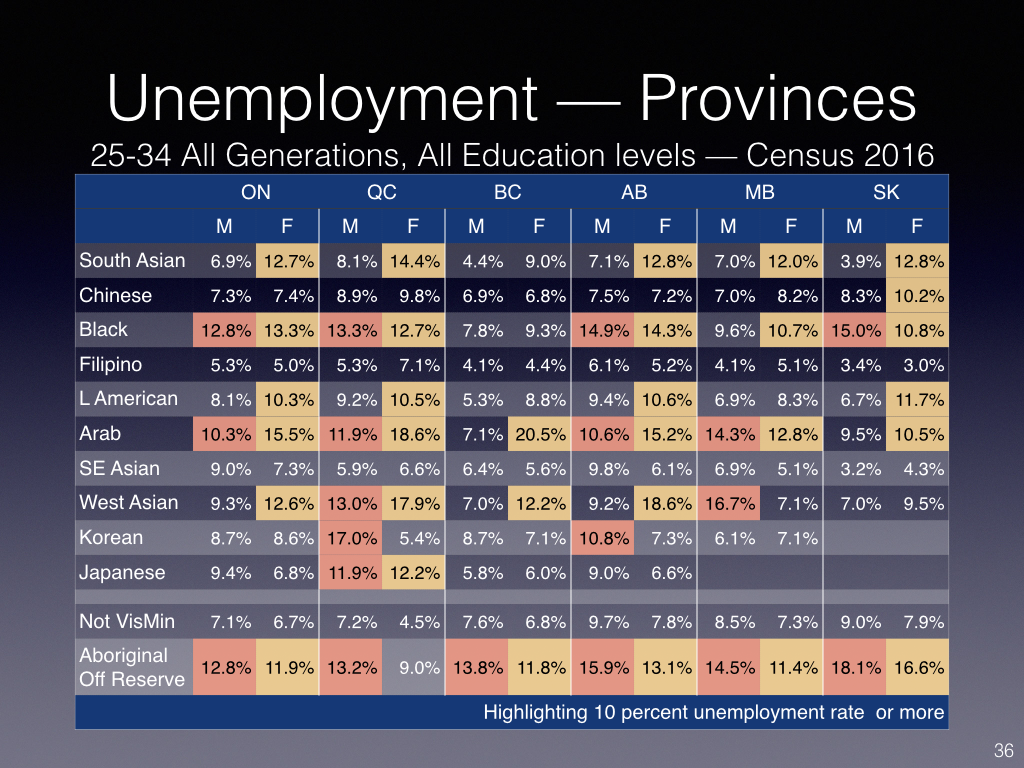
The above chart compares unemployment levels in the larger Canadian provinces with non-visible minorities (the vast bulk of recent immigrants). The report below focuses on numbers, and the relative share of employment in Montreal compared to the regions, and thus is less meaningful:

Même si leur taux d’emploi général demeure inférieur à celui des travailleurs nés au Canada, les immigrants sont de plus en plus présents sur le marché du travail, et cela suit d’ailleurs la courbe démographique.

Au cours des dix dernières années (2006-2017), les immigrants ont occupé un peu plus de la moitié des quelque 480 000 emplois nets créés, selon un nouveau bulletin de l’Institut de la statistique du Québec à l’aide des données de l’Enquête sur la population active (EPA) de Statistique Canada.

Voici trois faits saillants commentés.

Le taux de surqualification est en hausse chez les immigrants

Ce taux est passé de 37 % en 2006 à 44 % en 2017. Les immigrants récemment arrivés ont le taux de surqualification le plus élevé, qui peut s’expliquer par les délais dans la reconnaissance des diplômes, le temps qu’il leur faut pour trouver un emploi dans leur domaine, etc. Mais ce qui surprend est de voir qu’il s’est aggravé pour les immigrants qui sont ici depuis plus de 5 ans, passant de 33 % en 2006 à 42 % dix ans plus tard.


« Normalement, étant donné qu’il y a des interventions politiques pour aider les immigrants à s’intégrer, qu’on est plus conscient, on aurait dû solutionner le problème entre 2006 et 2017. Mais ces chiffres nous disent que ce n’est pas réglé, au contraire, ça s’est aggravé », soutient Marie-Thérèse Chicha, professeure à l’École des relations industrielles de l’Université de Montréal.

Chez les travailleurs nés au Canada, le taux de surqualification (27 %) est demeuré pratiquement inchangé en dix ans.

C’est surtout à Montréal que les immigrants travaillent

Bien qu’il y ait une pénurie de main-d’oeuvre dans les régions du Québec et que la régionalisation de l’immigration soit dans les plans des partis politiques, il semblerait que les immigrants travaillent surtout à Montréal. Sur les 250 000 emplois nets qu’ils ont occupés, 4 nouveaux emplois sur 5 seraient dans la métropole.


Durant les dix dernières années, c’est une proportion qui a augmenté, passant de 20 % à 26 %. C’est normal, selon Mme Chicha.

« Ils arrivent d’abord à Montréal et c’est là qu’il y a le plus de possibilités », fait-elle remarquer. « Si on les oblige à aller en région, il faudra trouver un emploi au conjoint ou à la conjointe et ça prend des services d’accueil. Mais déjà, on voit que les régions n’arrivent pas à attirer des natifs, alors pourquoi les immigrants y iraient ? »

Par ailleurs, les immigrants demeurent sous-représentés à Québec et à Sherbrooke.

La santé et les services sociaux sont les secteurs les plus prisés

C’est dans ces domaines qu’on enregistre la plus forte croissance de l’emploi chez les immigrants (50 000 emplois sur 250 000).

C’est toutefois dans l’industrie du transport et de l’entreposage que la croissance a été la plus forte au cours des dix dernières années (en hausse de 13 points de pourcentage), suivie de la finance (8 points de pourcentage).

Les immigrants sont cependant sous-représentés dans les secteurs de la fabrication et de la culture et des loisirs.

Source: De plus en plus d’immigrants en emploi au Québec

Ignore the alarmists, there is no language crisis in Quebec, economists say

Interesting and pertinent analysis of Census language data, using the different measures, and the resulting complexities of mixed linguistic unions:

Quebec’s June 24 Fête nationale is a celebration rooted in an impulse for preservation. Behind the parades, concerts and bonfires across the province this weekend lays a reminder of the ever-present need to defend the French language.

It is a message regularly reinforced by the media and politicians, from reports highlighting a decline in the proportion of Quebecers with French as their mother tongue to dismay over Montreal merchants embracing English with a ‘Bonjour-Hi’ greeting.

In fact, it is hard to imagine a Quebec without a serious language issue. But according to the author of a new economic study for a Montreal think tank, that Quebec already exists.

Analyzing the supply and demand of English and French in Quebec over the 40 years since the language law known as Bill 101 was introduced, the study by Université de Montréal economics professor François Vaillancourt finds the law and other measures have done their job.

Knowledge of French has increased despite a drop in the share of French mother-tongue speakers. Francophone employers dominate the Quebec economy. And speaking only French is no longer a brake on earning power.

“Quebec language policy will always face challenges, since Quebec is surrounded by anglophones,” the study for the CIRANO research group concludes. “But considering the picture presented in this paper, we must set aside language policies that regard English as the language of conquest and not the language of international openness.”

He is an economist, but Vaillancourt is intimately familiar with Quebec language law. In 1977 he was recruited to work as a consultant to Parti Québécois cultural development minister Camille Laurin in the drafting of Bill 101.

Forty years later, he decided it was time to assess the impact, and his paper published last month is the result.

Quebec Premier Rene Levesque tries to hush supporters at a Parti Quebecois rally in Montreal, Nov.15, 1976, following his party’s victory in the provincial election. The PQ victory led to the landmark Charter of the French Language, more commonly known as Bill 101, which became law on Aug. 26, 1977.

“Essentially, we are told two things,” Vaillancourt says in an interview. “There are fewer Quebecers with French as a mother tongue, and at the same time Montreal is becoming more English. That is true, but it is not the whole story. There are other things going on.”

For one thing, the percentage of the Quebec population able to speak French rose to 94.5 per cent in 2016 from 88.5 per cent in 1971, before Bill 101 was adopted. Because of the province’s selection criteria, more than half of immigrants to Quebec today already speak French, and Bill 101’s requirement that their children attend French school has ensured future generations become fluent.

To an economist’s eye, this is an increase in the supply of French speakers, and it has coincided with an increased demand, as francophones took control of the Quebec economy and workplaces became more French.

Vaillancourt has found that French is more common in the workplace when the ownership is francophone, and he notes that between 1961 and 2003 — the last year for which data is available — francophone-owned companies went from employing 47 per cent of workers to 67 per cent.

Using census data, Vaillancourt documents a steady increase in the income of unilingual francophones in comparison to their unilingual anglophone counterparts. For example, in 1970, a unilingual anglophone man earned on average 10 per cent more than a unilingual francophone man with comparable education. By 2010, the advantage had flipped to the unilingual francophone, who was earning 10 per cent more than a unilingual anglophone — and eight per cent more than a bilingual anglophone.

Economists Vincent Geloso and Alex Arsenault Morin have also written a paper challenging the commonly held view that French is in decline in Quebec.

The reality, they say, is that language-usage patterns have become much more complex as a result of immigration and “inter-linguistic marriages.” Their 2016 paper says that while census data shows a slight decline between 2001 and 2011 in the proportion of people speaking French at home, it is compensated for by an increase in those using French at work.

“In other words, 88 per cent of the population of Quebec have French as their most often used language at home, at work or in both spaces. The apparent decline of French in Quebec is then a consequence of a rise in multilingualism,” they write.

Statisticians struggle to keep up with evolving behavior that muddies once reliable measures such as mother tongue and language spoken at home.

“Before, if you were a French speaker, you married a French speaker, you worked in a French job and that was it,” Geloso, an assistant professor at Bates College in Maine, says in an interview.

“Now you may be a French speaker who marries an English person and works a French job. … It’s not because somebody uses English 30 per cent of his life instead of zero per cent that French is in a crisis, especially if some English speakers in the process start speaking more French on a daily basis.”

Vaillancourt says language has practically become a matter of faith in Quebec, with people worshipping at the altar of Bill 101 instead of the Catholic Church. But he thinks it is time to challenge the language-law orthodoxy.

He notes that the majority of people affected by Bill 101’s schooling restrictions are francophones, because they are prevented from sending their children to English school.

“That’s fine, but I don’t think having a common language necessarily implies depriving ourselves of understanding another language,” he says.

In 2011, just 38 per cent of Quebec francophones were bilingual, according to census results, compared with 61 per cent of Quebec anglophones. Vaillancourt proposes a mandatory one-year English immersion program for all students in French schools. He acknowledges there could be an increased “risk of assimilation” but says Quebecers’ economic potential would grow.

In parallel, with a view to ensuring all employees are able to provide service in French, he recommends that anglophones should be obliged to have part of their schooling in French, either in an immersion program or in French schools.

Quebec should draw inspiration from the Netherlands, where 90 per cent of the population speaks English, 71 per cent speaks German, and no one worries about he disappearance of the Dutch language, Vaillancourt says.

And if ever a widespread knowledge of English in Quebec led to the disappearance of francophone Quebec hundreds of years from now, “it would have to be understood that this is the result of the choice of francophones themselves and not a forced assimilation,” he concludes.

Source: Ignore the alarmists, there is no language crisis in Quebec, economists say

Québec solidaire dévoile sa politique en matière d’inclusion

Quebec does not require Canadian citizenship as a pre-condition (Permanent Residents acceptable), nor make it a preference as does the federal government. Hence the overall number of visible minorities is a valid benchmark although I would still argue a more realistic one would the visible minority citizenship benchmark (9.9 percent):

Le Québec a un tel retard à corriger en matière d’inclusion qu’il faudrait que le secteur public se fixe un taux d’embauche de 25 % au sein des minorités visibles et ethniques jusqu’à ce que celles-ci représentent 18 % de la main-d’œuvre, affirme Québec solidaire (QS).

Convaincu d’un « coup de barre » à donner, le parti a dévoilé dimanche une politique qui, s’il était porté au pouvoir, prévoirait aussi la création de « Carrefours d’accueil en immigration ». Ceux-ci joueraient un rôle de « guichet unique » permettant d’orienter les nouveaux arrivants vers des services comme l’aide à l’emploi ou des cours de francisation.

« C’est là que le Parti libéral, qui est là depuis 15 ans, a le plus échoué : face aux nouveaux arrivants et arrivantes, face aux gens de la diversité culturelle, des minorités visibles », a dit la députée de Sainte-Marie–Saint-Jacques, Manon Massé, lors de la présentation de la politique dimanche en compagnie du député Amir Khadir, d’Andres Fontecilla, qui se présentera dans Laurier-Dorion, et de plusieurs autres candidats.

« Dans la fonction publique, il y a des règles. Elles sont à peine respectées. D’ailleurs, il manque énormément d’employés issus de la diversité culturelle au sein du secteur public », a ajouté Mme Massé. « Il faut un coup de barre. » Québec solidaire souhaite que le taux de représentation des communautés culturelles soit le même que dans la société, soit d’environ 18 %. D’ici 2024, la fonction publique devrait embaucher un « minimum » de 3750 personnes, a-t-elle dit. Le parti politique souhaite aussi travailler à la reconnaissance des compétences de l’étranger.

En mars 2017, les communautés culturelles comptaient pour 9,4 % des employés du secteur public, selon le Secrétariat du Conseil du trésor. Le gouvernement Couillard a déjà affirmé que le taux d’emploi des immigrants qui sont au Québec depuis plus de dix ans (81,9 %) est inférieur à celui des gens nés au Canada (86,2 %).

À quelques mois des élections, les annonces se succèdent. Le gouvernement Couillard a récemment annoncé une stratégie de la main-d’œuvre 2018-2023 qui promet une somme de 1,3 milliard sur cinq ans. Le plan insiste sur la francisation, mais aussi sur la réduction des délais dans la remise des certificats de sélection.

Le Parti québécois a proposé il y a deux semaines de travailler sur la sélection des immigrants en fonction notamment de leur connaissance du français. Il souhaite aussi qu’ils choisissent de s’installer pas seulement à Montréal, mais en région.

Du côté de la CAQ, des documents révélés récemment par L’actualité montrent que le parti veut mettre un accent particulier sur la francisation et souhaite réformer « en profondeur » le ministère de l’Immigration.

Outre les investissements supplémentaires en francisation, QS souhaite impliquer les entreprises. Par exemple, l’application de la loi 101, qui vise actuellement les entreprises de 50 employés et plus, couvrirait désormais les sociétés de 20 employés et plus.

Source: Québec solidaire dévoile sa politique en matière d’inclusion

Quebec: 3% de minorité visible dans la haute fonction publique

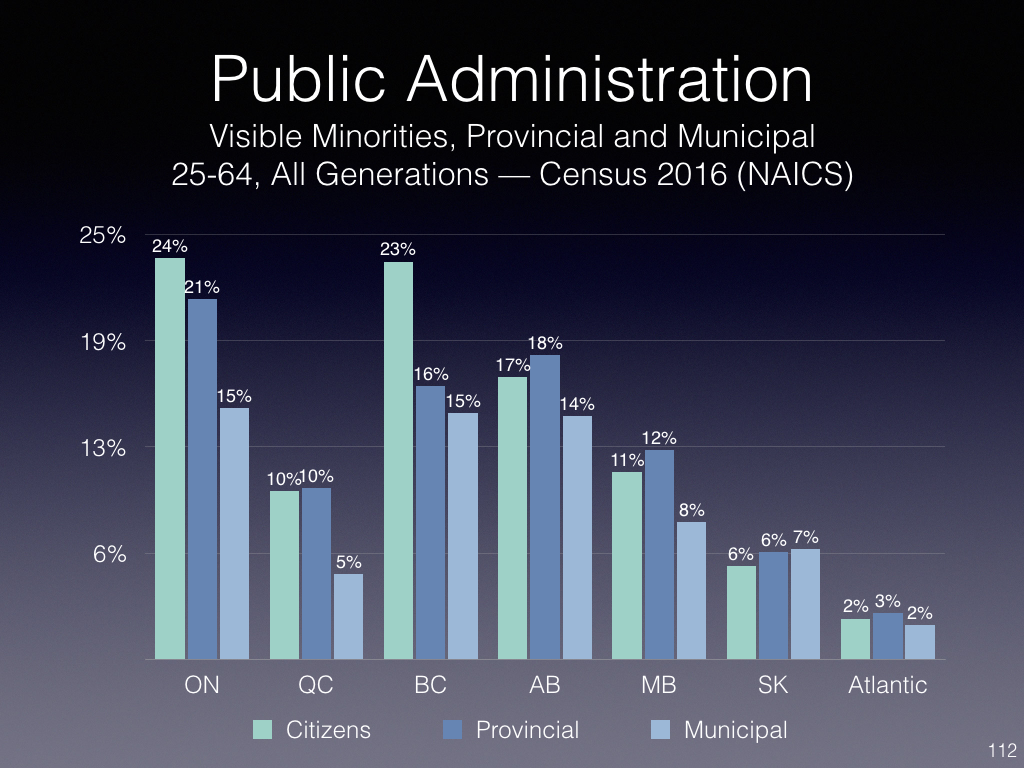
While I do not have breakdowns for senior management in all provinces (not all provide a breakdown like Quebec), this comparative chart on provincial and municipal diversity captures the overall picture (Census 2016 NAICS, visible minority numbers adjusted for citizenship):

Quelque 3% de personnes issues des minorités visibles ont été nommées à des postes de la haute fonction publique depuis 2014. Selon les données compilées par Québec solidaire (QS), parmi les 2330 personnes nommées à ces postes, seulement 72 proviennent des minorités visibles alors que celles-ci représentent 13 % de la population québécoise.

À Montréal, ce taux grimpe toutefois à 22,6 %. Bon an mal an, ce pourcentage est resté le même. De 2014 jusqu’à février 2017, le taux était de 3,7 % . En y ajoutant l’année 2018, en cours, ce taux s’établit à 3 %, selon les calculs de QS, chiffres qu’avait reconnus le Conseil exécutif.

Pour le député de QS Amir Khadir, c’est là un « constat d’échec lamentable » du gouvernement libéral au pouvoir. « Quand on parle de racisme systémique, c’est ça. La machine est structurée de telle sorte qu’elle discrimine, de manière systématique, tout ce qui n’est pas conforme. Ça vient par les accointances et les copinages au sommet », a-t-il déploré. « Si [Philippe Couillard] est sincère, il doit commencer à changer, au lieu de continuer avec des nominations partisanes et intéressées. »

En ce qui concerne plus largement la fonction publique, 9 % des effectifs sont des membres de communautés culturelles, ce qui comprend les minorités visibles et les minorités ethniques (dont la langue maternelle n’est ni le français ni l’anglais). Le gouvernement s’est engagé la semaine dernière à doubler ce pourcentage pour atteindre une cible de représentativité de 18 % des minorités.

via 3% de minorité visible dans la haute fonction publique | Le Devoir