Quebec cabinet shuffle reflects momentum from Trudeau’s gender parity commitment: Hébert

Chantal Hébert gets it right on gender parity in her comments on Quebec Premier Couillard’s recent cabinet shuffle:

But before concluding that this only proves that merit is a casualty of gender politics, ask yourself the following question: if one has to run out of competent male candidates before filling senior posts with equally or more talented women, is it any wonder that gender parity has been so elusive in Canada?

Source: Quebec cabinet shuffle reflects momentum from Trudeau’s gender parity commitment: Hébert | Toronto Star

The niqab election: Commentary by Wherry and Hébert, past controversies

Aaron Wherry has the rights argument nailed down:

At the outset, it should be understood that the niqab debate, or at least this particular niqab debate, is not about the niqab. Whether you like or agree with the niqab is irrelevant. How you would feel about your daughter wearing the niqab is besides the point. You are entitled to your opinion and, given the fraught politics and cultural curiosity that surround the garment, there is a discussion worth having about the niqab, preferably including the voices of the women who wear it. But for the purposes of whether or not the niqab should be banned during the swearing of the citizenship oath by new Canadian citizens your opinion is of no applicability. Proponents of a ban might want to note that, according to public opinion surveys, a large majority of Canadians do indeed oppose the wearing of the niqab during the oath, but this is irrelevant unless you believe that the rights of individuals should be determined by majority rule, that the extent of minority rights are at the whim of the majority.

One’s rights are what is at issue here. And on that note it is fun to note that on Thursday morning, about nine hours before Stephen Harper made his declaration about a women’s sartorial freedom, the Conservatives announced that, if they continue to govern long enough to do so, they will have the federal government purchase John Diefenbaker’s childhood home and declare it a national historic site. Among the accomplishments the Conservatives recognized in explaining the reason for such an honour was Diefenbaker’s Bill of Rights, which acknowledged, among other rights, the freedom of religion. “It will give to Canadians the realization that wherever a Canadian may live, whatever his race, his religion or his colour,” Diefenbaker said in 1960, “the Parliament of Canada will be jealous of his rights and will not infringe upon those rights.”

Diefenbaker’s Bill of Rights was ultimately overtaken by Pierre Trudeau’s Charter of Rights and Freedoms and it is those Charter rights that are relevant (even if a Federal Court judge actually overturned the government’s policy on the niqab because he found it contradicted the Citizenship Act). As Zunera Ishaq‘s lawyers argue in their factum for the Federal Court of Appeal, “The impugned Policy forces the Respondent into an impossible choice: violate a sincerely held religious belief in a significant and material manner, or give up obtaining the Canadian citizenship that she is otherwise entitled to. And it forces this choice on her for no good reason.”

There are no practical justifications for the ban. Confirming an individual’s identity can be done privately before the oath ceremony. Confirming that an individual has said the oath—the practical consideration that Jason Kenney first claimed when he introduced his ban—can be done by having an official stand within earshot.

Jason Kenney has asserted that, based on his consultations, the wearing of a niqab is not properly grounded in religious theology. But we should surely not wish for a country in which ministers of the crown are the arbiters of what constitutes a proper expression of faith. The Supreme Court has set out parameters for legally recognized religious belief (in Syndicat Northcrest v. Anselem and R. v. N.S), and if the case of the niqab ban ever has to be adjudicated on Charter grounds the sincerity of Ishaq’s belief could be tested, but I might suggest that a decent and confident country should give the benefit of the doubt to the claimant unless the welfare of others or the country is somehow threatened.

In Alberta v. Hutterian Brethren of Wilson Colony, the Supreme Court upheld a law that was being challenged on the grounds of religious freedom, but in that case the Court found a “pressing and substantial” goal—specifically, minimizing the potential for identity theft associated with driver’s licences. There is no such goal here. There is only symbolism.

Source: The niqab election – Macleans.ca

A timely reminder of Sikhs wearing turbans in the RCMP. Those who forget history …

The rhetoric over the niqab in the federal election campaign is proving reminiscent of another furor, more than 20 years ago, around the turban and its compatibility with Canadian values and the country’s dearest institutions.

What was allegedly at stake in that debate in the 1990s was the very fabric of the nation, and the sanctity and perhaps survival of an important historic symbol of the country — the Stetson of the Royal Canadian Mounted Police.

Baltej Singh Dhillon, a young practising Sikh, wanted to become a Mountie. But his application to the force led to a kind of turban turmoil and an eventual intervention in Parliament by the Progressive Conservative government of the day.

The debate was featured on newscasts and dominated the public conversation. Political parties took positions on it, including the Reform Party, which deemed allowing the right to wear a turban unnecessary, and went so far as to pass a resolution at its 1989 convention banning such religious attire for the RCMP. At the time, Stephen Harper was a defeated Reform candidate and the party’s policy chief.

Dhillon is now a staff sergeant in the RCMP. The force refused to allow him to speak to CBC News about the turban debate. But in a video story produced by Telus Optik in B.C. and posted online, Dhillon recalled the tone of the debate.

“It was vicious. It was angry. It was emotional. It had all the elements of racism in there. It was a disappointment is what it was,” he said in the video.

“The fear was that we would lose the symbols that defined Canadians and defined our culture and defined who we were and our branding with the rest of the world.”

“And that was the greatest irony: That on one hand, we need to protect our symbols, and in the same breath, we need you to not protect your faith or your religion or your roots.”

Source: Niqab debate recalls RCMP turban furor of the ’90s – Politics – CBC News

Lastly, Chantal Hébert on some of the debates that diverse societies will continue to have and the struggle for balance.

While her conclusion is right, the question is how to have such a discussion in an open and respectful fashion, not used as wedge politics but the Conservatives and Bloc:

And yet, under the guise of this discussion, voters are getting a taste of one of the fundamental debates of the 21st century. It revolves around how the increasingly diverse communities that make up pluralistic societies accommodate their cultural and religious differences and it is not going away after Oct. 19.

Source: Niqab debate leading to wider discussion on religious, cultural accommodation: Hébert | Toronto Star

Proposed niqab ban could be thin edge of the wedge: Hébert

Chantal Hébert speculates on the possible invoking the notwithstanding clause in the event a new Conservative government is elected and, as promised, passes a niqab-banning law:

If the Supreme Court agrees to hear the government’s appeal of its latest reversal, it will not address whether there is an irreconcilable conflict between the charter-guaranteed freedom of religion and a veil ban because that is simply not at issue in this case.

As an aside, if the top court were ever asked to pronounce on whether a veil ban is constitutional, the Conservatives might not like the answer, even if it turned out to be positive.

If the principle of gender equality or the secular character of the Canadian state could sustain a policy that requires the removing of the Muslim veil in order to take a citizenship oath, would the same argument not apply to just about any religion-related vestment or accessory?

The main consequence of the Conservatives’ efforts to keep their technically flawed case alive by appealing it all the way to the Supreme Court has been to turn the matter into a wedge issue in the election campaign.

At is happens, both the Liberals and the New Democrats oppose a ban on veils on constitutional and legal grounds.

The Conservatives are not the only party that believes there are points to be scored on the niqab issue. Support for a veil ban runs nowhere higher than in Quebec, the long-standing locale of a debate over the accommodation of religious minorities.

In a campaign that has the Bloc Québécois clutching at straws to justify its ongoing presence in Parliament, leader Gilles Duceppe has seized on the fact that the NDP — its main opponent in the election — is offside with the majority of voters on the niqab.

Since Bloc-sponsored attack ads came out late last week, NDP campaign signs have been defaced, with the word Islam scrawled across the face of some local Montreal candidates.

This may be only the first half of a larger game to be played out — if the Conservatives secure a majority — after the Oct. 19 election.

Harper has promised, if he is re-elected, to pass the niqab ban into law. If he wanted to pre-emptively bulletproof such a law from an all-but-certain charter challenge, he could use the notwithstanding clause of the Constitution.

It allows governments to shelter a law from the dispositions of the charter for a renewable period of five years. Over its 30-plus years of existence, it has never been used at the federal level. Some Conservative strategists have been shopping for an issue consensual enough to allow their government to break what has become a political taboo.

Support for the niqab ban extends well outside the Conservative base. It enjoys the backing of many progressive Canadians, including more than a few feminists. It would be tailor-made for that purpose.

Those same strategists believe that once the ice is broken, the use of the notwithstanding clause to suspend the fundamental freedoms that get in the way of the government’s legislative ambitions could eventually become as banal as the now-routine production of catch-all budget bills.

From medically assisted suicide to life imprisonment without parole and including supervised injection sites for drug addicts, the list of issues on which the Conservatives could find it convenient to free themselves of an inconvenient charter of rights is an extensive one.

Alberta’s politics have inevitably become more diverse: Hébert

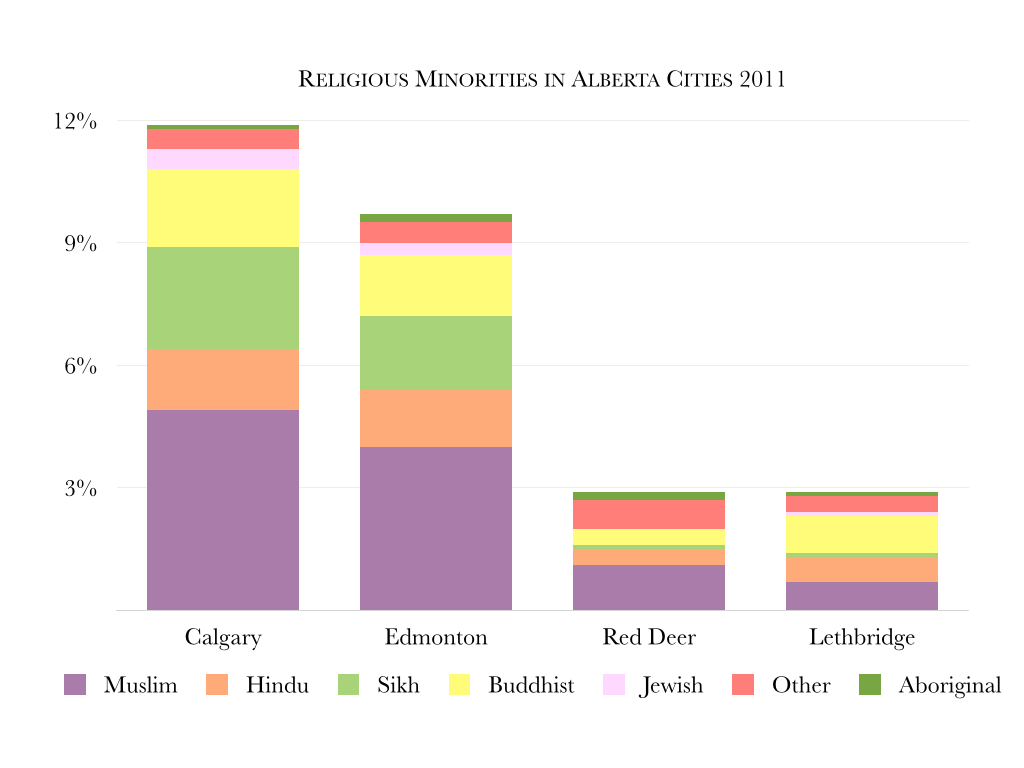
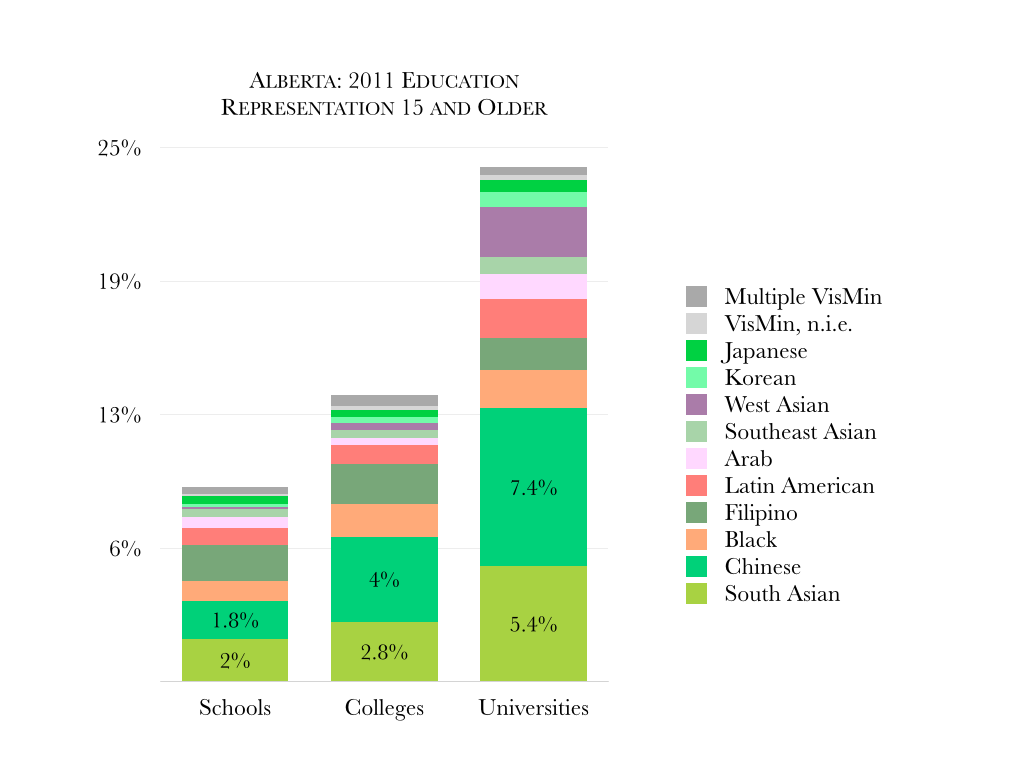
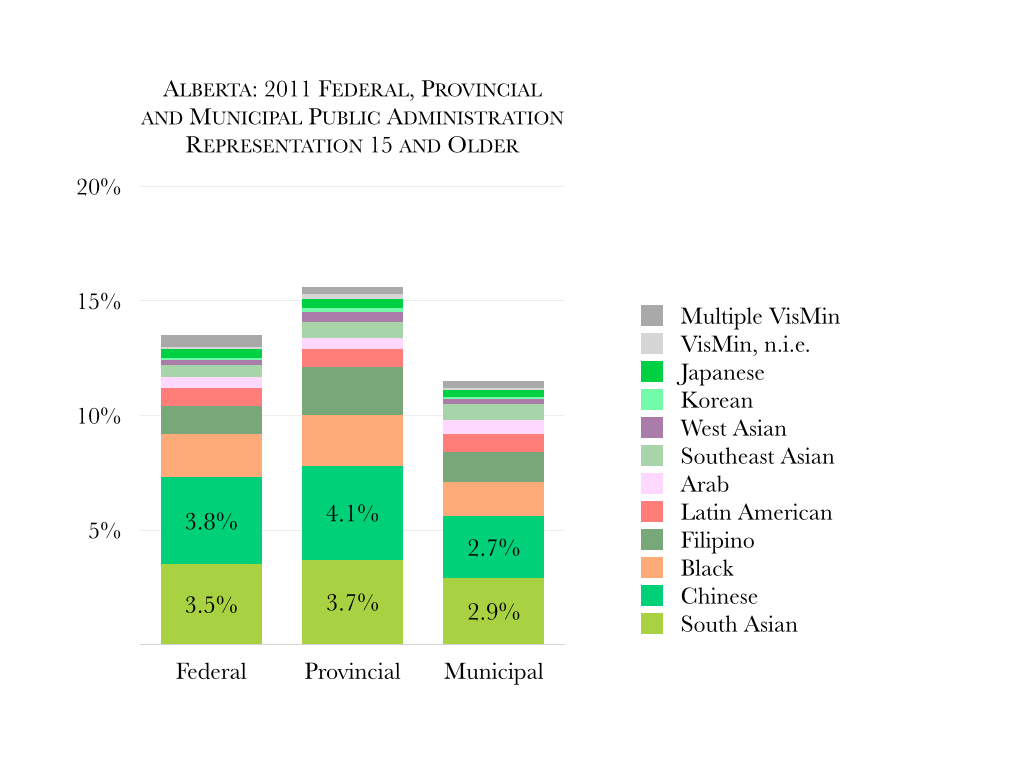
Aberta Key Slides.001 Aberta Key Slides.002 Aberta Key Slides.003 Aberta Key Slides.004 Aberta Key Slides.005

On the eve of the Alberta election, the national media finally notices that Alberta has changed.

The above charts from my forthcoming book, Multiculturalism in Canada: Evidence and Anecdote, highlight this change from a diversity angle, with Alberta having overtaken Quebec as Canada’s third most diverse province, with strong visible minority representation in healthcare, social services, universities, and provincial government public administration.

Chantal Hébert on the change:

As Alberta goes provincially on Tuesday, it will not automatically go federally. The dynamics of the two back-to-back campaigns are strikingly different.

But over the longer term it would be unwise for the federal Conservatives to bet that their virtual monopoly on Canada’s fourth largest province is immune to the tectonic shift that may see the NDP in power in Edmonton after next week.

In the big picture, it was actually only a matter of time before Alberta’s politics became more diverse.

Sooner or later, the changing demographics of the province were bound to impact on its voting patterns.

Its population has been growing faster than the Canadian average. Its median age (37) is the lowest of the four big provinces.

There is not a poll that does not show that the younger the electorate the better the NDP, the Liberals and the Greens fare versus the Conservatives.

The emergence of the NDP as the leading candidate for provincial government is the biggest crack to date in the monolithic facade of Alberta, but it is not the first one.

That was preceded in 2010 by the election in Calgary in 2010 of Naheed Nenshi, a mayoral candidate who was an outsider to the city’s power circles.

Then there was the taking of an Edmonton riding a year later by NDP MP Linda Duncan with more than 50 per cent of the vote cast and, a year after that, the rise to a close second place of Justin Trudeau’s Liberals in a 2012 Calgary byelection. (In that vote the Green Party came a respectable third with 25 per cent support.)

Even more recently the Trudeau Liberals won 35 per cent of the vote in Fort McMurray — the riding that current Wildrose Leader Brian Jean used to hold during his eight years as a Harper MP.

To predict that Alberta will increasingly take on shades other than blue is not to predict the demise of the federal Conservative party but it is to foresee an ultimately healthier federal political environment.

A more diverse Alberta voice at the national level would be a positive development both for the province and for Canada’s political life.

Alberta’s politics have inevitably become more diverse: Hébert | Toronto Star.

Supreme Court rules against prayer at city council meetings and selected commentary

Lot’s of coverage of the SCC decision on regarding prayer city council meetings, starting with the basics:

In 2008, city officials initially changed the prayer to one it deemed more neutral and delayed the opening of council by two minutes to allow citizens a window to return follow the reciting.

The Supreme Court said Canadian society has evolved and given rise to a “concept of neutrality according to which the state must not interfere in religion and beliefs.”

“The state must instead remain neutral in this regard,” the judgment said.

“This neutrality requires that the state neither favour nor hinder any particular belief, and the same holds true for non-belief. It requires that the state abstain from taking any position and thus avoid adhering to a particular belief.

“When all is said and done, the state’s duty to protect every person’s freedom of conscience and religion means that it may not use its powers in such a way as to promote the participation of certain believers or non-believers in public life to the detriment of others.”

The City of Ottawa quickly reacts with a sensible approach: a minute of silence and reflection:

In Ottawa, Mayor Jim Watson replaced the prayer with a moment of silence — even though he said the prayer councillors have been reciting for years was non-denominational.

“I always thought that our prayer was very respectful of all religions and cultures. But the court has ruled and we’ll take the ruling seriously. The alternative I believe would make some sense is to offer, as we did today, a moment of personal reflection and people can pray themselves personally and privately,” Watson said.

Supreme Court rules against prayer at city council meetings – Montreal – CBC News.

Best commentary seen to date:

The Court didn’t bite. It lacked evidence of the circumstances and purpose of the Commons prayer, Justice Gascon argued, and besides, it might be covered by parliamentary privilege. That might save it from the judiciary; it shouldn’t save it from Canadians’ scrutiny. While Maurice Duplessis’ crucifix still looms over the speaker’s chair in Quebec City, the National Assembly abandoned its introductory prayer nearly 40 years ago in favour of a moment of reflection — one in which members and others can gather courage and inspiration from whichever sources, earthly or otherwise, they choose. That’s an idea worth reflecting on.

National Post Editorial: The separation of prayer and council

But perhaps the part of the judgment that will be read most carefully by justice officials and their political masters is the section that spells out that a neutral public space is not one that obliterates religious diversity.

In paragraph 74 of the judgment, and almost as an aside from its core narrative, Justice Clément Gascon writes: “I note that a neutral public space does not mean the homogenization of private players in that space. Neutrality is required of institutions and the state, not individuals.”

He adds for good measure: “. . . a secular state does not — and cannot — interfere with the beliefs or practices of a religious group unless they conflict with or harm overriding public interests.”

That amounts to a red light flashing in the face of any government contemplating — as Quebec recently did — the imposition of a secular dress code on its public sector employees.

It also suggests that the federal government, should it want the court to give its ban on face-covering niqabs at citizenship oath ceremonies a green light, may have to come up with a pretty compelling demonstration of the “overriding public interest” served by such a measure.

Canadian legislators will have to pay attention to Supreme Court’s prayer ruling: Hébert

Pierre Karl Péladeau fait volte-face et s’excuse

Once the cat is out of the bag…

Les mots ont un sens. Les mots ont un poids. Le favori de la course à la direction du Parti québécois, Pierre Karl Péladeau, a reconnu jeudi soir avoir eu tort de présenter l’immigration comme un obstacle sur le chemin du pays du Québec.

Le PQ doit « rassembler le plus large possible », a fait valoir M. Péladeau lors d’une causerie entre les cinq prétendants à la succession de Pauline Marois et des militants péquistes de la région du Centre-du-Québec.

En route vers le motel Blanchet à Drummondville, le député de Saint-Jérôme a mis en ligne sur sa page Facebook un message intitulé « Mes excuses ». « Ça m’apparaissait important de chasser l’ambiguïté parce qu’il faut que ce soit clair, net et précis : […] ceux et celles qui ont décidé de venir s’installer ici au Québec, c’est une richesse pour le Québec », a-t-il répété une fois arrivé à destination.

… Les propos tenus par M. Péladeau mercredi soir attestent de la « déviation claire vers le nationalisme ethnique » prise par le PQ, estime le premier ministre Philippe Couillard. « Depuis la charte, il y a une dérive très malheureuse. Il n’y a plus d’arguments financiers [et] économiques pour la séparation du Québec. Alors, on essaie de s’accrocher à n’importe quoi », a déclaré le chef du gouvernement à l’entrée du caucus libéral. « D’après moi [cela] doit faire frémir ceux qui ont fondé ce parti-là. »

De son côté, le ministre Gaétan Barrette a reproché au PQ d’importer l’idéologie du Front national, parti d’extrême droite français, en sol québécois. « Le Parti québécois est en train de montrer son vrai visage. C’est un parti sectaire », a-t-il lancé.

Pierre Karl Péladeau fait volte-face et s’excuse | Le Devoir.

And Chantal Hébert’s commentary on the PQ leadership campaign:

PQ blind spot keeps Pierre Karl Péladeau the party favourite: Hébert

Parti québécois : l’aveuglement volontaire – Hébert

Chantal Hébert on the PQ remaining in denial mode:

Pendant que les ténors du PQ s’entêtaient — sur deux décennies — à vouloir prendre un non pour un peut-être, la majorité des Québécois sont passés à autre chose. Les résultats de l’élection en témoignent : l’écart entre le désir des uns et la réalité des autres est sans précédent.

Depuis le 7 avril, bien des militants souverainistes se consolent en se souvenant que la situation semblait aussi désespérée au moment de la signature de l’accord du lac Meech, en 1987. À l’époque, l’avenir de la souveraineté semblait compromis à tout jamais par la négociation d’un projet de réconciliation constitutionnelle entre le Québec et le Canada. De plus, le gouvernement fédéral de l’époque était dirigé par un Québécois, le progressiste-conservateur Brian Mulroney, disposé à favoriser le retour de sa province dans le giron fédéraliste en faisant une large place à ses compatriotes nationalistes dans la direction des affaires à Ottawa. Trois ans plus tard, l’échec spectaculaire de Meech avait plutôt donné un souffle inespéré à l’option souverainiste.

Les circonstances sont radicalement différentes aujourd’hui. Au bout du vote fédéraliste du 7 avril, il n’y avait aucune carotte constitutionnelle. Pendant la campagne électorale, personne à Ottawa — pas même les rares Québécois qui sont dans les coulisses conservatrices du pouvoir — n’a fait miroiter de grandes perspectives de changement. Le gouvernement libéral majoritaire de Philippe Couillard a été élu sans l’obligation d’obtenir des résultats sur le front des relations Québec-Canada.

Cette fois-ci, le reste du Canada ne viendra pas à la rescousse du Parti québécois.

Parti québécois : l’aveuglement volontaire – L’actualité.

Quebec Election – Initial Reactions

Quite an evening last night, watching the QC election results. Apart from the famous Peladeau raised fist for independence miscalculation, this election hopefully marks the end of divisive identity politics as exemplified in the QC Charter of Values. The gambit clearly did not work in combination with the referendum uncertainty and even Premier Marois’ overall gracious concession speech still played to les Québécois de souche, rather than the more inclusive messages of Couillard and Legault.

Clearly, the PQ needs a period of serious internal reflection and introspection. The leading candidates to replace former Premier Marois will need to get over their Kubler-Ross denial phase quickly (Drainville, Lisée and Peladeau were awful last night preaching to the shrunken PQ base) and it will be interesting to see the how the relative positions of the PQ and the CAQ evolved over the next few years.

I would not go so far as Andrew Coyne or Chantal Hébert as saying the PQ’s raison d’être of independence is completely dead, but it certainly would appear to be on life support.

From Le Devoir, a few articles on the magnitude of the PQ defeat:

À son premier test électoral, le chef libéral a fait des gains dans presque toutes les régions du Québec. Il a peint en rouge toute la ville de Laval et a arraché deux circonscriptions au PQ sur l’île de Montréal, en plus de remporter des sièges dans le Centre-du-Québec et dans la région de Québec, notamment. Le Dr Gaétan Barrette, candidat vedette parachuté contre l’indépendante Fatima Houda-Pepin, a facilement remporté la circonscription de La Pinière, sur la Rive-Sud.

Philippe Couillard met le PQ K.-O.

Avant même que ne commence le dévoilement des votes dans les circonscriptions, plusieurs membres du personnel péquiste concédaient la victoire au Parti libéral. Un consensus se dégageait : la campagne menée par Pauline Marois avait été désastreuse et on se promettait un bilan aussi exhaustif que sévère. Une majorité d’entre eux espéraient à tout le moins une défaite honorable, mais jamais les stratèges, appuyés par des sondages quotidiens faits selon les règles de l’art, n’avaient prévu pareille dégelée.

Catastrophe au Parti québécois

More commentary on the significance of the elections will come in the next few days but for some of the initial commentary:

Au Parti québécois, cette défaite provoquera de douloureux questionnements. La formation fondée par René Lévesque devra remettre en question le virage identitaire pris au cours des dernières années, virage qui, pour des raisons strictement partisanes, a fait un tort considérable au Québec.

Encore plus difficile sera la réflexion sur la raison d’être du PQ, l’indépendance. Quel que soit l’aboutissement de cette introspection, les résultats d’hier devraient inciter les péquistes à abandonner la stratégie de l’équivoque au profit de celle de la clarté.

Les Québécois ont dit NON (André Pratte, La Presse)

And finally, who leads this decimated party? Because the knives are already out. Drainville, Lisée and Péladeau prefixed Marois’s farewell speech with what amounted to stump speeches. This pack of restless egos all come with their own baggage: Péladeau is a capitalist boogeyman who derailed the whole campaign by declaring his sovereignist credentials. Drainville designed and executed the whole charter gambit, then thoroughly bellyflopped. Lisée went along with both, because he thought Péladeau and the charter was the one-two punch that, to paraphrase the title of his own book, would deliver a K.O. to the opposition.

Macleans. (Martin Patriquin)

It is impossible to overstate what a watershed this is. For thirty years after the Quiet Revolution, Quebecers were told the choice before them was either special status, under whatever name, or separation. At times the two were so blurred in definition that each could be made out to be the other. But what was clear was that they weren’t the status quo. They were better, in all sorts of fantastic ways….

But in the years since then, and in particular since the Secession Reference and the Clarity Act, it has slowly been dawning on Quebecers: neither of these choices is actually available. The choice is the status quo or the status quo. The rest of Canada is simply unwilling to make any more constitutional concessions, and wouldn’t be able to deliver them if it did, so tied up in knots has the constitutional amending formula become. Ditto separation: even if the rest of Canada tried to be helpful, the negotiations would go nowhere.

And as that realization has begun to sunk in, another, equally startling, has begun to take hold: The status quo is not so bad. We are not oppressed. We are not impoverished. We are not miserable. As Mr. Couillard said during the campaign, “we are happy in Canada.” What a revelation!

Quebecers have not only just said no to separation, but yes to the 1982 Constitution (Andrew Coyne)

Over the past month, that self-imposed tone-deafness has led to a campaign of false notes, from the second-coming atmosphere that attended the recruitment of media mogul Pierre Karl Péladeau as a star candidate, to Marois’s end-of-campaign mea culpa that she spent too much time entertaining the twin notions of sovereignty and a winning referendum.

One of the PQ’s worst fears has long been that it would turn out to be the party of a single generation.

Over their short time in office, Marois and her team have done much to turn that fear into a self-fulfilling prophecy.

It has long been apparent that the so-called secularism charter that has been the signature initiative of the outgoing government repelled more young Quebecers than it attracted to the secessionist cause.

For the first time in its history, the PQ is more popular among older voters aged 55 and over than among any other age group.

Parti Québécois could be party of a single generation:  Chantal Hébert

Expect Pauline Marois to seek sovereignty diversion: Hébert | Toronto Star

While Hébert’s assessment may change somewhat after the leader debates, a good assessment of the PQ’s electoral strategy:

And so the word is that Marois will seek salvation in a diversion.

Over the remaining two weeks of the campaign, the PQ is expected to go harder on its plan for a secularism charter. The project is as polarizing as the notion of a referendum but in a positive sense for the sovereigntist party.

It remains to be seen whether enough voters will decide that their support for the charter outweighs their opposition to another referendum to reverse the momentum of the campaign in the PQ’s favour.

According to CROP, the charter is a priority for only a fraction of its supporters. And fatigue with that debate is even more prevalent among Quebecers than fatigue with the referendum issue. Still, from the PQ’s electoral perspective, a tired horse is better than a lame horse.

Expect Pauline Marois to seek sovereignty diversion: Hébert | Toronto Star.

Further illustration of charter strategy seen in Minister Drainville’s most recent comments,  and making the plea for majority government:

Only way to save charter is through majority government: PQ

Drainville is also playing on the fears of the niqab/burka, and extending the Charter to include students, not just teachers and professors, relying on anecdotes of a few students at Concordia  (the exchange with the reporter is worth reading). I do find the niqab/burka in Western countries symbolizes rejection of integration, in contrast to kippas, turbans, hijabs, crucifixes etc.:

Ban the burka for students, Parti Québécois says

Quebec Values Charter and Elections

More catching up, starting with the polling numbers:

http://www.lapresse.ca/actualites/dossiers/charte-de-la-laicite/201403/03/01-4744020-lappui-a-la-charte-est-maintenant-majoritaire.php

Continuing with running on the Charter, confirming identity politics rather than substance:

http://www.lapresse.ca/actualites/politique/politique-quebecoise/201403/04/01-4744656-marois-veut-une-majorite-pour-adopter-la-charte.php

No surprise that allophones and anglophones see the Charter primarily targeting Muslim women:

http://www.cbc.ca/news/canada/montreal/most-anglos-allophones-say-secular-values-charter-targets-muslim-women-1.2558409?cmp=rss

A rare declaration of principle from the a senior staffer in Jean-Francois Lisée’s office:

http://www.lapresse.ca/actualites/politique/politique-quebecoise/201403/04/01-4744694-lisee-perd-sa-directrice-de-cabinet-adjointe-a-cause-de-la-charte.php

A wide range of commentary on the elections, and have selected only a few. From the Globe, Antonia Maioni’s fatalistic prediction, The PQ’s appeal is locked in, a more nuanced assessment by Chantal Hébert, Quebec election not a foregone conclusion, and Daniel Weinstock’s longer-term perspective, Québec at a Crossroads

Following the announcement of Pierre Karl Peladeau, the owner of Quebecor, Quebec’s media conglomerate, that he will run as a PQ candidate, lot’s of commentary and speculation what this means in the short and long-term. Summary by Chris Selley in the National Post provides a good sense of reactions, Full Pundit: Will Péladeaumania cure Marois malaise? Makes it clear sovereignty is on the agenda despite Maurois’s calculated ambiguity.

Lastly, a reminder that the election call meant the end of Parliamentary hearings on the proposed Charter, including this good brief from the Montreal Holocaust Centre, which has done good work in engaging the diverse communities in Montreal on Holocaust and intolerance issues:

http://www.montrealgazette.com/touch/story.html?id=9593693