Andrew Sullivan: The Abyss of Hate Versus Hate

While it doesn’t excuse the wearing of MAGA hats – after two years of President Trump, hard to deny that it has become a symbol of racism – does provide needed calling out of the Black Hebrew Israelites and the risks of tribalism:

One of the advantages of taking Saturdays off the web entirely is that I wasn’t aware of L’Affaire Covington until it was almost over. It’s one of those occasions I’m deeply glad I quit blogging 24/7 four years ago and disengaged from Twitter last month. I’m not going to dunk on the multitudes who badly misjudged a moment in time. We’re all fallible. But I did make time to watch the full 100 minutes of YouTube footage that covered the scene in front of the Lincoln Memorial long before, during, and after the smirk that was seen across the world.

What I saw was extraordinary bigotry, threats of violence, hideous misogyny, disgusting racism, foul homophobia, and anti-Catholicism — not by the demonized schoolboys, but by grown men with a bullhorn, a small group of self-styled Black Hebrew Israelites. They’re a fringe sect — but an extremely aggressive one — known for inflammatory bigotry in public. The Southern Poverty Law Center has designated them a hate group: “strongly anti-white and anti-Semitic.” They scream abuse at gays, women, white people, Jews, interracial couples, in the crudest of language. In their public display of bigotry, they’re at the same level as the Westboro Baptist sect: shockingly obscene. They were the instigators of the entire affair.

And yet the elite media seemed eager to downplay their role, referring to them only in passing, noting briefly that they were known to be anti-Semitic and anti-gay. After several days, the New York Times ran a news analysis on the group by John Eligon that reads like a press release from the sect: “They shout, use blunt and sometimes offensive language, and gamely engage in arguments aimed at drawing listeners near.” He notes that “they group people based on what they call nations, believing that there are 12 tribes among God’s chosen people. White people are not among those tribes, they believe, and will therefore be servants when Christ returns to Earth.” Nothing to see here, folks. Just a bunch of people preaching the enslavement of another race in public on speakers in the most inflammatory language imaginable.

Eligon actually writes: “Whatever tensions are sparked by Hebrew Israelite teaching, some adherents chalk that up to people being unwilling to accept uncomfortable doctrine.” The Washington Post ran a Style section headlineabout “the calculated art of making people uncomfortable.” In a news storyentirely about the Black Israelites, the Washington Post did not quote a single thing they had said on the tape, gave a respectful account of their theology, and only mentioned their status as a “hate group” in the 24th paragraph, and put the term in scare quotes. Vox managed to write an explainer that also did not include a single example of any of the actual insults hurled at the Covington kids. Countless near-treatises were written parsing the layers of bigotry inside a silent schoolboy’s smirk.

Here’s what I saw on the full tape: a small group of aggressive, hateful men using a bullhorn to broadcast the crudest of racial slurs, backed up by recitations of Bible verses. I saw a young Native American woman make the mistake of engaging them. When she stood her ground, she was suddenly interrupted: “You’re out of order. Where’s your husband? Where’s your husband? Let me speak to him.” On the tape, you can hear the commentary from another member of the Black Israelites: “You see this? This is the problem, Israel. It’s always our women coming up with their loud mouth, thinking they can run and bogart things, thinking they can come and distract things with their loud-ass mouth, because they’re not used to dealing with real men. You think we’re supposed to bow down to your damn emotions when you come around here and run your mouth and distract what we’re doing instead of coming here with order … She’s coming around here being wicked.”

Wait, there’s more. Hollering through a bullhorn at a group of Native Americans, the speaker boomed: “You ain’t no child of God. You are the Indian. You are a blue-eyed demon. That’s the last Mohican.” Then: “You’re still worshipping totem poles. You out of your mind! You have to repent. You worship the buffalo. You worship the eagle. You worship the phoenix. These are the idols you’ve been worshipping. A damn buffalo ain’t gonna save you. You worship the creations and not the creator … That’s why you’re drunkards in the casinos and the damn plantation.” Another: “Dumb-ass niggers. Bunch of demons. You’re a bunch of Uncle Tomahawks.” They snarled the word “savages” at Native Americans. The yelling was deafening, aggressive, vile, and threatening. But an inscrutable smile by a white teen was enough for some elite liberals to urge punching a schoolboy in the face.

Here is how the Black Israelites verbally assaulted the schoolboys: “Bring your cracker ass up here. Dirty ass crackers, your day coming. We can give a hell about your police. No one’s playing with these dusty-ass crackers.” Another: “Don’t get too close or your ass gonna get punished … You crackers are some slithery ass bastards. You better keep your distance.” And this, surveying the scene: “I see you, a bunch of incest babies … Babies made out of incest. If you’re the great damn nation, get rid of the lice on your back. … You’re a bunch of hyenas. You outnumber us but you keep your distance. You couldn’t touch us if you wanted to. You worship blasphemy.”

Then they took it up a notch: “Look at these dirty-ass crackers. You’re a bunch of future school-shooters. You crackers are crazy. You crackers have got some damn nerve …” And again: “When you guys gonna shoot up another school? You all gonna shoot up a school.” Yes, the man was accusing a bunch of schoolboys from Kentucky of wanting to murder their classmates — solely because they’re white.

Once the Israelites figured out the kids were Catholic, they offered this about what appeared to be a picture of the Pope: “This is a faggot child-molester.” And this about Donald Trump: “He’s a product of sodomy and he’s proud. Your president is a homosexual. … It says on the back of the dollar bill that ‘In God We Trust,’ and you give faggots rights.” At that homophobic outburst, the kids from the Catholic school spontaneously booed.

The boys — stuck waiting for a bus — decided to respond to this assault by performing school chants. Most look a little bewildered, as one might imagine. Some even tried to engage. Here are the spoken words I heard, in response to the abuse: “That’s racist, bro.” “That’s rude.” “Why are you being mean? Why do you call us Klansmen?” “We don’t judge you.” One of them offered to shake hands, and was rebuffed. Another offered some water from a plastic bottle. The response? “You got some Trump water? What does it taste like? Incest?”

Yes, the boys did chant some school riffs; I’m sure some of those joining in the Native American drumming and chanting were doing it partly in mockery, but others may have just been rolling with it. Yes, they should not have been wearing MAGA hats to a pro-life march. They aren’t angels; they’re teenage boys. But they were also subjected for quite a while to a racist, anti-Catholic, homophobic tirade on a loudspeaker, which would be more than most of us urbanites could bear — and they’re adolescents literally off the bus from Kentucky. I heard no slurs back. They stayed there because they were waiting for a bus, not to intimidate anyone.

To put it bluntly: They were 16-year-olds subjected to verbal racist assault by grown men; and then the kids were accused of being bigots. It just beggars belief that the same liberals who fret about “micro-aggressions” for 20-somethings were able to see 16-year-olds absorbing the worst racist garbage from religious bigots … and then express the desire to punch the kids in the face.

How did this grotesque inversion of the truth become the central narrative for what seemed to be the entire class of elite journalists on Twitter? That’s the somewhat terrifying question. Ruth Graham on Slate saw a 16-year-old she’d seen on a tape for a couple of minutes and immediately knew that he was indistinguishable from the “white young men crowding around a single black man at a lunch counter sit-in in Virginia in the 1960s” or other white “high school boys flashing Nazi salutes.” Even after the full context was clear, Graham refused to apologize to the kid, or retract her condemnation: The context didn’t “change the larger story” which, she explained, was bigotry toward Native Americans. She cited Trump’s use of the name “Pocahontas” for Elizabeth Warren as evidence. But using a bullhorn to call Native Americans “savages” and “drunkards at the casino” to their faces a few minutes earlier on the same tape was not worth a mention?

Graham was just one media voice among countless others, and I don’t mean to single her out. The reason I do is because her argument about the fuller context is now the norm in elite media, and it’s the underlying reason for the instant judgment. “Racism” now only means “prejudice plus power,” so what the adult Black Israelites yelled was nowhere near as bad as what a white teenager didn’t say. No empirical evidence could ever deny that underlying truth, as a piece at Deadspin insisted, after admitting that, well yes, there were “four black men who seem to belong to the Black Israelites … yelling insults.” No mention of the content of those insults, of course.

Across most of the national media, led by the New York Times and the Washington Post, the narrative had been set. “I’m willing to bet that fifty years from now, a defining image of this political era will be that smug white MAGA teen disrespecting a Native elder and veteran. It just captures so much,” Jessica Valenti tweeted. “And let’s please not forget that this group of teens … were there for the March for Life: There is an inextricable link between control over women’s bodies, white supremacy & young white male entitlement.” This is the orthodoxy of elite media, and it is increasingly the job of journalists to fit the facts to the narrative and to avoid any facts that undermine it.

There’s a reason why, in the crucial battle for the legitimacy of a free press, Trump is still on the offensive. Our mainstream press has been poisoned by tribalism. My own trust in it is eroding. I’m far from the only one.

The other night I was having a drink with a friend who said he believed that the Trump threat was essentially over, as the shutdown took its toll. He noted what might become an inflection point in the polling. He was heartened by the midterms. He might be right. But I think that misses the core point about this presidency. From my perspective, the Trump threat to liberal democracy is deepening, largely because its racial animus and rank tribalism are evoking a response that is increasingly imbued with racial animus and rank tribalism, in an ever-tightening spiral of mutual hostility.

“The red MAGA hat is the new white hood,” tweeted Alyssa Milano. In his debut Times column, Jamelle Bouie describes a border wall thus: “You can almost think of the wall as a modern-day Confederate monument, akin to those erected during a similar but far more virulent period of racist aggression in the first decades of the 20th century.” Charles Blow insists that “We have to stop thinking of the symbology of Trump’s presidency — the MAGA hats, the wall, etc — as merely physical objects. They have long since lost their original meaning and purpose. They are now emblems. They are now the new iconography of white supremacy … In much the same way that the confederate flag became a white supremacy signalling device, the MAGA hat now serves the same purpose. It is tangentially connected to Trump, but is transcends him also. It’s a way of cloaking racial hostility in the presentable form of politics.” A campaign slogan for a candidate who won the votes of 46 percent of the country in 2016 is to be seen as indistinguishable from the Confederate flag. This is not the language of politics. It is a language of civil war.

I can understand this impulse emotionally as a response to Trump’s hatefulness. But I fear it morally or politically. It’s a vortex that can lead to nothing but the raw imposition of power by one tribe over another. There can be no dialogue here, no debate, not even a State of the Union in which both tribes will participate. And none of us is immune.

What was so depressing to me about the Covington incident was how so many liberals felt comfortable taking a random teenager and, purely because of his race and gender, projected onto him all their resentments and hatred of “white men” in general. Here is Kara Swisher, a sane and kind person, reacting to the first video: “To all you aggrieved folks who thought this Gillette ad was too much bad-men-shaming, after we just saw it come to life with those awful kids and their fetid smirking harassing that elderly man on the Mall: Go fuck yourselves.” Judging — indeed demonizing — an individual on the basis of the racial or gender group he belongs to is the core element of racism, and yet it is now routine on the left as well as the right. To her great credit, Kara apologized profusely for the outburst. The point here is that tribal hatred can consume even the best of us.

And this is what will inevitably happen once you’ve redefined racism or sexism to mean prejudice plus power. It’s reasonable to note the social context of bigotry and see shades of gray, in which the powerful should indeed be more aware of how their racial or gender prejudice can hurt others, and the powerless given some slack. But if that leads you to ignore or downplay the nastiest adult bigotry imaginable and to focus on a teen boy’s silent face as the real manifestation of evil, you are well on your way to creating a new racism that mirrors aspects of the old.

This is the abyss of hate versus hate, tribe versus tribe. This is a moment when we can look at ourselves in the mirror of social media and see what we have become. Liberal democracy is being dismantled before our eyes — by all of us. This process is greater than one president. It is bottom-up as well as top-down. Tyranny, as Damon Linker reminded us this week, is not just political but psychological, and the tyrannical impulse, ratcheted up by social media, is in all of us. It infects the soul of the entire body politic. It destroys good people. It slowly strangles liberal democracy. This is the ongoing extinction level event.
In the dark: The cost of Canada’s data deficit

This incredibly valuable investigative reporting. I have excerpted a few of the sections I found most interesting but the entire article is worth a good read, and I look forward to future segments in this series.

I use StatsCan and other data frequently and generally find I can find what I need, or an alternate way to identity issues and trends. So I do have some sympathy for StatsCan Head Anora’s comments that sometimes researchers don’t try hard enough (e.g., see my critique of Karen Robson: Why won’t Canada collect data on race and student success?, weak to non-existent municipal diversity statistics can be found in census occupation group data).

But the example of birth statistics is where I cam up short. The vital statistics agencies do not capture visible minority data or accurate residency data, and do not verify identity documents of the parents. All of which mean, in addition to the all important health-related differences, that births to non-residents are drastically undercounted by StatsCan (in the end, I found better if imperfect numbers from hospital financial statistics: Hospital stats show birth tourism rising in major cities).

I look forward to their analysis of the data available on the government’s open data website as I did an analysis a few years back on the IRCC datasets, the most comprehensive ones available, but where timeliness is becoming an issue (IRCC Datasets: What they say about government priorities):

….

And yet, in fields ranging from public health to energy economics to the labour force to the status of children with disabilities, there’s a lot that Canada simply doesn’t know about itself.

Consider that we don’t have a clear national picture of the vaccination rate in particular towns and cities. We don’t know the Canadian marriage or divorce rate. We don’t know how much drug makers pay the Canadian doctors who are charged with prescribing their products. We don’t have detailed data on the level of lead in Canadian children’s blood. We don’t know the rate at which Canadian workers get injured. We don’t know the number of people who are evicted from their homes. We don’t even know how far Canadians drive – a seeming bit of trivia that can tell us about an economy’s animal spirits, as well as the bite that green policies are having.

Our ignorance is decades in the making, with causes that cut to the heart of Canada’s identity as a country: provincial responsibility for health and education that keeps important information stuck in silos and provides little incentive for provinces to keep easily comparable numbers about themselves; a zeal for protecting personal privacy on the part of our statistical authorities that shades into paranoia; a level of complacency about the scale of our problems that keeps us from demanding transparency and action from government; and a squeamishness about race and class that prevents us from finding out all we could about disparities between the privileged and the poor.

But if the problem has deep roots, it has never mattered more. We live in a data-driven age, when the internet and the processing power of computers has made it easier than ever to hoover up statistics about a society, make them public and accessible, and crowdsource better decisions about how to deliver everything from income support to green incentives to job training. Governments around the world have harnessed that power to make themselves smarter, leaner and more effective.

…

But government data are a different thing. It’s the information that various ministries, agencies and bureaus collect about citizens through administrative sources – such as tax filings and birth records – and questionnaires such as the census and community surveys. And unlike the tech companies that probe our digital lives for profit, governments aren’t in the business of caring what the numbers say about us individually: They’re looking for patterns.

The best way to spot trends is to enlist the public’s help by making your data open. At its best, this produces a charmed cycle: The government collects numbers, makes them anonymous and puts them on a website; a researcher, or even an ordinary citizen, notices something in the numbers (a spike in deaths! or a decline in productivity!); the government hears the alarm and can begin figuring out ways to address the problem.

….

In Canada, though, this cycle too often breaks down. Either the government hasn’t collected the relevant numbers or it won’t make them public. Important questions go unanswered. That’s especially dangerous for Canadian patients: Our health-care system is pockmarked with data gaps that leave people unsure of the quality and integrity of the care they’re getting, and leaves us in the dark about whether the system is meeting people’s needs.

….

No one asks themselves that question more often than academics. They are patient zero for Canada’s data-gaps epidemic. And the frustration they experience has implications for us all: When scholars work without access to proper data, they are unable to tell us stories about our world and ourselves that can only be unearthed when expert analysis is applied to a thorough rendering of the raw facts.

Lindsay Tedds, a professor of economic policy at the University of Calgary, has been struck recently by the difference, between the United States and Canada, regarding one of the most fundamental subsets of demographic data: birth records.

To begin with, the standard U.S. certificate of live birth collects all kinds of detailed information about the child’s parents – particularly their level of education and their race. “We know that African-American women die in childbirth at an alarming rate. We know that non-white babies are born smaller and earlier,” says Prof. Tedds. “Both of these factors are highly related to [the] poverty of the parents.” In Canada the picture is far less clear. “Imagine,” she says, “if we had similar detailed, population-level data, including for pregnancy and birth outcomes, for Indigenous moms.”

But even if the records were more detailed, she notes, the information would be harder to dig out: “The United States birth data, you just go onto a website and download it.”

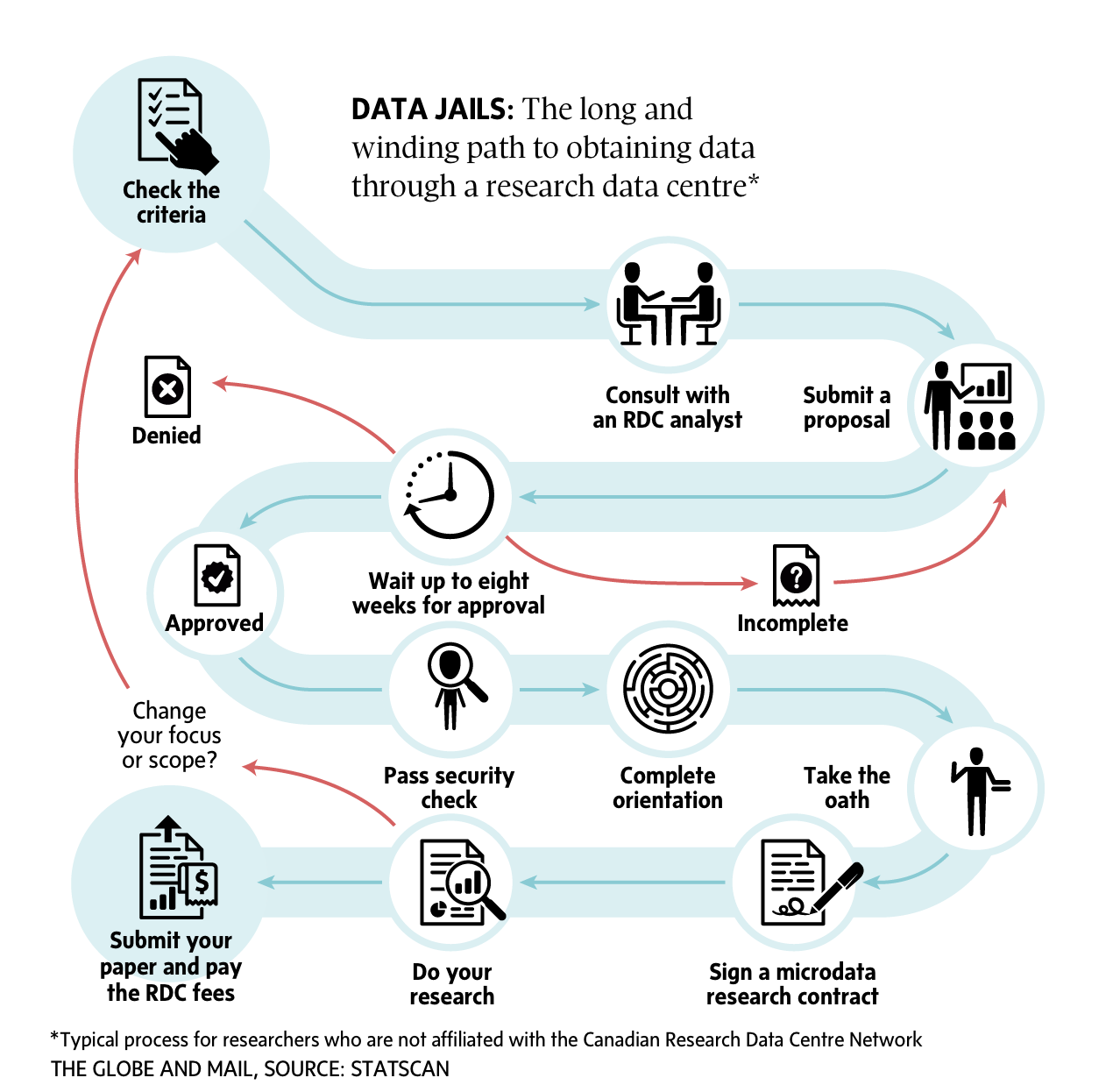
In Canada, by contrast, birth data are kept in a series of facilities called Research Data Centres – the bane of many researchers trying to unlock tricky problems in Canadian social science. Statistics Canada opened the first RDC in 2000, with the aim of giving researchers access to so-called confidential microdata – the previously hidden guts of Statscan’s collections, such as census responses, health-survey results and birth records – without compromising anyone’s privacy.

But while they contain a rich trove of data, the fact that it is embedded with potentially identifying details about individual Canadians – not names, which are scrubbed ahead of time, but occupation and gender, for example – means that researchers must jump through a series of bureaucratic hoops before they can get their hands on it. Wendy Watkins, a Carleton University sociologist and former Statscan analyst, calls the centres “little data jails.”

There are 30 RDCs across Canada, almost all on university campuses – although Brandon, Sudbury, Trois-Rivières, Charlottetown and Peterborough, Ont., all university towns, have no such research centres. There are no RDCs at all in Nunavut, Yukon or Prince Edward Island. Because researchers have to visit them in person, that often means travelling hundreds of kilometres.

And that journey only gets them to the jailhouse gates. Then the real hurdles emerge. These can include providing a five-year address history, submitting a research proposal well ahead of time, and being formally sworn in as a government employee for the duration of your visit, complete with a legally binding oath of secrecy. If you are not a graduate student or university faculty, you’re likely to face more than a dozen steps before being able to actually publish your research. In some cases, researchers have to pay a sizable fee – routinely more than $5,000 – to access the information.

“I had to get fingerprinted,” says Prof. Andersen of Western, “even though I had my passport. What did they think, I was faking my passport?”

In other countries, the kind of data we keep cloistered in RDCs for privacy reasons is often simply scrubbed of identifying details and opened to the public. Says Calgary’s Prof. Tedds, “We know enough about how to censor and anonymize data that those concerns … they shouldn’t be concerns.”

Placing the burden of security onto individual researchers, in turn, means that reams of information, painstakingly gathered by our government and waiting to be sorted, distilled and interpreted – and, possibly, put to use improving Canadian lives – remain untapped. “I’ve had a few colleagues tell me they don’t study Canada because it’s too much of a pain in the neck,” Prof. Siddiqi says. “Of course I also want to study Canada, but at a certain point you have to throw your hands up.”

The recent controversy over Statscan’s plan to request customers’ personal financial data from Canadian banks might have given the impression of an outfit with a cavalier attitude toward privacy. In fact, the episode was deeply out of character for the agency. Typically, Statscan suffers from the inverse problem, what former assistant chief statistician Michael Wolfson calls “excessive privacy chill.”

The secrecy, bureaucracy and plain eccentricity that have come to characterize the country’s central data-gathering agency are far from unique among federal departments and ministries. Almost every one of them gathers and publishes its own significant stores of data – and Canada’s Auditor-General has spent years quietly pointing out how badly they tend to manage the task.

Glenn Wheeler, a principal in the federal watchdog’s office, says ministries often don’t gather enough data about their own policies to have a good sense of whether those policies are working – or don’t release enough data to convince the public, which is paying for the programs through tax dollars. “It’s a serious issue we find across our audits, across departments, across a number of years,” he says.

What Mr. Wheeler doesn’t mention, but is hard not to notice, is the number of data gaps that threaten to undermine policies the government of Justin Trudeau has put a lot of stock in – policies meant to address such issues as sexual abuse, the settlement of refugees and improving the lot of Indigenous Canadians. “Good policy is impossible without good data,” said Finance Minister Bill Morneau in a 2016 speech. But this government’s trademark policies often don’t have good data behind them.

In an audit of the Canadian Armed Forces released last fall, the auditor-general found that the military had “no centralized system to collect and track incidents of inappropriate sexual behaviour in a systematic way,” despite launching Operation Honour to combat sexual misconduct in its ranks in 2015. An Armed Forces spokesperson told The Globe that the military is now addressing the issue: a sexual-misconduct tracking system was “implemented” this past October and it will be “fully operational” some time in 2019.

Meanwhile, a 2017 study of the government’s efforts to settle Syrian refugees – one of the Trudeau government’s signature initiatives – found that Immigration, Refugees and Citizenship Canada was not gathering numbers on such key measures as the average number of months those refugees spent on income assistance, the effectiveness of the language training they have received, or the percentage of refugee children attending school.

….

As the benefits of open government data become more widely accepted, Canada is falling behind many of its peer countries in making use of the stuff. Ireland publishes a comprehensive biennial data set on the well-being of children; Denmark tracks every aspect of gender equality; Britain breaks down many social-welfare indicators by ethnicity; and Australia publishes national workplace-injury rates – none of which can be said of Canada.

But no country throws our data failures into starker relief than does the United States. You might expect our southern neighbours to be data laggards: After all, theirs is a country that tends to prefer small government and emphasize individual rights over the common good.

Instead, Americans are world leaders at gathering and sharing an abundance of national numbers. “The U.S. has awesome data on almost everything,” says Jennifer Winter, director of energy and the environment at the University of Calgary school of public policy.

Some attribute U.S. public-data excellence to the country’s (small-r) republican form of government, which treats government property as the people’s. But it’s not just a question of national DNA. The United States has made strides in recent years as a result of deliberate government policy.

In 2013, then-president Barack Obama signed an executive order making government data open and machine-readable by default – a move which, remarkably, Donald Trump signed into law just this month after being presented with a bipartisan bill giving Congressional approval to the broad strokes of president Obama’s order.

During his tenure, Mr. Obama also hired Silicon Valley whiz D.J. Patil as the country’s chief data scientist. Mr. Patil’s marching orders: to free up more of the information that had been mouldering, unseen and unused, in federal government vaults. He realized, in short, that the country could solve more of its problems if it had more eyeballs trying to identify them. “Through these data sets, you get brilliant insights,” he says. “We’re harnessing the power of the country’s entire knowledge base.”

Embedded in Mr. Obama’s health-care law, meanwhile, was a sunshine list for payments made by drug companies to doctors. The data helped reveal some chastening facts. Among them: The more money the average doctor receives from opioid makers, the likelier she is to prescribe opioids; and even such small gifts as a single meal tend to tilt doctors toward prescribing more expensive brand-name drugs.

That analysis would not be possible in Canada; the numbers aren’t there. (Under its previous Liberal government, Ontario was on the verge of forcing pharma-payment disclosure, but the program has been put on hold by Doug Ford’s Conservatives.)

A disarming number of people who have spent time thinking about the problem come to the same conclusion about why this is: Yes, federalism creates data silos, and yes, Statscan is too risk-averse and cash poor, and yes, provinces and federal departments have a built-in incentive to keep their failures hidden with data blackouts. But maybe, just maybe, the problem has even deeper cultural roots. Maybe we’re just not curious enough about what goes on within our borders – blissful in our ignorance. Maybe, these people suggest, the problem comes down to Canadian complacency.

Tellingly, Canada’s Copyright Act, signed in 1921, gave the Crown the rights, for a full 50 years, to any work produced by any government department – a stark contrast with our southern neighbour, which banned government copyright in the 19th century. “The U.S., in its early history, made legislation that said, ‘We shall make this information available to the people,’ ” says Mark Leggott, executive director of Research Data Canada, a non-profit that helps researchers use public data. “In Canada, we made it so that the information was the property of the Queen.”

…

It doesn’t have to be this way. The Liberals’ 2015 election platform promised to “embrace open data” and stated that a Liberal government would “make government data available digitally, so that Canadians can easily access and use it.”

And, to be fair, the Trudeau government has certainly made some progress over the past three years. Most famously, it reinstated the mandatory long-form census, which Stephen Harper’s Conservatives had axed in 2010.

A spokesperson for Jane Philpott, the minister of digital government, a portfolio recently created and tacked on to the Treasury Board, also noted that 81,909 data sets are available through the federal open-government portal (though many of those were published by previous governments). Anyone can now open their laptop and look up everything from Canada’s sulphur-oxide emissions, over time, to the country’s “spatial density of oats cultivation.”

Like the governments of every industrialized country, Canada posts far more data online than anyone would have thought possible 30 years ago. It actually tied for first with Britain in a recent “open-data barometer” created by the World Wide Web Foundation (though it’s worth noting that the ranking awards points for fairly basic achievements, like publishing government budgets and election results, and that Canada scored poorly on national environmental statistics).

Statistics Canada would like you to know that it is making progress, too. Anil Arora, the agency’s chief statistician, points to new technologies and techniques that are changing the way it collects public data. Last year, for instance, the agency crowdsourced black-market cannabis prices by asking the public to use an app called StatsCannabis. More than 20,000 people responded. Statscan is also experimenting with “virtual data research centres” that will make microdata more easily accessible by computer, although their inauguration is likely years away.

Notwithstanding the backlash to Statscan’s banking-information scheme – and anxiety in some quarters about giving government more power to gather the personal information of citizens – the public has also shown signs of embracing the value of government data in recent years. The cancellation of the 2011 mandatory long-form census had the unexpected consequence of raising the census’s profile, and maybe even its popularity. The 2016 response rate was the highest ever, at 98.4 per cent, suggesting that Canadians see taking part in data collection as their civic duty, provided their confidentiality is protected and they feel it’s for the public good.

To be sure, a problem as vast and diffuse as a country’s ignorance about itself can hardly be laid neatly at one government’s door, much less one ministry’s. Still, given the Liberals’ enthusiasm for evidence and openness, their reluctance to frankly admit that Canada has a data deficit and to propose concrete solutions is notable.

When asked to comment for this story, the Prime Minister’s Office deferred to the minister of digital government, whose spokesperson’s answers focused on the government’s achievements, especially relative to the Harper Conservatives, and who spoke in general terms about plans for more data openness in the future. For example, in response to a question about the dozens of data gaps identified by The Globe, the spokesperson replied, “We have reinstated the long-form census, unmuzzled government scientists, and made ministerial mandate letters public while tracking progress on those commitments to Canadians. We know there is always more work to do.”

The leaders of Statscan were also reluctant to take ownership of Canada’s data-gap problem. In an interview last year, Mr. Arora pointed a finger at academic researchers who are unable to ferret out the numbers they need. “I would argue that there’s still a lot of data that we have that either researchers don’t even know about or underutilize,” he said. “They find the vetting steps, the confidentiality component, to be a little too much for them.”

In the meantime, Canadian public data remains full of lapses, hesitations and holes – for things as basic as average wait times for mental-health services and the number of homeless people who die on our streets. And the data we have is often so hard to access, it might as well be hidden. Even Mr. Arora knows the dangers of asking the country to fly blind this way: “There could come a day when the population says, ‘You had access to all of these data stores and you could have reasonably used it to prevent something nasty from happening. Why didn’t you?’ ”

Mr. Arora posed his question as a hypothetical – but didn’t need to. Every day, Canadian governments have the chance to prevent nasty things from happening, by putting stark numbers in front of Canadians, so that the public can demand change where it’s needed and build on what the country is doing right. And every day, governments pass up the opportunity to do so. On maternal health, on Indigenous education, on environmental action, on the safety of drugs and the integrity of the doctors who prescribe them, on matters as seemingly mundane as how far Canadians drive and as patently urgent as the rate at which whole demographic groups are dying, governments deprive Canadians of the data needed to make good decisions. Every day, they leave Canadians in the dark.

Source: The cost of Canada’s data deficit When it comes to basic data about its own citizens – from divorce rates to driving patterns to labour trends – Canada simply doesn’t have the answers. If information is power, this country has a big problem.

1 in 5 Canadian youths not sure what happened in the Holocaust, survey suggests

Whenever one asks a question about historical events, no matter how important, the level of ignorance is depressing:

One in five young people in Canada either hasn’t heard of the Holocaust or isn’t sure what it is.

That’s the conclusion from a new survey released ahead of International Holocaust Remembrance Day on Sunday.

Historians believe the new data should be a wake-up call on how the systematic murder of six million Jews in Europe is taught in Canadian schools — and remembered more broadly.

“One of the surprising things was the awareness gap between millennials and older respondents …it’s shocking,” said historian Naomi Azrieli, CEO of the Azrieli Foundation, the charity behind the survey.

“I think older Canadians are more likely to have known a survivor or been around in World War Two,” she told CBC News. “With each generation, it becomes less living history and more remote.”

In Britain, a new survey by the Holocaust Memorial Day Trust found that one in 20 adults in Britain do not believe the Holocaust took place.

The survey of more than 2,000 people released Sunday also found that nearly two-thirds of respondents either did not know how many Jews had been murdered or greatly underestimated the number killed during the Holocaust.

Chief executive Olivia Marks-Woldman described the results as “widespread ignorance and even denial.”

While there are debates among historians about exactly when the Holocaust began, the mass killing of Jews in the Second World War started in 1941 with the Nazi invasion of the Soviet Union, according to Yad Vashem, the World Holocaust Remembrance Center, and continued until the Nazis were defeated in 1945.

Held on Jan. 27 annually following a United Nations resolution, International Holocaust Remembrance Day coincides with the day Auschwitz-Birkenau, the largest complex of Nazi death camps, was liberated by Soviet forces in 1945.

Among other points, the Canadian survey found:

• Nearly six in 10 Canadians (57 per cent) said fewer people seem to care about the Holocaust than they used to.

• 15 per cent of Canadian adults and more than one fifth of Canadians under age 34 (22 per cent) haven’t heard about or are not sure if they have heard about the Holocaust.

• Nearly half of Canadian respondents (49 per cent) couldn’t name a single concentration camp. That’s roughly equal to the U.S., where 45 per cent couldn’t name one in a similar survey last year. There were over 40,000 concentration camps and ghettos in Europe during the Holocaust.

A crew member walks toward the National Holocaust Monument before the official opening in Ottawa on Sept. 27, 2017. (Adrian Wyld/Canadian Press)

• Nearly one quarter of all Canadians (23 per cent) believe substantially fewer than six million Jews were killed (two million or fewer) during the Holocaust, while another 24 per cent were unsure of how many were killed.

• Few Canadians believe there are many neo-Nazis in Canada today, while nearly half think there are many in the U.S. In fact, on a per capita basis, the two countries have roughly the same number of neo-Nazis, Azrieli said.

Reasons for optimism

With offices in Toronto, Montreal and Israel, the Azrieli Foundation commissioned Schoen Consulting to carry out the survey based on 1,100 interviews with Canadians over age 18 in September 2018. The margin of error was plus or minus three per cent.

While Azrieli was disappointed by the lack of knowledge about the Holocaust, especially among younger Canadians, she said the survey also offered plenty reasons for optimism.

More than 80 per cent of respondents believe all students should learn about the Holocaust in school and 85 per cent said it’s crucial to keep teaching about the Holocaust so it doesn’t happen again.

Azrieli wants to see a more comprehensive approach to how the Holocaust is taught in schools, potentially involving special professional development days for teachers to become more acquainted with its history.

With only around 5,000 Holocaust survivors alive in Canada today to tell their own stories about the mass killings, she said it’s more crucial than ever that schools and other institutions develop strong programs to teach the subject.

False beliefs

The need for better Holocaust education is especially intense due to rising anti-Semitic sentiment in much of the world, said Azrieli, whose father survived the Holocaust.

Since last year’s Holocaust Remembrance Day, an 85-year-old French Holocaust survivor, Mireille Knoll, was fatally stabbed in Paris and 11 Jews were gunned down in a Pittsburgh synagogue during Shabbat services, the deadliest attack on Jews in U.S. history.

Human Rights First, a U.S. organization, recalled those killings and warned that “today’s threats do not come solely from the fringe.”

“In places such as Hungary and Poland, once proudly democratic nations, government leaders are travelling the road to authoritarianism,” said Ira Forman, the group’s senior adviser for combating anti-Semitism. “As they do so, they are distorting history to spin a fable about their nations and the Holocaust.”

In Canada, hate crimes rose to an all-time high in 2017, according to a Statistics Canada report released in November. For hate crimes based on religion, Jews were the most targeted group in Canada, with more than 300 incidents reported to police.

Nearly one-third of survey respondents believed Canada had an open immigration policy for Jewish refugees fleeing Europe.

In fact, Canada had “one of the worst immigration records in the world” related to Jewish people, “worse than the U.S. or U.K.,” Azrieli said.

Canada allowed only 5,000 Jewish refugees into the country while allowing nearly 2,000 Nazi war criminals to immigrate to Canada after the Second World War, the Azrieli Foundation reported.

In the 1930s and 1940s, Canadian border guards had a saying about Jewish refugees, she said: “None is too many.”

Survey respondents thought Canada had been more welcoming toward Jewish refugees fleeing the Nazis, as they considered Canada to be generally more open toward immigrants than other nations, given the country’s current policies.

“That was a very interesting finding of this survey,” said Azrieli, “And an important indication that our own history is not well known to most Canadians.”

The Hidden Automation Agenda of the Davos Elite

Clarity and likely greater impact on the labour force needed and immigration levels:

They’ll never admit it in public, but many of your bosses want machines to replace you as soon as possible.

I know this because, for the past week, I’ve been mingling with corporate executives at the World Economic Forum’s annual meeting in Davos. And I’ve noticed that their answers to questions about automation depend very much on who is listening.

In public, many executives wring their hands over the negative consequences that artificial intelligence and automation could have for workers. They take part in panel discussions about building “human-centered A.I.” for the “Fourth Industrial Revolution” — Davos-speak for the corporate adoption of machine learning and other advanced technology — and talk about the need to provide a safety net for people who lose their jobs as a result of automation.

But in private settings, including meetings with the leaders of the many consulting and technology firms whose pop-up storefronts line the Davos Promenade, these executives tell a different story: They are racing to automate their own work forces to stay ahead of the competition, with little regard for the impact on workers.

All over the world, executives are spending billions of dollars to transform their businesses into lean, digitized, highly automated operations. They crave the fat profit margins automation can deliver, and they see A.I. as a golden ticket to savings, perhaps by letting them whittle departments with thousands of workers down to just a few dozen.

“People are looking to achieve very big numbers,” said Mohit Joshi, the president of Infosys, a technology and consulting firm that helps other businesses automate their operations. “Earlier they had incremental, 5 to 10 percent goals in reducing their work force. Now they’re saying, ‘Why can’t we do it with 1 percent of the people we have?’”

Few American executives will admit wanting to get rid of human workers, a taboo in today’s age of inequality. So they’ve come up with a long list of buzzwords and euphemisms to disguise their intent. Workers aren’t being replaced by machines, they’re being “released” from onerous, repetitive tasks. Companies aren’t laying off workers, they’re “undergoing digital transformation.”

A 2017 survey by Deloitte found that 53 percent of companies had already started to use machines to perform tasks previously done by humans. The figure is expected to climb to 72 percent by next year.

The corporate elite’s A.I. obsession has been lucrative for firms that specialize in “robotic process automation,” or R.P.A. Infosys, which is based in India, reported a 33 percent increase in year-over-year revenue in its digital division. IBM’s “cognitive solutions” unit, which uses A.I. to help businesses increase efficiency, has become the company’s second-largest division, posting $5.5 billion in revenue last quarter. The investment bank UBS projects that the artificial intelligence industry could be worth as much as $180 billion by next year.

Kai-Fu Lee, the author of “AI Superpowers” and a longtime technology executive, predicts that artificial intelligence will eliminate 40 percent of the world’s jobs within 15 years. In an interview, he said that chief executives were under enormous pressure from shareholders and boards to maximize short-term profits, and that the rapid shift toward automation was the inevitable result.

The Milwaukee offices of the Taiwanese electronics maker Foxconn, whose chairman has said he plans to replace 80 percent of the company’s workers with robots in five to 10 years.CreditLauren Justice for The New York Times

“They always say it’s more than the stock price,” he said. “But in the end, if you screw up, you get fired.”

Other experts have predicted that A.I. will create more new jobs than it destroys, and that job losses caused by automation will probably not be catastrophic. They point out that some automation helps workers by improving productivity and freeing them to focus on creative tasks over routine ones.

But at a time of political unrest and anti-elite movements on the progressive left and the nationalist right, it’s probably not surprising that all of this automation is happening quietly, out of public view. In Davos this week, several executives declined to say how much money they had saved by automating jobs previously done by humans. And none were willing to say publicly that replacing human workers is their ultimate goal.

“That’s the great dichotomy,” said Ben Pring, the director of the Center for the Future of Work at Cognizant, a technology services firm. “On one hand,” he said, profit-minded executives “absolutely want to automate as much as they can.”

“On the other hand,” he added, “they’re facing a backlash in civic society.”

For an unvarnished view of how some American leaders talk about automation in private, you have to listen to their counterparts in Asia, who often make no attempt to hide their aims. Terry Gou, the chairman of the Taiwanese electronics manufacturer Foxconn, has said the company plans to replace 80 percent of its workers with robots in the next five to 10 years. Richard Liu, the founder of the Chinese e-commerce company JD.com, said at a business conferencelast year that “I hope my company would be 100 percent automation someday.”

One common argument made by executives is that workers whose jobs are eliminated by automation can be “reskilled” to perform other jobs in an organization. They offer examples like Accenture, which claimed in 2017 to have replaced 17,000 back-office processing jobs without layoffs, by training employees to work elsewhere in the company. In a letter to shareholders last year, Jeff Bezos, Amazon’s chief executive, said that more than 16,000 Amazon warehouse workers had received training in high-demand fields like nursing and aircraft mechanics, with the company covering 95 percent of their expenses.

But these programs may be the exception that proves the rule. There are plenty of stories of successful reskilling — optimists often cite a program in Kentucky that trained a small group of former coal miners to become computer programmers — but there is little evidence that it works at scale. A report by the World Economic Forum this month estimated that of the 1.37 million workers who are projected to be fully displaced by automation in the next decade, only one in four can be profitably reskilled by private-sector programs. The rest, presumably, will need to fend for themselves or rely on government assistance.

In Davos, executives tend to speak about automation as a natural phenomenon over which they have no control, like hurricanes or heat waves. They claim that if they don’t automate jobs as quickly as possible, their competitors will.

“They will be disrupted if they don’t,” said Katy George, a senior partner at the consulting firm McKinsey & Company.

Automating work is a choice, of course, one made harder by the demands of shareholders, but it is still a choice. And even if some degree of unemployment caused by automation is inevitable, these executives can choose how the gains from automation and A.I. are distributed, and whether to give the excess profits they reap as a result to workers, or hoard it for themselves and their shareholders.

The choices made by the Davos elite — and the pressure applied on them to act in workers’ interests rather than their own — will determine whether A.I. is used as a tool for increasing productivity or for inflicting pain.

“The choice isn’t between automation and non-automation,” said Erik Brynjolfsson, the director of M.I.T.’s Initiative on the Digital Economy. “It’s between whether you use the technology in a way that creates shared prosperity, or more concentration of wealth.”

Amazon Is Pushing Facial Technology That a Study Says Could Be Biased

Of note. These kinds of studies are important to expose the bias inherent in some corporate facial recognition systems:

Over the last two years, Amazon has aggressively marketed its facial recognition technology to police departments and federal agencies as a service to help law enforcement identify suspects more quickly. It has done so as another tech giant, Microsoft, has called on Congress to regulate the technology, arguing that it is too risky for companies to oversee on their own.

Now a new study from researchers at the M.I.T. Media Lab has found that Amazon’s system, Rekognition, had much more difficulty in telling the gender of female faces and of darker-skinned faces in photos than similar services from IBM and Microsoft. The results raise questions about potential bias that could hamper Amazon’s drive to popularize the technology.

In the study, published Thursday, Rekognition made no errors in recognizing the gender of lighter-skinned men. But it misclassified women as men 19 percent of the time, the researchers said, and mistook darker-skinned women for men 31 percent of the time. Microsoft’s technology mistook darker-skinned women for men just 1.5 percent of the time.

A study published a year ago found similar problems in the programs built by IBM, Microsoft and Megvii, an artificial intelligence company in China known as Face++. Those results set off an outcry that was amplified when a co-author of the study, Joy Buolamwini, posted YouTube videos showing the technology misclassifying famous African-American women, like Michelle Obama, as men.

The companies in last year’s report all reacted by quickly releasing more accurate technology. For the latest study, Ms. Buolamwini said, she sent a letter with some preliminary results to Amazon seven months ago. But she said that she hadn’t heard back from Amazon, and that when she and a co-author retested the company’s product a couple of months later, it had not improved.

Matt Wood, general manager of artificial intelligence at Amazon Web Services, said the researchers had examined facial analysis — a technology that can spot features such as mustaches or expressions such as smiles — and not facial recognition, a technology that can match faces in photos or video stills to identify individuals. Amazon markets both services.

“It’s not possible to draw a conclusion on the accuracy of facial recognition for any use case — including law enforcement — based on results obtained using facial analysis,” Dr. Wood said in a statement. He added that the researchers had not tested the latest version of Rekognition, which was updated in November.

Amazon said that in recent internal tests using an updated version of its service, the company found no difference in accuracy in classifying gender across all ethnicities.

The M.I.T. researchers used these and other photos to study the accuracy of facial technology in identifying gender.

With advancements in artificial intelligence, facial technologies — services that can be used to identify people in crowds, analyze their emotions, or detect their age and facial characteristics — are proliferating. Now, as companies begin to market these services more aggressively for uses like policing and vetting job candidates, they have emerged as a lightning rod in the debate about whether and how Congress should regulate powerful emerging technologies.

The new study, scheduled to be presented Monday at an artificial intelligence and ethics conference in Honolulu, is sure to inflame that argument.

Proponents see facial recognition as an important advance in helping law enforcement agencies catch criminals and find missing children. Some police departments, and the Federal Bureau of Investigation, have tested Amazon’s product.

But civil liberties experts warn that it can also be used to secretly identify people — potentially chilling Americans’ ability to speak freely or simply go about their business anonymously in public.

Over the last year, Amazon has come under intense scrutiny by federal lawmakers, the American Civil Liberties Union, shareholders, employees and academic researchers for marketing Rekognition to law enforcement agencies. That is partly because, unlike Microsoft, IBM and other tech giants, Amazon has been less willing to publicly discuss concerns.

Amazon, citing customer confidentiality, has also declined to answer questions from federal lawmakers about which government agencies are using Rekognition or how they are using it. The company’s responses have further troubled some federal lawmakers.

“Not only do I want to see them address our concerns with the sense of urgency it deserves,” said Representative Jimmy Gomez, a California Democrat who has been investigating Amazon’s facial recognition practices. “But I also want to know if law enforcement is using it in ways that violate civil liberties, and what — if any — protections Amazon has built into the technology to protect the rights of our constituents.”

In a letter last month to Mr. Gomez, Amazon said Rekognition customers must abide by Amazon’s policies, which require them to comply with civil rights and other laws. But the company said that for privacy reasons it did not audit customers, giving it little insight into how its product is being used.

The study published last year reported that Microsoft had a perfect score in identifying the gender of lighter-skinned men in a photo database, but that it misclassified darker-skinned women as men about one in five times. IBM and Face++ had an even higher error rate, each misclassifying the gender of darker-skinned women about one in three times.

Ms. Buolamwini said she had developed her methodology with the idea of harnessing public pressure, and market competition, to push companies to fix biases in their software that could pose serious risks to people.

Ms. Buolamwini, who had done similar tests last year, conducted another round to learn whether industry practices had changed, she said.CreditTony Luong for The New York Times

“One of the things we were trying to explore with the paper was how to galvanize action,” Ms. Buolamwini said.

Immediately after the study came out last year, IBM published a blog post, “Mitigating Bias in A.I. Models,” citing Ms. Buolamwini’s study. In the post, Ruchir Puri, chief architect at IBM Watson, said IBM had been working for months to reduce bias in its facial recognition system. The company post included test results showing improvements, particularly in classifying the gender of darker-skinned women. Soon after, IBM released a new system that the company said had a tenfold decrease in error rates.

A few months later, Microsoft published its own post, titled “Microsoft improves facial recognition technology to perform well across all skin tones, genders.” In particular, the company said, it had significantly reduced the error rates for female and darker-skinned faces.

Ms. Buolamwini wanted to learn whether the study had changed overall industry practices. So she and a colleague, Deborah Raji, a college student who did an internship at the M.I.T. Media Lab last summer, conducted a new study.

In it, they retested the facial systems of IBM, Microsoft and Face++. They also tested the facial systems of two companies that were not included in the first study: Amazon and Kairos, a start-up in Florida.

The new study found that IBM, Microsoft and Face++ all improved their accuracy in identifying gender.

By contrast, the study reported, Amazon misclassified the gender of darker-skinned females 31 percent of the time, while Kairos had an error rate of 22.5 percent.

Melissa Doval, the chief executive of Kairos, said the company, inspired by Ms. Buolamwini’s work, released a more accurate algorithm in October.

Ms. Buolamwini said the results of her studies raised fundamental questions for society about whether facial technology should not be used in certain situations, such as job interviews, or in products, like drones or police body cameras.

Some federal lawmakers are voicing similar issues.

“Technology like Amazon’s Rekognition should be used if and only if it is imbued with American values like the right to privacy and equal protection,” said Senator Edward J. Markey, a Massachusetts Democrat who has been investigating Amazon’s facial recognition practices. “I do not think that standard is currently being met.”

Source: Amazon Is Pushing Facial Technology That a Study Says Could Be Biased

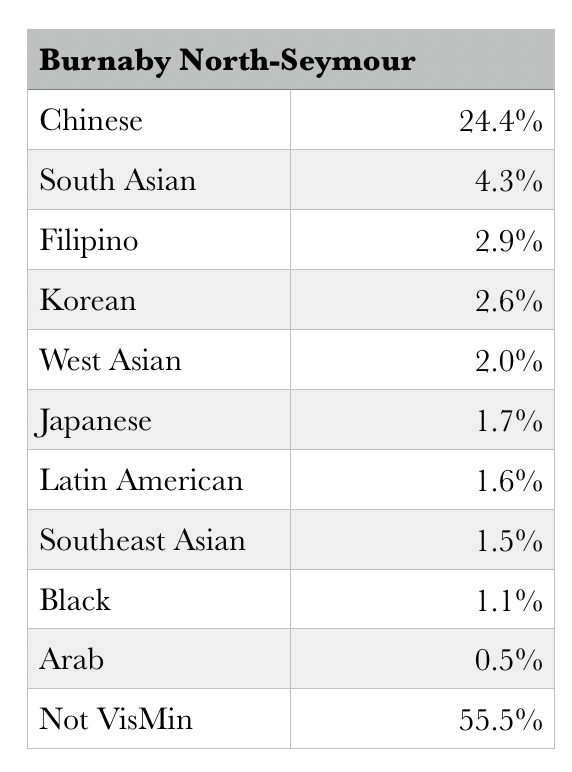
Diversity Votes — February By-elections: Matching Census Data with Ethnic Media Coverage (16-23 January 2019)

For background data on the riding demographic, economic, social and political characteristics, see: February By-elections: Matching Census Data with Ethnic Media Coverage (1-18 January 2019).

Ethnic Media Coverage

In contrast to coverage in the previous weeks, which included coverage of the general by-election announcement by more different language ethnic media, the past week was almost exclusively focused on Burnaby South and the ongoing controversy over the divisive remarks by former Liberal candidate Wang and overall issues related targeting ethnic votes, with only 41 media items compared to the 97 earlier in the month  .

Media coverage was overwhelmingly in Punjabi (39 percent) and 43.9 percent in Chinese, Cantonese and Mandarin language media. There was only one tangential media reference to Outremont in the context of NDP prospects.

The focus of candidate specific coverage was former Liberal candidate Wang and her efforts (unsuccessful) to distance herself from her comments on WeChat that basically said vote for the Chinese Canadian candidate, not the Indo-Canadian candidate. Conservative immigration critic Michelle Rempel’s revealing that Wang had sought being nominated and being rejected as a Conservative candidate was covered, as were Rempel’s press conference criticizing the Liberal government immigration record, including her statement that poor vetting had resulted in the killing of Burnaby teen Marrisa Shen by a Syrian refugee (charged, not yet convicted). The announcement of Wang’s replacement, Richard Lee, a former provincial politician was covered in summary fashion.

While NDP leader Singh’s housing, immigration (withdrawal from the Safe Third Country Agreement with the US)  and other policy proposals were covered, there was still some lingering coverage of his apparent unawareness of the implications of the Canadians detained in China in retaliation for the extradition proceedings against Huawei executive Meng Wanzhou.

Svend Robinson’s nomination as the NDP candidate for Burnaby North-Seymour after an 11 year absence was covered in Chinese media (the largest visible minority group in the riding). 

In terms of commentary (including analysis and opinion pieces), Punjabi media predominated with seven items and Chinese three. 

While most of these were neutral in tone, there were three critical pieces. Two of these were in Chinese media, which were highly critical of Wang and how ethnic politics was playing out among Chinese Canadians, and one in Punjabi media, making similar points with respect to Canadian Sikhs. There was one more positive piece on ethnic politics, noting that all candidates seek support from their ethnic group and that the Wang controversy was  “not a big deal.”

Related issues such as the ongoing dispute between Canada and China over the extradition request of Huawei executive Meng Wanzhou and the inappropriate comments regarding her possible extradition by Canada’s now former ambassador to China have not seen much by-election related coverage but are being covered by ethnic media separately.

See the MIREMS blog for some of the stories being covered: MIREMS blog.

Race or class irrelevant in intelligence of babies, groundbreaking Oxford study finds

The basics make the difference – medical care and nutrition:

Babies born in similar circumstances will thrive regardless of race or geography, Oxford-led research has found, quashing the idea that race or class determines intelligence.

In a scientific first, the team of researchers tracked the physical and intellectual development of babies around the world from the earliest days after conception to age two.

“At every single stage we’ve shown that healthy mothers have healthy babies and that healthy babies all grow at exactly the same rate,” said Professor Stephen Kennedy, the co-director of the Oxford Maternal and Perinatal Health Institute. “It doesn’t matter where you are living, it doesn’t matter what the colour of your skin is, it doesn’t matter what your race and ethnicity is, receiving decent medical care and nutrition is the key.”

The INTERGROWTH-21st Project, jointly led by Prof. Kennedy and Prof. Jose Villar at Oxford, involved nearly 60,000 mothers and babies worldwide, tracking growth in the womb, then followed more than 1,300 of the children, measuring physical growth and development.

The mothers – in locations as diverse as Brazil, India and Italy – were chosen because they were in good health and lived in similar environments. Their babies scored similarly on physical and intellectual development: in fact, researchers found more variation within racial groups than between them.

The study should help settle the ongoing debate genetics as a determination in intelligence which has been rumbling since the publication of Charles Murray’s The Bell Curve in the 1990s. The book argued that a “cognitive elite” was becoming separated from the general population.

“There’s still a substantial body of opinion out there in both the scientific and lay communities who… believe that intelligence is predominantly determined by genes and the environment that you’re living in and that your parents and grandparents were living in and their nutritional and health status are not relevant,” said Prof Kennedy. “Well, that’s clearly not the case.”

Yes, a MAGA hat is a symbol of hate: Domise

Good commentary by Andray Domise:

A few years ago, a very close friend of mine was hailing a cab off Spadina street, in downtown Toronto. He, a tall and broad-shouldered Black man, was on his way to a social event with an acquaintance, a blonde white woman. They were both well-dressed for nightlife, which is a normal sight for that neighbourhood on a Friday evening. What was not normal, however, was the gaunt white man approaching them wearing Doc Martens boots, a bomber jacket, and a clean-shaved scalp. My friend registered danger just before the skinhead opened his mouth twice, first to shout “Don’t trust that nigger” at the blonde woman, and again to spit in my friend’s face.

Being a dark-skinned man whose personal experience with hate crime stretches back to his childhood (when he was introduced to that ugly word right after being shot in the head by a white teen armed with a pellet gun), my friend didn’t need to have a conversation to assess the character of the man before the assault happened. He knew right away he’d just encountered a skinhead, a self-ordained social enforcer who believes the human species can be ordered by a racial hierarchy—one which places Black people like us below the cutoff.

If the man hadn’t given the game away with the racial slur, it would be ridiculous to try and convince my friend that was, perhaps, not a hate crime. When a person wearing the visual markers of a neo-Nazi passes every other human being on a busy street without incident, but singles out a Black man and a white woman for violence, there aren’t many questions to be asked.

And yet, supposedly sensible people and media outlets are willing to debase themselves by proposing that the Make America Great Again hat, that bright red beacon of racialized aggrievement, is somehow not a hate symbol. The perennial conversation bubbled to the surface again this week after an altercation between members of the Omaha nation (led by longtime activist Nathan Phillips), and a mob of students from now-infamous Covington Catholic high school.

In a nearly two-hour video shot at the Lincoln Memorial, students wearing MAGA hats shouted at the elders, danced mockingly, and pantomimed tomahawk chops. One of them, Nick Sandmann, made his way to the front of the crowd to stand almost nose-to-nose with Phillips and smirk in his face as the elder drummed and sang the American Indian Movement (A.I.M.) song.

By now, nonwhite groups are all too familiar with hate groups and what they’re about. The similarity in their tactics is not an accident. Hate groups typically construct an extremist kinship through shared values, language, and an aesthetic that serves a twofold purpose: to visually signal themselves to allies, and to let their enemies know they intend harm. The skinhead aesthetic—black boots, weathered denim, suspenders, and shaved heads—is one of these. Proud Boys—khakis, beards, and Fred Perry polo shirts—are another.

These aren’t political organizations that happen to attract the occasional radical, or unpolished community groups that happen to have a large platform. There is no driving sociopolitical force behind these movements outside of white nationalist ideology, which is why they’re designated hate groups. And they understand this, which is why they’ve spent so much time lately cultivating an everyman aesthetic. Even David Duke famously tried to rebrand the Klan with a kinder, gentler image before leaving in frustration that the message wasn’t catching on. His movement had long passed beyond plausible deniability of their motives.

We know this, yet when people quite logically connect the people who wear MAGA hats with the white supremacist ideology of Donald Trump, this is considered painting with too broad a brush. The same Donald Trump who egged on violence against Black protesters at his rallies, stereotyped Mexicans as rapists, referred to African and African-descended nations as “shithole countries,” referred to Senator Elizabeth Warren as “Pocahontas,” and for years has rattled off a near-endless litany of ad-libbed comments that place him squarely in the white nationalist camp – that is the Donald Trump with which a person openly signals kinship when they put on that garish red hat in public.

So when a restaurant manager refuses to serve a MAGA hat-wearing patron, or Omaha elders confront a crowd of MAGA hat-wearing students to try and diffuse an escalating conflict before it gets out of control, they’re not making assumptions out of whole cloth. Neither is Alyssa Milano, who tweeted “The red MAGA hat is the new white hood.” They’re justifiably responding the way that my friend responded to that skinhead, moments before that skinhead spat in his face, and the way decent people should be expected to respond to those who publicly align themselves with hate movements. If the people who wear the hat feel unfairly maligned, that’s just plain unfortunate for them. Maybe they should examine their politics, and their own hearts.

In other words: if the hood fits, wear it.

Source: Yes, a MAGA hat is a symbol of hate

Laïcité: des professeurs se posent en censeurs

Group think without allowing for discussion of other perspectives. And it should be possible to have respectful discussion of different perspectives:

À quelques semaines du dépôt probable d’un projet de loi sur les signes religieux, la laïcité reste un sujet « explosif » qui divise profondément les enseignants. La professeure Nadia El-Mabrouk, bien connue pour son opposition au port de signes religieux, a été bannie d’un colloque syndical auquel elle avait pourtant été invitée à livrer son point de vue.

Selon ce que Le Devoir a appris, la direction de l’Alliance des professeures et professeurs de Montréal a annulé l’invitation faite à Mme El-Mabrouk après l’éclatement d’une controverse chez les enseignants. La simple présence prévue de la professeure de l’Université de Montréal au colloque de l’Alliance a provoqué un « malaise » au sein de la profession, et même des « commentaires violents » dans un groupe de discussion Facebook.

L’assemblée des délégués du syndicat a voté à la majorité l’annulation de la conférence de Nadia El-Mabrouk sur la laïcité au colloque de l’Alliance, prévu les 18 et 19 février 2019. La professeure a aussi été bannie d’une table ronde sur le féminisme où elle devait prendre part avec la journaliste Pascale Navarro.

Ce colloque, qui célébrera le 100e anniversaire de l’Alliance des professeurs, doit regrouper une quarantaine de conférenciers de renom, dont Françoise David et le Dr Jean-François Chicoine. Ils aborderont une série de thèmes plutôt consensuels, comme l’école de demain, la gestion de classe, les jeux vidéo, le déficit d’attention, et ainsi de suite.

Les deux événements auxquels devait participer Nadia El-Mabrouk ont cependant mis le feu aux poudres. Cette expulsion de la conférencière sur fond de désaccord idéologique soulève la grogne au sein de l’Alliance. Des enseignants dénoncent cette « censure » digne des curés du siècle dernier. D’autres se réjouissent de ne pas être exposés à des idées contraires aux positions officielles du syndicat.

Des sujets « assez sensibles »

« Je vous écris pour vous faire part du malaise que certains profs ont ressenti en recevant le programme du colloque, hier matin, dans leur milieu. En effet, dans le résumé de votre conférence, il est question de sujets assez sensibles chez les profs ; port de signes religieux, cours d’ECR [éthique et culture religieuse], cours à la sexualité, bref, tout cela est assez explosif en ce moment. Nous n’avions évidemment pas prévu que la CAQ serait portée au pouvoir au moment où nous vous avons demandé votre intérêt à participer à ce colloque », indique l’Alliance dans un courriel à Nadia El-Mabrouk daté du 11 décembre 2018.

La présence de la professeure au colloque a été annulée le soir même par l’assemblée des délégués. Le conseil d’administration du syndicat s’est plié à la décision des délégués, même s’il avait recommandé de maintenir la conférence et la table ronde où Nadia El-Mabrouk était invitée.

« Le conseil d’administration a expliqué que cette personne-là avait été choisie même si elle n’avait pas nécessairement les mêmes opinions et orientations que notre organisation syndicale », explique Catherine Renaud, présidente de l’Alliance.

« On n’est pas toujours obligés d’entendre des gens qui pensent comme nous. Ça permet d’échanger et de faire progresser notre réflexion, ajoute-t-elle. On n’a jamais l’unanimité sur des sujets comme ça qui sont polarisants. Il y a des pour et des contre, et pour certains, c’est viscéral. Ce n’est pas différent de ce que pense la population de ces enjeux-là. »

Les syndicats d’enseignants, dont l’Alliance, s’opposent officiellement à l’interdiction du port de signes religieux que le gouvernement Legault a promis d’étendre à la profession enseignante. « On ne veut surtout pas que ces personnes-là soient congédiées non plus », précise Catherine Renaud.

« Censure » syndicale

Luc Charlebois, enseignant de francisation à l’école secondaire Louis-Riel, dans l’est de Montréal, est fâché. Il s’insurge contre ce qu’il considère comme de la « censure ». « La proposition [de retirer l’invitation à la professeure El-Mabrouk] a été amenée sur le plancher à la dernière minute, sans consultation des membres. Il y a un gros problème de démocratie syndicale », dit-il.

La professeure a été officiellement mise au ban à cause de ses positions sur l’identité des genres. Dans une chronique dans La Presse +, elle a déjà dit craindre que les cours d’éducation à la sexualité enseignent « l’idéologie queer ». Elle estime que ce phénomène devient une véritable « religion ». Elle déplore que cette seule mise en garde lui vaille d’être traitée de transphobe.

« Une accusation de transphobie, c’est une attaque à ma réputation. Ces gens n’ont sûrement pas lu mes articles », dit Nadia El-Mabrouk au Devoir.

« La vérité, c’est qu’on me censure. Si ma vie n’est pas en danger en allant au colloque, il n’y a pas de problème à ce que j’y sois. Il y a un débat sur la laïcité qui s’en vient [avec le dépôt promis du projet de loi du gouvernement Legault], et là, on est en train de faire de l’intimidation. Les gens n’osent pas s’exprimer sur les signes religieux par crainte d’être taxés de racisme », dit la professeure d’informatique.

Source: Laïcité: des professeurs se posent en censeurs

Why are we paying people to sue the government? [court challenges program]

The group that managed the court challenges program reported to me when I was at Canadian Heritage 2007-8. It was essentially managed as a arms-length G&C program but, like many other Canadian Heritage programs, with considerable assistance by program officers in the preparation of submissions. If I recall correctly, submissions were approved at the official level, unlike multiculturalism which required ministerial signature.

It always was controversial and my tweeting this story provoked considerable reaction, most opposed but not all. Personally, I felt somewhat ambivalent. While I recognized the role that it could play in supporting groups with limited resources to bring these before the courts, it did seem paradoxical to be funding challenges that government lawyers would be obliged to fight.

When the Conservatives cancelled the program, they faced a backlash, in particular by official language minorities, where they had to back track and reinstate that aspect of the program.

But the issue is less the social change and partisan charges made in this article but whether or not such a program does result in a more equal capacity to bring challenges to government policies and laws:

When a Muslim woman decided to challenge the Harper government’s policy forbidding face-coverings during the oath of citizenship, a feminist non-profit group called Women’s Legal Action Fund (LEAF) sought to intervene on her behalf.

When the Harper government cut extended health-care benefits like drugs and dental to refugee claimants, LEAF argued that the change had a “discriminatory effect upon refugee women.”

When homelessness advocates claimed that the Charter of Rights and Freedoms was being violated unless the government implemented policies to “eliminate homelessness and inadequate housing,” LEAF supported the fight against lawmakers.

This week, LEAF is in court fighting a group of Christian doctors who oppose a policy by their regulator requiring them to refer patients who seek abortions or euthanasia.

There’s nothing wrong with groups of citizens pooling their money to intervene in court cases. That’s healthy in a democracy. But these kinds of activist legal groups shouldn’t be getting taxpayer funding.

Yet that’s what’s happening under the Trudeau government. The new Department of Women and Gender Equality (formerly Status of Women Canada) just awarded LEAF $880,000 to develop a new five-year plan for “strategic litigation.” The project “will undertake a needs assessment with feminist groups and other key stakeholders to identify intersectional gender equality issues that can be effectively addressed through feminist strategic litigation.” It’s a big boost to their budget.

The Liberals have also restored funding to the Court Challenges Program that will hand out grants to groups who claim their human rights or minority language rights have been violated. The committee doling out the money is stacked with prominent left-wing advocates, including former LEAF director and Ottawa law professor Joanne St. Lewis, labour activist and McGill law professor Adelle Blackett, and University of Windsor francophone services proponent Emmanuelle Richez.

Harper had scrapped the program, created in 1978 by Pierre Trudeau, as one of his first acts. John Baird, then president of the Treasury Board, argued that it didn’t make sense for the government to pay people to fight its own laws in court. Indeed, it did not.

So, why are the Liberals eager to use taxpayer dollars to fund these legal challenges?

University of Waterloo political scientist Emmett Macfarlane suggested at the recent Law and Freedom conference in Toronto that Canada has a growing “culture of deference to courts,” in which politicians would rather wait for judges to make law than work to build consensus on controversial issues.

If so, then giving money to lawyers to sue the government is a backdoor way for Liberals to force the policy changes they want without the political risks. Assisted-death is a good example. It was popular with Canadians at large but many Catholics were opposed, which made it difficult for the Liberals to support legalization without risking seats in Quebec … until a successful Charter challenge allowed the Liberals to say that the courts forced their hands.

This type of funding may be particularly concerning to those with strong views on abortion. The Liberals wouldn’t dare legislate a right to abortion but they do like to claim it’s a Charter right. It’s easy to imagine someone seeking to firmly establish abortion as a Charter right through the Court Challenges Program or the newly bolstered LEAF. This type of funding should also concern those who support abortion. If the practice of funding activist legal groups becomes normalized, a future Conservative government could conceivably hand out grants to anti-abortion groups to do their bidding.

Canadians shouldn’t put up with this. If our politicians want social change, they should campaign on making those changes and introduce bills to make it happen. Funding activist groups risks becoming a backdoor way to have politicized lawyers doing their dirty work.

Source: Why are we paying people to sue the government?