Canada Wins Big From ‘America First’ Trade And Immigration Policies

His arguments on trade, given how China has retaliated against some of our agricultural exports but definitely on immigration, where there have been a series of reports of Canada becoming more attractive to those working in tech:

The theory behind the Trump administration’s “America First” trade and immigration restrictions is that they are good for America. However, after more than two and a half years it’s become clear the country such policies are helping is Canada, not the United States.

The Trump tariffs on China have turned into a boon for Canadian farmers. China stopped buying agricultural products from U.S. farmers to retaliate for the Trump administration imposing tariffs on imports from China. According to a U.S. Department of Agriculture report, “Canada’s share of total Chinese imports of wheat has rocketed above 60% in (Marketing Year) 2018/19, up from 32% in 2017/18, as U.S. wheat exports to China have plunged.”

“Losing the world’s most populous country as an export market has been a major blow to the [U.S.] agriculture industry,” reports the New York Times. “Total American agricultural exports to China were $24 billion in 2014 and fell to $9.1 billion last year, according to the American Farm Bureau.” U.S. exports of soybeans to China declined nearly 60% between 2018 and 2019, reports the U.S. Department of Agriculture.

A new study from the National Foundation for American Policy (NFAP) found the damage to exporters goes well beyond agriculture. “Retaliatory tariffs from foreign countries have significantly reduced U.S. exports,” according to economists David G. Tuerck, a professor of economics at Suffolk University and president of the Beacon Hill Institute, and William Burke, director of research at the Beacon Hill Institute, the authors of the NFAP report. “We estimate U.S. exports covered by retaliatory tariffs fell by $17 billion in 2018, and halfway through 2019, the loss to U.S. exports totaled $13.97 billion, for a combined total of $31 billion in lost exports.” And, they concluded, “The loss in U.S. exports will rise.”

U.S. exports of goods to China have declined 19% during the first 6 months of 2019 compared to the same period in 2018, according to an analysis of U.S. trade data. Therefore, it is not surprising that companies in other countries, such as Canada, are benefiting as U.S. companies lose opportunities to sell their goods.

Although the Trump administration recently delayed implementing some tariffs and China responded by canceling tariff increases it planned on U.S. pork and soybeans, former Chairman of the American Chamber of Commerce James Zimmerman in China told the Washington Post it was “not an incredibly significant” gesture. In response to a Donald Trump tweetabout China starting to buy “our agricultural products” again, Bloomberg’s Shawn Donnan noted, “Worth remembering: China bought a lot of agricultural products before this all started.”

The Trump tariffs have also harmed American consumers and inflicted high economic costs on the U.S. economy. “On an annual basis, when adding the tariffs in effect and the tariffs set to go into effect by the end of 2019, the tariffs . . . will cost the average household $2,031 per year, and will be recurring so long as the tariffs stay in effect,” write Tuerck and Burke, both research fellows at the National Foundation for American Policy.

Restrictive immigration policies, like protectionist trade policies, are also benefiting other nations, while harming the competitiveness of U.S. companies. By making it more difficult for international students to stay or work in America, the Trump administration has contributed to new international student enrollment at U.S. universities falling over 6% in the 2017/2018 academic year.

At the same time U.S. enrollment has declined, Canadian universities have attracted international students at record levels. The number of international students in Canada increased 20% in 2017 and 16% in 2018. Australia has also benefited from U.S. immigration restrictions, with Australian schools admitting many more international students, particularly from China. Australian exports to China are also up significantly, according to the Wall Street Journal.

H-1B petitions are typically the only practical way for an international student to work long-term in the United States, and denial rates on H-1Bs have increased to historic levels, according to National Foundation for American Policy research. Moreover, the Trump administration placed on its regulatory agenda a measure that would restrict or eliminate the ability of international students to work (on Optional Practical Training) following graduation, along with other policies that would make foreign students likely to think twice about choosing America as the place to launch their career.

In contrast, immigration policies in Canada have been aimed at attracting international students and retaining them after graduation. “International students who graduate from (at least) 2-year programs at Canadian colleges and universities, in any field, are eligible for 3-year open work permits,” Toronto-based immigration attorney Peter Rekai told me in an interview. “The knowledge that there is a clear ‘studies to work to permanent residence’ path has significantly increased the number of international students coming to Canada, with many choosing Canada over attending U.S. schools for this reason.”

The phrase “America First” carries negative historical connotations, most notably its association with policies of isolationism, laced with anti-Semitism, aimed at preventing the United States from fighting Nazi Germany’s attempt to conquer Europe. It also turns out, based on the results to date, America First trade and immigration policies are most likely to benefit countries other than the United States.

Source: Canada Wins Big From ‘America First’ Trade And Immigration Policies

What Japanese American history can teach us about diversity and immigrants in the workplace

Good long interview with U.S. GuideSpark CEO Keith Kitani given how his family was affected by World War II measures against Japanese Americans:

….

VentureBeat: What’s interesting about Japanese American history is that so many more people than Japanese Americans know about it. They look at the internment and see lessons in it — the constitutional issues, the diversity issues, the human rights issues. The legal history as well. In some ways it surprises me that it’s part of a liberal education about what it means to be an American.

Kitani: It’s interesting to see and think about that. I’ve often started to think about the impact it had, and the people who had to go through it, like my dad. How did it impact me? How did it impact you? It certainly did have an impact on our lives and how things have evolved. I’ve not seen anybody who’s done a study on it, but I know it has. I think about hearing these stories and seeing how my dad acted. It made it a bit clearer. We are the result of our upbringings and our experiences.

VentureBeat: You mentioned your dad didn’t really talk about it. How did you learn about it? Was that from someone else in your family, or did you eventually have conversations with him?

Kitani: I sat down with him and said, “Hey, dad, you’re getting old. It would be great to start writing about this, documenting the things you’ve done through your life.” That’s when he started to really share about it. I don’t know how your dad was, but my dad kept a lot of that stuff to himself. He wasn’t an emotional kind of guy. He kept it all to himself. It took a while to get it out. “Okay, now I understand you better. I wish I’d had this conversation 20 or 30 years earlier.”

VentureBeat: My dad was a little more open. He’d tell me some things that he didn’t mind talking about. There were other things where I got more out of him when I was an adult as well. He would talk about playing baseball in the camp. He was 10 to 15 years old at the time. He said that for a while he hated the U.S. government because they fed him macaroni 30 days in a row. He’d talk about some of the funnier stories.

I went to the National Archives and dug some records out. I asked about some of those things as well. It was an interesting historical exercise. It’s interesting that the Japanese Americans who have dug out some of this history can relate to each other. Among our parents, they always knew each other by what camp your family was in.

Japanese Americans photographed by Paul Kitagaki.

Above: Japanese Americans photographed by Paul Kitagaki.

Image Credit: Paul Kitagaki

Kitani: It’s interesting how they — how different people handled it. For my mom it was a different experience than my dad. But it took a long time for me to get some of those things. He did talk about the sports that they played, some of those things. Only after a little while did he talk about how they weren’t living in the greatest conditions in the world, those kinds of things. That didn’t come out in the first conversation. It’s the stuff that comes out later.

VentureBeat: I don’t know about you, but for me it also helps me understand other people. If I probe a bit and I can learn something about them, I can place them, where they are in this history. If I talk to other people — say, a Vietnamese person, and they say their family came over in 1975 — if you know a bit of your history, you know that was a big year for them, that they probably came as refugees. Just a bit of someone’s history like that tells you a lot about them.

Kitani: Here, there are so many people who have come from other countries. I think everyone has — there are so many different stories that brought them here. Obviously, for us it was a bit different as far as the experiences we had here.

My dad passed away a few years ago, and that made me reflect on it a lot more. Obviously not the best time. It’s better to do it when they’re alive. But it did give me some things to think about. I don’t write a whole bunch of stuff around things like that, but I did write a post on LinkedIn that talked about it in relation to some of the immigration issues that have been happening recently.

VentureBeat: What is the lesson you draw as far as what’s relevant today about immigration?

Kitani: The way I want to think about it, I think a lot of people know about history, but how do you really think about and learn from history to apply it? It’s harder to draw straight lines from all these things, but if I think about some of the policies, it’s more a scenario of — it’s easy to go down a slippery slope of policy. Something happened 75 years ago, and it would be helpful for people to remember about that as policies are being made today. That’s more how I think about it, rather than having strong opinions about what we should do and what we shouldn’t do. It’s important for us as we look at these things to look back at some of the scenarios that happened and try to learn from them.

People learn about history, but they don’t necessarily understand the impact it has on the people that were involved. Until my dad started telling me his stories, it was just visiting Manzanar, as opposed to understanding the impact it had on his life and the carry-over to me and my family’s lives. Those are things that, as you get older and learn more — that was what caused me to think about and comment on it.

VentureBeat: It seems like basic studies can lead you to some strong opinions, strong conclusions about what’s going on today.

Kitani: Yeah. The piece that can sometimes get lost — the people who were impacted, there aren’t as many of them around. We’re the people that need to carry on and think about the actual impact. It’s harder to truly understand that until you can get a few levels below, like you did with your dad and I was able to do with my dad.

VentureBeat: There are people with strong opinions about it who don’t have a grasp of what it means for the people who are directly affected. How you change the course of families for generations. Once they hear some real stories about what happens to people — you can understand where you stand on some things. What is an American? Who deserves these rights?

Kitani: Exactly. There’s reading about it, and then there’s personally experiencing, or feeling like you personally experienced through the people that you know. That’s often the disconnect. We all read about history. But the impact on people is hard to measure on an emotional level, unless you get it from a specific point of view.

VentureBeat: As far as communicating that, I don’t know if there are things you tell your employees, or somehow you carry this on in the management of the company, or your work style?

Kitani: As I’ve thought more about my background and the impact that I had with my family, through my educational background, growing up in a very diverse environment — I only started thinking about it more recently, and I reflected about the company we’ve built. As I prepare for these things — the next thing I do is I look at a set of stats to make sure of where we’re at in terms of a lot of these things. For us, on almost every scale we’re a pretty diverse organization. Our numbers, whether it’s gender or race, match close to the U.S. workforce. Whereas, as you probably know, a lot of Silicon Valley companies and technology companies don’t match that well.

I was trying to reflect on how my upbringing and my philosophies around it — one of our things around here is a value about being yourself. It’s really about appreciating the individual and the diversity of the experience that they bring to the company. That was something we created a number of year ago, when we weren’t really thinking about diversity and inclusion, but really just about individual.

One thing that’s happened, and it’s tied to communication — our team here started to create a program called Humans of GuideSpark. There’s that blog called Humans of New York. Twice a month they come up with a little profile with a personal story of different employees. For one, her parents came over from Vietnam around 1975, like you were talking about. You heard that story about her parents.

What we realized is that with communications and stories, you can really share and appreciate the diversity. It goes deeper than just looking at numbers or a set of people. It’s not just the specific gender or race. It’s also the stories that go behind it. Maybe that’s tied to the discussion we had about the impact of the internment on Japanese Americans, but it’s more than that. It’s the stories behind that and the impact they have.

I certainly feel, as I think about the cultural values we’ve built — we’re pretty diverse. We like to share stories about individuals and where they come from. That’s just happened organically. At our size of company, we don’t have programs. We don’t have any of that stuff. But it happens organically. I think that has a lot to do with who I am, how I was brought up, and the experience I had that shaped that.

That obviously leads into what I talked about earlier. One of the core things we’re trying to do is help organizations communicate better. Whether it’s a program around performance management, or diversity and inclusion, or any number of communications that companies do, the premise is that one-size-fits-all is just not going to work. Companies need to think about how they interact and connect with their employees in a way that starts to appreciate the diversity of that work force.

Again, none of these things were thought of 10 years ago when I started the company, as far as the culture and the products, but they’ve evolved as part of who we are and what we’re trying to do as an organization. It feels a little like it’s come all together somehow, without it being intentional, from what I was thinking. That’s why I think these things have had an impact on who I am and the kind of company and solutions I’m building.

VentureBeat: I think if you understand your people and your history, you’re able to work with them better.

Kitani: Yeah. And we’re obviously — one of the things I think are really powerful as the stories. You do that every day, so you know that. For us, so much of it is business communications, and then the team — we do a lot around sharing stories and their backgrounds. We have something called Our Values, Our Voices, which is a podcast the internal team has created where they tell stories about how people interpret the values of the company. It’s a lot of interesting organic stuff, but you can really see the power of it when it comes to life.

VentureBeat: When Japanese American history comes up, do you find that there’s some division of opinion about it? Is your interpretation different from some people growing up today? Do you find that there are different kinds of opinions about it?

Kitani: I wouldn’t say there are different kinds of opinions? I think I see the differences in the same way that I saw the differences 10 or 15 years ago, when I talked to my dad. I think the difference is, when most people that I know read about it, they don’t talk about it as a positive thing that this country did. Certainly some people understand why it was, and there are slight differences of opinion.

But the difference for me is understanding what it was and how it impacted those people and their families. When my mom’s family had a grocery store and then went through their struggles and ended up moving to California, that’s a pretty big impact on a family. People don’t think about that when they just read about this.

Or my dad, who essentially had to start over, he and his guardian. It shaped how we interacted and what he valued. He would tell me stories of family and the noise of family, how that was something that he treasured in our house, because he didn’t have that. Those are the things that, for me — I wouldn’t say it’s a difference of opinion, but it’s a different perspective that even I didn’t really have.

Source: What Japanese American history can teach us about diversity and immigrants in the workplace

Actually, it’s OK to disagree. Here are 5 ways we can argue better

Not a bad list:

….Arguing morally isn’t easy, but here are five tips to help:

  1. Avoid thinking that when someone starts up an argument, they are mounting an attack. To adapt a saying by Oscar Wilde, there is only one thing in the world worse than being argued with, and that is notbeing argued with. Reasoned argument acknowledges a person’s rationality, and that their opinion matters.
  2. There is always more going on in any argument than who wins and who loses. In particular, the relationship between the two arguers can be at stake. Often, the real prize is demonstrating respect, even as we disagree.
  3. Don’t be too quick to judge your opponent’s standards of argument. There’s a good chance you’ll succumb to “defensive reasoning”, where you’ll use all your intelligence to find fault with their views, instead of genuinely reflecting on what they are saying. Instead, try and work with them to clarify their reasoning.
  4. Never assume that others aren’t open to intelligent argument. History is littered with examples of people genuinely changing their minds, even in the most high stakes environments imaginable.
  5. It’s possible for both sides to “lose” an argument. The recently announced inquiry into question time in parliament provides a telling example. Even as the government and opposition strive to “win” during this daily show of political theatre, the net effect of their appalling standards is that everyone’s reputation suffers.

The upshot

There is a saying in applied ethics that the worst ethical decisions you’ll ever make are the ones you don’t recognise as ethical decisions.

So, when you find yourself in the thick of argument, do your best to remember what’s morally at stake.

Otherwise, there’s a risk you might lose a lot more than you win.

Former Ontario minister sides with Beijing, pins Hong Kong protests on ‘outside’ forces

Chan has also been writing a number of op-eds in Chinese media and his rebuttal to a National Post article on his activities in relation to pro-Hong Kong demonstrations was also published in Chinese Canadian media (Dawa Business News, 6 September):

A former Ontario cabinet minister, who held the province’s immigration and international trade portfolios under two Liberal premiers, has denounced acts of violence during the pro-democracy protests in Hong Kong as the work of foreign actors intent on undermining the state of China.

Former MPP Michael Chan, in a recent interview with Chinanews, a Chinese state-backed news site, condemned the city’s anti-government protesters and applauded Hong Kong police for showing restraint in the crisis.

His assertions echo the statements by Chinese officials as the protest movement in Hong Kong gathered steam. China has blamed “foreign forces” for manipulating the protests and interfering in Hong Kong affairs.

“I have been thinking, why are these young people so radical, so passionate [and] committed to do these things? And why so many people?” Mr. Chan said in an interview with Chinanews that was published earlier this month.

“If there is no deeply hidden organization in this, or deeply hidden push from the outside, there is no way that such large-scale turmoil would happen in Hong Kong in a few months.”

Mr. Chan served in various portfolios for the Ontario Liberals, including as immigration minister, during his tenure in office between 2007 and 2018.

Last week, in an article posted on Mr. Chan’s public WeChat social-media account, he is quoted as suggesting demonstrators have been trying to enlist the Japanese for help with their cause. The article is titled “Exclusive interview with Michael Chan: Guerrilla actions.”

He said in the article that Japanese media reported an interview with a Hong Kong protest leader who travelled to Japan and mused that “Japan could send a self-defence force on the grounds that they could protect the overseas Japanese.” Mr. Chan went on to say the report was strongly condemned by Hong Kong residents and added that the protest leader has denied ever saying such things.

The protester Mr. Chan referred to, Agnes Chow Ting, stated on her social-media accounts on Sept. 5 that she made no such claims and demanded the Japanese media delete the report.

Any reference to a Japanese military presence in Hong Kong is especially inflammatory among the Chinese community, because of Japan’s brutal treatment of Chinese citizens during the Second World War.

“That protest leader is actually taking the initiative to ask the Japanese army to occupy Hong Kong again in order to guard … ‘freedom and democracy.’ This is incomprehensible,” the article on Mr. Chan’s WeChat page said.

This article was also published under Mr. Chan’s byline at 51.ca, a prominent Chinese-language online publication in Canada.

Efforts to reach Mr. Chan through his public WeChat account were not successful.

Repeated calls and e-mails to Mr. Chan’s lawyers and workplace were not returned to The Globe and Mail. According to the Seneca College website, Mr. Chan sits on the board of governors.

In 2010, Mr. Chan was considered so close to the Chinese consulate in Toronto that Canada’s intelligence agency feared he was at risk of being unduly influenced by foreign officials. A senior intelligence official later met the province’s top bureaucrat to formally caution the province about the minister’s conduct and the risk of foreign influence.

Dalton McGuinty, who was then premier, dismissed the Canadian Security Intelligence Service’s concerns as baseless and kept Mr. Chan in cabinet. His successor, Kathleen Wynne, similarly dismissed the concerns and said the federal spy agency’s suspicions lacked substance.

CSIS’s concerns about Mr. Chan were never disclosed publicly at the time, nor was Mr. Chan named as the subject of the CSIS briefing. They were revealed in a 2015 report by The Globe.

When asked earlier this September about Mr. Chan’s interview with Chinanews, Ms. Wynne said she hadn’t spoken to Mr. Chan “for months.”

“We are no longer part of a caucus; I haven’t spoken to him for some time. He is a trusted colleague, but I have not had a conversation with him about the issues in Hong Kong, in China.”

After the Globe article appeared in 2015, Mr. Chan said CSIS’s concerns were “ludicrous” and “totally false” and he brought a legal action against The Globe.

“There is a persistent theme that there is a perceived risk that I am under undue influence and that I am an unwitting dupe of a foreign government,” he wrote in an open letter. “This is offensive and totally false.”

When he left politics last year, Mr. Chan joined the law firm Miller Thomson. A spokesperson for the firm said earlier this month that Mr. Chan no longer worked there.

In the Chinanews article, Mr. Chan said the violence in the movement in Hong Kong has been severe, and if there were similar unrest in Western countries, police would have “already fired bullets toward crowds.”

Protesters have accused Hong Kong police of excessive use of force, but Mr. Chan disagreed.

“It’s the opposite,” he stated. He said the restraint and courage of Hong Kong police should be praised, according to the article.

The months of unrest in the Chinese-governed, semi-autonomous city were prompted by a bill that would have allowed people in Hong Kong to be extradited to mainland China for trial. Many saw the extradition bill as an erosion of rights promised under a “one country, two systems” framework when the former British colony returned to Chinese rule in 1997. The bill was first suspended, but after the tensions in the city kept escalating, Hong Kong’s leader, Carrie Lam, announced on Sept. 4 that the government would withdraw the bill.

Hong Kong protesters have said the bill’s withdrawal was too little, too late.

In other remarks in the Chinanews interview, Mr. Chan noted about 300,000 Canadians are living in Hong Kong.

“If the system in Hong Kong is really that unfree, undemocratic, feeble, and bad, then why do these 300,000 (Canadians) live there?

“One country, two systems will not change. If whoever says Hong Kong wants to be independent and separated, then there is no discussion needed. Hong Kong belongs to China. This is unnegotiable.”

Some Chinese Canadians, especially those who have ties to Hong Kong, found Mr. Chan’s remarks appalling.

Gloria Fung, president of Canada-Hong Kong Link, said Mr. Chan’s remarks sound like the Chinese regime’s propaganda.

“It’s very clear that he is not using Canadian values nor the universal values of Western democracies in making all these comments. Rather, he abides by the values of the Chinese Communist Party,” Ms. Fung said. “That is troublesome.”

It was not the first time Mr. Chan publicly supported China’s stand on the Hong Kong issue. Last month, Mr. Chan spoke at a rally in Markham, Ont., expressing support for Hong Kong police, the government and Beijing.

Ms. Fung, who also lives in the Toronto area, said although Mr. Chan has stepped down from the political arena, he is still actively engaged in pro-China events.

The rally, organized by the Confederation of Toronto Chinese Canadian Organizations, attracted a few hundred attendees from the Chinese community. Online pictures and videos show leaflets resembling the Liberal Party’s old paid membership forms were distributed at the event.

Braeden Caley, spokesman for the Liberal Party of Canada, said the party had no involvement at the event. He said Mr. Chan has no formal role in the federal party.

The area that Mr. Chan once represented provincially is now held federally by Small Business Minister Mary Ng. A spokeswoman for Ms. Ng said the minister was aware of the rally, but declined to comment on whether Mr. Chan’s views are shared by many of Ms. Ng’s constituents.

Ms. Ng said in a statement that it is important that the situation in Hong Kong be de-escalated, and there is a diversity of views among Chinese Canadians as to how this can happen.

Source: Former Ontario minister sides with Beijing, pins Hong Kong protests on ‘outside’ forces

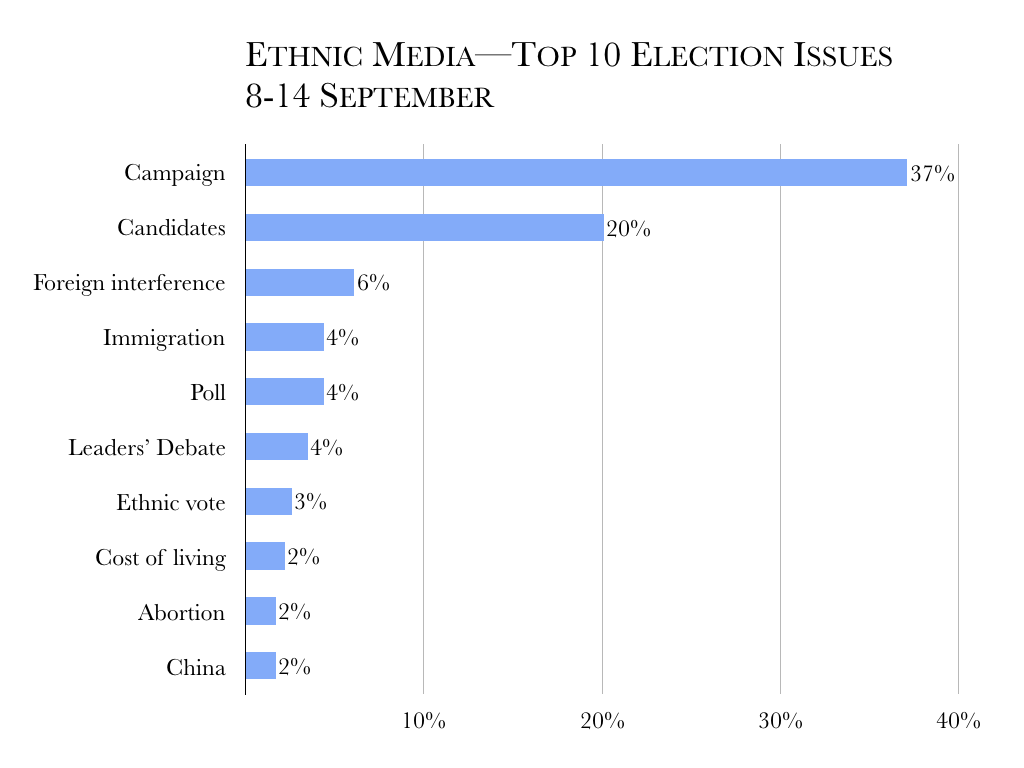
Ethnic media election coverage 8-14 September

Latest weekly analysis of ethnic media coverage. For the analytical narrative, go to Ethnic media election coverage 8-14 September:

Daphne Bramham: Conservatives go hunting for overseas votes

Predictable result of the change allowing voting to expatriates without restriction compared to the previous five-year limit.

To date, the number of registered expatriate voters according to the article is 20,000 compared to about 15,000 when the restriction was in place for the 2015 election.

Elections Canada does not provide a riding-level breakdown of expatriate registration and voter turnout, but has provided a list of registered voters by country (see after the article) so hard to assess which ridings will be most affected.

The Conservatives have been cultivating Canadian expatriates in Hong Kong for some time (not sure if the other parties have):

A few days before the federal election campaign got rolling in Canada, it was already underway for Conservatives in Hong Kong.

Former foreign affairs minister John Baird rallied the overseas troops at two events, while volunteers from Canadian Conservatives in Hong Kong helped people register to receive their mail-in ballots.

Notice of last Thursday’s event at a sports bar in Central and one on Sunday in Tsim Sha Tsui was posted on the group’s Facebook page with instructions to bring passports if they wanted to get registered.

The Conservative Party of Canada’s official website also has a page for the group where its invitation to the first event remains prominently displayed.

But a party spokesman said none of it — the event, the fancy logo with the Conservative Party of Canada’s C circling a red junk that’s long been Hong Kong’s tourism symbol or even helping voters get ballots — is affiliated with the party.

But if it’s not party-sanctioned, then why is it on the Conservative Party of Canada’s official website?

“An unaffiliated group of Canadian volunteers living abroad asked if we could host a webpage for their event to help other Canadians living abroad register to vote through Elections Canada’s process and exercise their right as Canadian citizens to participate in our democratic process,” said Simon Jefferies. “We obliged.”

Well, lucky for the Conservatives.

No other party has such eager overseas volunteers in Hong Kong, where there are an estimated 300,000 Canadians — or anywhere else for that matter.

Potentially, the Hong Kong votes could be decisive in Metro Vancouver, Toronto and even Calgary ridings because overseas Canadians vote in the riding where they last lived. But, so far, only 865 have registered as of this week, according to Elections Canada. Globally, fewer than 20,000 have registered with nearly half of those living in the United States and most of the others living in Britain, Australia and Germany.

This is the first time in 25 years that all Canadians living abroad are eligible to vote in the federal election. The Canada Elections Act was amended last year in advance of a January ruling by the Supreme Court of Canada that voting is “a fundamental political right, and the right to vote is a core tenet of our democracy.” Two Canadians living in the United States launched the Charter of Rights challenge in 2011 after Stephen Harper’s Conservative government began more strictly enforcing a 1993 change to the Canada Elections Act. That change denied the vote to Canadians who had lived abroad for five years or more.

It’s also, lucky for the Conservatives that Baird in his new role as a senior business advisor for a big Canadian law firm makes frequent visits to Hong Kong and China, and has lost none of his partisan zeal.

“Obviously we want Canadians living abroad to support the Conservative Party and make Andrew Scheer the next prime minister of Canada,” Baird said prior to his speech. “So, I’m here to encourage people to register and support him. “

That interview plus coverage of the event is posted on YouTube.

“What I hope is that an Andrew Scheer-led government can bring in more competent foreign policies and be able to re-engage with China and so we can be a strong, respected partner with China.”

The unaffiliated Conservatives’ organizers include Barrett Bingley from The Economist Group, who holds executive positions with both the American and Canadian chambers of commerce in Hong Kong, and Brett Stephenson, director of the Asia Business Trade Association.

The group’s Facebook page was only set up on August 28. And while it was set up as “a political organization,” it has yet to register as a third-party under the Elections Act.

Elections Canada spokesperson Natasha Gauthier didn’t know anything about Canadian Conservatives in Hong Kong. But she did outline the rules and noted that enforcement is done on a complaints-based system.

Regardless of where they live, any Canadian individuals or organizations spending $500 or more on partisan activities during the campaign and even in the pre-election period (which began June 30) must register. They need a bank account, a financial agent and an auditor if they spend more than $10,000.

They need to file revenue and expense statements. They need to list their donors because these are challenging times for democracies under threat from foreign interference and influence.

Gauthier emphasized that any person or organization that isn’t Canadian is forbidden from participating as third parties and as donors.

There’s also no official role for political parties to play in registering voters. That’s Election Canada’s job. Even the role of Canadian embassies and consulates is limited to printing out forms or pointing citizens to the Elections Canada website where people can register online and request their mail-in ballots. But they must get them back by Oct. 21. The deadline to register is Oct. 15, but Canadian Conservatives warn that getting it from Hong Kong to Ottawa by voting day means mailing it by Oct. 5.

These are troubled times in Hong Kong and at home in Canada. Linked by history and blood, both are now struggling in China’s dark shadow to preserve the rights and values that have enabled both to thrive.

But with protesters battling in Hong Kong’s streets, there are few places in the world where the right to vote in fair elections holds more meaning.

Source: Daphne Bramham: Conservatives go hunting for overseas votes

Liste préliminaire des Canadiens à l’étranger inscrits

  • Pays – Nombre –   % du total
  • États-Unis 8522 43,08 %
  • Royaume-Uni 2097 10,60 %
  • Australie 866 4,38 %
  • Hong Kong 865 4,37 %
  • Allemagne 862 4,36 %
  • France 720 3,64 %
  • Canada* 670 3,39 %
  • Suisse 483 2,44 %
  • Pays-Bas 350 1,77 %
  • Japon 297 1,50 %
  • Total des 10 pays : 15 731 79,53 %
  • Autres pays : 4053 21,47 %
  • Grand total : 19 784 100 %
  • *Personnel diplomatique

Source: Élections Canada lève le voile sur la liste des pays étrangers où résident des Canadiens

Toronto immigration firm charges $170K for fake Canadian job, undercover investigation reveals

Classic case of immigration fraud and good in-depth investigative reporting by CBC:

Toronto-based WonHonTa Consulting promises to help Chinese nationals gain permanent residency in Canada. (WonHonTa Consulting Inc. )

A Toronto immigration company offered a job to an undercover CBC journalist posing as a Chinese national seeking permanent residence in Canada for $170,000.

For that fee, WonHonTa Consulting Inc. said, the would-be immigrant would be buying the job and paying their own wage.

And the company said the applicant was to pay the fee to the personal bank account of WonHonTa’s sole director in order to avoid taxes.

Jiacheng Song, a manager with a China-based affiliate of WonHonTa, Nanjing Youtai Investment Consulting Co. Ltd., explained how the business works to the undercover journalist using WeChat, a Chinese social media app.

During the month-long investigation conducted through a translator, the journalist posed as a Chinese citizen wanting to become a permanent resident of Canada by obtaining skilled employment.

“To be frank, we have employers who work with us,” Song wrote. “We pay them money, they are willing to sponsor our clients for immigration.”

Song said “a big chunk” of the fee goes to the Canadian employer, prompting him to ask rhetorically: Why wouldn’t a Canadian company want to participate when it “can make easy money and have free labour for six months?”

Vancouver-based immigration lawyer and policy analyst Richard Kurland characterized what WonHonTa offered bluntly.

“It’s a fake job, pure and simple,” he said.

He said selling jobs is illegal and it allows rule-breakers to jump the queue on legitimate immigrants who play by the rules.

“Who gets hurt? The integrity of Canada’s immigration program,” said Kurland.

Real jobs ‘very rare and precious’

Song said his company, Nanjing Youtai, finds Chinese nationals interested in immigrating to Canada and refers them to WonHonTa in Toronto.

Song recommended the undercover journalist consider either Saskatchewan or Atlantic Canada because the qualification requirements are low and the wait times are short. He said it’s $180,000 for a job in Saskatchewan or $170,000 for the Atlantic provinces.

Song told the undercover reporter that over the past year his company had placed more than a dozen Chinese nationals in Atlantic Canada and just under ten in Saskatchewan.

On its WeChat site, WonHonTa promotes a range of skilled jobs, such as welders, sewing machine operators and daycare workers.

The company claims it has a national network of head hunters who help recruit willing employers. It claims some of them are government immigration officials.

“With more and more people now wanting to apply, employers are having a larger appetite for higher fees,” Song said.

“If you don’t pay a certain fee, there is no way the employer would want to get involved in this matter.”

In order to qualify for permanent residency, the foreign worker has to be able to prove they’re employed in a skilled profession in Canada.

In an article on its WeChat page, WonHonTa notes that it’s very difficult for a Chinese national to find a real job in Canada.

“Think of it this way: Someone only has overseas work experience, no PR [permanent resident] card, never met with the employer — it’s the equivalent to a Beijing local company hiring a migrant worker with no valid ID — Why would anyone dare to hire you directly?” the article asks.

“So is there any real job? The answer is very, very rare and precious,” the article says.

WonHonTa says it works around that by paying employers thousands of dollars for job offers.

Creating a paper trail

Song introduced CBC’s undercover reporter to the “boss” of WonHonTa’s head office in Toronto, Xin Liu, who goes by the name Yuki.

She said the would-be immigrant can go to work for the Canadian company that sponsored them if they wish. In that case, the employer will essentially be paying back some of the Chinese national’s fee in the form of wages.

However, Liu said it’s not necessary to actually work for the company that sponsored the applicant for immigration. She said WonHonTa will provide the necessary documentation to make it look as though they did work there.

“If you don’t work for the employer, we can ask him to issue a pay stub, but it’s not real pay,” she wrote via WeChat. “Your paycheque is just for show. Only to make the paper trail look good.”

Liu said she will ensure all of the appropriate documentation is in place.

“In many circumstances, records of the documents are required should there be an investigation. For example, you are required to file a tax return. You would have to have a tax return record. Banking activities have records, you would have to provide these records.”

She said if the Chinese national doesn’t actually work at their designated place of employment they will be responsible to pay the employer the taxes that would have been paid had the applicant actually worked.

“We can negotiate with the employer, telling them, ‘This person doesn’t really want to work for you, nor wants to stay in this province,'” she said. “This is all negotiable, and all you need to do is to pay the taxes owing to the CRA.”

The massive size of the country makes it impossible to pull resources for site visits just to find out if you are actually working at this company.– Xin Liu, WonHonTa Consulting Ltd. 

Liu assured CBC’s undercover reporter that immigration officials are unlikely to detect the scheme.

“For Immigration Canada, they are understaffed,” Liu said. “The massive size of the country makes it impossible to pull resources for site visits just to find out if you are actually working at this company.”

However, in the unlikely event that an immigration official makes an unexpected site visit to see if the foreign national is at work, Liu said the employer would say the worker was out of the office on business.

Avoiding taxes

Liu provided the undercover reporter with a copy of her company’s standard contract with a would-be immigrant.

In the section outlining the payment details, CBC noticed that Liu wanted her customers to pay her personal bank account.

On WeChat, the undercover reporter asked Liu why.

“In Canada, the VAT [value added tax] charge is 13 per cent when doing business with companies,” she said. “However, we offer the employers real profit, therefore it has to be done through a personal account. In China, we wire the money to the personal account of a company’s legal representative — this is a practice to avoid paying taxes.”

CBC gets a job offer

As the conversation with Liu developed over the month-long investigation, she began hunting for a job for the undercover journalist’s “wife.”

Late last month, Liu announced: “Great news! We have found a good match for your wife, based on her resume.”

Liu said the job offer came from a Halifax-based daycare called Daydreams.

“The owner is a Caucasian. This is a sought-after job opportunity, because there are several inquiries received by the employer already. It really comes down to who pays the deposit first,” she said.

Liu sent the undercover reporter a sample contract in the name of the reporter’s “wife” showing she would be charged $170,000 for the job offer.

When the undercover journalist inquired a couple of days later, Liu said they were too late. The position had been taken. But she promised to line up another offer once the deposit had been paid.

‘I have never heard of them’

One of the owners of Daydreams Childcare Centre, Colleen Dempsey, was baffled when CBC called to inquire about this supposed job offer.

Dempsey said her company had registered with the Atlantic Immigration Pilot Program (AIPP) about 10 months ago so she could hire one particular foreign national who had already been working at the facility on an open work permit.

“I have never done any business with them,” she said of WonHonTa. “I have never spoke with them. I have never heard of them.

“We’re a small business that I’ve built from the ground up and I certainly don’t appreciate my name being thrown around in those regards.”

The name of every company that registers with the AIPP is listed online.

Dempsey assumes that’s how WonHonTa found out about her company. She said the public listing has created other problems for her as well.

“Since we have become listed as part of the Atlantic Immigration Pilot Program … there have been an increase in e-mails from random individuals looking for [permanent] residency and I have not replied to one,” she said.

Dempsey isn’t the only one fielding unwelcome phone calls.

Erica Stanley, an immigration consultant in Charlottetown, told CBC she’s been flooded with calls from foreign nationals looking for an employment offer.

“So, just the volume of phone calls is ridiculous. And my inbox is full of website inquiries,” Stanley said. “They’re like, ‘Well, we’re willing to pay.’ I said, ‘Oh I’m sure you are but it’s illegal to do that.’ ‘Oh, but everybody’s doing it.’ I said, ‘Well, that’s nice, then you can find someone else who can do it.'”

Liu says jobs-for-cash is illegal

Shortly after receiving the job offer, a CBC reporter who was not undercover called Liu and asked if she would do an interview about immigration. At this time, CBC didn’t mention its ongoing investigation into Liu’s company.

Liu agreed to a phone interview. She confirmed her company helps Chinese nationals find employment in Canada, leading to permanent residency. She said she charges $2,000 to $5,000 for that service.

The reporter told Liu that some companies charge $170,000 to $180,000 for the same service.

“It could be, if somebody is trying to make money on it,” she said.

CBC asked Liu if she had ever heard of situations where a Chinese national had to pay a Canadian company for a job and pay their own wage. She said she had not.

“Wow,” she said. “Why would they do that?”

CBC asked if paying for a job and paying your own wage is allowed in Canada.

“Of course not,” Liu said. “The law says that it’s forbid if they [immigration officials] find that the job is not real, right?”

CBC then pointed out the article on WonHonTa’s WeChat site that says under the Atlantic Immigration Pilot Program, 90 per cent of the jobs obtained by foreign nationals are the sort where the employee pays their own wage.

She said she was surprised by this, noting that she doesn’t write or even read content on her own WeChat site.

“How could I have time to write those?” she said.

That article was removed from WeChat shortly after CBC brought it to Liu’s attention.

CBC unveils undercover investigation

CBC then revealed to Liu that it had been conducting a month-long investigation into her company and its practices and had been regularly communicating with her under an assumed identity.

When asked why she previously told the undercover reporter the cost was $170,000 for a job in Atlantic Canada, Liu stumbled over her words for 30 seconds, before attempting to end the interview.

“Ah, it’s um … it’s between the company … I’m driving right now. Can I call you back?” she said.

She promised to continue the conversation after receiving proof she was talking to a journalist. CBC sent an email, but Liu has not replied.

Then CBC phoned Song at his China office and revealed its undercover investigation to him. He said much of what he had told CBC’s undercover reporter was a lie.

He said he was lying when he claimed to have found jobs in Canada for Chinese nationals. He said he’s never done that. He said he was lying when he told CBC’s undercover reporter that his company pays Canadian employers for jobs. He said his company has never done that.

Song said most immigration companies in China do pay Canadian employers for jobs, so he has to pretend to do that as well.

“That’s just a marketing strategy in order to get clients to sign the deal,” Song said in an interview with CBC. “If we don’t do this, our business will never sustain.”

Song said he was unhappy that CBC was investigating his company, which is quite small.

“So it’s really unfair for us to be caught by you while there are so many much bigger companies out there you don’t look into.”

Song said he and Liu are too ethical to pay for a job offer.

“I believe Yuki is a guileless person. She works hard for her clients because she genuinely wants to help them find a real job in Canada.” he said.

‘Everyone’s hands are dirty’

Richard Kurland, the immigration lawyer in Vancouver, didn’t mince words when asked for his assessment of WonHonTa’s scheme.

“I don’t think there’s a serious question that this amounts to an egregious violation of IRPA, the Immigration Refugee Protection Act, as well as Canada’s immigration program.”

He said there is a corrosive effect on each person in the chain of transactions.

“Everyone’s hands are dirty, which means no one can appear in public and seek justice, which means that the business that collects money keeps the money, regardless of outcome,” said Kurland.

So-called arranged employment (AE) offers have been a tool of fraudsters for decades in Canada, as demonstrated by an internal 2010 federal government report commissioned by Human Resources and Social Development Canada.

Canadian diplomatic missions from around the world were questioned about the integrity of these job offers and they flagged widespread problems.

  • Hong Kong reported “high rates of fraud or suspected fraud and only 15-22 per cent of AE offers were found to be genuine.”
  • Beijing said that “21 of the 33 files chosen for review found the applicants were not working for the employer or had never worked for the employer.”
  • New Delhi found that “over 60 per cent of the cases never worked for the employers in Canada.”
  • Seoul said “that out of 29 cases landed in 2008, only eight appeared bona fide, 12 cases found collusion between the employer and/or applicant and/or agent.”

CBC asked the federal government for more recent numbers, but it didn’t provide any.

Instead, Shannon Ker, a spokesperson for Immigration, Refugees and Citizenship Canada, wrote that “the vast majority of applications received by IRCC are genuine.” Ker said IRCC has trained its employees “how to detect fraud and the appropriate steps to take when there is sufficient cause to suspect it is taking place.”

Kurland said that, in his view, Ottawa and provincial regulators aren’t doing enough.

“There is a genuine concern that the province and the feds have insufficient enforcement resources to keep things honest.”

And a lack of enforcement is an invitation for abuse, he said.

“If the international marketplace knows you have a budget for a handful of police officers and you have 2,000 banks in your city, some bank is going to get robbed all the time.”

Source: Toronto immigration firm charges $170K for fake Canadian job, undercover investigation reveals

An introduction to the new Quebec nationalism and the tricks it plays on federal leaders

To watch:

Quebec’s Bill 21 was a dominant theme in the first week of the campaign. Here’s why

The opening days of the 2019 election campaign have been marked, above all, by the attempts of federal leaders to navigate the new Quebec nationalism and its most potent expression, a law on secularism.

The main proponent of this resurgent nationalism is the provincial government led by Premier François Legault and his centre-right party, the Coalition Avenir Québec.

And Legault didn’t wait long before giving the federal leaders a taste.

The campaign was barely a few hours old when he demanded they renounce support for legal challenges to the secularism law his government passed in June — not just “for the moment,” as Liberal Leader Justin Trudeau said he would, but forever.

It was a warning to steer well clear of a matter he considers to be solely within his jurisdiction, even though the law has raised constitutional concerns across the country, not to mention within Quebec itself.

“It’s up to Quebecers to choose and Quebecers have chosen,” Legault said Wednesday of a law that bans religious symbols in parts of the civil service.

But the roots of the new Quebec nationalism go well beyond Legault’s sweeping election victory last year.

It’s a political mindset that has displaced sovereignty as the main alternative to federalism and, as the first week of the campaign has already made clear, will define how the leaders court votes in the province this fall.

Civic vs ethnic nationalism

The nationalism that currently holds sway is conservative. It is based on a holistic conception of Quebec society that prioritizes the historical experience of francophones.

It’s mainly worried that the combination of immigration and official multiculturalism will make francophone Quebec culture more vulnerable in an increasingly interconnected world where English is the lingua franca.

No surprise then that cutting immigration levels and protecting Quebec’s secular identity were the chief highlights of Legault’s first year in office.

He has sworn off sovereignty since his days in the Parti Québécois, but the origins of the conservative nationalism that his government espouses can nevertheless be traced to the movement’s most decisive moment: the night of the second referendum.

That night, Jacques Parizeau, the PQ premier, opted to improvise his concession speech. “We are beaten, it is true,” he said. “But by what, basically? By money and ethnic votes.”

Already in crisis following the narrow defeat, the sovereignty movement was split in its reaction to Parizeau’s comments.

There were those who were horrified and spent the ensuing years trying to expunge the movement of any hint of ethnic nationalism; trying to promote a more inclusive, civic-style nationalism instead.

And there were those who believed Parizeau was right, and sought to emphasize the history of French-Canadians in their version of Quebec nationalism.

At the outset, the civic nationalists had the upper-hand.

“After 1995, because of Mr. Parizeau’s comments, there was a tendency within the sovereigntist milieu to adhere to a Trudeauist conception of society,” said Éric Bédard, a prominent Quebec historian whose writings helped spark the revival of conservative nationalism.

“Why claim a special status, maybe even Quebec sovereignty, if fundamentally we adhere to the spirit of Canadian multiculturalism?”

But the reasonable accommodation crisis, which lasted roughly between 2006 and 2008, tipped the scales in the other direction.

The rise of the conservative nationalists

As debate raged in the province about whether minority cultural practices represented a threat to Quebec’s secular society, conservative nationalists mounted a fierce attack on multiculturalism.

Bédard and others argued the Canadian Charter of Rights and Freedoms and its application by federally appointed judges, was too accommodating of minorities, at the expense of a historically rooted Québécois culture.

According to a conservative nationalist reading of the past, this culture is defined by the solidarity forged among francophones fighting for their survival. And the legacy of this solidarity is a willingness to value collective rights over individual ones.

That, they said, is what a secularism law could do: protect the collective rights of Quebecers to live in a secular society against individuals who use the charter to carve out space for their religious practices.

This argument eventually found a sympathetic ear in PQ leader Pauline Marois, who was desperate to restore her party’s fortunes after a disastrous performance in the 2007 election.

Marois brought several conservative nationalists, including Bédard, into her inner circle.

It was a collaboration that ultimately produced the Charter of Values, a proposed secularism law that would have banned religious symbols from large parts of the civil service.

The charter died on the order paper when the PQ lost the 2014 election. But conservative nationalists didn’t blame the charter for the loss. They blamed Marois’s focus on sovereignty.

The CAQ’s successful 2018 election campaign was based on a similar reading of the political climate in the province.

“The CAQ is in the process of fostering a nationalism without sovereignty. And that’s the winning formula at the moment,” said Jacques Beauchemin, a sociologist and former adviser to Marois whose writings also played a big role in the nationalist revival.

“They are proposing a nationalism that suits Quebec of today; a nationalism that is not afraid of affirming things, like with Bill 21 (the secularism law).”

Of obstacles and opportunities

The federal election campaign thus opens in Quebec at a moment of deep suspicion about federal institutions.

Legault, and other defenders of Bill 21, have actively sought to delegitimize the charter and the court system charged with upholding it, fearing their power to strike down the law.

His government, moreover, seeks not simply to defend provincial jurisdiction, but expand it in key areas, like immigration.

In the meantime, multiculturalism, as both a policy and a value, is cast in ever darker terms by government officials and popular columnists.

The grid laid down by the new Quebec nationalism offers different opportunities and obstacles to the three main contenders in the province.

It helps explain why, when launching his campaign, Bloc Québécois Leader Yves-François Blanchet began with a paean to the nationalism of the CAQ government. Sovereignty received only a second-order mention.

It also provides an explanation for why Conservative Leader Andrew Scheer has been more timid than Justin Trudeau in his criticism of Bill 21.

Now that conservative nationalism has been shorn of its sovereigntist trappings, the Tories are trying to win over voters who once backed the Bloc.

There is, however, only so much Scheer can offer without departing from his federalist bedrock and alienating supporters in the West.

Of the three then, the Liberals would seem to have the most to lose from the present configuration.

Trudeau is seeking a delicate balance with his position on Bill 21, trying to present his pro-charter federalism as no immediate threat to the law without forsaking a document that’s at the core of his party’s identity.

But the Liberals, it bears recalling, have maintained a healthy lead in Quebec polls since the last election. Conservative nationalism may be ascendant in the province; it’s not yet hegemonic.

Source: An introduction to the new Quebec nationalism and the tricks it plays on federal leaders

And PM Trudeau’s carefully worded not closing the door on challenging the Bill 21 in court:

Pour sa première journée de campagne en sol québécois, le chef du Parti libéral, Justin Trudeau, est allé un peu plus loin au sujet d’une possible contestation judiciaire de la Loi 21 sur la laïcité de l’État en affirmant qu’il serait « irresponsable » pour un gouvernement fédéral de « fermer à tout jamais la porte » sur la question.

« Nous ne fermons pas la porte à une intervention éventuelle parce que ce serait irresponsable qu’un gouvernement ferme la porte à tout jamais sur une question de droits fondamentaux », a admis le premier ministre sortant, talonné par les journalistes après avoir annoncé une série d’incitatifs pour les entrepreneurs, à Trois-Rivières.

Justin Trudeau, quelques minutes après le coup d’envoi de la 43e élection générale fédérale mercredi, avait affirmé qu’il jugeait qu’il serait « contre-productif » de s’engager « pour l’instant » dans une démarche judiciaire pour contester la Loi 21.

Sa position a rapidement été entendue à l’Assemblée nationale alors que le premier ministre, François Legault, a bien averti les chefs politiques fédéraux de ne pas s’aventurer dans cette voie. Le chef du Parti conservateur, Andrew Scheer, a déjà fait savoir qu’il n’a pas l’intention d’intervenir dans le débat et qu’il ne contesterait pas la loi.

Loi 21 : Justin Trudeau persiste et signe


Four in 10 international students turned away by Canadian immigration

Study Permit Refusals by Level

Source: IRCC data

More than half the international students headed to undergraduate programs in Canada were turned away this winter and spring by immigration officials.

Between January and May, officers rejected 53 per cent of the study permit applications filed by foreign students hoping to begin a bachelor program in Canada, according to data provided by Immigration, Refugees and Citizenship Canada.

The record refusal rate is part of a trend that has seen immigration officials refuse a higher proportion of applications every year as international demand for Canadian education has soared. The overall refusal rate – including study permit applications to attend primary, secondary, post-secondary and language programs – was 39 per cent in the first five months of the year. (Rates for the first five months of 2019 may not reflect full-year rates.)

Reasons for refusal: fraud, danger, doubtful intentions

Twenty-eight per cent of all study permit applications were rejected by immigration officials in 2014. Four years later, in 2018, the overall rejection rate had climbed to 34 per cent. Demand for education boomed in that same period, with total applications almost doubling to more than 340,000 in 2018.

Increasing study permit refusals 2014 to 2019, Canada

Source: IRCC data

Robert Summerby-Murray is president of Saint Mary’s University, where 34 per cent of all students come from outside Canada. He is also chair of the Canadian Bureau for International Education, which promotes international education on behalf of more than 100 Canadian colleges, universities, schools and institutions.

He said study permit approvals have been improving for his students and he hasn’t heard of problems from other institutions.

“In some markets now, approvals are over 90 per cent,” he said of the experience of his own university this year. “We don’t see a 40 per cent refusal rate. That’s not our experience at all.”

Officials can refuse a study permit for many reasons: if they suspect the student may not return to their home country after graduation; if the student doesn’t have sufficient funds to pay for tuition and living costs while in Canada; if the student poses a health or security threat to Canada; if the officer doesn’t think the student’s academic plan makes sense; if the application is incomplete or inaccurate or if there is evidence of fraud in the application.

Harpreet Kochhar, assistant deputy minister of immigration, warned last fall that fraud had become a significant problem in study permit applications. He told a conference of the Canadian Bureau of International Education that a sample audit found that 10 per cent of the admission letters attached to study permit applications were false. In one case, he said, a supposed admission letter from Dalhousie University did not even spell the name of the university correctly.

Undergraduate refusals double

University-bound students are driving the higher rejection rate. While the study permit refusal rate for graduate university programs has increased slightly, the refusal rate for bachelor programs is soaring.

In 2014, only 20 per cent of international students headed to a bachelor program were refused a permit, compared to 37 per cent in 2018 and 53 per cent in the first five months of 2019.

Five years ago, visa officers were twice as likely to approve the study permit applications of international students bound for Canadian universities as students bound for Canadian college programs. Today the overall rates are similar.

The lowest refusal rates in early 2019 were for students who want to attend a doctoral program (11 per cent), high school (20 per cent), primary school (20 per cent), master’s program (31 per cent) or language program (31 per cent).

Refusals vary by source country

Refusal rates also vary dramatically by country, with students from Africa much less likely to receive a permit than students from many Asian and European countries.

Alain Roy, vice president of international partnerships with Colleges and Institutes Canada, said he is pleased that the rejection rate for college-bound students has remained steady despite a huge increase in the number of applications.

Summerby-Murray said his university works hard to build and maintain relationships with the consular officials who decide whether a student permit is approved, and they also work with expert agents who vet students thoroughly before an application is filed.

“We visit. We call,” he said. “I can pick up the phone. I can talk to the consuls in Shanghai, the team in Beijing, the folks in Hong Kong, Nairobi and other places and say, ‘Heh, we have these refusals, can you reconsider?’ We have worked very hard on these relationships.”

Polestar collected impressions from several other university administrators across Canada, all of whom shared information on the condition that neither they nor their institutions would be named. Two smaller universities said they have noticed an increase in problems with study permit approvals and two larger institutions said they had not seen any increase.

Universities Canada declined to comment on the study permit refusal rates.

International students who want to attend school in Canada must be admitted to a designated learning institution before they apply for a study permit from Immigration, Refugees and Citizenship Canada. Most students will also need either a temporary resident visa or an electronic travel authorization to enter Canada.

Source: Four in 10 international students turned away by Canadian immigration

Quebec’s religious symbols ban a major issue in federal election campaign

Good range of people interviewed. Odd conclusion given overall demographic changes and that most immigrants integrate:

The new Quebec law that bans many public servants from wearing visible religious symbols has become a major issue in the federal election campaign.

This isn’t a Quebec-versus-the-rest-of-Canada conflict. This is the shires against the cities, old stock versus those who welcome newcomers, the Canada that was against what Canada is becoming.

This is a conflict on the rise, not the wane.

Mario Levesque, a political scientist at Mount Allison University, agrees that Bill 21, as the Quebec legislation was known before it came law, divides Quebec from the rest of Canada. But even more, he says, it divides rural Canada from urban Canada.

When it comes to accepting high levels of immigration and the racial and cultural diversity that follows, “I would almost limit that to some of the bigger cities,” he said in an interview. “In other parts of Canada, I think there is some support for Bill 21.”

Erin Tolley, a political scientist at University of Toronto, points to research she and co-author Randy Besco conducted that shows about a third of Canadians oppose multiculturalism, a third support it, and a third are “conditional multiculturalists” who, as they wrote, “approve of immigration and ethnic diversity, but only under certain conditions” – the most important being that immigrants integrate fully into Canadian society.

“There is some difference between Quebec and the rest of Canada” on the question of embracing multiculturalism, Prof. Tolley said in an interview, “but it’s not as big a difference as you might think.”

Daniel Weinstock, a professor of political philosophy at McGill University, said that an important difference between Quebec and the rest of Canada “is that, in Quebec, politicians and pundits have been able to couch the law, fallaciously in my view, as being in continuity with Bill 101 [Quebec’s language law], as a defence of Quebec identity.”​​

But even without the veil of protecting French language and culture as an excuse, many Canadians object to minority religious and cultural practices. Prof. Tolley says that when Stephen Harper’s Conservatives vowed to ban the niqab – the full face and body covering worn by some Muslim women – at citizenship ceremonies, “many Canadians sided with the Conservatives.”

Prof. Levesque believes that more time may be needed for people in rural areas of Ontario, where he used to live, or the Maritimes, where he teaches now, “to learn about and welcome new arrivals, since they typically get so few of them.”

Although Maxime Bernier’s efforts to leverage voter discontent over multiculturalism with his new People’s Party have thus far gone nowhere, most political leaders are treating the Quebec law as though it were a new third rail.

Andrew Scheer says a Conservative government would not join the court challenge against the law. At this stage, neither would a Liberal government, Justin Trudeau said on Friday, although “we’re not going to close the door on intervening at a later date. “Intervention if necessary, but not necessarily intervention.

At Thursday night’s debate, Green Party Leader Elizabeth May hoped “that we can find a solution where we leave Quebec alone but we find jobs for anyone that Quebec has taken off their payroll.”

Only NDP Leader Jagmeet Singh stands firm against the law, which would prohibit him from being a teacher or judge in Quebec because he wears a turban. “It’s legislated discrimination, and it’s sad and it’s hurtful,” he said at the debate.

Prof. Weinstock profoundly objects to Quebec’s new law because it “asks vulnerable minorities to do something that they can only do at the cost of enormous symbolic harm to themselves,” by publicly abandoning religious symbols “that they see as central to their identities.”

Yet, despite the openly discriminatory nature of the legislation, Quebec Premier François Legault has warned federal politicians not to support the court challenge.

“I want them to stay out of it – forever,” he told reporters earlier this week. “Not for the moment, but forever.”

No political fight is more useless than a culture war. Not a job is created, not a single child lifted out of poverty, not a jot of environmental progress made. It’s just Us and Them, with both sides the loser.

But there may be no escaping this fight, if enough voters in the future reject what Canada is becoming and demand the old one back.

Source: Quebec’s religious symbols ban a major issue in federal election campaign