Religion and Healthcare

From UofT’s student newspaper, The Varsity, a lengthy piece on religion, accommodation and healthcare. My favourite part is the care taken to have an inclusive interfaith space:

The creation of the spiritual oasis of Mount Sinai, for example, was done by a committee.

“We actually pulled together staff who were interested in designing that space from a wide range of religious groups, including atheists, so we had everybody at the table,” says Kanee. “We worked together to figure out what we needed in that space, but also how we could build a space that wouldn’t be accommodating to the needs of one religion, and offend others.”

The room has prayer mats and kneelers, and a small table that can serve as an altar, and is attached to a wudu room. Each element was carefully considered before its inclusion; for example, no artifact could dominate the room.

“So it’s very plain,” Kanee explains, “but everything you need is in there, you just need to access it and pull it out.”

Shifting intersections: The evolving relationship between religion and medicine in Toronto’s public sphere

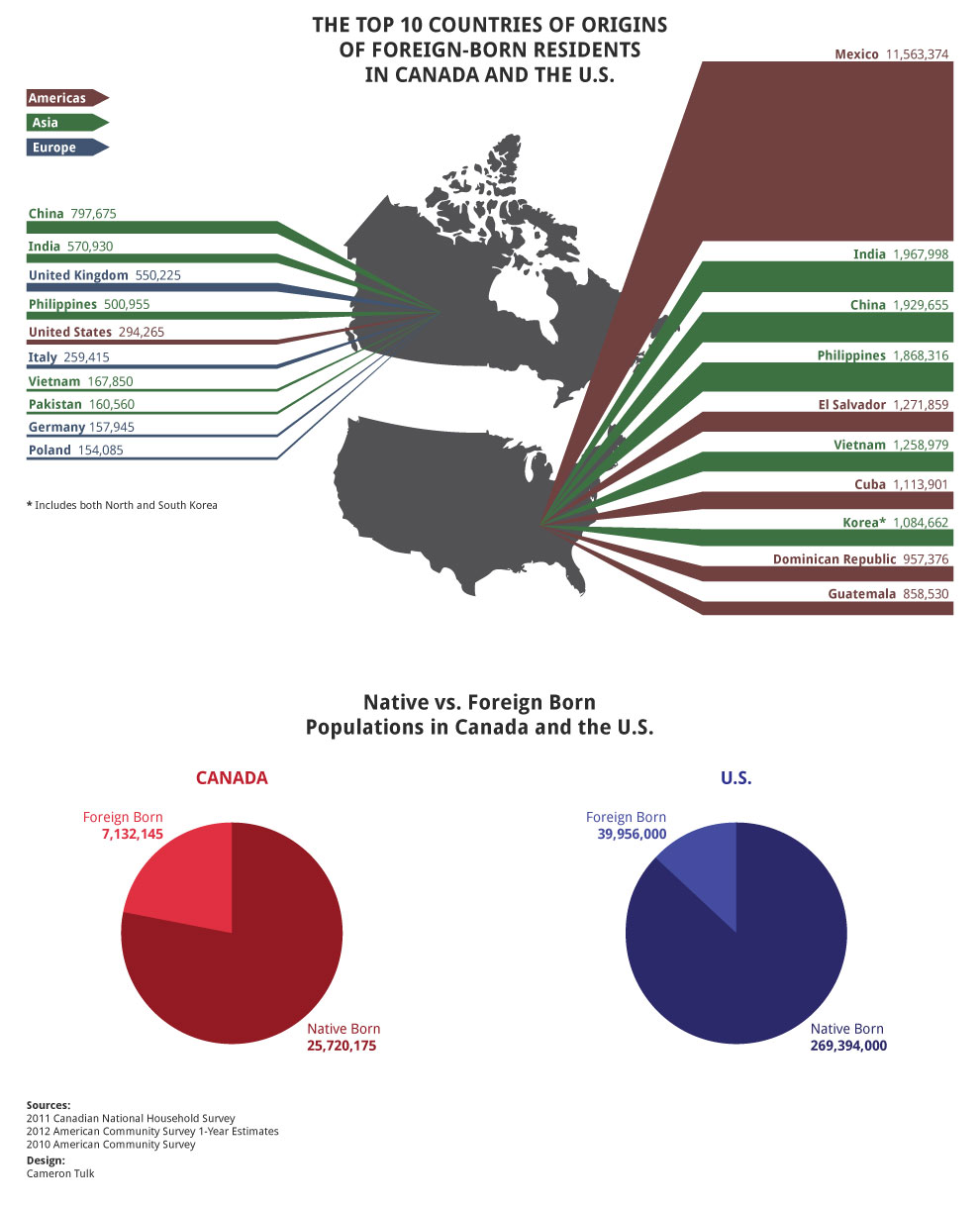
Canada-US Comparison on Source Countries of Immigrants

Good comparative graph contrasting Canada and US source countries of immigrants:

Immigration-Numbers-igversion

Canadian International Council – Canada’s hub for international affairs » Foreign Lands.

Slavery in Canada: Some uncomfortable truths

A reminder that slavery existed in pre-Confederation Canada, and the uncomfortable truth of slavery in French Canada, from Quebec historian Marcel Trudel’s book, Canada’s Forgotten Slaves: Two Hundred Years of Bondage:

“Slavery in Quebec was not some economic imperative, but rather a form of public extravagance which conferred prestige,” Mr. Trudel writes. In 18th-century Quebec, whose boundaries reached into parts of what is now the United States, a slave was a status symbol, more often found in town than in the country, more likely to be a domestic servant than a field labourer.

Mr. Trudel provoked a scandal in Quebec in 1960 when he first published his revelations as L’esclavage au Canada français. Generations of historians and church leaders had nurtured the myth that slavery, if it had existed at all, had been imported into the province by the English after the conquest of 1760. In fact, 85 per cent of Mr. Trudel’s confirmed owners were francophones, and the Quebec slave trade was well established before Wolfe met Montcalm. Nobody could refute Mr. Trudel’s careful research, so he was ostracized professionally, and in 1965 left his post at the University of Laval for a less frosty berth at the University of Ottawa.

200 years a slave: the dark history of captivity in Canada

Debate over Muslim Integration: Doug Saunders and Salim Mansur

Starting with Robert Sibley’s good account of the debate over Muslim immigration from both the comforting (Saunders) and alarmist (Mansur) angles.

Some of Mansur’s language, however, almost resembles “Elders of Zion” language in its conspiratorial characterizations (for my mini-review of Mansur’s book, Delectable Lie: A Liberal Repudiation of Multiculturalism, see my other blog, Lymphoma Journey Week 49: Another Good Week):

Mansur pointed out that the long-term subversion of the West is the mandate of the Muslim Brotherhood, the parent organization not only of the Council on American-Islamic Relations in the United States, but also CAIR’s Canadian subsidiary, CAIR-CAN (which now prefers to call itself the National Council of  Canadian Muslims). The Muslim Brotherhood “sees immigration as a process of settlement in its strategy of subverting Western civilization from within,” he said

In Mansur’s view, the Islamists think long-term in much the same way as the communists did following the Russian Revolution in the early 1900s. What Canadians are seeing now, he concluded, is “the drip, by drip, by drip” effort to erode the liberal democratic traditions of western countries by means, in part, of mass immigration.

http://blogs.ottawacitizen.com/2014/03/01/great-debate-mansur-versus-saunders-on-muslim-immigration/

The actual text of the interventions by Doug Saunders and Salim Mansour opening the debate:

http://www.theglobeandmail.com/globe-debate/is-muslim-immigration-a-threat-to-the-west/article17302855/#dashboard/follows/

A follow-on column by Sibley, commenting on Irshad Manji’s recent speech and interviews (Q&A: Irshad Manji on Multiculturalism), also building on the “controlling the world” theme:

In a similar fashion to Mansur, Manji warns that if current fear-based multiculturalism continues Canadians will see their country increasingly segregated and cliqueist. And that way lays a fractured society of competing power elites. “By giving rights to cultures, not just to individuals, what we wind up doing, in fact, is not giving more power to the entire community, we wind up giving more power to those who are already powerful within certain communities.”

And therein resides the “threat.” As theologian Mark Durie observes: Islam “classically demands a political realization, and specifically one in which Islam rules over all other religions, ideologies and competing political visions. Islam is not unique in having a political vision or speaking to politics, but it is unique in demanding that it alone must rule the political sphere … Not all Muslims are seeking to implement this vision, but many are.”

In other words, offending people (including Muslims) is a necessary, if insufficient, condition for freedom in a multicultural society.

I agree with his point on being able to offend people as part of a democratic society, and the focus on individual rights, not group rights, but the ability to offend should not be used in a gratuitous manner and criticism should be measured in tone.

Muslim immigration and multiculturalism

And while free speech and debate is to be encouraged, a reminder by Amy Awad that what seems to be considered acceptable discourse with respect to Muslims would not be for Blacks, Jews or other minorities:

Unlike recreational debating societies, MLI is supposed to be providing real policy alternatives. But the resolution being debated tonight is informed by fear: “Muslim immigration is no threat to Canada or the West.” Can you imagine if the word “Muslim” were replaced by any other religious or ethno-cultural group — say “Jewish” or “black”?

Over the past century, Western democracies have held public debates on whether or not blacks ought to be given certain rights, and whether Jews threatened the European societies in which they resided. The debates were based on the problematic premise that blacks, Jews or other minorities were monolithic groups with defined characteristics, and that those characteristics were more important than the humanity they shared with everyone else.

Similarly, can we really start a debate about “Muslim immigration”? There is no such thing. Rather, there is immigration of a large variety of Muslim individuals from a broad range of countries and cultures around the world with a wide range of religious practices. Recall that 20% of the world’s population is Muslim. It is not possible to generalize about the threat they may or may not pose to Canada. We should not accept the very premise of this debate.

But better to have the debate out in the open, rather than being overly polite and avoid discussion.

http://fullcomment.nationalpost.com/2014/02/27/amy-awad-people-immigrate-religions-dont/
Jonathan Kay: Shariah with a Jewish face | National Post

Good piece by the parallel fundamentalism of the Haredim by Jonathan Kay:

What’s worse, Haredim exhibit a level of misogyny and sexual phobia that is more commonly associated with militant Muslim fundamentalists. Public spaces in Haredi communities are rigidly segregated by sex. In extreme cases, the women even dress in Jewish burquas (colloquially referred to as “frumkas,” a play on a Yiddish word indicating piety). What’s worse, Haredim have demanded that the wider Israeli society adapt to their primitive views — insisting, for instance, that bus lines offer sex-segregated service, that advertising should be free of female faces or bodies, and that beaches maintain separate areas for men and women.

Haredi publications routinely censor out women — including, in the most appalling examples, the faces of female Holocaust victims in reprinted photos from the 1940s. The editorial policies of such publications are dictated by a board of religious censors, much like in Saudi Arabia. Haredi communities even have their own Jewish small-scale versions of the ministries of vice and virtue imposed by the Mullahs of Iran and other Muslim theocrats. This is, in essence, shariah with a Jewish face. And it is destroying Israel’s hard-earned reputation as an island of Western values in the heart of the Middle East.

Jonathan Kay: Shariah with a Jewish face | National Post.

Reasonable Accommodation and the Niqab – Quebec Ruling

Good example where an administrative tribunal made the right call in refusing an accommodation, in this case, for a medical examination required to justify an ongoing disability claim.

http://www.lapresse.ca/actualites/201403/06/01-4745405-voile-chez-le-medecin-la-csst-a-gain-de-cause.php

Radicalization

Some good pieces on radicalization, starting with a RCMP initiative to curb radicalization among at risk youth:

RCMP set to tackle extremism at home with program to curb radicalization of Canadian youth

Secondly, an overview of the case of Damian Clairmont, a Muslim convert from Calgary, who became radicalized and was killed in Syria:

Not His War: How a Catholic Canadian Became an Islamic Extremist

Hockey Night in Canada lineup demonstrates commitment to diversity (satire)

A very funny way to make a serious point:

Moore said the revamped HNIC will appeal to a new demographic, such as white men with brown hair and white men with darker brown hair.

“I think one of the beauties of Hockey Night in Canada is that is does get a broader audience, and we want to broaden that even more,” said Moore.

“This is not the same country it was 25 to 30 years ago,” Moore added, standing next to a group who represented a wide range of tie and suit fabric options.

A reporter — Simon Houpt of the Globe and Mail — did manage to ask, in the most deadpan way possible, about the lack of diversity.

“I love how diverse a panel we see up there on stage right now, are you intending to hire even more women to be on stage any time?” asked Houpt.

Moore seemed caught off guard and replied that more hiring announcements are in the works and the “full complement” would be in place by April. These hires would presumably “complement” the “dream team” trotted out on stage today.

Thumbs up for maintaining the status quo!

Hockey Night in Canada lineup demonstrates commitment to diversity | canada.com.

International Holocaust Remembrance Alliance Ends: Andrew Bennett New Canadian Head of Delegation

Interesting choice of new head of Canadian delegation to the International Holocaust Remembrance Alliance: Andrew Bennett, Canada’s Ambassador for Religious Freedom.

Responsibility for multiculturalism-related files now spans three Ministers:  Baird of DFATD, Alexander of CIC, and Kenney, who has overall political responsibility. Holocaust awareness and remembrance is about more than religious freedom. Countries like the US and UK separate religious freedom and Holocaust/antisemitism responsibilities. Represents a further dilution of the multiculturalism policy role of CIC, whether driven by the political or bureaucratic levels, and whether or not it represents distrust of officials.

News Release — Canadian Chair Year of the International Holocaust Remembrance Alliance Ends: Holocaust Awareness and the Fight Against Anti-Semitism Continue.

Godwin’s Law

An old post, but continues unfortunately to be relevant, by Bernie Farber on the abuse of Hitler comparisons (Godwin’s Law):

http://m.huffpost.com/ca/entry/1875579