ICYMI – Debate: Is al-Qaeda a global terror threat or a local military menace? – The Globe and Mail

Globe debate on Al-Qaeda and whether its strength today. Arguing for it being weaker is J.M. Berger:

Al-Qaeda has not abandoned terrorism, but it has adopted a default position of encouraging “lone wolf” attacks by non-networked supporters in the West. While this obviously represents an ongoing problem, individual actors do not represent the same magnitude of threat that manifested itself on September 11, nor do they require al-Qaeda to spend its own resources.

Holding territory is an inherently local activity, which has focused the resources of many jihadists on the countries where they dwell, rather than on attacking the U.S. homeland. Even al-Qaeda in the Arabian Peninsula — widely held to be the most dangerous al-Qaeda threat to the West — has attempted only a handful of attacks on the U.S. homeland. Each of the plots that have become public knowledge were lightly staffed and funded on a shoestring budget. AQAP’s resources are instead overwhelmingly devoted to battling the government of Yemen, where it is based.

For the Foundation for Defense of Democracies, Daveed Gartenstein-Ross argues the contrary:

But we should be cautious about repeating past mistakes, and prematurely penning the obituary of al-Qaeda’s senior leadership.

For their own part, al-Qaeda insiders reject the characterization that the group has become decentralized. Abu Sulayman al-Muhajir, an al-Qaeda official currently in Syria with its official affiliate, the Nusra Front, recently spoke at length about al-Qaeda’s bureaucracy. He described system known as aqalim – regionalization — wherein a different leader oversees each of the geographic locations where the group operates, but is subordinate through an oath of bayat (fealty) to al-Qaeda emir Ayman al-Zawahiri. One senior al-Qaeda official, known as the masul aqalim, is responsible for overseeing all the affiliates operating in different regions, coordinating with the regional emirs. Rather than disparate groups connected by little more than “loose ideology,” Abu Sulayman described a group with bureaucratic direction. His account appears more credible than that of The New York Times.

Debate: Is al-Qaeda a global terror threat or a local military menace? – The Globe and Mail.

Canadian-born visible minority youth facing an unfair job future

Diversity by City

Some good analysis of income gaps between visible minorities and the “mainstream” by Andrew Jackson of the Broadbent Institute:

… while members of visible minority groups are more likely to be recent immigrants than other Canadians, a high and rising proportion of non-whites were born in Canada.

Forty per cent of visible minority youth age 20 to 24 were born in Canada and thus have the same educational experience as other Canadians. Many others came to Canada as young children and were mainly educated in Canada. But they still encounter greater problems in the job market than whites.

2011 was a year of partial recovery from the Great Recession of 2008-09, and the overall unemployment rate averaged 7.8 per cent.

The NHS data show that the unemployment rate in 2011 was 9.9 per cent for visible minority workers compared to 7.3 per cent for white workers, a difference of 2.6 percentage points. The difference in unemployment rates between visible minorities and white workers was significantly greater for women 10.6 per cent vs. 6.7 per cent than for men 9.3 per cent vs. 7.8 per cent.

The unemployment rate in 2011 was especially high for Arabs 14.2 per cent, blacks 12.9 per cent and South Asians 10.2 per cent.

A high level of education did not narrow the unemployment rate gap between visible minority and white workers. In fact, the gap 7.9 per cent vs. 4.1 per cent was greater for workers with a university degree.

Strikingly, there was a big difference in unemployment rates in 2011 between visible minority workers who were born in Canada and white non-immigrants – 11.8 per cent compared to 7.4 per cent.

The gap was a bit smaller but still significant for young visible minority workers age 20 to 24 born and educated in Canada and white workers in the same age group, also born and educated in Canada – 17.2 per cent compared to 14.1 per cent.

Canadian-born visible minority youth facing an unfair job future – The Globe and Mail.

Hatred of women, not Islam, fuels Pakistan’s honour killings

Two takes on the horrific stoning in Pakistan of  Farzana Parveen, another example of all too frequent “honour killings,” or as CCMW names them, “femicide.” Starting with Omar Aziz in the Globe:

What are we afraid of? Can we, for one second, acknowledge that there is a cultural problem here, or will we continue to sanctimoniously blame all of this on ‘those other men over there?’ Within five kilometers of my home, I can think of at least two cases of such extreme, impenitent misogyny. In one case, a Pakistani father beat his daughter after he discovered her long-distance relationship. In another, the case of Aqsa Parvez, her brother strangled her to death with the father’s consent because she objected to wearing the hijab. Everywhere there is an honour killing – a human sacrifice – there is a woman breaking off the chains of tradition. There is a woman demanding the right to live as she wishes, and in her way is a man demanding she get in line.

These women are the real freedom fighters in the Pakistani and wider South Asian and Middle Eastern community, not the cowardly males who use their physical advantage to assault women in the name of some illusory honour, or their supporters in the West and throughout South Asia who rationalize their decisions. One crime too many has been committed against women by the insecure, ignorant, hate-filled mob that is their own family. It is time that we be honest about the causes of such barbarity and begin seriously combatting it, or Farzana Parveen’s name may soon be forgotten like the many women who were sacrificed before her.

Hatred of women, not Islam, fuels Pakistan’s honour killings – The Globe and Mail.

And, via Farzana Hassan, this piece by Matthew Syed in The National Secular Society:

Turn your mind away from the brutality of honour killings and focus, for a moment, on the psychology. Consider the corrupting power of a religious ideology that can animate a father to perpetrate the most intimate and barbaric of assaults on his own daughter, a brother on his own sister, an uncle on his own niece.

“I killed my daughter as she had insulted all of our family by marrying a man without our consent, and I have no regret over it,” the police investigator quoted the father of the murdered woman in Lahore as saying. Her crime, in case you were wondering, was to fall in love with the wrong man.

You cannot win against this kind of barbarism by being nice. You can’t win by beating a strategic retreat, as Sotheby’s plans to do by withdrawing nudes from arts sales because they are terrified of offending Middle Eastern clients. Fundamentalism is too fierce, too implacable, it takes too deep a hold on those who are infected by it, to reach any kind of compromise. Trying to find an accommodation with fanaticism is like trying to cuddle a virus.

A woman is stoned. We politely look away

Google diversity report highlights white male workforce

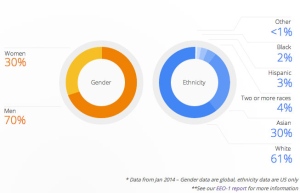
google-diversity-dataInteresting piece on Google’s efforts to increase diversity. The problem applies to much of the tech industry:

Gender and ethnic disparities are reflected throughout the tech industry. About seven per cent of tech workers are black or Latino in Silicon Valley and nationally. Blacks and Hispanics make up 13.1 and 16.9 per cent of the U.S. population, respectively, according to the most recent Census data.

In the coming months, Google said, it will work with the Kapor Center for Social Impact, a group that uses information technology to close gender and ethnic gaps in the Silicon Valley workforce. The centre will be organizing a Google-backed conference in California focusing on issues of technology and diversity.

Co-founder Freada Kapor Klein, who started the Level Playing Field Institute 13 years ago to teach and mentor black and Latino students in science and math, said Google is showing leadership “which has been sorely needed for a long time.”

“Google is the company known for the moonshot, and applying that part of Google DNA to this problem is a breath of fresh air,” she said.

Google diversity report highlights white male workforce – World – CBC News.

Younger Canadians hold more negative views about religious groups – CRRF

Further to an earlier release of the CRRF and ACS Survey on Religion, Racism and Intergroup Relations in Canada Shows Differences in Attitudes Among Anglophones, Francophones and Other Groups, a further release pertaining to attitudes to religious diversity by age group. Remarkably consistent across religions, except for Muslims:

Table 1: Negative attitudes towards certain groups, according to age groups
 Negative Opinion

Total

18-24

25-34

35-44

45-54

55-64

 Muslims 44% 43% 45% 40% 43% 40%
 Jews 19% 24% 25% 20% 15% 15%
 Protestants 15% 24% 23% 14% 15% 8%
 Catholics 19% 25% 25% 22% 18% 13%
 Atheists/Agnostics 21% 14% 18% 21% 21% 22%
 Religious 31% 36% 33% 31% 31% 27%
 Immigrants 24% 24% 27% 24% 30% 16%
 Aboriginals 26% 26% 26% 25% 29% 22%

Younger Canadians hold more negative views about religious groups

Whereas on diversity in general, young people are more supportive than older age groups, as another relatively recent study by ACS shows:

Do you have a very positive, somewhat positive, somewhat negative or very negative opinion of Canadian Multicultural Policy
Total 18-24 25-34 35-44 45-54 55-64 65 + French English Other
TOTAL positive 58% 74% 61% 61% 56% 54% 47% 48% 60% 67%
Very positive 15% 34% 18% 15% 10% 12% 8% 8% 14% 26%
Somewhat positive 43% 40% 43% 46% 46% 42% 39% 40% 46% 41%
TOTAL negative 35% 14% 29% 33% 35% 39% 50% 45% 32% 28%
Somewhat negative 23% 7% 19% 24% 25% 25% 33% 29% 22% 18%
Very negative 12% 8% 10% 9% 11% 14% 17% 16% 10% 11%
I prefer not answering 7% 11% 10% 6% 9% 7% 3% 7% 8% 5%

Younger Canadians Believe Multiculturalism Works; Older Canadians, Not So Sure 

I expect a further breakdown by region (urban vs rural, QC vs ROC), cross-referenced to more broad-based attitude polling, may cast more light, or it may simply reflect that younger people, in general, may be less religious.

No surprise, and consistent with other surveys, distrust of Muslims is higher than other religions (they did not ask about Sikhs which generally “rate” between Muslims and other religions). There may be a link between the categories “religious” and Muslims, given perceptions of more religious fundamentalism or conservatism.

Like all polling, one question leads to another …

Australia: Multiculturalism faces uncertain future in more polarised nation

Results of a survey for Australia’s Special Broadcasting Service (somewhat equivalent to OMNI) by Andrew Jakubowicz, and some of the divisions within Australian society:

A more “traditionalist” group perhaps as high as 47% wants conservative certainties, rejecting or fearing social change. A large middle group around a third of Australians is “open-minded” about the future, but highly protective of its own lifestyles and interests. Only a “cosmopolitan” minority one in five is drawn towards new opportunities while welcoming an evolving and changing world.

Evidence from the Census for the past two decades reveals some basic information. Australians are ageing; we are more culturally diverse; we live in smaller family units or alone; we are less religious; and we consume more stuff per head.

The divisions between us – the shape of the society we desire and the threats we fear – are deepening. The focus is on apprehension about, as against desire for, diversity and innovation. The multicultural future that all expect to increase lies at the heart of these tensions.

Multiculturalism faces uncertain future in our more polarised nation.

Changes to McGill faculty of medicine admissions pay off – ICYMI

Another example of historical bias and exclusion (‘check your privilege’) and McGill’s effort to address it:

History and tradition dictate that this person is probably white, well-moneyed and English-speaking. As such, he has had the run of McGill’s medical school for the quasi-entirety of the faculty’s existence. It is the stuff of cliché: One of the most exclusive degrees from one of the country’s best institutions has been the chattel of fathers and sons of rich anglophones, to the exclusion of nearly everyone else. It took a few brave female souls and nearly a century to chip away enough of that hardened privilege so as to allow women entrance into this rarefied club…..

Nevertheless, the reaction was equal parts swift and outraged. “The English community that has supported McGill for 150 years is being stabbed in the back,” Debra Finestone, a McGill professor and emergency room physician whose daughter was recently denied a spot in the school, told the Montreal Gazette. Dr. Finestone provided the most quotable bit of pith-and-vinegar emanating from what the Gazette quaintly called “McGill’s traditional stakeholders,” and epitomized this group’s overriding sense of entitlement. We supported you, so you owe us something—like a spot in your school for my kid. It’s interesting that much of the noise seems to come from physicians associated with McGill whose progeny was similarly rejected. And you thought universities were meant to be a respite from this sort of tribalism….

What has changed is competition. Thanks to McGill’s initiatives, the number of successful French-only applicants is up by two percentage points, to seven per cent, between 2009 and 2013. The number of bilingual medical students is up six percentage points, to 66 per cent, during the same time period. Meanwhile, the percentage of students from families earning more than $100,000 decreased from 64 to 52 per cent between 2010 and 2013. (All statistics come from the faculty’s admissions office.) Slowly, steadily, McGill’s medical school is starting to resemble the population beyond its walls.

Changes to McGill faculty of medicine admissions pay off.

Whither the Muslim Brotherhood | hilltimes.com

Tom Quiggan and Danny Eisen (Canadian Coalition Against Terror – C-CAT) on the Muslim Brotherhood and their advocacy of a Canadian inquiry on the activities of the Brotherhood in Canada, similar to that in the UK:

Those opposing further investigation into the Brotherhood point to the Ikhwan’s current eschewal of violence and its support for democracy as emblematic of changes within the Ikhwan, notwithstanding the historic and ideological indicators cited above. But in doing so, they have often overlooked the fine print of the Ikhwani paradigm and the blazing headlines regarding the Brotherhood’s forays into terror sponsorship. They have ignored Brotherhood definitions of democracy as legitimate only when defined by its version of Sharia, and as a principle that can be accepted or rejected once Islamic rule is attained. They have allowed the Brotherhood’s democratic slogans to drown out its annihilationist proclamations against “international Judaism” and incitement and assaults against Egyptian Copts. They have sidestepped the Brotherhood’s endorsement of suicide bombings, not only against Israel, but in “Iraq, Afghanistan, and all [other] parts of our Muslim world.” And perhaps most seriously they have sanitized the Ikhwan’s moral and material support of Hamas. This terrorist organization, renowned for its rabid anti-Semitism and brutality towards Palestinians who do not endorse their path, is defined in its charter as the Palestinian branch of the Muslim Brotherhood.

Whither the Muslim Brotherhood | hilltimes.com.

In other articles, they cast the net broader:

All this also shines some light on the libel suit recently launched by the National Council of Canadian Muslims (NCCM) against Prime Minister Stephen Harper and PMO spokesman Jason MacDonald, after MacDonald publicly noted NCCM’s “documented ties” to Hamas.

NCCM was formerly known as CAIR-CAN or the Council of American Islamic Relations-Canada. Its U.S. parent, CAIR-USA, was originally established by the Muslim Brotherhood and later designated by the U.S. Justice Department as an unindicted co-conspirator in the Holy Land Foundation case, meaning it might have been suspected but was never charged with an offence. One of CAIR-CAN’s founding directors was also an unindicted co-conspirator in the trial, which pertained to the illegal funding of Hamas. Not coincidently, Hamas is defined in its charter as the Palestinian branch of the Muslim Brotherhood. So despite the current denials by NCCM of any connection to the Brotherhood-affiliated CAIR-USA, the two organizations have extensive historical ties, with both groups having made repeated claims in the past that they are connected to each other.

Terrorists in our midst – Winnipeg Free Press

Which in turn provoked a response by NCCM:

Instead, they [Quiggan and Eisen] presented a conspiracy-laden diatribe that, in a sweeping stroke, smeared our long-standing Canadian organization as “terrorists” and despicably suggested we intend to destroy Canada from within.

By painting a far-fetched plot of sedition, the writers deliberately avoided the truth and mimicked the documented anti-Muslim cottage industry south of the border.

Rather than educate, their article misled readers by suggesting associations between known terrorist groups and Canadian Muslim organizations that have roundly condemned terrorism and extremism.

Since 2000, the National Council of Canadian Muslims (NCCM) has engaged with fellow Canadians, promoting active citizenship and outreach. As a mainstream organization, we have worked tirelessly, educating Canadian Muslims about their rights and responsibilities, building mutual understanding between communities, participating in major public inquiries and appearing before the Supreme Court of Canada.

We participate in important coalitions with respected organizations such as Amnesty International Canada and the Canadian Civil Liberties Association to uphold fundamental rights and the rule of law — indeed, to help make Canada an even better place for all.

NCCM’s entire body of work is public and we have consistently denounced all forms of violent extremism and specifically condemned terror groups such as al-Qaida and Hamas. No amount of mudslinging will change these facts.

Anti-Muslim diatribe promotes false suspicion

Given the upcoming court case on PMO comments on NCCM (Muslim group sues PM, spokesman for defamation), we shall see how this debate continues.

When working on radicalization and extremism issues, the easier ones, relatively speaking, were those that involved violence and terrorism. But from a multiculturalism and integration perspective, non-violent extremism, for whatever reason, also can undermine the fabric of society.

Professors Are Prejudiced, Too – ICYMI

Not surprising. Other “blind” tests show similar results (e.g., How an ethnic-sounding name may affect the job hunt):

Now for the bad news. We computed the average response rates for each category of student (e.g., white male, Hispanic female), dividing the number of responses from the professors by the number of emails sent from students in a given race or gender category. Our analyses, which we reported recently in a second paper, revealed that the response rates did indeed depend on students’ race and gender identity.

Professors were more responsive to white male students than to female, black, Hispanic, Indian or Chinese students in almost every discipline and across all types of universities. We found the most severe bias in disciplines paying higher faculty salaries and at private universities. In a perverse twist of academic fate, our own discipline of business showed the most bias, with 87 percent of white males receiving a response compared with just 62 percent of all females and minorities combined.

Surprisingly, several supposed advantages that some people believe women and minorities enjoy did not materialize in our data. For example: Were Asians favored, given the model minority stereotype they supposedly benefit from in academic contexts? No. In fact, Chinese students were the most discriminated-against group in our sample. Did reaching out to someone of the same gender or race — such as a black student emailing a black professor — reduce bias? No. We saw the same levels of bias in both same-race and same-gender faculty-student pairs that we saw in pairs not sharing a race or gender (the one exception was Chinese students writing to Chinese professors).

Professors Are Prejudiced, Too – NYTimes.com.

CBA Canadians on Immigration – YouTube

Nice short video by the Canadian Bar Association interviewing Canadians on what they think of immigration. Limitation is that all the street interviews seem to be within a few blocks of each other in downtown Toronto, rather than also interviewing some in rural Canada. 7 minutes.

Favourite interview was a reflective comment on the sacrifices some parents made to come to Canada in order to give their children the opportunity.

CBA Canadians on Immigration – YouTube.