Racial Diversity Gap in the Courtroom

Judicial DiversityFurther to recent news articles on the lack of diversity among federal judicial appointments, largely focused on Minister MacKay’s comments regarding women, good commentary by Tana Turner:

Without the data on how racial minorities and women fare in the hiring process, the argument often is that there is no evidence that there is a problem. Some also argue that low representation reflects the lack of qualified people or the lack of interest in the position.  Without an examination of the diversity gap, it is easy to hide behind the argument that “the problem is them, not us.”

When we look at the data we do have, as reported in the Toronto Star, the analysis does show that there is a racial diversity gap when we compare the representation of racial minorities among judges to their representation among lawyers, at least in Ontario.

Using the federal governments own method for analyzing whether this is an equity-related problem, this gives us a Racial Diversity Gap or severity ratio of .15 for federally appointed judges and .73 for provincially appointed judges. The governments own documents suggest that anything less than .80 is significant and requires that further analysis be conducted to investigate where the problem exists and goals be established to address the underlying issues and close the gap in representation.

Sometimes this investigation does find that applications from certain groups of people are low. But the Canadian Human Rights Commission says that this doesn’t let the employer off the hook. The perception that the workplace is hostile or unwelcoming, or that the process is unfair, are issues that the employer needs to address.

But to get to the point of collecting and analyzing diversity data among federally appointed judges, the Government of Canada, specifically the Minister of Justice, Peter McKay – needs to answer one fundamental question: does diversity among the country’s judiciary matter?

If Peter MacKay doesn’t think that having the best and brightest judges or having a judiciary that reflects and understands the diversity of the Canadian population are important, he should say so. If he thinks either of these are important, he should collect and release the data.

Racial Diversity Gap in the Courtroom – TURNER CONSULTING GROUP INC..

Anti-Semitism in Britain: My swastika | The Economist

On antisemitism in London:

Within Britain, the data on anti-Semitic attacks also turn out to be quietly encouraging, albeit with the proviso that much hate crime goes unreported. The Community Security Trust CST, which monitors anti-Semitic incidents in Britain, counted fewer of them in 2013 than in any year since 2005. The CST notes that spikes in aggressive anti-Semitism here tend to be triggered by external events such as war in the Middle East. Compared with the Jews of France and Belgium, who have suffered fatal shootings in the recent past—and compared with other minorities in Britain itself—British Jews seem to have little reason to fear.

So the evidence suggests that modern Britain is indeed an almost uniquely benign place for Jews lapsed or otherwise to live. My swastika was upsetting, but it was also unusual. All the same, there is something residually demoralising about it, and in these relative judgments. They imply that some degree of anti-Semitism is inevitable—as, apparently, it is. Even in this enlightened age, and the most cosmopolitan city in the world, this primitive, irrational, amazingly tenacious prejudice is still with us, written into our culture and occasionally on our walls.

Anti-Semitism in Britain: My swastika | The Economist.

In Justin Trudeau’s world, Christians need not apply

An odd post by Rex Murphy on religion and politics, prompted by Justin Trudeau’s decision that Liberal party candidates and MPs must toe the party line on abortion:

What kind of politics are they which require an MP to renounce his deepest moral commitments; indeed, to go beyond renunciation and declare himself positively in favour of ideas and actions that his faith condemns, his Church forbids, and his conscience cannot abide?

Religion, under these conditions, cannot survive political engagement. An understanding of politics based on an exclusion of thoughtful and engaged religious people — on the rejection of ideas and understandings offered by the great religious teachers and the massive legacy of thought our churches have to offer — is radically incomplete.

As things now are, a truly religious person must actually stay out of politics — must forgo an active role in democratic government — because in our brazen and new age, he or she will be faced with irreconcilable moral choices. If elected, he or she will be required to betray their faith and themselves, and on those very issues that matter most: issues of life, family, autonomy and the dignity of persons.

Whatever one’s views on abortion, the broader issue, as Rex points out, is the relationship between religion and politics. But his view breaks down when we look at other religions, where I suspect he would be less absolutist.

Would Rex support a party allowing an Islamist candidate opposed to equality for women? Advocating for sharia?

What about traditional Sikh or Jewish candidates who disagree with equality for LGBT persons?

What is different about Catholic orthodoxy compared to other orthodoxies that makes it more unchallengeable?

In the public arena, one has to temper one’s personal religious beliefs with the reality of living in a diverse, multicultural and pluralistic society. Most leaders get this and it is no accident that PM Harper has kept his social conservatives in line on abortion and other issues.

This is not to diminish the moral, ethical and faith dilemmas that abortion and other social issues pose for politicians, but it’s part of the “job description.” And there are plenty of ways to live your faith on a wide variety of other economic and social policy issues.

Rex Murphy: In Justin Trudeau’s world, Christians need not apply


La diversité sera «le défi de ce siècle», dit Couillard

Quite a change in tone from the PQ government and its Values Charter – Couillard’s remarks on the Saint-Jean:

Après plusieurs mois de débats sur la Charte des valeurs et le multiculturalisme, le premier ministre a mis de lavant sa vision dun Québec «fier», mais «en transition. «Sa belle et forte identité est définie notamment par notre langue commune, notre culture qui rayonne tant, nos valeurs sociales distinctes, notre régime juridique, a-t-il exposé. Le défi de ce siècle sera de conjuguer cette identité avec une diversité croissante. Une identité québécoise distincte, forte, partagée par tous les Québécoises et Québécois de toutes régions et de toutes origines. Voilà notre projet et notre avenir.»

M. Couillard a souligné que le Québec «de millions de familles» dici avait débuté par«un navire, un avion pris vers lespoir dun avenir meilleur». «Notre date darrivée au Québec peut être différente, mais notre fierté à légard de notre peuple nous réunit tous, parce quensemble, nous sommes le Québec», a-t-il ajouté.

La diversité sera «le défi de ce siècle», dit Couillard | Philippe Teisceira-Lessard | Politique québécoise.

Diversifying trade: report shows immigrant export success, with a catch

Good Conference Board study demystifying new Canadian SMEs and their potential for increasing Canadian exports:

For one thing, most of the successful immigrant-owned SMEs are inefficient retail traders that aren’t getting high rates of return.

“It is important to note that the superior growth in the profits of non-U.S. immigrant exporters does not translate into superior rates of return from business operations,” the report says.

These aren’t innovative, knowledge-intensive exporting businesses, and they’re more “likely to compete on the basis of a low-pricing strategy,” it suggests.

The advantages they have, therefore, might not make up for their lack of productivity in the long-term, and their success could be short-lived.

“Some may suggest that recent immigrants may play a more substantial role in export activity if they have a higher participation rate in business start-ups in Canada,” the report says.

“However, the findings in this study suggest that it is not the proliferation of young and small, immigrant-owned export businesses that will substantially advance Canada’s export agenda over the long-term; rather it is the existence of a few medium to large innovative non-U.S. immigrant exporting businesses.”Unfortunately, the report adds, those innovative companies are also much less likely to get bank financing because of their uncertain prospects.

Diversifying trade: report shows immigrant export success, with a catch (pay wall)

Moral Judgments Depend on What Language We’re Speaking – NYTimes.com

Interesting psychological experiment on language. Believe there have been similar experiments with managers working in a second-language which both slows down their thinking (Kahneman’s System 2) and removes some of the emotion:

But we’ve got some surprising news. In a study recently published in the journal PloS One, our two research teams, working independently, discovered that when people are presented with the trolley problem in a foreign language, they are more willing to sacrifice one person to save five than when they are presented with the dilemma in their native tongue.

One research team, working in Barcelona, recruited native Spanish speakers studying English and vice versa and randomly assigned them to read this dilemma in either English or Spanish. In their native tongue, only 18 percent said they would push the man, but in a foreign language, almost half 44 percent would do so. The other research team, working in Chicago, found similar results with languages as diverse as Korean, Hebrew, Japanese, English and Spanish. For more than 1,000 participants, moral choice was influenced by whether the language was native or foreign. In practice, our moral code might be much more pliable than we think.

Extreme moral dilemmas are supposed to touch the very core of our moral being. So why the inconsistency? The answer, we believe, is reminiscent of Nelson Mandela’s advice about negotiation: “If you talk to a man in a language he understands, that goes to his head. If you talk to him in his language, that goes to his heart.” As psychology researchers such as Catherine Caldwell-Harris have shown, in general people react less strongly to emotional expressions in a foreign language.

An aversion to pushing the large man onto the tracks seems to engage a deeply emotional part of us, whereas privileging five lives over one appears to result from a less emotional, more utilitarian calculus. Accordingly, when our participants faced this dilemma in their native tongue, they reacted more emotionally and spared the man. Whereas a foreign language seemed to provide participants with an emotional distance that resulted in the less visceral choice to save the five people.

If this explanation is correct, then you would expect that a less emotionally vivid version of the same dilemma would minimize the difference between being presented with it in a foreign versus a native language. And this indeed is what we found. We conducted the same experiment using a dilemma almost identical to the footbridge — but with one crucial difference. In this version, you can save the five people by diverting the trolley to a track where the large man is, rather than by actively shoving him off the bridge.

Moral Judgments Depend on What Language We’re Speaking – NYTimes.com.

Canada Today: Less Hotel, More Live-in Condo – My Take

Growing Diversity (National).001My take on changes to the multiculturalism program by Jason Kenney over the past 7 years, starting with this initial 2008 quote from him:

But having criss-crossed this great country; having attended hundreds of events and talked to thousands of new Canadians, I am certain of this: we all want a multiculturalism that builds bridges, not walls, between communities.

We want a Canada where we can celebrate our different cultural traditions, but not at the expense of sharing common Canadian traditions.We want a country where freedom of conscience is deeply respected, but where we also share basic political values, like a belief in human dignity, equality of opportunity, and the rule of law.

We don’t want a Canada that is a hotel, where people come and go with no abiding connection to our past or to one another, where citizenship means only access to a convenient passport. We want a Canada where we are citizens loyal first and finally to this country and her historically grounded values.

The key to building such a Canada, to maintaining our model of unity-in-diversity, is the successful integration of newcomers.And that should be the focus of today’s multiculturalism.

Canada Today: Less Hotel, More Live-in Condo – New Canadian Media – NCM.

The Runner-Up Religions Of America

US relions by stateA partial snapshot of US religious diversity, along with some interesting histories of some of the communities involved:

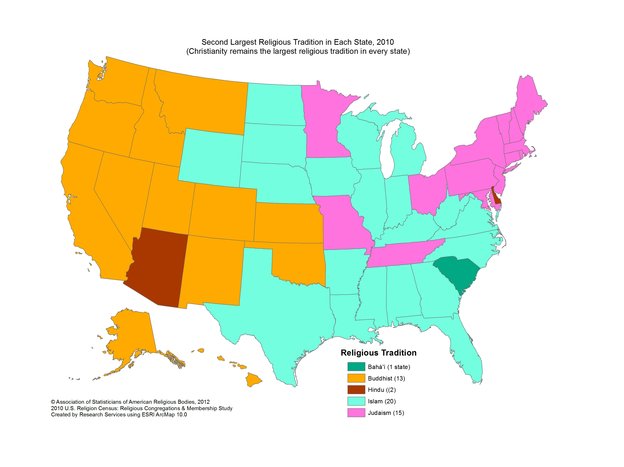
Glance at the map above, Second Largest Religious Tradition in Each State 2010, and you will see that Buddhism orange, Judaism pink and Islam blue are the runner-up religions across the country.No surprises there.

But can you believe that Hindu dark orange is the Number Two tradition in Arizona and Delaware, and that Bahai green ranks second in South Carolina?

The map — created by the Association of Statisticians of American Religious Bodies and published recently in The Washington Post — “looks very odd to me,” says Hillary Kaell. She is a professor at Concordia University in Montreal who specializes in North American Christianity. “These numbers, although they look impressive when laid out in the map, represent a very tiny fraction of the population in any of the states listed.”

True that. Christianity is the Number One religious tradition across the board. A 2012 Gallup poll showed that 77 percent of Americans identify as Christians. But a deeper look into the stories behind the maps data reveal a bit more about a nation in flux.

The Runner-Up Religions Of America : The Protojournalist : NPR.

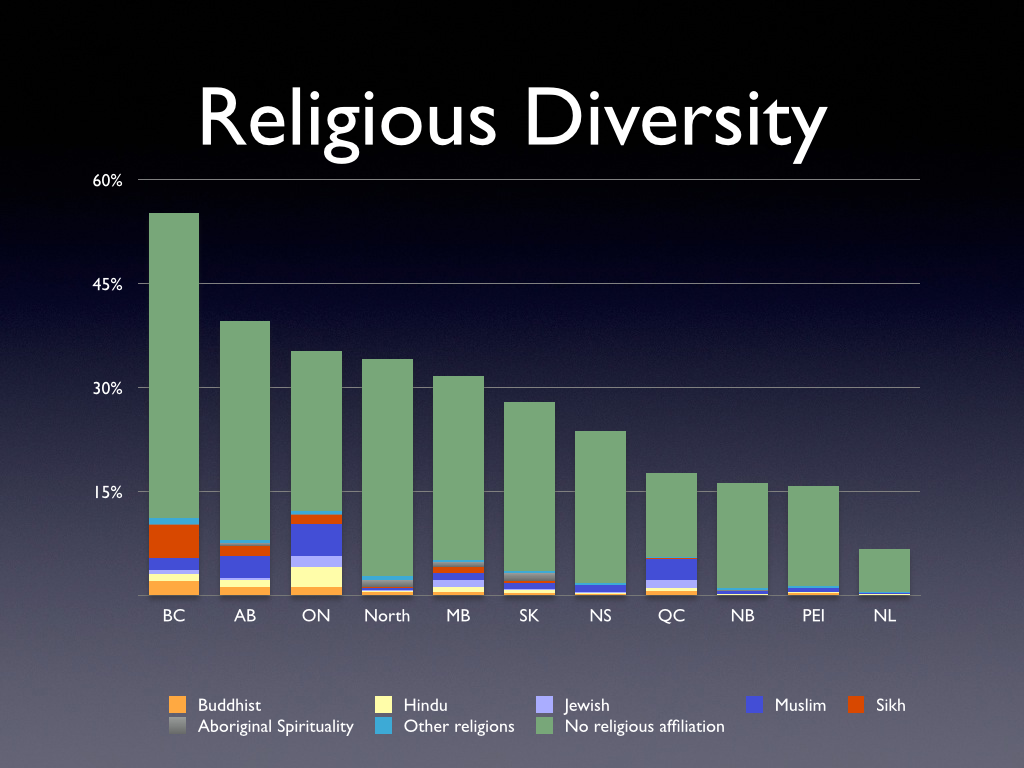
Canadian Comparison:

Religious Diversity by Provinces.001

UNESCO Exhibition on Jewish History in Middle East

In addition to the meeting with Hollande, the UNESCO exhibit on Jewish history and presence in the Holy Land finally sees the light of day (Canada led campaign to save exhibition on Jewish history in Middle East after Arab coalition quashed it):

Meanwhile, Cotler was effusive in his description of the Wistrich exhibit, which he called “historic.”

“It is a remarkable dramatization of history and heritage, of people, book, land, memory and state,” he said.

In 24 panels, it traces Jewish history back to the patriarch Abraham, through Moses, King David and all the way through to the struggle for Soviet Jewry, the birth of Zionism and the reconstitution of the State of Israel.

The exhibit, which will run for nine days, had been scheduled to open last January. Pressure from 22 Arab countries, who argued it would prejudice the peace process, prompted UNESCO to cancel it.

Responding to that decision Rabbi Hier stated, “It is ironic, that while the Arab League was trying to kill this exhibition and all the attention was focused on Paris, the UN headquarters in New York is hosting an exhibit entitled, Palestine, based entirely on the Arab narrative, which was not criticized as an interference with Secretary [John] Kerry’s mission.”

Following public criticism from Canadian Foreign Minister John Baird and U.S envoy Samantha Power, the exhibit was rescheduled to open last week, but with the name “Israel” removed from the title and replaced with “Holy Land.” UNESCO also required the removal of an image of the Dead Sea Scrolls, which had been part of the initial exhibit prepared by Wistrich, a professor of European and Jewish history at the Hebrew University in Jerusalem.

Hollande’s stand on anti-Semitism impresses delegation | The Canadian Jewish News.

How much of a threat do terrorists pose to Ottawa?

Wark’s comments appear to be the most sensible of those cited:

So, has Iran reached a violent tipping point with Canada? Is Ottawa sufficiently fortified? How concerned should we be?

Experts interviewed this week conclude this: Hezbollah is an important threat, but the probability of an Iranian-Hezbollah hit on the capital is low. If the aim was to strike against the West, there are other higher-value targets outside Canada.

“Canada is by and large off the political radar screens of most of these groups. It’s hard to see al-Qaida affiliates or terrorist movements abroad turning their sights on Ottawa specifically,” says Wesley Wark, a national security expert at the University of Ottawa.

“But a Canadian urban centre might be the bullseye of some disaffected Canadian who went the route of jihad and had the means to try violence. We’ve been there before in terms of the so-called Toronto 18 plot.”

How much of a threat do terrorists pose to Ottawa? | Ottawa Citizen.