UK: Multiculturalism in reverse as teenagers buck the trend towards integration

Surprising UK study:

Decades of efforts to promote multiculturalism have gone into reverse, major new research showing teenagers are no more likely to mix with people from other racial backgrounds than those 40 years older suggests.

The study, which analyses the social lives of almost 4,300 people from 13 to 80, shows that a clear trend towards each successive generation becoming more integrated than the one before breaks down when it comes to under-18s.

Despite growing up in more diverse society than ever before at a time when mass migration has transformed the make-up of Britain, today’s teenagers have almost 30 per cent fewer friends from other ethnic backgrounds than people in their 20s and early 30s. ….

The fact that those between the ages of 18 and 34 are significantly more integrated than other age groups suggests that universities and colleges offer a more natural way of mixing people than schools or other social settings.

“This isn’t a report about telling people off,” he [Matthew Taylor, chief executive of the Royal Society of Arts, who chaired the commission] said.

“Lots of research shows that it is perfectly natural for birds of a feather to flock together.

“But what we would also say is that because we believe integration is a good thing and because Britain is becoming more diverse by ethnicity, age, income and social class we need to look at what steps we might take to overcome that natural tendency.

“None of the commissioners is going to be advocating wholesale social engineering or naming and shaming people but we think that there are things that can be done, things which people would be happy to do which would just give them that little nudge.

“The fact that it looks like colleges and universities are places that encourage integration better than schools is an indication that maybe there are things that we could so.”

Maybe it is a teenager thing given that the older cohort, whether in colleges and universities as mentioned, or in the workplace, seems to be mixing reasonably well.

Multiculturalism in reverse as teenagers buck the trend towards integration – Telegraph.
Have Canada’s changing demographics made it time to retire the concept of ‘visible minority’?

This issue comes up periodically. However, it would require legislative changes to the Employment Equity Act, among others, and thus would be controversial.

More substantively, the advocates are correct in noting that lumping all communities together under visible minorities does not account for the differences in outcomes of groups and that relations between different groups are as important to integration as the old mainstream/visible minority dichotomy presented.

One of Kenney’s most substantial changes to multiculturalism was to recognize this and ensure that integration meant between all communities.

Some of the traditional equity challenges remain, but given the difference in communities, more targeted initiatives are part of the mix.

See the 2011 comparative analysis by CIC: Table 5: Ethnic Community Specific Challenges.

In 2011, the percentage of visible minorities was 19.1%, according to Statistics Canada. By 2031, that number is expected to grow to 30.6%, with South Asian and Chinese immigrants driving much that growth. Vancouver and Toronto are expected to become “majority-minority” cities with three out of five people — 60% — belonging to a visible minority group by then.

Compare that to 50 years ago, when the visible minority population was just 2%, and the majority of immigrants were from Europe.

“Personally, I have never liked the term ‘visible minority,’” says Frank Trovato, a sociology professor at the University of Alberta. “I doubt that most people belonging to these groups actually think of themselves as such. It may be that in the future Canadians will simply do away with this concept.”

The official use of the term can be traced back at least as far as the 1980s when federal lawmakers established the Employment Equity Act, which set out to remove barriers in the labour market for four “disadvantaged” groups: women, aboriginals, people with disabilities and visible minorities.

The act was a response to the recommendations of the 1984 Royal Commission on Equality in Employment, led by Justice Rosalie Abella, who wrote, “Ignoring differences and refusing to accommodate them is a denial of equal access and opportunity. It is discrimination. To reduce discrimination, we must create and maintain barrier-free environments so that individuals can have genuine access free from arbitrary obstructions to demonstrate and exercise fully their potential.”

On visible minorities, Judge Abella wrote of the need to attack racism, which she described as “pervasive,” to provide language training for immigrants, to accommodate religious and cultural differences, and to find a better way to assess qualifications of those who did not attend school in Canada or who have no work experience in Canada.

Three decades later, many of the gaps in workforce representation have narrowed and there are some visible minority groups that are doing just as well as their white counterparts, says Frances Woolley, an economics professor at Carleton University, who favours retiring the term “visible minority.”

“[The Act] was written for another time … when the workforce was majority male, when the population was overwhelmingly white,” Ms. Woolley said.

There are still some groups that are disadvantaged — such as African-Canadian men — but the legislation “lumps everybody together in this visible minority category when some people are doing just fine and other people aren’t,” she said.

Have Canada’s changing demographics made it time to retire the concept of ‘visible minority’?

UK: British Muslims right to fight in Syria backed by ex-adviser on radicalisation

A very different view from a former regional manager of the Prevent strategy (former anti-radicalization and extremism strategy):

A former senior government adviser on tackling radicalisation and extremism has defended the right of British Muslims to travel to Syria and fight.

Farooq Siddiqui, a former regional manager for the governments controversial Prevent strategy, said it was acceptable for Britons to “walk the walk” and travel to Syria to fight the forces of President Bashar al-Assad.

As part of a Facebook conversation Siddiqui, 45, defended the right of an individual to be called a martyr if he took up arms against Assad, and questioned whether those who fought against the Syrian president should face arrest upon return to the UK.

Former senior intelligence officials consider jihadists battling Assads government forces in Syria to be a potential threat. They estimate that up to 300 fighters have already returned to the UK from Syria. Scotland Yard has warned that Britain will live with the terror legacy of the Syrian conflict for years to come.

The foreign secretary, William Hague, believes as many as 400 British citizens may be fighting in Syria, recently confirming that security measures are in place such as the option of withdrawing leave to remain, cancelling passports and arresting UK jihadists who have been fighting in Syria or for terrorist group Islamic State in Iraq and the Levant (Isis), which has seized control of swaths of northern Iraq.

Siddiqui, who ran Prevent in the south-west until 2012, pointed out that Britons were free to join the Israeli Defence Force and return to the UK without censure, while those taking up arms against what they viewed as a tyrannical dictator, Assad, faced arrest. He says he knew “nothing about” Isis at the time of the online conversation in February. He does not support the group.

“One man’s terrorist is another man’s freedom fighter’ as the cliché goes, but one has to look at the nature, activities and goals of the organization and affiliation, not to mention potential longer-term implications (e.g., supporting the Mujahideen in Afghanistan which led to Taliban control and a base for Bin Laden).

But the worries regarding returning jihadists are legitimate. Their extreme views are incompatible with living in a diverse, open and democratic society.

British Muslims right to fight in Syria backed by ex-adviser on radicalisation | UK news | The Observer.

Shadeism: Filmmaker looks at discrimination among people of colour

Another term I had not heard of. Nayani Thiyagarajah’s personal experience and broader perspective in her documentary, Shadism:

“To this day, my family still reminisces about how light I was. But growing up, as I grew darker, I began questioning the notion of light skin being better. What did my family’s constant commentary on my skin colour really mean? I began to wonder. If I wasnt light anymore, did that mean I was no longer beautiful?”

This is an issue of beauty, of old ideas that determine what is still beautiful. Of how the colour of our skin has and continues to affect how we view ourselves. This is shadeism.”

Her documentary touches on the multi-billion dollar industry that’s cropped up around skin-lightening cosmetics, fuelled in part by recent revelations the Cameroon pop singer Dencia is an enthusiastic client of one marketed as “Whitenicious.”

Shadeism: Filmmaker looks at discrimination among people of colour – CBC News – Latest Canada, World, Entertainment and Business News.

Better data alone won’t fix Canada’s economy – The Globe and Mail

Good piece on the need for a broader and more thoughtful approach to the use of data in a “big data” environment:

The bottom line is that being data-dependent doesn’t mean responding to every wiggle in data. Nor does it mean basing our decisions solely on data or models and nothing else.Yes, we need better data.

But that’s only a start. We also need to ask precise and well-posed questions – of ourselves in our analysis and of our policy makers in their choices – particularly as “big data” increases the availability of non-conventional data sources. In addition, we need to bring new approaches to bare on data, and clearly explain the results to non-specialists.

After concerns about jobs estimates during the Ontario election, let’s hope that the lesson learned by our politicians is not to withhold economic analysis in future campaigns. Instead, let’s hope it causes them to raise their game by presenting more credible analyses.

At the same time, let’s be realistic about what better data can accomplish. This means acknowledging that data give us imprecise measurements of reality, but when used responsibly and creatively, they help us make better choices and hold governments to account for their policy decisions.

Better data alone won’t fix Canada’s economy – The Globe and Mail.

Contrasting Party Statements on Multiculturalism Day

Worth reading all three messages as they all have a different take. Conservative stress common values and standing on guard, NDP focus on tolerance, compassion and equality, Liberal emphasis on equality and inclusion:

Ministers Jason Kenney, Chris Alexander and Tim Uppal issued the following statement on Canadian Multiculturalism Day:

“Canadian Multiculturalism Day is an opportunity to appreciate our country’s longstanding tradition of peaceful pluralism, and the constitutional protection of our liberties.

“Since before Confederation, immigration has helped shape our country into one of the most culturally diverse in the world, and Canada continues to have the highest per-capita level of immigration among developed countries.

“Canada’s approach to multiculturalism encourages all Canadians to celebrate their cultural heritage, while actively integrating into Canadian society and committing to our common values of freedom, democracy and the rule of law.

“Let us continue to celebrate our unity in diversity, while standing on guard for the freedoms so many have fought to protect, both at home and abroad.”

Ministers Jason Kenney, Chris Alexander and Tim Uppal issue statement to celebrate Canadian Multiculturalism Day – Canada News Centre.

The Official Opposition:

“Multiculturalism is a fundamental Canadian value and on this Canadian Multiculturalism Day, the New Democratic Party is proud to celebrate our nation’s rich diversity.

“The values of tolerance, compassion and commitment to equality are shared by all Canadians and allow everyone to realize their full potential. The NDP has always been a staunch supporter of these values.

“We are proud to acknowledge the important contributions of our society’s many groups and multicultural communities, and the NDP will continue its efforts to promote our multicultural heritage, so that Canada may remain a land of possibility for all those who call it home.”

Statement by the Official Opposition on Canadian Multiculturalism Day

And from the Leader of the Liberal Party:

“Today we celebrate the ethnic, religious, and cultural diversity that has come to define Canada’s national fabric.

“Canadians can be proud of the progress we have made in promoting inclusion and equality in this country – from adopting an official policy of multiculturalism in 1971, to including it as a fundamental principle in the Charter of Rights and Freedoms.

“Canadian multiculturalism embodies the freedom and democracy upon which our country was built. Today, the success of our diverse communities in fostering innovation and prosperity has proven that we are made strong not in spite of our differences, but because of them. We are reminded to neither take our diversity for granted nor become complacent. We must continue on a path where every citizen feels equal and embody a nation of citizens who respect one another.

“On behalf of the Liberal Party of Canada and our Parliamentary Caucus, I join with all Canadians in celebrating Multiculturalism Day.”

Statement by Liberal Party of Canada Leader Justin Trudeau on Multiculturalism Day

Canadian imam group warns Muslim youths that ‘no one should get involved in international wars’

Good strong statement from the Canadian Council of Imams:

Imam Nadvi said those drawn to extremist groups tended to be saddened by injustices in the Muslim world and angry at what they perceive as the lack of response by the West. But when they fight in other countries, they disregard the fact that they are not their conflicts and their involvement only makes life worse for most Muslims.

“Any Canadian individuals taking up arms and fighting foreign governments are actually breaking the laws of their own country,” the imams’ statement says. “We believe that any Canadian citizen who takes up arms should do so only in the legal context of the Canadian law and government.”

While Syrians have “resorted to self-defence” against the forces of President Bashar Al-Assad, the imams said those living outside the country could not claim the same justification according to Islamic “laws and principles.”

Denouncing the “narrow, bigoted, dogmatic distortions of the purveyors of violence and terror,” the statement also said imams were prepared to take part in “meaningful discussions, to engage in preventative strategies and to find meaningful solutions to this growing threat in our country.”

Canadian imam group warns Muslim youths that ‘no one should get involved in international wars’

Most modern Catholics reject church teachings on marriage, sex and contraception, Vatican admits

Not surprising but still interesting:

The Vatican conceded Thursday most Roman Catholics reject its teachings on sex and contraception as intrusive and irrelevant, and officials pledged not to “close our eyes to anything” when it opens a two-year debate in October on some of the thorniest issues.

Core church doctrine on the nature of marriage, sexuality, abortion and divorce is not expected to change. But Pope Francis is well aware the church has lost much of its relevance and credibility in today’s secular world and is seeking to redirect priests to offer families, and even gays in civil unions, a “new language” that is welcoming and responsive to their needs.

Already, the working document for the synod discussions marks a sharp change from past practice. It is the result of a 39-point questionnaire that asked Catholics around the world about their understanding of, and adherence to, the church’s teaching on sexuality, homosexuality, contraception, marriage and divorce.

Thousands of ordinary people, clergy and academics responded. Usually, such working papers are compiled by bishops alone.

The responses were brutally honest.

The moral evaluation of the different methods of birth control is commonly perceived today as an intrusion in the intimate life of the couple

“A vast majority [stressed] the moral evaluation of the different methods of birth control is commonly perceived today as an intrusion in the intimate life of the couple and an encroachment on the autonomy of conscience,” the document said.

“Many responses recommend that for many Catholics the concept of ‘responsible parenthood’ encompasses the shared responsibility in conscience to choose the most appropriate method of birth control.”

Asked if the church might change its position to align itself with the practice of most of its faithful, Monsignor Bruno Forte, a meeting organizer, said, “We will not close our eyes to anything. These problems will be considered.”

Most modern Catholics reject church teachings on marriage, sex and contraception, Vatican admits

Happy Multiculturalism Day!

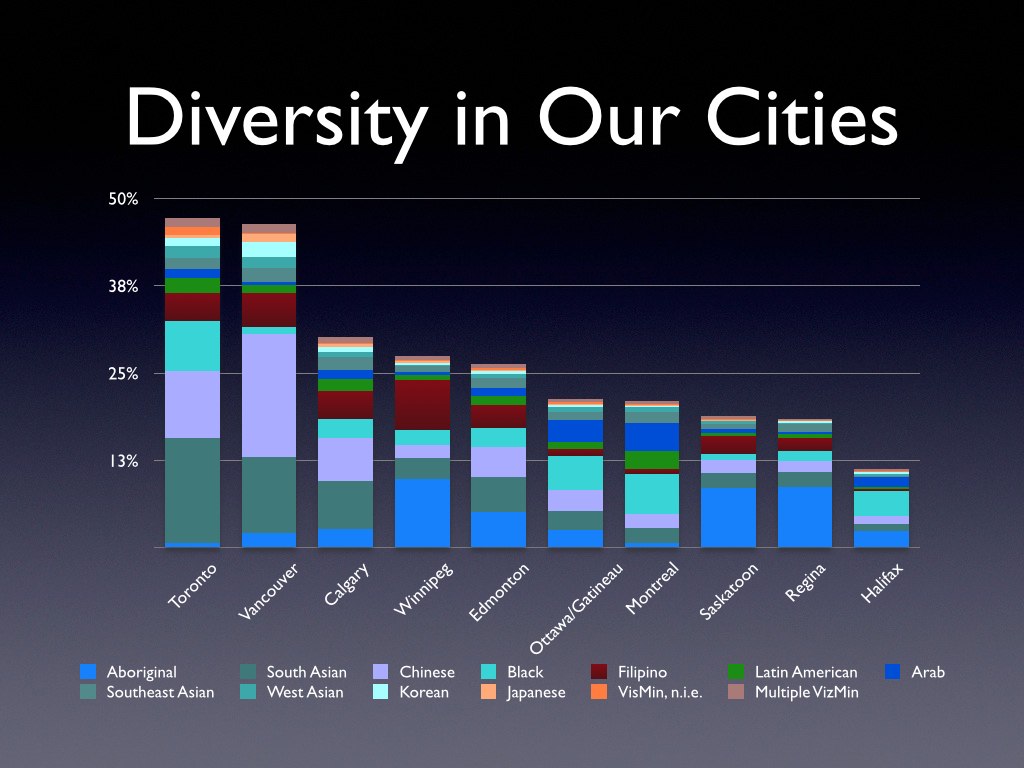
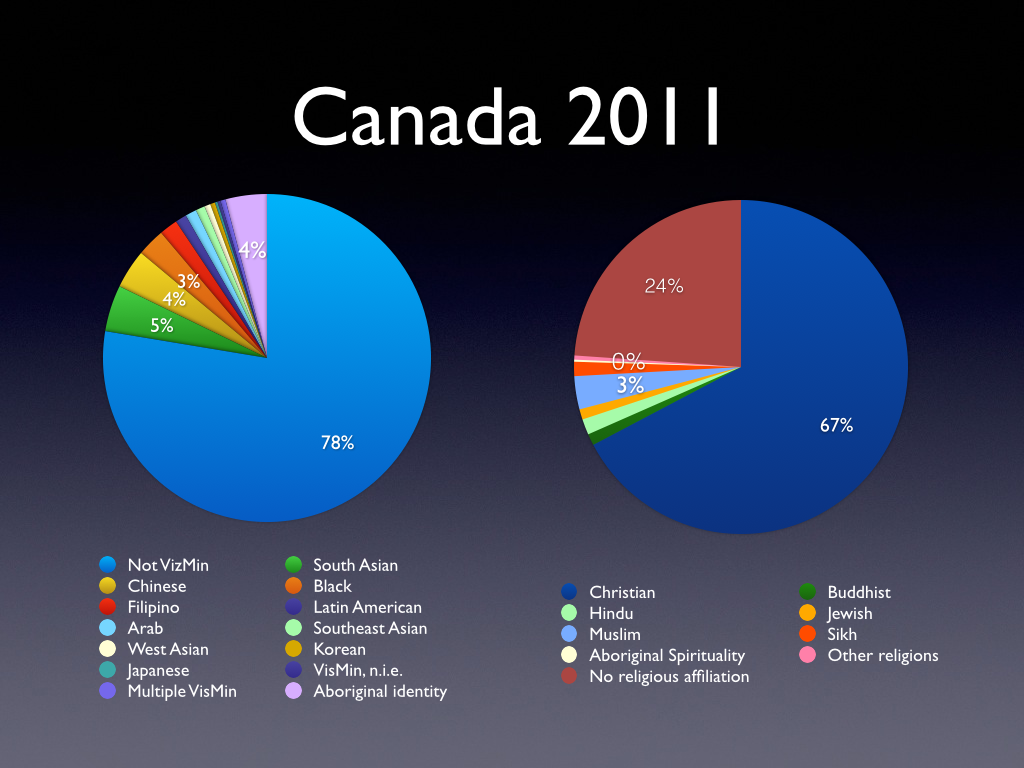
A few charts summarizing Canadian diversity, along with provincial and municipal comparisons (ICYMI, my take on multiculturalism Canada Today: Less Hotel, More Live-in Condo):

National Visible Minority and Religious Diversity

National Visible Minority and Religious Diversity

Diversity by Province

Diversity by Province


Diversity by City

Diversity by City

Christie Blatchford: What if Toronto man’s not a terrorist, but the middle-of-the-road Muslim his family says he is?

More quotes from the wiretaps of Mohammed Hersi and Blatchford insinuating that these are normal part of Muslim Canadian discourse:

But in the excerpts of wiretap recordings that were played for the jurors, though the focus was on Hersi’s interest in Al-Shabab, he also talked at length about his unhappiness with Canada and his longing to live as a real Muslim.

“But you know I … long term I wanna live in the Muslim land and never come back, right?” he told the UC once. “I wanna live in a Muslim country where I can be … practise my religion and be a good person right?”

His scorn for non-Muslims was evident.

“But talking to a non-Muslim about morality and shit, they don’t even know what morality is, Christians. You know what I mean?,” he said. “Talk to a Christian about morality and they believe Jesus died for all their sins, oh man. That’s [lunacy] right there,” he said.

In that same conversation, he said flatly, “I realize this country has no future for me in it.” In another, he recalled warmly the month he spent in Saudi Arabia, and how, “the life is very peaceful, I felt very at home my heart was content, you know?”

On one occasion, he told the agent, “Living in Somalia today is much better than living in Toronto ‘cause when you live in a place where there’s Islamic law, there’s harmony, there’s no more raping or murder.

“In Toronto, there is rape and murder happening right now every day every minute…”

She lost her religion altogether, right. Very tyrannical

Once, he talked to the agent about a Tunisian girl he’d read about online who was critical of the hijab.

“See how secular her mind is,” he said. “She’s against the hijab, this is something that’s from Islam, right?

“She’s against it, you know. Allah tells the believing woman to cover up, right? And she’s against it ‘cause she does … she lost her religion altogether, right. Very tyrannical.”

In other excerpts, Hersi talked admiringly about some of the sermons he’d heard at his mosque and how the imam there liked to slip in things he believed might pique the attention of the Canadian Security and Intelligence Service.

As he put it once, though Canadians want mosques to talk faith and faith only, “politics is a part of Islam, right?”

Hersi came to Canada as a refugee when his mother fled the civil war there. Though raised in public housing, he managed to get a degree from the University of Toronto.

As prosecutor Jim Clark said, arguing that Hersi should receive the maximum five-year sentence for both offences for a total of 10 years, and that he should serve half before being eligible for parole, “What we have in Mr. Hersi is a smart, educated guy who knew full well what Al-Shabab was all about…”

Even if Mohamed Hersi is that rarest of birds, the man who really did want to join a bowling league precisely so he could not bowl, it’s a shattering prospect that he might also be what those who love him claim — a typical, middle-of-the-road Muslim.

Christie Blatchford: What if Toronto man’s not a terrorist, but the middle-of-the-road Muslim his family says he is?

CBC story on prosecution asking for maximum penalty of 10 years:

Federal prosecutor James Clark urged an Ontario Superior Court judge to condemn Hersi to 10 years in prison to set an example.

“Canada has an international obligation to prevent the exportation of terror,” Clark said in court in Brampton, Ont.

Hersi’s defence counsel Paul Slansky, who has already pledged to appeal, said his client should get three to four years, calling him “youthful and immature.”

Throw book at Ontario terrorism convict, Crown urges

Hersi is a likely candidate for revocation under the new Citizenship Act, given that he was convicted in a Canadian Court. But of course, his radicalization occurred in Canada (he came as a child) and he would be treated differently than a Canadian without dual nationality (or the right to same), raising Charter and related issues.

Of course, if the Government decides to revoke his citizenship, it would essentially be enabling the “exportation of terror.”