‘Hawking index’ charts which bestsellers are the ones people never read

Fun example of innovative analysis (and for all those of you who claim to read Piketty or other similar tomes):

Jordan Ellenberg, a mathematician at the University of Wisconsin, Madison, has just about proved this suspicion correct.

In a cheeky analysis of data from Kindle e-readers, Mr. Piketty’s daunting 700-page doorstopper emerged as the least read book of the summer, according to Prof. Ellenberg, who calls his ranking the Hawking Index in honour of Mr. Hawking’s tome, famous as the most unread book of all time.

As a result, he is tempted to rename it the “Piketty Index,” because Mr. Piketty scored even worse than Mr. Hawking.

As such, both stand as extreme case studies in aspirational reading. Like the Economist magazine’s Big Mac index of hamburger prices around the world, which is both silly and serious, Prof. Ellenberg’s Hawking Index is funny, in that it reveals the vanity of many book choices. But it also offers an interesting psychological perspective on reading that is born of good intentions, and dies of boredom on the dock or beach.

The calculation is simple, and as Prof. Ellenberg says, “quick and dirty.” It exploits a feature of Kindle that allows readers to highlight favourite quotes. It averages the page number of the five most highlighted passages in Kindle versions, and ranks that as a percentage of the total page count. Although it does not measure how far people read into a book, it makes a decent proxy for it.

“Why do you buy a book? One reason is because you know you’re going to like it,” Prof. Ellenberg said. “Another reason might be, ‘Oh, I think this book will be good for me to read.’”

….. He said his formula illustrates what mathematicians call the problem of inference, meaning he cannot say for sure these books are going unread, just that he has strong evidence for it.

“You can make some observation about the world, but there’s some underlying fact about the world that you’d like to know, and you want to kind of reverse engineer. You want to go backwards from what you observed to what you think is producing the data you see,” he said.

Other books reveal different insights into why people buy books they start but do not finish. Michael Ignatieff’s political memoir Fire And Ashes, for example, scores comparatively well for non-fiction at 44%, far better than Hillary Clinton’s Hard Choices, which barely cracked 2%. Lean In, the self-help book by Facebook executive Sheryl Sandberg, scored 12.3%.

In fiction, The Luminaries, by Canadian-born New Zealand author Eleanor Catton, which won last year’s Man Booker Prize, scores a mere 19%, and would score a lot lower if not for one highlighted quote near the end.

Prime Minister Stephen Harper’s book on hockey, A Great Game, curiously has no highlighted passages, so cannot be ranked on the Hawking Index (or, equivalently, ranks as low as is theoretically possible).

Fiction tended to score higher, likely reflecting the tendency for non-fiction authors to put quotable thesis statements in the introduction. The only novel that was down in the range of the non-fiction books was Infinite Jest by David Foster Wallace.

Prof. Ellenberg does not mean to disparage the low ranking books, he said, noting that the reason people buy them in the first place is that they are rich in content.

“I think it’s good to do back of the envelope computations as long as you do them with the appropriate degree of humility, and understand what it is that they’re saying,” he said. “I think any statistical measure you make up, you take it as seriously as it deserves to be taken.”

‘Hawking index’ charts which bestsellers are the ones people never read
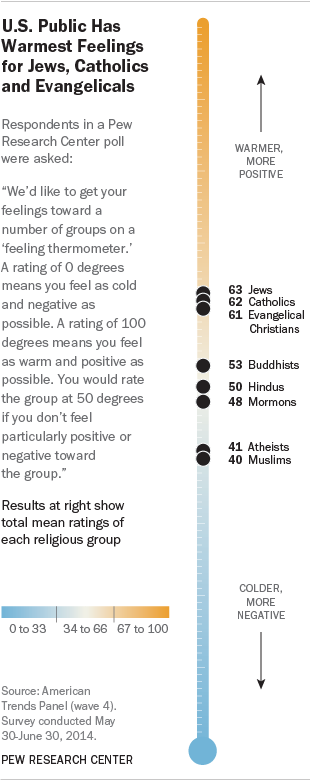
Chart of the Day: Religious Attitudes – USA, Canada and Quebec

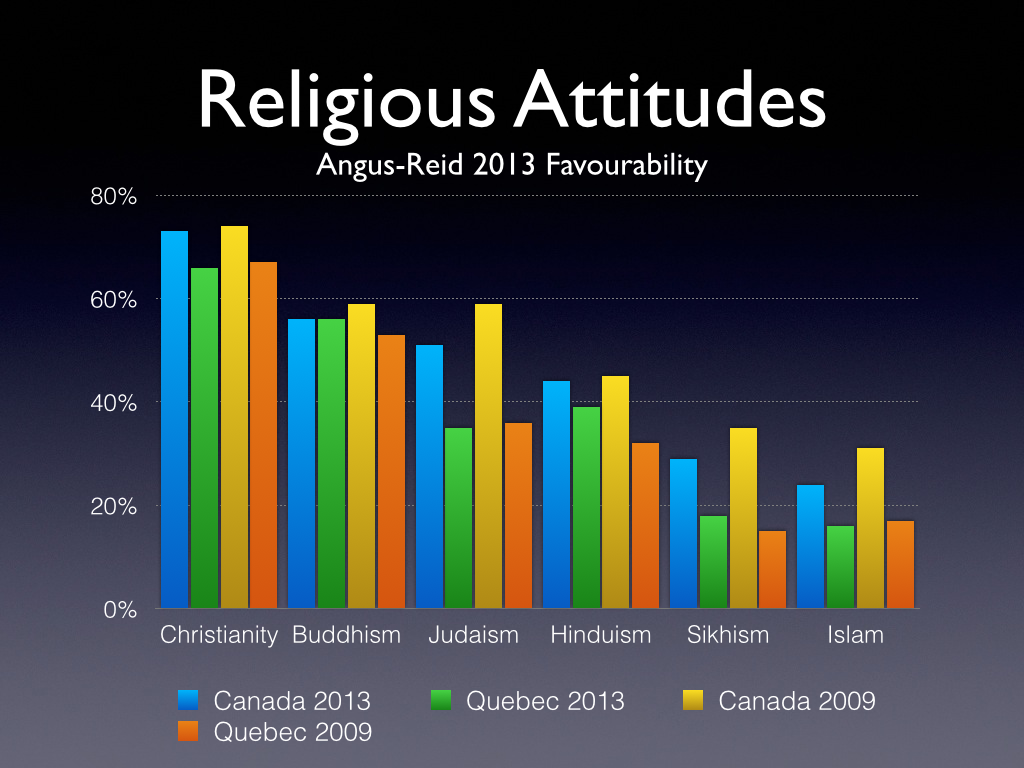
Although not strictly compatible, the just issued Pew Research survey of US attitudes towards religions can be compared with a 2013 Angus-Reid Survey.

No real surprise in the relative ranking, Christianity on top, Islam on the bottom.

But in US, Jews are comparable to Christians but not so in Canada. US survey also includes attitudes towards atheists (tied at the bottom with Muslims) but does not include Sikhs.

Pew PF_14.07.16_interreligiousRelations_totalRatings1

Religiious Attitudes Angus Reid.001

Multiculturalism, Britishness, and Muslims | openDemocracy

A somewhat (over) lengthy piece by Tariq Madood on British multiculturalism and Islam, but nevertheless interesting and rich in its reflections:

The Islamic-modernity argument counters by positioning the sharia not as a body of unchanging law, but as a set of ethical principles with legal conclusions that apply only to specific places and times and thus have to be continually reinterpreted; the effect is to place the ethical over the legal and the political see Ziauddin Sardar, The Future of Muslim Civilization [Mansell, 1987] and Tariq Ramadan, Western Muslims and the Future of Islam [Oxford University Press, 2005. This is an example of how scholarship can draw on extra-European heritages and reinterpret them in a context of a democratic citizenship.

As Muslims’ discussion of these matters develops, and as their discourse becomes an integral part of British debates, one positive effect could be that a broader range of Muslim voices or civic participants are able to contribute. Such a development would reflect a healthy internal variety among Muslims as within any group, part of which is that different individuals or members will want to locate themselves variously across the representational landscape secular, religious, close to government, distant from political parties. That, after all, is true integration; new groups should have similar opportunities to old groups and do not need to conform, or feel obliged to conform, to a special “minority” perspective.

These discursive and institutional processes have two implications. The first is that an increasing acceptance that Muslims can politically organise “as Muslims” without any sense of illegitimacy – in raising distinctive concerns or having group representation in public bodies, for example – means allowing them to choose the paths they think appropriate at different times, in different contexts and for different ends.

The result will be a democratic constellation of organisations, networks, alliances and discourses in which there will be agreement and disagreement, in which group identity will be manifested more by way of family resemblances than the idea that one group means one voice.

The second implication is that where there is “difference” there must also be commonality. That commonality is citizenship, a citizenship seen in a plural and dispersed way. There is no contradiction here, for emphasising and cultivating what we have in common is not a denial of difference – it all depends upon what kind of commonality is arrived at, something that cannot be taken for granted. Difference and commonality are not either-or opposites but are complementary and have to be made – lived – together, giving to each its due.

More than that, commonality must be difference-friendly, and if it is not, it must be remade to be so. This does not mean as a corollary weak or indifferent national identities; on the contrary, multiculturalism requires a framework of dynamic national narratives and the ceremonies and rituals which give expression to a national identity. Minority identities are capable of generating a sense of attachment and belonging, even a sense of a “cause” for many people. If multicultural citizenship is to be equally attractive to those people, it needs a comparable and counterbalancing set of emotions; it cannot be merely about a legal status or a passport.

A sense of belonging to one’s country is necessary to make a success of a multicultural society. An inclusive national identity is respectful of and builds upon the identities that people value and does not trample upon them. So integration is not simply or even primarily a “minority problem”. For central to it is a citizenship and the right to make a claim on the national identity in the direction of positive difference.

Multiculturalism, Britishness, and Muslims | openDemocracy.

Adapt to a New Culture – but Don’t Go Too Far – Harvard Business Review

Good piece on the intricacies and challenges with cultural adaptation. I think mentoring, either formal or informal, can be particularly beneficial:

Individuals need to take steps to avoid over-switching and decrease the likelihood that it will interfere with their success abroad. One essential strategy is to develop a detailed sense of the “cultural code” — the correct and appropriate interpersonal style — for whatever key situations you’re working in. How assertively are you expected to act in your role in this setting? How directly are you expected to communicate, and with how much emotional expressiveness?

Of course, the rules for how to behave are not the same in all situations you encounter in a foreign culture. Taking Cheng’s case as our example, some work cultures are extremely informal with very high expectations for assertiveness on the part of employees. Others are much less so. Some bosses also have styles that are more or less conducive to the behavior that Cheng exhibited in this situation. The overall goal is not to just learn how the new culture is different from yours. It’s to calibrate the specific level of difference and to learn how to acclimate your behavior to that particular level.

But even if you do work hard at mastering the cultural code, mistakes are still inevitable. You must also find ways to mitigate the brunt of these inevitable faux pas. Do what you can to develop a sense of rapport or, when possible, a relationship with the person you’re interacting with. Express genuine interest in the new culture and bond over areas of mutual interest, such as sports or family. And in certain cases, if the relationship allows, see if the other person might even be able to mentor you about cultural differences and the appropriate level of accommodation.

Over-switching is a natural part of the adaptation process. The trick isn’t to make it go away; it’s to try your best to convert these inevitable errors into valuable learning opportunities.

Adapt to a New Culture – but Don’t Go Too Far – Andy Molinsky – Harvard Business Review.

Cultural communities feel left out of Toronto Pan Am Games

Seems like it may be a repeat of the Vancouver Olympics which were put to shame by London’s relentless upbeat and upfront multiculturalism:

But a marketing consultant involved in the outreach efforts said only a few thousand dollars had been earmarked to buy ad space in dozens of small outlets.

Milind Shirke, director of Ethos Communications, which specializes in marketing to diverse communities, said organizers need to find “respectable amounts” of money to spend on advertising in multicultural newspapers and television, because that’s where many immigrants get their news.

“There’s definitely a strong media consumption of their own media versus the mainstream media,” he said.

In order to attend, those communities “would need to be provided some basic information in terms of pricing, venues, options, discounts, because they’re also value-conscious…. That’s where the media comes in.”

Shirke said it’s also important to include other communities, such as the Toronto region’s large south Asian population, whose home countries are not competing in the Games.

Cultural communities feel left out of Pan Am Games.

Mothers the latest weapon in U.K.’s fight against terrorism

Another UK initiative to reduce radicalization and extremism:

Now British police are hoping to tap into that mother’s instinct to protect her children. In April, they launched an unprecedented program to encourage Muslim women to contact authorities if they suspect their loved ones are planning to travel to Syria or have already gone.

Women are often best placed to intervene, says deputy assistant commissioner Helen Ball of the Metropolitan Police, one of three senior female police officers running Britain’s counterterrorism operations.

“This is very much about prevention and protection,” says Ball, who devised the program. “It is women who . . . notice a change in behaviour very quickly. We want women to feel confident to come forward, whether it is to police, or a community member they trust or a school teacher.”

Such initiatives — from the benign to the extraordinary — are being taken by governments as they struggle to reduce the number of western Muslims joining the war in Syria for fear they return to cause carnage on the streets of their homelands.

On Tuesday, U.S. Attorney General Eric Holder called the issue a “global crisis in need of a global solution.”

“The Syrian conflict has turned that region into a cradle of violent extremism. But the world cannot simply sit back and let it become a training ground from which our nationals can return and launch attacks,’” Holder said in a speech to Norwegian diplomats and national security officials in Oslo.

… But as Einas Deghayes [mother of an extremist killed in Syria] insists, it is often the mothers who are the last to know what their children are up to.

Mothers the latest weapon in U.K.’s fight against terrorism | Toronto Star.

Robyn Urback: If you want to learn abstinence, go to church. Get Christian sex-ed out of secular public schools

A reminder of other forms of fundamentalism.

It is not just the anecdotes cited by Urback regarding the effectiveness of abstinence approaches; the contrast between California and Texas is striking (Texas Isn’t Keeping Up With National Drop in Teenage Births):

The Pregnancy Care Centre taught courses in about 60 Edmonton-area schools last year, according to executive director Norah Kennedy. She says that their presentations do not explicitly mention Christianity, though the Centre was founded on religious principles. “We are brought in to speak from an abstinence-based perspective; which differs from abstinence-only presentation,” she told the Edmonton Journal. “We present abstinence as the best and safest choice while also giving them a comprehensive overview of all of their options.”

That may be true (though the Dawsons’ complaints, which have yet to be proven, say otherwise). Even still, an abstinence-focused sexual education program will not offer the same wide-ranging, balanced approach to education that a class without an “agenda” can deliver. Indeed, there’s a difference between a lecturer telling students to use a condom if they must, and a lecturer showing students how to properly put on a condom, why they shouldn’t layer condoms (it happens, amazingly enough), why they should use a condom for both vaginal and anal sex (that happens in high school, too) and what to do if the condom breaks.

Students wanting to know about same-sex relationships, the morning after pill and other religious no-nos should also feel free to do so without judgment; that’s hard to do when someone from a faith-based organization is standing at the front of the class. This might be a human rights issue for Emily and her mom, but it’s arguably more an access to education issue for everyone else. Christian sex education should stay out of secular public schools.

The Edmonton School Board dropped the program offered by Pregnancy Care Centre following the complaint and publicity.

Robyn Urback: If you want to learn abstinence, go to church. Get Christian sex-ed out of secular public schools

Chart of the Day: Hate crimes – Five-Year Trends

Source: StatsCan Police-reported hate crimes in Canada (2008-12)

Source: StatsCan Police-reported hate crimes in Canada (2008-12)

Thanks to New Canadian Media, the Statscan 2012 hate crimes report is getting some attention (reporting Share News):

There were 82 more hate crime incidents in Canada in 2012 than in 2011. Some of the increase is partly due to improvements in reporting by some police services.

The study lists Hamilton, Thunder Bay and Peterborough as having the highest incidents of hate crime in Canada.

And the majority, or 82 per cent of hate crimes, occurred in major cities with Toronto, Montreal, and Vancouver leading the way.

Of the hate crimes reported and examined, 75 per cent had been confirmed by police as hate-motivated; and the remaining 25 per cent were recorded as suspected, Statistics Canada said.

Looking at the report, and comparing with the previous four years, some observations:

  • the overall level of hate crimes is remarkably stable (about 1,400 per year);
  • mischief continues to be the most common hate crime;
  • race and ethnicity continue to account for around 50 %;
  • black victims consistently account for about 40 %;
  • Jewish victims range from 53 to 71%, with no trend line ;
  • Muslim victims range between 9 and 15%, similarly with no trend line; and,
  • while victims of hate crimes, save for sexual orientation, are relatively distributed in terms of age, those accused of hate crimes are overwhelmingly young. In both cases, males are predominant.

Some of the disparities in reporting rates (these are police reported hate crimes) reflects the comfort different communities have in reporting to the police.

Muslim hate crimes are likely relatively under-reported given the newness of the community to Canada and likely trust issues with the police.

In contrast,  Canadian Jews are more well established and comfortable reporting to the police, in part given the work of B’nai Brith.

Hate crimes increasing against Blacks and Jews – StatsCan | Share News.

Direct link to the StatsCan report (worth reading):

Police-reported hate crime in Canada, 2012

Douglas Todd: We must stand on guard for Canada

Douglas Todd captures the ongoing debate on new Canadians and Canadian values.

I tend to favour Tung Chan’s more pragmatic approach but with a bit more teeth with respect to public and private institutions in terms of setting accommodation limits when they conflict with fundamental equality rights:

Rohani, a businessman who has sat on RCMP diversity committees, and Dosanjh, a lawyer whose biography will be released on Aug. 5, want prospective immigrants to Canada to be taught the essentials of liberal democracy and equality.

“Speaking as an immigrant, if we choose Canada as the best place to come and live, then why aren’t we following its values?” Dosanjh says. “If we want to recreate the society we left behind, why don’t we just stay there? It’s incumbent upon us newcomers to embrace the whole of society, not just its dollars.”

Tung Chan, former head of the government-financed immigrant services society, SUCCESS, is a friend of Rohani’s. But he’s more sanguine about the religion-rooted hazards facing liberal democracy.

Chan would prefer not to highlight the difficulties associated with what he claims in Canada is only the “one per cent who are mal-adapted” and don’t embrace free choice and equality.

Although Chan agrees with Rohani and Dosanjh that new immigrants and all Canadians should be taught about the country’s laws, Constitution, and Charter of Rights and Freedoms, Chan takes a hands-off approach beyond that.

“After the teaching is done,” Chan says, “whether they choose to accept or reject our value system is entirely up to them as long as they do not break the law.”

Dosanjh strongly disagrees, maintaining Canadians shouldn’t be so shy about upholding democratic principles. “Society is not just governed by laws. We have our values, our ethics, our integrity. It’s not a written law, for example, that we should allow people to marry whoever they want to marry.”

Douglas Todd: We must stand on guard for Canada.

Misbahuddin Ahmed found guilty of 2 terrorism charges and ISIS Recruitment Video with Canadian

Yet another terrorism conviction. Born in Pakistan, raised in Montreal, radicalized in Canada, a likely candidate for citizenship revocation under the new Citizenship Act:

Conspiring to knowingly facilitate a terrorist activity carries a maximum sentence of 14 years in prison, while participation in the activities of a terrorist group has a 10-year maximum term.

Ahmed will be sentenced on Sept. 15.

Mark Ertel, Misbahuddin Ahmeds lawyer, said after the verdict that his client was misguided for a short period of his life but is a good man. “I’m devastated by the verdict, it’s never easy to lose a case and it’s especially hard to see someone like this be convicted of these types of offences,” said Ahmeds lawyer, Mark Ertel.

“He’s a good man, a family man, the jury obviously found that for a short period of time in his life he was misguided but the acquittal on the third count proves they realized if there was any danger to Canadians or anyone he put an end to it.”

Crown lawyers said during the trial that Ahmed was a “committed jihadist” with an eye on potential Canadian targets, pointing to a bag in his basement they alleged held bomb-making materials.

Misbahuddin Ahmed found guilty of 2 terrorism charges – Ottawa – CBC News.

And another example of a terrorist or extremist, born, raised and radicalized in Canada, and would not be subject to revocation (if he were still alive):

An Ontario janitor who died while fighting with an extremist group in Syria said in a posthumous video released Friday that he had left Canada because he could no longer live among non-Muslims.

“Life in Canada was good,” André Poulin, a Muslim convert who fled to Syria following a string of arrests in Timmins, Ont., said in an Islamic State of Iraq and Al-Sham recruitment video that encouraged others to follow his path.

“I had money, I had good family. But at the end of the day, it’s still dar al-kufr [a land of disbelief] and at the end of the day you cannot obey Allah fully as you can by living in a Muslim country, in an Islamic state,” he said.

…. But Poulin was hardly a regular Canadian. He was a troubled youth who had repeated brushes with the law for crimes such as uttering threats until he left to remake himself as a jihadist fighter. He was killed last summer in northern Syria.

“He accepted Islam in a land at war with Islam,” a narrator said in the video, referring to Canada, “in a land with few Muslims, in a land where evil, kufr [disbelief] and sin called him from every direction and corner to succumb to Satan and to his desires.”

It said he had married after arriving in Syria and that his wife was pregnant when he was killed while trying to capture the Mennegh airport. In his address from the grave, Poulin implored recruits to leave the West and join him.

“My brothers, how can you answer to Allah when you live on the same street, when you’re using their light and you’re paying taxes to them and they use these taxes to assist their war on Islam. You can’t live as a Muslim,” he said, adding those who can’t fight should “give money.”

The flow of radicalized youths to Syria has become a top priority for Canadian security and intelligence officials, who fear recruits could one day return home, bringing their paramilitary training and violent anti-Western ideology with them.

Parents of those lured to Syria have also becoming increasingly vocal, calling for government action to deal with radicalization and recruitment. Several dozen Canadians are fighting in Syria, and some have joined ISIS, which has seized parts of northern Syria and Iraq through a campaign of guerrilla warfare, suicide bombings and mass executions.

Concerned about the number of Canadians leaving to join armed factions in Syria, imams from across the country issued a statement last month warning Muslim youths against traveling abroad to fight in foreign conflicts.

The Canadian Council of Imams denounced the “narrow, bigoted, dogmatic distortions of the purveyors of violence and terror,” and called for “meaningful discussions, to engage in preventative strategies and to find meaningful solutions to this growing threat in our country.”

‘Regular Canadian’ killed in Syria conflict featured in slick, new ISIS propaganda video