Adil Charkaoui obtient sa citoyenneté après 19 ans d’attente | Le Devoir

Given the long history of being suspected of terrorism-related activities, and the Government’s unsuccessful defence of the use of security certificates in his case, quite a remarkable denouement being granted Canadian citizenship.

It does clear his name in that the Government did not find a way to deny him citizenship. He has a lawsuit pending against the Government but hopes to secure an out-of-court settlement:

Adil Charkaoui est officiellement devenu citoyen canadien jeudi, la première de trois étapes dans son combat pour laver son honneur.

M. Charkaoui n’y croyait presque plus, surtout avec le durcissement du gouvernement Harper, qui ne voulait même pas reprendre Omar Khadr de la prison de Guantánamo. « Je suis agréablement surpris, surtout que ça ne vient pas d’un gouvernement modéré », dit-il.

Sa mère, son père, sa femme et ses enfants étaient tous citoyens canadiens. Adil Charkaoui a dû patienter 19 ans avant de pouvoir en dire autant.

M. Charkaoui a fait l’histoire du droit canadien. Il a combattu avec succès deux certificats de sécurité lancés contre lui par le ministre de l’Immigration, afin de le renvoyer dans son pays d’origine, le Maroc. Les autorités le soupçonnaient d’être un « agent dormant » du réseau terroriste al-Qaïda.

While this effectively ends the terror-related charges, from an integration perspective, it is strange that he invites provocative Islamic speakers with respect to women, and then complains of Islamophobia when they are denied entry.

Could he not find speakers with more positive messages?

Adil Charkaoui obtient sa citoyenneté après 19 ans d’attente | Le Devoir.

Stopping ‘terror tourism’: The behind-the-scenes struggle to keep would-be jihadists at home

Another case of homegrown radicalization, Ahmed Waseem, of Windsor, Ontario. Seems like his family and the local Imam did everything possible to dissuade him and alert the authorities on the risk that he would return to Syria:

Sgt. Cox said the RCMP “works diligently” with its partners to keep Canadians from joining terrorist groups and has been focusing on prevention programs to help communities counter the toxic narratives of extremists. “The RCMP cannot effectively counter the threat of radicalization leading to violence through detection and disruption alone.”

Imam Mahmoud said the mosque was cooperating fully with agencies conducting the investigation. But he put part of the blame on the authorities for letting Mr. Waseem slip away and not being more clear that fighting in Syria was illegal.

Recently, he said, the RCMP told Mr. Waseem’s mother to pass a message to her son. “They said, ‘If he comes back we’re going to arrest him,’” he said. But the imam said that was counterproductive, and could drive Mr. Waseem away knowing what he faces if he returns to Canada.

The imam sounded frustrated as he recounted all the community had done to get the young man back on track, efforts that were ultimately an unsuccessful match for the stubborn resolve of a determined youth. “He has free will,” he said. “If the government can’t stop him, what can we do?”

Stopping ‘terror tourism’: The behind-the-scenes struggle to keep would-be jihadists at home

RCMP charge Canadian for allegedly joining Islamist fighters in Syria

Yet another alleged jihadist charged. But given he is out of the country, no trial unless he returns to Canada:

What is known in the case against Mr. Yusufzai is reflected in the police statement, which was filed in a Richmond, B.C. courthouse on July 17. It is not clear why the RCMP singled out Mr. Yusufzai as a test of the new law, though the charge suggests detectives have amassed evidence they lack in other cases. It’s often extremely difficult for police to obtain witness statements and gather other evidence in foreign conflict zones.

“The individual is known to have travelled to Syria to join Islamist fighters,” is the only additional information that an RCMP spokesman, Corporal David Falls, would provide.

Family members in B.C. say Mr. Yusufzai is actually working in a restaurant in Turkey, and calls them on Skype. They say that he has been smeared. “He’s harmless,” a brother said.

Relatively little is known about the suspect, who appears to have been raised in Canada by immigrant parents. One neighbour outside his family’s rented apartment told The Globe that starting three years ago, the young man began to change – becoming more religious, dressing in more traditional Islamic clothing, and even mentioning “jihad.” “He changed 100 per cent,” that neighbour said.

If he is in Turkey working in a restaurant and calling home via Skype, he could presumably call the Globe reporters or others as well directly to tell his story.

RCMP charge Canadian for allegedly joining Islamist fighters in Syria – The Globe and Mail.

Consumers More Borderless Than Multinationals – New Canadian Media – NCM

Environics Canada USFascinating market research and comparison between Canadian and American acculturation models and behaviours by Robin Brown of Environics.

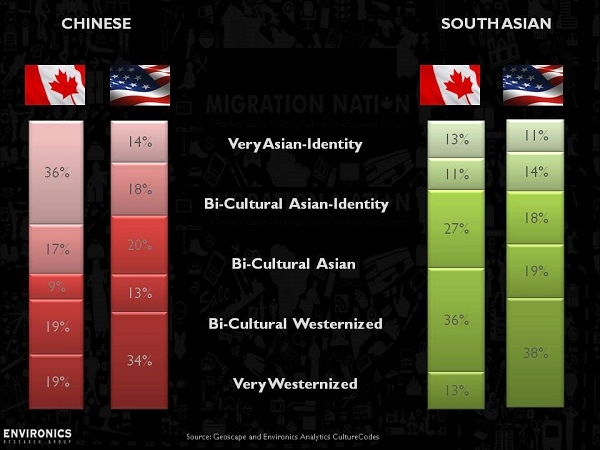
The cliché of the melting pot versus the cultural mosaic appears to still apply, at least for those of Chinese and South Asian origin (two of the largest communities in Canada):

Our recent research compared Chinese and South Asian Americans and Canadians’ level of acculturation using Geoscape and & Environics Analytics CultureCodes see graph. These analytical tools classify the population into five categories of acculturation based on their home language, knowledge of English/French and period of immigration. We found much higher levels of acculturation in the U.S. than in Canada for both groups. This results from a number of factors, including the “melting pot” vs. multicultural culture of each country. Of course, this means that these populations will differ and marketing efforts to reach them must navigate that difference.

But, understanding the diasporas may not be the biggest challenge faced by multinationals. The current reality for many multinationals is that many of their consumers are in some respects more global than they are. There may be good business reasons why an Asian Canadian cannot find Nescafe iced coffee here in Canada, but consumers are not aware or don’t care about the constraints of separate business units, tariffs and supply chain logistics. They are connected globally and informed of products and services that are used by their ethnic diaspora across the world.

Consumers More Borderless Than Multinationals – New Canadian Media – NCM.

Mideast conflict affects all Muslims and Jews: Marmur

Interesting column by Dow Marmur, rabbi emeritus at Toronto’s Holy Blossom Temple, and the need to focus on relations between Jewish and Muslim communities at home, as some of the recent tensions at demonstrations attest:

Christians act as catalysts here. Thus the proposed centre is to be built on a site where churches had stood since the Middle Ages; the last was damaged in the Second World War and subsequently demolished. Berlin is now to have a home promoting religious tolerance erected on Christian ground.

Christians in post-war Germany have a history of trying to bring Jews and Muslims together without meddling in the politics of the Middle East. Already more than 40 years ago, Christian institutions in what was then West Germany helped to create an organization called Jews, Christians and Muslims in Europe. To this day JCM promotes fruitful interfaith encounters, particularly between theology students. The Berlin House of Prayer and Learning would be a logical and more far-reaching extension of this work.

Toronto has a sizeable Jewish community and an even larger Muslim minority. Canada is known for its commitment to multiculturalism and peace. This city may, therefore, be the right place to imitate and fine-tune what’s being done in Berlin, not by seeking to import the Palestinian-Israeli conflict but by bringing together committed Christians, Jews and Muslims who would help to enrich our lives here despite the tensions there.

The Canadian Association of Jews and Muslims is already engaged in this kind of non-political work. What I know of it suggests that it could benefit from active Christian involvement and resourcefulness reflecting Canada’s commitment to peace and coexistence. Where Chicago and Los Angeles failed, Toronto taking its cue from Berlin might succeed.

Mideast conflict affects all Muslims and Jews: Marmur | Toronto Star.

Calgary mom targeted by jihadist blogger after her radicalized son killed in Syria

Not exactly a nice gesture to a grieving mother seeking explanation for her son, Damian Clairmont’s, turn to radical Islam and death in Syria:

Chris Boudreau has been reeling for months after learning her son died fighting with a terrorist group overseas. Now, a self-proclaimed jihadist is urging the Calgary mother to embrace an extremist ideology she suspects was used to brainwash her son.

On his blog, Abu Dujana al-Muhajir claims he was among a group of young men who left Calgary to join “various fronts of Jihad” after forming a study group at a downtown mosque. Damian Clairmont, Boudreau’s son who was also part of the group, was later killed during rebel infighting in Syria.

Clairmont’s death devastated and confounded his mother, who continues to struggle with how her boy, raised in a loving Canadian family, could adopt radical views and die fighting for them.

In his latest blog post, Abu Dujana writes an open letter to Boudreau in which he explains the ideology behind her son’s path to violence and encourages her to become sympathetic to the cause.

“The attempt to get me to fall for the same thing just made me shake my head,” said Boudreau, who has branded herself an advocate against homegrown radicalization, and has met with officials across Canada and abroad to advance her cause.

“At least it means I must be getting to somebody enough that they are trying to find another way to get me to see their point of view, so that I don’t continue what I’m doing.”

… Boudreau recently returned from Europe, where she met with three other mothers whose sons had also died fighting alongside radical Islamic groups. One of those sons was killed just two months before Clairmont in the same Syrian town northwest of Aleppo.

She was able to build a bond with the other women, something she had been searching for, and learned their sons spouted the same kind of rhetoric she read in Abu Dujana’s blog.

“After talking to these mothers and hearing the exact same story over and over again, you know that (radicals are) using the same verbiage with everybody.”

… The blog posts offer an apparent window into the group’s ideology and their path to violence.

The latest missive advances a form of Islam based on a selective reading of the Qur’an, ignoring verses that contradict its point of view, said Aaron Hugues, an author who has written extensively on religion and holds a PhD on Islamic studies.

“What these guys do is they have very little understanding of the tradition … and they tell themselves these ludicrous stories that they’re waging jihad and that if they die they’ll go to paradise, and it’s brainwashing,” said Hughes, who used to teach at the University of Calgary but now lectures at the University of Rochester.

“In many respects, I think this radical Islam is a cult, and these kids need to be deprogrammed,” Hughes said.

“This thing that he wrote is really meant to unsettle us, Canadians, because it’s very articulate … and he’s trying to say, we know full well what we’re doing and we’re not brainwashed,” he said.

Mubin Shaikh, a former Muslim radical who joined CSIS as an undercover operative in a Toronto terrorism investigation, said he was considering a formal response to the blog post on behalf of Boudreau, whom he’s been helping.

He called the open letter propaganda that “cherry-picks” verses of the Qur’an to promote a radical version of Islam.

He said the missive is simply an attempt to justify Clairmont’s “indoctrination.”

“These guys are relative nobodies, and they put on this hero costume and they want people to follow them,” Shaikh said. “He’s wrong on so many levels.”
Calgary mom targeted by jihadist blogger after her radicalized son killed in Syria

Opinions on Rob Ford divide Toronto’s black community | Toronto Star

Interesting article on Rob Ford and the black community in Toronto and how his “retail politics” as well as follow-up to specific requests by constituents continues to resonate with some:

[Ken] Bryan, raised in foster homes in some of the city’s most impoverished neighbourhoods, says he “gets” Ford’s support in communities ignored by other politicians unless they are “pandering for votes.”“

Ford shows up and helps someone fix their door that’s been broken for three months and they say, ‘Hey, this guy is a great guy,’” Bryan said. “His sort of populism appeals to that … ‘I’m just this poor little guy and there are these downtown elites who hold their noses up at us; they don’t come into our communities.’”

But Bryan bristles when he hears claims that Ford has done more for black people than any other politician, or that youths, as Ford has said, would be “dead or in jail,” if it weren’t for him and his football charity.

“It’s patently false,” said Bryan, “but he believes it and he says it and the people who don’t know any better believe it. And that’s unfortunate.”

…. Those struggling to eke out a living in Toronto may not have the time, or inclination, to follow the decision-making at city hall closely enough to realize the inconsistencies between Ford’s words and his policy positions, says Bryan.

“It is low information, not necessarily low education,” he said.For that reason, it’s up to those who are paying attention to bring those who feel left out “into the fold,” and get them involved in the political process, Bryan adds.

“The question to be asked is why do all these black people feel disenfranchised? The answer is larger and has to do with a lot more than Rob Ford.”

Opinions on Rob Ford divide Toronto’s black community | Toronto Star.

Don’t call it diversity, call it real life

ABC President Paul Lee on diversity in television programming:

ABC is not on a mission to change TV, Lee insisted. He sees it as reflecting society as it is today.

“We think that’s our job,” he said. “Its not so much diversity as authenticity, if you’re reflecting America. We think these shows are deeply relatable, When I watch Black-ish or when I watch Cristela, I am one of those families.”

……ABC president Lee said his own background as an outsider – a British immigrant who studied Portuguese at Oxford and worked in Brazil before settling down in the U.S. – has helped give him a different perspective.

“Being an outsider is sometimes a great advantage and sometimes a disadvantage,” Lee said. “Sometimes you gain more than you lose from that perspective. It gives me a chance to look at things from another angle. The reality is, great stories resonate in the heart and gut of the audience, and that’s true anywhere in the world.

“I was brought up on American shows as much as I was on British shows,” Lee said. “My job isn’t to sit here as a Brit, commissioning American shows. My job is to see whether these shows move me, whether they move me to laughter or tears. If they do, and they do it in an authentic way, then we have a chance to resonate in the U.S. and beyond.”

Don’t call it diversity, call it real life.

Angry Second-generation Immigrants – New Canadian Media

Richard Landau on radicalization and second-generation immigrants. Not very conclusive, understandably, as there are no simple solutions.

And Leiken, the author of a recent Foreign Policy article cited, fails to link to the broader social and economic context of the various approaches to diversity:

And here we have arrived at a dangerous intersection. While young men may find an international conflict exotic, I have seen enough disaffected youths drawn to religious cults and extremism to know that it, too, has a special idealistic lure. Young men, drifting and unaccustomed to lives of prayer, obligation and fasting, may find the rituals alluring. Ritual + an exotic overseas conflict + romanticism may equal something like catnip for young men who are not well grounded. Et voila, radicalization!

Yes, there are extremist pied pipers who prey upon the young, the lonely and disaffected, telling them they are being disrespected and that the society at large hates them. Extremists like the late Anwar Al Awlaki tell young men that they will finally find meaning in their lives when they take up arms against the West. Simple, uneducated minds buy this drivel. The Boston Marathon bombers had a cult-like belief they were doing the Almighty’s will. The thing about fundamentalism, be it religious conversion or political, is that converts have an unending reservoir of zeal.

So how should Western societies deal with the roots of homegrown terrorism? With only limited successes, they have tried three approaches for dealing with immigrant populations:

  • Multiculturalism: Promotion and financing of integration, and equality of opportunity;
  • Assimilation: Forced assimilation/melting pot that leads to resentment;
  • Avoidance: Laissez faire benign neglect that produces a Balkanized and segregated society.

Writing in a Foreign Affairs article “Europe’s Angry Muslims,” Robert S. Leiken observed: “Yet it is far from clear whether top-down policies will work without bottom-up adjustments in social attitudes. Can Muslims become Europeans without Europe opening its social and political circles to them? So far, it appears that absolute assimilationism has failed in France, but so has segregation in Germany and multiculturalism in the Netherlands and the United Kingdom.”

It appears there is no simple, proven answer that will assuage the angry second generation. The answers may involve an amalgam of the three approaches and an educational system that addresses the issues of this generation head on.

Angry Second-generation Immigrants – New Canadian Media – NCM.

Pie Charts Are Terrible | Graph Graph

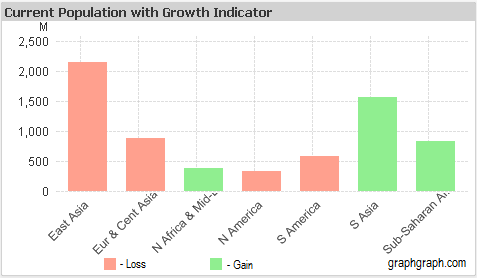
PieCharts_WorldBarColor


I am doing more and more charting to illustrate citizenship and multiculturalism issues and in consulting with those who have a better graphic sense than I, came across this convincing article and illustration against the use of pie charts.

Means I have to redo a number of what I have been working on but always good to learn something new that helps tell the story (I haven’t read his recommended book yet):

Let’s start this off with some honesty.  I used to love pie charts.  I thought they were great, just like the way I used to think Comic Sans was the best font ever.

But then I had some #RealTalk, and I’ve been enlightened in the error of my ways, and I want to pass on what I’ve learned to show people why pie charts aren’t the best choice for visualization.  For my day job, part of my work involves creating visualizations out of business data for our customers.  I picked up a copy of “Information Dashboard Design” a book by Stephen Few of Perceptual Edge.  If you’re at all interested in data visualization, I highly recommend his books, and on this site we attempt to use a lot of the principles in creating the visualizations we present to you.

Pie Charts Are Terrible | Graph Graph.