Jonathan Kay: Stop calling people ‘racialized minorities.’ It’s silly and cynical

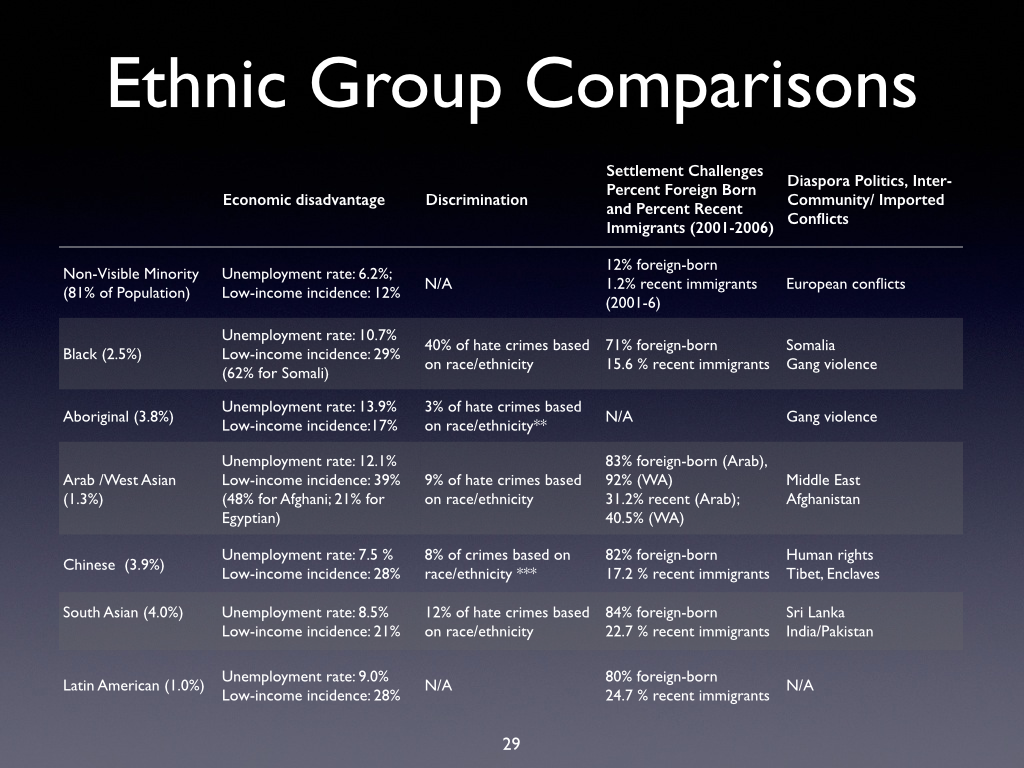
Ethnic Community Comparisons

From Policy Arrogance or Innocent Bias: Resetting Citizenship and Multiculturalism

Jon Kay takes the easy route out on faulting Carol Goar on her terminology, “racialized,” but ignores the broader, and more uncomfortable question she raised regarding inclusiveness and participation (Toronto is diverse but not as inclusive as it could be):

“Racialized Torontonians” as they call themselves?

Here’s a question for readers who live in Toronto: Do you know a single ordinary person — someone who is not either an activist, or enrolled in feminist film studies at Ryerson, or a “diversity consultant” hired by governments and big companies — who routinely refers to herself or anyone as a “racialized” person?

To be more specific, have these words ever escaped anyone’s lips within the 7,124 square kilometers of the Greater Toronto Area: “As a racialized Torontonian, I’m supporting Argentina over Germany in the World Cup final.” “As a racialized Torontonian, that shade of eye shadow really doesn’t go with my skin tone.” “As a racialized Torontonian, I’m having trouble finding a restaurant that serves authentic soul food.”

I suspect that most ordinary Torontonians would be utterly confused if Ms. Goar insisted on addressing them as a “racialized” person in a restaurant or store. They might assume she was taking some kind of ethnic census. If pressed to describe themselves through the lens of race-obsession, they might more simply respond: “If you really want to know, I’m half-black.” Or, “I’m Sephardic Jewish with a quarter Latino.” Or “I was both in The Philippines.” Or perhaps many might just avoid eye contact and say, “I’m a Canadian who lives in Toronto.”

Jason Kenney questioned the use of the term “racialized” along with “white power” and “oppression.” Grant and contribution proposals that included these terms, or websites of applicants with these terms, were routinely rejected.

While the underlying policy rationale was overdue – given Canada’s increased diversity, integration challenges within and among communities were equally significant – this change downplayed equity aspects of multiculturalism.

Jonathan Kay: Stop calling people ‘racialized minorities.’ It’s silly and cynical | National Post.
Why far-right nativist political parties stand no chance in Canada

Bit of a flawed and limited analysis by James Yan.

Canada is more welcoming, accepting, tolerant than other immigration-based countries like the US and Australia. Europe is not a comparator region.

Our history influences who we are, and as Kymlicka and Ibbitson’s popularization (Why is Canada the most tolerant country in the world? Luck), there are unique factors to our history, particularly the (imperfect) accommodation to aboriginal Canadians and more significantly French-English accommodation that provide the backdrop and culture for a more accommodating political culture.

And we recognized, belatedly, many of the unfortunate incidents of our past.

So while demographics now make it impossible, how we got here, and the contrast with other immigrant-based societies, are equally important factors:

In the case of Canada, however, the proportion of Canadian citizens who are foreign-born and the proportion who are members of a visible minority, at 20.6 per cent and 19.1 per cent respectively as of 2011, is simply too high for a nativist party to even be politically viable. Political parties in Canada win elections only by winning the support of a broad coalition of voters, especially immigrants and second-generation immigrants who belong to visible minorities, since they form such a sizable chunk of the electorate. In Canada, any far-right nativist political party will inevitably self-destruct since it alienates the very voting bloc from whom it inescapably needs votes.

In Europe, on the other hand, nativist parties are doing well because the proportion of foreign-born people in most countries is nowhere near as high as that in Canada. According to the United Nations Population Division’s 2013 International Migration Report, the percentage of the population that is foreign-born in most European countries mentioned at the beginning of this article is between five and eight per cent. European countries are also more ethnically homogeneous. This is why nativist political parties in Europe can afford to lose the immigrant and visible minority vote yet still perform so well in elections.

So it seems that hostility towards “outsiders” resembles a bell-shaped curve. These perceived outsiders can be scapegoated up to a certain point, but once they have attained a critical mass in any given country, nativist political parties cease to be politically viable. Luckily, Canada today is positioned on the right side of this bell curve.

Those who ignore history are condemned to repeat it.

Why far-right nativist political parties stand no chance in Canada | Embassy – Canadas Foreign Policy Newspaper.

Homegrown jihadis: Canadians have always fought in other people’s wars – Granatstein

Jack Granatstein’s fine reminder that Canadians have often fought in other wars and conflicts:

The government of Mackenzie King tried to stop Canadians from going to Spain, and it passed the Foreign Enlistment Act in April, 1937, to prevent men from signing up for foreign wars. The volunteers went to Spain anyway, while countless others donated money to the cause. Most of the Canadians who went to fight – 76 per cent, according to Michael Petrou’s fine study of the Mac-Paps – were Communist Party members, most recent immigrants to the Dominion. The Mac-Paps earned a reputation for political unreliability and combat effectiveness, and at least 400 never returned home. These “premature anti-fascists” suffered for their political sins in the Second World War and Cold War years.

The Foreign Enlistment Act remained on the books, but it didn’t stop Canadian Jews from fighting for Israel or raising millions of dollars for its support. Ben Dunkelman, who had served with distinction with the Queen’s Own Rifles in Europe, went to Israel in 1948 and led a brigade with great success in Israel’s independence war. Many others did so, including George Buzz Beurling, a Royal Canadian Air Force fighter ace and a gentile, who joined the Israeli Air Force as a well-paid mercenary. Beurling died in an air crash in Rome on his way to the Middle East. Many other Canadian Jews served in the major Arab-Israeli wars of the following decades. Others serve in the Israeli military to this day, all presumably in violation of Canadian law.

Then there was the Vietnam War. While hard numbers are unavailable, estimates are that as many as 50,000 Canadians served in the U.S. military during that long, bloody struggle. Some enlisted out of the conviction that North Vietnam was an aggressor state, others presumably because of an adventurous spirit that could not be satisfied in the Canadian Forces because of Ottawa’s preference for United Nations peacekeeping. Once again, the law was not applied against Canadians who fought abroad.

None of those war veterans brought jihad home to Canada, a legitimate concern we live with today, although some communists who fought in Spain might have had attitudes inimical to the Canadian capitalist state. Most of the Islamist volunteers, if they survive to return to Canada, will likely settle down to a “normal” life. But so long as ideology, religion, adventurism and a soldier’s pay still matter, Canadians will likely continue going off to fight in other people’s wars.

Not sure where he stands on citizenship revocation in such cases, but clearly his expectation is that most will “grow out of it” and return to Canada, which may be a bit naive given the intensity of their beliefs and the nature of the organizations they are fighting with.

Homegrown jihadis: Canadians have always fought in other people’s wars – The Globe and Mail.

When the “Multicultural” Penny Dropped – NCM

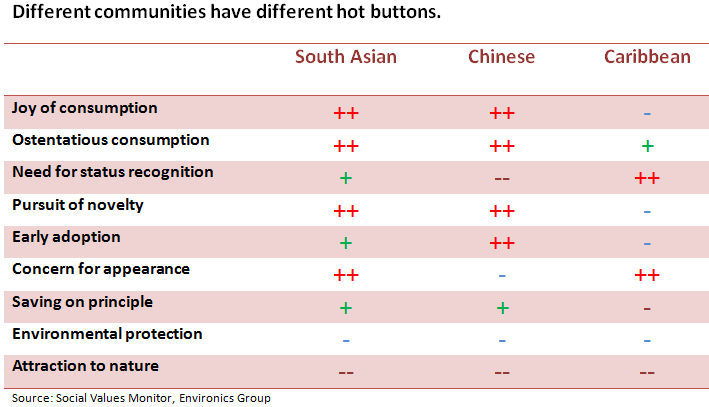
Diff comms have diff hot buttonsGautam Nath of Balmoral Multicultural Marketing on marketing to an increasingly diverse Canada:

Research was the backbone to facilitate professionalism in this market. There were but one or two long-established multicultural communication firms in Canada 20 years ago. Soon talent got together and a string of new agencies cut their teeth in the new space.

Today, there may be over 20 agencies, and in this digital era, each one looks very professional and established online.

The proof is in the pudding, however. Several agencies are literally one-man-shows operating from the confines of their basements looking to bag new business. A few have dedicated physical office space but operate with less than a handful of staff. And, literally, less than five agencies have dedicated in-house resources to support the full suite of client needs. However, this thin selection is supported by a contingent of planning, production, and other freelancers that give outside support to wherever the business goes.

Notwithstanding, over the years, the market has seen a wide range of companies wooing the multicultural consumer. In fact, it is estimated that the dollar spend of this community is about $40 billion annually and growing. But the challenge is that few marketers are constant spenders year on year.

With clients being erratic in their spending, each year is anybody’s guess.

Fortunes are made in a day and fortunes are lost with equal haste in the multicultural support services business. The long-standing, endurance-oriented and action-driven agencies will survive, others will truly shake in the wind.

Product groups that addressed these segments were the Big 5 banks initially and then the telecommunication providers. This was soon followed by large retailers, food products, real estate, automotive and entertainment. Education and settlement agencies are also growing in their spend in communicating to these audiences. But other than a handful with long-term vision and deep pockets, many are still in a pilot and a learning phase.

When the “Multicultural” Penny Dropped – New Canadian Media – NCM.

Europe takes rehab approach to Islamic extremists

German initiative to combat radicalization and extremism:

Bozay runs a project called Wegweiser, which means signpost in German. It seeks to prevent radicalization among Muslim teenagers in the city, which has a large Islamic community, with the help of schools, families, religious leaders and job centers. Besides Bochum, there are two Wegweiser centers in Bonn and Duesseldorf — all three aimed at engaging troubled youths before they fall into radical Islam.

The centers send out social workers who intervene when they see recruiters approaching teenagers on playgrounds, football fields and school yards, or when they carry out Islamic conversions on market squares. The workers engage the youths in conversation and try to offer solutions that steer them away from fundamentalism.

The centers, which were launched in April, have the backing of the security service in Germany’s most populous state, North-Rhine Westphalia. The state has seen a jump in the number of Salafists, adherents of an extreme fundamentalist version of Islam that has authorities worried. Their numbers have grown to 6,000 in Germany, according to official figures, with 1,800 in North-Rhine Westphalia alone.

“Salafism is a lifestyle package for young people because it offers them social warmth, a simple black-and-white view of the world, recognition by their peer group — basically everything they lack in real life,” said Burkhard Freier, who heads the states domestic intelligence service.

Europe takes rehab approach to Islamic extremists – Yahoo News.

Common lime name has racist history

Following the Redskins piece by Neil MacDonald (From Washington Redskins to queer culture, the uneasy evolution of the slur), another example of a term in need of changing:

There is a growing campaign to change the name of a variety of lime because it is viewed as offensive by some.

“Kaffir” lime is gaining popularity as North American cooks expand their culinary horizons into Southeast Asian food. The lime’s leaves are also used in parts of South Asia and Africa. It goes by many names around the world, but Veronica Vinje, a masters student in Intercultural and International Communications in Victoria, B.C., says the most common one is deeply racist.

Vinje says calling someone by this name in South Africa is akin to using the N-word to describe black people, while in the Middle East and South Asia, the name is a derisive term for non-Muslims.

​”Since there are so many other names for this lime already, I thought whats the big deal if we call it something else?” Vinje said. “Because it is becoming popular and trendy … and it’s not a very nice message to send to our citizens from Southern Africa … that know this term from a very bad history. Why not change it to something else?”

Common lime name has racist history – Canada – CBC News.

Toronto is diverse but not as inclusive as it could be: Goar

Carol Goar on diversity and inclusion, using the United Way keynote speech by Zabeen Hirji to frame her piece:

“Having diversity is interesting,” said Zabeen Hirji, chief human resources officer for the Royal Bank non-commitally. “It’s when you do something with it that it becomes powerful.”

She had put her finger on one of the biggest challenges facing this city: moving from diversity to inclusion.

As a woman, an Ismaili Muslim and an immigrant from Tanzania, Hirji is acutely aware of the difference. Many Torontonians are not.

Speaking at the annual meeting of the United Way of Toronto, Hirji was careful not to offend the business leaders in the room. Eighty per cent of the charity’s funds come from the corporate sector in direct donations and employee payroll contributions. But she made it clear that diversity — which Toronto has in abundance — is simply a description of the city’s talent pool. Inclusion is the act of tapping into the whole pool — not just the top layer — and mixing people from disparate cultures, backgrounds and generations together in a way that allows them to combine their strengths.

On that score, Toronto doesn’t do as well. Very few immigrants — who make up 46 per cent of the city’s population — hold senior positions in business, politics or civil society. Racialized Torontonians — as they call themselves — are disproportionately poor, underemployed and socially isolated.

Many influential Torontonians who could reach out — corporate CEOs, political leaders and heads of major public institutions — don’t; or don’t do it effectively. Many immigrants and their descendents in turn, live in ethnic enclaves, work for employers from their country of origin and socialize among themselves.

Hirji wasn’t there to preach. Her primary message was that harnessing the talent and energy of young people, newcomers, members of First Nations, gays and lesbians and other minorities is good for business and good for the city. She offered three tips, drawn from her 13 years spearheading RBC’s drive to make its workforce a better reflection of the population: Start with a clear commitment from the top, develop an explicit plan and get buy-in from all employees.

It was the right approach for a breakfast speech to the United Way. But it will take more than an upbeat sales pitch to identify and dismantle the barriers that hold non-white Torontonians back.

Toronto is diverse but not as inclusive as it could be: Goar | Toronto Star.

Diversity is right course: Public Editor | Toronto Star

The Star’s Public Editor, Kathy English, on diversity:

That means every Star journalist must filter the many choices made every day in creating and presenting stories, opinions, photos and videos through a key question — Does this reflect Toronto in all its diversity?

This question needs to be top of mind for reporters, columnists, photographers and their editors when stories are pitched, sources are selected, images are captured. Our journalists need to seek out visible minority sources for comment on all the broad issues that affect our entire community — not just the issues that affect their specific communities. We should not accept easy stereotypes and tokenism. And just as importantly, we must understand how a disproportionate level of negative coverage of visible minorities can skew perceptions of reality.

Of course, all of this makes good business sense at a time when the economics of news publishing are changing drastically. Studies link a decline in reader engagement with the news to the reality that many people do not see themselves reflected in coverage. Certainly to grow readership and deepen reader engagement across all the new platforms through which the Star serves readers now and into the future we need to reach and reflect a diverse audience.

But for me, the heart of this issue is the overall accuracy and fairness of the Star’s coverage of its community. When we do not fully and truly reflect the diversity of Toronto we give readers an incomplete and inaccurate picture of their community.

Indeed, reflecting Toronto in all its rich diversity is the right thing to do.

Diversity is right course: Public Editor | Toronto Star.

The Uses and Abuses of History: Tacitus’ Germania

Interesting history and impact of the work of the Roman Tacitus on Germans:

Tacitus wasn’t a satirist himself, but in the Germania he was working one of Western moralism’s most enduring tropes: contrasting the noble savage beyond the border with the decadent civilized man within. The Germans, he wrote, were all of a phenotype, red-haired, blue-eyed and huge in stature; they were warlike, but honourable and loyal to death, fighting only for truth, justice and the German way. Overall, their moral standards put Romans to shame: “nobody laughs off vice, and to corrupt and to be corrupted is not called ‘modern times.’ ” As that line reveals, Tacitus meant his work as a call to Roman renewal, not a paean to the barbarians, whose faults as he saw them—in culture, manners and personal hygiene—drew sneers to match his praise for their virtues.

But the sneers were easily ignored in the first stirrings of the German nationalism that would prove so potent during the Reformation, especially among intellectuals envious of the French and English nation-states. One of the few to play both themes was an Italian papal envoy sent north to rally support for a crusade against the expanding Ottoman Empire. In public he stressed German warrior prowess as set out by his illustrious Roman predecessor; in private the envoy sent whining letters home, begging his friends to pull enough strings to get him out of a frozen hell hole of inedible food and “dead men who are still farting.”

German thinkers simply embraced the positive aspects. By the 19th century, racial theorists were taking Tacitus’s judgment that the ancient Germans preserved their virtues through their refusal to intermarry with other peoples as Gospel—and as proof that Jews were poisoning the very blood of the volk. By the time the Third Reich arose, Nazi theorists considered the Germania “a bible that every thinking German should possess,” in the words of one, and its author supremely trustworthy because he was both ancient and an admiring enemy of the Germans. Nazi gatherings had “Tacitus rooms” with particularly choice quotations about blood purity and the supreme virtue of manly loyalty unto death written on the walls for the contemplation of young. Adolf Hitler aimed to call the new capital he aimed to build Germania.

For true believers like Heinrich Himmler—who sent an SS team to steal a manuscript copy of the Germania from an Italian villa even as the Allies were advancing up the peninsula—Tacitus was a racial genius on a par with the Fuhrer himself, and his work one of the foundations of Nazism. Some of the old monks of Corvey, those who agreed with the long-running medieval argument that no good could come from preserving the works of pagan authors, would have said “told you so.”

The uses and abuses of history

UK: Islamist terror threat to west blown out of proportion – former MI6 chief

Sensible and refreshing comments:

He made it clear he believed the way the British government and the media were giving the extremists the “oxygen of publicity” was counter-productive. The media were making monsters of “misguided young men, rather pathetic figures” who were getting coverage “more than their wildest dreams”, said Dearlove, adding: “It is surely better to ignore them.” …..

Dearlove said he was concerned about the influence of the media on the government’s security policy. It was time to take what he called a “more proportionate approach to terrorism”.

MI5, MI6, and GCHQ devoted a greater share of their resources to countering Islamist fundamentalism than they did to the Soviet Union during the cold war, or to Irish terrorism that had cost the lives of more UK citizens and British soldiers than al-Qaida had done, Dearlove noted.

A massive reaction after the 9/11 attacks was inevitable, he said, but it was not inevitable the 2001 attacks would continue to “dominate our way of thinking about national security”. There had been a “fundamental change” in the nature of the threat posed by Islamist extremists. Al-Qaida had largely failed to mount the kind of attacks in the US and UK it had threatened after 9/11.

It was time, he said to move away from the “distortion” of the post-9/11 mindset, make “realistic risk assessments” and think rationally about the causes of the crisis in the Middle East.

The al-Qaida franchises that had emerged since had largely “fallen back” on other Muslim countries, Dearlove said. What was happening now was a long-awaited war between Sunni and Shia Muslims that would have only a ripple effect on Britain, he suggested.

Pointing the finger at Sunni Saudi Arabia, Dearlove said the Isis surge in Iraq had to be the consequence of “sustained funding”.

Islamist terror threat to west blown out of proportion – former MI6 chief | UK news | The Guardian.