Charlie Hebdo shooting: Debate over publishing the Muhammad cartoons

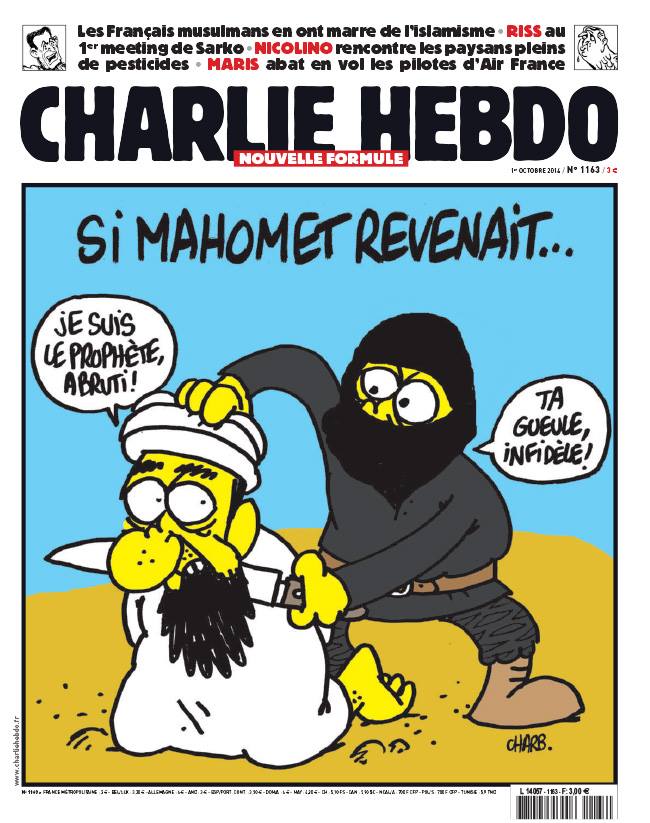
charlie hebdo no1163 011014While it is a legitimate debate to have over whether or not to publish the cartoons given fear of giving offence or further stirring things up, my sense is that editors have made a blanket decision rather than looking at the cartoons and selecting some that are not gratuitous but make valid points.

My example would be the one above:

Studer said the CBC decided against running the cartoons, arguing that to show those depictions of Muhammad would needlessly offend Muslims, who consider such depictions sacrilege.

And he wasn’t alone in putting forward that argument. The New York Times executive editor Dean Baquet told the paper’s public editor he spent about half of the day deciding whether or not to publish the cartoons, changing his mind twice before ultimately deciding not to run the images.

“We have a standard that is long held and that serves us well: that there is a line between gratuitous insult and satire. Most of these are gratuitous insult,” Baquet said.

The Washington Post ran one image on its editorial pages while the main U.S. networks, including ABC News, CNN and Fox backed off from publishing the cartoons. The Associated Press also declined to make them available.

In Canada, of the Toronto-based newspapers, only the National Post ran the controversial cartoons. Almost none of the U.K. papers ran the cartoons, nor did the BBC and the Paris-based papers Le Monde or Le Figaro.

Charlie Hebdo shooting: Debate over publishing the Muhammad cartoons – World – CBC News.

And in Quebec media, which apart from the Montreal Gazette, widely published some of the cartoons:
Publier les caricatures ou pas?

The Unbearable Whiteness of Congress – The Daily Beast

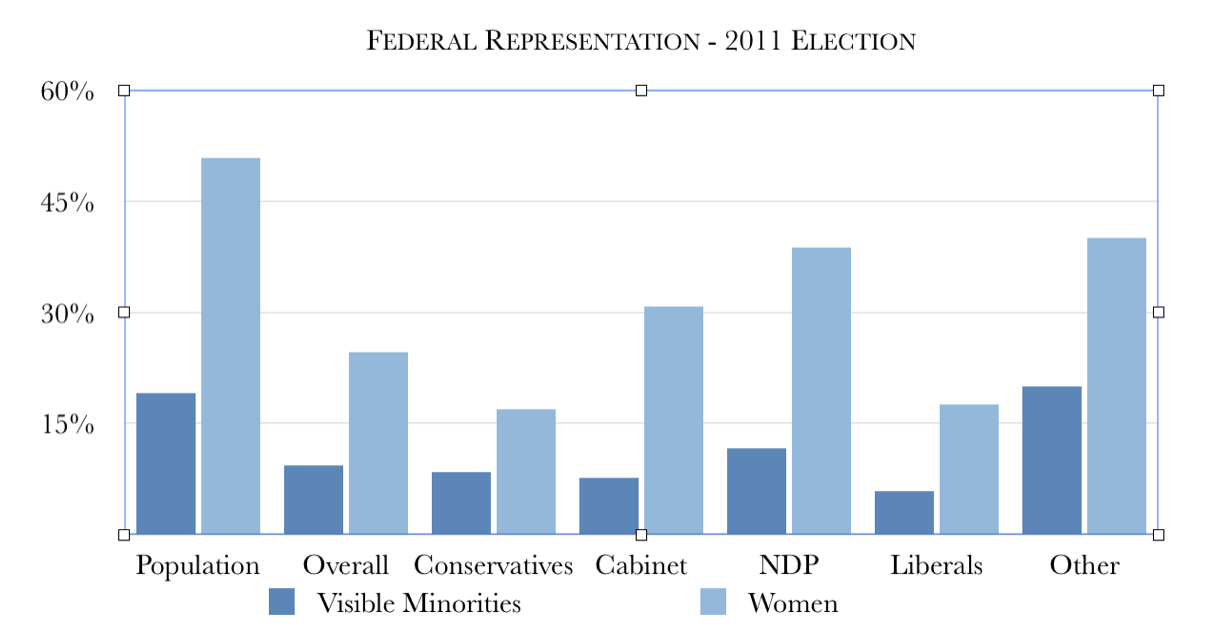
Federal_Representation_-_2011_ElectionA reminder in the US of gaps in political representation for women, blacks and hispanics (chart above shows Canadian representation from the 2011 federal election):

Cue the confetti: The new Congress sworn in on Tuesday is the most diverse in our nation’s history!

That would truly be a milestone to celebrate—until you see what that record “diversity” actually means. Ready? The breakdown of the 114th Congress is 80 percent white, 80 percent male, and 92 percent Christian.

… Look, I don’t care if you are a liberal or a conservative. It’s impossible to make the claim that our Congress accurately reflects the demographics of our nation. And it’s not missing by a little but a lot. If Congress accurately reflected our nation on the basis of race, about 63 percent would be white, not 80 percent. Blacks would hold about 13 percent of the seats and Latinos 17 percent.

But what do we really see? The new Senate has only two black senators. That statistic is even more striking given that earlier this week the first black person ever elected to the Senate, Edward Brooke, was laid to rest. Brooke won his seat in 1966 and served two terms. How far has Congress really evolved on race when in 50 years it has gone from one black senator to two? (Even the arguably more democratic House is only at 10 percent black members.)

Congress moves slowly, and I don’t mean just on passing legislation.

Latinos, the fastest growing minority group in America, are even more underrepresented in Congress. They hold 3 percent of the Senate and a little over 7 percent of the House.

And let’s look at religion. Congress is now 92 percent Christian, resembling more to a papal enclave than our religiously diverse nation. The latest Pew Poll found that nearly 20 percent of Americans identify as atheist, agnostic, or not being affiliated with any religion. Yet there’s only one member of Congress, Rep. Kyrsten Sinema (D-AZ), who openly acknowledges she’s not a member of any religious group.

OK, let’s put race, ethnicity, and religion aside and address the most glaring under representation in Congress of any group: women. This Congress will welcome more women than ever before at 19 percent of the House and 20 percent of the Senate.

The Unbearable Whiteness of Congress – The Daily Beast.

University backs professor who says Asian immigration damages Vancouver – The Globe and Mail

More on Professor Duchesne (see his UNB website here) for his overall philosophy on immigration and multiculturalism and the “uniqueness of Western Civilization.”

Not that one cannot have concerns about the pace and nature of change but his phraseology and ideology suggest a less than dispassionate view:

He said Prof. Duchesne is using academic freedom to hide poor scholarship. “He’s only providing one view to students and shaping their minds,” he said. “That whole academic enterprise of why we send our kids to school to become broad thinkers is not being upheld.”

Mr. Jang also said Prof. Duchesne’s views on Asian immigration to B.C. are simply untrue. “It really comes across as very white supremacist. That’s just not Canada. It’s a country of immigrants.”

But Prof. Duchesne, on Wednesday, disputed Mr. Jang’s views, noting that the university’s dean of arts came to see him earlier in the day and upheld his academic-freedom rights.

This week, Prof. Duchesne was quoted by CBC as saying the influx of Asians and Chinese to Vancouver was “too fast, too quick,” leading a “beautiful British city” to take on “a strongly Asian character.”

In an interview from Saint John, he stuck by that view Wednesday, describing Vancouver as a city dramatically altered by Chinese immigrants. “Vancouver can still be seen as a city that still remains British in many areas, but also has this strong, growing Asian side. There is this two-faced character to the city,” he said. “The fast pace of the change is bad.”

University backs professor who says Asian immigration damages Vancouver – The Globe and Mail.

Paris attacks illustrate the power of mockery – Saunders

Nice piece by Doug Saunders on the power of satire:

Mockery travels faster than news or analysis. While Charlie Chaplin’s Interview-style mockery of Adolf Hitler in The Great Dictator was not considered a major part of the arsenal against the Fuhrer in that predigital era (and certainly didn’t provoke violence), the instant spread of disrespectful imagery is capable of threatening entire edifices of authority overnight.

What Charlie Hebdo offended was not any broad community or religion or political tendency, but rather those militant few who are driven to revenge and violence at the prospect of disrespect. Its unsubtle, schoolyard style of humour, much like Mr. Rogen’s, turned off a lot of people and groups, but that’s a fully acceptable response to bad taste and not at all related to vengeful violence.

A century and a half ago, what the police called “respect crimes” were part of the political mainstream in countries such as Canada, where wounded honour was the cause for duels and vengeance. Gauntlet-throwing died out, in most places, for generations. But something has happened in the online age to make mockery, once again, into a potent instrument. The only reasonable response is to deploy it as often, and as mercilessly, as possible.

I remember reading Satanic Verses during the time of the fatwa and some of the passages took my breath away in the sharpness and humour of Rushdie’s use of satire to make his points.

Paris attacks illustrate the power of mockery – The Globe and Mail.

In the Mideast, as in France, satire is a weapon against extremists

Interesting piece by Nahrain Al-Mousawi on satire within the Arab world with some quite amusing examples. Her conclusion regarding the risks of organizing such satire by Western governments is valid.:

While the efforts highlighted above are organic, based on a shared community, other efforts appear to be more technocratically orchestrated. A recent article noted that Mr. Sharro’s satirical chart was widely shared, including by the U.S. State Department’s Center for Strategic Counterterrorism Communications. The CSCC has exhibited its own type of muted mockery in a video countering IS recruitment efforts. The integration of humor in U.S. counter-terrorism strategies has been ramped up since the development of social media and its snarky style of communication. A State Department program calling itself Viral Peace confronts and undermines online currents of extremism with “logic, humor, satire,” in its creator’s words.

But a government-backed effort does not necessarily make for an effective means of striking back (and can often be perceived as intrusive, stilted or awkward). After all, satire’s subversiveness can be an ill-fitting mask worn by government institutions, distinct from more organic efforts, produced in times of crisis by a shared, discursive community – at least, when that community itself is threatened. Still, if laughing in the face of the absurd reveals an ability to “dwell with the incomprehensible without dying from fear or going mad,” then that may be the first step in striking back – by having the last laugh.

In the Mideast, as in France, satire is a weapon against extremists – The Globe and Mail.

Canada vows to accept 13,000 more refugees from Syria and Iraq

Good commitment – finally, now the challenge will be in implementation:

Canada has already accepted 20,000 Iraqis and since mid-2013 has brought 1,060 Syrian refugees to Canada. Total approvals for resettled Syrian refugees now exceed 1,275, with thousands more applications still being processed. This number doesn’t include the many more Syrians who’ve been accepted as refugees after making “inland claims” from within Canada.

The government also announced another $90-million in humanitarian assistance for people affected by the intensifying violence in both Iraq and Syria, home to a long-running civil war as well as battles between Islamic jihadis and government forces. The assistance will be distributed via UN agencies, the Red Cross and aid groups.

Mr. Alexander said the 10,000 new Syrian refugees will be resettled in Canada through both government and private-organization sponsorship. He said he expects roughly 60 per cent will be supported by private sponsors such as church groups and 40 per cent through government arrangements – “roughly the same proportions we’ve always had.”

Refugee sponsor groups said it will be a huge task to help 6,000, or 60 per cent of Syrian refugees, settle in Canada over 36 months. This is on top of the 3,000 additional Iraqi refugees Canada is now accepting.

Some said they hadn’t been officially informed of the proportion that private sponsors are expected to shoulder.

“Over three years, it will be probably on the edge of possible,” Alexandra Kotyk, director of sponsorship at AURA, a charitable organization representing the Anglican Diocese of Toronto and the Toronto Conference of the United Church of Canada.

I have less of an issue than some critics on the issue of need and possible preference given to Christian refugees, as it is hard to argue that Christians, and other minorities, are not likely at more risk than others.

Canada vows to accept 13,000 more refugees from Syria and Iraq – The Globe and Mail.

National Post Editorial: Good Riddance to Carding

From the National Post Editorial Board:

Police have long defended carding as a vital law enforcement tool, and claim it has led to breakthroughs in major cases. But critics have long claimed  the process was inherently discriminatory, as young, black, male Torontonians were far more likely to be carded than others.

The critics were right. Data compiled by the Toronto Star revealed that young black men were being carded far more often than other citizens. Blacks, who are less than 10% of Toronto’s population, made up roughly a quarter of those being carded.

This is not to suggest that the police were simply bigoted. It is a sad truth that young black men in Toronto kill and are killed at a number that is wildly disproportionate to their share of the population. Young black men are charged with violent crimes more often than their numbers alone would warrant. Carding was the police response to the genuine issue of alarmingly high rates of violent crime among Toronto’s black youth.

But it was still the wrong response. Since 2008, more than a million people have been carded in a city that only sees somewhere in the region of 50 homicides a year. Not only was this an unwarranted police intrusion into the lives of citizens, but it needlessly stigmatized members of a racial minority, casting individuals under suspicion — or certainly making them feel under suspicion — solely on the basis of their race.

My only comment, as earlier posts this week have illustrated (A MacArthur Grant Winner Tries to Unearth Biases to Aid Criminal Justice – NYTimes.com, The Science of Why Cops Shoot Young Black Men), is not that the police are “simply bigoted” but they, like all of us, have subconscious biases and prejudices that play a role here.

National Post editorial board: Good riddance to carding 

Blatchford: Convicted hate-monger gets added jail time for his Muslim-offending ‘social experiment’

Worth reading. Eric Brazau, the person convicted, certainly seems a nasty piece of work.

Blatchford appears to be critical of the judge’s decision to “throw the book” at Brazeau. Would she be as critical of the judge’s decision had the comments been directed at Jews? Blacks?

Blatchford: Convicted hate-monger gets added jail time for his Muslim-offending ‘social experiment’.

Barbara Kay: When it comes to Islam, the media needs to ditch the ‘narrative,’ and report the truth

What Kay misses, in her reductionist approach to ideology and extremism of all kinds, is what are the factors that push some to violence and what are the ones that increase resilience to these appeals.

With lone-wolf extremists, it is clear that mental illness and other issues can be one of the factors that push them over the edge. It does not mean that Islamist ideology is not involved; it is just that there can be other factors as well that make some individuals more susceptible.

And I would distinguish between these kinds of attacks and the more “sophisticated”and “professional” attacks that took place on Charlie Hebdo.

And of course, none of this reduces the horror over any attack, no matter the motives or factors:

We’re in the middle of a Hot War with Islamism. There will be more attempted, or realized, lone-wolf terrorist attacks on our shores. In the event, it would be helpful if the liberal media could ditch its love affair with narratives, and stick with the truth.

The right-wing media also should ‘ditch its love affair with narratives’ and recognize the complexity of the various factors involved.

Barbara Kay: When it comes to Islam, the media needs to ditch the ‘narrative,’ and report the truth | National Post.

I am Charlie

A lot will be written about this with good reason. Arun’s post captures it well.

Arun's avatarArun with a View

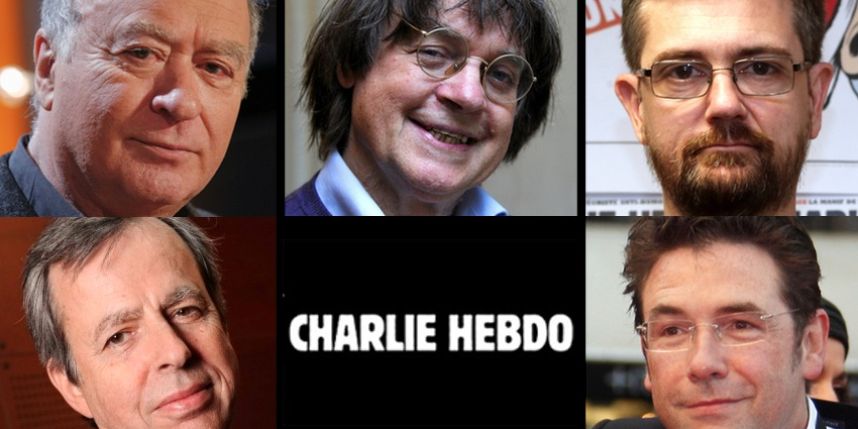
Top: Georges Wolinski, Jean Cabut (Cabu), Stéphane Charbonnier (Charb)  Bottom: Bernard Maris, Bernard Velhac (Tignous) (Image credit: AFP/Metronews) Top: Georges Wolinski, Jean Cabut (Cabu), Stéphane Charbonnier (Charb)
Bottom: Bernard Maris, Bernard Velhac (Tignous) (Image credit: AFP/Metronews)

I’m in the US right now, so heard the horrific news from Paris when waking up this morning. I’m in a state of shock. I’ve had tears in my eyes. I cannot believe what has happened. For me this is more than a terrorist attack and with twelve people—journalists, writers, cartoonists, intellectuals—murdered in cold blood. This happened in my city and to people I knew, not personally but via their writings, drawings, and media appearances, and to whom I have linked numerous times on this blog (here, here, here, here, here, and also here, here, here, and, above all, here). Bernard Maris was one of my favorite economists, whom I’ve been reading and listening to on Friday mornings on France Inter since…

View original post 286 more words