Richmond launches dialogue about language on signs | Indo-Canadian Voice

Follow-on to earlier controversies over Chinese-only signage in Richmond (majority Chinese Canadian population). See earlier post Richmond, B.C., considers banning Chinese-only signs amid uproar over city’s ‘un-Canadian’ advertisements:

Information gathered by the City will be provided to Richmond Council later this spring. The program responds to a referral from Council last year, which directed staff to study the issue of language on signs, undertake public and stakeholder consultation and develop recommendations for possible future regulatory, education or other measures.

Staff were also directed to consult with business owners to encourage more use of English language on signs. In response, City staff have undertaken a comprehensive program to educate Richmond businesses about the importance to community harmony of including English on all signage and advertising material. Multilingual staff are visiting every business in the City Centre on a zone-by-zone basis to inform them about sign bylaw requirements and discuss the issue of language on signs. The intent of the outreach project is to achieve compliance and promote community harmony with education rather than taking a strictly regulatory approach.

The City is also using the annual Business License renewal process to ensure that businesses are aware of the need for proper sign permits and to encourage inclusion of 50 per cent English content on signs. While this message was previously included in business license application forms, a special insert in both English and Chinese has now been produced to ensure that language is not a barrier to the message.  This approach will ensure that all licensed businesses in Richmond will have received a friendly written notice within one year.

New multilingual information packages on starting a small business in Richmond have been developed to help ensure businesses are aware of Sign Bylaw and other regulatory requirements.

Richmond launches dialogue about language on signs | Indo-Canadian Voice.

Contrasting Commentary: Barbara Kay vs Clifford Orwin and Marnie Soupcoff on the Niqab and Citizenship Ceremonies

Barbara Kay supporting the Government:

But Ms Bakht’s specious parallel has the virtue that it can be turned against its perpetrator. If a woman were to turn up at her citizenship swearing-in ceremony in a bikini, would she be allowed to? I think not. And rightly so. Bikinis on a beach are one thing – in a solemn ceremony quite another. Indecency swings both ways. Face cover is also indecent in certain situations, such as the swearing-in of a woman to citizenship in a democratic country based on, amongst other principles, gender equality. (I consider the niqab indecent in all getting and giving of government services. If the federal government would pass a law requiring the face be uncovered in these areas, as Quebec soon will, Canadians would approve en masse.)

Perhaps Ms Ishaq might give some thought to the reality that thousands upon thousands of Pakistani people wish to become citizens of Canada, but one does not see Canadians flocking to Pakistan to live. There are reasons for that. One of those reasons is that women here are equal to men, and nobody can tell a woman here that she must cover her face. One might think that Ms Ishaq would wish to honour that right, on behalf of her sisters who are forced to wear the niqab, by taking hers off for the five minutes it will take to accept the gift of great value our government wishes to confer on her.

Barbara Kay: Zunera Ishaq does a disservice to women forced to wear the veil

Marnie Soupcoff opposing:

Is the government’s quarrel with the niqab is that it represents a patriarchal practice it believes diminishes women’s autonomy and, ultimately, safety?

That seems to be what Citizenship and Immigration Minister Chris Alexander was getting at when he said while commenting on the case, “We also are a government, and I think a people, that is concerned about protecting women from violence, protecting women from human smuggling, protecting women from barbaric practices like polygamy, genital mutilation, honour killings.”

Quite apart from the dramatic leap from a legal piece of clothing to the commission of major crimes, which seems to lack some clear thinking on causation vs. correlation, Mr. Alexander is treading on dangerous ground, at least if he plans to be consistent and even-handed.

The ultra-Orthodox Jewish tradition has married women wear wigs or otherwise cover their hair in public, and all women wear long sleeves and skirts below the knees, to maintain their modesty and de-emphasize their sexual attractiveness to anyone but their husbands.

The rules about women’s dress are but one expression of the tradition’s emphasis on female purity and deference, which also includes a wife’s duty to always accept her husband’s sexual advances on his terms.

In Israel, concerns about sexual abuse in the ultra-Orthodox community are significant, and rabbis are accused of participating in cover-ups.

So shouldn’t Mr. Alexander and Mr. Harper also be addressing the offensiveness of the wigs and long skirts being worn by Orthodox women taking their citizenship oaths? And if they’re not, does that mean they’re endorsing the antiquated sexist idea that a woman who shows a stranger man her elbows is engaging in brazen sexual temptation?

Of course the answer is no. No, they shouldn’t, and no, it doesn’t.

Concerns about what cultural, religious and social signals are being sent by an individual’s choice in clothing should have no place in lawmakers’ minds, or at least not in their actions.

The very beauty of Canadian citizenship is that it comes with the freedom to choose your own way and your own life. Does the majority of society have to agree with your choice, whether it be to don a nun’s habit or a Wiccan pentagram necklace?

The obvious answer again is no, so long as you aren’t infringing on anyone else’s freedom with your decision. And apologies to Mr. Harper and Mr. Alexander, but their freedom not to be offended doesn’t count.

Marni Soupcoff: Tories vs. religious freedom

Along with a former prof of mine, Clifford Orwin:

You may ask whether Islam truly requires that a woman wear the niqab. This is none of a liberal state’s business; it is for Muslims to decide for themselves. But they won’t agree, and even if most did, liberal democracy rejects the imposition of religious authority. So this is nobody’s call but Ms. Ishaq’s. Like every citizen, she must be free to practise her religion not as we see fit, but as she does. This isn’t a question of “accommodation” or “diversity” or any such currently fashionable lingo: It’s a requirement of religious freedom, one of the first and most basic of liberal democratic principles.

The worst thing about Mr. Harper’s position is its implication that Ms. Ishaq can’t be a good Canadian unless she discards a practice she regards as incumbent on her as a Muslim and which is entirely harmless to others. I’m not about to claim that the biggest problem facing Canadian society is Islamophobia. (In fact, it has shown itself remarkably free of such attitudes.) The threat of Islamist terror poses a much bigger problem to Canada, as to other liberal democracies. But aggravating the lesser problem in no way helps to solve this greater problem. We shouldn’t hand devout Muslims legitimate (and wholly gratuitous) grievances. Nor (it should go without saying) should we practise demagoguery at their expense.

 Stephen Harper’s veiled attack on religious freedom 

Space for faith: Accomodating religion on campus

Overview of the different approaches taken by universities to provide prayer space to students. From an integration perspective, multiculturalism-faith centres are preferable to single-faith centres:

The University of Toronto’s approach to religion on campus lies somewhere between McGill’s and Western’s. While U of T has a multi-faith centre, a building with several rooms in which weekly discussions on faith and religious diversity take place, U of T does not provide designated space for any religious group. There are several multi-purpose spaces around campus that student groups, including religious ones, are responsible for booking. “We don’t expect students to park their faith at the edge of campus,” says Richard Chambers, director of the university’s multi-faith centre. “But we don’t privilege any particular group . . . that wouldn’t fly here.” Chambers has yet to receive a request from a single religious group asking for more space.

Space for faith: Accomodating religion on campus.

Ontario may collect race-based data on kids in care

Always controversial to collect race-based data but without data, hard to know what is happening and what measures could be taken to address problem areas:

The probe revealed for the first time that 41 per cent of children and youth in the care of the Children’s Aid Society of Toronto are black, though only 8.2 per cent of the city’s under-18 population is black.

MacCharles, who became Minister of Children and Youth Services last summer, is so concerned by those numbers she’s considering a province-wide count of black kids in care to determine the extent of the challenge. Few of Ontario’s 46 children’s aid societies track such data, and those that do keep the statistics secret.

Black community leaders have complained for years that their children are taken into care at rates far higher than white children. They say it is hard to get government to pay attention without hard statistics.

“I think there’s a lot more receptivity to looking at (race-based data) in this sector and beyond,” MacCharles said of the government’s current attitude. “We’re also looking at this notion of disaggregated data, which includes black children and youth in care, in schools, and in our youth justice system,” she added.

Without committing to making such data public, MacCharles told the Star: “My bottom line is, any data that helps improve the security and safety of children, I’m willing to have a hard look at.”

Ontario may collect race-based data on kids in care | Toronto Star.

Must-see QP: Jason Kenney takes on a death cult

While there may be an element of calculation in his use of a Christian prayer in his comments on the killing of Copts in Libya, it also likely reflects his strong faith.

Kenney has been consistent throughout his Ministerial career in his concern over the fate of Christians in the Mid-East:

Jason Kenney, the new defence minister with a knack for candid speech, cribbed largely from the prime minister’s rhetoric as he responded to the Coptic slaughter during question period. Kenney also referred to Islamic State as a “death cult,” a moniker he first applied last October as he made the case for airstrikes in Iraq—and which others in the House have since repeated. This afternoon, in question period, he applied his go-to measured tone, eschewed any opposition shaming, reinforced his government’s belief in ongoing airstrikes, and sat down to light applause. Fiery jingoism, it was not.

But yesterday was different. Kenney’s tweeted reaction to the beheadings was far less conventional. He recalled that the victims were killed because of their standing as “followers of the Cross,” and then, out of respect for the faith of the dead, typed out a prayer retweeted 128 times: “Eternal rest grant unto them, let light perpetual shine upon them.”

#ISIL death cult has beheaded 21 Copts for being “followers of the Cross.” Eternal rest grant unto them, let light perpetual shine upon them

— Jason Kenney ن (@jkenney) February 15, 2015

A typical observer might not think much of Kenney’s tweet. But imagine the reaction of an extremist who’s hell-bent on killing anyone who disagrees with his view of the world. The Canadian minister responsible for war responded to the intentional slaying of Christians with a Christian prayer. Kenney is no fool; he knows how inflammatory that sounds to the people who are, it’s worth remembering, also on the receiving end of Canadian airstrikes.

Must-see QP: Jason Kenney takes on a death cult.

Legal distinction between terrorists and criminals is ‘hazy,’ experts say

Good discussion among experts on some of the challenges in defining terrorism (beyond the obvious cases):

“The problem of defining terrorism has been a thorny one from the get-go,” said terrorism expert John Thompson, vice president of Strategic Capital and Intelligence Group.

“Terrorism overlaps with so many other activities. When does a violent protest become terrorism? When does some sort of psychotic episode where someone is acting out become terrorism? It’s a very hazy border.”

In Canada, section 83.01 of the Criminal Code defines terrorism as an act committed “in whole or in part for a political, religious or ideological purpose, objective or cause” with the intention of intimidating the public’s security or compelling a person, government or organization to do or refrain from doing an act.

Thompson said this definition was intentionally general and open to interpretation, but the key element is a political or ideological motivation.

“Terrorists can attack literally anything and they have, but the motivation has to be more political than anything else. Terrorism has always got an ideology involved in it,” he said.

Two suspects [Halifax shopping mall planned attack] have been charged with conspiracy to commit murder. Had they been accused of terrorism, the range of offences and potential punishment would have been much greater, said Thompson.

“Some of our terrorism legislation is high-powered and we don’t want it to be used for every single case,” he said.

Legal distinction between terrorists and criminals is ‘hazy,’ experts say – The Globe and Mail.

Disregard for Diversity in Selection of Judges – New Canadian Media – NCM

Valid concerns:

Several legal groups are calling on Ottawa for a more accountable process for judicial appointments saying there is an appalling lack of diversity and visible minority judges in Canada.

The Canadian Association of Black Lawyers, the South Asian Bar Association, and the Federation of Asian Canadian Lawyers have joined forces arguing the appointments show a “disregard for diversity” and are calling for change in the selection process.

Last week, the Federation of Asian Canadian Lawyers sent a letter to Justice Minister Peter MacKay asking if the government plans to start collecting information about the makeup of judges.

The letter was sent in response to media reports that found the department of justice doesn’t have any “readily available” information about the diversity of federal judicial appointments from the past 20 years.

It means the government can’t say how many women, visible minorities, French-speakers or aboriginals have been named as federal judges since 1993.

In its letter, the FACL – which represents some 700 members in Ontario, and is affiliated with the National Asian Pacific American Bar Association, which has approximately 40,000 members –  asks MacKay three questions:

  1. Does the government keep statistics on the number of judicial applicants who it says do not “self-identify”?
  2. How long will it take the government to gather this information?
  3. Does the government intend to gather and produce this information so that we may better understand where exactly we stand on judicial diversity in Canada?

The letter also says MacKay has twice declined a meeting with the federation’s president to discuss diversity. Another letter shows MacKay also turned down a meeting last summer with the Canadian Association of Black Lawyers, Global News reported.

Lawyer Anna Wong writing in Law Times said a recent round of judicial appointments by Justice Minister Peter MacKay has put the issue of judicial diversity squarely back in the spotlight.

“The latest appointments follow a trend of predominantly white male appointments that reflect neither the diversity of the population served nor that of the legal profession.

Disregard for Diversity in Selection of Judges – New Canadian Media – NCM.

No, Islam Isn’t Inherently Violent, And The Math Proves It – Steven Fish

More detail from the Steven Fish study on violence and Islam (see earlier New Atheists are wrong about Islam. Here’s how data proves it – Salon.com):

And a cursory look at the data shows that from 1994-2008, I found that 204 high-casualty terrorist bombings occurred worldwide and that Islamists were responsible for 125, or 61 percent, of these incidents, accounting for 70 percent of all deaths.

I exclude from the data all terrorist incidents that occurred in Iraq after the American invasion, and I consider attacks on occupying military forces anywhere to be guerilla resistance, not terrorism. I also use a restrictive definition of “Islamist” and classify attacks by Chechen separatists as ethnonational rather than Islamist terrorism. In other words, even when we define both “terrorism” and “Islamist” restrictively, thereby limiting the number of incidents and casualties that can be blamed on Islamists, Islamists come out as the prime culprits.

So, all that would seem to suggest Islam is more violent, right?

Not so. Rewind fifty or a hundred years and it was communists, anarchists, fascists, and others who thought than any means justified their glorious ends. Even now, Islamists are by no means the sole perpetrators. The Tamil Tigers in Sri Lanka and Colombia’s “narcoterrorists” blow up civilians and have nothing to do with Islam. In the United States, law enforcement considers the “sovereign citizens movement” to be a greater threat than Islamist terrorists. However, Islamists do commit most of the terrorism globally these days.

Look more closely, though, and you’ll see they don’t attack in the West very often. Of the 125 attacks committed by Islamists that I studied, 77—62 percent—of them were committed in predominantly Muslim countries, and their victims were overwhelmingly other Muslims. Another 40 attacks took place in just three countries—Israel, India, and the Philippines. Only four of the 125 attacks happened in the Western Hemisphere or Europe. They were ghastly and dramatic, just as they were intended to be. But they were, and still are, rare.

… Things get even more interesting when we look at other ways that people kill each other besides terrorism. In one of the most influential works of social science penned in the late 20th century, Samuel Huntington claimed that Muslim societies are “bloody.” He asserted that they experience more major intrastate political violence, meaning civil wars, rebellions, interethnic clashes, and sustained government repression. These types of violence claim far more lives than do terrorist acts, which take the form of one-off events.

Huntington provided no support for his claim, and I tested it. The world experienced 235 episodes of intrastate violence that claimed over one thousand lives between 1946 and 2007. A total of just over 21 million people lost their lives in these conflicts.

Huntington’s thesis about Muslim bloodiness fares badly when we look at the evidence. In predominantly Muslim countries, on average, 0.65 percent of the population perished in major episodes of intrastate violence. In non-Muslim countries, 0.72 percent died in such episodes on average. In the postwar period, Muslim countries suffered slightly less severely from loss of life in major episodes of political violence than non-Muslim countries.

Analyzing the data is tricky. In order to have confidence in the results, it’s necessary to crunch the numbers in a multitude of ways. But any way you slice the data Huntington’s thesis falls flat. Muslim societies are not more prone to mass political violence than others.

What about violent crime? Here Muslims are way behind the rest of us—and in a good way. Homicide rates in Muslim-majority countries average about two murders per annum per 100,000 people. In non-Muslim countries, the average rate is about 8 per 100,000. Murder rates fluctuate from year to year, but they are consistently low in Muslim societies. The homicide rate in Indonesia, the world’s largest Muslim country, is 1 per 100,000—one-fifth the rate of the world’s largest Christian country, the United States. Christian countries live with murder rates that are unknown in the Muslim world. Brazilians and Mexicans are used to murder rates in the 15-25 range; the rate in Venezuela tops 50. Turks, Egyptians, Iranians, and Malaysians live with rates in the 2-4 range. In a good year, Christian South Africa lives with a murder rate of around 30. In a bad year, the rate in Muslim Senegal is one-tenth of that. Anyone who is skeptical of these numbers is invited to walk through minaret-dotted Dakar and steeple-studded Johannesburg at night and compare their experiences in the two cities. For that matter, have a stroll after dark in the low-income areas of Istanbul or Ankara. Then do so in Philadelphia or Oakland.
No, Islam Isn’t Inherently Violent, And The Math Proves It – The Daily Beast.


What Transformed Copenhagen Gunman From Petty Thug to Lethal Jihadi? | TIME

One of the more interesting and in-depth pieces on the Copenhagen killer, Omar Abdel Hamid El-Hussein:

Increasingly, however, the distinction between common criminals and radicals is becoming meaningless, at least in Denmark. “Here, there’s crossover between criminal gangs and extremism,” says terrorism expert Magnus Ranstorp, a researcher at the Swedish National Defence College. “In other places you have a division between petty criminals and people [who join extremist groups] to give their life meaning. Here you have individuals who can switch between the two worlds, people who even use extremism as an exit strategy from gangs. Gang experience makes them more serious in extremist circles. They have access to weapons, they know how police work, they’re hardened, they have the skillset.”

The number of extremists has risen in Denmark in the past few years to around 200, according to the Danish intelligence service PET. The conflict in Syria has increased their ranks; officials say that 110 Danes have gone to Syria or Iraq as foreign fighters, though the real numbers are likely higher. Kaldet til Islam, an organization with ties to Wahabism and the British radical group Sharia4UK has been attracting a number of returning Danish foreign fighters, and posted a video in which several cartoonists, including Vilks, were depicted as targets.

There is no evidence that El-Hussein was influenced by Kaldet til Islam, and PET has admitted it had only passing awareness of him. That means his time in prison will come under even greater scrutiny as a potential source of his radicalization. Certainly it played a pivotal role for Cherif Kouachi and Amedy Coulibaly, two of the perpetrators of the attacks in Paris at the office of satirical magazine Charlie Hebdo and a kosher supermarket. Both men were known to have been in contact during their time in Europe’s largest prison with convicted jihadi Djamel Beghal.

Investigators in Denmark are looking into whether El-Hussein had the same kind of experience. “The Danish prison service is vastly different from the French and Belgian, which are serious incubators of terrorism,” says Ranstorp. “In Denmark, they are aware of this issue, and they document the cases of people who get involved, and try to address it. But of course the big issue is who did he come in contact with, what was his behavior there like?”

One measure of the seriousness with which Denmark takes the issue of extremism is the nearly 60.9 million kroner ($9.1 million) deradicalization plan recently agreed to by the government. The plan includes an ‘exit center’ for foreign fighters returning from Syria and Iraq, as well as prevention programs for susceptible youth. That the plan is viewed as potentially effective was evident in Kaldet til Islam’s response. On Feb 4, it was denounced as “a hostile desire to separate Muslims from their Islam” on the group’s Facebook page.

Whether that kind of program would have prevented the Copenhagen attacks is impossible to predict. And El-Hussein’s actions, however they were inspired, suggest a keen determination to carry out violence; sources have told Politiken newspaper that he pretended to be drunk so as to get close enough to the synagogue security to shoot them. But in the choice of his victims, the young man is representative of a nascent breed of homegrown terrorists who combine radicalized views of Islam with common crime. “He’s a hybrid,” Ranstorp says of El-Hussein. “You don’t attack these specific targets based just on criminality. You need an ideology that legitimates the model.”

What Transformed Copenhagen Gunman From Petty Thug to Lethal Jihadi? | TIME.

Immigrants With PhDs: Difficult Transitions, Marginal Advantages – New Canadian Media – NCM

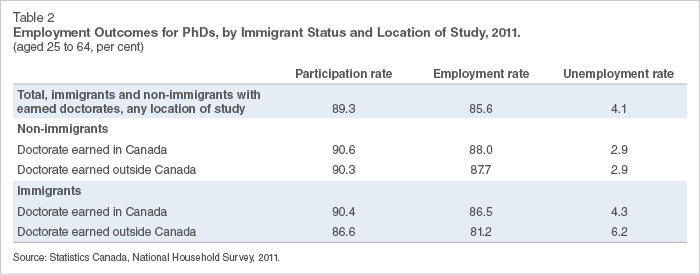
PhDs and EmploymentInteresting comparison on outcomes for immigrants and non-immigrants with PhDs, including country where PhD granted. Nice evidence-based approach to analysis:

Immigrants are less likely than non-immigrants to have studied in a country whose credentials are easily recognized and trusted by Canadian employers. While immigrants who earned their doctorates in the United States had an unemployment rate of only 3 per cent—in line with the unemployment rate of non-immigrants with doctorates—less than a quarter earned their doctorates from the United States. Immigrants who earned their doctorates in countries other than the U.S. or U.K. experience much higher rates of unemployment.

But location of study explains only part of the difference. Regardless of where they earn their PhDs, immigrants face a range of employment barriers, including less-developed employment networks, language barriers, and racism. Immigrants with PhDs fare much better than immigrants without PhDs, but they face difficult transitions, achieve only a slim advantage over non-immigrants with lower education, and continue to lag well behind their non-immigrant peers with PhDs.

Understanding and addressing the many barriers to immigrant PhDs is critical to ensuring that both they and Canada’s economy and society as a whole can benefit from the advanced education and skills they have obtained. The ongoing work of The Conference Board of Canada’s Centre for Skills and Post-Secondary Education and National Immigration Centre explores various dimensions of the challenges facing immigrants—those with and without PhDs. It will shed light on changes that might be required as to how immigrant PhDs are educated and trained in Canada, as well as how immigrants are selected and integrated into the Canadian economy and society more generally. Watch for future commentaries and reports from both centres in 2015.

Immigrants With PhDs:  Transitions, Marginal Advantages – New Canadian Media – NCM.