Prayer in Canadian Public Life: a Nation Divided – Angus Reid Institute

Prayer_in_Canadian_Public_Life__a_Nation_Divided_-_Angus_Reid_InstituteThe latest polling on the Supreme Court’s ruling against prayer in public meetings. Key Findings:

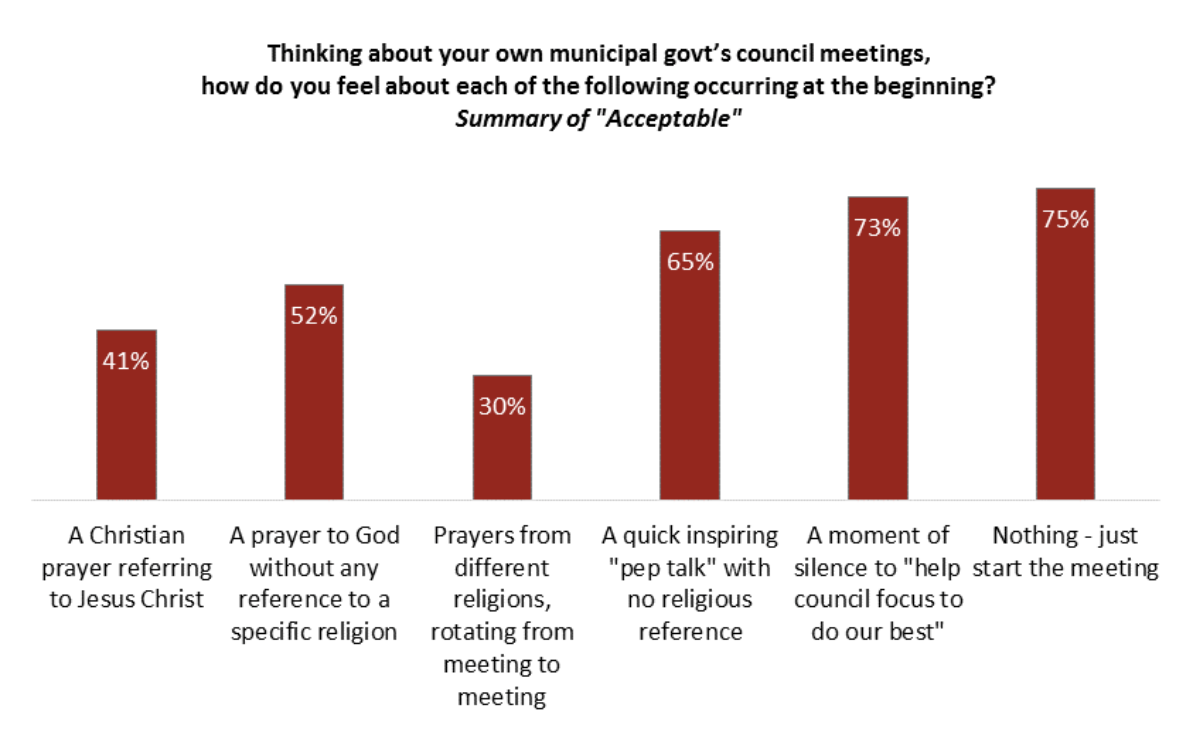
  • Just over half (56%) of respondents are in favour of the court’s decision while the rest (44%) are opposed.
  • That support drops to one-third (34%) among the religiously inclined, and jumps to nearly four-fifths (78%) among those who say religion isn’t important to them.
  • In spite of the secularist view on prayer at public meetings, very few (7%) of respondents want to see the lyrics to O Canada changed so that reference to God is removed.

Prayer in Canadian Public Life: a Nation Divided – Angus Reid Institute.

Military trying to cut recruitment targets for women despite expert’s report

Military, RCMP, CSIS.001RCMP envy (the RCMP successfully managed to negotiate lower targets). Declaring victory by changing the goalposts.

Seriously, there are particular challenges for both the Canadian Forces and the RCMP, but this approach only gives the impression that changing the targets is more important than improving recruitment and retention.

The above chart summarizes the Canadian Forces, the RCMP and CSIS. Only CSIS has a strong employment equity record, but the nature of their work, analogous to much policy work and IT makes it that much easier.

Interestingly, all three organizations do not post their reports. These have to be requested from the Library of Parliament (which is efficient in providing them):

The Canadian Armed Forces is now in consultations with Employment and Social Development Canada and the Canadian Human Rights Commission over how those targets are calculated in hopes they can be brought down to what the military argues are more realistic levels.

Lt.-Cmdr. Meghan Marsaw said in an email that the most recent consultations with ESDC and the human rights commission were held over the winter, though she couldn’t say when any new targets would be set “as further consultation is required both internally and externally.”

Documents obtained by the Citizen last year showed the Canadian Armed Forces wanting to cut the target for women from 25.1 per cent to 17.6 per cent. It also wanted to change the targets for visible minorities from 11.7 per cent to 8.2 per cent, and for aboriginals from 3.3 per cent to 2.6 per cent.

Military officials would not confirm whether those are still the proposed targets.

The Canadian Human Rights Commission is currently conducting an audit of the Canadian Armed Forces to determine if the military is taking adequate action to increase diversity within the ranks. The commission regularly audits all federal departments and agencies.

Some have previously cautioned against cutting the targets for fear the Canadian Armed Forces will then scale back efforts to increase the number of women as well as visible minorities and aboriginals in uniform. They say the military should strive to represent the country’s demographic make-up.

However, others say that maintaining unrealistic targets could force the military to dilute recruiting standards. They also say it could draw away resources better put to other uses.

Military trying to cut recruitment targets for women despite expert’s report | Ottawa Citizen.

Toronto Mayor John Tory calls for end to carding – Toronto – CBC News

Quite a change from his earlier position (not a bad thing in itself to be flexible and respond to public pressure):

Tory said the issue has been among “the most personally agonizing” since he became mayor.

“After great personal reflection and many discussions … I concluded it was time to say, enough. It was time to acknowledge there is no real way to fix a practice which has come to be regarded as illegitimate, disrespectful and hurtful.

“It was better to start over.”

Tory said his discussions included a talk with journalist Desmond Cole, who recently wrote about his experiences with carding for Toronto Life.

Cole said he was “overjoyed” with the mayor’s move, but cautioned that more action is needed.

“This has been a long time coming,” Cole told reporters. “Now we have to make sure [Tory] and the police services board and Chief Mark Saunders follow-up on this announcement … so carding is actually ended. So we’ll wait and see.”

Toronto Mayor John Tory calls for end to carding – Toronto – CBC News.

Christie Blatchford’s take:

Carding aside, what’s interesting here is that as of last week, presumably shortly before he hopped that plane to Edmonton, Tory was proudly standing shoulder-to-shoulder with Toronto’s new police chief, Mark Saunders, in defending the practice — always with a view to reforming it and improving it, he said (as indeed does the chief) but defending it nonetheless, and seemingly with sincerity.

It was a brave, if politically dangerous, position to take, I thought, and reinforced the romantic notion I think I had of the new mayor. (Before running for mayor, he was the host of a radio show on Newstalk 1010, where I was a regular guest, and I came to like him very much, and still do.)

But he is a politician, after all, and one who after several unsuccessful forays in politics has landed in a job he absolutely loves and for which he seems tailor-made: He works like a dog, is out and about every weekend at this festival or that, and has been by most measures a pretty good mayor.

And politicians, perhaps particularly those who enjoy the work and relentless social contact it entails, don’t like being unloved.

The voices against carding were rising; nothing said that better than a press conference last week featuring all manner of former civic leaders (why, they ran the gamut from A to B, from Gordon Cressy to David Crombie) denouncing the practice. And the voices against it were also louder (the Star has made it a veritable campaign, with at least one of its columnists suggesting pretty directly that Tory was a racist for supporting carding) than any on the other side.

I suspect internal polling numbers told Tory this was not a fight he would win, and that his support, even for a reformed version of carding, might define his mayoralty. And it’s a more believable explanation than the revelation-in-a-taxi or the epiphany-on-the-streetcar.

Christie Blatchford: Epiphanies on playing the cards right

Tory MP sees ‘wiggle room’ in site for victims of communism memorial

Trial balloon by Galipeau? Pre-election local candidate positioning? But Minister Polievre is the lead minister and responsible for Ottawa and has, typically, showed no flexibility.

I’m with Jen Gerson of the National Post: use this site for a memorial to the victims of the residential schools given that this is a fully Canadian historical tragedy, that haunts us still:

Throughout the ongoing controversy over the proposed Memorial to the Victims of Communism, opponents have focused on its prominent location on Wellington Street and its destructive impact on the Long Term Vision and Plan for the parliamentary and judicial precincts.

But according to Conservative MP Royal Galipeau, who has represented Ottawa-Orléans since 2006, the site for the memorial has yet to be finalized.

“It’s nowhere right now,” Galipeau said in an interview. “It’s planned to be on Wellington Street between the Library and Archives and the justice building. There’s a lot of wiggle room there.”

Galipeau confirmed that he has privately urged the government to locate the memorial a bit further west on Wellington, on a site closer to Library and Archives Canada — an idea he had not previously shared publicly.

“Since I don’t sit on the opposition side of the house,” he explained, “I generally don’t make my recommendations to the government by way of the media. I work in a way to bring results.”

Galipeau wouldn’t comment on the current status of his suggestion, saying only: “I think that after the monument is built, the people who oppose the monument no longer will. That much I can say.

“I suspect that everyone is getting their knickers in a snit for nothing. The monument will be of the right scale and will be located in a manner that it will not impede the architecture of the Supreme Court.”

Galipeau’s comments followed a call to the Citizen from Ludwik Klimkowski, the chair of Tribute to Liberty, the charity that proposed the monument and is raising money for it.

Stressing that he was not speaking for the government, Klimkowski floated the “purely hypothetical” idea of leaving the memorial where it is and designating the more westerly site eyed by Galipeau for a future Federal Court building.

The current Long Term Vision and Plan calls for the Federal Court building to be built on the 5,000-square-metre site on Wellington Street the government has publicly earmarked for the memorial.

Tory MP sees ‘wiggle room’ in site for victims of communism memorial | Ottawa Citizen.

Why Are Only Three Observant Sikh Men Serving In The U.S. Military? : NPR

Interesting. US appears to be the exception, given Canada, UK and India all allow:

If a Muslim woman may wear a headscarf at work, as the U.S. Supreme Court has now affirmed, perhaps a Sikh man should be able to wear a turban while serving in the U.S. military.

So argues the Sikh Coalition, an advocacy organization that has long opposed a Pentagon ban on facial hair and religious headgear among service members. That campaign got at least a moral boost with this week’s court decision.

“What I’m anticipating with this decision is that we will have a move in this country to recognize the right of individuals from different religious backgrounds to live in an America that does not discriminate against them on the basis of how they appear,” says Simran Jeet Singh, the senior religion fellow for the Sikh Coalition.

As a general rule, the Department of Defense prohibits facial hair and the wearing of religious headgear among service members, though it offers “accommodation” on a case-by-case basis in recognition of “sincerely held beliefs.”

Such waivers, however, are given only when they would not undermine “military readiness, unit cohesion, good order, discipline, health and safety, or any other military requirement.”

In practice, those considerations can present major obstacles. Currently, just three observant Sikh men serve in the U.S. military, all in the Army, and all are in noncombat positions. That’s out of an active-duty military force of 1.4 million.

…Sikh men are currently allowed to serve with beards and turbans in the military services in Canada, the United Kingdom and India, among other countries, and they were permitted in the U.S. military until the early 1980s, when the policy was changed.

The U.S. Supreme Court, in a 1986 decision, upheld the military’s right to ban facial hair and religious headgear, finding that the military is a “specialized society separate from civilian society” and that to “accomplish its mission the military must foster instinctive obedience, unity, commitment and esprit de corps.”

That ruling would suggest that this week’s court decision upholding the right of a Muslim woman to wear her hijab headscarf does not apply to observant Sikh men wishing to wear a turban in the U.S. military, but it may nonetheless hold some political significance.

“The military has shown on many occasions that it is influenced by the court of public opinion and by social change,” says Eugene Fidell, a specialist in military law at the Yale Law School.
Why Are Only Three Observant Sikh Men Serving In The U.S. Military? : NPR.

It’s not a small world after all: Pico Iyer

Pico Iyer on the enduring human differences:

Of course, the gulfs and divisions that remain aren’t entirely a terrible thing. When people say the world is growing homogeneous, losing its savour and individuality, I wonder if they’ve been to Yemen or Ethiopia recently. If someone tells you that we’re all blending into a Disneyland whole, singing “It’s a small, small world,” take them across town to where Haitians and Somalis are struggling to get by. Covering six Olympic Games in 14 years reminded me that the family of man is about as united and harmonious as many another family, even when on its best behaviour.

In Isfahan, Iran, not long ago I found the stores filled with pirated copies of Walter Isaacson’s biography of Steve Jobs, and last year in North Korea I saw a local crane forward to ask two visiting workers from Apple how Tim Cook’s management style differed from that of his celebrated predecessor. In the mausoleum where Kim Il-sung and Kim Jong-il lie, embalmed, we saw the sleek MacBook that the latter was said to have been using when he was reportedly felled by a heart attack on a train (our two Appleites confirmed that this was the perfect model to have in 2011, when he died). It’s wonderful that we can share more and more, and enjoy the tastes of foreign cultures in our hometowns and online.

But pity the politician who assumes that will really bring him any closer to Beijing or Tehran. The only way we’ll survive the global neighbourhood is by assuming we know nothing and recalling that a “Yes” in Tokyo – or Mexico City – conveys what we would mean by a “No.” I love the way that we can experience Jamaica, Pakistan, Haiti, Vietnam in our classrooms and cities; I shudder at the notion that to see them is to think we understand them or can easily be one with them.

Some people worry that soon all of us will be speaking English; my deeper fear is that, even if we are, we’ll still be largely incomprehensible to one another.

It’s not a small world after all – The Globe and Mail.

Why Reconciliation for Aboriginal Peoples Should Matter to New Canadians – New Canadian Media

Ranjit Bhaskar commentary on the TRC recommendations regarding new Canadians:

The broader hope is if Canadians have more knowledge of indigenous history, they will have a better understanding of the current policy disputes between governments and Aboriginal Peoples over natural resources, education and child welfare.

Of significant importance for new Canadians is the last two of the TRC’s 94 Calls to Action. The penultimate recommendation, “call[s] upon the federal government to revise the information kit for newcomers to Canada and its citizenship test to reflect a more inclusive history of the diverse Aboriginal [P]eoples of Canada, including information about the Treaties and the history of residential schools.”

Perhaps it is time for new Canadians themselves to insist on being better informed of an inconvenient truth to better appreciate the travails of indigenous people – essential because we cannot cherry-pick the history we inherit.

The last recommendation urges Ottawa to replace the current Oath of Citizenship with one in which new citizens swear to faithfully observe the laws of Canada, “including Treaties with Indigenous Peoples.”

A timely reminder of not just building a nation-to-nation relationship between Aboriginal Peoples and the Crown that respects the promises of historical treaties, but also for resetting relationships between the First Nations and the “latest nations.”

The two recommendations are a call to remember the injustices inflicted on one of the founding peoples of Canada now that we are slowly, but surely, coming to know about the other history. The part of our collective past not taught in schools, not part of the citizenship test and not part of the “Welcome to Canada” package.

Time to remember the more than 6,000 aboriginal children who never returned to their homes after being sent to residential schools by the Canadian government.

And perhaps it is time for new Canadians themselves to insist on being better informed of an inconvenient truth to better appreciate the travails of indigenous people – essential because we cannot cherry-pick the history we inherit.

…. Far too many Canadians, including many peoples of colour and First Nations themselves, are unaware of the Canadian history of colonization of the indigenous peoples and the exclusion of communities of colour. Instead, we need to invest in our collective understanding and put a halt to an enforced mass ignorance to change the way we look at each other, talk to each other and talk about each other.

Dialogue can hopefully foster positive relationships among indigenous peoples and newcomers to help bring about justice and equality for all. Reconciliation for indigenous people is an important first step towards that goal.

Why Reconciliation for Aboriginal Peoples Should Matter to New Canadians – New Canadian Media.

Know the truth, make amends – Erna Paris

Erna Paris on the need to face our history of residential schools and ‘cultural genocide,’ with some interesting contrasts with other countries who have (e.g., Germany, France), or have not (e.g., Japan, USA) faced up to their past:

A new challenge for Canadians will be to acknowledge the endemic disconnect between our myths and our reality. We view ourselves as a tolerant society that values diversity, but what the Truth and Reconciliation Commission has made clear is that we could believe this only because we excluded native peoples from the picture.

One key to reconciliation will be the rejection of all forms of coercive assimilation. For example, the Quebec Charter of Values, with its discriminatory rules about religious dress codes, was a throwback to attitudes that have historically produced ideas of lesser peoples.

The TRC has shown us where that leads.

The past can never be overcome. It can only be managed. With accountability on the part of lawmakers. With memorials to the victims. And with a major effort to pursue justice – however difficult that may be.

Know the truth, make amends – The Globe and Mail.

Wesley Wark: Information gap about Zehaf-Bibeau threatens security

Wesley Wark’s trenchant criticism of the narrowness of Canadian inquiries into the Zehaf-Bibeau and Couture-Rouleau attacks, which focus only on the security dimensions rather than also including the process of radicalization issues:

There is nothing in the forensic analysis of the Zehaf-Bibeau attack that can bear the burden of such a sweeping statement, but it smacks of politics and of an ill-considered willingness to add to public anxiety about Canada’s counter-terrorism capabilities.

The RCMP’s own, separate, after-action review was deliberately limited, by whose decision is not clear, to “the protective actions taken by the RCMP in response to the incident;” it explicitly precluded any examination of the national security context, existing threat levels at the time of the attacks, or any “pre-incident” information about the shooter.

This leaves Canadians with a worrying chasm of information about Zehaf-Bibeau’s development as a jihad-inspired terrorist, and any reflection of what, if anything, could have been done to prevent the attack plot. It may well be that confusion lingers about whether Zehaf-Bibeau even deserves the tag of “terrorist.” This became a highly politicized issue immediately following the attacks, with the prime minister’s immediate labeling of Zehaf-Bibeau as a terrorist.

An even greater chasm exists with regard to the other, and largely forgotten, terrorist attack of October 2014, in which Martin Couture-Rouleau ran down and killed Warrant Officer Patrice Vincent. Where is the inquiry into that attack and the subsequent death of Couture-Rouleau in a confrontation with the Quebec Sûreté? Unlike Zehaf-Bibeau, Couture-Rouleau had been under investigation by the RCMP, had his passport seized and had been prevented from travelling abroad. The RCMP had intervened directly with him and, as they confessed shortly after his attack, had come to a conclusion that he had changed his ways and did not pose an imminent threat. Later media leaks changed the channel on the story to one of an inability of the RCMP to acquire a peace bond against him, a leak that came suspiciously close to the government’s tabling of Bill C-51, the new anti-terrorism act, which included lowered thresholds for the issuance of peace bonds.

As a recent meeting of the Senate Liberal “Open Caucus” heard from several witnesses, including me, Canada suffers from an endemic problem of overweening secrecy that chokes off public debate. That problem has raised its head once more in the failure to constitute a proper public study of the attacks of October 2014. We need only look at how the Australians responded to their Sydney terror siege in December 2014, with an Australian government review issued in February 2015 and an on-going coroner’s inquiry that is expected to extend into 2016, to know that the balance between secrecy and public knowledge is out of kilter here.

Wesley Wark: Information gap about Zehaf-Bibeau threatens security | Ottawa Citizen.

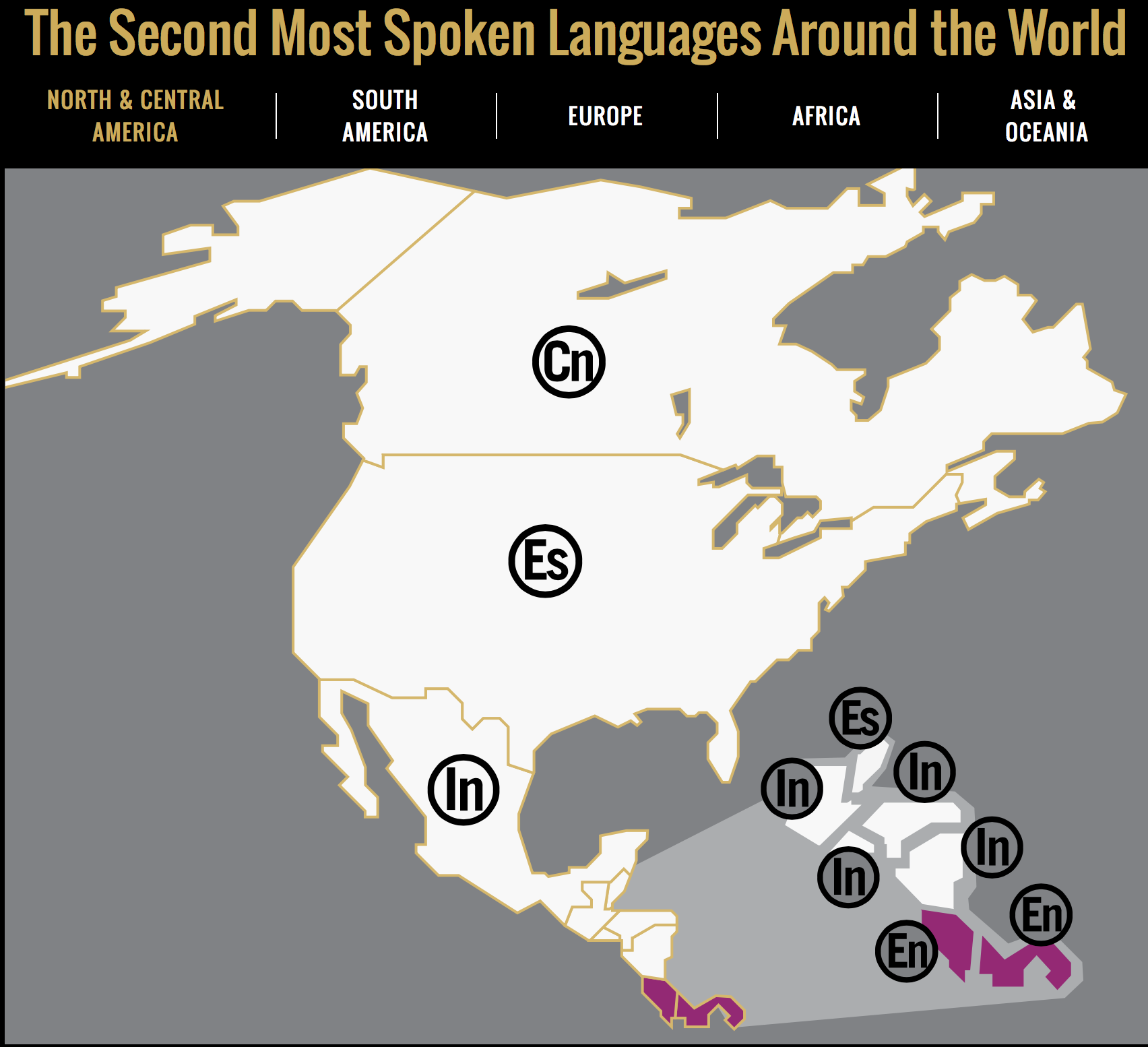
The Second Most Spoken Languages Around the World | Olivet Nazarene University

The_Second_Most_Spoken_Languages_Around_the_World___Olivet_Nazarene_UniversityPeriodically, I get these messages regarding some new interactive way of displaying data. This one is a nice web page that provides information on main second languages for most countries. Worth checking out if you like this kind of thing.

The Second Most Spoken Languages Around the World | Olivet Nazarene University.