European far-Right parties ‘seeking anti-Islam coalition with Jewish groups’

Not surprising but encouraging that most European Jewish groups have rejected the overture:

Right-wing European political parties are seeking to sow religious discord in Europe by approaching Jewish organisations in a bid to form an anti-Islamic alliance.

Speaking to Newsweek on condition of anonymity, a senior figure in one of Europe’s largest Jewish organisations has revealed that their group has been approached in the past year by MEPs, including members of the Austrian Freedom Party, seeking to create a coalition to combat the rise of Islam in Europe. They emphasized that all approaches had been flatly refused.

Last week, Marine Le Pen and other far-Right politicians met with Vadim Rabinovich, the chairman of the European Jewish Parliament (EJP), prompting criticism from European Jewish leaders.

Now the source says that far-Right’s rapprochement with Jewish groups is far from new as politicians from various parties have attempted to court their group, offering to “be friends with Jews” if Jewish groups “help us in our fight against Muslims”.

… The meeting drew criticism from prominent Jewish leaders and led to one member of the EJP, French rabbi Levi Matusof, resigning after the meeting which he called “opportunistic and inappropriate”.

The European Jewish Association, which claims to be the biggest federation of Jewish organisations in Europe, said that the EJP risked “magnifying the problem” of anti-Semitism by “giving a platform to those seeking to spread messages of hate”.

Dr Moshe Kantor, president of the European Jewish Congress, said he was shocked that the EJP met with “fig leaf racists and anti-Semites” and added: “It goes without saying that these people [the EJP] are as unrepresentative of the vast majority of European Jews as this collective of Le Pen’s MEPs is of the vast majority of European citizens.”

In a statement on the EJP’s website, Rabinovich said he was “very surprised” by the negative reaction from other Jewish groups.

“The meeting with the [Europe of Nations and Freedom] opens the new dialogue, which, in our firm conviction is what Europe needs today – a dialogue of everybody with everyone, in order to preserve peace and tolerance and combat anti-Semitism in Europe,” said Rabinovich.

He added that a joint statement with Le Pen had condemned anti-Semitism as “the cancer of Europe”.

European far-Right parties ‘seeking anti-Islam coalition with Jewish groups’.

Matthew Block: It’s a bad time to be religious in Canada

One view regarding the balance between religious and other freedoms but one that in my view, understates the importance of the impact this understanding of religious freedom would have on those who do not share those religious beliefs:

This curtailment of religious freedom has appeared even at the highest levels of government. Consider the leaders of Canada’s three major parties. Over the past few years, one has publicly condemned as “unCanadian” the religious ideals which motivate a Christian organization’s international relief work. Another has banned members of his party from voting according to deeply held moral and religious beliefs on issues regarding life. And another has campaigned to ban women from wearing certain religious garb while taking the oath of citizenship.

Like all Canadians, these leaders are free to dislike the religious choices of others, and to do so vocally. But when government coerces others to act against conscience, or argues that they have no right to express their religious beliefs in the public square, then there is a problem. These are quite literally the first freedoms guaranteed by the Charter of Rights and Freedoms: “freedom of conscience and religion,” and “freedom of thought, belief, opinion and expression.” If religious freedom is to mean anything, it must mean the ability to practice one’s faith both privately and publicly, without interference from the government or the public at large.

We would be closer to the Canadian ideal of a tolerant society if more people believed that.

Matthew Block: It’s a bad time to be religious in Canada

Daniel Lang: The Senate did not call for imams to be ‘licensed.’ Nor were we fretting about nothing

Senator Lang struggles to justify the Senate report and its messaging on the licensing of Imams:

Contrary to the suggestion made in a recent National Post editorial, the Standing Senate Committee on National Security and Defence did not propose that government intervene to certify or establish a registry of Islamic or other clerics.

The carefully crafted recommendation asks that “the federal government work with the provinces and the Muslim communities to investigate the options that are available for the training and certification of imams in Canada.”

This is a very important distinction because the recommendation is made in response to testimony from members of the Muslim community as well as experts who confirmed that radicalization begins with person-to-person or person to group contact.

The witnesses who appeared before the committee over the past nine months continuously brought up the fact that radicalizing messages mixed with religious ideology was being advocated by some foreign-trained imams in Canada.

Interesting, however, to see that Imam Soharwardy, demonized by Ezra Levant, is now brought forward as a government witness (he has been consistent and reasonably in his messaging).

Daniel Lang: The Senate did not call for imams to be ‘licensed.’ Nor were we fretting about nothing

2013 Hate Crimes Statistics

Hate Crimes Comparison.001

Interesting that in 2013, the number of hate crimes fell by 17 percent, reflecting a 30 percent decline in non-violent hate crimes (mainly mischief-related). For most groups, the per capita rate remained relatively constant, with the most notable decline with respect to Canadian Jews.

B’nai Brith statistics (2014 Audit of Antisemitic Incidents) however show an increase compared to earlier years (their statistics are always higher than police-reported hate crimes).

The National Council of Canadian Muslims recently launched a similar initiative to report on anti-Muslim incidents (NCCM Launches National Hate Crimes Awareness Project) to encourage more reporting (hate crimes against Canadian Muslims increased in this year).

The explanation for the overall decline in reported hate crimes is not clear beyond that it is the minor hate crimes that account for most of the decline.

While self-reporting by different groups is important to raising awareness of, and improving confidence within groups to report hate crimes to the police, there is merit to the consistent reporting  across different groups and categories contained in this report by Statistics Canada.

Pew Research: Anti-Minority Sentiment Not Increasing in Europe

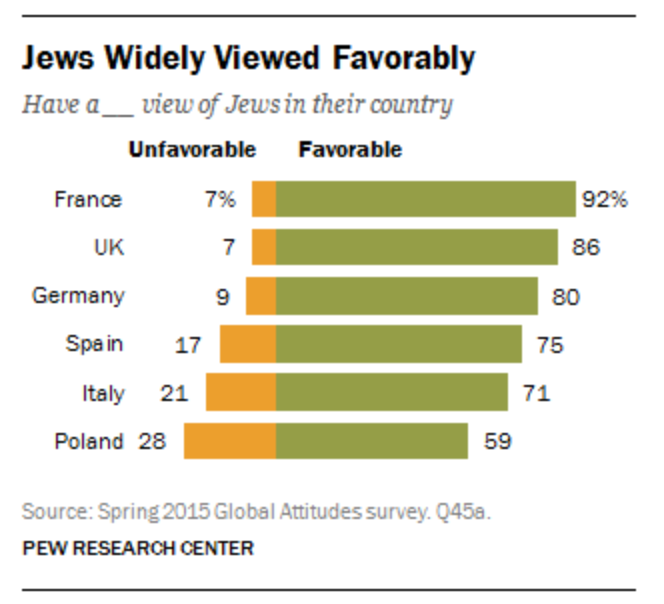
European Perceptions of Roma European Perception of Jews European Perceptions of MuslimsInteresting recent public opinion research on attitudes in Europe, with above charts showing highlights. Summary conclusion:

The economic downturn in Europe that followed the euro crisis raised concerns that economic stress would turn Europeans against each other, as many severe economic downturns have done throughout history, sparking xenophobia and anti-Semitism. And Europe has seen a number of hostile actions against Muslims, Jews, Roma and other minorities in recent years. But the activities of a few are not necessarily reflected in the views of the general public.

The 2015 Pew Research Center survey was conducted after the Charlie Hebdo massacre and the simultaneous attack on a Jewish grocery store, perpetrated by radical Islamists in Paris. But, in the wake of these events, there is no evidence that the atrocity sparked new public antipathy toward Muslims in any of the six European Union nations surveyed. In fact, favorability of Muslims actually improved in some nations. At the same time, French sympathy for Jews increased.

http://www.pewglobal.org/2015/06/02/chapter-3-anti-minority-sentiment-not-rising/

Register your imam, senators say – Globe Editorial

Globe has it right:

Now that the federal gun registry is no more, Canada is suffering from a large, gaping registry deficit. But be of good cheer, because salvation is at hand! The Senate committee on national security and defence, deftly leaping into the vacuum, has a plan to make Canada a safer place. It is calling for the creation of a Muslim imam registry.

The committee’s majority, all of them Conservatives, think it’s time to get the state in the business of deciding who is allowed to preach and teach which religion, and implicitly what they get to say while preaching and teaching. But just for Muslims.

In true Canadian fashion, the senators want The Department of Imam Approval and Oversight, or whatever a future body doing this important work might be called, to be a joint federal-provincial partnership. The idea is to “investigate the options that are available for the training and certification of imams in Canada.” The timing of the senators’ report, during the holy month of Ramadan, is particularly ideal.

More sweepingly, the committee recommends a protocol with CSIS “to require mandatory screening of citizens involved in public outreach.” On the other hand, Canadians “who are participating in the public discourse” should be “protected from vexatious litigation” – presumably, libel and slander actions by Muslims.

The certification of acceptable, or at least tolerable, Muslim religious teachers would presumably be accompanied by permits. Would clerics have to wear a cresent symbol on their lapel? Would police be empowered to demand a permit from anyone who appeared to be wearing certain types of headgear – defined of course by regulation?

Earlier this year, in Shawinigan, Que., in the same patriotic spirit as the Senate committee’s report, local authorities denied a minor zoning variance, to prevent Muslims from building a mosque in an industrial park. François Legault, Leader of the opposition Coalition Avenir Québec, called for the regulation of mosques in the province, with municipalities empowered to deny operating permits to mosques whose imams have engaged in “consistent denigration of Quebec values,” whatever that means. And now a group of federal Senators in Ottawa are picking up on the idea. Shame.

Register your imam, senators say – The Globe and Mail.

Catching up: Stories that caught my interest

While I have not been blogging over the past month, I have been following events and these stories and reports caught my eye.

From a general perspective, the Environics Institute latest Focus Canada annual survey showed continued strong support for immigration and multiculturalism, including some notable increases in support (e.g., general support for multiculturalism, reduced fear immigrants not adapting to Canadian values, that immigrants can be as good citizens as Canadian-born) along with increased recognition of discrimination and the need for policies and programs to address it.

Jeffrey Simpson in the Globe reminded us of just how successful the Canadian model of citizenship, immigration and multiculturalism has been.

Citizenship

The Canadian government launched its first revocation proceeding, selecting Hiva Alizadeh as the test case given that he is a dual national of Canada and Iran, was tried and convicted in a Canadian court where he pleaded guilty (avoiding many of the issues raised during C-24 hearings regarding due process in foreign courts).

The remaining provisions of the changes to the Canadian Citizenship Act came into force on June 11, provoking the usual stories about how some were affected by the date chosen (no matter which date was picked, there would always be some affected by the transition. The release of ATIP documents on the Citizenship Act consultations revealed that ethnic groups were particularly concerned about longer residency requirements and increased fees, with some concerned about revocation, and many questioned why advertising was focussed on revocation provisions rather than the changes they were concerned about.

Minister Alexander’s Canada Day message repeated the historic naturalization rate of over 85 percent, despite his department knowing that the recent rate is lower. His conflating of niqab-wearing women with terrorists and his highly selective citing of Liberal government restrictions on immigration and related discriminatory practices were savaged by some commentators.

CIC has yet to provide an explanation for the significant drop (over 30 percent) in the number of citizenship applications in 2013 and 2014 (Full 2014 Citizenship Statistics: Declining Applications).

The Australian government, despite a vigorous internal debate on citizenship revocation, appears committed to a fairly draconian approach, applying to both single and dual nationals and the children of those convicted.

Multiculturalism

The usual Multiculturalism Day messages by political parties, with the Government (Ministers Kenney and Uppal) emphasizing “peaceful pluralism and ordered liberty,” sport and “the values of freedom, democracy and the rule of law” (no mention of human rights), the NDP Multiculturalism Critic emphasizing “tolerance, understanding and equality” and the Liberal Party leader emphasizing “acceptance, fundamental freedoms, and mutual respect.”

The Government reversed a new policy requiring “pat-downs” of turbans, following protests by Canadian Sikhs (likely reflecting their political importance), leaving Minister for State for Multiculturalism Uppal to explain why an exemption for one form of religious headgear (the turban) and not another (the niqab). While there is a difference between covering one’s hair and covering one’s face, ironic that this decision took place in the same month as families of the Air India bombing commemorated the 30th anniversary, the largest terrorist attack in Canadian history with some families noting that some temples have pictures of the Sikh mastermind behind the bombing.

A thoughtful discussion of the challenges health care professionals face in dealing with accommodation requests for different groups, and the processes used to decide what can be accommodated and what not.

Declining support for immigration and multiculturalism post 9/11 and 7/7 in Britain was significant (56 percent in 2015 believe multiculturalism makes Britain worse compared to 32 percent in 2001).

Meanwhile, French Prime Minister Walls notes that Islam is “here to stay in France” while highlighting unacceptable behaviour (antisemitism and hate speech). In addition, despite the formal separation of church and state in France, some have initiated programs to have a more open approach to discussing religion in schools.

In a significant discrimination case, the US Supreme Court ruled that the actual results of policies and programs trumped the intent of these policies, providing a basis for challenging systemic racism and discrimination in future cases.

Canadian antisemitic incidents are reported as rising given B’nai Brith reports (which contrast with Statistics Canada police-reported hate crimes report which show a decline).

An interesting opinion piece that tries to assess the boundary between criticism of Israeli policies and antisemitism provided some nuance to debate on either side of the issue. As Israeli governments provide more support to the Israeli Rabinate, a divide may be emerging between American Jews and Israel.

A good discussion on some of the issues around providing Holocaust education to German Muslims, how it gets tied to the general Israel-Palestine issue, and the efforts by the German government to develop programs to reduce radical Islam by establishing centres for the study of Islam. Meanwhile, the Netherlands postpones the release of a report showing antisemitism among Dutch Muslim youth.

An account of how “trying white food” is part of the experience of children of immigrants, which complements the increased interest by “white people” in ethnic food, highlights one aspect of integration.

Google quickly learns the limits of its image recognition software when its software labels Blacks as gorillas, but quickly deletes the gorilla label as an interim step to ensuring better image recognition. Appears that software too can be subject to implicit bias and should be made to take the Implicit Association Test (IAT).

New Canadian Media held its first workshop for integration and settlement agencies on how to engage the mainstream media in ethnic community issues.

An amusing yet relevant discussion on when multiculturalism advertising can become offensive, using examples from the 1970s (particularly McDonalds and advertising targeted to Black Americans) and some tips to avoid crossing the line.

Following months of wedge and identity politics around Canadian Muslims (the most recent being the Bill tabled just before the House rose banning the niqab at citizenship ceremonies) and the threat of Islamic-inspired extremism, the PM makes a more positive gesture in hosting an Iftar dinner at 24 Sussex.

President Obama delivers one of his best, and arguably one of the best ever, speeches on racism in America and the need for action in his eulogy at the Charleston funeral for those gunned down by a white extremist. Worth taking the time to view in its entirety:

https://www.youtube.com/watch?v=RK7tYOVd0Hs

Nell Painter, recapping some of her insights of her book The History of White People, notes that “whiteness” is often defined by what it is not (“blackness”) and that we need to move beyond such binary expressions of identity.

Extremism

A reminder that right wing extremism has been a greater threat in North America than Islamic-inspired extremism provides again a note of nuance to current security and related debates.

A Canadian government-funded study demonstrated that there are various paths to radicalization, showing that despite rhetoric, the Government is sponsoring sociological research.

An interesting counterpoint to ISIS/ISIL’s destruction of non-Islamic (and non-Sunni) monuments can be seen in Israel considering restoring the historic Islamic site of Khirbat al-Minya, the ruins of an Umayyad palace complex on the northern shore of the Sea of Galilee.

Immigration

As been mentioned before, and as apparent in the analysis I did for my forthcoming book (Multiculturalism in Canada: Evidence and Anecdote), immigration is becoming increasingly dispersed beyond the larger urban centres, given housing costs and economic opportunities.

An ATIP request indicates profiling and bias in CIC’s review of potential marriage fraud, although the guide has subsequently been revised, with examples highlighting the extensive documentation required.

Following the Toronto police carding debate, and likely other but less high-profile debates elsewhere in Ontario, the Ontario government decides to develop and implement a province-wide policy.

The Quebec government provided fewer resources to organizations delivering integration courses as part of overall austerity measures.

Other immigration stories of interest included accusations of racial profiling of Roma travellers and the effective ending of the live-in-caregiver program and the impact on childcare needs,

Other

Rick Salutin wrote a good piece looking at the history and definitions of “barbaric cultural practices” providing perspective on the current government fetish to use the term for political marketing purposes.

Daniel Savoie had his usual biting commentary of some of the weaknesses of current governments and their apparent inability to deliver programs and policies effectively.

The issue of Saudi financing of Islamic religious schools in Canada was reported on, with little indication that this funding was influencing the curriculum and approach (largely appeared to be for buildings and other infrastructure).

As part of Canada Day reporting, CBC interviewed foreign academics on their views on how Canada was perceived abroad, highlighting their assessment that it had worsened, not surprising given their more centrist and left-wing perspective. The cut to the Canadian Studies Abroad program in 2012 was again lamented.

Sadly, but not surprisingly, the Government does not make any changes to the mandatory Census questions that would improve the quality of the data, and continues with the voluntary NHS approach.

Will be back to my regular posting schedule on Monday.

Vacation Break – June 11 – July 10

Off for the next month and will restart upon my return. Needed break before final push on Multiculturalism in Canada: Evidence and Anecdote .

Full 2014 Citizenship Statistics: Declining Applications

PRs, Applications, New Citizens.001

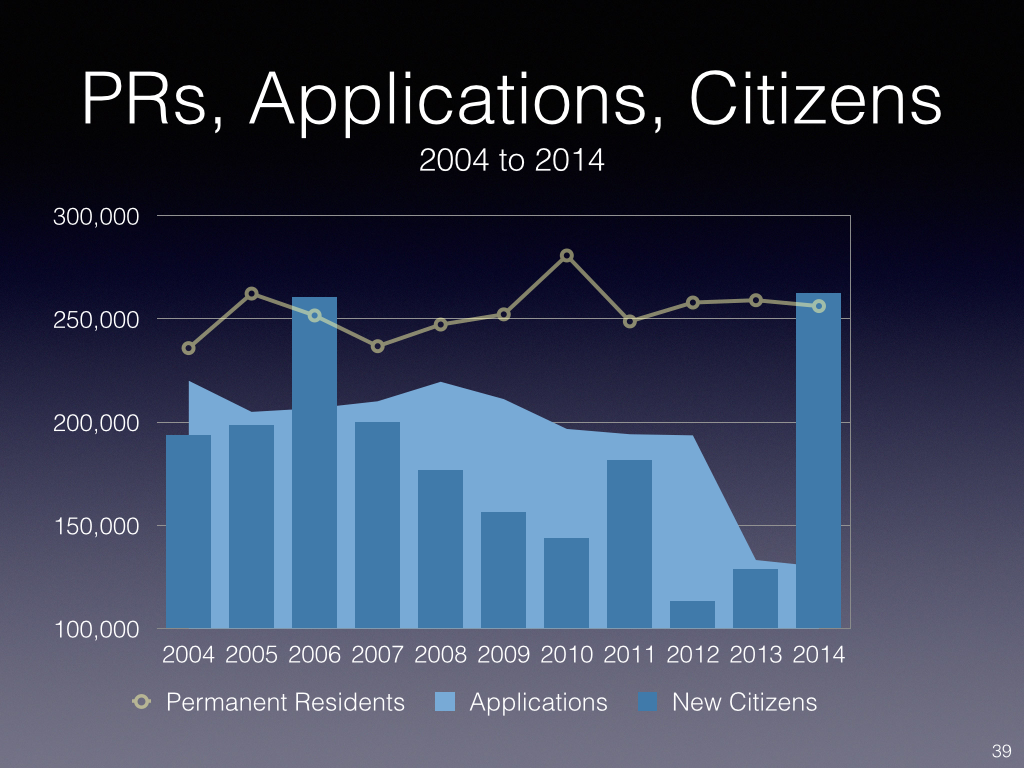
Finally, CIC has released the full operational stats for 2014. The most striking aspects are:

  • the record number of new citizens, given the influx of additional funds to address the backlog, confirming the previous announcements by press release; and,
  • the dramatic decline in citizenship applications from in 2012 (close to 200,000), to about 130,000 in 2013 and 2014, a drop of over 30 percent.

Unless there are methodological changes to explain this drop (CIC’s Quarterly Administrative Data has no notes to this effect), hard to explain. The January-September figure was 126,170, compared to the full-year figure of 129,993 meaning only about 4,000 new applications in the fourth quarter.

Or did CIC not enter new applications into the GCMS database as part of the transition to the provisions of the new Citizenship Act?

I have requested clarification from CIC of the reasons for this drop and will share once received.